Volume 7 — LORD BYRON
Reading edition
(1788-1824)
BY CHARLES DUDLEY WARNER

Goethe, in one of his conversations with Henry Crabb Robinson about Byron, said "There is no padding in his poetry" ("Es sind keine Flickwörter im Gedichte"). This was in 1829, five years after Byron died. "This, and indeed every evening, I believe, Lord Byron was the subject of his praise. He compared the brilliancy and clearness of his style to a metal wire drawn through a steel plate." He expressed regret that Byron should not have lived to execute his vocation, which he said was "to dramatize the Old Testament. What a subject under his hands would the Tower of Babel have been!" Byron's views of nature he declared were "equally profound and poetical." Power in all its forms Goethe had respect for, and he was captivated by the indomitable spirit of Manfred. He enjoyed the 'Vision of Judgment' when it was read to him, exclaiming "Heavenly!" "Unsurpassable!" "Byron has surpassed himself." He equally enjoyed the satire on George IV. He did not praise Milton with the warmth with which he eulogized Byron, of whom he said that "the like would never come again; he was inimitable."
Goethe's was the Continental opinion, but it was heightened by his conception of "realism"; he held that the poet must be matter-of-fact, and that it was the truth and reality that made writing popular: "It is by the laborious collection of facts that even a poetical view of nature is to be corrected and authenticated." Tennyson was equally careful for scientific accuracy in regard to all the phenomena of nature. Byron had not scientific accuracy, but with his objectivity Goethe sympathized more than with the reflection and introspection of Wordsworth.
Byron was hailed on the Continent as a poet of power, and the judgment of him was not influenced by his disregard of the society conventions of England, nor by his personal eccentricities, nor because he was not approved by the Tory party and the Tory writers. Perhaps unconsciously—certainly not with the conviction of Shelley—Byron was on the side of the new movement in Europe; the spirit of Rousseau, the unrest of 'Wilhelm Meister,' the revolutionary seething, with its tinge of morbidness and misanthropy, its brilliant dreams of a new humanity, and its reckless destructive theories. In France especially his influence was profound and lasting. His wit and his lyric fire excused his morbidness and his sentimental posing as a waif, unfriended in a cold and treacherous world of women and men; and his genius made misanthropy and personal recklessness a fashion. The world took his posing seriously and his grievances to heart, sighed with him, copied his dress, tried to imitate his adventures, many of them imaginary, and accepted him as a perturbed, storm-tost spirit, representative of an age of agitation.
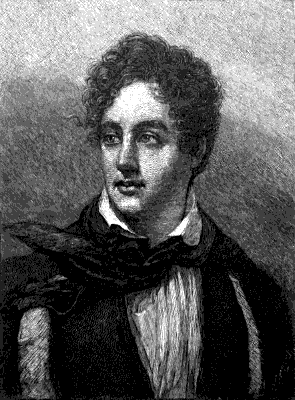
LORD GEORGE GORDON BYRON.
So he was, but not by consistent hypocritical premeditation; for his pose was not so much of set purpose as in obedience to a false education, an undisciplined temper, and a changing mind. He was guided by the impulse of the moment. I think it a supportable thesis that every age, every wide and popular movement, finds its supreme expression in a Poet. Byron was the mouthpiece of a certain phase of his time. He expressed it, and the expression remains and is important as a record, like the French Revolution and the battle of Waterloo. Whatever the judgment in history may be of the value to civilization of this eighteenth-century movement extending into the nineteenth, in politics, sociology, literature, with all its recklessness, morbidness, hopefulness, Byron represented it. He was the poet of Revolt. He sounded the note of intemperate, unconsidered defiance in the 'English Bards and Scotch Reviewers.' This satire was audacious; many of its judgments were unjust; but its wit and poetic vigor announced a new force in English literature, and the appearance of a man who was abundantly able to take care of himself and secure respectful treatment. In moments afterward he expressed regret for it, or for portions of it, and would have liked to soften its personalities. He was always susceptible to kindness, and easily won by the good opinion of even a declared enemy. He and Moore became lifelong friends, and between him and Walter Scott there sprang up a warm friendship, with sincere reciprocal admiration of each other's works. Only on politics and religion did they disagree, but Scott thought Byron's Liberalism not very deep: "It appeared to me," he said, "that the pleasure it afforded him as a vehicle of displaying his wit and satire against individuals in office was at the bottom of this habit of thinking. At heart I would have termed Byron a patrician on principle." Scott shared Goethe's opinion of Byron's genius:—"He wrote from impulse, never for effect, and therefore I have always reckoned Burns and Byron the most genuine poetic geniuses of my time, and of half a century before me. We have many men of high poetic talents, but none of that ever-gushing and perennial fountain of natural waters." It has been a fashion of late years to say that both Byron and Scott have gone by; I fancy it is a case of "not lost, but gone before." Among the men satirized in the 'Bards' was Wordsworth. Years after, Byron met him at a dinner, and on his return told his wife that the "one feeling he had for him from the beginning to the end of the visit was reverence." Yet he never ceased to gird at him in his satires. The truth is, that consistency was never to be expected in Byron. Besides, he inherited none of the qualities needed for an orderly and noble life. He came of a wild and turbulent race.
George Gordon, Lord Byron, the sixth of the name, was born in London, January 22d, 1788, and died at Missolonghi, Greece, April 19th, 1824. His father, John Byron, a captain in the Guards, was a heartless profligate with no redeeming traits of character. He eloped with Amelia D'Arcy, wife of the Marquis of Carmarthen, and after her divorce from her husband married her and treated her like a brute. One daughter of this union was Augusta, Byron's half-sister, who married Colonel Leigh, and who was the good angel of the poet, and the friend of Lady Byron until there was a rupture of their relations in 1830 on a matter of business. A year after the death of his first wife, John Byron entrapped and married Catherine Gordon of Gicht,—a Scotch heiress, very proud of her descent from James I. of Scotland,—whose estate he speedily squandered. In less than two years after the birth of George, John Byron ran away from his wife and his creditors, and died in France.
Mrs. Byron was a wholly undisciplined and weak woman, proud of her descent, wayward and hysterical. She ruined the child, whom she alternately petted and abused. She interfered with his education and fixed him in all his bad tendencies. He never learned anything until he was sent away from her to Harrow. He was passionate, sullen, defiant of authority, but very amenable to kindness; and with a different mother his nobler qualities, generosity, sense of justice, hatred of hypocrisy, and craving for friendship would have been developed, and the story of his life would be very different from what it is. There is no doubt that the regrettable parts of the careers of both Byron and Shelley are due to lack of discipline and loving-kindness in their early years. Byron's irritability and bad temper were aggravated by a physical defect, which hindered him from excelling in athletic sports of which he was fond, and embittered all his life. Either at birth or by an accident one of his feet was malformed or twisted so as to affect his gait, and the evil was aggravated by surgical attempts to straighten the limb. His sensitiveness was increased by unfeeling references to it. His mother used to call him "a lame brat," and his pride received an incurable wound in the heartless remark of Mary Chaworth, "Do you think I could care for that lame boy?" Byron was two years her junior, but his love for her was the purest passion of his life, and it has the sincerest expression in the famous 'Dream.' Byron's lameness, and his morbid fear of growing obese, which led him all his life into reckless experiments in diet, were permanent causes of his discontent and eccentricity. In 1798, by the death of its incumbent, Byron became the heir of Newstead Abbey and the sixth Lord Byron. He had great pride in the possession of this crumbling and ruinous old pile. After its partial repair he occupied it with his mother, and from time to time in his stormy life; but in 1818 it was sold for £90,000, which mostly went to pay debts and mortgages. Almost all the influences about Byron's early youth were such as to foster his worst traits, and lead to those eccentricities of conduct and temper which came at times close to insanity. But there was one exception, his nurse Mary Gray, to whom he owed his intimate knowledge of the Bible, and for whom he always retained a sincere affection. It is worth noting also, as an indication of his nature, that he always had the love of his servants.
A satisfactory outline of Byron's life and work is found in Mr. John Nichol's 'Byron' in the 'English Men of Letters' series. Owing to his undisciplined home life, he was a backward boy in scholarship. In 1805 he entered Trinity College, Cambridge, where he resided irregularly for three years, reading much in a desultory manner, but paying slight attention to the classics and mathematics; so that it was a surprise that he was able to take his degree. But he had keen powers of observation and a phenomenal memory. Notwithstanding his infirmity he was distinguished in many athletic sports, he was fond of animals and such uncomfortable pets as bears and monkeys, and led generally an irregular life. The only fruit of this period in literature was the 'Hours of Idleness,' which did not promise much, and would be of little importance notwithstanding many verses of great lyric skill, had it not been for the slashing criticism on it, imputed to Lord Brougham, in the Edinburgh Review, which provoked the 'English Bards and Scotch Reviewers.' This witty outburst had instant success with the public.
In 1809 Byron came of age, and went abroad on a two-years' pilgrimage to Spain, Malta, Greece, and Constantinople, giving free rein to his humor for intrigue and adventure in the "lands of the sun," and gathering the material for many of his romances and poems. He became at once the picturesque figure of his day,—a handsome, willful poet, sated with life, with no regret for leaving his native land; the conqueror of hearts and the sport of destiny. The world was speedily full of romances of his recklessness, his intrigues, his diablerie, and his munificence. These grew, upon his return in 1811 and the publication in 1812 of the first two cantos of 'Childe Harold.' All London was at his feet. He had already made his first speech in the House of Lords espousing the Liberal side. The second speech was in favor of Catholic emancipation. The fresh and novel poem, which Byron himself had not at first thought worth offering a publisher, fell in with the humor and moral state of the town. It was then that he made the oft-quoted remark, "I awoke one morning and found myself famous." The poem gave new impetus to the stories of his romantic life, and London seemed to idolize him as much for his follies and his liaisons as for his genius. He plunged into all the dissipation of the city. But this period from 1811 to 1815 was also one of extraordinary intellectual fertility. In rapid succession he gave to the press poems and romances,—'The Giaour,' 'The Bride of Abydos,' 'The Corsair,' 'Lara,' the 'Hebrew Melodies,' 'The Siege of Corinth,' and 'Parisina.' Some of the 'Hebrew Melodies' are unequaled in lyric fire. The romances are all taking narratives, full of Oriental passion, vivid descriptions of scenery, and portraitures of female loveliness and dark-browed heroes, often full of melody, but melodramatic; and in substance do not bear analysis. But they still impress with their flow of vitality, their directness and power of versification, and their frequent beauty.
Sated with varied dissipation, worn out with the flighty adoration of Lady Caroline Lamb, and urged by his friends to marry and settle down, Byron married (January 2d, 1815) Anne Isabella, daughter of Sir Ralph Milbanke. He liked but did not love her; and she was no doubt fascinated by the reputation of the most famous man in Europe, and perhaps indulged the philanthropic hope that she could reform the literary Corsair. On the 10th of December was born Augusta Ada, the daughter whom Byron celebrates in his verse and to whom he was always tenderly attached. On the 15th of January, five weeks after her daughter's birth, Lady Byron left home with the child to pay a visit to her family, dispatching to her husband a playfully tender letter. Shortly after, he was informed by her father and by herself that she did not intend ever to return to him. It is useless to enter into the controversy as to the cause of this separation. In the light of the latest revelations, the better opinion seems to be that it was a hopeless incongruity that might have been predicted from the characters of the two. It seems that Lady Byron was not quite so amiable as she was supposed to be, and in her later years she was subject to hallucinations. Byron, it must be admitted, was an impossible husband for any woman, most of all for any woman who cared for the social conventions. This affair brought down upon Byron a storm of public indignation which drove him from England. The society which had petted him and excused his vagaries and violations of all decency, now turned upon him with rage and made the idol responsible for the foolishness of his worshipers. To the end of his life, neither society nor the critics ever forgave him, and did not even do justice to his genius. His espousal of the popular cause in Europe embittered the conservative element, and the freedom of speculation in such masterly works as 'Cain' brought upon him the anathemas of orthodox England. Henceforth in England his poetry was judged by his liberal and unorthodox opinions. This vituperation rose to its height when Byron dared to satirize George III., and to expose mercilessly in 'Don Juan' the hypocrisy of English life.
On the 25th of April, 1816, Byron left England, never to return. And then opened the most brilliant period of his literary career. Instead of being crushed by the situation, Byron's warlike spirit responded to it with defiance, and his suffering and his anger invoked the highest qualities of his extraordinary genius. His career in Italy was as wild and dissipated as ever. Strange to say, the best influence in his irregular life was the Countess Guiccioli, who persuaded him at one time to lay aside the composition of 'Don Juan,' and in whose society he was drawn into ardent sympathy with the Italian liberals. For the cause of Italian unity he did much when it was in its darkest period, and his name is properly linked in this great achievement with those of Mazzini and Cavour. It was in Switzerland, before Byron settled in Venice, that he met Shelley, with whom he was thereafter to be on terms of closest intimacy. Each had a mutual regard for the genius of the other, but Shelley placed Byron far above himself. It was while sojourning near the Shelleys on the Lake of Geneva that Byron formed a union with Claire Clairmont, the daughter of Mrs. Clairmont, who became William Godwin's second wife. The result of this intimacy was a natural daughter, Allegra, for whose maintenance and education Byron provided, and whose early death was severely felt by him.
Byron's life in Italy from 1816 to 1823 continued to be a romance of exciting and dubious adventure. Many details of it are given in Byron's letters,—his prose is always as vigorous as his poetry, and as self-revealing,—and it was no doubt recorded in his famous Diary, which was intrusted to his friend Tom Moore, and was burned after Byron's death. Byron's own frankness about himself, his love of mystification, his impulsiveness in writing anything that entered his brain at the moment, and his habit of boasting about his wickedness, which always went to the extent of making himself out worse than he was, stands in the way of getting a clear narration of his life and conduct. But he was always an interesting and commanding and perplexing personality, and the writings about him by his intimates are as various as the moods he indulged in. The bright light of inquiry always shone upon him, for Byron was the most brilliant, the most famous, the most detested, the most worshiped, and the most criticized and condemned man in Europe.
It was in this period that he produced the works that by their innate vigor and power placed him in the front rank of English poets. A complete list of them cannot be given in this brief notice. The third and fourth cantos of 'Childe Harold' attained a height that the first two cantos had not prepared the world to expect. 'Cain' was perhaps the culmination of his power. The lyrics and occasional poems of this time add to his fame because they exhibit his infinite variety. Critics point out the carelessness of his verse,—and there is an air of haste in much of it; they deny his originality and give the sources of his inspiration,—but he had Shakespeare's faculty of transforming all things to his own will; and they deny him the contribution of thought to the ideas of the world. This criticism must stand against the fact of his almost unequaled power to move the world and make it feel and think. The Continental critics did not accuse him of want of substance. What did he not do for Spain, for Italy, for Greece! No interpretation of their splendid past, of their hope for the future, no musings over the names of other civilizations, no sympathy with national pride, has ever so satisfied the traveling and reading world in these lands, as Byron's. The public is not so good a judge of what poetry should be, as the trained critics; but it is a judge of power, of what is stirring and entertaining: and so it comes to pass that Byron's work is read when much poetry, more finished but wanting certain vital qualities, is neglected. I believe it is a fact that Byron is more quoted than any English poet except Pope since Shakespeare, and that he is better known to the world at large than any except the Master. But whether this is so or not, he is more read now at the close of this century than he was in its third quarter.
'The Dream' and 'Darkness' are poems that will never lose their value so long as men love and are capable of feeling terror. 'Manfred,' 'Mazeppa,' 'Heaven and Earth,' 'The Prisoner of Chillon,' and the satire of the 'Vision of Judgment' maintain their prominence; and it seems certain that many of the lyrics, like 'The Isles of Greece' and the 'Maid of Athens,' will never pall upon any generation of readers, and the lyrics will probably outlast the others in general favor. Byron wrote many dramas, but they are not acting plays. He lacked the dramatic instinct, and it is safe to say that his plays, except in certain passages, add little to his great reputation.
In the opinion of many critics, Byron's genius was more fully displayed in 'Don Juan' than in 'Childe Harold.' Byron was Don Juan, mocking, satirical, witty, pathetic, dissolute, defiant of all conventional opinion. The ease, the grace, the diablerie of the poem are indescribable; its wantonness is not to be excused. But it is a microcosm of life as the poet saw it, a record of the experience of thirty years, full of gems, full of flaws, in many ways the most wonderful performance of his time. The critics who were offended by its satire of English hypocrisy had no difficulty in deciding that it was not fit for English readers. I wonder what would be the judgment of it if it were a recovered classic disassociated from the personality of any writer.
Byron was an aristocrat, and sometimes exhibited a silly regard for his rank; but he was a democrat in all the impulses of his nature. His early feeling was that as a peer he condescended to authorship, and for a time he would take no pay for what he wrote. But later, when he needed money, he was keen at a bargain for his poetry. He was extravagant in his living, generous to his friends and to the popular causes he espoused, and cared nothing for money except the pleasure of spending it. It was while he was living at Ravenna that he became involved in the intrigues for Italian independence. He threw himself, his fortune and his time, into it. The time has come, he said, when a man must do something—writing was only a pastime. He joined the secret society of the Carbonari; he showed a statesmanlike comprehension of the situation; his political papers bear the stamp of the qualities of vision and leadership. When that dream faded under the reality of the armies of despotism, his thoughts turned to Greece. Partly his restless nature, partly love of adventure carried him there; but once in the enterprise, he gave his soul to it with a boldness, a perseverance, a good sense, a patriotic fervor that earn for him the title of a hero in a good cause. His European name was a tower of strength to the Greek patriots. He mastered the situation with a statesman's skill and with the perception of a soldier; he endured all the hardships of campaigning, and waited in patience to bring some order to the wrangling factions. If his life had been spared, it is possible that the Greeks then might have thrown off the Turkish yoke; but he succumbed to a malarial fever, brought on by the exposure of a frame weakened by a vegetable diet, and expired at Missolonghi in his thirty-seventh year. He was adored by the Greeks, and his death was a national calamity. This last appearance of Lord Byron shows that he was capable of as great things in action as in the realm of literature. It was the tragic end of the stormy career of a genius whose life was as full of contradictions as his character.
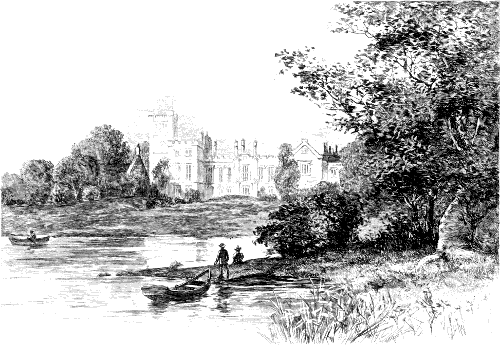
NEWSTEAD ABBEY.
The ancestral home of the family of Lord Byron. Original Etching from an Old Engraving.
It was not only in Greece that Byron's death was profoundly felt, but in all Europe, which was under the spell of his genius. Mrs. Anne Thackeray Ritchie, in her charming recollections of Tennyson, says:—"One day the news came to the village—the dire news which spread across the land, filling men's hearts with consternation—that Byron was dead. Alfred was then a boy about fifteen. 'Byron was dead! I thought the whole world was at an end,' he once said, speaking of those bygone days. 'I thought everything was over and finished for every one—that nothing else mattered. I remember I walked out alone and carved "Byron is dead" into the sandstone.'"

MAID OF ATHENS
Maid of Athens, ere we part, Give, oh give me back my heart! Or, since that has left my breast, Keep it now, and take the rest! Hear my vow before I go, Ζωε μου, σας αγαπω.107 By those tresses unconfined, Wooed by each Ægean wind; By those lids whose jetty fringe Kiss thy soft cheeks' blooming tinge; By those wild eyes like the roe, Ζωε μου, σας αγαπω. By that lip I long to taste; By that zone-encircled waist; By all the token-flowers that tell What words can never speak so well; By love's alternate joy and woe, Ζωε μου, σας αγαπω. Maid of Athens! I am gone: Think of me, sweet! when alone. Though I fly to Istambol, Athens holds my heart and soul: Can I cease to love thee? No! Ζωε μου, σας αγαπω.
TRANSLATION OF A ROMAIC SONG
I enter thy garden of roses, Beloved and fair Haidée, Each morning where Flora reposes, For surely I see her in thee. O Lovely! thus low I implore thee, Receive this fond truth from my tongue, Which utters its song to adore thee, Yet trembles for what it has sung: As the branch, at the bidding of Nature, Adds fragrance and fruit to the tree, Through her eyes, through her every feature, Shines the soul of the young Haidée. But the loveliest garden grows hateful When love has abandoned the bowers; Bring me hemlock—since mine is ungrateful, That herb is more fragrant than flowers. The poison, when poured from the chalice, Will deeply embitter the bowl; But when drunk to escape from thy malice, The draught shall be sweet to my soul. Too cruel! in vain I implore thee My heart from these horrors to save: Will naught to my bosom restore thee? Then open the gates of the grave. As the chief who to combat advances Secure of his conquest before, Thus thou, with those eyes for thy lances, Hast pierced through my heart to its core. Ah, tell me, my soul, must I perish By pangs which a smile would dispel? Would the hope, which thou once bad'st me cherish, For torture repay me too well? Now sad is the garden of roses, Belovèd but false Haidée! There Flora all withered reposes, And mourns o'er thine absence with me.
GREECE
From 'The Giaour'
He who hath bent him o'er the dead Ere the first day of death is fled,— The first dark day of nothingness, The last of danger and distress, (Before Decay's effacing fingers Have swept the lines where beauty lingers,)— And marked the mild angelic air, The rapture of repose that's there, The fixed yet tender traits that streak The languor of the placid cheek, And—but for that sad shrouded eye, That fires not, wins not, weeps not now, And but for that chill, changeless brow, Where cold Obstruction's apathy Appalls the gazing mourner's heart, As if to him it could impart The doom he dreads, yet dwells upon— Yes, but for these and these alone, Some moments, ay, one treacherous hour, He still might doubt the tyrant's power; So fair, so calm, so softly sealed, The first, last look by death revealed! Such is the aspect of this shore; 'Tis Greece, but living Greece no more! So coldly sweet, so deadly fair, We start, for soul is wanting there. Hers is the loveliness in death That parts not quite with parting breath; But beauty with that fearful bloom, That hue which haunts it to the tomb, Expression's last receding ray, A gilded halo hovering round decay, The farewell beam of Feeling passed away! Spark of that flame—perchance of heavenly birth— Which gleams, but warms no more its cherished earth! Clime of the unforgotten brave! Whose land from plain to mountain-cave Was Freedom's home, or Glory's grave! Shrine of the mighty! can it be That this is all remains of thee? Approach, thou craven crouching slave: Say, is not this Thermopylæ? These waters blue that round you lave, O servile offspring of the free— Pronounce what sea, what shore is this? The gulf, the rock of Salamis! These scenes, their story not unknown, Arise, and make again your own; Snatch from the ashes of your sires The embers of their former fires; And he who in the strife expires Will add to theirs a name of fear That Tyranny shall quake to hear, And leave his sons a hope, a fame, They too will rather die than shame: For Freedom's battle once begun, Bequeathed by bleeding Sire to Son, Though baffled oft, is ever won. Bear witness, Greece, thy living page, Attest it many a deathless age! While kings, in dusty darkness hid, Have left a nameless pyramid, Thy heroes, though the general doom Hath swept the column from their tomb, A mightier monument command, The mountains of their native land! There points thy Muse to stranger's eye The graves of those that cannot die! 'Twere long to tell, and sad to trace, Each step from splendor to disgrace: Enough—no foreign foe could quell Thy soul, till from itself it fell; Yes! self-abasement paved the way To villain-bonds and despot sway.
THE HELLESPONT AND TROY
From 'The Bride of Abydos'
The winds are high on Helle's wave; As on that night of stormy water, When Love, who sent, forgot to save The young, the beautiful, the brave, The lonely hope of Sestos's daughter. Oh! when alone along the sky Her turret torch was blazing high, Though rising gale, and breaking foam, And shrieking sea-birds, warned him home; And clouds aloft and tides below, With signs and sounds, forbade to go: He could not see, he would not hear, Or sound or sign foreboding fear; His eye but saw the light of love, The only star it hailed above; His ear but rang with Hero's song, "Ye waves, divide not lovers long!"— That tale is old, but love anew May nerve young hearts to prove as true. The winds are high, and Helle's tide Rolls darkly heaving to the main; And Night's descending shadows hide That field with blood bedewed in vain, The desert of old Priam's pride, The tombs, sole relics of his reign, All—save immortal dreams that could beguile The blind old man of Scio's rocky isle! Oh! yet—for there my steps have been; These feet have pressed the sacred shore; These limbs that buoyant wave hath borne— Minstrel! with thee to muse, to mourn, To trace again those fields of yore, Believing every hillock green Contains no fabled hero's ashes, And that around the undoubted scene Thine own "broad Hellespont" still dashes,— Be long my lot! and cold were he Who there could gaze denying thee!
GREECE AND HER HEROES
From 'The Siege of Corinth'
They fell devoted, but undying; The very gale their names seemed sighing: The waters murmured of their name; The woods were peopled with their fame; The silent pillar, lone and gray, Claimed kindred with their sacred clay; Their spirits wrapt the dusky mountain, Their memory sparkled o'er the fountain: The meanest rill, the mightiest river, Rolled mingling with their fame forever. Despite of every yoke she bears, That land is glory's still, and theirs! 'Tis still a watchword to the earth: When man would do a deed of worth He points to Greece, and turns to tread, So sanctioned, on the tyrant's head; He looks to her, and rushes on Where life is lost, or freedom won.
THE ISLES OF GREECE
From 'Don Juan'
The isles of Greece! the isles of Greece! Where burning Sappho loved and sung, Where grew the arts of war and peace, Where Delos rose and Phœbus sprung! Eternal summer gilds them yet, But all except their sun is set. The Scian108 and the Teian109 muse, The hero's harp, the lover's lute, Have found the fame your shores refuse; Their place of birth alone is mute To sounds which echo further west Than your sires' "Islands of the Blest." The mountains look on Marathon— And Marathon looks on the sea; And musing there an hour alone, I dreamed that Greece might still be free; For, standing on the Persians' grave, I could not deem myself a slave. A king sat on the rocky brow Which looks o'er sea-born Salamis; And ships by thousands lay below, And men in nations;—all were his! He counted them at break of day— And when the sun set, where were they? And where are they? and where art thou, My country? On thy voiceless shore The heroic lay is tuneless now— The heroic bosom beats no more! And must thy lyre, so long divine, Degenerate into hands like mine? 'Tis something, in the dearth of fame, Though linked among a fettered race, To feel at least a patriot's shame, Even as I sing, suffuse my face: For what is left the poet here? For Greeks a blush—for Greece a tear. Must we but weep o'er days more blest? Must we but blush?—Our fathers bled. Earth! render back from out thy breast A remnant of our Spartan dead! Of the three hundred grant but three To make a new Thermopylæ! What, silent still? and silent all? Ah, no;—the voices of the dead Sound like a distant torrent's fall, And answer, "Let one living head, But one, arise—we come, we come!" 'Tis but the living who are dumb. In vain—in vain: strike other chords; Fill high the cup with Samian wine! Leave battles to the Turkish hordes, And shed the blood of Scio's vine! Hark! rising to the ignoble call, How answers each bold Bacchanal! You have the Pyrrhic dance as yet, Where is the Pyrrhic phalanx gone? Of two such lessons, why forget The nobler and the manlier one? You have the letters Cadmus gave— Think ye he meant them for a slave? Fill high the bowl with Samian wine! We will not think of themes like these: It made Anacreon's song divine; He served—but served Polycrates— A tyrant: but our masters then Were still at least our countrymen. The tyrant of the Chersonese Was freedom's best and bravest friend; That tyrant was Miltiades! Oh that the present hour would lend Another despot of the kind! Such chains as his were sure to bind. Fill high the bowl with Samian wine! On Suli's rock, and Parga's shore, Exists the remnant of a line Such as the Doric mothers bore: And there, perhaps, some seed is sown The Heracleidan blood might own. Trust not for freedom to the Franks— They have a king who buys and sells; In native swords and native ranks The only hope of courage dwells: But Turkish force and Latin fraud Would break your shield, however broad. Fill high the bowl with Samian wine! Our virgins dance beneath the shade: I see their glorious black eyes shine; But, gazing on each glowing maid, My own the burning tear-drop laves, To think such breasts must suckle slaves. Place me on Sunium's marble steep, Where nothing, save the waves and I, May hear our mutual murmurs sweep: There, swan-like, let me sing and die! A land of slaves shall ne'er be mine— Dash down yon cup of Samian wine!
GREECE AND THE GREEKS BEFORE THE REVOLUTION
From 'Childe Harold's Pilgrimage'
Ancient of days! august Athena! where, Where are thy men of might? thy grand in soul? Gone—glimmering through the dream of things that were: First in the race that led to Glory's goal, They won, and passed away—is this the whole? A schoolboy's tale, the wonder of an hour! The warrior's weapon and the sophist's stole Are sought in vain, and o'er each moldering tower, Dim with the mist of years, gray flits the shade of power. . . . . . . . . . . . . . . . . . Fair Greece! sad relic of departed worth! Immortal, though no more! though fallen, great! Who now shall lead thy scattered children forth, And long accustomed bondage uncreate? Not such thy sons who whilome did await, The hopeless warriors of a willing doom, In bleak Thermopylæ's sepulchral strait— Oh, who that gallant spirit shall resume, Leap from Eurotas's banks, and call thee from the tomb? Spirit of Freedom! when on Phyle's brow Thou sat'st with Thrasybulus and his train, Couldst thou forebode the dismal hour which now Dims the green beauties of thine Attic plain? Not thirty tyrants now enforce the chain, But every earl can lord it o'er thy land: Nor rise thy sons, but idly rail in vain, Trembling beneath the scourge of Turkish hand, From birth till death enslaved; in word, in deed, unmanned. . . . . . . . . . . . . . . . . . Hereditary bondmen! know ye not Who would be free, themselves must strike the blow? By their right arms the conquest must be wrought? Will Gaul or Muscovite redress ye? No! True, they may lay your proud despoilers low, But not for you will Freedom's altars flame. Shades of the Helots! triumph o'er your foe: Greece! change thy lords, thy state is still the same; Thy glorious day is o'er, but not thy years of shame.... When riseth Lacedæmon's hardihood, When Thebes Epaminondas rears again, When Athens' children are with hearts endued, When Grecian mothers shall give birth to men, Then may'st thou be restored; but not till then. A thousand years scarce serve to form a State; An hour may lay it in the dust: and when Can man its shattered splendor renovate, Recall its virtues back, and vanquish Time and Fate? And yet how lovely in thine age of woe, Land of lost gods and godlike men, art thou! Thy vales of evergreen, thy hills of snow, Proclaim thee Nature's varied favorite now. Thy fanes, thy temples to thy surface bow, Commingling slowly with heroic earth, Broke by the share of every rustic plough: So perish monuments of mortal birth, So perish all in turn, save well-recorded worth; Save where some solitary column mourns Above its prostrate brethren of the cave; Save where Tritonia's airy shrine adorns Colonna's cliff, and gleams along the wave; Save o'er some warrior's half-forgotten grave, Where the gray stones and long-neglected grass Ages, but not oblivion, feebly brave, While strangers only not regardless pass, Lingering like me, perchance, to gaze, and sigh "Alas!" Yet are thy skies as blue, thy crags as wild, Sweet are thy groves, and verdant are thy fields, Thine olive ripe as when Minerva smiled, And still his honeyed wealth Hymettus yields; There the blithe bee his fragrant fortress builds, The free-born wanderer of thy mountain air; Apollo still thy long, long summer gilds, Still in his beam Mendeli's marbles glare: Art, Glory, Freedom fail, but Nature still is fair. Where'er we tread, 'tis haunted, holy ground; No earth of thine is lost in vulgar mold, But one vast realm of wonder spreads around, And all the Muse's tales seem truly told, Till the sense aches with gazing to behold The scenes our earliest dreams have dwelt upon: Each hill and dale, each deepening glen and wold, Defies the power which crushed thy temples gone: Age shakes Athena's tower, but spares gray Marathon.
TO ROME
From 'Childe Harold's Pilgrimage'
O Rome! my country! city of the soul! The orphans of the heart must turn to thee, Lone mother of dead empires! and control In their shut breasts their petty misery. What are our woes and sufferings? Come and see The cypress, hear the owl, and plod your way O'er steps of broken thrones and temples, ye! Whose agonies are evils of a day— A world is at our feet as fragile as our clay. The Niobe of nations! there she stands, Childless and crownless, in her voiceless woe; An empty urn within her withered hands, Whose holy dust was scattered long ago: The Scipios' tomb contains no ashes now; The very sepulchres lie tenantless Of their heroic dwellers: dost thou flow, Old Tiber! through a marble wilderness? Rise, with thy yellow waves, and mantle her distress! The Goth, the Christian, Time, War, Flood, and Fire Have dealt upon the seven-hilled city's pride: She saw her glories star by star expire, And up the steep, Barbarian monarchs ride, Where the car climbed the Capitol; far and wide Temple and tower went down, nor left a site:— Chaos of ruins! who shall trace the void, O'er the dim fragments cast a lunar light, And say, "Here was, or is," where all is doubly night? The double night of ages, and of her, Night's daughter, Ignorance, hath wrapt and wrap All round us; we but feel our way to err: The ocean hath its chart, the stars their map, And Knowledge spreads them on her ample lap; But Rome is as the desert, where we steer Stumbling o'er recollections: now we clap Our hands, and cry "Eureka! it is clear—" When but some false mirage of ruin rises near. Alas, the lofty city! and alas, The trebly hundred triumphs! and the day When Brutus made the dagger's edge surpass The conqueror's sword in bearing fame away! Alas for Tully's voice, and Virgil's lay, And Livy's pictured page! But these shall be Her resurrection; all beside—decay. Alas for Earth, for never shall we see That brightness in her eye she bore when Rome was free!
THE COLISEUM
From 'Childe Harold's Pilgrimage'
Arches on arches! as it were that Rome, Collecting the chief trophies of her line, Would build up all her triumphs in one dome, Her Coliseum stands; the moonbeams shine As 'twere its natural torches, for divine Should be the light which streams here, to illume This long explored but still exhaustless mine Of contemplation; and the azure gloom Of an Italian night, where the deep skies assume Hues which have words, and speak to ye of heaven, Floats o'er this vast and wondrous monument, And shadows forth its glory. There is given Unto the things of earth, which Time hath bent, A spirit's feeling, and where he hath leant His hand, but broke his scythe, there is a power And magic in the ruined battlement, For which the palace of the present hour Must yield its pomp, and wait till ages are its dower. And here the buzz of eager nations ran, In murmured pity, or loud-roared applause, As man was slaughtered by his fellow-man. And wherefore slaughtered? wherefore, but because Such were the bloody Circus's genial laws, And such the imperial pleasure.—Wherefore not? What matters where we fall to fill the maws Of worms—on battle-plains or listed spot? Both are but theatres where the chief actors rot. I see before me the Gladiator lie: He leans upon his hand—his manly brow Consents to death, but conquers agony, And his drooped head sinks gradually low; And through his side the last drops, ebbing slow From the red gash, fall heavy, one by one, Like the first of a thunder-shower; and now The arena swims around him—he is gone, Ere ceased the inhuman shout which hailed the wretch who won. He heard it, but he heeded not—his eyes Were with his heart, and that was far away; He recked not of the life he lost, nor prize, But where his rude hut by the Danube lay, There were his young barbarians all at play, There was their Dacian mother—he, their sire, Butchered to make a Roman holiday: All this rushed with his blood. Shall he expire, And unavenged?—Arise, ye Goths, and glut your ire! . . . . . . . . . . . . . . . . . A ruin—yet what ruin! from its mass Walls, palaces, half-cities, have been reared; Yet oft the enormous skeleton ye pass, And marvel where the spoil could have appeared. Hath it indeed been plundered, or but cleared? Alas! developed, opens the decay, When the colossal fabric's form is neared: It will not bear the brightness of the day, Which streams too much on all years, man, have reft away. But when the rising moon begins to climb Its topmost arch, and gently pauses there; When the stars twinkle through the loops of time, And the low night-breeze waves along the air The garland-forest which the gray walls wear, Like laurels on the bald first Cæsar's head; When the light shines serene, but doth not glare,— Then in this magic circle raise the dead: Heroes have trod this spot—'tis on their dust ye tread.
CHORUS OF SPIRITS
At the Storming of Rome by the Constable of Bourbon, 1527
From 'The Deformed Transformed'
'Tis the morn, but dim and dark. Whither flies the silent lark? Whither shrinks the clouded sun? Is the day indeed begun? Nature's eye is melancholy O'er the city high and holy; But without there is a din Should arouse the saints within, And revive the heroic ashes Round which yellow Tiber dashes. O ye seven hills! awaken, Ere your very base be shaken! Hearken to the steady stamp! Mars is in their every tramp! Not a step is out of tune, As the tides obey the moon! On they march, though to self-slaughter, Regular as rolling water, Whose high waves o'ersweep the border Of huge moles, but keep their order, Breaking only rank by rank. Hearken to the armor's clank! Look down o'er each frowning warrior, How he glares upon the barrier: Look on each step of each ladder, As the stripes that streak an adder. Look upon the bristling wall, Manned without an interval! Round and round, and tier on tier, Cannon's black mouth, shining spear, Lit match, bell-mouthed musquetoon, Gaping to be murderous soon— All the warlike gear of old, Mixed with what we now behold, In this strife 'twixt old and new, Gather like a locust's crew. Shade of Remus! 'tis a time Awful as thy brother's crime! Christians war against Christ's shrine: Must its lot be like to thine? Near—and near—and nearer still, As the earthquake saps the hill, First with trembling, hollow motion, Like a scarce-awakened ocean, Then with stronger shock and louder, Till the rocks are crushed to powder,— Onward sweeps the rolling host! Heroes of the immortal boast! Mighty chiefs! eternal shadows! First flowers of the bloody meadows Which encompass Rome, the mother Of a people without brother! Will you sleep when nations' quarrels Plow the root up of your laurels? Ye who wept o'er Carthage burning, Weep not—strike! for Rome is mourning! Onward sweep the varied nations! Famine long hath dealt their rations. To the wall, with hate and hunger, Numerous as wolves, and stronger, On they sweep. O glorious city! Must thou be a theme for pity? Fight like your first sire, each Roman! Alaric was a gentle foeman, Matched with Bourbon's black banditti. Rouse thee, thou eternal city! Rouse thee! Rather give the torch With thine own hand to thy porch, Than behold such hosts pollute Your worst dwelling with their foot. Ah! behold yon bleeding spectre! Ilion's children find no Hector; Priam's offspring loved their brother; Rome's great sire forgot his mother, When he slew his gallant twin, With inexpiable sin. See the giant shadow stride O'er the ramparts high and wide! When the first o'erleapt thy wall, Its foundation mourned his fall. Now, though towering like a Babel, Who to stop his steps are able? Stalking o'er thy highest dome, Remus claims his vengeance, Rome! Now they reach thee in their anger; Fire and smoke and hellish clangor Are around thee, thou world's wonder! Death is in thy walls and under. Now the meeting steel first clashes, Downward then the ladder crashes, With its iron load all gleaming, Lying at its foot blaspheming. Up again! for every warrior Slain, another climbs the barrier. Thicker grows the strife; thy ditches Europe's mingling gore enriches. Rome! although thy wall may perish, Such manure thy fields will cherish, Making gay the harvest-home; But thy hearths! alas, O Rome!— Yet be Rome amidst thine anguish, Fight as thou wast wont to vanquish! Yet once more, ye old Penates, Let not your quenched hearths be Atè's! Yet again, ye shadowy heroes, Yield not to these stranger Neros! Though the son who slew his mother Shed Rome's blood, he was your brother: 'Twas the Roman curbed the Roman;— Brennus was a baffled foeman. Yet again, ye saints and martyrs, Rise! for yours are holier charters! Mighty gods of temples falling, Yet in ruin still appalling, Mightier founders of those altars True and Christian—strike the assaulters! Tiber! Tiber! let thy torrent Show even nature's self abhorrent. Let each breathing heart dilated Turn, as doth the lion baited: Rome be crushed to one wide tomb, But be still the Roman's Rome!
VENICE
From 'Childe Harold's Pilgrimage'
I stood in Venice, on the Bridge of Sighs; A palace and a prison on each hand; I saw from out the wave her structures rise As from the stroke of the enchanter's wand: A thousand years their cloudy wings expand Around me, and a dying glory smiles O'er the far times when many a subject land Looked to the wingèd Lion's marble piles, Where Venice sat in state, throned on her hundred isles! She looks a sea Cybele, fresh from ocean, Rising with her tiara of proud towers At airy distance, with majestic motion, A ruler of the waters and their powers: And such she was; her daughters had their dowers From spoils of nations, and the exhaustless East Poured in her lap all gems in sparkling showers. In purple was she robed, and of her feast Monarchs partook, and deemed their dignity increased. In Venice, Tasso's echoes are no more, And silent rows the songless gondolier; Her palaces are crumbling to the shore, And music meets not always now the ear: Those days are gone—but Beauty still is here. States fall, arts fade—but Nature doth not die, Nor yet forget how Venice once was dear, The pleasant place of all festivity, The revel of the earth, the masque of Italy! But unto us she hath a spell beyond Her name in story, and her long array Of mighty shadows, whose dim forms despond Above the Dogeless city's vanished sway: Ours is a trophy which will not decay With the Rialto; Shylock and the Moor, And Pierre, cannot be swept or worn away— The keystones of the arch! though all were o'er, For us repeopled were the solitary shore. The beings of the mind are not of clay; Essentially immortal, they create And multiply in us a brighter ray And more beloved existence: that which Fate Prohibits to dull life, in this our state Of mortal bondage, by these spirits supplied, First exiles, then replaces what we hate; Watering the heart whose early flowers have died, And with a fresher growth replenishing the void.
ODE TO VENICE
I
O Venice! Venice! when thy marble walls Are level with the waters, there shall be A cry of nations o'er thy sunken halls, A loud lament along the sweeping sea! If I, a northern wanderer, weep for thee, What should thy sons do?—anything but weep: And yet they only murmur in their sleep. In contrast with their fathers—as the slime, The dull green ooze of the receding deep, Is with the dashing of the spring-tide foam That drives the sailor shipless to his home— Are they to those that were; and thus they creep, Crouching and crab-like, through their sapping streets. Oh, agony! that centuries should reap No mellower harvest! Thirteen hundred years Of wealth and glory turned to dust and tears; And every monument the stranger meets, Church, palace, pillar, as a mourner greets; And even the Lion all subdued appears, And the harsh sound of the barbarian drum, With dull and daily dissonance, repeats The echo of thy tyrant's voice along The soft waves, once all musical to song, That heaved beneath the moonlight with the throng Of gondolas—and to the busy hum Of cheerful creatures, whose most sinful deeds Were but the overbeating of the heart, And flow of too much happiness, which needs The aid of age to turn its course apart From the luxuriant and voluptuous flood Of sweet sensations, battling with the blood. But these are better than the gloomy errors, The weeds of nations in their last decay, When Vice walks forth with her unsoftened terrors, And Mirth is madness, and but smiles to slay: And Hope is nothing but a false delay, The sick man's lightning half an hour ere death, When Faintness, the last mortal birth of Pain, And apathy of limb, the dull beginning Of the cold staggering race which Death is winning, Steals vein by vein and pulse by pulse away, Yet so relieving the o'er-tortured clay, To him appears renewal of his breath, And freedom the mere numbness of his chain; And then he talks of life, and how again He feels his spirit soaring—albeit weak, And of the fresher air, which he would seek: And as he whispers knows not that he gasps, That his thin finger feels not what it clasps, And so the film comes o'er him—and the dizzy Chamber swims round and round—and shadows busy, At which he vainly catches, flit and gleam, Till the last rattle chokes the strangled scream, And all is ice and blackness—and the earth That which it was the moment ere our birth.
II
There is no hope for nations!—Search the page Of many thousand years—the daily scene, The flow and ebb of each recurring age, The everlasting to be which hath been, Hath taught us naught, or little: still we lean On things that rot beneath our weight, and wear Our strength away in wrestling with the air: For 'tis our nature strikes us down; the beasts Slaughtered in hourly hecatombs for feasts Are of as high an order—they must go Even where their driver goads them, though to slaughter. Ye men, who pour your blood for kings as water, What have they given your children in return? A heritage of servitude and woes, A blindfold bondage, where your hire is blows. What! do not yet the red-hot plowshares burn, O'er which you stumble in a false ordeal, And deem this proof of loyalty the real; Kissing the hand that guides you to your scars, And glorying as you tread the glowing bars? All that your sires have left you, all that Time Bequeaths of free, and History of sublime, Spring from a different theme! Ye see and read, Admire and sigh, and then succumb and bleed! Save the few spirits who, despite of all, And worse than all—the sudden crimes engendered By the down-thundering of the prison-wall, And thirst to swallow the sweet waters tendered Gushing from Freedom's fountains, when the crowd, Maddened with centuries of drought, are loud, And trample on each other to obtain The cup which brings oblivion of a chain Heavy and sore, in which long yoked they plowed The sand; or if there sprung the yellow grain, 'Twas not for them,—their necks were too much bowed, And their dead palates chewed the cud of pain;— Yes! the few spirits who, despite of deeds Which they abhor, confound not with the cause Those momentary starts from Nature's laws Which, like the pestilence and earthquake, smite But for a term, then pass, and leave the earth With all her seasons to repair the blight With a few summers, and again put forth Cities and generations—fair when free— For, Tyranny, there blooms no bud for thee!
III
Glory and Empire! once upon these towers With Freedom—godlike Triad!—how ye sate! The league of mightiest nations in those hours When Venice was an envy, might abate, But did not quench her spirit; in her fate All were enwrapped: the feasted monarchs knew And loved their hostess, nor could learn to hate, Although they humbled. With the kingly few The many felt, for from all days and climes She was the voyager's worship; even her crimes Were of the softer order—born of Love. She drank no blood, nor fattened on the dead, But gladdened where her harmless conquests spread; For these restored the Cross, that from above Hallowed her sheltering banners, which incessant Flew between earth and the unholy Crescent, Which if it waned and dwindled, Earth may thank The city it has clothed in chains, which clank Now, creaking in the ears of those who owe The name of Freedom to her glorious struggles; Yet she but shares with them a common woe, And called the "kingdom" of a conquering foe, But knows what all—and, most of all, we—know, With what set gilded terms a tyrant juggles!
IV
The name of Commonwealth is past and gone O'er the three fractions of the groaning globe: Venice is crushed, and Holland deigns to own A sceptre, and endures the purple robe; If the free Switzer yet bestrides alone His chainless mountains, 'tis but for a time, For tyranny of late is cunning grown, And in its own good season tramples down The sparkles of our ashes. One great clime, Whose vigorous offspring by dividing ocean Are kept apart and nursed in the devotion Of Freedom, which their fathers fought for and Bequeathed—a heritage of heart and hand, And proud distinction from each other land, Whose sons must bow them at a monarch's motion, As if his senseless sceptre were a wand Full of the magic of exploded science— Still one great clime, in full and free defiance, Yet rears her crest, unconquered and sublime, Above the far Atlantic! She has taught Her Esau-brethren that the haughty flag, The floating fence of Albion's feebler crag, May strike to those whose red right hands have bought Rights cheaply earned with blood. Still, still forever, Better, though each man's life-blood were a river, That it should flow, and overflow, than creep Through thousand lazy channels in our veins, Dammed like the dull canal with locks and chains, And moving as a sick man in his sleep, Three paces, and then faltering:—better be Where the extinguished Spartans still are free, In their proud charnel of Thermopylæ, Than stagnate in our marsh,—or o'er the deep Fly, and one current to the ocean add, One spirit to the souls our fathers had, One freeman more, America, to thee!
THE EAST
From 'The Bride of Abydos'
Know ye the land where the cypress and myrtle Are emblems of deeds that are done in their clime? Where the rage of the vulture, the love of the turtle, Now melt into sorrow, now madden to crime? Know ye the land of the cedar and vine, Where the flowers ever blossom, the beams ever shine; Where the light wings of Zephyr, oppressed with perfume, Wax faint o'er the gardens of Gül in her bloom; Where the citron and olive are fairest of fruit, And the voice of the nightingale never is mute: Where the tints of the earth and the hues of the sky, In color though varied, in beauty may vie, And the purple of ocean is deepest in dye; Where the virgins are soft as the roses they twine, And all, save the spirit of man, is divine? 'Tis the clime of the East! 'tis the land of the Sun! Can he smile on such deeds as his children have done? Oh! wild as the accents of lovers' farewell Are the hearts which they bear, and the tales which they tell.
ORIENTAL ROYALTY
From 'Don Juan'
He had fifty daughters and four dozen sons, Of whom all such as came of age were stowed— The former in a palace, where like nuns They lived till some Bashaw was sent abroad, When she whose turn it was, was wed at once, Sometimes at six years old—though this seems odd, 'Tis true: the reason is, that the Bashaw Must make a present to his sire-in-law. His sons were kept in prison, till they grew Of years to fill a bowstring or the throne,— One or the other, but which of the two Could yet be known unto the Fates alone: Meantime the education they went through Was princely, as the proofs have always shown; So that the heir-apparent still was found No less deserving to be hanged than crowned.
A GRECIAN SUNSET
From 'The Curse of Minerva'
Slow sinks, more lovely ere his race be run, Along Morea's hills the setting sun; Not, as in Northern climes, obscurely bright, But one unclouded blaze of living light: O'er the hushed deep the yellow beam he throws, Gilds the green wave that trembles as it glows. On cold Ægina's rock and Idra's isle The god of gladness sheds his parting smile; O'er his own regions lingering, loves to shine, Though there his altars are no more divine. Descending fast, the mountain shadows kiss Thy glorious gulf, unconquered Salamis! Their azure arches through the long expanse, More deeply purpled meet his mellowing glance, And tenderest tints, along their summits driven, Mark his gay course, and own the hues of heaven; Till, darkly shaded from the land and deep, Behind his Delphian cliff he sinks to sleep. On such an eve his palest beam he cast, When, Athens! here thy Wisest looked his last. How watched thy better sons his farewell ray, That closed their murdered sage's latest day! Not yet—not yet—Sol pauses on the hill— The precious hour of parting lingers still: But sad his light to agonizing eyes, And dark the mountain's once delightful dyes; Gloom o'er the lovely land he seemed to pour, The land where Phœbus never frowned before: But ere he sank below Cithæron's head, The cup of woe was quaffed—the spirit fled; The soul of him who scorned to fear or fly— Who lived and died as none can live or die. But lo! from high Hymettus to the plain, The queen of night asserts her silent reign. No murky vapor, herald of the storm, Hides her fair face, nor girds her glowing form. With cornice glimmering as the moonbeams play, Where the white column greets her grateful ray, And, bright around with quivering beams beset, Her emblem sparkles o'er the minaret; The groves of olive scattered dark and wide, Where meek Cephisus pours his scanty tide, The cypress saddening by the sacred mosque, The gleaming turret of the gay kiosk, And, dun and sombre 'mid the holy calm, Near Theseus's fane yon solitary palm,— All, tinged with varied hues, arrest the eye, And dull were his that passed them heedless by. Again the Ægean, heard no more afar, Lulls his chafed breast from elemental war; Again his waves in milder tints unfold Their long array of sapphire and of gold, Mixed with the shades of many a distant isle, That frown where gentler ocean deigns to smile.
AN ITALIAN SUNSET
From 'Childe Harold's Pilgrimage'
The moon is up, and yet it is not night— Sunset divides the sky with her—a sea Of glory streams along the Alpine height Of blue Friuli's mountains; Heaven is free From clouds, but of all colors seems to be, Melted to one vast Iris of the West, Where the Day joins the past Eternity; While, on the other hand, meek Dian's crest Floats through the azure air—an island of the blest! A single star is at her side, and reigns With her o'er half the lovely heaven; but still Yon sunny sea heaves brightly, and remains Rolled o'er the peak of the far Rhætian hill, As Day and Night contending were, until Nature reclaimed her order:—gently flows The deep-dyed Brenta, where their hues instil The odorous purple of a new-born rose, Which streams upon her stream, and glassed within it glows, Filled with the face of heaven, which from afar Comes down upon the waters; all its hues, From the rich sunset to the rising star, Their magical variety diffuse: And now they change; a paler shadow strews Its mantle o'er the mountains; parting day Dies like the dolphin, whom each pang imbues With a new color as it gasps away, The last still loveliest, till—'tis gone—and all is gray.
TWILIGHT
From 'Don Juan'
T' our tale.—The feast was over, the slaves gone, The dwarfs and dancing girls had all retired; The Arab lore and poet's song were done, And every sound of revelry expired; The lady and her lover, left alone, The rosy flood of twilight sky admired;— Ave Maria! o'er the earth and sea, That heavenliest hour of Heaven is worthiest thee! Ave Maria! blessed be the hour, The time, the clime, the spot, where I so oft Have felt that moment in its fullest power Sink o'er the earth so beautiful and soft, While swung the deep bell in the distant tower, Or the faint dying day hymn stole aloft, And not a breath crept through the rosy air, And yet the forest leaves seemed stirred with prayer. Ave Maria! 'tis the hour of prayer! Ave Maria! 'tis the hour of love! Ave Maria! may our spirits dare Look up to thine and to thy Son's above! Ave Maria! oh that face so fair! Those downcast eyes beneath the Almighty Dove— What though 'tis but a pictured image strike? That painting is no idol—'tis too like. Some kindly casuists are pleased to say, In nameless print, that I have no devotion; But set those persons down with me to pray, And you shall see who has the properest notion Of getting into heaven the shortest way: My altars are the mountains and the ocean, Earth, air, stars—all that springs from the great Whole, Who hath produced and will receive the soul. Sweet hour of twilight!—in the solitude Of that pine forest, and the silent shore Which bounds Ravenna's immemorial wood, Rooted where once the Adrian wave flowed o'er To where the last Cæsarean fortress stood,— Evergreen forest! which Boccaccio's lore And Dryden's lay made haunted ground to me, How have I loved the twilight hour and thee! The shrill cicalas, people of the pine, Making their summer lives one ceaseless song, Were the sole echoes, save my steed's and mine, And vesper bells that rose the boughs along: The spectre huntsman of Onesti's line, His hell-dogs and their chase, and the fair throng Which learned from this example not to fly From a true lover—shadowed my mind's eye. O Hesperus! thou bringest all good things: Home to the weary, to the hungry cheer, To the young bird the parent's brooding wings, The welcome stall to the o'er-labored steer; Whatever of peace about our hearthstone clings, Whate'er our household gods protect of dear, Are gathered round us by thy look of rest; Thou bring'st the child, too, to the mother's breast. Soft hour! which wakes the wish and melts the heart Of those who sail the seas, on the first day When they from their sweet friends are torn apart; Or fills with love the pilgrim on his way As the far bell of vesper makes him start, Seeming to weep the dying day's decay. Is this a fancy which our reason scorns? Ah! surely nothing dies but something mourns.
AN ALPINE STORM
From 'Childe Harold's Pilgrimage'
The sky is changed—and such a change!—O Night, And storm, and darkness, ye are wondrous strong, Yet lovely in your strength, as is the light Of a dark eye in woman! Far along, From peak to peak, the rattling crags among, Leaps the live thunder! Not from one lone cloud, But every mountain now hath found a tongue, And Jura answers through her misty shroud Back to the joyous Alps, who call to her aloud! And this is in the night.—Most glorious night! Thou wert not sent for slumber! let me be A sharer in thy fierce and far delight— A portion of the tempest and of thee! How the lit lake shines, a phosphoric sea, And the big rain comes dancing to the earth! And now again 'tis black—and now the glee Of the loud hills shakes with its mountain-mirth, As if they did rejoice o'er a young earthquake's birth. Now, where the swift Rhone cleaves his way between Heights which appear as lovers who have parted In hate, whose mining depths so intervene That they can meet no more, though broken-hearted! Though in their souls which thus each other thwarted, Love was the very root of that fond rage Which blighted their life's bloom, and then departed; Itself expired, but leaving them an age Of years all winters—war within themselves to wage— Now, where the quick Rhone thus hath cleft his way, The mightiest of the storms hath ta'en his stand: For here not one, but many, make their play And fling their thunderbolts from hand to hand, Flashing and cast around: of all the band, The brightest through these parted hills hath forked His lightnings; as if he did understand That in such gaps as desolation worked, There the hot shaft should blast whatever therein lurked. Sky, mountains, river, winds, lake, lightnings! ye, With night, and clouds, and thunder, and a soul To make these felt and feeling, well may be Things that have made me watchful; the far roll Of your departing voices is the knoll Of what in me is sleepless,—if I rest. But where of ye, O tempests! is the goal? Are ye like those within the human breast? Or do ye find at length, like eagles, some high nest?
THE OCEAN
From 'Childe Harold's Pilgrimage'
But I forgot: my Pilgrim's shrine is won, And he and I must part;—so let it be: His task and mine alike are nearly done; Yet once more let us look upon the sea: The midland ocean breaks on him and me, And from the Alban Mount we now behold Our friend of youth, that ocean, which when we Beheld it last by Calpe's rock unfold Those waves, we followed on till the dark Euxine rolled Upon the blue Symplegades: long years— Long, though not very many—since have done Their work on both; much suffering and some tears Have left us nearly where we had begun: Yet not in vain our mortal race hath run,— We have had our reward, and it is here; That we can yet feel gladdened by the sun, Can reap from earth, sea, joy almost as dear As if there were no man to trouble what is clear. Oh that the desert were my dwelling-place, With one fair Spirit for my minister, That I might all forget the human race, And, hating no one, love but only her! Ye Elements!—in whose ennobling stir I feel myself exalted—can ye not Accord me such a being? Do I err In deeming such inhabit many a spot? Though with them to converse can rarely be our lot. There is a pleasure in the pathless woods, There is a rapture on the lonely shore, There is society, where none intrudes, By the deep Sea, and music in its roar: I love not Man the less, but Nature more, From these our interviews, in which I steal From all I may be, or have been before, To mingle with the Universe, and feel What I can ne'er express, yet cannot all conceal. Roll on, thou deep and dark blue Ocean—roll! Ten thousand fleets sweep over thee in vain; Man marks the earth with ruin—his control Stops with the shore;—upon the watery plain The wrecks are all thy deed, nor doth remain A shadow of man's ravage, save his own, When for a moment, like a drop of rain, He sinks into thy depths with bubbling groan, Without a grave, unknelled, uncoffined, and unknown. His steps are not upon thy paths—thy fields Are not a spoil for him—thou dost arise And shake him from thee; the vile strength he wields For earth's destruction thou dost all despise, Spurning him from thy bosom to the skies, And send'st him, shivering in thy playful spray, And howling, to his gods, where haply lies His petty hope in some near port or bay, And dashest him again to earth: there let him lay. The armaments which thunderstrike the walls Of rock-built cities, bidding nations quake And monarchs tremble in their capitals,— The oak leviathans, whose huge ribs make Their clay creator the vain title take Of lord of thee, and arbiter of war,— These are thy toys, and as the snowy flake, They melt into thy yeast of waves, which mar Alike the Armada's pride, or spoils of Trafalgar. Thy shores are empires, changed in all save thee— Assyria, Greece, Rome, Carthage, what are they? Thy waters wasted them while they were free, And many a tyrant since: their shores obey The stranger, slave, or savage; their decay Has dried up realms to deserts;—not so thou, Unchangeable save to thy wild waves' play. Time writes no wrinkle on thine azure brow; Such as creation's dawn beheld, thou rollest now. Thou glorious mirror, where the Almighty's form Glasses itself in tempests: in all time, Calm or convulsed—in breeze, or gale, or storm, Icing the pole, or in the torrid clime Dark-heaving;—boundless, endless, and sublime; The image of eternity, the throne Of the Invisible: even from out thy slime The monsters of the deep are made; each zone Obeys thee; thou goest forth, dread, fathomless, alone. And I have loved thee, Ocean! and my joy Of youthful sports was on thy breast to be Borne, like thy bubbles, onward; from a boy I wantoned with thy breakers—they to me Were a delight; and if the freshening sea Made them a terror—'twas a pleasing fear, For I was as it were a child of thee, And trusted to thy billows far and near, And laid my hand upon thy mane—as I do here.
THE SHIPWRECK
From 'Don Juan'
'Twas twilight, and the sunless day went down Over the waste of waters; like a veil Which, if withdrawn, would but disclose the frown Of one whose hate is masked but to assail; Thus to their hopeless eyes the night was shown, And grimly darkled o'er their faces pale, And the dim desolate deep: twelve days had Fear Been their familiar, and now Death was here. . . . . . . . . . . . . . . . . . There was no light in heaven but a few stars; The boats put off, o'ercrowded with their crews: She gave a heel, and then a lurch to port, And going down head foremost—sunk, in short. Then rose from sea to sky the wild farewell! Then shrieked the timid and stood still the brave; Then some leaped overboard with dreadful yell, As eager to anticipate their grave; And the sea yawned around her like a hell, And down she sucked with her the whirling wave, Like one who grapples with his enemy, And tries to strangle him before he die. At first one universal shriek there rushed, Louder than the loud ocean, like a crash Of echoing thunder: and then all was hushed, Save the wild wind and the remorseless dash Of billows; but at intervals there gushed, Accompanied with a convulsive splash, A solitary shriek—the bubbling cry Of some strong swimmer in his agony.
LOVE ON THE ISLAND
From 'Don Juan'
It was the cooling hour, just when the rounded Red sun sinks down behind the azure hill, Which then seems as if the whole earth it bounded, Circling all nature, hushed, and dim, and still, With the far mountain-crescent half-surrounded On one side, and the deep sea calm and chill Upon the other, and the rosy sky, With one star sparkling through it like an eye. And thus they wandered forth, and hand in hand, Over the shining pebbles and the shells, Glided along the smooth and hardened sand, And in the worn and wild receptacles Worked by the storms, yet worked as it were planned, In hollow halls, with sparry roofs and cells, They turned to rest; and, each clasped by an arm, Yielded to the deep twilight's purple charm. They looked up to the sky, whose floating glow Spread like a rosy ocean, vast and bright; They gazed upon the glittering sea below, Whence the broad moon rose circling into sight; They heard the waves splash, and the wind so low, And saw each other's dark eyes darting light Into each other—and, beholding this, Their lips drew near, and clung into a kiss: A long, long kiss, a kiss of youth and love And beauty, all concentrating like rays Into one focus, kindled from above; Such kisses as belong to early days, Where heart, and soul, and sense, in concert move, And the blood's lava, and the pulse a blaze, Each kiss a heart-quake—for a kiss's strength, I think, it must be reckoned by its length. By length I mean duration; theirs endured Heaven knows how long—no doubt they never reckoned; And if they had, they could not have secured The sum of their sensations to a second: They had not spoken; but they felt allured, As if their souls and lips each other beckoned, Which, being joined, like swarming bees they clung— Their hearts the flowers from whence the honey sprung. They were alone, but not alone as they Who, shut in chambers, think it loneliness; The silent ocean, and the starlit bay, The twilight glow, which momently grew less, The voiceless sands, and dropping caves, that lay Around them, made them to each other press, As if there were no life beneath the sky Save theirs, and that their life could never die. They feared no eyes nor ears on that lone beach, They felt no terrors from the night; they were All in all to each other: though their speech Was broken words, they thought a language there; And all the burning tongues the passions teach Found in one sigh the best interpreter Of nature's oracle, first love,—that all Which Eve has left her daughters since her fall. And when those deep and burning moments passed, And Juan sank to sleep within her arms, She slept not, but all tenderly, though fast, Sustained his head upon her bosom's charms; And now and then her eye to heaven is cast, And then on the pale cheek her breast now warms, Pillowed on her o'erflowing heart, which pants With all it granted, and with all it grants. An infant when it gazes on the light, A child the moment when it drains the breast A devotee when soars the Host in sight, An Arab with a stranger for a guest, A sailor when the prize has struck in fight, A miser filling his most hoarded chest, Feel rapture; but not such true joy are reaping, As they who watch o'er what they love while sleeping. For there it lies, so tranquil, so beloved; All that it hath of life with us is living; So gentle, stirless, helpless, and unmoved, And all unconscious of the joy 'tis giving. All it hath felt, inflicted, passed, and proved, Hushed into depths beyond the watcher's diving: There lies the thing we love, with all its errors And all its charms, like death without its terrors. The lady watched her lover—and that hour Of Love's, and Night's, and Ocean's solitude, O'erflowed her soul with their united power; Amidst the barren sand and rocks so rude, She and her wave-worn love had made their bower Where naught upon their passion could intrude; And all the stars that crowded the blue space Saw nothing happier than her glowing face. Alas, the love of women! it is known To be a lovely and a fearful thing; For all of theirs upon that die is thrown, And if 'tis lost, life hath no more to bring To them but mockeries of the past alone, And their revenge is as the tiger's spring, Deadly and quick and crushing; yet as real Torture is theirs—what they inflict they feel.
THE TWO BUTTERFLIES
From 'The Giaour'
As, rising on its purple wing, The insect queen of eastern spring O'er emerald meadows of Kashmeer Invites the young pursuer near, And leads him on from flower to flower, A weary chase and wasted hour, Then leaves him, as it soars on high, With panting heart and tearful eye: So beauty lures the full-grown child, With hue as bright, and wing as wild,— A chase of idle hopes and fears, Begun in folly, closed in tears. If won, to equal ills betrayed, Woe waits the insect and the maid: A life of pain, the loss of peace, From infant's play and man's caprice. The lovely toy so fiercely sought Hath lost its charm by being caught, For every touch that wooed its stay Hath brushed its brightest hues away, Till, charm and hue and beauty gone, 'Tis left to fly or fall alone. With wounded wing or bleeding breast, Ah, where shall either victim rest? Can this with faded pinion soar From rose to tulip as before? Or Beauty, blighted in an hour, Find joy within her broken bower? No: gayer insects fluttering by Ne'er droop the wing o'er those that die, And lovelier things have mercy shown To every failing but their own, And every woe a tear can claim, Except an erring sister's shame.
TO HIS SISTER
From 'Childe Harold's Pilgrimage'
The castled crag of Drachenfels Frowns o'er the wide and winding Rhine, Whose breast of waters broadly swells Between the banks which bear the vine; And hills all rich with blossomed trees, And fields which promise corn and wine. And scattered cities crowning these, Whose far white walls along them shine, Have strewed a scene which I should see With double joy, wert thou with me! And peasant girls, with deep-blue eyes, And hands which offer early flowers, Walk smiling o'er this paradise; Above, the frequent feudal towers Through green leaves lift their walls of gray. And many a rock which steeply lours, And noble arch in proud decay, Look o'er this vale of vintage bowers; But one thing want these banks of Rhine— Thy gentle hand to clasp in mine! I send the lilies given to me; Though long before thy hand they touch, I know that they must withered be. But yet reject them not as such; For I have cherished them as dear. Because they yet may meet thine eye, And guide thy soul to mine even here, When thou beholdest them drooping nigh, And knowest them gathered by the Rhine, And offered from my heart to thine! The river nobly foams and flows, The charm of this enchanted ground, And all its thousand turns disclose Some fresher beauty varying round; The haughtiest breast its wish might bound Through life to dwell delighted here; Nor could on earth a spot be found To nature and to me so dear, Could thy dear eyes in following mine Still sweeten more these banks of Rhine!
ODE TO NAPOLEON
Tis done—but yesterday a King, And armed with Kings to strive; And now thou art a nameless thing, So abject—yet alive! Is this the man of thousand thrones, Who strewed our earth with hostile bones, And can he thus survive? Since he, miscalled the Morning Star, Nor man nor fiend hath fallen so far. Ill-minded man! why scourge thy kind Who bowed so low the knee? By gazing on thyself grown blind, Thou taught'st the rest to see. With might unquestioned—power to save— Thine only gift hath been the grave To those that worshiped thee; Nor till thy fall could mortals guess Ambition's less than littleness! Thanks for that lesson—it will teach To after-warriors more Than high Philosophy can preach, And vainly preached before. That spell upon the minds of men Breaks never to unite again, That led them to adore Those pagod things of sabre sway, With fronts of brass and feet of clay. The triumph and the vanity, The rapture of the strife110— The earthquake voice of Victory, To thee the breath of life— The sword, the sceptre, and that sway Which man seemed made but to obey, Wherewith renown was rife— All quelled!—Dark Spirit! what must be The madness of thy memory! The Desolator desolate! The victor overthrown! The Arbiter of others' fate A Suppliant for his own! Is it some yet imperial hope That with such change can calmly cope, Or dread of death alone? To die a prince, or live a slave— Thy choice is most ignobly brave! He who of old would rend the oak111 Dreamed not of the rebound; Chained by the trunk he vainly broke— Alone—how looked he round! Thou, in the sternness of thy strength, An equal deed hast done at length, And darker fate hast found: He fell, the forest prowlers' prey; But thou must eat thy heart away! The Roman,112 when his burning heart Was slaked with blood of Rome, Threw down the dagger—dared depart In savage grandeur, home: He dared depart, in utter scorn Of men that such a yoke had borne, Yet left him such a doom! His only glory was that hour Of self-upheld abandoned power. The Spaniard,113 when the lust of sway Had lost its quickening spell, Cast crowns for rosaries away, An empire for a cell; A strict accountant of his beads, A subtle disputant on creeds, His dotage trifled well: Yet better had he neither known A bigot's shrine, nor despot's throne. But thou—from thy reluctant hand The thunderbolt is wrung; Too late thou leav'st the high command To which thy weakness clung; All Evil Spirit as thou art, It is enough to grieve the heart To see thine own unstrung; To think that God's fair world hath been The footstool of a thing so mean! And Earth hath spilt her blood for him, Who thus can hoard his own! And Monarchs bowed the trembling limb, And thanked him for a throne! Fair Freedom! we may hold thee dear, When thus thy mightiest foes their fear In humblest guise have shown. Oh! ne'er may tyrant leave behind A brighter name to lure mankind! Thine evil deeds are writ in gore, Nor written thus in vain— Thy triumphs tell of fame no more, Or deepen every stain: If thou hadst died, as honor dies, Some new Napoleon might arise, To shame the world again; But who would soar the solar height, To set in such a starless night? Weighed in the balance, hero dust Is vile as vulgar clay; Thy scales, Mortality! are just To all that pass away; But yet methought the living great Some higher sparks should animate, To dazzle and dismay: Nor deemed Contempt could thus make mirth Of these, the Conquerors of the earth. And she, proud Austria's mournful flower, Thy still imperial bride, How bears her breast the torturing hour? Still clings she to thy side? Must she too bend, must she too share Thy late repentance, long despair, Thou throneless Homicide? If still she loves thee, hoard that gem— 'Tis worth thy vanished diadem! Then haste thee to thy sullen Isle, And gaze upon the sea; That element may meet thy smile— It ne'er was ruled by thee! Or trace with thine all idle hand, In loitering mood upon the sand, That Earth is now as free! That Corinth's pedagogue114 hath now Transferred his byword to thy brow. Thou Timour! in his captive's cage, What thoughts will there be thine, While brooding in thy prisoned rage? But one—"The world was mine!" Unless, like him of Babylon, All sense is with thy sceptre gone, Life will not long confine That spirit poured so widely forth— So long obeyed—so little worth!
THE BATTLE OF WATERLOO
From 'Childe Harold's Pilgrimage'
There was a sound of revelry by night, And Belgium's capital had gathered then Her beauty and her chivalry, and bright The lamps shone o'er fair women and brave men; A thousand hearts beat happily; and when Music arose with its voluptuous swell, Soft eyes looked love to eyes which spake again, And all went merry as a marriage-bell; But hush! hark! a deep sound strikes like a rising knell! Did ye not hear it?—No; 'twas but the wind, Or the car rattling o'er the stony street; On with the dance! let joy be unconfined; No sleep till morn, when Youth and Pleasure meet To chase the glowing Hours with flying feet. But hark! that heavy sound breaks in once more, As if the clouds its echo would repeat, And nearer, clearer, deadlier than before! Arm! arm! it is—it is—the cannon's opening roar! Within a windowed niche of that high hall Sat Brunswick's fated chieftain; he did hear That sound the first amidst the festival, And caught its tone with Death's prophetic ear; And when they smiled because he deemed it near, His heart more truly knew that peal too well, Which stretched his father on a bloody bier, And roused the vengeance blood alone could quell: He rushed into the field, and foremost fighting, fell. Ah! then and there was hurrying to and fro, And gathering tears, and tremblings of distress, And cheeks all pale, which but an hour ago Blushed at the praise of their own loveliness: And there were sudden partings, such as press The life from out young hearts; and choking sighs, Which ne'er might be repeated: who could guess If ever more should meet those mutual eyes, Since upon night so sweet such awful morn could rise! And there was mounting in hot haste: the steed, The mustering squadron, and the clattering car, Went pouring forward with impetuous speed, And swiftly forming in the ranks of war; And the deep thunder peal on peal afar; And near, the beat of the alarming drum Roused up the soldier ere the morning star; While thronged the citizens with terror dumb, Or whispering with white lips—"The foe! They come! they come!" And wild and high the "Cameron's gathering" rose! The war-note of Lochiel, which Albyn's hills Have heard, and heard, too, have her Saxon foes: How in the noon of night that pibroch thrills Savage and shrill! But with the breath which fills Their mountain pipe, so fill the mountaineers With the fierce native daring which instills The stirring memory of a thousand years, And Evan's, Donald's fame rings in each clansman's ears! And Ardennes waves above them her green leaves, Dewy with nature's teardrops, as they pass, Grieving, if aught inanimate e'er grieves, Over the unreturning brave—alas! Ere evening to be trodden like the grass Which now beneath them, but above shall grow In its next verdure, when this fiery mass Of living valor, rolling on the foe, And burning with high hope, shall molder cold and low. Last noon beheld them full of lusty life, Last eve in Beauty's circle proudly gay, The midnight brought the signal-sound of strife, The morn the marshaling in arms—the day Battle's magnificently stern array! The thunder-clouds close o'er it, which when rent, The earth is covered thick with other clay, Which her own clay shall cover, heaped and pent, Rider and horse—friend, foe—in one red burial blent!
MAZEPPA'S RIDE
From 'Mazeppa'
The last of human sounds which rose, As I was darted from my foes, Was the wild shout of savage laughter, Which on the wind came roaring after A moment from that rabble rout: With sudden wrath I wrenched my head, And snapped the cord which to the mane Had bound my neck in lieu of rein, And, writhing half my form about, Howled back my curse; but 'midst the tread, The thunder of my courser's speed, Perchance they did not hear nor heed; It vexes me—for I would fain Have paid their insult back again. I paid it well in after days: There is not of that castle gate, Its drawbridge and portcullis weight, Stone, bar, moat, bridge, or barrier left; Nor of its fields a blade of grass, Save what grows on a ridge of wall, Where stood the hearthstone of the hall; And many a time ye there might pass, Nor dream that e'er that fortress was: I saw its turrets in a blaze, Their crackling battlements all cleft, And the hot lead pour down like rain From off the scorched and blackening roof, Whose thickness was not vengeance-proof. They little thought, that day of pain When, launched as on the lightning's flash, They bade me to destruction dash, That one day I should come again, With twice five thousand horse, to thank The Count for his uncourteous ride. They played me then a bitter prank, When, with the wild horse for my guide, They bound me to his foaming flank: At length I played them one as frank— For time at last sets all things even— And if we do but watch the hour, There never yet was human power Which could evade, if unforgiven, The patient search and vigil long Of him who treasures up a wrong. . . . . . . . . . . . . . . . . . We rustled through the leaves like wind, Left shrubs, and trees, and wolves behind. By night I heard them on the track, Their troop came hard upon our back, With their long gallop, which can tire The hound's deep hate and hunter's fire: Where'er we flew they followed on, Nor left us with the morning sun; Behind I saw them, scarce a rood, At daybreak winding through the wood, And through the night had heard their feet Their stealing, rustling step repeat. Oh! how I wished for spear or sword, At least to die amidst the horde, And perish—if it must be so— At bay, destroying many a foe. When first my courser's race begun, I wished the goal already won; But now I doubted strength and speed. Vain doubt! his swift and savage breed Had nerved him like the mountain roe; Not faster falls the blinding snow Which whelms the peasant near the door Whose threshold he shall cross no more, Bewildered with the dazzling blast, Than through the forest-paths he passed— Untired, untamed, and worse than wild; All furious as a favored child Balked of its wish; or fiercer still— A woman piqued—who has her will. . . . . . . . . . . . . . . . . . Onward we went—but slack and slow: His savage force at length o'erspent, The drooping courser, faint and low, All feebly foaming went.... At length, while reeling on our way, Methought I heard a courser neigh, From out yon tuft of blackening firs. Is it the wind those branches stirs? No, no! from out the forest prance A trampling troop; I see them come! In one vast squadron they advance! I strove to cry—my lips were dumb. The steeds rush on in plunging pride; But where are they the reins to guide? A thousand horse—and none to ride! With flowing tail, and flying mane, Wide nostrils, never stretched by pain, Mouths bloodless to the bit or rein, And feet that iron never shod, And flanks unscarred by spur or rod, A thousand horse, the wild, the free, Like waves that follow o'er the sea, Came thickly thundering on, As if our faint approach to meet; The sight re-nerved my courser's feet; A moment staggering, feebly fleet, A moment, with a faint low neigh, He answered, and then fell; With gasps and glazing eyes he lay, And reeking limbs immovable— His first and last career is done!
THE IRISH AVATÀR
Ere the Daughter of Brunswick is cold in her grave, And her ashes still float to their home o'er the tide, Lo! George the triumphant speeds over the wave, To the long-cherished Isle which he loved like his—bride. True, the great of her bright and brief era are gone, The rainbow-like epoch where Freedom could pause For the few little years, out of centuries won, Which betrayed not, or crushed not, or wept not her cause. True, the chains of the Catholic clank o'er his rags; The castle still stands, and the senate's no more; And the famine which dwelt on her freedomless crags Is extending its steps to her desolate shore. To her desolate shore—where the emigrant stands For a moment to gaze ere he flies from his hearth; Tears fall on his chain, though it drops from his hands, For the dungeon he quits is the place of his birth. But he comes! the Messiah of royalty comes! Like a goodly leviathan rolled from the waves! Then receive him as best such an advent becomes, With a legion of cooks, and an army of slaves! He comes in the promise and bloom of threescore, To perform in the pageant the sovereign's part— But long live the shamrock which shadows him o'er! Could the green in his hat be transferred to his heart! Could that long-withered spot but be verdant again, And a new spring of noble affections arise— Then might Freedom forgive thee this dance in thy chain, And this shout of thy slavery which saddens the skies. Is it madness or meanness which clings to thee now? Were he God—as he is but the commonest clay, With scarce fewer wrinkles than sins on his brow— Such servile devotion might shame him away. Ay, roar in his train! let thine orators lash Their fanciful spirits to pamper his pride; Not thus did thy Grattan indignantly flash His soul o'er the freedom implored and denied. Ever glorious Grattan! the best of the good! So simple in heart, so sublime in the rest! With all which Demosthenes wanted, endued, And his rival or victor in all he possessed. Ere Tully arose in the zenith of Rome, Though unequaled, preceded, the task was begun; But Grattan sprung up like a god from the tomb Of ages, the first, last, the savior, the one! With the skill of an Orpheus to soften the brute; With the fire of Prometheus to kindle mankind; Even Tyranny, listening, sate melted or mute, And corruption shrunk scorched from the glance of his mind. But back to our theme! Back to despots and slaves! Feasts furnished by Famine! rejoicings by Pain! True Freedom but welcomes, while slavery still raves, When a week's Saturnalia hath loosened her chain. Let the poor squalid splendor thy wreck can afford (As the bankrupt's profusion his ruin would hide) Gild over the palace. Lo! Erin, thy lord! Kiss his foot with thy blessing, his blessings denied! Or if freedom past hope be extorted at last, If the idol of brass find his feet are of clay, Must what terror or policy wring forth be classed With what monarchs ne'er give, but as wolves yield their prey? Each brute hath its nature; a king's is to reign,— To reign! in that word see, ye ages, comprised The cause of the curses all annals contain, From Cæsar the dreaded to George the despised! Wear, Fingal, thy trapping! O'Connell, proclaim His accomplishments! His!!! and thy country convince Half an age's contempt was an error of fame, And that "Hal is the rascalliest, sweetest young prince!" Will thy yard of blue riband, poor Fingal, recall The fetters from millions of Catholic limbs? Or has it not bound thee the fastest of all The slaves, who now hail their betrayer with hymns? Ay! "Build him a dwelling!" let each give his mite! Till like Babel the new royal dome hath arisen! Let thy beggars and Helots their pittance unite— And a palace bestow for a poor-house and prison! Spread—spread for Vitellius the royal repast, Till the gluttonous despot be stuffed to the gorge! And the roar of his drunkards proclaim him at last The Fourth of the fools and oppressors called "George"! Let the tables be loaded with feasts till they groan! Till they groan like thy people, through ages of woe! Let the wine flow around the old Bacchanal's throne, Like their blood which has flowed, and which yet has to flow. But let not his name be thine idol alone— On his right hand behold a Sejanus appears! Thine own Castlereagh! let him still be thine own! A wretch never named but with curses and jeers! Till now, when the isle which should blush for his birth, Deep, deep as the gore which he shed on her soil, Seems proud of the reptile which crawled from her earth, And for murder repays him with shouts and a smile! Without one single ray of her genius, without The fancy, the manhood, the fire of her race— The miscreant who well might plunge Erin in doubt If she ever gave birth to a being so base. If she did—let her long-boasted proverb be hushed, Which proclaims that from Erin no reptile can spring: See the cold-blooded serpent, with venom full flushed, Still warming its folds in the breast of a King! Shout, drink, feast, and flatter! O Erin, how low Wert thou sunk by misfortune and tyranny, till Thy welcome of tyrants hath plunged thee below The depth of thy deep in a deeper gulf still! My voice, though but humble, was raised for thy right: My vote, as a freeman's, still voted thee free; This hand, though but feeble, would arm in thy fight, And this heart, though outworn, had a throb still for thee! Yes, I loved thee and thine, though thou art not my land; I have known noble hearts and great souls in thy sons, And I wept with the world o'er the patriot band Who are gone, but I weep them no longer as once. For happy are they now reposing afar,— Thy Grattan, thy Curran, thy Sheridan, all Who for years were the chiefs in the eloquent war, And redeemed, if they have not retarded, thy fall. Yes, happy are they in their cold English graves! Their shades cannot start to thy shouts of to-day,— Nor the steps of enslavers and chain-kissing slaves Be stamped in the turf o'er their fetterless clay. Till now I had envied thy sons and their shore, Though their virtues were hunted, their liberties fled; There was something so warm and sublime in the core Of an Irishman's heart, that I envy—thy dead. Or if aught in my bosom can quench for an hour My contempt for a nation so servile, though sore. Which though trod like the worm will not turn upon power, 'Tis the glory of Grattan, and genius of Moore!