Volume 7 — CAIUS JULIUS CÆSAR
Reading edition
(100-44 b.c.)
BY J. H. WESTCOTT

"Truly a wonderful man was Caius Julius Cæsar," says Captain Miles Standish. Truly wonderful he was on each of his many sides: as soldier, statesman, orator, and author, all of the first rank—and a respectable critic, man of science and poet besides.
As a writer of Latin prose, and as an orator, he was second to Cicero alone in the age that is called the Ciceronian; and no third is to be named with these two. Yet among his contemporaries his literary power was an insignificant title to fame, compared with his overwhelming military and political genius. Here he stood alone, unrivaled, the most successful conqueror and civilizer of all history, the founder of the most majestic political fabric the world has ever seen. There have been other generals, statesmen, authors, as great as Cæsar; but the extraordinary combination of powers in this one man goes very far toward making good the claim that he was the most remarkable man in history.
He was born 100 b.c., a member of the great Julian gens, which claimed descent from Æneas and Venus, the glories of which are celebrated in Vergil's immortal epic. Thus the future leader of the turbulent democracy, and the future despot who was to humble the nobles of Rome, was by birth an aristocrat of bluest blood. His life might easily have come to an untimely end in the days of Sulla's bloody ascendency, for he was connected by marriage with Marius and Cinna. Sulla was persuaded to spare him, but clearly saw, even then, that "in Cæsar there were many Mariuses."
All young Romans of rank were expected to go through a term of at least nominal military service. Cæsar's apprenticeship was in Asia Minor in 80 b.c. He distinguished himself at the storming of Mytilene, and afterwards served in Cilicia. He began his political and oratorical career by the prosecution of Cornelius Dolabella, one of the nobility, on a charge of extortion. About 75 b.c. he was continuing his studies at Rhodes, then a famous school of eloquence. Obtaining the quæstorship in 67 b.c., he was assigned to duty in the province of Further Spain. Two years later he became ædile. At the age of thirty-seven he was elected pontifex maximus over two powerful competitors. Entirely without religious belief, as far as we can judge, he recognized the importance of this portion of the civil order, and mastered the intricate lore of the established ceremonial. In this office, which he held for life, he busied himself with a Digest of the Auspices and wrote an essay on Divination.
After filling the prætorship in 62 b.c., he obtained, as proprætor, the governorship of his old province of Further Spain, which he was destined to visit twice in later years as conqueror in civil war. His military success at this time against the native tribes was such as to entitle him to the honor of a triumph. This he was obliged to forego in order to stand at once for the consulship, which office he held for the year 59 b.c. He had previously entered into a private agreement with Pompey and Crassus, known as the First Triumvirate. Cæsar had always presented himself as the friend of the people; Pompey was the most famous man of the time, covered with military laurels, and regarded, though not with perfect confidence, as the champion of the Senatorial party. Crassus, a man of ordinary ability, was valuable to the other two on account of his enormous wealth. These three men agreed to unite their interests and their influence. In accordance with this arrangement Cæsar obtained the consulship, and then the command for five years, afterward extended to ten, of the provinces of Gaul and Illyricum. It was while proconsul of Gaul in the years 58-50 b.c. that he subjugated and organized "All Gaul," which was far greater in extent than the country which is now France; increased his own political and material resources; and above all formed an army, the most highly trained and efficient the world had yet seen, entirely faithful to himself, by means of which he was able in the years 49-46 b.c. to defeat all his political antagonists and to gain absolute power over the State.
He held the consulship again in 48 and 46 b.c., and was consul without a colleague in 45 and 44 b.c., as well as dictator with authority to remodel the Constitution. While his far-reaching plans of organization and improvement were incomplete, and when he was about to start upon a war against the Parthians on the eastern frontier of the empire, he was murdered March 15th, 44 b.c., by a band of conspirators headed by Brutus and Cassius.
For purposes of a literary judgment of Cæsar we have of his own works in complete or nearly complete form his military memoirs only. His specifically literary works have all perished. A few sentences from his speeches, a few of his letters, a few wise or witty sayings, an anecdote or two scattered about in the pages of other authors, and six lines of hexameter verse, containing a critical estimate of the dramatist Terence, are all that remain as specimens of what is probably forever lost to us.
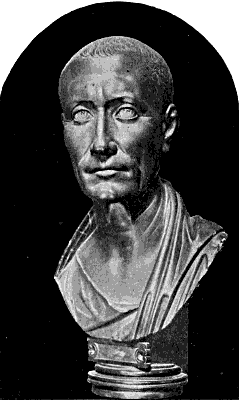
JULIUS CÆSAR.
An enumeration of his works, so far as their titles are known, is the best evidence of his versatility. A bit of criticism here and there shows the estimation in which Cæsar the writer and orator was held by his countrymen and contemporaries. Besides the military memoirs and the works spoken of above in connection with his pontificate, we may mention, as of a semi-official character, his astronomical treatise On the Stars (De Astris), published in connection with his reform of the calendar, when dictator, shortly before the end of his life.
Cicero alludes to a collection of witty sayings (Apophthegms) made by Cæsar, with evident satisfaction at the latter's ability to distinguish the real and the false Ciceronian bons mots.
Like most Roman gentlemen, Cæsar wrote in youth several poems, of which Tacitus grimly says that they were not better than Cicero's. This list includes a tragedy, 'Œdipus,' 'Laudes Herculis' (the Praises of Hercules), and a metrical account of a journey into Spain (Iter).
A grammatical treatise in two books (De Analogia), dedicated to Cicero, to the latter's immense gratification, was written on one of the numerous swift journeys from Italy to headquarters in Gaul. Passages from it are quoted by several subsequent writers, and an anecdote preserved by Aulus Gellius in his Noctes Atticæ I. 10. 4, wherein a young man is warned by Cæsar to avoid unusual and far-fetched language "like a rock," is supposed to be very characteristic of his general attitude in matters of literary taste. The 'Anticatones' were a couple of political pamphlets ridiculing Cato, the idol of the republicans. This was small business for Cæsar, but Cato had taken rather a mean advantage by his dramatic suicide at Utica, and deprived Cæsar of the "pleasure of pardoning him."
Of Cæsar's orations we have none but the most insignificant fragments—our judgment of them must be based on the testimony of ancient critics. Quintilian speaks in the same paragraph (Quintilian X. 1, 114) of the "wonderful elegance of his language" and of the "force" which made it "seem that he spoke with the same spirit with which he fought." Cicero's phrase "magnifica et generosa" (Cicero, Brutus, 261), and Fronto's "facultas dicendi imperatoria" (Fronto, Ep. p. 123), indicate "some kind of severe magnificence."
Collections of his letters were extant in the second century, but nothing now remains except a few brief notes to Cicero, copied by the latter in his correspondence with Atticus. This loss is perhaps the one most to be regretted. Letters reveal their author's personality better than more formal species of composition, and Cæsar was almost the last real letter-writer, the last who used in its perfection the polished, cultivated, conversational language, the Sermo urbanus.
But after all, we possess the most important of his writings, the Commentaries on the Gallic and Civil Wars. The first may be considered as a formal report to the Senate and the public on the conduct of his Gallic campaigns; the latter, as primarily intended for a defense of his constitutional position in the Civil War.
They are memoirs, half way between private notes and formal history. Cicero says that while their author "desired to give others the material out of which to create a history, he may perhaps have done a kindness to conceited writers who wish to trick them out with meretricious graces" (to "crimp with curling-irons"), "but he has deterred all men of sound taste from ever touching them. For in history a pure and brilliant conciseness of style is the highest attainable beauty." "They are worthy of all praise, for they are simple, straightforward and elegant, with all rhetorical ornament stripped from them as a garment is stripped." (Cicero, Brutus, 262.)
The seven books of the Gallic War are each the account of a year's campaigning. They were written apparently in winter quarters. When Cæsar entered on the administration of his province it was threatened with invasion. The Romans had never lost their dread of the northern barbarians, nor forgotten the capture of Rome three centuries before. Only a generation back, Marius had become the national hero by destroying the invading hordes of Cimbri and Teutones. Cæsar purposed to make the barbarians tremble at the Roman name. This first book of the Commentaries tells how he raised an army in haste, with which he outmarched, outmanœuvred and defeated the Helvetian nation. This people, urged by pressure behind and encouragement in front, had determined to leave its old home in the Alpine valleys and to settle in the fairer regions of southeastern France. Surprised and dismayed by Cæsar's terrific reception of their supposed invincible host, they had to choose between utter destruction and a tame return, with sadly diminished numbers, to their old abodes. Nor was this all the work of the first year. Ariovistus, a German king, also invited by a Gallic tribe, and relying on the terror of his nation's name, came to establish himself and his people on the Gallic side of the Rhine. He too was astonished at the tone with which Cæsar ordered him to depart, but soon found himself forced to return far more quickly than he had come.
Having thus vindicated the Roman claim to the frontiers of Gaul against other invaders, the proconsul devoted his second summer to the subjugation of the Belgæ, the most warlike and the most remote of the Gauls. The second book tells how this was accomplished. There was one moment when the conqueror's career came near ending prematurely. One of the Belgian tribes, the valiant Nervii, surprised and nearly defeated the Roman army. But steady discipline and the dauntless courage of the commander, never so great as in moments of mortal peril, saved the day, and the Nervii are immortalized as the people who nearly destroyed Cæsar.
These unprecedented successes all round the eastern and northern frontiers thoroughly established Roman prestige and strengthened Rome's supremacy over the central Gauls, who were already her allies, at least in name. But much yet remained to do. The work was but fairly begun. The third book tells of the conquest of the western tribes. The most interesting episode is the creation of a fleet and the naval victory over the Veneti on the far-away coast of Brittany. In the fourth year Cæsar crossed the Rhine, after building a wonderful wooden bridge in ten days, carried fire and sword among the Germans on the further bank, and returned to his side of the river, destroying the bridge behind him. Modern schoolboys wish he had never built it. Later in the season he made an expedition into Britain. This was followed in the fifth year by an invasion of the island in greater force. To people of our race this portion of the Commentaries is especially interesting. The southern part of the country was overrun, the Thames was crossed some miles above London, and several victories were gained, but no organized conquest was attempted. That remained for the age of Claudius and later emperors.
During the ensuing winter, on account of the scarcity of provisions, the Roman troops had to be quartered in separate detachments at long distances. One of these was treacherously destroyed by the Gauls, and the others were saved only by the extraordinary quickness with which Cæsar marched to their relief on hearing of their imminent danger. The chief part in this rising had been taken by the Eburones, led by their king Ambiorix. A large part of the sixth book is occupied with the recital of Cæsar's vengeance upon these people and their abettors, and with the vain pursuit of Ambiorix. The remainder contains an elaborate contrast of the manners and customs of the Gauls and Germans, which forms an important source for the history of the primitive institutions of these nations. The seventh book is the thrilling tale of the formidable rising of all the Gauls against their conquerors, under the leadership of Vercingetorix, an Arvernian chief. This man was a real hero,—brave, patriotic, resourceful, perhaps the only worthy antagonist that Cæsar ever met. This war strained to the utmost Cæsar's abilities and the disciplined valor of his legions. The Gauls nearly succeeded in undoing all the work of six years, in destroying the Roman army and in throwing off the Roman yoke. In this campaign, more conspicuously than ever before, Cæsar's success was due to the unexampled rapidity of his movements. So perfect had become the training of his troops and their confidence in his ability to win under all circumstances, that after a campaign of incredible exertions they triumphed over the countless hosts of their gallant foes, and in the next two years the last embers of Gaulish independence were finally stamped out. In all his later wars, Cæsar never had anything to fear from Gaul. As we read the story of Avaricum, of Gergovia, of Alesia, our sympathy goes out to the brave barbarians who were fighting for liberty—but we have to remember that though the cause of freedom failed, the cause of civilization triumphed. The eighth book, containing the account of the next two years, 51 and 50 b.c., was written by one of Cæsar's officers, Aulus Hirtius.
The first book of the Civil War begins with the year 49 b.c., where the struggle between Cæsar and the Senatorial party opens with his crossing of the Rubicon, attended by the advanced guard of his legions. Pompey proved a broken reed to those who leaned upon him, and Cæsar's conquest of the Italian peninsula was little else than a triumphal progress through the country. The enemy retired to the eastern shore of the Adriatic to muster the forces of the East on the side of the aristocracy, leaving Cæsar in possession of the capital and of the machinery of government. The latter part of the book contains the account of the campaign against Pompey's lieutenants in Spain, which was won almost without bloodshed, by masterly strategy, and which ended with the complete possession of the peninsula. The second book describes the capture of Marseilles after a long siege, and the tragic defeat and death of Curio, a brave but rash young officer sent by Cæsar to secure the African province. In the third book (48 b.c.) we have the story of the campaign against Pompey; first the audacious blockade for months of Pompey's greatly superior forces near Dyrrachium on the Illyrian coast; and when that failed, of the long march into Thessaly, where Pompey was at last forced into battle, against his judgment, by his own officers, on the fatal plains of Pharsalia; of the annihilation of the Senatorial army; of Pompey's flight to Egypt; of his treacherous murder there; of Cæsar's pursuit. The books on the Alexandrian, the African, and the Spanish wars, which continue the narrative down to Cæsar's final victory at Munda in southern Spain, are by other and inferior hands. The question of their authorship has been the subject of much controversy and conjecture.
Under this modest title of 'Commentaries,' in the guise of a simple narrative of events, Cæsar puts forth at once an inimitable history and a masterly apology. The author speaks of himself in the third person, tells of the circumstances of each situation in a quiet moderate way, which carries with it the conviction on the reader's part of his entire truthfulness, accuracy, and candor. We are persuaded that the Cæsar about whom he tells could not have acted otherwise than he did. In short, he exercises the same spell over our minds that he cast over the hearts of men twenty centuries ago.
There is nothing that so fascinates and enchains the imagination of men as power in another man. This man could captivate a woman by his sweetness or tame an angry mob of soldiers with a word; could mold the passions of a corrupt democracy or exterminate a nation in a day; could organize an empire or polish an epigram. His strength was terrible. But all this immense power was marvelously balanced and under perfect control. Nothing was too small for his delicate tact. Nothing that he did was so difficult but we feel he could have done more. Usually his means seemed inadequate to his ends. But it was Cæsar who used them.
The Commentaries show us this man at his work. They show him as an organizer of armies and alliances, a wily diplomatist, an intrepid soldier, an efficient administrator, a strategist of inspired audacity, a tactician of endless resources, an engineer of infinite inventiveness, an unerring judge of men. But he never boasts, except in speeches to hearten discouraged troops. He does not vilify or underrate his enemies.
His soldiers trusted him implicitly; there was no limit to their zeal. They found in him a generous appreciation of their deeds. Many a soldier and centurion has received immortality at his hands as the guerdon of valor. He describes a victory of Labienus with as much satisfaction as if it had been his own, and praises another lieutenant for his prudent self-restraint when tempted by a prospect of success. And he tells with hearty admiration of the devoted Gauls who sacrificed their lives one after another in a post of danger at Avaricum. Even in the Civil War no officers deserted him except Labienus and two Gaulish chiefs.
It was difficult to deceive him. His analysis of other men's motives is as merciless as it is passionless. He makes us disapprove the course of his antagonists with the same moderate but convincing statement with which he recommends his own. Few men can have had as few illusions as he. One would scarcely care to possess such an insight into the hearts of others. He seems to feel little warmth of indignation, and never indulges in invective. But woe to those who stood in the way of the accomplishment of his objects. Dreadful was the punishment of those who revolted after making peace. Still, even his vengeance seems dictated by policy rather than by passion. He is charged with awful cruelty because he slew a million men and sold another million into slavery. But he did not enjoy human suffering. These were simply necessary incidents in the execution of his plans. It is hard to see how European civilization could have proceeded without the conquest of Gaul, and it is surely better to make a conquest complete, rapid, overpowering, that the work may have to be done but once.
It is hard not to judge men by the standards of our own age. The ancients rarely felt an international humanity, and in his own time "Cæsar's clemency" was proverbial. As he was always careful not to waste in useless fighting the lives of his soldiers, so he was always true to his own precept, "Spare the citizens." The way in which he repeatedly forgave his enemies when they were in his power was an example to many a Christian conqueror. The best of his antagonists showed themselves bloodthirsty in word or act; and most of them, not excepting Cicero, were basely ungrateful for his forbearance. His treatment of Cicero was certainly most handsome—our knowledge of it is derived mainly from Cicero's letters. Perhaps this magnanimity was dashed with a tinge of kindly contempt for his fellow-citizens; but whatever its motives, it was certainly wise and benign at the beginning of the new era he was inaugurating. He was no vulgar destroyer, and did not desire to ruin in order to rule.
He is charged with ambition, the sin by which the angels fell. It is not for us to fathom the depths of his mighty mind. Let us admit the charge. But it was not an ignoble ambition. Let us say that he was so ambitious that he laid the foundations of the Roman Empire and of modern France; that his services to civilization and his plans for humanity were so broad that patriots were driven to murder him.
Some of Cæsar's eulogists have claimed for him a moral greatness corresponding to his transcendent mental power. This is mistaken zeal. He may stand as the supreme representative of the race in the way of practical executive intellect. It is poor praise to put him into another order of men, with Plato or with Paul. Their greatness was of another kind. We cannot speak of degrees. He is the exponent of creative force in political history—not of speculative or ethical power.
Moreover, with all his originality of conception and power of execution, Cæsar lacked that kind of imagination which makes the true poet, the real creative artist in literature. Thus we observe the entire absence of the pictorial element in his writings. There is no trace of his ever being affected by the spectacular incidents of warfare nor by the grandeur of the natural scenes through which he passed. The reason may be that his intellect was absorbed in the contemplation of men and motives, of means and ends. We cannot conceive of his ever having been carried out of himself by the rapture of inspiration. Such clearness of mental perception is naturally accompanied by a certain coolness of temperament. A man of superlative greatness must live more or less alone among his fellows. With his immense grasp of the relations of things in the world, Cæsar cannot have failed to regard men to some extent as the counters in a great game—himself the player. So he used men, finding them instruments—efficient and zealous, often—of his far-reaching plans. He was just in rewarding their services—more than just: he was generous and kind. But he did not have real associates, real friends; therefore it is not surprising that he met with so little gratitude. Even his diction shows this independence, this isolation. It would be difficult to find an author of any nation in a cultivated age so free from the influence of the language of his predecessors. Cæsar was unique among the great Roman writers in having been born at the capital. Appropriately he is the incarnation of the specifically Roman spirit in literature, as Cicero was the embodiment of the Italian, the Hellenic, the cosmopolitan spirit.
Toward the close of Cæsar's career there are some signs of weariness observable—a certain loss of serenity, a suspicion of vanity, a dimming of his penetrating vision into the men about him. The only wonder is that mind and body had not succumbed long before to the prodigious strain put upon them. Perhaps it is well that he died when he did, hardly past his prime. So he went to his setting, like the other "weary Titan," leaving behind him a brightness which lasted all through the night of the Dark Ages. Cæsar died, but the imperial idea of which he was the first embodiment has proved the central force of European political history even down to our time.
Such is the man who speaks to us from his pages still. He was a man who did things rather than a man who said things. Yet who could speak so well? His mastery of language was perfect, but in the same way as his mastery of other instruments. Style with him was a means rather than an end. He had the training which others of his kind enjoyed. Every Roman noble had to learn oratory. But Cæsar wrote and spoke with a faultless taste and a distinction that no training could impart. So we find in his style a beauty which does not depend upon ornament, but upon perfect proportion; a diction plain and severe almost to baldness; absolute temperateness of expression. The descriptions are spirited, but never made so by strained rhetoric; the speeches are brief, manly, business-like; the arguments calm and convincing; always and everywhere the language of a strong man well inside the limits of his power.
The chief ancient authorities for the life of Cæsar, besides his own works, are Suetonius in Latin, Plutarch and Appian in Greek. Among modern works of which he is made the subject may be mentioned 'Jules César,' by Napoleon III. (Paris, 1865); continued by Colonel Stoffel, with an Atlas; 'Cæsar, a Sketch,' by J. A. Froude (London, 1886); 'Cæsar,' by A. Trollope (London, 1870); 'Cæsar,' by T. A. Dodge, U.S.A. (Boston, 1893).

THE DEFEAT OF ARIOVISTUS AND THE GERMANS
From 'The Gallic Wars'
When he had proceeded three days' journey, word was brought to him that Ariovistus was hastening with all his forces to seize on Vesontio,115 which is the largest town of the Sequani, and had advanced three days' journey from his territories. Cæsar thought that he ought to take the greatest precautions lest this should happen, for there was in that town a most ample supply of everything which was serviceable for war; and so fortified was it by the nature of the ground as to afford a great facility for protracting the war, inasmuch as the river Doubs almost surrounds the whole town, as though it were traced round with a pair of compasses. A mountain of great height shuts in the remaining space, which is not more than six hundred feet, where the river leaves a gap in such a manner that the roots of that mountain extend to the river's bank on either side. A wall thrown around it makes a citadel of this mountain, and connects it with the town. Hither Cæsar hastens by forced marches by night and day, and after having seized the town, stations a garrison there.
Whilst he is tarrying a few days at Vesontio, on account of corn and provisions; from the inquiries of our men and the reports of the Gauls and traders (who asserted that the Germans were men of huge stature, of incredible valor and practice in arms,—that ofttimes they, on encountering them, could not bear even their countenance and the fierceness of their eyes), so great a panic on a sudden seized the whole army, as to discompose the minds and spirits of all in no slight degree. This first arose from the tribunes of the soldiers, the prefects and the rest, who, having followed Cæsar from the city [Rome] from motives of friendship, had no great experience in military affairs. And alleging, some of them one reason, some another, which they said made it necessary for them to depart, they requested that by his consent they might be allowed to withdraw; some, influenced by shame, stayed behind in order that they might avoid the suspicion of cowardice. These could neither compose their countenance, nor even sometimes check their tears: but hidden in their tents, either bewailed their fate or deplored with their comrades the general danger. Wills were sealed universally throughout the whole camp. By the expressions and cowardice of these men, even those who possessed great experience in the camp, both soldiers and centurions, and those [the decurions] who were in command of the cavalry, were gradually disconcerted. Such of them as wished to be considered less alarmed said that they did not dread the enemy, but feared the narrowness of the roads and the vastness of the forests which lay between them and Ariovistus, or else that the supplies could not be brought up readily enough. Some even declared to Cæsar that when he gave orders for the camp to be moved and the troops to advance, the soldiers would not be obedient to the command nor advance, in consequence of their fear.
When Cæsar observed these things, having called a council, and summoned to it the centurions of all the companies, he severely reprimanded them, "particularly for supposing that it belonged to them to inquire or conjecture either in what direction they were marching or with what object. That Ariovistus during his [Cæsar's] consulship had most anxiously sought after the friendship of the Roman people; why should any one judge that he would so rashly depart from his duty? He for his part was persuaded that when his demands were known and the fairness of the terms considered, he would reject neither his nor the Roman people's favor. But even if, driven on by rage and madness, he should make war upon them, what after all were they afraid of?—or why should they despair either of their own valor or of his zeal? Of that enemy a trial had been made within our fathers' recollection, when on the defeat of the Cimbri and Teutones by Caius Marius, the army was regarded as having deserved no less praise than their commander himself. It had been made lately too in Italy, during the rebellion of the slaves, whom, however, the experience and training which they had received from us assisted in some respect. From which a judgment might be formed of the advantages which resolution carries with it,—inasmuch as those whom for some time they had groundlessly dreaded when unarmed, they had afterwards vanquished when well armed and flushed with success. In short, that these were the same men whom the Helvetii, in frequent encounters, not only in their own territories, but also in theirs [the German], have generally vanquished, and yet cannot have been a match for our army. If the unsuccessful battle and flight of the Gauls disquieted any, these, if they made inquiries, might discover that when the Gauls had been tired out by the long duration of the war, Ariovistus, after he had many months kept himself in his camp and in the marshes, and had given no opportunity for an engagement, fell suddenly upon them, by this time despairing of a battle and scattered in all directions; and was victorious more through stratagem and cunning than valor. But though there had been room for such stratagem against savage and unskilled men, not even Ariovistus himself expected that thereby our armies could be entrapped. That those who ascribed their fear to a pretense about the deficiency of supplies and the narrowness of the roads acted presumptuously, as they seemed either to distrust their general's discharge of his duty or to dictate to him. That these things were his concern; that the Sequani, the Leuci, and the Lingones were to furnish the corn; and that it was already ripe in the fields; that as to the road, they would soon be able to judge for themselves. As to its being reported that the soldiers would not be obedient to command, or advance, he was not at all disturbed at that; for he knew that in the case of all those whose army had not been obedient to command, either upon some mismanagement of an affair fortune had deserted them, or that upon some crime being discovered covetousness had been clearly proved against them. His integrity had been seen throughout his whole life, his good fortune in the war with the Helvetii. That he would therefore instantly set about what he had intended to put off till a more distant day, and would break up his camp the next night in the fourth watch, that he might ascertain as soon as possible whether a sense of honor and duty, or whether fear, had more influence with them. But that if no one else should follow, yet he would go with only the tenth legion, of which he had no misgivings, and it should be his prætorian cohort."—This legion Cæsar had both greatly favored, and in it, on account of its valor, placed the greatest confidence.
Upon the delivery of this speech, the minds of all were changed in a surprising manner, and the highest ardor and eagerness for prosecuting the war were engendered; and the tenth legion was the first to return thanks to him, through their military tribunes, for his having expressed this most favorable opinion of them; and assured him that they were quite ready to prosecute the war. Then the other legions endeavored, through their military tribunes and the centurions of the principal companies, to excuse themselves to Cæsar, saying that they had never either doubted or feared, or supposed that the determination of the conduct of the war was theirs and not their general's. Having accepted their excuse, and having had the road carefully reconnoitred by Divitiacus, because in him of all others he had the greatest faith, he found that by a circuitous route of more than fifty miles he might lead his army through open parts; he then set out in the fourth watch, as he had said he would. On the seventh day, as he did not discontinue his march, he was informed by scouts that the forces of Ariovistus were only four-and-twenty miles distant from ours.
Upon being apprised of Cæsar's arrival, Ariovistus sends ambassadors to him, saying that what he had before requested as to a conference might now, as far as his permission went, take place, since he [Cæsar] had approached nearer; and he considered that he might now do it without danger. Cæsar did not reject the proposal, and began to think that he was now returning to a rational state of mind, as he voluntarily proffered that which he had previously refused to him when he requested it; and was in great hopes that, in consideration of his own and the Roman people's great favors towards him, the issue would be that he would desist from his obstinacy upon his demands being made known. The fifth day after that was appointed as the day of conference. Meanwhile, as ambassadors were being often sent to and fro between them, Ariovistus demanded that Cæsar should not bring any foot-soldier with him to the conference, saying that "he was afraid of being ensnared by him through treachery; that both should come accompanied by cavalry; that he would not come on any other condition." Cæsar, as he neither wished that the conference should, by an excuse thrown in the way, be set aside, nor durst trust his life to the cavalry of the Gauls, decided that it would be most expedient to take away from the Gallic cavalry all their horses, and thereon to mount the legionary soldiers of the tenth legion, in which he placed the greatest confidence; in order that he might have a body-guard as trustworthy as possible, should there be any need for action. And when this was done, one of the soldiers of the tenth legion said, not without a touch of humor, "that Cæsar did more for them than he had promised: he had promised to have the tenth legion in place of his prætorian cohort; but he now converted them into horse."
There was a large plain, and in it a mound of earth of considerable size. This spot was at nearly an equal distance from both camps. Thither, as had been appointed, they came for the conference. Cæsar stationed the legion which he had brought with him on horseback, two hundred paces from this mound. The cavalry of Ariovistus also took their stand at an equal distance. Ariovistus then demanded that they should confer on horseback, and that, besides themselves, they should bring with them ten men each to the conference. When they were come to the place, Cæsar, in the opening of his speech, detailed his own and the Senate's favors towards him [Ariovistus], "in that he had been styled king, in that he had been styled friend, by the Senate,—in that very considerable presents had been sent him; which circumstance he informed him had both fallen to the lot of few, and had usually been bestowed in consideration of important personal services; that he, although he had neither an introduction, nor a just ground for the request, had obtained these honors through the kindness and munificence of himself [Cæsar] and the Senate. He informed him, too, how old and how just were the grounds of connection that existed between themselves [the Romans] and the Ædui, what decrees of the Senate had been passed in their favor, and how frequent and how honorable; how from time immemorial the Ædui had held the supremacy of the whole of Gaul; even, said Cæsar, before they had sought our friendship; that it was the custom of the Roman people to desire not only that its allies and friends should lose none of their property, but be advanced in influence, dignity, and honor: who then could endure that what they had brought with them to the friendship of the Roman people should be torn from them?" He then made the same demands which he had commissioned the ambassadors to make, that Ariovistus should not make war either upon the Ædui or their allies; that he should restore the hostages; that if he could not send back to their country any part of the Germans, he should at all events suffer none of them any more to cross the Rhine.
Ariovistus replied briefly to the demands of Cæsar, but expatiated largely on his own virtues: "that he had crossed the Rhine not of his own accord, but on being invited and sent for by the Gauls; that he had not left home and kindred without great expectations and great rewards; that he had settlements in Gaul, granted by the Gauls themselves; that the hostages had been given by their own good-will; that he took by right of war the tribute which conquerors are accustomed to impose on the conquered; that he had not made war upon the Gauls, but the Gauls upon him; that all the States of Gaul came to attack him, and had encamped against him; that all their forces had been routed and beaten by him in a single battle; that if they chose to make a second trial, he was ready to encounter them again; but if they chose to enjoy peace, it was unfair to refuse the tribute which of their own free-will they had paid up to that time. That the friendship of the Roman people ought to prove to him an ornament and a safeguard, not a detriment; and that he sought it with that expectation. But if through the Roman people the tribute was to be discontinued, and those who surrendered to be seduced from him, he would renounce the friendship of the Roman people no less heartily than he had sought it. As to his leading over a host of Germans into Gaul, that he was doing this with a view of securing himself, not of assaulting Gaul: that there was evidence of this, in that he did not come without being invited, and in that he did not make war, but merely warded it off. That he had come into Gaul before the Roman people. That never before this time did a Roman army go beyond the frontiers of the province of Gaul. What, said he, does Cæsar desire?—why come into his [Ariovistus's] domains?—that this was his province of Gaul, just as that is ours. As it ought not to be pardoned in him if he were to make an attack upon our territories, so likewise that we were unjust to obstruct him in his prerogative. As for Cæsar's saying that the Ædui had been styled 'brethren' by the Senate, he was not so uncivilized nor so ignorant of affairs as not to know that the Ædui in the very last war with the Allobroges had neither rendered assistance to the Romans nor received any from the Roman people in the struggles which the Ædui had been maintaining with him and with the Sequani. He must feel suspicious that Cæsar, though feigning friendship as the reason for his keeping an army in Gaul, was keeping it with the view of crushing him. And that unless he depart and withdraw his army from these parts, he shall regard him not as a friend, but as a foe; and that even if he should put him to death, he should do what would please many of the nobles and leading men of the Roman people; he had assurance of that from themselves through their messengers, and could purchase the favor and the friendship of them all by his [Cæsar's] death. But if he would depart and resign to him the free possession of Gaul, he would recompense him with a great reward, and would bring to a close whatever wars he wished to be carried on, without any trouble or risk to him."
Many things were stated by Cæsar to the following effect:—"That he could not waive the business, and that neither his nor the Roman people's practice would suffer him to abandon most meritorious allies; nor did he deem that Gaul belonged to Ariovistus rather than to the Roman people; that the Arverni116 and the Ruteni117 had been subdued in war by Quintus Fabius Maximus, and that the Roman people had pardoned them and had not reduced them into a province or imposed a tribute upon them. And if the most ancient period was to be regarded, then was the sovereignty of the Roman people in Gaul most just: if the decree of the Senate was to be observed, then ought Gaul to be free, which they [the Romans] had conquered in war, and had permitted to enjoy its own laws."
While these things were being transacted in the conference, it was announced to Cæsar that the cavalry of Ariovistus were approaching nearer the mound, and were riding up to our men and casting stones and weapons at them. Cæsar made an end of his speech and betook himself to his men; and commanded them that they should by no means return a weapon upon the enemy. For though he saw that an engagement with the cavalry would be without any danger to his chosen legion, yet he did not think proper to engage, lest after the enemy were routed it might be said that they had been ensnared by him under the sanction of a conference. When it was spread abroad among the common soldiery with what haughtiness Ariovistus had behaved at the conference, and how he had ordered the Romans to quit Gaul, and how his cavalry had made an attack upon our men, and how this had broken off the conference, a much greater alacrity and eagerness for battle was infused into our army.
Two days after, Ariovistus sends ambassadors to Cæsar to state that "he wished to treat with him about those things which had been begun to be treated of between them, but had not been concluded"; and to beg that "he would either again appoint a day for a conference, or if he were not willing to do that, that he would send one of his officers as an ambassador to him." There did not appear to Cæsar any good reason for holding a conference; and the more so as the day before, the Germans could not be restrained from casting weapons at our men. He thought he should not without great danger send to him as ambassador one of his Roman officers, and should expose him to savage men. It seemed therefore most proper to send to him C. Valerius Procillus, the son of C. Valerius Caburus, a young man of the highest courage and accomplishments (whose father had been presented with the freedom of the city by C. Valerius Flaccus), both on account of his fidelity and on account of his knowledge of the Gallic language,—which Ariovistus, by long practice, now spoke fluently,—and because in his case the Germans would have no motive for committing violence;118 and for his colleague, M. Mettius, who had shared the hospitality of Ariovistus. He commissioned them to learn what Ariovistus had to say, and to report to him. But when Ariovistus saw them before him in his camp, he cried out in the presence of his army, "Why were they come to him? was it for the purpose of acting as spies?" He stopped them when attempting to speak, and cast them into chains.
The same day he moved his camp forward and pitched under a hill six miles from Cæsar's camp. The day following he led his forces past Cæsar's camp, and encamped two miles beyond him; with this design—that he might cut off Cæsar from the corn and provisions which might be conveyed to him from the Sequani and the Ædui. For five successive days from that day Cæsar drew out his forces before the camp and put them in battle order, that if Ariovistus should be willing to engage in battle, an opportunity might not be wanting to him. Ariovistus all this time kept his army in camp, but engaged daily in cavalry skirmishes. The method of battle in which the Germans had practiced themselves was this: There were six thousand horse, and as many very active and courageous foot, one of whom each of the horse selected out of the whole army for his own protection. By these men they were constantly accompanied in their engagements; to these the horse retired; these on any emergency rushed forward; if any one, upon receiving a very severe wound, had fallen from his horse, they stood around him; if it was necessary to advance farther than usual or to retreat more rapidly, so great, from practice, was their swiftness, that supported by the manes of the horses they could keep pace with their speed.
Perceiving that Ariovistus kept himself in camp, Cæsar, that he might not any longer be cut off from provisions, chose a convenient position for a camp beyond that place in which the Germans had encamped, at about six hundred paces from them, and having drawn up his army in three lines, marched to that place. He ordered the first and second lines to be under arms; the third to fortify the camp. This place was distant from the enemy about six hundred paces, as has been stated. Thither Ariovistus sent light troops, about sixteen thousand men in number, with all his cavalry; which forces were to intimidate our men and hinder them in their fortification. Cæsar nevertheless, as he had before arranged, ordered two lines to drive off the enemy; the third to execute the work. The camp being fortified, he left there two legions and a portion of the auxiliaries, and led back the other four legions into the larger camp.
The next day, according to his custom, Cæsar led out his forces from both camps, and having advanced a little from the larger one, drew up his line of battle, and gave the enemy an opportunity of fighting. When he found that they did not even then come out from their intrenchments, he led back his army into camp about noon. Then at last Ariovistus sent part of his forces to attack the lesser camp. The battle was vigorously maintained on both sides till the evening. At sunset, after many wounds had been inflicted and received, Ariovistus led back his forces into camp. When Cæsar inquired of his prisoners wherefore Ariovistus did not come to an engagement, he discovered this to be the reason—that among the Germans it was the custom for their matrons to pronounce from lots and divination whether it were expedient that the battle should be engaged in or not; that they had said that "it was not the will of heaven that the Germans should conquer, if they engaged in battle before the new moon."
The day following, Cæsar left what seemed sufficient as a guard for both camps; and then drew up all the auxiliaries in sight of the enemy, before the lesser camp, because he was not very powerful in the number of legionary soldiers, considering the number of the enemy; that thereby he might make use of his auxiliaries for appearance. He himself, having drawn up his army in three lines, advanced to the camp of the enemy. Then at last of necessity the Germans drew their forces out of camp and disposed them canton by canton, at equal distances, the Harudes, Marcomanni, Tribocci, Vangiones, Nemetes, Sedusii, Suevi; and surrounded their whole army with their chariots and wagons, that no hope might be left in flight. On these they placed their women, who, with disheveled hair and in tears, entreated the soldiers, as they went forward to battle, not to deliver them into slavery to the Romans.
Cæsar appointed over each legion a lieutenant and a quæstor, that every one might have them as witnesses of his valor. He himself began the battle at the head of the right wing, because he had observed that part of the enemy to be the least strong. Accordingly our men, upon the signal being given, vigorously made an attack upon the enemy, and the enemy so suddenly and rapidly rushed forward that there was no time for casting the javelins at them. Throwing aside, therefore, their javelins, they fought with swords hand to hand. But the Germans, according to their custom, rapidly forming a phalanx, sustained the attack of our swords. There were found very many of our soldiers who leaped upon the phalanx, and with their hands tore away the shields and wounded the enemy from above. Although the army of the enemy was routed on the left wing and put to flight, they still pressed heavily on our men from the right wing, by the great number of their troops. On observing this, P. Crassus the Younger, who commanded the cavalry,—as he was more disengaged than those who were employed in the fight,—sent the third line as a relief to our men who were in distress.
Thereupon the engagement was renewed, and all the enemy turned their backs, nor did they cease to flee until they arrived at the river Rhine, about fifty miles from that place. There some few, either relying on their strength, endeavored to swim over, or finding boats procured their safety. Among the latter was Ariovistus, who, meeting with a small vessel tied to the bank, escaped in it: our horse pursued and slew all the rest of them. Ariovistus had two wives, one a Suevan by nation, whom he had brought with him from home; the other a Norican, the sister of King Vocion, whom he had married in Gaul, she having been sent thither for that purpose by her brother. Both perished in that flight. Of their two daughters, one was slain, the other captured. C. Valerius Procillus, as he was being dragged by his guards in the flight, bound with a triple chain, fell into the hands of Cæsar himself, as he was pursuing the enemy with his cavalry. This circumstance indeed afforded Cæsar no less pleasure than the victory itself; because he saw a man of the first rank in the province of Gaul, his intimate acquaintance and friend, rescued from the hand of the enemy and restored to him, and that fortune had not diminished aught of the joy and exultation of that day by his destruction. He [Procillus] said that in his own presence the lots had been thrice consulted respecting him, whether he should immediately be put to death by fire or be reserved for another time: that by the favor of the lots he was uninjured. M. Mettius also was found and brought back to him [Cæsar].
This battle having been reported beyond the Rhine, the Suevi, who had come to the banks of that river, began to return home; when the Ubii,119 who dwelt nearest to the Rhine, pursuing them while much alarmed, slew a great number of them. Cæsar, having concluded two very important wars in one campaign, conducted his army into winter quarters among the Sequani a little earlier than the season of the year required. He appointed Labienus over the winter quarters, and set out in person for hither Gaul to hold the assizes.
ON THE MANNERS AND CUSTOMS OF ANCIENT GAULS AND GERMANS
From 'The Gallic Wars'
Since we have come to this place, it does not appear to be foreign to our subject to lay before the reader an account of the manners of Gaul and Germany, and wherein these nations differ from each other. In Gaul there are factions not only in all the States, and in all the cantons and their divisions, but almost in each family; and of these factions those are the leaders who are considered according to their judgment to possess the greatest influence, upon whose will and determination the management of all affairs and measures depends. And that seems to have been instituted in ancient times with this view, that no one of the common people should be in want of support against one more powerful; for none of those leaders suffers his party to be oppressed and defrauded, and if he do otherwise, he has no influence among his party. This same policy exists throughout the whole of Gaul; for all the States are divided into two factions.
When Cæsar arrived in Gaul, the Ædui were the leaders of one faction, the Sequani of the other. Since the latter were less powerful by themselves, inasmuch as the chief influence was from of old among the Ædui, and their dependencies were great, they had united to themselves the Germans and Ariovistus, and had brought them over to their party by great sacrifices and promises. And having fought several successful battles and slain all the nobility of the Ædui, they had so far surpassed them in power that they brought over from the Ædui to themselves a large portion of their dependants, and received from them the sons of their leading men as hostages, and compelled them to swear in their public character that they would enter into no design against them; and held a portion of the neighboring land, seized on by force, and possessed the sovereignty of the whole of Gaul. Divitiacus, urged by this necessity, had proceeded to Rome to the Senate for the purpose of entreating assistance, and had returned without accomplishing his object. A change of affairs ensued on the arrival of Cæsar: the hostages were returned to the Ædui, their old dependencies restored, and new ones acquired through Cæsar (because those who had attached themselves to their alliance saw that they enjoyed a better state and a milder government); their other interests, their influence, their reputation were likewise increased, and in consequence the Sequani lost the sovereignty. The Remi succeeded to their place, and as it was perceived that they equaled the Ædui in favor with Cæsar, those who on account of their old animosities could by no means coalesce with the Ædui, consigned themselves in clientship to the Remi. The latter carefully protected them. Thus they possessed both a new and suddenly acquired influence. Affairs were then in that position, that the Ædui were considered by far the leading people, and the Remi held the second post of honor.
Throughout all Gaul there are two orders of those men who are of any rank and dignity: for the commonalty is held almost in the condition of slaves, and dares to undertake nothing of itself and is admitted to no deliberation. The greater part, when they are pressed either by debt, or the large amount of their tributes, or the oppression of the more powerful, give themselves up in vassalage to the nobles, who possess over them the same rights, without exception, as masters over their slaves. But of these two orders, one is that of the Druids, the other that of the knights. The former are engaged in things sacred, conduct the public and the private sacrifices, and interpret all matters of religion. To these a large number of the young men resort for the purpose of instruction, and they [the Druids] are in great honor among them. For they determine respecting almost all controversies, public and private; and if any crime has been perpetrated, if murder has been committed, if there be any dispute about an inheritance, if any about boundaries, these same persons decide it; they decree rewards and punishments; if any one, either in a private or public capacity, has not submitted to their decision, they interdict him from the sacrifices. This among them is the most heavy punishment. Those who have been thus interdicted are esteemed in the number of the impious and criminal: all shun them, and avoid their society and conversation, lest they receive some evil from their contact; nor is justice administered to them when seeking it, nor is any dignity bestowed on them. Over all these Druids one presides, who possesses supreme authority among them. Upon his death, if any individual among the rest is pre-eminent in dignity, he succeeds; but if there are many equal, the election is made by the suffrages of the Druids; sometimes they even contend for the presidency with arms. These assemble at a fixed period of the year in a consecrated place in the territories of the Carnutes, which is reckoned the central region of the whole of Gaul. Hither all who have disputes assemble from every part and submit to their decrees and determinations. This institution is supposed to have been devised in Britain, and to have been brought over from it into Gaul; and now those who desire to gain a more accurate knowledge of that system generally proceed thither for the purpose of studying it.
The Druids do not go to war, nor pay tribute together with the rest; they have an exemption from military service and a dispensation in all matters. Induced by such great advantages, many embrace this profession of their own accord, and many are sent to it by their parents and relations. They are said there to learn by heart a great number of verses; accordingly some remain in the course of training twenty years. Nor do they regard it lawful to commit these to writing, though in almost all other matters, in their public and private transactions, they use Greek characters. That practice they seem to me to have adopted for two reasons: because they neither desire their doctrines to be divulged among the mass of the people, nor those who learn, to devote themselves the less to the efforts of memory, relying on writing; since it generally occurs to most men that in their dependence on writing they relax their diligence in learning thoroughly, and their employment of the memory. They wish to inculcate this as one of their leading tenets: that souls do not become extinct, but pass after death from one body to another; and they think that men by this tenet are in a great degree excited to valor, the fear of death being disregarded. They likewise discuss and impart to the youth many things respecting the stars and their motion; respecting the extent of the world and of our earth; respecting the nature of things; respecting the power and the majesty of the immortal gods.
The other order is that of the knights. These, when there is occasion and any war occurs (which before Cæsar's arrival was for the most part wont to happen every year, as either they on their part were inflicting injuries or repelling those which others inflicted on them), are all engaged in war. And those of them most distinguished by birth and resources have the greatest number of vassals and dependants about them. They acknowledge this sort of influence and power only.
The nation of all the Gauls is extremely devoted to superstitious rites; and on that account they who are troubled with unusually severe diseases, and they who are engaged in battles and dangers, either sacrifice men as victims, or vow that they will sacrifice them, and employ the Druids as the performers of those sacrifices; because they think that unless the life of a man be offered for the life of a man, the mind of the immortal gods cannot be rendered propitious, and they have sacrifices of that kind ordained for national purposes. Others have figures of vast size, the limbs of which formed of osiers they fill with living men, which being set on fire, the men perish enveloped in the flames. They consider that the oblation of such as have been taken in theft, or in robbery, or any other offense, is more acceptable to the immortal gods; but when a supply of that class is wanting, they have recourse to the oblation of even the innocent.
They worship as their divinity Mercury in particular, and have many images of him, and regard him as the inventor of all arts; they consider him the guide of their journeys and marches, and believe him to have very great influence over the acquisition of gain and mercantile transactions. Next to him they worship Apollo, and Mars, and Jupiter, and Minerva; respecting these deities they have for the most part the same belief as other nations: that Apollo averts diseases, that Minerva imparts the invention of manufactures, that Jupiter possesses the sovereignty of the heavenly powers; that Mars presides over wars. To him, when they have determined to engage in battle, they commonly vow those things which they shall take in war. When they have conquered, they sacrifice whatever captured animals may have survived the conflict, and collect the other things into one place. In many States you may see piles of these things heaped up in their consecrated spots; nor does it often happen that any one, disregarding the sanctity of the case, dares either to secrete in his house things captured, or take away those deposited; and the most severe punishment, with torture, has been established for such a deed.
All the Gauls assert that they are descended from the god Dis, and say that this tradition has been handed down by the Druids. For that reason they compute the divisions of every season, not by the number of days, but of nights; they keep birthdays and the beginnings of months and years in such an order that the day follows the night. Among the other usages of their life, they differ in this from almost all other nations; that they do not permit their children to approach them openly until they are grown up so as to be able to bear the service of war; and they regard it as indecorous for a son of boyish age to stand in public in the presence of his father.
Whatever sums of money the husbands have received in the name of dowry from their wives, making an estimate of it, they add the same amount out of their own estates. An account is kept of all this money conjointly, and the profits are laid by; whichever of them shall have survived the other, to that one the portion of both reverts, together with the profits of the previous time. Husbands have power of life and death over their wives as well as over their children: and when the father of a family born in a more than commonly distinguished rank has died, his relations assemble, and if the circumstances of his death are suspicious, hold an investigation upon the wives in the manner adopted towards slaves; and if proof be obtained, put them to severe torture and kill them. Their funerals, considering the state of civilization among the Gauls, are magnificent and costly; and they cast into the fire all things, including living creatures, which they suppose to have been dear to them when alive; and a little before this period, slaves and dependants who were ascertained to have been beloved by them were, after the regular funeral rites were completed, burnt together with them.
Those States which are considered to conduct their commonwealth more judiciously have it ordained by their laws, that if any person shall have heard by rumor and report from his neighbors anything concerning the commonwealth, he shall convey it to the magistrate and not impart it to any other; because it has been discovered that inconsiderate and inexperienced men were often alarmed by false reports and driven to some rash act, or else took hasty measures in affairs of the highest importance. The magistrates conceal those things which require to be kept unknown; and they disclose to the people whatever they determine to be expedient. It is not lawful to speak of the commonwealth except in council.
The Germans differ much from these usages, for they have neither Druids to preside over sacred offices nor do they pay great regard to sacrifices. They rank in the number of the gods those alone whom they behold, and by whose instrumentality they are obviously benefited,—namely, the sun, fire, and the moon; they have not heard of the other deities even by report. Their whole life is occupied in hunting and in the pursuits of the military art; from childhood they devote themselves to fatigue and hardships. Those who have remained chaste for the longest time receive the greatest commendation among their people; they think that by this the growth is promoted, by this the physical powers are increased and the sinews are strengthened. And to have had knowledge of a woman before the twentieth year they reckon among the most disgraceful acts; of which matter there is no concealment, because they bathe promiscuously in the rivers and only use skins or small cloaks of deer's hides, a large portion of the body being in consequence naked.
They do not pay much attention to agriculture, and a large portion of their food consists in milk, cheese, and flesh; nor has any one a fixed quantity of land or his own individual limits; but the magistrates and the leading men each year apportion to the tribes and families who have united together, as much land as, and in the place in which, they think proper, and the year after compel them to remove elsewhere. For this enactment they advance many reasons—lest seduced by long-continued custom, they may exchange their ardor in the waging of war for agriculture; lest they may be anxious to acquire extensive estates, and the more powerful drive the weaker from their possessions; lest they construct their houses with too great a desire to avoid cold and heat; lest the desire of wealth spring up, from which cause divisions and discords arise; and that they may keep the common people in a contented state of mind, when each sees his own means placed on an equality with [those of] the most powerful.
It is the greatest glory to the several States to have as wide deserts as possible around them, their frontiers having been laid waste. They consider this the real evidence of their prowess, that their neighbors shall be driven out of their lands and abandon them, and that no one dare settle near them; at the same time they think that they shall be on that account the more secure, because they have removed the apprehension of a sudden incursion. When a State either repels war waged against it or wages it against another, magistrates are chosen to preside over that war with such authority that they have power of life and death. In peace there is no common magistrate, but the chiefs of provinces and cantons administer justice and determine controversies among their own people. Robberies which are committed beyond the boundaries of each State bear no infamy, and they avow that these are committed for the purpose of disciplining their youth and of preventing sloth. And when any of their chiefs has said in an assembly that "he will be their leader; let those who are willing to follow, give in their names," they who approve of both the enterprise and the man arise and promise their assistance and are applauded by the people; such of them as have not followed him are accounted in the number of deserters and traitors, and confidence in all matters is afterwards refused them.
To injure guests they regard as impious; they defend from wrong those who have come to them for any purpose whatever, and esteem them inviolable; to them the houses of all are open and maintenance is freely supplied.
And there was formerly a time when the Gauls excelled the Germans in prowess, and waged war on them offensively, and on account of the great number of their people and the insufficiency of their land, sent colonies over the Rhine. Accordingly, the Volcæ Tectosăges seized on those parts of Germany which are the most fruitful and lie around the Hercynian forest (which I perceive was known by report to Eratosthenes and some other Greeks, and which they call Orcynia), and settled there. Which nation to this time retains its position in those settlements, and has a very high character for justice and military merit: now also they continue in the same scarcity, indigence, hardihood, as the Germans, and use the same food and dress; but their proximity to the Province and knowledge of commodities from countries beyond the sea supplies to the Gauls many things tending to luxury as well as civilization. Accustomed by degrees to be overmatched and worsted in many engagements, they do not even compare themselves to the Germans in prowess.
The breadth of this Hercynian forest which has been referred to above is, to a quick traveler, a journey of nine days. For it cannot be otherwise computed, nor are they acquainted with the measures of roads. It begins at the frontiers of the Helvetii, Nemetes, and Rauraci, and extends in a right line along the river Danube to the territories of the Daci and the Anartes; it bends thence to the left in a different direction from the river, and owing to its extent, touches the confines of many nations; nor is there any person belonging to this part of Germany who says that he either has gone to the extremity of that forest, though he had advanced a journey of sixty days, or has heard in what place it begins. It is certain that many kinds of wild beast are produced in it which have not been seen in other parts; of which the following are such as differ principally from other animals and appear worthy of being committed to record.
There is an ox of the shape of a stag, between whose ears a horn rises from the middle of the forehead, higher and straighter than those horns which are known to us. From the top of this, branches, like palms, stretch out a considerable distance. The shape of the female and of the male is the same; the appearance and the size of the horns is the same.
There are also animals which are called elks. The shape of these, and the varied color of their skins, is much like roes, but in size they surpass them a little and are destitute of horns, and have legs without joints and ligatures; nor do they lie down for the purpose of rest, nor if they have been thrown down by any accident, can they raise or lift themselves up. Trees serve as beds to them; they lean themselves against them, and thus reclining only slightly, they take their rest; when the huntsmen have discovered from the footsteps of these animals whither they are accustomed to betake themselves, they either undermine all the trees at the roots, or cut into them so far that the upper part of the trees may appear to be left standing. When they have leant upon them, according to their habit, they knock down by their weight the unsupported trees, and fall down themselves along with them.
There is a third kind, consisting of those animals which are called uri. These are a little below the elephant in size, and of the appearance, color, and shape of a bull. Their strength and speed are extraordinary; they spare neither man nor wild beast which they have espied. These the Germans take with much pains in pits and kill them. The young men harden themselves with this exercise, and practice themselves in this kind of hunting, and those who have slain the greatest number of them, having produced the horns in public to serve as evidence, receive great praise. But not even when taken very young can they be rendered familiar to men and tamed. The size, shape, and appearance of their horns differ much from the horns of our oxen. These they [the Gauls] anxiously seek after, and bind at the tips with silver, and use as cups at their most sumptuous entertainments.
THE TWO LIEUTENANTS
From 'The Gallic Wars'
In that legion there were two very brave men, centurions, who were now approaching the first ranks,—T. Pulfio and L. Varenus. These used to have continual disputes between them which of them should be preferred, and every year used to contend for promotion with the utmost animosity. When the fight was going on most vigorously before the fortifications, Pulfio, one of them, says: "Why do you hesitate, Varenus? or what better opportunity of signalizing your valor do you seek? This very day shall decide our disputes." When he had uttered these words, he proceeds beyond the fortifications, and rushes on that part of the enemy which appeared the thickest. Nor does Varenus remain within the rampart, but respecting the high opinion of all, follows close after. Then, when an inconsiderable space intervened, Pulfio throws his javelin at the enemy, and pierces one of the multitude who was running up, and while the latter was wounded and slain, the enemy cover him with their shields, and all throw their weapons at the other and afford him no opportunity of retreating. The shield of Pulfio is pierced and a javelin is fastened in his belt. This circumstance turns aside his scabbard and obstructs his right hand when attempting to draw his sword: the enemy crowd around him when thus embarrassed. His rival runs up to him and succors him in this emergency. Immediately the whole host turn from Pulfio to him, supposing the other to be pierced through by the javelin. Varenus rushes on briskly with his sword and carries on the combat hand to hand; and having slain one man, for a short time drove back the rest: while he urges on too eagerly, slipping into a hollow, he fell. To him in his turn, when surrounded, Pulfio brings relief; and both, having slain a great number, retreat into the fortifications amidst the highest applause. Fortune so dealt with both in this rivalry and conflict, that the one competitor was a succor and a safeguard to the other; nor could it be determined which of the two appeared worthy of being preferred to the other.
EPIGRAM ON TERENTIUS
[This sole fragment of literary criticism from the Dictator's hand is preserved in the Suetonian life of Terence. Two of Cæsar's brief but masterly letters to Cicero will be quoted under the latter name.]
You, moreover, although you are but the half of Menander, Lover of diction pure, with the first have a place—and with reason. Would that vigor as well to your gentle writing were added. So your comic force would in equal glory have rivaled Even the Greeks themselves, though now you ignobly are vanquished. Truly I sorrow and grieve that you lack this only, O Terence!