Volume 7 — PEDRO CALDERON
Reading edition
(1600-1681)
BY MAURICE FRANCIS EGAN

The reputation of Pedro Calderon de la Barca has suffered in the minds of English-speaking people from the injudicious comparisons of critics, as well as from lack of knowledge of his works. To put Calderon, a master of invention, beside Shakespeare, the master of character, and to show by analogies that the author of 'Othello' was far superior to the writer of 'The Physician of His Own Honor,' is unjust to Calderon; and it is as futile as are the ecstasies of Schultze to the coldness of Sismondi. Schultze compares Dante with him, and the French critics have only recently forgiven him for being less classical in form than Corneille, who in 'Le Cid' gave them all the Spanish poetry they wanted! Fortunately the student of Calderon need not take opinions. Good editions of Calderon are easily attainable. The best known are Heil's (Leipzig, 1827), and that by Harzenbusch (Madrid, 1848). The first edition, with forewords by Vera Tassis de Villareal, appeared at Madrid (nine volumes) in 1682-91. Commentaries and translations are numerous in German and in English; the translations by Denis Florence MacCarthy are the most satisfactory, Edward Fitzgerald's being too paraphrastic. Dean Trench added much to our knowledge of Calderon's best work; George Ticknor in the 'History of Spanish Literature,' and George Henry Lewes in 'The Spanish Drama,' left us clear estimates of Lope de Vega's great successor. Shelley's scenes from 'El Mágico Prodigioso' are superb.
No analyses can do justice to the dramas, or to the religious plays, called "autos," of Calderon. They must be read; and thanks to the late Mr. MacCarthy's sympathy and zeal, the finest are easily attainable. As he left seventy-three autos and one hundred and eight dramas, it is lucky that the work of sifting the best from the mass of varying merit has been carefully done. Mr. Ticknor mentions the fact that Calderon collaborated with other authors in the writing of fourteen other plays.
Calderon was not "the Spanish Shakespeare." "The Spanish Ben Jonson" would be a happier title, if one feels obliged to compare everything with something else. But Calderon is as far above Ben Jonson in splendor of imagery as he is below Shakespeare in his knowledge of the heart, and in that vitality which makes Hamlet and Orlando, Lady Macbeth and Perdita, men and women of all time. They live; Calderon's people, like Ben Jonson's, move. There is a resemblance between the autos of Calderon and the masques of Jonson. Jonson's are lyrical; Calderon's less lyrical than splendid, ethical, grandiose. They were both court poets; they both made court spectacles; they both assisted in the decay of the drama; they reflected the tastes of their time; but Calderon is the more noble, the more splendid in imagination, the more intense in his devotion to nature in all her moods. If one wanted to carry the habit of comparison into music, Mozart might well represent the spirit of Calderon. M. Philarète Chasles is right when he says that 'El Mágico Prodigioso' should be presented in a cathedral. Calderon's genius had the cast of the soldier and the priest, and he was both soldier and priest. His comedias and autos are of Spain, Spanish. To know Calderon is to know the mind of the Spain of the seventeenth century; to know Cervantes is to know its heart.
The Church had opposed the secularization of the drama, at the end of the fifteenth century, for two reasons. The dramatic spectacle fostered for religious purposes had become, until Lope de Vega rescued it, a medium for that "naturalism" which some of us fancy to be a discovery of M. Zola and M. Catulle Mendès; it had escaped from the control of the Church and had become a mere diversion. Calderon was the one man who could unite the spirit of religion to the form of the drama which the secular renaissance imperiously demanded. He knew the philosophy of Aristotle and the theology of the 'Summa' of St. Thomas as well as any cleric in Spain, though he did not take orders until late in life; and in those religious spectacles called autos sacramentales he showed this knowledge wonderfully. His last auto was unfinished when he died, on May 25th, 1681,—sixty-five years after the death of Shakespeare,—and Don Melchior de Leon completed it, probably in time for the feast of Corpus Christi.
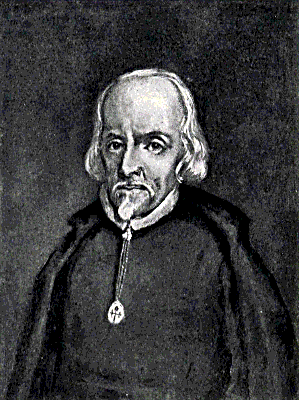
CALDERON.
The auto was an elaboration of the older miracle-play, and a spectacle as much in keeping with the temper of the Spanish court and people as Shakespeare's 'Midsummer Night's Dream' or Ben Jonson's 'Fortunate Isles' was in accord with the tastes of the English. And Calderon, of all Spanish poets, best pleased his people. He was the favorite poet of the court under Philip IV., and director of the theatre in the palace of the Buen Retiro. The skill in the art of construction which he had begun to acquire when he wrote 'The Devotion of the Cross' at the age of nineteen, was turned to stage management at the age of thirty-five, when he produced his gorgeous pageant of 'Circe' on the pond of the Buen Retiro. How elaborate this spectacle was, the directions for the prelude of the greater splendor to come will show. They read in this way:—
"In the midst of this island will be situated a very lofty mountain of rugged ascent, with precipices and caverns, surrounded by a thick and darksome wood of tall trees, some of which will be seen to exhibit the appearance of the human form, covered with a rough bark, from the heads and arms of which will issue green boughs and branches, having suspended from them various trophies of war and of the chase: the theatre during the opening of the scene being scantily lit with concealed lights; and to make a beginning of the festival, a murmuring and a rippling noise of water having been heard, a great and magnificent car will be seen to advance along the pond, plated over with silver, and drawn by two monstrous fishes, from whose mouth will continually issue great jets of water, the light of the theatre increasing according as they advance; and on the summit of it will be seen seated in great pomp and majesty the goddess Aqua, from whose head and curious vesture will issue an infinite abundance of little conduits of water; and at the same time will be seen another great supply flowing from an urn which the goddess will hold reversed, and which, filled with a variety of fishes leaping and playing in the torrent as it descends and gliding over all the car, will fall into the pond."
This 'Circe' was allegorical and mythological; it was one of those soulless shows which marked the transition of the Spanish drama from maturity to decay. It is gone and forgotten with thousands of its kind. Calderon will be remembered not as the director of such vain pomps, but as the author of the sublime and tender 'Wonderful Magician,' the weird 'Purgatory of St. Patrick,' 'The Constant Prince,' 'The Secret in Words,' and 'The Physician of His Own Honor.' The scrupulous student of the Spanish drama will demand more; but for him who would love Calderon without making a deep study of his works, these are sufficiently characteristic of his genius at its highest. The reader in search of wider vistas should add to these 'Los Encantos de la Culpa' (The Sorceries of Sin), and 'The Great Theatre of the World,' the theme of which is that of Jacques's famous speech in 'As You Like It':—
"En el teatro del mundo Todos son representados." ("All the world's a stage, And all the men and women merely players.")
On the principal feasts of the Church autos were played in the streets, generally in front of some great house. Giants and grotesque figures called tarascas gamboled about; and the auto, which was more like our operas than any other composition of the Spanish stage, was begun by a loa, written or sung. After this came the play, then an amusing interlude, followed by music and sometimes by a dance of gipsies.
Calderon boldly mingles pagan gods and Christ's mysteries in these autos, which are essentially of his time and his people. But the mixture is not so shocking as it is with the lesser poet, the Portuguese Camoens. Whether Calderon depicts 'The True God Pan,' 'Love the Greatest Enchantment,' or 'The Sheaves of Ruth,' he is forceful, dramatic, and even at times he has the awful gravity of Dante. His view of life and his philosophy are the view of life and the philosophy of Dante. To many of us, these simple and original productions of the Spanish temperament and genius may lack what we call "human interest." Let us remember that they represented truthfully the faith and the hope, the spiritual knowledge of a nation, as well as the personal and national view of that knowledge. In the Spain of Calderon, the personal view was the national view.
Calderon was born on January 17th, 1600,—according to his own statement quoted by his friend Vera Tassis,—at Madrid, of noble parents. He was partly educated at the University of Salamanca. Like Cervantes and Garcilaso, he served in the army. The great Lope, in 1630, acknowledged him as a poet and his friend. Later, his transition from the army to the priesthood made little change in his views of time and eternity.
On May 25th, 1881, occurred the second centenary of his death, and the civilized world—whose theatre owes more to Calderon than it has ever acknowledged—celebrated with Spain the anniversary at Madrid, where as he said,—
"Spain's proud heart swelleth."
The selections have been chosen from Shelley's 'Scenes,' and from Mr. MacCarthy's translation of 'The Secret in Words.' 'The Secret in Words' is light comedy of intricate plot. Fabio is an example of the attendant gracioso, half servant, half confidant, who appears often in the Spanish drama. The Spanish playwright did not confine himself to one form of verse; and Mr. MacCarthy, in his adequate translation, has followed the various forms of Calderon, only not attempting the assonant vowel, so hard to escape in Spanish, and still harder to reproduce in English. These selections give no impression of the amazing invention of Calderon. This can only be appreciated through reading 'The Constant Prince,' 'The Physician of His Own Honor,' or a comedy like 'The Secret in Words.'

THE LOVERS
From 'The Secret in Words'
[Flerida, the Duchess of Parma, is in love with her secretary Frederick. He loves her lady, Laura. Both Frederick and Laura are trying to keep their secret from the Duchess.]
Frederick—Has Flerida questioned you Aught about my love? Fabio—No, surely; But I have made up my mind That you are the prince of dunces, Not to understand her wish. Frederick—Said she something, then, about me? Fabio—Ay, enough. Frederick—Thou liest, knave! Wouldst thou make me think her beauty, Proud and gentle though it be, Which might soar e'en like the heron To the sovereign sun itself, Could descend with coward pinions At a lowly falcon's call? Fabio—Well, my lord, just make the trial For a day or two; pretend That you love her, and— Frederick—Supposing That there were the slightest ground For this false, malicious fancy You have formed, there's not a chink In my heart where it might enter,— Since a love, if not more blest. Far more equal than the other Holds entire possession there. Fabio—Then you never loved this woman At one time? Frederick—No! Fabio—Then avow— Frederick—What? Fabio—That you were very lazy. Frederick—That is falsehood, and not love. Fabio—The more the merrier! Frederick—In two places How could one man love? Fabio—Why, thus:— Near the town of Ratisbon Two conspicuous hamlets lay,— One of them called Ageré, The other called Mascárandón. These two villages one priest, An humble man of God, 'tis stated, Served; and therefore celebrated Mass in each on every feast. And so one day it came to pass, A native of Mascárandón Who to Ageré had gone About the middle of the mass, Heard the priest in solemn tone Say, as he the Preface read, "Gratias ageré," but said Nothing of Mascárandón. To the priest this worthy made His angry plaint without delay: "You give best thanks for Ageré, As if your tithes we had not paid!" When this sapient reason reached The noble Mascárandónese, They stopped their hopeless pastor's fees, Nor paid for what he prayed or preached; He asked his sacristan the cause, Who told him wherefore and because. From that day forth when he would sing The Preface, he took care t'intone, Not in a smothered or weak way, "Tibi semper et ubique Gratias—Mascárandón!" If from love,—that god so blind,— Two parishes thou holdest, you Are bound to gratify the two; And after a few days you'll find, If you do so, soon upon You and me will fall good things, When your Lordship sweetly sings Flerída et Mascárandón. Frederick—Think you I have heard your folly? Fabio—If you listened, why not so? Frederick—No: my mind can only know Its one call of melancholy. Fabio—Since you stick to Ageré And reject Mascárandón, Every hope, I fear, is gone, That love his generous dues will pay.
Translation of Denis Florence MacCarthy.
CYPRIAN'S BARGAIN
From 'The Wonderful Magician'
[The Demon, angered by Cyprian's victory in defending the existence of God, swears vengeance. He resolves that Cyprian shall lose his soul for Justina, who rejects his love. Cyprian says:—]
So bitter is the life I live, That, hear me hell, I now would give To thy most detested spirit My soul forever to inherit, To suffer punishment and pine, So this woman may be mine. [The Demon accepts his soul and hastens to Justina. Justina—'Tis that enamored nightingale Who gives me the reply: He ever tells the same soft tale Of passion and of constancy To his mate, who, rapt and fond, Listening sits, a bough beyond. Be silent, Nightingale!—No more Make me think, in hearing thee Thus tenderly thy love deplore, If a bird can feel his so, What a man would feel for me. And, voluptuous vine, O thou Who seekest most when least pursuing,— To the trunk thou interlacest Art the verdure which embracest And the weight which is its ruin,— No more, with green embraces, vine, Make me think on what thou lovest; For while thou thus thy boughs entwine, I fear lest thou shouldst teach me, sophist, How arms might be entangled too. Light-enchanted sunflower, thou Who gazest ever true and tender On the sun's revolving splendor, Follow not his faithless glance With thy faded countenance, Nor teach my beating heart to fear If leaves can mourn without a tear, How eyes must weep! O Nightingale, Cease from thy enamored tale,— Leafy vine, unwreath thy bower, Restless sunflower, cease to move— Or tell me all, what poisonous power Ye use against me— All—Love! love! love! Justina—It cannot be!—Whom have I ever loved? Trophies of my oblivion and disdain, Floro and Lelio did I not reject? And Cyprian?— [She becomes troubled at the name of Cyprian. Did I not requite him With such severity that he has fled Where none has ever heard of him again?— Alas! I now begin to fear that this May be the occasion whence desire grows bold, As if there were no danger. From the moment That I pronounced to my own listening heart, "Cyprian is absent, O miserable me!" I know not what I feel! [More calmly. It must be pity, To think that such a man, whom all the world Admired, should be forgot by all the world, And I the cause. [She again becomes troubled. And yet if it were pity, Floro and Lelio might have equal share, For they are both imprisoned for my sake. [Calmly. Alas! what reasonings are these? It is Enough I pity him, and that in vain, Without this ceremonious subtlety, And woe is me! I know not where to find him now, Even should I seek him through this wide world! Enter Demon. Demon—Follow, and I will lead thee where he is. Justina—And who art thou, who hast found entrance hither Into my chamber through the doors and locks? Art thou a monstrous shadow which my madness Has formed in the idle air? Demon—No. I am one Called by the thought which tyrannizes thee From his eternal dwelling—who this day Is pledged to bear thee unto Cyprian. Justina—So shall thy promise fail. This agony Of passion which afflicts my heart and soul May sweep imagination in its storm,— The will is firm. Demon—Already half is done In the imagination of an act. The sin incurred, the pleasure then remains: Let not the will stop half-way on the road. Justina—I will not be discouraged, nor despair, Although I thought it, and although 'tis true That thought is but a prelude to the deed: Thought is not in my power, but action is: I will not move my foot to follow thee! Demon—But a far mightier wisdom than thine own Exerts itself within thee, with such power Compelling thee to that which it inclines That it shall force thy step; how wilt thou then Resist, Justina? Justina—By my free will. Demon—I Must force thy will. Justina—It is invincible; It were not free if thou hadst power upon it. [He draws, but cannot move her. Demon—Come, where a pleasure waits thee. Justina—It were bought Too dear. Demon—'Twill soothe thy heart to softest peace. Justina—'Tis dread captivity. Demon—'Tis joy, 'tis glory. Justina—'Tis shame, 'tis torment, 'tis despair. Demon—But how Canst thou defend thyself from that or me, If my power drags thee onward? Justina—My defense Consists in God. [He vainly endeavors to force her, and at last releases her. Demon—Woman, thou hast subdued me Only by not owning thyself subdued. But since thou thus findest defense in God, I will assume a feignèd form, and thus Make thee a victim of my baffled rage. For I will mask a spirit in thy form Who will betray thy name to infamy, And doubly shall I triumph in thy loss, First by dishonoring thee, and then by turning False pleasure to true ignominy. [Exit Justina—I Appeal to Heaven against thee; so that Heaven May scatter thy delusions, and the blot Upon my fame vanish in idle thought, Even as flame dies in the envious air, And as the flow'ret wanes at morning frost, And thou shouldst never—But alas! to whom Do I still speak?—Did not a man but now Stand here before me?—No, I am alone, And yet I saw him. Is he gone so quickly? Or can the heated mind engender shapes From its own fear? Some terrible and strange Peril is near. Lisander! father! lord! Livia!— Enter Lisander and Livia. Lisander—O my daughter! what? Livia—What? Justina—Saw you A man go forth from my apartment now?— I scarce sustain myself! Lisander—A man here! Justina—Have you not seen him? Livia—No, lady. Justina—I saw him. Lisander—'Tis impossible; the doors Which led to this apartment were all locked. Livia [aside]—I dare say it was Moscon whom she saw, For he was locked up in my room. Lisander—It must Have been some image of thy phantasy. Such melancholy as thou feedest is Skillful in forming such in the vain air Out of the motes and atoms of the day. Livia—My master's in the right. Justina—Oh, would it were Delusion; but I fear some greater ill. I feel as if out of my bleeding bosom My heart was torn in fragments; ay, Some mortal spell is wrought against my frame. So potent was the charm, that had not God Shielded my humble innocence from wrong, I should have sought my sorrow and my shame With willing steps. Livia, quick, bring my cloak, For I must seek refuge from these extremes Even in the temple of the highest God Which secretly the faithful worship. Livia—Here. Justina [putting on her cloak]—In this, as in a shroud of snow, may I Quench the consuming fire in which I burn, Wasting away! Lisander—And I will go with thee! Livia [aside]—When I once see them safe out of the house, I shall breathe freely. Justina—So do I confide In thy just favor, Heaven! Lisander—Let us go. Justina—Thine is the cause, great God! Turn, for my sake And for thine own, mercifully to me!
Translation of Shelley.
DREAMS AND REALITIES
From 'Such Stuff as Dreams are Made Of,' Edward Fitzgerald's version of 'La Vida Es Sueno'
[The scene is a tower. Clotaldo is persuading Segismund that his experiences have not been real, but dreams, and discusses the possible relation of existence to a state of dreaming. The play itself is based on the familiar motif of which Christopher Sly furnishes a ready example.]
Clotaldo—Princes and princesses and counselors, Fluster'd to right and left—my life made at— But that was nothing— Even the white-hair'd, venerable King Seized on—Indeed, you made wild work of it; And so discover'd in your outward action, Flinging your arms about you in your sleep, Grinding your teeth—and, as I now remember, Woke mouthing out judgment and execution, On those about you. Segismund—Ay, I did indeed. Clotaldo—Ev'n your eyes stare wild; your hair stands up— Your pulses throb and flutter, reeling still Under the storm of such a dream— Segismund—A dream! That seem'd as swearable reality As what I wake in now. Clotaldo—Ay—wondrous how Imagination in a sleeping brain Out of the uncontingent senses draws Sensations strong as from the real touch; That we not only laugh aloud, and drench With tears our pillow; but in the agony Of some imaginary conflict, fight And struggle—ev'n as you did; some, 'tis thought. Under the dreamt-of stroke of death have died. Segismund—And what so very strange, too—in that world Where place as well as people all was strange, Ev'n I almost as strange unto myself, You only, you, Clotaldo—you, as much And palpably yourself as now you are, Came in this very garb you ever wore; By such a token of the past, you said, To assure me of that seeming present. Clotaldo—Ay? Segismund—Ay; and even told me of the very stars You tell me hereof—how in spite of them, I was enlarged to all that glory. Clotaldo—Ay, By the false spirits' nice contrivance, thus A little truth oft leavens all the false, The better to delude us. Segismund—For you know 'Tis nothing but a dream? Clotaldo—Nay, you yourself Know best how lately you awoke from that You know you went to sleep on.— Why, have you never dreamt the like before? Segismund—Never, to such reality. Clotaldo—Such dreams Are oftentimes the sleeping exhalations Of that ambition that lies smoldering Under the ashes of the lowest fortune: By which, when reason slumbers, or has lost The reins of sensible comparison, We fly at something higher than we are— Scarce ever dive to lower—to be kings Or conquerors, crown'd with laurel or with gold; Nay, mounting heav'n itself on eagle wings,— Which, by the way, now that I think of it, May furnish us the key to this high flight— That royal Eagle we were watching, and Talking of as you went to sleep last night. Segismund—Last night? Last night? Clotaldo—Ay; do you not remember Envying his immunity of flight, As, rising from his throne of rock, he sail'd Above the mountains far into the west, That burned about him, while with poising wings He darkled in it as a burning brand Is seen to smolder in the fire it feeds? Segismund—Last night—last night—Oh, what a day was that Between that last night and this sad to-day! Clotaldo—And yet perhaps Only some few dark moments, into which Imagination, once lit up within And unconditional of time and space, Can pour infinities. Segismund—And I remember How the old man they call'd the King, who wore The crown of gold about his silver hair, And a mysterious girdle round his waist, Just when my rage was roaring at its height, And after which it all was dark again, Bade me beware lest all should be a dream. Clotaldo—Ay—there another specialty of dreams, That once the dreamer 'gins to dream he dreams, His foot is on the very verge of waking. Segismund—Would that it had been on the verge of death That knows no waking— Lifting me up to glory, to fall back, Stunned, crippled—wretcheder than ev'n before. Clotaldo—Yet not so glorious, Segismund, if you Your visionary honor wore so ill As to work murder and revenge on those Who meant you well. Segismund—Who meant me!—me! their Prince, Chain'd like a felon— Clotaldo—Stay, stay—Not so fast. You dream'd the Prince, remember. Segismund—Then in dream Revenged it only. Clotaldo—True. But as they say Dreams are rough copies of the waking soul Yet uncorrected of the higher Will, So that men sometimes in their dream confess An unsuspected or forgotten self; One must beware to check—ay, if one may, Stifle ere born, such passion in ourselves As makes, we see, such havoc with our sleep, And ill reacts upon the waking day. And, by the by, for one test, Segismund, Between such swearable realities— Since dreaming, madness, passion, are akin In missing each that salutary rein Of reason, and the guiding will of man: One test, I think, of waking sanity Shall be that conscious power of self-control To curb all passion, but much, most of all, That evil and vindictive, that ill squares With human, and with holy canon less, Which bids us pardon ev'n our enemies, And much more those who, out of no ill-will, Mistakenly have taken up the rod Which Heaven, they think, has put into their hands. Segismund—I think I soon shall have to try again— Sleep has not yet done with me. Clotaldo—Such a sleep! Take my advice—'tis early yet—the sun Scarce up above the mountain; go within, And if the night deceived you, try anew With morning; morning dreams they say come true. Segismund—Oh, rather pray for me a sleep so fast As shall obliterate dream and waking too. [Exit into the tower. Clotaldo—So sleep; sleep fast: and sleep away those two Night-potions, and the waking dream between, Which dream thou must believe; and if to see Again, poor Segismund! that dream must be.— And yet—and yet—in these our ghostly lives, Half night, half day, half sleeping, half awake, How if our waking life, like that of sleep, Be all a dream in that eternal life To which we wake not till we sleep in death? How if, I say, the senses we now trust For date of sensible comparison,— Ay, ev'n the Reason's self that dates with them, Should be in essence of intensity Hereafter so transcended, and awoke To a perceptive subtlety so keen As to confess themselves befool'd before, In all that now they will avouch for most? One man—like this—but only so much longer As life is longer than a summer's day, Believed himself a king upon his throne, And play'd at hazard with his fellows' lives, Who cheaply dream'd away their lives to him. The sailor dream'd of tossing on the flood: The soldier of his laurels grown in blood: The lover of the beauty that he knew Must yet dissolve to dusty residue: The merchant and the miser of his bags Of finger'd gold; the beggar of his rags: And all this stage of earth on which we seem Such busy actors, and the parts we play'd Substantial as the shadow of a shade, And Dreaming but a dream within a dream!
THE DREAM CALLED LIFE
Segismund's Speech Closing the 'Vida Es Sueno': Fitzgerald's Version
A dream it was in which I found myself, And you that hail me now, then hailed me king, In a brave palace that was all my own, Within, and all without it, mine; until, Drunk with excess of majesty and pride, Methought I towered so high and swelled so wide That of myself I burst the glittering bubble Which my ambition had about me blown, And all again was darkness. Such a dream As this, in which I may be walking now; Dispensing solemn justice to you shadows, Who make believe to listen: but anon, Kings, princes, captains, warriors, plume and steel, Ay, even with all your airy theatre, May flit into the air you seem to rend With acclamations, leaving me to wake In the dark tower; or dreaming that I wake From this, that waking is; or this and that Both waking or both dreaming;—such a doubt Confounds and clouds our mortal life about. But whether wake or dreaming, this I know,— How dreamwise human glories come and go; Whose momentary tenure not to break, Walking as one who knows he soon may wake, So fairly carry the full cup, so well Disordered insolence and passion quell, That there be nothing after to upbraid Dreamer or doer in the part he played; Whether to-morrow's dawn shall break the spell, Or the last trumpet of the eternal Day, When dreaming with the night shall pass away.