Front matter
Reading edition
LONDON: PRINTED BY W. CLOWES AND SONS, STAMFORD STREET AND CHARING CROSS.
INSECT ARCHITECTURE
BY
JAMES RENNIE
NEW EDITION, MUCH ENLARGED
BY THE REV. J. G. WOOD, M.A.
AUTHOR OF “HOMES WITHOUT HANDS,” ETC.
WITH NEARLY TWO HUNDRED ILLUSTRATIONS.
LONDON: BELL AND DALDY, YORK STREET, COVENT GARDEN. 1869.
EDITOR’S PREFACE TO THE NEW EDITION.
The proprietors of this interesting work having felt that much additional knowledge of the subject has been obtained since the book was written, have asked me to supply characteristic examples of Insect Architecture which were not to be found in its pages. I have accordingly added a considerable number of such examples, in most cases accompanied by figures drawn from the specimens described. I have not been at liberty to alter or expunge, and am not, therefore, responsible for any portion of the letterpress except those passages which are enclosed in brackets [ ]. Some of the specimens from which the figures have been drawn are in my own collection, but the greater part are to be found in the British Museum.
CONTENTS.
PAGE
CHAPTER I.
Introduction 1
CHAPTER II.
Structures for Protecting Eggs 21
Mason-Wasps 22
Mason-Bees 38
Mining-Bees 50
CHAPTER III.
Carpenter-Bees 55
Carpenter-Wasps 62
Upholsterer-Bees 64
CHAPTER IV.
Carder-Bees 74
Lapidary-Bees 79
Humble-Bees 79
Social-Wasps 80
CHAPTER V.
Architecture of the Hive-Bee 112
Preparation of Wax 115
Propolis 126
The Building of the Cell 131
CHAPTER VI.
Architecture of the Hive-Bee—continued.
Form of the Cells 139
Irregularities in their Workmanship 148
The Finishing of the Cells 154
CHAPTER VII.
Carpentry of Tree-Hoppers 164
Saw-Flies 168
Icarias 176
CHAPTER VIII.
Leaf-Rolling Caterpillars 181
CHAPTER IX.
Insects Forming Habitations of Detached Leaves 195
Cypress-Spurge Caterpillar 197
Moss-Building Caterpillar 199
CHAPTER X.
Caddis-Worms and Goat-Moth 202
Carpenter-Caterpillars 207
Puss-Moth 211
Capricorn-Beetle 215
Oak-Bark Caterpillars 217
CHAPTER XI.
Earth-Mason Caterpillars 219
Ant-Lion 227
CHAPTER XII.
Clothes-Moth Caterpillars 235
Tent-Making Caterpillars 243
Stone-Mason Caterpillars 247
Muff-Shaped Tents 250
Leaf-Mining Caterpillars 252
Bark-Mining Caterpillars 257
Grubs of Beetles 258
Wasp-Beetle 261
Stag-Beetle 262
CHAPTER XIII.
Structures of Grasshoppers, Crickets, and Beetles 264
Mole Cricket 265
Field Cricket 267
Burying Beetle 269
Dung Beetle 271
Tumble-Dung Beetle 273
Cockchafer 275
CHAPTER XIV.
Architecture of Ants 278
Mason-Ants 279
CHAPTER XV.
Structures of the Wood-Ant or Pismire 294
Carpenter-Ants 301
CHAPTER XVI.
Structures of White Ants, or Termites 313
Turret-Building White Ants 325
CHAPTER XVII.
Structures of Silk Spun by Caterpillars 330
Silkworm 336
Emperor-Moth 342
Spinning Caterpillars 344
CHAPTER XVIII.
Structures of Spiders 366
Nest, Webs, and Nets of Spiders 383
Diving Water-Spider 393
CHAPTER XIX.
Structures of Gall-Flies and Aphides 398
Hawthorn Weevil 413
Gall-Beetles 415
>Leaf-Rolling Aphides 418
Pseudo-Galls 421
CHAPTER XX.
Animal Galls, Produced by Breeze-Flies and Snail-Beetles 424
Grub Parasite in the Snail 436
ILLUSTRATIONS.
PAGE
1. Eggs of Insects, magnified 16
2. Larvæ 17
3. Pupæ 18
4. Insects in the Imago or perfect state 19
5. Mason-Wasp 23
6. Jaws of Mason-Wasp 24
7. Cuckoo-Fly 25
8. Mason-Wasp’s Nest and Cocoons 25
9. Mason-Wasp 25
10. Nests, &c., of Mason-Wasps 26
11. Towers built by Mason-Wasp 29
12. Nests of Pompilus punctum 29
13. Scolia Xantiana, and section of its burrow 35
14. Mason-Bee 38
15. Exterior wall of Mason-Bee’s Nest 39
16. Cells of a Mason-Bee 39
17. Cells of Mason-Bees 46
18. Cells of Chalicodoma 49
19. Nest of Synagris calida 50
20. Cell of Mining-Bee 51
21. Cells of Carpenter-Bees, in an old post 57
22. Carpenter-Bee and Cells 58
23. Carpenter-Wasp and Cells 62
24. Rose-leaf-cutter-Bee and Nest 71
25. Carder-Bee and Nest 75
26. Breeding-cells of Carder-Bee 77
27. Interior view of Carder-Bee’s Nest 78
28. Cells of Humble-Bee and Insects 80
29. Nest of Common Wasp in early stage 88
30. Section of Wasp’s Nest 89
31. Section of Social-Wasps’ Nest 90
32. Suspension-rod and part of external crust of Social-Wasps’ Nest 91
33. Hornet’s Nest in its first stage 92
34. Complete Hornet’s Nest, and Insect 93
35. Hornet’s Nest in hollow tree 94
36. Nest of Tree-Wasp 96
37. Wasp’s Nest 97
38. Wasps’ Cells attached to a branch 98
39. Comb of Polistes 99
40. Nest of the Pasteboard-maker Wasp 103
41. Nest of Myrapetra 105
42. Nests of Polybia 108
43. Nests of Synæca and Polybia 109
44. Part of a Honeycomb and Bees at work 112
45. Worker-Bee, magnified 123
46. Abdomen of Wax-worker Bee 124
47. Structure of the Legs of the Bee 130
48. Curtain of Wax-workers secreting wax 133
49. Wax-worker laying the foundation of first cell 136
50. Curtain of Wax-workers 137
51. Arrangement of Cells 141
52. Foundation-wall and Cells commenced 143
53. Hive-Bees and Cells 159
54. Ovipositors, with files, of Tree-hopper 167
55. Excavations for eggs of Tree-hopper 167
56. Ovipositor of Saw-Fly 169
57. Ovipositor of Saw-Fly, much magnified 170
58. Portion of Saw-Fly’s comb-toothed rasp 171
59. Nest of eggs of Saw-Fly 173
60. Saw-Fly of the gooseberry 174
61. Exterior and section of Nest of Deilocenes Ellisii, and Insect 176
62. Cells of Icaria 177
63. Cells of Raphigaster Guiniensis 179
64. Single Cells of Icaria 179
65. Lilac-tree Moth 182
66. Nest of Lilac-leaf-roller 182
67. Do. another specimen 183
68. Small green Oak-Moth 184
69. Nests of Oak-leaf-rolling Caterpillars 184
70. Nest of Nettle-leaf-rolling Caterpillar 186
71. Leaf-rolling Caterpillars of the sorrel 188
72. Nests of the Hesperia Malvæ with Caterpillar, Chrysalis, and Butterflies 189
73. Nest of Willow-leaf-roller 191
74. Ziczac Caterpillar and Nest 192
75. Cypress-Spurge Caterpillar 198
76. Moss-cell of small Caterpillar 200
77. Leaf-nest of Caddis-Worm 202
75. Reed-nest of Caddis-Worm 202
79. Cell of Phryganea 203
80. Shell-nests of Caddis-Worms 203
81. Stone-nest of Caddis-Worm 204
82. Sand-nest balanced with a stone 204
83. Nest of Caddis-Worm balanced with straws 204
84. Various Nests of Caddis-Worms 206
85. Caterpillar of Goat-Moth 208
86. Winter-nest of Goat-Caterpillar 208
87. Nest of Goat-Moth 209
88. Larva of Ægeria 211
89. Eggs of the Puss-Moth 213
90. Rudiments of the Cell of Puss-Moth 213
91. Cell of Larva of Puss-Moth 214
92. Ichneumon 215
93. Magnified Cells of Pyralis strigulalis (?) 217
94. Outside view of Nests of Earth-Mason Caterpillars 220
95. Nests, etc., of Earth-Mason Caterpillar 221
96. Do. with perfect Moth 223
97. Nests of the Grubs of Ephemeræ 225
98. Nests of Ephemeræ in holes of Cossus 225
99. Grub of the Ant-Lion with traps 228
100. Ant-Lion’s traps in experimenting-box 231
101. Cases of the Clothes-Moth and Insect 238
102. Transformations of the Honeycomb-Moths 240
103. Transformations of the Grain-Moths 242
104. Tent of Caterpillar upon elm-leaf 244
105. Operations of Caterpillar upon leaf 246
106. Lichen-tents and Caterpillars 247
107. Branch of willow with Caterpillars’ muff-tents 251
108. Rose-leaf mined by Caterpillars 253
109. Bramble-leaf do. 254
110. Primrose-leaf do. 255
111. Bark mined by Beetle-Grubs 259
112. Cocoons of Rhagium and Rhyncophorus 261
113. Capricorn-Beetle rounding off bark of tree 262
114. Cerambyx carcharias, and Cerambyx populneus 263
115. The Mole-Cricket 265
116. Nest of Mole-Cricket 266
117. Acrida Verrucivora depositing her eggs 269
118. Transformations of the Cockchafer 276
119. Ant-hive or Formicary 291
120. Floor of Ant-nest 292
121. Insecure Nest propped up by Ants 293
122. Nest of Wood-Ant 295
123. Artificial Formicary 298
124. Portion of a tree tunnelled by Jet Ants 302
125. Formica fuliginosa 304
126. Crematogaster 310
127. Nests of Polyrachis bispinosa and P. textor 311
128. Termes bellicosus in the winged state 317
129. Queen Termite distended with eggs 320
130. Tree-nest of Termites arborum, and Hill-nests of T. bellicosus 324
131. Turret-nests of White Ants 326
132. Leg and Pro-leg of Caterpillar 331
133. Caterpillar of Goat-Moth 332
134. Interior structure of Cossus 333
135. Side view and section of Silk-tube of Cossus 334
136. Labium of Cossus 334
137. Cocoons of Emperor-Moth 343
138. Cocoon of Arctia villica 345
139. Net-work Cocoon 345
140. Nest of Puss-Moth 347
141. Caterpillars of small Ermine on Siberian crab 351
142. Winter-nests of Porthesia chrysorrhœa 352
143. Winter-nests of Social Caterpillars 353
144. Pendulous Leaves 356
145. Nest of Larrada 357
146. Nests of Polybia 358
147. Nests of Oiketicus, &c. 359
148. Nests of Pelopæus, &c. 361
149. Bombycidæ 363
150. Processionary Caterpillars 364
151. Nest of do. 365
152. Garden Spider suspended by single thread 367
153. Spinnerets of Spiders 368
154. Single thread of Spider, greatly magnified 369
155. Attached end of Spider’s thread 369
156. Geometric Net of Epeira diadema 387
157. Nest of the Mason-Spider 389
158. Nest of Mygale sauvagesii 391
159. Insect emerging from its Nest 391
160. Triple-clawed Foot of Spider 395
161. Small Galls on Oak-leaf 398
162. Ovipositor of Gall-Fly 399
163. Gall-Fly and mechanism of ovipositor 400
164. Bedeguar Gall of the Rose 402
165. One of the bristles of Bedeguar, magnified 403
166. Artichoke Gall of the Oak-bud, and Insect 405
167. Leafy gall of Dyer’s Broom 406
168. Semi-gall of the Hawthorn 408
169. Woolly Gall of the Oak 409
170. Oak-apple Galls 410
171. Root-galls of the Oak 411
172. Woody Gall on a Willow Branch 412
173. Currant-gall of the catkins of the Oak 413
174. Gall of the Hawthorn-Weevil 414
175. Plant-Louse, magnified 416
176. Galls produced on the Poplar, and Insects 417
177. Leaf of the Currant-bush with Aphides 419
178. Shoot of Lime-tree contorted by A. tiliæ 421
179. Pseudo-gall of the Bramble 422
180. Pseudo-galls of the Hawthorn 423
181. Ovipositor of the Breeze-Fly 426
182. The Grub of Breeze-Fly 432
183. The Ox-Breeze-Fly 433
184. Bumps produced on cattle by Breeze-Fly 434
185. Microgaster glomeratus 438
186. Microgaster alveolarius 439
INSECT ARCHITECTURE.
CHAPTER 1.
INTRODUCTION.
It can never be too strongly impressed upon a mind anxious for the acquisition of knowledge, that the commonest things by which we are surrounded are deserving of minute and careful attention. The most profound investigations of Philosophy are necessarily connected with the ordinary circumstances of our being, and of the world in which our every-day life is spent. With regard to our own existence, the pulsation of the heart, the act of respiration, the voluntary movement of our limbs, the condition of sleep, are among the most ordinary operations of our nature; and yet how long were the wisest of men struggling with dark and bewildering speculations before they could offer anything like a satisfactory solution of these phenomena, and how far are we still from an accurate and complete knowledge of them! The science of Meteorology, which attempts to explain to us the philosophy of matters constantly before our eyes, as dew, mist, and rain, is dependent for its illustrations upon a knowledge of the most complicated facts, such as the influence of heat and electricity upon the air; and this knowledge is at present so imperfect, that even these common occurrences of the weather, which men have been observing and reasoning upon for ages, are by no means satisfactorily explained, or reduced to the precision that every science should aspire to. Yet, however difficult it may be entirely to comprehend the phenomena we daily witness, everything in nature is full of instruction. Thus the humblest flower of the field, although, to one whose curiosity has not been excited, and whose understanding has, therefore, remained uninformed, it may appear worthless and contemptible, is valuable to the botanist, not only with regard to its place in the arrangement of this portion of the Creator’s works, but as it leads his mind forward to the consideration of those beautiful provisions for the support of vegetable life, which it is the part of the physiologist to study and to admire.
This train of reasoning is peculiarly applicable to the economy of insects. They constitute a very large and interesting part of the animal kingdom. They are everywhere about us. The spider weaves his curious web in our houses; the caterpillar constructs his silken cell in our gardens; the wasp that hovers over our food has a nest not far removed from us, which she has assisted to build with the nicest art; the beetle that crawls across our path is also an ingenious and laborious mechanic, and has some curious instincts to exhibit to those who will feel an interest in watching his movements; and the moth that eats into our clothes has something to plead for our pity, for he came, like us, naked into the world, and he has destroyed our garments, not in malice or wantonness, but that he may clothe himself with the same wool which we have stripped from the sheep. An observation of the habits of these little creatures is full of valuable lessons, which the abundance of the examples has no tendency to diminish. The more such observations are multiplied, the more are we led forward to the freshest and the most delightful parts of knowledge; the more do we learn to estimate rightly the extraordinary provisions and most abundant resources of a creative Providence; and the better do we appreciate our own relations with all the infinite varieties of nature, and our dependence, in common with the ephemeron that flutters its little hour in the summer sun, upon that Being in whose scheme of existence the humblest as well as the highest creature has its destined purposes. “If you speak of a stone,” says St. Basil, one of the Fathers of the Church, “if you speak of a fly, a gnat, or a bee, your conversation will be a sort of demonstration of His power whose hand formed them, for the wisdom of the workman is commonly perceived in that which is of little size. He who has stretched out the heavens, and dug up the bottom of the sea, is also He who has pierced a passage through the sting of the bee for the ejection of its poison.”
If it be granted that making discoveries is one of the most satisfactory of human pleasures, then we may without hesitation affirm, that the study of insects is one of the most delightful branches of natural history, for it affords peculiar facilities for its pursuit. These facilities are found in the almost inexhaustible variety which insects present to the curious observer. As a proof of the extraordinary number of insects within a limited field of observation, Mr. Stephens informs us, that in the short space of forty days, between the middle of June and the beginning of August, he found, in the vicinity of Ripley, specimens of above two thousand four hundred species of insects, exclusive of caterpillars and grubs,—a number amounting to nearly a fourth of the insects ascertained to be indigenous. He further tells us, that, among these specimens, although the ground had, in former seasons, been frequently explored, there were about one hundred species altogether new, and not before in any collection which he had inspected, including several new genera; while many insects reputed scarce were in considerable plenty.[A][A] The localities of insects are, to a certain extent, constantly changing; and thus the study of them has, in this circumstance, as well as in their manifold abundance, a source of perpetual variety. Insects, also, which are plentiful one year, frequently become scarce, or disappear altogether, the next—a fact strikingly illustrated by the uncommon abundance, in 1826 and 1827, of the seven-spot lady-bird (Coccinella septempunctata), in the vicinity of London, though during the two succeeding summers this insect was comparatively scarce, while the small two-spot lady-bird (Coccinella bipunctata) was plentiful.
There is, perhaps, no situation in which the lover of nature and the observer of animal life may not find opportunities for increasing his store of facts. It is told of a state prisoner, under a cruel and rigorous despotism, that when he was excluded from all commerce with mankind, and was shut out from books, he took an interest and found consolation in the visits of a spider; and there is no improbability in the story. The operations of that persecuted creature are among the most extraordinary exhibitions of mechanical ingenuity; and a daily watching of the workings of its instinct would beget admiration in a rightly-constituted mind. The poor prisoner had abundant leisure for the speculations in which the spider’s web would enchain his understanding. We have all of us, at one period or other of our lives, been struck with some singular evidence of contrivance in the economy of insects, which we have seen with our own eyes. Want of leisure, and probably want of knowledge, have prevented us from following up the curiosity which for a moment was excited. And yet some such accident has made men naturalists, in the highest meaning of the term. Bonnet, evidently speaking of himself, says, “I knew a naturalist, who, when he was seventeen years of age, having heard of the operations of the ant-lion, began by doubting them. He had no rest till he had examined into them: and he verified them, he admired them, he discovered new facts, and soon became the disciple and the friend of the Pliny of France”[B] (Réaumur). It is not the happy fortune of many to be able to devote themselves exclusively to the study of nature, unquestionably the most fascinating of human employments; but almost every one may acquire sufficient knowledge to be able to derive a high gratification from beholding the more common operations of animal life. His materials for contemplation are always before him. Some weeks ago we made an excursion to West Wood, near Shooter’s Hill, expressly for the purpose of observing the insects we might meet with in the wood: but we had not got far among the bushes, when heavy rain came on. We immediately sought shelter among the boughs of some thick underwood, composed of oak, birch, and aspen; but we could not meet with a single insect, not even a gnat or a fly, sheltered under the leaves. Upon looking more narrowly, however, into the bushes which protected us, we soon found a variety of interesting objects of study. The oak abounded in galls, several of them quite new to us; while the leaves of the birch and the aspen exhibited the curious serpentine paths of the minute mining caterpillars. When we had exhausted the narrow field of observation immediately around us, we found that we could considerably extend it, by breaking a few of the taller branches near us, and then examining their leaves at leisure. In this manner two hours glided quickly and pleasantly away, by which time the rain had nearly ceased; and though we had been disappointed in our wish to ramble through the wood, we did not return without adding a few interesting facts to our previous knowledge of insect economy.[C]
It will appear, then, from the preceding observations, that cabinets and collections, though undoubtedly of the highest use, are by no means indispensable, as the observer of nature may find inexhaustible subjects of study in every garden and in every hedge. Nature has been profuse enough in affording us materials for observation, when we are prepared to look about us with that keenness of inquiry, which curiosity, the first step in the pursuit of knowledge, will unquestionably give. Nor shall we be disappointed in the gratification which is thus within our reach. Were it no more, indeed, than a source of agreeable amusement, the study of insects comes strongly recommended to the notice of the well-educated. The pleasures of childhood are generally supposed to be more exquisite, and to contain less alloy, than those of riper years; and if so, it must be because then everything appears new and dressed in fresh beauties: while in manhood, and old age, whatever has frequently recurred begins to wear the tarnish of decay. The study of nature affords us a succession of “ever-new delights,” such as charmed us in childhood, when everything had the attractions of novelty and beauty; and thus the mind of the naturalist may have its own fresh and vigorous thoughts, even while the infirmities of age weigh down the body.
It has been objected to the study of insects, as well as to that of Natural History in general, that it tends to withdraw the mind from subjects of higher moment; that it cramps and narrows the range of thought; and that it destroys, or at least weakens, the finer creations of the fancy. Now, we should allow this objection in its fullest extent, and even be disposed to carry it further than is usually done, if the collecting of specimens only, or, as the French expressly call them, chips (échantillons), be called a study. But the mere collector is not, and cannot be, justly considered as a naturalist; and, taking the term naturalist in its enlarged sense, we can adduce some distinguished instances in opposition to the objection. Rousseau, for example, was passionately fond of the Linnæan botany, even to the driest minutiæ of its technicalities; and yet it does not appear to have cramped his mind, or impoverished his imagination. If Rousseau, however, be objected to as an eccentric being, from whose pursuits no fair inference can be drawn, we give the illustrious example of Charles James Fox, and may add the names of our distinguished poets, Goldsmith, Thomson, Gray, and Darwin, who were all enthusiastic naturalists. We wish particularly to insist upon the example of Gray, because he was very partial to the study of insects. It may be new to many of our readers, who are familiar with the ‘Elegy in a Country Churchyard,’ to be told that its author was at the pains to turn the characteristics of the Linnæan orders of insects into Latin hexameters, the manuscript of which is still preserved in his interleaved copy of the ‘Systema Naturæ.’ Further, to use the somewhat exaggerated words of Kirby and Spence, whose work on Entomology is one of the most instructive and pleasing books on the science, 'Aristotle among the Greeks, and Pliny the Elder among the Romans, may be denominated the fathers of Natural History, as well as the greatest philosophers of their day; yet both these made insects a principal object of their attention: and in more recent times, if we look abroad, what names greater than those of Redi, Malpighi, Vallisnieri, Swammerdam, Leeuwenhoek, Réaumur, Linnæus, De Geer, Bonnet, and the Hubers? and at home, what philosophers have done more honour to their country and to human nature than Ray, Willughby, Lister, and Derham? Yet all these made the study of insects one of their most favourite pursuits."[D]
And yet this study has been considered, by those who have superficially examined the subject, as belonging to a small order of minds; and the satire of Pope has been indiscriminately applied to all collectors, while, in truth, it only touches those who mistake the means of knowledge for the end:—
"O! would the sons of men once think their eyes And reason given them but to study Flies! See Nature, in some partial, narrow shape, And let the Author of the whole escape; Learn but to trifle; or, who most observe, To wonder at their Maker, not to serve."[E]
Thus exclaims the Goddess of Dulness, sweeping into her net all those who study nature in detail. But if the matter were rightly appreciated, it would be evident that no part of the works of the Creator can be without the deepest interest to an inquiring mind; and that a portion of creation which exhibits such extraordinary manifestations of design as is shown by insects must have attractions for the very highest understanding.
An accurate knowledge of the properties of insects is of great importance to man, merely with relation to his own comfort and security. The injuries which they inflict upon us are extensive and complicated; and the remedies which we attempt, by the destruction of those creatures, both insects, birds, and quadrupeds, who keep the ravages in check, are generally aggravations of the evil, because they are directed by an ignorance of the economy of nature. The little knowledge which we have of the modes by which insects may be impeded in their destruction of much that is valuable to us, has probably proceeded from our contempt of their individual insignificance. The security of property has ceased to be endangered by quadrupeds of prey, and yet our gardens are ravaged by aphides and caterpillars. It is somewhat startling to affirm that the condition of the human race is seriously injured by these petty annoyances; but it is perfectly true that the art and industry of man have not yet been able to overcome the collective force, the individual perseverance, and the complicated machinery of destruction which insects employ. A small ant, according to a most careful and philosophical observer, opposes almost invincible obstacles to the progress of civilization in many parts of the equinoctial zone. These animals devour paper and parchment; they destroy every book and manuscript. Many provinces of Spanish America cannot, in consequence, show a written document of a hundred years’ existence. “What development,” he adds, “can the civilization of a people assume, if there be nothing to connect the present with the past—if the depositories of human knowledge must be constantly renewed—if the monuments of genius and wisdom cannot be transmitted to posterity?”[F] Again, there are beetles which deposit their larvæ in trees in such formidable numbers that whole forests perish beyond the power of remedy. The pines of the Hartz have thus been destroyed to an enormous extent; and in North America, at one place in South Carolina, at least ninety trees in every hundred, upon a tract of two thousand acres, were swept away by a small black, winged bug. And yet, according to Wilson, the historian of American birds, the people of the United States were in the habit of destroying the redheaded woodpecker, the great enemy of these insects, because he occasionally spoilt an apple.[G] The same delightful writer and true naturalist, speaking of the labours of the ivory-billed woodpecker, says, “Would it be believed that the larvæ of an insect or fly, no larger than a grain of rice, should silently, and in one season, destroy some thousand acres of pine-trees, many of them from two to three feet in diameter, and a hundred and fifty feet high? In some places the whole woods, as far as you can see around you, are dead, stripped of the bark, their wintry-looking arms and bare trunks bleaching in the sun, and tumbling in ruins before every blast.”[H] The subterraneous larva of some species of beetle has often caused a complete failure of the seed-corn, as in the district of Halle in 1812.[I] The corn-weevil, which extracts the flour from grain, leaving the husk behind, will destroy the contents of the largest storehouses in a very short period. The wire-worm and the turnip-fly are dreaded by every farmer. The ravages of the locust are too well known not to be at once recollected as an example of the formidable collective power of the insect race. The white ants of tropical countries sweep away whole villages with as much certainty as a fire or an inundation; and ships even have been destroyed by these indefatigable republics. Our own docks and embankments have been threatened by such minute ravagers.
The enormous injuries which insects cause to man may thus be held as one reason for ceasing to consider the study of them as an insignificant pursuit; for a knowledge of their structure, their food, their enemies, and their general habits, may lead, as it often has led, to the means of guarding against their injuries. At the same time we derive from them both direct and indirect benefits. The honey of the bee, the dye of the cochineal, and the web of the silk-worm, the advantages of which are obvious, may well be balanced against the destructive propensities of insects which are offensive to man. But a philosophical study of natural history will teach us that the direct benefits which insects confer upon us are even less important than their general uses in maintaining the economy of the world. The mischiefs which result to us from the rapid increase and the activity of insects are merely results of the very principle by which they confer upon us numberless indirect advantages. Forests are swept away by minute beetles; but the same agencies relieve us from that extreme abundance of vegetable matter which would render the earth uninhabitable were this excess not periodically destroyed. In hot countries the great business of removing corrupt animal matter, which the vulture and hyæna imperfectly perform, is effected with certainty and speed by the myriads of insects that spring from the eggs deposited in every carcase by some fly seeking therein the means of life for her progeny. Destruction and reproduction, the great laws of nature, are carried on very greatly through the instrumentality of insects; and the same principle regulates even the increase of particular species of insects themselves. When aphides are so abundant that we know not how to escape their ravages, flocks of lady-birds instantly cover our fields and gardens to destroy them. Such considerations as these are thrown out to show that the subject of insects has a great philosophical importance—and what portion of the works of nature has not? The habits of all God’s creatures, whether they are noxious, or harmless, or beneficial, are worthy objects of our study. If they affect ourselves, in our health or our possessions, whether for good or for evil, an additional impulse is naturally given to our desire to attain a knowledge of their properties. Such studies form one of the most interesting occupations which can engage a rational and inquisitive mind; and, perhaps, none of the employments of human life are more dignified than the investigation and survey of the workings and the ways of nature in the minutest of her productions.
The exercise of that habit of observation which can alone make a naturalist—“an out-of-door naturalist,” as Daines Barrington calls himself—is well calculated to strengthen even the most practical and merely useful powers of the mind. One of the most valuable mental acquirements is the power of discriminating among things which differ in many minute points, but whose general similarity of appearance usually deceives the common observer into a belief of their identity. The study of insects, in this point of view, is most peculiarly adapted for youth. According to our experience, it is exceedingly difficult for persons arrived at manhood to acquire this power of discrimination; but, in early life, a little care on the part of the parent or teacher will render it comparatively easy. In this study the knowledge of things should go along with that of words. “If names perish,” says Linnæus, “the knowledge of things perishes also:”[J] and, without names, how can any one communicate to another the knowledge he has acquired relative to any particular fact, either of physiology, habit, utility, or locality? On the other hand, mere catalogue learning is as much to be rejected as the loose generalizations of the despisers of classification and nomenclature. To name a plant, or an insect, or a bird, or a quadruped rightly, is one step towards an accurate knowledge of it; but it is not the knowledge itself. It is the means, and not the end in natural history, as in every other science.
If the bias of opening curiosity be properly directed, there is not any branch of natural history so fascinating to youth as the study of insects. It is, indeed, a common practice in many families to teach children, from their earliest infancy, to treat the greater number of insects as if they were venomous and dangerous, and, of course, meriting to be destroyed, or at least avoided with horror. Associations are by this means linked with the very appearance of insects, which become gradually more inveterate with advancing years; provided, as most frequently happens, the same system be persisted in, of avoiding or destroying almost every insect which is unlucky enough to attract observation. How much rational amusement and innocent pleasure is thus thoughtlessly lost; and how many disagreeable feelings are thus created, in the most absurd manner! In order to show that the study or (if the word be disliked) the observation of insects is peculiarly fascinating to children, even in their early infancy, we may refer to what we have seen in the family of a friend, who is partial to this, as well as to all the departments of natural history. Our friend’s children, a boy and girl, were taught, from the moment they could distinguish insects, to treat them as objects of interest and curiosity, and not to be afraid even of those which wore the most repulsive appearance. The little girl, for example, when just beginning to walk alone, encountered one day a large staphylinus (Goërius olens? Stephens; vulgo, the devil’s coach-horse), which she fearlessly seized, and did not quit her hold, though the insect grasped one of her fingers in his formidable jaws. The mother, who was by, knew enough of the insect to be rather alarmed for the consequences, though she prudently concealed her feelings from the child. She did well; for the insect was not strong enough to break the skin, and the child took no notice of its attempts to bite her finger. A whole series of disagreeable associations with this formidable-looking family of insects was thus averted at the very moment when a different mode of acting on the part of the mother would have produced the contrary effect. For more than two years after this occurrence the little girl and her brother assisted in adding numerous specimens to their father’s collection, without the parents ever having cause, from any accident, to repent of their employing themselves in this manner. The sequel of the little girl’s history strikingly illustrates the position for which we contend. The child happened to be sent to a relative in the country, where she was not long in having carefully instilled into her mind all the usual antipathies against “everything that creepeth on the earth;” and though she afterwards returned to her paternal home, no persuasion or remonstrance could ever again persuade her to touch a common beetle, much less a staphylinus, with its tail turned up in a threatening attitude, and its formidable jaws ready extended for attack or defence.[K] We do not wish that children should be encouraged to expose themselves to danger in their encounters with insects. They should be taught to avoid those few which are really noxious—to admire all—to injure none.
The various beauty of insects—their glittering colours, their graceful forms—supplies an inexhaustible source of attraction. Even the most formidable insects, both in appearance and reality,—the dragon-fly, which is perfectly harmless to man, and the wasp, whose sting every human being almost instinctively shuns,—are splendid in their appearance, and are painted with all the brilliancy of natural hues. It has been remarked that the plumage of tropical birds is not superior in vivid colouring to what may be observed in the greater number of butterflies and moths.[L] “See,” exclaims Linnæus, “the large, elegant painted wings of the butterfly, four in number, covered with delicate feathery scales! With these it sustains itself in the air a whole day, rivalling the flight of birds and the brilliancy of the peacock. Consider this insect through the wonderful progress of its life,—how different is the first period of its being from the second, and both from the parent insect! Its changes are an inexplicable enigma to us: we see a green caterpillar, furnished with sixteen feet, feeding upon the leaves of a plant; this is changed into a chrysalis, smooth, of golden lustre, hanging suspended to a fixed point, without feet, and subsisting without food; this insect again undergoes another transformation, acquires wings, and six feet, and becomes a gay butterfly, sporting in the air, and living by suction upon the honey of plants. What has nature produced more worthy of our admiration than such an animal, coming upon the stage of the world, and playing its part there under so many different masks?” The ancients were so struck with the transformations of the butterfly, and its revival from a seeming temporary death, as to have considered it an emblem of the soul, the Greek word pysche signifying both the soul and a butterfly; and it is for this reason that we find the butterfly introduced into their allegorical sculptures as an emblem of immortality. Trifling, therefore, and perhaps contemptible, as to the unthinking may seem the study of a butterfly, yet when we consider the art and mechanism displayed in so minute a structure,—the fluids circulating in vessels so small as almost to escape the sight—the beauty of the wings and covering—and the manner in which each part is adapted for its peculiar functions,—we cannot but be struck with wonder and admiration, and allow, with Paley, that “the production of beauty was as much in the Creator’s mind in painting a butterfly as in giving symmetry to the human form.”
A collection of insects is to the true naturalist what a collection of medals is to the accurate student of history. The mere collector, who looks only to the shining wings of the one, or the green rust of the other, derives little knowledge from his pursuit. But the cabinet of the naturalist becomes rich in the most interesting subjects of contemplation, when he regards it in the genuine spirit of scientific inquiry. What, for instance, can be so delightful as to examine the wonderful variety of structure in this portion of the creation; and, above all, to trace the beautiful gradations by which one species runs into another? Their differences are so minute, that an unpractised eye would proclaim their identity; and yet, when the species are separated, and not very distantly, they become visible even to the common observer. It is in examinations such as these that the naturalist finds a delight of the highest order. While it is thus one of the legitimate objects of his study to attend to minute differences of structure, form, and colouring, he is not less interested in the investigation of habits and economy; and in this respect the insect world is inexhaustibly rich. We find herein examples of instinct to parallel those of all the larger animals, whether they are solitary or social; and innumerable others besides, altogether unlike those manifested in the superior departments of animated nature. These instincts have various directions, and are developed in a more or less striking manner to our senses, according to the force of the motive by which they are governed. Some of their instincts have for their object the preservation of insects from external attack; some have reference to procuring food, and involve many remarkable stratagems; some direct their social economy, and regulate the condition under which they live together either in monarchies or republics, their colonizations, and their migrations; but the most powerful instinct which belongs to insects has regard to the preservation of their species. We find, accordingly, that as the necessity for this preservation is of the utmost importance in the economy of nature, so for this especial object many insects, whose offspring, whether in the egg or the larva state, are peculiarly exposed to danger, are endued with an almost miraculous foresight, and with an ingenuity, perseverance, and unconquerable industry, for the purpose of avoiding those dangers, which are not to be paralleled even by the most singular efforts of human contrivance. The same ingenuity which is employed for protecting either eggs, or caterpillars and grubs, or pupæ and chrysalides, is also exercised by many insects for their own preservation against the changes of temperature to which they are exposed, or against their natural enemies. Many species employ those contrivances during the period of their hibernation, or winter sleep. For all these purposes some dig holes in the earth, and form them into cells; others build nests of extraneous substances, such as bits of wood and leaves; others roll up leaves into cases, which they close with the most curious art; others build a house of mud, and line it with the cotton of trees, or the petals of the most delicate flowers; others construct cells, of secretions from their own bodies; others form cocoons, in which they undergo their transformation; and others dig subterraneous galleries, which, in their complexity of arrangement, in solidity, and in complete adaptation to their purposes, vie with the cities of civilised man. The contrivances by which insects effect these objects have been accurately observed and minutely described, by patient and philosophical inquirers, who knew that such employments of the instinct with which each species is endowed by its Creator offered the most valuable and instructive lessons, and opened to them a wide field of the most delightful study. The construction of their habitations is certainly among the most remarkable peculiarities in the economy of insects; and it is of this subject that we propose to treat under the general name, which is sufficiently applicable to our purpose, of Insect Architecture.
In the descriptions which we shall give of Insect Architecture, we shall employ as few technical words as possible: and such as we cannot well avoid, we shall explain in their places; but, since our subject chiefly relates to the reproduction of insects, it may be useful to many readers to introduce here a brief description of the changes which they undergo.
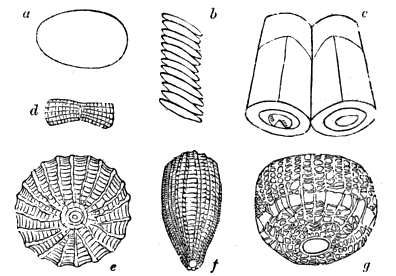
Magnified eggs, of a, Geometra armillata; b, of an unknown water insect; c, of the lacquey moth; d, of a caddis-fly (Phryganea atrata); e, of red under-wing moth (Catocala nupta); f, of Pontia Brassicæ; g, of the Clifden Nonpareil moth.
It was of old believed that insects were produced spontaneously by putrefying substances; and Virgil gives the details of a process for creating a swarm of bees out of the carcase of a bull; but Redi, a celebrated Italian naturalist, proved by rigid experiments that they are always, in such cases, hatched from eggs previously laid. Most insects, indeed, lay eggs, though some few are viviparous, and some propagate both ways. The eggs of insects are very various in form, and seldom shaped like those of birds. We have here figured those of several species, as they appear under the microscope.
When an insect first issues from the egg, it is called by naturalists larva, and, popularly, a caterpillar, a grub, or a maggot. The distinction, in popular language, seems to be, that caterpillars are produced from the eggs of moths or butterflies; grubs from the eggs of beetles, bees, wasps, &c.; and maggots (which are without feet) from blow-flies, house-flies, cheese-flies, &c., though this is not very rigidly adhered to in common parlance. Maggots are also sometimes called worms, as in the instance of the meal-worm; but the common earth-worm is not a larva, nor is it by modern naturalists ranked among insects.
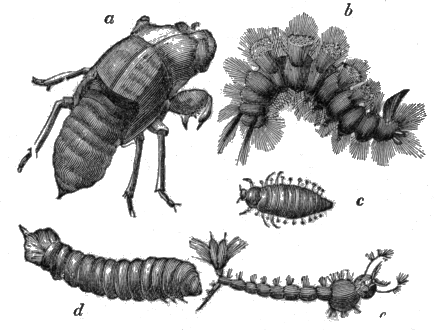
a, Ametabolous pupa of Cicada; b, caterpillar of tussock moth (Laria fascelina); c, larva of the poplar beetle (Chrysomela populi); d, larva of Sinex; e, larva of the common gnat.
There are, however, certain larvæ, as those of the Cicada, the crickets, the water-boatman (Notonecta), the cockroach, &c., which resemble the perfect insects in form, excepting that they are destitute of wings; but in the pupa state these appear in a rudimentary condition, at least in such species as have wings in the mature stage of existence. The pupæ are active and eat. Insects, the larvæ and pupæ of which are so similar to the adults, are termed Ametabolous (a, without, [Greek: metabolê], change); those the larvæ of which undergo changes of a marked character, Metabolous (Insecta ametabola and Insecta metabola, Burmeister).
Larvæ are remarkably small at first, but grow rapidly. The full-grown caterpillar of the goat-moth (Cossus ligniperda) is thus seventy-two thousand times heavier than when it issues from the egg; and the maggot of the blow-fly is, in twenty-four hours, one hundred and fifty-five times heavier than at its birth. Some larvæ have feet, others are without; none have wings. They cannot propagate. They feed voraciously on coarse substances; and as they increase in size, which they do very rapidly, they cast their skins three or four times. In defending themselves from injury, and in preparing for their change by the construction of secure abodes, they manifest great ingenuity and mechanical skill. The figures on the preceding page exemplify various forms of insects in this stage of their existence.
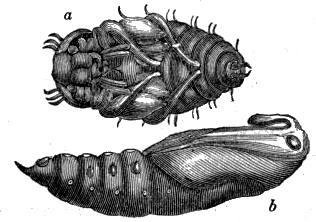
a, Pupa of a Water-Beetle (Hydrophilus); b, pupa of Sphinx Ligustri.
When larvæ are full grown, they cast their skins for the last time, undergo a complete change of form, excepting in the case of ametabolous larvæ, cease to eat, and remain nearly motionless. The inner skin of the larva now becomes converted into a membranous or leathery covering, which wraps the insect closely up like a mummy: in this condition it is termed Pupa, from its resemblance to an infant in swaddling bands. Nympha, or nymph, is another term given to insects in this stage;[M] moreover from the pupæ of many of the butterflies appearing gilt as if with gold, the Greeks called them Chrysalides, and the Romans Aureliæ, and hence naturalists frequently call a pupa chrysalis, even when it is not gilt. We shall see, as we proceed, the curious contrivances resorted to for protecting insects in this helpless state. The following are examples of insects in the imago, or perfect state.
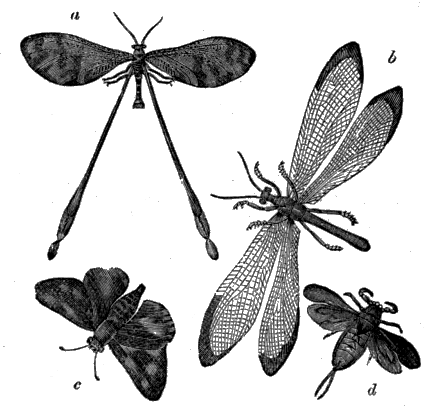
Insects in the Imago or perfect state. a, Nemopteryx coa, Leach.—b, Myrmeleon formicalynx, Fabricius.—c, Hesperia comma, Fabricius.—d, Nepa cinerea, Linnæus.
After a certain time, the insect which has remained in its pupa-case, like a mass of jelly without shape, is gradually preparing for its final change, when it takes the form of a perfect insect. This state was called by Linnæus Imago, because the insect, having thrown off its mask, becomes a perfect image of its species. Of some, this last portion of their existence is very short, others live through a year, and some exist for longer periods. They feed lightly, and never increase in size. The chief object of all is to perpetuate their species, after which the greater number quickly die. It is in this state that they exercise those remarkable instincts for the preservation of their race, which are exhibited in their preparations for the shelter of their eggs, and the nourishment of their larvæ.
CHAPTER II.
STRUCTURES FOR PROTECTING EGGS.—MASON-WASPS; MASON-BEES; MINING-BEES.
The provisions which are made by the different species of insects for protecting their eggs, appear in many cases to be admirably proportioned to the kind of danger and destruction to which they may be exposed. The eggs themselves, indeed, are not so liable to depredation and injury as the young brood hatched from them; for, like the seeds of plants, they are capable of withstanding greater degrees both of heat and cold than the insects which produce them. According to the experiments of Spallanzani, the eggs of frogs that had been exposed to various degrees of artificial heat were scarcely altered in their productive powers by a temperature of 111° of Fahrenheit, but they became corrupted after 133°. He tried the same experiment upon tadpoles and frogs, and found they all died at 111°. Silkworms died at a temperature of 108°, while their eggs did not entirely cease to be fertile till 144°. The larvæ of flesh-flies perished, while the eggs of the same species continued fertile, at about the same comparative degrees of heat as in the preceding instances. Intense cold has a still less effect upon eggs than extreme heat. Spallanzani exposed the eggs of silk-worms to an artificial cold 23° below zero, and yet, in the subsequent spring, they all produced caterpillars. Insects almost invariably die at the temperature of 14°, that is, at 18° below the freezing point.[N] The care of insects for the protection of their eggs is not entirely directed to their preservation in the most favourable temperature for being hatched, but to secure them against the numerous enemies which would attempt their destruction; and, above all, to protect the grubs, when they are first developed, from those injuries to which they are peculiarly exposed. Their prospective contrivances for accomplishing these objects are in the highest degree curious.
Most persons have more or less acquaintance with the hives of the social species of bees and wasps; but little is generally known of the nests constructed by the solitary species, though in many respects these are not inferior to the others in displays of ingenuity and skill. We admire the social bees, labouring together for one common end, in the same way that we look with delight upon the great division of labour in a well-ordered manufactory. As in a cotton-mill some attend to the carding of the raw material, some to its formation into single threads, some to the gathering these threads upon spindles, others to the union of many threads into one,—all labouring with invariable precision because they attend to a single object;—so do we view with delight and wonder the successive steps by which the hive-bees bring their beautiful work to its completion,—striving, by individual efforts, to accomplish their general task, never impeding each other by useless assistance, each taking a particular department, and each knowing its own duties. We may, however, not the less admire the solitary wasp or bee, who begins and finishes every part of its destined work; just as we admire the ingenious mechanic who perfects something useful or ornamental entirely by the labour of his own hands,—whether he be the patient Chinese carver, who cuts the most elaborately-decorated boxes out of a solid piece of ivory, or the turner of Europe, who produces every variety of elegant form by the skilful application of the simplest means.
Our island abounds with many varieties of solitary wasps and bees; and their nests may therefore be easily discovered by those who, in the proper seasons, are desirous of observing the peculiarities of their architecture.
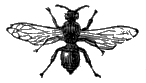
Odynerus.—Natural size.
Mason-Wasps.
In September, 1828, a common species of solitary mason-wasp (Odynerus, Latr.) was observed by us (J. R.) on the east wall of a house at Lee, in Kent, very busy in excavating a hole in one of the bricks, about five feet from the ground. Whether there might not have been an accidental hole in the brick before the wasp commenced her labours, is unknown, as she had made considerable progress in the work when first observed: but the brick was one of the hardest of the yellow sort made in this neighbourhood. The most remarkable circumstance in the process of hewing into the brick was the care of the insect in removing to a distance the fragments which from time to time she succeeded in detaching. It did not appear to suit her design to wear down the brick, particle by particle, as the furniture beetle (Anobium pertinax) does in making its pin-hole galleries in old wood. Our wasp-architect, on the contrary, by means of her strong tranchant-toothed jaws, severed a piece usually about the bigness of a mustard-seed. It might have been supposed that these fragments would have been tossed out of the hole as the work proceeded, without further concern; as the mole tosses above ground the earth which has been cleared out of its subterranean gallery. The wasp was of a different opinion; for it was possible that a heap of brick chips, at the bottom of the wall, might lead to the discovery of her nest by some of her enemies, particularly by one or other of the numerous tribe of what are called ichneumon-flies. This name is given to them, from the similarity of their habit of destroying eggs, to that of the little animal which proves so formidable an enemy to the multiplication of the crocodile of Egypt. They may be also denominated cuckoo-flies, because, like that bird, they thrust their egg into the nest of another species. These flies are continually prowling about and prying into every corner, to find, by stealth, a nidus for their eggs. It might have been some such consideration as this which induced the wasp to carry off the fragments as they were successively detached. That concealment was the motive, indeed, was proved: for one of the fragments which fell out of the hole by accident, she immediately sought for at the bottom of the wall, and carried off like the rest. It was no easy matter to get out one of the fragments, as may readily be conceived when the size of the insect is compared with that of the entrance of which this ( ) is the exact size, as taken from the impression of a bit of dough upon the hole when finished. It was only by seizing the fragment with her jaws, and retreating backwards, that the matter could be accomplished; though, after the interior of the excavation was barely large enough to admit of her turning round, she more than once attempted to make her exit head-foremost, but always unsuccessfully. The weight of the fragments removed did not appear to impede her flight, and she generally returned to her task in about two or three minutes.

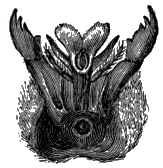
Mandibles—Jaws of Mason-Wasp.—Greatly magnified.
Within two days the excavation was completed; but it required two other days to line it with a coating of clay, to deposit the eggs, two in number, and, no doubt, to imprison a few live spiders or caterpillars for the young when hatched—a process which was first observed by Ray and Willughby,[O] but which has since been frequently ascertained. In the present instance, this peculiarity was not seen; but the little architect was detected in closing up the entrance, which was formed of a layer of clay more than double the thickness of the interior lining. In November following, we hewed away the brick around this nest, and found the whole excavation was rather less than an inch in depth.

Cuckoo-Fly (Tachina larvarum?).—Natural size.
Notwithstanding all the precautions of the careful parent to conceal her nest it was found out by one of the cuckoo-flies (Tachina larvarum?)—probably a common species very similar to the house-fly, but rather larger, which deposited an egg there; and the grub hatched from it, after devouring one of the wasp-grubs, formed itself a cocoon (a), as did the other undevoured grub of the wasp (b). Both awaited the return of summer to change into winged insects, burst their cerements, and proceed as their parents did.
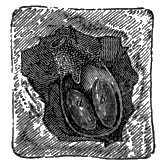
Mason-Wasp’s Nest and Cocoons.—About one-third the natural size.
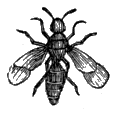
Mason-Wasp (Odynerus murarius).—Natural size.
Another mason-wasp (Odynerus murarius, Latr.), differing little in appearance from the former, may often be seen frequenting sandy banks exposed to the sun, and constructing its singular burrows. The sort of sand-bank which it selects is hard and compact; and though this may be more difficult to penetrate, the walls are not liable to fall down upon the little miner. In such a bank, the mason-wasp bores a tubular gallery two or three inches deep. The sand upon which Réaumur found some of these wasps at work was almost as hard as stone, and yielded with difficulty to his nail; but the wasps dug into it with ease, having recourse, as he ascertained, to the ingenious device of moistening it by letting fall two or three drops of fluid from their mouth, which rendered the mass ductile, and the separation of the grains easy to the double pickaxe of the little pioneers.
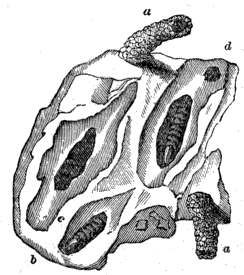
Nests, &c., of Mason-Wasps.—About half the natural size. a, The tower of the nest; b, the entrance after the tower is removed; c, the cell; d, the cell, with a roll of caterpillars prepared for the larva.
When this wasp has detached a few grains of the moistened sand, it kneads them together into a pellet about the size of one of the seeds of a gooseberry. With the first pellet which it detaches, it lays the foundation of a round tower, as an outwork, immediately over the mouth of its nest. Every pellet which it afterwards carries off from the interior is added to the wall of this outer round tower, which advances in height as the hole in the sand increases in depth. Every two or three minutes, however, during these operations, it takes a short excursion, for the purpose, probably, of replenishing its store of fluid wherewith to moisten the sand. Yet so little time is lost, that Réaumur has seen a mason-wasp dig in an hour a hole the length of its body, and at the same time build as much of its round tower. For the greater part of its height this round tower is perpendicular; but towards the summit it bends into a curve, corresponding to the bend of the insect’s body, which in all cases of insect architecture, is the model followed. The pellets which form the walls of the tower are not very nicely joined, and numerous vacuities are left between them, giving it the appearance of filigree-work. That it should be thus slightly built is not surprising, for it is intended as a temporary structure for protecting the insect while it is excavating its hole, and as a pile of materials, well arranged and ready at hand, for the completion of the interior building,—in the same way that workmen make a regular pile of bricks near the spot where they are going to build. This seems, in fact, to be the main design of the tower, which is taken down as expeditiously as it had been reared. Réaumur thinks that, by piling in the sand which has previously been dug out, the wasp intends to guard her progeny for a time from being exposed to the too violent heat of the sun; and he has even sometimes seen that there were not sufficient materials in the tower, in which case the wasp had recourse to the rubbish she had thrown out after the tower was completed. By raising a tower of the materials which she excavates, the wasp produces the same shelter from external heat as a human creature would who chose to inhabit a deep cellar of a high house. She further protects her progeny from the ichneumon-fly, as the engineer constructs an outwork to render more difficult the approach of an enemy to the citadel. Réaumur has seen this indefatigable enemy of the wasp peep into the mouth of the tower, and then retreat, apparently frightened at the depth of the cell which he was anxious to invade.
The mason-wasp does not furnish the cell she has thus constructed with pollen and honey, like the solitary bees, but with living caterpillars, and these always of the same species—being of a green colour, and without feet. She fixes the caterpillars together in a spiral column: they cannot alter their position, although they remain alive. They are an easy prey to their smaller enemy; and when the grub has eaten them all up, it spins a case, and is transformed into a pupa, which afterwards becomes a wasp. The number of caterpillars which is thus found in the lower cavity of the mason-wasp’s nest is ordinarily from ten to twelve. The mother is careful to lay in the exact quantity of provision which is necessary to the growth of the grub before he quits his retreat. He works through his store till his increase in this state is perfected, and he is on the point of undergoing a change into another state, in which he requires no food. The careful purveyor, cruel indeed in her choice of a supply, but not the less directed by an unerring instinct, selects such caterpillars as she is conscious have completed their growth, and will remain thus imprisoned without increase or corruption till their destroyer has gradually satisfied the necessities of his being. “All that the worm of the wasp,” says Réaumur, “has to do in his nest, from his birth to his transformation, is to eat.” There is another species of wasp which does not at once enclose in its nest all the sustenance which its larva will require before transformation, but which from time to time imprisons a living caterpillar, and when that is consumed, opens the nest and introduces another.
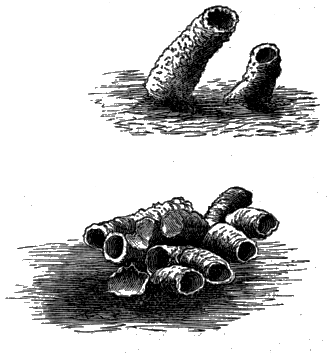
[The upper figure in the accompanying illustration exhibits two of the curious towers built by this interesting insect and drawn of their natural size.]
The insect is one of the most plentiful in England, and can be found on sunny days, flitting about sand-banks and making its curious habitations. The length is nearly half an inch, and the colour is black, variegated with five yellow bands upon the abdomen.
The lower figure represents the habitations of one of the British solitary wasps, Pompilus punctum, and is given in order to show a curious resemblance in the structure. The specimen from which the sketch was taken was found under the eaves of a roof which protected a bee-hive. The cells were thirteen in number, very carefully constructed of earth, and several of them were closed. Although these cells were not fossorial in their nature, several other species of the same genus are as accomplished burrowers as any insect. Pompilus plumbeus, for example, another black species, burrows into sand, and is very plentiful on our more southern shores. It may usually be found hovering about sand-banks, and flitting about with such agility that it is by no means an easy insect to catch. The male is peculiarly apt to evade the stroke of the entomologist’s net.
Then there is Pompilus rufipes, which is a black insect, but distinguished by the conspicuous red colour of the hind legs. This is very fond of our coasts, and may be found wherever the soil is suitable for its excavations. Many species of this genus carry off spiders for the purpose of provisioning their nests. Several species, which live far inland, prefer light and dry earth to sand, and make therein their burrows, preferring our little white spider as the provision for their young. Although the same insect may be often observed to carry the same kind of prey to its home, it does not at all follow that no change is ever made.
But the most remarkable example of this fact may be found in a very common swift-winged insect, black in colour, with a reddish patch on the end of the abdomen. Its name is Trachytes pompiliformis, and it generally stocks its nest with small caterpillars. Mr. F. Smith, however, has taken it when in the act of carrying off a small species of grasshopper—certainly the very last insect that would be thought of as likely to be immured by a captor which must be scarcely larger than itself.
This insect is to be found in most warm and sandy situations, and may be looked for at the end of summer and beginning of autumn. It may be easily known by its red spot on the abdomen, and the large, transverse head; it is wider than the thorax.
One species of mining-bee, not often found in England, chooses some very singular insects wherewith to feed its young. Its name is Philanthus triangulum, and it is a very fierce, waspish-looking creature, with a large wide head, wider even than the thorax, sharp and powerful jaws, and with broad wings. The head and thighs are black, with a few spots of a yellowish white, and the abdomen is yellow, with a black spot in the middle of each segment. Its length rather exceeds half an inch. The actions of this insect do not belie its looks, for it is a fierce and active creature, seizing upon various bees and dragging them into its tunnel.
Mr. F. Smith discovered the metropolis of this usually scarce insect at Sandown Bay, in the Isle of Wight, and has given an interesting description of its habits. He states that although it is so ferocious towards other insects, it appears to be perfectly harmless as far as man is concerned, allowing itself to be handled without even attempting to use its sting. Indeed, he was quite unable to provoke the insect to do so. Various bees were captured by the Philanthus, and the favourites seemed to belong to the genus Andrena, itself a burrowing bee, and the common hive-bee. The Philanthus seemed perfectly indifferent whether they attacked the comparatively small and feeble Andrena, or the formidable hive-bee, taking them as they came, and caring nothing for the sting. The Philanthus that burrowed on the top of the cliff, seemed to prefer the hive-bee, because the red clover attracted greater numbers of that insect. Those that made their burrows at the top of the cliff, took the Andrenæ. Of course, the Philanthus is obliged to catch more of the Andrenæ than the hive bees. Only one species of this genus is known in England; it is to be found in July and August.
There is a very large genus of rather small humming-bees, many of which are popularly mistaken for wasps, on account of their sharply pointed and yellow banded abdomen; they belong to the genus Crabro, and are extremely variable in the material into which they burrow, and the insects with which they feed their young. Some species burrow into dry bramble sticks. If the reader should wish to obtain specimens of them, as well as other burrowers, he will find bramble, rose, and jessamine sticks most prolific in them. The best plan is to collect a quantity of these sticks and put them into glass tubes, with the ends stopped with wire gauze; there is then an absolute certainty of identifying the insect with its habitation. The spring is the best time for collecting. Sometimes these creatures are afflicted with parasites, which also are detained in the tube, so as to yield valuable information to the captor.
Some species burrow in sand-banks and feed their young with gnats, others burrow into dead timber, and stock their tunnels with flies of various kinds. One very useful species, Crabro lævis, burrows in sand-banks, and provisions its nest with the noxious turnip-fleas (Halticæ), great numbers of which are needed to stock a single burrow. It is rather a social insect, many burrows being often found near each other. The turnip-flea has so hard a shell, that the young Crabro seems hardly capable of eating it. Mr. Smith, however, has remarked that another burrowing-bee stocks its nest with certain weevils that are almost too hard to be pierced with a pin, and that the shell is probably softened by the damp ground. The greater number of this group, however, are burrowers into the ground, and stock their nests with flies of some kind.
Another species of this large genus, Crabro luteipalpis, is fond of making its burrows in the mortar of old walls, preferring those spots where nails have been drawn, making the process of burrowing easier for the insect. It is not uncommon in the outskirts of London. All gardeners, especially those who cultivate roses, ought to encourage this very little insect, and welcome its presence, for it provisions its nest with the aphides, or green blight, which infect the rose-trees, and which have destroyed so many promising plants.
The female, which is the larger of the two sexes, measures only three lines in length. The colour is shining black, and the head is rather squared.
Among other burrowing species of this genus we may mention Crabro varius, a rather long and slender insect, black in colour, with yellow spottings about the thorax. It prefers very hard fine sand, such as is found in partially excavated sand-banks, and provisions its burrows with gnats. It is tolerably plentiful.
Our last example of the earth-burrowers belonging to this genus is Crabro Wesmoeli, which chooses similar localities, being mostly found in sand-banks. It carries off flies of different kinds for the food of its young. There is a very common insect, closely allied to the last mentioned genus, whose horns are worthy of notice. This is called Typoxylon figulus. It is a small creature, with a large head and slender abdomen. Its colour is black, and on the edges of the segments of the abdomen there is a little silvery shining down.
It generally burrows into light earth, though it sometimes drives its tunnel into decayed wood. In either case, it provisions its nest with spiders, flying into the hedges, pulling the unfortunate spiders out of their webs, and carrying them into the burrow. One burrow contains a series of cells, which are separated from each other by partitions of sand, the particles of which are firmly cemented together by some glutinous substance secreted by the insect. Some species of this genus burrow into the pith of the bramble and other shrubs.
One of the most determined of our British burrowers is the insect which is known by the name of Ammophila sabulosa. It has a large, squared head, wider than the thorax, a very long and slender body, and short though powerful wings. The colour is black, with a slight rust-red tint on the base of the abdomen.
When the female has dug her burrow, she sets off in search of a caterpillar of proportionate size, and having conveyed it into her dwelling, she affixes an egg to the imprisoned larva, and goes off in search of another, carefully stopping up the entrance with stones. In fine weather she will fill one burrow with caterpillars in a few hours, and then begin another nursery for the future young. This species appears always to make use of caterpillars, but another allied species prefers spiders. Mr. F. Smith mentions that he has found in a high sand-bank as many as twenty females apparently hibernating together till suitable weather enabled them to pursue their usual economy.
There really seems to be scarcely any genus of insect that is not seized upon by one or other of these burrowers, and packed away in a half living state to form food for their young. There is one of these solitary burrowing wasps called the Astata boops, deriving its specific name from its large round eyes, which in the male completely unite at the back of the head. The abdomen is shaped something like a boy’s peg-top, or a symmetrical turnip, the peg of the top, or the point of the turnip, corresponding to the top of the abdomen. Its length is about half an inch, and its colour is black, with a rust-red patch on the end of the abdomen.
There is a remarkably pretty, and very variable, sand-wasp, which is plentiful in most parts of the country. The colour is black, and the abdomen is banded by four yellow bars. Its feet are also yellow. Mr. Smith has written a very interesting account of the proceedings of this insect.
"Having frequently observed the habits of the type of this genus, Mellinus arvensis, and reared it from the larva state, a few observations are here recorded. When the parent insect has formed a burrow of the required length, and enlarged the extremity into a chamber of proper dimensions, she issues forth in search of the proper nutriment for her young; this consists of various dipterous insects: species of various genera are equally adapted to her purpose—Muscidæ, Syrphidæ, &c., are captured.
"It is amusing to see four or five females lie in wait upon a patch of cow-dung until some luckless fly settles on it. When this happens, a cunning and gradual approach is made; a sudden attempt would not succeed. The fly is the insect of quickest flight, therefore a degree of intrigue is necessary. This is managed by running past the victim slowly, and apparently in an unconcerned manner, until the poor fly is caught unawares, and carried off by the Mellinus to its burrow. The first fly being deposited, an egg is laid. The necessary number of flies are soon secured, and her task is completed. Sometimes she is interrupted by rainy weather, and it is some days ere she can store up the quantity required.
“A larva found feeding became full-fed in ten days. Six flies were devoured, the heads, harder parts of the throat, portions of the abdomen, and the legs, being left untouched. The larva spins a tough, thin, brown silken cocoon, passes the winter and spring in the larva state, changes to the nymph on the approach of summer, and appears about the beginning of autumn in the perfect state.”
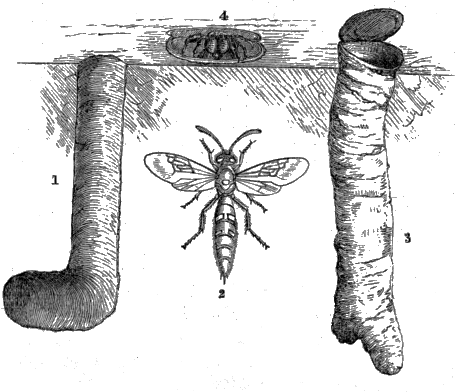
There is a genus of hymenopterous insects known by the name of Scolia, which are remarkable for their fossorial powers. The species represented in the engraving is called Scolia Xantiana, and is a native of California.
When the female Scolia is about to fulfil the great object for which she came into the world, she looks about for a suitable spot, where the ground is not too hard, and digs a perpendicular burrow of some depth, enlarging it at the bottom, and digging horizontally, so that the general shape of the burrow somewhat resembles that of a boot. When the burrow is completed, the insect flies off in search of food for its young, and presently returns, bearing with her a grub, which she clasps tightly under her chest, so that her wings may be at liberty. She then takes the grub to the bottom of the tunnel, deposits an egg upon it, and if the grub be a small one, goes off to fetch another. When a sufficiency of food has been obtained, she covers up the grub and egg and leaves the latter to its fate. In due time it is hatched, and begins straightway to feed upon its unfortunate fellow-prisoner. When all the food is gone, it is old enough to assume the perfect form, and when it finally becomes a perfect insect, it makes its way into the open air, and straightway looks out for a mate.
An European species of this genus, which is called Scolia flavifrons, is remarkable for the four large, round spots on the upper surface of the abdomen. This species always feeds its young on the grub of a beetle, one of the lamellicorn group, and in this case the grub is so large that one is sufficient.
In the illustration, the left hand figure shows a section of the burrow of Scolia Xantiana, and exhibits the enlarged portion of the tunnel in which are placed the young Scolia and the unfortunate grub which has to serve it for food. The insect itself is seen in the centre.
For figures 3 and 4 the reader is referred to the heading “Spiders.”
There is another British insect which feeds its young with flies, and which catches them in a manner somewhat similar to that which has recently been narrated when treating of the Mellinus. The insect in question is called Oxybelus unuglumis, and is a very pretty species. Its length is seldom much more than a quarter of an inch, and its colour is black, with some silvery hair about the face, and with some spots and bands of white, more or less yellowish, upon the pointed abdomen. The male is usually smaller than the female, but compensates for this want of size by his more brilliant colouring.
Mr. F. Smith has described to me the method employed by this insect in catching flies. In the air it would not have a chance of success, and so it proceeds after a fashion very much like that which is adopted by the hunting-spider. Choosing some spot where flies are likely to settle, such as a bare, sunny bank, the Oxybelus alights upon it and begins to run about without any apparent motive. At first the flies are rather alarmed, but after a while they become accustomed to the rapid movements of their foe, and allow it to come nearer and nearer the cause of its perambulations. As soon as it has succeeded in drawing within a few inches of a fly, the Oxybelus leaps upon it, just like the hunting spider on its prey, and flies off before the victim knows that an attack is even meditated.
The burrow of this species is made in hard white sand.
Several species of the genus Cerceris are noted, not only as burrowers, but for the exceeding variety of the food which they store in their dwellings. The most common species, Cerceris arenaria, makes its tunnel in hard, sandy spots, and is usually to be found about the middle of July and August. The length of this insect rather exceeds half an inch, and its colour is black, profusely spotted and barred with yellow. It is rather slenderly made, and gives little external indications of the great strength which it possesses.
This insect prefers to stock its nest with weevils of different kinds—a most singular choice, when the hardness of the exterior is taken into consideration. The well-known nut-weevil (Balaninus nucum), with its hard, round body, and long mouth, is frequently taken by this species of Cerceris, and Mr. Smith further mentions that he has captured it in the act of taking the weevil called Otiorhynchus sulcatus to its nest.
This beetle is among the most noxious of our garden foes, and the more so because its ravages are unseen. In its larval state it infests the roots of many of our succulent plants and flowers, and has a habit of eating away the plant just at the junction of the root and stem. Even flowers in pots are apt to be infested by this insect, and often die without the cause of their death being discovered. It is about half an inch in length, white, and is destitute of feet, their office being performed by bundles of stiff hairs, which are dispersed round the body.
In its perfect state it is about the third of an inch in length, the colour is black, covered with a coating of very fine and short grey hairs, and along its back are a number of short longitudinal grooves. From this latter circumstance it derives its name of “sulcatus,” or grooved.
The exterior of this beetle is extremely hard, even exceptionally so among the hard-bodied weevils. It is extremely difficult to get a pin through the body, and the entomologist is often obliged to bore a hole with a stout needle before the pin can be inserted. Yet, the Cerceris uses this insect as the food of its young, and stores them away in its burrow. That the young should eat them seems as impossible as if a lobster or a box-tortoise had been inserted in their place. It is, however, thought by most practical entomologists that the shell of the weevil is softened by lying in the damp ground, and that as the young is not hatched for several days after the burrow is sealed up, the hard wing cases have time to soften.
Another species of the same genus, Cerceris interrupta, has the curious habit of making its burrow in the hardest ground which it can penetrate, and is generally to be found in well used footpaths. This species also uses weevils for the food of its young, but prefers those small weevils which are classed under the genus Apion, and which are readily known by their pear-shaped bodies and rather elongated heads. [There are about seventy species of Apion, so that the Cerceris has plenty of choice.]
Mason-Bees.
It would not be easy to find a more simple, and, at the same time, ingenious specimen of insect architecture than the nests of those species of solitary bees which have been justly called mason-bees (Megachile, Latreille). Réaumur, who was struck by the analogies between the proceedings of insects and human arts, first gave to bees, wasps, and caterpillars those names which indicate the character of their labours; and which, though they may be considered a little fanciful, are at least calculated to arrest the attention. The nests of mason-bees are constructed of various materials; some with sand, some with earth mixed with chalk, and some with a mixture of earthy substances and wood.
Mason-Bee (Anthophora retusa).—Natural size.
On the north-east wall of Greenwich Park, facing the road, and about four feet from the ground, we discovered (J. R.), December 10th, 1828, the nest of a mason-bee, formed in the perpendicular line of cement between two bricks. Externally there was an irregular cake of dry mud, precisely as if a handful of wet road-stuff had been taken from a cart-rut and thrown against the wall; though, upon closer inspection, the cake contained more small stones than usually occur in the mud of the adjacent cart-ruts. We should in fact have passed it by without notice had there not been a circular hole on one side of it, indicating the perforation of some insect. This hole was found to be the orifice of a cell about an inch deep, exactly of the form and size of a lady’s thimble, finely polished, and of the colour of plaster-of-paris, but stained in various places with yellow.
Exterior Wall of Mason-Bee’s Nest.
This cell was empty; but, upon removing the cake of mud, we discovered another cell, separated from the former by a partition about a quarter of an inch thick, and in it a living bee, from which the preceding figure was drawn, and which, as we supposed, had just changed from the pupa to the winged state, in consequence of the uncommon mildness of the weather. The one which had occupied the adjacent cell had no doubt already dug its way out of its prison, and would probably fall a victim to the first frost.
Cells of a Mason-Bee (Anthophora retusa).—One-third the natural size.
Our nest contained only two cells—perhaps from there not being room between the bricks for more.
[There are only four British species of this genus. One species, A. acervorum, seems perfectly indifferent whether it burrows into banks or into the mortar of old walls. If possible, the former locality seems to be the most favoured.
This species is notable for the many parasites who infect the habitation and destroy the inmates. Perhaps the very worst and most destructive of these parasites is the common earwig, which wreaks wholesale desolation in the nest. It creeps into the burrow, and if it finds a store of pollen laid up for the young, it will eat the pollen. But if the young grub be hatched it will eat the grub. If the inmate be in the pupal state, or even if it be ready to emerge in its perfect condition, the earwig will eat it.
There are two bees which are parasitic upon this unfortunate insect, both belonging the genus Melecta.
But the most destructive of these parasites appears to be an insect which belongs to the great family of Chalcididæ. These insects are of the hymenopterous order, are of very minute dimensions, and of the most brilliant colours. Indeed, if they were an inch or two in length, instead of the eighth or twelfth of an inch, they would not suffer in comparison with the most gorgeous inhabitants of tropical countries.
Their forms are most eccentric, some species having the abdomen small and round and set on a long footstalk, while others have that portion of the body placed so closely against the thorax, that the short footstalk is scarcely visible. Others have certain joints of the legs so large that a single joint equals the entire abdomen. Some have the ovipositor projecting boldly from the body, while others have it tucked up underneath, and others again have it quite short. But there is one point which distinguishes them all, namely, the almost veinless character of the wings.
Some of the Chalcididæ are parasitic upon insects in their earliest stages, actually depositing their eggs in those of moths and butterflies. Others are entirely parasitic upon parasites, laying their eggs in the aphidii, which are parasites of the aphis. Some of them haunt the galls, and contrive to make their young parasitic upon the immature cynipidæ which lie within the gall. The common small tortoise-shell butterfly is terribly infested with these little creatures, and we have bred hundreds of the gem-like Chalcididæ from the larvæ and pupæ of that butterfly.
One of the Chalcididæ, belonging to the genus Melittobia, is a parasite upon the Anthophora; and the curious part of the proceeding is, that it finds there another parasite, which becomes developed in the home of the bee: the Melittobia feeds indiscriminately upon the bee and parasite.
Although the Melittobia does not make such wholesale destruction as is wrought by the earwig when it gets into a nest, it does more damage to the bee, on account of its great numbers. Some three or four females will lay a great quantity of eggs within a nest, and from those eggs a hundred of the young will be developed. When the larvæ are fully grown, they quit their hold of their prey, and fall to the bottom of the cell, where they lie until they have assumed the perfect form. They then burst forth, together with those of the bee that may have escaped their attacks.]
An interesting account is given by Réaumur of another mason-bee (Megachile muraria), not a native of Britain, selecting earthy sand, grain by grain; her glueing a mass of these together with saliva, and building with them her cells from the foundation. But the cells of the Greenwich Park nest were apparently composed of the mortar of the brick wall; though the external covering seems to have been constructed as Réaumur describes his nest, with the occasional addition of small stones.
About the middle of May, 1829, we discovered the mine from which all the various species of mason-bees in the vicinity seemed to derive materials for their nests. (J. R.) It was a bank of brown clay, facing the east, and close by the margin of the river Ravensbourn, at Lee, in Kent. The frequent resort of the bees to this spot attracted the attention of some workmen, who, deceived by their resemblance to wasps, pointed it out as a wasps’ nest; though they were not a little surprised to see so numerous a colony at this early season. As the bees had dug a hole in the bank, where they were incessantly entering and reappearing, we were of opinion that they were a peculiar sort of the social earth-bees (Bombi). On approaching the spot, however, we remarked that the bees were not alarmed, and manifested none of the irritation usual in such cases, the consequence of jealous affection for their young. This led us to observe their operations more minutely; and we soon discovered that on issuing from the hole each bee carried out in its mandibles a piece of clay. Still supposing that they were social earth-bees, we concluded that they were busy excavating a hollow for their nest, and carrying off the refuse to prevent discovery. The mouth of the hole was overhung, and partly concealed, by a large pebble. This we removed, and widened the entrance of the hole, intending to dig down and ascertain the state of the operations; but we soon found that it was of small depth. The bees, being scared away, began scooping out clay from another hole about a yard distant from the first. Upon our withdrawing a few feet from the first hole, they returned thither in preference, and continued assiduously digging and removing the clay. It became obvious, therefore, from their thus changing place, that they were not constructing a nest, but merely quarrying for clay as a building material. By catching one of the bees (Osmia bicornis) when it was loaded with its burden, we ascertained that the clay was not only carefully kneaded, but was also more moist than the mass from which it had been taken. The bee, therefore, in preparing the pellet, which was nearly as large as a garden-pea, had moistened it with its saliva, or some similar fluid, to render it, we may suppose, more tenacious, and better fitted for building. The reason of their digging a hole, instead of taking clay indiscriminately from the bank, appeared to be for the purpose of economizing their saliva, as the weather was dry, and the clay at the surface was parched and hard. It must have been this circumstance which induced them to prefer digging a hole, as it were, in concert, though each of them had to build a separate nest.
The distance to which they carried the clay was probably considerable, as there was no wall near, in the direction they all flew towards, upon which they could build; and in the same direction also, it is worthy of remark, they could have procured much nearer the very same sort of clay. Whatever might be the cause of their preference, we could not but admire their extraordinary industry. It did not require more than half a minute to knead one of the pellets of clay; and, from their frequent returns, probably not more than five minutes to carry it to the nest, and apply it where wanted. From the dryness of the weather, indeed, it was indispensable for them to work rapidly, otherwise the clay could not have been made to hold together. The extent of the whole labour of forming a single nest may be imagined, if we estimate that it must take several hundred pellets of clay for its completion. If a bee work fourteen or fifteen hours a-day, therefore, carrying ten or twelve pellets to its nest every hour, it will be able to finish the structure in about two or three days; allowing some hours of extra time for the more nice workmanship of the cells in which the eggs are to be deposited, and the young grubs reared.
That the construction of such a nest is not a merely agreeable exercise to the mason-bee has been sufficiently proved by M. Du Hamel. He has observed a bee (Megachile muraria) less careful to perform the necessary labour for the protection of her offspring than those we have described, but not less desirous of obtaining this protection, attempt to usurp the nest which another had formed. A fierce battle was invariably the consequence of this attempt; for the true mistress would never give place to the intruder. The motive for the injustice and the resistance was an indisposition to further labour. The trial of strength was probably, sometimes, of as little use in establishing the right as it is amongst mankind; and the proper owner, exhausted by her efforts, had doubtless often to surrender to the dishonest usurper.
The account which Réaumur has given of the operations of this class of bees differs considerably from that which we have here detailed; from the species being different, or from his bees not having been able to procure moist clay. On the contrary, sand was the chief material used by the mason-bees (Megachile muraria); which they had the patience to select from the walks of a garden, and knead into a paste or mortar, adapted to their building. They had consequently to expend a much greater quantity of saliva than our bees (Osmia bicornis), which worked with moist clay. Réaumur, indeed, ascertained that every individual grain of sand is moistened previous to its being joined to the pellet, in order to make it adhere more effectually. The tenacity of the mass is, besides, rendered stronger, he tells us, by adding a proportion of earth or garden-mould. In this manner, a ball of mortar is formed, about the size of a small shot, and carried off to the nest. When the structure of this is examined, it has all the appearance externally of being composed of earth and small stones or gravel. The ancients, who were by no means accurate naturalists, having observed bees carrying pellets of earth and small stones, supposed that they employed these to add to their weight, in order to steady their flight when impeded by the wind.
The nests thus constructed appear to have been more durable edifices than those which have fallen under our observation;—for Réaumur says they were harder than many sorts of stone, and could scarcely be penetrated with a knife. Ours, on the contrary, do not seem harder than a piece of sun-baked clay, and by no means so hard as brick. One circumstance appeared inexplicable to Réaumur and his friend Du Hamel, who studied the operations of these insects in concert. After taking a portion of sand from one part of the garden-walk, the bees usually took another portion from a spot almost twenty and sometimes a hundred paces off, though the sand, so far as could be judged by close examination, was precisely the same in the two places. We should be disposed to refer this more to the restless character of the insect than to any difference in the sand. We have observed a wasp paring the outside of a plank, for materials to form its nest; and though the plank was as uniform in the qualities of its surface, nay, probably more so than the sand could be, the wasp fidgeted about, nibbling a fibre from one, and a fibre from another portion, till enough was procured for one load. In the same way, the whole tribe of wasps and bees flit restlessly from flower to flower, not unfrequently revisiting the same blossom, again and again, within a few seconds. It appears to us, indeed, to be far from improbable, that this very restlessness and irritability may be one of the springs of their unceasing industry.
By observing, with some care, the bees which we found digging the clay, we discovered one of them (Osmia bicornis) at work upon a nest, about a gunshot from the bank. The place it had chosen was the inner wall of a coal-house, facing the south-west, the brick-work of which was but roughly finished. In an upright interstice of half an inch in width, between two of the bricks, we found the little architect assiduously building its walls. The bricklayer’s mortar had either partly fallen out, or been removed by the bee, who had commenced building at the lower end, and did not build downwards, as the social wasps construct their cells.
The very different behaviour of the insect here, and at the quarry, struck us as not a little remarkable. When digging and preparing the clay, our approach, however near, produced no alarm; the work went on as if we had been at a distance; and though we were standing close to the hole, this did not scare away any of the bees upon their arrival to procure a fresh load. But if we stood near the nest, or even in the way by which the bee flew to it, she turned back or made a wide circuit immediately, as if afraid to betray the site of her domicile. We even observed her turning back, when we were so distant that it could not reasonably be supposed she was jealous of us; but probably she had detected some prowling insect depredator, tracking her flight with designs upon her provision for her future progeny. We imagined we could perceive not a little art in her jealous caution, for she would alight on the tiles as if to rest herself; and even when she had entered the coal-house, she did not go directly to her nest, but again rested on a shelf, and at other times pretended to examine several crevices in the wall, at some distance from the nest. But when there was nothing to alarm her, she flew directly to the spot, and began eagerly to add to the building.