Front matter (continued 3)
Reading edition
The wasp has been labouring at her manufacture of paper from her first creation, with precisely the same instruments and the same materials; and her success has been unvarying. Her machinery is very simple, and therefore it is never out of order. She learns nothing, and she forgets nothing. Men, from time to time, lose their excellence in particular arts, and they are slow in finding out real improvements. Such improvements are often the effect of accident. Paper is now manufactured very extensively by machinery in all its stages; and thus, instead of a single sheet being made by hand, a stream of paper is poured out, which would form a roll large enough to extend round the globe, if such a length were desirable. The inventors of this machinery, Messrs. Fourdrinier, it is said, spent the enormous sum of 40,000l.. in vain attempts to render the machine capable of determining with precision the width of the roll; and, at last, accomplished their object, at the suggestion of a bystander, by a strap revolving upon an axis, at a cost of three shillings and sixpence. Such is the difference between the workings of human knowledge and experience, and those of animal instinct. We proceed slowly and in the dark, but our course is not bounded by a narrow line, for it seems difficult to say what is the perfection of any art; animals go clearly to a given point—but they can go no further. We may, however, learn something from their perfect knowledge of what is within their range. It is not improbable that if man had attended in an earlier state of society to the labours of wasps, he would have sooner known how to make paper. We are still behind in our arts and sciences, because we have not always been observers. If we had watched the operations of insects, and the structure of insects in general, with more care, we might have been far advanced in the knowledge of many arts which are yet in their infancy, for nature has given us abundance of patterns. We have learnt to perfect some instruments of sound by examining the structure of the human ear; and the mechanism of an eye has suggested some valuable improvements in achromatic glasses.
Réaumur has given a very interesting account of the wasps of Cayenne (Chartergus nidulans), which hang their nests in trees.[Y] Like the bird of Africa called the social grosbeak (Loxia socia), they fabricate a perfect house, capable of containing many hundreds of their community, and suspend it on high out of the reach of attack. But the Cayenne wasp is a more expert artist than the bird. He is a pasteboard-maker;—and the card with which he forms the exterior covering of his abode is so smooth, so strong, so uniform in its texture, and so white, that the most skilful manufacturer of this substance might be proud of the work. It takes ink admirably.
The nest of the pasteboard-making wasp is impervious to water. It hangs upon the branch of a tree, as represented in the engraving; and those rain-drops which penetrate through the leaves never rest upon its hard and polished surface. A small opening for the entrance of the insects terminates its funnel-shaped bottom. It is impossible to unite more perfectly the qualities of lightness and strength.
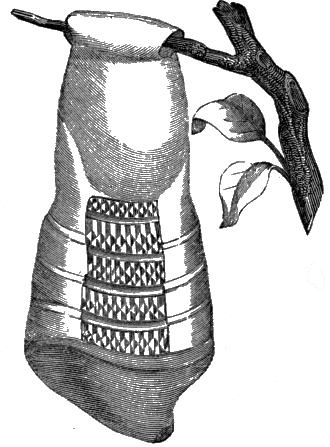
Nest of the Pasteboard-maker Wasp, with part removed to show the arrangement of the Cells.
In the specimen from which we take our description, the length of which is nine inches, six stout circular platforms stretch internally across, like so many floors, and fixed all round to the walls of the nest. They are smooth above, with hexagonal cells on the under surface. These platforms are not quite flat, but rather concave above, like a watch-glass reversed; the centre of each platform is perforated for the admission of the wasps, at the extremity of a short funnel-like projection, and through this access is gained from story to story. On each platform, therefore, can the wasps walk leisurely about attending to the pupæ secured in the cells, which, with the mouths downward, cover the ceiling above their heads—the height of the latter being just convenient for their work.
[Unlike the habitations made by the British wasps, and which are vacated annually, this nest is permanent, and serves for several successive seasons. Of course, it must be enlarged continually, so as to accommodate an ever-increasing number of inhabitants. The mode of enlarging is sufficiently curious. The British wasps enlarge their nests either by making a larger covering and then removing the smaller, or by raising blisters on the outside, and eating away beneath them. But the pendulous wasp of Brazil proceeds on just the opposite principle, making new cells first, and covering them afterwards. The new tier of cells is set on the bottom of the nest, which thus becomes the floor of that tier, and a new bottom is then made beneath these new cells.]
Pendent wasps’ nests of enormous size are found in Ceylon, suspended often in the talipot-tree at the height of seventy feet. The appearance of these nests thus elevated, with the larger leaves of the tree, used by the natives as umbrellas and tents, waving over them, is very singular. Though no species of European wasp is a storer of honey, yet this rule does not apply to certain species of South America. In the ‘Annals and Magazine of Natural History’ for June, 1841, will be found a detailed account, with a figure, of the pendent nest of a species termed by Mr. A. White Myrapetra scutellaris. The external case consists of stout cardboard covered with conical knobs of various sizes. The entrances are artfully protected by pent-roofs from the weather and heavy rains; and are tortuous, so as to render the ingress of a moth or other large insect difficult. Internally are fourteen combs, exclusive of a globular mass, the nucleus of several circular combs, which are succeeded by others of an arched form—that is, constituting segments of circles. Many of the uppermost combs were found to have the cells filled with honey of a brownish-red colour, but which had lost its flavour. After entering into some minute details, Mr. A. White makes the following interesting observations:—"Azara, in the account of his residence in various parts of South America, mentions the fact of several wasps of these countries collecting honey. The Baron Walchenaer, who edited the French translation of this work, published in 1809, thought that the Spanish traveller, who was unskilled in entomology, had made some mistake with regard to the insects, and regarded the so-called wasps as belonging to some bee of the genus of which Apis amalthea is the type (Melipona). Latreille (who afterwards corrected his mistake) also believed that they must be referred to the genera Melipona or Trigona—insects which in South America take the place of our honey-bee. These authors were afterwards clearly convinced of the correctness of Azara’s observations, by the circumstance of M. Auguste de St. Hilaire finding near the river Uruguay an oval grey-coloured nest of a papery consistence, like that of the European wasps, suspended from the branches of a small shrub about a foot from the ground: he and two other attendants partook of some honey (contained in its cells) and found it of an agreeable sweetness, free from the pharmaceutic taste which so frequently accompanies European honey. He gives a detailed account of its poisonous effects on himself and his two men. Afterwards he procured specimens of the wasp, which was described by Latreille under the name of Polistes Lecheguana."
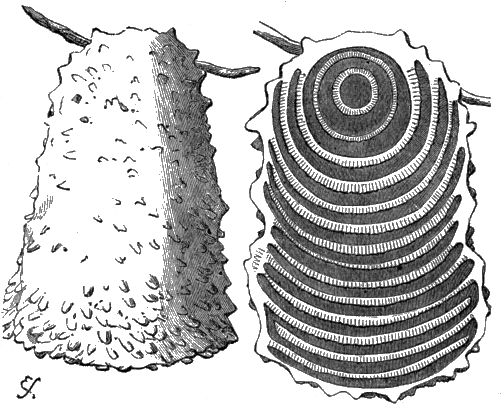
Nest of Myrapetra.
[The accompanying illustration shows this remarkable nest, both as it appears externally, and when divided vertically.
The material is probably the dung of the Capincha, an animal allied to the guinea-pig and the agouti. The natives, at all events, state that such is the case, and the aspect of the nest as seen through a magnifying glass carries out this assertion. The nest is hung to a branch, and is seldom more than four feet from the ground. The insect is a very little one in comparison with the size of the nest, which is sixteen inches in length, and twelve in width. The largest specimens of this insect are only one third of an inch long, while the generality scarcely exceed a quarter of an inch. Its colour is brown.
In the section is shown the very peculiar shape of the combs. At the upper part is seen the globular centre, surrounded with a comb that completely encircles it. Other combs follow in order, but are less curved as they approach the bottom of the nest. The insects obtain admission to the several tiers by means of apertures which are left between the extremities of the comb and the wall of the nest. The combs are made of the same material as the outer wall, but are very thin and paper-like. This nest may be seen in the British Museum.]
It would seem that the nest described by Mr. White agrees with that of a wasp termed Chiguana by Azara (or Lecheguana), and is very different to the slight papery nest of the Polistes Lecheguana of Latreille. We may add that M. Auguste de St. Hilaire speaks of two species of wasps remarkable for storing honey in South America; the honey of one is white, of the other reddish. That the habits of these honey-wasps must differ considerably from those of any of our European species we may at once admit; perhaps in some points of their economy these insects may approach the bee.
[In the same country as is inhabited by the Myrapetra, and in much the same localities, is sometimes found the nest of another honey-making wasp, called Nectarinia analis, a small and plainly-clad insect. It is hung to the branches of low trees and underwood, and often includes both twigs and leaves in its structure. The combs of this insect are greatly curved, in order to suit the shape of the general covering, but are not arranged with that beautiful regularity which distinguishes those of the Myrapetra. A specimen of this nest may be seen in the British Museum, and as the outer covering has been partially taken away, the observer will be enabled to note the general form of the combs and the structure of the cells.
In the accompanying illustration are shown the habitations of two remarkable insects, both belonging to the Hymenoptera. Indeed, the greater number of pensile nests made by insects are formed by members of this important order; and, if we were to exclude all the wasps, bees, and ants, we should find that we had excluded about ninety per cent. of the pensile architects.
The left-hand figure represents a nest made by a species of Polybia, inhabiting Brazil. It is made of a papery kind of substance, of rather slight texture, and is fixed to the stalk of a reed. The outside of the nest is seen to be marked with a series of horizontal ribs. These show the progressive stages of the nest, each rib marking a layer of paper as it was spread by the insect builder. The combs extend throughout the entire nest, the largest occupying the centre, and the smallest the ends. Each comb is firmly supported by a footstalk, which is fixed, not to the upper tier of cells, as is the case with the British wasps, but to the reed on which the nest is built.
Other species of Polybia build nests different in shape and arrangement, though still of the pensile character. One species builds a nearly globular nest, made in a rather curious manner. Carrying out still farther the principle on which the cardboard wasp enlarges its nest, the Polybia entirely covers the outer wall with cells, and then makes a new wall over them. When a nest has reached a tolerable size, it is composed of a whole series of concentric combs, the roof of each having been originally the outer wall of the nest. There are in the British Museum some admirable specimens of these nests, in some of which the process of enlargement can be very clearly traced. Patches of new cells are seen upon the external covering, while a few breaches in the structure show the concentric combs.
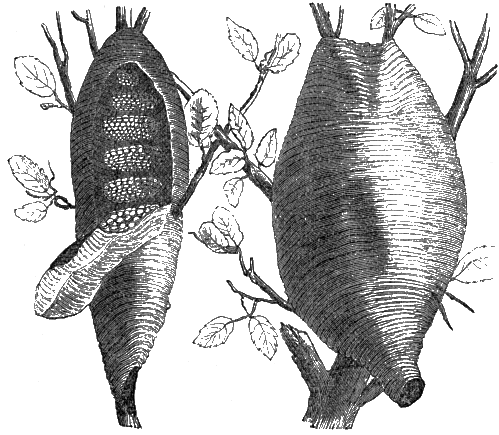
Nests of Polybia.
One very curious point about these cells is, that they are not uniform in their direction, as is generally the case with those of social hymenoptera. The greater part, such as the various wasps, hornets, and their kin, have the mouths of the cells downwards, while the cells of the hive-bee are nearly horizontal. But the cells of this insect are arranged without the least regard to their position, all the bases pointing towards the centre of the nest, and all the mouths radiating outwards.
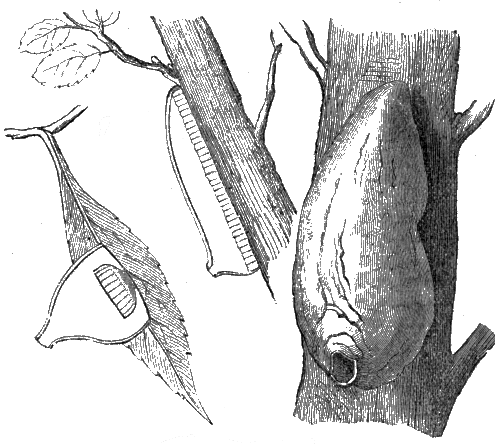
Nests of Synæca and Polybia.
There seems to be scarcely any bound to the variety which exists in the nests of the social hymenoptera. The insect which makes the nest which is represented in the illustration is a native of Brazil, and is known to entomologists as Synæca cyanea. The first of these names is given to it on account of its social habits, and the second, in reference to the bluish colour of its body. It is rather larger than the preceding insects, being about three quarters of an inch in length. Its wings are brown.
The shape and size of the nest are exceedingly variable, but it is almost invariably longer than wide, and is fixed to a branch or some similar object. Sometimes it attains considerable dimensions, and has been known to measure a full yard in length. Yet, however large it may be, there is only a single comb, which is set upon the side of the nest next the branch, and, in consequence, has almost all its cells placed in a horizontal direction. In the illustration, the right-hand figure represents the external appearance of the nest, and the central figure shows the manner in which the single comb is set upon the branch. The nest which occupies the left hand of the illustration is made by a species of Polybia, and is here given in order to show a remarkable example of similarity in the mode of building adopted by two different insects. In the one case, however, the cells are all fastened by their bases to the branch, but in the other the cells are attached to one common base which is prolonged into a footstalk.
There have been lately discovered some very remarkable social nests. Specimens of both these nests may be seen in the entomological department of the museum at Oxford.
The first is formed very much like a rather flattened Florence flask, and is hung by the neck from the branch of a tree. It is made of a strong, parchment-like substance, formed by innumerable silken threads woven and matted together into a kind of felt. When it was cut open a most singular sight was exhibited. Nearly the whole of the interior was covered with the pupæ of some butterfly, all hanging by their tails, and many of them suspended to a twig which projected downwards into the nest. Although the nest is barely eight inches in length, a great proportion of which is taken up by the neck, about one hundred pupæ were found in it. At the bottom of the nest is a small and nearly circular aperture, through which the insects could make their way as soon as they escaped from the pupal envelope, and before their wings became extended and hardened.
The butterfly which makes this singular nest is a native of Mexico, and is named Eucheira socialis. The colour of its wings is dark brown, with an ill-defined white band across them.
The second nest was brought from tropical Africa, and is remarkable for another peculiarity. It is shaped much like a cushion, and its measurements are, eight inches in length, five and a half in breadth, and three in depth. Instead of having only one place of exit for the inmates, it has thirteen or fourteen, all formed in the same manner. A number of short, stiff, and almost bristly threads are set round the apertures, their ends all projecting outwards, and converging to a point, where they all meet and even slightly cross each other. Owing to this structure, it is easy enough for any of the insects to pass out, as the converging hairs yield to the pressure, whereas they form an effectual barrier against any insect that wishes to creep into the nest.
The material of the nest is very strong and hard, and is formed of two layers, the inner being made of smooth brown silk, and the outer of harsher and stronger orange silk threads.]
CHAPTER V.
ARCHITECTURE OF THE HIVE-BEE.
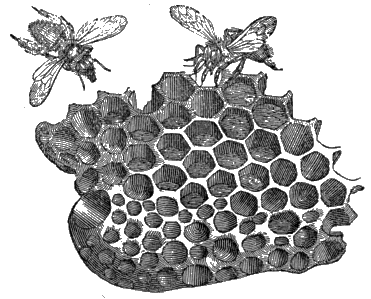
Part of a Honeycomb, and Bees at work.
Although the hive-bee (Apis mellifica) has engaged the attention of the curious from the earliest ages, recent discoveries prove that we are yet only beginning to arrive at a correct knowledge of its wonderful proceedings. Pliny informs us that Astromachus, of Soles, in Cilicia, devoted fifty-eight years to the study; and that Philiscus the Thracian spent his whole life in forests for the purpose of observing them. But in consequence (as we may naturally infer) of the imperfect methods of research, assuming that what they did discover was known to Aristotle, Columella, and Pliny, we are justified in pronouncing the statements of these philosophers, as well as the embellished poetical pictures of Virgil, to be nothing more than conjecture, almost in every particular erroneous. It was not indeed till 1711, when glass hives were invented by Maraldi, a mathematician of Nico, that what we may call the in-door proceedings of bees could be observed. This important invention was soon afterwards taken advantage of by M. Réaumur, who laid the foundation of the more recent discoveries of John Hunter, Schirach, and the Hubers. The admirable architecture which bees exhibit in their miniature cities has, by these and other naturalists, been investigated with great care and accuracy. We shall endeavour to give as full an account of the wonderful structures as our limits will allow. In this we shall chiefly follow M. Huber the elder, whose researches appear almost miraculous when we consider that he was blind.
At the early age of seventeen this remarkable man lost his sight by gutta serena, the “drop serene” of our own Milton. But though cut off from the sight of Nature’s works, he dedicated himself to their study. He saw them through the eyes of the admirable woman whom he married; his philosophical reasonings pointed out to her all that he wanted to ascertain; and as she reported to him from time to time the results of his ingenious experiments, he was enabled to complete, by diligent investigation, one of the most accurate and satisfactory accounts of the habits of bees which had ever been produced.
It had long been known that the bees of a hive consist of three sorts, which was ascertained by M. Réaumur to be distinguished as workers or neuters, constituting the bulk of the population; drones or males, the least numerous class; and a single female, the queen and mother of the colony. Schirach subsequently discovered the very extraordinary fact, which Huber and others have proved beyond doubt, that when a hive is accidentally deprived of a queen, the grub of a worker can be and is fed in a particular manner so as to become a queen and supply the loss.[Z] But another discovery of M. Huber is of more importance to the subject of architecture now before us. By minute research he ascertained that the workers which had been considered by former naturalists to be all alike, are divided into two important classes, nurse-bees and wax-makers.
The nurse-bees are rather smaller than the wax-workers, and even when gorged with honey their belly does not, as in the others, appear distended. Their business is to collect honey, and impart it to their companions; to feed and take care of the young grubs, and to complete the combs and cells which have been founded by the others; but they are not charged with provisioning the hive.
The wax-workers, on the other hand, are not only a little larger, but their stomach, when gorged with honey, is capable of considerable distension, as M. Huber proved by repeated experiments. He also ascertained that neither of the varieties can alone fulfil all the functions shared among the workers of a hive. He painted those of each class with different colours, in order to study their proceedings, and their labours were not interchanged. In another experiment, after supplying a hive deprived of a queen with brood and pollen, he saw the nurse-bees quickly occupied in the nutrition of the grubs, while those of the wax-working class neglected them. When hives are full of combs, the wax-workers disgorge their honey into the ordinary magazines, making no wax; but if they want a reservoir for its reception, and if their queen does not find cells ready made wherein to lay her eggs, they retain the honey in the stomach, and in twenty-four hours they produce wax. Then the labour of constructing combs begins.
It might perhaps be supposed that, when the country does not afford honey, the wax-workers consume the provision stored up in the hive. But they are not permitted to touch it. A portion of honey is carefully preserved, and the cells containing it are protected by a waxen covering, which is never removed except in case of extreme necessity, and when honey is not to be otherwise procured. The cells are at no time opened during summer; other reservoirs, always exposed, contribute to the daily use of the community; each bee, however, supplying itself from them with nothing but what is required for present wants. Wax-workers appear with large bellies at the entrance of their hive only when the country affords a copious collection of honey. From this it may be concluded that the production of the waxy matter depends on a concurrence of circumstances not invariably subsisting. Nurse-bees also produce wax, but in a very inferior quantity to what is elaborated by the real wax-workers. Another characteristic whereby an attentive observer can determine the moment of bees collecting sufficient honey to produce wax, is the strong odour of both these substances from the hive, which is not equally intense at any other time. From such data, it was easy for M. Huber to discover whether the bees worked in wax in his own hives, and in those of the other cultivators of the district.
There is still another sort of bee, first observed by Huber in 1809, which appear to be only casual inmates of the hive, and which are driven forth to starve, or are killed in conflict. They closely resemble the ordinary workers, but are less hairy, and of a much darker colour. These have been called black bees, and are supposed by Huber to be defective bees;[AA] but Kirby and Spence conjecture that they are toil-worn superannuated workers, of no further use, and are therefore sacrificed, because burdensome to a community which tolerates no unnecessary inmates.
Preparation of Wax.
In order to build the beautiful combs, which every one must have repeatedly seen and admired, it is indispensable that the architect-bees should be provided with the materials—with the wax, in short, of which they are principally formed. Before we follow them, therefore, to the operation of building, it may be necessary to inquire how the wax itself is procured. Here the discoveries of recent inquirers have been little less singular and unexpected than in other departments of the history of these extraordinary insects. Now that it has been proved that wax is secreted by bees, it is not a little amusing to read the accounts given by our elder naturalists, of its being collected from flowers. Our countryman, Thorley,[AB] appears to have been the first who suspected the true origin of wax, and Wildman (1769) seems also to have been aware of it; but Réaumur, and particularly Bonnet, though both of them in general shrewd and accurate observers, were partially deceived by appearances.
The bees, we are erroneously told, search for wax "upon all sorts of trees and plants, but especially the rocket, the simple poppy, and in general all kinds of flowers. They amass it with their hair, with which their whole body is invested. It is something pleasant to see them roll in the yellow dust which falls from the chives to the bottom of the flowers, and then return covered with the same grains; but their best method of gathering the wax, especially when it is not very plentiful, is to carry away all the little particles of it with their jaws and fore feet, to press the wax upon them into little pellets, and slide them one at a time, with their middle feet, into a socket or cavity, that opens at their hinder feet, and serves to keep the burthen fixed and steady till they return home. They are sometimes exposed to inconveniences in this work by the motion of the air, and the delicate texture of the flowers, which bend under their feet and hinder them from packing up their booty, on which occasions they fix themselves in some steady place, where they press the wax into a mass, and wind it round their legs, making frequent returns to the flowers; and when they have stocked themselves with a sufficient quantity, they immediately repair to their habitation. Two men, in the compass of a whole day, could not amass so much as two little balls of wax; and yet they are no more than the common burthen of a single bee, and the produce of one journey. Those who are employed in collecting the wax from flowers are assisted by their companions, who attend them at the door of the hive, ease them of their load at their arrival, brush their feet, and shake out the two balls of wax; upon which the others return to the fields to gather new treasure, while those who disburthened them convey their charge to the magazine. But some bees, again, when they have brought their load home, carry it themselves to the lodge, and there deliver it, laying hold of one end by their hinder feet, and with their middle feet sliding it out of the cavity that contained it; but this is evidently a work of supererogation which they are not obliged to perform. The packets of wax continue a few moments in the lodge, till a set of officers come, who are charged with a third commission, which is to knead this wax with their feet, and spread it out into different sheets, laid one above another. This is the unwrought wax, which is easily distinguished to be the produce of different flowers, by the variety of colours that appear on each sheet. When they afterwards come to work, they knead it over again; they purify and whiten, and then reduce it to a uniform colour. They use this wax with a wonderful frugality; for it is easy to observe that the whole family is conducted by prudence, and all their actions regulated by good government. Everything is granted to necessity, but nothing to superfluity; not the least grain of wax is neglected, and if they waste it, they are frequently obliged to provide more; at those very times when they want to get their provision of honey, they take off the wax that closed the cells, and carry it to the magazine."[AC]
Réaumur hesitated in believing that this was a correct view of the subject, from observing the great difference between wax and pollen; but he was inclined to think the pollen might be swallowed, partially digested, and disgorged in the form of a kind of paste. Schirach also mentions, that it was remarked by a certain Lusatian, that wax comes from the rings of the body, because, on withdrawing a bee while it is at work, and extending its body, the wax may be seen there in the form of scales.
The celebrated John Hunter shrewdly remarked that the pellets of pollen seen on the thighs of bees are of different colours on different bees, while the shade of the new-made comb is always uniform; and therefore he concluded that pollen was not the origin of wax. Pollen also, he observed, is collected with greater avidity for old hives, where the comb is complete, than for those where it is only begun, which would hardly be the case were it the material of wax. He found that when the weather was cold and wet in June, so that a young swarm was prevented from going abroad, as much comb was constructed as had been made in an equal time when the weather was favourable and fine.
The pellets of pollen on the thighs being thence proved not to be wax, he came to the conclusion that it was an external secretion, originating between the plates of the belly. When he first observed this, he felt not a little embarrassed to explain the phenomenon, and doubted whether new plates were forming, or whether bees cast their old ones as lobsters do their shell. By melting the scales, he ascertained at least that they were wax; and his opinion was confirmed by the fact, that the scales are only to be found during the season when the combs are constructed. But he did not succeed in completing the discovery by observing the bees actually detach the scales, though he conjectured they might be taken up by others, if they were once shaken out from between the rings.[AD]
We need not be so much surprised at mistakes committed upon this subject, when we recollect that honey itself was believed by the ancients to be an emanation of the air—a dew that descended upon flowers, as if it had a limited commission to fall only on them. The exposure and correction of error is one of the first steps to genuine knowledge; and when we are aware of the stumbling-blocks which have interrupted the progress of others, we can always travel more securely in the way of truth.
That wax is secreted is proved both by the wax-pouches within the rings of the abdomen, and by actual experiment. Huber and others fed bees entirely upon honey or sugar, and, notwithstanding, wax was produced and combs formed as if they had been at liberty to select their food. “When bees were confined,” says M. Huber, "for the purpose of discovering whether honey was sufficient for the production of wax, they supported their captivity patiently, and showed uncommon perseverance in rebuilding their combs as we removed them. Our experiments required the presence of grubs; honey and water had to be provided; the bees were to be supplied with combs containing brood, and at the same time it was necessary to confine them, that they might not seek pollen abroad. Having a swarm by chance, which had become useless from sterility of the queen, we devoted it for our investigation in one of my leaf-hives, which was glazed on both sides. We removed the queen, and substituted combs containing eggs and young grubs, but no cell with farina; even the smallest particle of the substance which John Hunter conjectured to be the basis of the nutriment of the young was taken away.
"Nothing remarkable occurred during the first and second day: the bees brooded over the young, and seemed to take an interest in them; but at sunset on the third a loud noise was heard in the hive. Impatient to discover the reason, we opened a shutter, and saw all in confusion; the brood was abandoned, the workers ran in disorder over the combs, thousands rushed towards the lower part of the hive, and those about the entrance gnawed at its grating. Their design was not equivocal; they wished to quit their prison. Some imperious necessity evidently obliged them to seek elsewhere what they could not find in the hive; and apprehensive that they might perish if I restrained them longer from yielding to their instinct, I set them at liberty. The whole swarm escaped, but the hour being unfavourable for their collections, they flew around the hive, and did not depart far from it. Increasing darkness and the coolness of the air compelled them very soon to return. Probably these circumstances calmed their agitation; for we observed them peaceably remounting their combs; order seemed re-established, and we took advantage of this moment to close the hive.
"Next day, the 19th of July, we saw the rudiments of two royal cells, which the bees had formed on one of the brood-combs. This evening, at the same hour as on the preceding, we again heard a loud buzzing in the closed hive; agitation and disorder rose to the highest degree, and we were again obliged to let the swarm escape. The bees did not remain long absent from their habitation; they quieted and returned as before. We remarked on the 20th that the royal cells had not been continued, as would have been the case in the ordinary state of things. A great tumult took place in the evening; the bees appeared to be in a delirium; we set them at liberty, and order was restored on their return. Their captivity having endured five days, we thought it needless to protract it farther; besides, we were desirous of knowing whether the brood was in a suitable condition, and if it had made the usual progress; and we wished also to try to discover what might be the cause of the periodical agitation of the bees. M. Burnens (the assistant of Huber), having exposed the two brood-combs, the royal cells were immediately recognised; but it was obvious that they had not been enlarged. Why should they? Neither eggs, grubs, nor that kind of paste peculiar to the individuals of their species were there! The other cells were vacant likewise; no brood, not an atom of paste, was in them. Thus, the worms had died of hunger. Had we precluded the bees from all means of sustenance by removing the farina? To decide this point, it was necessary to confide other brood to the care of the same insects, now giving them abundance of pollen. They had not been enabled to make any collections while we examined their combs. On this occasion they escaped in an apartment where the windows were shut; and after substituting young worms for those they had allowed to perish, we returned them to their prison. Next day we remarked that they had resumed courage; they had consolidated the combs, and remained on the brood. They were then provided with fragments of combs, where other workers had stored up farina; and to be able to observe what they did with it, we took this substance from some of their cells, and spread it on the board of the hive. The bees soon discovered both the farina in the combs and what we had exposed to them. They crowded to the cells, and also descending to the bottom of the hives, took the pollen grain by grain in their teeth, and conveyed it to their mouths. Those that had eaten it most greedily mounted the combs before the rest, and stopping on the cells of the young worms, inserted their heads, and remained there for a certain time. M. Burnens opened one of the divisions of the hive gently, and powdered the workers, for the purpose of recognising them when they should ascend the combs. He observed them during several hours, and by this means ascertained that they took so great a quantity of pollen only to impart it to their young. Then withdrawing the portions of comb which had been placed by us on the board of the hive, we saw that the pollen had been sensibly diminished in quantity. They were returned to the bees, to augment their provision still further, for the purpose of extending the experiment. The royal, as well as several common, cells were soon closed; and, on opening the hive, all the worms were found to have prospered. Some still had their food before them; the cells of others that had spun were shut with a waxen covering.
“We witnessed these facts repeatedly, and always with equal interest. They so decisively prove the regard of the bees towards the grubs which they are intrusted with rearing, that we shall not seek for any other explanation of their conduct. Another fact, no less extraordinary, and much more difficult to be accounted for, was exhibited by bees constrained to work in wax, several times successively, from the syrup of sugar. Towards the close of the experiment they ceased to feed the young, though in the beginning these had received the usual attention. They even frequently dragged them from their cells, and carried them out of the hive.”[AE]
Mr. Wiston, of Germantown, in the United States, mentions a fact conclusive on this subject. “I had,” says he, “a late swarm last summer, which, in consequence of the drought, filled only one box with honey. As it was late in the season, and the food collected would not enable the bees to subsist for the winter, I shut up the hive, and gave them half-a-pint of honey every day. They immediately set to work, filled the empty cells, and then constructed new cells enough to fill another box, in which they deposited the remainder of the honey.”
A more interesting proof is thus related by the same gentleman: “In the summer of 1824, I traced some wild bees, which had been feeding on the flowers in my meadow, to their home in the woods, and which I found in the body of an oak-tree, exactly fifty feet above the ground. Having caused the entrance to the hive to be closed by an expert climber, the limbs were separated in detail, until the trunk alone was left standing. To the upper extremity of this, a tackle-fall was attached so as to connect it with an adjacent tree, and, a saw being applied below, the naked trunk was cut through. When the immense weight was lowered nearly to the earth, the ropes broke, and the mass fell with a violent crash. The part of the tree which contained the hive, separated by the saw, was conveyed to my garden, and placed in a vertical position. On being released, the bees issued out by thousands, and though alarmed, soon became reconciled to the change of situation. By removing a part of the top of the block the interior of the hive was exposed to view, and the comb itself, nearly six feet in height, was observed to have fallen down two feet below the roof of the cavity. To repair the damage was the first object of the labourers: in doing which, a large part of their store of honey was expended, because it was at too late a season to obtain materials from abroad. In the following February these industrious but unfortunate insects issuing in a confused manner from the hive, fell dead in thousands around its entrance, the victims of a poverty created by their efforts to repair the ruins of their habitation.”[AF]
In another experiment, M. Huber confined a swarm so that they had access to nothing beside honey, and five times successively removed the combs with the precaution of preventing the escape of the bees from the apartment. On each occasion they produced new combs, which puts it beyond dispute that honey is sufficient to effect the secretion of wax without the aid of pollen. Instead of supplying the bees with honey, they were subsequently fed, exclusively, on pollen and fruit; but though they were kept in captivity for eight days under a bell-glass, with a comb containing nothing but farina, they neither made wax nor was any secreted under the rings. In another series of experiments, in which bees were fed with different sorts of sugar, it was found that nearly one-sixth of the sugar was converted into wax, dark-coloured sugar yielding more than double the quantity of refined sugar.
It may not be out of place to subjoin the few anatomical and physiological facts which have been ascertained by Huber, Maddle, Jurine, and Latreille.
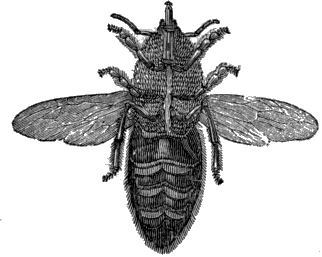
Worker-bee, magnified—showing the position of the scales of Wax.
The first stomach of the worker-bee, according to Latreille,[AG] is appropriated to the reception of honey, but this is never found in the second stomach, which is surrounded with muscular rings, and from one end to the other very much resembles a cask covered with hoops. It is within these rings that the wax is produced; but the secreting vessels for this purpose have hitherto escaped the researches of the acutest naturalists. Huber, however, plausibly enough conjectures that they are contained in the internal lining of the wax-pockets, which consists of a cellular substance reticulated with hexagons. The wax-pockets themselves, which are concealed by the overlapping of the rings, may be seen by pressing the abdomen of a worker-bee so as to lengthen it, and separate the rings further from each other. When this has been done, there may be seen on each of the four intermediate hoops of the belly, and separated by what may be called the keel (carina), two whitish-coloured pouches, of a soft texture, and in the form of a trapezium. Within, the little plates or scales of wax are produced from time to time, and are removed and employed as we shall presently see. We may remark, that it is chiefly the wax-workers which produce the wax; for though the nurse-bees are furnished with wax-pockets, they secrete it only in very small quantities; while in the queen-bee, and the males or drones, no pockets are discoverable.
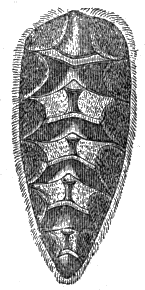
Abdomen of Wax-worker Bee.
“All the scales,” says Huber, “are not alike in every bee, for a difference is perceptible in consistence, shape, and thickness; some are so thin and transparent as to require a magnifier to be recognised, or we have been able to discover nothing but spiculæ similar to those of water freezing. Neither the spiculæ nor the scales rest immediately on the membrane of the pocket, a slight liquid medium is interposed, serving to lubricate the joinings of the rings, or to render the extraction of the scales easier, as otherwise they might adhere too firmly to the sides of the pockets.” M. Huber has seen the scales so large as to project beyond the rings, being visible without stretching the segments, and of a whitish yellow, from greater thickness lessening their transparency. These shades of difference in the scales of various bees, their enlarged dimensions, the fluid interposed beneath them, the correspondence between the scale and the size and form of the pockets, seem to infer the oozing of this substance through the membranes whereon it is moulded. He was confirmed in this opinion by the escape of a transparent fluid on piercing the membrane, whose internal surface seemed to be applied to the soft parts of the belly. This he found coagulated in cooling, when it resembled wax, and again liquefied on exposure to heat. The scales themselves, also, melted and coagulated like wax.[AH]
By chemical analysis, however, it appears that the wax of the rings is a more simple substance than that which composes the cells; for the latter is soluble in ether, and in spirit of turpentine, while the former is insoluble in ether, and but partially soluble in spirit of turpentine. It should seem to follow, that if the substance found lying under the rings be really the elements of wax, it undergoes some subsequent preparation after it is detached; and that the bees, in short, are capable of impregnating it with matter, imparting to it whiteness and ductility, whereas in its unprepared state it is only fusible.
Propolis.
Wax is not the only material employed by bees in their architecture. Beside this, they make use of a brown, odoriferous, resinous substance, called propolis,[AI] more tenacious and extensible than wax, and well adapted for cementing and varnishing. It was strongly suspected by Réaumur that the bees collected the propolis from those trees which are known to produce a similar gummy resin, such as the poplar, the birch, and the willow; but he was thrown into doubt by not being able to detect the bees in the act of procuring it, and by observing them to collect it where none of those trees, nor any other of the same description, grew. His bees also refused to make use of bitumen, and other resinous substances, with which he supplied them, though Mr. Knight, as we shall afterwards see, was more successful.[AJ]
Long before the time of Réaumur, however, Mouffet, in his Insectarum Theatrum, quotes Cordus for the opinion that propolis is collected from the buds of trees, such as the poplar and birch; and Reim says it is collected from the pine and fir.[AK] Huber at length set the question at rest; and his experiments and observations are so interesting, that we shall give them in his own words:—
“For many years,” says he, "I had fruitlessly endeavoured to find them on trees producing an analogous substance, though multitudes had been seen returning laden with it.
"In July, some branches of the wild poplar, which had been cut since spring, with very large buds, full of a reddish, viscous, odoriferous matter, were brought to me, and I planted them in vessels before hives, in the way of the bees going out to forage, so that they could not be insensible of their presence. Within a quarter of an hour, they were visited by a bee, which separating the sheath of a bud with its teeth, drew out threads of the viscous substance, and lodged a pellet of it in one of the baskets of its limbs; from another bud it collected another pellet for the opposite limb, and departed to the hive. A second bee took the place of the former in a few minutes, following the same procedure. Young shoots of poplar, recently cut, did not seem to attract these insects, as their viscous matter had less consistence than the former.[AL]
"Different experiments proved the identity of this substance with the propolis; and now, having only to discover how the bees applied it to use, we peopled a hive, so prepared as to fulfil our views. The bees, building upwards, soon reached the glass above; but, unable to quit their habitation, on account of rain, they were three weeks without bringing home propolis. Their combs remained perfectly white until the beginning of July, when the state of the atmosphere became more favourable for our observations. Serene, warm weather engaged them to forage, and they returned from the fields laden with a resinous gum, resembling a transparent jelly, and having the colour and lustre of the garnet. It was easily distinguished from the farinaceous pellets then collected by other bees. The workers bearing the propolis ran over the clusters, suspended from the roof of the hive, and rested on the rods supporting the combs, or sometimes stopped on the sides of their dwelling, in expectation of their companions coming to disencumber them of their burthen. We actually saw two or three arrive, and carry the propolis from off the limbs of each with their teeth. The upper part of the hive exhibited the most animated spectacle; thither a multitude of bees resorted from all quarters, to engage in the predominant occupation of the collection, distribution, and application of the propolis. Some conveyed that of which they had unloaded the purveyors in their teeth, and deposited it in heaps; others hastened, before its hardening, to spread it out like a varnish, or formed it into strings, proportioned to the interstices of the sides of the hives to be filled up. Nothing could be more diversified than the operations carried on.
"The bees, apparently charged with applying the propolis within the cells, were easily distinguished from the multitude of workers, by the direction of their heads towards the horizontal pane forming the roof of the hive, and on reaching it, they deposited their burthen nearly in the middle of intervals separating the combs: then they conveyed the propolis to the real place of its destination. They suspended themselves by the claws of the hind legs to points of support, afforded by the viscosity of the propolis on the glass; and, as it were, swinging themselves backwards and forwards, brought the heap of this substance nearer to the cells at each impulse. Here the bees employed their fore feet, which remained free, to sweep what the teeth had detached, and to unite the fragments scattered over the glass, which recovered all its transparency when the whole propolis was brought to the vicinity of the cells.
"After some of the bees had smoothed down and cleaned out the glazed cells, feeling the way with their antennæ, one desisted, and having approached a heap of propolis, drew out a thread with its teeth. This being broken off, it was taken in the claws of the fore feet, and the bee, re-entering the cell, immediately placed it in the angle of two portions that had been smoothed, in which operation the fore feet and teeth were used alternately; but probably proving too clumsy, the thread was reduced and polished; and we admired the accuracy with which it was adjusted when the work was completed. The insect did not stop here: returning to the cell, it prepared other parts of it to receive a second thread, for which we did not doubt that the heap would be resorted to. Contrary to our expectation, however, it availed itself of the portion of the thread cut off on the former occasion, arranged it in the appointed place, and gave it all the solidity and finish of which it was susceptible. Other bees completed the work which the first had begun: and the sides of the cells were speedily secured with threads of propolis, while some were also put on the orifices; but we could not seize the moment when they were varnished, though it may be easily conceived how it is done."[AM]
This is not the only use to which bees apply the propolis. They are extremely solicitous to remove such insects or foreign bodies as happen to get admission into the hive. When so light as not to exceed their powers, they first kill the insect with their stings, and then drag it out with their teeth. But it sometimes happens, as was first observed by Maraldi, and since by Réaumur and others, that an ill-fated slug creeps into the hive: this is no sooner perceived than it is attacked on all sides, and stung to death. But how are the bees to carry out so heavy a burthen? Such a labour would be in vain. To prevent the noxious smell which would arise from its putrefaction, they immediately embalm it, by covering every part of its body with propolis, through which no effluvia can escape. When a snail with a shell gets entrance, to dispose of it gives much less trouble and expense to the bees. As soon as it receives the first wound from a sting, it naturally retires within its shell. In this case, the bees, instead of pasting it all over with propolis, content themselves with gluing all round the margin of the shell, which is sufficient to render the animal for ever immovably fixed.
Mr. Knight, the learned and ingenious President of the Horticultural Society, discovered by accident an artificial substance, more attractive than any of the resins experimentally tried by Réaumur. Having caused the decorticated part of a tree to be covered with a cement composed of bees’-wax and turpentine, he observed that this was frequented by hive-bees, who, finding it to be a very good propolis ready made, detached it from the tree with their mandibles, and then, as usual, passed it from the first leg to the second, and so on. When one bee had thus collected its load, another often came behind and despoiled it of all it had collected; a second and a third load were frequently lost in the same manner; and yet the patient insect pursued its operations without manifesting any signs of anger.[AN] Probably the latter circumstance, at which Mr. Knight seems to have been surprised, was nothing more than an instance of the division of labour so strikingly exemplified in every part of the economy of bees.
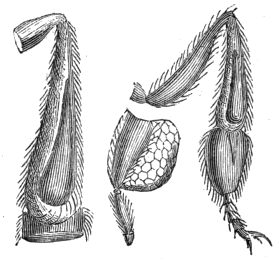
Structure of the legs of the Bee, for carrying propolis and pollen, magnified.
It may not be out of place here to describe the apparatus with which the worker-bees are provided for the purpose of carrying the propolis as well as the pollen of flowers to the hive, and which has just been alluded to in the observations of Mr. Knight. The shin or middle portion of the hind pair of legs is actually formed into a triangular basket, admirably adapted to this design. The bottom of this basket is composed of a smooth, shining, horn-like substance, hollowed out in the substance of the limb, and surrounded with a margin of strong and thickly-set bristles. Whatever materials, therefore, may be placed by the bee in the interior of this basket, are secured from falling out by the bristles around it, whose elasticity will even allow the load to be heaped beyond their points without letting it fall.
In the case of propolis, when the bee is loading her singular basket, she first kneads the piece she has detached with her mandibles, till it becomes somewhat dry and less adhesive, as otherwise it would stick to her limbs. This preliminary process sometimes occupies nearly half an hour. She then passes it backwards by means of her feet to the cavity of her basket, giving it two or three pats to make it adhere; and when she adds a second portion to the first, she often finds it necessary to pat it still harder. When she has procured as much as the basket will conveniently hold, she flies off with it to the hive.
The Building of the Cells.
The notion commonly entertained respecting glass hives is altogether erroneous. Those who are unacquainted with bees, imagine that, by means of a glass hive, all their proceedings may be easily watched and recorded; but it is to be remembered that bees are exceedingly averse to the intrusion of light, and their first operation in such cases is to close up every chink by which light can enter to disturb them, either by clustering together, or by a plaster composed of propolis. It consequently requires considerable management and ingenuity, even with the aid of a glass hive, to see them actually at work. M. Huber employed a hive with leaves, which opened in the manner of a book; and for some purposes he used a glass box, inserted in the body of the hive, but easily brought into view by means of screws.
But no invention hitherto contrived is sufficient to obviate every difficulty. The bees are so eager to afford mutual assistance, and for this purpose so many of them crowd together in rapid succession, that the operations of individuals can seldom be traced. Though this crowding, however, appears to an observer to be not a little confused, it is all regulated with admirable order, as has been ascertained by Réaumur and other distinguished naturalists.
When bees begin to build the hive, they divide themselves into bands, one of which produces materials for the structure; another works upon these, and forms them into a rough sketch of the dimensions and partitions of the cells. All this is completed by the second band, who examine and adjust the angles, remove the superfluous wax, and give the work its necessary perfection; and a third band brings provisions to the labourers, who cannot leave their work. But no distribution of food is made to those whose charge, in collecting propolis and pollen, calls them to the field, because it is supposed they will hardly forget themselves; neither is any allowance made to those who begin the architecture of the cells. Their province is very troublesome, because they are obliged to level and extend, as well as cut and adjust the wax to the dimensions required; but then they soon obtain a dismission from this labour, and retire to the fields to regale themselves with food, and wear off their fatigue with a more agreeable employment. Those who succeed them, draw their mouth, their feet, and the extremity of their body, several times over all the work, and never desist till the whole is polished and completed; and as they frequently need refreshments, and yet are not permitted to retire, there are waiters always attending, who serve them with provisions when they require them. The labourer who has an appetite, bends down his trunk before the caterer to intimate that he has an inclination to eat, upon which the other opens his bag of honey, and pours out a few drops: these may be distinctly seen rolling through the hole of his trunk, which insensibly swells in every part the liquor flows through. When this little repast is over, the labourer returns to his work, and his body and feet repeat the same motions as before.[AO]
Before they can commence building, however, when a colony or swarm migrates from the original hive to a new situation, it is necessary first to collect propolis, with which every chink and cranny in the place where they mean to build may be carefully stopped up; and secondly, that a quantity of wax be secreted by the wax-workers to form the requisite cells. The secretion of wax, it would appear, goes on best when the bees are in a state of repose; and the wax-workers, accordingly, suspend themselves in the interior in an extended cluster, like the curtain which is composed of a series of intertwined festoons or garlands, crossing each other in all directions—the uppermost bee maintaining its position by laying hold of the roof with its fore legs, and the succeeding one by laying hold of the hind legs of the first.
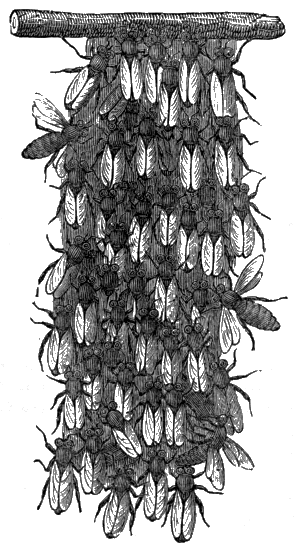
Curtain of Wax-workers secreting wax.
“A person,” says Réaumur, “must have been born devoid of curiosity not to take interest in the investigation of such wonderful proceedings.” Yet Réaumur himself seems not to have understood that the bees suspended themselves in this manner to secrete wax, but merely, as he imagined, to recruit themselves by rest for renewing their labours. The bees composing the festooned curtain are individually motionless; but this curtain is, notwithstanding, kept moving by the proceedings in the interior; for the nurse-bees never form any portion of it, and continue their activity—a distinction with which Réaumur was unacquainted.
Although there are many thousand labourers in a hive, they do not commence foundations for combs in several places at once, but wait till an individual bee has selected a site, and laid the foundation of a comb, which serves as a directing mark for all that are to follow. Were we not expressly told by so accurate an observer as Huber, we might hesitate to believe that bees, though united in what appears to be an harmonious monarchy, are strangers to subordination, and subject to no discipline. Hence it is, that though many bees work on the same comb, they do not appear to be guided by any simultaneous impulse. The stimulus which moves them is successive. An individual bee commences each operation, and several others successively apply themselves to accomplish the same purpose. Each bee appears, therefore, to act individually, either as directed by the bees preceding it, or by the state of advancement in which it finds the work it has to proceed with. If there be anything like unanimous consent, it is the inaction of several thousand workers while a single individual proceeds to determine and lay down the foundation of the first comb. Réaumur regrets that, though he could by snatches detect a bee at work in founding cells or perfecting their structure, his observations were generally interrupted by the crowding of other bees between him and the little builder. He was therefore compelled rather to infer the different steps of their procedure from an examination of the cells when completed, than from actual observation. The ingenuity of Huber, even under all the disadvantages of blindness, succeeded in tracing the minutest operations of the workers from the first waxen plate of the foundation. We think the narrative of the discoverer’s experiments, as given by himself, will be more interesting than any abstract of it which we could furnish:—
"Having taken a large bell-shaped glass receiver, we glued thin wooden slips to the arch at certain intervals, because the glass itself was too smooth to admit of the bees supporting themselves on it. A swarm, consisting of some thousand workers, several hundred males, and a fertile queen, was introduced, and they soon ascended to the top. Those first gaining the slips fixed themselves there by the fore-feet; others, scrambling up the sides, joined them, by holding their legs with their own, and they thus formed a kind of chain, fastened by the two ends to the upper parts of the receiver, and served as ladders or a bridge to the workers enlarging their number. The latter were united in a cluster, hanging like an inverted pyramid from the top to the bottom of the hive.
"The country then affording little honey, we provided the bees with syrup of sugar, in order to hasten their labour. They crowded to the edge of a vessel containing it; and, having satisfied themselves, returned to the group. We were now struck with the absolute repose of this hive, contrasted with the usual agitation of bees. Meanwhile, the nurse-bees alone went to forage in the country; they returned with pollen, kept guard at the entrance of the hive, cleansed it, and stopped up its edges with propolis. The wax-workers remained motionless about fifteen hours: the curtain of bees, consisting always of the same individuals, assured us that none replaced them. Some hours later, we remarked that almost all these individuals had wax scales under the rings; and next day this phenomenon was still more general. The bees forming the external layer of the cluster, having now somewhat altered their position, enabled us to see their bellies distinctly. By the projection of the wax scales, the rings seemed edged with white. The curtain of bees became rent in several places, and some commotion began to be observed in the hive.
"Convinced that the combs would originate in the centre of the swarm, our whole attention was then directed towards the roof of the glass. A worker at this time detached itself from one of the central festoons of the cluster, separated itself from the crowd, and, with its head, drove away the bees at the beginning of the row in the middle of the arch, turning round to form a space an inch or more in diameter, in which it might move freely. It then fixed itself in the centre of the space thus cleared.
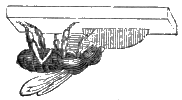
Wax-worker laying the foundation of the first Cell.
"The worker now employing the pincers at the joint of one of the third pair of its limbs, seized a scale of wax projecting from a ring, and brought it forward to its mouth with the claws of its fore-legs, where it appeared in a vertical position. We remarked that, with its claws, it turned the wax in every necessary direction; that the edge of the scale was immediately broken down, and the fragments having been accumulated in the hollow of the mandibles, issued forth like a very narrow ribbon, impregnated with a frothy liquid by the tongue. The tongue itself assumed the most varied shapes, and executed the most complicated operations,—being sometimes flattened like a trowel, and at other times pointed like a pencil; and, after imbuing the whole substance of the ribbon, pushed it forward again into the mandibles, whence it was drawn out a second time, but in an opposite direction.
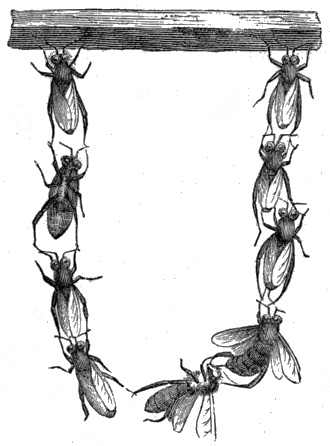
Curtain of Wax-workers (see p. 132).
"At length the bee applied these particles of wax to the vault of the hive, where the saliva impregnating them promoted their adhesion, and also communicated a whiteness and opacity which were wanting when the scales were detached from the rings. Doubtless this process was to give the wax that ductility and tenacity belonging to its perfect state. The bee then separated those portions not yet applied to use with its mandibles, and with the same organs afterwards arranged them at pleasure. The founder bee, a name appropriated to this worker, repeated the same operation, until all the fragments, worked up and impregnated with the fluid, were attached to the vault, when it repeated the preceding operations on the part of the scale yet kept apart, and again united to the rest what was obtained from it. A second and third scale were similarly treated by the same bee; yet the work was only sketched; for the worker did nothing but accumulate the particles of wax together. Meanwhile the founder, quitting its position, disappeared amidst its companions. Another, with wax under the rings, succeeded it, which suspending itself to the same spot, withdrew a scale by the pincers of the hind legs, and passing it through its mandibles, prosecuted the work; and taking care to make its deposit in a line with the former, it united their extremities. A third worker, detaching itself from the interior of the cluster, now came and reduced some of the scales to paste, and put them near the materials accumulated by its companions, but not in a straight line. Another bee, apparently sensible of the defect, removed the misplaced wax before our eyes, and carrying it to the former heap, deposited it there, exactly in the order and direction pointed out.
"From all these operations was produced a block of a rugged surface, hanging down from the arch, without any perceptible angle, or any traces of cells. It was a simple wall, or ridge, running in a straight line, and without the least inflection, two-thirds of an inch in length, above two-thirds of a cell, or two lines, high, and declining towards the extremities. We have seen other foundation walls from an inch to an inch and a half long, the form being always the same; but none ever of greater height.
“The vacuity in the centre of the cluster had permitted us to discover the first manœuvres of the bees, and the art with which they laid the foundations of their edifices. However, it was filled up too soon for our satisfaction; for workers collecting on both faces of the wall obstructed our view of their further operations.”[AP]
CHAPTER VI.
ARCHITECTURE OF THE HIVE-BEE CONTINUED—FORM OF THE CELLS.
The obstruction of which M. Huber complains only operated as a stimulus to his ingenuity in contriving how he might continue his interesting observations. From the time of Pappus to the present day, mathematicians have applied the principles of geometry to explain the construction of the cells of a bee-hive; but though their extraordinary regularity, and wonderfully-selected form, had so often been investigated by men of the greatest talent, and skilled in all the refinements of science, the process by which they are constructed, involving also the causes of their regularity of form, had not been traced till M. Huber devoted himself to the inquiry.
As the wax-workers secrete only a limited quantity of wax, it is indispensably requisite that as little as possible of it should be consumed, and that none of it should be wasted. Bees, therefore, as M. Réaumur well remarks,[AQ] have to solve this difficult geometrical problem:—a quantity of wax being given, to form of it similar and equal cells of a determinate capacity, but of the largest size in proportion to the quantity of matter employed, and disposed in such a manner as to occupy the least possible space in the hive. This problem is solved by bees in all its conditions. The cylindrical form would seem to be best adapted to the shape of the insect; but had the cells been cylindrical, they could not have been applied to each other without leaving a vacant and superfluous space between every three contiguous cells. Had the cells, on the other hand, been square or triangular, they might have been constructed without unnecessary vacancies; but these forms would have both required more material, and have been very unsuitable to the shape of a bee’s body. The six-sided form of the cells obviates every objection; and while it fulfils the conditions of the problem, it is equally adapted with a cylinder to the shape of the bee.
M. Réaumur further remarks, that the base of each cell, instead of forming a plane, is usually composed of three pieces in the shape of the diamonds on playing cards, and placed in such a manner as to form a hollow pyramid. This structure, it may be observed, imparts a greater degree of strength, and, still keeping the solution of the problem in view, gives a great capacity with the smallest expenditure of material. This has actually, indeed, been ascertained by mathematical measurement and calculation. Maraldi, the inventor of glass hives, determined, by minutely measuring these angles, that the greater were 109° 28’, and the smaller 70° 32’; and M. Réaumur, being desirous to know why these particular angles are selected, requested M. Kœnig, a skilful mathematician (without informing him of his design, or telling him of Maraldi’s researches), to determine by calculation what ought to be the angle of a six-sided cell, with a concave pyramidal base, formed of three similar and equal rhomboid plates, so that the least possible matter should enter into its construction. By employing what geometricians denominate the infinitesimal calculus, M. Kœnig found that the angles should be 109° 26’ for the greater, and 70° 34’ for the smaller, or about two-sixtieths of a degree, more or less, than the actual angles made choice of by bees. The equality of inclination in the angles has also been said to facilitate the construction of the cells.
M. Huber adds to these remarks, that the cells of the first row, by which the whole comb is attached to the roof of a hive, are not like the rest; for, instead of six sides, they have only five, of which the roof forms one. The base, also, is in these different, consisting of three pieces on the face of the comb, and on the other side of two: one of these only is diamond-shaped, while the other two are of an irregular four-sided figure. This arrangement, by bringing the greatest number of points in contact with the interior surface, insures the stability of the comb.
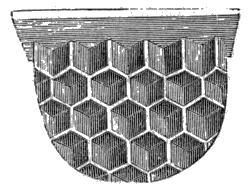
Arrangement of Cells.
It may, however, be said not to be quite certain, that Réaumur and others have not ascribed to bees the merit of ingenious mathematical contrivance and selection, when the construction of the cells may more probably originate in the form of their mandibles and the other instruments employed in their operations. In the case of other insects, we have, both in the preceding and subsequent pages of this volume, repeatedly noticed, that they use their bodies, or parts thereof, as the standards of measurement and modelling; and it is not impossible that bees may proceed on a similar principle. M. Huber replies to this objection, that bees are not provided with instruments corresponding to the angles of their cells; for there is no more resemblance between these and the form of their mandibles, than between the chisel of the sculptor and the work which he produces. The head, he thinks, does not furnish any better explanation. He admits that the antennæ are very flexible, so as to enable the insects to follow the outline of every object; but concludes that neither their structure, nor that of the limbs and mandibles, are adequate to explain the form of the cells, though all these are employed in the operations of building,—the effect, according to him, depending entirely on the object which the insect proposes.
We shall now follow M. Huber in the experiments which he contrived, in order to observe the operations of the bees subsequent to their laying a foundation for the first cell; and we shall again quote from his own narrative:—
“It appeared to me,” he says, "that the only method of isolating the architects, and bringing them individually into view, would be to induce them to change the direction of their operations and work upwards.
"I had a box made twelve inches square and nine deep, with a moveable glass lid. Combs, full of brood, honey, and pollen, were next selected from one of my leaf-hives, as containing what might interest the bees, and being cut into pieces a foot long, and four inches deep, they were arranged vertically at the bottom of the box, at the same intervals as the insects themselves usually leave between them. A small slip of wooden lath covered the upper edge of each. It was not probable that the bees would attempt to found new combs on the glass roof of the box, because its smoothness precluded the swarm from adhering to it; therefore, if disposed to build, they could do so over the slips resting on the combs, which left a vacuity five inches high above them. As we had foreseen, the swarm with which this box was peopled established itself among the combs below. We then observed the nurse-bees displaying their natural activity. They dispersed themselves throughout the hive, to feed the young grubs, to clear out their lodgment, and adapt it for their convenience. Certainly, the combs, which were roughly cut to fit the bottom of the box, and in some parts damaged, appeared to them shapeless and misplaced; for they speedily commenced their reparation. They beat down the old wax, kneaded it between their teeth, and thus formed binding materials to consolidate them. We were astonished beyond expression by such a multitude of workers employed at once in labours to which it did not appear they should have been called, at their coincidence, their zeal, and their prudence.
"But it was still more wonderful, that about half the numerous population took no part in the proceedings, remaining motionless, while the others fulfilled the functions required. The wax-workers, in a state of absolute repose, recalled our former observations. Gorged with the honey we had put within their reach, and continuing in this condition during twenty-four hours, wax was formed under their rings, and was now ready to be put in operation. To our great satisfaction, we soon saw a little foundation-wall rising on one of the slips that we had prepared to receive the superstructure. No obstacle was offered to the progress of our observations; and for the second time we beheld both the undertaking of the founder-bee, and the successive labours of several wax-workers, in forming the foundation-wall. Would that my readers could share the interest which the view of these architects inspired!
"This foundation, originally very small, was enlarged as the work required; while they excavated on one side a hollow, of about the width of a common cell, and on the opposite surface two others somewhat more elongated. The middle of the single cell corresponded exactly to the partition separating the latter: the arches of these excavations, projecting by the accumulation of wax, were converted into ridges in a straight line; whence the cells of the first row were composed of five sides, considering the slip as one side, and those of the second row, of six sides.
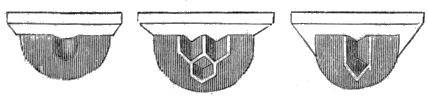
Foundation-wall enlarged, and the Cells commenced.
"The interior conformation of the cavities, apparently, was derived from the position of their respective outlines. It seemed that the bees, endowed with an admirable delicacy of feeling, directed their teeth principally to the place where the wax was thickest; that is, the parts where other workers on the opposite side had accumulated it; and this explains why the bottom of the cell is excavated in an angular direction behind the projection on the sides of which the sides of the corresponding cells are to rise. The largest of the excavations, which was opposite to three others, was divided into three parts, while the excavations of the first row on the other face, applied against this one, were composed of only two.
"In consequence of the manner in which the excavations were opposed to each other, those of the second row, and all subsequent, partially applied to three cavities, were composed of three equal diamond-shaped lozenges. I may here remark, that each part of the labour of bees appears the natural result of what has preceded it: therefore, chance has no share in these admirable combinations.
"A foundation-wall rose above the slip like a minute vertical partition, five or six lines long, two lines high, but only half a line in thickness; the edge circular, and the surface rough. Quitting the cluster among the combs, a nurse-bee mounted the slip, turned around the block, and visiting both sides, began to work actively in the middle. It removed as much wax with its teeth as might equal the diameter of a common cell; and after kneading and moistening the particles, deposited them on the edge of the excavation. This insect having laboured some seconds, retired, and was soon replaced by another; a third continued the work, raising the margin of the edges, now projecting from the cavity, and with assistance of its teeth and feet fixing the particles, so as to give these edges a straighter form. More than twenty bees successively participated in the same work; and when the cavity was little above a line and a half in height, though equalling a cell in width, a bee left the swarm, and after encircling the block, commenced its operations on the opposite face, where yet untouched. But its teeth acting only on one half of this side, the hollow which it formed was opposite to only one of the slight prominences bordering the first cavity. Nearly at the same time another worker began on the right of the face that had been untouched, wherein both were occupied in forming cavities which may be designed the second and third; and they also were replaced by substitutes. These two latter cavities were separated only by the common margin, framed of particles of wax withdrawn from them; which margin corresponded with the centre of the cavity on the opposite surface. The foundation-wall itself was still of insufficient dimensions to admit the full diameter of a cell: but while the excavations were deepened, wax-workers, extracting their scales of wax, applied them in enlarging its circumference; so that it rose nearly two lines further around the circular arch. The nurse-bees, which appeared more especially charged with sculpturing the cells, being then enabled to continue their outlines, prolonged the cavities, and heightened their margins on the new addition of wax.
"The arch, formed by the edge of each of these cavities, was next divided as by two equal chords, in the line of which the bees formed stages or projecting borders, or margins meeting at an obtuse angle: the cavities now had four margins, two lateral and perpendicular to the supporting slip, and two oblique, which were shorter.
"Meantime, it became more difficult to follow the operations of the bees, from their frequently interposing their heads between the eye of the observer and the bottom of the cell; but the partition, whereon their teeth laboured, had become so transparent as to expose what passed on the other side.
“The cavities of which we speak formed the bottom of the first three cells; and while the bees engaged were advancing them to perfection, other workers commenced sketching a second row of cells above the first, and partly behind those in front—for, in general, their labour proceeds by combination. We cannot say, ‘When bees have finished this cell, they will begin new ones;’ but, ‘while particular workers advance a certain portion, we are certain that others will carry on the adjacent cells.’ Further, the work begun on one face of the comb is already the commencement of that which is to follow on the reverse. All this depends on a reciprocal relation, or a mutual connexion of the parts, rendering the whole subservient to each other. It is undoubted, therefore, that slight irregularities on the front will affect the form of the cells on the back of the comb.”[AR]
When they have in this manner worked the bottoms of the first row of cells into the required forms, some of the nurse-bees finish them by imparting a sort of polish, while others proceed to cut out the rudiments of a second row from a fresh wall of wax which has been built in the meanwhile by the wax-workers, and also on the opposite side of this wall; for a comb of cells is always double, being arranged in two layers, placed end to end. The cells of this second row are engrafted on the borders of cavities hollowed out in the wall, being founded by the nurse-bees, bringing the contour of all the bottoms, which is at first unequal, to the same level; and this level is kept uniform in the margins of the cells till they are completed. At first sight nothing appears more simple than adding wax to the margins; but from the inequalities occasioned by the shape of the bottom, the bees must accumulate wax on the depressions, in order to bring them to a level. It follows accordingly that the surface of a new comb is not quite flat, there being a progressive slope produced as the work proceeds, and the comb being therefore in the form of a lens, the thickness decreasing towards the edge, and the last-formed cells being shallower or shorter than those preceding them. So long as there is room for the enlargement of the comb, this thinning of its edge may be remarked; but as soon as the space within the hive prevents its enlargement, the cells are made equal, and two flat and level surfaces are produced.
M. Huber observed, that while sketching the bottom of a cell, before there was any upright margin on the reverse, their pressure on the still soft and flexible wax gave rise to a projection, which sometimes caused a breach of the partition. This, however, was soon repaired, but a slight prominence always remained on the opposite surface, to the right and left of which they placed themselves to begin a new excavation; and they heaped up part of the materials between the two flutings formed by their labour. The ridge thus formed becomes a guide to the direction which the bees are to follow for their vertical furrow of the front cell.
We have already seen that the first cell determines the place of all that succeed it, and two of these are never, in ordinary circumstances, begun in different parts of the hive at the same time, as is alleged by some early writers. When some rows of cells, however, have been completed in the first comb, two other foundation-walls are begun, one on each side of it, at the exact distance of one-third of an inch, which is sufficient to allow two bees employed on the opposite cells to pass each other without jostling. These new walls are also parallel to the former; and two more are afterwards begun exterior to the second, and at the same parallel distance. The combs are uniformly enlarged, and lengthened in a progression proportioned to the priority of their origin; the middle comb being always advanced beyond the two adjoining ones by several rows of cells, and these again beyond the ones exterior to them. Did the bees lay the foundations of all their combs at the same time, they would not find it easy to preserve parallelism and an equality in their distances. It may be remarked further, that beside the vacancies of half an inch between the cells, which form what we call the highways of the community, the combs are pierced in several places with holes which serve as postern-gates for easy communication from one to another, to prevent loss of time in going round. The equal distance between the combs is of more importance to the welfare of the hive than might at first appear; for were they too distant, the bees would be so scattered and dispersed, that they could not reciprocally communicate the heat indispensable for hatching the eggs and rearing the young. If the combs, on the other hand, were closer, the bees could not traverse the intervals with the freedom necessary to facilitate the work of the hive. On the approach of winter, they sometimes elongate the cells which contain honey, and thus contract the intervals between the combs. But this expedient is in preparation for a season when it is important to have copious magazines, and when, their activity being relaxed, it is unnecessary for their communications to be so spacious and free. On the return of spring, the bees hasten to contract the elongated cells, that they may become fit for receiving the eggs which the queen is about to deposit, and in this manner they re-establish the regular distance.[AS]
We are indebted to the late Dr. Barclay of Edinburgh, well known as an excellent anatomist, for the discovery that each cell in a honeycomb is not simply composed of one wall, but consists of two. We shall give the account of his discovery in his own words:—
"Having inquired of several naturalists whether or not they knew any author who had mentioned that the partitions between the cells of the honeycomb were double, and whether or not they had ever remarked such a structure themselves, and they having answered in the negative, I now take the liberty of presenting to the Society pieces of honeycomb, in which the young bees had been reared, upon breaking which, it will be clearly seen that the partitions between different cells, at the sides and the base, are all double; or, in other words, that each cell is a distinct, separate, and in some measure an independent structure, agglutinated only to the neighbouring cells; and that when the agglutinating substance is destroyed, each cell may be entirely separated from the rest.
“I have also some specimens of the cells formed by wasps, which show that the partitions between them are also double, and that the agglutinating substance between them is more easily destroyed than that between the cells of the bee.”[AT]
Irregularities in their Workmanship.
Though bees, however, work with great uniformity when circumstances favour their operations, they may be compelled to vary their proceedings. M. Huber made several ingenious experiments of this kind. The following, mentioned by Dr. Bevan, was accidental, and occurred to his friend Mr. Walond. "Inspecting his bee-boxes at the end of October, 1817, he perceived that a centre comb, burthened with honey, had separated from its attachments, and was leaning against another comb so as to prevent the passage of the bees between them. This accident excited great activity in the colony; but its nature could not be ascertained at the time. At the end of a week, the weather being cold, and the bees clustered together Mr. Walond observed, through the window of the box, that they had constructed two horizontal pillars betwixt the combs alluded to, and had removed so much of the honey and wax from the top of each as to allow the passage of a bee: in about ten days more there was an uninterrupted thoroughfare; the detached comb at its upper part had been secured by a strong barrier, and fastened to the window with the spare wax. This being accomplished, the bees removed the horizontal pillars first constructed, as being of no further use."[AU]
A similar anecdote is told by M. Huber. “During the winter,” says he, "a comb in one of my bell-glass hives, having been originally insecure, fell down, but preserved its position parallel to the rest. The bees were unable to fill up the vacuity left above it, because they do not build combs of old wax, and none new could be then obtained. At a more favourable season they would have engrafted a new comb on the old one; but now their provision of honey could not be spared for the elaboration of this substance, which induced them to insure the stability of the comb by another process.
"Crowds of bees taking wax from the lower part of other combs, and even gnawing it from the surface of the orifices of the deepest cells, they constructed so many irregular pillars, joists, or buttresses, between the sides of the fallen comb, and others on the glass of the hive. All these were artificially adapted to localities. Neither did they confine themselves to repairing the accidents which their works had sustained. They seemed to profit by the warning to guard against a similar casualty.
"The remaining combs were not displaced; therefore, while solidly adhering by the base, we were greatly surprised to see the bees strengthen their principal fixtures with old wax. They rendered them much thicker than before, and fabricated a number of new connections, to unite them more firmly to each other and to the sides of their dwelling. All this passed in the middle of January, a time that these insects commonly keep in the upper part of their hive, and when work is no longer seasonable."[AV]
M. Huber the younger shrewdly remarks, that the tendency to symmetry observable in the architecture of bees does not hold so much in small details as in the whole work, because they are sometimes obliged to adapt themselves to particular localities. One irregularity leads on to another, and it commonly arises from mere accident, or from design on the part of the proprietor of the bees. By allowing, for instance, too little interval between the spars for receiving the foundation of the combs, the structure has been continued in a particular direction. The bees did not at first appear to be sensible of the defect, though they afterwards began to suspect their error, and were then observed to change their line of work till they gained the customary distance. The cells having been by this change of direction in some degree curved, the new ones which were commenced on each side of it, by being built everywhere parallel to it, partook of the same curvature. But the bees did not relish such approaches to the “line of beauty,” and exerted themselves to bring their buildings again into the regular form.
In consequence of several irregularities which they wished to correct, the younger Huber has seen bees depart from their usual practice, and at once lay on a spar two foundation-walls not in the same line. They could consequently neither be enlarged without obstructing both, nor from their position could the edges unite, had they been prolonged. The little architects, however, had recourse to a very ingenious contrivance: they curved the edges of the two combs, and brought them to unite so neatly that they could be both prolonged in the same line with ease; and when carried to some little distance, their surface became quite uniform and level.
“Having seen bees,” says the elder Huber, "work both up and down, I wished to try to investigate whether we could compel them to construct their combs in any other direction. We endeavoured to puzzle them with a hive glazed above and below, so that they had no place of support but the upright sides of their dwelling; but, betaking themselves to the upper angle, they built combs perpendicular to one of these sides, and as regularly as those which they usually build under a horizontal surface. The foundations were laid on a place which does not serve naturally for the base, yet, except in the difference of direction, the first row of cells resembled those in ordinary hives, the others being distributed on both faces, while the bottoms alternately corresponded with the same symmetry. I put the bees to a still greater trial. As they now testified their inclination to carry their combs, by the shortest way, to the opposite side of the hive (for they prefer uniting them to wood, or a surface rougher than glass), I covered it with a pane. Whenever this smooth and slippery substance was interposed between them and the wood, they departed from the straight line hitherto followed, and bent the structure of their comb at a right angle to what was already made, so that the prolongation of the extremity might reach another side of the hive, which had been left free.
"Varying this experiment in several ways, I saw the bees constantly change the direction of their combs, when I presented to them a surface too smooth to admit of their clustering on it. They always sought the wooden sides. I thus compelled them to curve the combs in the strangest shapes, by placing a pane at a certain distance from their edges. These results indicate a degree of instinct truly wonderful. They denote even more than instinct: for glass is not a substance against which bees can be warned by nature. In trees, their natural abode, there is nothing that resembles it, or with the same polish. The most singular part of their proceeding is changing the direction of the work before arriving at the surface of the glass, and while yet at a distance suitable for doing so. Do they anticipate the inconvenience which would attend any other mode of building? No less curious is the plan adopted by the bee for producing an angle in the combs: the wonted fashion of their work, and the dimensions of the cells, must be altered. Therefore, the cells on the upper or convex side of the combs are enlarged; they are constructed of three or four times the width of those on the opposite surface. How can so many insects, occupied at once on the edges of the combs, concur in giving them a common curvature from one extremity to the other? How do they resolve on establishing cells so small on one side, while dimensions so enlarged are bestowed on those of the other? And is it not still more singular, that they have the art of making a correspondence between cells of such reciprocal discrepance? The bottom being common to both, the tubes alone assume a taper form. Perhaps no other insect has afforded a more decisive proof of the resources of instinct, when compelled to deviate from the ordinary course.
"But let us study them in their natural state, and there we shall find that the diameter of their cells must be adapted to the individuals which shall be bred in them. The cells of males have the same figure, the same number of lozenges and sides, as those of workers, and angles of the same size. Their diameter is 3-1/3 lines, while those of workers are only 2-2/5.
"It is rarely that the cells of males occupy the higher part of the combs. They are generally in the middle or on the sides, where they are not isolated. The manner in which they are surrounded by other cells alone can explain how the transition in size is effected. When the cells of males are to be fabricated under those of workers, the bees make several rows of intermediate cells, whose diameter augments progressively, until gaining that proportion proper to the cells required; and in returning to those of workers, a lowering is observed in a manner corresponding.