Front matter (continued 7)
Reading edition
M. Adanson describes the termites of Senegal as constructing covert ways along the surface of wood which they intend to attack; but though we have no reason to distrust so excellent a naturalist, in describing what he saw, it is certain that they more commonly eat their way into the interior of the wood, and afterwards form the galleries, when they find that they have destroyed the wood till it will no longer afford them protection.
But it is time that we should come to their principal building, which may, with some propriety, be called a city; and, according to the method we have followed in other instances, we shall trace their labours from the commencement. We shall begin with the operations of the species which may be appropriately termed the Warrior (Termes fatalis, Linn.; T. bellicosus, Smeath.).
We must premise, that though they have been termed white ants, they do not belong to the same order of insects with our ants; yet they have a slight resemblance to ants in their form, but more in their economy. Smeathman, to whom we owe our chief knowledge of the genus, describes them as consisting of kings, queens, soldiers, and workers, and is of opinion that the workers are larvæ, the soldiers nymphæ, and the kings and queens the perfect insects. In this opinion he coincides with Sparrmann[DM] and others; but Latreille is inclined to think, from what he observed in a European species (Termes lucifugus) found near Bordeaux, that the soldiers form a distinct race, like the neuter workers among bees and ants, while the working termites are larvæ,[DN] which are furnished with strong mandibles for gnawing; when they become nymphs, the rudiments of four wings appear, which are fully developed in the perfect insects.
Termes bellicosus in the winged state.
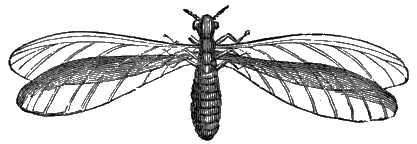
[It is now known that the differences of form among the termites are accounted for as follows. The winged specimens are the fully developed males and females, popularly called kings and queens. These crawl to the aperture of their house and take flight, retiring to earth after a short time. When a male and female meet each other, they cast off their wings exactly as do the ants of our own country, and become the founders of a new colony. Their soldiers are undeveloped males, and the workers are undeveloped females.]
In the winged state, they migrate to form new colonies, but the greater number of them perish in a few hours, or become the prey of birds, and even of the natives, who fry them as delicacies. “I have discoursed with several gentlemen,” says Smeathman, “upon the taste of the white ants, and on comparing notes, we have always agreed that they are most delicious and delicate eating. One gentleman compared them to sugared marrow, another to sugared cream and a paste of sweet almonds.”[DO]
Mr. Smeathman’s very interesting paper affords us the most authentic materials for the further description of these wonderful insects; and we therefore continue partly to extract from, and partly to abridge, his account.
The few pairs that are so fortunate as to survive the various casualties that assail them, are usually found by workers (larvæ), which, at this season, are running continually on the surface of the ground, on the watch for them. As soon as they discover the objects of their search, they begin to protect them from their surrounding enemies, by inclosing them in a small chamber of clay, where they become the parents of a new community, and are distinguished from the other inhabitants of the nest by the title of king and queen. Instinct directs the attention of these labouring insects to the preservation of their race, in the protection of this pair and their offspring. The chamber that forms the rudiment of a new nest is contrived for their safety, but the entrances to it are too small to admit of their ever leaving it; consequently, the charge of the eggs devolves upon the labourers, who construct nurseries for their reception. These are small, irregularly-shaped chambers, placed at first round the apartment of the king and queen, and not exceeding the size of a hazel-nut; but in nests of long standing they are of great comparative magnitude, and distributed at a greater distance. The receptacles for hatching the young are all composed of wooden materials, apparently joined together with gum, and, by way of defence, cased with clay. The chamber that contains the king and queen is nearly on a level with the surface of the ground; and as the other apartments are formed about it, it is generally situated at an equal distance from the sides of the nest, and directly beneath its conical point. Those apartments which consist of nurseries and magazines of provisions, form an intricate labyrinth, being separated by small, empty chambers and galleries, which surround them, or afford a communication from one to another. This labyrinth extends on all sides to the outward shells, and reaches up within it to two-thirds or more of its height, leaving an open area above, in the middle, under the dome, which reminds the spectator of the nave of an old cathedral. Around this are raised three or four large arches, which are sometimes two or three feet high, next the front of the area, but diminish as they recede further back, and are lost amidst the innumerable chambers and nurseries behind them.
Every one of these buildings consists of two distinct parts, the exterior and the interior. The exterior is one large shell, in the manner of a dome, large and strong enough to inclose and shelter the interior from the vicissitudes of the weather, and the inhabitants from the attacks of natural or accidental enemies. It is always, therefore, much stronger than the interior building, which is the habitable part, divided, with a wonderful kind of regularity and contrivance, into an amazing number of apartments for the residence of the king and queen, and the nursing of the numerous progeny; or for magazines, which are always found well filled with stores and provisions. The hills make their first appearance above ground by a little turret or two, in the shape of sugar-loaves, which are run a foot high or more. Soon after, at some little distance, while the former are increasing in height and size, they raise others, and so go on increasing their number, and widening them at the base, till their works below are covered with these turrets, of which they always raise the highest and largest in the middle, and by filling up the intervals between each turret, collect them into one dome. They are not very curious or exact in the workmanship, except in making them very solid and strong; and when, by their joining them, the dome is completed, for which purpose the turrets answer as scaffolds, they take away the middle ones entirely, except the tops, which, joined together, make the crown of the cupola, and apply the clay to the building of the works within, or to erecting fresh turrets for the purpose of raising the hillock still higher; so that some part of the clay is probably used several times, like the boards and posts of a mason’s scaffold.
When these hills are little more than half their height, it is a common practice of the wild bulls to stand as sentinels on them, while the rest of the herd are ruminating below. They are sufficiently strong for that purpose, and at their full height answer excellently well as places of look-out; and Mr. Smeathman has been, with four more, on the top of one of these hillocks, to watch for a vessel in sight. The outward shell, or dome, is not only of use to protect and support the interior buildings from external violence and the heavy rains, but to collect and preserve a regular degree of the warmth and moisture necessary for hatching the eggs and cherishing the young. The royal chamber occupied by the king and queen appears to be, in the opinion of this little people, of the most consequence, being always situated as near the centre of the interior building as possible. It is always nearly in the shape of half an egg, or an obtuse oval, within, and may be supposed to represent a long oven. In the infant state of the colony it is but about an inch in length; but in time will be increased to six or eight inches, or more, in the clear, being always in proportion to the size of the queen, who, increasing in bulk as in age, at length requires a chamber of such dimensions.
Queen distended with Eggs.
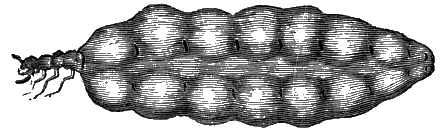
Its floor is perfectly horizontal, and in large hillocks, sometimes more than an inch thick of solid clay. The roof, also, which is one solid and well-turned oval arch, is generally of about the same solidity; but in some places it is not a quarter of an inch thick on the sides where it joins the floor, and where the doors or entrances are made level with it, at nearly equal distances from each other. These entrances will not admit any animal larger than the soldiers or labourers; so that the king and the queen (who is, at full size, a thousand times the weight of a king) can never possibly go out, but remain close prisoners.
[There is a good series of the queen cells of the Termite in the British Museum, and the reader is strongly recommended to go and examine them. Some of them are as large as cocoa-nuts. Around the cell are a number of small holes, looking as if they had been bored with a bradawl. Now, if the cell be carefully opened, a most curious arrangement will be seen. Each of the little holes serves as an opening into a passage which communicates with the interior of the cell. The apartment, if we may so call it, which contains the queen, is only just large enough to hold her, and there is no door or opening for her egress. This, however, is not required, as her enormous size prevents her from moving. Through these passages runs incessantly a stream of worker termites, some of them carrying eggs which the queen has just laid, and others returning to the royal chamber for a fresh supply.]
The royal chamber, if in a large hillock, is surrounded by a countless number of others, of different sizes, shapes, and dimensions; but all of them arched in one way or another—sometimes elliptical or oval. These either open into each other, or communicate by passages as wide as, and are evidently made for, the soldiers and attendants, of whom great numbers are necessary, and always in waiting. These apartments are joined by the magazines and nurseries. The former are chambers of clay, and are always well filled with provisions, which, to the naked eye, seem to consist of the raspings of wood, and plants which the termites destroy, but are found by the microscope to be principally the gums or inspissated juices of plants. These are thrown together in little masses, some of which are finer than others, and resemble the sugar about preserved fruits; others are like tears of gum, one quite transparent, another like amber, a third brown, and a fourth quite opaque, as we see often in parcels of ordinary gums. These magazines are intermixed with the nurseries, which are buildings totally different from the rest of the apartments; for these are composed entirely of wooden materials, seemingly joined together with gums. Mr. Smeathman calls them the nurseries because they are invariably occupied by the eggs and young ones, which appear at first in the shape of labourers, but white as snow. These buildings are exceedingly compact, and divided into many very small irregular-shaped chambers, not one of which is to be found of half an inch in width. They are placed all round, and as near as possible to the royal apartments.
When the nest is in the infant state, the nurseries are close to the royal chambers; but as, in process of time, the queen enlarges, it is necessary to enlarge the chamber for her accommodation; and as she then lays a greater number of eggs, and requires a greater number of attendants, so it is necessary to enlarge and increase the number of the adjacent apartments; for which purpose the small nurseries which are first built are taken to pieces, rebuilt a little further of a size larger, and the number of them increased at the same time. Thus they continually enlarge their apartments, pull down, repair, or rebuild, according to their wants, with a degree of sagacity, regularity, and foresight, not even imitated by any other kind of animals or insects.
All these chambers, and the passages leading to and from them, being arched, they help to support each other; and while the interior large arches prevent them from falling into the centre, and keep the area open, the exterior building supports them on the outside. There are, comparatively speaking, few openings into the great area, and they, for the most part, seem intended only to admit into the nurseries that genial warmth which the dome collects. The interior building, or assemblage of nurseries, chambers, &c., has a flattish top or roof, without any perforation, which would keep the apartments below dry, in case through accident the dome should receive any injury, and let in water; and it is never exactly flat and uniform, because the insects are always adding to it by building more chambers and nurseries; so that the division or columns between the future arched apartment resemble the pinnacles on the fronts of some old buildings, and demand particular notice, as affording one proof that for the most part the insects project their arches, and do not make them by excavation. The area has also a flattish floor, which lies over the royal chamber, but sometimes a good height above it, having nurseries and magazines between. It is likewise waterproof, and contrived to let the water off if it should get in, and run over by some short way into the subterraneous passages, which run under the lowest apartments in the hill in various directions, and are of an astonishing size, being wider than the bore of a great cannon. One that Mr. Smeathman measured was perfectly cylindrical, and thirteen inches in diameter. These subterraneous passages, or galleries, are lined very thick with the same kind of clay of which the hill is composed, and ascend the inside of the outward shell in a spiral manner; and winding round the whole building up to the top, intersect each other at different heights, opening either immediately in the dome in various places, and into the interior building, the new turrets, &c., or communicating with them by other galleries of different diameters, either circular or oval.
From every part of these large galleries are various small covert ways, or galleries leading to different parts of the building. Under ground there are a great many that lead downward by sloping descents, three and four feet perpendicular among the gravel, whence the workers cull the finer parts, which, being kneaded up in their mouths to the consistence of mortar, become that solid clay or stone of which their hills and all their buildings, except their nurseries, are composed. Other galleries again ascend, and lead out horizontally on every side, and are carried under ground near to the surface a vast distance: for if all the nests are destroyed within a hundred yards of a house, the inhabitants of those which are left unmolested farther off will still carry on their subterraneous galleries, and, invading it by sap and mine, do great mischief to the goods and merchandise contained in it.
It seems there is a degree of necessity for the galleries under the hills being thus large, since they are the great thoroughfares for all the labourers and soldiers going forth or returning, whether fetching clay, wood, water, or provisions; and they are certainly well calculated for the purposes to which they are applied by the spiral slope which is given them; for if they were perpendicular the labourers would not be able to carry on their building with so much facility, as they ascend a perpendicular with great difficulty, and the soldiers can scarcely do it at all. It is on this account that sometimes a road like a ledge is made on the perpendicular side of any part of the building within their hill, which is flat on the upper surface and half an inch wide, and ascends gradually like a staircase, or like those winding roads which are cut on the sides of hills and mountains, that would otherwise be inaccessible; by which and similar contrivances they travel with great facility to every interior part.
a, A covered way and nest, on the branch of a tree, of the Termites arborum. b, Section of the Hill-nest of the Termites bellicosi, to show the interior. c, Hill-nest of the Termites bellicosi, entire.
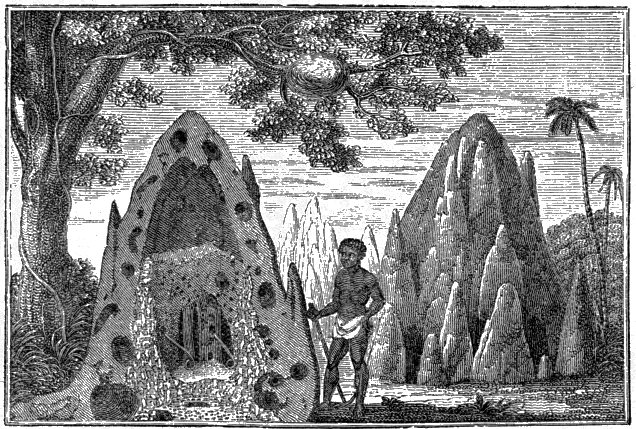
This, too, is probably the cause of their building a kind of bridge of one great arch, which answers the purpose of a flight of stairs from the floor of the area to some opening on the side of one of the columns that support the great arches. This contrivance must shorten the distance exceedingly to those labourers who have the eggs to carry from the royal chamber to some of the upper nurseries, which in some hills would be four or five feet in the straightest line, and much more if carried through all the winding passages leading through the inner chambers and apartments. Mr. Smeathman found one of these bridges, half an inch broad, a quarter of an inch thick, and ten inches long, making the side of an elliptic arch of proportionable size; so that it is wonderful it did not fall over or break by its own weight before they got it joined to the side of the column above.
It was strengthened by a small arch at the bottom, and had a hollow or groove all the length of the upper surface, either made purposely for the inhabitants to travel over with more safety, or else, which is not improbable, worn by frequent treading.
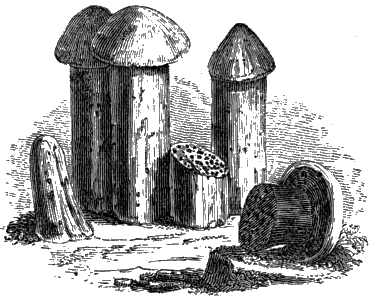
Turret-building White Ants.
Apparently more than one species smaller than the preceding, such as the Termes mordax and T. atrox of Smeathman, construct nests of a very different form, the figures of which resemble a pillar, with a large mushroom for a capital. These turrets are composed of well-tempered black earth, and stand nearly three feet high. The conical mushroom-shaped roof is composed of the same material, and the brims hang over the column, being three or four inches wider than its perpendicular sides. Most of them, says Smeathman, resemble in shape the body of a round windmill, but some of the roofs have little elevation in the middle. When one of these turrets is completed, the insects do not afterwards enlarge or alter it; but if it be found too small for them, they lay the foundation of another at a few inches’ distance. They sometimes, but not often, begin the second before the first is finished, and a third before they have completed the second. Five or six of these singular turrets in a group may be seen in the thick woods at the foot of a tree. They are so very strongly built, that in case of violence, they will sooner tear up the gravel and solid heart of their foundation than break in the middle. When any of them happen to be thus thrown down, the insects do not abandon them; but, using their overturned column as a basis, they run up another perpendicularly from it to the usual height, fastening the under part at the same time to the ground, to render it the more secure.
The interior of a turret is pretty equally divided into innumerable cells, irregular in shape, but usually more or less angular, generally quadrangular or pentagonal, though the angles are not well defined. Each shell has at least two entrances; but there are no galleries, arches, nor wooden nurseries, as in the nests of the warrior (T. bellicosus). The two species which build turret nests are very different in size, and the dimensions of the nests differ in proportion.
Turret Nests of White Ants. One nest is represented cut through, with the upper part lying on the ground.
The White Ants of Trees.
Latreille’s species of white ant (Termes lucifugus, Rossi), formerly mentioned as found in the south of Europe, appear to have more the habits of the jet-ant, described page 301, than their congeners of the tropics. They live in the interior of the trunks of trees, the wood of which they eat, and form their habitations of the galleries which they thus excavate. M. Latreille says they appear to be furnished with an acid for the purpose of softening the wood, the odour of which is exceedingly pungent. They prefer the part of the wood nearest to the bark, which they are careful not to injure, as it affords them protection. All the walls of their galleries are moistened with small globules of a gelatinous substance, similar to gum Arabic. They are chiefly to be found in the trunks of oak and pine trees, and are very numerous.[DP]
Another of the species (Termes arborum), described by Smeathman, builds a nest on the exterior of trees, altogether different from any of the preceding. These are of a spherical or oval shape, occupying the arm or branch of a tree sometimes from seventy to eighty feet from the ground, and as large, in a few instances, as a sugar-cask. The composition used for a building material is apparently similar to that used by the warriors for constructing their nurseries, being the gnawings of wood in very small particles, kneaded into a paste with some species of cement or glue, procured, as Smeathman supposes, partly from gummiferous trees, and partly from themselves; but it is more probable, we think, that it is wholly secreted, like the wax of bees, by the insects themselves. With this cement, whatever may be its composition, they construct their cells, in which there is nothing very wonderful except their great numbers. They are very firmly built, and so strongly attached to the trees, that they will resist the most violent tornado. It is impossible, indeed, to detach them, except by cutting them in pieces, or sawing off the branch, which is frequently done to procure the insects for young turkeys. (See engraving, p. 324, for a figure of this nest.)
This species very often, instead of selecting the bough of a tree, builds in the roof or wall of a house, and unless observed in time, and expelled, occasions considerable damage. It is easier, in fact, to shut one’s door against a fox or a thief, than to exclude such insidious enemies, whose aversion to light renders it difficult to trace them even when they are numerous.
[There are also termites in Europe, and the city of La Rochelle has suffered terribly from them. They eat the trees in the gardens, and not a stake can be driven into the ground, or even a plank left for twenty-four hours, without being attacked. They also enter the houses and utterly ruin them by eating every bit of timber that is used in them. In one instance, where a room had been repaired, the stalactitic galleries of the termites showed themselves the very day after the workmen had left the room.
They invaded the prefecture, and did exceeding damage, one of their feats of voracity being so extraordinary as to deserve mention. The archives of the department were left in boxes, and privately inspected. One day, when a paper was needed, the whole of the documents fell to pieces, and were metamorphosed as if by magic into a heap of clay. The termites had got into the boxes by boring through the wainscot of the room, and had then penetrated among the papers. They consumed every particle of them except the uppermost sheet and the edges, supplying their place with clay. The consequence was, that although the heap of documents seemed to be correct, there was nothing but a mass of clay galleries and a single sheet of paper at the top.
So voracious are they, that even a piece of paper wrapped round a bottle was eaten, the termites building a gallery of clay in order to reach it under cover.]
If we reflect on the prodigious numbers of those insects, and their power and rapidity of destroying, we cannot but admire the wisdom of Providence in creating so indefatigable and useful an agent in countries where the decay of vegetable substances is rapid in proportion to the heat of the climate. We have already remarked that they always prefer decaying or dead timber; and it is indeed a very general law among insects which feed on wood to prefer what is unsound; the same principle holds with respect to fungi, lichens, and other parasitical plants.
All the species of Termites are not social; but the solitary ones do not, like their congeners, distinguish themselves in architecture. In other respects, their habits are more similar; for they destroy almost every substance, animal and vegetable. The most common of the solitary species must be familiar to all our readers by the name of wood-louse (Termes pulsatorium, Linn.; Atropos lignarius, Leach)—one of the insects which produces the ticking superstitiously termed the death-watch. It is not so large as the common wood-louse, but whiter and more slender, having a red mouth and yellow eyes. It lives in old books, the paper on walls, collections of insects and dried plants, and is extremely agile in its movements, darting, by jerks, into dark corners for the purpose of concealment. It does not like to run straight forward without resting every half-second, as if to listen or look about for its pursuer, and at such resting times it is easily taken. The ticking noise is made by the insect beating against the wood with its head, and it is supposed by some to be peculiar to the female, and to be connected with the laying of her eggs. M. Latreille, however, thinks that the wood-louse is only the grub of the Psocus abdominalis, in which case it could not lay eggs; but this opinion is somewhat questionable. Another death-watch is a small beetle (Anobium tesselatum).
CHAPTER XVII.
STRUCTURES OF SILK SPUN BY CATERPILLARS, INCLUDING THE SILK-WORM.
"Millions of spinning-worms, That in their green shops weave the smooth-hair’d silk." Milton’s Comus.
All the caterpillars of butterflies, moths, and, in general, of insects with four wings, are capable of spinning silk; of various degrees of fineness and strength, and differing in colour, but usually white, yellow, brown, black, or grey. This is not only of advantage in constructing nests for themselves, and particularly for their pupæ, as we have so frequently exemplified in the preceding pages, but it enables them, the instant they are excluded from the egg, to protect themselves from innumerable accidents, as well as from enemies. If a caterpillar, for instance, be exposed to a gust of wind, and blown off from its native tree, it lets itself gently down, and breaks its fall, by immediately spinning a cable of silk, along which, also, it can reascend to its former station when the danger is over. In the same way it frequently disappoints a bird that has marked it out for prey, by dropping hurriedly down from a branch, suspended to its never-failing delicate cord. The leaf-rollers, formerly described, have the advantage of other caterpillars in such cases, by being able to move as quickly backwards as forwards; so that when a bird puts in its bill at one end of the roll, the insect makes a ready exit at the other, and drops along its thread as low as it judges convenient. We have seen caterpillars drop in this way from one to six feet or more; and by means of their cable, which they are careful not to break, they climb back with great expedition to their former place.
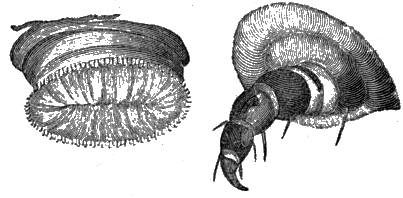
The structure of their legs is well adapted for climbing up their singular rope—the six fore-legs being furnished with a curved claw; while the pro-legs (as they have been termed) are no less fitted for holding them firm to the branch when they have regained it, being constructed on the principle of forming a vacuum, like the leather sucker with which boys lift and drag stones. The foot of the common fly has a similar sucker, by which it is enabled to walk on glass, and otherwise support itself against gravity. The different forms of the leg and pro-leg of a spinning caterpillar are represented in the figure.
Leg and Pro-leg of a Caterpillar, greatly magnified.
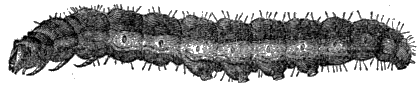
In order to understand the nature of the apparatus by which a caterpillar spins its silk, it is to be recollected that its whole interior structure differs from that of warm-blooded animals. It has, properly speaking, no heart, though a long tubular dorsal vessel, which runs along the back, and pulsates from twenty to one hundred times per minute, has been called so by Malpighi and others, but neither Lyonnet nor Cuvier could detect any vessel issuing from it, and consequently the fluid which is analogous to blood has no circulation. It differs also from the higher orders of animals in having no brain, the nerves running along the body being only united by little knobs, called ganglions. Another circumstance is, that it has no lungs, and does not breathe by the mouth, but by air-holes, or spiracles, eighteen in number, situated along the sides, in the middle of the rings, as may be seen in the following figure from Lyonnet.
Caterpillar of the Goat Moth (Cossus ligniperda).
Interior Structure of the Cossus.— A, silk bags; B, silk tube, through which the viscid matter, of which the silk threads are formed, is forced by a peristaltic motion; C, stomach; D D, intestines, with the coil of bile vessels.
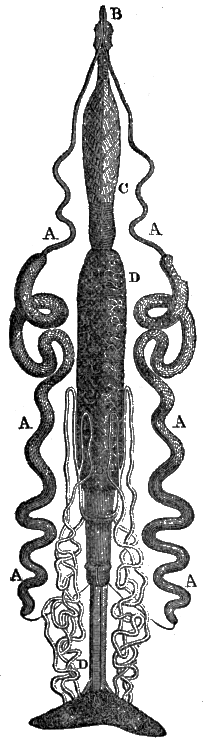
These spiracles communicate on each side with tubes, that have been called the wind-pipes (tracheæ). The spinning apparatus is placed near the mouth, and is connected with the silk-bags, which are long, slender, floating vessels, containing a liquid gum. The bags are closed at their lower extremity, become wider towards the middle, and more slender towards the head, where they unite to form the spinning-tube, or spinneret. The bags being in most cases longer than the body of the caterpillar, necessarily lie in a convoluted state, like the intestines of quadrupeds. The capacity, or rather the length, of the silk-bags is in proportion to the quantity of silk required for spinning; the Cossus ligniperda, for example, from living in the wood of trees spins little, having a bag only one-fourth the length of that of the silk-worm, though the caterpillar is at least twice the dimensions of the latter. The following figure, taken from the admirable treatise of Lyonnet on the anatomy of the Cossus, will render these several organs more easily understood than any description.
The spinneret itself was supposed by Réaumur to have two outlets for the silk; but Lyonnet, upon minute dissection, found that the two tubes united into one before their termination; and he also assured himself that it was composed of alternate slips of horny and membranaceous substance,—the one for pressing the thread into a small diameter, and the other for enlarging it at the insect’s pleasure. It is cut at the end somewhat like a writing-pen, though with less of a slope, and is admirably fitted for being applied to objects to which it may be required to attach silk. The following are magnified figures of the spinneret of the Cossus, from Lyonnet.
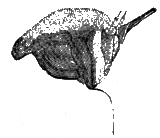

Side-view of the Silk-tube. Section of the Silk-tube, magnified 22,000 times.
“You may sometimes have seen,” says the Abbé de la Pluche, "in the work-rooms of goldsmiths or gold wire-drawers, certain iron plates, pierced with holes of different calibres, through which they draw gold and silver wire, in order to render it finer. The silk-worm has under her mouth such a kind of instrument, perforated with a pair of holes [united into one on the outside[DQ],] through which she draws two drops of the gum that fills her two bags. These instruments are like a pair of distaffs for spinning the gum into a silken thread. She fixes the first drop of gum that issues where she pleases, and then draws back her head, or lets herself fall, while the gum, continuing to flow, is drawn out and lengthened into a double stream. Upon being exposed to the air, it immediately loses its fluidity, becomes dry, and acquires consistence and strength. She is never deceived in adjusting the dimensions of the [united] apertures, or in calculating the proper thickness of the thread, but invariably makes the strength of it proportionable to the weight of her body.
Labium, or lower lip of Cossus.—a, Silk-tube.
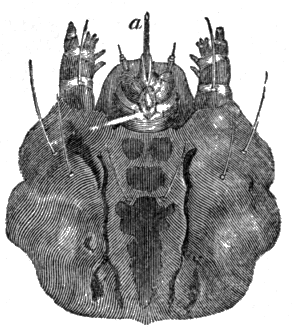
“It would be a very curious thing to know how the gum which composes the silk is separated and drawn off from the other juices that nourish the animal. It must be accomplished like the secretions formed by glands in the human body. I am therefore persuaded that the gum-bags of the silk-worm are furnished with a set of minute glands, which being impregnated with gum, afford a free passage to all the juices of the mulberry-leaf corresponding with this glutinous matter, while they exclude every fluid of a different quality.”[DR] When confined in an open glass vessel, the goat-moth caterpillar will effect its escape by constructing a curious silken ladder, as represented by Roesel.
Caterpillars, as they increase in size, cast their skins as lobsters do their shells, and emerge into renewed activity under an enlarged covering. Previous to this change, when the skin begins to gird and pinch them, they may be observed to become languid, and indifferent to their food, and at length they cease to eat, and await the sloughing of their skin. It is now that the faculty of spinning silk seems to be of great advantage to them; for, being rendered inactive and helpless by the tightening of the old skin around their expanding body, they might be swept away by the first puff of wind, and made prey of by ground beetles or other carnivorous prowlers. To guard against such accidents, as soon as they feel that they can swallow no more food, from being half choked by the old skin, they take care to secure themselves from danger by moorings of silk spun upon the leaf or the branch where they may be reposing. The caterpillar of the white satin-moth (Leucoma salicis, Stephens) in this way draws together with silk one or two leaves, similar to the leaf-rollers (Tortricidæ), though it always feeds openly without any covering. The caterpillar of the puss-moth again, which, in its third skin, is large and heavy, spins a thick web on the upper surface of a leaf, to which it adheres till the change is effected.
The most important operation, however, of silk-spinning is performed before the caterpillar is transformed into a chrysalis, and is most remarkable in the caterpillars of moths and other four-winged flies, with the exception of those of butterflies; for though these exhibit, perhaps, greater ingenuity, they seldom spin more than a few threads to secure the chrysalis from falling, whereas the others spin for it a complete envelope or shroud. We have already seen, in the preceding pages, several striking instances of this operation, when, probably for the purpose of husbanding a scanty supply of silk, extraneous substances are worked into the texture. In the case of other caterpillars, silk is the only material employed.
Of this the cocoon of the silk-worm is the most prominent example, in consequence of its importance in our manufactures and commerce, and on that account will demand from us somewhat minute details, though it would require volumes to incorporate all the information which has been published on the subject.
Silk-Worm.
The silk-worm, like most other caterpillars, changes its skin four times during its growth. The intervals at which the four moultings follow each other depend much on climate or temperature, as well as on the quality and quantity of food. It is thence found, that if they are exposed to a high temperature, say from 81° to 100° Fahrenheit, the moultings will be hastened; and only five days will be consumed in moulting the third or fourth time, whilst those worms that have not been hastened take seven or eight days.[DS]
The period of the moultings is also influenced by the temperature in which the eggs have been kept during the winter. When the heat of the apartment has been regulated, the first moulting takes place on the fourth or fifth day after hatching, the second begins on the eighth day, the third takes up the thirteenth and fourteenth days, and the last occurs on the twenty-second and twenty-third days. The fifth age, in such cases, lasts ten days, at the end of which, or thirty-two days after hatching, the caterpillars attain their full growth, and ought to be three inches in length; but if they have not been properly fed, they will not be so long.
With the age of the caterpillar, its appetite increases, and is at its maximum after the fourth moulting, when it also attains its greatest size. The silk gum is then elaborated in the reservoirs, while the caterpillar ceases to eat, and soon diminishes again in size and weight. This usually requires a period of nine or ten days, commencing from the fourth moulting, after which it begins to spin its shroud of silk. In this operation it proceeds with the greatest caution, looking carefully for a spot in which it may be most secure from interruption.
“We usually,” says the Abbé de la Pluche, "give it some little stalks of broom, heath, or a piece of paper rolled up, into which it retires, and begins to move its head to different places, in order to fasten its thread on every side. All this work, though it looks to a bystander like confusion, is not without design. The caterpillar neither arranges its threads nor disposes one over another, but contents itself with distending a sort of cotton or floss to keep off the rain; for Nature having ordained silk-worms to work under trees, they never change their method even when they are reared in our houses.
"When my curiosity led me to know how they spun and placed their beautiful silk, I took one of them, and frequently removed the floss with which it first attempted to make itself a covering; and as by this means I weakened it exceedingly, when it at last became tired of beginning anew, it fastened its threads on the first thing it encountered, and began to spin very regularly in my presence, bending its head up and down, and crossing to every side. It soon confined its movements to a very contracted space, and, by degrees, entirely surrounded itself with silk; and the remainder of its operations became invisible, though these may be understood from examining the work after it is finished. In order to complete the structure, it must draw out of the gum-bag a more delicate silk, and then with a stronger gum bind all the inner threads over one another.
"Here, then, are three coverings entirely different, which afford a succession of shelter. The outer loose silk, or floss, is for keeping off the rain; the fine silk in the middle prevents the wind from causing injury; and the glued silk, which composes the tapestry of the chamber where the insect lodges, repels both air and water, and prevents the intrusion of cold.
"After building her cocoon, she divests herself of her fourth skin, and is transformed into a chrysalis, and subsequently into a moth (Bombyx mori), when, without saw or centre-bit, she makes her way through the shell, the silk, and the floss; for the Being who teaches her how to build herself a place of rest, where the delicate limbs of the moth may be formed without interruption, instructs her likewise how to open a passage for escape.
"The cocoon is like a pigeon’s egg, and more pointed at one end than the other; and it is remarkable that the caterpillar does not interweave its silk towards the pointed end, nor apply its glue there as it does in every other part,[DT] by bending itself all around with great pliantness and agility: what is more, she never fails, when her labour is finished, to fix her head opposite to the pointed extremity. The reason of her taking this position is, that she has purposely left this part less strongly cemented, and less exactly closed. She is instinctively conscious that this is to be the passage for the perfect insect which she carries in her bowels, and has therefore the additional precaution never to place this pointed extremity against any substance that might obstruct the moth at the period of its egress.
"When the caterpillar has exhausted herself to furnish the labour and materials of the three coverings, she loses the form of a worm; her spoils drop all around the chrysalis; first throwing off the skin, with the head and jaws attached to it, and the new skin hardening into a sort of leathery consistence. Its nourishment is already in its stomach, and consists of a yellowish mucus, but gradually the rudiments of the moth unfold themselves,—the wings, the antennæ, and the legs becoming solid. In about a fortnight or three weeks, a slight swelling in the chrysalis may be remarked, which at length produces a rupture in the membrane that covers it, and by repeated efforts the moth bursts through the leathery envelope into the chamber of the cocoon.
“The moth then extends her antennæ, together with her head and feet, towards the point of the cone, which not being thickly closed up in that part gradually yields to her efforts; she enlarges the opening, and at last comes forth, leaving at the bottom of the cone the ruins of its former state—namely, the head and entire skin of the caterpillar, which bear some resemblance to a heap of foul linen.”[DU]
Réaumur was of opinion that the moth makes use of its eyes as a file, in order to effect its passage through the silk; while Malpighi, Peck, and others, believe that it is assisted by an acid which it discharges in order to dissolve the gum that holds the fibres of the silk together (see p. 338). Mr. Swayne denies that the threads are broken at all, either by filing or solution; for he succeeded in unwinding a whole cocoon from which the moth had escaped. The soiling of the cocoon by a fluid, however, we may remark, is no proof of the acid; for all moths and butterflies discharge a fluid when they assume wings, whether they be inclosed in a cocoon or not; but it gives no little plausibility to the opinion, that “the end of the cocoon is observed to be wetted for an hour, and sometimes several hours, before the moth makes its way out.”[DV] Other insects employ different contrivances for escape, as we have already seen, and shall still further exemplify.
It is the middle portion of the cocoon, after removing the floss or loose silk on the exterior, which is used in our manufactures; and the first preparation is to throw the cocoons into warm water, and to stir them about with twigs, to dissolve any slight gummy adhesions which may have occurred when the caterpillar was spinning. The threads of several cones, according to the strength of the silk wanted, are then taken and wound off upon a reel. The refuse, consisting of what we may call the tops and bottoms of the cones, are not wound, but carded, like wool or cotton, in order to form coarser fabrics. We learn from the fact of the cocoons being generally unwound without breaking the thread, that the insect spins the whole without interruption. It is popularly supposed, however, that if it be disturbed during the operation by any sort of noise, it will take alarm, and break its thread; but Latreille says this is a vulgar error.[DW]
The length of the unbroken thread in a cocoon varies from six hundred to a thousand feet; and as it is all spun double by the insect, it will amount to nearly two thousand feet of silk, the whole of which does not weigh above three grains and a half; five pounds of silk from ten thousand cocoons is considerably above the usual average. When we consider, therefore, the enormous quantity of silk which is used at present, the number of worms employed in producing it will almost exceed our comprehension. The manufacture of the silk, indeed, gives employment, and furnishes subsistence, to several millions of human beings; and we may venture to say, that there is scarcely an individual in the civilized world who has not some article made of silk in his possession.
In ancient times, the manufacture of silk was confined to the East Indies and China, where the insects that produce it are indigenous. It was thence brought to Europe in small quantities, and in early times sold at so extravagant a price, that it was deemed too expensive even for royalty. The Emperor Aurelian assigned the expense as a reason for refusing his empress a robe of silk; and our own James I., before his accession to the crown of England, had to borrow of the Earl of Mar a pair of silk stockings to appear in before the English ambassador, a circumstance which probably led him to promote the cultivation of silk in England.[DX] The Roman authors were altogether ignorant of its origin,—some supposing it to be grown on trees as hair grows on animals,—others that it was produced by a shell-fish similar to the mussel, which is known to throw out threads for the purpose of attaching itself to rocks,—others that it was the entrails of a sort of spider, which was fed for four years with paste, and then with the leaves of the green willow, till it burst with fat,—and others that it was the produce of a worm which built nests of clay and collected wax. The insect was at length spread into Persia; and eggs were afterwards, at the instance of the Emperor Justinian, concealed in hollow canes by two monks, and conveyed to the Isle of Cos. This emperor, in the sixth century, caused them to be introduced into Constantinople, and made an object of public utility. They were thence successively cultivated in Greece, in Arabia, in Spain, in Italy, in France, and in all places where any hope could be indulged of their succeeding. In America the culture of the silk-worm was introduced into Virginia in the time of James I., who himself composed a book of instructions on the subject, and caused mulberry-trees and silk-worms’ eggs to be sent to the colony. In Georgia, also, lands were granted on condition of planting one hundred white mulberry-trees on every ten acres of cleared land.[DY]
The growth of the silk-worm has also been tried, but with no great success, in this country. Evelyn computed that one mulberry-tree would feed as many silk-worms annually as would produce seven pounds of silk. “According to that estimate,” says Barham,[DZ] “the two thousand trees already planted in Chelsea Park (which take up one-third of it) will make 14,000 lbs. weight of silk; to be commonly worth but twenty shillings a pound, those trees must make 14,000l. per annum.” During the last century, some French refugees in the south of Ireland made considerable plantations of the mulberry, and had begun the cultivation of silk with every appearance of success; but since their removal the trees have been cut down.[EA] In the vicinity of London, also, a considerable plantation of mulberry-trees was purchased by the British, Irish, and Colonial Silk Company in 1825; but we have not learned whether this Company have any active measures now in operation.
The manufacture of silk was introduced into this country in 1718, at Derby, by Mr. John Lombe, who travelled into Italy to obtain the requisite information; but so jealous were the Italians of this, that according to some statements which have obtained belief, he fell a victim to their revenge, having been poisoned at the early age of twenty-nine.[EB]
There are not only several varieties of the common silk-worm (Bombyx mori), but other species of caterpillars, which spin silk capable of being manufactured, though not of so good qualities as the common silk. None of our European insects, however, seem to be well fitted for the purpose, though it has been proposed by Fabricius and others to try the crimson under-wing (Catocala sponsa, Schrank), &c. M. Latreille quotes from the ‘Recreations of Natural History,’ by Wilhelm, the statement that the cocoons of the emperor-moth (Saturnia pavonia) had been successfully tried in Germany, by M. Wentzel Hegeer de Berchtoldsdorf, under an imperial patent.
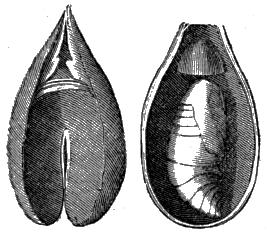
Cocoons of the Emperor-moth, cut open to show their structure.
Emperor-Moth.
The emperor-moth, indeed, is no less worthy of our attention with respect to the ingenuity of its architecture than the beauty of its colours, and has consequently attracted the attention of every Entomologist. The caterpillar feeds on fruit-trees and on the willow, and spins a cocoon, in the form of a Florence flask, of strong silk, so thickly woven that it appears almost like damask or leather. It differs from most other cocoons in not being closed at the upper or smaller end, which terminates in a narrow circular aperture, formed by the convergence of little bundles of silk, gummed together, and almost as elastic as whalebone. In consequence of all these terminating in needle-shaped points, the entrance of depredators is guarded against, upon the principle which prevents the escape of a mouse from a wire trap. The insect, however, not contented with this protection, constructs another in form of a canopy or dome, within the external aperture, so as effectually to shield the chrysalis from danger. We have formerly remarked (page 210) that the caterpillar of the Ægeria asiliformis of Stephens in a similar way did not appear to be contented with a covering of thin wood, without an additional bonnet of brown wax. The cocoon of the emperor-moth, though thus in some measure impenetrable from without, is readily opened from within; and when the moth issues from its pupa case, it easily makes its way out without either the acid or eye-files ascribed to the silk-worm. The elastic silk gives way upon being pushed from within, and when the insect is fairly out, it shuts again of its own accord, like a door with spring hinges,—a circumstance which at first puzzled Roesel not a little when he saw a fine large moth in his box, and the cocoon apparently in the same state as when he had put it there. Another naturalist conjectures that the converging threads are intended to compress the body of the moth as it emerges, in order to force the fluids into the nervures of the wings; for when he took the chrysalis previously out of the cocoon, the wings of the moth never expanded properly.[EC] Had he been much conversant with breeding insects, he would rather, we think, have imputed this to some injury which the chrysalis had received. We have witnessed the shrivelling of the wings which he alludes to, in many instances, and not unfrequently in butterflies which spin no cocoon. The shrivelling, indeed, frequently arises from the want of a sufficient supply of food to the caterpillar in its last stage, occasioning a deficiency in the fluids.
The elasticity of the cocoon is not peculiar to the emperor-moth. A much smaller insect, the green cream-border-moth (Tortrix chlorana) before mentioned (page 190), for its ingenuity in bundling up the expanding leaves of the willow, also spins an elastic shroud for its chrysalis, of the singular shape of a boat with the keel uppermost. Like the caterpillar of Pyralis strigulalis (page 217), whose building, though of different materials, is exactly of the same form, its first spins two approximating walls of whitish silk, of the form required, and when these are completed, it draws them forcibly together with elastic threads, so placed as to retain them closely shut. The passage of the moth out of this cocoon might have struck Roesel as still more marvellous than that of his emperor, in which there was at least a small opening; while in the boat cocoon there is none. We have now before us two of these, which we watched the caterpillars through the process of building, in the summer of 1828, and from one only a moth issued—the other, as often happens, having died in the chrysalis. But what is most remarkable, it is impossible by the naked eye to tell which of these two has been opened by the moth, so neatly has the joining been finished. (J. R.)
Some species of moths spin a very slight silken tissue for their cocoons, being apparently intended more to retain them from falling than to afford protection from other accidents. The gipsy-moth (Hypogymna dispar), rare in most parts of Britain, is one of these. It selects for its retreat a crack in the bark of the tree upon which it feeds, and over this spins only a few straggling threads. We found last summer (1829), in the hole of an elm-tree in the Park at Brussels, a group of half a dozen of these, that did not seem to have spun any covering at all, but trusted to a curtain of moss (Hypna) which margined the entrance. (J. R.) In a species nearly allied to this, the yellow-tussock (Dasychira pudibunda, Stephens), the cocoon, one of which we have now before us, is of a pretty close texture, and interwoven with the long hairs of the caterpillar itself (see figure b, page 17), which it plucks out piecemeal during the process of building,—as is also done by the vapourer (Orgyia antiqua, Hubner), and many others.
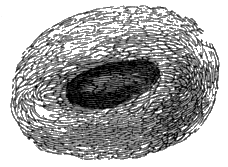
Cocoon of Arctia villica.
Net-work cocoon.
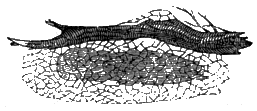
These are additional instances of the remarks we formerly made, that caterpillars which spin a slight web are transformed into perfect insects in a much shorter period than those which spin more substantial ones. Thus the cream-spot tiger (Arctia villica, Stephens) lies in chrysalis only three weeks, and therefore does not require a strong web. It is figured above, along with another, which is still slighter, though more ingeniously woven, being regularly meshed like net-work.
A very prettily-netted cocoon is constructed by the grub of a very small grey weevil (Hypera rumicis), which is not uncommon in July, on the seed spikes of docks (Rumices). This cocoon is globular, and not larger than a garden pea, though it appears to be very large in proportion to the pupa of the insect, reminding us not a little of the carved ivory balls from China. The meshes of the net-work are also large, but the materials are strong and of a waxy consistence. Upon remarking that no netting was ever spun over the part of the plant to which the cocoon was attached, we endeavoured to make them spin cocoons perfectly globular by detaching them when nearly finished; but though we tried four or five in this way, we could not make them add a single mesh after removal, all of them making their escape through the opening, and refusing to re-enter in order to complete their structure. (J. R.)
The silk, if it may be so termed, spun by many species of larvæ is of a still stronger texture than the waxy silk of the little weevil just mentioned. We recently met with a remarkable instance of this at Lee, in the cocoons of one of the larger ichneumons (Ophion Vinulæ? Stephens), inclosed in that of a puss-moth (Cerura Vinula)—itself remarkable for being composed of sand as well as wood, the fibres of which had been scooped out of the underground cross-bar of an old paling, to which it was attached. But the most singular portion of this was the junction of the outer wall with the edges of the hollow thus scooped out, which was formed of fibres of wood placed across the fibres of the bar nearly at right angles, and strongly cemented together, as if to form a secure foundation for the building.
In this nest were formed, surreptitiously introduced into the original building, five empty cells of a black colour, about an inch long, and a sixth of an inch in diameter; nearly cylindrical in form, but somewhat flattened; vertical and parallel to one another, though slightly curved on the inner side. The cells are composed of strong and somewhat coarse fibres, more like the carbonized rootlets of a tree than silk, and resembling in texture a piece of coarse milled cloth or felt, such as is used for the bases of plated hats. It is worthy of remark, that all these cells opened towards one end, as if the caterpillars which constructed them had been aware that the wall of the puss-moth, in which the flies would have to make a breach, was very hard, and would require their united efforts to effect an escape. The importance of such a precaution will appear more strikingly, when we compare it with the instance formerly mentioned (page 215), in which only one ichneumon had been able to force its way out. (J. R.)
Nest of Puss-moth, inclosing five cocoons of an Ichneumon. Natural size.
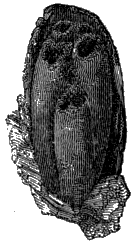
It appears indispensable to some grubs to be confined within a certain space in order to construct their cocoons. We saw this well exemplified in the instance of a grub of one of the mason-bees (Osmia bicornis), which we took from its nest, and put into a box with the pollen paste which the mother bee had provided for its subsistence. (See pages 45, 46.) When it had completed its growth, it began to spin, but in a very awkward manner-attaching threads, as if at random, to the bits of pollen which remained undevoured, and afterwards tumbling about to another part of the box, as if dissatisfied with what it had done. It sometimes persevered to spin in one place till it had formed a little vaulted wall; but it abandoned at the least three or four of these in order to begin others, till at length, as if compelled by the extreme urgency of the stimulus of its approaching change, it completed a shell of shining brown silk, woven into a close texture. Had the grub remained within the narrow clay cell built for it by the mother bee, it would, in all probability, not have thus exhausted itself in vain efforts at building, which were likely to prevent it from ever arriving at the perfect state—a circumstance which often happens in the artificial breeding of insects. This bee, however, made its appearance the following spring. (J. R.)
Besides silk, the cocoons of many insects are composed of other animal secretions, intended to strengthen or otherwise perfect their texture. We have already seen that some caterpillars pluck off their own hair to interweave amongst their silk; there are others which produce a peculiar substance for the same purpose. The lackey caterpillar (Clisiocampa neustria, Curtis) in this manner lines its cocoon with pellets of a downy substance, resembling little tufts of the flowers of sulphur. The small egger, again (Eriogaster lanestris, Germar), can scarcely be said to employ silk at all,—the cocoon being of a uniform texture, looking, at first sight, like dingy Paris plaster, or the shell of a pheasant’s egg; but upon being broken, and inspected narrowly, a few threads of silk may be seen interspersed through the whole. In size it is not larger than the egg of the gold-crested wren. It has been considered by Brahm a puzzling circumstance, that this cocoon is usually perforated with one or two little holes, as if made by a pin from without; and Kirby and Spence tell us that their use has not been ascertained.[ED] May they not be left as air-holes for the included chrysalis, as the close texture of the cocoon might, without this provision, prove fatal to the animal? Yet, on comparing one of these with a similar cocoon of the large egger-moth (Lasiocampa quercus), we find no air-holes in the latter, as we might have been led to expect from the closeness of its texture. We found a cocoon of a saw-fly (Trichiosoma), about the same size as that of the egger, attached to a hawthorn-twig, in a hedge at New Cross, Deptford, but of a leathery texture, and, externally, exactly the colour of the bark of the tree. During the summer of 1830 we found a considerable number of the same cocoons. These were all without air-holes. The egger, we may remark, unlike the dock-weevil or the bee-grub just mentioned, can work her cocoon without any point of attachment. We had a colony of these caterpillars in the summer of 1825, brought from Epping Forest, and saw several of them work their cocoons, and we could not but admire the dexterity with which they avoided filling up the little pin-holes. The supply of their building material was evidently measured out to them in the exact quantity required; for when we broke down a portion of their wall, by way of experiment, they did not make it above half the thickness of the previous portion, though they plainly preferred having a thin wall to leaving the breach unclosed. (J. R.)
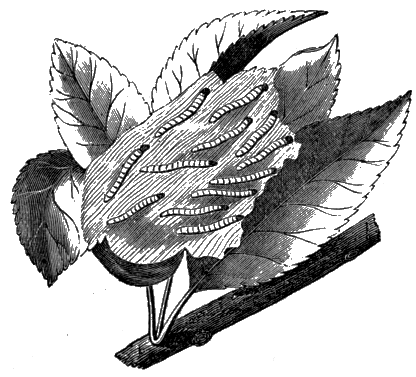
Several species of caterpillars, that spin only silk, are social, like some of those we formerly mentioned, which unite to form a common tent of leaves (see pages 351, 352, &c.). The most common instance of this is in the caterpillars which feed on the nettle—the small tortoise-shell (Vanessa urticæ), and the peacock’s eye (V. I.). Colonies of these may be seen, after midsummer, on almost every clump of nettles, inhabiting a thin web of an irregular oval shape, from which they issue out to feed on the leaves, always returning when their appetite is satisfied, to assist their companions in extending their premises. Other examples, still more conspicuous from being seen on fruit-trees and in hedges, occur in the caterpillars of the small ermine-moth (Yponomeuta padella), and of the lackey (Clisiocampa neustria), which in some years are but too abundant, though in others they are seldom met with. In the summer of 1826, every hedge and fruit-tree around London swarmed with colonies of the ermine, though it has not since been plentiful; and in the same way, during the summer of 1829, the lackeys were to be seen everywhere. We mention this irregularity of appearance that our readers may not disappoint themselves by looking for what is not always to be found. It is probable that in 1830 the lackeys will be few, for, notwithstanding the myriads of caterpillars last summer, we saw only a single moth of this species, and out of a number of chrysalides which a young friend had in his nurse-boxes, not one moth was bred.
The small ermine does not, besides, feed so indiscriminately as many others, but when the bird-cherry (Prunus padus), its peculiar food, is not to be had, it will put up with blackthorn, plum-tree, hawthorn, and almost any sort of orchard fruit-tree. With respect to such caterpillars as feed on different plants, Réaumur and De Geer make the singular remark, that in most cases they would only eat the sort of plant upon which they were originally hatched.[EE] We verified this, in the case of the caterpillar in question, upon two different nests which we took, in 1806, from the bird-cherry at Crawfordland, in Ayrshire. Upon bringing these to Kilmarnock, we could not readily supply them with the leaves of this tree; and having then only a slight acquaintance with the habits of insects, and imagining they would eat any sort of leaf, we tried them with almost everything green in the vicinity of the town; but they refused to touch any which we offered them. After they had fasted several days, we at length procured some fresh branches of the bird-cherry, with which they gorged themselves so that most of them died. Last summer (1829) we again tried a colony of these caterpillars, found on a seedling plum-tree at Lee, in Kent, with blackthorn, hawthorn, and many other leaves, and even with those of the bird-cherry; but they would touch nothing except the seedling plum, refusing the grafted varieties. (J. R.)
A circumstance not a little remarkable in so very nice a feeder is, that in some cases the mother moth will deposit her eggs upon trees not of indigenous growth, and not even of the same genus with her usual favourites. Thus, in 1825, the cherry-apple, or Siberian crab (Pyrus prunifolia, Willdenow), so commonly grown in the suburbs of London, swarmed with them. On a single tree at Islington we counted above twenty nests, each of which would contain from fifty to a hundred caterpillars; and though these do not grow thicker than a crow-quill, so many of them scarcely left a leaf undevoured, and, of course, the fruit, which showed abundantly in spring, never came to maturity. The summer following they were still more abundant on the hawthorn hedges, particularly near the Thames, by Battersea and Richmond. Since then we have only seen them sparingly; and last summer we could only find the single nest upon which we tried the preceding experiment. (J. R.)
Encampment of the caterpillar of the small ermine (Yponomeuta padella) on the Siberian crab.
The caterpillars of other moths, which are in some years very common—such as the brown-tail (Porthesia auriflua), and the golden-tail (P. chrysorrhœa), are also social; and, as the eggs are hatched late in the summer, the brood passes the winter in a very closely-woven nest of warm silk. This is usually represented as composed of leaves which have had their pulpy parts eaten as food by the colonists; but from minute observation of at least twenty of these nests in the winter of 1828-9, we are quite satisfied that leaves are only an accidental, and not a necessary, part of the structure. When a leaf happens to be in the line of the walls of the nest, it is included; but there is no apparent design in pressing it into the service, nor is a branch selected because it is leafy. On the contrary, by far the greater number of these nests do not contain a single leaf, but are composed entirely of grey silk. In external form, no two of these nests are alike; as it depends entirely upon the form of the branch. When, therefore, there is only one twig, it is somewhat egg-shaped; but when there are several twigs, it commonly joins each, assuming an angular shape, as may be seen in the left-hand figure.
Winter nests of Porthesia chrysorrhœa, one being cut open to show the chambers. The dots represent the egesta of the caterpillars.
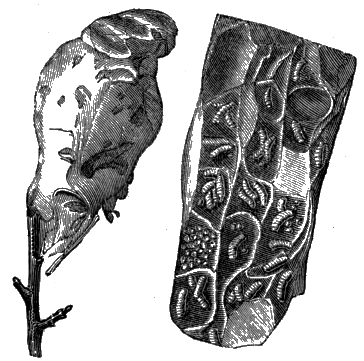
This irregularity arises from the circumstance of each individual acting on its own account, without the direction or superintendence of the others. The interior of the structure is, for the same reason, more regular, being divided into compartments, each of which forms a chamber for one or more individuals. Previous to the cold weather, these chambers have but slight partitions; but before the frosts set in the whole is made thick and warm.
Winter nest of the Social Caterpillars of the Brown-tail Moth (Porthesia auriflua), figured from specimen.
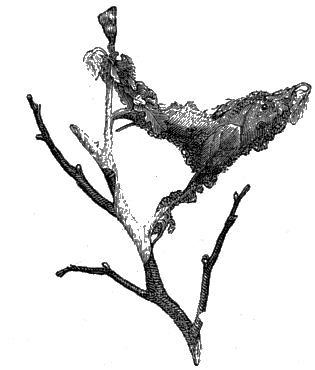
None of the preceding details, however, appear so striking as what is recorded of the brown-tail moth (Porthesia auriflua) by Mr. W. Curtis,[EF] whose multitudinous colonies spread great alarm over the country in the summer of 1782. This alarm was much increased by the exaggeration and ignorant details which found their way into the newspapers. The actual numbers of these caterpillars must have been immense, since Curtis says, “in many of the parishes near London subscriptions have been opened, and the poor people employed to cut off the webs at one shilling per bushel, which have been burnt under the inspection of the church-wardens, overseers, or beadle of the parish: at the first onset of this business fourscore bushels, as I was most credibly informed, were collected in one day in the parish of Clapham.”
It is not, therefore, very much to be wondered at, that the ignorant, who are so prone to become the victims of groundless fears, should have taken serious alarm on having so unusual a phenomenon forced upon their attention. Some alarmists accordingly asserted that the caterpillars “were the usual presage of the plague;” and others that they not only presaged it, but would actually cause it, for “their numbers were great enough to render the air pestilential;” while, to add to the mischief, “they would destroy every kind of vegetation, and starve the cattle in the fields.” “Almost every one,” adds Curtis, “ignorant of their history, was under the greatest apprehensions concerning them; so that even prayers were offered up in some churches to deliver the country from the apprehended approaching calamity.”
It seems to have been either the same caterpillar, or one very nearly allied to it, probably that of the golden-tail (Porthesia chrysorrhœa), which in 1731-2 produced a similar alarm in France. Réaumur, on going from Paris to Tours, in September, 1730, found every oak, great and small, literally swarming with them, and their leaves parched and brown as if some burning wind had passed over them; for when newly hatched, like the young buff-tips, they only eat one of the membranes of the leaf, and of course the other withers away. These infant legions, under the shelter of their warm nests, survived the winter in such numbers, that they threatened the destruction not only of the fruit-trees, but of the forests,—every tree, as Réaumur says, being overrun with them. The Parliament of Paris thought that ravages so widely extended loudly called for their interference, and they accordingly issued an edict, to compel the people to uncaterpillar (décheniller) the trees; which Réaumur ridiculed as impracticable, at least in the forests. About the middle of May, however, a succession of cold rains produced so much mortality among the caterpillars, that the people were happily released from the edict; for it soon became difficult to find a single individual of the species.[EG] In the same way the cold rains, during the summer of 1829, seem to have nearly annihilated the lackeys, which in the early part of the summer swarmed on every hedge around London. The ignorance displayed in France, at the time in question, was not inferior to that recorded by Curtis; for the French journalists gravely asserted that part of the caterpillars were produced by spiders; and that these spiders, and not the caterpillars, constructed the webs of the slime of snails, which they were said to have been seen collecting for the purpose! “Verily,” exclaims Réaumur, “there is more ignorance in our age than one might believe.”
It is justly remarked by Curtis, that the caterpillar of the brown-tail moth is not so limited a feeder as some, nor so indiscriminate as others; but that it always confines itself to trees or shrubs, and is never found on herbaceous plants, whose low growth would seldom supply a suitable foundation for its web. Hence the absurdity of supposing it would attack the herbage of the field, and produce a famine among cattle. Curtis says, it is found on the “hawthorn most plentifully, oak the same, elm very plentifully, most fruit-trees the same, blackthorn plentifully, rose-trees the same, bramble the same, on the willow and poplar scarce. None have been noticed on the elder, walnut, ash, fir, or herbaceous plants. With respect to fruit-trees the injuries they sustain are most serious, as, in destroying the blossoms as yet in the bud, they also destroy the fruit in embryo; the owners of orchards, therefore, have great reason to be alarmed.”
The sudden appearance of great numbers of these caterpillars in particular years, and their scarcity in others, is in some degree explained by a fact stated by Mr. Salisbury. “A gentleman of Chelsea,” he says, “has informed me that he once took a nest of moths and bred them; that some of the eggs came the first year, some the second, and others of the same nest did not hatch till the third season.”[EH] We reared, during 1829, several nests both of the brown-tails and of the golden-tails, and a number of the females deposited their eggs in our nurse-cages; but, contrary to the experiment just quoted, all of these were hatched during the same autumn. (J. R.) The difference of temperature and moisture in particular seasons may produce this diversity.
A no less remarkable winter nest, of a small species of social caterpillar, is described by M. Bonnet, which we omitted to introduce when treating of the Glanville fritillary. The nest in question is literally pendulous, being hung from the branch of a fruit tree by a strong silken thread. It consists of one or two leaves neatly folded, and held together with silk, in which the caterpillars live harmoniously together.
Pendulous leaf-nests, from Bonnet.
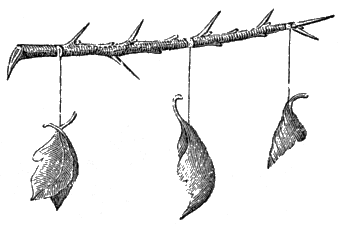
In a recently-published volume of ‘Travels in Mexico,’ we find a very remarkable account of some pendulous nests of caterpillars, which appear to be almost as curious as the nests of the pasteboard-making wasps, described at p. 177. The author of these Travels does not define the species of caterpillar whose constructions attracted his observation. He says, "After having ascended for about an hour, we came to the region of oaks and other majestically tall trees, the names of which I could not learn. Suspended from their stately branches were innumerable nests, enclosed, apparently, in white paper bags, in the manner of bunches of grapes in England, to preserve them from birds and flies. I had the curiosity to examine one of them, which I found to contain numberless caterpillars. The texture is so strong that it is not easily torn; and the interior contained a quantity of green leaves, to support the numerous progeny within."[EI]
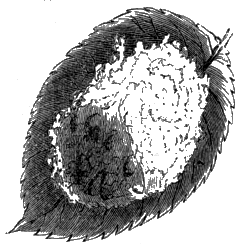
[We will now give a brief account of several foreign insects that are remarkable for the pendulous nests which they make.
The first of these is built by a hymenopterous insect belonging to the genus Larrada. It is fastened to the under side of a leaf, and is made of vegetable fibres, cut up very short, and masticated by the insect, much like the materials used by the Fungus Ant, described on page 311. The insect which forms this nest is black in colour and has very thick legs. The wings are clouded. It is but a small insect, being only three-eighths of an inch in length. Both nest and insect are in the collection of Mr. F. Smith, of the British Museum.
Nest of Larrada.
In the next illustration are seen two nests built by hymenopterous insects belonging to the hymenopterous genus Polybia. The left-hand figure represents a nest made by Polybia sedula, a Brazilian insect. It is fixed to a large leaf, and, as may be seen, has the entrance at the end of a long neck. The exterior of the nest is a very thin sheet of pale-brown substance, almost identical with the paper with which our British wasps make their nests. It is, however, very much stronger and very much thinner, and is very close in texture, so that it effectually excludes rain.
Nests of Polybia.
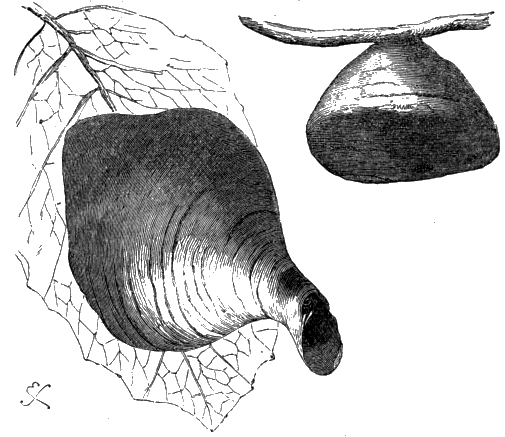
The right-hand figure shows a nest also brought from Brazil. It has no neck, the opening being a mere hole beneath. The name Polybia is derived from two Greek words signifying that many insects live together, and has been given to the genus on account of the social habits of its members.
Our next illustration contains some very remarkable nests.
The large central nest is the cocoon of a moth belonging to the genus Oiketicus, or Housebuilder. There are many species of Housebuilder moths, and all are remarkable for the fact that the larva never exhibits itself, but builds a dwelling in which it conceals itself, just as does the well-known caddis-worm. Indeed the nests of several Oiketici look exactly as if the dwelling of a caddis-worm had been greatly enlarged and hung up in a tree.
Nests of Oiketicus, &c.
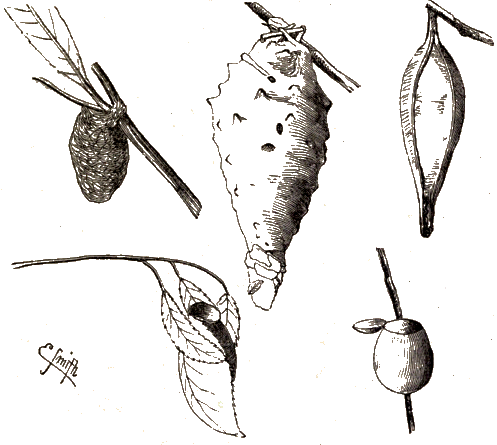
The nest of this species, however, differs from that of the common Oiketicus by being covered with a coating of greyish silk. If we cut open the silk, we find a great number of little sticks and leaf-stems crossed on each other, and showing their ends through the silken cover. Within these defences there is a layer of leaves cut into small pieces, and lastly comes the cell inhabited by the caterpillar. It is lined with a silken web similar in character to that on the outside, but finer, stronger, and whiter The caterpillar is therefore defended by four distinct barriers. First comes the strong silken web which lines the cell, and next is the layer of leaf fragments. Outside them comes the chevaux de frise of crossed sticks, and lastly we have the grey silken web. This outer wrapper has no connection with the interior of the cell, and is only lightly attached to the ends of the cross sticks.
Within this curious dwelling the caterpillar conceals the whole of its body, clinging to the branch or leaf by its feet, and if alarmed drawing itself up so that the mouth of the cocoon is pressed tightly against the branch, and effectually conceals even the feet which hold it.
The other figure on the right hand represents the dwelling of another Housebuilder caterpillar. It looks very much as if it were made of drab cloth. The most remarkable point about it is the lower end. When the insect is within the dwelling the extremity has a spiral twist, but when the moth has escaped the spiral form is destroyed, and it appears as represented in the illustration. The female Oiketicus never attains the winged state nor leaves her house, but lives and dies in it, almost unchanged in shape. In fact, the adult female is even more undeveloped in appearance than the caterpillar, and looks like a large, fat, unwieldy grub, covered with down. The male, on the contrary, is a tolerably active moth, with sharply-pointed wings and beautiful feathered antennæ.
Another kind of Housebuilder’s residence is shown in the lower left-hand figure, enveloped and almost concealed by leaves.
The remaining figures represent the dwellings of two unknown insects, both from Australia. The upper left-hand nest is made wonderfully like that of the weaver-bird, being composed of fibres like cow-hairs woven loosely together. It is brown outside and white in the interior.
The last nest is made of some substance which is smooth, and hard as horn, brown within, and dark grey on the outside. The circular lid by which the enclosed insect escapes is shown open.
In the accompanying illustration, we have five remarkable pensile nests of insects, some British, and others exotic.
Fig. 1 represents the nest of a Pelopæus from Natal. It is made of dried cow-dung, and is fixed to straws. The length is from three to five inches, and there are sometimes found three or more in a row upon a single straw. The insect is about an inch in length, black-blue in colour, and with clouded wings. The abdomen is small, sharply pointed, and placed on a long footstalk.
Nests of Pelopæus (1, 2); Anthidium (3); Trypoxylon (4); and Eumenes (5).
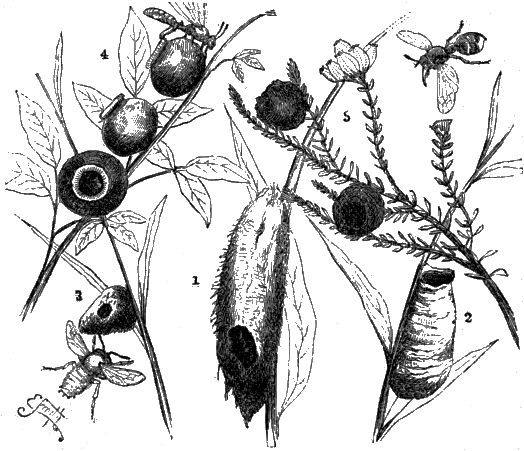
At Fig. 2 is seen the nest of Pelopæus Flavipes, a North American insect, which is also fixed along its whole length to the supporting object, which is sometimes a wall, and sometimes, as in the illustration, a branch. It is made of mud, and the insects seem to have a sort of gregarious instinct, loving to fix their nests in rows, one above the other. There is only one larva in each cell. The Pelopæi are, by the way, allied to the English genus Ammophila.
Fig. 3 shows the nest of Anthidium cordatum, one of the solitary bees of Natal. It is made of vegetable fibres. The insect as well as the nest is represented of the natural size. It is black and shining, with the under part and sides and legs yellowish.
At Fig. 4 are seen three of the nests of Trypoxylon aurifrons, a Brazilian insect. They are built of mud, and are remarkable for their elegant shape, which looks as if it had been formed by the hand of the potter, and for the manner in which the mouth is turned over so as to form a distinct neck. The larvæ is fed with a store of spiders. The insect is represented of the natural size; its colour is black, and the face is covered with short golden hairs, a fact which has gained for it the name of aurifrons, or golden-fronted.
Our last example, Fig. 5, is the nest of an English insect, Eumenes coarctata. The insect is represented of its natural size. It is very pretty in colour as well as elegant in shape, being black, diversified with yellow bands and spots. The nest is made of clay, and is found upon the heath twigs. The larvæ of the Eumenes are fed with those of a species of Crambus. The insect is tolerably common in Surrey and Hampshire, and appears in July and August.
The three figures in the next illustration represent the cocoons of three species of the Bombycidæ, and are given in order to show the different modes by which they are fastened. The upper nest is hung by a slight cord, which spreads into a broad silken band wrapped round the branch for some distance. The right-hand figure shows a very remarkable cocoon suspended by a long footstalk affixed to a ring. The remarkable point in the construction of this ring is that it is very hard and horny, and is not fastened to the branch, but passes loosely round it, so that the cocoon swings backwards and forwards in the breeze. The cocoon is about two inches in length, and is covered with thick black veinings. The lowermost cocoon is most curiously fixed to the branch by bending the leaves round the exterior of the dwelling, and fixing them to it with silk. All these specimens were brought from Northern India.]
Bombycidæ.
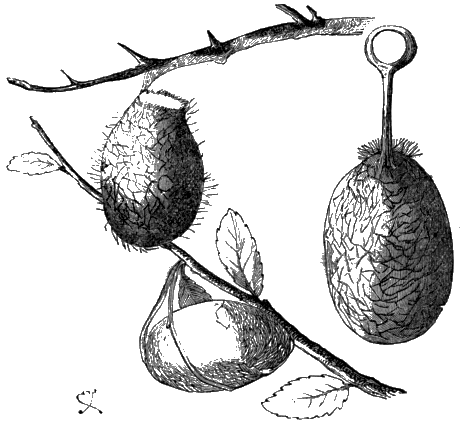
In all the nests of social caterpillars, care is taken to leave apertures for passing out and in. It is remarkable, also, that however far they may ramble from their nest, they never fail to find their way back when a shower of rain or nightfall renders shelter necessary. It requires no great shrewdness to discover how they effect this: for by looking closely at their track it will be found that it is carpeted with silk—no individual moving an inch without constructing such a pathway, both for the use of his companions and to facilitate his own return. All these social caterpillars, therefore, move more or less in processional order, each following the road which the first chance traveller has marked out with his strip of silk carpeting.
Nest and order of marching of the Processionary Caterpillars of the oak (Cnethocampa processionea).
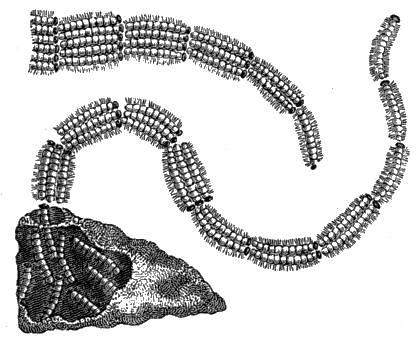
There are some species, however, which are more remarkable than others in the regularity of their processional marchings, particularly two which are found in the south of Europe, but are not indigenous in Britain. The one named by Réaumur the Processionary (Cnethocampa processionea, Stephens) feeds upon the oak; a brood dividing, when newly hatched, into one or more parties of several hundred individuals, which afterwards unite in constructing a common nest nearly two feet long, and from four to six inches in diameter. As it is not divided like that of the brown-tails into chambers, but consists of one large hall, it is not necessary that there should be more openings than one; and accordingly, when an individual goes out and carpets a path, the whole colony instinctively follow in the same track, though from the immense population they are often compelled to march in parallel files from two to six deep. The procession is always headed by a single caterpillar; sometimes the leader is immediately followed by one or two in single file, and sometimes by two abreast, as represented in the cut. A similar procedure is followed by a species of social caterpillars which feed on the pine in Savoy and Languedoc; and though their nests are not half the size of the preceding, they are more worthy of notice, from the strong and excellent quality of their silk, which Réaumur was of opinion might be advantageously manufactured. Their nest consists of more chambers than one, but is furnished with a main entrance, through which the colonists conduct their foraging processions.
[In the accompanying illustration is shown a nest of the Processionary caterpillar, part of which has been torn away to show the interior. Inside may be seen the larva of a certain beetle (Calosoma sycophanta), which feeds on these caterpillars, and one of the beetles is seen below in the act of ascending the tree. This beetle, although exceedingly scarce in England, is very common on the Continent, and trees have been cleared of Processionary caterpillars by the simple process of putting a few female beetles upon the branches.]
Nest of Processionary Caterpillars (Cnethocampa and Calosoma).
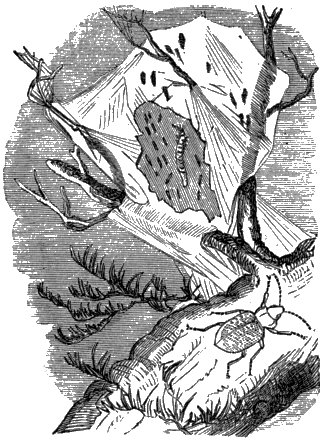
CHAPTER XVIII.
STRUCTURES OF SPIDERS.
Modern naturalists do not rank spiders among insects, because they have no antennæ, and no division between the head and the shoulders. They breathe by leaf-shaped gills, situated under the belly, instead of spiracles in the sides; have a heart connected with these; have eight legs instead of six; and eight fixed eyes. But as spiders are popularly considered insects, it will sufficiently suit our purpose to introduce them here as such.
The apparatus by which spiders construct their ingenious fabrics is much more complicated than that which we have described as common to the various species of caterpillars. Caterpillars have only two reservoirs for the materials of their silk; but spiders, according to the dissections of M. Treviranus, have four principal vessels, two larger and two smaller, with a number of minute ones at their base. Several small tubes branch towards the reservoirs, for carrying to them, no doubt, a supply of the secreted material. Swammerdam describes them as twisted into many coils of an agate colour.[EJ] We do not find them coiled, but nearly straight, and of a deep-yellow colour. From these, when broken, threads can be drawn out like those spun by the spider, though we cannot draw them so fine by many degrees.
From these little flasks or bags of gum, situated near the apex of the abdomen, and not at the mouth, as in caterpillars, a tube originates, and terminates in the external spinnerets, which may be seen by the naked eye in the larger spiders, in the form of five little teats surrounded by a circle, as represented in the following figure.
Garden Spider (Epeira diadema), suspended by a thread proceeding from its spinneret.
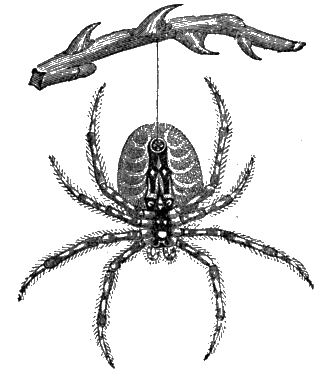
We have seen that the silken thread of a caterpillar is composed of two united within the tube of the spinneret, but the spider’s thread would appear, from the first view of its five spinnerets, to be quintuple, and in some species which have six teats, so many times more. It is not safe, however, in our interpretations of nature to proceed upon conjecture, however plausible, nor to take anything for granted which we have not actually seen; since our inferences in such cases are almost certain to be erroneous. If Aristotle, for example, had ever looked narrowly at a spider when spinning, he could not have fancied, as he does, that the materials which it uses are nothing but wool stripped from its body. On looking, then, with a strong magnifying glass, at the teat-shaped spinnerets of a spider, we perceive them studded with regular rows of minute bristle-like points, about a thousand to each teat, making in all from five to six thousand. These are minute tubes which we may appropriately term spinnerules, as each is connected with the internal reservoirs, and emits a thread of inconceivable fineness. In the following figure, this wonderful apparatus is represented as it appears in the microscope.
Spinnerets of a Spider magnified to show the Spinnerules.
We do not recollect that naturalists have ventured to assign any cause for this very remarkable multiplicity of the spinnerules of spiders, so different from the simple spinneret of caterpillars. To us it appears to be an admirable provision for their mode of life. Caterpillars neither require such strong materials, nor that their thread should dry as quickly. It is well known in our manufactures, particularly in rope-spinning, that in cords of equal thickness, those which are composed of many smaller ones united are greatly stronger than those which are spun at once. In the instance of the spider’s thread, this principle must hold still more strikingly, inasmuch as it is composed of fluid materials that require to be dried rapidly, and this drying must be greatly facilitated by exposing so many to the air separately before their union, which is effected at the distance of about a tenth of an inch from the spinnerets. In the following figure each of the threads represented is reckoned to contain one hundred minute threads, the whole forming only one of the spider’s common threads.
Leeuwenhoeck, in one of his extraordinary microscopical observations on a young spider not bigger than a grain of sand, upon enumerating the threadlets in one of its threads, calculated that it would require four millions of them to be as thick as a hair of his beard.
A single thread of a Spider, greatly magnified, so that, for the small space represented, the lines are shown as parallel. Attached end of a Spider’s thread magnified.
Another important advantage derived by the spider from the multiplicity of its threadlets is, that the thread affords a much more secure attachment to a wall, a branch of a tree, or any other object, than if it were simple; for, upon pressing the spinneret against the object, as spiders always do when they fix a thread, the spinnerules are extended over an area of some diameter, from every hair’s-breadth of which a strand, as rope-makers term it, is extended to compound the main cord. The preceding figure exhibits this ingenious contrivance.
Those who may be curious to examine this contrivance will see it best when the line is attached to any black object, for the threads, being whitish, are, in other cases, not so easily perceived.
Shooting of the Lines.
It has long been considered a curious though a difficult investigation, to determine in what manner spiders, seeing that they are destitute of wings, transport themselves from tree to tree, across brooks, and frequently through the air itself, without any apparent starting point. On looking into the authors who have treated upon this subject, it is surprising how little there is to be met with that is new, even in the most recent. Their conclusions, or rather their conjectural opinions, are, however, worthy of notice; for by unlearning error, we the more firmly establish truth.
1. One of the earliest notions upon this subject is that of Blancanus, the commentator on Aristotle, which is partly adopted by Redi, by Henricus Regius of Utrecht, by Swammerdam, [EK] by Lehmann, and by Kirby and Spence.[EL] “The spider’s thread,” says Swammerdam, “is generally made up of two or more parts, and after descending by such a thread, it ascends by one only, and is thus enabled to waft itself from one height or tree to another, even across running waters; the thread it leaves loose behind it being driven about by the wind, and so fixed to some other body.” “I placed,” says Kirby, "the large garden spider (Epeira diadema) upon a stick about a foot long, set upright in a vessel containing water.… It let itself drop, not by a single thread, but by two, each distant from the other about the twelfth of an inch, guided, as usual, by one of its hind feet, and one apparently smaller than the other. When it had suffered itself to descend nearly to the surface of the water, it stopped short, and by some means, which I could not distinctly see, broke off, close to the spinners, the smallest thread, which still adhering by the other end to the top of the stick, floated in the air, and was so light as to be carried about by the slightest breath. On approaching a pencil to the loose end of this line, it did not adhere from mere contact. I therefore twisted it once or twice round the pencil, and then drew it tight. The spider, which had previously climbed to the top of the stick, immediately pulled at it with one of its feet, and finding it sufficiently tense, crept along it, strengthening it as it proceeded by another thread, and thus reached the pencil."
We have repeatedly witnessed this occurrence, both in the fields and when spiders were placed for experiment, as Kirby has described; but we very much doubt that the thread broken is ever intended as a bridge cable, or that it would have been so used in that instance, had it not been artificially fixed and accidentally found again by the spider. According to our observations, a spider never abandons, for an instant, the thread which she despatches in quest of an attachment, but uniformly keeps trying it with her feet, in order to ascertain its success. We are, therefore, persuaded that when a thread is broken in the manner above described, it is because it has been spun too weak; and spiders may often be seen breaking such threads in the process of netting their webs. (J. R.)
The plan, besides, as explained by these distinguished writers, would more frequently prove abortive than successful, from the cut thread not being sufficiently long. They admit, indeed, that spiders’ lines are often found “a yard or two long, fastened to twigs of grass not a foot in height.… Here, therefore, some other process must have been used.”[EM]
2. Our celebrated English naturalist, Dr. Lister, whose treatise upon our native spiders has been the basis of every subsequent work on the subject, maintains that "some spiders shoot out their threads in the same manner that porcupines do their quills;[EN] that whereas the quills of the latter are entirely separated from their bodies, when thus shot out, the threads of the former remain fixed to their anus, as the sun’s rays to its body."[EO] A French periodical writer goes a little farther, and says, that spiders have the power of shooting out threads, and directing them at pleasure towards a determined point, judging of the distance and position of the object by some sense of which we are ignorant.[EP] Kirby also says, that he once observed a small garden spider (Aranea reticulata) “standing midway on a long perpendicular fixed thread, and an appearance caught” his “eye, of what seemed to be the emission of threads.” “I, therefore,” he adds, “moved my arm in the direction in which they apparently proceeded, and, as I had suspected, a floating thread attached itself to my coat, along which the spider crept. As this was connected with the spinners of the spider, it could not have been formed” by breaking a “secondary thread.”[EQ] Again, in speaking of the gossamer-spider, he says, “it first extends its thigh, shank, and foot, into a right line, and then, elevating its abdomen till it becomes vertical, shoots its thread into the air, and flies off from its station.”[ER]