Front matter (continued 4)
Reading edition
"Bees, in preparing the cells of males, previously establish a block or lump of wax on the edge of their comb, thicker than is usually employed for those of workers. It is also made higher, otherwise the same order and symmetry could not be preserved on a larger scale.
"Several naturalists notice the irregularities in the cells of bees as so many defects. What would have been their astonishment had they observed that part of them are the result of calculation? Had they followed the imperfection of their organs, some other means of compensating them would have been granted to the insects. It is much more surprising that they know how to quit the ordinary route, when circumstances demand the construction of enlarged cells; and, after building thirty or forty rows of them, to return to the proper proportions from which they have departed by successive reductions. Bees also augment the dimensions of their cells when there is an opportunity for a great collection of honey. Not only are they then constructed of a diameter much exceeding that of the common cells, but they are elongated throughout the whole space admitting it. A great portion of irregular comb contains cells an inch, or even an inch and a half, in depth.
"Bees, on the contrary, sometimes are induced to shorten their cells. When wishing to prolong an old comb, whose cells have received their full dimensions, they gradually reduce the thickness of its edges, by gnawing down the sides of the cells, until they restore it to its original lenticular form. They add a waxen block around the whole circumference, and on the edge of the comb construct pyramidal bottoms, such as those fabricated on ordinary occasions. It is a certain fact, that a comb never is extended in any direction unless the bees have thinned the edges, which are diminished throughout a sufficient space to remove any angular projection.
"The law which obliges these insects partly to demolish the cells on the edges of the comb before enlarging it, unquestionably demands more profound investigation. How can we account for instinct leading them to undo what they have executed with the utmost care? The wonted regular gradation which may be necessary for new cells, subsists among those adjoining the edges of a comb recently constructed. But afterwards, when those on the edge are deepened like the cells of the rest of the surface, the bees no longer preserve the decreasing gradation which is seen in the new combs."[AW]
The Finishing of the Cells.
While the cells are building they appear to be of a dull white colour, soft, even, though not smooth, and translucent; but in a few days they become tinged with yellow, particularly on the interior surface; and their edges, from being thin, uniform, and yielding, become thicker, less regular, more heavy, and so firm that they will bend rather than break. New combs break on the slightest touch. There is also a glutinous substance observable around the orifices of the yellow cells, of reddish colour, unctuous, and odoriferous. Threads of the same substance are applied all around the interior of the cells, and at the summit of their angles, as if it were for the purpose of binding and strengthening the walls. These yellow cells also require a much higher temperature of water to melt them than the white ones.
It appeared evident, therefore, that another substance, different from wax, had been employed in varnishing the orifices, and strengthening the interior of the cells. M. Huber, by numerous experiments, ascertained the resinous threads lining the cells, as well as the resinous substance around their orifice, to be propolis; for he traced them, as we mentioned in our account of propolis, from the poplar buds where they collected it, and saw them apply it to the cells; but the yellow colour is not imparted by propolis, to which it bears no analogy. We are, indeed, by no means certain what it is, though it was proved by experiment not to arise from the heat of the hives, nor from emanations of honey, nor from particles of pollen. Perhaps it may be ascribed to the bees rubbing their teeth, feet, and other parts of their body, on the surfaces where they seem to rest; or to their tongue (haustellum) sweeping from right to left like a fine pliant pencil, when it appears to leave some sprinkling of a transparent liquid.
Besides painting and varnishing their cells in this manner, they take care to strengthen the weaker part of their edifice by means of a mortar composed of propolis and wax, and named pissoceros[AX] by the ancients who first observed it, though Réaumur was somewhat doubtful respecting the existence of such a composition. We are indebted to the shrewd observations of Huber for a reconcilement of the Roman and the French naturalists. The details which he has given of his discovery are perhaps the most interesting in his delightful book.
“Soon,” he says, "after some new combs had been finished in a hive, manifest disorder and agitation prevailed among the bees. They seemed to attack their own works. The primitive cells, whose structure we had admired, were scarcely recognizable. Thick and massive walls, heavy, shapeless pillars, were substituted for the slight partitions previously built with such regularity. The substance had changed along with the form, being composed apparently of wax and propolis. From the perseverance of the workers in their devastation, we suspected that they proposed some useful alteration of their edifices; and our attention was directed to the cells least injured. Several were yet untouched; but the bees soon rushed precipitately on them, destroyed the tubes, broke down the wax, and threw all the fragments about. But we remarked that the bottom of the cells of the first row were spared; neither were the corresponding parts on both faces of the comb demolished at the same time. The bees laboured at them alternately, leaving some of the natural supports, otherwise the comb would have fallen down, which was not their object: they wished, on the contrary, to provide it a more solid base, and to secure its union to the vault of the hive, with a substance whose adhesive properties infinitely surpassed those of wax. The propolis employed on this occasion had been deposited in a mass over a cleft of the hive, and had hardened in drying, which probably rendered it more suitable for the purpose. But the bees experienced some difficulty in making any impression on it; and we thought, as also had appeared to M. de Réaumur, that they softened it with the same frothy matter from the tongue which they use to render wax more ductile.
"We very distinctly observed the bees mixing fragments of old wax with the propolis, kneading the two substances together to incorporate them; and the compound was employed in rebuilding the cells that had been destroyed. But they did not now follow their ordinary rules of architecture, for they were occupied by the solidity of their edifices alone. Night intervening, suspended our observations, but next morning confirmed what we had seen.
“We find, therefore, that there is an epoch in the labour of bees, when the upper foundation of their combs is constructed simply of wax, as Réaumur believed; and that, after all the requisite conditions have been attained, it is converted to a mixture of wax and propolis, as remarked by Pliny so many ages before us. Thus is the apparent contradiction between these two great naturalists explained. But this is not the utmost extent of the foresight of these insects. When they have plenty of wax, they make their combs the full breadth of the hive, and solder them to the glass or wooden sides, by structures more or less approaching the form of cells, as circumstances admit. But should the supply of wax fail before they have been able to give sufficient diameter to the combs whose edges are rounded, large intervals remain between them and the upright sides of the hive, and they are fixed only at the top. Therefore, did not the bees provide against it, by constructing great pieces of wax mixed with propolis, in the intervals, they might be borne down by the weight of the honey. These pieces are of irregular shape, strangely hollowed out, and their cavities void of symmetry.”[AY]
It is remarked by the lively Abbé la Pluche, that the foundations of our houses sink with the earth on which they are built, the walls begin to stoop by degrees, they nod with age, and bend from their perpendicular;—lodgers damage everything, and time is continually introducing some new decay. The mansions of the bees, on the contrary, grow stronger the oftener they change inhabitants. Every bee-grub, before its metamorphosis into a nymph, fastens its skin to the partitions of its cell, but in such a manner as to make it correspond with the lines of the angle, and without in the least disturbing the regularity of the figure. During summer, accordingly, the same lodging may serve for three or four grubs in succession; and in the ensuing season it may accommodate an equal number. Each grub never fails to fortify the panels of its chamber by arraying them with its spoils, and the contiguous cells receive a similar augmentation from its brethren.[AZ] Réaumur found as many as seven or eight of these skins spread over one another: so that all the cells being incrusted with six or seven coverings, well dried and cemented with propolis, the whole fabric daily acquires a new degree of solidity.
It is obvious, however, that by a repetition of this process the cell might be rendered too contracted; but in such a case the bees know well how to proceed, by turning the cells to other uses, such as magazines for bee-bread and honey. It has been remarked, however, that in the hive of a new swarm, during the months of July and August, there are fewer small bees or nurse-bees than in one that has been tenanted four or five years. The workers, indeed, clean out the cell the moment that a young bee leaves its cocoon, but they never detach the silky film which it has previously spun on the walls of its cell. But though honey is deposited after the young leave the cells, the reverse also happens; and accordingly, when bees are bred in contracted cells, they are by necessity smaller, and constitute, in fact, the important class of nurse-bees.
We are not disposed, however, to go quite so far as an American periodical writer, who says, "Thus we see that the contraction of the cell may diminish the size of a bee, even to the extinction of life, just as the contraction of a Chinese shoe reduces the foot even to uselessness."[BA] We know, on the contrary, that the queen-bee will not deposit eggs in a cell either too small or too large for the proper rearing of the young. In the case of large cells, M. Huber took advantage of a queen that was busy depositing the eggs of workers to remove all the common cells adapted for their reception, and left only the larger cells appropriated for males. As this was done in June, when bees are most active, he expected that they would have immediately repaired the breaches he had made; but to his great surprise they did not make the slightest movement for that purpose. In the meanwhile the queen, being oppressed by her eggs, was obliged to drop them about at random, preferring this to depositing them in the male cells, which she knew to be too large. At length she did deposit six eggs in the large cells, which were hatched as usual three days after. The nurse-bees, however, seemed to be aware that they could not be reared there, and though they supplied them with food, did not attend to them regularly. M. Huber found that they had been all removed from the cells during the night, and the business both of laying and nursing was at a complete stand for twelve days, when he supplied them again with a comb of small cells, which the queen almost immediately filled with eggs, and in some cells she laid five or six.
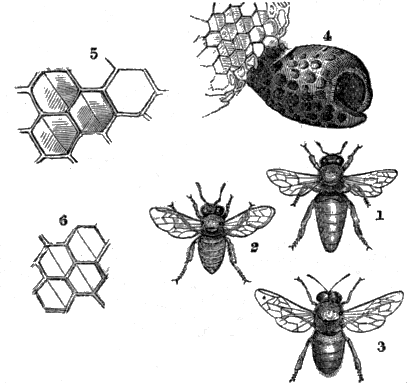
[The accompanying illustration exhibits these three kinds of bees, namely, the Queen, the Drone, and the Worker, together with the cells which they respectively inhabit. Fig. 1 shows the queen-bee as she appears when in command of a hive. When she first issues from the royal cell, she is much smaller in the body, and an inexperienced observer might have some difficulty in distinguishing her from an ordinary worker. But any one who has been accustomed to bees can pick her out as soon as his eyes rest upon her. Her body is rather larger and narrower than those of the workers, and the wings are shorter in proportion, slightly crossing at the tips when she is at rest. Fig. 2 represents the common worker-bee, which, as has already been mentioned, is simply an undeveloped female. Fig. 3 is the male or drone-bee, which is easily distinguishable, even by a novice. He is larger, stouter, and heavier built than the female; his eyes are so enormous that they seem to occupy nearly the entire head, and he has some well-defined tufts of hair on the end of the abdomen. He can even be detected by the ear, as he flies, the deep droning hum being quite unlike the fussy, business-like sound produced by the worker. Fig. 4 represents one of the royal cells, a little reduced in size. In making this cell, the bees lose sight of their habitual economy of wax, and use enough material for fifty ordinary cells. It is probable that the great size of the cell enables the inclosed insect to expand, and so to be capable of becoming the mother as well as the ruler of her subjects. The royal cell is always placed at the edge of a comb, so as not to interfere with the other cells, which contain honey, bee-bread, and grubs; and in each hive there are generally several of these cells in different stages of structure. Figs. 5 and 6 represent the proportionate sizes of the cells which contain the drone and worker bees.]
* * * * *
The architecture of the hive, which we have thus detailed, is that of bees receiving the aid of human care, and having external coverings of a convenient form, prepared for their reception. In this country bees are not found in a wild state; though it is not uncommon for swarms to stray from their proprietors. But these stray swarms do not spread colonies through our woods, as they are said to do in America. In the remoter parts of that continent there are no wild bees. They precede civilization; and thus when the Indians observe a swarm they say, “The white man is coming.” There is evidence of bees having abounded in these islands, in the earlier periods of our history; and Ireland is particularly mentioned by the Venerable Bede as being “rich in milk and honey.”[BB] The hive-bee has formed an object of economical culture in Europe at least for two thousand years; and Varro describes the sort of hives used in his time, 1870 years ago. We are not aware, however, that it is now to be found wild in the milder clime of Southern Europe, any more than it is in our own island.
The wild bees of Palestine principally hived in rocks. “He made him,” says Moses, “to suck honey out of the rock.”[BC] “With honey out of the rock,” says the Psalmist, “should I have satisfied thee.”[BD] In the caves of Salsette and Elephanta, at the present day, they hive in the clefts of the rocks, and the recesses among the fissures, in such numbers as to become very troublesome to visitors. Their nests hang in innumerable clusters.[BE]
We are told of a little black stingless bee found in the island of Guadaloupe, which hives in hollow trees or in the cavities of rocks by the sea-side, and lays "up honey in cells about the size and shape of pigeons’ eggs. These cells are of a black or deep-violet colour, and so joined together as to leave no space between them. They hang in clusters almost like a bunch of grapes."[BF] The following are mentioned by Lindley as indigenous to Brazil. “On an excursion towards Upper Tapagippe,” says he, “and skirting the dreary woods which extend to the interior, I observed the trees more loaded with bees’ nests than even in the neighbourhood of Porto Seguro. They consist of a ponderous shell of clay, cemented similarly to martins’ nests, swelling from high trees about a foot thick, and forming an oval mass full two feet in diameter. When broken, the wax is arranged as in our hives, and the honey abundant.”[BG]
Captain Basil Hall found in South America the hive of a honey-bee very different from the Brazilian, but nearly allied to, if not the same as, that of Guadaloupe. “The hive we saw opened,” he says, “was only partly filled, which enabled us to see the economy of the interior to more advantage. The honey is not contained in the elegant hexagonal cells of our hives, but in wax bags, not quite so large as an egg. These bags or bladders are hung round the sides of the hive, and appear about half full; the quantity being probably just as great as the strength of the wax will bear without tearing. Those near the bottom, being better supported, are more filled than the upper ones. In the centre of the lower part of the hive we observed an irregularly-shaped mass of comb, furnished with cells like those of our bees, all containing young ones in such an advanced state, that, when we broke the comb, and let them out, they flew merrily away.”
Clavigero, in his ‘History of Mexico,’ evidently describing the same species of bee, says it abounds in Yucatan, and makes the honey of Estabentum, the finest in the world, and which is taken every two months. He mentioned another species of bee, smaller in size, and also without a sting, which forms its nest of the shape of a sugar-loaf, and as large or larger. These are suspended from trees, particularly from the oak, and are much more populous than our common hives.
Wild honey-bees of some species appear also to abound in Africa. Mr. Park, in his second volume of travels, tells us that some of his associates imprudently attempted to rob a numerous hive of its honey, when the exasperated bees, rushing out to defend their property, attacked their assailants with great fury, and quickly compelled the whole company to fly.
At the Cape of Good Hope the bees themselves must be less formidable, or more easily managed, as their hives are sought for with avidity. Nature has there provided man with a singular and very efficient assistant in a bird, most appropriately named the honey-guide (Indicator major, Veillot; Cuculus indicator, Latham). The honey-guide, it is said, so far from being alarmed at the presence of man, appears anxious to court his acquaintance, and flits from tree to tree with an expressive note of invitation, the meaning of which is both well known to the colonists and the Hottentots. A person thus invited by the honey-guide seldom refuses to follow it onward till it stops, as it is certain to do, at some hollow tree containing a bee-hive, usually well stored with honey and wax. It may be that the bird finds itself inadequate to the attack of a legion of bees, or to penetrate into the interior of the hive, and is thence led to invite an agent more powerful than itself. The person invited, indeed, always leaves the bird a share of the spoil, as it would be considered sacrilege to rob it of its due, or in any way to injure so sacred a bird.
Useful, however, as is the honey-guide, it must always be carefully watched, and the traveller must not follow it without keeping his eyes well open. For although, as a general fact, the bird will lead its followers to honey, it has a strange habit of leading them to the spot where lies hidden some dangerous animal. Sometimes it brings them to a rhinoceros, wallowing in a mud pool. Sometimes it directs them to a solitary buffalo, one of the most dangerous animals that Southern Africa produces, and one which the natives fear but little less than the lion itself. And more than once the too-confiding traveller has followed the honey-guide, and been led to a spot where was lying one of the venomous serpents.
The Americans, who have not the African honey-guide, employ several well-known methods to track bees to their hives. One of the most common though ingenious modes is to place a piece of bee-bread on a flat surface, a tile for instance, surrounding it with a circle of wet white paint. The bee, whose habit it is always to alight on the edge of any plane, has to travel through the paint to reach the bee-bread. When, therefore, she flies off, the observer can track her by the white on her body. The same operation is repeated at another place, at some distance from the first, and at right angles to the bee-line just ascertained. The position of the hive is easily determined, for it lies in the angle made by the intersection of the bee-lines. Another method is described in the ‘Philosophical Transactions for 1721.’ The bee-hunter decoys, by a bait of honey, some of the bees into his trap, and when he has secured as many as he judges will suit his purpose, he encloses one in a tube, and, letting it fly, marks its course by a pocket-compass. Departing to some distance, he liberates another, observes its course, and in this manner determines the position of the hive, upon the principle already detailed. These methods of bee-hunting depend upon the insect’s habit of always flying in a right line to its home. Those who have read Cooper’s tale of the ‘Prairie’ must well remember the character of the bee-hunter, and the expression of “lining a bee to its hive.”
In reading these and similar accounts of the bees of distant parts of the world, we must not conclude that the descriptions refer to the same species as the common honey-bee. There are numerous species of social bees, which, while they differ in many circumstances, agree in the practice of storing up honey, in the same way as we have numerous species of the mason-bee and of the humble-bee.
CHAPTER VII.
CARPENTRY OF TREE-HOPPERS AND SAW-FLIES.
The operations of an insect in boring into a leaf or a bud to form a lodgment for its eggs appear very simple. The tools, however, by which these effects are performed are very complicated and curious. In the case of gall-flies (Cynips), the operation itself is not so remarkable as its subsequent chemical effects. These effects are so different from any others that may be classed under the head of Insect Architecture, that we shall reserve them for the latter part of this volume, although, with reference to the use of galls, the protection of eggs and larvæ, they ought to find a place here. We shall, however, at present confine ourselves to those which simply excavate a nest, without producing a tumour.
The first of these insects which we shall mention is celebrated for its song, by the ancient Greek poets, under the name of Tettix. The Romans called it Cicada, which we sometimes, but erroneously, translate “grasshopper;” for the grasshoppers belong to an entirely different order of insects. We shall, therefore, take the liberty of calling the Cicadæ Tree-hoppers, to which the cuckoo-spit insect (Tettigonia spumaria, Oliv.) is allied; but there is only one of the true Cicadæ hitherto ascertained to be British, namely, the Cicada hæmatodes (Linn.), which was discovered in the New Forest, Hampshire, by Mr. Daniel Bydder.
M. Réaumur was exceedingly anxious to study the economy of these insects; but they not being indigenous in the neighbourhood of Paris, he commissioned his friends to send him some from more southern latitudes, and he procured in this way specimens not only from the South of France and from Italy, but also from Egypt. From these specimens he has given the best account of them yet published; for though, as he tells us, he had never had the pleasure of seeing one of them alive, the most interesting parts of their structure can be studied as well in dead as in living specimens. We ourselves possess several specimens from New Holland, upon which we have verified some of the more interesting observations of Réaumur.
Virgil tells us that in his time “the cicadæ burst the very shrubs with their querulous music;”[BH] but we may well suppose that he was altogether unacquainted with the singular instrument by means of which they can, not poetically, but actually, cut grooves in the branches they select for depositing their eggs. It is the male, as in the case of birds, which fills the woods with his song; while the female, though mute, is no less interesting to the naturalist on account of her curious ovipositor. This instrument, like all those with which insects are furnished by nature for cutting, notching, or piercing, is composed of a horny substance, and is also considerably larger than the size of the tree-hopper would proportionally indicate. It can on this account be partially examined without a microscope, being, in some of the larger species, no less than five lines[BI] in length.
The ovipositor, or auger (tarière), as Réaumur calls it, is lodged in a sheath which lies in a groove of the terminating ring of the belly. It requires only a very slight pressure to cause the instrument to protrude from its sheath, when it appears to the naked eye to be of equal thickness throughout, except at the point, where it is somewhat enlarged and angular, and on both sides finely indented with teeth. A more minute examination of the sheath demonstrates that it is composed of two horny pieces slightly curved, and ending in the form of an elongated spoon, the concave part of which is adapted to receive the convex end of the ovipositor.
When the protruded instrument is further examined with a microscope, the denticulations, nine in number on each side, appear strong, and arranged with great symmetry, increasing in fineness towards the point, where there are three or four very small ones, beside the nine that are more obvious. The magnifier also shows that the instrument itself, which appeared simple to the naked eye, is, in fact, composed of three different pieces; two exterior armed with the teeth before mentioned, denominated by Réaumur files (limes), and another pointed like a lancet, and not denticulated. The denticulated pieces, moreover, are capable of being moved forwards and backwards, while the centre one remains stationary; and as this motion is effected by pressing a pin or the blade of a knife over the muscles on either side at the origin of the ovipositor, it may be presumed that those muscles are destined for producing similar movements when the insect requires them. By means of a finely-pointed pin carefully introduced between the pieces, and pushed very gently downwards, they may be, with no great difficulty, separated in their whole extent.
The contrivance by which those three pieces are held united, while at the same time the two files can be easily put in motion, is similar to those of our own mechanical inventions, with this difference, that no human workman could construct an instrument of this description so small, fine, exquisitely polished, and fitting so exactly. We should have been apt to form the grooves in the central piece, whereas they are scooped out in the handles of the files, and play upon two projecting ridges in the central piece, by which means this is rendered stronger. M. Réaumur discovered that the best manner of showing the play of this extraordinary instrument is to cut it off with a pair of scissors near its origin, and then, taking it between the thumb and the finger at the point of section, work it gently to put the files in motion.
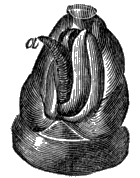
Beside the muscles necessary for the movement of the files, the handle of each is terminated by a curve of the same hard horny substance as itself, which not only furnishes the muscles with a sort of lever, but serves to press, as with a spring, the two files close to the central piece, as is shown in the lower figure.
M. Pontedera, who studied the economy of the tree-hoppers with some care, was anxious to see the insect itself make use of the ovipositor in forming grooves in wood, but found that it was so shy and easily alarmed, that it took to flight whenever he approached; a circumstance of which Réaumur takes advantage, to soothe his regret that the insects were not indigenous in his neighbourhood. But of their workmanship, when completed, he had several specimens sent to him from Provence and Languedoc by the Marquis de Caumont.
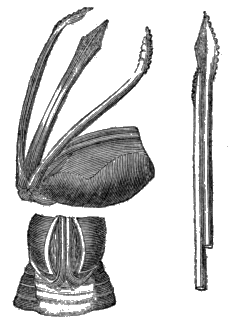
Ovipositors, with files, of Tree-hopper, magnified.
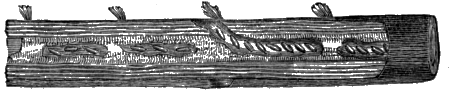
Excavations for eggs of Tree-hopper, with the chip-lids raised.
The gall-flies, when about to deposit their eggs, select growing plants and trees; but the tree-hoppers, on the contrary, make choice of dead, dried branches, for the mother seems to be aware that moisture would injure her progeny. The branch, commonly a small one, in which eggs have been deposited, may be recognised by being covered with little oblong elevations caused by small splinters of the wood, detached at one end, but left fixed at the other, by the insect. These elevations are for the most part in a line, rarely in a double line, nearly at equal distances from each other, and form a lid to a cavity in the wood about four lines in length, containing from four to ten eggs. It is to be remarked that the insect always selects a branch of such dimensions that it can get at the pith, not because the pith is more easily bored, for it does not penetrate into it all, but to form a warm and safe bed for the eggs. M. Pontedera says, that when the eggs have been deposited, the insect closes the mouth of the hole with a gum capable of protecting them from the weather; but M. Réaumur thinks this only a fancy, as, out of a great number which he examined, he could discover nothing of the kind. Neither is such a protection wanted; for the woody splinters above mentioned furnish a very good covering.
The grubs hatch from these eggs (of which, M. Pontedera says, one female will deposit from five to seven hundred), issue from the same holes through which the eggs have been introduced, and betake themselves to the ground to feed on the roots of plants. They are not transformed into chrysalides, but into active nymphs, remarkable for their fore limbs, which are thick, strong, and furnished with prongs for digging; and when we are told, by Dr. Le Ferve, that they make their way easily into hard stiff clay, to the depth of two or three feet, we perceive how necessary to them such a conformation must be.
Saw-flies.
An instrument for cutting grooves in wood, still more ingeniously contrived than that of the tree-hopper, was first observed by Vallisnieri, an eminent Italian naturalist, in a four-winged fly, most appropriately denominated by M. Réaumur the saw-fly (Tenthredo) of which many sorts are indigenous to Great Britain. The grubs from which these flies originate are indeed but too well known, as they frequently strip our rose, gooseberry, raspberry, and red currant trees of their leaves, and are no less destructive to birch, alder, and willows; while turnips and wheat suffer still more seriously by their ravages. These grubs may readily be distinguished from the caterpillars of moths and butterflies by having from sixteen to twenty-eight feet, by which they usually hang to the leaf they feed on, while they coil up the hinder part of their body in a spiral ring. The perfect flies are distinguished by four transparent wings; and some of the most common have a flat body of a yellow or orange colour, while the head and shoulders are black.
In order to see the ovipositor, to which we shall for the present turn our chief attention, a female saw-fly must be taken, and her belly gently pressed, when a narrow slit will be observed to open at some distance from the apex, and a short, pointed, and somewhat curved body, of a brown colour and horny substance, will be protruded. The curved plates which form the sides of the slit are the termination of the sheath, in which the instrument lies concealed till it is wanted by the insect. The appearance of this instrument, however, and its singular structure, cannot be well understood without the aid of a microscope.
a, Ovipositor of Saw-fly, protruded from its sheath, magnified.
The instrument thus brought into view is a very finely-contrived saw, made of a horny substance, and adapted for penetrating branches and other parts of plants where the eggs are to be deposited. The ovipositor-saw of the insect is much more complicated than any of those employed by our carpenters. The teeth of our saws are formed in a line, but in such a manner as to cut in two lines parallel to, and at a small distance from, each other. This is effected by slightly bending the points of the alternate teeth right and left, so that one-half of the whole teeth stand a little to the right, and the other half a little to the left. The distance of the two parallel lines thus formed is called the course of the saw, and it is only the portion of wood which lies in the course that is cut into sawdust by the action of the instrument. It will follow that in proportion to the thinness of a saw there will be the less destruction of wood which may be sawed. When cabinet-makers have to divide valuable wood into very thin leaves, they accordingly employ saws with a narrow course, while sawyers who cut planks use one with a broad course. The ovipositor-saw being extremely fine, does not require the teeth to diverge much; but from the manner in which they operate, it is requisite that they should not stand, like those of our saws, in a straight line. The greater portion of the edge of the instrument, on the contrary, is towards the point somewhat concave, similar to a scythe, while towards the base it becomes a little convex, the whole edge being nearly the shape of an Italic f.
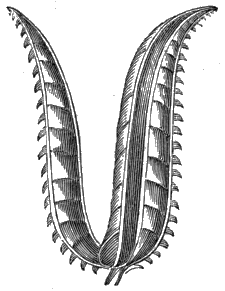
Ovipositor-saw of Saw-fly, with rasps shown in the cross lines.
The ovipositor-saw of the fly is put in motion in the same way as a carpenter’s hand-saw, supposing the tendons attached to its base to form the handle, and the muscles which put it in motion to be the hand of the carpenter. But the carpenter can only work one saw at a time, whereas each of these flies is furnished with two, equal and similar, which it works at the same time—one being advanced and the other retracted alternately. The secret, indeed, of working more saws than one at once is not unknown to our mechanics; for two or three are sometimes fixed in the same frame. These, however, not only all move upwards and downwards simultaneously, but cut the wood in different places; while the two saws of the ovipositor work in the same cut, and consequently, though the teeth are extremely fine, the effect is similar to a saw with a wide set.
It is important, seeing that the ovipositor-saws are so fine, that they be not bent or separated while in operation—and this, also, nature has provided for, by lodging the backs of the saws in a groove, formed by two membranous plates, similar to the structure of a clasp-knife. These plates are thickest at the base, becoming gradually thinner as they approach the point, which the form of the saws requires. According to Vallisnieri, it is not the only use of this apparatus to form a back for the saws, he having discovered, between the component membranes, two canals, which he supposes are employed to conduct the eggs of the insect into the grooves which it has hollowed out for them.
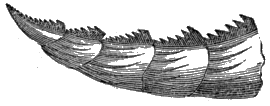
Portion of a Saw-Fly’s comb-toothed rasp, and saw.
The teeth of a carpenter’s saw, it may be remarked, are simple, whereas the teeth of the ovipositor-saw are themselves denticulated with fine teeth. The latter, also, combines at the same time the properties of a saw and of a rasp or file. So far as we are aware, these two properties have, never been combined in any of the tools of our carpenters. The rasping part of the ovipositor, however, is not constructed like our rasps, with short teeth thickly studded together, but has teeth almost as long as those of the saw, and placed contiguous to them, on the back of the instrument, resembling in their form and setting the teeth of a comb, as may be seen in the figure. Of course, such observations are conducted with the aid of a microscope.
When a female saw-fly has selected the branch of a rose-tree, or any other, in which to deposit her eggs, she may be seen bending the end of her belly inwards, in form of a crescent, and protruding her saw, at the same time, to penetrate the bark or wood. She maintains this recurved position so long as she works in deepening the groove; but when she has attained the depth required, she unbends her body into a straight line, and in this position works upon the place lengthways, by applying the saw more horizontally. When she has rendered the groove as large as she wishes, the motion of the tendons ceases, and an egg is placed in the cavity. The saw is then withdrawn into the sheath for about two-thirds of its length, and at the same moment a sort of frothy liquid, similar to a lather made with soap, is dropped over the egg, either for the purpose of gluing it in its place or sheathing it from the action of the juices of the tree. She proceeds in the same manner in sawing out a second groove, and so on in succession, till she has deposited all her eggs, sometimes to the number of twenty-four. The grooves are usually placed in a line, at a small distance from one another, on the same branch; but sometimes the mother-fly shifts to another, or to a different part of the branch, when she is either scared or finds it unsuitable. She commonly, also, takes more than one day to the work, notwithstanding the superiority of her tools. Réaumur has seen a saw-fly make six grooves in succession, which occupied her about ten hours and a half.
The grooves, when finished, have externally little elevation above the level of the bark, appearing like the puncture of a lancet in the human skin; but in the course of a day or two the part becomes first brown and then black, while it also becomes more and more elevated. This increased elevation is not owing to the growth of the bark, the fibres of which, indeed, have been destroyed by the ovipositor-saw, but to the actual growth of the egg; for when a new-laid egg of the saw-fly is compared with one which has been several days enclosed in the groove, the latter will be found to be very considerably the larger. This growth of the egg is contrary to the analogy observable in the eggs of birds, and even of most other insects; but it has its advantages. As it continues to increase, it raises the bark more and more, and consequently widens, at the same time, the slit at the entrance; so that, when the grub is hatched, it finds a passage ready for its exit. The mother-fly seems to be aware of this growth of her eggs, for she takes care to deposit them at such distances as may prevent their disturbing one another by their development.
Another species of saw-fly, with a yellow body and deep violet-coloured wings, which also selects the rose-tree, deposits her eggs in a different manner. Instead of making a groove for each egg, like the preceding, she forms a large single groove, sufficient for about two dozen eggs. These eggs are all arranged in pairs, forming two straight lines parallel to the sides of the branch. The eggs, however, though thus deposited in a common groove, are carefully kept each in its place; for a ridge of the wood is left to prevent those on the right from touching those on the left—and not only so, but between each egg of a row a thin partition of wood is left, forming a shallow cell.
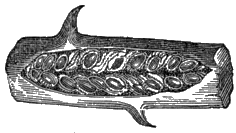
Nest of eggs of Saw-fly, in rose-tree.
The edges of this groove, it will be obvious, must be farther apart than those which only contain a single egg, and, in fact, the whole is open to inspection; but the eggs are kept from falling out, both by the frothy glue before mentioned, and by the walls of the cells containing them. They were observed also, by Vallisnieri, to increase in size like the preceding.
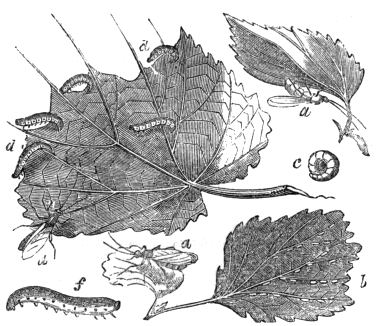
a a a, Saw-fly of the gooseberry (Nematus Ribesii, Stephens). b, its eggs on the nervures of a leaf. d d, the caterpillars eating. c, one rolled up. f, one extended.
[In the middle of summer, plenty of these grooves may be seen, by looking at the under lid of leaf-stalks or delicate young twigs. Row upon row of the grooves are sometimes found, so the all-destructive power of the insects must indeed be great. The larvæ, when full fed, dispose of themselves in various ways. Those of the gooseberry-fly, for example (Nematus Ribesii), after they have stripped the bush of its leaves, either seek the ground or remain on the branches, and spin a series of cocoons, attaching them to each branch by their ends. Those, therefore, who wish to destroy these little pests, must know both localities of the cocoons, or they will allow one half to escape while destroying the other.]
This insect has a flat yellow body and four pellucid wings, the two outer ones marked with brown on the edge. In April it issues from the pupa, which has lain under ground from the preceding September. The female of the gooseberry saw-fly does not, like some of the family, cut a groove in the branch to deposit her eggs;—“of what use, then,” asks Réaumur, “is her ovipositor-saw?” In order to satisfy himself on this point, he introduced a pair of the flies under a bell-glass along with a branch bent from a red-currant bush, that he might watch the process. The female immediately perambulated the leaves in search of a place suited to her purpose, and passing under a leaf began to lay, depositing six eggs within a quarter of an hour. Each time she placed herself as if she wished to cut into the leaf with her saw; but, upon taking out the leaf, the eggs appeared rather projecting than lodged in its substance. The caterpillars are hatched in two or three weeks; and they feed in company till after midsummer, frequently stripping both the leaves and fruit of an extensive plantation. The caterpillar has six legs and sixteen pro-legs, and is of a green colour mixed with yellow, and covered with minute black dots raised like shagreen. In its last skin it loses the black dots and becomes smooth and yellowish white. The Caledonian Horticultural Society have published a number of plans for destroying these caterpillars.
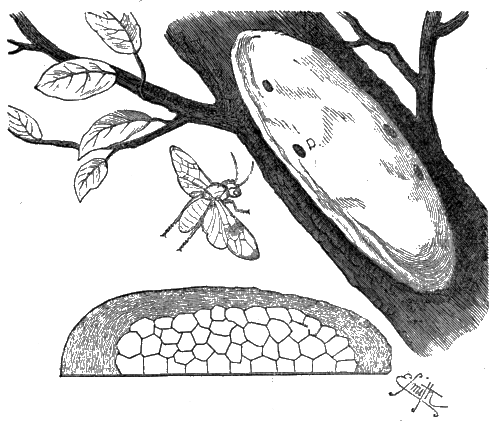
[Another remarkable mode of disposing of the pupa is shown in the accompanying illustration; it represents the nest of an exotic saw-fly, named Deilocenes Ellisii. In this instance, the numerous larvæ unite in spinning for themselves a common envelope of considerable strength; it is seen as it appears when attached to the branch of a tree. The material of which it is composed is the tough silken fibre spun by the larvæ of so many insects, which may be seen in perfection in the cocoons of the Microgaster. Two species of this curious group will be described in a future page.
By the side of the branch is seen a diagram of the same nest, as it would appear in section. The irregularly angular cells are seen in the centre, and around them is the common envelope composed of fibres. As may be seen from the upper figure, as soon as the insects have attained their perfect form, they gnaw their way out of the cell and the covering also. The insect is shown as it appears when flying.
We will conclude this chapter by a few remarks upon some exotic insects, whose nests are not only remarkable in their form, but are valuable to the entomologist in affording grounds for the reception or rejection of certain familiar theories upon the subject of this volume—Insect Architecture. Several of these nests are of comparatively late discovery, and are therefore found in this work.
The curious series of cells shown in the left-hand figure is made by a hymenopterous insect belonging to the genus Icaria, and the specimens from which the drawing was taken may be seen in the British Museum. They are made of a paper-like substance, much resembling in look the material of which the common wasp builds its cells, but as they are exposed to the air, they are necessarily tougher and stronger than ordinary wasp cells, which are shielded from the elements. The insects belonging to this genus make nests of very diverse forms, some of which are stuck on leaves in a most curious manner, reminding the observer of the parasitic mollercoids that cover the stems and fronds of large seaweeds. Others, however, are not dependent upon leaves for their support, but stand out boldly from the branches to which they are fixed, supported entirely by a footstalk composed of the same material as the cells, though necessarily of a harder and more compact substance.
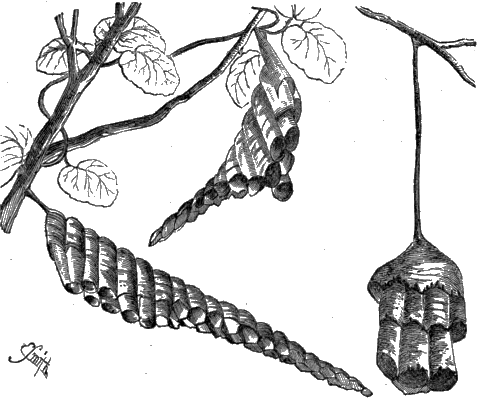
As many of these nests have been found in India, it is easy to trace the manner in which they were made. The mother insect began by kneading woody fibre into a paste, and making the footstalk of the future nest. One end of this footstalk is attached very strongly to the branch, and to the other end is fastened the first cell. As soon as the Icaria has made the first beginning of the cell, and raised—or rather lowered—the walls to a fourth or so of their complete dimensions, she inserts an egg into the yet imperfect cell, and adds to the walls while the egg is being hatched. Her next duty is, to add a second cell, and this is quickly followed by a third, all these cells being fastened to each other on three or four of their sides, leaving the others free and unattached. It is evident that by this mode of construction the cells nearest the branch must be the longest, because they are begun the soonest, and this will always be found to be the case.
Now, there is a point respecting which the attention of the reader must be specially solicited. On looking at the cells, he will see that they are partly cylindrical and partly angular, and may perhaps think that this fact goes towards proving that the hexagonal shape of bee cells is owing to mutual pressure, the outer sides of the cells being rounded, while the inner are angular. But, there are other cells in existence, built by allied insects, and formed in an analogous manner, and which are either angular or cylindrical, exactly according to the instinctive powers of the insect which built them.
On the right hand of the Icarian nest may be seen a singular-looking structure pendent at the end of a long footstalk. This is the nest of an insect called Mischocyttarus labiatus, one of the Polistidæ. In this case, the cells are built so as to be defended from the rain by a sort of penthouse, over which all the rain-drops would run, and so fall harmless to the ground. The cells of this insect are soft in texture, and are more cylindrical than angular, the angles being but very slightly marked.
Here, however, is the nest of an insect called Raphigaster Guiniensis, which is built in a manner similar to that of the Icaria, the cells being closely in contact with each other. The material of which they are made is peculiarly soft. something like very thin and flimsy grey paper. Consequently, they must press strongly upon each other, and we might reasonably expect to find that their angles are well and boldly developed. But, instead of that, we find that they have no angles at all, but remain smooth and rounded throughout their length.
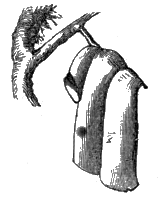
Perhaps the most powerful argument against the equal pressure theory is to be found in the nest of a species of Icaria, which is shown in the accompanying illustration.
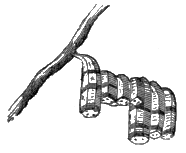
As may be seen by reference to the illustration, the material of which they are made is so soft, that they bend over by their own weight, and therefore we might expect to find that they would follow the shape of the Raphigaster and the Mischocyttarus. But, we find that all the cells are boldly angular, and that the angles are just as sharp on the exterior of each cell as on the sides which cement the cells together. It is clear that the bold lines and decided angles of these cells cannot have been produced mechanically, and that they must have been intentionally formed by the insect architect.
One single cell, such as is here shown, is sufficient to overthrow the theory of “equal pressure,” by which insects were deprived of all mechanical skill, and supposed to labour like so many animated machines, without caring or knowing anything about the work on which they were engaged. According to the equal pressure theory, each of these cells would have required six similar cells around it before it could have assumed the hexagonal form, and yet we find that a cell which is only connected with its neighbour by one side, has its other five sides angular, and with the angles boldly defined.]
CHAPTER VIII.
LEAF-ROLLING CATERPILLARS.
The labours of those insect-architects, which we have endeavoured to describe in the preceding pages, have been chiefly those of mothers to form a secure nest for their eggs, and the young hatched from them, during the first stage of their existence. But a much more numerous and not less ingenious class of architects may be found among the newly-hatched insects themselves, who, untaught by experience, and altogether unassisted by previous example, manifest the most marvellous skill in the construction of tents, houses, galleries, covert-ways, fortifications, and even cities, not to speak of subterranean caverns and subaqueous apartments, which no human art could rival.
The caterpillars, which are familiarly termed leaf-rollers, are perfect hermits. Each lives in a cell, which it begins to construct almost immediately after it is hatched; and the little structure is at once a house which protects the caterpillar from its enemies, and a store of food for its subsistence, while it remains shut up in its prison. But the insect only devours the inner folds. The art which these caterpillars exercise, although called into action but once, perhaps, in their lives, is perfect. They accomplish their purpose with a mechanical skill, which is remarkable for its simplicity and unerring success. The art of rolling leaves into a secure and immovable cell may not appear very difficult: nor would it be so if the caterpillars had fingers, or any parts which were equivalent to those delicate and admirable natural instruments with which man accomplishes his most elaborate works. And yet the human fingers could not roll a rocket-case of paper more regularly than the caterpillar rolls his house of leaves. A leaf is not a very easy substance to roll. In some trees it is very brittle. It has also a natural elasticity,—a disposition to spring back if it be bent,—which is caused by the continuity of its threads, or nervures. This elasticity is speedily overcome by the ingenuity with which the caterpillar works; and the leaf is thus retained in its artificial position for many weeks, under every variety of temperature. We will examine, in detail, how these little leaf-rollers accomplish their task.
One of the most common as well as the most simple fabrics constructed by caterpillars, may be discovered during summer on almost every kind of bush and tree. We shall take as examples those which are found on the lilac and on the oak.

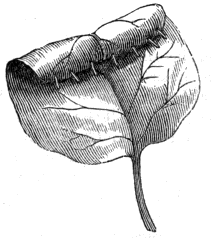
Lilac-tree Moth. (Lozotænia riteana, Stephens?) Nest of a Lilac-leaf Roller.
A small but very pretty chocolate-coloured moth, abundant in every garden, but not readily seen, from its frequently alighting on the ground, which is so nearly of its own colour, deposits its eggs on the leaves of the currant, the lilac, and of some other trees, appropriating a leaf to each egg. As soon as the caterpillar is hatched, it begins to secure itself from birds and predatory insects by rolling up the lilac leaf into the form of a gallery, where it may feed in safety. We have repeatedly seen one of them when just escaped from the egg, and only a few lines long, fix several silk threads from one edge of a leaf to the other, or from the edge to the mid-rib; then going to the middle of the space, he shortened the threads by bending them with his feet, and consequently pulled the edges of the leaves into a circular form; and he retained them in that position by gluing down each thread as he shortened it. In their younger state, those caterpillars seldom roll more than a small portion of the leaf; but, when farther advanced, they unite the two edges together in their whole extent, with the exception of a small opening at one end, by which an exit may be made in case of need.
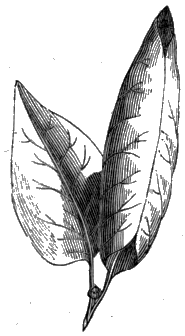
Another nest of Lilac-leaf Roller.
Another species of caterpillar, closely allied to this, rolls up the lilac leaves in a different form, beginning at the end of a leaf, and fixing and pulling its threads till it gets it nearly into the shape of a scroll of parchment. To retain this form more securely, it is not contented, like the former insect, with threads fixed on the inside of the leaf; but has also recourse to a few cables which it weaves on the outside.
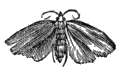
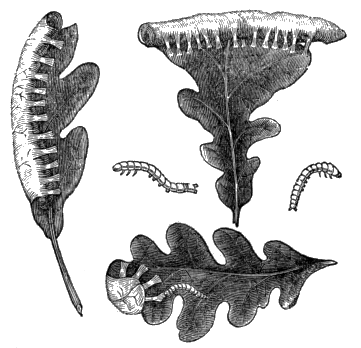
Small green Oak-moth. (Tortrix viridana.) Nests of Oak-leaf-rolling Caterpillars.
Another species of moth, allied to the two preceding, is of a pretty green colour, and lays its eggs upon the leaves of the oak. This caterpillar folds them up in a similar manner, but with this difference, that it works on the under surface of the leaf, pulling the edge downwards and backwards, instead of forwards and upwards. This species is very abundant, and may readily be found as soon as the leaves expand. In June, when the perfect insect has appeared, by beating a branch of an oak, a whole shower of these pretty green moths may be shook into the air.
* * * * *
Among the leaf-rolling caterpillars, there is a small dark-brown one, with a black head and six feet, very common in gardens, on the currant-bush, or the leaves of the rose-tree (Lozotænia rosana, Stephens). It is exceedingly destructive to the flower-buds. The eggs are deposited in the summer, and probably also in the autumn or in spring, in little oval or circular patches of a green colour. The grub makes its appearance with the first opening of the leaves, of whose structure in the half-expanded state it takes advantage to construct its summer tent. It is not, like some of the other leaf-rollers, contented with a single leaf, but weaves together as many as there are in the bud where it may chance to have been hatched, binding their discs so firmly with silk, that all the force of the ascending sap, and the increasing growth of the leaves, cannot break through; a farther expansion is of course prevented. The little inhabitant in the meanwhile banquets securely on the partitions of its tent, eating door-ways from one apartment into another, through which it can escape in case of danger or disturbance.
The leaflets of the rose, it may be remarked, expand in nearly the same manner as a fan, and the operations of this ingenious little insect retain them in the form of a fan nearly shut. Sometimes, however, it is not contented with one bundle of leaflets, but by means of its silken cords unites all which spring from the same bud into a rain-proof canopy, under the protection of which it can feast on the flower-bud, and prevent it from ever blowing.
In the instance of the currant-leaves, the proceedings of the grub are the same; but it cannot unite the plaits so smoothly as in the case of the rose leaflets, and it requires more labour, also, as the nervures, being stiff, demand a greater effort to bend them. When all the exertions of the insect prove unavailing in its endeavours to draw the edges of a leaf together, it bends them inwards as far as it can, and weaves a close web of silk over the open space between . This is well exemplified in one of the commonest of our leaf-rolling caterpillars, which may be found as early as February on the leaves of the nettle and the white archangel (Lamium album). It is of a light dirty-green colour, spotted with black, and covered with a few hairs. In its young state it confines itself to the bosom of a small leaf, near the insertion of the leaf-stalk, partly bending the edges inwards, and covering in the interval with a silken curtain. As this sort of covering is not sufficient for concealment when the animal advances in growth, it abandons the base of the leaf for the middle, where it doubles up one side in a very secure and ingenious manner.
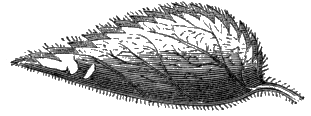
Nest of the Nettle-leaf-rolling Caterpillar.
We have watched this little architect begin and finish his tent upon a nettle in our study, the whole operation taking more than half an hour. (J. R.) He began by walking over the plant in all directions, examining the leaves severally, as if to ascertain which was best fitted for his purpose by being pliable, and bending with the weight of his body. Having found one to his mind, he placed himself along the mid-rib, to the edge of which he secured himself firmly with the pro-legs of his tail; then stretching his head to the edge of the leaf, he fixed a series of parallel cables between it and the mid-rib, with another series crossing these at an acute angle. The position in which he worked was most remarkable, for he did not, as might have been supposed, spin his cables with his face to the leaf, but throwing himself on his back, which was turned towards the leaf, he hung with his whole weight by his first-made cables. This, by drawing them into the form of a curve, shortened them, and consequently pulled the edge of the leaf down towards the mid-rib. The weight of his body was not, however, the only power which he employed; for, using the terminal pro-legs as a point of support, he exerted the whole muscles of his body to shorten his threads, and pull down the edge of the leaf. When he had drawn the threads as tight as he could, he held them till he spun fresh ones of sufficient strength to retain the leaf in the bent position into which he had pulled it. He then left the first series to hang loose while he shortened the fresh-spun ones as before. This process was continued till he had worked down about an inch and a half of the leaf, as much as he deemed sufficient for his habitation. This was the first part of the architecture.
By the time he had worked to the end of the fold, he had brought the edge of the leaf to touch the mid-rib; but it was only held in this position by a few of the last-spun threads, for all the first-spun ones hung loose within. Apparently aware of this, the insect protruded more than half of its body through the small aperture left at the end, and spun several bundles of threads on the outside precisely similar to those ropes of a tent which extend beyond the canvas, and are pegged into the ground. Unwilling to trust the exposure of his whole body on the outside, lest he should be seized by the first sand-wasp (odynerus) or sparrow which might descry him, he now withdrew to complete the internal portion of his dwelling, where the threads were hanging loose and disorderly. For this purpose he turned his head about, and proceeded precisely as he had done at the beginning of his task, but taking care to spin his new threads so as to leave the loose ones on the outside, and make his apartment smooth and neat. When he again reached the opposite end, he constructed there also a similar series of cables on the outside, and then withdrew to give some final touches to the interior.
It is said by Kirby and Spence,[BJ] that when these leaf-rolling insects find that the larger nervures of the leaves are so strong as to prevent them from bending, they “weaken it by gnawing it here and there half through.” We have never observed the circumstance, though we have witnessed the process in some hundreds of instances; and we doubt the statement, from the careful survey which the insect makes of the capabilities of the leaf before the operation is begun. If she found upon examination that a leaf would not bend, she would reject it, as we have often seen happen, and pass to another. (J. R.)
* * * * *
A species of leaf-roller, of the most diminutive size, merits particular mention, although it is not remarkable in colour or figure. It is without hair, of a greenish-white, and has all the vivacity of the other leaf-rollers. Sorrel is the plant on which it feeds; and the manner in which it rolls a portion of the leaf is very ingenious.
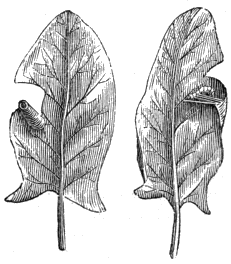
Leaf-rolling Caterpillars of the Sorrel.
The structure which it contrives is a sort of conical pyramid, composed of five or six folds lapped round each other. From the position of this little cone the caterpillar has other labours to perform, beside that of rolling the leaf. It first cuts across the leaf, its teeth acting as a pair of scissors; but it does not entirely detach this segment. It rolls it up very gradually, by attaching threads of silk to the plane surface of the leaf, as we have before seen; and then, having cut in a different direction, sets the cone upright, by weaving other threads, attached to the centre of the roll and the plane of the leaf, upon which it throws the weight of its body. This, it will be readily seen, is a somewhat complicated effort of mechanical skill. It has been minutely described by M. Réaumur; but the preceding representation will perhaps make the process clearer than a more detailed account.
This caterpillar, like those of which we have already spoken, devours all the interior of the roll. It weaves, also, in the interior, a small and thin cocoon of white silk, the tissue of which is made compact and close. It is then transformed into a chrysalis.
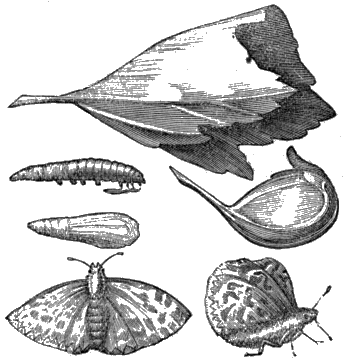
Nests of the Hesperia malvæ, with Caterpillar, Chrysalis, and Butterflies.
The caterpillars of two of our largest and handsomest butterflies, the painted lady (Cynthia cardui, Stephens), and the admiral, or Alderman of the London fly-fanciers (Vanessa atalanta), are also leaf-rollers. The first selects the leaves of the great spear-thistle, and sometimes those of the stemless or star-thistle, which might be supposed rather difficult to bend; but the caterpillar is four times as large and strong as those which we have been hitherto describing. In some seasons it is plentiful; in others it is rarely to be met with: but the admiral is seldom scarce in any part of the country; and by examining the leaves of nettles which appear folded edge to edge, in July and August, the caterpillar may be readily found.
Another butterfly (Hesperia malvæ) is met with on dry banks where mallows grow, in May, or even earlier, and also in August, but is not indigenous. The caterpillar, which is grey, with a black head, and four sulphur-coloured spots on the neck, folds around it the leaves of the mallow, upon which it feeds. There is nothing, however, peculiarly different in its proceedings from those above described; but the care with which it selects and rolls up one of the smaller leaves, when it is about to be transformed into a chrysalis, is worthy of remark; it joins it, indeed, so completely round and round, that it has somewhat the resemblance of an egg. Within this green cell it lies secure, till the time arrives when it is ready to burst its cerements, and trust to the quickness of its wings for protection against its enemies.
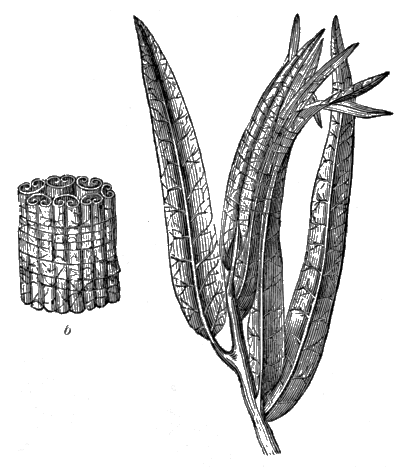
Among the nests of caterpillars which roll up parcels of leaves, we know none so well contrived as those which are found upon willows and a species of osier. The long and narrow leaves of these plants are naturally adapted to be adjusted parallel to each other; for this is the direction which they have at the end of each stalk, when they are not entirely developed. One kind of small smooth caterpillar (Tortrix chlorana), with sixteen feet, the under part of which is brown, and streaked with white, fastens these leaves together, and makes them up into parcels. There is nothing particularly striking in the mechanical manner in which it constructs them. It does precisely what we should do in a similar case: it winds a thread round those leaves which must be kept together, from a little above their termination to a very short distance from their extreme point; and as it finds the leaves almost constantly lying near each other, it has little difficulty in bringing them together, as is shown in the following cut, a.
The prettiest of these parcels are those which are made upon a kind of osier, the borders of whose leaves sometimes form columnar bundles before they become developed. A section of these leaves has the appearance of filigree-work (see b).
Nest of Willow-leaf Roller.
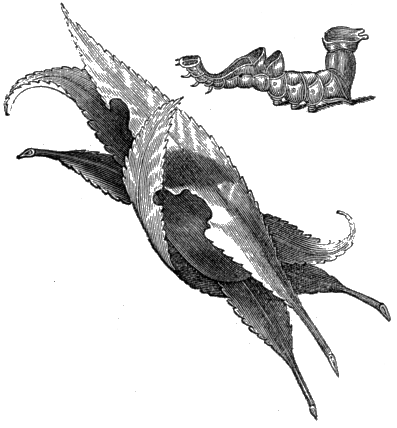
A caterpillar which feeds upon the willow, and whose singular attitudes have obtained for it the trivial name of Ziczac, also constructs for itself an arbour of the leaves, by drawing them together in an ingenious manner. M. Roesel[BK] has given a tolerable representation of this nest, and of the caterpillar. The caterpillar is found in June; and the moth (Notodonta ziczac) from May to July in the following year (see cut, p. 151).
Beside those caterpillars which live solitary in the folds of a leaf, there are others which associate, employing their united powers to draw the leaves of the plants they feed upon into a covering for their common protection. Among these we may mention the caterpillar of a small butterfly, the plantain or Glanville fritillary (Melitea cinxia), which is very scarce in this country.
Ziczac Caterpillar and Nest.
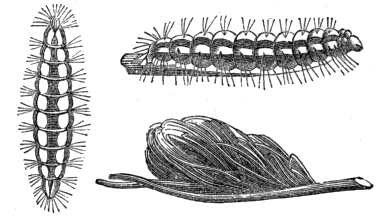
Although a colony of these caterpillars is not numerous, seldom amounting to a hundred individuals, the place which they have selected is not hard to discover. Their abode may be seen in the meadow in form of a tuft of herbage covered with a white web, which may readily be mistaken, at first view, for that of a spider, but closer inspection soon corrects this notion. It is, in fact, a sort of common tent, in which the whole brood lives, eats, and undergoes the usual transformations. The shape of this tent, for the most part, approaches the pyramidal, though that depends much upon the natural growth of the herbage which composes it. The interior is divided into compartments formed by the union of several small tents, as it were, to which others have been from time to time added according to the necessities of the community.
When they have devoured all the leaves, or at least those which are most tender and succulent, they abandon their first camp, and construct another contiguous to it under a tuft of fresh leaves. Several of these encampments may sometimes be seen within the distance of a foot or two, when they can find plantain (Plantago lanceolata) fit for their purpose; but though they prefer this plant, they content themselves with grass if it is not to be procured.
When they are about to cast their skins, but particularly when they perceive the approach of winter, they construct a more durable apartment in the interior of their principal tent. The ordinary web is thin and semi-transparent, permitting the leaves to be seen through it; but their winter canvas, if we may call it so, is thick, strong, and quite opaque, forming a sort of circular hall without any partition, where the whole community lie coiled up and huddled together.
Early in spring they issue forth in search of fresh food, and again construct tents to protect them from cold and rain, and from the mid-day sun.
M. Réaumur found upon trial, that it was not only the caterpillars hatched from the eggs of the same mother which would unite in constructing the common tent; for different broods, when put together, worked in the same social and harmonious manner. We ourselves ascertained, during the present summer (1829), that this principle of sociality is not confined to the same species, nor even to the same genus. The experiment which we tried was to confine two broods of different species to the same branch, by placing it in a glass of water to prevent their escape. The caterpillars which we experimented on were several broods of the brown-tail moth (Porthesia auriflua) and the lackey (Clisiocampa neustria). These we found to work with as much industry and harmony in constructing the common tent as if they had been at liberty on their native trees; and when the lackeys encountered the brown-tails they manifested no alarm nor uneasiness, but passed over the backs of one another, as if they had made only a portion of the branch. In none of their operations did they seem to be subject to any discipline, each individual appearing to work, in perfecting the structure, from individual instinct, in the same manner as was remarked by M. Huber in the case of the hive-bees. In making such experiments, it is obvious that the species of caterpillars experimented with must feed upon the same sort of plant.[BL] (J. R.)
The design of the caterpillars in rolling up the leaves is not only to conceal themselves from birds and predatory insects, but also to protect themselves from the cuckoo-flies, which lie in wait in every quarter to deposit their eggs in their bodies, that their progeny may devour them. Their mode of concealment, however, though it appear to be cunningly contrived and skilfully executed, is not always successful, their enemies often discovering their hiding-place. We happened to see a remarkable instance of this last summer (1828), in the case of one of the lilac caterpillars which had changed into a chrysalis within the closely-folded leaf. A small ichneumon, aware it should seem of the very spot where the chrysalis lay within this leaf, was seen boring through it with her ovipositor, and introducing her eggs through the punctures thus made into the body of the dormant insect. We allowed her to lay all her eggs, about six in number, and then put the leaf under an inverted glass. In a few days the eggs of the cuckoo-fly were hatched, the grubs devoured the lilac chrysalis, and finally changed into pupæ in a case of yellow silk, and into perfect insects like their parents. (J. R.)
CHAPTER IX.
INSECTS FORMING HABITATIONS OF DETACHED LEAVES.
The habitations of the insects which we have just described consist of growing leaves, bent, rolled, or pressed together, and fixed in their positions by silken threads. But there are other habitations of a similar kind, which are constructed by cutting out and detaching a whole leaf, or a portion of a leaf. We have already seen how dexterously the upholsterer-bees cut out small parts of leaves and petals with their mandibles, and fit them into their cells. Some of the caterpillars do not exhibit quite so much neatness and elegance as the leaf-cutting bees, though their structures answer all the purposes intended; but there are others, as we shall presently see, that far excel the bees, at least in the delicate minutiæ of their workmanship. We shall first advert to those structures which are the most simple.
* * * * *
Not far from Longchamps, in a road through the Bois de Boulogne, is a large marsh, which M. Réaumur never observed to be in a dry state even during summer. This marsh is surrounded with very lofty oaks, and abounds with pondweed, the water-plant named by botanists potamogeton. The shining leaves of this plant, which are as large as those of the laurel or orange-tree, but thicker and more fleshy, are spread upon the surface of the water. Having pulled up several of these about the middle of June, M. Réaumur observed, beneath one of the first which he examined, an elevation of an oval shape, which was formed out of a leaf of the same plant. He carefully examined it, and discovered that threads of silk were attached to this elevation. Breaking the threads, he raised up one of the ends, and saw a cavity, in which a caterpillar (Hydrocampa potamogeta) was lodged. An indefatigable observer, such as M. Réaumur, would naturally follow up this discovery; and he has accordingly given us a memoir of the pondweed tent-maker, distinguished by his usual minute accuracy.
In order to make a new habitation, the caterpillar fastens itself on the under side of a leaf of the Potamogeton. With its mandibles it pierces some part of this leaf, and afterwards gradually gnaws a curved line, marking the form of the piece which it wishes to detach. When the caterpillar has cut off, as from a piece of cloth, a patch of leaf of the size and shape suited to its purpose, it is provided with half of the materials requisite for making a tent. It takes hold of this piece by its mandibles, and conveys it to the situation on the under side of its own or another leaf, whichever is found most appropriate. It is there disposed in such a manner that the under part of the patch—the side which was the under part of the entire leaf—is turned towards the under part of the new leaf, so that the inner walls of the cell or tent are always made by the under part of two portions of leaf. The leaves of the potamogeton are a little concave on the under side; and thus the caterpillar produces a hollow cell, though the rims are united.
The caterpillar secures the leaf in its position by threads of white silk. It then weaves in the cavity a cocoon, which is somewhat thin, but of very close tissue. There it shuts itself up, to appear again only in the form of the perfect insect, and is soon transformed into a chrysalis. In this cocoon of silk no point touches the water; whilst the tent of leaves, lined with silk, has been constructed underneath the water. This fact proves that the caterpillar has a particular art by which it repels the water from between the leaves.
When the caterpillar, which has thus conveyed and disposed a patch of leaf against another leaf, is not ready to be transformed into a chrysalis, it applies itself to make a tent or habitation which it may carry everywhere about with it. It begins by slightly fixing the piece against the perfect leaf, leaving intervals all round, between the piece and leaf, at which it may project its head. The piece which it has fixed serves as a model for cutting out a similar piece in the other leaf. The caterpillar puts them accurately together, except at one end of the oval, where an opening is left for the insect to project its head through. When the caterpillar is inclined to change its situation, it draws itself forward by means of its scaly limbs, riveted upon the leaf. The membraneous limbs, which are riveted against the inner sides of the tents, oblige it to follow the anterior part of the body, as it advances. The caterpillar, also, puts its head out of the tent every time it desires to eat.
There is found on the common chickweed (Stellaria media), towards the end of July, a middle-sized smooth green caterpillar, having three brown spots bordered with white on the back, and six legs and ten pro-legs, whose architecture is worthy of observation. When it is about to go into chrysalis, towards the beginning of August, it gnaws off, one by one, a number of the leaves and smaller twigs of the chickweed, and adjusts them into an oval cocoon, somewhat rough and unfinished externally, but smooth, uniform, and finely tapestried with white silk within. Here it undergoes its transformation securely, and, when the period of its pupa trance has expired in the following July, it makes its exit in the form of a yellowish moth, with several brown spots above, and a brown band on each of its four wings below. It is also furnished with a sort of tail.
On the cypress-spurge (Euphorbia cyparissias), a native woodland plant, but not of very common occurrence, may be found, towards the end of October, a caterpillar of a middle size, sparely tufted with hair, and striped with black, white, red, and brown. The leaves of the plant, which are in the form of short narrow blades of grass, are made choice of by the caterpillar to construct its cocoon, which it does with great neatness and regularity, the end of each leaf, after it has been detached from the plant, being fixed to the stem, and the other leaves placed parallel, as they are successively added. The other ends of all these are bent inwards, so as to form a uniformly rounded oblong figure, somewhat larger at one end than at the other.
A caterpillar which builds a very similar cocoon to the last-mentioned may be found upon a more common plant—the yellow snap-dragon or toad-flax (Antirrhinum linaria)—which is to be seen in almost every hedge. It is somewhat shaped like a leech, is of a middle size, and the prevailing colour pearl-grey, but striped with yellow and black. It spins up about the beginning of September, forming the outer coating of pieces of detached leaves of the plant, and sometimes of whole leaves placed longitudinally, the whole disposed with great symmetry and neatness. The moth appears in the following June.
Cypress-Spurge Caterpillar—(Acronycta Euphrasiæ)—with a Cocoon, on a branch.
It is worthy of remark, as one of the most striking instances of instinctive foresight, that the caterpillars which build structures of this substantial description are destined to lie much longer in their chrysalis trance than those which spin merely a flimsy web of silk. For the most part, indeed, the latter undergo their final transformation in a few weeks; while the former continue entranced the larger portion of a year, appearing in the perfect state the summer after their architectural labours have been completed. (J. R.) This is a remarkable example of the instinct which leads these little creatures to act as if under the dictates of prudence, and with a perfect knowledge of the time, be it long or short, which will elapse before the last change of the pupa takes place. That the caterpillar, while weaving its cocoon and preparing to assume the pupa state, exercises any reflective faculties, or is aware of what is about to occur relative to its own self, we cannot admit. It enters upon a work of which it has had no previous experience, and which is performed, as far as contingencies allow, in the same manner by every caterpillar of the same species. Its labours, its mode of carrying them on, and the very time in which they are to be commenced, are all pre-appointed; and an instinctive impulse urges and guides; and with this instinct its organic endowments are in precise harmony; nor does instinct ever impel to labours for which an animal is not provided. “The same wisdom,” says Bonnet, “which has constructed and arranged with so much art the various organs of animals, and has made them concur towards one determined end, has also provided that the different operations which are the natural results of the economy of the animal should concur towards the same end. The creature is directed towards his object by an invisible hand; he executes with precision, and by one effort, those works which we so much admire; he appears to act as if he reasoned, to return to his labour at the proper time, to change his scheme in case of need. But in all this he only obeys the secret influence which drives him on. He is but an instrument which cannot judge of each action, but is wound up by that adorable Intelligence, which has traced out for every insect its proper labours, as he has traced the orbit of each planet. When, therefore, I see an insect working at the construction of a nest, or a cocoon, I am impressed with respect, because it seems to me that I am at a spectacle where the Supreme Artist is hid behind the curtain.”[BM]
There is a small sort of caterpillar which may be found on old walls, feeding upon minute mosses and lichens, the proceedings of which are well worthy of attention. They are similar, in appearance and size, to the caterpillar of the small cabbage-butterfly (Pontia rapæ), and are smooth and bluish. The material which they use in building their cocoons is composed of the leaves and branchlets of green moss, which they cut into suitable pieces, detaching at the same time along with them a portion of the earth in which they grow. They arrange these upon the walls of their building, with the moss on the outside, and the earth on the inside, making a sort of vault of the tiny bits of green moss turf, dug from the surface of the wall. So neatly, also, are the several pieces joined, that the whole might well be supposed to be a patch of moss which had grown in form of an oval tuft, a little more elevated than the rest growing on the wall. When these caterpillars are shut up in a box with some moss, without earth, they construct with it cells in form of a hollow ball, very prettily plaited and interwoven.
Moss-Cell of small Caterpillar (Bryophila perla?)
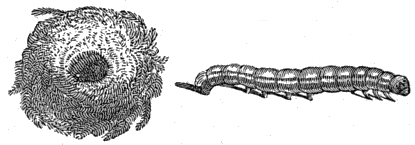
In May last (1829), we found on the walls of Greenwich Park a great number of caterpillars, whose manners bore some resemblance to those of the grub described by M. Réaumur. (J. R.) They were of middle size, with a dull-orange stripe along the back; the head and sides of the body black, and the belly greenish. Their abodes were constructed with ingenuity and care. A caterpillar of this sort appears to choose either a part where the mortar contains a cavity, or it digs one suited to its design. Over the opening of the hollow in the mortar it builds an arched wall, so as to form a chamber considerably larger than is usual with other architect caterpillars. It selects grains of mortar, brick, or lichen, fixing them, by means of silk, firmly into the structure. As some of these vaulted walls were from an inch to an inch and a half long, and about a third of an inch wide and deep, it may be well imagined that it would require no little industry and labour to complete the work; yet it does not demand more than a few hours for the insect to raise it from the foundation. Like all other insect architects, this caterpillar uses its own body for a measuring-rule, and partly for a mould, or rather a block or centre to shape the walls by, curving itself round and round concentrically with the arch which it is building.
We afterwards found one of these caterpillars, which had dug a cell in one of the softest of the bricks, covering itself on the outside with an arched wall of brick-dust, cemented with silk. As this brick was of a bright-red colour, we were thereby able to ascertain that there was not a particle of lichen employed in the structure.
The neatness mentioned by Réaumur, as remarkable in his moss-building caterpillars, is equally observable in that which we have just described; for, on looking at the surface of the wall, it would be impossible for a person unacquainted with those structures to detect where they were placed, as they are usually, on the outside, level with the adjoining brick-work; and it is only when they are opened by the entomologist, that the little architect is perceived lying snug in his chamber. If a portion of the wall be thus broken down, the caterpillar immediately commences repairing the breach, by piecing in bits of mortar and fragments of lichen, till we can scarcely distinguish the new portion from the old.
CHAPTER X.
CADDIS-WORMS AND CARPENTER-CATERPILLARS.
Leaf Nest of Caddis-Worm.
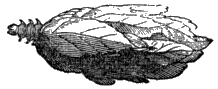
Reed Nest of Caddis-Worm.
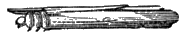
There is a very interesting class of grubs which live under water, where they construct for themselves moveable tents of various materials as their habits direct them, or as the substances they require can be conveniently procured. Among the materials used by these singular grubs, well-known to fishermen by the name of caddis-worms, and to naturalists as the larvæ of the four-winged flies in the order Trichoptera of Kirby and Spence, we may mention sand, stones, shells, wood, and leaves, which are skilfully joined and strongly cemented. One of these grubs forms a pretty case of leaves glued together longitudinally, but leaving an aperture sufficiently large for the inhabitant to put out its head and shoulders when it wishes to look about for food. Another employs pieces of reed cut into convenient lengths, or of grass, straw, wood, &c., carefully joining and cementing each piece to its fellow as the work proceeds; and he frequently finishes the whole by adding a broad piece longer than the rest to shade his door-way overhead, so that he may not be seen from above. A more laborious structure is reared by the grub of a beautiful caddis-fly (Phryganea), which weaves together a group of the leaves of aquatic plants into a roundish ball, and in the interior of this forms a cell for its abode. The fallowing figure from Roesel will give a more precise notion of this structure than a lengthened description.
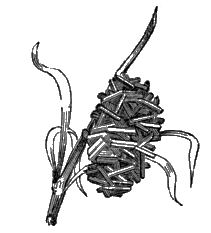
Another of these aquatic architects makes choice of the tiny shells of young fresh-water mussels and snails (Planorbis), to form a moveable grotto; and as these little shells are for the most part inhabited, he keeps the poor animals close prisoners, and drags them without mercy along with him. These grotto-building grubs are by no means uncommon in ponds; and in chalk districts, such as the country about Woolwich and Gravesend, they are very abundant.
Shell Nests of Caddis-Worms.
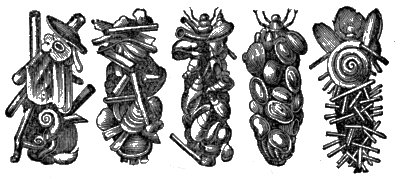
One of the most surprising instances of their skill occurs in the structures of which small stones are the principal material. The problem is to make a tube about the width of the hollow of a wheat-straw or a crow-quill, and equally smooth and uniform. Now the materials being small stones full of angles and irregularities, the difficulty of performing this problem will appear to be considerable, if not insurmountable: yet the little architects, by patiently examining their stones and turning them round on every side, never fail to accomplish their plans. This, however, is only part of the problem, which is complicated with another condition, and which we have not found recorded by former observers, namely, that the under-surface shall be flat and smooth, without any projecting angles which might impede its progress when dragged along the bottom of the rivulet where it resides. The selection of the stones, indeed, may be accounted for, from this species living in streams where, but for the weight of its house, it would to a certainty be swept away. For this purpose, it is probable that the grub makes choice of larger stones than it might otherwise want; and therefore also it is that we frequently find a case composed of very small stones and sand, to which, when nearly finished, a large stone is added by way of ballast. In other instances, when the materials are found to possess too great specific gravity, a bit of light wood, or a hollow straw, is added to buoy up the case.
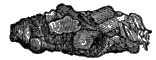
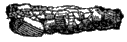
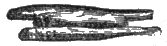
Stone Nest of Caddis-Worm. Sand Nest balanced with a Stone. Nest of Caddis-Worm balanced with Straws.
It is worthy of remark, that the cement, used in all these cases, is superior to pozzolana[BN] in standing water, in which it is indissoluble. The grubs themselves are also admirably adapted for their mode of life, the portion of their bodies which is always enclosed in the case being soft like a meal-worm, or garden-caterpillar, while the head and shoulders, which are for the most part projected beyond the door-way in search of food, are firm, hard, and consequently less liable to injury than the protected portion, should it chance to be exposed.
We have repeatedly tried experiments with the inhabitants of those aquatic tents, to ascertain their mode of building. We have deprived them of their little houses, and furnished them with materials for constructing new ones, watching their proceedings from their laying the first stone or shell of the structure. They work at the commencement in a very clumsy manner, attaching a great number of chips to whatever materials may be within their reach with loose threads of silk, and many of these they never use at all in their perfect building. They act, indeed, much like an unskilful workman trying his hand before committing himself upon an intended work of difficult execution. Their main intention is, however, to have abundance of materials within reach: for after their dwelling is fairly begun, they shut themselves up in it, and do not again protrude more than half of their body to procure materials; and even when they have dragged a stone, a shell, or a chip of reed within building reach, they have often to reject it as unfit. (J. R.)
[We have here some examples of the latter kind of nest, i. e., those habitations which are made of stones and shells. Beginning at the upper left-hand figure, we find one that is made of moderately-sized stones cemented together in a way that reminds the observer of the manner in which a builder forms irregular stones into a wall. Next to it is another, in which the stones are larger and narrower, and are arranged much as some of the caddis-worms arrange pieces of stick and straw.
In the second, and on the left-hand side, is a very long and simple tube, made of a grass stem, and balanced by three little sticks attached to its centre. The next figure represents a number of sand-tubes attached to each other. These are built up laboriously of single particles of sand, and are remarkable for their peculiar horn-like shape, the tube having the same regular curve as the horn of an ox or antelope, and tapering gradually from the base to the top. A somewhat similar tube, but of larger size, is shown in the right-hand figure.
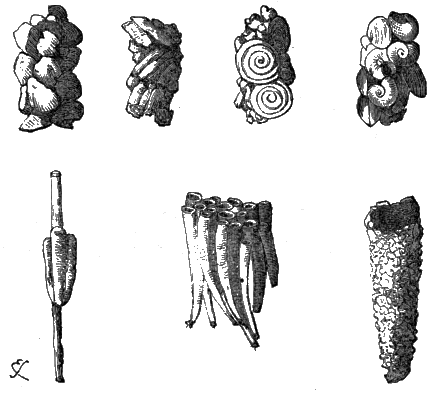
Any one who wishes to see one of these creatures rebuild its house can do so by carefully removing it from its tube, and supplying it with fresh material. Very great care must be taken in the removal, as the grub is easily damaged, and it holds so tightly to the tube with a pair of pincers at the end of its body, that it must rather be coaxed than driven out.
If desirable, they can be made to build their new houses of most singular materials. A lady, Miss Smee, was very successful in a series of experiments which she made with these insects, forcing them to make tubes of different colours and patterns, by supplying them with coloured sand, pieces of stained glass of various hues, gold dust, and similar materials. Although there was scarcely any material which they would not use, they seemed to consider a certain amount of angularity as essential, and rejected any object, such as a bead, of which the surface was perfectly rounded, while they would accept the same, if it were broken or indented.
When the caddis-grub has ceased from feeding, and is about to pass into the perfect stage, it spins over the mouth of the tube a strong silken web. This web is made in quite a pretty pattern, and being woven with rather wide meshes, it allows the water to flow through the tube while it prevents any aquatic foes from penetrating and destroying the pupa.
The remaining figures of the illustration represent tubes, around which are built a quantity of small shells. Generally, stones are mixed with the shells; but in some cases, shells seem to be almost the only material.]
Carpenter-Caterpillars.
Insects, though sometimes actuated by an instinct apparently blind, unintelligent, or unknown to themselves, manifest in other instances a remarkable adaptation of means to ends. We have it in our power to exemplify this in a striking manner by the proceedings of the caterpillar of a goat-moth (Cossus ligniperda) which we kept till it underwent its final change.
This caterpillar, which abounds in Kent and many other parts of the island, feeds on the wood of willows, oaks, poplars, and other trees, in which it eats extensive galleries; but it is not contented with the protection afforded by these galleries during the colder months of winter, before the arrival of which it scoops out a hollow in the tree, if it does not find one ready prepared, sufficiently large to contain its body in a bent or somewhat coiled-up position. On sawing off a portion of an old poplar in the winter of 1827, we found such a cell with a caterpillar coiled up in it.