Front matter (continued 2)
Reading edition
It is in instances such as these, which exhibit the adaptation of instinct to circumstances, that our reason finds the greatest difficulty in explaining the governing principle of the minds of the inferior animals. The mason-bee makes her nest by an invariable rule; the model is in her mind, as it has been in the mind of her race from their first creation: they have learnt nothing by experience. But the mode in which they accomplish this task varies according to the situations in which they are placed. They appear to have a glimmering of reason, employed as an accessary and instrument of their instinct.
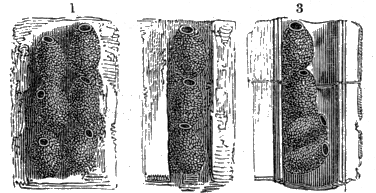
Cells of Mason-Bees, built, in the first and second figures, by Osmia bicornis between bricks, and in the third, by Megachile muraria in the fluting of an old pilaster.—About half the natural size.
The structure, when finished, consisted of a wall of clay supported by two contiguous bricks, enclosing six chambers, within each of which a mass of pollen, rather larger than a cherry-stone, was deposited, together with an egg, from which in due time a grub was hatched. Contrary to what has been recorded by preceding naturalists with respect to other mason-bees, we found the cells in this instance quite parallel and perpendicular; but it may also be remarked, that the bee itself was a species altogether different from the one which we have described above as the Anthophora retusa, and agreed with the figure of the one we caught quarrying the clay—(Osmia bicornis).
[In Mr. F. Smith’s elaborate catalogue of the British hymenoptera there is a most interesting account of the habits of this insect, which is the most abundant species of the genus, and is spread not only over the whole of England, but over the continent, being found as far south as Italy and as far north as Lapland.
“In a hilly country, or at the sea-side, it chooses the sunny side of cliffs or sandy banks in which to form its burrows, but in cultivated districts, particularly if the soil be clayey, it selects a decayed tree, preferring the stump of an old willow. It lays up a store of pollen and honey for the larvæ, which when full grown, spins a tough dark brown cocoon, in which they remain in the larval state until the autumn, when the majority change to pupæ, and soon arrive at their perfect condition. Many, however, pass the winter in the larva state. In attempting to account for so remarkable a circumstance, all must be conjecture, but it is not of unfrequent occurrence. This species frequently makes its burrows in the mortar of old walls.”
Another species (Osmia bicolor) sometimes makes its cells in very peculiar situations. When obliged to have recourse to its natural powers, it uses its limbs right well, attacks the hard sandy banks, and works at them with the greatest perseverance. But it will not work one stroke where it can avoid the necessity, and in many cases, it contrives to avoid work with much ingenuity.
Lying hidden under hedges, bushes, grass, and herbage, are sure to be shells of various snails, such as the common garden-snail, and the banded-snail, whose diversified shell is the delight of children. These shells the bee thinks are as good as ready-made burrows, and she uses them accordingly.
She goes to the end of the shell, carrying her materials with her, and then builds a cell, and fills it with pollen and honey. Another cell is then made, and yet another, until the shell is nearly filled. As the shell widens, the Osmia places two cells side by side, and when the insect has worked within a short distance of the mouth, she places the cells horizontally, so as to fill up the space. There are several specimens of these curious habitations in the British Museum.
When the whole series of cells is completed, the bee closes up the entrance with little morsels of earth, bits of stick and little stones, all strongly glued together with some very adhesive substance.
Another species (Osmia parietina) has much simpler habits, and is much easier satisfied with a dwelling. This insect merely looks out for a flattish stone lying on the ground, and crawls under it to see if there is any hollow. If so, it attaches the cocoons to the stone and leaves them. On one stone, seen in the British Museum, no less than two hundred and thirty cocoons were placed, although the stone is only ten inches in length by six in width.
This insect is almost wholly confined to the north of England.]
There was one circumstance attending the proceedings of this mason-bee which struck us not a little, though we could not explain it to our own satisfaction. Every time she left her nest for the purpose of procuring a fresh supply of materials, she paid a regular visit to the blossoms of a lilac-tree which grew near. Had these blossoms afforded a supply of pollen, with which she could have replenished her cells, we could have easily understood her design; but the pollen of the lilac is not suitable for this purpose, and that she had never used it was proved by all the pollen in the cells being yellow, whereas that of the lilac is of the same pale purple colour as the flowers. Besides, she did not return immediately from the lilac-tree to the building, but always went for a load of clay. There seemed to us, therefore, to be only two ways to explain the circumstance:—she must either have applied to the lilac-blossoms to obtain a refreshment of honey, or to procure glutinous materials to mix with the clay.
When employed upon the building itself, the bee exhibited the restless disposition peculiar to most hymenopterous[P] insects; for she did not go on with one particular portion of her wall, but ran about from place to place every time she came to work. At first, when we saw her running from the bottom to the top of her building, we naturally imagined that she went up for some of the bricklayer’s mortar to mix with her own materials; but upon minutely examining the walls afterwards, no lime could be discovered in their structure similar to that which was apparent in the nest found in the wall of Greenwich Park.
Réaumur mentions another sort of mason-bee, which selects a small cavity in a stone, in which she forms her nest of garden-mould moistened with gluten, and afterwards closes the whole with the same material.
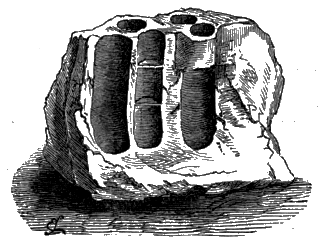
Cells of Chalicodoma.
[In the accompanying illustration is shown a series of cells which are constructed by an insect which is closely related to the rose-cutter bee of our own country, to which it bears a close resemblance.
It is a native of South Africa, and its name is Chalicodoma cœlocerus. The insect is about half an inch in length, and the colour of the head and body is black, that of the abdomen being brick red.
The nest is made of mud, which is collected by the patient insect and stuck against walls, trunks of trees, and similar localities. In this lump of mud the insect excavates a small number of burrows, each of which contains several cells. If the reader will refer to the central burrow, he will see that it is divided into three cells. The specimen from which this drawing is taken may be seen in the British Museum.
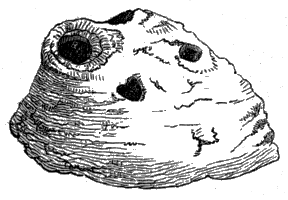
There is another South African insect which makes its mud nest, and fastens it against trees and walls. This is called Synagris calida, and its colour is almost dingy black, the only exception being the red tip to the abdomen. The holes seen in the engraving are the apertures through which the young brood has escaped into the world. The nest is represented of half its natural size.]
Mining-Bees.
A very small sort of bees (Andrenæ), many of them not larger than a house-fly, dig in the ground tubular galleries little wider than the diameter of their own bodies. Samouelle says, that all of them seem to prefer a southern aspect; but we have found them in banks facing the east, and even the north. Immediately above the spot where we have described the mason-bees quarrying the clay, we observed several holes, about the diameter of the stalk of a tobacco-pipe, into which those little bees were seen passing. The clay here was very hard; and on passing a straw into the hole as a director, and digging down for six or eight inches, a very smooth circular gallery was found, terminating in a thimble-shaped horizontal chamber, almost at right angles to the entrance and nearly twice as wide. In this chamber there was a ball of bright yellow pollen, as round as a garden pea, and rather larger, upon which a small white grub was feeding; and to which the mother bee had been adding, as she had just entered a minute before with her thighs loaded with pollen. That it was not the male, the load of pollen determined; for the male has no apparatus for collecting or transporting it. The whole labour of digging the nest and providing food for the young is performed by the female. The females of the solitary bees have no assistance in their tasks. The males are idle; and the females are unprovided with labourers, such as the queens of the hive command.
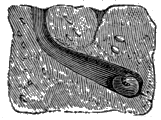
Cell of Mining-Bee (Andrena).—About half the natural size.
Réaumur mentions that the bees of this sort, whose operations he had observed, piled up at the entrance of their galleries the earth which they had scooped out from the interior; and when the grub was hatched, and properly provided with food, the earth was again employed to close up the passage, in order to prevent the intrusion of ants, ichneumon-flies, or other depredators. In those which we have observed, this was not the case; but every species differs from another in some little peculiarity, though they agree in the general principles of their operations.
[The genus Andrena is an exceedingly large one, nearly seventy species being acknowledged in England alone. They choose various situations for their nest; a very favourite situation is a hard-trodden pathway; into this the bees burrow for some six or seven inches, and often drive their tunnels to a depth of ten inches. Digging up these habitations is not a very easy task, because the tunnel does not run straight, but turns aside when a stone or any similar obstacle comes in the way, and in getting out the stone the burrow is mostly broken. The only method of digging out the nest successfully is either by pushing a small twig up the hole, and using it as a guide, or by filling the entire hole with cotton wool, so as to prevent the earth from falling in.
The commonest species is Andrena albicans. Its length is rather less than half an inch, and its colour is black, with a thick coating of rich red hair on the upper part of the thorax. This species is plentiful on the continent, and is found as far south as Italy. But it is equally capable of enduring great cold, as it has been captured in the Arctic regions. Sometimes the bee will not trouble itself to make a number of separate burrows, but will drive short supplementary tunnels from the side of the first burrow, so that they all open into one common entrance.
The Andrenæ are remarkable for the parasites with which they are infested, the most curious of which is that tiny strepsipterous insect called the Stylops.
One of the Andrenæ, called Colletes Daviesana, is remarkable for the character of its burrow. Like many of the insects which have already been described, it seems indifferent whether it burrows in sand-banks or into the mortar of walls, provided that in the latter case the mortar is soft and friable.
The insect burrows a hole which is very deep in proportion to its size, the little bee being only the third of an inch in length, and the burrows some eight or ten inches in depth. When the mother Colletes has finished her tunnel, she lines the end of it with a thin kind of membrane, which has been well compared by Mr. F. Smith to goldbeater’s skin. This lining is intended to enable the bee to store honey in the cell, as, if there were no such protection, the honey would soak in the ground and be lost.
Having stored up enough food for a single offspring, she shuts it off by a partition of the same membranous substance as the lining. Her next care is to make a thimble-like cup at the end, so as to have a double lining where the honey is to come, and then she puts a fresh supply in the new cell. This cell is then closed, and the bee proceeds with her work until she has made from six to eight cells in a single burrow. This insect suffers terribly from the depredations of the earwig, which completely empties the burrow both of food and of inhabitants. The colour of the insect is black, with a little reddish down on the upper part of the thorax, and some white on the legs. The abdomen is shining black, but each segment has a very narrow band of reddish down on its edge.
In 1850, Mr. F. Smith, to whose works such constant reference has been made, undertook the study of a genus of mining-bees belonging to this family. The species which he chiefly watched is Halictus morio, and his observations are peculiarly valuable, as showing the wonderful manner in which the economy of the race is managed. It is known that in these and many other insects, the pregnant females pass the winter in a state of hibernation, and begin to work in the following spring, and that therefore some arrangement must be needful that a supply of such queens should be kept up.
Mr. Smith found the case to stand thus. Early in April, the females appeared abundantly, and could be seen until June, but not a single male was to be found. During June and July, almost all the Halicti had disappeared, the reason being, that the queens had made their burrows, laid their eggs, stocked their cells, and then died, the duties of their life having been fulfilled. In the middle of August, the males began to appear, and in September the females of the first brood came out. They immediately set to work at their burrows, and laid their eggs. The ground, thoroughly warmed by the summer sun, soon hastened the young through their changes, and in an incredibly short time the insects of the second brood made their appearance. The females of this brood meet their mates, and then hide themselves until the following spring.
As in the case of Andrenæ, several tunnels are often made with one common entrance. The insect is very small, scarcely exceeding the sixth of an inch in length. The head and thorax are a dark green, the abdomen is white, and the legs are covered with silvery hairs. It is a plentiful insect, and is found haunting the holes of old walls.
Passing to another family of British mining-bees, we come to one species that is remarkable not only for its form, but for its economy. This is the Eucera longicornis, the only known species that inhabits England. In form it is chiefly remarkable from the fact that the antennæ of the male are as long as the entire body. The pupa of this insect is enclosed in a thin membrane, and when the male insect is about to emerge from its pupal shell, it has recourse to a rather curious expedient. At the base of the first joint of the front feet there is a bold notch. When the insect wishes to remove the thin membranous pellicle which envelopes the antennæ, it lays these organs in the notch, draws them through, and thus easily strips off the pellicle. The antennæ are most beautifully formed, the surface of each joint being marked with an elaborate pattern like net-work, so that they form beautiful objects for the microscope.
The soil preferred by the Eucera is of a clayey nature. When it has completed the burrow, it presses the soil at the extremity with all its might, and smooths it so carefully that the burrow becomes capable of holding honey without needing any lining. The insect is generally found about the end of May or beginning of June, and in some places is found in great numbers. The ground colour of the insect is black, but the body is covered with a coating of short dun hairs. The length rather exceeds half an inch.]
CHAPTER III.
CARPENTER-BEES; CARPENTER-WASPS; UPHOLSTERER-BEES.
Carpenter-Bees.
Among the solitary bees are several British species, which come under that class called carpenter-bees by M. Réaumur, from the circumstance of their working in wood, as the mason-bees work in stone. We have frequently witnessed the operations of these ingenious little workers, who are particularly partial to posts, palings, and the wood-work of houses which has become soft by beginning to decay. Wood actually decayed, or affected by dry-rot, they seem to reject as unfit for their purposes; but they make no objections to any hole previously drilled, provided it be not too large; and, like the mason-bees, they not unfrequently take possession of an old nest, a few repairs being all that in this case is necessary.
When a new nest is to be constructed, the bee proceeds to chisel sufficient space for it out of the wood with her jaws. We say her, because the task in this instance, as in most others of solitary bees and wasps, devolves solely upon the female, the male taking no concern in the affair, and probably being altogether ignorant that such a work is going forward. It is, at least, certain that the male is never seen giving his assistance, and he seldom, if ever, approaches the neighbourhood. The female carpenter-bee has a task to perform no less arduous than the mason-bee; for though the wood may be tolerably soft, she can only cut out a very small portion at a time. The successive portions which she gnaws off may be readily ascertained by an observer, as she carries them away from the place. In giving the history of a mason-wasp (Odynerus), at page 22, we remarked the care with which she carried to a distance little fragments of brick, which she detached in the progress of excavation. We have recently watched a precisely similar procedure in the instance of a carpenter-bee forming a cell in a wooden post. (J. R.) The only difference was, that the bee did not fly so far away with her fragments of wood as the wasp did; but she varied the direction of her flight every time: and we could observe that, after dropping, the chip of wood which she had carried off, she did not return in a direct line to her nest, but made a circuit of some extent before wheeling round to go back.
On observing the proceedings of this carpenter-bee next day, we found her coming in with balls of pollen on her thighs; and on tracing her from the nest into the adjacent garden, we saw her visiting every flower which was likely to yield her a supply of pollen for her future progeny. This was not all; we subsequently saw her taking the direction of the clay quarry frequented by the mason-bees, as we have mentioned in page 41, where we recognised her loading herself with a pellet of clay, and carrying it into her cell in the wooden post. We observed her alternating this labour for several days, at one time carrying clay, and at another pollen; till at length she completed her task, and closed the entrance with a barricade of clay, to prevent the intrusion of any insectivorous depredator, who might make prey of her young; or of some prying parasite, who might introduce its own eggs into the nest she had taken so much trouble to construct.
Some days after it was finished, we cut into the post, and exposed this nest to view. It consisted of six cells of a somewhat square shape, the wood forming the lateral walls; and each was separated from the one adjacent by a partition of clay, of the thickness of a playing card. The wood was not lined with any extraneous substance, but was worked as smooth as if it had been chiseled by a joiner. There were five cells, arranged in a very singular manner—two being almost horizontal, two perpendicular, and one oblique.
The depth to which the wood was excavated in this instance was considerably less than what we have observed in other species which dig perpendicular galleries several inches deep in posts and garden-seats; and they are inferior in ingenuity to the carpentry of a bee described by Réaumur (Xylocopa violacea), which has not been ascertained to be a native of Britain, though a single indigenous species of the genus has been doubtingly mentioned, and is figured by Kirby and Spence, in their valuable ‘Monographia.’ If it ever be found here, its large size and beautiful violet-coloured wings will render mistakes impossible.
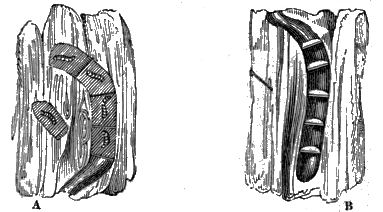
Cells of Carpenter-Bees, excavated in an old post. In fig. A the cells contain the young grubs; in fig. B the cells are empty. Both figures are shown in section, and about half their natural size.
The violet carpenter-bee usually selects an upright piece of wood, into which she bores obliquely for about an inch; and then, changing the direction, works perpendicularly, and parallel to the sides of the wood, from twelve or fifteen inches, and half an inch in breadth. Sometimes the bee is contented with one or two of these excavations; at other times, when the wood is adapted to it, she scoops out three or four—a task which sometimes requires several weeks of incessant labour.
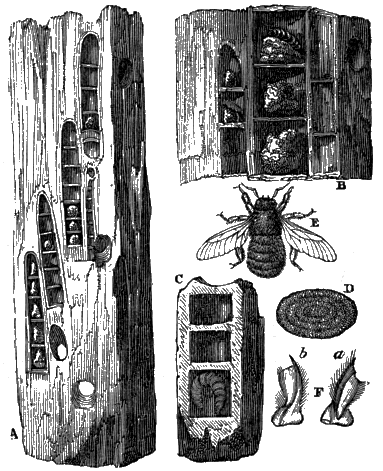
A represents a part of an espalier prop, tunnelled in several places by the violet Carpenter-Bee: the stick is split, and shows the nests and passages by which they are approached. B, a portion of the prop, half the natural size. C, a piece of thin stick, pierced by the Carpenter-Bee, and split, to show the nests. D, perspective view of one of the partitions. E, Carpenter-Bee (Xylocopa violacea). F, Teeth of the Carpenter-Bee, greatly magnified; a, the upper side; b, the lower side.
The tunnel in the wood, however, is only one part of the work; for the little architect has afterwards to divide the whole into cells, somewhat less than an inch in depth. It is necessary, for the proper growth of her progeny, that each should be separated from the other, and be provided with adequate food. She knows, most exactly, the quantity of food which each grub will require during its growth; and she therefore does not hesitate to cut it off from any additional supply. In constructing her cells, she does not employ clay, like the bee which we have mentioned above, but the sawdust, if we may call it so, which she has collected in gnawing out the gallery. It would not, therefore, have suited her design to scatter this about, as our carpenter-bee did. The violet-bee, on the contrary, collects her gnawings into a little store-heap for future use, at a short distance from her nest. She proceeds thus:—At the bottom of her excavation she deposits an egg, and over it fills a space nearly an inch high with the pollen of flowers, made into a paste with honey. She then covers this over with a ceiling composed of cemented sawdust, which also serves for the floor of the next chamber above it. For this purpose she cements round a wall a ring of wood-chips taken from her store-heap; and within this ring forms another, gradually contracting the diameter till she has constructed a circular plate, about the thickness of a crown-piece, and of considerable hardness. This plate of course exhibits concentric circles, somewhat similar to the annual circles in the cross section of a tree. In the same manner she proceeds till she has completed ten or twelve cells; and then she closes the main entrance with a barrier of similar materials.
Let us compare the progress of this little joiner with a human artisan—one who has been long practised in his trade, and has the most perfect and complicated tools for his assistance. The bee has learnt nothing by practice; she makes her nest but once in her life, but it is then as complete and finished as if she had made a thousand. She has no pattern before her—but the Architect of all things has impressed a plan upon her mind, which she can realize without scale or compasses. Her two sharp teeth are the only tools with which she is provided for her laborious work; and yet she bores a tunnel, twelve times the length of her own body, with greater ease than the workman who bores into the earth for water, with his apparatus of augurs adapted to every soil. Her tunnel is clean and regular; she leaves no chips at the bottom, for she is provident of her materials. Further, she has an exquisite piece of joinery to perform when her ruder labour is accomplished. The patient bee works her rings from the circumference to the centre, and she produces a shelf, united with such care with her natural glue, that a number of fragments are as solid as one piece.
The violet carpenter-bee, as may be expected, occupies several weeks in these complicated labours; and during that period she is gradually depositing her eggs, each of which is successively to become a grub, a pupa, and a perfect bee. It is obvious, therefore, as she does not lay all her eggs in the same place—as each is separated from the other by a laborious process—that the egg which is first laid will be the earliest hatched; and that the first perfect insect, being older than its fellows in the same tunnel, will strive to make its escape sooner, and so on of the rest. The careful mother provides for this contingency. She makes a lateral opening at the bottom of the cells; for the teeth of the young bees would not be strong enough to pierce the outer wood, though they can remove the cemented rings of sawdust in the interior. Réaumur observed these holes, in several cases; and he further noticed another external opening opposite to the middle cell, which he supposed was formed, in the first instance, to shorten the distance for the removal of the fragments of wood in the lower half of the building.
* * * * *
That bees of similar habits, if not the same species as the violet-bee, are indigenous to this country, is proved by Grew, who mentions, in his ‘Rarities of Gresham College,’ having found a series of such cells in the middle of the pith of an elder branch, in which they were placed lengthwise, one after another, with a thin boundary between each. As he does not, however, tell us that he was acquainted with the insect which constructed these, it might as probably be allied to the Ceratina albilabris, of which Spinola has given so interesting an account in the ‘Annales du Muséum d’Histoire Naturelle’ (x. 236). This noble and learned naturalist tells us, that one evening he perceived a female ceratina alight on the branch of a bramble, partly withered, and of which the extremity had been broken; and, after resting a moment, suddenly disappear. On detaching the branch, he found that it was perforated, and that the insect was in the very act of excavating a nidus for her eggs. He forthwith gathered a bundle of branches, both of the bramble and the wild-rose, similarly perforated, and took them home to examine them at leisure. Upon inspection, he found that the nests were furnished like those of the same tribe, with balls of pollen kneaded with honey, as a provision for the grubs.
The female ceratina selects a branch of the bramble or wild-rose which has been accidentally broken, and digs into the pith only, leaving the wood and bark untouched. Her mandibles, indeed, are not adapted for gnawing wood; and, accordingly, he found instances in which she could not finish her nest in branches of the wild-rose, where the pith was not of sufficient diameter.
The insect usually makes her perforation a foot in depth, and divides this into eight, nine, or even twelve cells, each about five lines long, and separated by partitions formed by the gnawings of the pith, cemented by honey, or some similar glutinous fluid, much in the same manner with the Xylocopa violacea, which we have already described.
[This species is probably Ceratina cærulea, as the second species, C. albilabris, seems to have little claim to be considered as a British insect. It is plentiful in spots where it resides, but is very local. It can best be found by collecting all the specimens of bramble branches that have holes bored into the pith.
Mr. F. Smith says of this tiny bee, “Some years ago I observed a small bee most industriously employed in excavating a dead bramble stick. My attention was directed to the circumstance from observing some of the fallen pieces of pith on the ground immediately beneath. Occasionally fresh quantities of dust were pushed out. At length, the little creature came out of the stick as if to rest, and after sunning itself for a few minutes, it re-entered, and again commenced its labours. Later in the day, after stopping up the entrance, I cut off the branch and found in it a male and female ceratina.”
The ceratina is only the sixth of an inch in length, and is deep shining blue in colour.
There are many other species of British bees which frequent the stems of bramble and other trees. One of them is known as Prosopis signata. The cells made by the bees of this genus are lined with a membrane, and are stocked with liquid honey. Some species will not take the trouble of boring a tunnel for themselves, but will make use of hollow stones, or similar localities, and place in them the silk-covered cocoons.
There are species of that versatile genus Osmia (O. leucomelana), in the habit of burrowing into dead bramble branches. The mother insect bores a hole some six inches in length, throwing the pieces of pith away, and then, depositing at the bottom an egg and a supply of food, she forms a cell by fixing across the burrow a stopper made of masticated leaves.
The stopper retains its place firmly, because the bee does not eat away the whole of the pith, but alternately widens and contracts the diameter of the burrow, each contracted portion being the termination of a cell. The perfect insect appears in the early summer of the following year.]
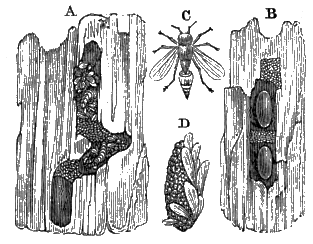
A, B, represent sections of old wooden posts, with the cells of the Carpenter-Wasp. In fig. A the young grubs are shown feeding on the insects placed there for their support by the parent wasp. The cells in fig. B contain cocoons. C, Carpenter-Wasp, natural size. D, cocoon of a Carpenter-Wasp, composed of sawdust and wings of insects.
Carpenter-Wasps.
As there are mason-wasps similar in economy to mason-bees, so are there solitary carpenter-wasps which dig galleries in timber, and partition them out into several cells by means of the gnawings of the wood which they have detached. This sort of wasp is of the genus Eumenes. The wood selected is generally such as is soft, or in a state of decay; and the hole which is dug in it is much less neat and regular than that of the carpenter-bees, while the division of the chambers is nothing more than the rubbish produced during the excavation.
The provision which is made for the grub consists of flies or gnats piled into the chamber, but without the nice order remarkable in the spiral columns of green caterpillars provided by the mason-wasp (Odynerus murarius). The most remarkable circumstance is, that in some of the species, when the grub is about to go into the pupa state, it spins a case (a cocoon), into which it interweaves the wings of the flies whose bodies it has previously devoured. In other species, the gnawings of the wood are employed in a similar manner.
[Some of the solitary wasps are also carpenters, and the genus Crabro has several species which are classed under this head. There is, for example, Crabro clavipes, a little black insect with red and black abdomen, that burrows into dead bramble sticks, boring out the pith, and forming a series of cells in the narrow tube thus made. Sometimes this insect bores into decaying wood, but its general home is the bramble-stick. The same habits are common to several other British species of this genus, and the reader will find that old, decaying willow trees are chiefly visited by these pretty little insects. Their store of food, which they lay up for their young, mostly consists of dipterous insects, and various species of gnats are used for this purpose.
Another of the carpenter-wasps (Pemphredon lugubris) is really a useful insect. It makes its burrows in posts, rails, and similar localities, and provides its future young with a large stock of aphides. It has been seen to settle on a rose-bush, scrape off the branches a number of aphides, form them into a ball, and carry them off between its head and front legs.
The colour of this insect is dull black, from which circumstance it derives its name of lugubris. The head is large, and squared, and the abdomen is attached to the thorax by a large footstalk. Its length is about half an inch. It is a very common insect, and is believed to be the only British representation of its genus.
Several species do not take the trouble to form a burrow for themselves, but content themselves with building in holes ready made for them. Straws are favourite resorts of such insects, and in thatched buildings the straws of the roof are often filled with their cells.
One of these insects is a very little species, barely a quarter of an inch in length. Its colour is black, with some silver white hair on the face, and the legs are paler than the body. The abdomen has a long footstalk. Its scientific name is Psen pallipes. Like the insect which has just been described, it provisions its young with aphides.]
Upholsterer-Bees.
In another part of this volume we shall see how certain caterpillars construct abodes for themselves, by cutting off portions of the leaves or bark of plants, and uniting them by means of silk into a uniform and compact texture; but this scarcely appears so wonderful as the prospective labours of some species of bees for the lodgment of their progeny. We allude to the solitary bees, known by the name of the leaf-cutting bees, but which may be denominated more generally upholsterer-bees, as there are some of them which use other materials beside leaves.
One species of our little upholsterers has been called the poppy-bee (Osmia papaveris, Latr.), from its selecting the scarlet petals of the poppy as tapestry for its cells. Kirby and Spence express their doubts whether it is indigenous to this country: we are almost certain that we have seen the nests in Scotland. (J. R.) At Largs, in Ayrshire, a beautiful sea-bathing village on the Firth of Clyde, in July, 1814, we found in a footpath a great number of the cylindrical perforations of the poppy-bee. [In his catalogue of British Hymenoptera, Mr. F. Smith makes the following remarks with regard to this insect. "The poppy-bee, Anthocopa papaveris, is closely allied to this genus (Osmia), and may indeed be placed before it as a connecting link with the Osmia. This interesting insect (l’abeille Tapissiere), of Réaumur, has been supposed to inhabit this country, specimens having been placed in the collection at the British Museum. But it was with much regret that I discovered, when engaged upon the catalogue of British bees for the Museum, and had occasion to examine each individual specimen with care, that in the first place there was no satisfactory evidence of the locality, and that in the next place, all the males associated with the series were those of Osmia adunca, of Panzear." For these reasons, this species has been excluded from the list of British bees.] Réaumur remarked that the cells of this bee which he found at Bercy, were situated in a northern exposure, contrary to what he had remarked in the mason-bee, which prefers the south. The cells at Largs, however, were on an elevated bank, facing the south, near Sir Thomas Brisbane’s observatory. With respect to exposure, indeed, no certain rule seems applicable; for the nests of mason-bees which we found on the wall of Greenwich Park faced the north-east, and we have often found carpenter-bees make choice of a similar situation. In one instance, we found carpenter-bees working indifferently on the north-east and south-west side of the same post.
As we did not perceive any heaps of earth near the holes at Largs, we concluded that it must either have been carried off piecemeal when they were dug, or that they were old holes re-occupied (a circumstance common with bees), and that the rubbish had been trodden down by passengers. Réaumur, who so minutely describes the subsequent operations of the bee, says nothing respecting its excavations. One of these holes is about three inches deep, gradually widening as it descends, till it assumes the form of a small Florence flask. The interior of this is rendered smooth, uniform, and polished, in order to adapt it to the tapestry with which it is intended to be hung, and which is the next step in the process.
The material used for tapestry by the insect upholsterer is supplied by the flower-leaves of the scarlet field-poppy, from which she successively cuts off small pieces of an oval shape, seizes them between her legs, and conveys them to the nest. She begins her work at the bottom, which she overlays with three or four leaves in thickness, and the sides have never less than two. When she finds that the piece she has brought is too large to fit the place intended, she cuts off what is superfluous, and carries away the shreds. By cutting the fresh petal of a poppy with a pair of scissors, we may perceive the difficulty of keeping the piece free from wrinkles and shrivelling; but the bee knows how to spread the pieces which she uses as smooth as glass.
When she has in this manner hung the little chamber all around with this splendid scarlet tapestry, of which she is not sparing, but extends it even beyond the entrance, she then fills it with the pollen of flowers mixed with honey, to the height of about half an inch. In this magazine of provisions for her future progeny she lays an egg, and over it folds down the tapestry of poppy-petals from above. The upper part is then filled in with earth; but Latreille says he has observed more than one cell constructed in a single excavation. This may account for Réaumur’s describing them as sometimes seven inches deep; a circumstance which Latreille, however, thinks very surprising.
It will, perhaps, be impossible ever to ascertain, beyond a doubt, whether the tapestry-bee is led to select the brilliant petals of the poppy from their colour, or from any other quality they may possess, of softness or of warmth, for instance. Réaumur thinks that the largeness, united with the flexibility of the poppy-leaves, determines her choice. Yet it is not improbable that her eye may be gratified by the appearance of her nest; that she may possess a feeling of the beautiful in colour, and may look with complacency upon the delicate hangings of the apartment which she destines for her offspring. Why should not an insect be supposed to have a glimmering of the value of ornament? How can we pronounce, from our limited notion of the mode in which the inferior animals think and act, that their gratifications are wholly bounded by the positive utility of the objects which surround them? Why does a dog howl at the sound of a bugle, but because it offends his organ of hearing?—and why, therefore, may not a bee feel gladness in the brilliant hues of her scarlet drapery, because they are grateful to her organs of sight? All these little creatures work, probably, with more neatness and finish than is absolutely essential for comfort; and this circumstance alone would imply that they have something of taste to exhibit, which produces to them a pleasurable emotion.
The tapestry-bee is, however, content with ornamenting the interior only of the nest which she forms for her progeny. She does not misplace her embellishments with the error of some human artists. She desires security as well as elegance; and, therefore, she leaves no external traces of her operations. Hers is not a mansion rich with columns and friezes without, but cold and unfurnished within, like the desolate palaces of Venice. She covers her tapestry quite round with the common earth; and leaves her eggs enclosed in their poppy-case with a certainty that the outward show of her labours will attract no plunderer.
The poppy-bee may be known by its being rather more than a third of an inch long, of a black colour, studded on the head and back with reddish-grey hairs; the belly being grey and silky, and the rings margined with grey above, the second and third having an impressed transversal line.
* * * * *
A species of solitary bee (Anthidium manicatum, Fabricius), by no means uncommon with us, forms a nest of a peculiarly interesting structure. Kirby and Spence say, that it does not excavate holes, but makes choice of the cavities of old trees, key-holes, and similar localities; yet it is highly probable, we think, that it may sometimes scoop out a suitable cavity when it cannot find one; for its mandibles seem equally capable of this, with those of any of the carpenter or mason-bees.
Be this as it may, the bee in question having selected a place suitably sheltered from the weather, and from the intrusion of depredators, proceeds to form her nest, the exterior walls of which she forms of the wool of pubescent plants, such as rose-campion (Lychnis coronaria), the quince (Pyrus cydonia), cats-ears (Stachys lunata), &c. “It is very pleasant,” says Mr. White, of Selborne, “to see with what address this insect strips off the down, running from the top to the bottom of the branch, and shaving it bare with all the dexterity of a hoop-shaver. When it has got a vast bundle, almost as large as itself, it flies away, holding it secure between its chin and its fore-legs.”[Q] The material is rolled up like a ribbon; and we possess a specimen in which one of these rolls still adheres to a rose-campion stem, the bee having been scared away before obtaining her load.
The manner in which the cells of the nest are made seems not to be very clearly understood. M. Latreille says, that, after constructing her nest of the down of quince-leaves, she deposits her eggs, together with a store of paste, formed of the pollen of flowers, for nourishing the grubs. Kirby and Spence, on the other hand, tell us, that “the parent bee, after having constructed her cells, laid an egg in each, and filled them with a store of suitable food, plasters them with a covering of vermiform masses, apparently composed of honey and pollen; and having done this, aware, long before Count Rumford’s experiments, what materials conduct heat most slowly,” she collects the down from woolly plants, and “sticks it upon the plaster that covers her cells, and thus closely envelops them with a warm coating of down, impervious to every change of temperature.” “From later observations,” however, they are "inclined to think that these cells may possibly, as in the case of the humble-bee, be in fact formed by the larva previously to becoming a pupa, after having eaten the provision of pollen and honey with which the parent bee had surrounded it. The vermicular shape, however, of the masses with which the cases are surrounded, does not seem easily reconcilable with this supposition, unless they are considered as the excrement of the larva."[R]
Whether or not this second explanation is the true one, we have not the means of ascertaining; but we are almost certain the first is incorrect, as it is contrary to the regular procedure of insects to begin with the interior part of any structure, and work outwards. We should imagine, then, that the down is first spread out into the form required, and afterwards plastered on the inside to keep it in form, when probably the grub spins the vermicular cells previous to its metamorphosis.
It might prove interesting to investigate this more minutely; and as the bee is by no means scarce in the neighbourhood of London, it might not be difficult for a careful observer to witness all the details of this singular architecture. Yet we have repeatedly endeavoured, but without success, to watch the bees, when loaded with down, to their nests. The bee may be readily known from its congeners, by its being about the size of the hive-bee, but more broad and flattened, blackish-brown above, with a row of six yellow or white spots along each side of the rings, very like the rose-leaf cutter, and having the belly covered with yellowish-brown hair, and the legs fringed with long hairs of a rather lighter colour.
* * * * *
[This bee does not bore a tunnel for herself, but occupies that of some other insect. The nests of this insect are generally to be obtained from old willows, because these trees are so largely bored by the goat-moth caterpillar, and afford ample space for the larva. The woolly substance obtained from the plant is pressed against the sides of the burrow, so as to form a lining. She then makes a series of cells of a similar material, and the young larva, when it is about to change into the pupa state, envelops itself in a silken covering of a brown colour.
It is a curious fact, that the male of this insect is considerably larger than the female, thus reversing the usual order of things among insects. Only one species of this bee is known in England.]
A common bee belonging to the family of upholsterers is called the rose-leaf cutter (Megachile centuncularis, Latr.). The singularly ingenious habits of this bee have long attracted the attention of naturalists; but the most interesting description is given by Réaumur. So extraordinary does the construction of their nests appear, that a French gardener having dug up some, and believing them to be the work of a magician, who had placed them in his garden with evil intent, sent them to Paris to his master, for advice as to what should be done by way of exorcism. On applying to the Abbé Nollet, the owner of the garden was soon persuaded that the nests in question were the work of insects; and M. Réaumur, to whom they were subsequently sent, found them to be the nests of one of the upholsterer-bees, and probably of the rose-leaf cutter, though the nests in question were made of the leaves of the mountain ash (Pyrus aucuparia).
The rose-leaf cutter makes a cylindrical hole in a beaten pathway, for the sake of more consolidated earth (or in the cavities of walls or decayed wood), from six to ten inches deep, and does not throw the earth dug out from it into a heap, like the Andrenæ.[S] In this she constructs several cells about an inch in length, shaped like a thimble, and made of cuttings of leaves (not petals), neatly folded together, the bottom of one thimble-shaped cell being inserted into the mouth of the one below it, and so on in succession.
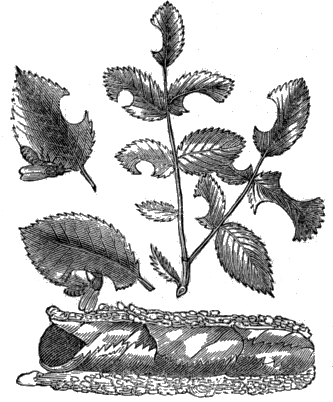
Rose-leaf cutter Bees, and Nest lined with rose-leaves.
It is interesting to observe the manner in which this bee procures the materials for forming the tapestry of her cells. The leaf of the rose-tree seems to be that which she prefers, though she sometimes takes other sorts of leaves, particularly those with serrated margins, such as the birch, the perennial mercury (Mercurialis perennis), mountain-ash, &c. She places herself upon the outer edge of the leaf which she has selected, so that its margin may pass between her legs. Turning her head towards the point, she commences near the footstalk, and with her mandibles cuts out a circular piece with as much expedition as we could do with a pair of scissors, and with more accuracy and neatness than could easily be done by us. As she proceeds, she keeps the cut portion between her legs, so as not to impede her progress; and using her body for a trammel, as a carpenter would say, she cuts in a regular curved line. As she supports herself during the operation upon the portion of the leaf which she is detaching, it must be obvious, when it is nearly cut off, that the weight of her body might tear it away, so as to injure the accuracy of its curvilineal shape. To prevent any accident of this kind, as soon as she suspects that her weight might tear it, she poises herself on her wings, till she has completed the incision. It has been said, by naturalists, that this manœuvre of poising herself on the wing, is to prevent her falling to the ground, when the piece gives way; but as no winged insect requires to take any such precaution, our explanation is probably the true one.
With the piece which she has thus cut out, held in a bent position perpendicularly to her body, she flies off to her nest, and fits it into the interior with the utmost neatness and ingenuity; and, without employing any paste or glue, she trusts, as Réaumur ascertained, to the spring the leaf takes in drying, to retain it in its position. It requires from nine to ten pieces of leaf to form one cell, as they are not always of precisely the same thickness. The interior surface of each cell consists of three pieces of leaf, of equal size, narrow at one end, but gradually widening at the other, where the width equals half the length. One side of each of the pieces is the serrated margin of the leaf from which it was cut, and this margin is always placed outermost, and the cut margin innermost. Like most insects, she begins with the exterior, commencing with a layer of tapestry, which is composed of three or four oval pieces, larger in dimensions than the rest, adding a second and a third layer proportionately smaller. In forming these, she is careful not to place a joining opposite to a joining, but with all the skill of a consummate artificer, lays the middle of each piece of leaf over the margins of the others, so as by this means both to cover and strengthen the junctions. By repeating this process, she sometimes forms a fourth or a fifth layer of leaves, taking care to bend the leaves at the narrow extremity or closed end of the cell, so as to bring them into a convex shape.
When she has in this manner completed a cell, her next business is to replenish it with a store of honey and pollen, which, being chiefly collected from thistles, forms a beautiful rose-coloured conserve. In this she deposits a single egg, and then covers in the opening with three pieces of leaf, so exactly circular, that a pair of compasses could not define their margin with more accuracy. In this manner the industrious and ingenious upholsterer proceeds till the whole gallery is filled, the convex extremity of the one fitting into the open end of the next, and serving both as a basis and as the means of strengthening it. If, by any accident, the labour of these insects is interrupted or the edifice deranged, they exhibit astonishing perseverance in setting it again to rights. Insects, indeed, are not easily forced to abandon any work which they may have begun.
The monkish legends tell us that St. Francis Xavier, walking one day in a garden, and seeing an insect, of the Mantis genus, moving along in its solemn way, holding up its two fore legs, as in the act of devotion, desired it to sing the praises of God. The legend adds that the saint immediately heard the insect carol a fine canticle with a loud emphasis. We want no miraculous voice to record the wonders of the Almighty hand, when we regard the insect world. The little rose-leaf cutter, pursuing her work with the nicest mathematical art—using no artificial instruments to form her ovals and her circles—knowing that the elastic property of the leaves will retain them in their position—making her nest of equal strength throughout, by the most rational adjustment of each distinct part—demands from us something more than mere wonder; for such an exercise of instinctive ingenuity at once directs our admiration to the great Contriver, who has so admirably proportioned her knowledge to her necessities.
CHAPTER IV.
CARDER-BEES; HUMBLE-BEES; SOCIAL-WASPS.
The bees and wasps, whose ingenious architecture we have already examined, are solitary in their labours. Those we are about to describe live in society. The perfection of the social state among this class of insects is certainly that of the hive-bees. They are the inhabitants of a large city, where the arts are carried to a higher excellence than in small districts enjoying little communication of intelligence. But the bees of the villages, if we may follow up the parallel, are not without their interest. Such are those which are called carder-bees and humble-bees.
Carder-Bees.
The nests of the bees which Réaumur denominates carders (Bombus muscorum, Latr.) are by no means uncommon, and are well worth the study of the naturalist. During the hay harvest, they are frequently met with by mowers in the open fields and meadows; but they may sometimes be discovered in hedge-banks, the borders of copses, or among moss-grown stones. The description of the mode of building adopted by this bee has been copied by most of our writers on insects from Réaumur; though he is not a little severe on those who write without having ever had a single nest in their possession. We have been able to avoid such a reproach; for we have now before us a very complete nest of carder-bees, which differs from those described by Réaumur, in being made not of moss, but withered grass. With this exception, we find that his account agrees accurately with our own observations. (J. R.)
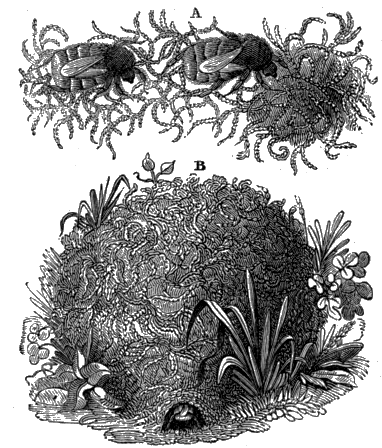
Fig. A represents two Carder-Bees heckling moss for their Nests; B, exterior view of the Nest of the Carder-Bee.
The carder-bees select for their nest a shallow excavation about half a foot in diameter; but when they cannot find one to suit their purpose, they undertake the Herculean task of digging one themselves. They cover this hollow with a dome of moss—sometimes, as we have ascertained, of withered grass. They make use, indeed, of whatever materials may be within their reach; for they do not attempt to bring anything from a distance, not even when they are deprived of the greater portion by an experimental naturalist. Their only method of transporting materials to the building is by pushing them along the ground—the bee, for that purpose, working backwards, with its head turned from the nest. If there is only one bee engaged in this labour, as usually happens in the early spring, when a nest is founded by a solitary female who has outlived the winter, she transports her little bundles of moss or grass by successive backward pushes, till she gets them home.
In the latter part of the season, when the hive is populous and can afford more hands, there is an ingenious division of this labour. A file of bees, to the number sometimes of half a dozen, is established, from the nest to the moss or grass which they intend to use, the heads of all the file of bees being turned from the nest and towards the material. The last bee of the file lays hold of some of the moss with her mandibles, disentangles it from the rest, and having carded it with her fore legs into a sort of felt or small bundle, she pushes it under her body to the next bee, who passes it in the same manner to the next, and so on till it is brought to the border of the nest,—in the same way as we sometimes see sugar-loaves conveyed from a cart to a warehouse, by a file of porters throwing them from one to another.
The elevation of the dome, which is all built from the interior, is from four to six inches above the level of the field. Beside the moss or grass, they frequently employ coarse wax to form the ceiling of the vault, for the purpose of keeping out rain, and preventing high winds from destroying it. Before this finishing is given to the nest, we have remarked, that on a fine sunshiny day the upper portion of the dome was opened to the extent of more than an inch, in order, we suppose, to forward the hatching of the eggs in the interior; but on the approach of night this was carefully covered in again. It was remarkable that the opening which we have just mentioned was never used by the bees for either their entrance or their exit from the nest, though they were all at work there, and, of course, would have found it the readiest and easiest passage; but they invariably made their exit and their entrance through the covert-way or gallery which opens at the bottom of the nest, and, in some nests, is about a foot long and half an inch wide. This is, no doubt, intended for concealment from field-mice, polecats, wasps, and other depredators.
On removing a portion of the dome and bringing the interior of the structure into view, we find little of the architectural regularity so conspicuous in the combs of a common bee-hive: instead of this symmetry, there are only a few egg-shaped, dark-coloured cells, placed somewhat irregularly, but approaching more to the horizontal than to the vertical position, and connected together with small amorphous[T] columns of brown wax. Sometimes there are two or three of these oval cells placed one above another, without anything to unite them.
These cells are not, however, the workmanship of the old bees, but of their young grubs, who spin them when they are about to change into nymphs. But, from these cases, when they are spun, the enclosed insects have no means of escaping, and they depend for their liberation on the old bees gnawing off the covering, as is done also by ants in the same circumstances. The instinct with which they know the precise time when it is proper to do this is truly wonderful. It is no less so, that these cocoons are by no means useless when thus untenanted, for they subsequently serve for honey-pots, and are indeed the only store-cells in the nest. For this purpose the edge of the cell is repaired and strengthened with a ring of wax.
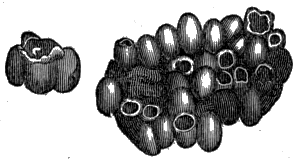
Breeding-Cells.
The true breeding-cells are contained in several amorphous masses of brown-coloured wax, varying in dimensions, but of a somewhat flat and globular shape. On opening any of these, a number of eggs or grubs are found, on whose account the mother bee has collected the masses of wax, which also contain a supply of pollen moistened with honey, for their subsistence.
The number of eggs or grubs found in one spheroid of wax varies from three to thirty, and the bees in a whole nest seldom exceed sixty. There are three sizes of bees, of which the females are the largest; but neither these nor the males are, as in the case of the hive-bee, exempt from labour, the females, indeed, always found the nests, since they alone survive the winter, all the rest perishing with cold. In each nest, also, are several females, that live in harmony together.
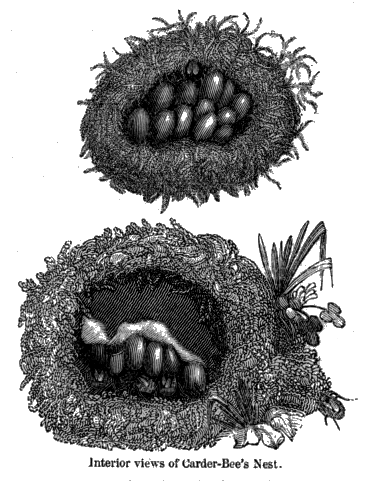
Interior views of Carder-Bee’s Nest.
The carder-bees may be easily distinguished from their congeners (of the same genus), by being not unlike the colour of the withered moss with which they build their nests, having the fore part of their back a dull orange, and hinder part ringed with different shades of greyish yellow. They are not so large as the common humble-bee (Bombus terrestris, Latr.), but rather shorter and thicker in the body than the common hive-bee (Apis mellifica).
Lapidary-Bees.
A bee still more common, perhaps, than the carder is the orange-tailed bee, or lapidary (Bombus lapidaria), readily known by its general black colour and reddish orange tail. It builds its nest sometimes in stony ground, but prefers a heap of stones such as are gathered off grass fields or are piled up near quarries. Unlike the carder, the lapidary carries to its nest bits of moss, which are very neatly arranged into a regular oval. These insects associate in their labours; and they make honey with great industry. The individuals of a nest are more numerous than the carders, and likewise more pertinaciously vindictive. About two years ago we discovered a nest of these bees at Compton-Bassett, in Wiltshire, in the centre of a heap of limestone rubbish; but owing to the brisk defensive warfare of their legionaries, we could not obtain a view of the interior. It was not even safe to approach within many yards of the place; and we do not exaggerate when we say that several of them pursued us most pertinaciously about a quarter of a mile. (J. R.)
Humble-Bees.
The common humble-bee (Bombus terrestris) is precisely similar in its economy to the two preceding species, with this difference, that it forms its nest underground like the common wasp, in an excavated chamber, to which a winding passage leads, of from one to two feet, and of a diameter sufficient to allow of two bees passing. The cells have no covering beside the vault of the excavation and patches of coarse wax similar to that of the carder-bee.
[The accompanying illustration represents a group of cells made by this species. As may be seen by reference to the engraving, they are not placed with any regularity, but seem to be tossed about at random.
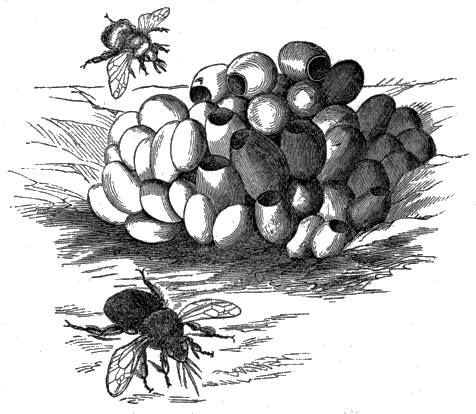
Some of the cells contain larvæ, in others, those closely sealed, lie the pupæ in different stages of development, and some of the cells are filled with a very fragrant and sweet honey, which, however, is injurious to many persons, giving them severe and persistent headaches, even though taken in small quantities.]
Social-Wasps.
The nest of the common wasp (Vespa vulgaris) attracts more or less the attention of everybody; but its interior architecture is not so well known as it deserves to be, for its singular ingenuity, in which it rivals even that of the hive-bee (Apis mellifica). In their general economy the social or republican wasps closely resemble the humble-bee (Bombus), every colony being founded by a single female who has survived the winter, to the rigours of which all her summer associates of males and working wasps uniformly fall victims. Nay, out of three hundred females which may be found in one vespiary, or wasp’s nest, towards the close of autumn, scarcely ten or a dozen survive till the ensuing spring, at which season they awake from their hibernal lethargy, and begin with ardour the labours of colonization.
It may be interesting to follow one of these mother wasps through her several operations, in which she merits more the praise of industry than the queen of a bee-hive, who does nothing, and never moves without a numerous train of obedient retainers, always ready to execute her commands and to do her homage. The mother wasp, on the contrary, is at first alone, and is obliged to perform every species of drudgery herself.
Her first care, after being roused to activity by the returning warmth of the season, is to discover a place suitable for her intended colony; and, accordingly, in the spring, wasps may be seen prying into every hole of a hedge-bank, particularly where field-mice have burrowed. Some authors report that she is partial to the forsaken galleries of the mole; but this does not accord with our observations, as we have never met with a single vespiary in any situation likely to have been frequented by moles. But though we cannot assert the fact, we think it highly probable that the deserted nest of the field-mouse, which is not uncommon in hedge-banks, may be sometimes appropriated by a mother wasp as an excavation convenient for her purpose. Yet, if she does make choice of the burrow of a field-mouse, it requires to be afterwards considerably enlarged in the interior chamber, and the entrance gallery very much narrowed.
The desire of the wasp to save herself the labour of excavation, by forming her nest where other animals have burrowed, is not without a parallel in the actions of quadrupeds, and even of birds. In the splendid continuation of Wilson’s American Ornithology, by Charles L. Bonaparte (whose scientific pursuits have thrown around that name a beneficent lustre, pleasingly contrasted with his uncle’s glory), there is an interesting example of this instinctive adoption of the labours of others. "In the trans-Mississippian territories of the United States, the burrowing-owl resides exclusively in the villages of the marmot, or prairie-dog, whose excavations are so commodious as to render it unnecessary that the owl should dig for himself, as he is said to do where no burrowing animals exist.[U] The villages of the prairie-dog are very numerous and variable in their extent,—sometimes covering only a few acres, and at others spreading over the surface of the country for miles together. They are composed of slightly-elevated mounds, having the form of a truncated cone, about two feet in width at the base, and seldom rising as high as eighteen inches from the surface of the soil. The entrance is placed either at the top or on the side, and the whole mound is beaten down externally, especially at the summit, resembling a much-used footpath. From the entrance, the passage into the mound descends vertically for one or two feet, and is thence continued obliquely downwards until it terminates in an apartment, within which the industrious prairie-dog constructs, on the approach of cold weather, a comfortable cell for his winter’s sleep. The cell, which is composed of fine dry grass, is globular in form, with an opening at top, capable of admitting the finger; and the whole is so firmly compacted, that it might without injury be rolled over the floor."[V]
In case of need the wasp is abundantly furnished by nature with instruments for excavating a burrow out of the solid ground, as she no doubt most commonly does—digging the earth with her strong mandibles, and carrying it off or pushing it out as she proceeds. The entrance gallery is about an inch or less in diameter, and usually runs in a winding or zig-zag direction, from one to two feet in depth. In the chamber to which this gallery leads, and which, when completed, is from one to two feet in diameter, the mother wasp lays the foundations of her city, beginning with the walls.
The building materials employed by wasps were long a matter of conjecture to scientific inquirers; for the bluish-grey papery substance of the whole structure has no resemblance to any sort of wax employed by bees for a similar purpose. Now that the discovery has been made, we can with difficulty bring ourselves to believe that a naturalist so acute and indefatigable as M. Réaumur, should have, for twenty years, as he tells us, endeavoured, without success, to find out the secret. At length, however, his perseverance was rewarded. He remarked a female wasp alight on the sash of his window, and begin to gnaw the wood with her mandibles; and it struck him at once that she was procuring materials for building. He saw her detach from the wood a bundle of fibres about a tenth of an inch in length, and finer than a hair; and as she did not swallow these, but gathered them into a mass with her feet, he could not doubt that his first idea was correct. In a short time she shifted to another part of the window-frame, carrying with her the fibres she had collected, and to which she continued to add, when he caught her, in order to examine the nature of her bundle; and he found that it was not yet moistened nor rolled into a ball, as is always done before employing it in building. In every other respect it had precisely the same colour and fibrous texture as the walls of a vespiary. It struck him as remarkable that it bore no resemblance to wood gnawed by other insects, such as the goat-moth caterpillar, which is granular like sawdust. This would not have suited the design of the wasp, who was well aware that fibres of some length form a stronger texture. He even discovered, that before detaching the fibres, she bruised them (les charpissoit) into a sort of lint (charpie) with her mandibles. All this the careful naturalist imitated by bruising and paring the same wood of the window-sash with his penknife, till he succeeded in making a little bundle of fibres scarcely to be distinguished from that collected by the wasp.
We have ourselves frequently seen wasps employed in procuring their materials in this manner, and have always observed that they shift from one part to another more than once in preparing a single load—a circumstance which we ascribe entirely to the restless temper peculiar to the whole order of hymenopterous insects. Réaumur found that the wood which they preferred was such as had been long exposed to the weather, and is old and dry. White of Selborne, and Kirby and Spence, on the contrary, maintain that wasps obtain their paper from sound timber, hornets only from that which is decayed.[W] Our own observations, however, confirm the statement of Réaumur with respect to wasps, as, in every instance which has fallen under our notice, the wood selected was very much weathered; and in one case, an old oak post in a garden at Lee, in Kent, half destroyed by dry-rot, was seemingly the resort of all the wasps in the vicinity. In another case, the deal bond in a brick wall, which had been built thirty years, is at this moment (June, 1829) literally striped with the gnawings of wasps, which we have watched at the work for hours together. (J. R.)
[Different species of wasps use different materials for their nest. Vespa vulgaris always uses decayed wood, while V. germanica and other species use sound wood. Owing to the colour, the distinction between the nests of these insects is evident at a glance.
The bundles of ligneous fibres thus detached are moistened before being used, with a glutinous liquid, which causes them to adhere together, and are then kneaded into a sort of paste, or papier maché.
The method employed by the wasp in making its nest has been so admirably described by Mr. S. Stone, that we cannot do better than copy his description, which appeared in “Beeton’s Annual” of 1865.
"Having found a place suitable—the deserted burrows of the field-mice being perhaps more generally selected than any other by the underground species, the chamber formed by that animal for its nest being exactly the kind of place required by the insect—it proceeds to attach its web to the centre of the roof of the chamber. This consists, in the first instance, of a pedicle, or footstalk, about half an inch in length, at the extremity of which a single cell is formed, which is presently surrounded by others.
"Simultaneously with the formation of these cells, an umbrella-shaped covering is prepared above them. More cells are added, an egg being deposited in each of them as soon as formed, while constant additions are made to the covering until it has assumed a globular form, with only an aperture sufficiently large for the insect to pass in and out. Before the completion of the first covering, a second, just large enough to enclose it, is begun, and while this is in progress a third is commenced, and then a fourth, and so on. When young wasps have been produced in sufficient numbers to carry on the work without the assistance of the parent, an event which usually takes place in about six weeks from the commencement of the nest, she does not again leave home, but occupies herself solely in the task of depositing eggs as fast as cells can be formed by the workers for their reception.
"There are two methods by which the nests are enlarged by the workers after the queen has given up the task of building; some species choosing one, some adopting the other. One consists in forming a series of regular sheets or layers, which are made to overlap each other like the slates or tiles on the roof of a building, in the same way as is pursued by the queen of every species so long as she continues to be the architect. When a few of these sheets have been completed, that is, when they have been made to assume a spherical form, with only a small aperture for ingress and egress, each internal sheet is cut away, nearly but not quite, as fast as additional ones are formed externally, the shell or covering therefore slightly increasing in thickness as the nest increases in size. Thus architects among the human race are careful to proportion the thickness, and consequently the strength of the walls to the magnitude of the building designed to be erected.
"The other method consists in forming hollow pieces, or raising, as it were, blisters all over the plain surface which the queen has left; and upon these other blisters, and so on continually; cutting away, as in the former case, the under skin on the formation of the outer one. The latter method is adopted by the workers of V. crabro, V. vulgaris, and V. germanica; the former by V. Norvegica, V. sylvestris, V. rufa, and probably by V. arborea. Cutting away the inner portions of the coverings is a necessary process in order to make room for the increased size of the comb or combs. The material cut away is not thrown by as useless, but is worked up afresh; indeed this is effected in, and by, the very act of removing it; it is then either used in enlarging the combs or it is brought out and employed in making additions to the outside.
"As the nest increases in size, it is obvious that the cavity in which it is placed must be proportionably enlarged; accordingly, each wasp, as it emerges from the aperture, may be observed to bring out with it a small lump of earth which it has scraped from the walls of the chamber, care being taken to keep a clear space of about a quarter of an inch between the covering of the nest, and the walls of the chamber. About the same space also occurs between the combs, which are placed horizontally, with the mouth of the cells downwards; supporting columns or pillars being constructed at regular intervals so as to keep them at a proper distance apart, thus allowing the insects room to pass between them for the purpose of feeding the grubs. Supporting columns or pillars are also placed between the roof of the chamber and the crown of the nest, connecting the one with the other; and these supports are constantly strengthened as the increasing weight of the nest renders such a precaution necessary.
"The material of which the wasps’ nests are composed is a sort of paper manufactured chiefly from wood by the insects themselves; one species using sound wood for the purpose, another that which has become decayed. This they scrape by means of their jaws from posts, rails, gates, hurdles, &c., in which act it becomes mixed with some peculiar fluid with which they are provided; it then possesses nearly the same properties as the pulp from which paper is made, but is of firmer consistence. This is gathered in a small lump under the chest, to which it adheres, and in that way is carried to the nest.
"The operators having, after the exhibition of a considerable amount of fickleness in the choice, fixed upon a suitable place for commencing, or recommencing operations—for these remarks have reference to a nest already somewhat advanced in the building—place themselves along the edge of a yet unfinished piece, then walking slowly backward, spread the material as they go, along this edge, where it forms a thick streak; they then go forward to the point at which they began to spread the composition, again marching slowly backward, press this streak between their jaws, which acts as a pair of pincers, thus thinning it out throughout its whole length. They then go forward a second time, pressing it still thinner, and then a third, and so on, until they have rendered it sufficiently thin. Before this is accomplished, the operators have generally to go five or six times over their work. They do not return to the same spot with their next burden, but seek a fresh one, and thus allow the work they recently executed to become dry and firm, previous to making further additions to it. Possibly the material first ‘used up’ was from wood of a dark colour; the next may be from light-coloured wood, and the next from that of an intermediate colour; and this it is which gives so much beauty to the coverings of the nests of these insects.
"Vespa crabro and V. vulgaris are the only species which use decayed wood or touchwood in the fabrication of their nests; the other species employ sound wood, varied occasionally by sound vegetable fibre obtained from plants of different kinds.
"From the upper combs in a nest, workers are produced; from the lower ones, queens or females; and from the intermediate ones, males. Workers become developed early in the season, males not till an advanced period; and young females or queens not until towards the close of the season.
“The nests of V. crabro, V. vulgaris, and V. germanica, when of full size, measure not unfrequently twelve inches in diameter, the communities working on, in a favourable season, until the month of November; while the labours of the other species close, and the communities break up towards the end of August; their nests scarcely attaining to half the size of those above mentioned.”
The accompanying illustration exhibits the nest of the common wasp in an early stage. The first cover has been completed, and a second is in course of progress. We have now before us a beautiful series of wasps’ nests, in their various stages, prepared by Mr. Stone, in order to show the progressive enlargement of the edifice.
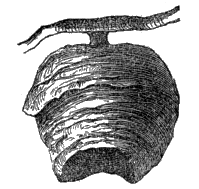
Nest of Wasp in an early stage.
First, there is the single cell attached to a small part that had penetrated the roof of the burrow. Next comes a more advanced stage, in which three cells are made, and the roof is just begun, being not quite half an inch in diameter. Then come five cells, and a tolerably large roof; and then twelve cells, with a complete roof.
The next stage is that which is represented in the illustration, where the group of cells is seen suspended from its slender footstalk, and a second covering is in progress. By degrees the nest enlarges until the second layer or tier of cells is begun, while the first tier is occupied in the centre by the pupæ, sheltered by their little silk doors, and on the circumference by the larvæ, whose cells are still open in order to allow themselves to be fed by the nurse-wasps.
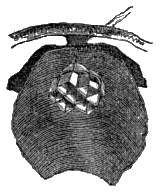
Section of the same Nest, showing the first tier of Cells.
In these nests, the difference between the homes of Vespa vulgaris and those of V. germanica is very strongly marked, the former being yellowish brown, and the latter grey. One nest of V. germanica, is remarkable for being thickly studded with the long, white eggs of some insect, probably a parasite, which has gained admittance to the burrow, in spite of the care of its guardians. It may be here mentioned, that V. germanica is by far the most common species of wasp in England.
The illustration at p. 90 represents a completed nest of V. germanica. The rough, thick covering is seen outside, and within are the tiers of cells, each layer being supported by pillars from the layer immediately above. These pillars are always formed at the angle where these cells touch each other, so as to obtain as strong a foundation as possible. Only a very small space is left between the combs, just enough room, in fact, for the nurse-wasps to pass as they feed the young. The reader will remember that the young wasps all hang with their heads downwards, being held in their places by a sort of clasper at the end of the tail.]
When the foundress-wasp has completed a certain number of cells, and deposited eggs in them, she soon intermits her building operations, in order to procure food for the young grubs, which now require all her care. In a few weeks these become perfect wasps, and lend their assistance in the extension of the edifice; enlarging the original coping of the foundress by side walls, and forming another platform of cells, suspended to the first by columns, as that had been suspended to the ceiling.
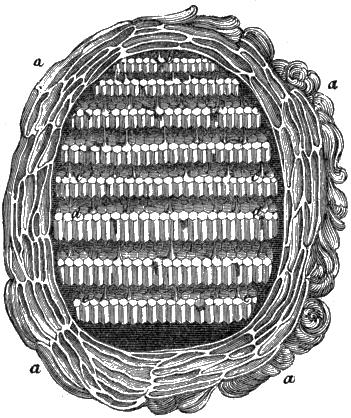
Section of the Social-Wasp’s Nest. a a, the external wall; b, c c, five small terraces of cells for the neuter wasps, d d, e e, three rows of larger cells for the males and females.
In this manner several platforms of combs are constructed, the outer walls being extended at the same time; and, by the end of the summer, there is generally from twelve to fifteen platforms of cells. Each contains about 1060 cells—forty-nine being contained in an inch and a half square, and, of course, making the enormous number of about 16,000 cells in one colony. Réaumur, upon these data, calculates that one vespiary may produce every year more than 30,000 wasps, reckoning only 10,000 cells, and each serving successively for the cradle of three generations. But, although the whole structure is built at the expense of so much labour and ingenuity, it has scarcely been finished before the winter sets in, when it becomes nearly useless, and serves only for the abode of a few benumbed females, who abandon it on the approach of spring, and never return; for wasps do not, like mason-bees, ever make use of the same nest for more than one season.
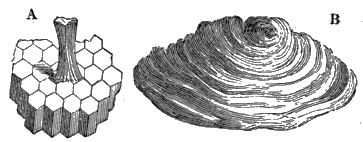
A, represents one of the rods from which the terraces are suspended. B, a portion of the external crust.
Both Réaumur and the younger Huber studied the proceedings of the common wasp in the manner which has been so successful in observing bees—by means of glazed hives, and other contrivances. In this, these naturalists were greatly aided by the extreme affection of wasps for their young; for though their nest is carried off, or even cut in various directions, and exposed to the light, they never desert it, nor relax their attention to their progeny. When a wasp’s nest is removed from its natural situation, and covered with a glass hive, the first operation of the inhabitants is to repair the injuries it has suffered. They carry off with surprising activity all the earth or other matters which have fallen by accident into the nest; and when they have got it thoroughly cleared of everything extraneous, they begin to secure it from further derangement, by fixing it to the glass with papyraceous columns, similar to those which we have already described. The breaches which the nest may have suffered are then repaired, and the thickness of the walls is augmented, with the design, perhaps, of more effectually excluding the light.
* * * * *
The nest of the hornet is nearly the same in structure with that of the wasp; but the materials are considerably coarser, and the columns to which the platforms of cells are suspended are larger and stronger, the middle one being twice as thick as any of the others. The hornet, also, does not build underground, but in the cavities of trees, or in the thatch or under the eaves of barns. Réaumur once found upon a wall a hornet’s nest which had not been long begun, and had it transferred to the outside of his study-window; but in consequence, as he imagined, of the absence of the foundress-hornet at the time it was removed, he could not get the other five hornets, of which the colony consisted, either to add to the building or repair the damages which it had sustained.
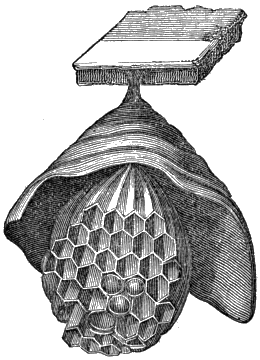
Hornet’s Nest in its first stage.
M. Réaumur differs from our English naturalists, White, and Kirby and Spence, with respect to the materials employed by the hornet for building. The latter say that it employs decayed wood; the former, that it uses the bark of the ash-tree, but takes less pains to split it into fine fibres than wasps do; not, however, because it is destitute of skill; for in constructing the suspensory columns of the platforms, a paste is prepared little inferior to that made by wasps. We cannot, from our own observations, decide which of the above statements is correct, as we have only once seen a hornet procuring materials, at Compton-Bassett, in Wiltshire; and in that case it gnawed the inner bark of an elm which had been felled for several months, and was, consequently, dry and tough. Such materials as this would account for the common yellowish-brown colour of a hornet’s nest. (J. R.)
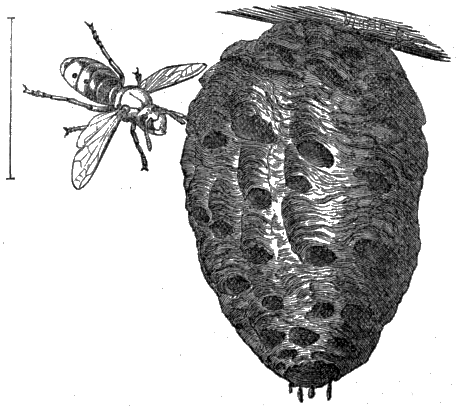
[The accompanying figure represents a completed hornet’s nest as it appears when suspended from a beam. Hornets often choose for their home the space between the roof and the ceiling of summer-houses, and the nests that are made in such localities are mostly large and handsome. The reader should notice the blisters by means of which the insect enlarges its habitation.]
When hornets make choice of a tree for their domicile, they select one which is in a state of decay, and already partly hollowed; but they possess the means, in their sharp and strong mandibles, of extending the excavation to suit their purposes; and Réaumur frequently witnessed their operations in mining into a decayed tree, and carrying off what they had gnawed. He observed, also, that in such cases they did not make use of the large hole of the tree for an entrance, but went to the trouble of digging a gallery, sufficient for the passage of the largest hornet in the nest, through the living and undecayed portion of the tree. As this is perforated in a winding direction, it is no doubt intended for the purpose of protecting the nest from the intrusion of depredators, who could more easily effect an entrance if there were not such a tortuous way to pass through.
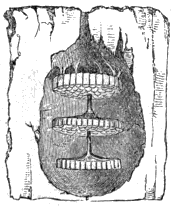
Hornet’s Nest in a hollow tree.
[Here is an illustration of a hornet’s nest as it appears in the hollow of a tree. Industrious as is this insect, it never takes needless trouble, and alters its nest according to circumstances. As has already been seen, the combs are defended by a complete cover when the nest is placed in an open situation. But when it is built in the hollow of a tree there is no cover at all, the insect evidently knowing that the wooden wall with which the cells are surrounded, affords a sufficient protection. In cases where a cover is made, the hornets do not form only a single entrance, as is the case with the wasp, but have a large number of small entrances in different parts of the wall. Some of these entrances can be seen in the illustration on page 93.
Hornets are in one sense more industrious than wasps. When night falls, the wasps betake themselves to their home, and sleep throughout the night. But, if the moon be up, the hornet is sure to work throughout the entire night, and will often do so, even when no moon is visible.]
* * * * *
One of the most remarkable of our native social wasps is the tree-wasp (Vespa Britannica), which is not uncommon in the northern, but is seldom to be met with in the southern parts of the island. Instead of burrowing in the ground like the common wasp (Vespa vulgaris), or in the hollows of trees like the hornet (Vespa crabro), it boldly swings its nest from the extremity of a branch, where it exhibits some resemblance, in size and colour, to a Welsh wig hung out to dry. We have seen more than one of these nests on the same tree, at Catrine, in Ayrshire, and at Wemyss Bay, in Renfrewshire. The tree which the Britannic wasp prefers is the silver fir, whose broad flat branch serves as a protection to the suspended nest both from the sun and the rain. We have also known a wasp’s nest of this kind in a gooseberry-bush, at Red-house Castle, East Lothian. The materials and structure are nearly the same as those employed by the common wasp, and which we have already described. (J. R.)
[We have before us a beautiful example of a nest made by this species of wasp. There are no less than three consecutive coverings quite entire, while another is about three-fourths completed, and a fifth is just begun. The illustration exhibits a very perfect specimen.]
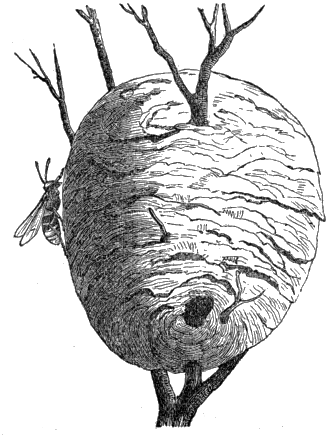
A singular nest of a species of wasp is figured by Réaumur, but is apparently rare in this country, as Kirby and Spence mention only a single nest of similar construction, found in a garden at East-Dale. This nest is of a flattened globular figure, and composed of a great number of envelopes, so as to assume a considerable resemblance to a half-expanded Provence rose. The British specimen mentioned by Kirby and Spence had only one platform of cells; Réaumur had two; but there was a large vacant space, which would probably have been filled with cells, had the nest not been taken away as a specimen. The whole nest was not much larger than a rose, and was composed of paper exactly similar to that employed by the common ground-wasp.[X]
[This is probably the nest of V. rufa. We possess several specimens of the nest, one of which corresponds tolerably closely with the edifice described in the work.]
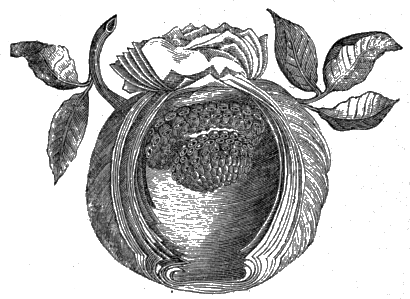
Wasp’s Nest.
There is another species of social-wasp (Epipone nidulans, Latr.) meriting attention from the singular construction of its nest. It forms one or more terraces of cells, similar to those of the common wasp, but without the protection of an outer wall, and quite exposed to the weather. Swammerdam found a nest of this description attached to the stem of a nettle. Réaumur says that they are sometimes attached to the branch of a thorn or other shrub, or to stalks of grass;—peculiarities which prove that there are several species of these wasps.
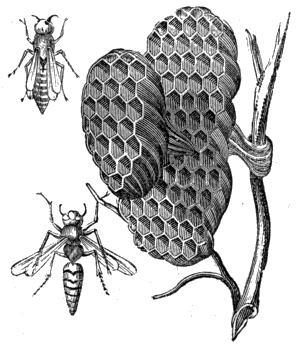
Wasps’ Cells attached to a Branch.
The most remarkable circumstance in the architecture of this species of vespiary is, that it is not horizontal, like those formerly described, but nearly vertical. The reason appears to be, that if it had been horizontal, the cells must have been frequently filled with rain; whereas, in the position in which it is placed, the rain runs off without lodging. It is, besides, invariably placed so as to face the north or the east, and consequently is less exposed to rains, which most frequently come with southerly or westerly winds. It is another remarkable peculiarity, that, unlike the nests of other wasps, it is covered with a shining coat of varnish, to prevent moisture from soaking into the texture of the wasp’s paper. The laying on this varnish, indeed, forms a considerable portion of the labour of the colony, and individuals may be seen employed for hours together spreading it on with their tongues.
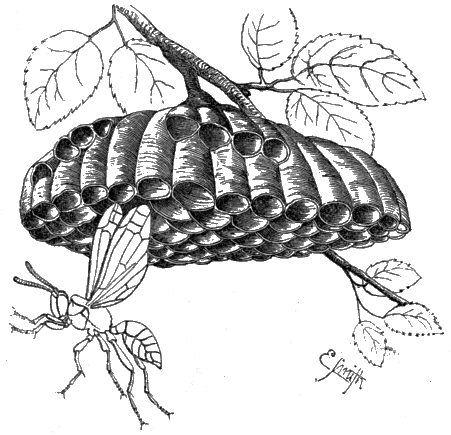
Comb of Polistes.
[There is a genus of foreign hymenoptera, called Polistes, which is remarkable for the building powers possessed by its members. The accompanying illustration is taken from a nest in the British Museum, and is given of the natural size. The cells are not hexagonal, like those of the Epipone, but are roundish in form. Those in the centre assume a roughly hexagonal form by pressure, but those which form the circumference of the cell-group are nearly round, especially on their outer sides. The cells are not of uniform width, but are narrower at the base than at the mouth, thus causing the group to assume the form which is seen in the illustration. This curious group of cells was brought from Bareilly, in the East Indies, and in the same collection there are several other specimens, varying considerably both in shape and size.]
Few circumstances are more striking, with regard to insects, as Kirby and Spence justly remark, than the great and incessant labour which maternal affection for their progeny leads them to undergo. Some of these exertions are so disproportionate to the size of the insect, that nothing short of ocular conviction could attribute them to such an agent. A wild bee, or a wasp, for instance, as we have seen, will dig a hole in a hard bank of earth some inches deep, and five or six times its own size, labouring unremittingly at this arduous task for several days in succession, and scarcely allowing itself a moment for eating or repose. It will then occupy as much time in searching for a store of food; and no sooner is this finished, than it will set about repeating the process, and, before it dies, will have completed five or six similar cells, or even more.
We shall have occasion more particularly to dwell upon the geometrical arrangement of the cells, both of the wasp and of the social-bee, in our description of those interesting operations, which have long attracted the notice, and commanded the admiration of mathematicians and naturalists. A few observations may here be properly bestowed upon the material with which the wasp-family construct the interior of their nests.
The wasp is a paper-maker, and a most perfect and intelligent one. While mankind were arriving, by slow degrees, at the art of fabricating this valuable substance, the wasp was making it before their eyes, by very much the same process as that by which human hands now manufacture it with the best aid of chemistry and machinery. While some nations carved their records on wood, and stone, and brass, and leaden tablets,—others, more advanced, wrote with a style on wax,—others employed the inner bark of trees, and others the skins of animals rudely prepared,—the wasp was manufacturing a firm and durable paper. Even when the papyrus was rendered more fit, by a process of art, for the transmission of ideas in writing, the wasp was a better artisan than the Egyptians; for the early attempts at paper-making were so rude, that the substance produced was almost useless, from being extremely friable. The paper of the papyrus was formed of the leaves of the plant, dried, pressed, and polished; the wasp alone knew how to reduce vegetable fibres to a pulp, and then unite them by a size or glue, spreading the substance out into a smooth and delicate leaf. This is exactly the process of paper-making. It would seem that the wasp knows, as the modern paper-makers now know, that the fibres of rags, whether linen or cotton, are not the only materials that can be used in the formation of paper; she employs other vegetable matters, converting them into a proper consistency by her assiduous exertions. In some respects she is more skilful even than our paper-makers, for she takes care to retain her fibres of sufficient length, by which she renders her paper as strong as she requires. Many manufacturers of the present day cut their material into small bits, and thus produce a rotten article. One great distinction between good and bad paper is its toughness; and this difference is invariably produced by the fibre of which it is composed being long, and therefore tough; or short, and therefore friable.