Front matter (continued 6)
Reading edition
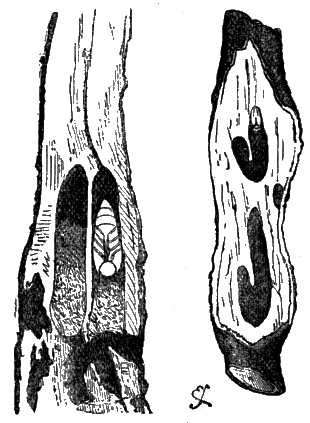
The last wood-boring beetle which will be mentioned is the stag-beetle of our own country. In the larval state this insect resides in tree trunks, mostly towards the roots, and therefore escapes observation more successfully than would be the case if it inhabited a higher portion of the tree. When full-grown, the larva is of enormous size, and the hole which it bores is necessarily of corresponding dimensions. In some parts of England, the larvæ are popularly called “Joe Bassetts,” and are said to turn into “Pincher Bobs.” The latter title is a very appropriate one, as any one can testify who has allowed a fine male stag-beetle to grip his finger between its jaws. As to the Joe Bassett, it is simply a local name.]
Cerambyx carcharias. Cerambyx populneus.
CHAPTER XIII.
STRUCTURES OF GRASSHOPPERS, CRICKETS, AND BEETLES.
Grasshoppers, locusts, crickets, and beetles are, in many respects, no less interesting than the insects whose architectural proceedings we have already detailed. They do not, indeed, build any edifice for the accommodation of themselves or their progeny; but most, if not all of them, excavate retreats in walls or in the ground.
The house-cricket (Acheta domestica) is well known for its habit of picking out the mortar of ovens and kitchen fire-places, where it not only enjoys warmth, but can procure abundance of food. It is usually supposed that it feeds on bread. M. Latreille says it only eats insects, and it certainly thrives well in houses infested by the cockroach; but we have also known it eat and destroy lamb’s-wool stockings, and other woolen stuffs, hung near a fire to dry. It is evidently not fond of hard labour, but prefers those places where the mortar is already loosened, or at least is new, soft, and easily scooped out; and in this way it will dig covert ways from room to room. In summer, crickets often make excursions from the house to the neighbouring fields, and dwell in the crevices of rubbish, or the cracks made in the ground by dry weather, where they chirp as merrily as in the snuggest chimney-corner. Whether they ever dig retreats in such circumstances we have not ascertained: though it is not improbable they may do so for the purpose of making nests. M. Bory St. Vincent tells us that the Spaniards are so fond of crickets that they keep them in cages like singing birds.[CC]
The Mole-Cricket, with a separate outline of one of its hands.
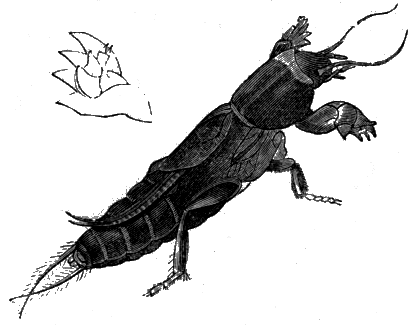
The Mole-Cricket.
The insect, called, from its similarity of habits to the mole, the mole-cricket (Gryllotalpa vulgaris, Latr.), is but too well known in gardens, corn-fields, and the moist banks of rivers and ponds, in some parts of England, such as Wiltshire and Hampshire, though it is comparatively rare or unknown in others. It burrows in the ground, and forms extensive galleries similar to those of the mole, though smaller; and these may always be recognized by a slightly elevated ridge of mould: for the insect does not throw up the earth in hillocks like the mole, but gradually, as it digs along, in the manner of the field-mouse. In this way it commits great ravages, in hotbeds and in gardens, upon peas, young cabbages, and other vegetables, the roots of which it is said to devour. It is not improbable, we think, that, like its congener, the house-cricket, it may also prey upon underground insects, and undermine the plants to get at them, as the mole has been proved to do. Mr Gould, indeed, fed a mole-cricket for several months upon ants.
The structure of the mole-cricket’s arms and hands (if we may call them so) is admirably adapted for these operations, being both very strong, and moved by a peculiar apparatus of muscles. The breast is formed of a thick, hard, horny substance, which is further strengthened within by a double framework of strong gristle, in front of the extremities of which the shoulder-blades of the arms are firmly jointed: a structure evidently intended to prevent the breast from being injured by the powerful action of the muscles of the arms in digging. The arms themselves are strong and broad, and the hand is furnished with four large sharp claws, pointed somewhat obliquely outwards, this being the direction in which it digs, throwing the earth on each side of its course. So strongly indeed does it throw out its arms, that we find it can thus easily support its own weight when held between the finger and thumb, as we have tried upon half-a-dozen of the living insects now in our possession.
Nest of the Mole-Cricket.
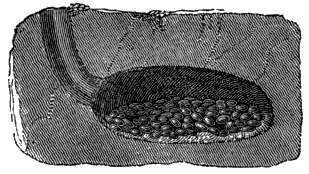
The nest which the female constructs for her eggs, in the beginning of May, is well worthy of attention. The Rev. Mr. White, of Selborne, tells us that a gardener, at a house where he was on a visit, while mowing grass by the side of a canal, chanced to strike his scythe too deep, and pared off a large piece of turf, laying open to view an interesting scene of domestic economy. There was a pretty chamber dug in the clay, of the form and about the dimensions it would have had if moulded by an egg, the walls being neatly smoothed and polished. In this little cell were deposited about a hundred eggs, of the size and form of caraway comfits, and of a dull tarnished white colour. The eggs were not very deep, but just under a little heap of fresh mould, and within the influence of the sun’s heat.[CD] The dull tarnished white colour, however, scarcely agrees with a parcel of these eggs now before us, which are translucent, gelatinous, and greenish.
Like the eggs and young of other insects, however, those of the mole-cricket are exposed to depredation, and particularly to the ravages of a black beetle which burrows in similar localities. The mother insect, accordingly, does not think her nest secure till she has defended it, like a fortified town, with labyrinths, intrenchments, ramparts, and covert ways. In some part of these out-works she stations herself as an advanced guard, and when the beetle ventures within her circumvallations, she pounces upon him and kills him.
The Field-Cricket.
Another insect of this family, the field-cricket (Acheta campestris), also forms burrows in the ground, in which it lodges all day, and comes out chiefly about sunset to pipe its evening song. It is so very shy and cautious, however, that it is by no means easy to discover either the insect or its burrow. “The children in France amuse themselves with hunting after the field-cricket; they put into its hole an ant fastened by a long hair, and as they draw it out the cricket does not fail to pursue it, and issue from its retreat. Pliny informs us it might be captured in a much more expeditious and easy manner. If, for instance, a small and slender piece of stick were to be thrust into the burrow, the insect, he says, would immediately get upon it for the purpose of demanding the occasion of the intrusion: whence arose the proverb, stultior grillo (more foolish than a cricket), applied to one who, upon light grounds, provokes his enemy, and falls into the snares which might have been laid to entrap him.”[CE]
The Rev. Mr. White, who attentively studied their habits and manners, at first made an attempt to dig them out with a spade, but without any great success; for either the bottom of the hole was inaccessible, from its terminating under a large stone, or else in breaking up the ground the poor creature was inadvertently squeezed to death. Out of one thus bruised a great number of eggs were taken, which were long and narrow, of a yellow colour, and covered with a very tough skin. More gentle means were then used, and these proved successful. A pliant stalk of grass, gently insinuated into the caverns, will probe their windings to the bottom, and bring out the inhabitant; and thus the humane inquirer may gratify his curiosity without injuring the object of it.
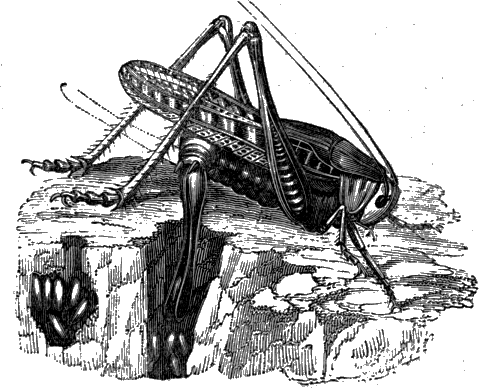
When the males meet, they sometimes fight very fiercely, as Mr. White found by some that he put into the crevices of a dry stone wall, where he wished to have them settle. For though they seemed distressed by being taken out of their knowledge, yet the first that got possession of the chinks seized on all the others that were obtruded upon him with his large row of serrated fangs. With their strong jaws, toothed like the shears of a lobster’s claws, they perforate and round their curious regular cells, having no fore-claws to dig with, like the mole-cricket. When taken into the hand, they never attempt to defend themselves, though armed with such formidable weapons. Of such herbs as grow about the mouths of their burrows they eat indiscriminately, and never in the day-time seem to stir more than two or three inches from home. Sitting in the entrance of their caverns, they chirp all night as well as day, from the middle of the month of May to the middle of July. In hot weather, when they are most vigorous, they make the hills echo; and, in the more still hours of darkness, may be heard to a very considerable distance. “Not many summers ago,” says Mr. White, "I endeavoured to transplant a colony of these insects to the terrace in my garden, by boring deep holes in the sloping turf. The new inhabitants stayed some time, and fed and sang; but they wandered away by degrees, and were heard at a greater distance every morning; so it appears that on this emergency they made use of their wings in attempting to return to the spot from which they were taken."[CF] The manner in which these insects lay their eggs is represented in the following figure, which is that of an insect nearly allied to the crickets, though of a different genus.
Acrida verrucivora depositing her eggs. The usual position of the ovipositor is represented by dots.
A more laborious task is performed by an insect by no means uncommon in Britain, the burying beetle (Necrophorus vespillo), which may be easily recognized by its longish body, of a black colour, with two broad and irregularly indented bands of yellowish brown. A foreign naturalist, M. Gleditsch, gives a very interesting account of its industry. He had "often remarked that dead moles, when laid upon the ground, especially if upon loose earth, were almost sure to disappear in the course of two or three days, often of twelve hours. To ascertain the cause, he placed a mole upon one of the beds in his garden. It had vanished by the third morning; and on digging where it had been laid, he found it buried to the depth of three inches, and under it four beetles, which seemed to have been the agents in this singular inhumation. Not perceiving anything particular in the mole, he buried it again; and on examining it at the end of six days, he found it swarming with maggots, apparently the issue of the beetles, which M. Gleditsch now naturally concluded had buried the carcase for the food of their future young. To determine these points more clearly, he put four of these insects into a glass vessel, half filled with earth and properly secured, and upon the surface of the earth two frogs. In less than twelve hours one of the frogs was interred by two of the beetles; the other two ran about the whole day, as if busied in measuring the dimensions of the remaining corpse, which on the third day was also found buried. He then introduced a dead linnet. A pair of the beetles were soon engaged upon the bird. They began their operations by pushing out the earth from under the body, so as to form a cavity for its reception; and it was curious to see the efforts which the beetles made, by dragging at the feathers of the bird from below, to pull it into its grave. The male, having driven the female away, continued the work alone for five hours. He lifted up the bird, changed its place, turned it, and arranged it in the grave, and from time to time came out of the hole, mounted upon it, and trod it under foot, and then retired below, and pulled it down. At length, apparently wearied with this uninterrupted labour, it came forth, and leaned its head upon the earth beside the bird, without the smallest motion, as if to rest itself, for a full hour, when it again crept under the earth. The next day, in the morning, the bird was an inch and a half under ground, and the trench remained open the whole day, the corpse seeming as if laid out upon a bier, surrounded with a rampart of mould. In the evening it had sunk half an inch lower, and in another day the work was completed, and the bird covered. M. Gleditsch continued to add other small dead animals, which were all sooner or later buried; and the result of his experiment was, that in fifty days four beetles had interred, in the very small space of earth allotted to them, twelve carcases, viz., four frogs, three small birds, two fishes, one mole, and two grasshoppers, besides the entrails of a fish, and two morsels of the lungs of an ox. In another experiment, a single beetle buried a mole, forty times its own bulk and weight, in two days."[CG]
In the summer of 1826, we found on Putney Heath, in Surrey, four of these beetles, hard at work in burying a dead crow, precisely in the manner described by M. Gleditsch. (J. R.)
Dung-Beetle.
A still more common British insect, the dorr, clock, or dung-beetle (Geotrupes stercorarius), uses different materials for burying along with its eggs. “It digs,” to use the words of Kirby and Spence, “a deep cylindrical hole, and carrying down a mass of the dung to the bottom, in it deposits its eggs. And many of the species of the genus Ateuchus roll together wet dung into round pellets, deposit an egg in the midst of each, and when dry push them backwards, by their hind feet, to holes of the surprising depth of three feet, which they have previously dug for their reception, and which are often several yards distant. The attention of these insects to their eggs is so remarkable, that it was observed in the earliest ages, and is mentioned by ancient writers, but with the addition of many fables; as that they were all of the male sex; that they became young again every year; and that they rolled the pellets containing their eggs from sunrise to sunset every day, for twenty-eight days, without intermission.”[CH]
“We frequently notice in our evening walks,” says Mr. Knapp, "the murmuring passage, and are often stricken by the heedless flight of the great dorr-beetle (Geotrupes stercorarius), clocks, as the boys call them. But this evening my attention was called to them in particular, by the constant passing of such a number as to constitute something like a little stream; and I was led to search into the object of their direct flight, as in general it is irregular and seemingly inquisitive. I soon found that they dropped on some recent nuisance: but what powers of perception must these creatures possess, drawn from all distances and directions by the very little fetor which, in such a calm evening, could be diffused around, and by what inconceivable means could odours reach, this beetle in such a manner as to rouse so inert an insect into action! But it is appointed one of the great scavengers of the earth, and marvellously endowed with powers of sensation, and means of effecting this purpose of its being. Exquisitely fabricated as it is to receive impressions, yet probably it is not more highly gifted than any of the other innumerable creatures that wing their way around us, or creep about our paths, though by this one perceptible faculty, thus ‘dimly seen,’ it excites our wonder and surprise. How wondrous then the whole!
"The perfect cleanliness of these creatures is a very notable circumstance, when we consider that nearly their whole lives are passed in burrowing in the earth, and removing nuisances; yet such is the admirable polish of their coating and limbs, that we very seldom find any soil adhering to them. The meloe, and some of the scarabæi, upon first emerging from their winter’s retreat, are commonly found with earth clinging to them; but the removal of this is one of the first operations of the creature; and all the beetle race, the chief occupation of which is crawling about the soil, and such dirty employs, are, notwithstanding, remarkable for the glossiness of their covering, and freedom from defilements of any kind. But purity of vesture seems to be a principal precept of Nature, and observable throughout creation. Fishes, from the nature of the element in which they reside, can contract but little impurity. Birds are unceasingly attentive to neatness and lustration of their plumage. All the slug race, though covered with slimy matter calculated to collect extraneous things, and reptiles, are perfectly free from soil. The fur and hair of beasts, in a state of liberty and health, is never filthy or sullied with dirt. Some birds roll themselves in dust, and, occasionally, particular beasts cover themselves with mire; but this is not from any liking or inclination for such things, but to free themselves from annoyances, or to prevent the bites of insects. Whether birds in preening, and beasts in dressing themselves, be directed by any instinctive faculty, we know not; but they evidently derive pleasure from the operation, and thus this feeling of enjoyment, even if the sole motive, becomes to them an essential source of comfort and of health."[CI]
The rose or green chafer (Cetonia aurata), which is one of our prettiest native insects, is one of the burrowers, and, for the purpose of depositing her eggs, digs, about the middle of June, into soft light ground. When she is seen at this operation, with her broad and delicate wings folded up in their shining green cases, speckled with white, it could hardly be imagined that she had but just descended from the air, or dropped down from some neighbouring rose.
* * * * *
The proceedings of the Tumble-Dung Beetle of America (Scarabæus pilularius, Linn.) are described in a very interesting manner by Catesby, in his ‘Carolina.’ “I have,” says he, "attentively admired their industry, and mutual assisting of each other in rolling their globular balls from the place where they made them to that of their interment, which is usually the distance of some yards, more or less. This they perform breech foremost, by raising their hind parts, and forcing along the ball with their hind feet. Two or three of them are sometimes engaged in trundling one ball, which, from meeting with impediments on account of the unevenness of the ground, is sometimes deserted by them. It is, however, attempted by others with success, unless it happens to roll into some deep hollow or chink, where they are constrained to leave it; but they continue their work by rolling off the next ball that comes in their way. None of them seem to know their own balls, but an equal care for the whole appears to affect all the community. They form these pellets while the dung remains moist, and leave them to harden in the sun before they attempt to roll them. In their moving of them from place to place, both they and the balls may frequently be seen tumbling about the little eminences that are in their way. They are not, however, easily discouraged; and, by repeating their attempts, usually surmount the difficulties."
He further informs us that they “find out their subsistence by the excellency of their noses, which direct them in their flight to newly-fallen dung, on which they immediately go to work, tempering it with a proper mixture of earth. So intent are they always upon their employment, that, though handled or otherwise interrupted, they are not to be deterred, but immediately, on being freed, persist in their work without any apprehension of danger. They are said to be so exceedingly strong and active as to move about, with the greatest ease, things that are many times their own weight. Dr. Brichell was supping one evening in a planter’s house of North Carolina, when two of them were conveyed, without his knowledge, under the candlesticks. A few blows were struck on the table, and, to his great surprise, the candlesticks began to move about, apparently without any agency; and his surprise was not much lessened when, on taking one of them up, he discovered that it was only a chafer that moved it.”
We have often found the necklace-beetle (Carabus monilis) inhabiting a chamber dug out in the earth of a garden, just sufficient to contain its body, and carefully smoothed and polished. From the form of this little nest, it would seem as if it were constructed, not by digging out the earth and removing it, but chiefly by the insect pushing its body forcibly against the walls. The beetles which we have found nestling in this manner have been all males; and therefore it cannot be intended for a breeding-cell; for male insects are never, we believe, sufficiently generous to their mates to assist them in such labours. The beetle in question appears to be partial to celery trenches (J. R.); probably from the loose earth of which they are composed yielding, without much difficulty, to the pressure of its body.
[Many of the subterranean larvæ which are turned up by the spade or the plough are the imperfect conditions of earth-burrowing beetles, and many of them are among the most insidious pests of the farmer, their ravages being all the more dangerous because they are unseen.]
The most destructive, perhaps, of the creatures usually called grubs are the larvæ of the may-bug or cockchafer (Melolontha vulgaris), but too well known, particularly in the southern and midland districts of England, as well as in Ireland, where the grub is called the Connaught worm;[CJ] but fortunately not abundant in the north. We only once met with the cockchafer in Scotland, at Sorn, in Ayrshire. (J. R.) Even in the perfect state, this insect is not a little destructive to the leaves of both forest and fruit trees. In 1823, we remember to have observed almost all the trees about Dulwich and Camberwell defoliated by them; and Salisbury says, the leaves of the oaks in Richmond Park were so eaten by them, that scarcely an entire leaf was left. But it is in their previous larva state that they are most destructive, as we shall see by tracing their history.
The mother cockchafer, when about to lay her eggs, digs into the earth of a meadow or corn-field to the depth of a span, and deposits them in a cluster at the bottom of the excavation. Rösel, in order to watch the proceedings, put some females into glasses half-filled with earth, covered with a tuft of grass and a piece of thin muslin. In a fortnight, he found some hundreds of eggs deposited, of an oval shape and a pale-yellow colour. Placing the glass in a cellar, the eggs were hatched towards autumn, and the grubs increased remarkably in size. In the following May they fed so voraciously that they required a fresh turf every second day; and even this proving too scanty provender, he sowed in several garden pots a crop of peas, lentils, and salad, and when the plants came up he put a pair of grubs in each pot; and in this manner he fed them through the second and third years. During this period, they cast their skins three or four times, going for this purpose deeper into the earth, and burrowing out a hole where they might effect their change undisturbed; and they do the same in winter, during which they become torpid and do not eat.
Transformations of the Cockchafer (Melolontha vulgaris). a, Newly-hatched larvæ. b, larva, one year old. c, the same larva at the second year of its growth. d, the same three years old. e, section of a bank of earth, containing the chrysalis of the fourth year. f, the chafer first emerging from the earth. g, the perfect chafer in a sitting posture. h, the same flying.
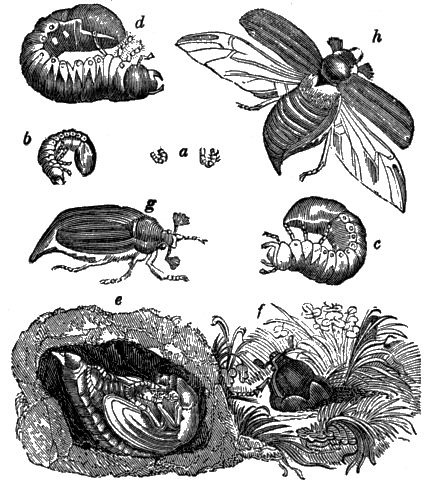
When the grub changes into a pupa, in the third autumn after it is hatched, it digs a similar burrow about a yard deep; and when kept in a pot, and prevented from going deep enough, it shows great uneasiness and often dies. The perfect beetle comes forth from the pupa in January or February; but it is then as soft as it was whilst still a grub, and does not acquire its hardness and colour for ten or twelve days, nor does it venture above ground before May, in the fourth year from the time of its hatching. At this time, the beetles may be observed issuing from their holes in the evening, and dashing themselves about in the air as if blind.
During the three summers then of their existence in the grub state, these insects do immense injury, burrowing between the turf and the soil, and devouring the roots of grass and other plants; so that the turf may easily be rolled off, as if cut by a turfing spade, while the soil underneath for an inch or more is turned into soft mould like the bed of a garden. Mr. Anderson, of Norwich, mentions having seen a whole field of fine flourishing grass so undermined by these grubs, that in a few weeks it became as dry, brittle, and withered as hay.[CK] Bingley also tells us that “about sixty years ago, a farm near Norwich was so infested with cockchafers, that the farmer and his servants affirmed they gathered eighty bushels of them; and the grubs had done so much injury, that the court of the city, in compassion to the poor fellow’s misfortune, allowed him twenty-five pounds.”[CL] In the year 1785, a farmer, near Blois, in France, employed a number of children and poor persons to destroy the cockchafers at the rate of two liards a hundred, and in a few days they collected fourteen thousand.[CM]
“I remember,” says Salisbury, “seeing in a nursery near Bagshot, several acres of young forest trees, particularly larch, the roots of which were completely destroyed by it, so much so that not a single tree was left alive.”[CN] We are doubtful, however, whether this was the grub of the cockchafer, and think it more likely to have been that of the green rose-beetle (Cetonia aurata), which feeds on the roots of trees.
CHAPTER XIV.
ARCHITECTURE OF ANTS.—MASON-ANTS.
All the species of ants are social. There are none solitary, as is the case with bees and wasps. They are all more or less skilful in architecture, some employing masonry, and others being carpenters, wood-carvers, and miners. They consequently afford much that is interesting to naturalists who observe their operations. The genuine history of ants has only been recently investigated, first by Gould in 1747, and subsequently by Linnæus, De Geer, Huber, and Latreille. Previous to that time their real industry and their imagined foresight were held up as moral lessons, without any great accuracy of observation; and it is probable that, even now, the mixture of truth and error in Addison’s delightful papers in the Guardian (Nos. 156, 157) may be more generally attractive than the minute relation of careful naturalists. Gould disproved, most satisfactorily, the ancient fable of ants storing up corn for winter provision, no species of ants ever eating grain, or feeding in the winter upon anything. It is to Huber the younger, however, that we are chiefly indebted for our knowledge of the habits and economy of ants; and to Latreille for a closer distinction of the species. Some of the more interesting species, whose singular economy is described by the younger Huber, have not been hitherto found in this country. We shall, however, discover matter of very considerable interest in those which are indigenous; and as our principal object is to excite inquiry and observation with regard to those insects which may be easily watched in our own gardens and fields, we shall chiefly confine ourselves to the ants of these islands. We shall begin with the labours of those native ants which may be called earth-masons, from their digging in the ground, and forming structures with pellets of moistened loam, clay, or sand.
Mason-Ants.
We have used in the preceding pages the terms mason-bees and mason-wasps, for insects which build their nests of earthy materials. On the same principle, we have followed the ingenious M. Huber the younger, in employing the term mason-ants for those whose nests on the exterior appear to be hillocks of earth, without the admixture of other materials, whilst in the interior they present a series of labyrinths, lodges, vaults, and galleries constructed with considerable skill. Of these mason-ants, as of the mason-wasps and bees already described, there are several species, differing from one another in their skill in the art of architecture.
One of the most common of the ant-masons is the turf-ant (Formica cæspitum, Latr.), which is very small and of a blackish-brown colour. Its architecture is not upon quite so extensive a scale as some of the others; but, though slight, it is very ingenious. Sometimes they make choice of the shelter of a flat stone or other covering, beneath which they hollow out chambers and communicating galleries; at other times they are contented with the open ground; but most commonly they select a tuft of grass or other herbage, the stems of which serve for columns to their earthen walls.
We had a small colony of these ants accidentally established in a flower-pot, in which we were rearing some young plants of the tiger-lily (Lilium tigrinum), the stems of which being stronger than the grass where they usually build, enabled them to rear their edifice higher, and also to make it more secure, than they otherwise might. It was wholly formed of small grains of moist earth, piled up between the stems of the lily without any apparent cement; indeed it has been ascertained by Huber, as we shall afterwards see, that they use no cement beside water. This is not always to be procured, as they depend altogether on rains and dew; but they possess the art of joining grains of dry sand so as to support one another, on some similar principle, no doubt, to that of the arch.
The nest which our turf-ants constructed in the flower-pot was externally of an imperfect square form, in consequence of its situation; for they usually prefer a circular plan. The principal chambers were placed under the arches, and, when inspected, contained a pile of cocoons, and pupæ. Beneath those upper chambers there were others dug out deeper down, in which were also a numerous collection of eggs and cocoons in various stages of advancement. (J. R.)
Mr. Knapp describes a still more curious structure of another species of ant common in this country:—“One year,” says he, "on the third of March, my labourer being employed in cutting up ant-hills, or tumps as we call them, exposed to view multitudes of the yellow species (Formica flava) in their winter’s retirement. They were collected in numbers in little cells and compartments, communicating with others by means of narrow passages. In many of the cells they had deposited their larvæ, which they were surrounding and attending, but not brooding over or covering. Being disturbed by our rude operations, they removed them from our sight to more hidden compartments. The larvæ were small. Some of these ant-hills contained multitudes of the young of the wood-louse (Oniscus armadillo), inhabiting with perfect familiarity the same compartments as the ants, crawling about with great activity with them, and perfectly domesticated with each other. They were small and white; but the constant vibration of their antennæ, and the alacrity of their motions, manifested a healthy vigour. The ants were in a torpid state; but on being removed into a temperate room, they assumed much of their summer’s animation. How these creatures are supported during the winter season it is difficult to comprehend; as in no one instance could we perceive any store or provision made for the supply of their wants. The minute size of the larvæ manifested that they had been recently deposited; and consequently that their parents had not remained during winter in a dormant state, and thus free from the calls of hunger. The preceding month of February, and part of January, had been remarkably severe; the frost had penetrated deep into the earth, and long held it frozen; the ants were in many cases not more than four inches beneath the surface, and must have been enclosed in a mass of frozen soil for a long period; yet they, their young, and the onisci, were perfectly uninjured by it: affording another proof of the fallacy of the commonly received opinion, that cold is universally destructive to insect life."[CO]
The earth employed by mason-ants is usually moist clay, either dug from the interior parts of their city or moistened by rain. The mining-ants and the ash-coloured (Formica fusca) employ earth which is probably not selected with so much care, for it forms a much coarser mortar than what we see used in the structure of the yellow ants (F. flava) and the brown ants (F. brunnea). We have never observed them bringing their building materials of this kind from a distance, like the mason-bees and like the wood or hill ant (F. rufa); but they take care, before they fix upon a locality, that it shall produce them all that they require. We are indebted to Huber the younger for the most complete account which has hitherto been given of these operations, of which details we shall make free use.
“To form,” says this shrewd observer, "a correct judgment of the interior arrangement or distribution of an ant-hill, it is necessary to select such as have not been accidentally spoiled, or whose form has not been too much altered by local circumstances; a slight attention will then suffice to show that the habitations of the different species are not all constructed after the same system. Thus, the hillock raised by the ash-coloured ants will always present thick walls, fabricated with coarse earth, well-marked stories, and large chambers, with vaulted ceilings, resting upon a solid base. We never observe roads, or galleries, properly so called, but large passages, of an oval form, and all around considerable cavities and extensive embankments of earth. We further notice, that the little architects observe a certain proportion between the large arched ceilings and the pillars that are to support them.
"The brown ant (Formica brunnea), one of the smallest of the ants, is particularly remarkable for the extreme finish of its work. Its body is of a reddish shining brown, its head a little deeper, and the antennæ and feet a little lighter in colour. The abdomen is of an obscure brown, the scale narrow, of a square form, and slightly scolloped. The body is one line and two-fifths in length.[CP]
"This ant, one of the most industrious of its tribe, forms its nest of stories four or five lines in height. The partitions are not more than half a line in thickness; and the substance of which they are composed is so finely grained, that the inner walls present one smooth unbroken surface. These stories are not horizontal; they follow the slope of the ant-hill, and lie one upon another to the ground-floor, which communicates with the subterranean lodges. They are not always, however, arranged with the same regularity, for these ants do not follow an invariable plan; it appears, on the contrary, that nature has allowed them a certain latitude in this respect, and that they can, according to circumstances, modify them to their wish; but however fantastical their habitations may appear, we always observe they have been formed by concentrical stories. On examining each story separately, we observe a number of cavities or halls, lodges of narrower dimensions, and long galleries, which serve for general communication. The arched ceilings covering the most spacious places are supported either by little columns, slender walls, or by regular buttresses. We also notice chambers, that have but one entrance, communicating with the lower story, and large open spaces, serving as a kind of cross-road (carrefour), in which all the streets terminate.
"Such is the manner in which the habitations of these ants are constructed. Upon opening them, we commonly find the apartments, as well as the large open spaces, filled with adult ants; and always observed their pupæ collected in the apartments more or less near the surface. This, however, seems regulated by the hour of the day, and the temperature: for in this respect these ants are endowed with great sensibility, and know the degree of heat best adapted for their young. The ant-hill contains, sometimes, more than twenty stories in its upper portion, and at least as many under the surface of the ground. By this arrangement the ants are enabled, with the greatest facility, to regulate the heat. When a too-burning sun overheats their upper apartments, they withdraw their little ones to the bottom of the ant-hill. The ground-floor becoming, in its turn, uninhabitable during the rainy season, the ants of this species transport what most interests them to the higher stories; and it is there we find them more usually assembled, with their eggs and pupæ, when the subterranean apartments are submerged."[CQ]
Ants have a great dislike to water, when it exceeds that of a light shower to moisten their building materials. One species, mentioned by Azara as indigenous to South America, instinctively builds a nest from three to six feet high,[CR] to provide against the inundations during the rainy season. Even this, however, does not always save them from submersion; and, when that occurs, they are compelled, in order to prevent themselves from being swept away, to form a group somewhat similar to the curtain of the wax-workers of hive-bees (see p. 133). The ants constituting the basis of this group lay hold of some shrub for security, while their companions hold on by them; and thus the whole colony, forming an animated raft, floats on the surface of the water till the inundation (which seldom continues longer than a day or two) subsides. We confess, however, that we are somewhat sceptical respecting this story, notwithstanding the very high character of the Spanish naturalist.
It is usual with architectural insects to employ some animal secretion, by way of mortar or size, to temper the materials with which they work; but the whole economy of ants is so different, that it would be wrong to infer from analogy a similarity in this respect, though the exquisite polish and extreme delicacy of finish in their structures lead, naturally, to such a conclusion. M. P. Huber, in order to resolve this question, at first thought of subjecting the materials of the walls to chemical analysis, but wisely (as we think) abandoned it for the surer method of observation. The details which he has given, as the result of his researches, are exceedingly curious and instructive. He began by observing an ant-hill till he could perceive some change in its form.
“The inhabitants,” says he, "of that which I selected, kept within during the day, or only went out by subterranean galleries which opened at some feet distance in the meadow. There were, however, two or three small openings on the surface of the nest; but I saw none of the labourers pass out this way, on account of their being too much exposed to the sun, which these insects greatly dread. This ant-hill, which had a round form, rose in the grass, at the border of a path, and had sustained no injury. I soon perceived that the freshness of the air and the dew invited the ants to walk over the surface of their nest; they began making new apertures; several ants might be seen arriving at the same time, thrusting their heads from the entrances, moving about their antennæ, and at length adventuring forth to visit the environs.
“This brought to my recollection a singular opinion of the ancients. They believed that ants were occupied in their architectural labours during the night, when the moon was at its full.”[CS]
M. Latreille discovered a species of ants which were, so far as he could ascertain, completely blind,[CT] and of course it would be immaterial to them whether they worked by night or during the day. All observers indeed agree that ants labour in the night, and a French naturalist is therefore of opinion that they never sleep—a circumstance which is well ascertained with respect to other animals, such as the shark, which will track a ship in full sail for weeks together.[CU] The ingenious historian of English ants, Gould, says they never intermit their labours by night or by day, except when compelled by excessive rains. It is probable the ancients were mistaken in asserting that they only work when the moon shines;[CV] for, like bees, they seem to find no difficulty in building in the dark, their subterranean apartments being as well finished as the upper stories of their buildings. But to proceed with the narrative of M. P. Huber.
"Having thus noticed the movements of these insects during the night, I found they were almost always abroad and engaged about the dome of their habitation after sunset. This was directly the reverse of what I had observed in the conduct of the wood-ants (F. rufa), who only go out during the day, and close their doors in the evening. The contrast was still more remarkable than I had previously supposed; for, upon visiting the brown ants some days after, during a gentle rain, I saw all their architectural talents in full play.
"As soon as the rain commenced, they left in great numbers their subterranean residence, re-entered it almost immediately, and then returned, bearing between their teeth pellets of earth, which they deposited on the roof of their nest. I could not at first conceive what this was meant for, but at length I saw little walls start up on all sides with spaces left between them. In several places, columns, ranged at regular distances, announced halls, lodges, and passages which the ants proposed establishing; in a word, it was the rough beginning of a new story.
"I watched with a considerable degree of interest the most trifling movements of my masons, and found they did not work after the manner of wasps and humble-bees, when occupied in constructing a covering to their nest. The latter sit, as it were, astride on the border or margin of the covering, and take it between their teeth to model and attenuate it according to their wish. The wax of which it is composed, and the paper which the wasp employs, moistened by some kind of glue, are admirably adapted for this purpose, but the earth of which the ants make use, from its often possessing little tenacity, must be worked up after some other manner.
"Each ant, then, carried between its teeth the pellet of earth it had formed by scraping with the end of its mandibles the bottom of its abode, a circumstance which I have frequently witnessed in open day. This little mass of earth, being composed of particles but just united, could be readily kneaded and moulded as the ants wished; thus when they had applied it to the spot where they had to rest, they divided and pressed against it with their teeth, so as to fill up the little inequalities of their wall. The antennæ followed all their movements, passing over each particle of earth as soon as it was placed in its proper position. The whole was then rendered more compact by pressing it lightly with the fore-feet. This work went on remarkably fast. After having traced out the plan of their masonry, in laying here and there foundations for the pillars and partitions they were about to erect, they raised them gradually higher, by adding fresh materials. It often happened that two little walls, which were to form a gallery, were raised opposite, and at a slight distance from each other. When they had attained the height of four or five lines, the ants busied themselves in covering in the space left between them by a vaulted ceiling.
"As if they judged all their partitions of sufficient elevation, they then quitted their labours in the upper part of the building; they affixed to the interior and upper part of each wall fragments of moistened earth, in an almost horizontal direction, and in such a way as to form a ledge, which, by extension, would be made to join that coming from the opposite wall. These ledges were about half a line in thickness; and the breadth of the galleries was, for the most part, about a quarter of an inch. On one side several vertical partitions were seen to form the scaffolding of a lodge, which communicated with several corridors by apertures formed in the masonry; on another, a regularly-formed hall was constructed, the vaulted ceiling of which was sustained by numerous pillars; further off, again, might be recognised the rudiments of one of those cross roads of which I have before spoken, and in which several avenues terminate. These parts of the ant-hill were the most spacious; the ants, however, did not appear embarrassed in constructing the ceiling to cover them in, although they were often more than two inches in breadth.
"In the upper part of the angles formed by the different walls, they laid the first foundations of this ceiling, and from the top of each pillar, as from so many centres, a layer of earth, horizontal and slightly convex, was carried forward to meet the several portions coming from different points of the large public thoroughfare.
"I sometimes, however, laboured under an apprehension that the building could not possibly resist its own weight, and that such extensive ceilings, sustained only by a few pillars, would fall into ruin from the rain which continually dropped upon them; but I was quickly convinced of their stability, from observing that the earth brought by these insects adhered at all points, on the slightest contact; and that the rain, so far from lessening the cohesion of its particles, appeared even to increase it. Thus, instead of injuring the building, it even contributed to render it still more secure.
"These particles of moistened earth, which are only held together by juxtaposition, require a fall of rain to cement them more closely, and thus varnish over, as it were, those places where the walls and galleries remain uncovered. All inequalities in the masonry then disappear. The upper part of these stories, formed of several pieces brought together, presents but one single layer of compact earth. They require for their complete consolidation nothing but the heat of the sun. It sometimes, however, happens that a violent rain will destroy the apartments, especially should they be but slightly arched; but under these circumstances the ants reconstruct them with wonderful patience.
“These different labours were carried on at the same time, and were so closely followed up in the different quarters, that the ant-hill received an additional story in the course of seven or eight hours. All the vaulted ceilings being formed upon a regular plan, and at equal distances from one wall to the other, constituted, when finished, but one single roof. Scarcely had the ants finished one story than they began to construct another; but they had not time to finish it—the rain ceasing before the ceiling was fully completed. They still, however, continued their work for a few hours, taking advantage of the humidity of the earth; but a keen north wind soon sprung up, and hastily dried the collected fragments, which, no longer possessing the same adherence, readily fell into powder. The ants, finding their efforts ineffectual, were at length discouraged, and abandoned their employment; but what was my astonishment when I saw them destroy all the apartments that were yet uncovered, scattering here and there over the last story the materials of which they had been composed! These facts incontestably prove that they employ neither gum, nor any kind of cement, to bind together the several substances of their nest; but in place of this avail themselves of the rain, to work or knead the earth, leaving the sun and wind to dry and consolidate it.”[CW]
Dr. Johnson of Bristol observed very similar proceedings in the case of a colony of red ants (Myrmica rubra?), the roof of whose nest was formed by a flat stone. During dry weather, a portion of the side walls fell in; but the rubbish was quickly removed, though no repairs were attempted till a shower of rain enabled them to work. As soon as this occurred, they worked with extraordinary rapidity, and in a short time the whole of the fallen parts were rebuilt, and rendered as smooth as if polished with a trowel.
When a gardener wishes to water a plot of ground where he has sown seeds that require nice management, he dips a strong brush into water, and passes his hand backwards and forwards over the hairs for the purpose of producing a fine artificial shower. Huber successfully adopted the same method to excite his ants to recommence their labours, which had been interrupted for want of moisture. But sometimes, when they deem it unadvisable to wait for rain, they dig down (as we remarked to be the practice of the mason-bees) till they arrive at earth sufficiently moist for their purpose. They do not, however, like these bees, merely dig for materials; for they use the excavations for apartments, as well as what they construct with the materials thence derived. They appear, in short, to be no less skilful in mining than in building.
Such is the general outline of the operations of this singular species; but we are still more interested with the history which M. P. Huber has given of the labours of an individual ant. “One rainy day,” he says, "I observed a labourer of the dark ash-coloured species (Formica fusca) digging the ground near the aperture which gave entrance to the ant-hill. It placed in a heap the several fragments it had scraped up, and formed them into small pellets, which it deposited here and there upon the nest. It returned constantly to the same place, and appeared to have a particular design, for it laboured with ardour and perseverance. I remarked a slight furrow, excavated in the ground in a straight line, representing the plan of a path or gallery. The labourer (the whole of whose movements fell under my immediate observation) gave it greater depth and breadth, and cleared out its borders; and I saw, at length—in which I could not be deceived—that it had the intention of establishing an avenue which was to lead from one of the stories to the underground chambers. This path, which was about two or three inches in length, and formed by a single ant, was opened above, and bordered on each side by a buttress of earth. Its concavity, in the form of a pipe (gouttière), was of the most perfect regularity: for the architect had not left an atom too much. The work of this ant was so well followed and understood, that I could almost to a certainty guess its next proceeding, and the very fragment it was about to remove. At the side of the opening where this path terminated was a second opening, to which it was necessary to arrive by some road. The same ant began and finished this undertaking without assistance. It furrowed out and opened another path, parallel to the first, leaving between each a little wall of three or four lines in height."
Like the hive-bees, ants do not seem to work in concert, but each individual separately. There is, consequently, an occasional want of coincidence in the walls and arches; but this does not much embarrass them, for a worker, on discovering an error of this kind, seems to know how to rectify it, as appears from the following observations:—
“A wall,” says M. Huber, "had been erected, with the view of sustaining a vaulted ceiling, still incomplete, that had been projected towards the wall of the opposite chamber. The workman who began constructing it had given it too little elevation to meet the opposite partition, upon which it was to rest. Had it been continued on the original plan, it must infallibly have met the wall at about one-half of its height; and this it was necessary to avoid. This state of things very forcibly claimed my attention; when one of the ants arriving at the place, and visiting the works, appeared to be struck by the difficulty which presented itself; but this it as soon obviated, by taking down the ceiling, and raising the wall upon which it reposed. It then, in my presence, constructed a new ceiling with the fragments of the former one.
"When the ants commence any undertaking, one would suppose that they worked after some preconceived idea, which, indeed, would seem verified by the execution. Thus, should any ant discover upon the nest two stalks of plants which lie crossways, a disposition favourable to the construction of a lodge, or some little beams that may be useful in forming its angles and sides, it examines the several parts with attention; then distributes, with much sagacity and address, parcels of earth in the spaces, and along the stems, taking from every quarter materials adapted to its object, sometimes not caring to destroy the work that others had commenced; so much are its motions regulated by the idea it has conceived, and upon which it acts, with little attention to all else around it. It goes and returns, until the plan is sufficiently understood by its companions.
“In another part of the same ant-hill,” continues M. Huber, “several fragments of straw seemed expressly placed to form the roof of a large house: a workman took advantage of this disposition. These fragments lying horizontally, at half-an-inch distance from the ground, formed, in crossing each other, an oblong parallelogram. The industrious insect commenced by placing earth in the several angles of this framework, and all along the little beams of which it was composed. The same workman afterwards placed several rows of the same materials against each other, when the roof became very distinct. On perceiving the possibility of profiting by another plant to support a vertical wall, it began laying the foundations of it; other ants having by this time arrived, finished in common what this had commenced.”[CX]
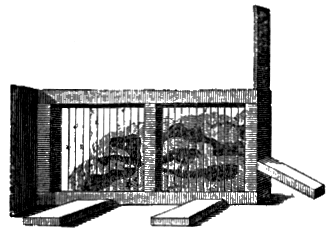
M. Huber made most of his observations upon the processes followed by ants in glazed artificial hives or formicaries. The preceding figure represents a view of one of his formicaries of mason-ants.
We have ourselves followed up his observations, both on natural ant-hills and in artificial formicaries. On digging cautiously into a natural ant-hill, established upon the edge of a garden-walk, we were enabled to obtain a pretty complete view of the interior structure. There were two stories, composed of large chambers, irregularly oval, communicating with each other by arched galleries, the walls of all which were as smooth and well-polished as if they had been passed over by a plasterer’s trowel. The floors of the chambers, we remarked, were by no means either horizontal or level, but all more or less sloped, and exhibiting in each chamber at least two slight depressions of an irregular shape. We left the under story of this nest untouched, with the notion that the ants might repair the upper galleries, of which we had made a vertical section; but instead of doing so they migrated during the day to a large crack formed by the dryness of the weather, about a yard from their old nest. (J. R.)
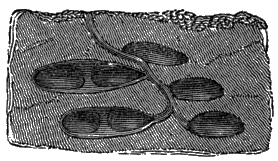
We put a number of yellow ants (Formica flava), with their eggs and cocoons, into a small glass frame, more than half full of moist sand taken from their native hill, and placed in a sloping position, in order to see whether they would bring the nearly vertical, and therefore insecure, portion to a level by masonry. We were delighted to perceive that they immediately resolved upon performing the task which had been assigned them, though they did not proceed very methodically in their manner of building; for instead of beginning at the bottom and building upwards, many of them went on to add to the top of the outer surface, which increased rather than diminished the insecurity of the whole. Withal, however, they seemed to know how far to go, for no portion of the newly-built wall fell; and in two days they had not only reared a pyramidal mound to prop the rest, but had constructed several galleries and chambers for lodging the cocoons, which we had scattered at random amongst the sand. The new portion of this building is represented in the figure as supporting the upper and insecure parts of the nest.
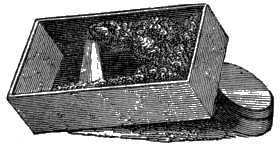
We are sorry to record that our ingenious little masons were found upon the third day strewed about the outside of the building dead or dying, either from over-fatigue or perhaps from surfeit, as we had supplied them with as much honey as they could devour. A small colony of turf-ants have at this moment (July 28th, 1829) taken possession of the premises of their own accord. (J. R.)
CHAPTER XV.
STRUCTURES OF THE WOOD-ANT OR PISMIRE, AND OF CARPENTER-ANTS.
The largest of our British ants is that called the Hill-ant by Gould, the Fallow-ant by the English translator of Huber, and popularly the Pismire; but which we think may be more appropriately named the Wood-ant (Formica rufa, Latr.), from its invariable habit of living in or near woods and forests. This insect may be readily distinguished from other ants by the dusky black colour of its head and hinder parts, and the rusty brown of its middle. The structures reared by this species are often of considerable magnitude, and bear no small resemblance to a rook’s nest thrown upon the ground bottom upwards. They occur in abundance in the woods near London, and in many other parts of the country: in Oak of Honour Wood alone, we are acquainted with the localities of at least two dozen,—some in the interior, and others on the hedge-banks on the outskirts of the wood. (J. R.)
The exterior of the nest is composed of almost every transportable material which the colonists can find in their vicinity; but the greater portion consists of the stems of withered grass and short twigs of trees, piled up in apparent confusion, but with sufficient regularity to render the whole smooth, conical, and sloping towards the base, for the purpose, we may infer, of carrying off rain-water. When within reach of a corn-field, they often also pick up grains of wheat, barley, or oats, and carry them to the nest as building materials, and not for food, as was believed by the ancients. There are wonders enough observable in the economy of ants, without having recourse to fancy—wonders which made Aristotle extol the sagacity of bloodless animals, and Cicero ascribe to them not only sensation, but mind, reason, and memory.[CY] Ælian, however, describes, as if he had actually witnessed it, the ants ascending a stalk of growing corn, and throwing down “the ears which they bit off to their companions below.” Aldrovand assures us that he had seen their granaries; and others pretend that they shrewdly bite off the ends of the grain to prevent it from germinating.[CZ] These are fables which accurate observation has satisfactorily contradicted.
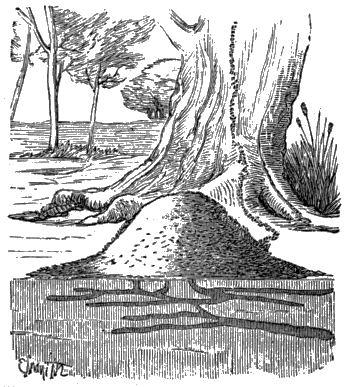
Nest of Wood-Ant.
But these errors, as it frequently happens, have contributed to a more perfect knowledge of the insects than we might otherwise have obtained; for it was the wish to prove or disprove the circumstance of their storing up and feeding upon grain which led Gould to make his observations on English ants; as the notion of insects being produced from putrid carcases had before led Redi to his ingenious experiments on their generation. Yet, although it is more than eighty years since Gould’s book was published, we find the error still repeated in very respectable publications.[DA]
The coping which we above described as forming the exterior of the wood-ant’s nest, is only a small portion of the structure, which consists of a great number of interior chambers and galleries, with funnel-shaped avenues leading to them. The coping, indeed, is one of the most essential parts, and we cannot follow a more delightful guide than the younger Huber in detailing its formation.
“The labourers,” he says, "of which the colony is composed, not only work continually on the outside of their nest, but, differing very essentially from other species, who willingly remain in the interior, sheltered from the sun, they prefer living in the open air, and do not hesitate to carry on, even in our presence, the greater part of their operations.
"To have an idea how the straw or stubble-roof is formed, let us take a view of the ant-hill at its origin, when it is simply a cavity in the earth. Some of its future inhabitants are seen wandering about in search of materials fit for the exterior work, with which, though rather irregularly, they cover up the entrance; whilst others are employed in mixing the earth, thrown up in hollowing the interior, with fragments of wood and leaves, which are every moment brought in by their fellow-assistants; and this gives a certain consistence to the edifice, which increases in size daily. Our little architects leave here and there cavities, where they intend constructing the galleries which are to lead to the exterior, and as they remove in the morning the barriers placed at the entrance of their nest the preceding evening, the passages are kept open during the whole time of its construction. We soon observed the roof to become convex; but we should be greatly deceived did we consider it solid. This roof is destined to include many apartments or stories. Having observed the motions of these little builders through a pane of glass, adjusted against one of their habitations, I am thence enabled to speak with some degree of certainty upon the manner in which they are constructed. I ascertained that it is by excavating or mining the under portion of their edifice that they form their spacious halls—low, indeed, and of heavy construction, yet sufficiently convenient for the use to which they are appropriated, that of receiving, at certain hours of the day, the larvæ and pupæ.
"These halls have a free communication by galleries, made in the same manner. If the materials of which the ant-hill is composed were only interlaced, they would fall into a confused heap every time the ants attempted to bring them into regular order. This, however, is obviated by their tempering the earth with rain-water, which, afterwards hardened in the sun, so completely and effectually binds together the several substances, as to permit the removal of certain fragments from the ant-hill without any injury to the rest; it, moreover, strongly opposes the introduction of the rain. I never found, even after long and violent rains, the interior of the nest wetted to more than a quarter of an inch from the surface, provided it had not been previously out of repair, or deserted by its inhabitants.
"The ants are extremely well sheltered in their chambers, the largest of which is placed nearly in the centre of the building; it is much loftier than the rest, and traversed only by the beams that support the ceiling; it is in this spot that all the galleries terminate, and this forms, for the most part, their usual residence.
“As to the underground portion, it can only be seen when the ant-hill is placed against a declivity; all the interior may be then readily brought in view, by simply raising up the straw roof. The subterranean residence consists of a range of apartments, excavated in the earth, taking an horizontal direction.”[DB]
[It seems rather surprising that the wood-ants should be able, with such materials as they employ, to make a dome-shaped structure, which shall be furnished with cells and galleries, and yet shall endure rain and wind, without being penetrated by the one or blown away by the other. If the hill be closely examined, the little sticks of which it is composed will be seen to have a definite, though not very regular arrangement; and it is a noteworthy circumstance that the longest are preserved for the galleries, being laid across each other in a very ingenious manner, so as to prevent the material from falling and filling up the galleries. This structure was shown very clearly in a huge ant-hill in Bagshot Park. We introduced a sheet of plate glass into the nest, so as to divide it perpendicularly into two halves, and having given the insects six weeks to repair damages, we removed one half of the hill, so that the whole interior of the other half could be seen through the glass. The whole economy of the nest was thus made clear, and the artificial arrangement of the materials showed itself very plainly on the roofs of the cells and galleries.]
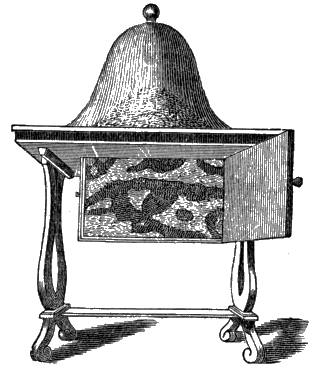
M. P. Huber, in order to observe the operations of the wood-ant with more attention, transferred colonies of them to his artificial formicaries, plunging the feet of the stand into water to prevent their escape till they were reconciled to their abode, and had made some progress in repairing it.
[Under the glass shade on the top of the formicary may be seen the mound which the wood-ants have raised, according to their custom, and below, through the glass front, the reader may see the various passages and cells which communicate with the hill above. As the ants require that the lower part of their dwelling should be in darkness, a stout wooden door can be shut over the glass to exclude the light.]
There is this remarkable difference in the nest of the wood-ants, that they do not construct a long covert way as if for concealment, as the yellow and the brown ants do. The wood-ants are not, like them, afraid of being surprised by enemies, at least during the day, when the whole colony is either foraging in the vicinity or employed on the exterior. But the proceedings of the wood-ants at night are well worthy of notice; and when M. Huber began to study their economy, he directed his entire attention to their night proceedings. “I remarked,” says he, "that their habitations changed in appearance hourly, and that the diameter of those spacious avenues, where so many ants could freely pass each other during the day, was, as night approached, gradually lessened. The aperture, at length, totally disappeared, the dome was closed on all sides, and the ants retired to the bottom of their nest.
"In further noticing the apertures of these ant-hills, I fully ascertained the nature of the labour of its inhabitants, of which I could not before even guess the purport; for the surface of the nest presented such a constant scene of agitation, and so many insects were occupied in carrying materials in every direction, that the movement offered no other image than that of confusion.
"I saw then clearly that they were engaged in stopping up passages; and for this purpose they at first brought forward little pieces of wood, which they deposited near the entrance of those avenues they wished to close; they placed them in the stubble; they then went to seek other twigs and fragments of wood, which they disposed above the first, but in a different direction, and appeared to choose pieces of less size in proportion as the work advanced. They, at length, brought in a number of dried leaves, and other materials of an enlarged form, with which they covered the roof: an exact miniature of the art of our builders, when they form the covering of any building. Nature, indeed, seems everywhere to have anticipated the inventions of which we boast, and this is doubtless one of the most simple.
“Our little insects, now in safety in their nest, retire gradually to the interior before the last passages are closed; one or two only remain without, or concealed behind the doors on guard, while the rest either take their repose, or engage in different occupations in the most perfect security. I was impatient to know what took place in the morning upon these ant-hills, and therefore visited them at an early hour. I found them in the same state in which I had left them the preceding evening. A few ants were wandering about on the surface of the nest, some others issued from time to time from under the margin of their little roofs formed at the entrance of the galleries; others afterwards came forth, who began removing the wooden bars that blockaded the entrance, in which they readily succeeded. This labour occupied them several hours. The passages were at length free, and the materials with which they had been closed scattered here and there over the ant-hill. Every day, morning and evening, during the fine weather, I was a witness to similar proceedings. On days of rain the doors of all the ant-hills remained closed. When the sky was cloudy in the morning, or rain was indicated, the ants, who seemed to be aware of it, opened but in part their several avenues, and immediately closed them when the rain commenced.”[DC]
The galleries and chambers which are roofed in as thus described are very similar to those of the mason-ants, being partly excavated in the earth, and partly built with the clay thence procured. It is in these they pass the night, and also the colder months of the winter, when they become torpid, or nearly so, and of course require not the winter granaries of corn with which the ancients fabulously furnished them.
Carpenter-Ants.
The ants that work in wood perform much more extensive operations than any of the other carpenter insects which we have mentioned. Their only tools, like those of bees and wasps, are their jaws or mandibles; but though these may not appear so curiously constructed as the ovipositor file of the tree-hopper (Cicada), or the rasp and saw of the saw-flies (Tenthredinidæ), they are no less efficient in the performance of what is required. Among the carpenter-ants, the emmet or jet-ant (F. fuliginosa) holds the first rank, and is easily known by being rather less in size than the wood-ant, and by its fine shining black colour. It is less common in Britain than some of the preceding, though its colonies may occasionally be met with in the trunks of decaying oak or willow trees in hedges.
“The labourers,” says Huber, "of this species work always in the interior of trees, and are desirous of being screened from observation: thus every hope on our part is precluded of following them in their several occupations. I tried every expedient I could devise to surmount this difficulty; I endeavoured to accustom these ants to live and work under my inspection, but all my efforts were unsuccessful; they even abandoned the most considerable portion of their nest to seek some new asylum, and spurned the honey and sugar which I offered them for nourishment. I was now, by necessity, limited to the inspection only of their edifices: but, by decomposing some of the fragments with care, I hoped to acquire some knowledge of their organization.
"On one side I found horizontal galleries, hidden in great part by their walls, which follow the circular direction of the layers of the wood; and on another, parallel galleries, separated by extremely thin partitions, having no communication except by a few oval apertures. Such is the nature of these works, remarkable for their delicacy and lightness.
"In other fragments I found avenues which opened laterally, including portions of walls and transverse partitions, erected here and there within the galleries, so as to form separate chambers. When the work is further advanced, round holes are always observed, encased, as it were, between two pillars cut out in the same wall. These holes in course of time become square, and the pillars, originally arched at both ends, are worked into regular columns by the chisel of our sculptors. This, then, is the second specimen of their art. This portion of the edifice will probably remain in this state.
"But in another quarter are fragments differently wrought, in which these same partitions, pierced now in every part, and hewn skilfully, are transformed into colonnades, which sustain the upper stories, and leave a free communication throughout the whole extent. It can readily be perceived how parallel galleries, hollowed out upon the same plan, and the sides taken down, leaving only from space to space what is necessary to sustain their ceilings, may form an entire story; but as each has been pierced separately, the flooring cannot be very level: this, however, the ants turn to their advantage, since these furrows are better adapted to retain the larvæ that may be placed there.
Portion of a Tree, with Chambers and Galleries chiseled out by Jet-Ants.
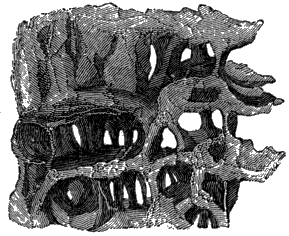
"The stories constructed in the great roots offer greater irregularity than those in the very body of the tree, arising either from the hardness and interlacing of the fibres, which renders the labour more difficult, and obliges the labourers to depart from their accustomed manner, or from their not observing in the extremities of their edifice the same arrangement as in the centre: whatever it be, horizontal stories and numerous partitions are still found. If the work be less regular, it becomes more delicate; for the ants, profiting by the hardness and solidity of the materials, give to their building an extreme degree of lightness. I have seen fragments of from eight to ten inches in length, and of equal height, formed of wood as thin as paper, containing a number of apartments, and presenting a most singular appearance. At the entrance of these apartments, worked out with so much care, are very considerable openings; but in place of chambers and extensive galleries, the layers of the wood are hewn in arcades, allowing the ants a free passage in every direction. These may be regarded as the gates or vestibules conducting to the several lodges."[DD]
It is a singular circumstance in the structures of these ants, that all the wood which they carve is tinged of a black colour, as if it were smoked; and M. Huber was not a little solicitous to discover whence this arose. It certainly does not add to the beauty of their streets, which look as sombre as the most smoke-dyed walls in the older lanes of the metropolis. M. Huber could not satisfy himself whether it was caused by the exposure of the wood to the atmosphere, by some emanation from the ants, or by the thin layers of wood being acted upon or decomposed by the formic acid.[DE] But if any or all of these causes operated in blackening the wood, we should be ready to anticipate a similar effect in the case of other species of ants which inhabit trees; yet the black tint is only found in the excavations of the jet-ant.
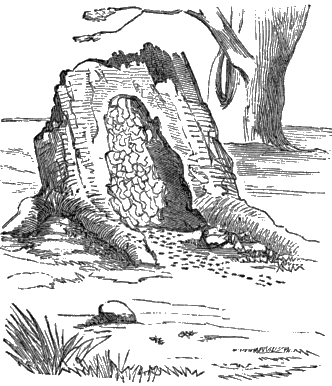
We are acquainted with several colonies of the jet-ants (Formica fuliginosa)—one of which, in the roots and trunk of an oak on the road from Lewisham to Sydenham, near Brockley, in Kent, is so extremely populous, that the numbers of its inhabitants appeared to us beyond any reasonable estimate. None of the other colonies of this species which we have seen appear to contain many hundreds. On cutting into the root of the before-mentioned tree, we found the vertical excavations of much larger dimensions, both in width and depth, than those represented by Huber in the preceding cut (page 302). What surprised us the most was to see the tree growing vigorously and fresh, though its roots were chiseled in all directions by legions of workers, while every leaf, and every inch of the bark, was also crowded by parties of foragers. On one of the low branches we found a deserted nest of the white-throat (Sylvia cinerea, Temminck), in the cavity of which they were piled upon one another as close as the unhappy negroes in the hold of a slave-ship; but we could not discover what had attracted them hither. Another dense group, collected on one of the branches, led us to the discovery of a very singular oak gall, formed on the bark in the shape of a pointed cone, and crowded together. It is probable that the juice which they extracted from these galls was much to their taste. (J. R.)
F. fuliginosa.
Beside the jet-ant, several other species exercise the art of carpentry,—nay, what is more wonderful still, they have the ingenuity to knead up, with spider’s-web for a cement, the chips which they chisel out into a material with which they construct entire chambers. The species which exercise this singular art are the Ethiopian (Formica nigra) and the yellow ant (F. flava).[DF]
We once observed the dusky ants (F. fusca) at Blackheath, in Kent, busily employed in carrying out chips from the interior of a decaying black poplar, at the root of which a colony was established; but, though it thence appears that this species can chisel wood if they choose, yet they usually burrow in the earth, and by preference, as we have remarked, at the root of a tree, the leaves of which supply them with food.
* * * * *
Among the foreign ants we may mention a small yellow ant of South America, described by Dampier, which seems, from his account, to construct a nest of green leaves. “Their sting,” he says, “is like a spark of fire; and they are so thick among the boughs in some places, that one shall be covered with them before he is aware. These creatures have nests on great trees, placed on the body between the limbs: some of their nests are as big as a hogshead. This is their winter habitation; for in the wet season they all repair to these their cities, where they preserve their eggs. In the dry season, when they leave their nests, they swarm all over the woodlands, for they never trouble the savannahs. Great paths, three or four inches broad, made by them, may be seen in the woods. They go out light, but bring home heavy loads on their backs, all of the same substance, and equal in size. I never observed anything besides pieces of green leaves, so big that I could scarcely see the insect for his burthen; yet they would march stoutly, and so many were pressing forward that it was a very pretty sight, for the path looked perfectly green with them.”
Ants observed in New South Wales, by the gentlemen in the expedition under Captain Cook, are still more interesting. “Some,” we are told, "are as green as a leaf, and live upon trees, where they build their nests of various sizes, between that of a man’s head and his fist. These nests are of a very curious structure: they are formed by bending down several of the leaves, each of which is as broad as a man’s hand, and gluing the points of them together, so as to form a purse. The viscous matter used for this purpose is an animal juice which nature has enabled them to elaborate. Their method of first bending down the leaves we had no opportunity to observe; but we saw thousands uniting all their strength to hold them in this position, while other busy multitudes were employed within in applying this gluten that was to prevent their returning back. To satisfy ourselves that the leaves were bent and held down by the efforts of these diminutive artificers, we disturbed them in their work; and as soon as they were driven from their stations, the leaves on which they were employed sprang up with a force much greater than we could have thought them able to conquer by any combination of their strength. But, though we gratified our curiosity at their expense, the injury did not go unrevenged; for thousands immediately threw themselves upon us, and gave us intolerable pain with their stings, especially those which took possession of our necks and hair, from whence they were not easily driven. Their sting was scarcely less painful than that of a bee; but, except it was repeated, the pain did not last more than a minute.
"Another sort are quite black, and their operation and manner of life are not less extraordinary. Their habitations are the inside of the branches of a tree, which they contrive to excavate by working out the pith almost to the extremity of the slenderest twig, the tree at the same time flourishing as if it had no such inmate. When we first found the tree we gathered some of the branches, and were scarcely less astonished than we should have been to find that we had profaned a consecrated grove, where every tree, upon being wounded, gave signs of life; for we were instantly covered with legions of these animals, swarming from every broken bough, and inflicting their stings with incessant violence.
“A third kind we found nested in the root of a plant, which grows on the bark of trees in the manner of mistletoe, and which they had perforated for that use. This root is commonly as big as a large turnip, and sometimes much bigger. When we cut it we found it intersected by innumerable winding passages, all filled with these animals, by which, however, the vegetation of the plant did not appear to have suffered any injury. We never cut one of these roots that was not inhabited, though some were not bigger than a hazel-nut. The animals themselves are very small, not more than half as big as the common red ant in England. They had stings, but scarcely force enough to make them felt: they had, however, a power of tormenting us in an equal, if not in a greater degree; for the moment we handled the root, they swarmed from innumerable holes, and running about those parts of the body that were uncovered, produced a titillation more intolerable than pain, except it is increased to great violence.”[DG]
The species called sugar-ants in the West Indies are particularly destructive to the sugar-cane, as well as to lime, lemon, and orange-trees, by excavating their nests at the roots, and so loosening the earth that they are frequently uprooted and blown down by the winds. If this does not happen, the roots are deprived of due nourishment, and the plants become sickly and die.[DH]
[One or two examples of foreign ants are well worthy of notice. The first of them is an insect whose habits bear strongly upon the familiar passage in Proverbs, ch. vi. v. 6:—
"Go to the ant, thou sluggard; consider her ways, and be wise: Which having no guide, overseer, or ruler, Provideth her meat in the summer, and gathereth her food in the harvest."
This passage is one that has been often mentioned as a proof that the Bible is not to be implicitly trusted. Judging from all the species of ants known to entomologists, some writers argue that the author of the proverb in question was ignorant of the real history of the ant, and was taking up a popular fallacy.
[Still, although the ants of the old world are chiefly carnivorous, or feed on soft substances, and in consequence have not the least idea of hoarding food for the winter, there is one species of Brazilian ant which absolutely builds houses, prepares ground, sows seed, reaps the grain, and stores it away for future consumption. It is the Agricultural Ant, Atta malefaciens, first described by Dr. Lincecum, who watched the insect for twelve years before publishing an account that he knew would at first be received with incredulity. The following abstract of his paper appeared in the Journal of the Linnæan Society.
"The species which I have named ‘Agricultural’ is a large brownish ant. It dwells in what may be termed paved cities, and like a thrifty, diligent, provident farmer, makes suitable and timely arrangements for the changing seasons. It is, in short, endowed with skill, ingenuity, and untiring patience, sufficient to enable it successfully to contend with the varying exigencies which it may have to encounter in the life conflict.
"When it has selected a situation for its habitation, if on ordinary dry ground, it bores a hole, around which it raises the surface three and sometimes six inches, forming a low circular mound, having a very gentle inclination from the centre to the outer border, which on an average is three or four feet from the entrance. But if the location is chosen on low, flat, wet land, liable to inundation, though the ground may be perfectly dry at the time the ant sets to work, it nevertheless elevates the mound, in the form of a pretty sharp cone, to the height of fifteen or twenty inches or more, and makes the entrance near the summit. Around the mound, in either case, the ant clears the ground of all obstructions, and levels and marks the surface to the distance of three or four feet from the gate of the city, giving the space the appearance of a handsome pavement, as it really is.
"Within this paved area not a blade of any green thing is allowed to grow, except a single species of grain-bearing grass. Having planted this crop in a circle around, and two or three feet from the centre of the mound, the insect tends and cultivates it with constant care, cutting away all other grasses and weeds that may spring up amongst it, and all around outside the farm circle to the extent of one or two feet more. The cultivated grass grows luxuriantly, and produces a heavy crop of small, white, flinty seeds, which under the microscope very closely resemble ordinary rice. When ripe, it is carefully harvested and carried by the workers, chaff and all, into the granary cells, where it is divested of the chaff and packed away. The chaff is taken out and thrown beyond the limits of the paved area.
"During protracted wet weather it sometimes happens that the provision-stores become damp, and are liable to sprout and spoil. In this case, on the first fine day, the ants bring out the damp and damaged grain, and expose it to the sun till it is dry, when they carry it back and pack away all the sound seeds, leaving those that had sprouted to waste.
"In a peach orchard not far from my house is a considerable elevation, on which is an extensive bed of rock. In the sand-beds overlying portions of this rock are five cities of the agricultural ants, evidently very ancient. My observations on their manners and customs have been limited to the last twelve years, during which time the inclosure surrounding the orchard has prevented the approach of cattle to the ant-farms. The cities which are outside the inclosure, as well as those protected in it, are at the proper season invariably planted with the ant-rice. The crop may accordingly always be seen springing up within the circle about the 1st of November every year. Of late years, however, since the number of farms and cattle has greatly increased, and the latter are eating off the grass much closer than formerly, thus preventing the ripening of the seeds, I notice that the agricultural ant is placing its cities along the turn-rows in the fields, walks in gardens, inside about the gates, &c., where they can cultivate their farms without molestation from the cattle.
"There can be no doubt that the particular species of grain-bearing grass mentioned above is intentionally planted. In farmer-like manner the ground upon which it stands is carefully divested of all other grasses and weeds during the time it is growing. When it is ripe, the grain is taken care of, the dry stubble cut away and carried off, the paved area being left unencumbered until the ensuing autumn, when the same ant-rice reappears within the same circle, and receives the same agricultural attention as was bestowed upon the previous crop—and so on, year after year, as I know to be the case, in all situations where the ants’ settlements are protected from granivorous animals."
This interesting account is simply the result of twelve years’ patient investigation on the part of Dr. Lincecum, who took special care not to invent a theory and to twist facts in accordance with it, but watched the entire proceedings of the insects for a series of years.
Crematogaster.
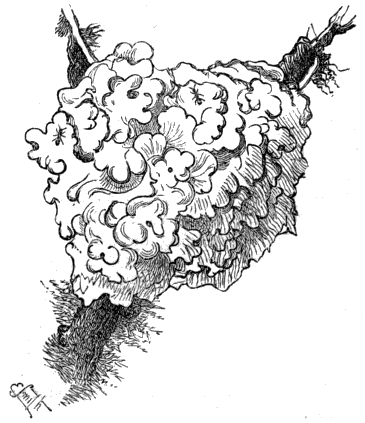
The preceding illustration represents the rather remarkable nest of an Australian ant, belonging to the genus Crematogaster. This word signifies “hanging-belly,” and the name has been applied to the ant in consequence of the manner in which its abdomen is held up in the air, so that it overhangs the back.
As may be seen, the nest is of considerable size, and might from its external appearance be mistaken for that of a wasp. The interior of it, however, is even more elaborate, being full of little covered passages interlacing with each other in a most intricate manner, but all leading to the internal galleries.
The two nests which are shown in the next illustration are, if possible, still more remarkable.
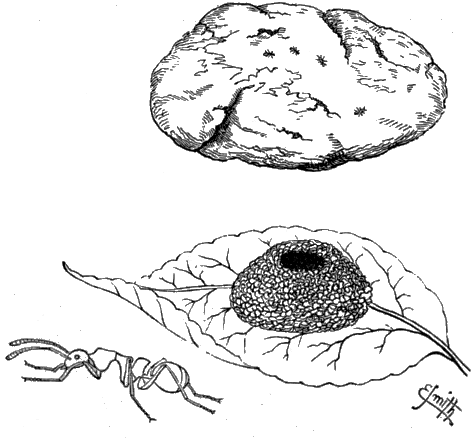
The upper one is found in Cayenne, and is made by an insect called the fungus ant (Polyrachis bispinosa), because the nest looks as if it were made of fungus. It is not, however, composed of that material, but of the fibre of the cotton-tree (Bombax ceiba).
The fibre is in itself very short, barely exceeding an inch in length, but it is cut very much shorter by the ant, who contrives to felt it together in a most curious manner, so that it is hardly possible to trace the course of any one fibre. The size of the nest is, on an average, about eight or nine inches in diameter. The insect itself is given in the preceding illustration, but very much enlarged. If the reader will look at the centre of the body, he will see the projections which have given it the name of bispinosa, or two-spined.
The lower figure represents the nest of another species of ant belonging to the same genus, and called scientifically, Polyrachis textor. The nest is most ingeniously made of little pieces of wood and tendrils, put together so as to form a kind of open net-work, through which the interior of the nest is plainly visible. This insect inhabits Malacca.]
CHAPTER XVI.
STRUCTURES OF WHITE ANTS, OR TERMITES.
When we look back upon the details which we have given of the industry and ingenuity of numerous tribes of insects, both solitary and social, we are induced to think it almost impossible that they could be surpassed. The structures of wasps and bees, and still more those of the wood-ant (Formica rufa), when placed in comparison with the size of the insects, equal our largest cities compared with the stature of man. But when we look at the buildings erected by the white ants of tropical climates, all that we have been surveying dwindles into insignificance. Their industry appears greatly to surpass that of our ants and bees, and they are certainly more skilful in architectural contrivances. The elevation, also, of their edifices is more than five hundred times the height of the builders. Were our houses built according to the same proportions, they would be twelve or fifteen times higher than the London Monument, and four or five times higher than the pyramids of Egypt, with corresponding dimensions in the basements of the edifices. These statements are, perhaps, necessary to impress the extraordinary labours of ants upon the mind; for we are all more or less sensible to the force of comparisons. The analogies between the works of insects and of men are not perfect; for insects are all provided with instruments peculiarly adapted to the end which they instinctively seek, while man has to form a plan by progressive thought, and upon the experience of others, and to complete it with tools which he also invents.
The termites do not stand above a quarter of an inch high, while their nests are frequently twelve feet, and Jobson mentions some which he had seen as high as twenty feet; “of compass,” he adds, "to contain a dozen men, with the heat of the sun baked into that hardness, that we used to hide ourselves in the ragged tops of them when we took up stands to shoot at deer or wild beasts."[DI] Bishop Heber saw a number of these high ant-hills in India, near the principal entrance of the Sooty or Moorshedabad river. “Many of them,” he says, “were five or six feet high, and probably seven or eight feet in circumference at the base, partially overgrown with grass and ivy, and looking at a distance like the stumps of decayed trees. I think it is Ctesias, among the Greek writers, who gives an account alluded to by Lucian in his ‘Cock,’ of monstrous ants in India, as large as foxes. The falsehood probably originated in the stupendous fabrics which they rear here, and which certainly might be supposed to be the work of a much larger animal than their real architect.”[DJ] Herodotus has a similar fable of the enormous size and brilliant appearance of the ants of India.
Nor is it only in constructing dwellings for themselves that the termites of Africa and of other hot climates employ their masonic skill. Though, like our ants and wasps, they are almost omnivorous, yet wood, particularly when felled and dry, seems their favourite article of food; but they have an utter aversion to feeding in the light, and always eat their way with all expedition to the interior. It thence would seem necessary for them either to leave the bark of a tree, or the outer portion of the beam or door of a house, undevoured, or to eat in open day. They do neither; but are at the trouble of constructing galleries of clay, in which they can conceal themselves, and feed in security. In all their foraging excursions, indeed, they build covert ways, by which they can go out and return to their encampment.[DK]
Others of the species (for there are several), instead of building galleries, exercise the art of miners, and make their approaches under ground, penetrating beneath the foundation of houses or areas, and rising again either through the floors, or by entering the bottom of the posts that support the building, when they follow the course of the fibres, and make their way to the top, boring holes and cavities in different places as they proceed. Multitudes enter the roof, and intersect it with pipes or galleries, formed of wet clay, which serve for passages in all directions, and enable them more readily to fix their habitations in it. They prefer the softer woods, such as pine and fir, which they hollow out with such nicety, that they leave the surface whole, after having eaten away the inside. A shelf or plank attacked in this manner looks solid to the eye, when, if weighed, it will not out-balance two sheets of pasteboard of the same dimensions. It sometimes happens that they carry this operation so far on stakes in the open air, as to render the bark too flexible for their purpose; when they remedy the defect by plastering the whole stick with a sort of mortar which they make with clay, so that, on being struck, the form vanishes, and the artificial covering falls in fragments on the ground. In the woods, when a large tree falls from age or accident, they enter it on the side next the ground, and devour it at leisure, till little more than the bark is left. But in this case they take no precaution of strengthening the outward defence, but leave it in such a state as to deceive an eye unaccustomed to see trees thus gutted of their insides: and “you may as well,” says Mr. Smeathman, “step upon a cloud.” It is an extraordinary fact, that when these creatures have formed pipes in the roof of a house, instinct directs them to prevent its fall, which would ensue from their having sapped the posts on which it rests; but as they gnaw away the wood, they fill up the interstices with clay, tempered to a surprising degree of hardness, so that, when the house is pulled down, these posts are transformed from wood to stone. They make the walls of their galleries of the same composition as their nests, varying the materials according to their kind; one species using the red clay, another black clay, and the third a woody substance, cemented with gums, as a security from the attacks of their enemies, particularly the common ant, which, being defended by a strong, horny shell, is more than a match for them, and when it can get at them, rapaciously seizes them, and drags them to its nest for food for its young brood. If any accident breaks down part of their walls, they repair the breach with all speed. Instinct guides them to perform their office in the creation, by mostly confining their attacks to trees that are beginning to decay, or such timber as has been severed from its roots for use, and would decay in time. Vigorous, healthy trees do not require to be destroyed, and accordingly, these consumers have no taste for them.[DL]