Front matter (continued 9)
Reading edition
Had we not other instances to adduce, of similar terror caused among sheep, deer, and horses, by insects of the same genus, which are ascertained not to penetrate the skin, we should not have hesitated to conclude that Vallisnieri and Réaumur are right, and Mr. Bracey Clark wrong. In the strictly similar instance of Reindeer-fly (Œstrus tarandi, Linn.), we have the high authority of Linnæus for the fact, that it lays its eggs upon the skin.
“I remarked,” he says, "with astonishment how greatly the reindeer are incommoded in hot weather, insomuch that they cannot stand still a minute, no not a moment, without changing their posture, starting, puffing and blowing continually, and all on account of a little fly. Even though amongst a herd of perhaps five hundred reindeer, there were not above ten of those flies, every one of the herd trembled and kept pushing its neighbour about. The fly, meanwhile, was trying every means to get at them; but it no sooner touched any part of their bodies, than they made an immediate effort to shake it off. I caught one of these insects as it was flying along with its tail protruded, which had at its extremity a small linear orifice perfectly white. The tail itself consisted of four or five tubular joints, slipping into each other like a pocket spying-glass, which this fly, like others, has a power of contracting at pleasure."[GL]
In another work he is still more explicit. “This well-known fly,” he says, “hovers the whole day over the back of the reindeer, with its tail protruded and a little bent, upon the point of which it holds a small white egg, scarcely so large as a mustard-seed, and when it has placed itself in a perpendicular position, it drops its egg, which rolls down amongst the hair to the skin, where it is hatched by the natural heat and perspiration of the reindeer, and the grub eats its way slowly under the skin, causing a bump as large as an acorn.”[GM] The male and female of the reindeer breeze-fly are figured in the ‘Library of Entertaining Knowledge, Menageries,’ vol. i. p. 405.
There is one circumstance which, though it appears to us to be of some importance in the question, has been either overlooked or misrepresented in books. “While the female fly,” say Kirby and Spence, “is performing the operation of oviposition, the animal attempts to lash her off as it does other flies, with its tail;”[GN] though this is not only at variance with their own words in the page but one preceding, where they most accurately describe “the herd with their tails in the air, or turned upon their backs, or stiffly stretched out in the direction of the spine,”[GO] but with the two facts mentioned above from Réaumur, as well as with common observation. If the ox then do not attempt to lash off the breeze-fly, but runs with its tail stiffly extended, it affords a strong presumption that the fly terrifies him by her buzzing (asper, acerba sonans), rather than pains him by piercing his hide: her buzz, like the rattle of the rattlesnake, being instinctively understood, and intended, it may be, to prevent an over-population, by rendering it difficult to deposit the eggs.
The horse breeze-fly (Gasterophilus equi, Leach), which produces the maggots well known by the name of botts in horses, is ascertained beyond a doubt to deposit her eggs upon the hair; and as insects of the same genus almost invariably proceed upon similar principles, however much they may vary in minute particulars, it may be inferred with justice, that the breeze-flies which produce galls do the same. The description given by Mr. Bracey Clark, of the proceedings of the horse breeze-fly, is exceedingly interesting.
"When the female has been impregnated, and her eggs sufficiently matured, she seeks among the horses a subject for her purpose, and approaching him on the wing, she carries her body nearly upright in the air, and her tail, which is lengthened for the purpose,[GP] curved inwards and upwards; in this way she approaches the part where she designs to deposit the egg; and suspending herself for a few seconds before it, suddenly darts upon it and leaves the egg adhering to the hair; she hardly appears to settle, but merely touches the hair with the egg held out on the projected point of the abdomen.[GP] The egg is made to adhere by means of a glutinous liquor secreted with it. She then leaves the horse at a small distance, and prepares a second egg, and poising herself before the part, deposits it in the same way. The liquor dries, and the egg becomes firmly glued to the hair: this is repeated by these flies till four or five hundred eggs are sometimes placed on one horse."
Mr. Clark farther tells us, that the fly is careful to select a part of the skin which the horse can easily reach with his tongue, such as the inside of the knee, or the side and back part of the shoulder. It was at first conjectured, that the horse licks off the eggs thus deposited, and that they are by this means conveyed into its stomach; but Mr. Clark says, "I do not find this to be the case, or at least only by accident; for when they have remained on the hair four or five days, they become ripe, after which time the slightest application of warmth and moisture is sufficient to bring forth, in an instant, the latent larva. At this time, if the tongue of the horse touches the egg, its operculum is thrown open, and a small, active worm is produced, which readily adheres to the moist surface of the tongue, and is thence conveyed with the food to the stomach." He adds, that “a horse which has no ova deposited on him may yet have botts, by performing the friendly office of licking another horse that has.”[GQ] The irritations produced by common flies (Anthomyiæ meteoricæ, Meigen) are alleged as the incitement to licking.
The circumstance, however, of most importance to our purpose, is the agitation and terror produced both by this fly and by another horse breeze-fly (Gasterophilus hæmorrhoidalis, Leach), which deposits its eggs upon the lips of the horse as the sheep breeze-fly (Œstrus ovis) does on that of the sheep. The first of these is described by Mr. Clark as “very distressing to the animal, from the excessive titillation it occasions; for he immediately after rubs his mouth against the ground, his fore-feet, or sometimes against a tree, with great emotion; till, finding this mode of defence insufficient, he quits the spot in a rage, and endeavours to avoid it by galloping away to a distant part of the field, and if the fly still continues to follow and teaze him, his last resource is in the water, where the insect is never observed to pursue him. These flies appear sometimes to hide themselves in the grass, and as the horse stoops to graze they dart upon the mouth or lips, and are always observed to poise themselves during a few seconds in the air, while the egg is prepared on the extended point of the abdomen.”[GR]
The moment the second fly just mentioned touches the nose of a sheep, the animal shakes its head and strikes the ground violently with its fore-feet, and at the same time holding its nose to the earth, it runs away, looking about on every side to see if the flies pursue. A sheep will also smell the grass as it goes, lest a fly should be lying in wait, and if one be detected, it runs off in terror. As it will not, like a horse or an ox, take refuge in the water, it has recourse to a rut or dry dusty road, holding its nose close to the ground, thus rendering it difficult for the fly to get at the nostril.
a, The belly of the grub. b, Its back. c, The tail of the grub, greatly magnified. d, The bump, or gall, having its external aperture filled with the tail of the grub.
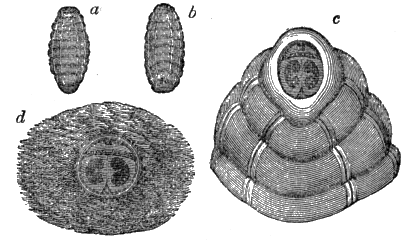
When the egg of the ox breeze-fly (Hypoderma bovis, Latr.) is hatched, it immediately (if Mr. Bracey Clark be correct) burrows into the skin; while, according to Réaumur, it is hatched there. At all events, the grub is found in a bump on the animal’s back, resembling a gall on a tree,—“a place,” says Réaumur, “where food is found in abundance, where it is protected from the weather, where it enjoys at all times an equal degree of warmth, and where it finally attains maturity.”[GS] When in an advanced stage, the bumps appear much like the swellings produced upon the forehead by a smart blow. These, with the grubs, are represented in the foregoing figure, and also at page 434.
Every bump, according to Réaumur, has in its inside a cavity, which is a lodging proportionate to the size of the insect. The bump and cavity also increase in proportion to the growth of the grub. It is not until about the middle of May that these bumps can be seen full grown. Owing to particular circumstances, they do not all attain an equal size. The largest of them are sixteen or seventeen lines in diameter at their base, and about an inch high; but they are scarcely perceptible before the beginning or during the course of the winter.
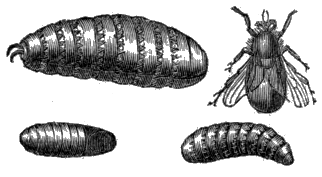
Fly, maggot, and grub of the Ox breeze-fly, with a microscopic view of the maggot.
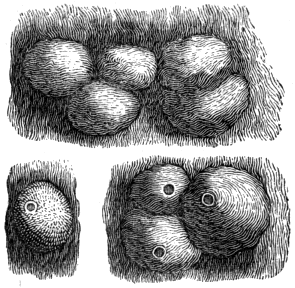
It is commonly upon young cattle, such, namely, as are two or three years old, that the greatest number of bumps is found; it being rare to observe them upon very old animals. The fly seems to be well aware that such skins will not oppose too much resistance, and seems to know, also, that tender flesh is the most proper for supplying good nourishment to its progeny. “And why,” asks Réaumur, “should not the instinct which conducts it to confide its eggs to the flesh of certain species only, lead it to prefer the flesh of animals of the same species which is most preferable?” The number of bumps which are found upon a beast is equal to the number of eggs which have been deposited in its flesh; or, to speak more correctly, to the number of eggs which have succeeded, for apparently all are not fertile; but this number is very different upon different cattle. Upon one cow only three or four bumps may be observed, while upon another there will appear from thirty to forty. They are not always placed on the same parts, nor arranged in the same manner: commonly, they are near the spine, but sometimes upon or near the thighs and shoulders. Sometimes they are at remote distances from each other; at other times they are so near that their circumferences meet. In certain places, three or four tumors may be seen touching each other; and more than a dozen sometimes occur arranged as closely together as possible.
It is very essential to the grub that the hole of the tumor should remain constantly open; for by this aperture a communication with the air necessary for respiration is preserved; and the grub is thence placed in the most favourable position for receiving air. Its spiracles for respiration, like those of many other grubs, are situated immediately upon the posterior extremity of the body. Now, being almost always placed in such a situation as to have this part above, or upon a level with the external aperture, it is enabled to respire freely.[GT]
Bumps or wurbles produced on cattle by the Ox breeze-fly.
We have not so many examples of galls of this kind as we have of vegetable galls; and when we described the surprising varieties of the latter, we did not perceive that it was essential to the insects inhabiting them to preserve a communication with the external air: in the galls of trees, openings expressly designed or kept free for the admission of air are never observed. Must the grub, then, which inhabits the latter have less need of respiring air than the grub of the breeze-flies in a flesh-gall? Without doubt, not; but the apertures by which the air is admitted to the inhabitants of the woody gall, although they may escape our notice, in consequence of their minuteness, are not, in fact, less real. We know that, however careful we may be in inserting a cork into a glass, the mercury with which it is filled is not sheltered from the action of the air, which weighs upon the cork; we know that the air passes through, and acts upon the mercury in the tube. The air can also, in the same way, penetrate through the obstruction of a gall of wood, though it have no perceptible opening or crack; but the air cannot pass in this manner so readily through the skins and membranes of animals.
In order to see the interior of the cavity of an animal gall, Réaumur opened several, either with a razor or a pair of scissors; the operation, however, cannot fail to be painful to the cow, and consequently renders it impatient under the process. The grub being confined in a tolerably large fistulous ulcer, a part of the cavity must necessarily be filled with pus or matter. The bump is a sort of cautery, which has been opened by the insect, as issues are made by caustic: the grub occupies this issue, and prevents it from closing. If the pus or matter which is in the cavity, and that which is daily added to it, had no means of escaping, each tumor would become a considerable abscess, in which the grub would perish; but the hole of the bump, which admits the entrance of the air, permits the pus or matter to escape; that pus frequently mats the hairs together which are above the small holes, and this drying around the holes acquires a consistency, and forms in the interior of the opening a kind of ring. This matter appears to be the only aliment allowed for the grub, for there is no appearance that it lives, like the grubs of flesh-flies, upon putrescent meat. Mandibles, indeed, similar to those with which other grubs break their food, are altogether wanting. A beast which has thirty, forty, or more of these bumps upon its back, would be in a condition of great pain and suffering, terrible indeed in the extreme, if its flesh were torn and devoured by as many large grubs; but there is every appearance that they do not at all afflict, or only afflict it with little pain. For this reason cattle most covered with bumps are not considered by the farmer as injured by the presence of the fly, which generally selects those in the best condition.
A fly, evidently of the same family with the preceding, is described in Bruce’s ‘Travels,’ under the name of zimb, as burrowing during its grub state in the hides of the elephant, the rhinoceros, the camel, and cattle. “It resembles,” he says, “the gad-fly in England, its motion being more sudden and rapid than that of a bee. There is something peculiar in the sound or buzzing of this insect; it is a jarring noise together with a humming, which as soon as it is heard all the cattle forsake their food and run wildly about the plain till they die, worn out with fatigue, fright, and hunger. I have found,” he adds, “some of these tubercles upon almost every elephant and rhinoceros that I have seen, and attribute them to this cause. When the camel is attacked by this fly, his body, head, and legs break out into large bosses, which swell, break, and putrefy, to the certain destruction of the creature.”[GU] That camels die under such symptoms, we do not doubt; but we should not, without more minutely-accurate observation, trace all this to the breeze-fly.
MM. Humboldt and Bonpland discovered, in South America, a species, probably of the same genus, which attacks man himself. The perfect insect is about the size of our common house-fly (Musca domestica), and the bump formed by the grub, which is usually on the belly, is similar to that caused by the ox breeze-fly. It requires six months to come to maturity; and if it is irritated it eats deeper into the flesh, sometimes causing fatal inflammations.
Grub Parasite in the Snail.
During the summer of 1829, we discovered in the hole of a garden-post, at Blackheath, one of the larger grey snail shells (Helix aspersa, Muller), with three white soft-bodied grubs burrowing in the body of the snail. They evidently, from their appearance, belonged to some species of beetle, and we carefully preserved them in order to watch their economy. It appeared to us that they had attacked the snail in its stronghold while it was laid up torpid for the winter; for more than half of the body was already devoured. They constructed for themselves little cells attached to the inside of the shell, and composed of a sort of fibrous matter, having no distant resemblance to shag tobacco, both in form and smell, and which could be nothing else than the remains of the snail’s body. Soon after we took them, appearing to have devoured all that remained of the poor snail, we furnished them with another, which they devoured in the same manner. They formed a cocoon of the same fibrous materials during the autumn, and in the end of October appeared in their perfect form, turning out to be Drilus flavescens, the grub of which was first discovered in France in 1824. The time of their appearance, it may be remarked, coincides with the period when snails become torpid. (J. R.)
In the following autumn, we found a shell of the same species with a small pupa-shaped egg deposited on the lid. From this a caterpillar was hatched, which subsequently devoured the snail, spun a cocoon within the shell, and was transformed into a small moth (of which we have not ascertained the species) in the spring of 1830.
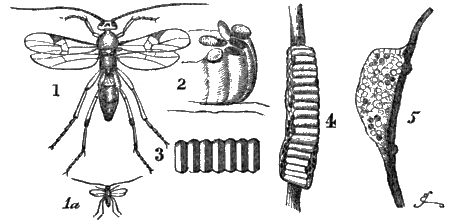
[Before concluding the account of the parasite insects, it will be necessary to mention two of our British Ichneumonidæ, which not only deposit their eggs in the larvæ of other insects, but make for themselves cells of very beautiful structure. In the accompanying illustration are shown the cells of one of our commonest and most useful ichneumonidæ (Microgaster glomeratus), together with the insect itself. At Fig. 1a (p. 438) is shown the little insect of the natural size, and the same is given at 1 much magnified.
This creature lays its eggs in the body of the cabbage caterpillar, forty or fifty eggs being deposited in the same larva. They soon hatch into little transparent grubs, which lie under the skin, and live on the fatty parts of the caterpillar, which continues to grow, and seems to thrive, whereas its bulk is largely made up of the ichneumon larvæ.
Microgaster glomeratus.
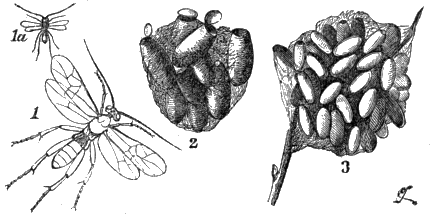
After the caterpillar ceases from feeding, it crawls aside for the purpose of assuming the pupal state. But, before it can do so, the ichneumon larvæ, which have also ceased from feeding, burst their way through the sides of the caterpillar, and immediately begin to spin their cocoon. These are oval, very small, and covered with yellow silk. A group of these cocoons is shown at Fig. 3. The innumerable fibres of these cocoons hamper the caterpillars so much that, in most cases, it seldom is able to stir from the spot, but dies in the midst of its enemies. Groups of these yellow cocoons can be found in every wall or paling near cabbage gardens. In a few days, the larvæ have passed through their pupal stage, assuming the winged state, and emerge from the cocoons through little circular doors, as seen in Fig. 2.
Our second illustration represents another species, Microgaster alveolarius, together with its cocoons. As before, the insect is shown of its natural size at la, and magnified at 1. The preliminary life of this insect is exactly the same as that of the preceding; but, instead of making a number of independent and separate cocoons, the insects spin so closely together that they form an edifice very much resembling a bee-comb. Fig. 5 represents one of these cell-groups of the natural size, and the edge of another group is shown at Fig. 4. A longitudinal section, slightly enlarged, is given at 3, in order to show the hexagonal shape assumed by the aggregated cells; and Fig. 2 shows the little lids which open to give egress to the insect. All these figures are drawn from specimens in my collection.]
Microgaster alveolarius.
THE END.
LONDON: PRINTED BY W. CLOWES AND SONS, STAMFORD STREET AND CHARING CROSS.
FOOTNOTES:
Transcriber’s Note
The unmatched opening quote on page 12 was assumed to be a typographical error and removed. Where a sequential series of paragraphs have an opening bracket without a closing one, these were standardized to one opening and one closing bracket for the whole section. One opening bracket missing on page 38 was assumed to belong at the start of last line of that paragraph. The closing quote from the second paragraph on page 47 was added. An Internet search confirmed this location.
Where the footnotes originally stated “Ibid.”, the source of the previous footnote was inserted.
The cover image was derived from an image made available on The Internet Archive and is placed in the Public Domain.