Front matter (continued 8)
Reading edition
Another distinguished naturalist, Mr. White of Selborne, in speaking of the gossamer-spider, says, “Every day in fine weather in autumn do I see these spiders shooting out their webs, and mounting aloft: they will go off from the finger, if you will take them into your hand. Last summer, one alighted on my book as I was reading in the parlour; and running to the top of the page, and shooting out a web, took its departure from thence. But what I most wondered at was, that it went off with considerable velocity in a place where no air was stirring; and I am sure I did not assist it with my breath.”[ES]
Having so often witnessed the thread set afloat in the air by spiders, we can readily conceive the way in which those eminent naturalists were led to suppose it to be ejected by some animal force acting like a syringe; but as the statement can be completely disproved by experiment, we shall only at present ask, in the words of Swammerdam—“how can it be possible that a thread so fine and slender should be shot out with force enough to divide and pass through the air?—is it not rather probable that the air would stop its progress, and so entangle it and fit it to perplex the spider’s operations?”[ET] The opinion, indeed, is equally improbable with another, suggested by Dr. Lister, that the spider can retract her thread within the abdomen, after it has been emitted.[EU] De Geer[EV] very justly joins Swammerdam in rejecting both of these fancies, which, in our own earlier observations upon spiders, certainly struck us as plausible and true. There can be no doubt, indeed, that the animal has a voluntary power of permitting the material to escape, or stopping it at pleasure, but this power is not projectile.
3. “There are many people,” says the Abbé de la Pluche, “who believe that the spider flies when they see her pass from branch to branch, and even from one high tree to another; but she transports herself in this manner: she places herself upon the end of a branch, or some projecting body, and there fastens her thread; after which, with her two hind feet, she squeezes her dugs (spinnerets), and presses out one or more threads of two or three ells in length, which she leaves to float in the air till it be fixed to some particular place.”[EW] Without pretending to have observed this, Swammerdam says, “I can easily comprehend how spiders, without giving themselves any motion, may, by only compressing their spinnerets, force out a thread, which being driven by the wind, may serve to waft them from one place to another.”[EX] Others, proceeding upon a similar notion, give a rather different account of the matter. “The spider,” says Bingley, "fixes one end of a thread to the place where she stands, and then with her hind paws draws out several other threads from the nipples, which, being lengthened out and driven by the wind to some neighbouring tree or other object, are by their natural clamminess fixed to it."[EY]
Observation gives some plausibility to the latter opinion, as the spider always actively uses her legs, though not to draw out the thread, but to ascertain whether it has caught upon any object. The notion of her pressing the spinneret with her feet must be a mere fancy; at least it is not countenanced by anything which we have observed.
4. An opinion much more recondite is mentioned, if it was not started, by M. D’Isjonval, that the floating of the spider’s thread is electrical. “Frogs, cats, and other animals,” he says, “are affected by natural electricity, and feel the change of weather; but no other animal more than myself and my spiders.” During wet and windy weather he accordingly found that they spun very short lines, “but when a spider spins a long thread, there is a certainty of fine weather for at least ten or twelve days afterwards.”[EZ] A periodical writer, who signs himself Carolan,[FA] fancies that in darting out her thread the spider emits a stream of air, or some subtle electric fluid, by which she guides it as if by magic.
A living writer (Mr. John Murray), whose learning and skill in conducting experiments give no little weight to his opinions, has carried these views considerably farther. “The aëronautic spider,” he says, "can propel its thread both horizontally and vertically, and at all relative angles, in motionless air, and in an atmosphere agitated by winds; nay more, the aërial traveller can even dart its thread, to use a nautical phrase, in the ‘wind’s eye.’ My opinion and observations are based on many hundred experiments.… The entire phenomena are electrical. When a thread is propelled in a vertical plane, it remains perpendicular to the horizontal plane, always upright, and when others are projected at angles more or less inclined, their direction is invariably preserved; the threads never intermingle, and when a pencil of threads is propelled, it ever presents the appearance of a divergent brush. These are electrical phenomena, and cannot be explained but on electrical principles."
“In clear, fine weather, the air is invariably positive; and it is precisely in such weather that the aëronautic spider makes its ascent most easily and rapidly, whether it be in summer or in winter.” “When the air is weakly positive, the ascent of the spider will be difficult, and its altitude extremely limited, and the threads propelled will be but little elevated above the horizontal plane. When negative electricity prevails, as in cloudy weather, or on the approach of rain, and the index of De Saussure’s hygrometer rapidly advancing towards humidity, the spider is unable to ascend.”[FB]
Mr. Murray had previously told us, that “when a stick of excited sealing-wax is brought near the thread of suspension, it is evidently repelled; consequently, the electricity of the thread is of a negative character,” while “an excited glass tube brought near, seemed to attract the thread, and with it the aëronautic spider.”[FC] His friend, Mr. Bowman, further describes the aërial spider as “shooting out four or five, often six or eight, extremely fine webs several yards long, which waved in the breeze, diverging from each other like a pencil of rays.” One of them “had two distinct and widely-diverging fasciculi of webs,” and “a line uniting them would have been at right angles to the direction of the breeze.”[FD]
Such is the chief evidence in support of the electrical theory; but though we have tried these experiments, we have not succeeded in verifying any one of them. The following statements of Mr. Blackwall come nearer our own observations.
5. “Having procured a small branched twig,” says Mr. Blackwall, "I fixed it upright in an earthen vessel containing water, its base being immersed in the liquid, and upon it I placed several of the spiders which produce gossamer. Whenever the insects thus circumstanced were exposed to a current of air, either naturally or artificially produced, they directly turned the thorax towards the quarter whence it came, even when it was so slight as scarcely to be perceptible, and elevating the abdomen, they emitted from their spinners a small portion of glutinous matter, which was instantly carried out in a line, consisting of four finer ones, with a velocity equal, or nearly so, to that with which the air moved, as was apparent from observations made on the motion of detached lines similarly exposed. The spiders, in the next place, carefully ascertained whether their lines had become firmly attached to any object or not, by pulling at them with the first pair of legs; and if the result was satisfactory, after tightening them sufficiently, they made them pass to the twig; then discharging from their spinners, which they applied to the spot where they stood, a little more of their liquid gum, and committing themselves to these bridges of their own constructing, they passed over them in safety, drawing a second line after them, as a security in case the first gave way, and so effected their escape.
"Such was invariably the result when spiders were placed where the air was liable to be sensibly agitated: I resolved, therefore, to put a bell-glass over them; and in this situation they remained seventeen days, evidently unable to produce a single line by which they could quit the branch they occupied, without encountering the water at its base; though, on the removal of the glass, they regained their liberty with as much celerity as in the instances already recorded.
“This experiment, which, from want of due precaution, has misled so many distinguished naturalists, I have tried with several geometric spiders, and always with the same success.”[FE]
Mr. Blackwall, from subsequent experiments, says he is “confident in affirming, that in motionless air spiders have not the power of darting their threads even through the space of half an inch.”[FF] The following details are given in confirmation of this opinion. Mr. Blackwall observed, the 1st Oct., 1826, a little before noon, with the sun shining brightly, no wind stirring, and the thermometer in the shade ranging from 55°·5 to 64°, a profusion of shining lines crossing each other at every angle, forming a confused net-work, covering the fields and hedges, and thickly coating his feet and ankles, as he walked across a pasture. He was more struck with the phenomenon, because on the previous day a strong gale of wind had blown from the south, and as gossamer is only seen in calm weather, it must have been all produced within a very short time.
“What more particularly arrested my attention,” says Mr. Blackwall, "was the ascent of an amazing quantity of webs, of an irregular, complicated structure, resembling ravelled silk of the finest quality and clearest white; they were of various shapes and dimensions, some of the largest measuring upwards of a yard in length, and several inches in breadth in the widest part; while others were almost as broad as long, presenting an area of a few square inches only.
"These webs, it was quickly perceived, were not formed in the air, as is generally believed, but at the earth’s surface. The lines of which they were composed, being brought into contact by the mechanical action of gentle airs, adhered together, till, by continual additions, they were accumulated into flakes or masses of considerable magnitude, on which the ascending current, occasioned by the rarefaction of the air contiguous to the heated ground, acted with so much force as to separate them from the objects to which they were attached, raising them in the atmosphere to a perpendicular height of at least several hundred feet. I collected a number of these webs about mid-day, as they rose; and again in the afternoon, when the upward current had ceased, and they were falling; but scarcely one in twenty contained a spider: though, on minute inspection, I found small winged insects, chiefly aphides, entangled in most of them.
"From contemplating this unusual display of gossamer, my thoughts were naturally directed to the animals which produced it, and the countless myriads in which they swarmed almost created as much surprise as the singular occupation that engrossed them. Apparently actuated by the same impulse, all were intent upon traversing the regions of air: accordingly, after gaining the summits of various objects, as blades of grass, stubble, rails, gates, &c., by the slow and laborious process of climbing, they raised themselves still higher by straightening their limbs; and elevating the abdomen, by bringing it from the usual horizontal position into one almost perpendicular, they emitted from their spinning apparatus a small quantity of the glutinous secretion with which they construct their webs. This viscous substance being drawn out by the ascending current of rarefied air into fine lines several feet in length, was carried upward, until the spiders, feeling themselves acted upon with sufficient force in that direction, quitted their hold of the objects on which they stood, and commenced their journey by mounting aloft.
“Whenever the lines became inadequate to the purpose for which they were intended, by adhering to any fixed body, they were immediately detached from the spinners, and so converted into terrestrial gossamer, by means of the last pair of legs, and the proceedings just described were repeated; which plainly proves that these operations result from a strong desire felt by the insects to effect an ascent.”[FG] Mr. Blackwall has recently read a paper (still unpublished) in the Linnean Society, confirmatory of his opinions.
6. Without going into the particulars of what agrees or disagrees in the above experiments with our own observations, we shall give a brief account of what we have actually seen in our researches. (J. R.) So far as we have determined, then, all the various species of spiders, how different soever the form of their webs may be, proceed in the circumstance of shooting their lines precisely alike; but those which we have found the most manageable in experimenting, are the small gossamer spider (Aranea obtextrix, Bechstein), known by its shining blackish-brown body and reddish-brown semi-transparent legs; but particularly the long-bodied spider (Tetragnatha extensa, Latr.), which varies in colour from green to brownish or grey—but has always a black line along the belly, with a silvery white or yellowish one on each side. The latter is chiefly recommended by being a very industrious and persevering spinner, while its movements are easily seen, from the long cylindrical form of its body and the length of its legs.
We placed the above two species with five or six others, including the garden, the domestic and the labyrinthic spiders, in empty wine-glasses, set in tea-saucers filled with water to prevent their escape. When they discovered, by repeated descents from the brims of the glasses, that they were thus surrounded by a wet ditch, they all set themselves to the task of throwing their silken bridges across. For this purpose they first endeavoured to ascertain in what direction the wind blew, or rather (as the experiment was made in our study) which way any current of air set,—by elevating their arms as we have seen sailors do in a dead calm. But, as it may prove more interesting to keep to one individual, we shall first watch the proceedings of the gossamer spider.
Finding no current of air on any quarter of the brim of the glass, it seemed to give up all hopes of constructing its bridge of escape, and placed itself in the attitude of repose; but no sooner did we produce a stream of air, by blowing gently towards its position, than, fixing a thread to the glass, and laying hold of it with one of its feet, by way of security, it placed its body in a vertical position, with its spinnerets extended outwards; and immediately we had the pleasure of seeing a thread streaming out from them several feet in length, on which the little aëronaut sprung up into the air. We were convinced, from what we thus observed, that it was the double or bend of the thread which was blown into the air; and we assigned as a reason for her previously attaching and drawing out a thread from the glass, the wish to give the wind a point d’appui—something upon which it might have a purchase, as a mechanic would say of a lever. The bend of the thread, then, on this view of the matter, would be carried out by the wind,—would form the point of impulsion,—and, of course, the escape bridge would be an ordinary line doubled.
Such was our conclusion, which was strongly corroborated by what we subsequently found said by M. Latreille—than whom no higher authority could be given. “When the animal,” says he, “desires to cross a brook, she fixes to a tree or some other object one of the ends of her first threads, in order that the wind or a current of air may carry the other end beyond the obstacle;”[FH] and as one end is always attached to the spinnerets, he must mean that the double of the thread flies off. In his previous publications, however, Latreille had contented himself with copying the statement of Dr. Lister.
In order to ascertain the fact, and put an end to all doubts, we watched, with great care and minuteness, the proceedings of the long-bodied spider above mentioned, by producing a stream of air in the same manner, as it perambulated the brim of the glass. It immediately, as the other had done, attached a thread, and raised its body perpendicularly, like a tumbler, standing on his hands with his head downwards; but we looked in vain for this thread bending, as we had at first supposed, and going off double. Instead of this it remained tight, while another thread, or what appeared to be so, streamed off from the spinners, similar to smoke issuing through a pin-hole, sometimes in a line, and sometimes at a considerable angle, with the first, according to the current of the air,—the first thread, extended from the glass to the spinnerets, remaining all the while tight drawn in a right line. It further appeared to us, that the first thread proceeded from the pair of spinnerets nearest the head, while the floating thread came from the outer pair,—though it is possible in such minute objects we may have been deceived. That the first was continuous with the second, without any perceptible joining, we ascertained in numerous instances, by catching the floating line and pulling it tight, in which case the spider glides along without attaching another line to the glass; but if she has to coil up the floating line to tighten it, as usually happens, she gathers it into a packet and glues the two ends tight together. Her body, while the floating line streamed out, remained quite motionless, but we distinctly saw the spinnerets not only projected, as is always done when a spider spins, but moved in the same way as an infant moves its lips when sucking. We cannot doubt, therefore, that this motion is intended to emit (if eject or project be deemed too strong words) the liquid material of the thread; at the same time, we are quite certain that it cannot throw out a single inch of thread without the aid of a current of air. A long-bodied spider will thus throw out in succession as many threads as we please, by simply blowing towards it; but not one where there is no current, as under a bell-glass, where it may be kept till it die, without being able to construct a bridge over water of an inch long. We never observed more than one floating thread produced at the same time; though other observers mention several.
The probable commencement, we think, of the floating line, is by the emission of little globules of the glutinous material to the points of the spinnerules—perhaps it may be dropped from them, if not ejected, and the globules being carried off by the current of air, drawn out into a thread. But we give this as only a conjecture, for we could not bring a glass of sufficient power to bear upon the spinnerules at the commencement of the floating line.
In subsequent experiments we found that it was not indispensable for the spider to rest upon a solid body when producing a line, as she can do so while she is suspended in the air by another line. When the current of air also is strong, she will sometimes commit herself to it by swinging from the end of the line. We have even remarked this when there was scarcely a breath of air.
We tried another experiment. We pressed pretty firmly upon the base of the spinnerets, so as not to injure the spider, blowing obliquely over them; but no floating line appeared. We then touched them with a pencil and drew out several lines an inch or two in length, upon which we blew in order to extend them; but in this also we were unsuccessful, as they did not lengthen more than a quarter of an inch. We next traced out the reservoirs of a garden-spider (Epeira diadema), and immediately taking a drop of the matter from one of them on the point of a fine needle, we directed upon it a strong current of air, and succeeded in blowing out a thick yellow line, as we might have done with gum-water, of about an inch and a half long.
When we observed our long-bodied spider eager to throw a line by raising up its body, we brought within three inches of its spinnerets an excited stick of sealing-wax, of which it took no notice, nor did any thread extend to it, not even when brought almost to touch the spinnerets. We had the same want of success with an excited glass rod; and indeed we had not anticipated any other result, as we have never observed that these either attract or repel the floating threads, as Mr. Murray has seen them do; nor have we ever seen the end of a floating thread separated into its component threadlets and diverging like a brush, as he and Mr. Bowman describe. It may be proper to mention that Mr. Murray, in conformity with his theory, explains the shooting of lines in a current of air by the electric state produced by motion in consequence of the mutual friction of the gaseous particles. But this view of the matter does not seem to affect our statements.
Nests, Webs, and Nets of Spiders.
The neatest, though the smallest spider’s nest which we have seen, was constructed in the chink of a garden post, which we had cut out in the previous summer in getting at the cells of a carpenter-bee. The architect was one of the large hunting-spiders, erroneously said by some naturalists to be incapable of spinning. The nest in question was about two inches high, composed of a very close satin-like texture. There were two parallel chambers placed perpendicularly, in which position also the inhabitant reposed there during the day, going, as we presume, only abroad to prey during the night. But the most remarkable circumstance was, that the openings (two above and two below) were so elastic, that they shut almost as closely as the boat cocoon of the Tortrix Chlorana. We observed this spider for several months, but at last it disappeared, and we took the nest out, under the notion that it might contain eggs; but we found none, and therefore conclude that it was only used as a day retreat. (J. R.) The account which Evelyn has given of these hunting-spiders is so interesting, that we must transcribe it.
“Of all sorts of insects,” says he, "there is none has afforded me more divertisement than the venatores (hunters), which are a sort of lupi (wolves) that have their dens in rugged walls and crevices of our houses; a small brown and delicately-spotted kind of spiders, whose hinder legs are longer than the rest. Such I did frequently observe at Rome, which, espying a fly at three or four yards’ distance, upon the balcony where I stood, would not make directly to her, but crawl under the rail till, being arrived at the antipodes, it would steal up, seldom missing its aim; but if it chanced to want anything of being perfectly opposite, would, at first peep, immediately slide down again,—till, taking better notice, it would come the next time exactly upon the fly’s back: but if this happened not to be within a competent leap, then would this insect move so softly, as the very shadow of the gnomon seemed not to be more imperceptible, unless the fly moved; and then would the spider move also in the same proportion, keeping that just time with her motion, as if the same soul had animated both these little bodies; and whether it were forwards, backwards, or to either side, without at all turning her body like a well-managed horse: but if the capricious fly took wing and pitched upon another place behind our huntress, then would the spider whirl its body so nimbly about, as nothing could be imagined more swift: by which means she always kept the head towards her prey, though, to appearance, as immovable as if it had been a nail driven into the wood, till by that indiscernible progress (being arrived within the sphere of her reach) she made a fatal leap, swift as lightning, upon the fly, catching him in the pole, where she never quitted hold till her belly was full, and then carried the remainder home."
One feels a little sceptical, however, when he adds, “I have beheld them instructing their young ones how to hunt, which they would sometimes discipline for not well observing; but when any of the old ones did (as sometimes) miss a leap, they would run out of the field and hide themselves in their crannies, as ashamed, and haply not to be seen abroad for four or five hours after; for so long have I watched the nature of this strange insect, the contemplation of whose so wonderful sagacity and address has amazed me; nor do I find in any chase whatsoever more cunning and stratagem observed. I have found some of these spiders in my garden, when the weather, towards spring, is very hot, but they are nothing so eager in hunting as in Italy.”[FI]
We have only to add to this lively narrative, that the hunting-spider, when he leaps, takes good care to provide against accidental falls by always swinging himself from a good strong cable of silk, as Swammerdam correctly states,[FJ] and which anybody may verify, as one of the small hunters (Salticus scenicus), known by having its back striped with black and white like a zebra, is very common in Britain.
Mr. Weston, the editor of ‘Bloomfield’s Remains,’ falls into a very singular mistake about hunting-spiders, imagining them to be web-weaving ones which have exhausted their materials, and which are therefore compelled to hunt. In proof of this he gives an instance which fell under his own observation![FK]
As a contrast to the little elastic satin nest of the hunter, we may mention the largest with which we are acquainted,—that of the labyrinthic spider (Agelena labyrinthica, Walchenaer). Our readers must often have seen this nest spread out like a broad sheet in hedges, furze, and other low bushes, and sometimes on the ground. The middle of this sheet, which is of a close texture, is swung like a sailor’s hammock, by silken ropes extended all around to the higher branches; but the whole curves upwards and backwards, sloping down to a long funnel-shaped gallery which is nearly horizontal at the entrance, but soon winds obliquely till it becomes quite perpendicular. This curved gallery is about a quarter of an inch in diameter, is much more closely woven than the sheet part of the web, and sometimes descends into a hole in the ground, though oftener into a group of crowded twigs, or a tuft of grass. Here the spider dwells secure, frequently resting with her legs extended from the entrance of the gallery, ready to spring out upon whatever insect may fall into her sheet net. She herself can only be caught by getting behind her and forcing her out into the web; but though we have often endeavoured to make her construct a nest under our eye, we have been as unsuccessful as in similar experiments with the common house spider (Aranea domestica). (J. R.)
The house spider’s proceedings were long ago described by Homberg, and the account has been copied, as usual, by almost every subsequent writer. Goldsmith has, indeed, given some strange misstatements from his own observations, and Bingley has added the original remark, that, after fixing its first thread, creeping along the wall, and joining it as it proceeds, it “darts itself to the opposite side, where the other end is to be fastened!”[FL] Homberg’s spider took the more circuitous route of travelling to the opposite wall, carrying in one of the claws the end of the thread previously fixed, lest it should stick in the wrong place. This we believe to be the correct statement, for as the web is always horizontal, it would seldom answer to commit a floating thread to the wind, as is done by other species. Homberg’s spider, after stretching as many lines by way of warp as it deemed sufficient between the two walls of the corner which it had chosen, proceeded to cross this in the way our weavers do in adding the woof, with this difference, that the spider’s threads were only laid on, and not interlaced.[FM] The domestic spiders, however, in these modern days, must have forgot this mode of weaving, for none of their webs will be found to be thus regularly constructed!
The geometric, or net-working spiders (Tendeuses, Latr.), are as well known in most districts as any of the preceding; almost every bush and tree in the gardens and hedge-rows having one or more of their nets stretched out in a vertical position between adjacent branches. The common garden spider (Epeira diadema), and the long-bodied spider (Tetragnatha extensa), are the best known of this order.
The chief care of a spider of this sort is, to form a cable of sufficient strength to bear the net she means to hang upon it; and, after throwing out a floating line as above described, when it catches properly she doubles and redoubles it with additional threads. On trying its strength she is not contented with the test of pulling it with her legs, but drops herself down several feet from various points of it, as we have often seen, swinging and bobbing with the whole weight of her body. She proceeds in a similar manner with the rest of the framework of her wheel-shaped net; and it may be remarked that some of the ends of these lines are not simple, but in form of a Y, giving her the additional security of two attachments instead of one.
Geometric Net of Epeira diadema.
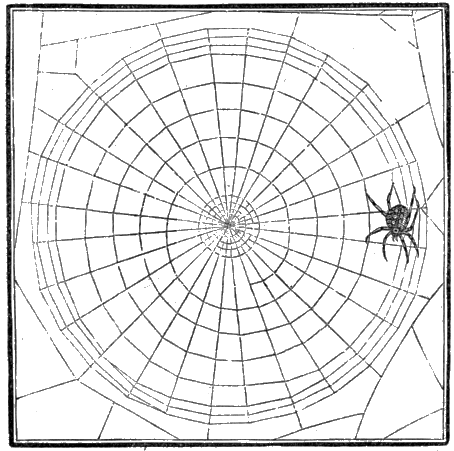
In constructing the body of the net, the most remarkable circumstance is her using her limbs as a measure, to regulate the distances of her radii or wheel-spokes, and the circular meshes interweaved into them. These are consequently always proportional to the size of the spider. She often takes up her station in the centre, but not always, though it is so said by inaccurate writers; for she as frequently lurks in a little chamber constructed under a leaf or other shelter at the corner of her web, ready to dart down upon whatever prey may be entangled in her net. The centre of the net is said also to be composed of more viscid materials than its suspensory lines,—a circumstance alleged to be proved by the former appearing under the microscope studded with globules of gum.[FN] We have not been able to verify this distinction, having seen the suspensory lines as often studded in this manner as those in the centre. (J. R.)
Mason-Spiders.
A no less wonderful structure is composed by a sort of spiders, natives of the tropics and the south of Europe, which have been justly called mason-spiders by M. Latreille. One of these (Mygale nidulans, Walckn.), found in the West Indies, “digs a hole in the earth obliquely downwards about three inches in length, and one in diameter. This cavity she lines with a tough thick web, which, when taken out, resembles a leathern purse; but, what is most curious, this house has a door with hinges, like the operculum of some sea-shells, and herself and family, who tenant this nest, open and shut the door whenever they pass and repass. This history was told me,” says Darwin, “and the nest, with its door, shown me by the late Dr. Butt, of Bath, who was some years physician in Jamaica.”[FO]
Nest of the Mason-Spider. A. The nest shut. B. The nest open. C. The spider, Mygale cæmentaria. D. The eyes magnified. E, F. Parts of the foot and claw magnified.
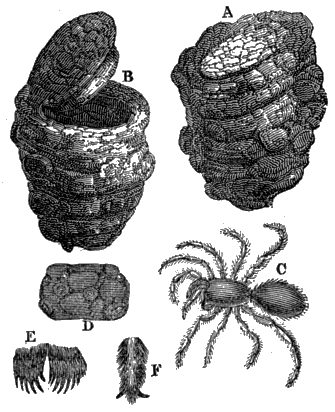
The nest of a mason-spider, similar to this, has been obligingly put into our hands by Mr. Riddle, of Blackheath. It came from the West Indies, and is probably that of Latreille’s clay-kneader (Mygale cratiens), and one of the smallest of the genus. We have since seen a pair of these spiders in possession of Mr. William Mello, of Blackheath. The nest is composed of very hard argillaceous clay, deeply tinged with brown oxide of iron. It is in form of a tube, about one inch in diameter, between six and seven inches long, and slightly bent towards the lower extremity—appearing to have been mined into the clay rather than built. The interior of the tube is lined with a uniform tapestry of silken web, of an orange-white colour, with a texture intermediate between India paper and very fine glove leather. But the most wonderful part of this nest is its entrance, which we look upon as the perfection of insect architecture. A circular door, about the size of a crown piece, slightly concave on the outside and convex within, is formed of more than a dozen layers of the same web which lines the interior, closely laid upon one another, and shaped so that the inner layers are the broadest, the outer being gradually less in diameter, except towards the hinge, which is about an inch long; and in consequence of all the layers being united there, and prolonged into the tube, it becomes the thickest and strongest part of the structure. The elasticity of the materials, also, gives to this hinge the remarkable peculiarity of acting like a spring, and shutting the door of the nest spontaneously. It is, besides, made to fit so accurately to the aperture, which is composed of similar concentric layers of web, that it is almost impossible to distinguish the joining by the most careful inspection. To gratify curiosity, the door has been opened and shut hundreds of times, without in the least destroying the power of the spring. When the door is shut, it resembles some of the lichens (Lecidea), or the leathery fungi, such as Polyporus versicolor (Micheli), or, nearer still, the upper valve of a young oyster shell. The door of the nest, the only part seen above ground, being of a blackish-brown colour, it must be very difficult to discover. (J. R.)
Another mason-spider (Mygale cæmentaria, Latr.), found in the south of France, usually selects for her nest a place bare of grass, sloping in such a manner as to carry off the water, and of a firm soil, without rocks or small stones. She digs a gallery a foot or two in depth, and of a diameter (equal throughout) sufficient to admit of her easily passing. She lines this with a tapestry of silk glued to the walls. The door, which is circular, is constructed of many layers of earth kneaded, and bound together with silk. Externally, it is flat and rough, corresponding to the earth around the entrance, for the purpose, no doubt, of concealment: on the inside it is convex, and tapestried thickly with a web of fine silk. The threads of this door-tapestry are prolonged, and strongly attached to the upper side of the entrance, forming an excellent hinge, which, when pushed open by the spider, shuts again by its own weight, without the aid of spring hinges. When the spider is at home, and her door forcibly opened by an intruder, she pulls it strongly inwards, and even when half-opened often snatches it out of the hand; but when she is foiled in this, she retreats to the bottom of her den, as her last resource.[FP]
Rossi ascertained that the female of an allied species (Mygale sauvagesii, Latr.), found in Corsica, lived in one of these nests, with a numerous posterity. He destroyed one of these doors to observe whether a new one would be made, which it was; but it was fixed immovably, without a hinge; the spider, no doubt, fortifying herself in this manner till she thought she might reopen it without danger.[FQ]
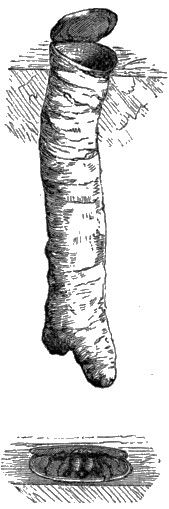
[The accompanying illustration shows one of these nests, which is in my own collection. It was brought from Jamaica, together with the spider that made it.
The nest is nearly six inches in length, and is made of a double layer of silken web. The inner layer is yellowish, with a tinge of red, and although fine, very tough and strong. The outer layer is thick, coarse, dark brown, and rather flaky, the dark colour being probably caused by the earth which is mixed with it. The lid is made of eight or ten layers of coarse web, overlapping each other like the tiles of a house-roof, and the entrance of the nest is formed after the same fashion. If the lid be opened, the inside of the nest is seen to be of a different make from the exterior, being greyish-white, smooth, close-textured, and looking much like the finest kid leather.
[The smaller illustration shows the spider in the act of emerging from its home.]
* * * * *
“The Rev. Revett Shepherd has often noticed, in the fen ditches of Norfolk, a very large spider (the species not yet determined) which actually forms a raft for the purpose of obtaining its prey with more facility. Keeping its station upon a ball of weeds about three inches in diameter, probably held together by slight silken cords, it is wafted along the surface of the water upon this floating island, which it quits the moment it sees a drowning insect. The booty thus seized it devours at leisure upon its raft, under which it retires when alarmed by any danger.”[FR] In the spring of 1830, we found a spider on some reeds in the Croydon Canal, which agreed in appearance with Mr. Shepherd’s.
Among our native spiders there are several besides this one, which, not contented with a web like the rest of their congeners, take advantage of other materials to construct cells where, “hushed in grim repose,” they “expect their insect prey.” The most simple of those spider-cells is constructed by a longish-bodied spider (Aranea holosericea, Linn.), which is a little larger than the common hunting-spider. It rolls up a leaf of the lilac or poplar, precisely in the same manner as is done by the leaf-rolling caterpillars, upon whose cells it sometimes seizes to save itself trouble, having first expelled, or perhaps devoured, the rightful owner. The spider, however, is not satisfied with the tapestry of the caterpillar, but always weaves a fresh set of her own, much more close and substantial.
Another spider, common in woods and copses (Epeira quadrata?), weaves together a great number of leaves to form a dwelling for herself, and in front of it she spreads her toils for entrapping the unwary insects which stray thither. These, as soon as caught, are dragged into her den, and stored up for a time of scarcity. Here also her eggs are deposited and hatched in safety. When the cold weather approaches, and the leaves of her edifice wither, she abandons it for the more secure shelter of a hollow tree, where she soon dies; but the continuation of the species depends upon eggs, deposited in the nest before winter, and remaining to be hatched with the warmth of the ensuing summer.
The spider’s den of united leaves, however, which has just been described, is not always useless when withered and deserted, for the dormouse usually selects it as a ready-made roof for its nest of dried grass. That those old spiders’ dens are not accidentally chosen by the mouse, appears from the fact, that out of about a dozen mouse-nests of this sort found during winter in a copse between Lewisham and Bromley, Kent, every second or third one was furnished with such a roof. (J. R.)
Diving Water-Spider.
Though spiders require atmospheric air for respiration, yet one species well known to naturalists is aquatic in its habits, and lives not only upon the surface but below the surface of the water, contriving to carry down with it a sufficiency of air for the support of life during a considerable period of time. Its subaqueous nest is in fact a sort of diving-bell, and constitutes a secure and most ingenious habitation. This spider does not like stagnant water, but prefers low running streams, canals, and ditches, where she may often be seen in the vicinity of London and elsewhere, living in her diving-bell, which shines through the water like a little globe of silver: her singular economy was first, we believe, described by Clerck,[FS] L. M. de Lignac,[FT] and De Geer.
“The shining appearance,” says Clerck, "proceeds either from an inflated globule surrounding the abdomen, or from the space between the body and the water. The spider, when wishing to inhale the air, rises to the surface, with its body still submersed, and only the part containing the spinneret rising just to the surface, when it briskly opens and moves its four teats. A thick coat of hair keeps the water from approaching or wetting the abdomen. It comes up for air about four times an hour or oftener, though I have good reason to suppose it can continue without it for several days together.
"I found in the middle of May one male and ten females, which I put into a glass filled with water, where they lived together very quietly for eight days. I put some duckweed (Lemna) into the glass to afford them shelter, and the females began to stretch diagonal threads in a confused manner from it to the sides of the glass about half-way down. Each of the females afterwards fixed a close bag to the edge of the glass, from which the water was expelled by the air from the spinneret, and thus a cell was formed capable of containing the whole animal. Here they remained quietly, with their abdomens in their cells, and their bodies still plunged in the water; and in a short time brimstone-coloured bags of eggs appeared in each cell, filling it about a fourth part. On the 7th of July several young ones swam out from one of the bags. All this time the old ones had nothing to eat, and yet they never attacked one another as other spiders would have been apt to do."[FU]
“These spiders,” says De Geer, “spin in the water a cell of strong, closely-woven white silk, in the form of half the shell of a pigeon’s egg, or like a diving-bell. This is sometimes left partly above water, but at others is entirely submersed, and is always attached to the objects near it by a great number of irregular threads. It is closed all round, but has a large opening below, which, however, I found closed on the 15th of December, and the spider living quietly within, with her head downwards. I made a rent in this cell, and expelled the air, upon which the spider came out; yet, though she appeared to have been laid up for three months in her winter quarters, she greedily seized upon an insect and sucked it. I also found that the male as well as the female constructs a similar subaqueous cell, and during summer no less than in winter.”[FV] We have recently kept one of these spiders for several months in a glass of water, where it built a cell half under water, in which it laid its eggs.
Cleanliness of Spiders.
When we look at the viscid material with which spiders construct their lines and webs, and at the rough, hairy covering (with a few exceptions) of their bodies, we might conclude that they would be always stuck over with fragments of the minute fibres which they produce. This, indeed, must often happen, did they not take careful precautions to avoid it; for we have observed that they seldom, if ever, leave a thread to float at random, except when they wish to form a bridge. When a spider drops along a line, for instance, in order to ascertain the strength of her web, or the nature of the place below her, she invariably, when she reascends, coils it up into a little ball, and throws it away. Her claws are admirably adapted for this purpose, as well as for walking along the lines, as may be readily seen by a magnifying glass.
Triple-clawed foot of a Spider, magnified.
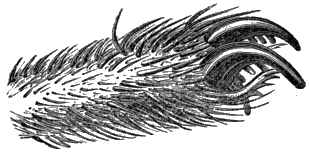
There are three claws, one of which acts as a thumb, the others being toothed like a comb, for gliding along the lines. This structure, however, unfits it to walk, as flies can do, upon any upright polished surface like glass; although the contrary[FW] is erroneously asserted by the Abbé de la Pluche. Before she can do so, she is obliged to construct a ladder of ropes, as Mr. Blackwell remarks,[FX] by elevating her spinneret as high as she can, and laying down a step upon which she stands to form a second, and so on; as any one may try by placing a spider at the bottom of a very clean wine-glass.
The hairs of the legs, however, are always catching bits of web and particles of dust; but these are not suffered to remain long. Most people may have remarked that the house-fly is ever and anon brushing its feet upon one another to rub off the dust, though we have not seen it remarked in authors that spiders are equally assiduous in keeping themselves clean. They have, besides, a very efficient instrument in their mandibles or jaws, which, like their claws, are furnished with teeth; and a spider which appears to a careless observer as resting idly, in nine cases out of ten will be found slowly combing her legs with her mandibles, beginning as high as possible on the thigh, and passing down to the claws. The flue which she thus combs off is regularly tossed away.
With respect to the house-spider (A. domestica), we are told in books, that “she from time to time clears away the dust from her web, and sweeps the whole by giving it a shake with her paw, so nicely proportioning the force of her blow, that she never breaks anything.”[FY] That spiders may be seen shaking their webs in this manner, we readily admit; though it is not, we imagine, to clear them of dust, but to ascertain whether they are sufficiently sound and strong.
We recently witnessed a more laborious process of cleaning a web than merely shaking it. On coming down the Maine by the steamboat from Frankfort, in August, 1829, we observed the geometric-net of a conic-spider (Epeira conica, Walck.) on the framework of the deck, and as it was covered with flakes of soot from the smoke of the engine, we were surprised to see a spider at work on it; for, in order to be useful, this sort of net must be clean. Upon observing it a little closely, however, we perceived that she was not constructing a net, but dressing up an old one; though not, we must think, to save trouble, so much as an expenditure of material. Some of the lines she dexterously stripped of the flakes of soot adhering to them; but in the greater number, finding that she could not get them sufficiently clean, she broke them quite off, bundled them up, and tossed them over. We counted five of these packets of rubbish which she thus threw away, though there must have been many more, as it was some time before we discovered the manœuvre, the packets being so small as not to be readily perceived, except when placed between the eye and the light. When she had cleared off all the sooty lines, she began to replace them in the usual way; but the arrival of the boat at Mentz put an end to our observations. (J. R.) Bloomfield, the poet, having observed the disappearance of these bits of ravelled web, imagined that the spider swallowed them; and even says that he observed a garden spider moisten the pellets before swallowing them![FZ] Dr. Lister, as we have already seen, thought the spider retracted the threads within the abdomen.
CHAPTER XIX.
STRUCTURES OF GALL-FLIES AND APHIDES.
Many of the processes which we have detailed bear some resemblance to our own operations of building with materials cemented together; but we shall now turn our attention to a class of insect-architects, who cannot, so far as we know, be matched in prospective skill by any of the higher orders of animals. We refer to the numerous family which have received the name of gall-flies,—a family which, as yet, is very imperfectly understood, their economy being no less difficult to trace than their species is to arrange in the established systems of classification; though the latter has been recently much improved by Mr. Westwood.
Small berry-shaped galls of the oak leaf, produced by Cynips quercus folii?
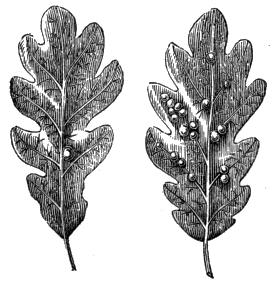
One of the most simple and very common instances of the nests constructed by gall-insects, may be found in abundance during the summer, on the leaves of the rose-tree, the oak, the poplar, the willow (Salix viminalis), and many other trees, in the globular form of a berry, about the size of a currant, and usually of a green colour, tinged with red, like a ripe Alban or Baltimore apple.
When this psuedo-apple in miniature is cut into, it is found to be fresh, firm, juicy, and hollow in the centre, where there is either an egg or a grub safely lodged, and protected from all ordinary accidents. Within this hollow ball the egg is hatched, and the grub feeds securely on its substance, till it prepares for its winter sleep, before changing into a gall-fly (Cynips) in the ensuing summer. There is a mystery as to the manner in which this gall-fly contrives to produce the hollow miniature apples, each enclosing one of her eggs; and the doubts attendant upon the subject cannot, so far as our present knowledge extends, be solved, except by plausible conjecture. Our earlier naturalists were of opinion that it was the grub which produced the galls, by eating, when newly hatched, through the cuticle of the leaf, and remaining till the juices flowing from the wound enveloped it, and acquired consistence by exposure to the air. This opinion, however, plausible as it appeared to be, was at once disproved by finding unhatched eggs on opening the galls.
Ovipositor of Gall-fly, greatly magnified.
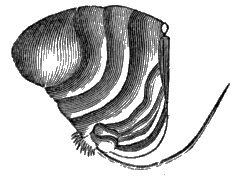
There can be no doubt, indeed, that the mother gall-fly makes a hole in the plant for the purpose of depositing her eggs. She is furnished with an admirable ovipositor for that express purpose, and Swammerdam actually saw a gall-fly thus depositing her eggs, and we have recently witnessed the same in several instances. In some of these insects the ovipositor is conspicuously long, even when the insect is at rest; but in others, not above a line or two of it is visible, till the belly of the insect be gently pressed. When this is done to the fly that produces the currant-gall of the oak, the ovipositor may be seen issuing from a sheath in form of a small curved needle, of a chestnut-brown colour, and of a horny substance, and three times as long as it at first appeared.
Gall-fly, and mechanism of ovipositor, greatly magnified.
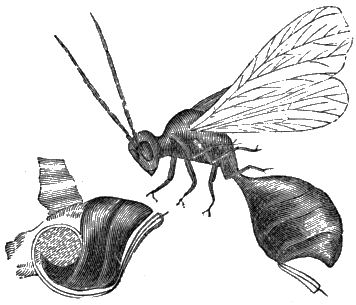
What is most remarkable in this ovipositor is, that it is much longer than the whole body of the insect, in whose belly it is lodged in a sheath, and, from its horny nature, it cannot be either shortened or lengthened. It is on this account that it is bent into the same curve as the body of the insect. The mechanism by which this is effected is similar to that of the tongue of the woodpeckers (Picidæ), which, though rather short, can be darted out far beyond the beak, by means of a forked bone at the root of the tongue, which is thin and rolled up like the spring of a watch. The base of the ovipositor of the gall-fly is, in a similar way, placed near the anus, runs along the curvature of the back, makes a turn at the breast, and then, following the curve of the belly, appears again near where it originates. We copy from Réaumur his accurate sketch of this remarkable structure.
With this instrument the mother gall-fly pierces the part of a plant which she selects, and, according to our older naturalists, “ejects into the cavity a drop of her corroding liquor, and immediately lays an egg or more there; the circulation of the sap being thus interrupted, and thrown, by the poison, into a fermentation that burns the contiguous parts and changes the natural colour. The sap, turned from its proper channel, extravasates and flows round the eggs, while its surface is dried by the external air, and hardens into a vaulted form.”[GA] Kirby and Spence tell us, that the parent fly introduces her egg “into a puncture made by her curious spiral sting, and in a few hours it becomes surrounded with a fleshy chamber.”[GB] M. Virey says, the gall tubercle is produced by irritation, in the same way as an inflamed tumor in an animal body, by the swelling of the cellular tissue and the flow of liquid matter, which changes the organization, and alters the natural external form.[GC] This seems to be the received doctrine at present in France.[GD]
Sprengel, speaking of the rose-willow, says, the insect in spring deposits its eggs in the leaf buds. “The new stimulus attracts the sap,—the type of the part becomes changed, and from the prevailing acidity of the animal juice, it happens, that in the rose and stock-shaped leaves which are pushed out, a red instead of a green colour is evolved.”[GE]
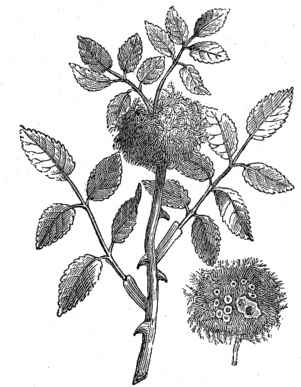
Bedeguar Gall of the Rose, produced by Cynips rosæ.
Without pretending positively to state facts which are, perhaps, beyond human penetration, we may view the process in a rather different light. (J. R.) Following the analogy of what is known to occur in the case of the saw-flies, after the gall-fly has made a puncture and pushed her egg into the hole, we may suppose that she covers it over with some adhesive gluten or gum, or the egg itself, as is usual among moths, &c., may be coated over with such a gluten. In either of these two cases, the gluten will prevent the sap that flows through the puncture from being scattered over the leaf and wasted; and the sap, being thus confined to the space occupied by the eggs, will expand and force outwards the pellicle of gluten that confines it, till becoming thickened by evaporation and exposure to the air, it at length shuts up the puncture, stops the further escape of the sap, and the process is completed. This explanation will completely account for the globular form of the galls alluded to; that is, supposing the egg of the gall-fly to be globular, and covered or coated with a pellicle of gluten of uniform thickness, and consequently opposing uniform resistance, or rather uniform expansibility, to the sap pressing from within. It will also account for the remarkable uniformity in the size of the gall apples; for the punctures and the eggs being uniform in size, and the gluten, by supposition, uniform in quantity, no more than the same quantity of sap can escape in such circumstances.
But though this explanation appears to be plausible, it is confessedly conjectural; for though Swammerdam detected a gall-fly in the act of depositing her eggs, he did not attend to this circumstance; and in the instances which we have observed, some unlucky accident always prevented us from following up our observations. The indefatigable Réaumur, on one occasion, thought he would make sure of tracing the steps of the process in the case of the gall-fly which produces the substance called bedeguar on the wild rose-tree, and to which we shall presently advert. His plan was to enclose in a box, in which a brood of flies had just been produced from a bedeguar, a living branch from a wild rose-tree; but, to his great disappointment, no eggs were laid, and no bedeguar formed. Upon further investigation, he discovered that the brood of flies produced from the bedeguar were not the genuine bedeguar insects at all, but one of the parasite ichneumons (Callimone bedeguaris, Stephens), which had surreptitiously deposited their eggs there, in order to supply their young with the bedeguar grubs, all of which they appeared to have devoured. It may prove interesting to look into the remarkable structure of the bedeguar itself, which is very different from the globular galls above described.
One of the bristles of the Bedeguar of the Rose magnified.
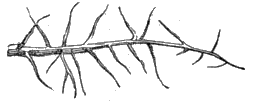
The gall-fly of the willow (Cynips viminalis) deposits, as we have just seen, only a single egg on one spot; but the bedeguar insect lays a large cluster of eggs on the extremity of a growing branch of the wild rose-tree, making, probably, a proportionate number of punctures to procure materials for the future habitation of her young progeny. As in the former case, also, each of these eggs becomes (as we may suppose) surrounded with the sap of the rose, enclosed in a pellicle of gluten. The gluten, however, of the bedeguar insect is not, it would appear, sufficiently tenacious to confine the flowing sap within the dimensions of any of the little clustered globes containing the eggs, for it oozes out from numerous cracks or pores in the pellicle; which cracks or pores, however, are not large enough to admit a human hair. But this, so far from being a defect in the glutinous pellicle of the bedeguar fly, is, as we shall presently see, of great utility. The sap which issues from each of these pores, instead of being evaporated and lost, shoots out into a reddish-coloured, fibrous bristle.
It is about half an inch long, and, from the natural tendency of the sap of the rose-tree to form prickles, these are all over studded with weak pricklets. The bedeguar, accordingly, when fully formed, has some resemblance, at a little distance, to a tuft of reddish-brown hair or moss stuck upon the branch. Sometimes this tuft is as large as a small apple, and of a rounded but irregular shape; at other times it is smaller, and in one instance mentioned by Réaumur, only a single egg had been laid on a rose-leaf, and, consequently, only one tuft was produced. Each member of the congeries is furnished with its own tuft of bristles, arising from the little hollow globe in which the egg or the grub is lodged.
The prospective wisdom of this curious structure is admirable. The bedeguar grubs live in their cells through the winter, and as their domicile is usually on one of the highest branches, it must be exposed to every severity of the weather. But the close, non-conducting, warm, mossy collection of bristles, with which it is surrounded, forms for the soft, tender grubs a snug protection against the winter’s cold, till, through the influence of the warmth of the succeeding summer, they undergo their final change into the winged state; preparatory to which they eat their way with their sharp mandibles through the walls of their little cells, which are now so hard as to be cut with difficulty by a knife. (J. R.)
Another structure, similar in principle, though different in appearance, is very common upon oak-trees, the termination of a branch being selected as best suited for the purpose. This structure is rather larger than a filbert, and is composed of concentric leaves diverging from the base, and expanding upwards, somewhat like an artichoke. Whether this leafy structure is caused by a superinduced disease, as the French think, or by the form of the pores in the pellicle of gluten surrounding the eggs, or rather by the tendency of the exuding sap of the oak to form leaves, has not been ascertained; but that it is intended, as in the case of the bedeguar, to afford an efficient protection against the weather to the included eggs or grubs, there can be no doubt.
Artichoke Gall of the Oak-bud, with Gall-fly (Cynips quercus gemmæ), natural size, and its ovipositor (a) magnified.
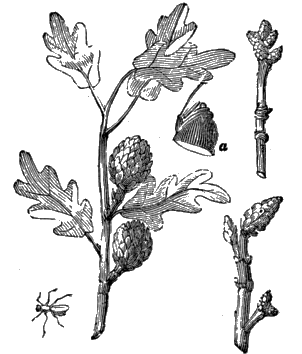
From the very nature of the process of forming willow-galls, bedeguar, and the artichoke of the oak, whatever theory be adopted, it will be obvious that their growth must be rapid; for the thickening of the exuded sap, which is quickly effected by evaporation, will soon obstruct and finally close the orifice of the puncture made by the parent insect. It is accordingly asserted by Réaumur and other observers, that all the species of galls soon reach their full growth.
Leafy Gall of Dyer’s Broom, produced by Cynips genistæ? A, gall, natural size; B, a leaflet magnified.
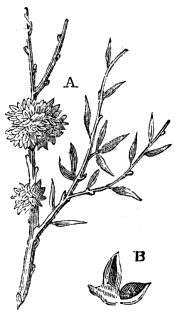
A very minute reddish-coloured grub feeds upon dyer’s broom (Genista), producing a sort of gall, frequently globular, but always studded with bristles, arising from the amorphous leaves. The stem of the shrub passes through this ball, which is composed of a great number of leaves, shorter and broader than natural, and each rolled into the form of a horn, the point of which ends in a bristle. In the interior we find a thick fleshy substance, serving to sustain the leaves, and also for the nourishment of the grubs, some of which are within and some between the leaves. They are in prodigious numbers,—hundreds being assembled in the small gall, and so minute as scarcely to be perceived without the aid of a magnifying glass. The bud of the plant attacked by those grubs, instead of forming a shoot, pushes out nothing but leaves, and these are all rolled, and turned round the stem. Some shrubs have several of these galls, which are of various sizes, from that of a filbert to that of a walnut.
A similar but still more beautiful production is found upon one of the commonest of our indigenous willows (Salix purpurea), which takes the name of rose-willow, more probably from this circumstance than from the red colour of its twigs. The older botanists, not being aware of the cause of such excrescences, considered the plants so affected as distinct species; and old Gerard accordingly figures and describes the rose-willow as “not only making a gallant show, but also yielding a most cooling air in the heat of summer, being set up in houses for decking the same.” The production in question, however, is nothing more than the effect produced by a species of gall-fly (Cynips salicis) depositing its eggs in the terminal shoot of a twig, and, like the bedeguar and the oak artichoke, causing leaves to spring out, of a shape totally different from the other leaves of the tree, and arranged very much like the petals of a rose. Decandolle says it is found chiefly on the Salix helix, S. alba, and S. riparia.[GF]
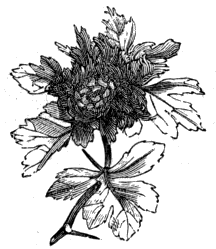
A production very like that of the rose-willow may be commonly met with on the young shoots of the hawthorn, the growth of the shoot affected being stopped, and a crowded bunch of leaves formed at the termination. These leaves, besides being smaller than natural, are studded with short bristly prickles, from the sap (we may suppose) of the hawthorn being prevented from rising into a fresh shoot, and thrown out of its usual course in the formation of the arms. These bristles appear indiscriminately on both sides of the leaves, some of which are bent inwards, while others diverge in their natural manner.
This is not caused by the egg or grub of a true gall-fly, but by the small white tapering grub of some dipterous insect, of which we have not ascertained the species, but which is, probably, a cecidomyia. Each terminal shoot is inhabited by a number of these—not lodged in cells, however, but burrowing indiscriminately among the half-withered brown leaves which occupy the centre of the production. (J. R.)
A more remarkable species of gall than any of the above we discovered, in June, 1829, on the twig of an oak in the grounds of Mr. Perkins, at Lee, in Kent. When we first saw it, we imagined that the twig was beset with some species of the lanigerous aphides, similar to what is vulgarly called the American or white blight (Aphis lanata); but on closer examination we discarded this notion. The twig was indeed thickly beset with a white downy, or rather woolly, substance around the stem at the origin of the leaves, which did not appear to be affected in their growth, being well formed, healthy, and luxuriant. We could not doubt that the woolly substance was caused by some insect; but though we cut out a portion of it, we could not detect any egg or grub, and we therefore threw the branch into a drawer, intending to keep it as a specimen, whose history we might complete at some subsequent period.
Semi-Gall of the Hawthorn, produced by Cecidomyia? drawn from a specimen.
A few weeks afterwards, on opening this drawer, we were surprised to see a brood of several dozens of a species of gall-fly (Cynips), similar in form and size to that whose eggs cause the bedeguar of the rose, and differing only in being of a lighter colour, tending to a yellowish brown. We have since met with a figure and description of this gall in Swammerdam. We may remark that the above is not the first instance which has occurred in our researches, of gall insects outliving the withering of the branch or leaf from which they obtain their nourishment.
Woolly Gall of the Oak, less than the natural size, caused by a Cynips, and drawn from a specimen.
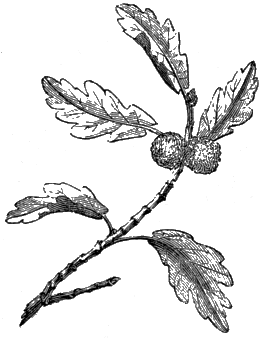
The woolly substance on the branch of the oak which we have described was similarly constituted with the bedeguar of the rose, with this difference, that instead of the individual cells being diffused irregularly through the mass, they were all arranged at the off-goings of the leaf-stalks, each cell being surrounded with a covering of the vegetable wool, which the stimulus of the parent egg, or its gluten, had caused to grow, and from each cell a perfect fly had issued. We also remarked that there were several small groups of individual cells, each of which groups was contained in a species of calyx or cup of leaf-scales, as occurs also in the well-known gall called the oak-apple.
We were anxious to watch the proceedings of these flies in the deposition of their eggs, and the subsequent developments of the gall-growths; and endeavoured for that purpose to procure a small oak plant in a garden-pot; but we did not succeed in this: and though they alighted on rose and sweet-briar trees, which we placed in their way, we never observed that they deposited any eggs upon them. In a week or two the whole brood died, or disappeared. (J. R.)
There are some galls, formed on low-growing plants, which are covered with down, hair, or wool, though by no means so copiously as the one which we have just described. Among the plants so affected are the germander speedwell, wild thyme, ground-ivy, and others to which we shall afterwards advert.
Oak-apple Galls, one being cut open to show the vessels running to granules.
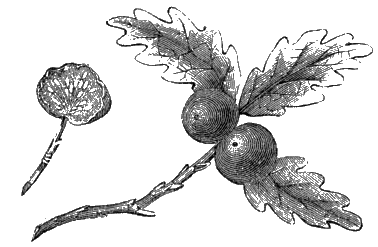
The well-known oak-apple is a very pretty example of the galls formed by insects; and this, when compared with other galls which form on the oak, shows the remarkable difference produced on the same plant by the punctures of insects of different species. The oak-apple is commonly as large as a walnut or small apple, rounded, but not quite spherical, the surface being irregularly depressed in various places. The skin is smooth, and tinged with red and yellow, like a ripe apple; and at the base there is, in the earlier part of the summer, a calyx or cup of five or six small brown scaly leaves; but these fall off as the season advances. If an oak-apple be cut transversely, there is brought into view a number of oval granules, each containing a grub, and embedded in a fruit-looking fleshy substance, having fibres running through it. As these fibres, however, run in the direction of the stem, they are best exhibited by a vertical section of the gall; and this also shows the remarkable peculiarity of each fibre terminating in one of the granules, like a footstalk, or rather like a vessel for carrying nourishment. Réaumur, indeed, is of opinion that these fibres are the diverted nervures of the leaves, which would have sprung from the bud in which the gall-fly had inserted her eggs, and actually do carry sap-vessels throughout the substance of the gall.
Root Galls of the Oak, produced by Cynips quercus inferus? drawn from a specimen.
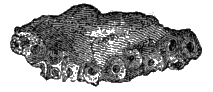
Réaumur says the perfect insects (Cynips quercus) issued from his galls in June and the beginning of July, and were of a reddish-amber colour. We have procured insects, agreeing with Réaumur’s description, from galls formed on the bark or wood of the oak, at the line of junction between the root and the stem. These galls are precisely similar in structure to the oak-apple, and are probably formed at a season when the fly perceives, instinctively, that the buds of the young branches are unfit for the purpose of nidification.
There is another oak-gall, differing little in size and appearance from the oak-apple, but which is very different in structure, as, instead of giving protection and nourishment to a number of grubs, it is only inhabited by one. This sort of gall, besides, is hard and woody on the outside, resembling a little wooden ball of a yellowish colour, but internally of a soft, spongy texture. The latter substance, however, encloses a small hard gall, which is the immediate residence of the included insect. Galls of this description are often found in clusters of from two to seven, near the extremity of a branch, not incorporated, however, but distinctly separate.
Woody Gall on a Willow branch, drawn from a specimen.
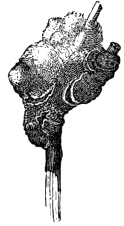
We have obtained a fly very similar to this from a very common gall, which is formed on the branches of the willow. Like the one-celled galls just described, this is of a hard, ligneous structure, and forms an irregular protuberance, sometimes at the extremity, and sometimes on the body, of a branch. But instead of one, this has a considerable number of cells, irregularly distributed through its substance. The structure is somewhat spongy, but fibrous; and externally the bark is smoother than that of the branch upon which it grows. (J. R.)
The currant-galls (as the French call them) of the oak are exactly similar, when formed on the leaves, to those which we have first described as produced on the leaves of the willow and other trees. But the name of currant-gall seems still more appropriate to an excrescence which grows on the catkins of the oak, giving them very much the appearance of a straggling branch of currants or bird-cherries. The galls resemble currants which have fallen from the tree before being ripe. These galls do not seem to differ from those formed on the leaves of the oak; and are probably the production of the same insect, which selects the catkin in preference, by the same instinct that the oak-apple gall-fly, as we have seen, sometimes deposits its eggs in the bark of the oak near the root.
Currant Gall of the catkins of the Oak, produced by Cynips quercus pedunculi?
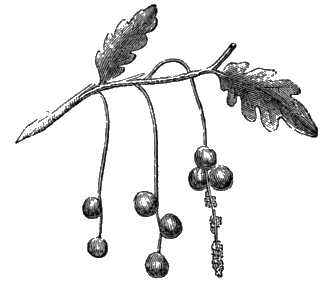
The gall of the oak, which forms an important dye-stuff, and is used in making writing-ink, is also produced by a Cynips, and has been described in the ‘Library of Entertaining Knowledge’ (Vegetable Substances, p. 16). The employment of the Cynips psenes for ripening figs is described in the same volume, p. 244.
Gall of the Hawthorn Weevil, drawn from specimen. a, Opened to show the grub.
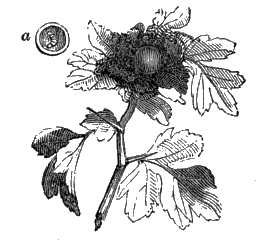
Gall of a Hawthorn Weevil.
In May, 1829, we found on a hawthorn at Lee, in Kent, the leaves at the extremity of a branch neatly folded up in a bundle, but not quite so closely as is usual in the case of leaf-rolling caterpillars. On opening them, there was no caterpillar to be seen, the centre being occupied with a roundish, brown-coloured, woody substance, similar to some excrescences made by gall-insects (Cynips). Had we been aware of its real nature, we should have put it immediately under a glass or in a box, till the contained insect had developed itself; but instead of this, we opened the ball, where we found a small yellowish grub coiled up, and feeding on the exuding juices of the tree. As we could not replace the grub in its cell, part of the walls of which we had unfortunately broken, we put it in a small pasteboard box with a fresh shoot of hawthorn, expecting that it might construct a fresh cell. This, however, it was probably incompetent to perform: it did not at least make the attempt, and neither did it seem to feed on the fresh branch, keeping in preference to the ruins of its former cell. To our great surprise, although it was thus exposed to the air, and deprived of a considerable portion of its nourishment, both from the part of the cell having been broken off, and from the juices of the branch having been dried up, the insect went through its regular changes, and appeared in the form of a small greyish-brown beetle of the weevil family. The most remarkable circumstance in the case in question, was the apparent inability of the grub to construct a fresh cell after the first was injured,—proving, we think, beyond a doubt, that it is the puncture made by the parent insect when the egg is deposited that causes the exudation and subsequent concretion of the juices forming the gall. These galls were very abundant during the summer of 1830. (J. R.)
A few other instances of beetles producing galls are recorded by naturalists. Kirby and Spence have ascertained, for example, that the bumps formed on the roots of kedlock or charlock (Sinapis arvensis) are inhabited by the larvæ of a weevil (Curculio contractus, Marsham; and Rhynchœnus assimilis, Fabr.); and it may be reasonably supposed that either the same or similar insects cause the clubbing of the roots of cabbages, and the knob-like galls on turnips, called in some places the anbury. We have found them also infesting the roots of the hollyhock (Alcea rosea). They are evidently beetles of an allied genus which form the woody galls sometimes met with on the leaves of the guelder-rose (Viburnum), the lime-tree (Tilia Europæa), and the beech (Fagus sylvatica).
There are also some two-winged flies which produce woody galls on various plants, such as the thistle-fly (Tephritis cardui, Latr.). The grubs of this pretty fly produce on the leaf-stalks of thistles an oblong woody knob. On the common white briony (Bryonia dioica) of our hedges may be found a very pretty fly of this genus, of a yellowish-brown colour, with pellucid wings, waved much like those of the thistle-fly with yellowish brown. This fly lays its eggs near a joint of the stem, and the grubs live upon its substance. The joint swells out into an oval form, furrowed in several places, and the fly is subsequently disclosed. In its perfect state, it feeds on the blossom of the briony. (J. R.) Flies of another minute family, the gall-gnats (Cecidomyiæ, Latr.), pass the first stage of their existence in the small globular cottony galls which abound on germander speedwell (Veronica chamædrys), wild thyme (Thymus serpyllum), and ground-ivy (Glechoma hederacea). The latter is by no means uncommon, and may be readily recognised.
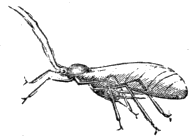
Certain species of plant-lice (Aphides), whose complete history would require a volume, produce excrescences upon plants which may with some propriety be termed galls, or semi-galls. Some of these are without any aperture, whilst others are in form of an inflated vesicle, with a narrow opening on the under side of a leaf, and expanding (for the most part irregularly) into a rounded knob on its upper surface. The mountain-ash (Pyrus aucuparia) has its leaves and young shoots frequently affected in this way, and sometimes exhibits galls larger than a walnut or even than a man’s fist; at other times they do not grow larger than a filbert. Upon opening one of these, they are found to be filled with the aphides sorbi. If taken at an early stage of their growth, they are found open on the under side of the leaf, and inhabited only by a single female aphis, pregnant with a numerous family of young. In a short time the aperture becomes closed, in consequence of the insect making repeated punctures round its edge, from which sap is exuded and forms an additional portion of the walls of the cell.
A Plant-Louse (Aphis), magnified.
In this early stage of its growth, however, the gall does not, like the galls of the cynips, increase very much in dimensions. It is after the increase of the inhabitants by the young brood that it grows with considerable rapidity; for each additional insect, in order to procure food, has to puncture the wall of the chamber and suck the juices, and from the punctures thus made the sap exudes, and enlarges the walls. As those galls are closed all round in the more advanced state, it does not appear how the insects can ever effect an exit from their imprisonment.
Galls produced on the leaves and leaf-stalks of the Poplar by Eriosoma populi, with the various forms of the insects, winged, not winged, and covered with wool, both of the natural size and magnified.
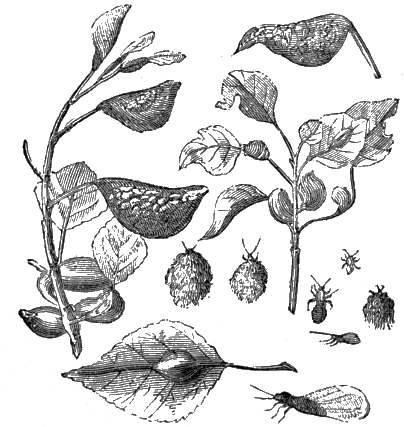
A much more common production, allied to the one just described, may be found on the poplar in June and July. Most of our readers may have observed, about midsummer, a small snow-white tuft of downy-looking substance floating about on the wind, as if animated. Those tufts of snow-white down are never seen in numbers at the same time, but generally single, though some dozens of them may be observed in the course of one day. This singular object is a four-winged fly (Eriosoma populi, Leach), whose body is thickly covered with long down—a covering which seems to impede its flight, and make it appear more like an inanimate substance floating about on the wind, than impelled by the volition of a living animal. This pretty fly feeds upon the fresh juices of the black poplar, preferring that of the leaves and leaf-stalks, which it punctures for this purpose with its beak. It fixes itself with this design to a suitable place upon the principal nervure of the leaf, or upon the leaf-stalk, and remains in the same spot till the sap, exuding through the punctures, and thickening by contact with the air, surrounds it with a thick fleshy wall of living vegetable substance, intermediate in texture between the wood and the leaf, being softer than the former and harder than the latter. In this snug little chamber, secure from the intrusion of lady-birds and the grubs of aphidivorous flies (Syrphi), she brings forth her numerous brood of young ones, who immediately assist in enlarging the extent of their dwelling, by puncturing the walls. In one respect, however, the galls thus formed differ from those of the mountain-ash just described,—those of the poplar having always an opening left into some part of the cell, and usually in that portion of it which is elongated into an obtuse beak. From this opening the young, when arrived at the winged state, make their exit, to form new colonies; and, during their migrations, attract the attention of the most incurious by the singularity of their appearance. (J. R.)
On the black poplar there may be found, later in the season than the preceding, a gall of a very different form, though, like the other, it is for the most part on the leaf-stalk. The latter sort of galls are of a spiral form; and though they are closed, they open upon slight pressure, and appear to be formed of two laminæ, twisted so as to unite. It is at this opening that an aperture is formed spontaneously for the exit of the insects, when arrived at a perfect state. In galls of this kind we find aphides, but of a different species from the lanigerous ones, which form the horn-shaped galls above described.
Leaf-Rolling Aphides.
It may not be improper to introduce here a brief sketch of some other effects, of a somewhat similar kind, produced on leaves by other species of the same family (Aphidæ). In all the instances of this kind which we have examined, the form which the leaf takes serves as a protection to the insects, both from the weather and from depredators. That there is design in it appears from the circumstance of the aphides crowding into the embowering vault which they have formed; and we are not quite certain whether they do not puncture certain parts of the leaf for the very purpose of making it arch over them; at least, in many cases, such as that of the hop-fly (Aphis humuli), though the insects are in countless numbers, no arching of the leaves follows. The rose-plant louse, again (Aphis rosæ), sometimes arches the leaves, but more frequently gets under the protecting folds of the half-expanded leaf-buds. (J. R.)
Leaf of the Currant-bush, bulged out by the Aphis ribis.
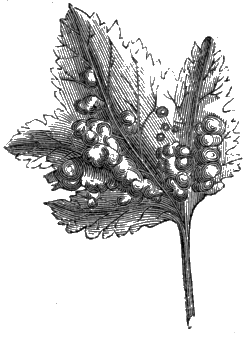
One of the most common instances of what we mean occurs on the leaves of the currant-bush, which may often be observed raised up into irregular bulgings, of a reddish-brown colour. On examining the under side of such a leaf there will be seen a crowd of small insects, some with and some without wings, which are the Aphides ribis in their different stages, feeding securely and socially on the juices of the leaf.
The most remarkable instance of this, however, which we have seen, occurs on the leaves of the elm, and is caused by the Aphis ulmi. The edge of an elm-leaf inhabited by those aphides is rolled up in an elegant convoluted form, very much like a spiral shell; and in the embowered chamber thus formed the insects are secure from rain, wind, and partially from the depredations of carnivorous insects. One of their greatest enemies, the lady-bird (Coccinella), seldom ventures, as we have remarked, into concealed corners except in cold weather, and contrives to find food enough among the aphides which feed openly and unprotected, such as the zebra aphides of the alder (Aphides sambuci). The grubs, however, of the lady-bird, and also those of the aphidivorous flies (Syrphi), may be found prying into the most secret recesses of a leaf to prey upon the inhabitants, whose slow movements disqualify them from effecting an escape. (J. R.)
The effect of the puncture of aphides on growing plants is strikingly illustrated in the shoots of the lime-tree and several other plants, which become bent and contorted on the side attacked by the insects, in the same way that a shoot might warp by the loss of its juices on the side exposed to a brisk fire. The curvings thus effected become very advantageous to the insects, for the leaves sprouting from the twig, which naturally grow at a distance from each other, are brought close together in a bunch, forming a kind of nosegay, that conceals all the colour of the sprig, as well as the insects which are embowered under it, protecting them against the rain and the sun, and at the same time hiding them from observation. It is only requisite, however, where they have formed bowers of this description, to raise the leaves, in order to see the little colony of the aphides,—or the remains of those habitations which they have abandoned. We have sometimes observed sprigs of the lime-tree, of a thumb’s thickness, portions of which resembled spiral screws; but we could not certainly have assigned the true cause for this twisting, had we not been acquainted with the manner in which aphides contort the young shoots of this tree.[GG] The shoots of the gooseberry and the willow are sometimes contorted in the same way, but not so strikingly as the shoots of the lime.
Shoot of the Lime-tree contorted by the punctures of the Aphis tiliæ.
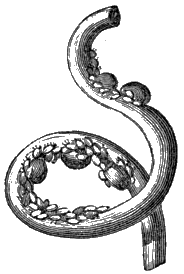
Pseudo-Galls.
It may not be out of place to mention here certain anomalous excrescences upon trees and other plants, which, though they much resemble galls, are not so distinctly traceable to the operations of any insect. In our researches after galls, we have not unfrequently met with excrescences which so very much resemble them, that before dissection we should not hesitate to consider them as such, and predict that they formed the nidus of some species of insects. In more instances than one we have felt so strongly assured of this, that we have kept several specimens for some months, in nurse-boxes, expecting that in due time the perfect insect would be disclosed.
One of these pseudo-galls occurs on the common bramble (Rubus fruticosus), and bears some resemblance to the bedeguar of the rose when old and changed by weather. It clusters round the branches in the form of irregular granules, about the size of a pea, very much crowded, the whole excrescence being rather larger than a walnut. We expected to find this excrescence full of grubs, and were much surprised to discover, upon dissection, that it was only a diseased growth of the plant, caused (it might be) by the puncture of an insect, but not for the purpose of a nidus or habitation. (J. R.)
Pseudo-gall of the Bramble, drawn from a specimen.
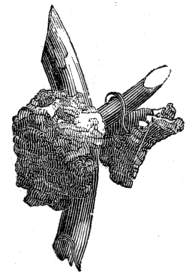
Another sort of excrescence is not uncommon on the terminal shoots of the hawthorn. This is in general irregularly oblong, and the bark which covers it is of an iron colour, similar to the scoriæ of a blacksmith’s forge. When dissected, we find no traces of insects, but a hard, ligneous, and rather porous texture. It is not improbable that this excrescence may originate in the natural growth of a shoot being checked by the punctures of aphides, or of those grubs which we have described.
Many of these excrescences, however, are probably altogether unconnected with insects, and are simply hypertrophic diseases, produced by too much nourishment, like the wens produced on animals. Instances of this may be seen at the roots of the hollyhock (Althea rosea) of three or four years’ standing; on the stems of the elm and other trees, immediately above the root; and on the upper branches of the birch, where a crowded cluster of twigs sometimes grows, bearing no distant resemblance to a rook’s nest in miniature, and provincially called witch-knots.
Pseudo-galls of the Hawthorn, drawn from specimens.
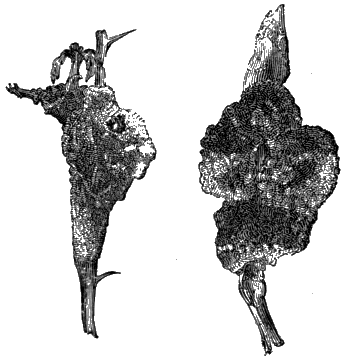
Pseudo-gall produced by Aphis pini on the Scotch fir, drawn from a specimen.

One of the prettiest of these pseudo-galls with which we are acquainted, is produced on the Scotch fir (Pinus sylvestris), by the Aphis pini, which is one of the largest species of our indigenous aphides. The production we allude to may be found, during the summer months, on the terminal shoots of this tree, in the form of a small cone, much like the fruit of the tree in miniature, but with this difference, that the fruit terminates in a point, whereas the pseudo-gall is nearly globular. Its colour also, instead of being green, is reddish; but it exhibits the tiled scales of the fruit cone.
We have mentioned this the more willingly that it seems to confirm the theory which we have hazarded respecting the formation of the bedeguar of the rose and other true galls—by which we ascribed to the sap, diverted from its natural course by insects, a tendency to form leaves, &c., like those of the plant from which it is made to exude.
CHAPTER XX.
ANIMAL GALLS,[GH] PRODUCED BY BREEZE-FLIES AND SNAIL-BEETLES.
The structures which we have hitherto noticed have all been formed of inanimate materials, or at the most of growing vegetables; but those to which we shall now advert are actually composed of the flesh of living animals, and seem to be somewhat akin to the galls already described as formed upon the shoots and leaves of plants. These were first investigated by the accurate Vallisnieri, and subsequently by Réaumur, De Geer, and Linnæus; but the best account which has hitherto been given of them is by our countryman Mr. Bracey Clark, who differs essentially from his predecessors as to the mode in which the eggs are deposited. As, in consequence of the extreme difficulty, if not the impossibility, of personal observation, it is no easy matter to decide between the conflicting opinions, we shall give such of the statements as appear most plausible.
The mother breeze-fly (Oestrus bovis, Clark;—Hypoderma bovis, Latr.), which produces the tumours in cattle called wurbles or wormuls (quasi, worm-holes), is a two-winged insect, smaller, but similar in appearance and colour to the carder-bee (p. 75), with two black bands, one crossing the shoulders and the other the abdomen, the rest being covered with yellow hair. This fly appears to have been first discovered by Vallisnieri, who has given a curious and interesting history of his observations upon its economy. “After having read this account,” says Réaumur, "with sincere pleasure, I became exceedingly desirous of seeing with my own eyes what the Italian naturalist had reported in so erudite and pleasing a manner. I did not then imagine that it would ever be my lot to speak upon a subject which had been treated with so much care and elegance; but since I have enjoyed more favourable opportunities than M. Vallisnieri, it was not difficult for me to investigate some of the circumstances better, and to consider them under a different point of view. It is not, indeed, very wonderful to discover something new in an object, though it has been already carefully inspected with very good eyes, when we sit down to examine it more narrowly, and in a more favourable position; while it sometimes happens, also, that most indifferent observers have detected what had been previously unnoticed by the most skilful interpreters of nature."[GI]
From the observations made by Réaumur, he concluded that the mother-fly, above described, deposits her eggs in the flesh of the larger animals, for which purpose she is furnished with an ovipositor of singular mechanism. We have seen that the ovipositors in the gall-flies (Cynips) are rolled up within the body of the insect somewhat like the spring of a watch, so that they can be thrust out to more than double their apparent length. To effect the same purpose, the ovipositor of the ox-fly lengthens, by a series of sliding tubes, precisely like an opera-glass. There are four of these tubes, as may be seen by pressing the belly of the fly till they come into view. Like other ovipositors of this sort, they are composed of a horny substance; but the terminal piece is very different indeed from the same part in the gall-flies, the tree-hoppers (Cicadæ), and the ichneumons, being composed of five points, three of which are longer than the other two, and at first sight not unlike a fleur-de-lis, though, upon narrower inspection, they may be discovered to terminate in curved points, somewhat like the claw of a cat. The two shorter pieces are also pointed, but not curved; and by the union of the five, a tube is composed for the passage of the eggs.
It would be necessary, Réaumur confesses, to see the fly employ this instrument to understand in what manner it acts, though he is disposed to consider it fit for boring through the hides of cattle. “Whenever I have succeeded,” he adds, “in seeing these insects at work, they have usually shown that they proceeded quite differently from what I had imagined; but unfortunately I have never been able to see one of them pierce the hide of a cow under my eyes.”[GJ]
Ovipositor of the Breeze-fly, greatly magnified, with a claw and part of the tube, distinct.
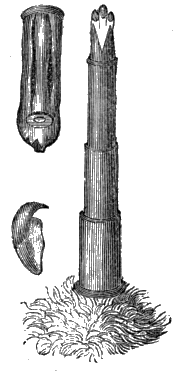
Mr. Bracey Clark, taking another view of the matter, is decidedly of opinion that the fly does not pierce the skin of cattle with its ovipositor at all, but merely glues its eggs to the hairs, while the grubs, when hatched, eat their way under the skin. If this be the fact, as is not improbable, the three curved pieces of the ovipositor, instead of acting, as Réaumur imagined, like a centre-bit, will only serve to prevent the eggs from falling till they are firmly glued to the hair, the opening formed by the two shorter points permitting this to be effected. This account of the matter is rendered more plausible, from Réaumur’s statement that the deposition of the egg is not attended by much pain, unless, as he adds, some very sensible nervous fibres have been wounded. According to this view, we must not estimate the pain produced by the thickness of the instrument; for the sting of a wasp, or a bee, although very considerably smaller than the ovipositor of the ox-fly, causes a very pungent pain. It is, in the latter case, the poison infused by the sting, rather than the wound, which occasions the pain; and Vallisnieri is of opinion that the ox-fly emits some acrid matter along with her eggs, but there is no proof of this beyond conjecture.
It ought to be remarked, however, that cattle have very thick hides, which are so far from being acutely sensitive of pain, that in countries where they are put to draw ploughs and waggons, they find a whip ineffectual to drive them, and have to use a goad, in form of an iron needle, at the end of a stick. Were the pain inflicted by the fly very acute, it would find it next to impossible to lay thirty or forty eggs without being killed by the strokes of the ox’s tail; for though Vallisnieri supposes that the fly is shrewd enough to choose such places as the tail cannot reach, Réaumur saw a cow repeatedly flap its tail upon a part full of the gall-bumps; and in another instance he saw a heifer beat away a party of common flies from a part where there were seven or eight gall-bumps. He concludes, therefore, with much plausibility, that these two beasts would have treated the ox-flies in the same way, if they had given them pain when depositing their eggs.
The extraordinary effects produced upon cattle, on the appearance of one of these flies, would certainly lead us to conclude that the pain inflicted is excruciating. Most of our readers may recollect to have seen, in the summer months, a whole herd of cattle start off across a field in full gallop, as if they were racing,—their movements indescribably awkward—their tails being poked out behind them as straight and stiff as a post, and their necks stretched to their utmost length. All this consternation has been known, from the earliest times, to be produced by the fly we are describing. Virgil gives a correct and lively picture of it in his Georgies,[GK] of which the following is a translation, a little varied from Trapp:
Round Mount Alburnus, green with shady oaks, And in the groves of Silarus, there flies An insect pest (named Œstrus by the Greeks, By us Asilus): fierce with jarring hum It drives, pursuing, the affrighted herd From glade to glade; the air, the woods, the banks Of the dried river echo their loud bellowing.