THE FIRST DISCOVERIES
Reading edition
The Beginning of Mining in Alaska—Forty Mile Creek—Canadian and American Deposits—The Largest Log-Cabin Town in the World—Life of the First Adventurers—The Superfluity of Six-Shooters—Leaving the Latch-Strings Out—The Way of the Transgressors—Indian Charley and his Nugget.
A LITTLE history of placer mining in the Yukon valley, at this turn of my narrative, will be of importance, I think, in making what follows more comprehensible. It was early in the eighties, if not before, that the first prospectors, armed with Indian tales, faith, and a “gold pan,” packed their supplies to the shores of the Lewes lakes over the passes which were the means of communication between the Indians of the coast and those of the interior. They followed the ice out of the lakes and down the river into a practically unexplored country, panning out of the gravel at the mouth of each tributary.
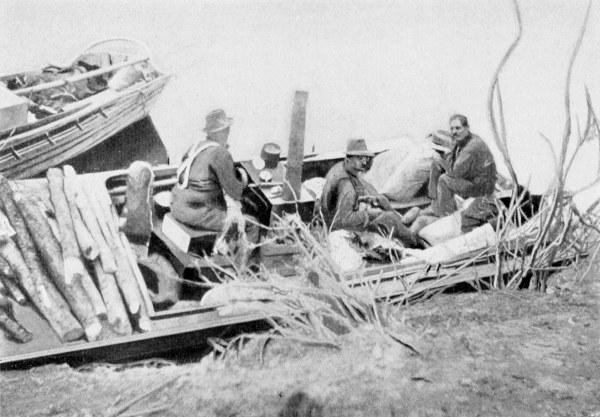
A Typical Pilgrims’ Boat.
At first, these and the other brave spirits who were encouraged to follow their example arduously poled their boats back up-stream in September, with the result of their summer’s labor, to spend the winter in one of the towns of the quartz-mining region in southeastern Alaska or in the Pacific Coast States. Some had three or four hundred dollars; others, who had impatiently disregarded certain “pay” on the bars of the tributaries and had prospected in the hope of making a great “strike,” returned with little or nothing.
Soon they began to take in enough supplies to last them through the winter, and to build cabins for their protection. A little settlement sprang up on the site of the “diggings” of Forty Mile Creek. All of the rich deposits thus far have been found not on the tributaries of the Yukon but on the tributaries of the tributaries. (The wealth of the far-famed Klondyke is not on the Klondyke River but on Eldorado and Bonanza, which flow into it.) So the next progressive step was a discovery which led to the working of the frozen ground in the valleys of the numerous little streams tributary to Forty Mile, by stripping off the dirt as fast as the very hot sun of the long days of the arctic summer thawed it. This process, however, was feasible only when the “pay-dirt” was near to the surface, and the season of activity was still restricted to four or five months of the year.
As the prospectors moved on down the river, gradually widening the circle of their labors and their experience, deposits considerably richer than those of the tributaries of Forty Mile were found on the tributaries of Birch Creek in American territory. Here, for the first time, an innovation, which did not appeal to everybody, made it feasible to work twelve months in the year. An energetic man sank a shaft to bedrock with fires. Then he drifted out his “pay-dirt” in the same manner and piled it in dumps on the surface to be sluiced out in summer. By the autumn of 1896, when the great discovery of Bonanza Creek was made, Circle City was said to be the largest log-cabin town in the world, and from twenty-five hundred to three thousand white men dwelt in the Yukon valley.
Experience in placer mining counted for little in a region where conditions were so different from those of the Pacific Coast States. There was no sprinkling of capitalists or mining engineers among those robust pilgrims of the early days. Many of the hardships which they endured are already a memory. They were cheered in their combat with nature by no such tales as lured on the Cheechawkos of 1897-98. The majority of them came from the frontiers of the United States; a smaller part, generally of French descent, from the frontiers of Canada. All were peculiarly the product of the Anglo-Saxon bent for overcoming obstacles. Not infrequently there were fugitives from justice, who, having the inclination and the energy to undergo great physical trials rather than serve a term in prison, and learning a lesson in manhood by bitter retrospection, have often become heroic pioneers. More numerous than the inhabitants of the old centres of civilization would suppose were those recluses who are ever seeking lonely refuges out of touch with the advance posts of organized society.
There was no prospect, especially when no “big strikes” had been reported, to attract the idle and the dissolute who infest similar settlements in more hospitable countries. Relieved of the parasitic class and being interdependent in isolation from the outside world under the most rigorous conditions for eight months in the year, their inhabitants, despite the “pasts” of some of them, made Circle City and Forty Mile the most peaceable of mining camps. Captain Constantine, of the British Northwest Mounted Police, with a few men, had plenary powers at Forty Mile, while Circle City was nominally governed by a United States Commissioner and a United States Marshal.
All the white women in both communities could be counted on the fingers of two hands. Mrs. Constantine, the wives of a few missionaries and of a few leading men, had come in on steamers up the river in summer to join their husbands. Half a dozen half-breed women, with more or less of the blood of Russian fur traders in their veins, composed the demimonde of either camp. Full-blooded squaws performed the household duties in some cabins for a civilized lord and master. But the “squaw man” was the exception. In no part of the world where isolated white men live among aborigines was the man who had a native mistress held in greater disrespect than here.
As a rule, the miners did their own washing and mending. Their amusements were card-playing and checker-playing. The climate seemed to exercise a softening effect upon bellicose natures, and even intoxication seldom carried quarrels beyond a dispute of words. Whoever struck the first blow had the consensus of opinion of the camp against him.
“We’ve got enough to do fighting Alaska,” was a saying which sententiously expressed the general feeling, “without fighting one another.”
To the new-comer it was hinted that a six-shooter, which fiction makes the inseparable companion of all men in a new placer mining camp, was a superfluity that would keep him out of trouble only when he kept it at all times hanging on a peg in his cabin. Its weight alone was equal to two days’ rations in a country where the prospector had to dispense with his helpmeet, the mule or the burro, and carry his grub for a tour on his back. Therefore, arms were never carried unless there was a chance of meeting with game.
The essence of the “free miners’ law” was being on the “squar’,” which, after all, is a rough equivalent of the brotherhood of man. Between the disputants as to the ownership of a claim the “miners’ meeting” decided which one was in the right. All offenders were brought before the bar of their fellows. A man accused of theft, after an examination of witnesses, was acquitted or convicted by the holding up of hands. If guilty, he was, according to the circumstances, either warned to leave the country for good—no slight penalty in midwinter with only the hospitality of Indians to depend upon—or else ostracism was postponed pending good behavior. “Miners’ meeting law” is unscientific and rarely commendable, but here it served its purpose well because its methods made it so seldom required.
Under the force of self-interest a universal good-will prevailed. Whatever a miner had—perhaps the increment of a summer’s earnings which was to pay for another year’s supplies—he kept in tomato cans on the table of his cabin with impunity. When he went away from home on a journey to some other creek he left his latch-string out. On the very evening of his absence, while his cabin was occupied by another, he was, perhaps, sleeping in someone else’s without an invitation. By the unwritten law of the land he enjoyed whatever luxuries of food and rest the cabin afforded; but, likewise by the unwritten law of the land, he washed any dishes that he had used and put them and all other things that he had disturbed back where they belonged, folded the blankets on the bunk, cut firewood in place of that which he had burned, and laid kindlings by the stove ready to make warmth and cheer for the owner when he should return, cold and weary.
Cheechawkos who came down the river in the spring in their rough boats at first, through ignorance, were often transgressors of the unwritten laws. But so few arrived at a time that the majority were soon able to convince them of the folly of courting trouble for themselves. Anyone with a bad record could not obtain favors or a loan when he needed it. After he had consumed the supplies which he had brought into the country with him, he must rely upon the transportation companies, established to meet the demand of the new settlements, whose river steamers connected with ocean-going vessels at the island of St. Michael in Norton Sound. When a man had been unfortunate in his summer’s work, a reputation for probity would secure from the companies a year’s outfit on a simple promise to pay. In treating generously the real prospector who sought new fields, they only had an eye to their own interests in the development of the country. Every canned and preserved delicacy was included in a year’s supplies, costing from $500 to $600. Canned plum pudding was a treat for the holidays; and more than one miner ate pâté de foie gras for the first time in Circle City or Forty Mile. These luxuries, however, were no substitutes for fresh fruits and fresh vegetables.
The flat-bottomed river steamers continued on their course until the ice in the river led them to seek a slough or side channel for safety, all hands preparing to spend the winter housed up on board. Then no more Cheechawkos’ boats could arrive, and the camps were as completely separated from the outside world as a whaler caught in the ice of Bering Sea. To all men, including the recluses, a “pardner” was essential. For the recluses were recluses from civilization and not from fellow-men of their own tastes; and no one, except a few of the most perverse, undertook single-handed to put up a cabin or to live in it alone.
The “town” was on the river bank at the most accessible point to the creeks whose wealth was responsible for its existence. Its cabins clustered around the commercial companies’ stores and the saloons. To one side was a camp of Indians and the mission station which ministered to their spiritual wants and, following the paths of diplomacy, to the spiritual wants of the miners—upon request. Fuel was brought from the hill-sides and food was taken to the cabins on the creeks by teams of husky dogs.
When the winter settled down in serene triumph in December there was not even the falling of snow to disturb the calm atmosphere. The fine white particles under foot, which seemed as sharp as powdered glass to the touch, were precipitated invisibly, like frost. They glistened on the mountain-sides without a breath of air to stir them. In the few hours of gray light out of the twenty-four, men welcomed the sound of their own voices, or even the howl of their dogs, to break the silence which was the fit companion of the dry, biting cold. At night they forgave the still and merciless panorama of the day as they watched out of their cabin-windows the play of the Northern Lights, in which nature has furnished for the eyes a greater treat than is the breaking of surf for the ears.
With the coming of spring, when the sun mounted so rapidly in the heavens, every man had his opinion and his reasons for it as to the exact date when the ice should go out of the Yukon. After this—the greatest event of the year—had taken place, all eyes kept a lookout up-stream for the first pine-colored boat that should dart around the bend with the rapidity of the current. The Cheechawko was surrounded by a little crowd which asked him about the result of the previous November’s elections, or if France and Germany had gone to war as indicated by an August paper which the community had been reading for eight months.
As a rule, the early arrivals had been in the country before. They knew the channels and the currents of the river, and could resist the temptation of stopping to pan the gravel of the bars in search of colors, for the old-timers had long since concluded that the travel-worn particles of dust to be found at the mouths of all of the tributaries of the Yukon which are in the so-called gold belt, were vagrants and not the advance guard of a floating pilgrimage. They had poled weary miles in their long boats and carried packs for wearier ones without finding at the head-waters of the tributaries, which were named by them and still await accurate mapping by geographers, any original deposits. The shallow bedrock in the neighborhood of Forty Mile put the original deposits there within reach of the summer’s sun and the superficial investigation of the hurrying prospector, and opened the way to the discovery of richer original deposits at Circle City at a slightly greater depth of bedrock.
So the miners had concluded that the next great strike, following the progress of development down the river, would be made below Circle City. On account of an Indian’s keen glance the contrary happened, and they retraced their footsteps to find fortunes at a depth of thirty feet under soil whose surface they had trod before. The sharp-eyed Indian was a brother-in-law of “Siawash George,” and “Siawash George” was an outcast, whose nickname was given to him by his fellow white men. The Siawashes are one of the lowest orders of the American Indians, and the old-timers, so largely men from the Pacific Coast, use Siawash both as a noun and as an adjective to signify contempt. One of the first white pilgrims to cross the passes, Cormac, was now the father of three or four half-breed children. He had planned that his marriage to a princess of the tribe would be the stepping-stone of his ambition to become chief of the Sticks. In the autumn of 1896 he and his family and retainers were encamped at the mouth of the Klondyke, gathering from the land and the water, according to aboriginal custom but with modern riffles and hooks, their winter supply of provender.
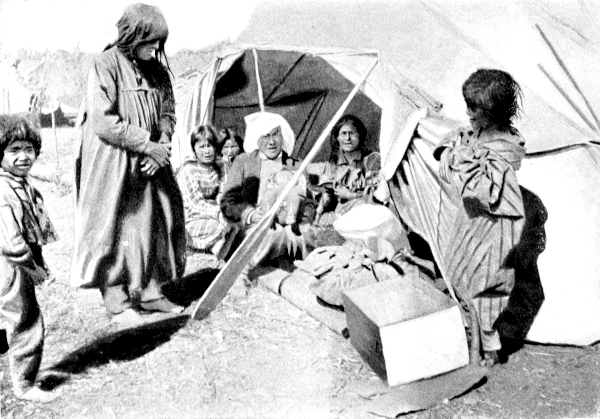
Yukon Indians.
The Klondyke is one of the best rivers in the neighborhood for fish, much better than the Indian River, which flows into the Yukon between thirty and forty miles above it. At the summit of the water-shed between the Indian and the Klondyke is a great mountain, which, from its shape, the miners have named The Dome. In the snows of its sides six creeks have their origin, three flowing into either stream. The longest of these is sixteen miles. They wind through beds of black muck, ranging from fifty to two hundred and fifty yards in breadth, which lie between steep embankments. It is presumed that the embankments are the walls of an ancient river channel. They are indented only by the gulches cut by tributaries which once were mighty but now have dwindled to little torrents which flourish only with the first warmth of spring or after a heavy rain in summer. The great heat of June, July, and August drew out of the muck with a growth of tropical rapidity a rank grass upon which the moose fed in peace, fattening his sides, made lean by winter’s privations.
Here “Injun Sharley,” as he called himself, came to look for moose, and here he found instead, as he was crossing the first tributary of the Klondyke at a point where its bending course had dug a niche out of the side-hill, a glistening nugget of gold. According to all of the preconceived ideas of the placer mining prospectors, no creeks in the region were so unpromising as these. Those few prospectors who had tramped up this valley, finding a few colors in the shoals made by washing the earth of the embankment, had passed them by with the ever-ready expression of the country:
“Oh, well, you can find colors anywhere.”
If the turn of the creek had not washed one stray nugget as well as stray colors out of a bench which no one found worth working two years after discovery, the moose might still be feeding undisturbed in the valleys of Eldorado and Bonanza creeks, which are now as expressive of man’s handiwork as the rear of a row of tenement houses, and certain unhappy newspaper correspondents would not have missed the Spanish-American War.
There is no reason to believe that “Siawash George,” personally, had any great confidence in the “strike.” Rather—after having staked creek claims for himself and “Injun Sharley”—he thought it worth advertising, when advertising was so cheap because of the expert canoists and good pedestrians in his family. He was further assisted in spreading the news by Joe La Due, another “squaw man,” who has been erroneously called Father of the Klondyke, just as “Siawash George,” and not “Injun Sharley,” has been called its discoverer. La Due staked out a town-site on the flat which had been formed in the course of time by the alluvial deposits of the Klondyke at its mouth. He was fond of “booms,” and as a part of his plan of promoting his latest boom he offered lots for five dollars apiece to all who would stake claims on the new creeks. Neither he nor “Siawash George” had much to lose and they might gain a great deal if shafts were sunk to bedrock with fires after the plan that had lately come into vogue at Circle City.
When an Indian arrived at Forty Mile and then at Circle City with a tale out of all proportion to the actual size of the nugget that “Injun Sharley” had found, the miners received it with that garlic cynicism which has its natural abiding-place in the unkempt beards of hardened frontiersmen. They had become so used to strikes with no foundation except an irresponsible imagination, as nominally to believe in nothing that a man said about any find he had made. So they told the Indian that he was a liar pure and simple, who had been primed by an ambitious brother-in-law. The Indian had been told to expect this reply and was not the least disturbed in mind by it. But no miner acts upon his convictions in such a matter. He usually hurries off to the reported scene of the find because, after all, “mebbe there might be somethin’ in it.” But such were the reputations of Joe La Due and Cormac that many of the earlier pioneers refused to budge. Their superior wisdom was as unfortunate for them as absence from the settlements was for those at work on the creeks. The two or three hundred, lounging in the saloons and the stores or resting in their cabins, who made for the mouth of the Klondyke in the mood of men who are playing a joke on themselves, became rich.
There were not enough claims on the discovery creek, Bonanza, for all of them, so the later arrivals, just for the sake of staking something, contemptuously staked a tributary of Bonanza, which they called in their phrase a “pup.” Then there was naught to do but to wait until a few of the more energetic fellows sunk holes on Bonanza. No one was more surprised at the result than “Siawash George.” Bedrock on Bonanza showed the richest placer dirt yet found in Alaska or the British Northwest Territory. Those who had been in time to stake claims on Bonanza settled down to work at once, incidentally extending their pity to the fellows on the “pup.” The claim-owners on Eldorado, where no shaft had been sunk, accepted the pity in good part and offered their claims at various prices, ranging from one hundred to five hundred dollars. Most of them were so lucky as to be unable to make a sale, and are now worth from five hundred thousand to a million dollars apiece. The “pup” is the richest placer mining creek in the world.
Nine months after “Injun Sharley” had brought home a nugget instead of a moose, the outside world heard of the great discovery. Such pilgrims, attracted by the news, as succeeded in reaching Dawson in the autumn of 1897 found that all creeks rising on the slopes of The Dome and all other creeks at that time proven to be worth the working, had already been staked by the old-timers who had followed the advance guard from Circle City and Forty Mile. Feverish stampede followed on feverish stampede to new ground. That putting down four stakes in a creek-bed anywhere in the region was equal to drawing a fortune from a bank became the gospel of the hour, which received its authority from the original attitude toward the “pup” of the men who had staked Eldorado. A man needed only to come into a saloon with a pack on his back, and, being tired, appear silent and mysterious, to excite the suspicion that he had made a “strike.” “Only an affidavit” of having found “color” was necessary to have a discovery claim recorded, and a discovery always meant a stampede. Having received a hint from a friend, or overheard a whispered conversation in the street, a pilgrim would rush off for a distance of more than a day’s travel, without food or blankets, trusting to luck to feed him and keep him warm. Death was often the result.
Having staked the remaining creeks in a radius of from thirty to sixty miles of Dawson, some of the new-comers rested in their cabins, eating their winter’s supply of food. Others found employment on the work-claims; and still others departed over the ice to escape starvation and to thrill their neighbors at home with the information that they owned claims. As the humor of the saloons went, there remained for the oncoming host of May and June an expanse of unexplored territory sufficient to keep a hundred times their number busy prospecting for a century, but no gold at all, unless they could find it for themselves.
V