ARCTIC TRAITS
Reading edition
Daily Life in Dawson—Renting a Cabin—Circumventing the Huskies—Joey Boureau and His Restaurant—The Faro Dealer’s Wife and Her Bakery—The Laundryman and His Claim—Jack Beltz’s Schemes—A Pair of Dreamers.
IT depends upon the season of the year whether the town-site of Dawson is liquid, mushy, or as flinty as frozen ground can be. At one time in the summer of 1898 most of it was under water. Two weeks later, the Yukon having fallen some sixteen feet, this same town-site was at a respectable height above the level of the stream. The smaller sandbar on the opposite side of the mouth of the Klondyke, which, out of respect to the cabins which cover an area of six or seven acres, has been called Klondyke City, is without the surface layer of muck which held sewage as in a sponge under the noses of the residents of Dawson. The good nature of the fellow, known as “Dud,” who keeps the sole saloon and hotel at Klondyke City, was as largely responsible for our choice of abode as the healthfulness of the location. Empty cabins were scarce. “Dud” said he had one to rent. When I asked him the price, I offended him.
“You walk right in and stay till I tell you to get out,” he said. “But if you go shakin’ your dust in my face I won’t let you have it at all.”
So we stood our sleds up beside the door, set up our little Yukon stove, threw our blankets on the floor, and were at home. The comfort of my daily existence I felt to be great compared with a bunk in a bunk-house for $2.50 a night, or a room with cloth partitions over a bar for $10 a night.
Fritz, who liked movement and life, went over to town to live in the cabin of a friend, leaving Jack and me to do our own cooking or to eat at the restaurant when we were of idle mind. The dogs also patronized the restaurant without standing on ceremony. “Jack” carried off almost the last ham in the camp, having lifted it from a nail with the unostentatiousness of an expert thief. The proprietors of the restaurant would not listen to reimbursement. They explained that anybody who had been in the country for six years and let a husky dog get the better of him deserved to be mulcted. It is out of deference to the husky dog that the miner builds little caches, set on poles, for storing food, which make the town look like a Bornese village, whose inhabitants have deserted their old homes to live in cabins.
The proprietors of the restaurant, in my opinion, were well worth knowing. Joey Boureau—undeniably French-Canadian, but forever repeating that he was a citizen of the United States—was almost as dark as a Moor, with the torso of a Turkish wrestler. He yielded neither to excess nor fatigue, blustered at times, never cared for to-morrow, and was possessed of a ready wit. His blague had a counterpart in the blarney of his partner, Tim, undeniably Irish American and proud of it. This pair had been inseparable for the many years that they had sought gold with the pick and in all the ways of camp life. Upon the scales at the end of the oilcloth-covered dining table they weighed out $2.50 worth of dust out of your bag whenever you ate off their board. Whichever one happened to be in did the cooking, and if both were in, one told stories to amuse the guests and acted as cashier.
But both were seldom there. One was usually at “Dud’s” faro table. The other, when he grew tired of working brought his “pardner” home on his arm, installed him in the kitchen, and immediately went out to enjoy a little recreation on his own account. As he took with him whatever dust there was in the tomato-can, which served as their cash-box, we heard frequent excuses for the absence of moose steak on the table because of lack of funds to purchase it. Just as their business was beginning to prosper they sold it for a song to a Cheechawko whom they met on the river-front. A week in town sufficed to spend the song, and then they put packs on their backs and started over the hills, whistling as they went.
In one of the neighboring cabins the wife of a faro dealer had set up a bakery. We paid her fifty cents apiece for pies and fifty cents for loaves of bread, and had to order them beforehand to make sure of getting them.
Our laundryman had staked a claim in which he placed great hopes; but his invariable charge remained seventy-five cents a garment. He related with a realism almost tragic the details of the processes by which he had arrived at the original color of the khaki trousers that I had worn on the trail. Jack Beltz, for his part, secured the loan of an old tub and a washboard, and after a day’s labor surveyed bandanna handkerchiefs and what not hung out on the line with the mien of a conqueror.
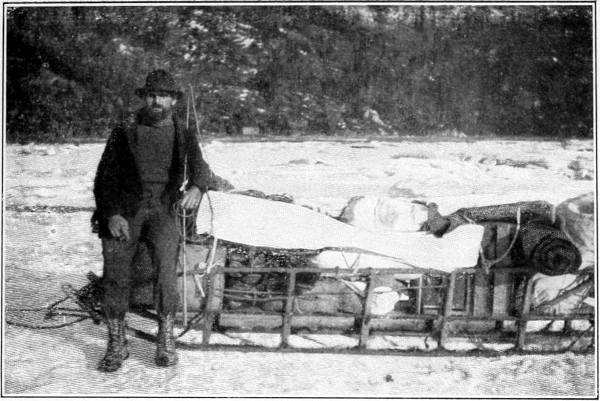
Jack Beltz.
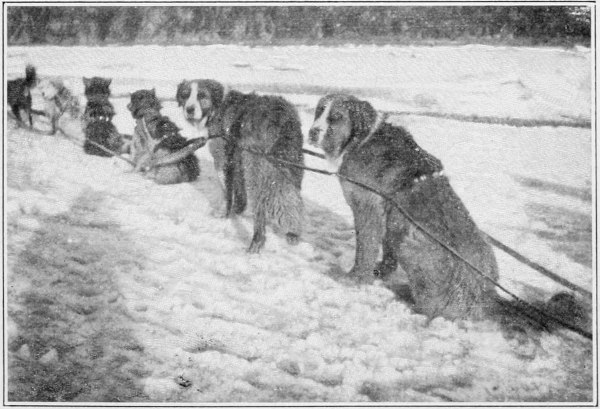
“The Huskies.”
Economy, however, was always a matter of necessity with him. On the first night of his return from town he said, with some pride, that he still had most of the dust which he had received in conclusion of our contract. The next night before going to bed he built a fire in the stove out of the driftwood which he snaked out of the river for fuel, and sat for a long time in a reverie.
“Well, I’ll have to earn some more,” he said, finally, to himself, and dropped upon his blankets.
In the morning, followed by his troop of dogs, who had regained their spirits and their flesh, because he had fed them so bountifully, he went up on the mountain side, where he picked a great bouquet of the wild flowers which spring up in such profusion in summer. He never told me of his losses, and I tried to avoid the appearance of suspecting the truth, at the same time that I took practical measures to obviate an effort to dispose of his robe for cash and to hypothecate his year’s outfit, which was to be brought down the river by his “pardner,” Cliff.
Meanwhile, he revolved in his mind many schemes for making money. The price of moose steak, $1.50 a pound, suggested to him that a fortune might be made in moose hunting. Learning that Dawson had no bowling alley, he so far arranged to start one as to find that balls and pins could not be obtained nearer than Seattle. This scheme was succeeded by the more alluring prospect of taking dogs, which are valueless in summer, as they are valuable in winter, to an island in the river to feed for so much a month. Always before his dream had taken definite form he dismissed it by saying he was no city man. He recalled his experience in keeping the restaurant in a British Columbia mining town, and he reverted to a proposition that was to the liking of his love of robust vagabondage:
“I’ll get a pardner and take the dogs and go up to the head-waters of the Porcupine and cross over to the Mackenzie. It would be a rattling trip!”
As if in excuse of his venture he would add that he was certain to find gold in that region.
One day another dreamer, Kidd, came to join us. He was a protégé of Jack, who had found him trying to put his outfit over the Pass. There must have been such giants as Kidd, with such straight noses, curling black hair and curling black beard, in the phalanxes that confounded the Persians. But this type of the freshness and strength of country life was quite modern. He slouched into the cabin with his hands in his pockets, and included in the drawl with which he greeted us a Missourian “Doggone it!” Like many other unfortunate fellows, Kidd had been obliged to spend the whole winter in the neighborhood of the Pass. Jack and his partner had made him a tent-mate in their camp on the banks of Linderman, during the dreary period of waiting. Going on to Le Barge after our departure from Linderman, he had arrived in Dawson before Cliff.
“That boy comes from a good family,” said Jack; “and I’ll bet they’re proud as anybody that ever had a grand-dad who owned a lot of niggers and went stone broke after the war. He don’t say nothin’ about it, but it sticks out all over him. He didn’t know how to hitch a pack on a mule’s back when I first met him. But though he was green, he wasn’t fresh; and when tenderfeet are that way they’ll learn and you like to learn ’em. When they ain’t, you like nothin’ better than to give ’em the worst bronch’ on the ranch and leave ’em to find out things for themselves.”
It was not until after considerable urging that Kidd would consent to share our cabin. His character was in sharp contrast to that of another young stranger who entered and threw his blankets on the floor for the night without any formalities. In the morning, picking up certain articles of my kit which were lying beside my bed, he said:
“You’re goin’ out on the first steamer. Don’t suppose you want these, do you? I’ll take ’em along. They’ll come in handy next winter.”
“He’ll get on,” quoth Jack, “but I’m ding-donged if he’ll get on with my help.”
Jack now included Kidd in his schemes, which became more and more attenuated. Kidd would walk back and forth for some time as if in deep thought, and finally drawl:
“Gee-mo-nee! We must do something, Jack!”
And Jack, as he looked out upon the rapidly flowing river, would agree, and relight his pipe. Kidd admitted that he was homesick, “doggoned homesick.” He had a right to be, for he left home with a thousand dollars and his mother’s blessing, instead of finishing his education and studying for the country bar.
“Gee-mo-nee!” he exclaimed. “I was green, wasn’t I, Jack? I thought you’d just pick the gold up once you got here. But doggoned if I’ll go back broke. I’ll have as much as I had when I left or stay forever. I’ve got three hundred of that thousand and I’ll make seven hundred and my fare out some way this winter.”
One day the dreamers found employment on the log booms for the new saw-mill that was to be built on the island in the Klondyke between Dawson and Klondyke City. Jack was as much at home on a rolling log as on the back of a broncho. Poor Kidd fell into the water often, but showed great persistence until the rise in the river made work impossible and left them idle again. So Jack sat by the cabin door keeping a lookout for Cliff, the third giant of the trio, who arrived one day, with a broad grin.
“Gosh!” he exclaimed, as he grasped Jack’s hand. “I was washed out of the boat when we came through Five Finger Rapids, and blamed if I wasn’t washed in again! How’s that for luck?”
There was something of the New England Yankee in him, though he had been born in Colorado.
“I’ll bet you’ve give your money all away, ain’t you, Jack?” was his next remark. “You wouldn’t be Jack if you hadn’t.”
“Weeks ago,” was the reply.
They secured a contract with one of the saw-mills to cut rafts of logs sixty miles up the river. Here was a chance for Jack to swing an axe, to build bonfires, and to do what he called an honest man’s work. With his dogs around him on the day of his departure I said a regretful good-by to the vagabond.
IX