PILGRIMS’ TRAILS AND TRIALS
Reading edition
Itineraries—Alleged Unimportance of Experience—The Case of Father Stanley—Press Agents and Primers of Wealth—The Secretary of the Seattle Chamber of Commerce His own Convert—Pardners and Promoters—Outfits—Home Comforts for an Arctic Climate—Heterogeneous Boat Loads—The Nancy G—Tragedies of the Passes.
NEXT to taking part in some event chronicled on the bulletin boards your average pilgrim of fortune best enjoyed being near them. Least of all he liked waiting in latitude 64 degrees for a month or more for news of progress of the only war yet waged by his country in his generation. When he left home the Klondyke was the ruling general topic of the hour in the newspapers. When he reached his destination he was quite forgotten, and public interest was entirely absorbed in the invasion of Cuba.
Viewed in one light, there was good reason for the pique which he naturally felt toward Shafter’s army. He might see many wars, for instance, before he saw the like of this Dawson pilgrimage again. Thirty-five thousand generals, each one his own quartermaster, packing a thousand pounds of food apiece over a rugged coast range of mountains, building a flotilla with axe and whipsaw out of the primeval forest, and travelling six hundred miles into a country having an arctic climate in winter and a tropical climate in summer and yielding no food except a little game, presented a spectacle more romantic, if not so exciting, as the massing of an army corps under one general, its extension into a battle line, and the capture of the enemy’s outposts.
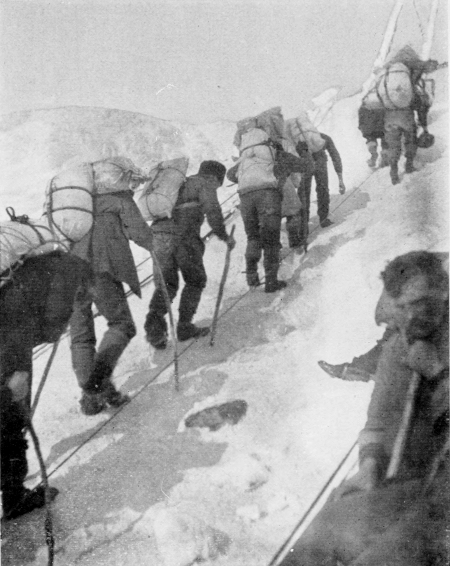
On the Pass.
The old prospector from California, British Columbia, Australia, or South Africa formed only a small percentage of those who entered, with the enthusiasm of children, a world of effort quite new to them. The village loafer and the ne’er-do-well son of the banker became partners on the trail. Mechanics who had mortgaged homes bought with savings from their wages to buy an outfit, rubbed elbows with broken-down speculators and business men who hoped to recover all that they had lost by finding a placer mine. The farmer, the clerk, the artisan, and the city or the provincial day laborer of the Eastern States, Eastern Canada, and England, were as confident of success as their associates who had learned in the severe school of the plains, the veldt, or the bush how to preserve life and health in a new country. If they had not swung a lariat or a pioneer’s axe, they had at least beaten someone in walking or rowing or had gone longer without eating than any of their immediate friends.
Of the eighty thousand who left their homes for the Klondyke in the winter of 1897-98 and the spring of 1898, some thirty-five thousand arrived at Dawson. The battle was not always to the strong. More important than physical strength were determination and cheerfulness. Those who failed were as peculiarly Anglo-Saxon as those who succeeded; for they had the restlessness which impels one to seek obstacles but does not necessarily provide the force to overcome them. Most of those who had endeavored to reach Dawson in the autumn of 1897 were stranded on one side or the other of the passes, where they had to wait through a dreary winter until the ice which had arrested their progress should go out of the river. But only a small proportion of the whole number of pilgrims made this attempt. The great majority planned to transport their outfits over the passes in the early months of 1898 and build their boats on Lakes Linderman and Bennett in the interval between good travelling in a snow-bound country and the opening of navigation.
All pilgrims, whatsoever their itineraries, were grist for the mills of the towns of the Pacific Coast States and of British Columbia, bringing welcome relief from a period of commercial depression. Enterprising merchants, chambers of commerce, and steamship companies scattered broadcast throughout the United States (whence came seventy per cent. of the pilgrimage, ninety per cent. of it being Anglo-Saxon) pamphlets, well written for the purpose, telling “How to Get to the Klondyke.”
The career of “Father” Stanley, of Seattle, was used as a stock illustration of the unimportance of experience to the prospector. This lame old bookseller, having the enthusiasm of the fanatic in place of real strength, had gone to the Klondyke in the spring of 1896. For a time he worked on the bars of Stewart, taking out $10 a day. If he had not been deformed he would have packed more food over the Pass. Fortunately, his supply ran out in September, and on his way down stream to Forty Mile, where he hoped to get more, he happened to arrive at the mouth of the Klondyke just as the first miners from Forty Mile were hurrying to the scene of Indian Charlie’s “strike.” As he could not walk as fast as the others, they got all the claims on Bonanza, and he had the good luck to get one of the best claims on Eldorado.
A year later, returning on the treasure ship that brought the news of the great strike, when he entered his house with a small portion of his fortune—a hundred thousand dollars in cash—his good wife, as the story goes, was at the washboard, where she had spent a deal of her time during her husband’s absence, earning a living for a large family. Her customers coming to make inquiries about their clothes were told to take whatever was in the tub which they could identify as their own. As for herself, she was boarding at the hotel, sending such of her apparel as she had not thrown away to the laundry, and, moreover, was too busy with the dressmaker to attend to any trifling details which might have concerned her past life.
“In the frozen fastnesses of the far North fortunes nestle in nuggets of glittering gold for all”—but the press agents were too well versed in human nature to say that these fortunes were to be had for a pleasure trip. They mentioned hardships which put up a price of success, thus making the nuggets more attractive, and, in a sense, supporting the assertion of their existence. Anyone who would overcome the hardships might have a competency for the trouble of thawing it out of the frozen ground. No pilgrim felt himself to be less courageous and vigorous than “Father” Stanley; and the wives of all pilgrims were equally certain that, under similar circumstances, they could conduct themselves with quite as much dignity as Mrs. Stanley.
As became a primer to wealth, the pamphlets told just how much it would cost to reach Dawson with the all-necessary year’s outfit, going to the trouble, in a spirit of solicitude and rectitude, of setting down opposite each article of food and each utensil, whether spade or gold-pan, or oakum or pitch, or nails for boat-building, its cost in dollars and cents, and adding up a fascinatingly small total from a very tall column of figures. With a receipted bill for this, and having paid his fare to Dyea or Skaguay, where he would disembark on the mainland of Alaska and begin the transportation of his outfit over the passes, the pilgrim, although he was supposed to have expended only $300, needed no more money to take him to his mine.
It was not to the credit of the calculations of the pamphlets, and not testimony, in all if it was in some instances, to the success of the numerous gambling establishments that sprang up at the point of mobilization of the army of fortune-seekers, that the Seattle post-office did an overwhelming business in money-orders in December, 1897, and January and February, 1898. The authors of the pamphlets were not called to account for their errors. Rather, they received the thanks of their employers. Once he was on the coast, it stood to reason that while he was yet sleeping between sheets and eating meals cooked by someone other than himself the pilgrim would not retreat because he needed a few more dollars which were obtainable from friends or relatives at home.
Seattle’s success beyond all other towns in attracting trade was due to a university graduate and an author of works on art. Having to give up journalism in the East and seek health in the West, after some severe tests of versatility of earning a living, he became Secretary of the Seattle Chamber of Commerce. Such were the results of his knowledge of the peculiarities of the Easterner, the Westerner, the Canadian, and the Englishman, which he incorporated in separate pamphlets, that his employers continued to raise his salary from week to week until the war broke out and he relieved them of the embarrassing consequences of their transports of generosity by resigning and starting for the Klondyke himself (regardless of his doctor’s advice) as a convert of his own arguments.
The camp-followers of the host of individual quartermasters which Seattle equipped and embarked, besides the gambler and the pickpocket, included many men of elastic consciences and elastic schemes, who had no capital but were ambitious to become capitalists. Those promising large dividends on properties yet to be purchased or staked were common; those proposing such grand things as running snow and ice locomotives over the hummocks of the Yukon in winter were in some measure distinguished. In the corridors of the crowded hotels you overheard the consultations of “pardners” as well as the harangues of promoters.
Sacks of flour, bacon, and beans, the chief constituents of the Yukon outfit, were piled on the sidewalks. In the windows of the stores were samples of various improved edibles and home comforts for an arctic climate. Fakirs on the curbs proclaimed the merits of patent sleds, portable boats, and devices for thawing frozen ground. In selecting his outfit, the pilgrim experienced the same emotion as the young wife who furnishes a flat. When he had settled on the kind of sled, the kind of stove, and the kind of tent that he was going to take, he faced the important question of buying dogs or of drawing his own supplies from Dyea or Skaguay to the lakes. If he had money enough he usually fell a victim to the speculators, who sold the house dogs that they had shipped into Seattle, after a few days’ training in harness, for fifty dollars apiece.
The last article of his outfit bought, he waited for his steamer to sail, while his hotel bill grew apace. Liberal navigation laws, at all times carelessly enforced, in these piping times of prosperity became a dead letter. Every available sailing and steam craft in the Pacific marine, which is comparatively small and is largely recruited from the Atlantic seaboard, was called into service by the demands of the pilgrimage. Fortunes were made in two or three trips of vessels, which had been condemned as unseaworthy years before. To get all the passengers they could carry they had only to offer transportation for a pilgrim and a ton of supplies at a little less exorbitant price than any of their rivals.
Inexperienced pilots steered many vessels on to rocks in the tortuous and narrow channels between the barren and mountainous islands of the Alexander Archipelago which skirt the coast of British Columbia and the adjoining territory of southeastern Alaska. Pilgrims not yet embarked were too anxious about their own departure to think of the miseries of those who had suffered from exposure and lost their outfits, if not their lives. Rarely did the best steamers leave within less than a week of their appointed sailing time. In loading them there was little discrimination or even classification. Quarters of beef for the restaurants of Dyea and Skaguay, dogs in crates and in leash, mules and bales of hay, were put on the decks after the hold was filled. Considering the experiences of a volunteer army with a single quartermaster, better things were scarcely to be expected of a volunteer army composed entirely of quartermasters. The chaos had the sole attraction of not bearing the stamp of officialdom.
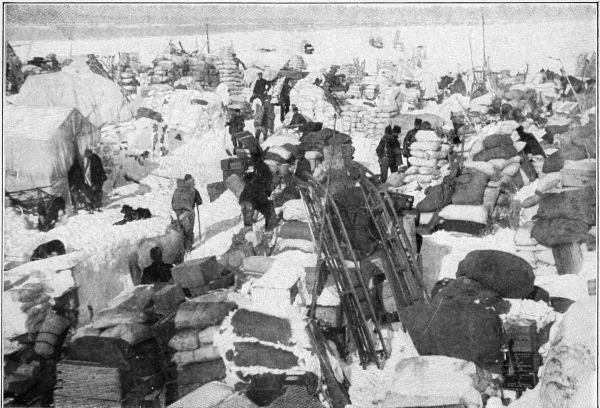
Caches of Pilgrims’ Outfits at the Summit.
As an example of what a pilgrim might suffer, there was the case of the Nancy G. When I left Seattle on February 15th, on the Nancy G.’s mast still fluttered the torn ends of a cloth sign with fast-fading red letters: “This fine schooner in the tow of a powerful ocean tug, will positively sail for Dyea on January 25th.” Every day the passengers went down to the pier to see if their outfits were still on board and to see how repairs were getting on. A man with a hammer in one hand and some oakum in the other came out of the hold.
“You needn’t cuss me,” he said. “A schooner that’s been resurrected after five years in the graveyard, ain’t what she was when she was new, and you oughter know it. Every minute I lose caulkin’ up the old girl’s corn out of your own crops.”
Afterward they went to see the owner, who received their complaints with an air of disdain, refused to return the amount that they had paid in fares for the good reason that he had their signatures to a contract for January 25th or thereabouts, and warned them in their own interests that “thereabouts” was a very elastic word.
“And I’ll tell you something else,” he said. “If you talk to me in this way much more, I’ll have you up for riot. If you want to lose a gold mine and go to jail, that’s your business and not mine.”
The owner was a small man—a small man who had spent his life in the new towns of the West. The passengers were mostly hulking Swedes from the lumber camps of Minnesota and Wisconsin. They longed to lay their strong hands on him for just a moment. But it was hard to lose a gold mine, and they hadn’t enough money to pay for passage on another steamer. So they slouched out of the owner’s presence more in sorrow than in anger. I heard afterward that the Nancy G. finally started on February 20th. Fate was so kind to her passengers that she did not sink until the return journey. They were more fortunate than two hundred of their fellows, who saw their outfits burned on the vessel which had reached Skaguay just in time to have disembarked them in safety.
To meet the demands of the migration to the interior, Dyea and Skaguay had sprung up as quickly as a house of cards. When Indian Charlie found his nugget there was no building at Skaguay and only a trading-store at Dyea for bartering with the Indians and furnishing any supplies to an old-time prospector which he had neglected to buy at Juneau. The two towns are situated at the heads of either of two arms of the Lynn Canal, which nature has cut through the rock as man cut that of Corinth, upon sandy deposits at the mouths of the Dyea and Skaguay Rivers, and separated by a distance of a mile in a straight line over a mountain spur or of three miles around the point of the spur by water. This spur, rising into high peaks as it reaches the summit of the main range, is a barrier separating the two rivers and the two passes.
Dyea is the gateway to Chilcoot Pass, which leads to Lake Linderman, and Skaguay is the gateway to the White Pass, which leads to Lake Bennett. They were not, as it appeared to the superficial observer, trying to excel each other in wickedness, but in the amount of business that they could do. Anyone who had been a resident of either town a single day considered it his duty to warn you as a friend against the rival town and the rival pass. In a week he had become an old citizen. The small proportion who were on hand for the rush of the late summer and autumn of 1897 were as proud as Lord Mayors. Then, thousands of pack-horses, earning as high as $50 apiece a day, died from the exertions to which they were forced by their owners. In the winter their bones sticking up through the snow were snags to catch the sleds of the pilgrims. Instead of a series of steps, the packers on Chilcoot had to walk around bowlders, slipping on the fragments of crumbling rock, and possibly, after all their exertion, reaching Linderman and building their boats only to have them blocked by ice half way to Dawson, where they were effectually stranded with their outfits.
Perhaps every fifth or sixth house in the main streets was not a gambling hall or a dance hall. With these and a large idle population it is easy to understand how men who had a few dollars in cash when they arrived were obliged to sell their outfits and return home. The enforcement of law was in the hands of a United States commissioner and three or four deputy marshals. The commissioner was a gentle optimist who spent most of his working-hours in an office with a window looking out on the river and the mountain side, where he might see no wrong-doing. “Soapy” Smith, gambler, by self-appointment, was Mayor of Skaguay and General-in-chief of the Army of Disorder, composed of characters from San Francisco and Seattle, who had no money left after their fare to Alaska was paid and were looking for something to turn up. When an atrocious murder was committed by one of his followers, “Soapy” told a body of protesting citizens that they would better mind their own business. As his army outnumbered theirs and was better armed, they accepted his advice. The United States sent out two companies of infantry, with instructions from the authorities at Washington that they should not interfere with the affairs of the two towns unless there was a riot. The Commissioner, seeming to regard their presence as an intrusion on his rights, never asked for their assistance. No murders or highway robberies were committed within sight of his little window. In time, however, “Soapy” Smith met the death that he deserved at the hands of one of his followers, and through the efforts of the merchants and the better element the towns became more orderly.
Not every pilgrim who returned home was the victim of gamblers and other parasites. For two or three days he might stop at one of the hotels until he selected the parcels of his outfit from the piles which had been thrown indiscriminately on the shore by common carriers in haste to have done with their contracts. Then, with his tent, his stove, and a cook-book, which was the gift of a baking-powder company, his journey began in earnest. The novelty of making his first flapjacks wore off by the time he had washed his dishes the second or third time. It was not long before he came to the conclusion that the fellow whom he had chosen to share all of his sorrows and joys was lazy. He blamed his own disinclination to rise in the morning and all his little failures upon him, as some men do upon their wives. Whenever he had a chance he solaced his wounded spirits by telling a stranger that he had put up with doing all of the work of his party about as long as he could.
Partnerships formed so gayly in Seattle by men who thought that being a partner was being a playfellow, could not be expected to last long at pulling sleds through the slush and going to bed in a robe or a sleeping-bag which was cheap and inefficient, with a supper of sandwiches made of sticky flapjacks and cold bacon. As he grew more angry with his partner he grew fonder of his dog. Jim might beat his poor Newfoundland, who was too nervous to pull even if he had ever been taught how; he might put up with a poor dinner; but if Tom, who was cooking, kicked the Newfoundland for stealing the bacon off the plate or sticking his nose in the butter, it was the last straw. He demanded a division of goods on the spot. But quarrels seldom resulted in blows, because they occurred when the men were too tired to do more than join in a contest of forcible language.
It was the man who leaves the door ajar at home who went to bed without washing his dishes. The Easterner now learned that, while he might know things that the Westerner did not, the Westerner knew better than he how to take care of himself. The Westerner always cooked a warm supper, and dried his footwear before going to work in the morning; while the self-neglect of the Easterner made hundreds of doctors at Dyea and Skaguay the busiest in the world. Spinal meningitis was often the penalty of sitting down to rest when dripping with perspiration without throwing a coat over the shoulders.
Even after their goods were on the summit of the Pass and the worst of their labors were over, many pilgrims gave up the battle. One by one they were thinned out until only thirty-five thousand were ready with their boats when the ice broke in Bennett. This far I had shared their experiences and then had gone on ahead. Mine was the privilege of having been a Cheechawko and at the same time standing on the river bank as an old-timer or among old-timers, to watch the arrival of the pilgrimage in its unpainted, unique flotilla.
X