SOME KLONDYKE TYPES
Reading edition
The Fool and His Lucky Friends—More Theorizers—Joe Staley and Billy Deddering—French Gulch Bench—Good Fortune that was Deserved—Neighbors and Twins—No Cure for the Gold Fever.
IT was the greater world of the Klondyke that was bounded by the creek claims. A smaller world was bounded by the hill-sides where there were many fresh mounds of earth, suggesting that the population might be digging their graves one by one. Graves of ambitions most of these mounds were, in all truth. A few, readily distinguished as far as you could see the two figures hovering over them, were the birthplaces of the fortune which the figures were exhuming with the orthodox rocker.
The original nugget washed out of a bench and deposited where Indian Charlie’s gaze would light on it did not lead, even indirectly, to the discovery of the wealth of the benches. This honor belongs to a stalwart Swede, whose race in the Klondyke is the general butt of that fine wit of our own race which makes a mark of a foreigner’s broken English and his efforts to understand strange manners and a strange language. One day in the spring of 1897 he went up the slope above his cabin near the mouth of Eldorado and began to strip off the muck as fast as the sun thawed it. Directly his neighbors saw what he was doing they began to compose satirical remarks against the time when he should come down.
“Why don’t you go looking for gold up a tree?” they asked him.
“I tank gold no grow on trees,” he replied, in all candor.
“Say, did you ever hear,” they continued, as they held their sides, “that the weight of gold makes it sink? I suppose you think the glacier walked up on the hills and left a few millions there. The millions didn’t roll down? Oh, no! That’s why we have to sink through thirty feet in the creek bed to pay dirt. Better try the trees! You might find a bear up the trees and bear meat would be worth three pennyweights a pound in town.”
“If you don’t dig some hole you no find gold. By tam! I dig a hole if I vant to,” he replied, as he went into his cabin.
“Well of all the fools,” they said, “it takes a Swede to beat the lot.”
Men passing on the trails stopped to look up to the point where the “fool” was working, grew friendly in despising him, and carried the joke to the ends of the creeks and to Dawson, where it was elaborated over the bars.
One evening the “fool” quietly called on all of his friends among his fellow Scandinavians, as well as upon certain Anglo-Saxons who had not made fun of his English. They followed him up the hill and drove stakes in the neighborhood of his prospect hole. The twinkle in his blue eye was not unkind, though suggestive, the next morning when he showed to the scoffers a handful of nuggets from a claim which was worth $50,000. But scoffers accept nothing on faith. They would not believe that he took the nugget out of the hill until they had panned some of his dirt themselves.
“Well, of all the lucky fools,” they said, “it takes a Swede to beat the lot! Here’s millions been lyin’ within ten rods of us for a year and we never knowed it.”
Those who had sharpened their wits at the discoverer’s expense now hastened to get a claim as near as possible to his, until a mile of Bonanza on both sides of the creek was taken up, from the point where the slopes meet the creek bed to their summit. Theories about the habits of the glacier were qualified by the experts. Thenceforth, it stood to reason that the breadth of no glacier of such importance would be limited to that of a creek. The scoffers soon found themselves saying that this had been their opinion all along, and eventually became so imaginative as to hint that they had advised the Swede to make the experiment.
Poetic justice attended the immediate outcome of the stampede. The pioneer and the parasite got their fit rewards. There was less than an acre of good pay dirt on Skookum Bench, as it was called, and this mostly fell to the discoverer and his friends. Here and there in the neighborhood good day’s wages could be made with a rocker, and nothing more. Enthusiasm over bench claims languished.
“It was just like a Swede to strike the only rich bench in the whole country the first time that he put his pick in the ground,” said the scoffers. In their pessimistic philosophy, which exults over deserted prospect holes, the latest strike is always bound to be the last. They are the very ones who were the greatest optimists when they left home to try their luck in the North against the advice of their friends. This weakness is likely to grow on Klondykers who become too fond of a sedentary life, unless their supply of bacon runs out and forces action, or they awaken to a sense of their growing degradation when they eat fresh eggs in Dawson and then see the world in bright colors again. But long after the cynics are dead, strikes will be made in Alaska by the class of real prospectors who cheerily face all hardships and get out of them good digestions for anything from flapjacks to moose gristle or even boiled willow roots.
Joe Staley and Billy Deddering, who discovered French Gulch Bench, the richest of all the benches, the spring following the discovery of Skookum Bench, were of the order of real prospectors. They had served their apprenticeship in various parts of the Rockies, which are the playground of free men from end to end.
Fond as I am of the California prospector, I am unwilling to accept the verdict of his squint whenever he brings it to bear on a portion of the earth’s surface, though Billy Deddering, I admit, as he understands relative values, has reason to believe in his. But, in one sense, I rejoice with him in his faith, inasmuch as the scoffers, who want to make out that all success in the Klondyke comes from luck, and that they have failed because they never had any, spun the yarn that a log which he was shooting down the hill for a cabin knocked a nugget out of the ground and thus became the godfather of his fortune.
Some two miles above the mouth of Eldorado, French Gulch splits the embankment which forms the western wall of the valley of Eldorado. Billy’s squint, when he brought it to bear on the rounded corner of the embankment on the lower side of the gulch in something of the manner of an old-fashioned marine covering a sail with his telescope, told him that this was exactly the place where gold ought to be found, even if it was not. The first hole that he sunk yielded only colors. A clerk from London or the Eastern seaboard of the United States might have gone back down the hill with his pick and shovel in a fit of blues and never come up again. Billy was not in the least discouraged. He merely readjusted his squint, and concluded:
“If ’tain’t here it must be farther up.”
So it was. In the next hole he took $187 out of his first pan on bedrock. Joe was with him at the time, but at the request of Joe I give all the credit for the discovery to Billy.
“It was Billy’s idea entirely,” Joe said. “He spotted the ground first.”
“What did you do,” I asked Billy, “when you struck it after all your years of buffeting about from one camp to another?”
“Well,” he replied, “I looked around to see if anybody had seen us.”
“Nobody did see us, so far as we could make out,” Joe put in, “but they must have noticed that we went down the hill as light as if we was walkin’ on feathers, though we was tryin’ to look very solemn, like we was at a funeral. When somebody asked us if we had found anything I reckon we kind o’ started, though we was careful to say, ‘Jest a few colors.’ But durned if the crowd wasn’t up there ’fore the few friends we had among our neighbors had fairly got their stakes in the ground.”
“And you, Joe? What did you think of that night before you turned in?”
“Old’s I am, and long’s I’ve been knockin’ about the world, I’ve never been married, and naturally I thought what a surprise it would be to mother, when she got a letter sayin’ that her oldest boy was comin’ back to ’hio with a pile to pay off the mortgage and spend the rest of his days on the old homestead.”
“And you, Billy?”
“I wished I was in ’Frisco with that hundred and eighty-seven.”
Many times I climbed the hill to have a talk with Joe and Billy. They were a relief from the loungers and speculators in the hotel at the Forks, who seemed to think that the business of a newspaper correspondent was to expound the possibility of the schemes for enlisting capital which they were promoting. It was a pleasure to look into the good faces of Joe and Billy, and to shake their hands, caked with clay. I sat on a stone and smoked my pipe, while Joe carried buckets of dirt to Billy, who looked up with a smile on his round German face, which was spattered with drops of mud that had splashed out of the rocker when he shook it, or when he ladled water on to the dirt with a dipper made out of a butter-can. Joe said that he didn’t mind if the fact that he had struck it was published in the Sydney (Ohio) Journal, but beyond that I knew he had no axes to grind, and my highest ambition for the moment was that they should think me a good fellow, while their greatest fear was that I was starving because I would not go up to the tent and have a cup of coffee and a “bite to eat” in the middle of the afternoon.
The sun was accommodating enough to thaw the dirt as fast as Billy could rock it, and Joe could bring it a little faster than either the sun could thaw it or Billy could rock it. This allowed Joe intervals in which to rest, to entertain me, and to relight his pipe. I used to offer my pouch to him, telling him that he would get more smoke if he used tobacco.
“Couldn’t think of it. There’s nothin’ so sweet as the heel,” he would say. “It gives me a puff, and that’s all I want.”
It was not surprising that he wondered why the supplies of tobacco which other men had brought in with their outfits were long ago exhausted, while he had plenty left. He protested, notwithstanding Billy’s denials, that he filled his pipe every morning—at least, almost every morning.
The experience of seeking with his own hands wealth direct from the hands of Mother Nature had chiselled out the lines of his face in distinct, unqualified characteristics, without any of the doubtful gingerbread work which we find on faces in civilization. It was like the weather-beaten image on some old church, careless of the storms which make a new image streaked and mean. He and his “pardner” were “rocking out” five hundred dollars a day; he was no man’s servant and no man’s master, and more of a king than kings. I have gathered nuggets on his claim as easily as I have picked up white pebbles on the beach in boyhood.
The great difficulty is in developing such a wonderful squint as Billy Deddering’s and in finding the exact spot where such nests of nuggets are located. If ever there was a poor man’s claim it is the bench claim. All you need to work it are a rocker, which costs fifteen dollars, and your pick and shovel. A blind ditch whose frozen walls are as tight as a porcelain bath-tub will catch the seepage from the pay dirt, which is thawed by the sun as it is gradually exposed. So you have all the water that you need, without too much. If the bedrock be at some depth, you can work in winter as well as in summer. A year at the most will suffice to take out your fortune; and you have no worry over borrowed money, flumes, sluices, or dams.
If Billy had not already staked his bench claim rights for the Bonanza Creek region, he and Joe would not have had to be content with a single claim, and one of them would have got the claim just above discovered, which was even richer, two men taking as high as a thousand dollars a day out of it. Here was dirt richer than any on Eldorado itself, twenty of whose forty working claims, probably containing thirty million dollars, stretched out in a panorama before you when you looked either up or down the creek. If one could have had a claim on the bench of the size of the creek claims, instead of one only a hundred feet square, he would have been more than a millionaire; and by hiring labor he could have left the country in three months after the discovery with his money in his pocket.
Sad to say, there was not room for all on French Gulch Bench any more than on Eldorado. The whole extent of the pay dirt was not more than two or three acres. It was just as large as the dip in the hill-side, which, according to the theory of Billy, caught and held the gold when it was travelling, while all that passed over the rim went on down to the creek bed below, leaving only an occasional color in its track. But I disagree with Billy. I think that all is accounted for by the giant keeper of the pot in The Dome having thrown out a handful of the overflow across the hills. This makes the presence of wash-gravel, which is absent, unnecessary, and reconciles itself to the presence of nuggets in rotten mica shist, which is the most inexcusable of all the paradoxes in Alaska, the old prospectors say.
Aside from Billy and Joe, I came to know some of their fortunate neighbors. Dan Saunders probably had the best claim of all. He was at the hotel at the Forks one day, and in his cups when a man offered in the bar-room to sell a claim on French Gulch Bench for a hundred dollars. The Forks is the Stock Exchange of the creeks, and at that moment, on account of some rumor, the opinion ruled that the bench had been salted. The claim-owner believed it. Dan said he would give fifty down and the first fifty out of the claim, and the offer was accepted. The morning after, when Dan’s wit was not so brilliant, but his reasoning faculties had improved, he went up to look at his elephant. He came down a week later and tried to spend the two or three thousand dollars he had taken out in the meantime. He could dispose of only part of it, and returned to his claim in despair, somewhat disgusted with city life.
Burke, who owned the claim next to Saunders, was a type of the runaway boys from the East who have turned up in the Klondyke after having served an apprenticeship in the West. This one reaped among the harvest of his wild oats the largest nugget that was taken out of French Gulch Bench. It was the shape of an oblong pancake, without any quartz in it, and worth $210. When I met him in Dawson one morning, he was gleeful over the joke he had played on the old folks at home. For the first time in five years he had written to them. They had as good reasons to suppose that he was dead as that he was in the Klondyke.
“Won’t their eyes pop and won’t they have something to tell the neighbors when they find out that their worthless Tom is comin’ home with fifty thousand cold!”
That same day I dined with Joe Staley at the foremost restaurant in town. When we had eaten fresh eggs and other luxuries which had just been brought in from the “outside,” as he pushed his plate away from him he shook his head dubiously:
“I dunno as I’ll be so happy as I thought, when I settle down among the cows and chickens,” he mused. “This grub don’t taste the way I thought ’twould. Darned if I don’t like the beans and bacon that I have up at the claim better, and I’ll be glad to be back carryin’ dirt to the rocker for Billy to-morrow. They say once the gold fever’s in a fellow’s bones it sticks like the rheumatiz, and I believe it. I reckon it’s the only thing I’ll be satisfied with in this life. But I won’t prospect in this godless region. I’ll go back to Californy.”
On my way to see Joe and Billy I often stopped for a chat with Ned and Fred Beck, who were sinking a shaft to bedrock at the base of French Gulch Bench hill. These twin brothers had been “pardners” for forty years. They had the vigor which comes from living among the Rockies. Their faces, framed in white beards, were fresh and smiling. The archaic furnace which they had constructed for sharpening their tools, if not their age and personal resemblance, would have attracted attention.
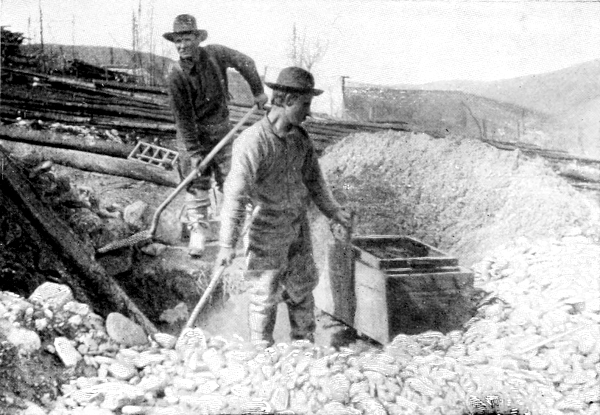
The Discoverers of French Gulch Bench at Work.
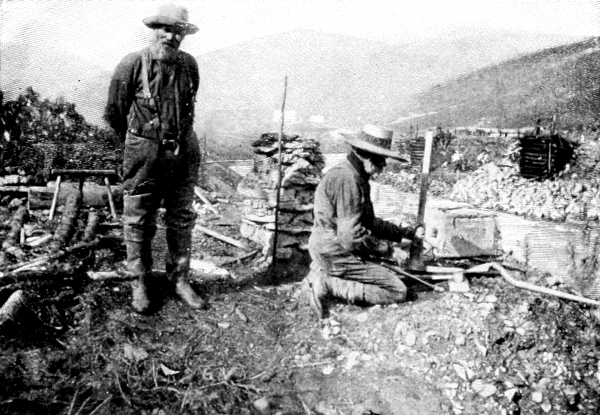
Pardners and Twins for Forty Years.
“Have you never quarrelled?” I asked.
“Oh, yes, lots of times,” said Fred, “and agreed on quits lots of times, too. After Ned’s had a drink or two he always gets cranky and wants to start out for himself.”
“Not much crankier’n you do,” Ned put in.
“That’s right,” Fred assented. “But when we’re sober we make it up again and are ashamed of ourselves. We may be twins, but we’re just fitted for each other.”
“That’s right, too,” Fred assented.
VII