GOVERNMENT
Reading edition
The Canadian Policy in the Yukon Province—Taxes and Fees—The Gold Commissioner’s Office—Conflicts between Territorial and Dominion Governments—Timber Grants—The Value of the Mounted Police—The Newly Rich at Dawson—The Order of the Yukon Pioneers—Mrs. Constantine.
IN its policy the Dominion Government, which took matters out of the hands of the Territorial Government after the Klondyke “boom” began, has apparently been largely influenced by the predominance of aliens in the Klondyke. At least three-fourths of the 2,000 men in and around Dawson in the winter of 1897-98 and of the 35,000 pilgrims of the spring of 1898, were citizens of the United States. Naturally, the members of the Canadian Parliament regarded with dismay the prospect that the new-found wealth of a portion of their domain hitherto considered valueless was going to American mints, and that their constituents would be paying the expenses of administration, which, owing to the isolation of the region to be governed, must be comparatively expensive, for the benefit of another country.
Accordingly, the placer regions of the Yukon Valley lying in British territory were created a special province called the Yukon District, under the jurisdiction of the Dominion Parliament. A Commissioner, with the powers of a dictator, was appointed for the District, the Judge of the district alone being responsible to Ottawa and not subject to the Commissioner’s orders. The other civil officials were a Gold Commissioner, who had charge of the recording of claims, a Crown Attorney, and two Mining Inspectors for collecting the royalties. The opportunities of the officials for their own aggrandizement were exceptional by reason of the system of taxation devised. On the output of all claims a royalty of ten per cent. was collected. Every pilgrim had to take out a mining license at a cost of $10. For having a claim recorded a fee of $15 was charged. Every alternate claim on all new discoveries was reserved to the Crown, thus depriving the community of half the reward of enterprise. These restrictions drove a great many experienced American prospectors to the other side of the boundary line and at the same time served the inexperienced as an excuse for returning home.
Major J. M. Walsh, who was chosen Commissioner, did not go to Dawson in the autumn of 1897. His corps of civil officials preceded him while he remained behind in camp on the Lewes Lakes, with a considerable force of police, in order to escort to Dawson the United States Relief Expedition.
Among the foremost charges of maladministration made against the civil officials was the one in connection with the water front, data of which were given to me by several leading men. The Canadian law provides that the main street of a new town shall be at all points a certain distance from the bank of the river. In order not to have a crooked main street, the men who staked the town-site of Dawson agreed to follow this measurement, from the greatest indentation of the bank, in a straight line. Those who bought lots on the main street supposed that they were securing river frontage, which is invaluable. The spring of 1898 however, saw a long row of buildings whose back-doors were toward the river and which faced the original row. The officials had let the water-front to an individual for a nominal sum in the name of the Government. The sub-lessees said, with a shrug of their shoulders, that they did not care to say to whom they paid their heavy rents, and that they were satisfied as long as they were left undisturbed.
Captain Constantine, who had been transferred from the charge of the police at Forty Mile to the same position at Dawson, was an old fashioned executive. His departure in the summer of 1898 was agreeable to him as well as to the other officials, because he was alone among uncongenial company. He understood the miners; and they knew that, though gruff, he was honest and incorruptible. Even the lawless ones admitted this much; for in no community is simple integrity enforced by a strong will better appreciated than in a mining-camp. Had he been retained as administrator of the whole district, with the power to choose his own assistants, Dawson would have been a phenomenally well-governed settlement from the start, and the development of the great wealth of the region would have been less retarded. Instead of men who had spent their lives among pioneers, the Dominion Government sent, as the reward for party service, men whose experience was limited to local politics at home. With hundreds of experts to choose from in British Columbia, an ex-captain of a whaler and an ex-livery-stable-keeper were made inspectors to collect the royalty of 10 per cent. on an output of eleven millions of gold.
Considering the expense of recording a claim, the owners of claims and the prospectors had at least the right to expect from the Gold Commissioner’s Office reasonable attention to duty. To have posted in a public place a detailed map of the district, with all claims and the names of their owners recorded, would have required little labor and no expense; but it would have ruined the business of the clerks in furnishing information. Considering the number of policemen with idle hands, mail received in the summer might have been sorted with dispatch and distributed at different windows under different heads. But a delay of two or three days, and the prospect of waiting in line for several hours before one could even ask if there was a letter for him, were strong incentives, to miners who wished to hurry back to their claims, to put a few dollars into an itching palm, and in return to receive immediate attention at the side-door of the Post-Office.
Unfortunately the arrival of Major Walsh in Dawson in the spring was not productive of the reforms which an oppressed population had hoped for. The acts of the officials, except that of a representative of the Northwest Territory in placing a tax of $2,000 each on saloons and gambling-halls, seemed to meet with the favor of the Commissioner. He maintained that the Territorial Government was infringing on the special powers granted to him by the Dominion Government; and he issued an order that anyone who chose might sell liquor without any form of license.
The buildings on the water-front stood in the way of even a primitive system of sewerage. Simple sanitary rules were not promulgated, much less enforced. Absolutely no precautions were taken against the epidemic of fever, which was responsible for so many deaths. Private beneficence built the two hospitals, and it now maintains them and carries on all charitable undertakings. Whatever has been done in the way of improvements has been paid for by public subscriptions. The full measure of the Government’s public spirit was the construction of the barracks and stockade for the Police on the Government Reserve. Had some of the money collected from the claim-owners and the prospectors been expended on constructing trails and on a system of sanitation, there would have been less ground for complaint. Doing nothing itself, the Government often took the position of the dog in the manger. The exorbitant price demanded for a charter forced capitalists to give up the plan of building a railroad from Dawson to the mines, which would have been invaluable in cheapening the cost of mining. After paying for timber privileges in their licenses, the pilgrims found, to their dismay, that the Government, or the officials, had given enormous timber grants in the neighborhood of Dawson to individuals, thus putting an artificial value on logs for firewood and building purposes.
Very properly the loudest complaints arose from Englishmen, Australians, and South Africans. If the new laws were directed against Americans, they injured Canadians and other British subjects equally as much, if not more. From the first, London regarded the Klondyke as a great field for exploration, and most of the capital represented there last spring was British. The royalty of 10 per cent. and the failure to use the money so collected in constructing trails have been, however, more injurious to capitalistic enterprise, which is largely British, than to individual enterprise, which is largely American. A poor man who takes from $5,000 to $50,000 out of a bench-claim with his own hands will not be deterred from his labors by the royalty. But 10 per cent. on the gross output makes a majority of company propositions impracticable. Often it will wipe out a goodly profit, and put a balance on the wrong side of the ledger. As soon as it was known that the Dominion Government would not heed the appeals for the abolition of the royalty, the reaction from the “boom” was complete. The appointment of Mr. Ogilvie, the new Commissioner, who has a reputation for probity, was as welcome to the aliens as to the other residents. He at once set about the work of making reforms.
Too much cannot be said in praise of the personnel of the Northwest Mounted Police—mounted only in name, for they have not a single horse in the Klondyke—which is largely drawn from the ranks of the young Englishmen who enjoy “roughing it.” In preserving order they are good-natured but severe. Malefactors are punished with the commendable promptness of British justice; and no murderer in Dawson can snap his fingers in the face of the law as one did at Skaguay. At Skaguay there was no order; at Dawson too much civil government.
For the first winter, being populated entirely by men from the old camps, Dawson was, of course, largely a sociological counterpart of Forty Mile and Circle City, except that the excitement and the feverish optimism, which increased as the new discoveries continued to surpass expectations, had hitherto been unknown in the valley. The contamination of the old customs began with the arrival of the fifteen hundred madly hastening pilgrims who succeeded in reaching Dawson before navigation was closed in the autumn of 1897. It was complete with the arrival of the great pilgrimage with its element of toughs, gamblers, and other parasites. The time had passed when every man nodded to whomsoever he met. Dawson had become a settlement not of neighbors, but, like Mecca, of strangers. The old-timers were developing those human weaknesses which are brought out in sharp relief by the sometimes doubtful blessing of great and unexpected success. Practical communism was easier for a man when he and his comrade were equally poor than after chance had made him the owner of a plot of creek bed worth from $500,000 to $1,000,000, while his comrade, who had been too late in the stampede to stake a claim on Eldorado, was among his employees.
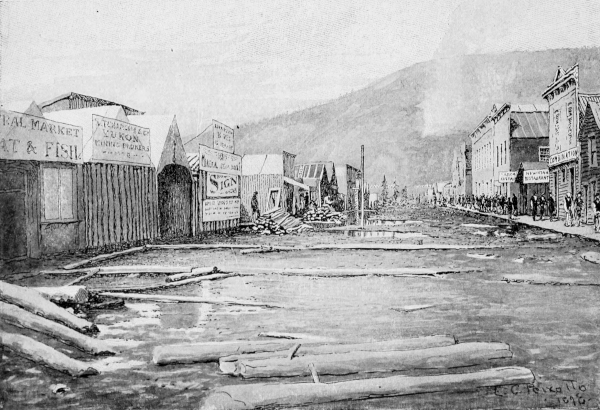
The Main Street of Dawson.
There sprang up as a consequence an aristocratic social circle called the Eldorado Kings, suffering, in a measure, from the affliction of the nouveaux riches of old communities who live miserably under the suspicion that whoever approaches them has an axe to grind. Yet they did not forget their duties to their less fortunate fellows. They gave bountifully to the churches, to the hospitals, and for the care of those poor Cheechawkos who lay ill in their tents. Upon a special occasion, the Order of the Yukon Pioneers—perhaps the death of a comrade or perhaps a church sociable, where you bought ice-cream made from condensed milk for $2.50 a plate—appeared together wearing broad blue ribands. Foremost among them was Jack McQuestion. He was keeping a trading post when the first prospectors entered the Yukon Valley. The old miners came to him to settle disputes, and the poorest of them asked him for the loan of an ounce of dust.
On the day before the departure of our steamer for the outside, attired in their best clothes and wearing their ribands, the old-timers presented to Captain Constantine an address of appreciation and a peck of nuggets. Then Jack McQuestion went over to the barracks and asked that Mrs. Constantine should share with her husband the central position in a photographic group of all the pioneers. She consented.
The Captain’s wife had been her husband’s companion during his service on the Yukon. When she was quite ill one winter and had to remain in her cabin from one short day’s end to another—with long, dark, monotonous nights between them—the kindnesses shown to her were not limited to the devotion of her stalwart husband or the attention of ruddy-faced privates, whose Cockney accent told how far they were from the motherland of commonplaces and restraints. The miners who came to the door to inquire how she was getting on, devised means of entertaining her over their pipes and cabin fires, and then were sometimes too bashful to put them into execution. For one thing they learned by heart the contents of some old humorous journals in camp. Though she had been the first person to receive the journals when they had been brought down the river the preceding summer, she did not say so, and listened with gentle patience to their jokes being retold again and again.
“Mrs. Constantine,” said one old-timer, as he bade her good-by, “we ain’t much on manners, but we do know a lady when we see one.”
XII