DOWN THE YUKON AND HOME.
Reading edition
Good-by to Dawson—The Extinction of the Unfit—Steamboating to St. Michaels—Mosquitoes and Sandbars—Pilgrims by the All-Water Route—Behring Sea—Civilization Once More.
DESPITE the diet, the isolation, and the inhospitable nature of the country, many of the old-timers who had now realized the material ambition which had brought them to Alaska and were going home, saw the great crowd which gathered on the river bank to bid our steamer a pleasant voyage, disappear in the distance with a feeling of regret amounting to more than a momentary pang. From two to ten years had passed since many of them had seen a paved street.
“You’ll wish you’re back,” and, “You won’t feel natcheral,” their departing friends called out to them.
Out of deference to civilization everyone had bought certain of its habiliments. New red ties stood out on the background of black sweaters, and crumpled overalls drooped over patent leather shoes. Some had taken whatever they could find to fit them, regardless of cost and incongruity. Others had halted half way in making out a wardrobe because they feared that they might not be getting the right styles or because they got indignant at the prices charged by the Dawson speculators compared with those on the outside.
The dying woman who was the mother of the first white baby born in Dawson, the sallow men who had limped down from the hospital just before the steamer sailed, and the Cheechawkos who had sold their outfits for just enough to pay for passage to Seattle, where they would have to telegraph home for railway fare—these had no regrets. We buried the woman half way down the river, two of the men before we reached St. Michaels, and a third at sea when only two days from Seattle.
With good accommodations, the journey of eighteen hundred miles from Dawson to St. Michaels would have been a pleasure trip. It was far from that with us, owing to the Spanish-American war and certain other reasons. The commercial company which charged us $300 for transportation had two steamers at Dawson. It held them there long enough to give us the questionable satisfaction of seeing the steamer of the rival company, which had been delayed in coming up the river from its winter quarters, arrive and cut prices before our steamer, having room for seventy-five passengers, and one hundred and seventy-five on board, started on ahead of her sister steamer. We were to act as a reconnoitering force or a buffer, or whatever you choose, for the sister steamer, which had a dozen lonely, armed passengers and $2,500,000 in dust on board, with a view to saving her treasure from a Spanish privateer if one were waiting for us at the mouth of the river, as rumor from the outside said. Therefore, one hundred passengers had to sleep on the floor of the dining-room or on the lower deck among the Indians and the piles of firewood.
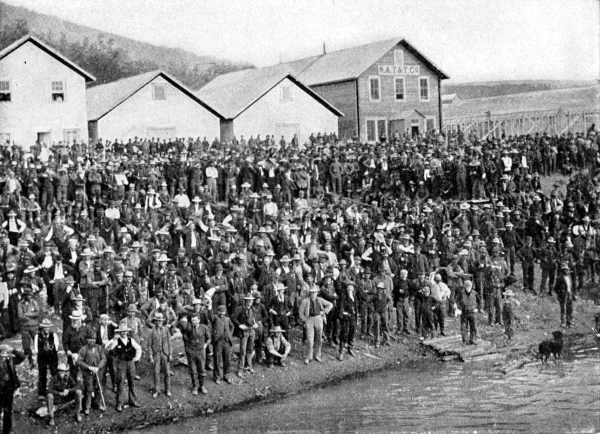
A Dawson Good-by.
Except when we ate, and when the steamer poked its bow into the sand in front of some piles of fire-wood on the bank, we could be fairly comfortable lounging on the decks. For the eleven days which the journey occupied, we had one tablecloth for three sittings at each meal. As the miners had a general disregard for the utility of dishes for holding things, the cloth did not preserve its original color, even in spots, for more than two days. Our food was bad rice, bad bacon and bread, and old canned roast beef, which, however, did not count, as we could not eat it. If the company had only allowed us to use our fingers instead of forks and knives which men who were “working their fare” out as waiters washed indifferently, I should have been much happier. By July, moreover, the little mosquitoes were out. They, and not the big ones which come early in the season, understand flying straight to the mark with rigid lance. They bit the Indians as well as the white men, but to no purpose so far as making them hurry in bringing on the wood. As soon as the steamer was in midstream, the buzzing mists, which could be resisted only by the finest netting drawn over the head, disappeared.
Our principal stops in the eighteen hundred miles were at Forty Mile and Circle City, where the deserted cabins were being once more occupied and there was a chance that the old claims, which were good for their day, would be worked again, and of a recrudescence of the boom; and at Minook, where important discoveries had been made in the past winter. But we stopped also at every little Indian village—to please the Indians, one presumed—where the inhabitants came out to meet us in their light canoes and wanted to sell furs and trinkets. At many of these villages there were mission houses. We had on board a Russian priest, who had come up on the steamer from Anvik and was now returning. He was bold enough to say that he thought he needed this little recreation after having been two years alone among the Indians.
We had left behind the great mountains below Dawson, we had seen the midnight sun across the vast stretches of flats below Circle City, and were just congratulating ourselves that our Indian pilot had led us through the last of the many shallow channels in the flats, when we ran on a sandbar. Our mate and his Indian crew labored for twenty-four hours before we were off. The next day a hog chain broke and our engines were helpless. For the rest of the distance to St. Michaels we were towed by the steamer which carried the treasure and had the misery of seeing the fellows who had started two days after us and paid less fare pass us on the steamer of the rival company.
At St. Michaels we met three or four thousand pilgrims who were going into the Klondyke by the all-water route. They had bought transportation for themselves and outfits of new companies which had attempted to tow flotillas of river steamers built in Seattle to St. Michaels. Almost invariably the river steamers had been lost at sea between Seattle and Unalaska, and those who depended upon them for transportation to Dawson were only better off than others who had attempted the journey on decrepit sailing vessels that had gone to the bottom. It was a little unkind of our passengers, while we waited for transfer to an ocean steamer, to enjoy setting before them in the bluntest phrase an exaggerated account of the desperate condition of all the newcomers in Dawson.
Behring Sea was placid as a lake when we crossed it. After two days for coaling at Unalaska and after five days on the Pacific, we entered Puget Sound on the morning of July 19th. Everyone on board was thinking of the steaks and the fruit that he would eat that evening for dinner. The old-timers, who had heretofore resented the steward’s requests that they should not expectorate on the decks, were a little ill at ease at the prospect of the social restraint of civilization. Civilization offers many advantages over Dawson or Circle City for spending a fortune, to be sure, but such of the old-timers as were destined to become poor again—and the majority were, I think—would no doubt return to the pick and the pan as a wanderer returns home.
THE END.
BOOKS ON OUR NEW POSSESSIONS
COMMERCIAL CUBA
A Book for Business Men
By WILLIAM J. CLARK
With 8 maps, 7 plans of cities, and 40 full-page illustrations, and a Commercial Directory of Cuba. Large 8vo, $4.00
“A THOROUGHLY good and useful book. We should not know where to find within another pair of covers so much and so carefully sifted information bearing on this subject. Mr. Clark’s painstaking account of the railway and telegraph systems; of highways and harbors; of rivers and water supplies, and lighthouses; of sugar and tobacco growing; and his detailed description of each province and of every city of any size, together with a ‘business directory’ for the whole island, make his book one of great value for reference as well as for practical guidance. In the present situation of Cuban affairs it should command a wide sale. Its accuracy is certainly of a high order.”—New York Evening Post.
YESTERDAYS IN THE PHILIPPINES
By JOSEPH EARLE STEVENS
With 32 full-page illustrations from photographs by the author. Seventh thousand. 12mo, $1.50
“WITH the observant and indulgent eye of an old traveller, Mr. Stevens has seen everything in the islands worth seeing, and has described what he has seen in a most interesting manner.... All is set forth by the narrator in a breezy, chatty way that would be entertaining under any circumstances.”
—Philadelphia Evening Telegraph.
CHARLES SCRIBNER’S SONS, NEW YORK
THE WAR ON SEA AND LAND
THE CUBAN AND PORTO RICAN CAMPAIGNS
By RICHARD HARDING DAVIS
With 117 illustrations from photographs and with 4 maps. Twentieth thousand. 12mo, $1.50
“NEVER has a war been reported as this has been, and never has a history been written like this, by one who saw it all—while the blood was hot and the memory vivid.”—New York World.
“THIS is much the most vivid and readable of all the books on the war that have appeared so far, and it is full of life and color and incidents that show the sort of stuff of which our soldiers were made. The book is written with a keenness, a vivacity, a skill and a power to thrill and to leave an impression which mark a decided advance over anything that even Mr. Davis has written heretofore.”—Boston Herald.
OUR NAVY IN THE WAR WITH SPAIN
By JOHN R. SPEARS
Author of “The History of Our Navy”
With 125 illustrations from photographs and with charts and diagrams. 12mo, $2.00
“MR. SPEARS has plainly put his best efforts into that mighty combat, the sea-Gettysburg of the war, the death-grapple of Cervera’s ships and Sampson’s. His story of the action of July 3d is superb. It is the most lucid and comprehensive description which has yet been laid before the American people, and it is made all the more valuable by the official chart of the ships’ courses which accompanies it. As a whole, Mr. Spears’s book is not only true to technical details, but it is a spirited and admirable piece of literary workmanship. It is one of the few volumes out of the many hurriedly issued in the wake of the war which will endure the test of time and stand as a faithful, competent picture to future generations.”—Boston Journal.
CHARLES SCRIBNER’S SONS, NEW YORK