PROFITS AND LOSSES
Reading edition
Newspapers as Profit-Winners—Hearing about Dewey—A Drop in Eggs—Market Items—Lemons against Scurvy—The Mercury at 110 degrees—An Averted Moving Day—Industrious Scavengers—The Klondyke Itself—Aspects of Summer—Bandanna Hats and Pink Lemonade—A Restaurant Trust—The Grasshoppers and the Ants—Disillusions.
IT was only to be expected that the first boat of the season to shoot around the bend above Dawson and raise a shout which would bring all the population to the shore would be manned by a resident of Seattle with the name of his beloved town painted on a huge streamer flying from the mast. Enterprising citizens of the far West such as he owned the stores at Dyea and Skaguay, the pack-mules on the trail, the restaurant tents which had sprung up in Sheep Camp, and then, following the pilgrimage on to Linderman and Bennett, generally made money out of the Klondyke without having to use a spade, because of their knowledge of the life and necessities of new communities. This proud Seattleite with the boat had two hundred dozen of nominally “fresh” eggs to sell, for which he received $3,600 within less than an hour after he had landed. Those of the crowd who could afford it hurried off to the restaurant for a “squar’” composed entirely of “ham and”. The others, having to bide their time until luxuries were cheaper, found compensation in the items of news which were passed from tongue to tongue—for it had not occurred to the Seattleite to bring a newspaper with him.
“Thought there was more money in eggs,” was his aggravating explanation. “’Sposed you fellers wanted to eat, not read.”
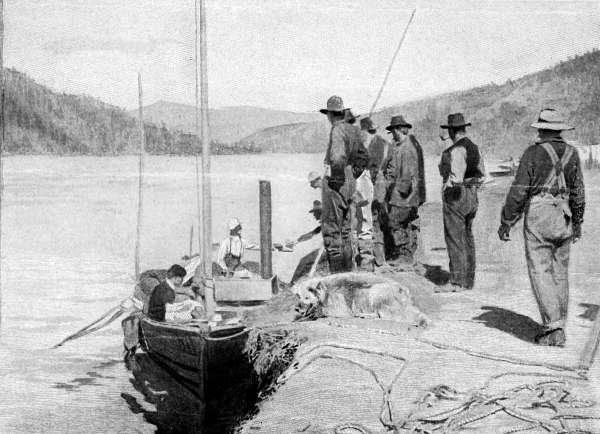
Bargaining for a Newly Arrived Boat-Load, Dawson.
As he had heard it, within a week after the declaration of war with Spain, the cruiser New York, Captain Evans in command, had reduced the fortifications of Havana in three hours. The second Cheechawko to arrive assured us that this was quite untrue, and that two of Admiral Sampson’s squadron had been sunk and the Spaniards were winning on every hand. The crowd refused to believe anything of the kind, and the second Cheechawko received only $14 a dozen for his eggs.
With the next boat came a single newspaper, soiled with bacon grease. A curbstone speculator bought it for $15, stuffed it instantly into his inside coat pocket, and a few minutes later was posting signs to the effect that all might hear the news of Admiral Dewey’s victory read by paying a dollar a piece that evening. His entertainment would have netted him twice as much as it did if more than three hundred and fifty people could have been packed in the hall in which it was held. Some of the wealthy men considered this proceeding an outrage on personal liberty and made it a point to buy between them any single copy of a paper later than any others that had arrived and have it read at once in the streets.
Never did contrast better illustrate the comparative reliability of even the most unreliable of modern newspapers. All winter the camp had not had so much as a small hand printing-press, and news was carried solely by word of mouth. Most miners have the weakness of exaggeration. With some it is unconscious. Others enjoy testing a hearer’s credulity. Twice, up the creeks, I heard that the Continent had declared war against England and the United States; in the second instance, the detail of an Anglo-American naval victory off the coast of Bohemia perhaps was supplied. Such rumors were the natural fruit of the desire of Americans and Englishmen to pay compliments to one another at a juncture when the Anglo-Saxon alliance of the Klondyke was quite ready, without any assistance from London or Washington, to stand in arms against the whole world.
Within a week some thirty boats all bringing merchandise had arrived. In momentary anxiety of being lodged on a sandbar, without stopping to make camps, their crews bending to the oars night and day, they had raced with one another to the goal of high prices. Too many had placed their speculative trust in eggs. After all, there were only four hundred working claims, and the stomachs of each of their owners, and of the chief gamblers and business men, were little if any larger than that of the average human being. Eggs fell in five days from $18 to $4 a dozen and finally to $3.
A stock of fine millinery and ladies’ apparel, sold to the women of the town, gave to one fellow a profit of $5,000. The first condensed milk to arrive brought $1 a can; the first butter, $2.50 a pound; the first ham, $1.25 a pound, and the first sugar, $1.50 a pound. Lemons were more in demand in a scurvy-ridden country than oranges and bananas and sold for double their price, which was seventy-five cents apiece. But the happiest of all the newcomers was the one who had the only boat-load of boots for a community which was miserable in moccasins in warm weather. He received $15 a pair for fifteen hundred pairs which had cost him $1.75 a pair in Montreal. A five-cent bottle of ink cost $1; a fifteen-cent golf cap, $2.50; a pen-holder, fifty cents—the smallest amount of dust that anyone cared to weigh out; socks $2 a pair; a broad-brimmed summer hat, $20 to $40; a small whisk broom, $2.50; a ready-made suit of clothes, from $50 to $200; canned roast beef, $2.50 a can; canned oysters, a great luxury, $5 for a pound or pint can, and cigars, fifty cents to $1 apiece.
Against the profits which such prices represented the speculator had to set the original cost of the articles, the expense of transporting them to Dyea or Skaguay and over the one hundred and seventy-five miles to the foot of Lake Le Barge, his own fare on a steamer out of the country, and the loss of from three to six months’ time.
During the lull between the arrivals of the few speculators from Le Barge and the main body of the pilgrims from Linderman and Bennett, it seemed at one time not unlikely that Dawson might be carried down the river and a new town established on some sandbar. But there was not enough snow left on the mountain sides to allow the tropical sun, shining eighteen hours out of the twenty-four and raising the mercury to 110 degrees, to accomplish its apparent purpose. Never had the old-timers known it to be so warm so early in May, and never had they known the river to be so high. They held that the Lord was displeased with the prospective defilement of the country by an army of “clerks, farmers, and dudes.” The Indians knew better. White man might be very cunning in making a boat go up stream by burning wood in an iron box, but Indian could tell him some things besides how to kill moose. Old Indian could count off on his fingers some twenty years ago when the canoeing was good on the whole town-site of Dawson. That was why Indian never lived in Dawson but at Klondyke City.
Day by day we saw the water approaching a few inches nearer to our door-sill. It began to fall just as we were thinking of putting up our tent on the mountain side. Only the roofs of some cabins in Dawson were above the level of the stream. The suspension bridge between Dawson and Klondyke City, whose woven wire cables were earning two or three hundred fifty-cent tolls a day for their owners, was carried away along with a great pile of débris that it had collected. You paid fifty cents for being ferried from one island to another in the main street. Along the bank, standing in their boats, pike poles in hand, were those easy-going ones of the inhabitants who raised husky dogs for sale, did a little freighting in the winter, and took naturally to odd jobs—and I might say to squaw wives—now, in the heyday of importance, as they rowed out in the strong current and brought in a tree which had been uprooted by the flood. If the tree was suitable only for firewood it was probably worth a quarter of an ounce, or four dollars; if large enough for sawing, half an ounce. The average Klondyker’s dislike for such work being quite as strong as that of the average man at home for scavenging, the easy-going had a free field and earned enough in a few days to buy winter outfits for themselves and their families. A few had even better luck. They caught portions of rafts—in two instances whole rafts—which had slipped their moorings up the river, and steering the sum of two or three months’ labor of men probably unknown to them up to the bank, let the owners of the saw-mill have it at a bargain.
A source of amusement if not of income was a ditch in one of the back streets, hidden under three or four inches of water. As you stepped into it up to your thighs you heard a roar of laughter from several men sitting on a prominence near by.
“If you don’t tell your friends, pardner,” said one of them, “there’s room up here for another, and you can enjoy yourself watchin’ the others tumble in.”
With all the snow gone and no rainfall, the Yukon fell as rapidly as it had risen. The thawing and crumbling soft earth of the embankments of the upper reaches made it muddier than the Missouri at its worst. For drinking water one had either to resort to the rivulets on the hill-side, amber-colored from the moss, or go to the Klondyke, which, once sluicing was nearly finished, became so clear that the bottom was visible at a depth of ten or twelve feet, while the eddies and rapids of its current as seen from the mountain tops, left a dark, comet-like streak, stretching from its mouth for a distance of two or three miles on the café-au-lait surface of the mother stream.
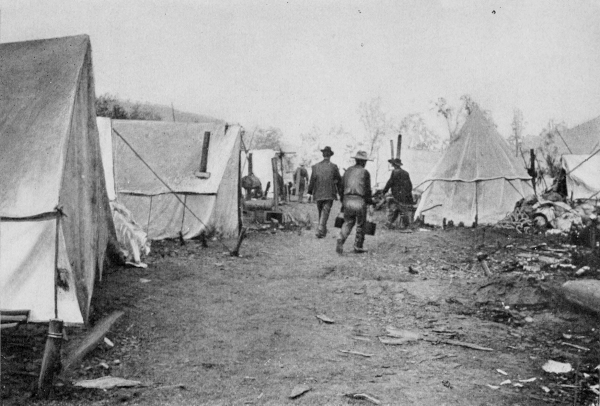
In the Camps of the Cheechawkos.
By the fifteenth of June the river-bank was lined with the boats of the pilgrims, two or three deep. A city of canvas, with the old cabins and buildings as its heart, extended until the neighboring heights were dotted with tents. Knowledge of boat-building had turned out to be a misfortune, if anything, for the scows moved just as fast with the current and proved quite as easy to manage, I was told, as smaller craft pointed at both ends. The bow of each vessel bore the number which had been put on by the Mounted Police when they examined outfits for a second time for custom purposes at Le Barge or Tagish. Beside it was the name of the pilgrim’s home town, of his sweetheart, his wife, or his daughter, put on with coal if he had no paint. From the mast fluttered a red bandanna, a towel, or possibly some absurdly elaborate flag which had been made in the idle hour between the completion of the boat and his embarkation. If there were three in a boat, which is the best working number for a Klondyke party, one was in the bow on the watchout for sandbars, the second was at the oars, and the third in the stern with a sweep. Navigation had its perils, too. The river as well as the Pass had claimed its victims. You heard on every hand tales of wrecks in White Horse Rapids and in Thirty Mile River, whose hidden rocks had proven even more dangerous than the White Horse Rapids. Many a scow with merchandise which had cost its owner his last cent was split in two, and those on board were thankful to find themselves on shore alive.
In their camps, the pilgrims found the mosquitoes of summer worse than the cold of winter. Fevers and headaches upon their arrival in Dawson were the consequences of exposure under the sun. It was even the fate of a few to be taken at once to the big log hospital on the hill-side which already had more patients than it could accommodate; and of a part of these to be buried in the little cemetery beyond the hospital, which gives to relatives of the deceased the sombre satisfaction of knowing that its inmates, lying at a depth where the earth never thaws, are preserved for all time—unless the town-site itself one day is marked by hydraulics.
Between the pilgrims when I met them in Seattle and when I met them again in Dawson there was all the difference of volunteers in new uniforms going forth to war and the dust-stained men who return. Their tents, so white and new in Dyea, had patches where holes had been burned by sparks or by carelessly hung candles. Their canvas bags of provender were the color of the Yukon. Their cheap sheet-iron stoves were so badly warped that the oven had ceased to bake well. Their beards were unkempt, their faces tanned. The knees of their trousers proved again how helpless a man is when alone with a needle. Many were still wearing caps. A few had made substitutes for summer hats out of wire, straw, fir twigs, and a bandanna. If the Seattle and the Vancouver merchants could have seen the outfits which they had sold after three or four months’ usage, they themselves might have wondered at the skill of the manufacturers in making little seem a great deal by the use of varnish.
Very wisely the Canadian Government had provided that every pilgrim entering Canadian territory must have eleven hundred pounds, or a year’s supply of food. Flour was the cheapest thing to bring an outfit that lacked two or three hundred pounds up to the requirements. Almost without exception the pilgrims had failed to realize the importance of luxuries in contributing a healthful and sustaining diet in the North. Flour sold on July 1st, after the commercial companies began to receive supplies, for $6 a sack, but white sugar sold for fifty cents a pound. Everybody had enough of staples, but many had eaten all their sugar—the larger part of their dried fruits, soup preparations, and canned delicacies and smoked or chewed all of their tobacco. It was easy to promise themselves on the trail that if they indulged themselves in “something good” after a hard day’s work they could buy more of the same article in Dawson. For they were certain that a great many of their comrades intended to sell their outfits and leave the country at once—so many of their comrades did. But they, too, had eaten all their butter and evaporated eggs and kept any tobacco they had lest they should run out of it on the way home.
Pilgrims who had goods to sell hastened to find a niche for a booth on the busy main street, where you could buy peanuts and pink lemonade, or the substantials of eating; patent leather shoes, yellow-backed novels, and cheap jewelry, or the substantials of wearing apparel. The six restaurants formed a trust and kept the price of a meal up to $2.50. In furnishing them with meat, the men who had used oxen for drawing their outfits up to the Scales and again to draw them over the lakes, now had reason to laugh back at the friends who had scoffed at them for thinking that any animal except a dog or a mule was useful in Alaska. An ox sold for $700 or $800 and was butchered at once before it had a chance to eat any more hay—which was worth $100 a ton—while the rich men stood by to see that they got the tenderloin. Besides beefsteak, we had moose-steak. One moose, who had possibly come back to his old pastures out of curiosity, was shot with a revolver only a mile out of town. His slayer, who met him ambling along the white man’s trail as if he were on a stampede to some new creek, sold his carcass for $500.
Carpenters got employment at $15 a day on some one of the new dance halls, saloons, and stores which were being built as fast as green lumber for their construction could be obtained. Pilgrims without any trade, if they were wise, immediately secured logs and built a cabin, which served them at once as a temporary home, a storehouse for their supplies, and assured them warmth and shelter when winter should come. But the grasshoppers were far more numerous than the ants. The debilitating climate of summer, joined with the indecision of whether to leave the country or to remain, of whether to go down the river to the American side or up the river to Stewart if they did remain, supplied the majority with a good excuse for idleness. Some did not even put up tents on the shore, but kept house in their boats which they had moored to the bank. They sat on logs discussing their experiences in shooting the rapids, and they kept watch of the new arrivals for the purpose of guying anyone who had started before themselves but had arrived later.
There was something pitiful as well as ridiculous in the disappointment of the pilgrim who had believed everything that he read in the press-agents’ pamphlets, to find that a rich claim was not to be had for working it. When he put his new gold-pan and a pack on his back and went up the trail to the creeks, where possibly he found a few colors in a rivulet, the old-timers laughed at him and asked him if he liked prospecting well enough to pan ground that was staked two years ago. If he carried a revolver they begged him, please not to shoot them. Wearily, and with all his visions dispelled, he returned to Dawson. His tent was no protection from the sun of midday. At night the light made it difficult for him to sleep. As he fried his fat bacon he could not help thinking that it was just strawberry time on the “outside.”
Few pilgrims had any money and those who had were inclined to spend it on the luxuries which their palates craved. They walked up and down the main street like the crowd at a country fair; looked on at the drinking and gambling of the successful miners and marvelled at the amount of dust that passed over the saloon-keeper’s scales; and slouched in and out of the stores of the two commercial companies to see the bulletin board, which had the list of names of men for whom letters had been received. If they might not visit the new variety theatre, with gambling hall and bar attached, where actresses from ’Frisco and Seattle sang the songs of a local poet containing spirited references to the rich claim-owners—who, in return for the compliment, opened champagne at $30 a bottle between the “turns,”—they could at least enjoy the sights of the river bank. In the absence of so great an event as the arrival of a scow with mules or the latest papers on board, some “pardners” were either quarrelling or dividing their outfits preparatory to selling them. With the first steamer from down the river came the news from Circle City, which meant a great deal to the old-timers. The Cheechawkos could not understand it, but, as became a crowd which gets only a glimpse into the inside world, they made the most of the peeps and simulated intense interest.
One day a midget of a steamer, the first to shoot White Horse Rapids—her parts had been packed over the Pass and put together on Bennett—ran in between two scows and tied up so quietly that not more than three or four hundred men saw it. Their pride was no greater than the disappointment of the multitude, who refused to forgive the captain until they learned that his whistle was out of gear.
Next to knowing them personally, the Cheechawkos enjoyed having the leading citizens and the foremost gamblers pointed out to them. They knew the story of how the Eldorado kings had made their fortunes, and how Jack Smith had once bet $7,000 on the turn of a card. Now and then they caught a glimpse of the tall, raw-boned Scotchman who was the richest man in the country. Two years before he had been a day laborer at Circle City. When the value of Eldorado claims was an uncertain quantity he bought one of the best for $800. He spent all the first year’s output in buying undeveloped properties, and then bought still others upon his promise to pay, which the miners accepted without any written word. The clean-up had vindicated his judgment. Now the fact that he had stopped on a trail to look at a claim was supposed to increase its speculative value.
And speculation still continued in both mining property and real estate. A French-Canadian who had paid $5 for a front lot just after the town-site was staked still held out persistently for $20,000, with slight prospect of getting it. The “bottom” was out of the “boom,” as every man who supported himself by gambling or speculation well knew. No new strikes were made except on a few benches. None could be made on the creeks at a season of the year when the seepage from the thawing earth would fill a prospect-hole as fast as it was dug. Autumn and winter have ever been the time for prospecting in the Klondyke, and summer the time for cabin building or for taking provisions to the heads of some of the tributaries in poling-boats preparatory to prospecting.
Roughly but surely the lesson was forced home to the pilgrim that a fortune cannot be made in the Klondyke in a hurry. If he would have a claim he must find it. Even after he has found it, he must spend two or three years, unless he sells it, taking out its treasure. If it were not for the humiliation of facing their friends from whom they had parted with merry good-bys, nine out of every ten of the pilgrims would have returned home at once. Thirty per cent. of them did, as it was. Two-thirds would have gone if many had not loitered on in their tents until it was too late to go except over the ice. The tenth man developed those characteristics of patience and nonchalance in dealing with obstacles which the veteran prospector possesses by experience and by nature. For such as lacked this spirit and remained in the country there was the prospect of loitering in their cabins until their supplies were eaten, in the hope of getting a good claim on a stampede, or of going to work for wages.
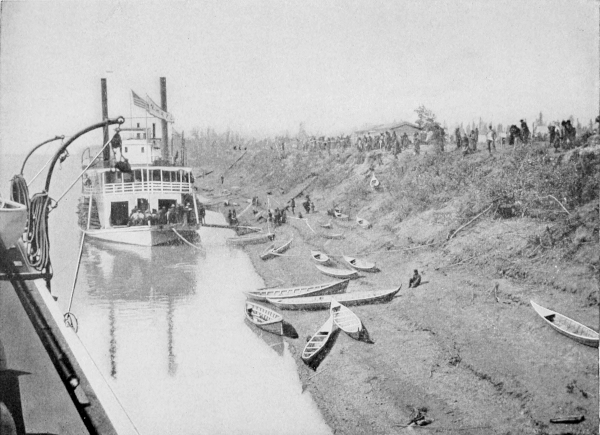
A Yukon Steamer.
In all, the pilgrims must have spent $30,000,000, or $40,000,000, on outfits and transportation. (The output of gold in the Klondyke for the year was $11,000,000.) But they have paved the way with their failures for the development of a vast expanse of country whose abounding wealth is unquestioned. The hardships of a journey to Dawson are of the past. An aërial tramway, without groans or perspiration, does the work of the packers at one-fifth of the expense on Chilcoot, and a railroad carries passengers as well as freight over the whole Pass. Steamers ply on both the upper and lower branches of the river connecting at White Horse Rapids with others plying on the lakes. Hereafter, the mines of the Klondyke will be an established institution, like the mines of California, and the prospectors who go there, better fitted for their tasks.
XI