MINERS AND MINING
Reading edition
Reaping the Gold Harvest—Thawing and Sluicing—Miners and their Theories—The Dome—Expensive Timber—Empty Pockets but Dollars in the Dumps—The First Millionnaires—Color in the Pan—Once a Prospector Always a Prospector—Figuring Fortunes—Capitalists in Demand—The Forty Happy Kings on Eldorado.
IT was just on the eve of harvest-time when I first visited the creeks. In a day or two the flow of water from the gulches where the snow lay thickest would make a head sufficient to wash the yellow grain out of the dumps. Along the four miles of Eldorado, or its full length, and the ten miles of working claims on Bonanza, lines of flumes and their dependent sluice-boxes—the lumber for which had been drawn on sleds from Dawson by husky dogs, or cut with whipsaws—formed a network around the string of cabins occupied by claim-owners and their workmen and around the piles of clayish-colored dirt, thawed out inch by inch during the short winter days, which contained virgin wealth amounting to ten million dollars. The hill-sides, once covered with timber, were bare of all except stumps and scarred by broad streaks from top to bottom, showing where logs for building the cabins and for feeding the fires in the drifts had been slid down.
If you descended by the shafts beside the dumps to the drifts, you soon comprehended that reaping the harvest, once you have a claim, is not so easy as picking wild cranberries. It is dogged work to build fires day after day, running the risk of suffocation and permanent injury to the eyes by the smoke, and pulling up the dirt, bucketful after bucketful, by means of a windlass, with the thermometer forty below zero—and the prospect of cooking your own dinner. The rising steam from the thawing pay-dirt of the drifts, which fills the valley with mist, adds the discomfort of humidity to the biting cold. Though the man who turns the windlass may have to beat his hands and dance about to keep warm, he is never in positive danger as is his partner below, who, in returning to relight one of the series of nicely arranged piles of wood which have failed to ignite, is likely to be suffocated, or, barring such slips as this or any consequent accident, is sure to suffer continually from soreness and smarting of the eyes, if not to have them permanently injured by the smoke.
In one spot of three or four square feet on Eldorado, the nuggets are so thick that you can pick them out by hand as a farmer’s boy picks potatoes out of a hill. In juxtaposition there may be as many more square feet which are not considered worth thawing and sluicing; and so the angles of the drifts seem like the path of a man of vacillating mind trying to make his way to the light in darkness. From two to three feet above the real bedrock is the false bedrock, a stratum of stone broken into angular fragments, apparently by some great force passing overhead. Between the two is the best paying-dirt, and occasionally here is found, perhaps with particles of gold sticking to it, the tusk of a mammoth who was the ruler in the valley before the days of the moose.
In the angular fragments of the false bedrock the miners who are fond of making out the reason of things over their cabin-fires, with diversified reading in newspapers or even a dip in a text-book of geology at school as basic knowledge, find support for their favorite theory as to how the yellow particles came to their resting-place. Gold had never been found before in such incongruous surroundings. Therefore, they contend, it must have been borne from its point of precipitation by some force worthy of the situation and of Alaska, where nature has a gift for seemingly paradoxical performances done on a Brobdingnagian scale. What else but a glacier was equal to the feat? It had scattered wealth in its progress like some good Lady Bountiful, crushing with its great weight the false bedrock between whose fragments the dust had fallen by force of gravity to the true bedrock.
Another, a smaller and perforce a more confident school of thought, holds that an ancient volcano “coughed” the dust out of the bowels of the earth.
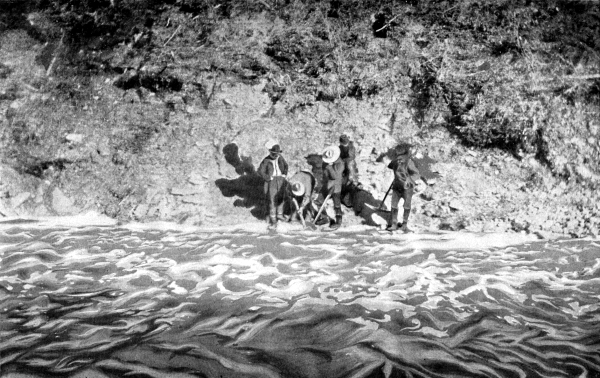
On the Creeks.
For my part, inasmuch as the geologists themselves have come to no certain conclusion, I hold that all the gold which has been found in the Klondyke and Indian River districts was smelted in a great pot in The Dome and has leaked out of its cracks. Then, as a fitting corollary, I desire that one day an old forty-niner, as sturdy and as fine as an old weather-beaten oak, shall discover the pot and find a leverage strong enough to lift the cover off it; whereupon, a good guardian, gently reserving enough of his millions to give him a certain annuity for life, he may spend the rest in ’Frisco after the manner of his own choosing as quickly as he can. But I am certain—such is the irony of fate—that, instead of him, the happy man will be an Oklahoma “boomer,” the father of several strapping daughters, who never panned a handful of dirt before he mortgaged his all in order to buy a Klondyker’s outfit. He will set his daughters up in the capitals of Europe, where they will marry continental noblemen, while the whole family will be miserable for life.
In candor, I must say that with mine as with most theories there are facts which go to contradict it. The claims on the upper reaches of the creeks, which have their origin on the slopes of The Dome, are much richer than those on the lower reaches, where the dust is finer and more travel-worn as well as more scattering. But in the head-waters nothing has yet been found which is worth the working. So either all the gold leaked out some time before this force that carried it ceased to operate, or the mythical person who has charge of the pot mended the cracks, or, possibly—and this is my hope—the fortunes which have already been brought to light were only an overflow, the palpable result of the chemist in charge of the vessel having misjudged its capacity.
By the fifteenth of May the drifts were filled or partly filled with seepage which had frozen below a depth of a few feet, where the temperature is never above freezing. Work in them was at an end by the first of May, when the surface earth had begun to thaw a little at midday. Then the plane, saw, and hammer took the place of the pick and shovel. If they had used rosewood at New York or London prices the miners could not have built their flumes and sluice-boxes out of more expensive material than that they had in the warping, knotty fir boards which were condescendingly sold at $250 a thousand by the three saw-mills in the country. Once the flumes were laid to the gulches and to the dams in the creek itself, the sluice-boxes were properly laid on the dumps which were to be washed first and the gates between the two were made tight, the community was ready to reap the reward of a winter’s toil as soon as the sun should thaw the drifts of snow on the mountain-sides sufficiently to make a sluice-head of water.
There followed a brief period of inactivity like that between sowing and harvest for the farmer. Every man had his opinion of how much the output of all the creeks would be, and the estimates varied from six to fifteen millions. Within the big world of speculation there were the small worlds of the groups of cabins which clustered around that of the owner of each claim on Eldorado and Bonanza. For the laymen who had taken portions of claims to work on shares and for the claim-owners, especially those who had employed the workers on their claims at daily wages, it was an interval of some anxiety. They would soon know in what measure the estimates that they had made from specimens of pay-dirt panned out in buckets of water in their cabins during the winter would be verified. Men who had more than a hundred thousand dollars in their dumps possibly had not five dollars in cash in their possession.
The members of no community had ever been submitted to a greater burden of usury. They bore it with rare good-nature. What else were they to do? they asked. They needed money for wages, for food for their men, and for lumber, and those in town who had money knew the value of it. The regular rate in the winter was ten per cent. a month, and some of the so-called millionnaires who had owned nothing except an outfit two years before were owing as much as $25,000 on from three to six months’ time.
A spirit of optimism and good cheer prevailed. A sun bath, lounging in a home-made chair on the stoop of a cabin (perhaps with a pair of moose horns forming an ornamental back), was a luxury better appreciated in the Klondyke than in a temperate clime. Sometimes a breeze, with a faint odor of fir-trees and of the many wild flowers which spring up in tropical luxuriance in the spring, came down the valley. Over the hills were young birches which yielded a delicious sap for the tapping. There was even gratitude to the tyrant windlass of the winter days in that it had supplied exercise, given an appetite, kept the blood circulating, and prevented the scurvy, which is to be dreaded only by the man who lounges in his cabin, does not wash himself, does not cook his food properly, and endeavors generally to imitate the bear. Nearly everyone could hope, if he did not expect, that his claim or his lay would turn out as well as he had estimated. At all events, he would have some spending money. He knew that the early boats from Lake Le Barge would bring in many luxuries just at the opportune moment when the “clean-up” was about finished and he might go to “town.” He smacked his lips in anticipation of the day when he would have all the eggs that he could eat, regardless of their cost.
One day the sun suddenly beat down with great fierceness, which was unabated for several days. Then the water came gushing down the flumes in greater quantity than was needed, and the men picked up their picks and shovels again and began peeling off the dirt on the dumps and tossing it into the sluice-boxes. The warmth was prolonged through the night, so that the dirt continued to thaw as fast as they could strip it off, and on many claims—whose owners had foresight or were in luck, as one pleases to put it—there were two shifts working all the time except when, once or twice a day, the boxes were being “cleaned” of the accumulation of gold and the sand which sinks with it between the cleats. The snowdrifts were melting as if they were under a blowpipe. Even the tiny streams of the gulches become torrents, dams had to be opened, and some sluice-boxes floated away from their moorings. Only too soon was the loss of the wasted energy brought home. With the snow gone and rains and the seepage from the thawing surface the only source of water supply, the currents dwindled until many claims had not a single sluice-head. The claim-owners on the tributary Eldorado, with as much dirt to wash as the main stream Bonanza, particularly had cause to resent the prodigality of nature in expending all of its ammunition at once. Instead of having finished their washing in June as they had confidently expected, all through July they were measuring the head of water from hour to hour with the care of a physician feeling a patient’s pulse.
When the “clean-up” of a day’s shovelling was made, you might feast your eyes on the consummation of the harvest. The water was shut off and the cleats in the boxes were lifted and rinsed, leaving a residue which glistened with yellow particles. Just a small stream was turned on by the man at the water-gates, who was probably making the most of his rest from shovelling by smoking a pipe of cut plug, and then turned off again, or on a little more or off a little less, while the most expert miner on the claim pushed the speckled sand-pile back and forth with a common brush-broom until all the foreign particles had floated off, except a sprinkling of the heavy black sand which is invariably the companion of placer gold.
Three or four or five thousand dollars—perhaps ten or fifteen or twenty thousand if the “clean-up” be on Eldorado—which is three or four or five double handfuls, is put into a pan with an ordinary fire-shovel. The sight is bound to make your blood run faster and to color your reason with an epic enthusiasm. That little yellow pile, you know at a glance, will stand the test of chemicals. It must also accept the concrete responsibility for all the disappointments, sufferings, and deaths of the pilgrims on the trail and the worries of their friends and relatives at home. Once you have seen a “color” in the bottom of a pan with the black sand following it around like a faithful servant, you can never again be deceived by the glitter of any false gods. You would know it if you saw it between cobblestones on Broadway, or if it were no larger than a pin-head at the bottom of a trout-pool.
It is small wonder that once a man is a prospector, in good faith, not a child of a wild stampede, he is always a prospector. There is an heroic aspect, the more charming in contrast to the complexity of civilization, in going from creek to creek which have no place on the maps of geographical societies, taking a pan of dirt here and a pan of dirt there, breathing fresh air, a zest given to your exercise by the hope of success.
For the moment, the yellow pile makes you feel like seeking a claim of your own and harvesting its treasure for yourself. But when you look at the miry path along the base of the mountain by the creek-side, and think of following it with a pack on your back until it is no more, and a wilderness begins; of passing on over the mountains until you come to what you consider a likely place, and thawing through thirty feet of earth at a rate of a foot a day in the hap-hazard possibility of finding “pay-dirt,” you conclude that the poetry of the thing can be better appreciated by sitting on someone else’s dump.
Besides, as one who did a little prospecting on his own account and is proud to say that he found a few “colors”—which is just what anyone else can do in the Klondyke region—I observed that the recent arrivals of Nestorian prospectors who took a delight in quoting to you from Emerson when their hands were reeking with clay and their gray locks were sticking through the crowns of old hats, do not like Alaska, though free to admit its material opportunities. They could not be weaned from the temperate climate and the skies of California, and were determined to return to their old stamping-grounds, where any honest prospector can get a grubstake from a speculative city man, and needs nothing more to make him happy and free.
After a few days’ washing the hopes of most of the laymen were shattered; and so far as their peace of mind was concerned, the worst of it was that they had only their own lack of foresight to blame. They had learned that even in the Klondyke men do not make a practice of giving fortunes away to strangers—except to music-hall artistes—though, as in the centres of civilization, they often negotiated a bargain with an air of self-sacrifice which is an assumption of as much.
Such was the attitude of many of the claim-owners below the discovery claim on Bonanza and of a few above who had prospected their claims well enough to have some idea of what was in them. They concluded to let out their ground to be worked on shares, two men to each section, which is called a lay. Many, especially those who had come in with the little pilgrimage that reached Dawson in the autumn of ’97, were enraptured over the chance of getting a portion of a claim on the original creek and not far from “discovery,” at that.
The number of applications quite exceeded the number of lays to be let, and all through the winter the laymen on Bonanza were the envy of their fellows. The samples which they washed out in their cabins had the peculiarity of bringing promises up to original expectations, because the laymen had the weakness of selecting the samples from their best dirt. When the man who was in the drift came to one of those rare spots in the pay-streak of Lower Bonanza where he could see the tiny particles shining in the wall of earth like golden hoar-frost, he gleefully called out to his “pardner” at the windlass to take it into the cabin so they could see how much it ran to the bucket. In the evening the happy children, upon the result as a basis, quite overestimating the amount of dirt they had in their dumps, figured out small fortunes for themselves, spoke of the claim-owner as a good angel, hugged their knees fondly, as if they had materialized into dust, and saw brilliant pictures in their smoke rings.
In their letters, detailing their success to the folks at home, they promised their wives new gowns and their daughters pianos. They were doing so well that they felt that they could afford holidays. They fell into the way of “knocking off” by mutual consent at noon on days when they had to bake bread. If it was a little colder than usual in the morning they succumbed to the temptation of making more figures and dreaming more dreams by the fire and postponing work until the morrow. “The gold’s in the ground; it’s ours. All we’ve got to do is to take it out, and we’ve got to stay here two or three winters, anyway,” was the argument with which they excused themselves. The size of their dumps beside those excavated by employees who worked by the hour was a silent commentary on the value of discipline.
Mid-July found them in Dawson in a mood to afford at least one more dish of eggs, one more dinner at the restaurant before they settled down to the economical life which their necessities required. Occasionally they took out of their pockets, to amuse their friends, clippings from the home paper, in which they saw themselves made out millionnaires. They reread the letters from home which had come along with the clippings in the first mail down the river, and confronted deep perplexities. It was only human that they should wish that the wife had not gone so far as actually to order the piano and the gown. While they calculated how much they would need for their winter’s outfit and how much they could send home—if that fund did not all go for eggs before the problem was settled—they formulated the wording of their replies by which they should explain the situation.
To the credit of the sex be it said that the wives of some of the unfortunate laymen knew their husbands’ weaknesses. One optimist, who had taken only $900 out of his claim instead of the $10,000 that he had anticipated, received this reply from home:
“God bless you, Charlie, but we’ve made too many ten thousands without ever getting them for me to count my chickens before they’re hatched. I’m being as economical as I can, and telling the neighbors that I hope you’ll make a good year’s wages, but that it’s too early to tell yet for certain.”
Most of the laymen, if they had worked steadily for eight hours a day—more are scarcely practicable on account of the long nights—would have had more than the equivalent of the prevailing rate of wages. Those who had felt themselves to be unfortunate in not getting lays and had sought employment, because they had someone to tell them to go to work in the morning, were in the mood of the school-boy who had studied during the term and passed his examination as opposed to the boy who had not. Their employers were better satisfied because their claims had been worked with more system and thoroughness than the others, and were more than glad to pay the interest, heavy as it was, on their borrowed capital.
While the laymen were inclined to exaggerate the amount of their earnings in order to decrease the discrepancy between their winter boasts and their spring returns, the claim-owners themselves, who early in May were serene optimists and put the total output of the country at $15,000,000, by the end of May were dour pessimists, asserting their unbounded faith that the total output would not be more than $6,000,000. Early in May, you see, there was an impression that the Government royalty of ten per cent. on the gross product of all claims had been repealed. At the end of May, Major Walsh, the Commissioner of the Yukon District, arrived with the positive information that the royalty would be collected. Most of the claim-owners on Bonanza had suffered the same disillusion as their laymen; but most of them, if the Government had not decided that they would have to pay the royalty on the laymen’s gold as well as on their own, would have put on a bold front, especially as their claims were for sale.
When claim-owners met on the trail, after comparing notes as to the number of eggs eaten at the first sitting, the invariable remark was:
“I don’t suppose you’ve heard anything about your claim being sold!”
For no one was certain whether he or some stranger owned the wealth of his dumps. Without any property under consideration by the capitalists of London or New York, you were a kind of social outcast. Claims that were under options were as common as mortgages formerly were on farms in Kansas.
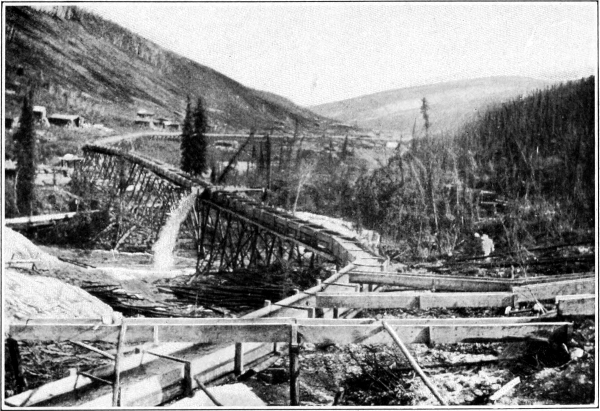
A Flume on Bonanza Creek.
The prospect of famine during the winter had been responsible for this. Some enterprising fellows, who were among the first to go out over the ice, made the best of their opportunity as connecting links between an isolated community and civilization.
“Here you are,” they said to the claim-owners on Eldorado and Bonanza, “paying a dollar and a quarter and a dollar and a half an hour for labor and thawing the dirt out by inches, when capitalists, with cheaper labor and improved appliances, can take it out for half the money. Why, it’s a case of the old stage coach against the lightning express. If they can block a number of claims and work ’em together, they’ll gladly pay you on the spot more’n you can get out of your claim the way you’re working it, and make a good thing out of it too. The whole outside’s wild over the Klondyke. The capitalists are longing for the chance. All that’s got to be done is to lay it before ’em. You name your price and give me six months’ option and we’ll take ’em out and sell ’em. What we get for ’em’s our affair. We’ll make our commission out of the difference.”
The enthusiasts believed what they said. They assured themselves and the claim-owners that none of the arguments which held good in other mining camps could apply in this instance. The Klondyke was a law unto itself in all matters of investment, they said. They put dust from each of the claims which they were to sell in a separate bag, and this they were to offer to the simple-minded financiers of London and New York as a guarantee of the correctness of their several representations. Each zealous miner being desirous that his claim should show up well on the list, some of the promoters obtained several thousand dollars in nuggets.
Such examples of success were not without their effect upon those who went out over the ice at later periods. The field of all the claims on the creeks as yet demonstrated to be valuable having been worked, they turned their attention to those creeks which had been staked on unfounded rumors by stampedes, and possibly were worth no more than the beds of so many creeks in the valley of the Hudson River. They neglected none of the details. Because it looks better to the lay eye, they chose dust from Eldorado as examples of the product of these “wild oat prospectors.”
The moral effect of the option craze was unfortunate in more respects than one. Men who owned claims on stampede creeks felt that they could afford to waste their winter in idleness in their cabins as long as they had property in the hands of New York capitalists. They could not escape the heresy that a claim in the Klondyke, no matter what its location, was regarded by the outside world as a valuable piece of property. It was especially hard for those who had not funds enough to buy their winter’s outfit, as they inquired along the river bank, day after day, as the boats came in, to learn finally that the promoters to whom they had intrusted their claims had arrived on the Pacific Coast just at the time when the Klondyke was forgotten and all public interest was centred in another subject, and, accordingly, had enlisted in the volunteer army.
Those promoters with small ambitions fared the best. In London they sold a few of the cheaper claims, which, as a rule, were disappointments to the purchasers. But sometimes it is better to be trusting than to be wise. One young Englishman bought a claim on Sulphur for $2,000 which would not have sold for $500 in Dawson at the time. When he arrived to take possession of it in June, its value had risen so rapidly on account of the later development of the creek that he sold it for $20,000. The anxiety of the claim-owners on the new creeks, as Sulphur, Dominion, and Hunker—all having their head-waters on the slopes of The Dome—were called, lest the promoters had sold their claims, was as great as that of some of the claim-owners on Bonanza lest their claims had not been sold. Perhaps as many as thirty claims on the new creeks had been worked to any extent during the past winter, with such results as to increase their speculative value by five hundred per cent.
The forty happy kings of the forty claims on Eldorado also preferred not to sell. That “pup” returned good for evil. It heaped satire upon the satirists who had given it its name as a joke, and continued to surpass all expectations. The optimism which over-estimated Bonanza under-estimated Eldorado. These forty kings, as they compared the output with their figures, concluded, with some pride, that all born mathematicians are inclined to be too conservative.
You could see the dust glistening in the dumps of the “pup.” The water gurgling over the cleats in the sluice-boxes seemed to sing a merrier song than on Bonanza. Every shovelful which it bore chuckling over the cleats yielded up a dollar or more. It licked twice as much off rocks that had to be lifted out of the sluice-boxes by hand because its current was not strong enough to carry them on down to the waste pile. At intervals, nuggets of some size were unearthed by the spade and were tossed into a pan at one side. If you were a friend of the claim-owner he would beg you to take your pick of the lot as a souvenir of the day. But you would not get one worth more than ten or fifteen dollars, even if you were greedy enough to choose it for its size rather than for its beauty. The giants—one was found worth $600 and those worth from $50 to $100 were not infrequent—had been spied in the drifts in the winter.
A magnificent carelessness of details prevailed. A scientific miner who had seen fortunes made in California out of a cent a pan would have regarded the forty kings in the light of infants making a holiday with a tack hammer and a gold watch. They could afford to laugh back at him in return. There is some reason in their philosophy that one cannot afford to pay men a dollar and a quarter an hour to pick up stray pennies, and more in the philosophy that when you have a fortune you have enough.
It was not yet in the old-timer’s nature, rapidly as his character was changing, to squeeze the last cent out of Mother Earth, in the manner of some hard taskmaster, when she had given to him such a bountiful harvest. A little line of dust, like a braid of gold lace, remaining on either side of the sluice-boxes after a day’s clean-up was dismissed with the remark that it would “come out in the wash” next time. If the workman who had the uncomfortable and unhealthy position—especially when the sun was directly overhead—of standing in the dump-box, took a few minutes’ rest, he shrugged his shoulders and said that any dust that was lost in the meantime could be a boon to the Chinamen who, coming humbly after the white man’s departure, would patiently take fortunes out of the white man’s tailings—unless the capitalist should make the valley resound with the toil of machinery manned by cheap labor, thus cheating poor John out of what he has come to regard as the right of his race in placer mining countries.
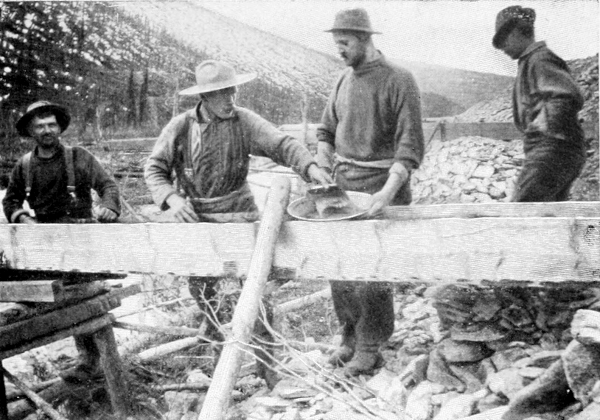
Shovelling a Clean-Up into a Gold Pan.
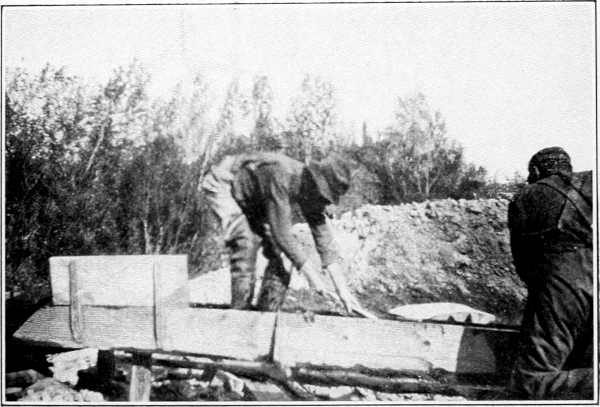
Cleaning Up.
There was not one strong box for the safekeeping of the daily harvest of thousands on all of the creeks. The bags of dust were kept in the little cellars which the miners had excavated under their cabins for the preservation of their food. There was a joke which went the round of the firesides during the food-panic that it would be cheaper to fry the dust and save the hams. For the bags, made of roughly tanned moosehide, the Indians received prices in keeping with those of other things. They bore the owner’s name printed in ink, if ink could be obtained; their capacity was about $5,000 each, and they were not unlike, in their freshness as well as in their size, the dirty, worn, brown little bags which were carried in lieu of purses. Three or four of them were all that you cared to carry on your back. When you met men on the trail bending as under heavy packs of slight bulk, you knew their business. If there were many bags there might be an escort with a rifle and there might not. Most of the claim-owners thought nothing of sending several thousands by their employees, unaccompanied, to be deposited in one of the Commercial Companies’ stores; but once the “Cheechawkos” began to arrive, all sought locks for their cellar-doors.
VI