GETTING ACQUAINTED
Reading edition
Mr. and Mrs. “Meenach” and their Menage—The Juvenile Mining Company, Limited—Voss—The Arch-Deacon—A Sour-Dough Stiff—A Dalmatian and a Turk—Siawash George and his Steam-engine—Miss Mulrooney at The Forks—The Price of a “Square” with Trimmings.
ONE day, if the quartz claims which have been staked should fulfil the hopes of their owners, the Klondyke will become a place of managers and workmen, of stamp mills and chemical processes. To-day, there is very little to say about the working of the mines, which is as simple as building a fire, digging a well and doing the week’s wash, but much to say about my friends and acquaintances there, who came from the ends of the earth and represented most of its employments. Without knowing individuals, the pilgrimage of the Cheechawkos would have meant no more to me than a motley procession seen from a balcony. Those leading citizens and well-known characters whom I met, under the guidance of Captain Hansen in a round of the town on the evening after my arrival, are worthy of a chapter by themselves. If I had taken advantage of all the letters of introduction to claim-owners that they gave me I think that I should have been three weeks in travelling the length of Bonanza.
In return for hospitality that did not stand upon formality but laid its hand on my shoulder and insisted, I could offer nothing except the news from the “outside,” the bad news that there was no escape from the royalty. I registered a vow that if I were to make the journey over the ice again I would find room among my supplies for one more article of luxury, or else forego the privilege of introductions. I saw in my dreams the smiles with which my hosts would have greeted the offer of a good cigar, until I had the conscience of a highway robber.
“Don’t forget to call on Meenach!” said Captain Hansen. “He’s the luckiest man in the country without exception. He doesn’t have to darn his own socks and cook his own bacon and beans and you’ll know him because he’s sleek and fat and clean-shaven. I walk up the creek when I can get the time just for the privilege of poking my head in at Meenach’s door. To a poor devil of a Klondyker it’s a peep into paradise.”
It was not enough that the fortunate Meenach should have his wife; he had also his little boy of six and his two little girls, one of four and the other of two years, with him. After he wrote to Mrs. Meenach that he had killed his lion, she came on to him; and she brought with her such thing as sheets, tablecloths, and pillows, and a regulation cooking-stove. He never dared to compute just how much the stove had cost him, preferring not to have his enjoyment of the luxury allayed. The mere expense of bringing it up from Dawson would have bought two or three good ones at home.
To the miners the most wonderful feature of the Meenach cabin was the carpet on the floor. Some of them wanted to take off their boots before entering, and one suggested that if he were younger he would walk in on his hands.
“If you don’t mind,” he added, “I’ll sit with my back to the sheets on the bed. It’s too much at a time. I want to drift into this easy like.”
“Folks who live in castles may be bothered by having too many rooms to care for,” said Mrs. Meenach, “but not I, in my cabin. I could put the children to bed with one hand, stir something on the stove with the other, and set the table with the third, if I had it. It’s no trouble to go to the market in the morning. All our fresh vegetables are in tin cans in the cache just outside the door. Oh, yes, there is much to be thankful for if I look at it in the right light. We kept our condensed cream, our canned asparagus and our canned peas all winter without being frozen. Then, please heaven, something green grows in this country. I have a little cranberry sauce from the poor cranberries on the hill-side, and I agree with the children that it is ‘gooder’n’ anything I ever tasted. If I could get a fresh cabbage I think I should eat it all without waiting to put salt on it. Now I live from day to day on the hopes of the eggs which are expected in on the first boats.”
Thus she chatted while she warmed the tinned roast mutton in the frying-pan, boiled the evaporated potatoes and the tinned sweet corn.
“I’m not going to say that dinner, such as it is, is ready,” she said, “because, in the Klondyke, that is quite superfluous.”
It is good when you have eaten beans for a month off a tin plate balanced upon your knee, to look upon a clean table-cloth again, to sit by the window of a cabin in blissful certainty that your journey is at an end, and have a good and gentle woman pour you a cup of tea. I remember the meal as a banquet, not a dinner. After it was over, the lord and master and I smoked our pipes until the little ones’ heads began to nod, when I went into the cabin of one of his laymen to roll up in my blanket.
The children had reason to think that they were the only children in the world and to be as proud as princes. But Mrs. Meenach’s fears lest they should be spoiled by the adulation of the miners were equally vain with her fears about their health. The extent of their illnesses was a day’s indisposition on the part of the baby. Swathed in furs and scarfs until only their noses were visible and their limbs were as stiff as a doll baby’s, they might go out to play with their sleds for a few moments at a time. Listening to the cries of the dog-drivers and the howls of their steeds, which had turned their mother’s nerves on edge, had been as good as the kuh-chuk-chuk-chuk of a railroad locomotive to them. The miners, with frost-encrusted beards, were so many Father Christmases who rarely forgot to bring a present of a nugget when they came.
With the coming of spring, an old Californian took the baby in his arms while the brother and sister followed at his heels up the hill-side to his bench claim. He showed them to a log, where they sat very gravely while he unfolded to them a mighty scheme. In return for three kisses apiece, one to be delivered when the bargain was struck and two when the goods were delivered, he agreed to build for them a small rocker, so that they could start a Mining Company (Limited) on their own account.
Their dividends were large until one of the laymen found out that they were using the best portions of his dumps. Then the total income fell to a dollar a day, which the boy explained was due to laxness on the part of the president—his elder sister—and gross negligence on the part of the assistant manager—the baby—who insisted upon turning the gold pan bottom side up at critical moments. Their father played the part of the unskilled laborer, and sometimes when he was ordered to work he said, “In a minute!” an excuse which had to be accepted. The time came when the old Californian could no longer keep his joke to himself.
“Meenach, seems to me I ’member tellin’ the youngsters that you’d carry water for ’em to work the rocker with,” he chuckled.
It was by a diversion from my programme that I spent the next night with Voss. His name was not on my list, and I had never heard of it until I drifted into his cabin. I was attracted by his speech, which sounded a little unnatural in a community where expressions are intended to convey a meaning and not to subserve the rules of grammar. Despite his education, Voss was an old-timer among old-timers, greeting them all by their first names. The most ferocious of them, out of whose mouths an oath rolled with the ease and deliberation of their tobacco smoke, regarded him as a personal friend.
“He looks stuck up, but he ain’t stuck up,” they said. “He’s clean all the way down and all the way through and game as a grizzly bear, and we know. We’ve followed him on the trail.”
The sincere fellowship which he felt for them in return belongs to that philosophy which makes of the young men of old but impoverished families, good and cheerful prospectors, ranchers, and cowboys. Not in fancy—which misled so many poor souls among the Cheechawkos—but in fact, they prefer the independent life of a mining camp to working for a salary in a city; prefer washing their own dishes and rising at 3 A.M., and harnessing the dogs to start on the trail to going to an office every morning and leaving it every afternoon at a certain hour. By all the manners that stamp the man, Voss was a child of civilization, and such a child as was equal to carrying out his determination not to return to it until he was master in his own right of the little luxuries that keep the taste of ashes out of the mouth. Often he spoke of these, then ran his hands into the pockets of his overalls, took a pull at his pipe, and looked at his dumps with an anticipation as keen as that of some naval captain of Drake’s day in sight of the chalk cliffs of England, after years in foreign countries on rations of hard biscuit.
“But even before I carry out my plans of travel,” he said, “I shall buy a ranch, where I shall have a home with no other habitations in sight; where I shall have a good saddle-horse waiting for me, whenever I shall grow tired of town. Once you have become accustomed to the silence of the plains, the mountains, and the trail, mere country houses will not satisfy you—something gets into the blood.”
“You all catch it, I see,” I interrupted. “Joe Staley says it’s like rheumatiz’ and it gets not into the blood but into the bones.”
“Yes, bones—blood and bones, both!” was the reply.
He had four retainers, who lived in his cabin: the boy, the Archdeacon, Jim, and Grouse, the fox-terrier. The boy was sixteen or seventeen. He had gone to the Klondyke, against his parents’ wishes, to find himself nonplussed by the necessity of a food supply for the winter months. Voss put him on his feet. The Archdeacon was of the Established Church and a graduate of Oxford. He did not seem to be, but he must have been, older than the boy, for he was gray and the father of three children. Shortly after he was ordained archdeacon the something had “got into” his blood and bones, and he vacillated between the church and travel until his meanderings brought the promise of a brilliant career to the guardianship of a flock of Indians, halfway around the world. He baked the best bread that I ate in the Klondyke. Though he accepted praise on that score as quietly as he did everything else, I could see that it pleased him—better, perhaps, than the praise of a bishop. In getting breakfast, which he had taken upon himself as one of his tasks, his slippered feet moved about so softly that you were not awakened until his voice called you at the right moment.
“It is good to see many kinds of men and to do many things,” he volunteered, as he lifted a flapjack from the skillet to my plate. “When all the world was going to the Klondyke, I had to join the throng. I got a lay on Bonanza and put some men to work on it. But, unfortunately, I had no food for myself. Mr. Voss”—the Archdeacon never omitted the Mister—“asked me to come and live with him through the winter. What a pity it is that there isn’t such a good fellow as Mr. Voss to take care of every unfortunate fellow like me!”
Jim, in the language of the Klondyke, was a “sour-dough stiff,” and he was certainly an unhappy man. A “sour-dough stiff” will, under no circumstances, eat baking-powder bread. This eccentricity, developed in the later years of a prospector’s life, generates others which are its natural companions. He thinks that baking powder in the smallest quantity is poisonous, and, therefore, is as finicky and miserable as any other man who becomes a victim of dyspepsia through forever thinking of some means to avoid it.
In addressing his employer Jim uttered the word “Voss” in a harsh voice, as if calling attention to its nudity and implying that he would not subvert his rights as a free man by using “Mister,” though he were to hang for it. He was the first to rise in the morning and he always prepared his own breakfast.
“Some folks don’t like my cookin’, an’ I don’t like some folks’ cookin’, either,” he explained.
On some occasions, when he felt a little lazy, he would condescend to eat at the table with the others, but with an expression of martyrdom on his thin, old face. Voss told me that Jim would probably confide to me at the first opportunity how grossly the claim was mismanaged, and so he did. Voss forgave his eccentricities partly because they amused him and his friends, and partly because Jim was an expert in saving fine gold from floating down to the waste pile.
Jim’s contempt for the Alaskan miner’s knowledge of sluicing was pleasant to hear unless you had to hear it often. He had a miniature sluice for treating the residue which contains the lighter particles. It were better to step on the hem of your wife’s skirt on the way to the theatre than to lay your hands on this fine gold machine, as he called it. Whether or not it was worth the time that Jim had spent in building it, was a grave question with Voss.
In making the “clean-up” Jim was the general in charge of the field. The best-natured men on the claim were selected to assist him, and even their patience sometimes gave out. Voss himself, accompanied by the fox-terrier, who was general superintendent of the claim, winter and summer, used to take up his station at the water gate. He did not always interpret Jim’s orders satisfactorily, and I overheard this grumbling complaint:
“A man can’t play with a dog an’ pay ’tention to business at the same time.”
Everybody about the claim except Jim was the slave of the fox-terrier’s moods. In New York or London you could have bought Grouse for five dollars. Voss was offered $200 for him by another claim owner, but would as soon have parted with his claim. I knew of only one other terrier in the Klondyke. He was a companion, deserving the affix of bull, of a doggy-looking man who walked up and down the river front of Dawson. He was usually limping on three legs, but not infrequently on two. He seemed to realize his position as the sole representative of civilized dogdom among thousands of savages, and he no more thought of surrender than a Roman prefect. The boast of his master that he could whip any two or three of the huskies was well founded. Even when he was attacked by a dozen he gave more wounds than he received, retreating with the dignity of one who belongs to a ruling race.
Provincial as Voss’s claim was in its isolation from the world, its surroundings were cosmopolitan enough. Among his employees, aside from Germans, Swedes, and French-Canadians, were a Dalmatian and a Turk. The Turk was a good workman. When he had made his “stake” he was going to buy a fig orchard in southern California.
On the day that I visited the discovery claim of Siawash George, which is only a short distance beyond Voss’s, several Cheechawkos were panning some gravel at the very point where Indian Charlie had found the famous nugget. They did not wash out a single color, and passed on in disgust to do more prospecting on ground whose stakes—for the most part fallen down—had been driven so long ago that the weather had washed off the writing on their four hewn sides. Siawash George had expended several thousand dollars in buying and bringing an old boiler and engine up to his claim from Forty Mile. Owing to a fatal defect in its pumping gear it would not supply half a sluice-head of water or do the work of a small dam; but the noise of its puffing and his ability to hire an engineer to superintend it at $15 a day greatly amused a mind which had become aboriginal from family associations.
Money playing an important part in the politics of Alaska as well as in other countries, poor George had acquired a fortune only to find that it was two-edged and might be an obstacle, as well as instrumental, in the fulfilment of his royal ambition. On a fatal day he had brought from Dawson to his wife some little brown things in a box which was lettered in gilt. She had found them so superior to plain brown sugar that they had opened a new world to her. She gave over her rights to a throne to dream of the day when she should take passage on a Yukon steamer to the land where shops were filled with chocolate bonbons.
Joe Powers was a near neighbor of Siawash George. As both had squaw wives there was a bond of union between them, and they visited back and forth a great deal. Joe could not read or write, I was told, but his good fellowship shone out of his ever-grinning face.
“Some of the boys I knowed down in Circle and Forty Mile that’s struck it big,” he told me in confidence, “is going into s’ciety when they get on the outside. But I ain’t. How I would look in s’ciety, wouldn’t I? The rest of the boys are about on the same pattern, too, I guess, only they can’t see it when they look into a pool of water. I’m thankful I know them dodgers on the outside are too clever for me. I’ll buy a fruit farm in Californy. Nobody can beat me out o’ that.”
However dangerous a little learning may be to some of the old-timers, one does not envy them their dust, spend it how they will. It is fitting that they who bore the brunt of the robust business of pioneering should occupy the cabins of the masters on the Eldorado and the Bonanza claims. Graduates of colleges and universities, who work for them with pick and shovel for a dollar an hour, arrived on the scene after the great strikes, and must take the consequences.
It is scarcely half a mile from Siawash George’s to the cluster of cabins at the mouth of Eldorado; and Eldorado flows into Bonanza about midway of its working claims, making of The Forks, as the confluence of the two streams is called, the hub of a wheel with three spokes. When Miss Mulrooney came up to The Forks in the autumn of 1897 she appreciated the mathematical advantage of the situation at once, and acted upon her perception with such decision that the news of her wonderful undertaking went up and down the creeks that very day.
“Boys,” said the heralds to the scoffers, “there’s a new woman up to The Forks with a bit of an Irish brogue and the tongue of a lawyer, that’s goin’ to show us old moss-backs how to get rich. Hanged if she ain’t got so much money to lose that she’s goin’ to build a two-story hotel bigger’n any in Dawson right up here on the creeks.”
“Strange things was to be expected from the Cheechawkos once the news of a strike got into the newspapers all over the States,” said the scoffers; while the saloon-keepers, being specialists on the subject, apprehended with professional disdain that Miss Mulrooney might as well start a hotel at the head of the Stewart or at the North Pole.
The next instalment of news related that Miss Mulrooney was up on the hill-side superintending the labors of the one lone mule surviving of those brought down the river on rafts in the summer, which she had hired for $20 a day to drag logs to the site of her building. That class of women who are too common in the Klondyke are not given to this sort of thing; and, moreover, they wear bloomers, while Miss Mulrooney wore long skirts. A new woman deserved punishment for such folly, but a good woman who wore long skirts was entitled to the friendly advice which one of the leading claim-owners undertook to supply.
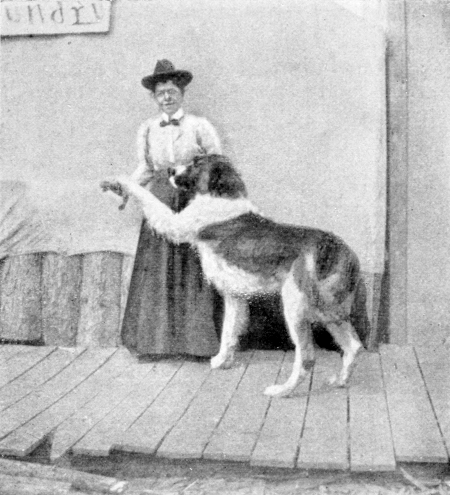
Miss Mulrooney of The Forks.
“I’ve been in the country some time,” he told Miss Mulrooney, “and I don’t mind telling you for your own interest that Dawson’s the place, not The Forks, for a hotel.”
“Now, that’s kind of you,” assented Miss Mulrooney. “And may I ask if you would like something to drink?”
“Er-r-r, well,” stuttered the Committee of One, as he tried to get his bearings, “well, I admit I sometimes do, like the most of the boys—but I didn’t know as you’d be mentionin’ that.”
“Oh, I’m not, and I’m not likely to,” with a toss of her head, “when I know there’s no chance of your accepting. Of course, if you or any of the other boys was hungry or thirsty you wouldn’t think of buying a drink or a meal up here. You’d walk sixteen miles to Dawson and back for it, wouldn’t you? And the boys going over the divide to Dominion or Sulphur when they break the journey at The Forks would hang up in a tree over night before they’d sleep in a hotel, wouldn’t they, now?”
A light burst upon the Committee of One.
“You’ll pass, Miss Mulrooney, you’ll pass,” he said. “You kin take care o’ yourself all right. With that head of yours, you’ll own the Klondyke by the time you’ve been in the country as long as I have.”
And the word that Miss Mulrooney was all right was passed along the line. Every man on the creeks looked forward to the date of the opening of her hotel. A democratic community could not confer titles, but it might call her Miss Mulrooney of the Forks, and thus she will be known for all time among Klondykers.
Meanwhile, she expected that every day would be the lone mule’s last. There was neither hay nor oats in the country. As the story was told to me, he held body and soul together on birch bark and willow sprouts until the final log was dragged to the foundations, and then promptly expired.
“He had nothing to live on,” as Miss Mulrooney expressed it, “and nothing to live for, and I’m thinkin’ the poor fellow was so slow because he just knew that his interest in the enterprise was all that kept him up; and, like the rest of us, he wanted to postpone the last hour as long as he could.”
The third night after the hotel was opened the Committee of One, himself, had to sleep on the floor because the bunks were all taken. Nothing could have served Miss Mulrooney better than the food-panic of midwinter. She had bought a full supply before everyone began to hoard whatever beans or flour or whiskey he could get. All but two of the restaurants in Dawson had to close their doors. The two exceptions on fête days gave butter and apple sauce along with bacon, beans, and coffee. Their owners grew to regard Miss Mulrooney as their animate consciences whose voice was that of every miner who ate a meal in Dawson when he was down from the creeks.
“I don’t mind paying double,” said the Committee of One, to a Dawson waiter, “s’long’s I get suthin to eat. Just bring that dinner over again. Then I’ll have only half a square meal for $5, not to mention that no fixin’s go with it. Miss Mulrooney charges $3.50 for a square, but she gives you canned beef, canned mutton, and ham, and fixin’s, and keeps askin’ you if you won’t have more and you keep acceptin’ till you have to send for a drink ’fore you’re strong enough to get up from the table. Jumpin’ John Rogers! How you fellers must suffer when you pass out a bean and a rind and think of what a woman is doin’ up there to The Forks!”
If you want to reach a man’s heart through his stomach in a scurvy-stricken country, feed him, if it is the best you have, with sauce made of dried apples. Miss Mulrooney kept a great bowlful of this on her table. The transient ate of its contents with the ravenousness of the thirsty traveller drinking from a spring of cold water. No sooner was it emptied—I know by actual observation of a quart of apple-sauce having been eaten by two persons—than it was filled again by the cook, rapid if rough in his movements, who picked it up and put it down as if it were a red-hot ingot.
The ground floor of the hotel was divided into the bar-room and the dining-room. Cards were permitted, but no gaming-tables were maintained. Upstairs was a tier of bunks running along the wall, with a passageway between them. The blankets seemed cleaner than elsewhere—no hotel had sheets—and the bunks had curtains. Either a nice sense of individuality or sheer fatigue restrained the guests from removing their socks, and I have known miners who were over-tired by a long tramp not to remove their boots. They had enough respect for Miss Mulrooney to hang the soles of them over the edge of the bunk, however, though, if in their dreams they should participate in a stampede to some new creek, their good intentions were sadly belied. The sole occupant of a lower bunk, which was supposed to accommodate two in case of necessity, might be awakened at any hour by a nudge, and:
“Pardner, sorry to trouble you, but I guess you’ll have to move over a bit to make room for me.”
In winter the curse of a Klondyke cabin, banked with snow, chinked with moss and dirt to the last crack and knothole, is lack of ventilation. In summer, when there is no night and no two men quite agree on their hours of sleep or hours for travelling, it was as good as reading a local newspaper to try to sleep at Miss Mulrooney’s. The widening cracks between boards of fir (put into the floors and partitions while yet green) never permitted the slightest details of conversation over the card-table or over the bar to be inaudible, except during unavoidable and scarcely welcome intervals when you heard the tramping and scuffling of heavy boots. I could discern the direction the traveller was going upon entering the dining-room door; whether he was coming up stairs to bed, or was going to call out to the cook for a “squar” or “half a dozen eggs.”
Andrew, a quiet, soft-voiced, obliging young man, who wore a white shirt and was solicitous about keeping his tie straight, had charge of the bar. According to all the traditions of new placer mining camps he was as much out of place as the average bartender would be in a chair of moral philosophy. He was so essentially lacking in combativeness that no one ever thought of picking a quarrel with him. Luck and whiskey, however, despite the Northwest Mounted Police, will generate in miners a surplus energy which they are inclined to expend upon furniture if not upon one another. Miss Mulrooney did not depend for purposes of pacification upon a huge St. Bernard who was always at her side when he was not drawing her upon her sled up and down the creeks in winter, but rather upon her blarney. She knew when, where, and just how much to apply.
“I always appeal to their best instincts,” she said. “It’s easy to lead and hard to drive. That’s what you men don’t understand. You try to drive.”
I saw her theory put to the test of practice. A giant who was so well on in his cups that he could scarcely walk, concluded, only half an hour after he had finished one, that he wanted another meal. When it was placed before him he seemed to think that the cook was trying to hurt his feelings by making him eat twice, and with an oath he threw a dish of stew on the floor. Miss Mulrooney happened to be passing through the room at the time. She stepped over to him and told him in her pleasantest tone that accidents would happen.
“Accident?” he asked, dazedly.
“Of course,” she said. “I know you’re too much of a gentleman to do such a thing purposely.”
“Coursh! Coursh it was!” he kept repeating, as he dropped down on to his knees and tried to scrape the stew up into a little pile, despite her protests.
Then out of the maze of his crippled memory another horror presented itself suddenly and prompted him to arise.
“Miss Mulrooney,” he asked, his face very red, “did you hear me swear?”
“A little one—a slip,” she replied.
He told her that it was only a real lady who would put so liberal a construction on what he called a breach of “ettykit.” Fearful, nevertheless, that she might secretly think ill of him, he followed her about the hotel with apologies and dripping hands while he kept repeating how a poor devil might be a little weak, so rarely did a good bench claim fall to a poor devil’s lot, until the inner workings of his conscience culminated in a full confession that the plate had not been broken by accident but intentionally. She forgave him even this, and then he went up-stairs and to sleep.
“What I want to do is to make money, you may be sure,” Miss Mulrooney would say if you persuaded her to tell you her story. “I was born in Scranton, Pennsylvania. I had to earn my own living before I was out of short skirts, and I kept on doing a little better from one thing to another, till I was stewardess of a steamer on the Pacific Coast. There’s nothing like being a stewardess to develop your wits when you’re just a bit too independent for the job and you have to give the passengers as good as they send when they’re sassy. I remember an old Englishman who expected me to black his boots. I told him I wouldn’t, and I told him if he put ’em outside his door again I’d be thinkin’ he was wantin’ ice-water and turn a pitcherful into ’em. He went to the captain. The captain was a Scotchman and he didn’t believe in puttin’ on airs; and when the captain sent for me and I went to the captain’s room I found the old gentleman there. Before we came out I had him laughin’, and I’d never blacked his boots, either. But runnin’ errands doesn’t suit me. I started for the Klondyke as soon as I heard of it, and like the rest I’m going back either rich or broke.”
The last time I saw Miss Mulrooney she was in Dawson searching for a good location for a hotel which was to have sheets and be positively palatial. Three weeks later, so I am told, it was completed. Once her first venture succeeded, she had begun to speculate in mining properties. Her position at The Forks gave her exceptional opportunities for inside information, and she was a “pardner” of a dozen leading citizens in as many enterprises.
“If you ever go to Chicago or New York,” I suggested to her, “the women’s clubs will be making a heroine of you as an example of what their sex can do.”
“Not if I know it,” she replied. “They won’t, I’m thinkin’, if they hear I sold whiskey. Besides, there’s nothin’ new about me. I’m old-fashioned.”
Without abusing a much-abused word, I think that Miss Mulrooney may be called a remarkable woman, more particularly as her own opinion of herself is quite the contrary.
VIII