Chapter IX
Reading edition
Hills Road.—Gog-Magogs.—Vandlebury.—Babraham, Peter Pence.—Old Railway.—Hildersham, Brasses, Clapper Stile.—Linton.—Horseheath.—Bartlow, St. Christopher, Battle of Assandun.—Cherry Hinton, War Ditches, Saffron.—Teversham.—Fulbourn, Brasses.—Wilbraham.—Fleam Dyke, Wild Flowers, Butterflies, Ostorius, Last Cambs Battle.—Balsham, Battle of Ringmere, Massacre, Church Brasses, Grooved Stones.
At Burwell we are within touch of Exning, Fordham, and Soham, so that we have now exhausted the interest of the Cambridge-Newmarket Road. Next in order comes the Via Devana, which when it leaves Cambridge for the south-east is denominated the "Hills Road." The reason for this is that it shortly brings us to the most ambitious elevation neighbouring the town, no less than 220 feet in height, and bearing the high-sounding name of the Gog-Magog Hills.
The origin of this curious appellation is still to seek. According to some archæologists it is derived from the prehistoric figure of a giant which was formerly to be seen on the slope, traced there by cutting away the turf along the outline of the shape, such as that still extant near Cerne Abbas in Dorsetshire. This, if it ever existed, has long since disappeared. Others consider the name to be a seventeenth century skit on the gigantic height of the hills. Others again see in it a dim traditional recollection of the days when a set of gigantic barbarians really were, for a time, quartered here. This was in the reign of the Roman Emperor Probus (277 A.D.), who leavened his mutinous British forces with prisoners from the Vandal horde lately defeated by the Romans on the Danube. From one such detachment, placed here in garrison, the name of Vandlebury is supposed to have clung ever since to the great earthwork on the summit of the Gog-Magogs.
In the early decades of the nineteenth century the then Duchess of Leeds here set up for her tenantry one of the earliest rural elementary schools. Children of both sexes were taught in this institution to read and to sew, the boys making their own smock frocks. The boys might, if they would, also learn, as an extra, to write; but not the girls, for Her Grace considered that it would deleteriously affect their prospects in domestic service if they were possessed of the dangerous power of deciphering their employers' correspondence.
"Here lies Horatio Palavazene, Who robbed the Pope to lend the Queen." "He was a thiefe." "A thiefe? Thou liest; For why? he robbed but Antichrist. Him Death with besome swept from Babram Into the bosome of old Abram. But then came Hercules with his club, And struck him down to Beelzebub."
A curious fresco on the north wall of the church is thought to represent King Edward the Second.
A little beyond Babraham we cross the Icknield Street, on its way from Newmarket to Chesterford. Beside it runs, what is almost unknown in England, a deserted railroad, built by the Eastern Counties Railway Company (now the Great Eastern) in 1848, to afford direct communication between Newmarket and London, and abandoned, as a financial failure, in 1852, since which date the trains have gone round by Cambridge. Where this long disused line runs on the level it has melted back again into the adjoining fields, but the old cuttings and embankments and bridges still exist, and a weird sight they are.
From Hildersham the road goes on to Linton, a mile or so further; while the two places are also connected by a specially pleasant footpath, starting from a fine old smithy, and so through the meadows by the clear trout-stream, and past the yews and thorn-trees of the moated grange of "Little Linton," while above rises (to nearly four hundred feet, a proud height in Cambridgeshire) the appropriately named Furze Hill, with some real gorse patches (also a proud distinction in Cambridgeshire) upon its ridge.
Before we reach Linton we cross the famous "Clapper" stile, which can best be described as formed by three huge sledge-hammers (of wood) with exceptionally long shanks, hinged near the head to an upright post, each about a foot above the next. Normally the three hammer-heads rest upon one another and look like a single post (about a foot from the first); but, on attempting to cross, the shanks (the ends of which are not fastened but slide in a grooved post at their side of the stile) yield to our weight, the heads fly apart, and, when we are over, come together again with the "claps" whence the name of the stile is derived. How old this curious device is does not appear, but it is here immemorial. An effective sketch of this stile is given by Dr. Wherry, in his "Notes from a Knapsack."
Linton is a tiny town, smaller than sundry villages, but obviously not a village, with a long street of undetached houses (duly lighted) swinging down the slopes on either side the little river. There is a fine Perpendicular church, with some Norman work remaining in it, and a good tower, on the top of which an Ascension Day service is annually held. Against a wall are suspended two fire-hooks (much lighter than the one at St. Benet's, Cambridge) for the destruction of burning houses. (See note on page 38).
The location of that most dramatic of English battles, fought in the year 1016, is hotly disputed amongst historians; but there is much to be said for the early view which identifies Assandun with Ashdon in Essex, hard by Bartlow. For ten miserable years, under Ethelred the Unready, England had been ground in the dust, deeper and ever deeper, beneath the heel of the invading Dane. Year by year the degrading tribute wherewith she strove to buy off the foe had gone up by leaps and bounds. All hope seemed dead, when the accession of a hero to the throne roused the harried and exhausted nation into one last convulsive effort for freedom. Six times in as many months did Edmund of England and Canute of Denmark clash in battle. Five of these fields were indecisive, and then, on St. Luke's Day, 1016, the champions met once more at Assandun, perhaps on the slope still known as Bartlow End.
Treason decided the day against England. The fight began with a brilliant charge by Edmund at the head of his bodyguard, which crashed through the Danish phalanx "like a thunderbolt." But his absence from the English line enabled a traitorous noble, one Edric (who was always playing into Canute's hands, in hope of thereby making his own advantage), to raise a cry that the King was slain. A panic set in at once; and before Edmund could cut his way back, the whole army had broken, and was being fearfully cut up in its flight by the pursuing Danes. "And there the whole nobility of England was utterly destroyed." Edmund died of his exertions the same year; and Canute became King of England, the first monarch so to call himself. The native title had always been "King of the English." In thanksgiving he built a minster on the scene of his victory; and, as he had promised, he lifted up the head of Edric "above all the nobility of England"—upon the highest turret of the Tower of London. The "Roman" theory notwithstanding, the three Bartlow barrows may well be a memorial of this great fight, and so may the names of Castle Camps and Shudy Camps which attach to the furthest villages in this far-away corner of Cambridgeshire. The "Castle," however, of which only the moat now remains, was built later by De Vere, the first Earl of Oxford. Shudy Camps has a far-seen church on its lofty brow, visible even from Barrington Hill, on the other side of the Cam basin, fifteen miles away as the crow flies.
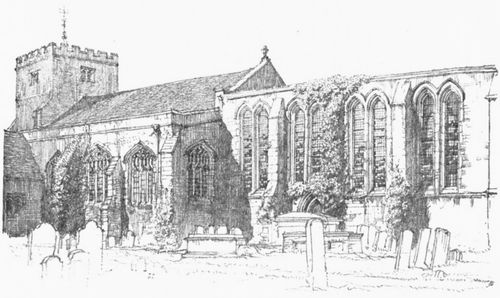
Cherry Hinton Church.
From the Via Devana, where it leaves Cambridge (just after the bridge over the Great Eastern Railway), there branches off to the left another road, which leads us to the scenes of earlier battles between Dane and Englishman. This is the Cherry Hinton Road, named after the first village along its course, some three miles on. Its long straight vista suggests at first sight the idea that it too may be a Roman road. In fact, however, it dates only from the enclosure of the land (about the beginning of last century), when the best ploughman in the village was employed, so the story goes, to drive his straightest furrow across the whole breadth of the Common Field as a guide for the road-makers. The older track between Cherry Hinton and Cambridge was by what used to be, till within the last fifty years, a pretty footpath across the fenny ground to the north of the field. It is fenny no longer, and the path has become for three-fourths of its length a somewhat dreary street through the dingy suburb of "Romsey Town."
Cherry Hinton itself is not yet absorbed by Cambridge, and remains a bright spacious village, with a rarely beautiful church. The exquisite Early English chancel is lighted on either side by four couplets of lancet windows, in ideal proportion, while five equally ideal lancets serve for an East window. Both walls have an arcading of cinque-foil pattern; and the double piscina and the graduated sedilia are of no less merit. All this loveliness is within a fine oaken screen of the fifteenth century, and the rest of the church is not unworthy of it. The great quarry, whence the "clunch" of which the church is mainly built was drawn, is a conspicuous object on the hill-side above the village; and above that again, equally conspicuous, is the reservoir of the Cambridge Water-works, looking like a redoubt, on the summit of the slope. At the foot clear springs break out from the chalk, which are also utilised to supply the town.
From Cherry Hinton Church a green lane leads to Teversham, a short mile distant, but, except for pedestrians, more easily approached from the Newmarket Road. The church here is a pretty little structure, mainly Early English, with curious oval clerestory windows, and a nice Perpendicular screen. The octagonal pillars have floreated capitals. Dowsing's record of his destructions here is of special interest, inasmuch as the objects of his Protestant zeal were not, as usual, relics of pre-Reformation Popery, but the newly painted devices of the Laudian vicar, Dr. Wren (the Bishop of Ely and builder of Peterhouse Chapel). They consisted of the name JESUS, "in big letters" no fewer than eighteen times repeated, of those of the Three Persons of the Blessed Trinity, and of texts from Scripture: "Let this mind be in you which was also in Christ Jesus," and "O come let us worship and fall down and kneel before the Lord our Maker." All these were "done out" as "idolatries"!
From the springs at Cherry Hinton the furrow-drawn road (passing on its way the County Lunatic Asylum) makes another bee-line of three miles to Fulbourn. Here the church is of special interest. There are no fewer than five mediæval brasses, including one, almost life-size, of Canon William de Fulburne, 1380, which is notable as being, probably, the earliest known example of a priest vested in a cope. This ecclesiastic was one of Edward the Third's chaplains. In a wooden shrine on the north side of the chancel is a moribund effigy of John Careway, vicar here in 1433. This is beneath a sept-foiled arch, beside which is another strangely irregular arch over a sedile. There is also the very unusual feature of a fourteenth century pulpit of richly-carved oak.
The dedication of this church is as unusual. It is to St. Vigor, an obscure sixth century bishop of Bayeux, who has only one other church in England, at Stratton-on-the-Fosse in Somerset. Till late in the eighteenth century there was a second church here in the same churchyard, as at Swaffham Prior. This was All Saints', and was ruined by the fall of its tower in 1766. The ruins were gradually stolen, the wood going first, but it took ten years for the last of the bells to disappear.
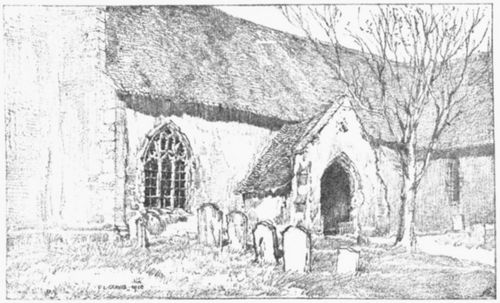
Great Wilbraham Church.
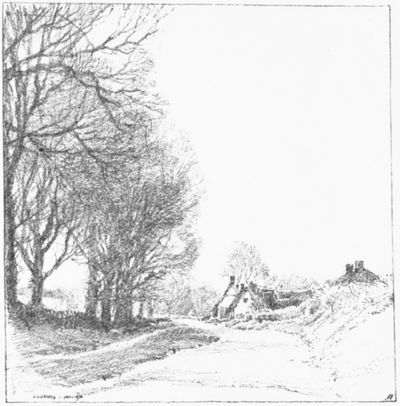
Great Wilbraham.
Or our thoughts may turn to the later day when here was beheld the last fight worthy to be called a battle ever fought in Cambridgeshire. It is the year 905 A.D.; the great Alfred has been dead four years, and his son Edward the Elder has been chosen King in his stead. For the English monarchy is still elective, though already with a strong tendency to become hereditary. And this tendency now gives trouble. When Alfred himself was made King his nephew Ethelwald Clito, son of his elder brother Ethelred, the late King, was passed over in his favour. At that fearful crisis, when it was doubtful whether even an Alfred could stem the Danish inrush, there could be no thought of choosing a child as King.
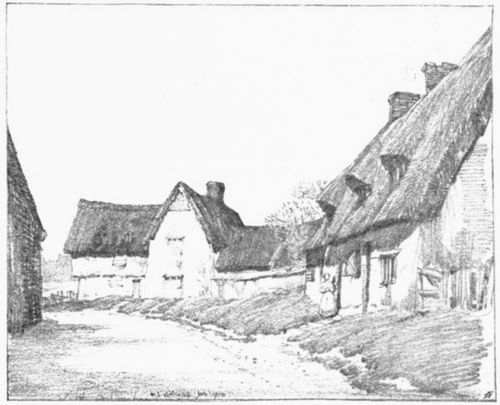
Little Wilbraham.
But the Danes are now quietly settled in the Eastern Counties, and Ethelwald has grown up to manhood, and is bitterly angry at being again passed over, this time for his cousin Edward. If the English will not choose him, he will try the Danes. So to the Danes he goes, with promises of unlimited loot if they will support him, and, in the words of the Anglo-Saxon Chronicle, "entices them to break the peace," so that they cross the Watling Street, and make a ferocious raid into Mercia. "They took all they might lay hands on, and so turned homeward again. Then after them came King Edward, as fast as he might gather his force, and overran all their land between the Dykes and the Ouse, as far North as the Fens."
The Devil's Dyke and the Fleam Dyke are by this time known as "the two dykes of St. Edmund," and now play their latest part in history as defences. Edward is no Ostorius, being a valiant warrior of the cautious rather than the daring type, and the Fleam Dyke brings his avenging host to a standstill. Finally he resolves that to storm it would cost too much, and retires his command. But his levies from Kent are of another temper, and positively refuse to obey what they look upon as an ignominious order. One after another, seven royal messengers repeat it in vain; and finally the main body of the English army marches off under the Royal banner, leaving the mutineers still before the Dyke—probably at the very point where the Icknield Way cuts it.
Balsham Tower.
For it played no part in the tragedy which, a hundred years after this last fight, is associated with its alternative name. Once more Danes and Englishmen are at hand-grips; but now it is no mere loose aggregate of private hordes pressing, each on its own, into the land, but Swend Forkbeard, the monarch of a great Scandinavian Empire purposing to add England also to his dominions. And under the weak sceptre of Ethelred the Unready, nothing beyond local resistance has been offered him; and here alone is the local resistance serious. East Anglia is under the governorship of the hero Ulfcytel, who has already given the Danes an unforgotten taste of his "hand-play," and he gathers her whole force to meet them at Ringmere. But the appalling tidings of what Swend has done elsewhere, "lighting his war-beacons as he went" throughout the length and breadth of the land, "with his three wonted comrades, fire, famine, and slaughter," have taken all the heart out of the English levies. For "all England did quake before him like a reed-bed rustling in the wind." The battle is speedily over. "Soon fled the East Angles; there stood Grantabryg-shire fast only."
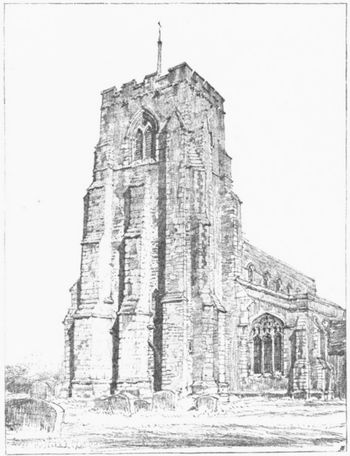
Upon Cambridgeshire accordingly this vainly gallant stand brought down the special vengeance of the conquerors. To and fro went Danish punitive columns, and visited the district with a harrying even beyond their wont. "What they could lift, that took they; what they might not carry, that burned they; and so marched they up and down the land." And at Balsham, perhaps because of some local resistance, they are said to have killed out the entire population, man, woman, and child; save one single individual only, who successfully defended against them the narrow entrance to the Church steeple.
It is quite possible that this doorway is the very one which we see when we reach Balsham, where the Dyke ends, high on the East Anglian heights: for, though the church was rebuilt in the fourteenth century, the basement of the tower seems to be far older. Here we are four hundred feet up, and the air has quite an Alpine freshness, after the damp, sluggish atmosphere of the sea level at Cambridge. We feel well why the old Chronicler, Henry of Huntingdon, speaks of "Balsham's pleasant hills."
Cottage at Balsham.