Chapter XIII
Reading edition
Island of Ely.—Haddenham.—Aldreth, Conqueror's Causeway, Belsars Hill.—Wilburton.—Sutton.—Wentworth.—Via Devana.—Girton, College.—Oakington, Holdsworth.—Elsworth.—Conington, Ancient Bells.—Long Stanton, Queen Elizabeth.—Willingham, Stone Chamber.—Over, Gurgoyles.—Swavesey, Finials.—Ely Road.—Chesterton.—Fen Ditton.—Milton, Altar Rails.—Horningsea.—Bait's Bite, Start of Race.—Clayhithe.—Waterbeach.—Car Dyke.—Denny.—Stretham.—Upware.—Wicken Fen.
From the bridge over the Ouse by the Earith sluice we see the sea-board (for that and nothing less is the word which its appearance irresistibly suggests) of the Island of Ely, rising before us, with a couple of miles of level fen between. We may reach it, if we will, by the main road, which leads eastward to Haddenham, the southernmost of the island villages. Haddenham stands on a projecting peninsula of high ground, the highest in the island, rising to nearly 150 feet, almost cut off from the rest by two inlets of fen (Grunty Fen on the north-east and North Fen on the north-west), and nearer than any other part to the mainland on the south. This quasi-insulation has left a curious mark on the Ecclesiastical map of Cambridgeshire. Throughout the whole Isle of Ely—the old Fenland Archipelago—the Bishop acts as his own Archdeacon. An Archdeacon of Ely there is; but his jurisdiction is confined to Cambridgeshire proper, Cambridgeshire south of the Isle. It extends, however, over Haddenham and the neighbouring village of Wilburton, the two parishes in this peninsula.
Wilburton, a mile to the east, was given to Ely by St. Ethelwold, Bishop of Winchester, the prelate who aided in King Edgar's restoration of the Monastery of Ely, after its destruction by the Danes, in 870, had laid it waste for upwards of a century. The church has some fine woodwork in stalls, screen, and roof, adorned on the spandrills and bosses with the three cocks of Bishop Alcock, the founder of Jesus College. While Archdeacon of Ely he here entertained Henry the Eighth, when, as Prince of Wales, he accompanied his father on the last Royal Pilgrimage ever made to the shrine of St. Etheldreda at Ely, which he himself was so soon to despoil and destroy. A good brass (now affixed to the wall) commemorates Alcock's predecessor in the archidiaconate, Richard Bole (1477). And yet another Archdeacon, Wetheringset, is also here buried. Some curious metal-work hangs from the roof, and on the north wall of the nave are ancient frescoes, representing not only St. Christopher, the usual subject, but the much less known St. Blaise and St. Leodegar. The former was Bishop of Sebaste, and was martyred in 316 A.D. He became the patron saint of wool-combers, and was specially venerated in Leeds and Bradford. The latter was Bishop of Autun in Gaul, during the seventh century. There is here a fine old red-brick manor-house, called the Burgh-stead (or Bury-stead), built in 1600 by a London alderman to whom Queen Elizabeth sold the Manor,—after filching it from the Bishop of Ely, according to her usual practice.
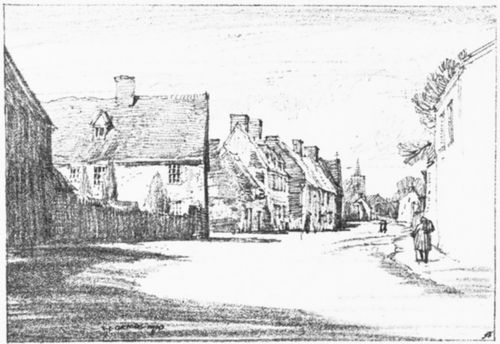
Wilburton.
The whole peninsula is specially rich in memorials of long past ages. In the peat of the old Ouse channel by Wilburton was found a great hoard of bronze weapons, lying in a promiscuous heap, "in such a manner as to suggest that a canoe with a cargo of bronze scrap had been upset there," as Professor and Mrs. Hughes picturesquely put it, in their "Geography of Cambridgeshire." Grunty Fen has produced a bronze sickle, and two splendid ornaments of twisted gold; while, a mile east of Wilburton, a British urn was discovered, associated with the bones of the urus, or gigantic wild ox of the Neolithic Age. And between Earith and Wilburton there has been dug out gold ring-money.
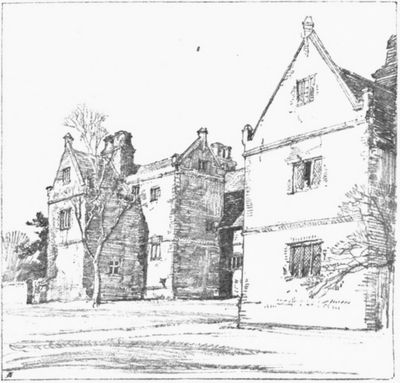
The Burystead, Wilburton.
But a yet more striking approach to the Island of Ely may be made by taking at Earith the road through the toll-gate which leads northward immediately alongside the great embankment of the New River, and lies some few feet below the level of its waters. For three miles this association continues; then road and river part company, and the former drives straight across the fen to climb the western shore of the island. The change of scenery when you reach that shore is striking in its suddenness. You have been travelling for miles through the bare, treeless, dead level of the fen, with its immense width of view; then, almost in a moment, you find yourself ascending a steepish hill through a tree-shaded hedge-bordered cutting which might be in Kent or even Devonshire.
At the top of this brow you look down on the fen behind you and on either hand, your southern horizon being bounded by the near uplands of Haddenham, with the flat bay of North Fen between. And very shortly you come to the undulating village street of Sutton, with its highest point crowned by the truly glorious church. This church is all in one style, Decorated, on the verge of developing into Perpendicular, having been built by Barnet, Bishop of Ely 1366 to 1373. The splendid tower is crowned by an octagonal steeple, and that again by a second, richly pinnacled, and is a landmark for many miles along the valleys of the Ouse and Cam.
From Sutton we reach Ely by way of Wentworth and Witchford. The former name is supposed to be a corruption of Owensworth, and to commemorate that the place was of old the property of St. Owen. The little church has a Saxon porch, with twisted pillars, and contains a remarkable carving of the same date, representing an ecclesiastic wearing the pall of a Primate. His left hand supports an open book, while in his right he holds, not a cross or pastoral staff, but something more suggestive of an aspersory for holy water. The corbel in Ely Cathedral depicting the burial of St. Etheldreda shows us a figure similarly equipped.
In looking southward from Sutton Church, three steeples are specially conspicuous in the Ouse valley. They are those of Over, Swavesey, and Willingham. All are churches of the first class, and all are best reached from Cambridge by way of the Via Devana, which, after crossing the "Great Bridge" and climbing the ascent past the Castle, continues its straight course to the north-west under the designation of the Huntingdon Road. Just as it leaves the town a branch-road on the right leads to the village of Histon, which the jam factories of Messrs. Chivers have made one of the most flourishing in the county. The church here has some good Early English work, and a remarkable "Rood" (much defaced) on the gable of the S. transept. This is an almost unique example of the early "Majestas" type of crucifix (p. 339). Christ, with outspread arms, wears, not the Crown of Thorns, but the Old English "king-helm," and is fully robed. About 1200 this ideal type gave place to the later "realistic" crucifix.
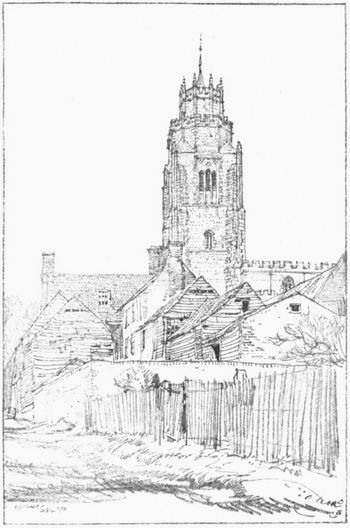
Sutton Church.
The first named was a Fellow of Clare College where he had for his "chum" (i.e. chamber-mate, as we find the word used in "Pickwick") Tillotson, the future Archbishop of Canterbury. He began his ministerial career by taking on himself to supply the place of a brother collegian, the Puritan minister in charge of Littlington, near Royston, who, most un-Puritanically, was often incapacitated by drink from performing his duties. Later, in 1655, when still only twenty-two, he himself became pastor of the adjoining parish of Bassingbourn. When the "Black Bartholomew" of 1662 deprived him of this charge under the Act of Uniformity, he preached, at the risk of fine and imprisonment, throughout the neighbourhood, binding together his adherents in a loosely-knit organisation, whose members were admitted on subscribing the following Profession of Faith:
His efforts were vigorously seconded by Oddy and Oasland, whose consciences, like his own, would not permit them to use the Anglican Prayer Book; and the units of this embryo Church, who were often spoken of at the time as "Mr. Holcroft's disciples," became widely spread throughout the county. Already, before the end of 1662, they had regular meetings at Barrington, Eversden, Waterbeach, and Guyhirn, as well as Cambridge; and when, ten years later, they became licensed by the King's Proclamation of Indulgence, we find the number increased fourfold. So far Nonconformity had been the only bond between these scattered bands of worshippers; but they now began to differentiate themselves into Baptist, Independent, and Presbyterian Congregations, though the lines were not as yet sharply drawn, and, indeed, are not even now sharply drawn in the country villages, where a man is "Church" or "Chapel," caring little what may be the precise denomination of his chapel. The strength of the Dissenting spirit thus implanted at Oakington may be measured by that of the language employed by the zealous Archdeacon of Ely, who, in 1685, declares this to be "the most scandalous parish and the worst in the diocese. The people most vile. A Fanatic Schoolmaster."
From Oakington the lane leads on to Long Stanton, where the two churches of St. Michael and All Saints are both noteworthy. The former is a simple Early English building with a thatched roof (till lately made of reeds from the fen, a far more durable material than straw, but now unobtainable), a rich double piscina, and an oak chest dating from the twelfth century. The latter, at the other end of the "long" village street, is a Decorated cruciform structure, the south transept having become the mortuary chapel of the Hatton family, who bought the lordship of the manor from Queen Elizabeth.
That rapacious monarch, her father's worthy daughter in ecclesiastical spoliation, had seized upon it amongst the surrenders which she exacted from Bishop Cox, the first Protestant to be Bishop of Ely. On his accession she confiscated a full half of his episcopal property, and was constantly insisting on further denudations, including Ely House, Holborn. On this final act of despotism goading him into remonstrance, she is reported (in Strype's History of the Reformation) to have made the well-known reply, "Proud priest! I made you. And I will unmake you. Obey my pleasure, or I will forthwith unfrock you." Only his speedy death (in 1581) prevented her from actually carrying out this threat. After it she kept the whole property of the See in her own hands for no less than nineteen years, when she handed it over to Bishop Heton, shorn of yet another moiety, which included the Manor of Longstanton with its ancient episcopal palace.
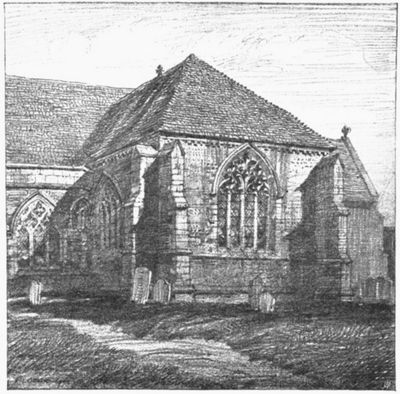
All Saints' Church, Long Stanton.
The next turn on the Via Devana is the southward lane to Madingley, already described. Southward also lie Lolworth, Boxworth and Elsworth. The last has an exceptionally fine church, Decorated throughout, and displaying the almost unique feature of small lockers for books in the fourteenth century stalls. Conington, near the road on the same side, has a stone-ribbed spire containing three mediæval bells—a rare survival. They bear the following inscriptions:
ASSVMPTA · EST · MARIA · IN · CELIS · GAVDENT · ANGELI LAVDANTES · BENEDICVNT · DOMINVM. Mary is taken up to Heaven. The Angels are glad. They praise and bless the Lord.
SANCTA · MARIA · ORA · PRO · NOBIS Holy Mary pray for us.
VIRGO · CORONATA · DVC · NOS · AD · REGNA · BEATA · O crownèd Maid lead us to realms of bliss.
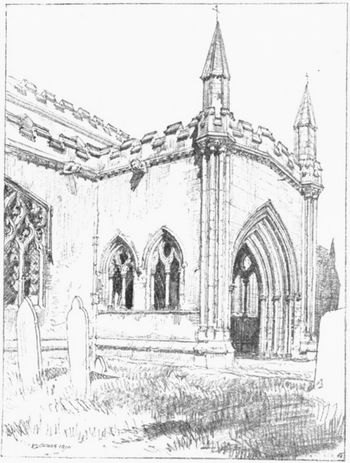
Over, South Porch.
Northward we find the magnificent churches of Swavesey and Over already mentioned. The former is one of the noblest in Cambridgeshire. The nave is Perpendicular, but the large windows in the south aisle are really Early English lancets, the Perpendicular tracery being inserted—a most unusual development. The finials of the fourteenth century benches are to be noticed, especially in the north aisle, where they take the form of grotesque animals. The small size of these seats suggests that they were meant for children. The little ones would be charmed with these delightful finials, representing a fox and a goose, a fox and a stork, a bear and a dog, a wolf and a hound, an eagle and a snake, a wild boar, a lion, a pelican, a cherub, St. Peter, and an angel playing upon a dulcimer.
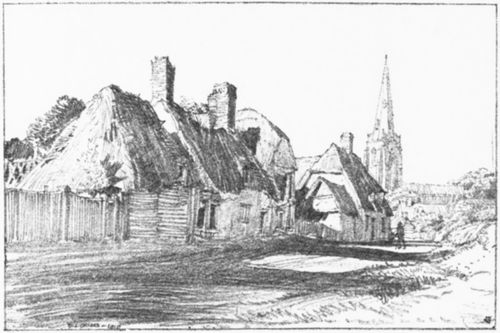
Over.
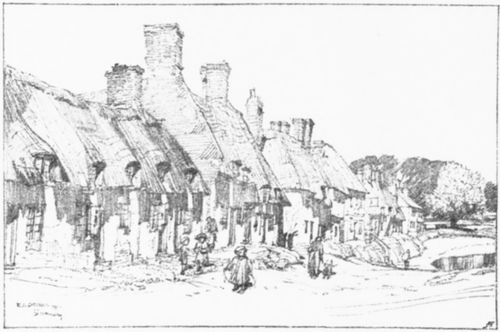
Swavesey.
The next lock is Clayhithe, two miles further down the river, with an inn beside it in special favour for Cambridge boating pic-nics. Here, too, is the lowest bridge over the Cam, indeed the only one below Cambridge. It belongs to a private company, and is rigorously tolled. A pretty shady lane leads to it from Horningsea. Hard by, on the left bank, are the villages of Waterbeach and Landbeach. They are respectively four and twelve furlongs from the stream, and mark successive boundaries of the fenland waters. Between them runs an ancient earthwork, the Car Dyke (probably of Roman date), which of old kept those waters in flood time from drowning the meadows to the south. Starting from the Cam at Clayhithe it runs along the whole western limit of the fenland. It reaches the Ouse near the large village of Cottenham (where the east window of the fourteenth century church is copied from one in Prior Crauden's Chapel at Ely) with over 2,000 inhabitants, and goes on past the tiny and picturesque Rampton, with under 200, to Willingham and Earith, Ramsey and Peterborough, Deeping and Sleaford; finally ending its long course on the banks of the far off Witham, hard by Lincoln.
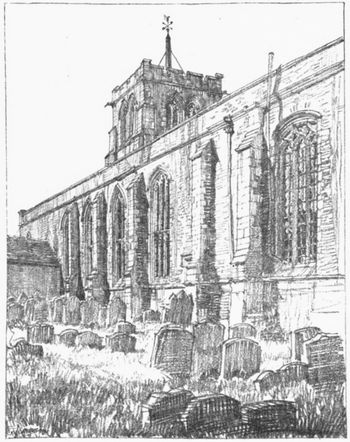
Swavesey Church.
For a mile or so our "Akeman Street" follows the course of the Car Dyke, and then strikes northward across the fen, along a causeway of its own, passing near the remains of Denny Abbey, a small foundation which passed through unusual vicissitudes. Originally a Benedictine House, it was transferred in the twelfth century to the Templars, and in 1290, passed from them to the Minor Sisters of the Franciscan order. Marie de Valence, the foundress of Pembroke College, was a noted benefactress to Denny, and in her statutes solemnly enjoined on the scholars of the former institution "kindness" towards the recluses of the latter. The abbey is now a farm, but there are more remains of the monastic buildings here than almost anywhere else in the county. Much of the church is built into the farm house, and the refectory is in use as a barn. Many old walls and dykes may be traced, while a large entrenchment to the south is known as "Soldiers' Hill." This name may be due to the Templars.
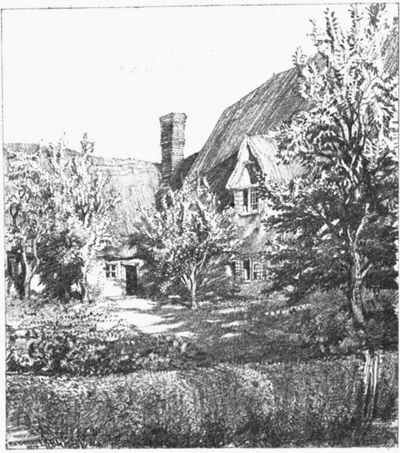
Cottage at Rampton.
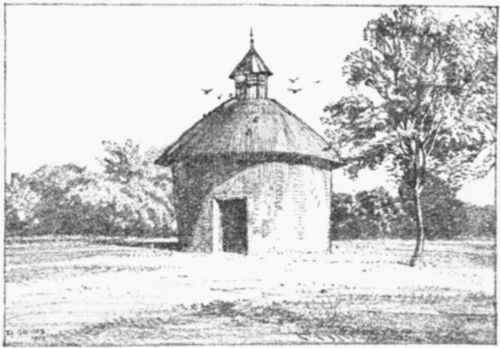
Dovecote at Rampton.
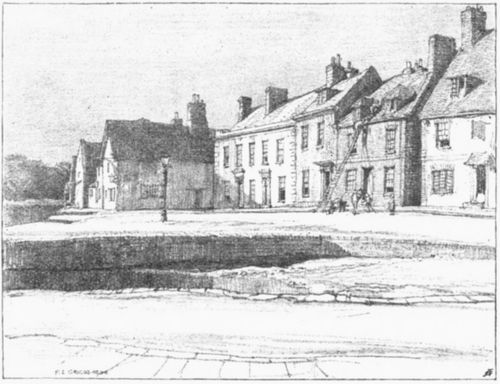
The Quay, Ely.
Some two miles beyond Upware the Cam falls into the Ouse, and the united stream sweeps past Thetford and round the corner of the island to Ely, where the Cutter Inn (near the railway station) makes a good landing-place.