Chapter VIII
Reading edition
Roads from Cambridge.—Cambs and Isle of Ely, Girvii, East Angles, Mercians, Formation of County.—Newmarket Road.—Quy.—Fleam Dyke.—Devil's Dyke.—Icknield Way.—Iceni, Ostorius, Boadicea.—Newmarket Heath, First Racing.—Exning, Anna.—Snailwell.—Fordham.—Soham, St. Felix.—Stuntney.—Wicken.—Chippenham.—Isleham, Lectern.—Eastern Heights.—Chevely, Cambridge Corporation.—Kirtling.—Wood Ditton.—Stetchworth.—Borough Green.—Bottisham.—Swaffham Bulbeck.—The Lodes.—Swaffham Prior.—Reach, Peat, Submerged Forest.—Burwell, Church, Clunch, Brass, Castle, Geoffry de Magnaville.
At the Lepers' Chapel we are clear of Cambridge and well on the road to Newmarket, probably the most trafficked of all the great roads which radiate from Cambridge. Of these there are seven; this Newmarket Road going to the north-east, the Hills road to the south-east, the Trumpington Road to the south, the Barton Road to the south-west, the Madingley Road to the west, the Huntingdon Road to the north-west, and, finally, the Ely Road to the north. This last takes us into the Isle of Ely; the other six serve the county of Cambridge, more strictly so-called, i.e., the southern half of the Cambridgeshire of our maps, not so long ago quite separate, politically, from the northern half, and even now not wholly united for administrative purposes.
The Isle, which contains the whole of the fenland forming this northern half of Cambridgeshire, is far older as a political entity than the southern part of the county. Its existence dates back to the far-off days of the Anglo-Saxon conquest, in the fifth and sixth centuries, when the poor remnants of the British population in East Anglia, once the proud tribe of "the great Iceni," fled for refuge into the "dismal swamp" of the Fens. Here they held out for centuries, and formed themselves into a new tribe, the Girvii (as our earliest Latin chronicler transliterates the Welsh name Gyrwy, signifying "brave men," by which they called themselves). This Girvian principality has ever since held together. It passed as a whole into the hands of St. Etheldreda, by her marriage (in 652 A.D.) with the last Girvian Prince, Tonbert, and from her to her successors the Abbots and Bishops of Ely, whose jurisdiction survived until the nineteenth century.
Meanwhile the old southland homes of the unhappy Britons were being shared up by their English exterminators. The East Anglians swarmed over the uplands to the east, and joined hands (not in friendship) with the more powerful Mercians swarming in from the west. Roughly speaking the Cam divided these jarring tribes, which lived in undying hostility till the various English Kingdoms were united into one (in A.D. 827) by the genius and valour of Egbert, the first "King of the English." But the boundaries were not effaced till the desolating flood of the Danish invasions poured over all.
When that flood was stayed by Egbert's glorious grandson, Alfred the Great, and the district once more made English and Christian by his only less glorious son, Edward "the Elder," it was formed by him into a County called, from its chief town, Cambridgeshire (or, as it was then, "Granta-bryg-shire"). This was in the year 921. But for the first idea of any union between this new County and the old Isle of Ely we must wait another two centuries, when, in 1107, the Abbot of Ely became a Bishop, with the Isle and the County together for his See. The ecclesiastical tie thus formed has gradually developed into a civil tie also; just as the first union of the English race under a common Primate, the Archbishop of Canterbury, paved the way for its union under a common King.
To many charming byways amid the streamlets and the meadows and the gentle slopes of this southern Cambridgeshire the seven highways out of Cambridge will successively conduct us. The highways themselves are, as has been said, seldom inspiring thoroughfares, save for their far-flung horizons; and the Newmarket Road least of all, for it is, as might be looked for, motor-swept beyond all the rest. The one near-hand object alone worth mention is the little Church of Quy, whose far-seen tower dominates some miles of the road. But this has little interest except its curious name, which is matter of dispute amongst etymologists. "Cow-ey" is the most commonly accepted derivation, meaning the Island of Cows. But Quy can never have been an island. More probably it is "Cow-way," like the "Cowey Stakes" on the Thames, signifying that here was a passage for cattle across the marshy ground which bordered the little stream crossed by the road before reaching the church. This stream flows out of Fulbourn Fen, an isolated patch of fen-land a mile square, even yet only half reclaimed, and of old so impassable that it determined the line of the great Fleam Dyke, which runs up to it on either side but does not need to cross it.
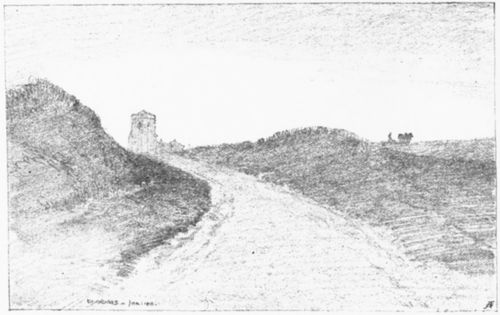
Quy Church.
When these were constructed we do not know. They first appear in history as the scene of desperate fighting between Britons and Romans in the first century of our era. But they may very probably have existed before even the Britons came into the land. Magnificent earthworks they are, some 10 feet high on the inner side, and on the outer at least 30, from the bottom of the great ditch which flanks them to the crown of the parapet. When that parapet was topped by a palisade of timber, they must have presented formidable obstacles indeed. The Fleam Dyke we do not see from this road. But as we approach Newmarket, and enter upon its famous Heath, we cross the Devil's Dyke; and, as we look at its mighty dimensions, we cease to wonder that our simple-minded ancestors should have ascribed its formation to superhuman agency.
At the Roman conquest of Britain in 55 A.D. the Iceni were friendly to the invaders, whom indeed they had invited into the land, to free them from their subjection to the House of Cymbeline, King of Britain. But when, a few years later, during the settlement of the country, the Roman general Ostorius ordered them to give up their arms, they regarded the demand as an intolerable insult, and bade him defiance, manning the Fleam Dyke against him. But such was his energy that, though he had no regular troops with him, his light-armed auxiliaries stormed the whole length of the line at a single rush. The routed Icenians fled in panic homewards, only to find their way hopelessly barred by their own fortifications along the Devil's Dyke, and all but the few who could force their way through the mad crush at this one narrow gap, were, in spite of a desperate resistance, slaughtered wholesale. The tribe were then disarmed, and endured unresistingly the licence and greed of Roman officials and Roman moneylenders, till goaded into madness, twelve years later, by the wrongs of their "warrior-queen," Boadicea. Then followed that convulsive explosion of popular rage and despair, in which every Roman within reach was massacred with every circumstance of horror, and to which the Romans, after their victory, replied by such a policy of extermination as to blot the Icenian name from the page of history. Never again do we meet with it.
Between the Dyke and Newmarket lies the Heath, renowned as the earliest English race-course. This form of amusement seems to have come in with the Stuart Dynasty. James the First is said to have inaugurated the sport. But the well-known tale of how Edward the First escaped from his captivity at Hereford, by inducing his guards to ride matches till their horses were exhausted and then galloping off on his own fresh mount, shows that the idea was afloat long before. And at Newmarket in particular such matches must often have been ridden in connection with the great horse mart which has given the town its name.
This New Market is, like the New Forest, now far from new. It dates from the year 1227, when a frightful outbreak of sickness frightened away buyers and sellers from their older market-place two miles off at Exning (a pretty natural amphitheatre of turf bright with many springs), and sent them to meet for the future in the freer air of the Heath. This word, by the way, does not, in Cambridgeshire, imply the existence of heather, merely meaning an open space.
The Royal sport spread like wildfire, and the bare Heath became year by year crowded by the gayest throng in England, thus vividly described by Macaulay:
"It was not uncommon for the whole Court and Cabinet to go down there," Charles himself, to the admiration of his subjects, posting down from London in a single day, with only two relays of fresh horses. "Jewellers and milliners, players and fiddlers, venal wits and venal beauties, followed in crowds. The streets were made impassable by coaches and six. In the places of public resort peers flirted with maids of honour, and officers of the Life Guards, all plumes and gold lace, jostled professors in trencher caps and black gowns. For on such occasions the neighbouring University of Cambridge always sent her highest functionaries with loyal addresses, and selected her ablest theologians to preach before the Sovereign and his splendid retinue. In the wild days before the Revolution, indeed, the most learned and eloquent divine might fail to draw a fashionable audience, particularly if Buckingham announced his intention of holding forth; for sometimes his Grace would enliven the dulness of a Sunday morning by addressing to the bevy of fine gentlemen and fine ladies a ribald exhortation which he called a sermon. With lords and ladies from St. James's and Soho, and with doctors from Trinity College and King's College, were mingled the provincial aristocracy, fox-hunting squires and their rosy-cheeked daughters, who had come in queer-looking family coaches, drawn by cart-horses, from the remotest parishes of three or four counties to see their Sovereign.... Racing was only one of the many amusements of that festive season. On fine mornings there was hunting. For those who preferred hawking, choice falcons were brought from Holland. On rainy days the cock-pit was encircled by stars and blue ribbons.... The Heath was fringed by a wild, gipsy-like camp of vast extent. For the hope of being able to feed on the leavings of many sumptuous tables, and to pick up some of the guineas and crowns which the spendthrifts of London were throwing about, attracted thousands of peasants from a circle of many miles."
Nor were these beggars the only ones to profit by the festive occasion. The townsfolk of Newmarket reaped a golden harvest; lodgings for the press of visitors were at fancy prices, and many were glad to pay a guinea a night for even the third of a bed; and "at Cambridge," we read, "a hackney-horse is not to be got for money."
When Newmarket became only one of many racing centres throughout the land, this height of glory naturally departed. But to this day its meetings rank in the very first class of such fixtures. And as a training ground for race-horses it stands second to none. Training stables rise all round it, and strings of young thorough-breds are constantly to be met along the road, and are treated with reverence, even by the drivers of motor-cars, who, for some distance on either side of the town are not allowed to travel at any speed over ten miles an hour. There are now seven principal annual racing fixtures here, the chief being the "Craven," in the spring, and the "Two Thousand" in the autumn.
The town of Newmarket is now wholly in Suffolk, although till a few years ago it lay partly in Cambridgeshire, for it is built on either side of the Icknield Street, which here formed the county boundary. But the Old Market at Exning was always in Suffolk; a little island of which may be seen on the map, surrounded by Cambridgeshire territory. Here we have an interesting historical survival. Whence came about this curious delimitation? The answer is that when Cambridgeshire was first formed into a county by Edward the Elder it was not yet forgotten that Exning had long been a special residence of Suffolk royalty.
Suffolk, it must be remembered, is not, like Cambridgeshire, Bedfordshire, and other counties named after their chief town, an artificial division of the land, called into being by the Government merely as an administrative unit, but, like the Isle of Ely, one of the originally independent principalities the gradual accretion of which has formed England. Very early Suffolk and Norfolk joined together in one East Anglian Kingdom; but that Kingdom endured for centuries, and was not extinguished till its last monarch, St. Edmund, was murdered by the Danes in their great raid of 870 A.D. He was, indeed, but a tributary monarch, under the King of the English; but this was then only a quite recent arrangement, and his predecessors had been wholly independent sovereigns. For many years they were engaged in a heroic struggle to preserve their independence against Mercia, the great power which occupied all the Midlands, and therefore it was that they fixed their Royal abode at Exning, close to the great dyke which bulwarked the East Anglian realm, as, long before, it had bulwarked the Icenian.
Hence it came about that Exning was the birthplace of St. Etheldreda, the foundress of our great "sacred fane" at Ely, round which, almost more than Cambridge itself, the fortunes of Cambridgeshire have centred. Her father, King Anna, was called to the East Anglian throne in troublous times. Christianity and Paganism were at death-grips throughout the land. And the latter cause was championed by the monarch who was, for the moment, far the most powerful of the English sovereigns, Penda, King of Mercia. From his central position he struck out north, south, and east, at his Christian neighbours. His first blows were against Northumbria, where he successively shattered the Roman Mission of Paulinus and the Celtic Mission of Aidan. Next he drove into exile Kenwalk, the first Christian King of Wessex, and finally, in 654, burst over the East Anglian frontier "like a wolf, so that Anna and his folk were devoured as in a moment."
The road from Newmarket to Ely (twelve miles) passes several places worth notice. First comes Snailwell, with the flint-built round tower of its little church rising so picturesquely above the "well," now a broad, clear pond, from which the little river Snail crawls away into the adjacent fen. At the adjoining hamlet of Landwade there was lately unearthed a Roman villa, the fine tesselated pavement of which is now in the Sedgwick Museum of Cambridge.
Fordham, which we next reach, is a larger village, with a church of most unusual architectural interest. The north porch has a stone roof of no fewer than six vaulted bays, running east and west, and supporting a parvis chamber, with late Decorated windows, approached by a stone staircase from without, and, seemingly, designed for a chapel with a separate dedication to St. Mary Magdalene, the Church being St. Peter's. This development is unique.
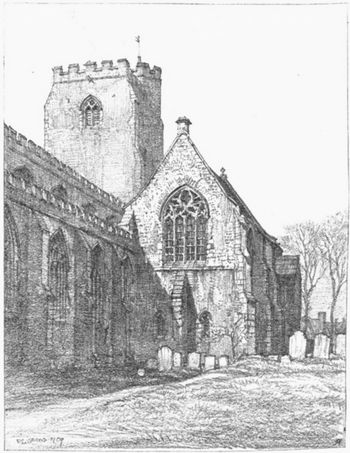
Fordham Church.
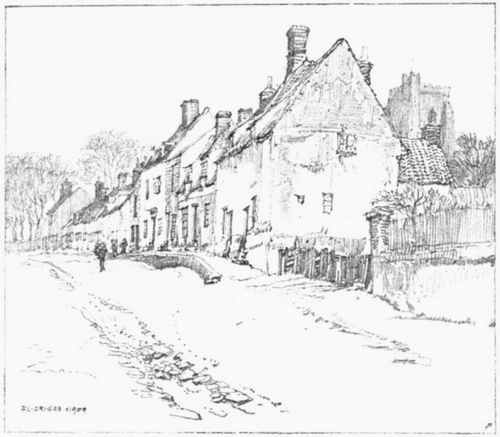
Fordham.
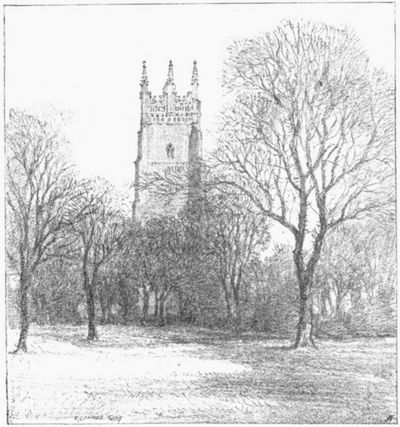
Soham.
Soham, as has been said, was on all sides surrounded by fen, except on the narrow ridge of firm ground between it and Fordham. So water-logged, indeed, was the country round that sea-going vessels made a port here. This fen is now all drained and become most prosaic cornland. But a few miles east and west of Soham two little patches, each about a mile square, remain in their original state. These are Chippenham Fen to the east, and Wicken Fen to the west. Both are fairly inaccessible spots, but when we get to them they enable us to form a vivid idea of what the state of things must have been when the whole fenland was such as this. Both give the impression of a morass hopelessly impenetrable, covered with a dense growth of tall reeds rising high above your head, through which you push your way blindly, to be constantly checked by some sluggish watercourse, too wide to jump, too shallow to swim, and impossible to wade, for the bottom is a fathomless stratum of soft turf and ooze giving no foothold. To stumble into one of these watercourses is, indeed, no small peril. If you are alone the case is well-nigh hopeless, and even a friend on the bank would find it hard to pull you out. His best course is to cut a fairly large bundle of reeds, by trampling which under your feet you may for a moment be able to stand while he rescues you.
One can well understand how it came about that such a country was an almost inviolable sanctuary for those whom despair drove to seek refuge in its recesses. These small fragments of it still form a sanctuary; for many rare plants and insects, exterminated elsewhere by the march of progress, here still nourish. Conspicuous amongst these is the lovely swallow-tail butterfly; which flits about, dashing with bright touches of colour the weird and sombre beauty of the silent scene. Very silent it is now. But it was not so of old, when the whole fen was crowded with the swarming bird-life, so vividly described by Kingsley in "Hereward the Wake": "where the coot clanked, and the bittern boomed, and the sedge-bird, not content with its own sweet song, mocked the notes of all the birds around, ... where hung motionless, high over head, hawk beyond hawk, buzzard beyond buzzard, kite beyond kite, as far as eye could see. Into the air whirred up great skeins of wildfowl innumerable, with a cry as of all the bells of Crowland; while clear above all their noise sounded the wild whistle of the curlews, and the trumpet note of the great white swan." Such was the fenland of old; but all this wealth of commotion is long since gone, and scarcely do we see a bird now at Wicken or Chippenham, except here and there a waterhen, and (at Chippenham) the pheasants which are reared in coops on its margin.
They may have found Isleham too sequestered. It stands, like Soham, on the verge of the Isle of Ely, and also on the verge of Suffolk, to which county it seems actually to have belonged throughout great part of the Middle Ages. But it was in the Bishopric neither of Ely nor of Norwich, but of far away Rochester, to which it had been annexed, as tradition went, by Alfred the Great. The Church, dedicated to St. Andrew, has an exceptionally fine hammer-beam roof, bearing the inscription:
CRYSTOFER PEYTON DID MAK THYS ROFE IN THE YERE OF OURE LORD MCCCCLXXXXV BEING THE X YERE OF KINGE HENRY THE VII.
A splendid brass records the memory of this benefactor's father, Thomas, who brought the Isleham estates into the family by his marriage with Margaret Bernard, the heiress of the former possessors. She as well as her successor, Margaret Francis, are on either side of him, in low-necked and high-waisted robes with ample skirts. That of Margaret Bernard bears a large flower and scroll pattern, and on her head-gear is inscribed the prayer "Jesu, mercy! Lady, help!" That of Margaret Francis is plain, trimmed with fur. Both wear an identical necklace, presumably the very same. Thomas himself (who was High Sheriff of Cambridge and Huntingdonshire in 1442 and 1452) is in plate armour of the most highly developed kind, with quaint and enormous elbow-guards. The figures, which are some thirty inches in height, are surmounted by an elaborate triple canopy.
Besides these brasses, there is the fine tomb, in the north transept, of the first Bernard to be Lord of Isleham, a Crusader, as is shown by the crossed legs of his recumbent effigy. The tailed surcoat over his coat of mail fixes his date at about 1275. He was, in fact, one of those who accompanied Edward the First (not yet King) to Palestine. The moulding of the canopy above the tomb also connects him with that monarch, for it is the same as that of the Coronation Chair in Westminster Abbey, placed by Edward over the Holy Stone of Scone, which he had carried off from Scotland in token of his claim to be indeed the rightful King of that stubborn realm.
Yet another point of interest in this church is the eagle lectern, an exquisite piece of mediæval brasswork, so good, indeed, that it has been copied in the lectern of Ely Cathedral. It is apparently fifteenth century work, and was found buried in the fen, some half century ago, between Isleham and Soham, so nearly half way that both parishes laid claim to it, and even now Soham folk are not reconciled to its loss. Whoever were the original possessors, it was probably concealed in the fen to save it from the Puritan iconoclasts of the seventeenth century, who, during the Civil War, habitually destroyed lecterns of this type as "abominable idols."
Eastward from Newmarket radiate most fascinating roads, leading through heather and pine woods to Mildenhall, with its splendid church and ancient market hall; and to Brandon, where men still make (as they have made for 5000 years) palæolithic flint implements by the very same methods used in those prehistoric days; and to Bury St. Edmunds, with its wonderful ruins and great historical associations. But these are all out of our beat. To the southward, however, we are in Cambridgeshire, and a fine avenue, two miles in length, known as "the Duchess's Drive," leads up to the ridge of the East Anglian heights. It is noteworthy that almost along the whole length of that ridge, and particularly hereabouts, villages cluster thick, whereas the slopes below can show scarcely any, but form an unoccupied belt, two miles wide, between the upland and the lowland populated area. A very out-of-the-way district is this watershed between the broad basin of the Ouse and those of the little rivers running into the North Sea, for the nearest railways are miles away, and an old time peace broods over everything.
The first village we come to is Cheveley. The church here is cruciform, with a piscina of rare beauty in its Early English chancel, which is closed in by a fourteenth century rood screen of Decorated work. To the same period belongs the church chest, which has the unique feature of being made of cypress wood, and the tower, also with the unique feature of an external bartizan or watch-turret, apparently for a beacon fire. The dedication of the church is no less unique, "St. Mary and the Sacred Host."
The wide moat which surrounded it still exists, and reminds us that this mansion was on the site of a great mediæval castle belonging to the Tony family, from the days of William the Conqueror to those of Henry the Eighth. The manor had once been the property of the ill-fated King Harold, and was given by the Conqueror to Judith, widow of the saintly hero Waltheof, after his judicial murder. The church contains many North monuments, and Kirtling also possesses a pretty little Roman Catholic church, being one of the five "Missions" in Cambridgeshire—along with Cambridge, Ely, Newmarket, and Wisbech. For the Norths still hold, not only their ancient seat, but their ancient Faith.
Not far from Kirtling is Wood Ditton; the last word signifying either Ditch Town, or, more probably, Ditch End, for it stands at the upland extremity of the Devil's Dyke. Along this ridge of the East Anglian Heights the primæval forest was of old so dense that no artificial defence was needed to check the progress of an invading army. It was a veritable wall of oak, and ash, and thorn, and holly, and alder; no route for an army at any time, and where the felling of a few trees across the glades would speedily form an absolutely impenetrable obstacle. Here then the great earthwork, which we saw on Newmarket Heath, ends its ten-mile climb from the Fen at Reach, 350 feet below. Wood Ditton is a picturesque little place, still suggestive of woodland, especially around the flint-built church (constructed in the twelfth century and remodelled in the fifteenth), which has an octagonal steeple of specially graceful poise. A large brass, in somewhat poor condition, dating from 1393, commemorates "Henry Englissh and Wife Margt." Henry was a Knight, and wears what is known as "Camail" armour, which consisted of a series of small steel roundels fastened on to leather, hardened by boiling. Dowsing records (under date March 22, 1643), "We here brake down 50 superstitious pictures and crucifixes. Under the Virgin Mary was written: 'O Mother of God have mercy upon us.'"
The neighbouring village of Stetchworth (or Stretchworth) also suffered in Dowsing's visitation. But he failed to notice that one of the two ancient bells in the steeple had a "superstitious" inscription:
SANCTA MARGARETA ORA PRO NOBIS.
So it remained unshattered, and still hangs in the belfry, where the other bells also have noticeable inscriptions, two bearing the words "God save Thy Church. 1608," and the third
OMS·SPT·LAVDA·DNM. ("Let everything that hath breath praise the Lord.")
This and the Margaret bell are ascribed to the fifteenth century.
Stetchworth Manor, in the tenth century, was given to the Abbey of Ely, to provide clothing for a newly-professed monk, the son of the donor. This sounds an extraordinarily disproportionate gift; but the clothing of an Ely monk was really a very serious item, and, as the Abbey account books show, cost the convent the equivalent of something very like £50 per annum. Readers of Chaucer will remember how comfortably, and even luxuriously, the monk of his "Canterbury Tales" is dressed.
Weston Colville has also a brass, now affixed to the wall, and too much damaged for identification. The church here is almost wholly Early English, as is that of Dullingham. Borough Green contains some fine twelfth century monuments, sadly knocked about. The Parson here was ejected by the Puritan Earl of Manchester, Governor of Cambridge, during the Civil War, for the heinous offence of saying "that he ought to shorten his sermons rather than neglect reading the Common Prayer, and that the Collects were to be preferred before preaching." Grounds no less frivolous were a sufficient excuse for a like ejection of half the parsons in Cambridgeshire at this period. The rest signed the Covenant and renounced their Anglican heresies, sometimes with considerable emphasis. One curate is recorded to have stamped the Book of Common Prayer under his feet, in the face of the congregation, declaring that he would henceforth be their minister "by no Prelatical and Popish imposition of hands." Some score of these Vicars of Bray lived to turn their coats once more at the Restoration.
Bottisham, in all probability, played a part in that pathetic episode in the life of King Charles the First, which began with his flight from Oxford and ended with his vain appeal to the loyalty of the Scottish army then besieging Newark. Finding that Oxford must needs surrender to the Parliamentary forces closing in upon it, the King cut off his hair and beard, and in the disguise of a servant, carrying the cloak-bag of the two faithful chaplains who accompanied him, stole away at three in the morning, on Monday, April 27, 1646, from the beleaguered city, which had been his headquarters for so long. A long day's ride of 50 miles brought the party that night to Wheathampstead, near St. Albans, where a faithful adherent was found to give him shelter, though the Parliament were proclaiming, with drum and trumpet, that "what person soever shall harbour and conceal, or know of the harbouring and concealing of the King's Person, and shall not immediately reveal it to both Houses, shall be proceeded against as a traitor, forfeit his whole estate, and die without mercy." The next day, Tuesday, in clerical attire this time, and with only one companion, Mr. Ashburnham, the hunted Monarch entered Cambridgeshire (avoiding the towns) and that night, after another 50 miles of riding, slept "at a small village, seven miles from Newmarket." This village, Mr. Kingston, the historian of the Civil War in East Anglia, to whom I am indebted for this picturesque story, thinks may have been Bottisham, whence Charles could have reached Downham, his next stage, by water.
Bottisham is the first of a line of interesting villages. We next reach, through a mile or two of pretty lanes, Swaffham Bulbeck, where, again the church has some good Decorated work, and fifteenth century seats, also a cedar chest of the same period, with carvings of the Crucifixion, the Resurrection, and the Assumption of Our Lady. It is remarkable that these should have escaped the specially thorough "purification" which Dowsing here describes. "We brake down two crucifixes (and Christ nailed to them), one hundred superstitious pictures, and twenty cherubims, two crosses from the steeple, and two from the church and chancel, and digged down the altar-steps." The vicar was also ejected for being "zealous to put into execution Bishop Wren's fancies." Wren, the builder of Peterhouse Chapel, was Bishop of Ely 1638-1667, and deeply offended the Puritans by ordering the Communion Tables to be set "altar-wise" at the east end of the chancels (instead of being merely boards, which were habitually leant against the walls, and at Communion time were placed on trestles anywhere about the church). His High Church proclivities earned him eighteen years' imprisonment in the Tower, till released by the Restoration.
To the north of Swaffham Bulbeck runs out an extension of the village known by the remarkable name of "Commercial End." It consists of one picturesque street, at the extremity of which we find ourselves on the banks of a deep, narrow waterway, like an old canal. An old canal in fact it is, and shows us that we have here reached the beach-line of the ancient Fen; for this is Swaffham Lode, one of those artificial cuts through the tangled swamp by which barges and even sea-going vessels were enabled of old to reach the mainland. Of these Lodes there were several; and the knot of population at the termination of each shows the amount of traffic they anciently carried. Bottisham Lode has given its name to a village larger than Bottisham itself, and some three miles from it. And here at Swaffham the commerce of those bygone days has left us Commercial End. Hard by are the insignificant remains of a small Benedictine nunnery founded by the Bulbeck family in the reign of King John.
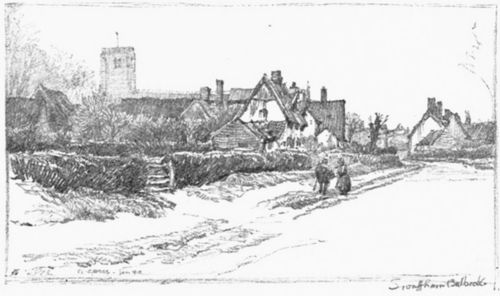
Swaffham Bulbeck.
Till the Restoration these represented two separate incumbencies; the former having been given to the Abbey of Ely by Brithnoth, the heroic Alderman of East Anglia under Ethelred the Unready. Both churches have passed through singular architectural vicissitudes. The design of the Norman tower of St. Mary's (the lower of the two), square below and octagonal above, was copied by the fifteenth century builders of St. Cyriac's, and is the only surviving portion of their work—the body of the church having been pulled down in 1667, at the union of the benefices.
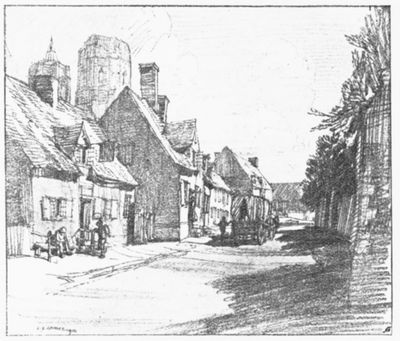
Swaffham Prior.
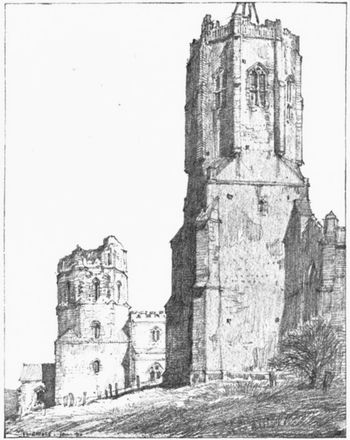
Swaffham Prior Churches.
From the churchyard of Swaffham Prior we get a grand view over the limitless fen to the northward; Ely Cathedral, ten miles away, rising conspicuous above it. The road we have been pursuing leads us on Ely-wards; but, a mile hence, comes to a dead stop at the little hamlet of Reach, once one of the most important places in the whole county. For here the mighty earthwork of the Devil's Dyke runs down into the fen. To meet it the greatest of all the Lodes was cut from the Cam at Upware, and at its hithe (or quay) our road has its termination. It is a striking surprise, for one comes upon it abruptly round a corner, and suddenly finds oneself at the end of all things. The hithe is a quiet green meadow now; but the clear brown water of the lode still sleeps beside it, and even yet barges, laden with turf or coal, occasionally creep up hither. Of old it was a constantly busy spot, where sea-going ships were loaded and unloaded, and trains of waggons attended, bringing and carrying off the cargoes.
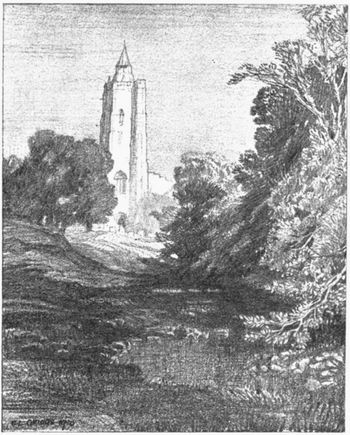
The Castle Moat, Burwell.
Reach was of importance even in Roman days. The Dyke, of course, was already ancient when they ruled Britain, and the lode, too, may very probably have been already cut. The remains of one of their villas have been unearthed here, near the point where the Cambridge and Mildenhall railway now cuts through the Dyke. It has a well-preserved hypocaust, or apparatus for warming the house by hot air. The Roman "villa," we must remember, was the country mansion of the period, and equipped with every known luxury. In the Middle Ages the annual Fair at Reach (on the Monday before Ascension Day) was big enough to bring over the Mayor of Cambridge to open it. And the custom survives even today, when the occasion has dwindled to a very petty little gathering.
Reach, however, has still a local industry; the cutting of the peat, or "turf" as it is here called, in the neighbouring fen, for use as fuel. This peat forms a layer often many feet in thickness, and is formed for the most part of moss, mingled with the vegetable mould made by the decay of the dense forests with which the district was covered for uncounted ages; before its final submergence, early in the Christian era, destroyed the last of them. A like subsidence had more than once produced the same results earlier; for the remains of four or five forest beds at different levels have been found in the peat.
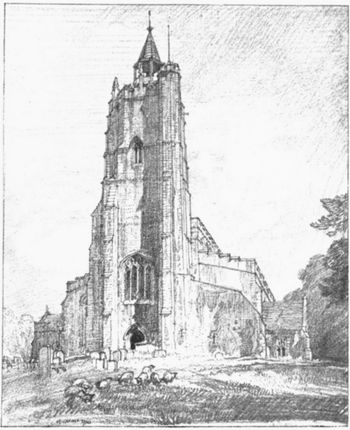
Burwell Church, West End.
The peat is cut with a spade of peculiar construction, being flat, and both longer and narrower than ordinary spades. It is shaped somewhat like a fire shovel with a flange on either side, the object being that each "turf" extracted should be of uniform size, like a brick. A thousand of these should go to the ton; but though uniform in size they are not of uniform weight, for the peat, as might be expected, is more dense at its lower levels than near the surface. There is a good market for this turf, which makes a hot and lasting fire with a minimum of smoke, and that pleasant smoke. It is mostly sent off by water to Cambridge, Ely, Wisbech, etc.
This turf-cutting is not, of course, confined to Reach, but it has its greatest development here, and at the neighbouring village of Burwell, a mile or so to the eastward (to which, as we have seen, part of Reach belongs). Burwell is an important village of considerable extent, with a population of 2000, and a magnificent church, capable of seating them all. It is of the finest fifteenth century workmanship, with a few remains of Norman in the tower. The exterior is mostly flint; the interior, like that of so many churches in Cambridgeshire, is of "clunch," a hardened form of chalk, well adapted for building, and easily worked for carving. The beautiful sculptures of the Lady Chapel at Ely are of this material, drawn from the large quarries between Burwell and Reach. Clunch is found in many places throughout the county and has been worked (as existing remains show) ever since Roman days.
Burwell Church is specially connected with the University of Cambridge, in whose gift is the preferment, burdened with the condition that on Mid-Lent Sunday a sermon shall be preached there by the Vice-Chancellor or his deputy. Till the nineteenth century this condition was no light one; for the roads were in such a state that half a dozen men on each side could hardly keep the preacher's carriage from overturning, and, whenever possible, the cortege took to the newly-ploughed fields in preference. The route was not round by Reach but direct from Swaffham Prior.
Here is a remarkable brass of John Lawrence de Wardeboys, the last Abbot of Ramsey in Huntingdonshire. For his readiness in abetting the designs of Henry the Eighth, not only by eagerly surrendering his own abbey, "which was not his to give," but by persuading others to do like violence to their conscience, he was rewarded with a pension equivalent to between two and three thousand pounds a year. His brass records this venality of his principles. It was originally made during his abbacy, and showed him in full abbatical vestments, mitre and all (for Ramsey was a mitred abbey). After the surrender he had it turned over, and on the reverse side, now uppermost, we see him in a simple clerical gown and cap. He only lived a few years to enjoy his ill-gotten gains, dying in 1542.
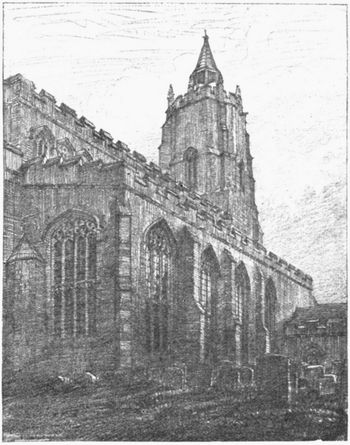
Burwell Church, N.E. View.
South-west of the church are some scanty remains of Burwell Castle, which was built by King Stephen during the miserable "nineteen winters" of his war with Queen Matilda, so forcibly described in the Anglo-Saxon Chronicle, when the country was laid desolate by the outrages of the robber barons. The particular brigand who afflicted Cambridgeshire was one Geoffry de Magnaville, an outrageously wicked plunderer, who "did not spare even the churches," regarded as inviolable by ordinary malefactors. Both Cambridge and Ely were looted by him, and he terrorised the whole district, till at length he was slain, by an arrow through the throat, in attacking Burwell Castle. "Nor was the earth permitted to give a grave to the sacrilegious offender."