Chapter XX
Reading edition
Coveney.—Manea.—Doddington.—March, Angel Roof.—Whittlesea.—Old Course of Ouse, Well Stream.—Upwell, Outwell.—Emneth.—Elm.—The Marshland.—West Walton.—Walsoken.—Walpole.—Cross Keys.—Leverington.—Tydd.—Wisbech, Church, Trade, Castle, Catholic Prisoners, Clarkson.—The Wash.—King John.
In close contiguity to the Island of Ely, on the west, is a tiny satellite, which supports the little village of Coveney. Here the church has some remarkable modern woodwork from Oberammergau, the gift of Mr. Athelstan Riley. The pulpit is also remarkable, dating from 1703 and being of Danish work. More remote are Manea and Stonea, both, happily for themselves, now on a railway line, but otherwise unspeakably inaccessible. It is strange at Manea to see the towers of Ely a short five miles away, and to know that twenty miles of bad road will scarcely get you there. Both names seem to have the same signification, Stone Island; which (as they are eminently unstony, being merely low elevations of gravel) may perhaps refer to the selenite crystals with which the ground here teems. Manea Station is one of the few inland places where the curvature of the earth can be clearly seen. The line (towards March) is perfectly straight and perfectly level, and along it you may observe the trains rising into sight over the horizon like ships at sea.
March is the half-way house between Ely and Peterborough, and between it and the last-named lies Whittlesea, also on a good-sized island of its own, which extends nearly to the Northamptonshire mainland. It is a pleasant little town, with a picturesque market place, where the ancient Market House still rises in the centre. And its church almost rivals that of March, with a still more glorious spire. In 1335 Whittlesea was the scene of a most unedifying conflict between the Abbeys of Ramsey and Ely. To begin with, the Abbot of Ramsey and his monks raided the lands at Whittlesea belonging to Ely, drove away sixteen horses, and (by firing the sedge) burned twenty others, besides ten oxen, eighty cows, and one hundred swine, along with much grass, reeds, and other property. In retaliation for this outrage the Prior of Ely (and he, too, the saintly Prior Crauden) organised a regular military expedition, and came, at the head of the whole Abbey musters, "with banners flying as in war," to Ramsey itself, where, as that House complains, he "hewed down our woods, depastured our grass, and drove off our cattle." Both parties appealed to the King; but the discreditable transaction seems to have ended in a compromise. That such wild work should be possible at all in England reminds us that at this date the country had not yet recovered from the confusions attendant on the fall and murder of Edward the Second eight years before.
Till the latter part of the nineteenth century Whittlesea gave its name to a famous mere, lying to the south of the town, and on the very border of the fens. It was a sheet of shallow water a couple of miles in length and breadth, and furnished a splendid field for angling, skating, and boat-sailing. Its shallowness made it none the less dangerous; for the bottom was fathomless ooze, so soft that the punting poles used here had to be furnished with a round board at their extremities, and demanded special skill, for if you once let this board get underneath the mud, it was much more likely to pull you in than you to pull it out.
Other islets of the fen archipelago are Murrow, between Thorney and Wisbech, Westry near March, and Welney, on the Old Bedford river to the north of Manea. The name of the last reminds us that by it ran the old Well Stream, long robbed of its waters by their diversion to Lynn in the thirteenth century. To this day, however, its course may be traced on the map by the meandering boundary between Cambridgeshire and Norfolk across the fen. Following this line northwards we shortly come to the outskirts of the firm ground on which Wisbech stands, an artificial island dating from Roman times and owing its existence to the great Roman sea wall around the Wash.
Through this island ran the great Well Stream, giving their names to the villages (or rather the village, for they form a continuous row of houses) of Upwell and Outwell. This is the longest village in England, stretching on either side of the road for nearly five unbroken miles. It contains over 5,000 inhabitants, and lies partly in Cambridgeshire partly in Norfolk. The churches are in the latter county, and are grand specimens of the splendid series of churches which glorify the Marshland, as this district by the Wash has for ages been named. Both are of Perpendicular date, with a tower somewhat older. That of Upwell has an elaborate turret for the Sanctus bell. The canopy over the pulpit is still more elaborate. The roof has a series of angels, but far less numerous and effective than those at March. At Outwell there is a fine Decorated door, like that of Barrington.
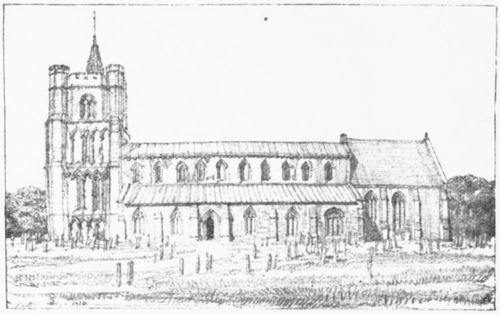
Elm Church.
Emneth, on the further road to Wisbech, also has an angel roof, of specially interesting character. Each figure is holding some symbol of the Faith; one the Host, another a candlestick, another a Gospel-book. At Elm, hard by, may be seen a still more interesting development of church architecture. The tower is Early English, enriched on its internal face with exquisite shafting, and opening into the nave by an Early English arch. But both shafting and arch must have been insertions in much older work, for between the two may be seen the high-pitched string-course and the rude little window of the original Saxon church. The nave is also Early English (clerestory and all, which is rare hereabouts), while the chancel is Decorated, with its roof higher than that of the nave.
Here at a farm house called Needham Hall (from a famous historic mansion formerly on the site) is shown an old table formed of one solid piece of oak, on which Oliver Cromwell is said to have once slept. When he arrived here at the head of his command during the Civil War, he chose this rude couch in preference to the best bed in the house, that he might fare no better than his men, who were bivouacking in the yard and outhouses.
The churches along the Roman sea-wall on either side of the old Well Stream estuary are also of rare magnificence. To the east, in Norfolk, we find a series of villages deriving their names from the wall itself,—Walsoken, West Walton, Walpole St. Peter, and Walpole St. Andrew. In every one of these the church is a joy; above all at West Walton, with its bell-tower (fifty yards to the south of the main building) uplifted on four graceful arches enriched with dog-tooth moulding. Octangular buttresses support the angles, which are ornamented with blank lancet arches. The next floor has on each side an arcade of three lancets, and the storey above a window of two lights beneath an arch of two mouldings, forming a splay of four banded pillars. No more perfect gem of composition exists; and the Perpendicular parapet which now crowns it very inadequately takes the place of the spire which seems to have been purposed by the original builder. The church itself displays similar features of Early English grace. The nave pillars have Purbeck marble shafts, with beautifully foliated capitals, and the clerestory is pierced with seventeen small archlets, alternately blind and light.
Walsoken, now practically a suburb of Wisbech, has a Perpendicular shell around a Norman nave, which is (next to Norwich Cathedral) the best example of the style in all Norfolk. The chancel arch is a deservedly famous specimen of Transition work. It springs from six banded pillars, and has a soffit exquisitely worked with zig-zags and cusps. The screens of the chapels which formerly occupied the east end of either aisle are rich Perpendicular woodwork. The roof is also Perpendicular, with angels on the transome beams.
Walpole St. Peter's is even more remarkable; for there is actually an ancient right of way through it, underneath the Altar. The thirteenth century chancel, with its five large Decorated windows on either side, ascends by no fewer than eleven steps from the nave to make room for this unique passage way. The five windows of the nave are of the earliest and best Perpendicular, and its eastern gable is crowned with three beautifully proportioned pinnacles. In this parish is the hamlet of Cross Keys, the name of which is sometimes supposed to be connected with St. Peter. But it is much more probably the quay at the starting point of the ancient low-tide passage across the sands of the estuary which led to Sutton Crosses on the Lincolnshire side, five miles away, and which played, as we shall shortly tell, so notable a part in English history. From Walpole the sea-wall sweeps round by Terrington to Lynn. But here we are far in Norfolk. We must not, however, forget that we owe one of our Cambridge Colleges to Terrington, for Dr. Gonville, while Vicar here, founded in 1347 his "College of the Annunciation," the embryo of Caius College.
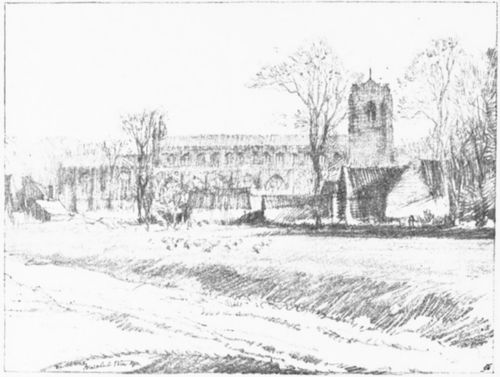
Walpole St. Peter.
On the Cambridgeshire side of the Well Stream we also find churches fully equal to those on the Norfolk bank. Leverington is one specially to be noted, with its beautiful steeple, an Early English tower surmounted by a Decorated spire so exquisitely proportioned that it seems absolutely to melt away into the sky. There is also a fine Decorated porch with a stone-roofed parvis chamber of original and singular beauty. The chancel is also Decorated, while the grand nave is Perpendicular. The font, too, is Perpendicular, an octagonal structure of oolite, with richly ornamented niches on every face, each containing the head of a saint in high relief. The east window of the north aisle retains much of its ancient glass, proving it to be a "Jesse" window, tracing the descent of Christ from that patriarch through David.
Tydd St. Giles lies at the northernmost extremity of the Isle of Ely, where the "Shire Drain" divides the village from its sister parish of Tydd St. Mary in Lincolnshire. Here, too, the church is remarkable, having its tower fifty feet beyond the East End, a unique position. Like Leverington, it has a specially fine octagonal font, richly traceried, and carved with emblems of the Passion and with the arms of the See of Ely. In the floor of the nave is a thirteenth century gravestone, bearing a floriated cross, and the legend (in Old English characters): "Orate.pro.anima.dni John.Fysner, cujus.aie.deus.ppiciet.Amen." (Pray for the soul of Mr. John Fysner, on whose soul may God be merciful.)
On one of the pillars is a more interesting inscription in rude capital letters, much worn. It is in French, and would seem to be of the early fourteenth century, when that language was becoming very fashionable in England, as our current legal phraseology still shows. It runs thus:—
CEST . PILER . CVME NCAT . RICARD . LE . PRE STRE . PRIMER . PRE YEZ . PVR . LVI
i.e. in modern French: "Ce pilier commença Ricard le Prêtre premièrement. Priez pour lui"; and in English "This pillar Richard the Priest first began. Pray for him."
After having told of so much loveliness all around, it is disappointing to be obliged to confess that at Wisbech itself, the metropolis of the northern Fenland, the church is comparatively commonplace. Not that it is otherwise than a fine structure, and, like Great Yarmouth, splendidly wide, having a double nave and a double chancel; but it is hopelessly outclassed by those in the neighbouring villages. The best feature is the tower, which is richly ornamented with sacred and heraldic devices of the later Perpendicular period. And in the nave is a fine fifteenth century brass. Otherwise there is little to say about it; and, indeed, little to say about Wisbech at all. It is a picturesque old place, with that somewhat pathetic picturesqueness of an ancient seaport town which the sea has deserted.
Wisbech, however, is not by any means a "dead city." It has 10,000 inhabitants, and keen local ambitions, which have developed an excellent museum and other up-to-date municipal equipment. Modern energy and science have, moreover, made so effective a waterway through the ten miles of silted-up estuary that vessels of 3,000 tons can now, at high tide, reach the wharf. Such, however, are almost unknown visitants. Last year (1909) the vessels clearing from the port numbered 209, of 36,000 tons in all. Two of these are registered at Wisbech itself, as are also twelve sea-fishing boats. A characteristic photograph of Wisbech's shipping is given by Mrs. Hughes in the "Geography of Cambridgeshire" (p. 118). Other photographs (pp. 47, 48) show the great height to which the tide rises in the river, there being a difference of over twenty feet between high and low water mark. The Nene still has its outfall here, and flows through the town in a fine sweep locally called the Brink.
It is hard to believe that this Brink is not the Beach whence the name of the town is vulgarly supposed to be derived. But you must not suggest this to a Wisbech man. The single vowel is an integral part of local faith and local pride, and to insert the "a" is to show yourself a hopeless outsider. With it the name would come from Ouse-beach (like Land-beach and Water-beach near Cambridge). Without it the derivation is Ouse-beck. This last syllable is a Scandinavian word, well known throughout the north of England, and there signifying a running brook. Throughout the Fenland it is frequently used for a drain. But can the mighty Well Stream of the Ouse, at its tidal outfall here, have ever suggested either drain or brook to the men of old who named the place? And can these have been Scandinavians?
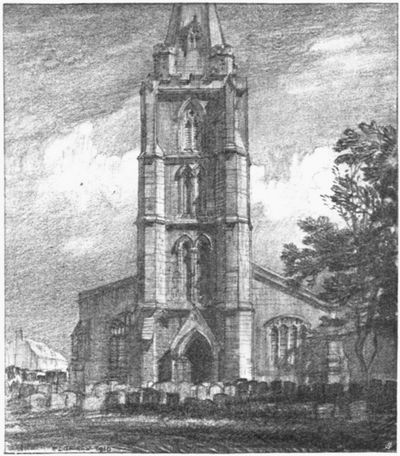
Leverington.
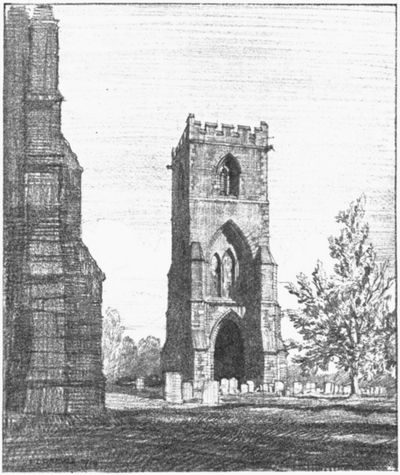
Bell Tower, Tydd St. Giles.
Yet, though thus inoffensive, their doom was grievously heavy. Committed, to begin with, to solitary confinement, in what Froude calls "the living death of the Tower" and other London prisons, for three or four years, they were afterwards quartered (singly) on the Protestant prelates, who were stringently ordered by the Council to prevent them from communication, either by word or letter, with anyone, and to see that they had neither paper to write withal, nor books to read (except Protestant ones). Thus deprived of every intellectual, social, and religious solace, "pining away in miserable desolation, tossing and shifting from one keeper to another," they one by one drooped and died. But all remained steadfast to their Faith; and finally the "obstinate" survivors were, in 1580, closely imprisoned, along with others in like case, in Wisbech Castle.
Kept with this rigour the Confessors lingered on, year after year, till death set them free. The latest to be released were Thomas Watson, Bishop of Lincoln, who died in 1584, and Feckenham, the last Abbot of Westminster, who died in 1585. Both are buried (as the Parish Registers testify) in Wisbech churchyard.
The castle was sold by the See of Ely in 1783, and has since been almost wholly pulled down. Nearly at the same date a young man, born at Wisbech, was beginning those efforts which have reflected glory on his native town, and have revolutionised public opinion throughout the civilised world. The man was Thomas Clarkson, and the cause to which he devoted his life was the abolition of slavery. That institution, up to his time, was regarded as a very foundation of the earth. Rooted in the furthest past of man's history, and as world-wide as it was ancient, the idea of questioning its place in the eternal fitness of things never occurred even to philanthropists. A virtuous man would treat his slaves kindly; but as for not having such, he would as soon have scrupled at having sheep and oxen, or at employing hired servants.
It was left for young Clarkson, while a student at Cambridge, to realise that the time was come when, if the human conscience was to make any further progress in enlightenment, this hoary iniquity must, root and branch, be abolished. On a steep hillside above Wade Mill, in the road between Cambridge and London, a monument by the wayside still marks the spot where he dismounted from his horse, and, kneeling on the ground in the fervour of youthful enthusiasm, solemnly vowed to God that for this holy object he would live and, if need be, die.
At once he set to work. Gathering a band of like-minded friends round him (mostly belonging to the so-called Clapham Sect, who were then inaugurating the great Evangelical Revival)—Wilberforce, Zachary Macaulay, Babington, Thornton, Buxton, Cropper, and the rest—he started an agitation in and out of Parliament, which carried all before it. The Slave Trade was abolished in 1807; on August 1st, 1834, slavery itself ceased throughout the British Empire; the example of Britain was followed by other European Powers; and finally, in 1864, after a last desperate struggle for existence in the American Civil War, it was cast forth from its last stronghold in the United States. If practised at all now, it is practised under some feigned name and elusive system. No civilised man dare any longer proclaim himself an avowed slave-driver. Well indeed does Clarkson deserve the monument which Wisbech has erected to her glorious son.
At Wisbech, till the reclamation of the neighbouring Washes, Cambridgeshire (or rather the Isle of Ely) possessed an actual strip of seaboard extending from Wisbech town northward to the county boundary between Tydd St. Mary and Tydd St. Giles. This strip was itself reclaimed ground, but of far earlier date, due to the era of Roman civilisation in Britain. The old coast-line, as has been said, is still marked for us by a massive embankment extending from Sutton, in Lincolnshire, to Wisbech, and thence to King's Lynn, in Norfolk—an embankment sufficiently old to have given its name to the ancient villages along its course. The designations of Walsoken, West Walton, Walpole St. Peter, and Walpole St. Andrew, all testify to this sea wall having been already in existence when the East Anglians, in the fifth century, first took possession of the land.
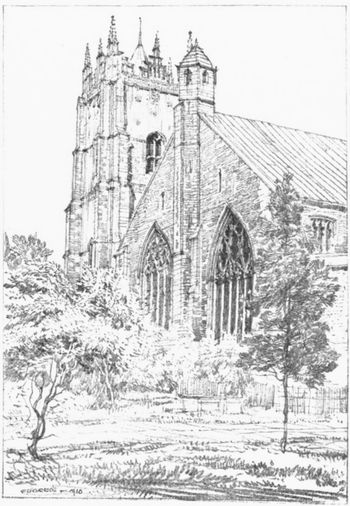
Wisbech Church.
This embankment kept back, to the west and to the east, the tide-water of the Well Stream (see p. 399), a wide inlet of the sea, narrowing southward till it reached its extremity at Wisbech, and forming the estuary for the united outfall of all the Fenland waterways. In later days operations connected with the draining of the fens have diverted nearly the whole volume of the Great Ouse and its tributary streams to fall into the sea at King's Lynn, and have led the Nene straight to Wisbech. But till the thirteenth century was well advanced the Ouse and the Nene joined each other near Outwell, the united river being called the "Well" or "Well Stream." The names of Upwell, Outwell, Welney, &c., still preserve the memory of this old waterway.
The estuary was, of course, tidal, leaving at low water a broad expanse of sands, amidst which the shifting channel of the river was so far broadened out as to be fordable at certain points; thus admitting of passage across the whole breadth of the inlet, even where it became five miles wide. The regular track for this passage was from the little hamlet of Cross Keys, on the Norfolk coast (the name of which is derived from this circumstance) to Sutton Crosses, near the village of Long Sutton, on the Lincolnshire side, and is approximately marked for us to-day by the line of the Great Northern Railway between these spots, traversing the level fields and meadows which have (since the year 1830) finally replaced the sands of old.
The conditions of the passage were identical with those to be found now at Morecambe Bay. That estuary can also be crossed at low tide; but to do so in safety a good deal of local knowledge is essential. The right points for fording the river channels must be found, the numerous quicksands must be avoided, while the localities of both fords and quicksands are constantly changing. It is therefore exceedingly rash to make the attempt without guides; for across the level sands of every estuary the tide makes with extreme rapidity, sometimes coming in before the wind faster than any man can hope to outrun it. These guides are professionals, who await on either bank the demand for their services.
All this is exactly what is said of the Well Stream "Washes" in authorities of the seventeenth and eighteenth centuries. As late as 1775, though successive reclamations had by that time reduced the breadth of the passage by more than half, we hear of the guide "always attending at Cross Keys to conduct passengers over, bearing a wand or rod in his hand, probably in imitation of Moses, who held a rod when he conducted the Israelites through the Red Sea." The rod was really used for probing the sand in front, lest it should prove "quick," and also for taking the bearings on the opposite shore by which the course was steered.
It was through neglect of such expert advice that the Well Stream estuary became the scene of that dramatic episode in English history, which, on the 13th of October in the year 1216, cost King John his treasures and his life. The story is narrated by the contemporary historian Roger of Wendover, and the Barnwell and Coggeshall chroniclers. The whole circumstances have been most carefully and minutely elaborated by Mr. St. John Hope, through whose kindness I am enabled to use his materials. His able monograph on the subject is to be found in Vol. LX. of "Archæologia."
John was, in 1216, at death-grips with the Barons, who, in the previous year, had wrung from him the signature of Magna Charta. The rights and wrongs of the quarrel were not so wholly one-sided as is popularly supposed, and the appeal of both parties to the Pope had not sufficed to clear them up. The offer of the Crown by the Barons to Louis, Dauphin of France, was for the moment more successful. Most of England acknowledged him as King, and even the King of Scots came to do homage for his sub-kingdom (as Scotland then was); only a few strongholds, notably Windsor Castle, holding out for John and being besieged by the Barons.
John himself, however, was still at large, and at the head of a small, but very effective, mercenary army of filibusters from all the countries of Europe. He met the situation by a campaign of extraordinary energy; his object being to relieve his invested fortresses by drawing off their assailants to the defence of their own lands. Incidentally, desire of revenge, and the need of paying his troops by plunder, operated as a further motive for the merciless destruction which, in a series of brilliant and ferocious raids, he meted out to the districts owned by his opponents. The speed of his movements is almost incredible, considering the conditions of travel in the thirteenth century; but they can be traced with accuracy by the still existing entries in the Patent and Close Rolls; for day by day John did not cease to do royal business and to sign the documents submitted to him, however far he might have marched since morning. In the eyes of his Continental contemporaries this consuming energy came to be held his chief characteristic. In the "Dittamondo" of the Italian poet, Fazio degli Uberti, written early in the fourteenth century, which gives a brief notice of the successive Kings of England from the Norman Conquest onwards, the one thing mentioned about John is the "hot haste" of his riding.
Yet another week of marches up and down Lincolnshire, 115 miles in all, brought him round the Wash to Lynn (by way of Wisbech); and then came the great catastrophe.
It was on Wednesday the 12th of October, 1215, that King John, after three days' stay at Lynn, retraced his steps, with his wonted celerity, by way of Wisbech, to Swineshead Abbey near Boston, a distance of over forty miles. Documents signed by him on this day at all three places are to be found in the Patent and Close Rolls. His baggage train, which obviously could not have kept up with this pace, he ordered to follow by the direct route across the sands. We read with some surprise that his flying column was accompanied by such a train at all; but the contemporary historians agree in telling us of "carts, waggons, and sumpter horses," loaded with the King's treasures and properties (including even a portable chapel), and with the spoil amassed during this long raid.
Such a train would cover at least a mile on any road, and could only move quite slowly, three miles an hour at the very outside. How it kept touch with the column at all is a wonder, and we may be sure that it could never have done so during the forced march from Hedingham on the 19th of September. After that date the occupation of Cambridge by the Baronial forces would effectually bar the way against any attempt to follow in the King's track; and it is highly probable that he, knowing that this would be so, had ordered the train and its escort to make their way instead from Hedingham to Lynn, and that he paid his hurried visit to that place with the sole object of once more getting into touch with them.
However that may be, there is no doubt that the train did set out from Lynn, along the road to Cross Keys, after the King and his troops had ridden off towards Wisbech. It was impossible, however, to attempt the passage that same day, for the channel of the Well Stream could only be forded during the hour or so on either side of low-water, which, as calculations show, was on this day about noon. The long line of vehicles had, accordingly, to halt for the night at Cross Keys, for to have attempted the passage in the dark (the moon was nearly at the new), would have been simply suicidal.
Next morning, Thursday, October 13th, they woke to find the tide lapping against the old Roman embankment behind which they lay, for it was a spring tide, and at its highest about 6.30 a.m. Rapidly it receded, and by 9 a.m. the wide expanse of the sands would lie bare before them. The moment these were dry enough for the passage of carts they would start, for their leaders knew well the urgent necessity for speed. To get such a train across the Well Stream channel in the short space of two hours they must be at the ford the very moment it was practicable. Every instant was precious, and every driver did his utmost to press on, regardless of the warnings of the guides (if they had any).
But to drive a loaded cart over wet sand is at the best a slow job. Readers of Sir Walter Scott will remember his vivid description, in Redgauntlet, of the difficulties attending such attempts:
"The vehicle, sinking now on one side, now on the other, sometimes sticking absolutely fast and requiring the utmost exertions of the animal which drew it to put it once more in motion, was subjected to jolts in all directions.... There seemed at least five or six people around the cart, some on foot, others on horseback. The former lent assistance whenever it was in danger of upsetting or sticking fast in the quicksands: the others rode before and acted as guides, often changing the direction of the vehicle as the precarious state of the passage required.... Thus the cart was dragged heavily and wearily on, until the nearer roar of the advancing tide excited apprehension of another danger.... A rider hastily fastened his own horse to the shafts of the cart, in order to assist the exhausted animal which drew it, ... but at length, when, after repeated and hair-breadth escapes, it actually stuck fast in a quicksand, the driver, with an oath, cut the harness, and departed with the horses, splashing over the wet sand and through the shallows as he galloped off."
Multiply all this at least a hundred-fold, throwing in the added turmoil caused by the multitude of carts jamming and impeding one another, and we can picture something of the scene as that fatal morning advanced and the doomed cavalcade ploughed its way on to destruction. For there was no margin of time; and though the leading vehicles seem to have reached the Well Stream channel, they reached it too late. Already it was unfordable, for such traffic at least as theirs. Some of the carts doubtless tried to make a dash across; but their horses, exhausted by the strenuous effort of the last two hours, were unequal to the tremendous strain of negotiating the soft bottom of the stream. A very few such failures would entirely bar the way to those who were eagerly pressing on behind, and almost in a moment the whole column would be in irremediable confusion. In the struggling press, to turn would be as impossible as to proceed, while momentarily the laden carts, for which the only hope was to be kept going, would, at a standstill, sink deeper, inch by inch, into the ever quickening sand. And then in the midst of the welter, up came the tide, sweeping over the level sands, as spring tides in the Wash do sweep;—and, when the waters once more went down, of all that mass of treasure and plunder, of all those horses and drivers and carts and waggons not a trace was to be seen. The sands had swallowed all; and to this day they retain their prey. As Shakespeare makes King John say:
"These Lincoln Washes have devoured them."
The expanse of sands is now an expanse of fields and meadows, through which the River Nene is led by a straight cut from Wisbech to the sea. Where that cut is crossed by the Great Northern Railway (which, as has been said, runs almost along the line of the old crossing-track) is the traditional spot of the disaster, and Mr. St. John Hope believes that excavation might there bring to light some of its relics, even after the lapse of so many years.
Matthew Paris (in his Historia Anglorum), writing in the generation following the catastrophe, tells us that John himself was on the scene and barely escaped from the rising waters. But he, as we have seen, was the previous night (and the next) at Swineshead Abbey. It is just possible that, with his astounding energy, he may have ridden in the morning with a few attendants to Long Sutton (a distance of twenty miles, as before the reclamation of the fens travellers from Boston thither would have to go round by Spalding), and thence across the sands, to overlook in person the passage of the Well Stream. If so, he may well, in the confusion, have been surprised by the tide and have barely escaped by hard riding. Anyhow the catastrophe cost him his life; for this heart-breaking blow, coming on top of his three months' herculean exertions, brought on a feverish attack that very night. Ill as he was, he was on horseback again by dawn, and rode fifteen miles to Sleaford. Next day he struggled on twenty miles to Newark, where "the disease increasing, he received the counsel of Confession and the Eucharist from the Abbot of Croxton," and died that same evening (October 18th), fairly burnt out by his own consuming and tireless energy. If ever King did, he "died standing."
"Foul as Hell is, it is defiled by the fouler presence of John." Such is the uncompromising verdict of the inimical chronicler; and such (in less trenchant phraseology) has been very much the verdict of popular historians even to our own day. But it was a verdict by no means universally accepted by contemporaries. John did not, like William Rufus, receive what Professor Freeman calls "the distinction of a popular excommunication." For Rufus no prayer was said, no psalm was sung, no Mass was offered. All men felt that prayer was hopeless. But John was buried in peace; and it speedily appeared that the cause for which he stood was the cause which (more especially when the weight of his own personal unpopularity was removed) most commended itself to the heart of England. Men had no desire to see the English Crown become an appanage for the heir to the French monarchy. And so Louis rapidly found. Within nine days of his father's death the infant Henry the Third was crowned at Gloucester,—with his mother's bracelet, in default of the proper crown (which, however, is not likely to be amongst the treasures lost in the Wash, as many histories assume); and within six months men were flocking "as to a Holy War," from all parts of the country, to take part in that decisive battle known as "the Fair of Lincoln," which crushed, once and for all, the foreign intrusion, and established irrevocably the claim of the native-born ruler to succeed his father on the throne of England.
And with this stirring story we take our leave of the Highways and Byways of Cambridgeshire, the stage of so many a story, the home of so many a memory; the scene—to those who have eyes to see—of so much quiet loveliness; where the Present is ever brooded over by the Past, and where on the anvils of Thought and Science the Future is ever being shaped. We have explored the County from end to end, we have mounted her uplands, we have traversed her fens, we have clambered her earthworks, we have entered her churches. Her Manor-houses have told us their tale of struggle, her Colleges have borne their witness to the growth of knowledge. We have been able to
"Watch Time's full river as it flows";
and the pathos of all that has come and gone stands out before us, as a record more thrilling than the most daring romance, as a theme more inspiring than the noblest poem. We bid good-bye to the County of Cambridge and the Isle of Ely feeling that no hue of dulness attaches to them, as is commonly supposed by the unappreciative crowd, but that rather the footprints of the past which abound within their borders give promise of a future that shall not be unworthy of what has gone before.
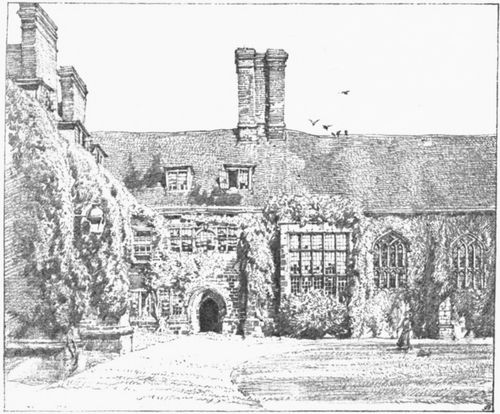
The Old Court of Corpus.
ADDENDA.
Attention should have been called to two remarkable ecclesiastical inscriptions, on the Eastern and Western borders of our district respectively.
In the upland churchyard of Castle Camps (p. 206), hard by the Priest's Door into the Chancel, a tombstone has the following epitaph:
Mors Mortis Morti mortem nisi morte dedisset Æternæ Vitæ janua clausa foret.
["Except the Death of Death Death's death by death had been Ne'er would Eternal Life with door unshut be seen."]
And in the church of Fen Stanton, low down amid the Ouse meadows near St. Ives, is the following ancient rebus (also hard by the Priest's Door):
QV A D T M P
OS NGVIS IRVS RISTI VLCEDINE AVIT
H SA M X D L
I.e.—Quos Anguis dirus tristi mulcedine pavit Hos Sanguis mirus Christi dulcedine lavit.
["Whom the dire Serpent fouls with poisonous food Christ washeth in His sweet and wondrous Blood."]
A variant of these lines is to be seen in the Alpine sanctuary of Champéry near the Lake of Geneva.
INDEX
A
Abbeys: Barnwell, 10, 160 Chatteris, 390 Crowland, 137, 393 Denny, 30, 298 Ely, 302-341, 345-376 Peterborough, 373, 390, 394 Ramsey, 75, 198, 279, 310, 392, 410 Soham, 178 Thorney, 392, 396 Abbey Barn, 161 Abington, 203 Adams, Prof., 266 "Ad eundem," 265 Adventurers, 403 Adwulf, 304 Agincourt, 184 Aidan, St., 175 Akeman Street, 252, 258, 295 Alan of Walsingham, 329, 345, 356, 360, 362, 366, 373 Alcock, Bp., 146, 283, 332, 376, 418 Aldreth, 283, 295, 316 Alfred the Etheling, 314 Alfred the Great, 11, 38, 169, 183, 213 Alum, 92 Ambulatory, 366 Ancarig, 392 Andrewes, Bp., 342 Andrew, St., Oratory of, 161 Anna, King, 303 Archdeacon of Ely, 282 Armeswerke, 306 Arnold, Matthew, 268 Arrington, 258 Artesian, 260 Ashwell, 248 Ashwell Bush, 236 Assandun, 205, 313 Assize of Barnwell, 161 Athelney, 308 Audley End, 234 Audrey's Fair, St., 307 Augustine, St., 38, 303 Augustinians, 11, 158
B
B.A., 16 Babraham, 202 Backs, 2, 41, 85 Bacon, 90, 102 Baitsbite, 296 Balsham, 171, 216 Balsham, Bp., 12, 25, 112, 325 Baptistery (Ely), 352 Barham Hall, 205 Barnack, 329 Barnett, Bp., 366 Barnwell, 10, 160 Barnwell Gate, 35, 152 Barnwell Priory, 16, 160, 370 Barrington, 238, 289 Barrow, 102 Bartlow, 205 Barton, 254 Barton Road, 252 Basevi, 371 Basket-making, 384 Bassingbourn, 247 Bateman, Bp., 82 Bath, 252 Becket, Thomas à, 235, 246 Bedford, Earl of, 406 Bedford Rivers, 280, 389 Bedmakers, 16 Belsars Hill, 283, 292 Benedictine Rule, 339 Benson, A. C., 138 Bentham, 345 Bentley, 40, 101, 105, 109 Bible (St. John's Coll.), 117 Bidding Prayer, 128 Biggin "Abbey," 295 Bishop's Delph, 178 Bishopsgate, 222 Black Death, 248, 340 Blaise, St., 284 Blazer, 119 Bluntisham, 280 Boadicea, 172 Boat Houses, 146 Boat Races, 88, 146, 296 Boat Show, 43 Bonfire, 85 Borough, 7, 8 Borough Green, 188 Botolph, St., 32, 34, 304 Bottisham, 189 Bourn, 273 Bourn Brook, 270 Bourne R., 202 Brazier, 97 Brandon, 185 Bretwalda, 178 Bridges: Clare, 42, 84, 93 Great, 46, 136 Hauxton, 235 Hostel, 43 Huntingdon, 278 King's, 42 Magdalene, 136 Newnham, 41, 222 Queens', 41 St. John's, 118 Trinity, 43 Bucer, 23, 131 Buckingham College, 137 Bulldogs, 132 Burgesses, 12 Burgraed (King), 309 Burnt Mill, 236 Burwell, 195, 198 Bury St. Edmunds, 320, 370 Butcher's Broom, 227 Butterflies, 182, 211 Butter Measure, 12 Buttery, 95 Butts, 254 Byron, 90, 94 Byron's Pool, 220
C
Caldecote, 271 Cam, 7, 8, 40, 222, 295 Cambridge and Oxford, 2, 11, 17 Camden Society, 134 Camp of Refuge, 10, 316 Canute, 8, 205, 313 Car Dyke, 297 Carmelites, 11 Castle, 4, 138 Castle Camps, 206 Cavendish Laboratory, 159, 267 Caxton, 273 Ceilings, 100 Chad, St., 176, 355 Chained books, 83 Chancellor, 125 Chantries, 239 Chapel, Bush, 238 Chapel lists, 104 Chapels (College): Christ's, 153 Clare, 84 Corpus, 35 Emmanuel, 158 Girton, 144 Jesus, 147, 148 King's, 52-77, 290 Pembroke, 30, 342 Peterhouse, 26, 342 Queens', 48 St. John's, 113 Trinity, 102 Chapels (at Ely): Bishop Alcock's, 332, 369 Bishop West's, 332, 367 Crauden's, 330, 346 Lady, 330, 372 St. Catherine's, 352 St. Edmund's, 360 Charles the First, 101, 138, 182, 190, 268, 406 Charles the Second, 173 Cherry Hill, 345 Cherryhinton, 208 Chester, 221 Chesterford, 232 Chesterton, 295 Chevely, 185 Childerley, 271 Chimes, 101, 129 Choirs, 114 Choir School (Ely), 314 Christopher, St., 205 Chum, 288 Church ales, 247 Churches (Cambridge): Abbey, 161 All Saints', 108 Christ Church, 162 Holy Sepulchre, 133 Holy Trinity, 152 Our Lady's, 21 St. Andrew's the Great, 155 St. Andrew's the Less, 161 St. Benet's, 36 St. Botolph's, 32 St. Clement's, 136 St. Giles', 140 St. Mary's the Great, 127 St. Mary's the Less, 25 St. Michael's, 13, 86 St. Paul's, 162 St. Peter's, 140 Churches (Ely): Holy Trinity, 372 St. Cross, 379 St. Mary's, 378 Clapham Sect, 422 Clapper Stile, 204 Clarence, Duke of, 94 Clarkson, 421 Clayhithe, 296 Clergy Training School, 148 Clerks, 11 Clerk-Maxwell, 97 Cloisters, 92, 353 Clough, 142 Clunch, 198, 236 Codex Bezæ, 82 Coe Fen, 159 Coleridge, 150 "College" (Ely), 376 Colleges: Christ's, 152-155 Clare, 83-85, 342 Corpus Christi, 35-38 Downing, 159 Ely Theological, 382 Emmanuel, 156-158 Girton, 144 Gonville and Caius, 120-124 Jesus, 146-150, 369 King's, 50-79 Magdalene, 137 Newnham, 142 Pembroke, 28-34, 298 Peterhouse, 25-28, 369 Queens', 47-50 Ridley Hall, 142 St. Catherine's, 39-40 St. John's, 109-119 Selwyn, 144 Sidney Sussex, 151-152 Trinity, 86-107, 242 Trinity Hall, 82-83 Westminster, 1 42 Comacine Guild, 353 Comberton, 254 Combination Rooms, 26, 97 Commons, 1 "Commons," 95 Common Fields, 3 Conduit, 23, 130, 158 Confessionals, 263 Conington, 292 Conqueror, William the, 187, 283, 315, 359 Coprolites, 240 Corporation, 12, 185 Coton, 89 Cottenham, 298 Courts (College), 2 Courts, Christian, 11 Covenant, 91 Coveney, 409 Cox, Bishop, 289 Cratendune, 179, 303 Cranmer, Abp., 150 Crauden, Prior, 330, 346, 359, 410 Cromwell, Oliver, 32, 128, 151, 272, 278, 367, 381, 406, 412 Cross Keys, 413, 424, 427 Crusades, 328 Cycloid, 89 Cyclone, 276 Cymbeline, 172
D
Darwin, 155 Deanery (Ely), 348, 353 Decorated, 334 Degrees, 16 Denver, 387 Denver Sluice, 280, 389, 407 Devil's Dyke, 171, 187, 194, 212, 300 "Disinherited," 325 Divinity schools, 109 Doddington, 409 Dominicans, 11, 155 Dowsing, 56, 187, 189, 205, 222, 270 Dry Drayton, 270 Dullingham, 188 Dunstan, Abp., 309 Dunwich, 180 "Duties," 377 Duxford, 228 Dykes, 170-173
E
Earith, 298, 389 Early English, 334 Eastern Counties Association, 380 Edgar the Peacemaker, 309, 373, 192 Edmund the Ironside, 206, 313 Edmund, St., 175, 180, 262 Edmundhouse, 142 Edward the Confessor, 314 Edward the Elder, 6, 8, 169, 212, 278 Edward the First, 328 Edward the Second, 86, 359, 411 Edward the Third, 86, 101, 330, 348, 359 Edward the Seventh, 94, 268 Egbert, 7, 169 Eleanor, Queen, 324 Electoral roll, 125 Elizabeth, Queen, 126, 290, 419 Elm, 412 Elsworth, 292 Eltisley, 274 Ely, 7, 11, 140, 188, 236, 302-385, 409 Ely House, 290, 333 Ely Place, 322 Emma, Queen, 314 Emneth, 412 Enclosure Acts, 387 Epigrams, 80 Erasmus, 47 Erconwald, St., 176, 262 Ermine Street, 244, 258, 273 Ermenilda, 176, 307 Esquire, Bedell, 128 Ethandune, 308 Etheldreda, St., 7, 169, 175, 179, 283, 303, 358 Ethelred, the Unready, 310 Eton, 51 Eustace, Bp., 349, 367 Eversden, 289 Examination Hall, 15 Examinations, 14, 98 Exeat, 17 Exning, 173, 175
F
Fagius, 23, 131 Fairy-cart, 260 Falcon Cup, 84 Felix, St., 178 Fellow Commoners, 151 Fellows, 2, 89 Fen Ditton, 171, 295 Fields, 3 Firehooks, 38, 204 First Trinity, 88, 148 Fisher, Bishop, 110, 152 Fisher, Osmund, 149 Fitzwilliam, 23, 371 Fleam Dyke, 170, 210 Fordham, 176 Fowlmere, 230 Foxton, 242 Franchise of Ely, 321 Franciscans, 11, 100, 152 Free School Lane, 36 Freshman's Pillar, 92 Friars, 11 Fulbourn, 209 Fuller, 344, 357, 384
G
Galilee, 324, 349 Garret Hostel, 43 Gating, 16 Geoffry de Magnaville, 34, 200 George the First, 80 George the Third, 90 Gibbet, 273 Gibbons, 90 Girton, 268 Girvii, 169 Godmanchester, 278 Godolphin, 202 God's House, 153 Gogmagogs, 201 Gonville, 14, 120 Goodhart, 95 Goodrich, Bp., 332, 341, 376 Granby, Marquis of, 98 Granta, 7, 202, 222 Grantabridge, 7 Grantabrigshire, 8 Granta-ceaster, 7 Grantchester, 7, 221 Grantset, 7 Gray, 28 Great Ouse, 399 Greek, 47 Greensand, 240 Guild Hall, 130 Guilden Morden, 262 Gunning, Bp., 342, 367 Guyhirn, 289
H
Haddenham, 282, 356 Halls, 15 Hardwick, 270 Harlton, 255 Harvard, 156 Haslingfield, 236 Hauxton, 235 Hemingford, 279 Henrietta Maria, Queen, 116 Henry the First, 359 Henry the Third, 324, 359 Henry the Sixth, 41, 51, 54 Henry the Eighth, 87, 97, 118, 152, 283, 372 Hereward, 10, 283, 315 Hermits, 41, 222 Hervey, Bp., 180, 321, 359 Hervey de Stanton, 86, 242 Hiding-hole, 225 High-table, 15, 96 Hilda, St., 303 Hildersham, 203 Hinxton, 230 Histon, 268, 287 Hithes, 44, 194 Hobson, 21, 158 Holcroft, 288 Holme, 400 Holywell, 279 Honours, 14, 98 Horningsea, 295 Horseheath, 209 Hospital of St. John, 25, 112 Hospitallers, 258 Hostels, 12, 43 Hotham, Bp., 330, 335, 359, 363, 366 Hubert, St., 270 Huddleston, 225 Hundreds, 10 Huntingdon, 138, 278
I
Iceni, 168, 211 Ickleton, 231 Icknield Way, 171, 203, 234, 244 Indulgence, 91, 235 Ink, 336 Ireton, 272 Ireton's Way, 390 Isle of Ely, 8, 168, 282 Isleham, 183 Ivo, St., 279
J
Jacutus, St., 205 James the First, 154, 173, 403 Jesus Lane Sunday School, 162 Jewry, 10, 108 Job, 248 John, King, 12, 136, 425-430 Jowett, 129 Julitta, St., 191 Jurats, 400
K
Kendal, 166 King's Ditch, 3, 34 King's Hall, 14, 86, 101 King's Mill, 34 Kingsley, 138 Kingston, 271 Kirtling, 186 Kitchen (Trinity), 96 Kitchener, Lord, 131 Knapwell, 273 Knee-holm, 227
L
Landbeach, 296 Landwade, 176 Lantern (Ely), 356 Lantern (Trinity), 97 Lectures, 16 Lepers' Chapel, 162 Leverington, 414 Leverrier, 266 Leys School, 160 "Libellers," 403 Liber Eliensis, 303, 337 Libraries: Corpus, 38 King's, 52 Pepys, 137 Peterhouse, 26 St. John's, 44, 116 Trinity, 43, 80 Trinity Hall, 82 University, 79-82, 100 Lincoln, 298 Lingay Fen, 222 Linton, 204 Littlego, 155 "Little John," 226 Little Ouse, 399 Littleport, 387, 400 Littlington, 264, 288 Lock-up, 264 Lode, 191, 194, 300 Logan, 2, 95, 100 London Stone, 160 Long Stanton, 289 Long Vacation, 17 Lycidas, 154 Lynn, 326, 390, 399, 400, 426
M
Macaulay, 14, 107, 136 Madingley, 268 Maitland, 3, 185 "Majestas," 287, 339 Maldon, 310 Manea, 409 March, 410 Margaret, Lady, 110, 152 Margaret, Queen, 41 Mark, 318 Market Hill, 130 Marshland, 399, 411 Martial, 384 Martin V., Pope, 161, 238 Mary Stuart, 278 Mary Tudor, 97, 225 Maur, St., 252 Mayor of Cambridge, 12 May pole, 255 Mazes, 254, 352 Medhampsted, 308, 394, 396 Melbourn, 242 Meldreth, 242 Mepal, 390 Merton, 25, 142 Michael House, 14, 86 Midsummer Common, 146 Mildenhall, 185 Mildmay, 156 Milestone, 82, 160 Mill Hill, 345 Mill, St., 50 Milton, 295 Milton, John, 56, 58, 91, 154 Miserere seats, 363 Monks' Door, 356 Monks' garments, 338 Morning Talks, 36 Morton, Bp., 336, 398, 418
N
Needham Hall, 412 Needingworth, 279 Nene, 398 Neotus, St., 276 Neptune, 266 Nevile, 92, 100 Nevile's Court, 92, 94, 95 Newcastle, 390 New College, 51 Newmarket, 173, 174, 389 Newton, Isaac, 41, 91, 92, 103, 107, 265 Non-Collegiate Students, 15 Northwold, Bp. Hugh de, 307, 324, 329, 335, 359, 363, 365, 369, 371
O
Oakington, 288 Oasland, 288 Oath of Supremacy, 419 Observatory, 221, 265 Octagon, 356 Oddy, 288 Old North Road, 244 Opponencies, 14 Organs, 105 Orwell, 256 Ostorius, 172, 211 Ouse R., 277-280, 301 Outwell, 398, 411 Over, 286, 294 Overcote, 280, 295 Owen, 283, 355
P
Paley, 155 Pandiana, St., 275 Parallax, 280 Parchment, 224 Paris, Matthew, 325, 328 Park (Ely), 345 Parker, Abp., 39 Paxton, 278 Peacock, Dean, 384 Peas Hill, 130 Pembroke, 28 Penda, 175, 303 Pensioners, 15 Pepys, 137 Perne, 23 Perpendicular Architecture, 334 Perry, Bp., 105, 155, 162 Peterborough, 298, 308, 315, 373, 400 Peter Pence, 203 Peters, Hugh, 183 Philippa, Queen, 330, 348, 359 Picot, 10, 160 Pilgrim's Progress, 166 Pitt Press, 40 Pitt, William, 32 Plate, College, 31, 84, 95 Poison Cup, 84 Population, 4, 10 Posidonius, 384 Preachers' Street, 155 Premier College, 50 President, 48 Prior's Door, 353 Priory Chapel, 161 Probus, 201 Proctors, 12, 16, 125 Provost, 12, 48
Q
Quarles, 155 Queen's Lane, 50 Querela Cantabrigiensis, 31, 129 Quy, 169
R
Radegund, St., 10, 144 Railroads, 20, 203 Rampton, 298 Reach, 171, 187, 194, 196, 300 Regent Street, 159 Residence, 17 Richard the Third, 322 Ridley, Bp., 31 Ringmere, 8, 214 Roger of Wendover, 309, 324 Rolls, C. S., 91 Romney Marsh, 400 Romsey Town, 208 Röntgen, 267 Roof Climbing, 91 Rooms, 15 Roubillac, 102 Round Churches, 133 Royston, 244 Rufus, William, 336, 430 Rustication, 16 Rutherford, Professor, 267
S
Sacring Bell, 231, 294 Saffron, 209 St. Ives, 279 St. John's Farm, 382 St. Neots, 276 Sancroft, Abp., 156 Sarcophagus, 307 Sawston, 222 Scholars, 14 Schools, 14 Screens, 95, 98 Seals, 393 Sea Wall, 399, 411, 422 Sedgwick, Adam, 267 Selenite, 292, 409 Selwyn, Bp., 367 Senate House, 15, 125 Sexburga, 176, 306 Sexwulf, 392 "Shammy" Leather, 222 Sharpinhoe, 236 Shelford, 222 Shepreth, 242 Shingay, 258 Ship Money, 244 Shudy Camps, 206 Sibyl, 149 Simeon, Abbot, 319, 335, 359, 360 Simeon, Charles, 152 Simon de Montfort, 325 Slavery, 421 Snailwell, 176 Soham, 178, 180 Sophs, 96 Sound, 92 Southey, 114 Spark, Bp., 321 Spenser, 32 Spikes, 78 Stanground, 387 Stapleford, 222 Steeple Morden, 263 Stocks, 242 Stokes, Sir George, 32, 267 Stonea, 409 Stone altar, 134 Stourbridge Fair, 163-167 Stretham, 283, 298 Stuntney, 180 Suffolk, 175 Sutton, 286 Sutton Crosses, 424 Swaffham, 236 Swaffham Bulbeck, 189 Swaffham Prior, 191 Swavesey, 292 Syndicates, 125
T
Tabula Eliensis, 319 Taxers, 12 "T.B.C.," 88 Tennyson, 55, 91, 97, 102, 104 Terms, 17 Terrington, 120, 414 Teversham, 209 Thackeray, 91, 97, 107 Theodore of Tarsus, 306 Thetford, 180 Third Trinity, 88 Thirlby, Bp., 341 Thompson, 104 Thomson, Sir J. J., 267 Tillotson, Abp., 288 Tithe Barn, 381 Toft, 270 Tonbert, 169, 283 Triplow Heath, 228 Tripos, 14, 127 Trumpington, 219, 310 Trumpington Gate, 35 Turf-cutting, 196 Turner, Bp., 274, 343 Tydd, 415
U
Ulfcytel, 8, 214 "Undertakers," 403 Union, 134 University, Origin of, 11 Upper River, 220 Upware, 194, 300 Upwell, 411
V
Vacations, 17 Valence, Marie de, 30 Vandlebury, 201 Vanity Fair, 166 Vermuyden, 406 Via Devana, 21, 159, 206 Vicars Brook, 23 Vice-Chancellor, 125 Victoria, Queen, 257 Vigor, St., 210
W
Walden, 137 Wall-rue, 295 Walpole, 413, 422 Walpole Gate, 345 Walsoken, 413, 422 War Ditches, 208 Warstead Street, 209 Washington Arms, 26 Waterbeach, 289, 296 Wat Tyler, 131, 248 Waynflete, Bp., 52 Wedmore, Peace of, 8, 308 Well Stream, 399, 411, 416, 422 Welney, 411 Wendred, St., 176, 275 Wendy, 260 Wentworth, 286 West, Bp., 332, 335, 367 Westcott House, 148 Westley Waterless, 188 Westminster College, 142 Westmorland, 166 Weston Colville, 188 Westry, 411 West Walton, 413, 422 Whalley, 272 Whewell, 104, 108 White Hill, 236 Whitgift, Abp., 124 Whittlesea, 410 Whittlesford, 227 Wicken Fen, 180, 300 Wilbraham, 210 Wilburton, 283 Wilfrid, St., 303, 393 Will of Henry the Sixth, 52 Williams, Bp., 116 Willingham, 286, 290 Wimpole, 256 Wireless Telegraphy, 267 Wisbech, 399, 403, 415, 426 Wisbech, John of, 331 Witchford, 286, 318 Woad, 417 Wood Ditton, 171, 187 Wordsworth, 55, 101, 102, 113, 118 Wranglers, 14 Wren, Bp., 25, 189, 209, 342 Wren, Christopher, 30, 43, 360
Y
Yaxley, 400
Richard Clay and Sons, Limited BREAD STREET HILL, E.C., AND BUNGAY SUFFOLK.
Sussex. By E. V. Lucas. With Illustrations by Frederick L. Griggs.
WESTMINSTER GAZETTE.—"A delightful addition to an excellent series.... Mr. Lucas's knowledge of Sussex is shown in so many fields, with so abundant and yet so natural a flow, that one is kept entertained and charmed through every passage of his devious progress."
Berkshire. By James Edmund Vincent. With Illustrations by Frederick L. Griggs.
DAILY CHRONICLE.—"We consider this book one of the best in an admirable series, and one which should appeal to all who love this kind of literature."
Oxford and the Cotswolds. By H. A. Evans. With Illustrations by Frederick L. Griggs.
DAILY TELEGRAPH.—"The author is everywhere entertaining and fresh, never allowing his own interest to flag, and thereby retaining the close attention of the reader."
Shakespeare's Country. By The Ven. W. H. Hutton. With Illustrations by Edmund H. New.
PALL MALL GAZETTE.—"Mr. Edmund H. New has made a fine book a thing of beauty and a joy for ever by a series of lovely drawings."
Hampshire. By D. H. Moutray Read. With Illustrations by Arthur B. Connor.
STANDARD.—"In our judgment, as excellent and as lively a book as has yet appeared in the Highways and Byways Series."
Dorset. By Sir Frederick Treves. With Illustrations by Joseph Pennell.
STANDARD.—"A breezy, delightful book, full of sidelights on men and manners, and quick in the interpretation of all the half-inarticulate lore of the countryside."
Wiltshire. By Edward Hutton. With Illustrations by Nelly Erichsen.
DAILY GRAPHIC.—"Replete with enjoyable and informing reading ... Illustrated by exquisite sketches."
Somerset. By Edward Hutton. With Illustrations by Nelly Erichsen.
DAILY TELEGRAPH.—"A book which will set the heart of every West-country-man beating with enthusiasm, and with pride for the goodly heritage into which he has been born as a son of Somerset."
Devon and Cornwall. By Arthur H. Norway. With Illustrations by Joseph Pennell and Hugh Thomson.
DAILY CHRONICLE.—"So delightful that we would gladly fill columns with extracts were space as elastic as imagination.... The text is excellent; the illustrations of it are even better."
South Wales. By A. G. Bradley. With Illustrations by Frederick L. Griggs.
SPECTATOR.—"Mr. Bradley has certainly exalted the writing of a combined archæological and descriptive guide-book into a species of literary art. The result is fascinating."
North Wales. By A. G. Bradley. With Illustrations by Hugh Thomson and Joseph Pennell.
PALL MALL GAZETTE.—"To read this fine book makes us eager to visit every hill and every valley that Mr. Bradley describes with such tantalising enthusiasm. It is a work of inspiration, vivid, sparkling, and eloquent—a deep well of pleasure to every lover of Wales."
Cambridge and Ely. By Rev. Edward Conybeare. With Illustrations by Frederick L. Griggs.
ATHENÆUM.—"A volume which, light and easily read as it is, deserves to rank with the best literature about the county."
East Anglia. By William A. Dutt. With Illustrations by Joseph Pennell.
WORLD.—"Of all the fascinating volumes in the 'Highways and Byways' series, none is more pleasant to read.... Mr. Dutt, himself an East Anglian, writes most sympathetically and in picturesque style of the district."
Lincolnshire. By W. F. Rawnsley. With Illustrations by Frederick L. Griggs.
PALL MALL GAZETTE.—"A splendid record of a storied shire."
Nottinghamshire. By J. B. Firth. With Illustrations by Frederick L. Griggs.
DAILY TELEGRAPH.—"A book that will rank high in the series which it augments; a book that no student of our Midland topography and of Midland associations should miss."
Northamptonshire and Rutland. By Herbert A. Evans. With Illustrations by Frederick L. Griggs.
TIMES.—"A pleasant, gossiping record ... Mr. Evans is a guide who makes us want to see for ourselves the places he has seen."
Derbyshire. By J. B. Firth. With Illustrations by Nelly Erichsen.
DAILY TELEGRAPH.—"The result is altogether delightful, for 'Derbyshire' is as attractive to the reader in his arm-chair as to the tourist wandering amid the scenes Mr. Firth describes so well."
Yorkshire. By Arthur H. Norway. With Illustrations by Joseph Pennell and Hugh Thomson.
PALL MALL GAZETTE.—"The wonderful story of Yorkshire's past provides Mr. Norway with a wealth of interesting material, which he has used judiciously and well; each grey ruin of castle and abbey he has re-erected and re-peopled in the most delightful way. A better guide and story-teller it would be hard to find."
Lake District. By A. G. Bradley. With Illustrations by Joseph Pennell.
ST. JAMES'S GAZETTE.—"A notable edition—an engaging volume, packed with the best of all possible guidance for tourists. For the most part the artist's work is as exquisite as anything of the kind he has done."
Northumbria. By P. Anderson Graham. With Illustrations by Hugh Thomson.
The Border. By Andrew Lang and John Lang. With Illustrations by Hugh Thomson.
STANDARD.—"The reader on his travels, real or imaginary, could not have pleasanter or more profitable companionship. There are charming sketches by Mr. Hugh Thomson to illustrate the letterpress."
Galloway and Carrick. By the Rev. C. H. Dick. With Illustrations by Hugh Thomson.
SATURDAY REVIEW.—"The very book to take with one into that romantic angle of Scotland, which lies well aside of the beaten tourist track."
Donegal and Antrim. By Stephen Gwynn. With Illustrations by Hugh Thomson.
DAILY TELEGRAPH.—"A perfect book of its kind, on which author, artist, and publisher have lavished of their best."
Normandy. By Percy Dearmer, M.A. With Illustrations by Joseph Pennell.
ST. JAMES'S GAZETTE.—"A charming book ... Mr. Dearmer is as arrestive in his way as Mr. Pennell. He has the true topographic eye. He handles legend and history in entertaining fashion."
MACMILLAN AND CO., Ltd., LONDON.