Chapter VII
Reading edition
Sidney Sussex College, Oliver Cromwell, Fellow Commoners.—Holy Trinity, Simeon, Henry Martyn.—Christ's College, "God's House," Lady Margaret, Flogging of Students, Bathing forbidden, Milton, Lycidas, Gardens, Paley, Darwin.—Great St. Andrew's, Bishop Perry.—Emmanuel College, Harvard, Sancroft, Chapel, Ponds.—University Museums.—Downing College.—Coe Fen.—First Mile Stone.—Barnwell, Priory, Abbey Church.—Lepers Chapel, Stourbridge Fair, Vanity Fair.
Leaving Holy Trinity to our right, a turn in the street brings us face to face with the grey stone front of Christ's College, one of the most ideal in Cambridge. We owe it, like St. John's, to the bounty of the Lady Margaret Tudor, King Henry the Seventh's mother, whose beautiful character has already been dwelt upon in our last chapter. And she bestowed it upon us under the same inspiration as in the case of St. John's, that of her friend and confessor, Bishop Fisher, and, in doing so, adopted the same plan of transforming and expanding an earlier Foundation. This was a very small "School of Grammar," which never attained to the dignity of collegiate rank, founded in 1430 by John Bingham, parson of St. John Zachary, just before he and his Church were swept away to make room for King's College. It was then removed to this site, just outside the "Barnwell Gate" of Cambridge, where it maintained a microscopic existence for the rest of that century.
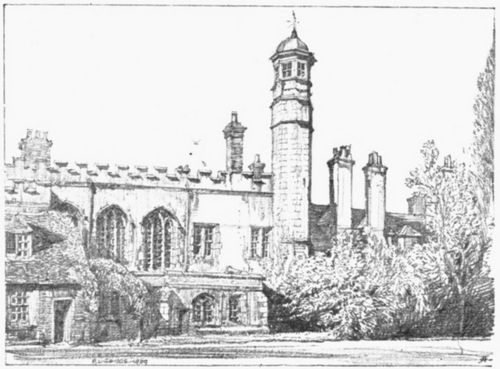
Christ's College Chapel.
But, to the ordinary visitor, the memory of even Lady Margaret is, at Christ's, overshadowed by the mightier memory of John Milton, who was in residence here for seven years, from 1625 till, in 1632, he became a Master of Arts. In residence along with him was his "Lycidas," whose real name was Edward King. In the gardens an ancient mulberry tree, so old that its stem has to be encased in a pyramid of turf, and its remaining arms jealously shored up, is called by his name. The tradition that he himself planted it is probably unfounded, but it was actually there in his day, one of the score of these trees which, by the desire of King James the First, were placed in the gardens.
Hidden in a thicket at the north-eastern corner is a sequestered swimming-bath, fed by a stream drawn off from Hobson's conduit. To climb the statue beside this and dive off the head is a current feat amongst Christ's men. Something of a feat it is; requiring considerable sureness of foot and skill in balancing oneself.
His hope was realised. Emmanuel at once sprang to the front as the great power-house of the Puritan movement in Cambridge; and so strong was that movement that for the moment it carried the College to the very top of the list, so that it surpassed in numbers even Trinity and St. John's. Many of the stalwarts who belonged to the Pilgrim Fathers of New England were here educated; notably John Harvard, whose name is borne by the Premier University of America. So also were many of the preachers who kindled and sustained the ardour of the Roundheads through the stress of the Civil War. Even after the Restoration the College retained the impress of its Founder's hope. When, in 1664, the Duke of Monmouth visited Cambridge, a satirical guide to the University, written in doggerel Latin verse for his benefit, sneers at the strict moral tone of Emmanuel: "You may well perceive that they are all Puritans here." And Archbishop Sancroft, famous as the chief of the Seven Bishops who made so staunch a stand against the toleration of Roman Catholics under James the Second, was an Emmanuel man.
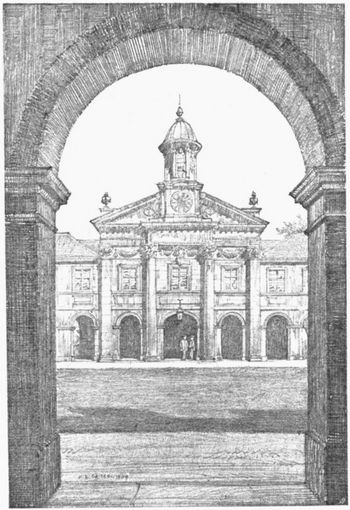
Emmanuel College.
Emmanuel has little architectural beauty; but there are pleasant grounds, with a swimming-bath, as at Christ's, and two larger ponds, in which swans and wild ducks are kept. The swimming-bath and the smaller pond are accessible only by the favour of a Fellow; but the large piece of water is in a great open court (beyond the first court). All are fed from a branch of the Hobson's Conduit stream, runlets from which run down St. Andrew's Street, even as they run down Trumpington Street. Beyond the swan-pond lie the new buildings, lately erected to meet the greater expansion of the College, for Emmanuel, after over two centuries of depression, now ranks (along with Caius and Pembroke) at the head of the list with regard to relative numbers, except Trinity alone. In actual numbers she broke in 1890 her record of 1628, and has gone on advancing steadily since. Her shield bears a blue lion ramping on a white ground and holding a laurel wreath, emblematic of the victory of the "Lion of the tribe of Judah."
To reach Downing to-day, one must turn to the left on leaving Emmanuel, and continue along the Via Devana (here called Regent Street) till large iron gates on the opposite side of the road invite us to enter the College grounds. These give still an impressive sense of space, though now curtailed at the southern as well as the northern end, and form a pretty setting for the two parallel ranges of yellow stone, which date from the beginning of the nineteenth century. For though Downing was by that time keeping the centenary of its foundation (by Sir George Downing, of Gamlingay in Cambridgeshire), the funds had not hitherto admitted of the erection of college buildings. When first set up, these classical frontages were considered the ne plus ultra of architectural perfection, and strangers were taken to see them as the great glory of Cambridge.
It is from this side that we notice how this is no ordinary milestone, but a grand monolith twelve or fifteen feet in length, and feel that it must have a story. And so indeed it has, for it is the very first milestone ever set up in Britain since the days of the Roman dominion here. In those days every great road in the country had its series of milestones recording the distance from the central milestone in London, which still exists, in its decay, as "London Stone." But after the mighty organisation of the Roman Empire lost its hold upon the land, roads went to ruin, and milestones were broken up or used for Anglo-Saxon gate-posts. Not till 1729 was the idea of restoring the system entertained; and it was a Cambridge College, Trinity Hall, that first took it up, and carried it out on the road from Cambridge to London. Hence it is that these milestones bear the Crescent of the College shield. And for their inaugural milestone was chosen this grand monolith, which was itself an old Roman milestone.
North-east of Cambridge stretch the mesh of dingy streets which make up the great suburb of Barnwell. Hither and thither they run, in soul-crushing monotony; yet even here there are gems of interest to be found. The suburb came into existence, to begin with, through the proximity of a great Abbey, the Augustinian Priory of Barnwell. This House of Religion was founded in the first instance by Hugoline, the pious wife of Picot, William the Conqueror's far from pious Sheriff of Cambridgeshire. It was by her located close beneath his dwelling-place in the Castle, and dedicated to St. Giles. Half a century later, the Picot land was forfeited for treason, and granted to Richard Peverel, who had been, in the First Crusade, standard-bearer to Robert Curthose, the Conqueror's eldest son. He transferred the House to the riverside, hard by a holy spring, the Burn Well (or source of the Brook), where a hermit of special sanctity had already reared an Oratory dedicated to St. Andrew. He also raised the number of monks from six to thirty, to correspond with that of his own years at the time.
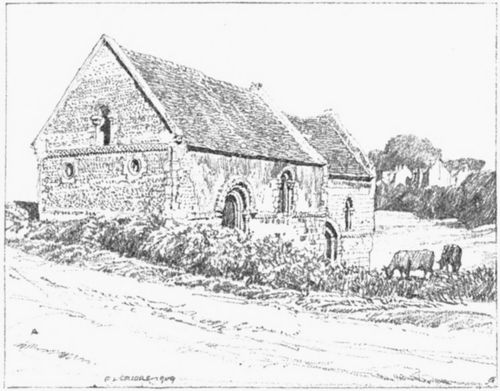
The Lepers' Chapel, Barnwell.
Pursuing the Newmarket Road, we find (at the point where it at last ceases to be a Barnwell Street, and crosses the railway into the open country beyond), yet another tiny ancient church, called traditionally the "Lepers' Chapel." It is of Norman date, and probably served the Lepers' Hospital, which we know to have existed hereabouts, as remote as might be from the town. This hospital was endowed by King John with the tolls of the great Fair held hard by on Stourbridge Common, which even so late as the Eighteenth Century boasted itself the largest and most important in all Europe, a position now claimed by that of Nijni Novgorod in Russia. And, to judge by the accounts that have come down to us, the boast was not unfounded. The Cambridgeshire historian, Carter, writing in 1753, thus describes it:
"Stourbridge Fair ... is set out annually on St. Bartholomew by the Mayor, Aldermen, and the rest of the Corporation of Cambridge; who all ride thither in a grand procession, with music playing before them, and most of the boys in the town on horseback after them, who, as soon as the ceremony is read over, ride races about the place; when returning to Cambridge each boy has a cake and some ale at the Town Hall. On the 7th of September they ride in the same manner to proclaim it; which being done, the Fair begins, and continues three weeks; though the greatest part is over in a fortnight.
"This Fair, which was thought some years ago to be the greatest in Europe, is kept in a cornfield, about half a mile square, having the River Cam running on the north side thereof, and the rivulet called the Stour (from which and the bridge over it the Fair received its name) on the east side, and it is about two miles east of Cambridge market-place; where, during the Fair, coaches, chaises, and chariots attend to carry persons to the Fair. The chief diversions at Stourbridge are drolls, rope-dancing, and sometimes a music-booth; but there is an Act of Parliament which prohibits the acting of plays within fifteen miles of Cambridge.
"If the field (on which the Fair is kept) is not cleared of the corn by the 24th of August, the builders may trample it under foot to build their booths; and, on the other hand, if the same be not cleared of the booths and material belonging thereto by Michaelmas Day at noon, the plough-men may enter the same with their horses, ploughs, and carts, and destroy whatever they find on the premises. The filth, dung, straw, etc., left behind by the fair-keepers, make amends for their trampling and hardening of the ground.
"The shops or booths are built in rows like streets, having each their name, as Garlick Row, Booksellers'-row, Cook-row, etc. And every commodity has its proper place, as the Cheese Fair, Hop Fair, Wool Fair, etc.; and here, as in several other streets or rows, are all sorts of traders, who sell by wholesale or retail, as goldsmiths, toy-men, brasiers, turners, milliners, haberdashers, hatters, mercers, drapers, pewterers, china warehouses, and, in a word, most trades that can be found in London, from whence many of them come. Here are also taverns, coffee-houses, and eating-houses in great plenty, and all kept in booths, in any of which (except the coffee-booth) you may at any time be accommodated with hot or cold roast goose, roast or boiled pork, etc.
"Crossing the main road at the south end of Garlick Row, and a little to the left hand, is a great Square, formed of the largest booths, called the Duddery, the area of which Square is from 240 to 300 feet, chiefly taken up with woollen drapers, wholesale tailors, and sellers of second-hand clothes; where the dealers have room before their booths to take down and open their packs, and bring in waggons to load and unload the same. In the centre of this Square was (till within these three years) erected a tall May-pole, with a vane at the top; and in this Square, on the two chief Sundays during the fair, both forenoon and afternoon, Divine Service is read, and a sermon preached from a pulpit placed in the open air, by the Minister of Barnwell; who is very well paid for the same by the contribution of the fair-keepers.
"In this Duddery only, it is said, there have been sold £100,000 worth of woollen manufactures in less than a week's time; besides the prodigious trade carried on here, by the wholesale tailors from London, and most other parts of England, who transact their business wholly in their pocket-books, and meeting here their chapmen from all parts, make up their accounts, receive money chiefly in bills, and take further orders. These, they say, exceed by far the sale of goods actually brought to the Fair, and delivered in kind; it being frequent for the London wholesale men to carry back orders from their dealers for £10,000 worth of goods a man, and some much more. And once in this Duddery, it is said, there was a booth consisting of six apartments, all belonging to a dealer in Norwich stuffs only, who had there above £20,000 worth of those goods.
"The trade for wool, hops, and leather here is prodigious; the quantity of wool only sold at one fair is said to have amounted to £50,000 or £60,000, and of hops very little less.
"September 14, being the Horse Fair day, is the day of the greatest hurry, when it is almost incredible to conceive what number of people there are, and the quantity of victuals that day consumed by them.
"During the Fair, Colchester oysters and white herrings, just coming into season, are in great request, at least by such as live in the inland parts of the kingdom, where they are seldom to be had fresh, especially the latter.
"The Fair is like a well-governed city; and less disorder and confusion to be seen there than in any other place where there is so great a concourse of people: here is a Court of Justice always open from morning till night, where the Mayor of Cambridge, or his Deputy, sits as Judge, determining all controversies in matters arising from the business of the Fair, and seeing the Peace thereof kept; for which purpose he hath eight servants, called Red-coats, attending him during the time of the Fair and other public occasions, one or other of which are constantly at hand in most parts of the Fair; and if any dispute arise between buyer and seller, on calling out 'Red-coat,' you have instantly one or more come running to you; and if the dispute is not quickly decided, the offender is carried to the said Court, where the case is decided in a summary way, from which sentence there lies no appeal.
"About two or three days after the Horse Fair day, when the hurry of the wholesale business is over, the country gentry for about ten or twelve miles round begin to come in with their sons and daughters; and though diversion is what chiefly brings them, yet it is not a little money they lay out among the tradesmen, toy-shops, etc., besides what is flung away to see the puppet shows, drolls, rope-dancing, live creatures, etc., of which there is commonly plenty.
"The last observation I shall make concerning this Fair is, how inconveniently a multitude of people are lodged there who keep it; their bed (if I may so call it) is laid on two or three boards, nailed to four pieces that bear it about a foot from the ground, and four boards round it, to keep the persons and their clothes from falling off, and is about five feet long, standing abroad all day if it rains not. At night it is taken into their booths, and put in to the best manner they can; at bed-time they get into it, and lie neck and heels together until the morning, if the wind and rain do not force them out sooner; for a high wind often blows down their booths, as it did A.D. 1741, and a heavy rain forces through the hair-cloth that covers it.
"Though the Corporation of Cambridge has the tolls of this Fair, and the government as aforesaid, yet the body of the University has the oversight of the weights and measures thereof (as well as at Midsummer and Reach Fairs) and the licensing of all show-booths, live creatures, etc.; and the Proctors of the University keep a Court there also to hear complaints about weights and measures, seek out and punish lewd women, and see that their Gownsmen commit no disorders."
Fuller (in the seventeenth century) gives us the tradition that the fair originated with some Westmorland cloth dealers, who were here overtaken by a storm on their way to Norwich, and found so ready a market for the goods which they spread out to dry on the grass of the common that they went no further but returned hither the next year, and again. Thus the special prominence given to the "Duddery" here is accounted for. The tradition does not seem improbable, for Kendal has, from time immemorial, been renowned for its cloth—the famous "Kendal green" worn, in old ballads, by the English archers. To this day the shield of that town bears cloth-making implements, with the motto "Pannus mihi panis" ("Flock is my food"). And Norwich was (throughout the Middle Ages) the great commercial centre of the cloth trade. That there was some marked connection between Cambridgeshire and Westmorland is proved by the constant occurrence here of family names derived from Kendal place-names (Sizergh, Docwray, Strickland, Sedgwick, etc.) which have been current amongst the peasantry of Cambridgeshire since the fourteenth century at least.
Since Carter wrote, the great development of communication has made fairs a mere survival, and Stourbridge Fair has fallen from its high estate. It is now a very commonplace affair of a few days' duration, mainly for the horse trade. But it still is declared open by the Mayor of Cambridge or his delegate, and a dish of the white herrings which Carter speaks of still forms part of the opening ceremony. And it has an abiding interest for English readers, as the prototype of "Vanity Fair" in the "Pilgrim's Progress." Bunyan, as a Bedford man, would be familiar with the bustling scene, and, if we compare his pages with those which we have transcribed from Carter's History, we see how vividly he has allegorised it:
"At this Fair are all such Merchandize sold as Houses, Lands, Trades, Places, Honours, Preferments, Titles, Countreys, Kingdoms, Lusts, Pleasures, and Delights of all sorts, as Whores, Bauds, Wives, Husbands, Children, Masters, Servants, Lives, Blood, Bodies, Souls, Silver, Gold, Pearls, Precious Stones, and what not.
"And moreover at this Fair there is at all times to be seen Juglings, Cheats, Games, Plays, Fools, Apes, Knaves, and Rogues, and that of every kind.
"Here are to be seen, too, and that for nothing, Thefts, Murders, Adulteries, False Swearings, and that of a blood-red colour.
"And as, in other Fairs of less moment, there are the several Rows and Streets, under their proper Names, here such and such Wares are vended, so here likewise you have the proper Places, Rows, and Streets (namely Countries and Kingdoms) where the Wares of this Fair are soonest to be found. Here is the Britain Row, the French Row, the Italian Row, the Spanish Row, the German Row, where several sorts of vanities are to be sold. But, as in other Fairs some one Commodity is the Chief of all the Fair, so the Wares of Rome and her Merchandize is greatly promoted in this Fair."
We find also reference to the standing Court of summary jurisdiction under "the Great One of the Fair," with "the trusty Friends" who formed his police, that took cognisance of the "Hubbub and great Stir in the Fair" caused by the demeanour of the pilgrims.
As an instance of how wide a range the commodities sold at this fair covered, we may mention that Sir Isaac Newton there bought his famous prisms—three of them for £3. They were probably of French or Italian make; no glass of this character was as yet manufactured in England.