Chapter VI
Reading edition
Round Church.—Union Society.—The "Great Bridge," Hithe.—Magdalene College, Buckingham College, Pepys, Charles Kingsley, the "College Window," Master's Garden.—Castle Hill, Camboritum, Cromwell's Rampart, Repulse of Charles I, the "Borough," View from Castle.—St. Peter's Church.—"School of Pythagoras."—Westminster College.—Ridley Hall.—Newnham College.—Selwyn College.—Convent of St. Radegund, Bishop Alcock.—Midsummer Common.—Boat Houses, Bumping Races.—Jesus College, "Chimney," Cloisters, Chapter House, Chapel, Cranmer, Coleridge.
Starting once more from the Great Gate of Trinity and turning northwards past St. John's we soon reach the "Via Devana," the old Roman road which, as has been said, is the backbone of Cambridge, traversing the town, under various names, from end to end. At this point of its course it is called Bridge-street. Opposite to us, as we enter it, rises one of the most distinctive buildings of Cambridge, the Church of the Holy Sepulchre, popularly known as "the Round Church." Its strange shape is an echo of the Crusading period, during the whole of which such reproductions of the famous church of the Holy Sepulchre at Jerusalem, the deliverance of which from the Turks was the Crusaders' dream, were erected in various parts of England. Earliest in date comes the Church of the Holy Sepulchre at Northampton, built at the very beginning of the twelfth century, in the opening fervour of the first Crusade, which has also given us the beautiful old chapel of Ludlow Castle (now in ruins) and this church in Cambridge. The gallant but fruitless effort of Richard Cœur de Lion to retrieve the disastrous loss of Jerusalem is commemorated by the Temple Church in London, completed at the very close of that century; while the yet more fruitless endeavours of Edward the First, a century later again, in the last expiring flash of Crusading zeal, inspired the latest of our English Round Churches, that of Maplestead in Essex. In all these churches the reproduction of their original is of a very modified character.
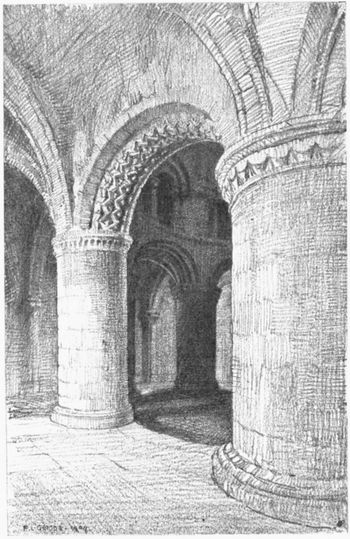
The Church of the Holy Sepulchre.
"When the Favourite comes, With his trumpets and drums, And his arms, and his metaphors, crossed."
To the North of the Bridge, and on the Eastern bank of the River, is the last of the many "Hithes" (or Quays), of which we read so much in connection with old Cambridge, remaining in actual use for traffic. Here we may to this day see exemplified the ancient local proverb, "Here water kindleth fire;" for barges loaded with fire-wood and turf from the fens still discharge their cargoes at this spot.
The beginnings of the re-founded College were on a very small scale, with only a single College servant (who acted as cook). Even forty years later this number, as Dr. Caius tells us, had only increased to three. To this day, indeed, Magdalene remains a small and select College. It consists of a single Court, representing Buckingham College, and the further side only of a second Court beyond. This isolated side, an admirable arcade, built at the close of the seventeenth century, contains the special treasure of the College, the collection of books bequeathed to it by the famous diarist, Samuel Pepys. This remains, as he himself arranged it, in twelve oaken "presses" with glass doors; the books on each shelf being brought to a common top level by appropriately graduated blocks of wood (shaped in imitation of their backs) inserted under each. The Library is on view on Tuesdays and Thursdays during Full Term, from 11.30 to 1 o'clock. Over the door is the Pepys motto: Mens cujusque is est quisque. ("Each man's mind is his very Self.")
Pepys had been a student here, and his portrait, by Lely, hangs in the Hall. So does that of another distinguished Magdalene man, Charles Kingsley, who was in residence 1839 to 1842. College tradition still records how he used surreptitiously to climb out of the College in the very early summer mornings, to be off on one of those piscatorial excursions which he so dearly loved. Another well-known writer connected with Magdalene is Mr. A. C. Benson, whose "College Window" was in the ground floor of the Pepysian Library range, on the North side, looking into the gardens of the Master's Lodge. In these gardens is a high terraced walk, beneath an old wall. Both terrace and wall are supposed to be connected with the ancient defences of Cambridge, but this is not proven.
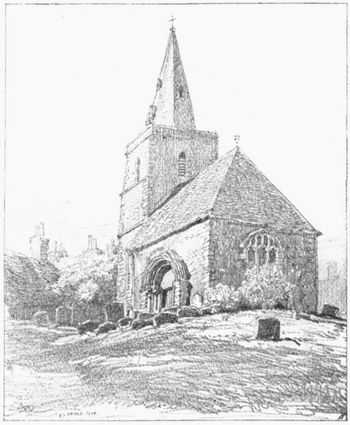
St. Peter's Church.
Many antiquarians, indeed, hold that the Cambridge of early days (anyhow down to the ninth century) was wholly confined to this small area, some quarter of a mile square, and that the extension of the town across the river was due to the expulsion of the inhabitants by Danish and Norman intruders. Be that as it may, we are here undoubtedly in the earliest Cambridge. The Castle has gradually passed away, till no ruins, even, are now left. Its modern representative, the County Court-house, where the Assizes are held, and the County Gaol, stand at the western foot of the great mound, whereon the Norman Keep no longer rises. From the summit is to be obtained a delightful view of Cambridge, with the "green-muffled" ring of the Backs, and the grey inner ring of the river-side Colleges, dominated by King's College Chapel, girding in the western flank of the Town, and starting almost from our feet; the long line of the East Anglian heights bounding our southern and eastern prospect; and to the north the "boundless plain," with the towers of Ely on the far horizon.
Close below us, and really at our very feet, rise the two churches of this earliest Cambridge, that of St. Giles, now merely a handsome modern edifice of imposing size, and that of St. Peter, also modern in its present form, but embodying some ancient features. It is the smallest church in Cambridge, only thirty-five feet in length by fifteen in width, being the reconstructed fragment of a larger structure built in the twelfth century, and pulled down in the eighteenth, when the Parish was united to that of St. Giles. It contains a fine late Norman font, with grotesque figures at each corner—two-tailed Mer-men, each grasping his tails in either hand. At one time the Borough had yet a third church, "All Hallows by the Castle" (so called to distinguish it from "All Hallows in the Jewry"), but this has wholly disappeared, Parish and all.
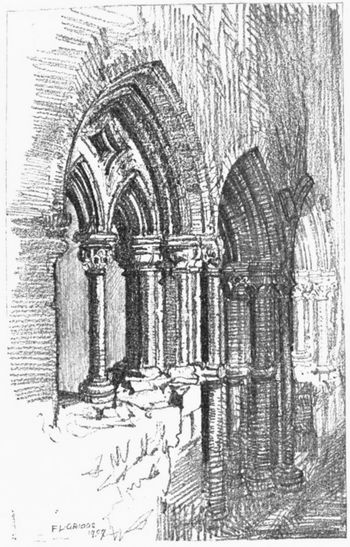
Remains of St. Radegund's Priory.
Beyond the spire of St. Peter's, as seen from the top of Castle Hill, may be distinguished a small mediæval building, known, for some forgotten reason, by the high-sounding title of "the School of Pythagoras." This lies just off the street to the eastward, at the point where this ceases to be a street, and merges into the open road that runs along the Backs. It is worth seeking out, for it is a picturesque little edifice, and an interesting example of a twelfth-century house built of stone. Wood, or, at the best, brick, were the materials then commonly used. In spite of the name, there is no reason to suppose that it was ever used for scholastic purposes, or anything more than a mere private dwelling-house. But Walter de Merton, the founder of Merton College, Oxford, actually acquired land hereabouts, apparently with some idea of starting a sister establishment at Cambridge. This land still belongs to Merton.
The great red brick and white stone edifice opposite the entrance to the School of Pythagoras is "Westminster College," wherein candidates for the Presbyterian ministry go through their theological course, after completing their secular studies at the University. A like institution for Anglicans, built in like style (which, indeed, is all but universal in modern academic work), is Ridley Hall, at the other end of the Backs. Neither of these is recognised by the University as anything more than a private lodging-house, nor is the similar (but much smaller) Roman Catholic seminary of Edmundhouse, on the slope above Westminster College.
The same non-recognition extends to the great Ladies' College of Newnham, which flings out its widespread "halls" over a lavish space adjoining Ridley. The grand bronze entrance gates to these "vestal precincts," inscribed with the name of the first Principal of the College, Miss Anne Jemima Clough (sister to the poet Arthur Clough) are hard by the more modest entrance to Ridley, and admit the visitor to a scene which reminds us of those in Tennyson's "Princess." And there are almost as many maidens here as he has assigned to his imaginary College, for Newnham is surpassed in the number of its students by Trinity only. Each has her own room, in which the bed becomes by day a sofa. Each is assigned to one of the "Halls," which in many respects are treated as separate entities, but all share the common collegiate life. There is, however, no chapel, for Newnham is most strictly undenominational. Students are, of course, free to attend any place of worship they may prefer, the preference being largely given to King's College Chapel. Hence a French traveller, who came over to study Women's Education in England, is said to have answered when asked on his return what religion was professed at Newnham: "Mostly, I think, the King's religion."
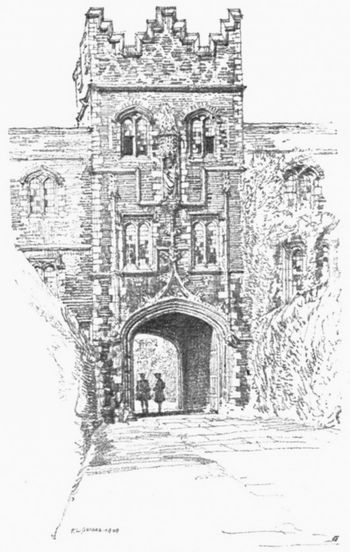
Jesus College Gateway.
Immediately to the north of Newnham is Selwyn College, a denominational institution belonging to the Church of England, corresponding to Keble College at Oxford, and, like it, recognised by the University, not indeed as a College, but as a "Public Hostel," whose undergraduates are not mere "non-collegiate students." Such "unattached" students are under a "Censor" and a special syndicate, and have a centre in the "Fitzwilliam Hall" (close to the museum of that name), where they have to report themselves daily.
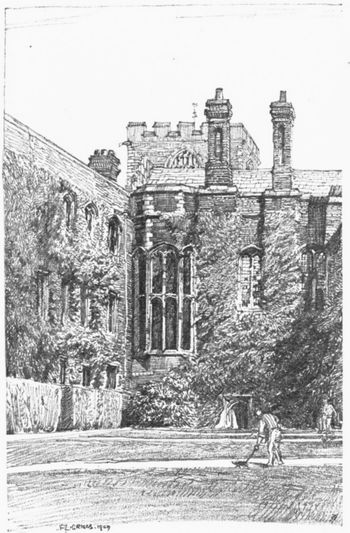
The Back Court, Jesus College.
Looking eastwards from the Castle Hill, we see a wide, open green stretching from the further bank of the river, and beyond it a low church tower rising amid trees. This is the tower of Jesus College Chapel, once the Priory Church of St. Radegund. This lady was a Frankish queen of the sixth century, and a friend of the poet Venantius, the author of the well-known hymns Vexilla Regis and Pange Lingua. Under her dedication a Benedictine nunnery was founded here at the beginning of the eleventh century. It was never a large or wealthy institution, but continued to flourish for four hundred years and more. In 1455 its account books, still preserved among the archives of Jesus College, show an income of £70 per annum, equivalent in purchasing power to some £1,200 at the present value of money. Every Benedictine nun ranked socially as a gentlewoman, so that this income needed careful administration to make it suffice for the nine or ten sisters in residence. The Convent, however, was at this date quite solvent, but in less than twenty years a single incapable Prioress had run it deep in debt. The butcher's bill alone then amounted to £21 (equivalent to over £350), and, having no cash to pay withal, the nuns were taking two of his daughters free amongst the boarders whom they educated. They were also alienating their capital, so that the income was rapidly dwindling. In 1481 it had decreased by more than 50 per cent., and was only £30. The next Prioress was a strong and capable ruler, imposed upon the convent by the Bishop of the Diocese, who was its Visitor. But things had gone too far, and, in spite of her efforts, the place dwindled away. By 1496 there were only two nuns left, and, under Royal license, the convent was turned into "Jesus College" by the same Visitor. His name was Alcock, so his coat of arms bore three cocks' heads, with yet another cock for crest. This device confronts us at every turn in our passage through the College.
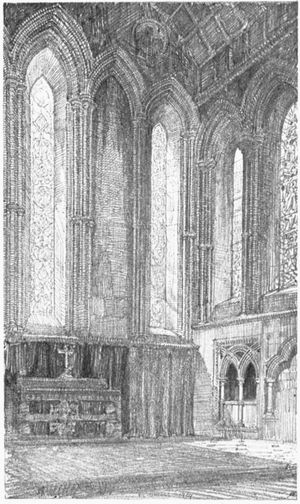
Jesus College Chapel, East End.
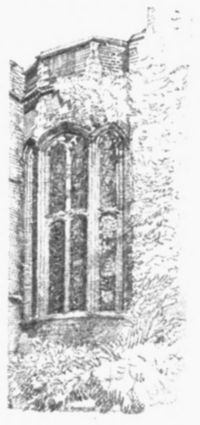
Oriel of Hall, Jesus College.
The western portion of that common is often called "Jesus Green." It witnessed the execution of the only Marian martyr burnt at Cambridge. His pile was largely formed of Protestant books of devotion, one of which, "a Communion Book," he picked up and read diligently till the flames overpowered him, "praising God, who had sent him this consolation in his death."