Chapter IV
Reading edition
Spiked gates.—Old King's.—University Library, Origin, Growth, Codex Bezæ.—Trinity Hall, Colours, Library.—Clare College, "Poison Cup," Court, Bridge, Avenue.—The Backs, Sirdar Bonfire, College Gardens.—Trinity College, Michaelhouse, King's Hall, Henry the Eighth, Boat-clubs, Avenue, College Livings, Bridge, Library, Byron, Nevile's Court, Cloisters, Echo, "Freshman's Pillar," Prince Edward, Royal Ball, Goodhart, Buttery, College Plate, Grace-cup, Kitchen, Hall, Combination Room, Marquis of Granby, Tutors, Old Court, Fountain, Gate Towers, Clock, Lodge, Chapel, Newton, Organ, Bentley, Windows, Macaulay.
The formidable chevaux-de-frise which crown this gate are supposed at once to figure and to emphasise the danger run by such presumptuous students as dare to contemplate illicit exit from or entrance into the College during prohibited hours. It has already been said that between 10 p.m. and 7 a.m. no undergraduate resident in College may leave its precincts, and no outsider may enter, under divers pains and penalties. Every College supplements this moral pressure by more or less effectual and awe-inspiring physical barriers. None however are more fearsome to see, and less effective in fact, than these. For not only can the College be entered or left with comparative ease by way of the Backs, but even this ghastly array of spikes is not unscalable to those who know the trick of it. Tennyson, as will be remembered, has referred to this exploit in his "Princess."
Passing beneath them we find ourselves again in that same ancient street of Cambridge, here again now a wholly Academic byway, by which we entered King's. But though we have left the College behind us we have not yet quite got clear of its associations. The fine modern Gothic pile to our right embeds, as we see, an ancient gateway. For more than three and a half centuries this was the entrance to the one small Court which alone represented the magnificent design of Henry the Sixth for his Royal Foundation. Not till the nineteenth century dawned were the students moved to the other side of the Chapel. The old precincts were then mostly destroyed, and the site made over to the University Library; for the growth of that magnificent institution has long taxed to the utmost all the accommodation that can be provided for it.
The mediæval Library of the University was a collection of manuscripts, requiring only one small room. Of its eighteen book-cases, eight were devoted to Theology, four to Law, and one apiece to Classics, Mathematics, Medicine, Logic, Moral Philosophy, and Scholasticism. This original Library was utterly swept away at the Reformation: Dr. Perne of Peterhouse, when Vice-Chancellor in the reign of Edward the Sixth, thus signalising his new-born zeal for Protestantism. A few years later, however, we find him amongst the first founders of the present Library, which now ranks third amongst the great Libraries of England; that of the British Museum standing first, and the Bodleian Library at Oxford second. All three are entitled to a free copy of every book published in the kingdom; so that their growth is now-a-days portentously rapid. One of the most striking features in this Library is the tableful of new books, scores in number, which is cleared every Friday.
The Library is open only to Members of the University (Masters of Arts having the privilege of taking out not more than ten books at a time) and such ladies as are fortunate enough to find a place on the admission list. For this it is needful that two Masters of Arts should certify that the lady is, to their personal knowledge, seriously engaged in some branch of study or research. And even when admitted, she finds herself under disabilities, being forbidden to occupy any seat except in one room (the oriel window of which is visible from our standpoint at the gate of King's). Ordinary visitors may only enter under the escort of an M.A., who may take in six at a time.
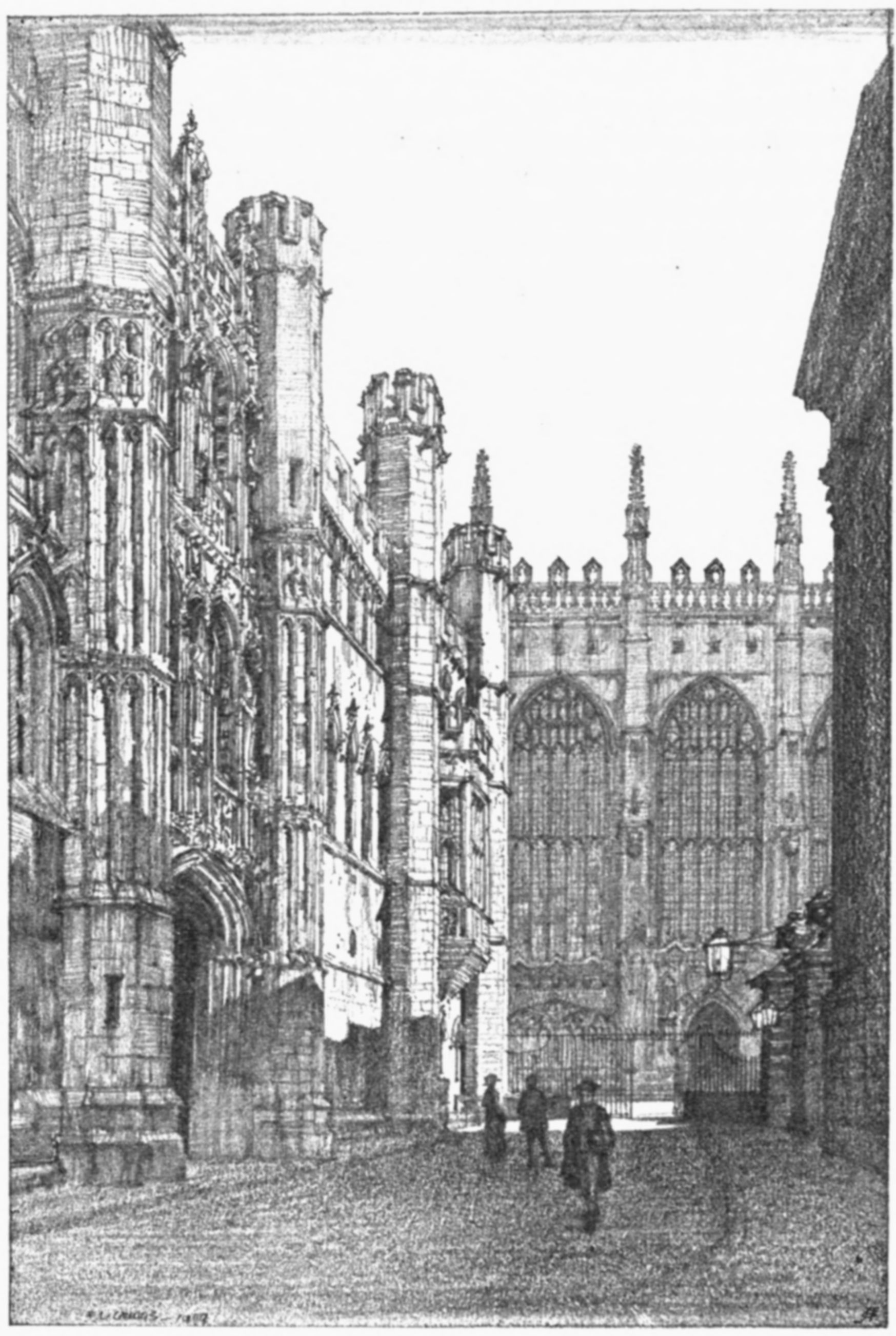
Old Gate of King's College.
Those who have the good hap to be thus inducted, will, besides the new books, probably be most impressed by the long range of volumes forming the catalogue, and by the densely packed shelves of long-forgotten fiction in the "Novel Room." But the real treasures of the Library are to be found in Cockerell's Building. Here, in a range of cases, are to be seen our best Manuscripts, including a Thirteenth Century life of Edward the Confessor, the illustrations in which were found useful as a precedent even at the coronation of his latest namesake on the British Throne. At the extreme end, in a separate case, is the crown of all, one of the earliest manuscripts of the Gospels, dating from the Fifth Century. Only four others of equal authority are known, one in the British Museum, one in the Vatican Library, one at Paris, and one at St. Petersburg. Ours is known as "D" or "Codex Bezæ," from being the gift of the celebrated Calvinist divine Theodore Beza, who procured it from a soldier after the sack of its early home, the Monastery of St. Irenaeus at Lyons, in the Sixteenth Century. It is noteworthy for containing passages not found in any other Codex, one of which may be read (in Greek and Latin) on the single leaf here exposed to view. It narrates how our Lord, "seeing a certain man working on the Sabbath, said unto him: Man, if thou art doing this with Knowledge thou art blessed, but if without Knowledge thou art cursed."
Space does not permit us to enlarge further on the Library; and we return to our station at the old gate of King's College. As we look along the lane our view is bounded by the College whose name it now bears, Trinity Hall. This must not be confounded with the larger and later Foundation of Trinity College, next door to it beyond. Trinity Hall was founded in 1350, by Bishop Bateman of Norwich, specially for the education of Clergy. It has, however, actually, become especially given to the study of Law, and is yet more widely known by its prowess in aquatics. Its boat, for the last half century, has never been far from the Headship of the River, and has oftener attained that coveted position than any other. The colours of the College, white and black, are thus of wide renown. They are derived from the College Shield, which in heraldic language is sable a crescent ermines with a bordure ermines. Visitors who approach Cambridge by the London road see this device upon the milestones near the town, which were set up by the College in the eighteenth century, and were the first milestones erected in Britain since the days of the Roman occupation.
The Library here (which is open to visitors from noon to 1 P.M. in Full Term) is the best example left us of what libraries were of old in Cambridge. It was built about 1560, and still retains its original book-cases, the tops of which form desks for reading the folios in the shelves beneath. These were in old days chained to rings sliding on a locked bar which ran the whole length of each desk. Some of the books are so chained still, but not in the ancient fashion; for of old books were shelved with the backs inward, the title being written across the closed leaves of the front.
Otherwise the College has little to show us; and, instead of seeking it, we shall do better if we turn westwards through the specially beautiful iron gate which leads us into Clare College. The coat of arms beneath which we pass as we enter has its tale to tell concerning the foundation of the College. They are those of the noble lady who, in 1338, thus commemorated her widowhood, an example followed, as we have seen, in the next decade, by Marie de Valence at Pembroke. But Lady Elizabeth, daughter of Gilbert de Clare (the "Red Earl" mentioned in Marmion), had gone through no fewer than three of these lamentable experiences. She therefore not only charged her College Shield with the golden chevronels of Clare impaled with the golden cross of De Burgh (her latest husband), but surrounded the whole with a sable bordure besprinkled with golden heraldic tears, bearing perennial witness to her repeated sorrows. Hence it comes that the Clare "colours" are to this day black and gold.
Passing through the court, we come to the beautiful bridge, already familiar to us from the river. Its balustraded parapet is surmounted by fourteen large balls of stone, thirteen of them whole, and one out of which a cantle of nearly a quarter of its bulk has, for some unknown reason and at some unknown date, been cut. A cheap laugh may thus be obtained by challenging a stranger to count these balls accurately; for the missing cantle, being turned towards the river, is quite invisible from the bridge itself. Another feature in connection with these balls is that one of them is visibly much newer than the rest (which, like the bridge, date from the middle of the seventeenth century). This is due to a not very far off feud between Clare and St. John's, when a piratical Johnian crew came up the river after dark and stormed the bridge. Before the enraged Clare men could open the iron gate under the College archway and pour out to the rescue, the enemy had begun throwing the balls into the water, where one sank so deep into the muddy bottom that it could never be recovered.
From the bridge we get a lovely view of the College "Backs." To the south the single slender arch of King's Bridge flings itself over the river in the graceful curve which is all its own; to the north we see the iron span of Garret Hostel Bridge, hiding from us the beauties of Trinity Bridge beyond. But, if there be no ripple upon the water, the three graceful arches of this invisible bridge are seen reflected upon the glassy surface with a specially charming effect. The whole view is amongst the world's loveliest, especially in the May term, when the Master's little garden to our right glows with bright colour, answered across the stream by that of the Fellows; when the water is alive with gay little craft, gigs, punts, and canoes; and when the "ambrosial dark" of the Avenue before us beckons us on to explore the delights of its umbrageous depths. It was planted in 1691, and is carried for 150 yards on a wide embankment, dense with shrubs and closed with jealously-spiked gates at either end, across what was once an island in the river (known as Butts Close), till it debouches on to the elm-shaded length of greensward described in our opening page, and named, in old maps of Cambridge, "King's College Back-sides." The whole does, in fact, belong to King's, but the many rights of way which traverse it make it practically an open park.
Not so long ago oaken railings (still to be seen in places) ran between it and the road, till a visit from Lord Kitchener (then Sirdar of Egypt, fresh from his Ethiopian victories) was made the occasion of a gigantic bonfire in the Market Place, to feed which the whole were torn up and carried away by gangs of enthusiastic undergraduates. A like fate befell the wooden palings and gates of the College gardens across the road, now replaced by iron, and altogether the damage done ran into hundreds of pounds; while the town police and the University proctors waited for each other to act until too late. There are three of these College gardens on end—King's, Clare, and Trinity; and rarely lovely they are, with their wide "smooth-shaven" lawns, broken into glades by clumps of ornamental trees. But each can only be entered under the ægis of a Fellow of its own respective College, and they are so carefully planted out from the road that scarcely even a glimpse can be gained of the delights within, "where no profaner eye may look."
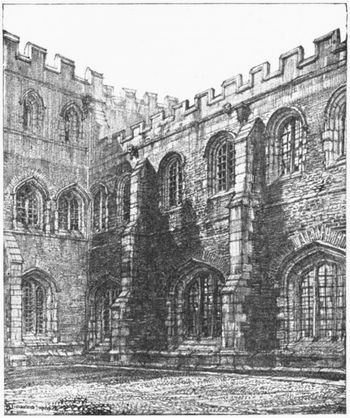
Old Schools' Quadrangle.
All these, Colleges and Hostels alike, were seized upon by Henry the Eighth, when that rapacious and unprincipled monarch desired to pose (in 1546, a year before his death) as a Pious Founder, and go down to posterity as a benefactor. He gained this credit cheaply; for not only did he thus get his edifices ready made, but their endowments also; while such additional endowments as he bestowed on his new College were almost wholly derived from the spoil of the Abbeys suppressed by him. Nor did he fail to take toll of each transfer of this stolen property for the benefit of his exchequer. His professed object, meanwhile, was "to educate Youth in piety, virtue, self-restraint, charity towards the poor, and relief of the distressed." His alumni, in short, were to be made as opposite to himself in character as possible.
We have here in front of us the New Court of St. John's College, seen across its lawn-tennis grounds; while to our left is the magnificent range of horse-chestnuts along the boundary of the two Colleges. Splendid at all times, these are seen at their very best when duly touched by frost. To our right rises the fine mass of Trinity Library, built by Sir Christopher Wren in 1675; whose walls of warm-coloured stone have been already dwelt upon. The lower portion of the building forms an open cloister, with grated windows and gates barring it from the Backs where we stand.
Through one of these gates our path leads us, and we find ourselves within the College, and at the door of the Library. At certain hours, usually between three and four in the afternoon, this is open to visitors; at others the escort of a Member of the College is needed. Of all the College Libraries in Cambridge this is the most interesting in its miscellaneous contents. Mounting the wide stone stair-way, we enter the long, wide, lofty, vaulted gallery, with a series of wooden book-cases projecting from either wall all along its course. The carved wreaths of flowers and leaves and fruitage which adorn these cases deserve careful notice. They are by Grinling Gibbons, probably the most wonderful wood carver who ever lived, and their intricacies bear striking testimony to his almost superhuman skill. In the recesses between the cases are to be seen sundry curios, from the College estates and other sources, while more are to be found in the long ranges of glass-covered tables topping the smaller book-shelves which line either side of the central passage way. Roman and Anglo-Saxon antiquities, and a splendid series of coins and medals, are here exhibited. Amongst the miscellaneous curios are a model of Cæsar's famous bridge across the Rhine and a globe of the planet Mars.
What will, however, first catch our eye on entering, will be the window at the southern end of the room, with its painted glass so unlike anything to be seen elsewhere. It is, in fact, unique, having been made in the middle of the eighteenth century by the discoverer of this particular method of staining glass, who kept the process secret—a secret which died with him and has never been recovered. The window cannot be called artistically beautiful, and the subject is weird. The University of Cambridge, represented as a lady in a somewhat scanty robe of yellow, is presenting Sir Isaac Newton to King George the Third (who did not come to the Throne till 1760, many years after the great philosopher died), while the transaction is being recorded by Francis Bacon Lord Verulam of Elizabethan fame!
And here is a copy of the famous Indulgence sold by Tetzel, Luther's denunciation of which gave the signal for the earliest outburst of Protestantism at the Reformation. When the crabbed old printing is deciphered it proves to be a startlingly mild document, no licence to commit sin, as is generally supposed, but merely granting to the purchaser the privilege of confessing, once in his life, to a priest of his own choice instead of to the parson in whose parish he dwelt. The priest so chosen is given authority to absolve from nearly all sins, but not from the heinous offence of buying alum from anyone except the Pope, in whose territory it had, at that date (1515), been recently discovered. Alum was in those days a most valuable substance, and had hitherto been attainable only at the Turkish town of Roc, in Syria, whence the name of "rock alum" still surviving in use amongst pharmacopœists. To buy it there was not only to take money out of the pocket of the Pope, but to put it into those of the enemies of Christendom. Hence the heinousness of the offence.
Trinity library forms the western side of one of the Courts of the College, known as "Nevile's Court" (from Dr. Thomas Nevile, Master at the close of the sixteenth century, who planned and began it in 1610), and also as "Cloister Court," from the wide cloisters which surround it on the north, south, and west. The eastern side is formed by the Hall, raised four feet above the ground level, and reached by a beautiful balustraded and terraced staircase of stone. It is the finest college hall in either university, and was also the work of Nevile.
In the northern cloister which leads us to it, there are sundry points not to be overlooked. As we look along it from the library entrance we perceive at the far end a door with a stalwart iron knocker. Now there is a fine echo in this cloister, and a stamp of the foot at our end will evoke a sound from the door precisely like that of a knocker. So great a part does illusion play in human impressions, that five people out of six, when they hear this sound, are ready to declare that they have seen the knocker actually move. It was by timing this echo, we may mention, that Sir Isaac Newton first measured the velocity of sound. The echoing properties of these cloisters are referred to by Tennyson in the "Princess":
"our cloisters echoed frosty feet."
The massive block which pillars the angle of the cloister is known as the "Freshman's Pillar"; a favourite old-time amusement of the junior students (not yet wholly disremembered) having been to traverse the very narrow base-top right round, without setting foot to the ground. In old times, indeed until the last quarter of the nineteenth century, these cloisters played a notable part in undergraduate life. Athletic pursuits were far less general than now, and exercise was largely pedestrian. On a wet day, accordingly, when the roads were uninviting, the cloisters used to be crowded with a veritable swarm of trampers, doing "quarter-deck" from end to end of the three covered sides of the court.
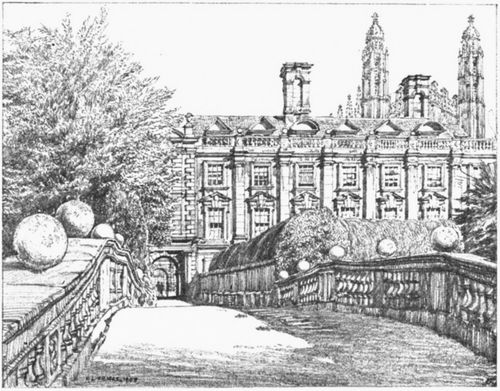
Clare College from Bridge.
The beautiful rooms of Nevile's Court are mostly held by Fellows of the College whose names may be known in the doorway lists by the "Mr." prefixed to them. Over one doorway we see a small bronze bust, set up as a memorial to Mr. Goodhart who once "kept" there and was an object of special admiration to all who knew him. He was, in fact, a kind of Admirable Crichton; not only a man of great intellectual power (as Fellows of Trinity must needs be, for these fellowships are the "blue riband" of the University), but excellent at all athletic pursuits, and able to do successfully whatever thing he set his hand to. It is recorded that on one occasion a bet was laid that he could not make himself an entire suit of clothes, and wear them for a month without their amateur origin being detected. Goodhart won the bet.
A sight of the kitchen, which adjoins the Buttery, can almost always be had, and is worth having; though the glory of the place has largely departed with the substitution of gas stoves for the old open ranges, six feet high and twelve feet long, before which scores of joints and fowls might be seen simultaneously twisting on huge spits. If less picturesque, the cooking is now more scientific, and the kitchen is a splendid chamber, the finest of all College kitchens, with an open pitched roof, and an oriel window, having been traditionally the ancient Hall of Michaelhouse. The walls are adorned with the shells of turtles, emblazoned with the dates of the great occasions on which they were immolated for soup. It is not only the dinners in Hall which are here cooked. Members of the College may order dishes to be sent to their own rooms, in reason; though any very extra expenditure in this respect would need to be authorised by your Tutor. This extraneous fare may constantly be seen being carried about the Courts, in large flat blue boxes, on the heads of the kitchen servants.
The high-pitched roof with its elaborate beams is copied, as are the other features (and the dimensions) of the Hall, from the Hall of the Middle Temple in London. Its ridge is broken in the centre by a "Lantern," or small openwork spire of wood (the openings being now glazed). This once served as a ventilating shaft, through which might escape the fumes of the great brazier (a yard in depth and two yards across) standing beneath it, and, till this generation, the only means used to warm the Hall. Over the doors is a "Music Gallery," usually closed in by quaintly carved shutters, whence, on Feast days, the College Choristers still discourse melody. The armorial bearings in the windows are those of eminent members of the College; while pictures of its more prominent Worthies (or Unworthies) hang on the walls. Conspicuous amongst these is Holbein's great portrait of Henry the Eighth, who stands "straddled over the whole breadth of the way," above the centre of the High Table, in all his underbred self-assertion, looking indeed "all our fancy painted him." His unhappy daughter Mary (who built the College Chapel) hangs near him, her full dourness and wretchedness in her face. Thackeray (a singularly powerful presentation) is also here, so is Clerk-Maxwell, so is Bishop Lightfoot, and many another light of literature, science, and theology; for the great size of Trinity has given it as great a proportion in the rolls of Fame.
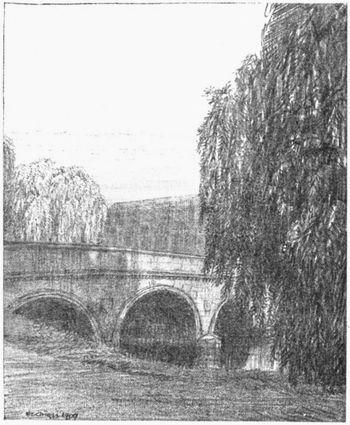
Trinity Bridge.
Since his day, indeed, surprisingly little alteration has been made. Plaster has been put on (and stripped off) here and there, stonework has been touched up, the Master's Lodge has been altered and re-altered, but the only radical change has been in the south-west corner beyond the Hall, which was rebuilt in 1775, with results as artistically deplorable as may well be, especially in comparison with the older work. Nevile had left in this corner a beautiful oriel window, still to be seen in Logan's view of the College (1680).
Of the three gate towers only one is of Nevile's own building, that on the southern side of the Court, known as the Queen's Gate from the statue of Anne of Denmark, the Queen Consort of James the First, which stands above its inner archway. The gate of this tower is used only on occasions. The other two both belonged to King's Hall; the eastern being still in its original place, the northern, which formerly aligned with it, having been moved back by Nevile to align with the Chapel. Both set forth the glories of Edward the Third; the former displaying over its entrance gate the armorial bearings of his seven sons, while over the archway of the latter he stands himself, with his three crowns (of England, France and Scotland) spitted on the long naked sword which he holds erect in front of him, and the proud motto "Fama super æthera notus" ("Known by Fame beyond the skies"). From his like niche in the eastern tower he has been displaced by Henry the Eighth. The statues on the inside of this tower are James the First, with his wife and son (afterwards Charles the First).
The northern tower is commonly known as the Clock Tower; being the dwelling place of the famous timepiece referred to by Wordsworth in the "Prelude" as breaking the silence of his rooms at St. John's College, which were not many yards away:
"Near me hung Trinity's loquacious clock, Who never let the quarters, night or day, Slip by him unproclaimed, and told the hours Twice over, with a male and female voice."
To complete the round of the Court outside the grass-plots while midnight strikes is a favourite test of running powers amongst the Undergraduates. It is a fairly severe one; for the distance is 383 yards, with four sharp corners to negotiate, on somewhat pronounced pebbling, and the time occupied by the 32 strokes (8 for the 4 quarters and a double 12 for the hour) is only 43 seconds. An easier performance is to make a standing jump from top to bottom of the steps before the Hall; this is chiefly a trial of nerve. There are 8 steps, each 6 inches high and 15 wide, so that the drop is only 4 feet and the distance under 10; but it is a fearsome thought, looking down, to contemplate the result should one's heel catch on a step. To jump clear up the flight is a real feat, which only two men are known to have accomplished: even with the preliminary run which is possible below though not above the stairway.
Other heroic figures are grouped around, Francis Bacon, (Tennyson's
"Large-browed Verulam The first of those that know,")
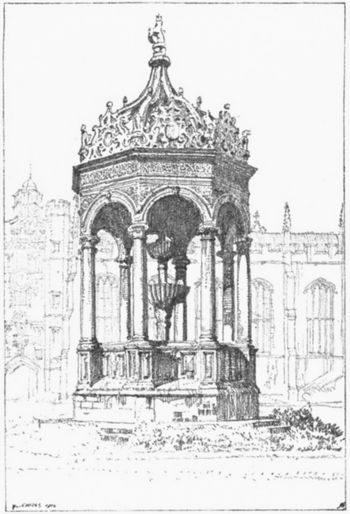
The Fountain, Trinity College.
"Trinity's full tide of life flooding o'er him Morning and evening as he lies dead."
The profuse gilding and painting which enriches walls and roof in the Chapel is due to a restoration some forty years ago, when the outside was also faced with stone, and the windows filled with stained glass, commemorating ecclesiastical and other celebrities throughout all the Christian centuries. The Apostles appear in the most easterly windows on either side; whence the series progresses in chronological order westwards. The figures are for the most part powerfully drawn, and should be examined through an opera glass to appreciate their wealth of detail. We can thus see that Hildebrand has driven his crosier through the eagles of the Imperial Crown, that Dante, Matthew Paris, and Roger Bacon, hold in their hands copies of their own greatest works, that Giotto is studying an elevation of his Campanile; while noted church-builders, like St. Hugh of Lincoln and William of Wykeham, carry models of their edifices. The hapless Mary Tudor holds one of this very Chapel, of which she was the Foundress. It is appropriate that the beautiful silver cross over the Altar should be Spanish work of her date, though only placed there a few years ago by the generosity of some members of the College who met with it while travelling in Spain. It was originally a processional cross, and has been adapted for its new purpose with artistic skill of the first order.