Chapter V
Reading edition
Whewell's Courts.—All Saints' Cross.—The Jewry.—Divinity School.—St. John's College, Trinity and John's, Lady Margaret, Fisher, Hospital of St. John, Gate Tower, First Court, Hall, Wordsworth, Compulsory Worship, Combination Room, Second Court, Library, Great Bible, Third Court, Bridge of Sighs, New Court, Roof-climbing, Blazers, Wilderness.—Caius College, Gonville, The Three Gates, Kitchen, "Blues."—Senate House, Congregations, Vice-Chancellor, Voting, Degree-giving.—University Church, Mr. Tripos, Golgotha, Sermons, Tower, Chimes, Jowett.—Market Hill, Peasant Revolt, Wat Tyler, Bucer and Fagius, Bonfires, Town and Gown.
The slender and lofty stone cross to the north of these buildings marks the site of the ancient church of All Saints, which was pulled down in the middle of last century, to be rebuilt at the further extremity of its parish, opposite the entrance to Jesus College. Its earliest name (in the twelfth century) was "All Hallows in the Jewry"; for Cambridge made good its claim to be amongst the larger towns of England by having, like the most of them, its Ghetto, or quarter (more or less sharply divided off from the rest), in which alone the Jews might reside. They were nowhere popular residents, for they were outside the pale of the Law (which refused to take cognisance of aliens in race and religion) and mere "chattels" of the Crown. This position, however ignominious, gave them special privileges as against their neighbours. They were too useful as financial assets to allow of their being murdered or robbed by anyone but their Royal owner himself; and, secure in his protection, they took small pains to conceal their contempt for their Christian neighbours, who retaliated by as much petty persecution as they dared, and, now and then, by a wholesale massacre. Finally matters became so strained that in the fourteenth century, under Richard the Second, the whole race of Israel were expelled from England, not to return till the days of Cromwell. They had originally come to our shores in the train of the Conqueror's army, thus conveniently enabling the Norman soldiers to turn their English loot into hard cash. Their quarter in Cambridge was the small triangular piece of ground between St. John's Street, Sidney Street, and All Saints' Passage.
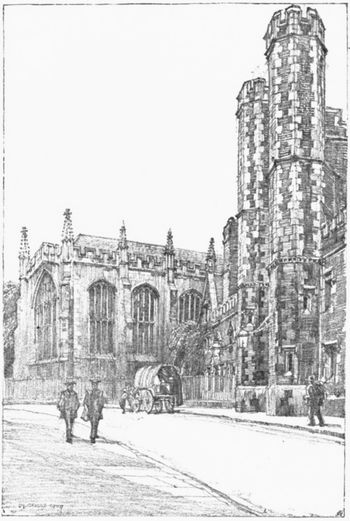
Trinity College Chapel and St. John's Gateway.
His first act was to enclose a Court, the Gate Tower of which should worthily commemorate the Foundress. In this his success was complete. The tower, which to this day forms the main entrance to the College, is a delightful example of what may be done in architecture by a skilful use of red brick. The quoining is of stone, and of stone also are the elaborate decorations. In the centre above the first string-course a richly-canopied niche contains the statue of St. John the Evangelist. Below this, and immediately above the gate, is to be seen Lady Margaret's shield, the three lions of England, quartered with the three lilies of France, within a bordure barred azure and argent, supported by the antelopes of the Beaufort family. On either side of both statue and shield appear the Plantagenet rose and the Tudor portcullis, each surmounted by an Imperial crown (just as we so constantly find them in King's College Chapel), and all round is sprinkled the Margaret flower, the daisy. The whole forms a beautiful piece of composition which makes us regret that more of Fisher's work is not left. All the First Court, indeed, is his, but it has been altered out of all knowledge. Now its chief feature is the soaring mid-Victorian chapel, the largest in Cambridge (except, of course, King's), the most pleasing view of which is to be gained from the Trinity Backs, where the tower, framed in foliage, exquisitely doubles itself on the surface of the river. This ambitious fabric was built by Sir Gilbert Scott in the 'sixties; and a line of cement on the lawn of the Court alone traces for us the foundations of Fisher's original Chapel.
The Hall ranks in size and beauty next to that of Trinity. The most interesting of its portraits are those of Lady Margaret, Bishop Fisher, and the poet Wordsworth, who was a resident member of the College from 1787 to 1791. His rooms, as he tells in "The Prelude," were in the south-western staircase of the "First Court," just above the kitchen:
"The Evangelist St. John my Patron was: Three Gothic Courts are his, and in the first Was my abiding-place, a nook obscure. Right underneath, the College Kitchens made A humming sound, less tuneable than bees, But hardly less industrious, with shrill notes Of sharp command and scolding intermixed."
It is interesting to note that these sentiments are echoed, a year or two later, from Oxford, by Southey, then also in his youthful paroxysm of Revolutionary fervour. He lets himself go in his "Ode to the Chapel Bell":
"O how I hate the sound! It is the knell That still a requiem tolls to Comfort's hour; And loth am I, at Superstition's bell, To quit, or Morpheus', or the Muse's bower. Better to lie and doze than gape amain, Hearing still mumbled o'er the same eternal strain, ......... The snuffling, snaffling Fellow's nasal tone, And Romish rites retained, though Romish faith be flown."
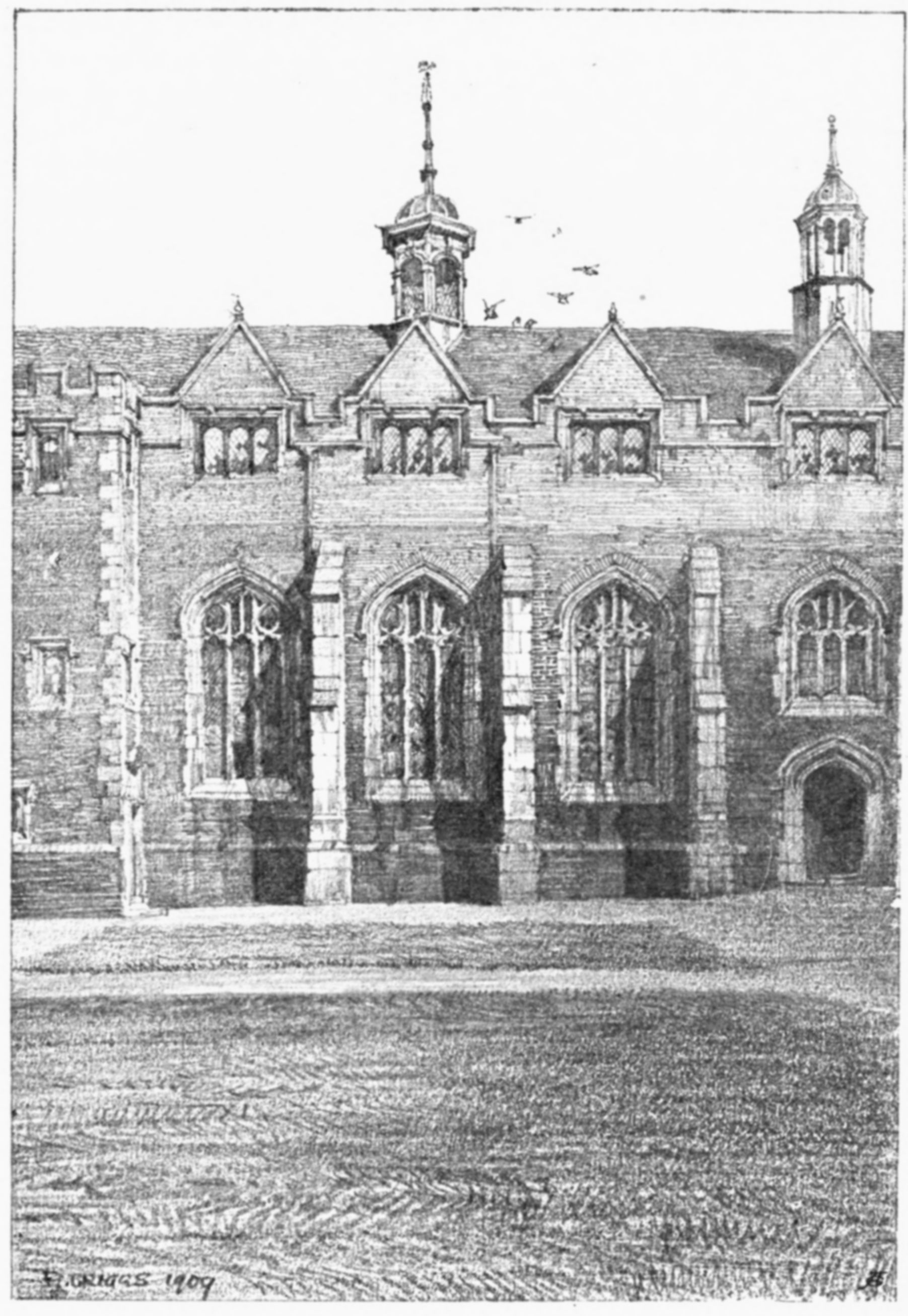
Hall, St. John's College.
The Hall of St. John's was the scene of notable Christmas feasting in the good old days of academic prosperity. Daily, from Christmas to Twelfth Night, boars' heads, turkeys, gargantuan pasties, and cups of a peculiarly enticing composition, went the round of the board. After the fatal agricultural depression of the 'seventies these hospitable doings dwindled more and more, till now they are wholly of the past.
This splendid benefaction was intended to be anonymous, as was also that which, in the "Third" Court, has given to St. John's yet another unique beauty, its exquisite Library, which (like the Combination Room) stands at the head, architecturally, of all College libraries, whether at Oxford or Cambridge. The benefactor in this case was Dr. John Williams, Bishop of Lincoln and Keeper of the Great Seal. His initials, as has been already mentioned, may be seen upon the outside of the western wall, beside the beautiful oriel window, overlooking the river, with which the room terminates, and his escutcheon hangs on the eastern wall, inside, over the door. For in his case, too, as in that of Lady Mary Cavendish, the secret leaked out before the work was finished, and in 1624 the letters I. L. C. S. (denoting Iohannes Lincolnensis Custos Sigilli) disclosed to passers-by the donor's identity.
The original bookcases of dark oak still project from either wall. They have mostly been heightened to make room for more books, but the additional shelves have been added not above but at the bottom, so that the sloping desks of the old tops still remain, though too high to be used; but the pair nearest the door remain at their original height. In the panelled end of each shelf may be noticed a tiny folding door, which on being opened proves to contain the catalogue, in crabbed early seventeenth century writing, of the books which the shelf held when first filled. The Library, however, contains nothing of any very special interest, its most noteworthy exhibit being an edition de luxe of the "Great Bible" issued in 1540 by Royal authority under the auspices of Archbishop Cranmer. This was the first English Bible authorised to be read in churches, and a copy was ordered to be set up in every parish church throughout the realm; the object being that every man might have access to it, and read for his own edification. He was not, however, allowed to take it home with him, and it was usually chained to the reading-desk to prevent this. And, as yet, there was no provision for any reading of Scripture in public worship, beyond the Epistles and Gospels of the Mass, the "sense" (i.e. the English) of which each parish priest had long been bound to give his congregation every Sunday as best he might.
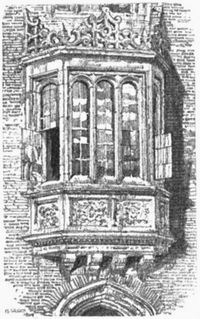
Oriel in Second Court of St. John's College.
The main approach to the Library is by a fine stone staircase in the north-western corner of the "Second Court;" but access is more generally obtained at present by an unpretending doorway in the middle of the northern side of the "Third Court." This door opens into the lower storey of the Library, which contains nothing of interest except a not very inspired statue of Wordsworth. Hence a circular iron stair leads up to the Library proper.
The New Court, on its southern side, is separated by a traceried cloister from the College Backs. On passing through the gate of this it is well to bear to the left and walk along the bank of the river, here overhung by magnificent elms, and affording a picturesque prospect of the Trinity buildings on the other side. The grounds of both Colleges to the west of the river are here divided up into a series of lawn-tennis courts, and are parted from each other by a broad ditch, which runs beneath the boughs of bowery horse-chestnut trees. In spring the Trinity bank of this ditch is bright with daffodils, the Johnian with narcissus. An iron foot-bridge, common to both Colleges, with a gate at either end, gives access from one to the other; but we had best continue by the path which skirts the Johnian bank. This finally leads out of the College grounds into the Backs proper, by a fine iron gate bearing a gilded eagle rising from a crown, the crest borne by Lady Margaret.
Before we reach this, we find water on either side of us; that to the west being not from the Cam, but a small tributary brooklet which joins the river near the Great Bridge. It is here dammed up so as to afford space for the College swans to make merry in, and on the further side is the Fellows' Garden, known as "the Wilderness." The wealth of spring flowers here cultivated—snowdrops, daffodils, crocuses, primroses, anemones, and hyacinths—is delicious in a country like Cambridgeshire, where Nature supplies their charms with very niggardly hand in comparison with the more favoured regions of England. Outside the Eagle gate we are close to the entrance of the Trinity avenue.
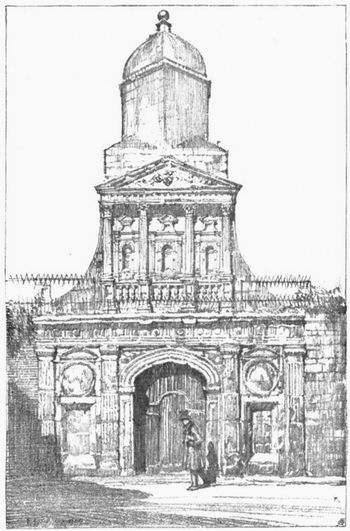
The Gate of Honour, Caius College.
The undergraduates of Caius wear a gown of a singular and not very pleasing violet hue with velvet trimmings. The College "colours" are light blue and black; the former, which is, as all know, the University colour, having been granted them to use, in memory of a famous race, in the early days of College boating, seventy years ago, when their crew beat the University Eight. It is, of course, an axiomatic rule of sportsmanship that no Club may assume the insignia of another (or any colourable imitation thereof), without leave from the previous users. The earliest "Light Blues" were the Eton Boat Club, by whose permission the Cambridge Boat Club took the colour. The Cricket Clubs, at both Eton and Cambridge, were then permitted to use it, and now this permission has been extended to all engaged as champions of the University, at athletics, football, etc.
These numbers are usually but small; indeed most of the business is altogether unopposed. But when some subject which excites general interest is brought forward, "backwoods-men" flock (and are whipped) up from all parts of England. Macaulay has given us a humorous poem on the coach-loads of country clergy thus pitch-forked into Cambridge to vote against the admission of Roman Catholics to the University; and within the last few decades, similar scenes were witnessed in connection with the question of their being allowed a recognised Public Hostel of their own, and with those of Compulsory Greek, and of granting Degrees to women.
The church has witnessed various vicissitudes of doctrine. Here, during the first outbreak of Protestantism, the Missal was solemnly torn up and burnt amid the hooting of the crowd; and when, a century later, the Puritans gained the ascendancy, a like fate befell the Book of Common Prayer, Cromwell himself presiding at the ceremony. This was on Good Friday, 1643, when the Vice-Chancellor and several other Heads of Colleges were, for refusing to abet the proceeding, shut up in the church "all the long cold night, without fire or candle." They were afterwards haled to London, and, after being pelted through the City, were subjected to a sort of Black Hole treatment, under hatches on board a hulk in the river, with all port-holes closed, and no air "save such as they could suck from each others' breaths," as the "Querela Cantabrigiensis" piteously complains.
1st Quarter 1236
2nd " 3126, 3213
3rd " 1326, 6213, 1236
4th " 3126, 3213, 1326, 6213
The hour is struck on the tenor bell. These bells are of eighteenth century date: two more have been added since.
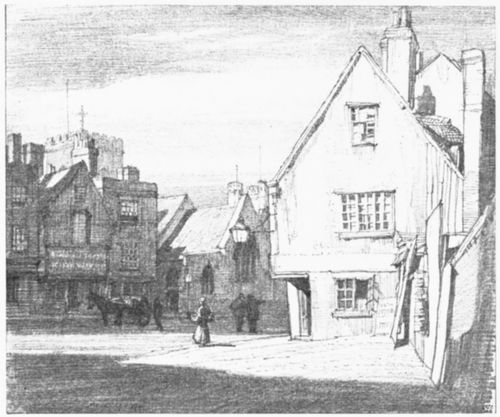
Peas Hill.
Like the University Church, the Market Place has witnessed many stirring scenes. Here, in the fierce but short-lived Socialistic outbreak which we commonly associate with the name of Wat Tyler, when dreams were afloat of melting down all existing distinctions into one great Magna Societas, which should redress all wrongs and make all men equal in all things, a mighty bonfire was made by the insurgent peasantry of all the books and documents which could be looted from the University Chest in Great St. Mary's, and from the various Colleges and Hostels then existing. The Mayor of Cambridge was compelled to give the sanction of his presence to the deed; and finally the ashes were scattered to the winds, with the cry: "Away with the skill of the clerks! Away with it!"
Two centuries later, in 1555, the Hill saw another burning, of a more gruesome character. The Catholic reaction under Queen Mary was then in full swing; and it was determined to visit with the extreme penalty of the laws against heresy the corpses of two notable pioneers of the Reformation, Dr. Bucer and Dr. Fagius. Both were amongst the band of German Protestants who, under King Edward the Sixth, flocked over to disseminate the new Religion in England, and both had died while promulgating their tenets at Cambridge. They were now torn from their graves, and chained, in their coffins, to the stake, the pyre which incinerated them being chiefly composed of their own condemned books.
Within the last decade two other notable conflagrations have here been kindled. When Lord Kitchener, then Sirdar of Egypt, and fresh from his victories over the Mahdi, visited Cambridge to receive an Honorary Degree, his presence amongst us was greeted by the wildest orgies. A huge bonfire was kindled on the Hill, the pile ultimately stretching diagonally across almost the entire area, and fed with ever fresh supplies of wood, for which the whole town was scoured. Railings were torn up wholesale (notably, as has been said, in the Backs), shutters were wrenched from shop windows, and even doors from houses; while hoardings, gates, and tradesmen's barrows were seized and devoted to the flames. Like scenes, a few years later, on a somewhat smaller scale, celebrated the relief of Ladysmith in the Boer War.