Chapter XII · THE DYNAMO
Reading edition
The dynamo is a machine which converts mechanical energy into electrical energy by electromagnetic induction.
The word dynamo is used to designate a machine which produces direct current as distinguished from the alternator or machine generating an alternating current. In a broader sense, the word generator is used to denote any machine generating electric current by electromagnetic induction; the term therefore includes both dynamos and alternators.
Operation of a Dynamo.—A dynamo does not create electricity, but generates or produces an induced electromotive force which causes a current of electricity to flow through a circuit of conductors in much the same way as a force pump causes a current of water to flow in pipes. The electromotive force generated in the dynamo causes the current of electricity to pass from a lower to a higher potential in the machine, and from the higher back to the lower potential in the external circuit; that is, the dynamo generates electrical pressure which overcomes the resistance or opposition to the current flow in the circuit. The pump produces a mechanical pressure which, for instance, may be used to force water into an elevated reservoir against the back pressure due to its weight.
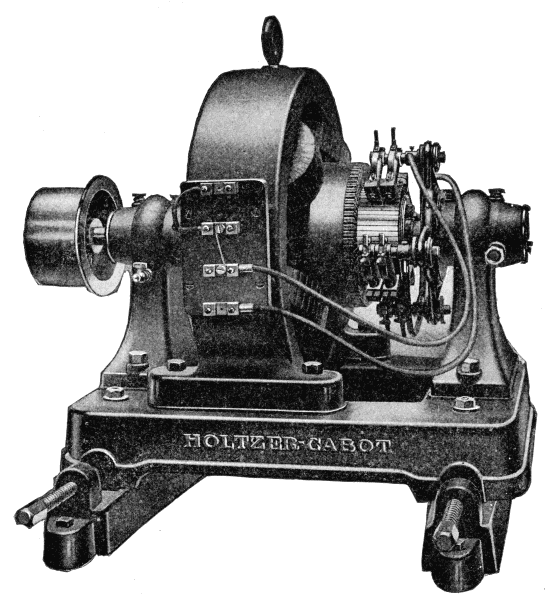
Fig.
162.—Holzer Cabot type “M” dynamo. The design of the base is such that it allows the field ring or frame to drop down, lowering the center of gravity, which gives increased stability. The pedestals are bolted directly to the base. Both front and rear pedestals are removable, so that the armature may be taken out from either end without disturbing the brushes or connections. The journals are provided with oil rings which keep the oil in continual circulation around the shaft by means of oil grooves in the journal. The pole pieces are cylindrical in shape and are fitted with shoes which retain the field coils in place and assist commutation. The field coils are former wound, the insulation being reinforced with mica. They are soaked in varnish and baked for 24 hours at 225° Fahr. The armature is wound as desired, series, shunt or compound. The armature core is of the drum type and is laminated, the discs being held by end plates locked without through bolts. The armature coils are formed of round, ribbon or bar copper, and are without joint except at the commutator; they lie in troughs of insulating material, the upper layers being insulated from the lower layers; they are retained in place by maple wedges secured by binding wires, soldered throughout their length. The commutator segments are drop forged in the smaller, and hard drawn in the larger sizes. Radial brushes are used. The efficiency of this type machine is stated by the maker at from 80% to 90%, according to size.
The point to be emphasized is that the dynamo does not create electricity (nor the pump water) but sets into motion something already existing by generating sufficient pressure to overcome the opposition to its movement.
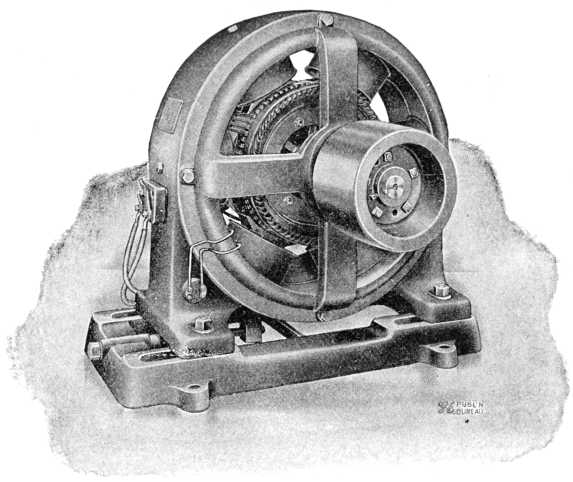
Fig.
163.—General Electric 16 KW multi-polar dynamo designed to operate at moderate and slow speeds. The outer structure of the machine consists of a magnet frame having feet in one casting. Adjustment is provided for moving the machine on its bed plate to tighten the belt. The field coils are former wound and the series windings permit of any degree of compounding up to 10% by the use of suitable German silver shunts connected across the series field.
Essential Parts of a Dynamo.—The dynamo in its simplest form consists of two principal parts:
1. The field magnet;
2. The armature.
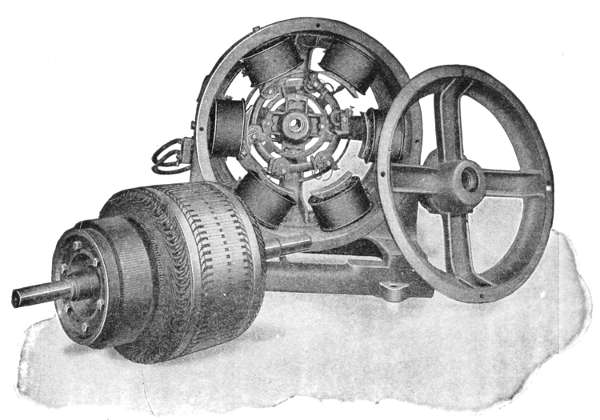
Fig.
164.—General Electric dynamo with end shield and armature removed showing construction. The core of the armature consists of laminations keyed to spider with space blocks inserted at intervals to provide ventilating ducts for cooling the core and windings. The armature is
former wound
—that is, the inductors are bent to the proper shape on a form; they are, therefore, interchangeable.
Ques. What is the object of the field magnet?
Ans. To provide a field of magnetic lines or lines of force to be cut by the armature inductors as they revolve in the field.
Ques. What is an armature?
Ans. A collection of inductors mounted on a shaft and arranged to rotate in a magnetic field with provision for collecting the currents induced in the inductors.
A simple loop or turn or wire may be considered as the simplest form of armature.
Ques. How do armatures and field magnets differ in dynamos and alternators?
Ans. A characteristic feature is that in the dynamo the field magnet is the stationary part and the armature the rotating part, while in the alternator the reverse conditions usually obtain.
Ques. With respect to this feature, what names are sometimes given to the armature and field magnet?
Ans. The stator and the rotor depending on which moves.
Ques. What is the real distinction between an armature and a field magnet?
Ans. The name field magnet is properly given to that part which, whether stationary or revolving, maintains its magnetism steady during operation; the name armature is properly given to that part which, whether revolving or fixed, has its magnetism changed in a regularly repeated fashion when the machine is in motion.
Construction of Dynamos.—In the make up of a dynamo, as actually constructed, there are five principal parts, as follows:
1. Bed plate;
2. Field magnets;
3. Armature;
4. Commutator;
5. Brushes.