Chapter I · ELECTRICITY
Reading edition
Nature and Source of Electricity.—What is electricity? This is a question that is frequently asked, but has not yet been satisfactorily answered. It is a force, subject to control under well known laws.
While the nature and source of electricity still remain a mystery, many things about it have become known, thus, it is positively assured that electricity never manifests itself except when there is some mechanical disturbance in ordinary matter.
The true nature of electricity has not yet been discovered. Many think it a quality inherent in nearly all the substances, and accompanied by a peculiar movement or arrangement of the molecules. Some assume that the phenomena of electricity are due to a peculiar state of strain or tension in the ether which is present everywhere, even in and between the atoms of the most solid bodies. If the latter theory be the true one, and if the atmosphere of the earth be surrounded by the same ether, it may be possible to establish these assumptions as facts.
The most modern supposition regarding this matter, by Maxwell, is that light itself is founded on electricity, and that light waves are merely electromagnetic waves. The theory “that electricity is related to, or identical with, the luminiferous ether,” has been accepted by the most prominent scientists.
But while electricity is still a mystery, much is known about the laws governing its phenomena. Man has mastered this mighty force and made it his powerful servant; he can produce it and use it.
Electricity, it is also conceded, is without weight, and, while it is without doubt, one and the same, it is for convenience sometimes classified according to its motion, as:
1. Static electricity, or electricity at rest;
2. Current electricity, or electricity in motion;
3. Magnetism, or electricity in rotation;
4. Electricity in vibration (radiation).
Other useful divisions are:
1. Positive;
2. Negative electricity;
3. Static;
4. Dynamic electricity.
Static Electricity.—This is a term employed to define electricity produced by friction. It is properly employed in the sense of a static charge which shows itself by the attraction or repulsion between charged bodies.
When static electricity is discharged, it causes more or less of a current, which shows itself by the passage of sparks or a brush discharge; by a peculiar prickling sensation; by a peculiar smell due to its chemical effects; by heating the air or other substances in its path; and sometimes in other ways.[1]
Current Electricity.—This may be defined as the quantity of electricity which passes through a conductor in a given time—or, electricity in the act of being discharged, or electricity in motion.
An electric current manifests itself by heating the wire or conductor; by causing a magnetic field around the conductor and by causing chemical changes in a liquid through which it may pass.
Dynamic Electricity.—This term is used to define current electricity to distinguish it from static electricity.
Radiated Electricity.—Electricity in vibration. Where the current oscillates or vibrates back and forth with extreme rapidity, it takes the form of waves which are similar to waves of light.
Positive electricity.—This term expresses the condition of the point of an electrified body having the higher energy from which it flows to a lower level. The sign which denotes this phase of electric excitement is +; all electricity is either positive or negative.
Negative Electricity.—This is the reverse condition to the above and is expressed by the sign or symbol -. These two terms are used in the same sense as hot and cold.
Atmospheric Electricity is the free electricity of the air which is almost always present in the atmosphere. Its exact cause is unknown.
The phenomena of atmospheric electricity are of two kinds; there are the well known manifestations of thunderstorms; and there are the phenomena of continual slight electrification in the air, best observed when the weather is fine; the Aurora constitutes a third branch of the subject.
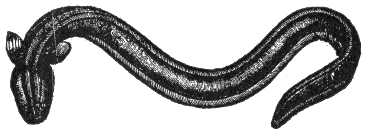
Fig.
1.—The electric eel. There are several species inhabiting the water, and which have the power of producing electric discharges by certain portions of their organism. The best known of these are the
Torpedo
, the
Gymnotus
, and the
Silurus
, found in the Nile and the Tiger. The Electric Ray, of which there are three species inhabiting the Mediterranean and Atlantic is provided with an electric organ on the back of its head, as shown in the illustration. This organ consists of laminæ composed of polygonal cells to the number of 800 or 1000, or more, supplied with four large bundles of nerve fibres; the under surface of the fish is -, the upper +. In the Surinam eel, the electric organ goes the whole length of the body along both sides. It is able to give a very severe shock, and is a formidable antagonist when it has attained its full length of 5 or 6 feet.
Frictional Electricity is that produced by the friction of one substance against another.
Resinous Electricity.—The kind of electricity produced upon a resinous substances such as sealing wax, resin, shellac, rubber or amber when rubbed with wool or fur. Resinous electricity is negative electricity.
Vitreous Electricity.—A term applied to the positive electricity developed in a glass rod by rubbing it with silk. This electric charge will attract to itself bits of pith or paper which have been repelled from a rod of sealing wax or other resinous substance which had been rubbed with wool or fur.