VOLUME X SLICE V Fleury, Claude to Foraker
Reading edition
Articles in This Slice
FLEURY, CLAUDE FLYGARE-CARLÉN, EMILIE
FLIEDNER, THEODOR FLYING BUTTRESS
FLIGHT and FLYING FLYING COLUMN
FLINCK, GOVERT "FLYING DUTCHMAN,"
FLINDERS, MATTHEW FLYING-FISH
FLINSBERG FLYING-FOX
FLINT, AUSTIN FLYING-SQUIRREL
FLINT, ROBERT FLYSCH
FLINT, TIMOTHY FOČA
FLINT (Michigan, U.S.A.) FOCHABERS
FLINT (county of North Wales) FOCSHANI
FLINT (town of North Wales) FOCUS
FLINT (crystalline substance) FOG
FLINT IMPLEMENTS AND WEAPONS FOGAZZARO, ANTONIO
FLOAT FOGELBERG, BENEDICT ERLAND
FLOCK FOGGIA
FLODDEN FÖHN
FLODOARD FÖHR
FLOE FOIL
FLOOD, HENRY FOIL-FENCING
FLOOD FOIX, PAUL DE
FLOOD PLAIN FOIX
FLOOR FOLARD, JEAN CHARLES
FLOORCLOTH FOLD
FLOQUET, CHARLES THOMAS FOLENGO, TEOFILO
FLOR, ROGER DI FOLEY, JOHN HENRY
FLORA FOLEY, SIR THOMAS
FLORE AND BLANCHEFLEUR FOLI, ALLAN JAMES
FLORENCE, WILLIAM JERMYN FOLIGNO
FLORENCE OF WORCESTER FOLIO
FLORENCE (Alabama, U.S.A.) FOLIUM
FLORENCE (capital of Tuscany) FOLKES, MARTIN
FLORES (island in the Atlantic Ocean) FOLKESTONE
FLORES (island of the Dutch East Indies) FOLKLAND
FLOREZ, ENRIQUE FOLKLORE
FLORIAN, SAINT FOLLEN, AUGUST LUDWIG
FLORIAN, JEAN PIERRE CLARIS DE FOLLEN, KARL
FLORIANOPOLIS FOLLETT, SIR WILLIAM WEBB
FLORIDA FONBLANQUE, ALBANY WILLIAM
FLORIDABLANCA, DON JOSE MOÑINO Y REDONDO FOND DU LAC
FLORIDOR FONDI
FLORIN FONNI
FLORIO, GIOVANNI FONSAGRADA
FLORIS, FRANS FONSECA, MANOEL DEODORO DA
FLORUS FONSECA, BAY OF
FLORUS, JULIUS FONT
FLORUS, PUBLIUS ANNIUS FONTAINE, PIERRE FRANÇOIS LÉONARD
FLOTOW, FRIEDRICH FERDINAND ADOLF VON FONTAINEBLEAU
FLOTSAM, JETSAM and LIGAN FONTAN, LOUIS MARIE
FLOUNDER FONTANA, DOMENICO
FLOUR and FLOUR MANUFACTURE FONTANA, LAVINIA
FLOURENS, GUSTAVE FONTANA, PROSPERO
FLOURENS, MARIE JEAN PIERRE FONTANE, THEODOR
FLOWER, SIR WILLIAM HENRY FONTANES, LOUIS
FLOWER FONTENAY-LE-COMTE
FLOWERS, ARTIFICIAL FONTENELLE, BERNARD LE BOVIER DE
FLOYD, JOHN FONTENOY
FLOYD, JOHN BUCHANAN FONTEVRAULT
FLOYER, SIR JOHN FOOD
FLUDD, ROBERT FOOD PRESERVATION
FLÜGEL, GUSTAV LEBERECHT FOOL
FLÜGEL, JOHANN GOTTFRIED FOOLS, FEAST OF
FLUKE FOOLSCAP
FLUME FOOL'S PARSLEY
FLUMINI MAGGIORE FOOT
FLUORANTHENE FOOT-AND-MOUTH DISEASE
FLUORENE FOOTBALL
FLUORESCEIN FOOTE, ANDREW HULL
FLUORESCENCE FOOTE, MARY HALLOCK
FLUORINE FOOTE, SAMUEL
FLUOR-SPAR FOOTMAN
FLUSHING (New York, U.S.A.) FOOTSCRAY
FLUSHING (Zeeland, Holland) FOOT-STALL
FLUTE FOPPA, VINCENZO
FLUX FORAGE
FLY FORAIN, J. L.
FLYCATCHER FORAKER, JOSEPH HENSON
FLEURY, CLAUDE (1640-1723), French ecclesiastical historian, was born at Paris on the 6th of December 1640. Destined for the bar, he was educated at the aristocratic college of Clermont (now that of Louis-le-Grand). In 1658 he was nominated an advocate to the parlement of Paris, and for nine years followed the legal profession. But he had long been of a religious disposition, and in 1667 turned from law to theology. He had been some time in orders when Louis XIV., in 1672, selected him as tutor of the princes of Conti, with such success that the king next entrusted to him the education of the count of Vermandois, one of his natural sons, on whose death in 1683 Fleury received for his services the Cistercian abbey of Loc-Dieu, in the diocese of Rhodez. In 1689 he was appointed sub-preceptor of the dukes of Burgundy, of Anjou, and of Berry, and thus became intimately associated with Fénelon, their chief tutor. In 1696 he was elected to fill the place of La Bruyère in the French Academy; and on the completion of the education of the young princes the king bestowed upon him the rich priory of Argenteuil, in the diocese of Paris (1706). On assuming this benefice he resigned, with rare disinterestedness, that of the abbey of Loc-Dieu. About this time he began his great work, the first of the kind in France, and one for which he had been collecting materials for thirty years—the Histoire ecclésiastique. Fleury’s evident intention was to write a history of the church for all classes of society; but at the time in which his great work appeared it was less religion than theology that absorbed the attention of the clergy and the educated public; and his work accordingly appealed to the student rather than to the popular reader, dwelling as it does very particularly on questions of doctrine, of discipline, of supremacy, and of rivalry between the priesthood and the imperial power. Nevertheless it had a great success. The first edition, printed at Paris in 20 volumes 4to, 1691, was followed by many others, among which may be mentioned that of Brussels, in 32 vols. 8vo, 1692, and that of Nismes, in 25 vols. 8vo, 1778 to 1780. The work of Fleury only comes down to the year 1414. It was continued by J. Claude Fabre and Goujet down to 1595, in 16 vols. 4to. In consulting the work of Fleury and its supplement, the general table of contents, published by Rondel, Paris, 1758, 1 vol. 4to, will be found very useful. Translations have been made of the entire work into Latin, German and Italian. The Latin translation, published at Augsburg, 1758-1759, 85 vols. 8vo, carries the work down to 1684. Fleury, who had been appointed confessor to the young king Louis XV. in 1716, because, as the duke of Orleans said, he was neither Jansenist nor Molinist, nor Ultramontanist, but Catholic, died on the 14th of July 1723. His great learning was equalled by the modest simplicity of his life and the uprightness of his conduct.
Fleury left many works besides his Histoire ecclésiastique. The following deserve special mention:—Histoire du droit françois (1674, 12mo); Mœurs des Israélites (1681, 12mo); Mœurs des Chrétiens (1682, 12mo); Traité du choix et de la méthode des études (1686, 2 vols. 12mo); Les Devoirs des maîtres et des domestiques (1688, 12mo). A number of the smaller works were published in one volume at Paris in 1807. The Roman Congregation of the Index condemned his Catéchisme historique (1679) and the Institution du droit ecclésiastique (1687).
See C. Ernst Simonetti, Der Character eines Geschichtsschreibers in dem Leben und aus den Schriften des Abts C. Fleury (Göttingen, 1746, 4to); C.F.P. Jaeger, Notice sur C. Fleury, considéré comme historien de l’église (Strassburg, 1847, 8vo); Reichlin-Meldegg, Geschichte des Christentums, i.
FLIEDNER, THEODOR (1800-1864), German Protestant divine, was born on the 21st of January 1800 at Epstein (near Wiesbaden), the small village in which his father was pastor. He studied theology at the universities of Giessen and Göttingen, and at the theological seminary of Herborn, and at the age of twenty he passed his final examination. After a year spent in teaching and preaching, in 1821 he accepted a call from the Protestant church at Kaiserswerth, a little town on the Rhine, a few miles below Düsseldorf. To help his people and to provide an endowment for his church, he undertook journeys in 1822 through part of Germany, and then in 1823 to Holland and England. He met with considerable success, and had opportunities of observing what was being done towards prison reform; in England he made the acquaintance of the philanthropist Elizabeth Fry. The German prisons were then in a very bad state. The prisoners were huddled together in dirty rooms, badly fed, and left in complete idleness. No one dreamed of instructing them, or of collecting statistics to form the basis of useful legislation on the subject. Fliedner, at first singly, undertook the work. He applied for permission to be imprisoned for some time, in order that he might look at prison life from the inside. This petition was refused, but he was allowed to hold fortnightly services in the Düsseldorf prison, and to visit the inmates individually. Those interested in the subject banded themselves together, and on the 18th of June 1826 the first Prison Society of Germany (Rheinisch-Westfälischer Gefängnisverein) was founded. In 1833 Fliedner opened in his own parsonage garden at Kaiserswerth a refuge for discharged female convicts. His circle of practical philanthropy rapidly increased. The state of the sick poor had for some time excited his interest, and it seemed to him that hospitals might be best served by an organized body of specially trained women. Accordingly in 1836 he began the first deaconess house, and the hospital at Kaiserswerth. By their ordination vows the deaconesses devoted themselves to the care of the poor, the sick and the young; but their engagements were not final—they might leave their work and return to ordinary life if they chose. In addition to these institutions Fliedner founded in 1835 an infant school, then a normal school for infant school mistresses (1836), an orphanage for orphan girls of the middle class (1842), and an asylum for female lunatics (1847). Moreover, he assisted at the foundation and in the management of similar institutions, not only in Germany, but in various parts of Europe.
In 1849 he resigned his pastoral charge, and from 1849 to 1851 he travelled over a large part of Europe, America and the East—the object of his journeys being to found “mother houses,” which were to be not merely training schools for deaconesses, but also centres whence other training establishments might arise. He established a deaconess house in Jerusalem, and after his return assisted by counsel and money in the erection of establishments at Constantinople, Smyrna, Alexandria and Bucharest. Among his later efforts may be mentioned the Christian house of refuge for female servants in Berlin (connected with which other institutions soon arose) and the “house of evening rest” for retired deaconesses at Kaiserswerth. In 1855 Fliedner received the degree of doctor in theology from the university of Bonn, in recognition rather of his practical activity than of his theological attainments. He died on the 4th of October 1864, leaving behind him over 100 stations attended by 430 deaconesses; and these by 1876 had increased to 150 with an attendance of 600.
Fliedner’s son Fritz Fliedner (1845-1901), after studying in Halle and Tübingen, became in 1870 chaplain to the embassy in Madrid. He followed in his father’s footsteps by founding several philanthropic institutions in Spain. He was also the author of a number of books, amongst which was an autobiography, Aus meinem Leben. Erinnerungen und Erfahrungen (1901).
Theodor Fliedner’s writings are almost entirely of a practical character. He edited a periodical, Der Armen und Kranken Freund, which contained information regarding the various institutions, and also the yearly almanac of the Kaiserswerth institution. Besides purely educational and devotional works, he wrote Buch der Märtyrer (1852); Kurze Geschichte der Entstehung der ersten evang. Liebesanstalten zu Kaiserswerth (1856); Nachricht über das Diakonissen-Werk in der Christ. Kirche (5th ed., 1867); Die evangel. Märtyrer Ungarns und Siebenbürgens; and Beschreibung der Reise nach Jerusalem und Constantinopel. All were published at Kaiserswerth. There is a translation of the German life by C. Winkworth (London, 1867). See also G. Fliedner, Theodor Fliedner, kurzer Abriss seines Lebens und Wirkens (3rd ed., 1892). See also on Fliedner and his work Kaiserswerth Deaconesses (London, 1857); Dean John S. Howson’s Deaconesses (London, 1862); The Service of the Poor, by E.C. Stephen (London, 1871); W.F. Stevenson’s Praying and Working (London, 1865).
FLIGHT and FLYING. Of the many scientific problems of modern times, there are few possessing a wider or more enduring interest than that of aerial navigation (see also Aeronautics). To fly has always been an object of ambition with man; nor will this occasion surprise when we remember the marvellous freedom enjoyed by volant as compared with non-volant animals. The subject of aviation is admittedly one of extreme difficulty. To tread upon the air (and this is what is really meant) is, at first sight, in the highest degree utopian; and yet there are thousands of living creatures which actually accomplish this feat. These creatures, however varied in form and structure, all fly according to one and the same principle; and this is a significant fact, as it tends to show that the air must be attacked in a particular way to ensure flight. It behoves us then at the outset to scrutinize very carefully the general configuration of flying animals, and in particular the size, shape and movements of their flying organs.
Flying animals differ entirely from sailing ships and from balloons, with which they are not unfrequently though erroneously compared; and a flying machine constructed upon proper principles can have nothing in common with either of those creations. The ship floats upon water and the balloon upon air; but the ship differs from the balloon, and the ship and the balloon differ from the flying creature and flying machine. The water and air, moreover, have characteristics of their own. The analogies which connect the water with the air, the ship with the balloon, and the ship and the balloon with the flying creature and flying machine are false analogies. A sailing ship is supported by the water and requires merely to be propelled; a flying creature and a flying machine constructed on the living type require to be both supported and propelled. This arises from the fact that water is much denser than air, and because water supports on its surface substances which fall through air. While water and air are both fluid media, they are to be distinguished from each other in the following particulars. Water is comparatively very heavy, inelastic and incompressible; air, on the other hand, is comparatively very light, elastic and compressible. If water be struck with violence, the recoil obtained is great when compared with the recoil obtained from air similarly treated. In water we get a maximum recoil with a minimum of displacement; in air, on the contrary, we obtain a minimum recoil with a maximum of displacement. Water and air when unconfined yield readily to pressure. They thus form movable fulcra to bodies acting upon them. In order to meet these peculiarities the travelling organs of aquatic and flying animals (whether they be feet, fins, flippers or wings) are made not of rigid but of elastic materials. The travelling organs, moreover, increase in size in proportion to the tenuity of the fluid to be acted upon. The difference in size of the travelling organs of animals becomes very marked when the land animals are contrasted with the aquatic, and the aquatic with the aerial, as in figs. 1, 2 and 3.
The peculiarities of water and air as supporting media are well illustrated by a reference to swimming, diving and flying birds. A bird when swimming extends its feet simultaneously or alternately in a backward direction, and so obtains a forward recoil. The water supports the bird, and the feet simply propel. In this case the bird is lighter than the water, and the long axis of the body is horizontal (a of fig. 4). When the bird dives, or flies under water, the long axis of the body is inclined obliquely downwards and forwards, and the bird forces itself into and beneath the water by the action of its feet, or wings, or both. In diving or sub-aquatic flight the feet strike upwards and backwards, the wings downwards and backwards (b of fig. 4). In aerial flying everything is reversed. The long axis of the bird is inclined obliquely upwards and forwards, and the wings strike, not downwards and backwards, but downwards and forwards (c of fig. 4). These changes in the direction of the long axis of the bird in swimming, diving and flying, and in the direction of the stroke of the wings in sub-aquatic and aerial flight, are due to the fact that the bird is heavier than the air and lighter than the water.
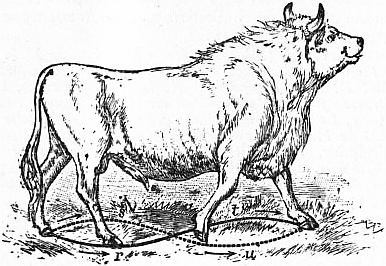
Fig. 1.—Chillingham Bull (Bos Scoticus). Small travelling extremities adapted for land. r, s, t, u, figure-of-8 described by the feet in walking.
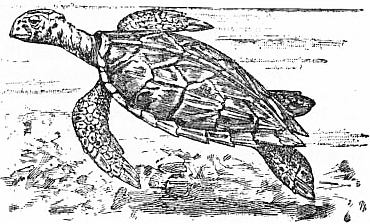
Fig. 2.—The Turtle (Chelonia imbricata). Enlarged travelling extremities (flippers) adapted for water.
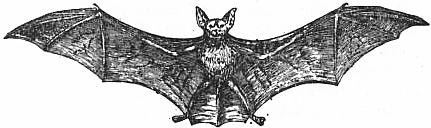
Fig. 3.—The Bat (Phyllocina gracilis). Greatly expanded travelling extremities adapted for air.
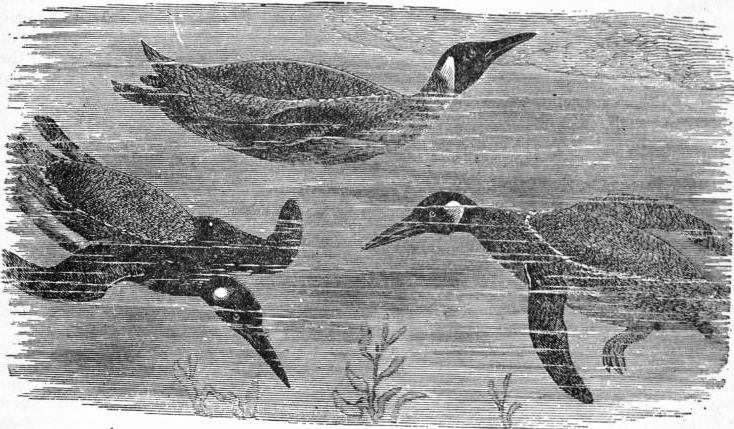
Fig. 4.—The King Penguin in the positions assumed by a bird in (a) swimming, (b) diving, and (c) flying.
The physical properties of water and air explain in a great measure how the sailing ship differs from the balloon, and how the latter differs from the flying creature and flying machine constructed on the natural type. The sailing ship is, as it were, immersed in two oceans, viz. an ocean of water and an ocean of air—the former being greatly heavier and denser than the latter. The ocean of water buoys or floats the ship, and the ocean of air, or part of it in motion, swells the sails which propel the ship. The moving air, which strikes the sails directly, strikes the hull of the vessel indirectly and forces it through the water, which, as explained, is a comparatively dense fluid. When the ship is in motion it can be steered either by the sails alone, or by the rudder alone, or by both combined. A balloon differs from a sailing ship in being immersed in only one ocean, viz. the ocean of air. It resembles the ship in floating upon the air, as the ship floats upon the water; in other words, the balloon is lighter than the air, as the ship is lighter than the water. But here all analogy ceases. The ship, in virtue of its being immersed in two fluids having different densities, can be steered and made to tack about in a horizontal plane in any given direction. This in the case of the balloon, immersed in one fluid, is impossible. The balloon in a calm can only rise and fall in a vertical line. Its horizontal movements, which ought to be the more important, are accidental movements due to air currents, and cannot be controlled; the balloon, in short, cannot be guided. One might as well attempt to steer a boat carried along by currents of water in the absence of oars, sails and wind, as to steer a balloon carried along by currents of air. The balloon has no hold upon the air, and this consequently cannot be employed as a fulcrum for regulating its course. The balloon, because of its vast size and from its being lighter than the air, is completely at the mercy of the wind. It forms an integral part, so to speak, of the wind for the time being, and the direction of the wind in every instance determines the horizontal motion of the balloon. The force required to propel a balloon against even a moderate breeze would result in its destruction. The balloon cannot be transferred with any degree of certainty from one point of the earth’s surface to another, and hence the chief danger in its employment. It may, quite as likely as not, carry its occupants out to sea. The balloon is a mere lifting machine and is in no sense to be regarded as a flying machine. It resembles the flying creature only in this, that it is immersed in the ocean of air in which it sustains itself. The mode of suspension is wholly different. The balloon floats because it is lighter than the air; the flying creature floats because it extracts from the air, by the vigorous downward action of its wings, a certain amount of upward recoil. The balloon is passive; the flying creature is active. The balloon is controlled by the wind; the flying creature controls the wind. The balloon in the absence of wind can only rise and fall in a vertical line; the flying creature can fly in a horizontal plane in any given direction. The balloon is inefficient because of its levity; the flying creature is efficient because of its weight.
Weight, however paradoxical it may appear, is necessary to flight. Everything which flies is vastly heavier than the air. The inertia of the mass of the flying creature enables it to control and direct its movements in the air. Many are of opinion that flight is a mere matter of levity and power. This is quite a mistake. No machine, however light and powerful, will ever fly whose travelling surfaces are not properly fashioned and properly applied to the air.
It was supposed at one time that the air sacs of birds contributed in some mysterious way to flight, but this is now known to be erroneous. The bats and some of the best-flying birds have no air sacs. Similar remarks are to be made of the heated air imprisoned within the bones of certain birds.1 Feathers even are not necessary to flight. Insects and bats have no feathers, and yet fly well. The only facts in natural history which appear even indirectly to countenance the flotation theory are the presence of a swimming bladder in some fishes, and the existence of membranous expansions or pseudo-wings in certain animals, such as the flying fish, flying dragon and flying squirrel. As, however, the animals referred to do not actually fly, but merely dart into the air and there sustain themselves for brief intervals, they afford no real support to the theory. The so-called floating animals are depicted at figs. 5, 6 and 7.
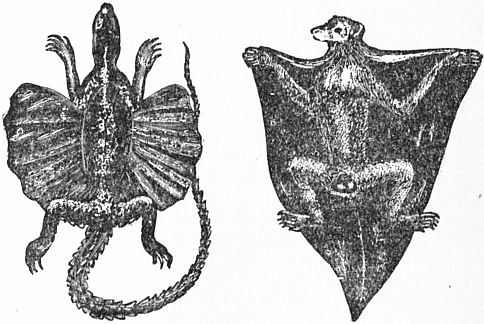
Fig. 5.—The Red-throated Dragon (Draco haematopogon). Fig. 6.—The Flying Colugo (Galeopithecus volans); also called flying lemur and flying squirrel.
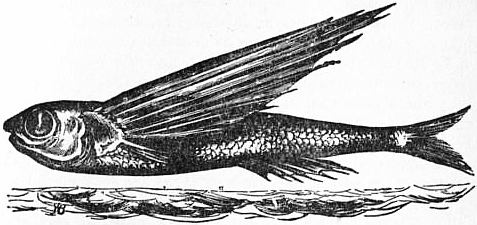
Fig. 7.—The Flying Fish (Exocoetus exiliens).
It has been asserted, and with some degree of plausibility, that a fish lighter than the water might swim, and that a bird lighter than the air might fly: it ought, however, to be borne in mind that, in point of fact, a fish lighter than the water could not hold its own if the water were in the least perturbed, and that a bird lighter than the air would be swept into space by even a moderate breeze without hope of return. Weight and power are always associated in living animals, and the fact that living animals are made heavier than the medium they are to navigate may be regarded as a conclusive argument in favour of weight being necessary alike to the swimming of the fish and the flying of the bird. It may be stated once for all that flying creatures are for the most part as heavy, bulk for bulk, as other animals, and that flight in every instance is the product, not of superior levity, but of weight and power directed upon properly constructed flying organs.
This fact is important as bearing on the construction of flying machines. It shows that a flying machine need not necessarily be a light, airy structure exposing an immoderate amount of surface. On the contrary, it favours the belief that it should be a compact and moderately heavy and powerful structure, which trusts for elevation and propulsion entirely to its flying appliances—whether actively moving wings, or screws, or aeroplanes wedged forward by screws. It should attack and subdue the air, and never give the air an opportunity of attacking or subduing it. It should smite the air intelligently and as a master, and its vigorous well-directed thrusts should in every instance elicit an upward and forward recoil. The flying machine must be multum in parvo. It must launch itself in the ocean of air, and must extract from that air, by means of its travelling surfaces—however fashioned and however applied—the recoil or resistance necessary to elevate and carry it forward. Extensive inert surfaces indeed are contra-indicated in a flying machine, as they approximate it to the balloon, which, as has been shown, cannot maintain its position in the air if there are air currents. A flying machine which could not face air currents would necessarily be a failure. To obviate this difficulty we are forced to fall back upon weight, or rather the structures and appliances which weight represents. These appliances as indicated should not be unnecessarily expanded, but when expanded they should, wherever practicable, be converted into actively moving flying surfaces, in preference to fixed or inert dead surfaces.
The question of surface is a very important one in aviation: it naturally resolves itself into one of active and passive surface. As there are active and passive surfaces in the flying animal, so there are, or should be, active and passive surfaces in the flying machine. Art should follow nature in this matter. The active surfaces in flying creatures are always greatly in excess of the passive ones, from the fact that the former virtually increase in proportion to the spaces through which they are made to travel. Nature not only distinguishes between active and passive surfaces in flying animals, but she strikes a just balance between them, and utilizes both. She regulates the surfaces to the strength and weight of the flying creature and the air currents to which the surfaces are to be exposed and upon which they are to operate. In her calculations she never forgets that her flying subjects are to control and not to be controlled by the air. As a rule she reduces the passive surfaces of the body to a minimum; she likewise reduces as far as possible the actively moving or flying surfaces. While, however, diminishing the surfaces of the flying animal as a whole, she increases as occasion demands the active or wing surfaces by wing movements, and the passive or dead surfaces by the forward motion of the body in progressive flight. She knows that if the wings are driven with sufficient rapidity they practically convert the spaces through which they move into solid bases of support; she also knows that the body in rapid flight derives support from all the air over which it passes. The manner in which the wing surfaces are increased by the wing movements will be readily understood from the accompanying illustrations of the blow-fly with its wings at rest and in motion (figs. 8 and 9). In fig. 8 the surfaces exposed by the body of the insect and the wings are, as compared with those of fig. 9, trifling. The wing would have much less purchase on fig. 8 than on fig. 9, provided the surfaces exposed by the latter were passive or dead surfaces. But they are not dead surfaces: they represent the spaces occupied by the rapidly vibrating wings, which are actively moving flying organs. As, moreover, the wings travel at a much higher speed than any wind that blows, they are superior to and control the wind; they enable the insect to dart through the wind in whatever direction it pleases.
The reader has only to imagine figs. 8 and 9 cut out in paper to realize that extensive, inert, horizontal aeroplanes2 in a flying machine would be a mistake. It is found to be so practically, as will be shown by and by. Fig. 9 so cut out would be heavier than fig. 8, and if both were exposed to a current of air, fig. 9 would be more blown about than fig. 8.
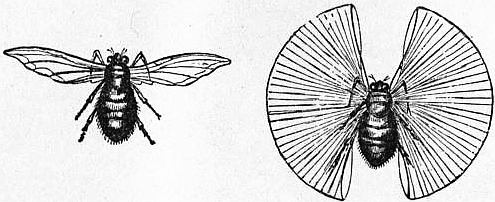
Fig. 8.—Blow-fly (Musca vomitoria) with its wings at rest. Fig. 9.—Blow-fly with its wings in motion as in flight.
It is true that in beetles and certain other insects there are the elytra or wing cases—thin, light, horny structures inclined slightly upwards—which in the act of flight are spread out and act as sustainers or gliders. The elytra, however, are comparatively long narrow structures which occupy a position in front of the wings, of which they may be regarded as forming the anterior parts. The elytra are to the delicate wings of some insects what the thick anterior margins are to stronger wings. The elytra, moreover, are not wholly passive structures. They can be moved, and the angles made by their under surfaces with the horizon adjusted. Finally, they are not essential to flight, as flight in the great majority of instances is performed without them. The elytra serve as protectors to the wings when the wings are folded upon the back of the insect, and as they are extended on either side of the body more or less horizontally when the insect is flying they contribute to flight indirectly, in virtue of their being carried forward by the body in motion.
Natural Flight.—The manner in which the wings of the insect traverse the air, so as practically to increase the basis of support, raises the whole subject of natural flight. It is necessary, therefore, at this stage to direct the attention of the reader somewhat fully to the subject of flight, as witnessed in the insect, bird and bat, a knowledge of natural flight preceding, and being in some sense indispensable to, a knowledge of artificial flight. The bodies of flying creatures are, as a rule, very strong, comparatively light and of an elongated form,—the bodies of birds being specially adapted for cleaving the air. Flying creatures, however, are less remarkable for their strength, shape and comparative levity than for the size and extraordinarily rapid and complicated movements of their wings. Prof. J. Bell Pettigrew first satisfactorily analysed those movements, and reproduced them by the aid of artificial wings. This physiologist in 18673 showed that all natural wings, whether of the insect, bird or bat, are screws structurally, and that they act as screws when they are made to vibrate, from the fact that they twist in opposite directions during the down and up strokes. He also explained that all wings act upon a common principle, and that they present oblique, kite-like surfaces to the air, through which they pass much in the same way that an oar passes through water in sculling. He further pointed out that the wings of flying creatures (contrary to received opinions, and as has been already indicated) strike downwards and forwards during the down strokes, and upwards and forwards during the up strokes. Lastly he demonstrated that the wings of flying creatures, when the bodies of said creatures are fixed, describe figure-of-8 tracks in space—the figure-of-8 tracks, when the bodies are released and advancing as in rapid flight, being opened out and converted into waved tracks.
It may be well to explain here that a claim has been set up by his admirers for the celebrated artist, architect and engineer, Leonardo da Vinci, to be regarded as the discoverer of the principles and practice of flight (see Theodore Andrea Cook, Spirals in Nature and Art, 1903). The claim is, however, unwarranted; Leonardo’s chief work on flight, bearing the title Codice sul Volo degli Uccelli e Varie Altre Materie, written in 1505, consists of a short manuscript of twenty-seven small quarto pages, with simple sketch illustrations interspersed in the text. In addition he makes occasional references to flight in his other manuscripts, which are also illustrated. In none of Leonardo’s manuscripts, however, and in none of his figures, is the slightest hint given of his having any knowledge of the spiral movements made by the wing in flight or of the spiral structure of the wing itself. It is claimed that Leonardo knew the direction of the stroke of the wing, as revealed by recent researches and proved by modern instantaneous photography. As a matter of fact, Leonardo gives a wholly inaccurate account of the direction of the stroke of the wing. He states that the wing during the down stroke strikes downwards and backwards, whereas in reality it strikes downwards and forwards. In speaking of artificial flight Leonardo says: “The wings have to row downwards and backwards to support the machine on high, so that it moves forward.” In speaking of natural flight he remarks: “If in its descent the bird rows backwards with its wings the bird will move rapidly; this happens because the wings strike the air which successively runs behind the bird to fill the void whence it comes.” There is nothing in Leonardo’s writings to show that he knew either the anatomy or physiology of the wing in the modern sense.
Pettigrew’s discovery of the figure-of-8 and waved movements made by the wing in stationary and progressive flight was confirmed some two years after it was made by Prof. E.J. Marey of Paris4 by the aid of the “sphygmograph.”5 The movements in question are now regarded as fundamental, from the fact that they are alike essential to natural and artificial flight.
The following is Pettigrew’s description of wings and wing movements published in 1867:—
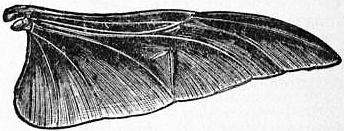
Fig. 10.—Right Wing of the Beetle (Goliathus micans) when at rest; seen from above.

Fig. 11.—Right Wing of the Beetle (Goliathus micans) when in motion; seen from behind. This figure shows how the wing twists and untwists when in action, and how it forms a true screw.
“The wings of insects and birds are, as a rule, more or less triangular in shape, the base of the triangle being directed towards the body, its sides anteriorly and posteriorly. They are also conical on section from within outwards and from before backwards, this shape converting the pinions into delicately graduated instruments balanced with the utmost nicety to satisfy the requirements of the muscular system on the one hand and the resistance and resiliency of the air on the other. While all wings are graduated as explained, innumerable varieties occur as to their general contour, some being falcated or scythe-like, others oblong, others rounded or circular, some lanceolate and some linear. The wings of insects may consist either of one or two pairs—the anterior or upper pair, when two are present, being in some instances greatly modified and presenting a corneous condition. They are then known as elytra, from the Gr. ἔλυτρον, a sheath. Both pairs are composed of a duplicature of the integument, or investing membrane, and are strengthened in various directions by a system of hollow, horny tubes, known to entomologists as the neurae or nervures. These nervures taper towards the extremity of the wing, and are strongest towards its root and anterior margin, where they supply the place of the arm in birds and bats. The neurae are arranged at the axis of the wing after the manner of a fan or spiral stair—the anterior one occupying a higher position than that farther back, and so of the others. As this arrangement extends also to the margins, the wings are more or less twisted upon themselves and present a certain degree of convexity on their superior or upper surface, and a corresponding concavity on their inferior or under surface,—their free edges supplying those fine curves which act with such efficacy upon the air in obtaining the maximum of resistance and the minimum of displacement. As illustrative examples of the form of wings alluded to, those of the beetle, bee and fly may be cited—the pinions in those insects acting as helices, or twisted levers, and elevating weights much greater than the area of the wings would seem to warrant” (figs. 10 and 11).... “To confer on the wings the multiplicity of movements which they require, they are supplied with double hinge or compound joints, which enable them to move not only in an upward, downward, forward and backward direction, but also at various intermediate degrees of obliquity. An insect with wings thus hinged may, as far as steadiness of body is concerned, be not inaptly compared to a compass set upon gimbals, where the universality of motion in one direction ensures comparative fixedness in another.”... “All wings obtain their leverage by presenting oblique surfaces to the air, the degree of obliquity gradually increasing in a direction from behind, forwards and downwards, during extension when the sudden or effective stroke is being given, and gradually decreasing in an opposite direction during flexion, or when the wing is being more slowly recovered preparatory to making a second stroke. The effective stroke in insects, and this holds true also of birds, is therefore delivered downwards and forwards, and not, as the majority of writers believe, vertically, or even slightly backwards.... The wing in the insect is more flattened than in the bird; and advantage is taken on some occasions of this circumstance, particularly in heavy-bodied, small-winged, quick-flying insects, to reverse the pinion more or less completely during the down and up strokes.”... “This is effected in the following manner. The posterior margin of the wing is made to rotate, during the down stroke, in a direction from above downwards and from behind forwards—the anterior margin travelling in an opposite direction and reciprocating. The wing may thus be said to attack the air by a screwing movement from above. During the up or return stroke, on the other hand, the posterior margin rotates in a direction from below upwards and from before backwards, so that by a similar but reverse screwing motion the pinion attacks the air from beneath.”... “A figure-of-8, compressed laterally and placed obliquely with its long axis running from left to right of the spectator, represents the movements in question. The down and up strokes, as will be seen from this account, cross each other, the wing smiting the air during its descent from above, as in the bird and bat, and during its ascent from below as in the flying fish and boy’s kite” (fig. 12).
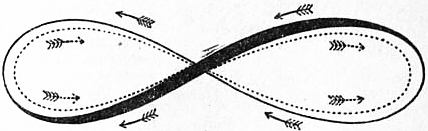
Fig. 12 shows the figure-of-8 made by the margins of the wing in extension (continuous line), and flexion (dotted line). As the tip of the wing is mid-way between its margins, a line between the continuous and dotted lines gives the figure-of-8 made by the tip. The arrows indicate the reversal of the planes of the wing, and show how the down and up strokes cross each other.
... “The figure-of-8 action of the wing explains how an insect or bird may fix itself in the air, the backward and forward reciprocating action of the pinion affording support, but no propulsion. In these instances the backward and forward strokes are made to counterbalance each other. Although the figure-of-8 represents with considerable fidelity the twisting of the wing upon its axis during extension and flexion, when the insect is playing its wings before an object, or still better when it is artificially fixed, it is otherwise when the down stroke is added and the insect is fairly on the wing and progressing rapidly. In this case the wing, in virtue of its being carried forward by the body in motion, describes an undulating or spiral course, as shown in fig. 13.”
... “The down and up strokes are compound movements—the termination of the down stroke embracing the beginning of the up stroke, and the termination of the up stroke including the beginning of the down stroke. This is necessary in order that the down and up strokes may glide into each other in such a manner as to prevent jerking and unnecessary retardation.”6...

Fig. 13.—Wave track made by the wing in progressive flight. a, b, Crests of the wave; c, d, e, up strokes; x, x, down strokes; f, point corresponding to the anterior margin of the wing, and forming a centre for the downward rotation of the wing (a, g); g, point corresponding to the posterior margin of the wing, and forming a centre for the upward rotation of the wing (d, f).
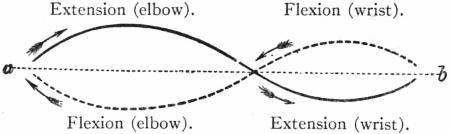
Fig. 14.—a, b, line along which the wing travels during extension and flexion. The arrows indicate the direction in which the wing is spread out in extension and closed or folded in flexion.
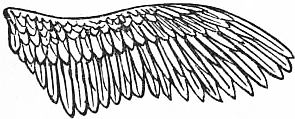
Fig. 15.—Right Wing of the Red-legged Partridge (Perdix rubra). Dorsal aspect as seen from above.
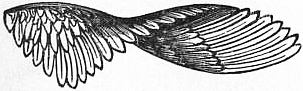
Fig. 16.—Right Wing of the Red-legged Partridge (Perdix rubra). Dorsal and ventral aspects as seen from behind; showing auger-like conformation of wing. Compare with figs. 11 and 18.
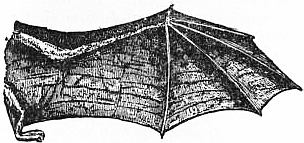
Fig. 17.—Right Wing of the Bat (Phyllocina gracilis). Dorsal aspect as seen from above.
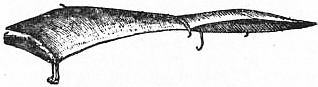
Fig. 18.—Right Wing of the Bat (Phyllocina gracilis). Dorsal and ventral aspects, as seen from behind. These show the screw-like configuration of the wing, and also how the wing twists and untwists during its action.
“The wing of the bird, like that of the insect, is concavo-convex, and more or less twisted upon itself when extended, so that the anterior or thick margin of the pinion presents a different degree of curvature to that of the posterior or thin margin. This twisting is in a great measure owing to the manner in which the bones of the wing are twisted upon themselves, and the spiral nature of their articular surfaces—the long axes of the joints always intersecting each other at right angles, and the bones of the elbow and wrist making a quarter of a turn or so during extension and the same amount during flexion. As a result of this disposition of the articular surfaces, the wing may be shot out or extended, and retracted or flexed in nearly the same plane, the bones composing the wing rotating on their axes during either movement (fig. 14). The secondary action, or the revolving of the component bones on their own axes, is of the greatest importance in the movements of the wing, as it communicates to the hand and forearm, and consequently to the primary and secondary feathers which they bear, the precise angles necessary for flight. It in fact ensures that the wing, and the curtain or fringe of the wing which the primary and secondary feathers form, shall be screwed into and down upon the wind in extension, and unscrewed or withdrawn from the wind during flexion. The wing of the bird may therefore be compared to a huge gimlet or auger, the axis of the gimlet representing the bones of the wing, the flanges or spiral thread of the gimlet the primary and secondary feathers” (figs. 15 and 16).... “From this description it will be evident that by the mere rotation of the bones of the forearm and hand the maximum and minimum of resistance is secured much in the same way that this object is attained by the alternate dipping and feathering of an oar.”... “The wing, both when at rest and when in motion, may not inaptly be compared to the blade of an ordinary screw propeller as employed in navigation. Thus the general outline of the wing corresponds closely with the outline of the propeller (figs. 11, 16 and 18), and the track described by the wing in space is twisted upon itself propeller fashion7 (figs. 12, 20, 21, 22, 23). The great velocity with which the wing is driven converts the impression or blur made by it into what is equivalent to a solid for the time being, in the same way that the spokes of a wheel in violent motion, as is well understood, more or less completely occupy the space contained within the rim or circumference of the wheel” (figs. 9, 20 and 21).
... “The wing of the bat bears a considerable resemblance to that of the insect, inasmuch as it consists of a delicate, semi-transparent, continuous membrane, supported in divers directions, particularly towards its anterior margin, by a system of osseous stays or stretchers which confer upon it the degree of rigidity requisite for flight. It is, as a rule, deeply concave on its under or ventral surface, and in this respect resembles the wing of the heavy-bodied birds. The movement of the bat’s wing in extension is a spiral one, the spiral running alternately from below upwards and forwards and from above downwards and backwards. The action of the wing of the bat, and the movements of its component bones, are essentially the same as in the bird” (figs. 17 and 18).
... “The wing strikes the air precisely as a boy’s kite would if it were jerked by its string, the only difference being that the kite is pulled forwards upon the wind by the string and the hand, whereas in the insect, bird and bat the wing is pushed forwards on the wind by the weight of the body and the power residing in the pinion itself” (fig. 19).8

Fig. 19.—The Cape Barn-owl (Strix capensis), showing the kite-like surfaces presented by the ventral aspect of the wings and body in flight.
The figure-of-8 and kite-like action of the wing referred to lead us to explain how it happens that the wing, which in many instances is a comparatively small and delicate organ, can yet attack the air with such vigour as to extract from it the recoil necessary to elevate and propel the flying creature. The accompanying figures from one of Pettigrew’s later memoirs9 will serve to explain the rationale (figs. 20, 21, 22 and 23).
As will be seen from these figures, the wing during its vibration sweeps through a comparatively very large space. This space, as already explained, is practically a solid basis of support for the wing and for the flying animal. The wing attacks the air in such a manner as virtually to have no slip—this for two reasons. The wing reverses instantly and acts as a kite during nearly the entire down and up strokes. The angles, moreover, made by the wing with the horizon during the down and up strokes are at no two intervals the same, but (and this is a remarkable circumstance) they are always adapted to the speed at which the wing is travelling for the time being. The increase and decrease in the angles made by the wing as it hastens to and fro are due partly to the resistance offered by the air, and partly to the mechanism and mode of application of the wing to the air. The wing, during its vibrations, rotates upon two separate centres, the tip rotating round the root of the wing as an axis (short axis of wing), the posterior margin rotating around the anterior margin (long axis of wing). The wing is really eccentric in its nature, a remark which applies also to the rowing feathers of the bird’s wing. The compound rotation goes on throughout the entire down and up strokes, and is intimately associated with the power which the wing enjoys of alternately seizing and evading the air.
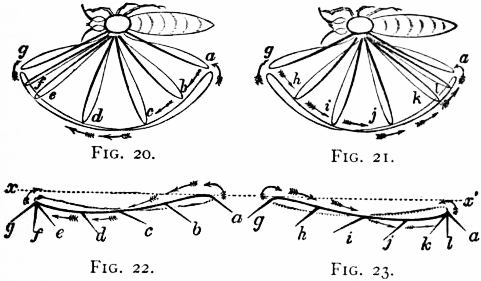
Figs. 20, 21, 22 and 23 show the area mapped out by the left wing of the Wasp when the insect is fixed and the wing made to vibrate. These figures illustrate the various angles made by the wing with the horizon as it hastens to and fro, and show how the wing reverses and reciprocates, and how it twists upon itself in opposite directions, and describes a figure-of-8 track in space. Figs. 20 and 22 represent the forward or down stroke (a b c d e f g), figs. 21 and 23 the backward or up stroke (g h i j k l a). The terms forward and back strokes are here employed with reference to the head of the insect, x, x′, line to represent the horizon. If fig. 22, representing the down or forward stroke, be placed upon fig. 23, representing the up or backward stroke, it will be seen that the wing crosses its own track more or less completely at every stage of the down and up strokes.
The compound rotation of the wing is greatly facilitated by the wing being elastic and flexible. It is this which causes the wing to twist and untwist diagonally on its long axis when it is made to vibrate. The twisting referred to is partly a vital and partly a mechanical act;—that is, it is occasioned in part by the action of the muscles and in part by the greater resistance experienced from the air by the tip and posterior margin of the wing as compared with the root and anterior margin,—the resistance experienced by the tip and posterior margin causing them to reverse always subsequently to the root and anterior margin, which has the effect of throwing the anterior and posterior margins of the wing into figure-of-8 curves, as shown at figs. 9, 11, 12, 16, 18, 20, 21, 22 and 23.
The compound rotation of the wing, as seen in the bird, is represented in fig. 24.
Not the least curious feature of the wing movements is the remarkable power which the wing possesses of making and utilizing its own currents. Thus, when the wing descends it draws after it a strong current, which, being met by the wing during its ascent, greatly increases the efficacy of the up stroke. Similarly and conversely, when the wing ascends, it creates an upward current, which, being met by the wing when it descends, powerfully contributes to the efficiency of the down stroke. This statement can be readily verified by experiment both with natural and artificial wings. Neither the up nor the down strokes are complete in themselves.
The wing to act efficiently must be driven at a certain speed, and in such a manner that the down and up strokes shall glide into each other. It is only in this way that the air can be made to pulsate, and that the rhythm of the wing and the air waves can be made to correspond. The air must be seized and let go in a certain order and at a certain speed to extract a maximum recoil. The rapidity of the wing movements is regulated by the size of the wing, small wings being driven at a very much higher speed than larger ones. The different parts of the wing, moreover, travel at different degrees of velocity—the tip and posterior margin of the wing always rushing through a much greater space, in a given time, than the root and anterior margin.
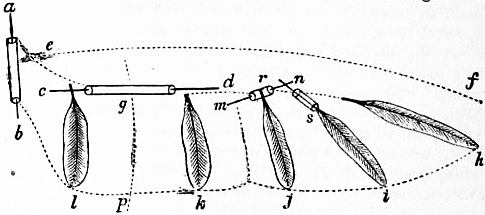
Fig. 24.—Wing of the Bird with its root (a, b) cranked forwards.
a, b, Short axis of the wing (axis for tip of wing, h). c, d, Long axis (axis for posterior margin of wing, h, i, j, k, l). m, n, Short axis of rowing feathers of wing. r, s, Long axis of rowing feathers of wing. The rotation of the rowing feathers on their long axis (they are eccentrics) enables them to open or separate during the up, and close or come together during the down strokes. e f, g p, concave shape presented by the under surface of the wing.
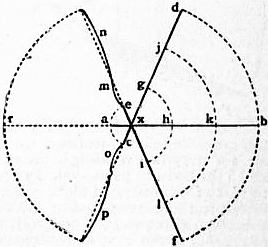
Fig. 25 shows how different portions of the wing travel at different degrees of speed. In this figure the rod a, b, hinged at x, represents the wing. When the wing is made to vibrate, its several portions travel through the spaces d b f, j k l, g h i, and e a c in exactly the same interval of time. The part of the wing marked b, which corresponds with the tip, consequently travels very much more rapidly than the part marked a, which corresponds with the root. m n, o p, curves made by the wing at the end of the up and down strokes; r, position of the wing at the middle of the stroke.
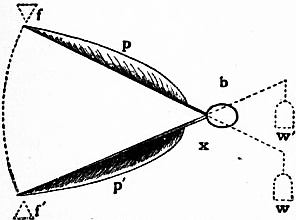
Fig. 26.—In this figure f, f’ represent the movable fulcra furnished by the air, p p’ the power residing in the wing, and b the body to be moved. In order to make the problem of flight more intelligible, the lever formed by the wing is prolonged beyond the body (b), and to the root of the wing so extended the weight (w, w′) is attached; x represents the universal joint by which the wing is attached to the body. When the wing ascends as shown at p, the air (fulcrum f) resists its upward passage, and forces the body (b) or its representative (w) slightly downwards. When the wing descends as shown at p’, the air (fulcrum f′) resists its downward passage, and forces the body (b) or its representative (w′) slightly upwards. From this it follows that when the wing rises the body falls, and vice versa—the wing describing the arc of a large circle (f f′), the body (b), or the weights (w, w′) representing it, describing the arc of a small circle.
The rapidity of travel of the insect wing is in some cases enormous. The wasp, for instance, is said to ply its wings at the rate of 110, and the common house-fly at the rate of 330 beats per second. Quick as are the vibrations of natural wings, the speed of certain parts of the wing is amazingly increased. Wings as a rule are long and narrow. As a consequence, a comparatively slow and very limited movement at the root confers great range and immense speed at the tip, the speed of each portion of the wing increasing as the root of the wing is receded from. This is explained on a principle well understood in mechanics, viz. that when a wing or rod hinged at one end is made to move in a circle, the tip or free end of the wing or rod describes a much wider circle in a given time than a portion of the wing or rod nearer the hinge (fig. 25).
One naturally inquires why the high speed of wings, and why the progressive increase of speed at their tips and posterior margins? The answer is not far to seek. If the wings were not driven at a high speed, and if they were not eccentrics made to revolve upon two separate axes, they would of necessity be large cumbrous structures; but large heavy wings would be difficult to work, and what is worse, they would (if too large), instead of controlling the air, be controlled by it, and so cease to be flying organs.
There is, however, another reason why wings should be made to vibrate at high speeds. The air, as explained, is a very light, thin, elastic medium, which yields on the slightest pressure, and unless the wings attacked it with great violence the necessary recoil or resistance could not be obtained. The atmosphere, because of its great tenuity, mobility and comparative imponderability, presents little resistance to bodies passing through it at low velocities. If, however, the speed be greatly accelerated, the action of even an ordinary cane is sufficient to elicit a recoil. This comes of the action and reaction of matter, the resistance experienced varying according to the density of the atmosphere and the shape, extent and velocity of the body acting upon it. While, therefore, scarcely any impediment is offered to the progress of an animal in motion in the air, it is often exceedingly difficult to compress the air with sufficient rapidity and energy to convert it into a suitable fulcrum for securing the necessary support and forward impetus. This arises from the fact that bodies moving in air experience a minimum of resistance and occasion a maximum of displacement. Another and very obvious difficulty is traceable to the great disparity in the weight of air as compared with any known solid, and the consequent want of buoying or sustaining power which that disparity involves. If we compare air with water we find it is nearly 1000 times lighter. To meet these peculiarities the insect, bird and bat are furnished with extensive flying surfaces in the shape of wings, which they apply with singular velocity and power to the air, as levers of the third order. In this form of lever the power is applied between the fulcrum and the weight to be raised. The power is represented by the wing, the fulcrum by the air, and the weight by the body of the flying animal. Although the third order of lever is particularly inefficient when the fulcrum is rigid and immobile, it possesses singular advantages when these conditions are reversed, that is, when the fulcrum, as happens with the air, is elastic and yielding. In this instance a very slight movement at the root of the pinion, or that end of the lever directed towards the body, is followed by an immense sweep of the extremity of the wing, where its elevating and propelling power is greatest—this arrangement ensuring that the large quantity of air necessary for support and propulsion shall be compressed under the most favourable conditions.
In this process the weight of the body performs an important part, by acting upon the inclined planes formed by the wings in the plane of progression. The power and the weight may thus be said to reciprocate, the two sitting as it were side by side and blending their peculiar influences to produce a common result, as indicated at fig. 26.
When the wings descend they elevate the body, the wings being active and the body passive; when the body descends it contributes to the elevation of the wings,10 the body being active and the wings more or less passive. It is in this way that weight forms a factor in flight, the wings and the weight of the body reciprocating and mutually assisting and relieving each other. This is an argument for employing four wings in artificial flight,—the wings being so arranged that the two which are up shall always by their fall mechanically elevate the two which are down. Such an arrangement is calculated greatly to conserve the driving power, and as a consequence, to reduce the weight.
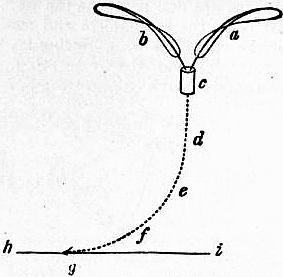
Fig. 27.—a, b, quill feathers; c, cork; d, e, f, g, downward and forward curved trajectory made by the feathers and cork before reaching the ground (h, i).
That the weight of the body plays an important part in the production of flight may be proved by a very simple experiment. If two quill feathers are fixed in an ordinary cork, and so arranged that they expand and arch above it (fig. 27), it is found that if the apparatus be dropped from a vertical height of 3 yds. it does not fall vertically downwards, but downwards and forwards in a curve, the forward travel amounting in some instances to a yard and a half. Here the cork, in falling, acts upon the feathers (which are to all intents and purposes wings), and these in turn act upon the air, in such a manner as to produce a horizontal transference.
In order to utilize the air as a means of transit, the body in motion, whether it moves in virtue of the life it possesses, or because of a force super-added, must be heavier than air. It must tread with its wings and rise upon the air as a swimmer upon the water, or as a kite upon the wind. This is necessary for the simple reason that the body must be active, the air passive. The flying body must act against gravitation, and elevate and carry itself forward at the expense of the air and of the force which resides in it, whatever that may be. If it were otherwise—if it were rescued from the law of gravitation on the one hand, and bereft of independent movement on the other, it would float about uncontrolled and uncontrollable like an ordinary balloon.
In flight one of two things is necessary. Either the wings must attack the air with great violence, or the air in rapid motion must attack the wings: either suffices. If a bird attempts to fly in a calm, the wings must be made to smite the air after the manner of a boy’s kite with great vigour and at a high speed. In this case the wings fly the bird. If, however, the bird is fairly launched in space and a stiff breeze is blowing, all that is required in many instances is to extend the wings at a slight upward angle to the horizon so that the under parts of the wings present kite-like surfaces. In these circumstances the rapidly moving air flies the bird. The flight of the albatross supplies the necessary illustration. If by any chance this magnificent bird alights upon the sea he must flap and beat the water and air with his wings with tremendous energy until he gets fairly launched. This done he extends his enormous pinions11 and sails majestically along, seldom deigning to flap his wings, the breeze doing the work for him. A familiar illustration of the same principle may be witnessed any day when children are engaged in the pastime of kite-flying. If two boys attempt to fly a kite in a calm, the one must hold up the kite and let go when the other runs. In this case the under surface of the kite is made to strike the still air. If, however, a stiff autumn breeze be blowing, it suffices if the boy who formerly ran when the kite was let go stands still. In this case the air in rapid motion strikes the under surface of the kite and forces it up. The string and the hand are to the kite what the weight of the flying creature is to the inclined planes formed by its wings.
The area of the insect, bird and bat, when the wings are fully expanded, is greater than that of any other class of animal, their weight being proportionally less. As already stated, however, it ought never to be forgotten that even the lightest insect, bird or bat is vastly heavier than the air, and that no fixed relation exists between the weight of body and expanse of wing in any of the orders. We have thus light-bodied and large-winged insects and birds, as the butterfly and heron; and others with heavy bodies and small wings, as the beetle and partridge. Similar remarks are to be made of bats. Those apparent inconsistencies in the dimensions of the body and wings are readily explained by the greater muscular development of the heavy-bodied, small-winged insects, birds and bats, and the increased power and rapidity with which the wings in them are made to oscillate. This is of the utmost importance in the science of aviation, as showing that flight may be attained by a heavy powerful animal with comparatively small wings, as well as by a lighter one with greatly enlarged wings. While, therefore, there is apparently no correspondence between the area of the wing and the animal to be raised, there is, except in the case of sailing insects, birds and bats, an unvarying relation as to the weight and number of oscillations; so that the problem of flight would seem to resolve itself into one of weight, power, velocity and small surfaces, versus buoyancy, debility, diminished speed and extensive surfaces—weight in either case being a sine qua non.
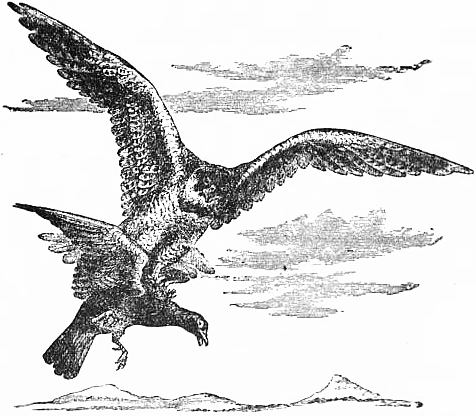
Fig. 28.—Hawk and Pigeon.
That no fixed relation exists between the area of the wings and the size and weight of the body to be elevated is evident on comparing the dimensions of the wings and bodies of the several orders of insects, bats and birds. If such comparison be made, it will be found that the pinions in some instances diminish while the bodies increase, and the converse. No practical good can therefore accrue to aviation from elaborate measurements of the wings and body of any flying thing; neither can any rule be laid down as to the extent of surface required for sustaining a given weight in the air. The statements here advanced are borne out by the fact that the wings of insects, bats and birds may be materially reduced without impairing their powers of flight. In such cases the speed with which the wings are driven is increased in the direct ratio of the mutilation. The inference to be deduced from the foregoing is plainly this, that even in large-bodied, small-winged insects and birds the wing-surface is greatly in excess, the surplus wing area supplying that degree of elevating and sustaining power which is necessary to prevent undue exertion on the part of the volant animal. In this we have a partial explanation of the buoyancy of insects, and the great lifting power possessed by birds and bats,—the bats carrying their young without inconvenience, the birds elevating surprising quantities of fish, game, carrion, &c. (fig. 28).
While as explained, no definite relation exists between the weight of a flying animal and the size of its flying surfaces, there being, as stated, heavy-bodied and small-winged insects, birds and bats, and the converse, and while, as has been shown, flight is possible within a wide range, the wings being, as a rule, in excess of what are required for the purposes of flight,—still it appears from the researches of L. de Lucy that there is a general law, to the effect that the larger the volant animal, the smaller, by comparison, are its flying surfaces. The existence of such a law is very encouraging so far as artificial flight is concerned, for it shows that the flying surfaces of a large, heavy, powerful flying machine will be comparatively small, and consequently comparatively compact and strong. This is a point of very considerable importance, as the object desiderated in a flying machine is elevating capacity.
De Lucy tabulated his results as under:—
Insects Birds.
Names. Flying Surface referred to the Kilogramme = 2 ℔ 8 oz. 3 dwt. 2 gr. avoird. = 2 ℔ 3 oz. 4.428 dr. troy. Names. Flying Surface referred to the Kilogramme.
sq. yds. ft. in. sq. yds. ft. in.
Gnat 11 8 92 Swallow 1 1 104½
Dragon-fly (small) 7 2 56 Sparrow 0 5 142½
Coccinella (Lady-bird) 5 13 87 Turtle-dove 0 4 100½
Dragon-fly (common) 5 2 89 Pigeon 0 2 113
Tipula, or Daddy-long-legs 3 5 11 Stork 0 2 20
Bee 1 2 74½ Vulture 0 1 116
Meat-fly 1 3 54½ Crane of Australia 0 0 130
Drone (blue) 1 2 20
Cockchafer 1 2 50
Lucanus cervus Stag-beetle (female) 1 1 39½
Lucanus cervus Stag-beetle (male) 0 8 33
Rhinoceros-beetle 0 6 122½
“It is easy, by the aid of this table, to follow the order, always decreasing, of the surfaces, in proportion as the winged animal increases in size and weight. Thus, in comparing the insects with one another, we find that the gnat, which weighs 460 times less than the stag-beetle, has 14 times more of surface. The lady-bird weighs 150 times less than the stag-beetle, and possesses 5 times more of surface, &c. It is the same with the birds. The sparrow weighs about 10 times less than the pigeon, and has twice as much surface. The pigeon weighs about 8 times less than the stork, and has twice as much surface. The sparrow weighs 339 times less than the Australian crane, and possesses 7 times more surface, &c. If now we compare the insects and the birds, the gradation will become even much more striking. The gnat, for example, weighs 97,000 times less than the pigeon, and has 40 times more surface; it weighs three millions of times less than the crane of Australia, and possesses 140 times more of surface than this latter, the weight of which is about 9 kilogrammes 500 grammes (25 ℔ 5 oz. 9 dwt. troy, 20 ℔ 15 oz. 2¼ dr. avoirdupois).
“The Australian crane, the heaviest bird weighed, is that which has the smallest amount of surface, for, referred to the kilogramme, it does not give us a surface of more than 899 square centimetres (139 sq. in.), that is to say, about an eleventh part of a square metre. But every one knows that these grallatorial animals are excellent birds of flight. Of all travelling birds they undertake the longest and most remote journeys. They are, in addition, the eagle excepted, the birds which elevate themselves the highest, and the flight of which is the longest maintained.”12
The way in which the natural wing rises and falls on the air, and reciprocates with the body of the flying creature, has a very obvious bearing upon artificial flight. In natural flight the body of the flying creature falls slightly forward in a curve when the wing ascends, and is slightly elevated in a curve when the wing descends. The wing and body are consequently always playing at cross purposes, the wing rising when the body is falling and vice versa. The alternate rise and fall of the body and wing of the bird are well seen when contemplating the flight of the gull from the stern of a steamboat, as the bird is following in the wake of the vessel. The complementary movements referred to are indicated at fig. 29, where the continuous waved line represents the trajectory made by the wing, and the dotted waved line that made by the body. As will be seen from this figure, the wing advances both when it rises and when it falls. It is a peculiarity of natural wings, and of artificial wings constructed on the principle of living wings, that when forcibly elevated or depressed, even in a strictly vertical direction, they inevitably dart forward. If, for instance, the wing is suddenly depressed in a vertical direction, as at a b of fig. 29, it at once darts downwards and forwards in a double curve (see continuous line of figure) to c, thus converting the vertical down stroke into a down, oblique, forward stroke. If, again, the wing be suddenly elevated in a strictly vertical direction, as at c d, the wing as certainly darts upwards and forwards in a double curve to e, thus converting the vertical up strokes into an upward, oblique, forward stroke. The same thing happens when the wing is depressed from e to f and elevated from g to h, the wing describing a waved track as at e g, g i.
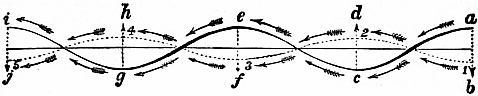
Fig. 29 shows how in progressive flight the wing and the body describe waved tracks,—the crests of the waves made by the wing (a, c, e, g, i) being placed opposite the crests of the waves made by the body (1, 2, 3, 4, 5).
There are good reasons why the wings should always be in advance of the body. A bird when flying is a body in motion; but a body in motion tends to fall not vertically downwards, but downwards and forwards. The wings consequently must be made to strike forwards and kept in advance of the body of the bird if they are to prevent the bird from falling downwards and forwards. If the wings were to strike backwards in aerial flight, the bird would turn a forward somersault.
That the wings invariably strike forwards during the down and up strokes in aerial flight is proved alike by observation and experiment. If any one watches a bird rising from the ground or the water, he cannot fail to perceive that the head and body are slightly tilted upwards, and that the wings are made to descend with great vigour in a downward and forward direction. The dead natural wing and a properly constructed artificial wing act in precisely the same way. If the wing of a gannet, just shot, be removed and made to flap in what the operator believes to be a strictly vertical downward direction, the tip of the wing, in spite of him, will dart forwards between 2 and 3 ft.—the amount of forward movement being regulated by the rapidity of the down stroke. This is a very striking experiment. The same thing happens with a properly constructed artificial wing. The down stroke with the artificial as with the natural wing is invariably converted into an oblique, downward and forward stroke. No one ever saw a bird in the air flapping its wings towards its tail. The old idea was that the wings during the down stroke pushed the body of the bird in an upward and forward direction; in reality the wings do not push but pull, and in order to pull they must always be in advance of the body to be flown. If the wings did not themselves fly forward, they could not possibly cause the body of the bird to fly forward. It is the wings which cause the bird to fly.
It only remains to be stated that the wing acts as a true kite, during both the down and the up strokes, its under concave or biting surface, in virtue of the forward travel communicated to it by the body of the flying creature, being closely applied to the air, during both its ascent and its descent. This explains how the wing furnishes a persistent buoyancy alike when it rises and when it falls (fig. 30).

Fig. 30 shows the kite-like action of the wing during the down and up strokes, how the angles made by the wing with the horizon (a, b) vary at every stage of these strokes, and how the wing evades the superimposed air during the up stroke, and seizes the nether air during the down stroke. In this figure the spaces between the double dotted lines (c g, i b) represent the down strokes, the single dotted line (h, i) representing the up stroke. The kite-like surfaces and angles made by the wing with the horizon (a, b) during the down strokes are indicated at c d e f g, j k l m,—those made during the up strokes being indicated at g h i. As the down and up strokes run into each other, and the convex surface of the wing is always directed upwards and the concave surface downwards, it follows that the upper surface of the wing evades in a great measure the upper air, while the under surface seizes the nether air. It is easy to understand from this figure how the wing always flying forwards furnishes a persistent buoyancy.
The natural kite formed by the wing differs from the artificial kite only in this, that the former is capable of being moved in all its parts, and is more or less flexible and elastic, whereas the latter is comparatively rigid. The flexibility and elasticity of the kite formed by the natural wing are rendered necessary by the fact that the wing, as already stated, is practically hinged at its root and along its anterior margin, an arrangement which necessitates its several parts travelling at different degrees of speed, in proportion as they are removed from the axes of rotation. Thus the tip travels at a higher speed than the root, and the posterior margin than the anterior margin. This begets a twisting diagonal movement of the wing on its long axis, which, but for the elasticity referred to, would break the wing into fragments. The elasticity contributes also to the continuous play of the wing, and ensures that no two parts of it shall reverse at exactly the same instant. If the wing was inelastic, every part of it would reverse at precisely the same moment, and its vibration would be characterized by pauses or dead points at the end of the down and up strokes which would be fatal to it as a flying organ. The elastic properties of the wing are absolutely essential, when the mechanism and movements of the pinion are taken into account. A rigid wing can never be an effective flying instrument.
The kite-like surfaces referred to in natural flight are those upon which the constructors of flying machines very properly ground their hopes of ultimate success. These surfaces may be conferred on artificial wings, aeroplanes, aerial screws or similar structures; and these structures, if we may judge from what we find in nature, should be of moderate size and elastic. The power of the flying organs will be increased if they are driven at a comparatively high speed, and particularly if they are made to reverse and reciprocate, as in this case they will practically create the currents upon which they are destined to rise and advance. The angles made by the kite-like surfaces with the horizon should vary according to circumstances. They should be small when the speed is high, and vice versa. This, as stated, is true of natural wings. It should also be true of artificial wings and their analogues.
Artificial Flight.—We are now in a position to enter upon a consideration of artificial wings and wing movements, and of artificial flight and flying machines.
We begin with artificial wings. The first properly authenticated account of an artificial wing was given by G.A. Borelli in 1670. This author, distinguished alike as a physiologist, mathematician and mechanician, describes and figures a bird with artificial wings, each of which consists of a rigid rod in front and flexible feathers behind. The wings are represented as striking vertically downwards, as the annexed duplicate of Borelli’s figure shows (fig. 31).
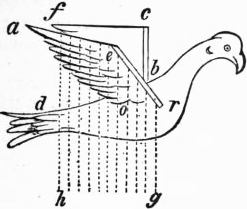
Fig. 31.
Borelli’s bird with artificial wings.
r e, Anterior margin of the right wing, consisting of a rigid rod. o a, Posterior margin of the right wing, consisting of flexible feathers. b c, Anterior; and f, Posterior margins of the left wing same as the right. d, Tail of the bird. r g, d h, Vertical direction of the down stroke of the wing.
Borelli was of opinion that flight resulted from the application of an inclined plane, which beats the air, and which has a wedge action. He, in fact, endeavours to prove that a bird wedges itself forward upon the air by the perpendicular vibration of its wings, the wings during their action forming a wedge, the base of which (c b e) is directed towards the head of the bird, the apex (a f) being directed towards the tail (d). In the 196th proposition of his work (De motu animalium, Leiden, 1685) he states that—
“If the expanded wings of a bird suspended in the air shall strike the undisturbed air beneath it with a motion perpendicular to the horizon, the bird will fly with a transverse motion in a plane parallel with the horizon.” “If,” he adds, “the wings of the bird be expanded, and the under surfaces of the wings be struck by the air ascending perpendicularly to the horizon with such a force as shall prevent the bird gliding downwards (i.e. with a tendency to glide downwards) from falling, it will be urged in a horizontal direction.”
The same argument is restated in different words as under:—“If the air under the wings be struck by the flexible portions of the wings (flabella, literally fly flaps or small fans) with a motion perpendicular to the horizon, the sails (vela) and flexible portions of the wings (flabella) will yield in an upward direction and form a wedge, the point of which is directed towards the tail. Whether, therefore, the air strikes the wings from below, or the wings strike the air from above, the result is the same,—the posterior or flexible margins of the wings yield in an upward direction, and in so doing urge the bird in a horizontal direction.”
There are three points in Borelli’s argument to which it is necessary to draw attention: (1) the direction of the down stroke: it is stated to be vertically downwards; (2) the construction of the anterior margin of the wing: it is stated to consist of a rigid rod; (3) the function delegated to the posterior margin of the wing: it is said to yield in an upward direction during the down stroke.
With regard to the first point. It is incorrect to say the wing strikes vertically downwards, for, as already explained, the body of a flying bird is a body in motion; but as a body in motion tends to fall downwards and forwards, the wing must strike downwards and forwards in order effectually to prevent its fall. Moreover, in point of fact, all natural wings, and all artificial wings constructed on the natural type, invariably strike downwards and forwards.
With regard to the second point, viz. the supposed rigidity of the anterior margin of the wing, it is only necessary to examine the anterior margins of natural wings to be convinced that they are in every case flexible and elastic. Similar remarks apply to properly constructed artificial wings. If the anterior margins of natural and artificial wings were rigid, it would be impossible to make them vibrate smoothly and continuously. This is a matter of experiment. If a rigid rod, or a wing with a rigid anterior margin, be made to vibrate, the vibration is characterized by an unequal jerky motion, at the end of the down and up strokes, which contrasts strangely with the smooth, steady fanning movement peculiar to natural wings.
As to the third point, viz. the upward bending of the posterior margin of the wing during the down stroke, it is necessary to remark that the statement is true if it means a slight upward bending, but that it is untrue if it means an extensive upward bending.
Borelli does not state the amount of upward bending, but one of his followers, E.J. Marey, maintains that during the down stroke the wing yields until its under surface makes a backward angle with the horizon of 45°. Marey further states that during the up stroke the wing yields to a corresponding extent in an opposite direction—the posterior margin of the wing, according to him, passing through an angle of 90°, plus or minus according to circumstances, every time the wing rises and falls.
That the posterior margin of the wing yields to a slight extent during both the down and up strokes will readily be admitted, alike because of the very delicate and highly elastic properties of the posterior margins of the wing, and because of the comparatively great force employed in its propulsion; but that it does not yield to the extent stated by Marey is a matter of absolute certainty. This admits of direct proof. If any one watches the horizontal or upward flight of a large bird he will observe that the posterior or flexible margin of the wing never rises during the down stroke to a perceptible extent, so that the under surface of the wing, as a whole, never looks backwards. On the contrary, he will perceive that the under surface of the wing (during the down stroke) invariably looks forwards and forms a true kite with the horizon, the angles made by the kite varying at every part of the down stroke, as shown more particularly at c d e f g, i j k l m of fig. 30.
The authors who have adopted Borelli’s plan of artificial wing, and who have endorsed his mechanical views of the wing’s action most fully, are J. Chabrier, H.E.G. Strauss-Dürckheim and Marey. Borelli’s artificial wing, it will be remembered, consists of a rigid rod in front and a flexible sail behind. It is also made to strike vertically downwards. According to Chabrier, the wing has only one period of activity. He believes that if the wing be suddenly lowered by the depressor muscles, it is elevated solely by the reaction of the air. There is one unanswerable objection to this theory: the birds and bats, and some if not all the insects, have distinct elevator muscles, and can elevate their wings at pleasure when not flying and when, consequently, the reaction of the air is not elicited. Strauss-Dürckheim agrees with Borelli both as to the natural and the artificial wing. He is of opinion that the insect abstracts from the air by means of the inclined plane a component force (composant) which it employs to support and direct itself. In his theology of nature he describes a schematic wing as consisting of a rigid ribbing in front, and a flexible sail behind. A membrane so constructed will, according to him, be fit for flight. It will suffice if such a sail elevates and lowers itself successively. It will of its own accord dispose itself as an inclined plane, and receiving obliquely the reaction of the air, it transfers into tractile force a part of the vertical impulsion it has received. These two parts of the wing, moreover, are equally indispensable to each other.
Marey repeats Borelli and Dürckheim with very trifling modifications, so late as 1869. He describes two artificial wings, the one composed of a rigid rod and sail—the rod representing the stiff anterior margin of the wing; the sail, which is made of paper bordered with cardboard, the flexible posterior margin. The other wing consists of a rigid nervure in front and behind of thin parchment which supports fine rods of steel. He states that if the wing only elevates and depresses itself, “the resistance of the air is sufficient to produce all the other movements. In effect (according to Marey) the wing of an insect has not the power of equal resistance in every part. On the anterior margin the extended nervures make it rigid, while behind it is fine and flexible. During the vigorous depression of the wing, the nervure has the power of remaining rigid, whereas the flexible portion, being pushed in an upward direction on account of the resistance it experiences from the air, assumes an oblique position which causes the upper surface of the wing to look forwards.” The reverse of this, in Marey’s opinion, takes place during the elevation of the wing—the resistance of the air from above causing the upper surface of the wing to look backwards.... “At first,” he says, “the plane of the wing is parallel with the body of the animal. It lowers itself—the front part of the wing strongly resists, the sail which follows it being flexible yields. Carried by the ribbing (the anterior margin of the wing) which lowers itself, the sail or posterior margin of the wing being raised meanwhile by the air, which sets it straight again, the sail will take an intermediate position and incline itself about 45° plus or minus according to circumstances.... The wing continues its movements of depression inclined to the horizon; but the impulse of the air, which continues its effect, and naturally acts upon the surface which it strikes, has the power of resolving itself into two forces, a vertical and a horizontal force; the first suffices to raise the animal, the second to move it along.”13 Marey, it will be observed, reproduces Borelli’s artificial wing, and even his text, at a distance of nearly two centuries.
The artificial wing recommended by Pettigrew is a more exact imitation of nature than either of the foregoing. It is of a more or less triangular form, thick at the root and anterior margin, and thin at the tip and posterior margin. No part of it is rigid. It is, on the contrary, highly elastic and flexible throughout. It is furnished with springs at its root to contribute to its continued play, and is applied to the air by a direct piston action in such a way that it descends in a downward and forward direction during the down stroke, and ascends in an upward and forward direction during the up stroke. It elevates and propels both when it rises and falls. It, moreover, twists and untwists during its action and describes figure-of-8 and waved tracks in space, precisely as the natural wing does. The twisting is most marked at the tip and posterior margin, particularly that half of the posterior margin next the tip. The wing when in action may be divided into two portions by a line running diagonally between the tip of the wing anteriorly and the root of the wing posteriorly. The tip and posterior parts of the wing are more active than the root and anterior parts, from the fact that the tip and posterior parts (the wing is an eccentric) always travel through greater spaces, in a given time, than the root and anterior parts.
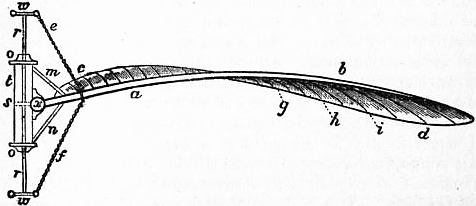
Fig. 32.—Elastic Spiral Wing, which twists and untwists during its action, to form a mobile helix or screw. This wing is made to vibrate by a direct piston action, and by a slight adjustment can be propelled vertically, horizontally or at any degree of obliquity.
a b, Anterior margin of wing, to which the neurae or ribs are affixed. c d, Posterior margin of wing crossing anterior one. x, Ball-and-socket joint at root of wing, the wing being attached to the side of the cylinder by the socket. t, Cylinder. r r, Piston, with cross heads (w, w) and piston head (s). o o, Stuffing boxes. e, f, Driving chains. m, Superior elastic band, which assists in elevating the wing. n, Inferior elastic band, which antagonizes m. The alternate stretching of the superior and inferior elastic bands contributes to the continuous play of the wing, by preventing dead points at the end of the down and up strokes. The wing is free to move in a vertical and horizontal direction and at any degree of obliquity.
The wing is so constructed that the posterior margin yields freely in a downward direction during the up stroke, while it yields comparatively little in an upward direction during the down stroke; and this is a distinguishing feature, as the wing is thus made to fold and elude the air more or less completely during the up stroke, whereas it is made to expand and seize the air with avidity during the down stroke. The oblique line referred to as running diagonally across the wing virtually divides the wing into an active and a passive part, the former elevating and propelling, the latter sustaining.
It is not possible to determine with exactitude the precise function discharged by each part of the wing, but experiment tends to show that the tip of the wing elevates, the posterior margin propels, and the root sustains.
The wing—and this is important—is driven by a direct piston action with an irregular hammer-like movement, the pinion having communicated to it a smart click at the beginning of every down stroke—the up stroke being more uniform. The following is the arrangement (fig. 32). If the artificial wing here represented (fig. 32) be compared with the natural wing as depicted at fig. 33, it will be seen that there is nothing in the one which is not virtually reproduced in the other. In addition to the foregoing, Pettigrew recommended a double elastic wing to be applied to the air like a steam-hammer, by being fixed to the head of the piston. This wing, like the single wing described, twists and untwists as it rises and falls, and possesses all the characteristics of the natural wing (fig. 34).
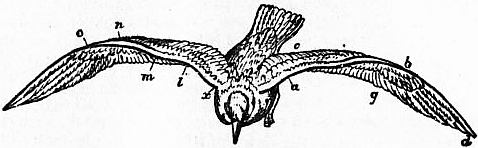
Fig. 33 shows the Spiral Elastic Wings of the Gull. Each wing forms a mobile helix or screw.
a b, Anterior margin of left wing. c d, Posterior margin of ditto. d g, Primary or rowing feathers of left wing. g a, Secondary feathers ditto. x, Root of right wing with ball-and-socket joint. l, Elbow joint. m, Wrist joint, n,o, Hand and finger joints.
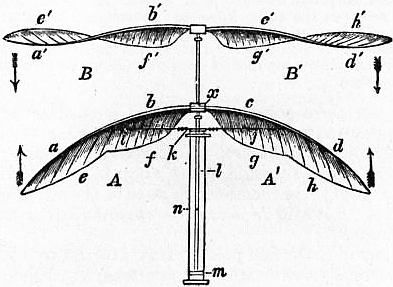
Fig. 34.—Double Elastic Wing driven by direct piston action. During the up stroke of the piston the wing is very decidedly convex on its upper surface (a b c d, A A′); its under surface (e f g h, A A′) being deeply concave and inclined obliquely upwards and forwards. It thus evades, to a considerable extent, the air during the up stroke. During the down stroke of the piston the wing is flattened out in every direction, and its extremities twisted in such a manner as to form two screws, as seen at a′ b′ c′ d′, e′ f′ g′ h′, B, B′. The active area of the wing is by this arrangement considerably diminished during the up stroke, and considerably augmented during the down stroke; the wing seizing the air with greater avidity during the down than during the up stroke. i, j, k, elastic band to regulate the expansion of the wing; l, piston; m, piston head; n, cylinder.
He also recommends an elastic aerial screw consisting of two blades, which taper and become thinner towards the tips and posterior margins. When the screw is made to rotate, the blades, because of their elasticity, assume a great variety of angles, the angles being least where the speed of the blades is greatest and vice versa. The pitch of the blades is thus regulated by the speed attained (fig. 35).
The peculiarity of Pettigrew’s wings and screws consists in their elasticity, their twisting action, and their great comparative length and narrowness. They offer little resistance to the air when they are at rest, and when in motion the speed with which they are driven is such as to ensure that the comparatively large spaces through which they travel shall practically be converted into solid bases of support.
After Pettigrew enunciated his views (1867) as to the screw configuration and elastic properties of natural wings, and more especially after his introduction of spiral, elastic artificial wings, and elastic screws, a great revolution took place in the construction of flying models. Elastic aeroplanes were advocated by D.S. Brown,14 elastic aerial screws by J. Armour,15 and elastic aeroplanes, wings and screws by Alphonse Pénaud.16
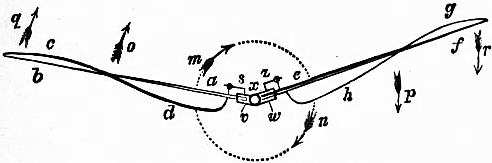
Fig. 35.—Elastic Aerial Screw with twisted blades resembling wings (a b c d, e f g h).
x, End of driving shaft. v,w, Sockets in which the roots of the blades of the screw rotate, the degree of rotation being limited by steel springs (z, s). a b, e f, tapering elastic rods forming anterior or thick margins of blades of screw. d c, h g, Posterior or thin elastic margins of blades of screw. The arrows m, n, o, p, q, r indicate the direction of travel.
Pénaud’s experiments are alike interesting and instructive. He constructed models to fly by three different methods:—(a) by means of screws acting vertically upwards; (b) by aeroplanes propelled horizontally by screws; and (c) by wings which flapped in an upward and downward direction. An account of his helicoptère or screw model appeared in the Aeronaut for January 1872, but before giving a description of it, it may be well to state very briefly what is known regarding the history of the screw as applied to the air.
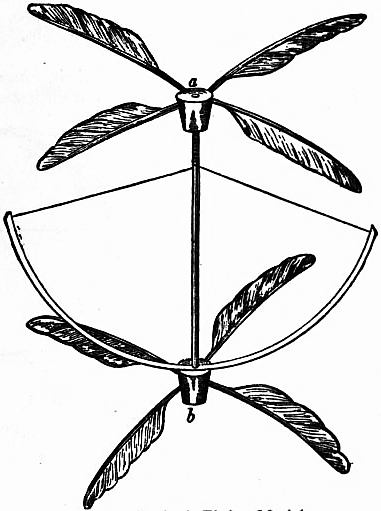
Fig. 36.—Cayley’s Flying Model.
The first suggestion on this subject was given by A.J.P. Paucton in 1768. This author, in his treatise on the Théorie de la vis d’Archimède, describes a machine provided with two screws which he calls a “ptérophores.” In 1796 Sir George Cayley gave a practical illustration of the efficacy of the screw as applied to the air by constructing a small machine, consisting of two screws made of quill feathers, a representation of which we annex (fig. 36). Sir George writes as under:—
“As it may be an amusement to some of your readers to see a machine rise in the air by mechanical means, I will conclude my present communication by describing an instrument of this kind, which any one can construct at the expense of ten minutes’ labour.
“a and b, fig. 36, are two corks, into each of which are inserted four wing feathers from any bird, so as to be slightly inclined like the sails of a windmill, but in opposite directions in each set. A round shaft is fixed in the cork a, which ends in a sharp point. At the upper part of the cork b is fixed a whalebone bow, having a small pivot hole in its centre to receive the point of the shaft. The bow is then to be strung equally on each side to the upper portion of the shaft, and the little machine is completed. Wind up the string by turning the flyers different ways, so that the spring of the bow may unwind them with their anterior edges ascending; then place the cork with the bow attached to it upon a table, and with a finger on the upper cork press strong enough to prevent the string from unwinding, and, taking it away suddenly, the instrument will rise to the ceiling.”
Cayley’s screws were peculiar, inasmuch as they were superimposed and rotated in opposite directions. He estimated that if the area of the screws was increased to 200 sq. ft., and moved by a man, they would elevate him. His interesting experiment is described at length, and the apparatus figured in Nicolson’s Journal, 1809, p. 172.
Other experimenters, such as J. Degen in 1816 and Ottoris Sarti in 1823, followed Cayley at moderate intervals, constructing flying models on the vertical screw principle. In 1842 W.H. Phillips succeeded, it is stated, in elevating a steam model by the aid of revolving fans, which according to his account flew across two fields after having attained a great altitude; and in 1859 H. Bright took out a patent for a machine to be sustained by vertical screws. In 1863 the subject of aviation by vertical screws received a fresh impulse from the experiments of Gustave de Ponton d’Amécourt, G. de la Landelle, and A. Nadar, who exhibited models driven by clock-work springs, which ascended with graduated weights a distance of from 10 to 12 ft. These models were so fragile that they usually broke in coming in contact with the ground in their descent. Their flight, moreover, was unsatisfactory, from the fact that it only lasted a few seconds.