VOLUME X SLICE V Fleury, Claude to Foraker (continued 8)
Reading edition
16 Florence, Carrand Collection. See Museo Nazionale Firenze, Catalogo (1898), p. 205, No. 26 (description only). Illustration in Gallerie nazionali italiane, A. Venturi, vol. iii. (1897), p. 263, L’Arte (Rome, 1894), vol. i. p. 24, Hans Graeven, “Antike Vorlagen byzantinischer Elfenbeinreliefs,” in Jahrb. d. K. Preuss. Kunst-Sammlungen (Berlin, 1897), Bd. xviii. p. 11; Hans Graeven, “Ein Reliquienkästchen aus Pirano,” id., 1899, Bd. xx. fig. 2 and pl. iii.
17 Greek MS. 510, Grégoir de Nazance 10th century, Bibliothèque Nationale, Paris; illustration in Gustave L. Schlumberger, L’Épopée byzantine à la fin du dizième siècle (Paris, 1896 and 1900), vol. i. p. 503. British Museum, Greek Psalter, add. MS. 19352, fol. 189b. written and illuminated cir. 1066 by Theodorus of Caesarea. A cylindrical flute is shown turned to the right, the left hand being uppermost. Smyrna, Library of the Evaggelike Schole B. 18, fol. 72a, A.D. 1100, illustration by Strzygowski, “Der Bilderkreis des griechischen Physiologus,” in Byzantinisches Archiv (Leipzig, 1899), Heft 2, Taf. xi.; N.P. Kondakoff, Histoire de l’art byzantin (Paris, 1886 and 1891), pl. xii. 5; “Kuseyr’ Amra,” issued by K. Akad. d. Wissenschaften (Vienna, 1907), vol. ii. pl. xxxiv.
18 A fine volume containing coloured drawings of these frescoes has been published in St Petersburg (British Museum library catalogue, sect. “Academies,” St Petersburg, 1874-1887, vol. iv. Tab. 1325a).
19 This manuscript, written towards the end of the 12th century, was preserved in the Strassburg library until 1870, when it was burnt during the bombardment of the city. See the fine reproduction in facsimile published by the Soc. pour la conservation des monuments historiques d’Alsace. Texte explicatif de A. Straub and G. Keller (Strassburg, 1901), pl. lvii., also C.M. Engelhardt, Herrad von Landsperg und ihr Werk (Stuttgart and Tübingen, 1818), twelve plates.
20 MS. j. b. 2. Illustrated in Critical and Bibliographical Notes on Early Spanish Music (London, 1887), p. 119.
21 Musica getutscht und auszgezogen (Basel, 1511).
22 Organographia (Wolfenbüttel. 1618), pp. 24, 25, 40.
23 Harmonie universelle (Paris, 1636), Livre v. p. 241.
24 Principes de la flûte traversière ou flûte d’Allemagne, de la flûte à bec et du hautbois (Paris, 1722), p. 38.
25 Musicus αὐτοδιδακτός oder der sich selbst informirende Musicus (Erfurt, 1738), p. 85.
26 Fétis, Rapport sur la fabrication des instruments de musique à l’Exposition Universelle de Paris, en 1855.
27 See Recueil de planches, vol. iv., and article “Basse de flûte traversière,” vol. ii. (Paris, 1751). See also The Flute, by R.S. Rockstro (London, 1890), p. 238, where the wood cut is reproduced together with a translation of the article. The Museum of the Conservatoire in Paris also possesses a bass flute by the noted French maker Delusse.
28 Versuch einer Anweisung die Flöte traversière zu spielen (Berlin, 1752).
29 Unless the contrary is stated, we have always in view, in describing the successive improvements of the flute, the treble flute in D, which is considered to be typical of the family.
30 “Herrn Johann Joachim Quantzens-Lebenslauf, von ihm selbst entworfen,” in the Historisch-Kritische Beyträge zur Aufnahme der Musik, by Marpurg (Berlin, 1754), p. 239. Quantz was professor of the flute to Frederick the Great.
31 See Johann Georg Tromlitz, Ausführlicher und gründlicher Unterricht die Flöte zu spielen (Leipzig, 1791), 1, § 7, and Über Flöten mit mehrern Klappen (Leipzig, 1800), cap. vii. § 21.
32 Antonio Lorenzoni, Saggio per ben sonare il flauto traverso (Vicenza, 1779).
33 See Anweisung, i. § 15.
34 See Lebenslauf, loc. cit. p. 248, where Quantz states that he invented the adjustable head for the flute.
35 See Anweisung, i. §§ 10-13 and iv. § 26.
36 Ausführlicher und gründlicher Unterricht die Flöte zu spielen (Leipzig, 1791), i. cap. § 20. Compare Schilling, Univ.-Lexikon (Leipzig, 1835).
37 Stendal, 1782 (published under his initials only, J. J. H. R., see p. 2).
38 Kurze Abhandlung von Flötenspielen (Leipzig, 1786), p. 27.
39 Über Flöten, &c., pp. 133 and 134.
40 See The Flute, pp. 242-244 and 561 and 562.
41 See op. cit. pp. 51 and 62.
42 English patent, No. 1499.
43 See Rockstro, op. cit. p. 197.
44 Saggio per costruire e suonare un flauto traverso enarmonico che ha i suoni bassi del violino (Rome, 1797).
45 The idea of this large flute was taken up again in 1819 by Trexler of Vienna, who called it the “panaulon.”
46 Patent, No. 3183. Part of the specification together with a diagram is reproduced by Rockstro, op. cit. pp. 273-274.
47 Patent, No. 3349. Part of the specification together with a diagram is reproduced by Rockstro, op. cit. pp. 273-274.
48 Another specimen, almost the same, constructed about 1775, and called “Basse de Musette,” may be seen in the Museum of the Paris Conservatoire.
49 See account of Capeller’s inventions by Carl Maria von Weber in Allgem. musikal. Zeit. (Leipzig, 1811), pp. 377-379, a translation of which is given by Rockstro, op. cit. pp. 279 and 280.
50 See Über den Flötenbau und die neuesten Verbesserungen desselben (Mainz, 1847); and W.S. Broadwood, An Essay on the Construction of Flutes originally written by Theobald Boehm, published with the addition of Correspondence and other Documents (London, 1882).
51 Examen critique de la flûte ordinaire comparée à la flûte Boehm (Paris, 1838).
52 They existed long before, however, in the Chinese Ty and the Japanese Fuye.
53 The reader may consult with advantage Mr C. Welch’s History of the Boehm Flute (London, 1883), wherein all the documents relating to this interesting discussion have been collected with great impartiality.
54 For further details see Kathleen Schlesinger, The Instruments of the Orchestra, part i. pp. 192-194, where an illustration is given, and Paul Wetzger, Die Flöte (Heilbronn, 1906), pp. 23-24, and Tafel iv. No. 20.
FLUX (Lat. fluxus, a flowing; this being also the meaning of the English term in medicine, &c.), in metallurgy, a substance introduced in the smelting of ores to promote fluidity, and to remove objectionable impurities in the form of a slag. The substances in commonest use are:—lime or limestone, to slag off silica and silicates, fluor-spar for lead, calcium and barium sulphates and calcium phosphate, and silica for removing basic substances such as limestone. Other substances are also used, but more commonly in assaying than in metallurgy. Sodium and potassium carbonates are valuable for fluxing off silica; mixed with potassium nitrate sodium carbonate forms a valuable oxidizing fusion mixture; “black flux” is a reducing flux composed of finely divided carbon and potassium carbonate, and formed by deflagrating a mixture of argol with ¼ to ½ its weight of nitre. Borax is very frequently employed; it melts to a clear liquid and dissolves silica and many metallic oxides. Potassium bisulphate is useful in the preliminary treatment of refractory aluminous ores. Litharge and red lead are used in silver and gold assays, acting as solvents for silica and any metallic oxides present.
FLY (formed on the root of the supposed original Teut. fleugan, to fly), a designation applied to the winged or perfect state of many insects belonging to various orders, as in butterfly (see Lepidoptera), dragon-fly (q.v.), may-fly (q.v.), caddis-fly (q.v.), &c.; also specially employed by entomologists to mean any species of the two-winged flies, or Diptera (q.v.). In ordinary parlance fly is often used in the sense of the common house-fly (Musca domestica); and by English colonists and sportsmen in South Africa in that of a species of tsetse-fly (Glossina), or a tract of country (“belt”) in which these insects abound (see Tsetse-Fly).
Apart from the house-fly proper (Musca domestica), which in England is the usual one, several species of flies are commonly found in houses; e.g. the Stomoxys calcitrans, or stable-fly; Pollenia rudis, or cluster-fly; Muscina stabulans, another stable-fly; Calliphora erythrocephala, blue-bottle fly, blow-fly or meat-fly, with smaller sorts of blue-bottle, Phormia terraenovae and Lucilia caesar; Homalomyia canicularis and brevis, the small house-fly; Scenopinus fenestralis, the black window-fly, &c. But Musca domestica is far the most numerous, and in many places, especially in hot weather and in hot climates, is a regular pest. Mr L.O. Howard (Circular 71 of the Bureau of Entomology U.S. Dept. of Agriculture, Washington, 1906) says that in 1900 he made a collection of the flies in dining-rooms in different parts of the United States, and out of a total of 23,087 flies, 22,808 were the common house-fly. Its geographical distribution is of the widest, and its rapidity of breeding, in manure and door-yard filth, so great that, as a carrier of germs of disease, especially cholera and typhoid, the house-fly is now recognized as a potent source of danger; and various sanitary regulations have been made, or precautions suggested, for getting rid of it. These are discussed by Mr Howard in the paper referred to, but in brief they all amount to measures of general hygiene, and the isolation, prompt removal, or proper sterilization of the animal or human excrement in which these flies breed.
FLYCATCHER, a name introduced in ornithology by Ray, being a translation of the Muscicapa of older authors, and applied by Pennant to an extremely common English bird, the M. grisola of Linnaeus. It has since been used in a general and very vague way for a great many small birds from all parts of the world, which have the habit of catching flies on the wing. Ornithologists who have trusted too much to this characteristic and to certain merely superficial correlations of structure, especially those exhibited by a broad and rather flat bill and a gape beset by strong hairs or bristles, have associated under the title of Muscicapidae an exceedingly heterogeneous assemblage of forms much reduced in number by later systematists. Great advance has been made in establishing as independent families the Todidae and Eurylaemidae, as well as in excluding from it various members of the Ampelidae, Cotingidae, Tyrannidae, Vireonidae, Mniotiltidae, and perhaps others, which had been placed within its limits. These steps have left the Muscicapidae a purely Old-World family of the order Passeres, and the chief difficulty now seems to lie in separating it from the Campephagidae and the Laniidae. Only a very few of the forms of flycatchers (which, after all the deductions above mentioned, may be reckoned to include some 60 genera or subgenera, and perhaps 250 species) can here be even named.1
The best-known bird of this family is that which also happens to be the type of the Linnaean genus Muscicapa—the spotted or grey flycatcher (M. grisola). It is a common summer visitant to nearly the whole of Europe, and is found throughout Great Britain, though less abundant in Scotland than in England, as well as in many parts of Ireland, where, however, it seems to be but locally and sparingly distributed. It is one of the latest migrants to arrive, and seldom reaches the British Islands till the latter part of May, when it may be seen, a small dust-coloured bird, sitting on the posts or railings of gardens and fields, ever and anon springing into the air, seizing with an audible snap of its bill some passing insect as it flies, and returning to the spot it has quitted, or taking up some similar station to keep watch as before. It has no song, but merely a plaintive or peevish call-note, uttered from time to time with a jerking gesture of the wings and tail. It makes a neat nest, built among the small twigs which sprout from the bole of a large tree, fixed in the branches of some plant trained against a wall, or placed in any hole of the wall itself that may be left by the falling of a brick or stone. The eggs are from four to six in number, of a pale greenish-blue, closely blotched or freckled with rust-colour. Silent and inconspicuous as is this bird, its constant pursuit of flies in the closest vicinity of houses makes it a familiar object to almost everybody. A second British species is the pied flycatcher (M. atricapilla), a much rarer bird, and in England not often seen except in the hilly country extending from the Peak of Derbyshire to Cumberland, and more numerous in the Lake District than elsewhere. It is not common in Scotland, and has only once been observed in Ireland. More of a woodland bird than the former, the brightly-contrasted black and white plumage of the cock, together with his agreeable song, readily attracts attention where it occurs. It is a summer visitant to all western Europe, but farther eastward its place is taken by a nearly allied species (M. collaris) in which the white of the throat and breast extends like a collar round the neck. A fourth European species (M. parva), distinguished by its very small size and red breast, has also strayed some three or four times to the extreme south-west of England. This last belongs to a group of more eastern range, which has received generic recognition under the name of Erythrosterna, and it has several relations in Asia and particularly in India, while the allies of the pied flycatchers (Ficedula of Brisson) are chiefly of African origin, and those of the grey or spotted flycatcher (Muscicapa proper2) are common to the two continents.
One of the most remarkable groups of Muscicapidae is that known as the paradise flycatchers, forming the genus Tchitrea of Lesson. In nearly all the species the males are distinguished by the growth of exceedingly long feathers in their tail, and by their putting on, for some part of the year at least, a plumage generally white, but almost always quite different from that worn by the females, which is of a more or less deep chestnut or bay colour, though in both sexes the crown is of a glossy steel-blue. They are found pretty well throughout Africa and tropical Asia to Japan, and seem to affect the deep shade of forests rather than the open country. The best-known species is perhaps the Indian T. paradisi; but the Chinese T. incii, and the Japanese T. princeps, from being very commonly represented by the artists of those nations on screens, fans and the like, are hardly less so; and the cock of the last named, with his bill of a pale greenish-blue and eyes surrounded by bare skin of the same colour—though these are characters possessed in some degree by all the species—seems to be the most beautiful of the genus. T. bourbonnensis, which is peculiar to the islands of Mauritius and Réunion, appears to be the only species in which the outward difference of the sexes is but slight. In T. corvina of the Seychelles, the adult male is wholly black, and his middle tail-feathers are not only very long but very broad. In T. mutata of Madagascar, some of the males are found in a blackish plumage, though with the elongated median rectrices white, while in others white predominates over the whole body; but whether this sex is here actually dimorphic, or whether the one dress is a passing phase of the other, is at present undetermined. Some of the African species, of which many have been described, seem always to retain the rufous plumage, but the long tail-feathers serve to mark the males.
A few other groups are distinguished by the brilliant blue they exhibit, as Myiagra azurea, and others as Monarcha (or Arses) chrysomela by their golden yellow. The Australian forms assigned to the Muscicapidae are very varied. Sisura inquieta has some of the habits of a water-wagtail (Motacilla), and hence has received the name of “dishwasher,” bestowed in many parts of England on its analogue; and the many species of Rhipidura or fantailed flycatchers, which occur in various parts of the Australian Region, have manners still more singular—turning over in the air, it is said, like a tumbler pigeon, as they catch their prey; but concerning the mode of life of the majority of the Muscicapidae, and especially of the numerous African forms, hardly anything is known.
(A. N.)
1 Of the 30 genera or subgenera which Swainson included in his Natural Arrangement and Relations of the Family of Flycatchers (published in 1838), at least 19 do not belong to the Muscicapidae at all, and one of them, Todus, not even to the order Passeres. It is perhaps impossible to name any ornithological work whose substance so fully belies its title as does this treatise. Swainson wrote it filled with faith in the so-called “Quinary System”—that fanciful theory, invented by W.S. Macleay, which misled and kept back so many of the best English zoologists of his generation from the truth,—and, unconsciously swayed by his bias, his judgment was warped to fit his hypothesis.
2 By some writers this section is distinguished as Butalis of Boie, but to do so seems contrary to rule.
FLYGARE-CARLÉN, EMILIE (1807-1892), Swedish novelist, was born in Strömstad on the 8th of August 1807. Her father, Rutger Smith, was a retired sea-captain who had settled down as a small merchant, and she often accompanied him on the voyages he made along the coast. She married in 1827 a doctor named Axel Flygare, and went with him to live in the province of Småland. After his death in 1833 she returned to her old home and published in 1838 her first novel, Waldemar Klein. In the next year she removed to Stockholm, and married, in 1841, the jurist and poet, Johan Gabriel Carlén (1814-1875). Her house became a meeting-place for Stockholm men of letters, and for the next twelve years she produced one or two novels annually. The premature death of her son Edvard Flygare (1829-1853), who had already published three books, showing great promise, was followed by six years of silence, after which she resumed her writing until 1884. The most famous of her tales are Rosen på Tistelön (1842; Eng. trans. The Rose of Tistelön, 1842); Enslingen på Johannesskäret (1846; Eng. trans. The Hermit, 4 vols., 1853); and Ett Köpemanshus i skärgården (1859; The Merchant’s House on the Cliffs). Fru Carlén published in 1878 Minnen af svenskt författarlif 1840-1860, and in 1887-1888 three volumes of Efterskörd från en 80- årings författarbana, containing her last tales. She died at Stockholm on the 5th of February 1892. Her daughter, Rosa Carlén (1836-1883), was also a popular novelist.
Emilie Flygare-Carlén’s novels were collected in thirty-one volumes (Stockholm, 1869-1875).
FLYING BUTTRESS, in architecture, the term given to a structural feature employed to transmit the thrust of a vault across an intervening space, such as an aisle, chapel or cloister, to a buttress built outside the latter. This was done by throwing a semi-arch across to the vertical buttress. Though employed by the Romans and in early Romanesque work, it was generally masked by other constructions or hidden under a roof, but in the 12th century it was recognized as rational construction and emphasized by the decorative accentuation of its features, as in the cathedrals of Chartres, Le Mans, Paris, Beauvais, Reims, &c. Sometimes, owing to the great height of the vaults, two semi-arches were thrown one above the other, and there are cases where the thrust was transmitted to two or even three buttresses across intervening spaces. As a vertical buttress, placed at a distance, possesses greater power of resistance to thrust than if attached to the wall carrying the vault, vertical buttresses as at Lincoln and Westminster Abbey were built outside the chapterhouse to receive the thrust. All vertical buttresses are, as a rule, in addition weighted with pinnacles to give them greater power of resistance.
FLYING COLUMN, in military organization, an independent corps of troops usually composed of all arms, to which a particular task is assigned. It is almost always composed in the course of operations, out of the troops immediately available. Mobility being its raison d’être, a flying column is when possible composed of picked men and horses accompanied with the barest minimum of baggage. The term is usually, though not necessarily, applied to forces under the strength of a brigade. The “mobile columns” employed by the British in the South African War of 1899-1902, were usually of the strength of two battalions of infantry, a battery of artillery, and a squadron of cavalry—almost exactly half that of a mixed brigade. Flying columns are mostly used in savage or guerrilla warfare.
“FLYING DUTCHMAN,” a spectre-ship popularly believed to haunt the waters around the Cape of Good Hope. The legend has several variants, but the commonest is that which declares that the captain of the vessel, Vanderdecken, was condemned for his blasphemy to sail round the cape for ever, unable to “make” a port. In the Dutch version the skipper is the ghost of the Dutch seaman Van Straaten. The appearance of the “Flying Dutchman” is considered by sailors as ominous of disaster. The German legend makes one Herr Von Falkenberg the hero, and alleges that he is condemned to sail for ever around the North Sea, on a ship without helm or steersman, playing at dice for his soul with the devil. Sir Walter Scott says the “Flying Dutchman” was originally a vessel laden with bullion. A murder was committed on board, and thereafter the plague broke out among the crew, which closed all ports to the ill-fated craft. The legend has been used by Wagner in his opera Der fliegende Holländer.
FLYING-FISH, the name given to two different kinds of fish. The one (Dactylopterus) belongs to the gurnard family (Triglidae), and is more properly called flying gurnard; the other (Exocoetus) has been called flying herring, though more nearly allied to the gar-pike than to the herring. Some other fishes with long pectoral fins (Pterois) have been stated to be able to fly, but this has been proved to be incorrect.
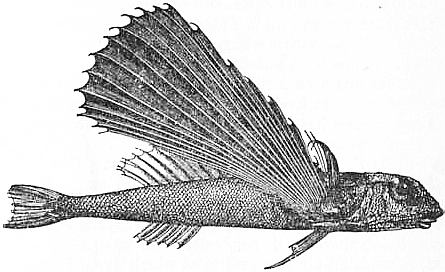
Fig. 1.—Dactylopterus volitans.
The flying gurnards are much less numerous than the Exocoeti with regard to individuals as well as species, there being only three or four species known of the former, whilst more than fifty have been described of the latter, which, besides, are found in numerous shoals of thousands. The Dactylopteri may be readily distinguished by a large bony head armed with spines, hard keeled scales, two dorsal fins, &c. The Exocoeti have thin, deciduous scales, only one dorsal fin, and the ventrals placed far backwards, below the middle of the body; some have long barbels at the chin. In both kinds the pectoral fins are greatly prolonged and enlarged, modified into an organ of flight, and in many species of Exocoetus the ventral fins are similarly enlarged, and evidently assist in the aerial evolutions of these fishes. Flying-fishes are found in the tropical and sub-tropical seas only, and it is a singular fact that the geographical distribution of the two kinds is nearly identical. Flying-fish are more frequently observed in rough weather and in a disturbed sea than during calms; they dart out of the water when pursued by their enemies or frightened by an approaching vessel, but frequently also without any apparent cause, as is also observed in many other fishes; and they rise without regard to the direction of the wind or waves. The fins are kept quietly distended, without any motion, except an occasional vibration caused by the air whenever the surface of the wing is parallel with the current of the wind. Their flight is rapid, greatly exceeding that of a ship going 10 m. an hour, but gradually decreasing in velocity and not extending beyond a distance of 500 ft. Generally it is longer when the fishes fly against, than with or at an angle to, the wind. Any vertical or horizontal deviation from a straight line is not caused at the will of the fish, but by currents of the air; thus they retain a horizontally straight course when flying with or against the wind, but are carried towards the right or left whenever the direction of the wind is at an angle with that of their flight. However, it sometimes happens that the fish during its flight immerses its caudal fin in the water, and by a stroke of its tail turns towards the right or left. In a calm the line of their flight is always also vertically straight or rather parabolic, like the course of a projectile, but it may become undulated in a rough sea, when they are flying against the course of the waves; they then frequently overtop each wave, being carried over it by the pressure of the disturbed air. Flying-fish often fall on board of vessels, but this never happens during a calm or from the lee side, but during a breeze only and from the weather side. In day time they avoid a ship, flying away from it, but during the night when they are unable to see, they frequently fly against the weather board, where they are caught by the current of the air, and carried upwards to a height of 20 ft. above the surface of the water, whilst under ordinary circumstances they keep close to it. All these observations point clearly to the fact that any deflection from a straight course is due to external circumstances, and not to voluntary action on the part of the fish.
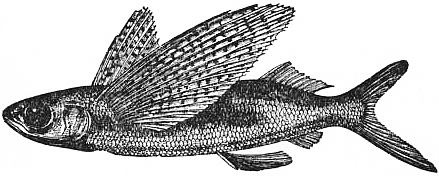
Fig. 2.—Exocoetus callopterus.
A little Malacopterygian fish about 4 in. long has recently been discovered in West Africa which has the habits of a fresh-water flying-fish. It has been named Pantodon buchholzi. It has very large pectoral fins with a remarkable muscular process attached to the inner ray. It lives in fresh-water lakes and rivers in the Congo region, and has been caught in its flight above the water in a butterfly-net.
FLYING-FOX, or, more correctly, Fox-Bat. The first name is applied by Europeans in India to the fruit-eating bats of the genus Pteropus, which contains more than half the family (Pteropidae). This genus is confined to the tropical regions of the Eastern hemisphere and Australia. It comprises numerous species, a considerable proportion of which occur in the islands of the Malay Archipelago. The flying-foxes are the largest of the bats, the kalong of Java (Pteropus edulis) measuring about a foot in length, and having an expanse of wing-membrane measuring 5 ft. across. Flying-foxes are gregarious, nocturnal bats, suspending themselves during the day head-downwards by thousands from the branches of trees, where with their wings gathered about them, they bear some resemblance to huge shrivelled-up leaves or to clusters of some peculiar fruit. In Batchian, according to Wallace, they suspend themselves chiefly from the branches of dead trees, where they are easily caught or knocked down by sticks, the natives carrying them home in basketfuls. They are then cooked with abundance of spices, and “are really very good eating, something like hare.” Towards evening these bats bestir themselves, and fly off in companies to the village plantations, where they feed on all kinds of fruit, and so numerous and voracious are they that no garden crop has much chance of being gathered which is not specially protected from their attacks. The flying-fox of India (Pteropus medius) is a smaller species, but is found in great numbers wherever fruit is to be had in the Indian peninsula.
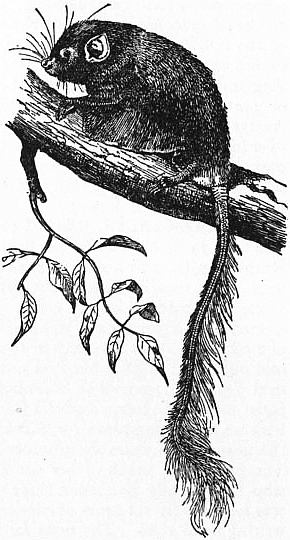
Pigmy African Flying-Squirrel (Idiurus zenkeri).
FLYING-SQUIRREL, properly the name of such members of the squirrel-group of rodent mammals as have a parachute-like expansion of the skin of the flanks, with attachments to the limbs, by means of which they are able to take long flying-leaps from tree to tree. The parachute is supported by a cartilage attached to the wrist or carpus; in addition to the lateral membrane, there is a narrow one from the cheek along the front of each shoulder to the wrist, and in the larger species a third (interfemoral) connecting the hind-limbs with the base of the long tail. Of the two widely distributed genera, Pteromys includes the larger and Sciuropterus the smaller species. The two differ in certain details of dentition, and in the greater development in the former of the parachute, especially the interfemoral portion, which in the latter is almost absent. In Pteromys the tail is cylindrical and comparatively thin, while in Sciuropterus it is broad, flat and laterally expanded, so as to compensate for the absence of the interfemoral membrane by acting as a supplementary parachute.
In general appearance flying-squirrels resemble ordinary squirrels, although they are even more beautifully coloured. Their habits, food, &c., are also very similar to those of the true squirrels, except that they are more nocturnal, and are therefore less often seen. The Indian flying-squirrel (P. oral) leaps with its parachute extended from the higher branches of a tree, and descends first directly and then more and more obliquely, until the flight, gradually becoming slower, assumes a horizontal direction, and finally terminates in an ascent to the branch or trunk of the tree to which it was directed. The presence of these rodents at night is made known by their screaming cries. Sciuropterus is represented by S. velucella in eastern Europe and northern Asia, and by a second species in North America, but the other species of this genus and all those of Pteromys are Indo-Malayan. A third genus, Eupetaurus, typified by a very large, long-haired, dark-grey species from the mountains to the north-west of Kashmir (Eu. cinereus), differs from all other members of the squirrel-family by its tall-crowned molar teeth. It has a total length of 37 in., of which 22 are taken up by the tail.
In Africa the name of flying-squirrel is applied to the members of a very different family of rodents, the Anomaluridae, which are provided with a parachute. Since, however, this parachute is absent in some members of the family, the most distinctive character is the presence of a double row of spiny scales on the under surface of the tail, which apparently aid in climbing. The flying species are also distinguished from ordinary flying-squirrels by the circumstance that the additional bone serving for the support of the fore part of the flying-membrane rises from the elbow-joint instead of from the wrist. The family is represented by two flying genera, Anomalurus and Idiurus; the latter containing only one very minute species (shown in the cut) characterized by its small ears and elongated tail. Most of the species are West African. In habits these rodents appear to be very similar to the true flying-squirrels. The species without a parachute constitutes the genus Zenkerella, and looks very like an ordinary squirrel (see Rodentia).
In Australia and Papua the name flying-squirrel is applied to such marsupials as are provided with parachutes; animals which naturalists prefer to designate flying-phalangers (see Marsupialia)
(R. L.*)
FLYSCH, in geology, a remarkable formation, composed mainly of sandstones, soft marls and sandy shales found extending from S.W. Switzerland eastward along the northern Alpine zone to the Vienna basin, whence it may be followed round the northern flanks of the Carpathians into the Balkan peninsula. It is represented in the Pyrenees, the Apennines, the Caucasus and extends into Asia; similar flysch-like deposits are related to the Himalayas as the European formations are to the Alps. The Flysch is not of the same age in every place; thus in the western parts of Switzerland the oldest portions probably belong to the Eocene period, but the principal development is of Oligocene age; as it is traced eastward we find in the east Alps that it descends into the upper Cretaceous, and in the Vienna region and the Carpathians it contains intercalations which clearly indicate a lower Cretaceous horizon for the lower parts. It appears indeed that this type of formation was in progress of deposition at one point or another in the regions enumerated above from Jurassic to late Tertiary times. The absence of fossils from enormous thicknesses of Flysch makes the correlation with other formations difficult; often the only indications of organisms are the abundant markings supposed to represent Algae (Chondrites, &c.), which have given rise to the term “Hieroglyphic-sandstone.” The most noteworthy exceptions are perhaps the Oligocene fish-bed of Glarus, the Eocene nummulitic beds in Calabria, and the Aptychus beds of Waidhofen. Local phases of the Flysch have received special names; it is the “Vienna” or “Carpathian” sandstone of those regions; the “macigno” (a soft sandstone with calcareous cement) of the Maritime Alps and Apennines; the “scagliose” (scaly clays) and “alberese” (limestones) of the same places are portions of this formation. The gris de Menton, the gris d’Annot of the Basses Alps, and the gris d’Embrun of Chaillot appear in Switzerland as the gris de Taveyannaz. At several places the upper layers of the Flysch are iron-stained, as in the region of Léman and at the foot of the Dent du Midi; it is then styled the “Red-Flysch.” Lenticular intercalations of gabbro, diabase, &c., occur in the Flysch in Calabria on the Pyrenees. Large exotic blocks of granite, gneiss and other crystalline rocks in coarse conglomerates are found near Vienna, near Sonthofen in Bavaria, near Lake Thun (Wild Flysch) and at other points, which have been variously regarded as indications of glaciation or of coastal conditions.
FOČA (pronounced Fáwtcha), a town of Bosnia, situated at the confluence of the Drina and Čehotina rivers, and encircled by wooded mountains. Pop. (1895) 4217. The town is the headquarters of a thriving industry in silver filigree-work and inlaid weapons, for which it was famous. With its territories enclosed by the frontiers of Montenegro and Novi Bazar, Foča, then known as Chocha, was the scene of almost incessant border warfare during the middle ages. No monuments of this period are left except the Bogomil cemeteries, and the beautiful mosques, which are the most ancient in Bosnia. The three adjoining towns of Foča, Goražda and Ustikolina were trading-stations of the Ragusans in the 14th century, if not earlier. In the 16th century, Benedetto Ramberti, ambassador from Venice to the Porte, described the town, in his Libri Tre delle Cose dei Turchi, as Cozza, “a large settlement, with good houses in Turkish style, and many shops and merchants. Here dwells the governor of Herzegovina, whose authority extends over the whole of Servia. Through this place all goods must pass, both going and returning, between Ragusa and Constantinople.”
FOCHABERS, a burgh of barony and village of Elginshire, Scotland. Pop. (1901) 981. It is delightfully situated on the Spey, about 9 m. E. by S. of Elgin, the terminus of a branch of the Highland railway connecting at Orbliston Junction with the main line from Elgin to Keith. The town was rebuilt in its present situation at the end of the 18th century, when its earlier site was required for alterations in the grounds of Gordon Castle, in which the old town cross still stands. The streets all lead at right angles to the central square, where fairs and markets are held. The public buildings include a library and reading-room, the court-house and the Milne school, named after Alexander Milne, who endowed it with a legacy of £20,000. Adjoining the town, surrounded by a park containing many magnificent old trees, stands Gordon Castle, the chief seat of the duke of Richmond and Gordon, erected in the 18th century. The antiquary George Chalmers (1742-1825) and the composer William Marshall (1748-1833) were natives of the burgh.
FOCSHANI (Rumanian Focşani, sometimes incorrectly written Fokshani or Fokshan), the capital of the department of Putna, Rumania; on the river Milcov, which formed the ancient frontier of the former principalities of Moldavia and Walachia. Pop. (1900) 23,783; of whom 6000 were Jews. The chief buildings are the prefecture, schools, synagogues, and many churches, including those of the Armenians and Protestants. Focshani is a commercial centre of some importance, the chief industries being oil and soap manufacture and tannery. A large wine trade is also carried on, and corn is shipped in lighters to Galatz. The annual fair is held on the 29th of April. Government explorations in the vicinity of this town show it to be rich in minerals, such as iron, copper, coal and petroleum. The line Focshani-Galatz is covered by a very strong line of fortifications, known as the Sereth Line. A congress between Russian and Turkish diplomatists was held near the town in 1772. In the neighbourhood the Turks suffered a severe defeat from the Austrians and Russians in 1789.
FOCUS (Latin for “hearth” or “fireplace”), a point at which converging rays meet, toward which they are directed, or from which diverging rays are directed; in the latter case called the virtual focus (see Microscope; Telescope; Lens). In geometry the word is used to denote certain points (see Geometry; Conic Section; and Perspective).
FOG, the name given to any distribution of solid or liquid particles in the surface layers of the atmosphere which renders surrounding objects notably indistinct or altogether invisible according to their distance. In its more intense forms it hinders and delays travellers of all kinds, by sea or land, by railway, road or river, or by the mountain path. It is sometimes so thick as to paralyse traffic altogether. According to the New English Dictionary the word “appears to be” a back formation from the adjective “foggy,” a derivative of “fog” used with its old meaning of aftermath or coarse grass, or, in the north of Britain, of “moss.” Such a formation would be reasonable, because wreaths of fog in the atmospheric sense are specially characteristic of meadows and marshes where fog, in the more ancient sense, grows.
Two other words, mist and haze, are also in common use with reference to the deterioration of transparency of the surface layers of the atmosphere caused by solid or liquid particles, and in ordinary literature the three words are used almost according to the fancy of the writer. It seems possible to draw a distinction between mist and haze that would be fairly well supported by usage. Mist may be defined as a cloud of water particles at the surface of land or sea, and would only occur when the air is nearly or actually saturated, that is, when there is little or no difference between the readings of the dry and wet bulbs; the word haze, on the other hand, may be reserved for the obscuration of the surface layers of the atmosphere when the air is dry.
It would not be difficult to quote instances in which even this distinction is disregarded in practice. Indeed, the telegraphic code of the British Meteorological Office uses the same figure for mist and haze, and formerly the Beaufort weather notation had no separate letter for haze (now indicated by z), though it distinguished between f, fog, and m, mist. It is possible, however, that these practices may arise, not from confusion of idea, but from economy of symbols, when the meaning can be made out from a knowledge of the associated observations.
As regards the distinction between mist and fog, careful consideration of a number of examples leads to the conclusion that the word “fog” is used to indicate not so much the origin or meteorological nature of the obscurity as its effect upon traffic and travellers whether on land or sea. It is, generally speaking, “in a fog” that a traveller loses himself, and indeed the phrase has become proverbial in that sense. A “fog-bell” or “fog-horn” is sounded when the atmosphere is so thick that the aid of sound is required for navigation. A vessel is “fog-logged” or “fog-bound” when it is stopped or detained on account of thick atmosphere. A “fog-signal” is employed on railways when the ordinary signals are obliterated within working distances. A “fog-bow” is the accompaniment of conditions when a mountain traveller is apt to lose his way.
These words are used quite irrespective of the nature of the cloud which interferes with effective vision and necessitates the special provision; the word “mist” is seldom used in similar connexion. We may thus define a fog as a surface cloud sufficiently thick to cause hindrance to traffic. It will be a thick mist if the cloud consists of water particles, a thick haze if it consists of smoke or dust particles which would be persistent even in a dry atmosphere.
It is probable that sailors would be inclined to restrict the use of the word to the surface clouds met with in comparatively calm weather, and that the obscurity of the atmosphere when it is blowing hard and perhaps raining hard as well should be indicated by the terms “thick weather” or “very thick weather” and not by “fog”; but the term “fog” would be quite correctly used on such occasions from the point of view of cautious navigation. If cloud, drizzling rain, or heavy rain cause such obscurity that passing ships are not visible within working distances the sounding of a fog-horn becomes a duty.
The number of occasions upon which fog and mist may be noted as occurring with winds of different strengths may be exemplified by the following results of thirty years for St Mary’s, Scilly Isles, where the observations have always been made by men of nautical experience.
Wind Force. 0 & 1 2 3 4 5 6 7 8-12 All Winds.
Number of occasions of fog per 1000 observations 8 7 9 14 6 3 <1 <1 47
Number of occasions of mist per 1000 observations 5 6 11 22 20 12 6 2 84
The use of the word “fog” in the connexion “high fog,” to describe the almost total darkness in the daytime occasionally noted in London and other large cities due to the persistent opaque cloud in the upper air without serious obscuration of the surface layers, is convenient but incorrect.
Regarding “fog” as a word used to indicate the state of the atmosphere as regards transparency considered with reference to its effect upon traffic, a scale of fog intensity has been introduced for use on land or at sea, whereby the intensity of obscurity is indicated by the numbers 1 to 5 in the table following. At sea or in the country a fog, as a rule, is white and consists of a cloud of minute water globules, of no great vertical thickness, which disperses the sunlight by repeated reflection but is fully translucent. In dust-storms and sand-storms dark or coloured fog clouds are produced such as those which are met with in the Harmattan winds off the west coast of Africa. In large towns the fog cloud is darkened and intensified by smoke, and in some cases may be regarded as due entirely to the smoke.
Description of Effects.
Name. No. On Land. On Sea. On River.
Slight Fog or Mist 1 Objects indistinct, but traffic by rail or road unimpeded Horizon invisible, but lights and landmarks visible at working distances Objects indistinct, but navigation unimpeded
Moderate Fog 2 3 Traffic by rail requires additional caution Traffic by rail or road impeded Lights, passing vessels and landmarks generally indistinct under a mile. Fog signals are sounded Navigation impeded, additional caution required
Thick Fog 4 5 Traffic by rail or road impeded Traffic by rail or road totally disorganized Ships’ lights and vessels invisible at ¼ mile or less Navigation suspended
The physical processes which produce fogs of water particles are complicated and difficult to unravel. We have to account for the formation and maintenance of a cloud at the earth’s surface; and the process of cloud-formation which is probably most usual in nature, namely, the cooling of air by rarefaction due to the reduction of pressure on ascent, cannot be invoked, except in the case of the fogs forming the cloud-caps of hills, which are perhaps not fairly included. We have to fall back upon the only other process hitherto recognized as causing cloudy condensation in the atmosphere, that is to say, the mixing of masses of mist air of different temperatures. The mixing is brought about by the slow motion of air masses, and this slow motion is probably essential to the phenomenon.
Table I.—Air travelling from Northern Africa to Northern Russia, round by the Azores.
Successive Temperatures of sea 68° 68° 67° 59° 54° F.
Successive Temperatures of air 68° 70° 67° 60° 56° F.
Successive States of the atmosphere clear clear clear shower mist
Table II.—Air travelling from N.W. Africa to Scotland.
Successive Temperatures of sea 67° 63° 54° F.
Successive Temperatures of air 66° 64° 53° F.
Successive State of atmosphere fair shower mist with shower
Over the sea fog is most frequently due to the cooling of a surface layer of warm air by the underlying cold water. The amount of motion of the air must be sufficient to prevent the condensation taking place at the sea surface without showing itself as a cloud. In a research on the Life History of Surface Air Currents the changes incidental to the movement of the air over the north Atlantic Ocean were traced with great care, and the above examples (Tables I, II) taken from page 72 of the work referred to are typical of the formation of sea fog by the cooling of a relatively warm current passing over cold water.
In conformity with this suggestion we find that fog is most liable to occur over the open ocean in those regions where, as off the Newfoundland banks, cold-water currents underlie warm air, and that it is most frequent at the season of the year when the air temperature is increasing faster than the water temperature. But it is difficult to bring this hypothesis always to bear upon actual practice, because the fog is representative of a temperature difference which has ceased to exist. One cannot therefore observe under ordinary circumstances both the temperature difference and the fog. Doubtless one requires not only the initial temperature difference but also the slow drift of air which favours cooling of the lower layers without too much mixing and consequently a layer of fog close to the surface. Such a fog, the characteristic sea fog, may be called a cold surface fog. From the conditions of its formation it is likely to be less dense at the mast-head than it is on deck.
One would expect that a cold-air current passing over a warm sea surface would give rise to an ascending current of warmed air and hence cause cumulus cloud and possibly thunder showers rather than surface fog, but one cannot resist the conclusion that sea fog is sometimes formed by slow transference of cold air over relatively warm water, giving rise to what may be called a “steaming-pot” fog. In such a case the actual surface layer in contact with the warm water would be clear, and the fog would be thicker aloft where the mixing of cold air and water vapour is more complete. Such fogs are, however, probably rare in comparison with the cold-water fogs. If the existence of a cold current over warm water were a sufficient cause of fog, as a current of warm air over cold water appears to be, the geographical distribution of notable fog would be much more widespread than it actually is, and the seasonal distribution of fog would also be other than it is.
The formation of fog over land seems to be an even more complicated process than over the sea. Certainly in some cases mistiness amounting to fog arises from the replacement of cold surface air which has chilled the earth and the objects thereon by a warm current. But this process can hardly give rise to detached masses or banks of fog. The ordinary land or valley fog of the autumn evening or winter morning is due to the combination of three causes, first the cooling of the surface layer of air at or after sunset by the radiation of the earth, or more particularly of blades of grass, secondly the slow downward flow (in the absence of wind) of the air thus cooled towards lower levels following roughly the course of the natural water drainage of the land, and thirdly the supply of moisture by evaporation from warm moist soil or from the relatively warm water surface of river or lake. In this way steaming-pot fog gradually forms and is carried downward by the natural though slow descent of the cooled air. It thus forms in wreaths and banks in the lowest parts, until perhaps the whole valley becomes filled with a cloud of mist or fog. A case of this kind in the Lake District is minutely described by J.B. Cohen (Q.J. Roy. Met. Soc. vol. 30, p. 211, 1904).
It will be noticed that upon this hypothesis the circumstances favourable for fog formation are (1) a site near the bottom level of the drainage area, (2) cold surface air and no wind, (3) an evening or night of vigorous radiation, (4) warm soil, and (5) abundant moisture in the surface-soil. These conditions define with reasonable accuracy the circumstances in which fog is actually observed.
The persistence of these fog wreaths is always remarkable when one considers that the particles of a fog cloud, however small they may be, must be continually sinking through the air which holds them, and that unless some upward motion of the air keeps at least a balance against this downward fall, the particles of the cloud must reach the earth or water and to that extent the cloud must disappear. In sheltered valleys it is easy to suppose that the constant downward drainage of fresh and colder fog-laden material at the surface supplies to the layers displaced from the bottom the necessary upward motion, and the result of the gradual falling of drops is only that the surface cloud gets thicker; but there are occasions when the extent and persistence of land fog seems too great to be accounted for by persistent radiation cooling. For example, in the week before Christmas of 1904 the whole of England south of the Humber was covered with fog for several days. It is of course possible that so much fog-laden air was poured down from the sides of mountains and hills that did project above the surface of the fog, as to keep the lower reaches supplied for the whole time, but without more particulars such a statement seems almost incredible. Moreover, the drifting of fog banks over the sea seems capricious and unrelated to any known circumstances of fog-formation, so that one is tempted to invoke the aid of electrification of the particles or some other abnormal condition to account for the persistence of fog. The observations at Kew observatory show that the electrical potential is abnormally high during fog, but whether that is the cause or the result of the presence of the water particles, we are not yet in a position to say. It must be remembered that a fog cloud ought to be regarded as being, generally speaking, in process of formation by mixing. Observations upon clouds formed experimentally in globes tend to show that if a mass of fog-bearing air could be enclosed and kept still for only a short while the fog would settle and leave the air clear. The apparently capricious behaviour of fog banks may be due to the fact that mixing is still going on in the persistent ones, but is completed in the disappearing ones.
One remarkable characteristic of a persistent fog is the coldness of the foggy air at the surface in spite of the heat of the sun’s rays falling upon the upper surface of the fog. A remarkable example may be quoted from the case of London, which was under fog all day on 28th January 1909. The maximum temperature only reached 31° F., whereas at Warlingham in Surrey from which the fog lifted it was as high as 46° F.
A priori we might suppose that the formation of fog would arrest cooling by radiation, and that fog would thus act as a protection of plants against frost. The condensation of water evaporated from wet ground, which affords the material for making fog, does apparently act as a protection, and heavy watering is sometimes used to protect plants from frost, but the same cannot be said of fog itself—cooling appears to go on in spite of the formation of fog.
A third process of fog-formation, namely, the descent of a cloud from above in the form of light drizzling rain, hardly calls for remark. In so far as it is subject to rules, they are the rules of clouds and rain and are therefore independent of surface conditions.
These various causes of fog-formation maybe considered with advantage in relation to the geographical distribution of fog. Statistics on this subject are not very satisfactory on account of the uncertainty of the distinction between fog and mist, but a good deal may be learned from the distribution of fog over the north Atlantic Ocean and its various coasts as shown in the Monthly Meteorological Charts of the north Atlantic issued by the Meteorological Office, and the Pilot charts of the North Atlantic of the United States Hydrographic Office. Coast fog, which is probably of the same nature as land fog, is most frequent in the winter months, whereas sea fog and ocean fog is most extensive and frequent in the spring and summer. By June the fog area has extended from the Great Banks over the ocean to the British Isles, in July it is most intense, and by August it has notably diminished, while in November, which is proverbially a foggy month on land, there is hardly any fog shown over the ocean.
The various meteorological aspects of fog and its incidence in London were the subject of reports to the Meteorological Council by Captain A. Carpenter and Mr R.G.K. Lempfert, based upon special observations made in the winters of 1901-1902 and 1902-1903 in order to examine the possibility of more precise forecasts of fog.
The study of the properties and behaviour of fog is especially important for large towns in consequence of the economic and hygienic results which follow the incidence of dense fogs. The fogs of London in particular have long been a subject of inquiry. It is difficult to get trustworthy statistics on the subject in consequence of the vagueness of the practice as regards the classification of fog. For large towns there is great advantage in using a fog scale such as that given above, in which one deals only with the practical range of vision irrespective of the meteorological cause.
Accepting the classification which distinguishes between fog and haze or mist, but not between the two latter terms, as equivalent to specifying fog when the thickness amounts to the figure 2 or more on the fog scale, we are enabled to compare the frequency of fog in London by the comparison of the results at the London observing stations. The comparison was made by Mr Brodie in a paper read before the Royal Meteorological Society (Quarterly Journal, vol. 31, p. 15), and it appears therefrom that in recent years there has been a notable diminution of fog frequency, as indicated in the following table of the total number of days of fog in the years from 1871:—
1871. 1872. 1873. 1874. 1875. 1876. 1877. 1878. 1879. 1880. 1881. 1882. 1883. 1884. 1885. 1886. 1887. 1888. 1889.
42 35 75 53 49 40 46 63 69 74 59 69 61 53 69 86 83 62 75
1890. 1891. 1892. 1893. 1894. 1895. 1896. 1897. 1898. 1899. 1900. 1901. 1902. 1903. 1904. 1905. 1906. 1907. 1908.
65 69 68 31 51 48 43 48 47 56 13 45 42 26 44 19 16 37 19
But from any statistics of the frequency occurrence of fog it must not be understood that the atmosphere of London is approaching that of the surrounding districts as regards transparency. Judged by the autographic records it is still almost opaque to sunshine strong enough to burn the card of the recorder during the winter months.
The bibliography of fog is very extensive. The titles referring to fog, mist and haze in the Bibliography of Meteorology (part ii.) of the U.S. Signal Office, published in 1889, number 306. Among more recent authors on the subject, besides those referred to in the text, may be mentioned:—Köppen, “Bodennebel,” Met. Zeit. (1885); Trabert, Met. Zeit. (1901), p. 522; Elias in Ergebnisse des aëronautischen Observatoriums bei Berlin, ii. (Berlin, 1904); Scott, Q.J.R. Met. Soc. xix. p. 229; A.G. McAdie, “Fog Studies,” Amer. Inv. ix. (Washington, D.C., 1902), p. 209; Buchan, “Fogs on the Coasts of Scotland,” Journ. Scot. Met. Soc. xii. p. 3.
(W. N. S.)
FOGAZZARO, ANTONIO (1842- ), Italian novelist and poet, was born at Vicenza in 1842. He was a pupil of the Abate Zanella, one of the best of the modern Italian poets, whose tender, thoughtful and deeply religious spirit continued to animate his literary productions. He began his literary career with Miranda, a poetical romance (1874), followed in 1876 by Valsolda, which, republished in 1886 with considerable additions, constitutes perhaps his principal claim as a poet, which is not inconsiderable. To the classic grandeur of Carducci and D’Annunzio’s impetuous torrent of melody Fogazzaro opposes a Wordsworthian simplicity and pathos, contributing to modern Italian literature wholesome elements of which it would otherwise be nearly destitute. His novels, Malombra (1882), Daniele Cortis (1887), Misterio del Poeta (1888), obtained considerable literary success upon their first publication, but did not gain universal popularity until they were discovered and taken up by French critics in 1896. The demand then became prodigious, and a new work, Piccolo Mondo antico (1896), which critics far from friendly to Fogazzaro’s religious and philosophical ideas pronounced the best Italian novel since I Promessi Sposi, went through numerous editions. Even greater sensation was caused by his novel Il Santo (The Saint, 1906), on account of its being treated as unorthodox by the Vatican; and Fogazzaro’s sympathy with the Liberal Catholic movement—his own Catholicism being well known—made this novel a centre of discussion in the Roman Catholic world.
See the biography by Molmenti (1900).
FOGELBERG, BENEDICT (or Bengt) ERLAND (1786-1854), Swedish sculptor, was born at Gothenburg on the 8th of August 1786. His father, a copper-founder, encouraging an early-exhibited taste for design, sent him in 1801 to Stockholm, where he studied at the school of art. There he came much under the influence of the sculptor Sergell, who communicated to him his own enthusiasm for antique art and natural grace. Fogelberg worked hard at Stockholm for many years, although his instinct for severe beauty rebelled against the somewhat rococo quality of the art then prevalent in the city. In 1818 the grant of a government pension enabled him to travel. He studied from one to two years in Paris, first under Pierre Guérin, and afterwards under the sculptor Bosio, for the technical practice of sculpture. In 1820 Fogelberg realized a dream of his life in visiting Rome, where the greater part of his remaining years were spent in the assiduous practice of his art, and the careful study and analysis of the works of the past. Visiting his native country by royal command in 1854, he was received with great enthusiasm, but nothing could compensate him for the absence of those remains of antiquity and surroundings of free natural beauty to which he had been so long accustomed. Returning to Italy, he died suddenly of apoplexy at Trieste on the 22nd of December 1854. The subjects of Fogelberg’s earlier works are mostly taken from classic mythology. Of these, “Cupid and Psyche,” “Venus entering the Bath,” “A Bather” (1838), “Apollo Citharede,” “Venus and Cupid” (1839) and “Psyche” (1854) may be mentioned. In his representations of Scandinavian mythology Fogelberg showed, perhaps for the first time, that he had powers above those of intelligent assimilation and imitation. His “Odin” (1831), “Thor” (1842), and “Balder” (1842), though influenced by Greek art, display considerable power of independent imagination. His portraits and historical figures, as those of Gustavus Adolphus (1849), of Charles XII. (1851), of Charles XIII. (1852), and of Birger Jarl, the founder of Stockholm (1853), are faithful and dignified works.
See Casimir Leconte, L’Œuvre de Fogelberg (Paris, 1856).
FOGGIA, a town and episcopal see (since 1855) of Apulia, Italy, the capital of the province of Foggia, situated 243 ft. above sea-level, in the centre of the great Apulian plain, 201 m. by rail S.E. of Ancona and 123 m. N.E. by E. of Naples. Pop. (1901) town, 49,031; commune, 53,134. The name is probably derived from the pits or cellars (foveae) in which the inhabitants store their grain. The town is the medieval successor of the ancient Arpi, 3 m. to the N.; the Normans, after conquering the district from the Eastern empire, gave it its first importance. The date of the erection of the cathedral is probably about 1179; it retains some traces of Norman architecture, and the façade has a fine figured cornice by Bartolommeo da Foggia; the crypt has capitals of the 11th (?) century. The whole church was, however, much altered after the earthquake of 1731. A gateway of the palace of the emperor Frederick II. (1223, by Bartolommeo da Foggia) is also preserved. Here died his third wife, Isabella, daughter of King John of England. Charles of Anjou died here in 1284. After his son’s death, it was a prey to internal dissensions and finally came under Alphonso I. of Aragon, who converted the pastures of the Apulian plain into a royal domain in 1445, and made Foggia the place at which the tax on the sheep was to be paid and the wool to be sold. The other buildings of the town are modern. Foggia is a commercial centre of some importance for the produce of the surrounding country, and is also a considerable railway centre, being situated on the main line from Bologna to Brindisi, at the point where this is joined by the line from Benevento and Caserta. There are also branches to Rocchetta S. Antonio (and thence to either Avellino, Potenza, or Gioia del Colle), to Manfredonia, and to Lucera.
FÖHN (Ger., probably derived through Romansch favongn, favoign, from Lat. favonius), a warm dry wind blowing down the valleys of the Alps from high central regions, most frequently in winter. The Föhn wind often blows with great violence. It is caused by the indraft of air from the elevated region to areas of low barometric pressure in the neighbourhood, and the warmth and dryness are due to dynamical compression of the air as it descends to lower levels. Similar local winds occur in many parts of the world, as Greenland, and on the slopes of the Rocky Mountains. In the southern Alpine valleys the Föhn wind is often called sirocco, but its nature and cause are different from the true sirocco. The belief that the warm dry wind comes from the Sahara dies hard; and still finds expression in some textbooks.
For a full account of these winds see Hann, Lehrbuch der Meteorologie, p. 594.
FÖHR, a German island in the North Sea, belonging to the province of Schleswig-Holstein, and situated off its coast. Pop. 4500. It comprises an area of 32 sq. m., and is reached by a regular steamboat service from Husum and Dagebüll on the mainland to Wyk, the principal bathing resort on the E. coast of the island. The chief attraction of Wyk is the Sandwall, a promenade which is shaded by trees and skirts the beach. Föhr, the most fertile of the North Frisian islands, is principally marshland, and comparatively well wooded. There are numerous pleasantly-situated villages and hamlets scattered over it, of which the most frequented are Boldixum, Nieblum and Alkersum. The inhabitants are mainly engaged in the fishing industry, and are known as excellent sailors.
FOIL. 1. (Through O. Fr. from Lat. folium, a leaf, modern Fr. feuille), a leaf, and so used in heraldry and in plant names, such as the “trefoil” clover; and hence applied to anything resembling a leaf. In architecture, the word appears for the small leaf-like spaces formed by the cusps of tracery in windows or panels, and known, according to the number of such spaces, as “quatrefoil,” “cinquefoil,” &c. The word is also found in “counterfoil,” a leaf of a receipt or cheque book, containing memoranda or a duplicate of the receipt or draft, kept by the receiver or drawer as a “counter” or check. “Foil” is particularly used of thin plates of metal, resembling a leaf, not in shape as much as in thinness. In thickness foil comes between “leaf” and “sheet” metal. In jewelry, a foil of silvered sheet copper, sometimes known as Dutch foil, is used as a backing for paste gems, or stones of inferior lustre or colour. This is coated with a mixture of isinglass and translucent colour, varying with the stones to be backed, or, if only brilliancy is required, left uncoloured, but highly polished. From this use of “foil,” the word comes to mean, in a figurative sense, something which by contrast, or by its own brightness, serves to heighten the attractive qualities of something else placed in juxtaposition. The commonest “foil” is that generally known as “tinfoil.” The ordinary commercial “tinfoil” usually consists chiefly of lead, and is used for the wrapping of chocolate or other sweetmeats, tobacco or cigarettes. A Japanese variegated foil gives the effect of “damaskeening.” A large number of thin plates of various metals, gold, silver, copper, together with alloys of different metals are soldered together in a particular order, a pattern is hammered into the soldered edges, and the whole is hammered or rolled into a single thin plate, the pattern then appearing in the order in which the various metals were placed.
2. (From an O. Fr. fuler or foler, modern fouler, to tread or trample, to “full” cloth, Lat. fullo, a fuller), an old hunting term, used of the running back of an animal over its own tracks, to confuse the scent and baffle the hounds. It is also used in wrestling, of a “throw.” Thus comes the common use of the word, in a figurative sense, with reference to both these meanings, of baffling or defeating an adversary, or of parrying an attack.
3. As the name of the weapon used in fencing (see Foil-Fencing) the word is of doubtful origin. One suggestion, based on a supposed similar use of Fr. fleuret, literally a “little flower,” for the weapon, is that foil means a leaf, and must be referred in origin to Lat. folium. A second suggestion is that it means “blunted,” and is the same as (2). A third is that it is an adaptation of an expression “at foils,” i.e. “parrying.” Of these suggestions, according to the New English Dictionary, the first has nothing to support it, the second is not supported by any evidence that in sense (2) the word ever meant to blunt. The third has some support. Finally a suggestion is made that the word is an alteration of an old word “foin,” meaning a thrust with a pointed weapon. The origin of this word is probably an O. Fr. foisne, from the Lat. fuscina, a three-pronged fork.
FOIL-FENCING, the art of attack and defence with the fencing-foil. The word is used in several spellings (foyle, file, &c.) by the English writers of the last half of the 16th century, but less in the sense of a weapon of defence than merely as an imitation of a real weapon. Blunt swords for practice in fencing have been used in all ages. For the most part these were of wood and flat in general form, but when, towards the close of the 17th century, all cutting action with the small-sword was discarded (see Fencing), foil-blades were usually made of steel, and either round, three-cornered or four-cornered in form, with a button covering the point. The foil is called in French fleuret, and in Italian fioretto (literally “bud”) from this button. The classic small-sword play of the 17th and 18th centuries is represented at the present time by fencing with the épée de combat (fighting-rapier), which is merely the modern duelling-sword furnished with a button (see Épée-de-Combat), and by foil-fencing. Foil-fencing is a conventional art, its characteristic limitation lying in the rule that no hits except those on the body shall be considered good, and not even those unless they be given in strict accordance with certain standard precepts. In épée-fencing on the contrary, a touch on any part of the person, however given, is valid. Foil-fencing is considered the basis, so far as practice is concerned, of all sword-play, whether with foil, épée or sabre.
There are two recognized schools of foil-fencing, the French and the Italian. The French method, which is now generally adopted everywhere except in Italy, is described in this article, reference being made to the important differences between the two schools.
The Foil.—The foil consists of the “blade” and the “handle.” The blade, which is of steel and has a quadrangular section, consists of two parts: the blade proper, extending from the guard to the button, and the “tongue,” which runs through the handle and is joined to the pommel. The blade proper is divided into the “forte,” or thicker half (next the handle), and the “foible” or thinner half. Some authorities divide the blade proper into three parts, the “forte,” “middle” and “foible.” The handle is comprised of the “guard,” the “grip” and the “pommel.” The guard is a light piece of metal shaped like the figure 8 (Fr. lunettes, spectacles) and backed with a piece of stiff leather of the same shape. The grip, which is grasped by the hand, is a hollow piece of wood, usually wound with twine, through which the tongue of the blade passes. The pommel is a piece of metal, usually pear-shaped, to which the end of the tongue is joined and which forms the extremity of the handle. The blade from guard to button is about 33 in. long (No. 5), though a somewhat shorter and lighter blade is generally used by ladies. The handle is about 8 in. long and slightly curved downwards.
The genuine Italian foil differs from the French in having the blade a trifle longer and more whippy, and in the form of the handle, which consists of a thin, solid, bell-shaped guard from 4 to 5 in. in diameter, a straight grip and a light metal bar joining the grip with the guard, beyond the edge of which it extends slightly on each side. Of late years many Italian masters use French blades and even discard the cross-bar, retaining, however, the bell-guard.
In holding the foil, the thumb is placed on the top or convex surface of the grip (the sides of which are a trifle narrower than the top and bottom), while the palm and fingers grasp the other three sides. This is the position of “supination,” or thumb-up. “Pronation” is the reverse position, with the knuckles up. The French lay stress upon holding the foil lightly, the necessary pressure being exerted mostly by the thumb and forefinger, the other fingers being used more to guide the direction of the executed movements. This is in order to give free scope to the doigté (fingering), or the faculty of directing the point of the foil by the action of the fingers alone, and includes the possibility of changing the position of the hand on the grip. Thus, in parrying, the end of the thumb is placed within half an inch, or even less, of the guard, while in making a lunge, the foil is held as near the pommel as possible, in order to gain additional length. It will be seen that doigté is impossible with the Italian foil, in holding which the forefinger is firmly interlaced with the cross-bar, preventing any movement of the hand. The lightness of grasp inculcated by the French is illustrated by the rule of the celebrated master Lafaugère: “Hold your sword as if you had a little bird in your hand, firmly enough to prevent its escape, yet not so firmly as to crush it.” This lightness has for a consequence that a disarmament is not considered of any value in the French school.
To Come on Guard.—The position of “on guard” is that in which the fencer is best prepared both for attack and defence. It is taken from the position of “attention”; the feet together and at right angles with each other, head and body erect, facing forward in the same direction as the right foot, left arm and hand hanging in touch with the body, and the right arm and foil forming a straight line so that the button is about 1 yd. in front of the feet and 4 in. from the floor. From this position the movements to come “on guard” are seven in number:—
1. Raise the arm and foil and extend them towards the adversary (or master) in a straight line, the hand being opposite the eye.
2. Drop the arm and foil again until the point is about 4 in. from the floor.
3. Swing the button round so that it shall point horizontally backwards, and hold the hilt against the left thigh, the open fingers of the left hand being held, knuckles down, against the guard and along the blade.
4. Carry the foil, without altering the position of the hands, above the head until the arms are fully extended, the foil being kept horizontal and close to the body as it is lifted.
5. Let the left arm fall back behind the head to a curved position, the hand being opposite the top of the head; at the same time bring the right hand down opposite the right breast and about 8 in. from it; keeping the elbow well in and the point of the foil directed towards the opponent’s eye.
6. Bend the legs by separating them at the knees but without moving the feet.
7. Shift the weight of the body on to the left leg and advance the right foot a short distance (from 14 to 18 in., according to the height of the fencer).
In the Italian school the fencer stands on guard with the right arm fully extended, the body more effaced, i.e. the left shoulder thrown farther back, and the feet somewhat farther apart. At the present time, however, many of the best Italian fencers have adopted the guard with crooked sword-arm, owing to their abandonment of the old long-foil blade.
The Recover (at the close of the lesson or assault).—To recover “in advance”: extend the right arm at right angles with the body, drop the left arm and straighten the legs by drawing the rear foot up to the one in advance. To recover “to the rear”: extend the right arm and drop the left as before, and straighten the legs by drawing the forward foot back to that in the rear.
The Salute always follows the recover, the two really forming one manœuvre. Having recovered, carry the right hand to a position just in front of the throat, knuckles out, foil vertical with point upwards; then lower and extend the arm with nails up until the point is 4 in. from the floor and slightly to the right.
To Advance.—Being on guard, take a short step forward with the right foot and let the left foot follow immediately the same distance, the position of the body not being changed. However the step, or series of steps, is made, the right foot should always move first.
To Retreat.—This is the reverse of the advance, the left foot always moving first.
The Calls (deux appels).—Being on guard, tap the floor twice with the right foot without altering the position of any other part of the person. The object of the calls is to test the equilibrium of the body, and they are usually executed as a preliminary to the recover.
The Lunge is the chief means of attack. It is immediately preceded by the movement of “extension,” in fact the two really form one combined movement. Extension is executed by quickly extending the right arm, so that point, hand and shoulder shall have the same elevation; no other part of the person is moved. The “lunge” is then carried out by straightening the left leg and throwing forward the right foot, so that it shall be planted as far forward as possible without losing the equilibrium or preventing a quick recovery to the position of guard. The left foot remains firmly in its position, the right shoulder is advanced, and the left arm is thrown down and back (with hand open and thumb up), to balance the body. The recovery to the position of guard is accomplished by smartly throwing the body back by the exertion of the right leg, until its weight rests again on the left leg, the right foot and arms resuming their on-guard positions. The point upon which the French school lays most stress is, that the movement of extension shall, if only by a fraction of a second, actually precede the advance of the right foot. The object of this is to ensure the accuracy of the lunge, i.e. the direction of the point.
The Gain.—This consists in bringing up the left foot towards the right (the balance being shifted), keeping the knees bent. In this manner a step is gained and an exceptionally long lunge can be made without the knowledge of the adversary. It is a common stratagem of fencers whose reach is short.
Defence.—For the purpose of nomenclature the space on the fencer’s jacket within which hits count is divided into quarters, the two upper ones being called the “high lines,” and the two lower ones the “low lines.” Thus a thrust directed at the upper part of the breast is called an attack in the high lines. In like manner the parries are named from the different quarters they are designed to protect. There are four traditional parries executed with the hand in supination, and four others, practically identical in execution, made with the hand held in pronation. Thus the parries defending the upper right-hand quarter of the jacket are “sixte” (sixth; with the hand in supination) and “tierce” (third; hand in pronation). Those defending the upper left-hand quarter are “quarte” (fourth; in supination) and “quinte” (fifth; in pronation). Those defending the lower right-hand quarter are “octave” (eighth; in supination) and “seconde” (second; in pronation). Those defending the lower left-hand quarter are “septime” (seventh; in supination), more generally called “demicircle,” or “half-circle”; and “prime” (first; in pronation).
The Parries.—The tendency of the French school has always been towards simplicity, especially of defence, and at the present day the parries made with the knuckles up (pronation), although recognized and taught, are seldom if ever used against a strong adversary in foil-fencing, owing principally to the time lost in turning the hand. The theory of parrying is to turn aside the opponent’s foil with the least possible expenditure of time and exertion, using the arm as little as possible while letting the hand and wrist do the work, and opposing the “forte” of the foil to the “foible” of the adversary’s. The foil is kept pointed as directly as possible towards the adversary, and the parries are made rather with the corners than the sides of the blade. The slightest movement that will turn aside the opponent’s blade is the most perfect parry. There are two kinds of parries, “simple,” in which the attack is warded off by a single movement, and “counter,” in which a narrow circle is described by the point of the foil round that of the opponent, which is thus enveloped and thrown aside. There are also complex parries, composed of combinations of two or more parries, which are used to meet complicated attacks, but they are all resolvable into simple parries. In parrying, the arm is bent about at right angles.
Simple Parries.—The origin of the numerical nomenclature of the parries is a matter of dispute, but it is generally believed that they received their names from the positions assumed in the process of drawing the sword and falling on guard. Thus the position of the hand and blade, the moment it is drawn from the scabbard on the left side, is practically that of the first, or “prime,” parry. To go from “prime” to “seconde” it is only necessary to drop the hand and carry it across the body to the left side; thence to “tierce” is only a matter of raising the point of the sword, &c.
Parry of Prime (to ward off attacks on the—usually lower—left-hand side of the body). Hold the hand, knuckles up, opposite the left eye and the point directed towards the opponent’s knee. This parry is now regarded more as an elegant evolution than a sound means of defence, and is little employed.
Parry of Seconde (against thrusts at the lower right-hand side). This is executed by a quick, not too wide movement of the hand downwards and slightly to the right, knuckles up.
Parry of Tierce (against thrusts at the upper right-hand side). A quick, dry beat on the adversary’s “foible” is given, forcing it to the right, the hand, in pronation, being held opposite the middle of the right breast. This parry has been practically discarded in favour of “sixte.”
Parry of Quarte (against thrusts at the upper left-hand side). This parry, perhaps the most used of all, is executed by forcing the adversary’s blade to the left by a dry beat, the hand being in supination, opposite the left breast.
Parry of Quinte (against thrusts at the left-hand side, like “quarte”). This is practically a low “quarte,” and is little used.
Parry of Sixte (against thrusts at the upper right-hand side). This parry is, together with “quarte,” the most important of all. It is executed with the hand held in supination opposite the right breast, a quick, narrow movement throwing the adversary’s blade to the right.
Parry of Septime or Half-Circle (against thrusts at the lower left-hand side) is executed by describing with the point of the foil a small semicircle downward and towards the left, the hand moving a few inches in the same direction, but kept thumb up.
Parry of Octave (against thrusts at the lower right-hand side) is executed by describing with the point of the foil a small semicircle downward and towards the right, the hand moving a few inches in the same direction, but kept thumb up.
Counter Parries (Fr. contre).—Although the simple parries are theoretically sufficient for defence, they are so easily deceived by feints that they are supplemented by counter parries, in which the blade describes narrow circles, following that of the adversary and meeting and turning it aside; thus the point describes a complete circle while the hand remains practically stationary. Each simple parry has its counter, made with the hand in the same position and on the same side as in the simple parry. The two most important are the “counter of quarte” and the “counter of sixte,” while the counters of “septime” and “octave” are less used, and the other four at the present time practically never.
Counter of Quarte.—Being on guard in quarte (with your adversary’s blade on the left of yours), if he drops his point under and thrusts in sixte, in other words at your right breast, describe a narrow circle with your point round his blade, downward to the right and then up over to the left, bringing hand and foil back to their previous positions and catching and turning aside his blade on the way. The “Counter of Sixte” is executed in a similar manner, but the circle is described in the opposite direction, throwing off the adverse blade to the right. The “Counters of Septime and Octave” are similar to the other two but are executed in the low lines.
Complex or Combined Parries are such as are composed of two or more parries executed in immediate succession, and are made in answer to feint attacks by the adversary (see below); e.g. being on guard in quarte, should the adversary drop his point under and feint at the right breast but deflect the point again and really thrust on the left, it is evident that the simple parry of sixte would cover the right breast but would leave the real point of attack, the left, entirely uncovered. The sixte parry is therefore followed, as a continuation of the movement, by the parry of quarte, or a counter parry. The complex parries are numerous and depend upon the attack to be met.
Engagement is the junction of the blades, the different engagements being named from the parries. Thus, if both fencers are in the position of quarte, they are said to be engaged in quarte. To engage in another line (Change of Engagement) e.g. from quarte to sixte, the point is lowered and passed under the adversary’s blade, which is pressed slightly outward, so as to be well covered (called “opposition”). “Double Engagement” is composed of two engagements executed rapidly in succession in the high lines, the last with opposition.
Attack.—The attack in fencing comprises all movements the object of which is to place the point of the foil upon the adversary’s breast, body, sides or back, between collar and belt. The space upon which hits count is called the “target” and differs according to the rules prevailing in the several countries, but is usually as above stated. In Great Britain no hits above the collar-bones count, while in America the target is only the left breast between the median line and a line running from the armpit to the belt. The reason for this limitation is to encourage accuracy.
Attacks are either “primary” or “secondary.” Primary Attacks are those initiated by a fencer before his adversary has made any offensive movement, and are divided into “Simple,” “Feint” and “Force” attacks.
Simple Attacks, the characteristic of which is pace, are those made with one simple movement only and are four in number, viz. the “Straight Lunge,” the “Disengagement,” the “Counter-disengagement” and the “Cut-over.” The Straight-Lunge (coup droit), used when the adversary is not properly covered when on guard, is described above under “Lunge.” The Disengagement is made by dropping the point of the foil under the opponent’s blade and executing a straight lunge on the other side. It is often used to take an opponent unawares or when he presses unduly hard on your blade. The Counter-disengagement is used when the adversary moves his blade, i.e. changes the line of engagement, upon which you execute a narrow circle, avoiding his blade, and thrust in your original line. The Cut-over (coupé) is a disengagement executed by passing the point of the foil over that of the adversary and lunging in the opposite line. The preliminary movement of raising the point is made by the action of the hand only, the arm not being drawn back.
Feint Attacks, deceptive in character, are those which are preceded by one or more feints, or false thrusts made to lure the adversary into thinking them real ones. A feint is a simple extension, often with a slight movement of the body, threatening the adversary in a certain line, for the purpose of inducing him to parry on that side and thus leave the other open for the real thrust. At the same time any movement of the blade or any part of the body tending to deceive the adversary in regard to the nature of the attack about to follow, must also be considered a species of feint. The principal feint attacks are the “One-Two,” the “One-Two-Three” and the “Double.”
The “One-Two” is a feint in one line, followed (as the adversary parries) by a thrust in the original line of engagement. Thus, being engaged in quarte, you drop your point under the adversary’s blade and extend your arm as if to thrust at his left breast, but instead of doing this, the instant he parries you move your point back again and lunge in quarte, i.e. on the side on which you were originally engaged. In feinting it is necessary that the extension of the arm and blade be so complete as really to compel the adversary to believe it a part of a real thrust in that line.
The “One-Two-Three” consists of two feints, one at each side, followed by a thrust in the line opposite to that of the original engagement. Thrusts preceded by three feints are also sometimes used. It is evident that the above attacks are useless if the adversary parries by a counter (circular parry), which must be met by a “Double.” This is executed by feinting and, upon perceiving that the adversary opposes with a circular parry, by following the circle described by his point with a similar circle, deceiving (i.e. avoiding contact with) his blade and thrusting home.
The “Double,” which is a favourite manœuvre in fencing, is a combination of a disengagement and a counter-disengagement.
Force-Attacks, the object of which is to disconcert the opponent by assaulting his blade, are various in character, the principal ones being the “Beat,” the “Press,” the “Glide” and the “Bind.” The “Beat” is a quick, sharp blow of the forte of the foil upon the foible of the adversary’s, for the purpose of opening a way for a straight lunge which follows instantly. The blow is made with the hand only. A “false beat” is a lighter blow made for the purpose of drawing out or disconcerting the opponent, and is often followed by a disengagement. The “Press” is similar in character to the beat, but, instead of striking the adverse blade, a sudden pressure is brought to bear upon it, sufficiently heavy to force it aside and allow one’s own blade to be thrust home. A “false press” may be used to entice the adversary into a too heavy responsive pressure, which may then be taken advantage of by a disengagement. The “Traverse” (Fr. froissé, Ital. striscio) is a prolonged press carried sharply down the adverse blade towards the handle. The “Glide” (“Graze,” Fr. coulé) is a stealthy sliding of one’s blade down that of the adversary, without his notice, until a straight thrust can be made inside his guard. It is also used as a feint before a disengage. The “Bind” (liement) consists in gaining possession of the adversary’s foible with one’s forte, and pressing it down and across into the opposite low line, when one’s own point is thrust home, the adversary’s blade being still held by one’s hilt. It may be also carried out from a low line into a high one. The bind is less used in the French school than in the Italian. The “Flanconnade” is a bind made by capturing the adversary’s blade in high quarte, carrying it down and thrusting in the outside line with strong opposition. Another attack carried out by means of a twist and thrust is the “Cross” (croisé), which is executed when the adversary’s blade is held low by passing one’s point over his wrist and forcing down both blades into seconde with a full extension of the arm. The result is to create a sudden and wide opening, and often disarms the adversary.
Secondary Attacks are those made (1) just as your adversary himself starts to attack; (2) during his attack; and (3) on the completion of his attack if it fails.
1. “Attacks on the Preparation” are a matter of judgment and quickness. They are usually attempted when the adversary is evidently preparing a complicated attack, such as the “one-two-three” or some other manœuvre, involving one or more preliminary movements. At such a time a quick thrust will often catch him unawares and score. Opportunities for preparation attacks are often given when the adversary attempts a beat preliminary to his thrust; the beat is frustrated by an “absence of the blade,” i.e. your blade is made to avoid contact with his by a narrow movement, and your point thrust home into the space left unguarded by the force of his unresisted beat. Or the adversary himself may create an “absence” by suddenly interrupting the contact of the blades, in the hope that, by the removal of the pressure, your blade will fly off to one side, leaving an opening; if, however, you are prepared for his “absence” a straight thrust will score.
2. The chief “Attacks on the Development,” or “Counter Attacks,” are the “Stop Thrust” and the “Time Thrust,” both made while the adversary is carrying out his own attack. The “Stop Thrust” (coup d’arrêt) is one made after the adversary has actually begun an attack involving two or more movements, and is only justified when it can be brought off without your being hit by the attacking adversary’s point on any part of the person. The reason for this is, that the rules of fencing decree that the fencer attacked must parry, and that, if he disregards this and attempts a simultaneous counter attack, he must touch his opponent while totally avoiding the latter’s point. Should he, however, be touched, even on the foot or mask, by the adversary, his touch, however good, is invalid. If both touches are good, that of the original attacker only counts. Stop thrusts are employed mostly against fencers who attack wildly or without being properly covered. The “Time Thrust” is delivered with opposition upon the adversary’s composite attack (one involving several movements), and, if successful, generally parries the original attack at the same time. It is not valid if the fencer employing it is touched on any part of the person.
3. “Attacks on the Completion” (i.e. of the adversary’s attack) are “Ripostes,” “Counter-ripostes,” “Remises” and “Renewals of Attack.”
The Riposte (literally, response) is an attack made, immediately after parrying successfully, by merely straightening the arm, the body remaining immovable. The “counter-riposte” is a riposte made after parrying the adversary’s riposte, and generally from the position of the lunge, or while recovering from it, since one must have attacked with a full lunge if the adversary has had an opportunity to deliver a riposte. There are three kinds of ripostes: direct, with feints and after a pause.
The “direct riposte” may be made instantly after parrying the adversary’s thrust by quitting his blade and straightening the arm, so that the point will touch his body on the nearest and most exposed part; or by not quitting his blade but running yours quickly down his and at the same time keeping a strong opposition (“riposte d’opposition”). The quickest direct riposte is that delivered after parrying quarte (for a right-hand fencer), and is called by the French the riposte of “tac-au-tac,” imitative of the sudden succession of the click of the parry and the tap of the riposting fencer’s point on his adversary’s breast. In making “ripostes with a feint” the point is not jabbed on to the opponent’s breast immediately after the parry, but one or more preliminary movements precede the actual riposte, such as a disengagement, a cut-over or a double.
Ripostes with a pause (à temps perdu, with lost time) are made after a second’s hesitation, and are resorted to when the fencers are too near for an accurate direct riposte, or to give the adversary time to make a quick parry, which is then deceived.
The remise is a thrust made after one’s first thrust has been parried and in the same line; it must be made in such a way that the adversary’s justified riposte is at the same time parried by opposition or completely avoided. It is really a renewal of the attack in the original line, while the so-called “renewal of attack” (“redoublement d’attaque”) is a second thrust which ignores the adversary’s riposte, but made in a different line. Both the remise and the renewal are valid only when the adversary’s riposte does not hit.