VOLUME X SLICE V Fleury, Claude to Foraker (continued 5)
Reading edition
FLORUS, Roman historian, flourished in the time of Trajan and Hadrian. He compiled, chiefly from Livy, a brief sketch of the history of Rome from the foundation of the city to the closing of the temple of Janus by Augustus (25 B.C.). The work, which is called Epitome de T. Livio Bellorum omnium annorum DCC Libri duo, is written in a bombastic and rhetorical style, and is rather a panegyric of the greatness of Rome, whose life is divided into the four periods of infancy, youth, manhood and old age. It is often wrong in geographical and chronological details; but, in spite of its faults, the book was much used in the middle ages. In the MSS. the writer is variously given as Julius Florus, Lucius Anneus Florus, or simply Annaeus Florus. From certain similarities of style he has been identified with Publius Annius Florus, poet, rhetorician and friend of Hadrian, author of a dialogue on the question whether Virgil was an orator or poet, of which the introduction has been preserved.
The best editions are by O. Jahn (1852), C. Halm (1854), which contain the fragments of the Virgilian dialogue. There is an English translation in Bohn’s Classical Library.
FLORUS, JULIUS, poet, orator, and jurist of the Augustan age. His name has been immortalized by Horace, who dedicated to him two of his Epistles (i. 3; ii. 2), from which it would appear that he composed lyrics of a light, agreeable kind. The statement of Porphyrion, the old commentator on Horace, that Florus himself wrote satires, is probably erroneous, but he may have edited selections from the earlier satirists (Ennius, Lucilius, Varro). Nothing is definitely known of his personality, except that he was one of the young men who accompanied Tiberius on his mission to settle the affairs of Armenia. He has been variously identified with Julius Florus, a distinguished orator and uncle of Julius Secundus, an intimate friend of Quintilian (Instit. x. 3, 13); with the leader of an insurrection of the Treviri (Tacitus, Ann. iii. 40); with the Postumus of Horace (Odes, ii. 14) and even with the historian Florus.
FLORUS, PUBLIUS ANNIUS, Roman poet and rhetorician, identified by some authorities with the historian Florus (q.v.). The introduction to a dialogue called Virgilius orator an poëta is extant, in which the author (whose name is given as Publius Annius Florus) states that he was born in Africa, and at an early age took part in the literary contests on the Capitol instituted by Domitian. Having been refused a prize owing to the prejudice against African provincials, he left Rome in disgust, and after travelling for some time set up at Tarraco as a teacher of rhetoric. Here he was persuaded by an acquaintance to return to Rome, for it is generally agreed that he is the Florus who wrote the well-known lines quoted together with Hadrian’s answer by Aelius Spartianus (Hadrian 16). Twenty-six trochaic tetrameters, De qualitate vitae, and five graceful hexameters, De rosis, are also attributed to him. Florus is important as being the first in order of a number of 2nd-century African writers who exercised a considerable influence on Latin literature, and also the first of the poëtae neoterici or novelli (new-fashioned poets) of Hadrian’s reign, whose special characteristic was the use of lighter and graceful metres (anapaestic and iambic dimeters), which had hitherto found little favour.
The little poems will be found in E. Bährens, Poëtae Latini minores (1879-1883); for an unlikely identification of Florus with the author of the Pervigilium Veneris (q.v.) see E.H.O. Müller, De P. Annio Floro poëta et de Pervigilio Veneris (1855), and, for the poet’s relations with Hadrian, F. Eyssenhardt, Hadrian und Florus (1882); see also F. Marx in Pauly-Wissowa’s Realencyclopädie, i. pt. 2 (1894).
FLOTOW, FRIEDRICH FERDINAND ADOLF VON, Freiherr (1812-1883), German composer, was born on his father’s estate at Teutendorf, in Mecklenburg, on the 27th of April 1812. Destined originally for the diplomatic profession, his passion for music induced his father to send him to Paris to study under Reicha. But the outbreak of the revolution in 1830 caused his return home, where he busied himself writing chamber-music and operetta until he was able to return to Paris. There he produced Pierre et Cathérine, Rob Roy, La Duchesse de Guise, but made his first real success with Le Naufrage de la Méduse at the Renaissance Théâtre in 1838. Greater, however, was the success which attended Stradella (1844) and Martha (1847), which made the tour of the world. In 1848 Flotow was again driven home by the Revolution, and in the course of a few years he produced Die Grossfürstin (1850), Indra (1853), Rübezahl (1854), Hilda (1855) and Albin (1856). From 1856 to 1863 he was director (Intendant) of the Schwerin opera, but in the latter year he returned to Paris, where in 1869 he produced L’Ombre. From that time to the date of his death he lived in Paris or on his estate near Vienna. He died on the 24th of January 1883. Of his concert-music only the Jubelouvertüre is now ever heard. His strength lay in the facility of his melodies.
FLOTSAM, JETSAM and LIGAN, in English law, goods lost at sea, as distinguished from goods which come to land, which are technically designated wreck. Jetsam (the same word as jettison, from Lat. jactare, to throw) is when goods are cast into the sea, and there sink and remain under water; flotsam (floatson, from float, Lat. flottare) is where they continue floating on the surface of the waves; ligan (or lagan, from lay or lie) is where they are sunk in the sea, but tied to a cork or buoy in order to be found again. Flotsam, jetsam and ligan belong to the sovereign in the absence only of the true owner. Wreck, on the other hand (i.e. goods cast on shore), was by the common law adjudged to the sovereign in any case, because it was said by the loss of the ship all property was gone out of the original owner. This singular distinction which treated goods washed ashore as lost, and goods on and in the sea as not lost, is no doubt to be explained by the primitive practice of plundering wrecked ships. (See Wreck.)
FLOUNDER, a common term for flat-fish. The name is also more specially given to certain varieties, according to local usage. Thus the Pleuronectes flesus is the common flounder of English terminology, found along the coasts of northern Europe from the Bristol Channel to Iceland. It is particularly partial to fresh water, ascending the Rhine as far as Cologne. It rarely exceeds a length of 12 in. or a weight of 1½ ℔ In American terminology the principal fish of the name are the “summer flounders” or “deep-sea flounders,” also known in America as “plaice” (Paralichthys dentatus), as long as 3 ft. and as heavy as 15 ℔; the “four-spotted flounders” (Paralichthys oblongus); the “common” or “winter” flounder (Pseudopleuronectes americanus); the “diamond flounder” (Hysopsetta guttulata); and the “pole flounder” (Glyptocephalus cynoglossus).
FLOUR and FLOUR MANUFACTURE. The term “flour” (Fr. fleur, flower, i.e. the best part) is usually applied to the triturated farinaceous constituents of the wheat berry (see Wheat); it is, however, also used of other cereals and even of leguminoids when ground into a fine powder, and of many other substances in a pulverulent state, though in these cases it is usual to speak of rye flour, bean flour, &c. The flour obtained from oats is generally termed oatmeal. In Great Britain wheaten flour was commonly known in the 16th and 17th centuries as meal, and up to the beginning of the 19th century, or perhaps later, the term mealing trade was not infrequently used of the milling trade.
The ancestor of the millstone was apparently a rounded stone about the size of a man’s fist, with which grain or nuts were pounded and crushed into a rude meal. These stones are generally of hard sandstone and were evidently Primitive grinding. used against another stone, which by dint of continual hammering was broken into hollows. Sometimes the crusher was used on the surface of rocks. St Bridget’s stone, on the shore of Lough Macnean, is supposed to have been a primitive Irish mill; there are many depressions in the face of the table-like rock, and it is probable that round this stone several women (for in early civilization the preparation of flour was peculiarly the duty of the women) would stand and grind, or rather pound, meal. Many such stones, known as Bullan stones, still exist in Ireland. Similar remains are found in the Orkneys and Shetlands, and it is on record that some of these stones have been used for flour-making within historic times. Richard Bennett in his History of Corn Milling remarks that the Seneca Indians to this day boil maize and crush it into a paste between loose stones. In the same way the Omahas pound this cereal in holes in the rocks, while the Oregon Indians parch and pound the capsules of the yellow lily, much after the fashion described by Herodotus in his account of the ancient Egyptians. In California the Indian squaws make a sort of paste by crushing acorns between a round stone or “muller,” and a cuplike hollow in the surface of a rock. Crushing stones are of different shapes, ranging from the primitive ball-like implement to an elongated shape resembling the pestle of a mortar. Mullers of the latter type are not infrequent among prehistoric remains in America, while Dr Schliemann discovered several specimens of the globular form on the reputed site of the city of Troy, and also among the ruins of Mycenae. As a matter of fact stone mullers survived in highly civilized countries into modern days, if indeed they are now altogether extinct.
The saddle-stone is the connecting link between the primitive pounder, or muller, and the quern, which was itself the direct ancestor of the millstones still used to some extent in the manufacture of flour. The saddle-stone, the Saddle-stone. first true grinding implement, consisted of a stone with a more or less concave face on which the grain was spread, and in and along this hollow surface it was rubbed and ground into coarse meal. Saddle-stones have been discovered in the sand caves of Italy, among the lake dwellings of Switzerland, in the dolmens of France, in the pit dwellings of the British Isles, and among the remains of primitive folk all the world over. The Romans of the classical period seem to have distinguished the saddle-stone from the quern. We find allusions to the mola trusatilis, which may be translated “the thrusting mill”; this would fairly describe a backwards and forwards motion. The mola versatilis evidently referred to the revolving millstone or quern. In primitive parts of the world the saddle-stone is not yet extinct, as for instance in Mexico. It is known as the metata, and is used both for grinding maize and for making the maize cakes known as tortillas. The same implement is apparently still in use in some parts of South America, notably in Chile.
According to Richard Bennett, the quern, the first complete milling machine, originated in Italy and is in all probability not older than the 2nd century B.C. This is, however, a controverted point. Querns are still used in most Quern. primitive countries, nor is it certain that they have altogether disappeared from remoter districts of Scotland and Ireland. Whatever was their origin, they revolutionized flour milling. The rotary motion of millstones became the essential principle of the trituration of grain, and exists to-day in the rolls of the roller mill. The early quern appears to have differed from its descendants in that it was somewhat globular in shape, the lower stone being made conical, possibly with the idea that the ground flour should be provided with a downward flow to enable it to fall from the stones. This type did not, however, persist. Gradually the convexity disappeared and the surface of the two stones became flat or very nearly so. In the upper stone was a species of funnel, through which the grain passed as through a hopper, making its way thence, as the stone revolved, into the space between the running and the bed stone. The ground meal was discharged at the periphery. The runner, or upper stone, was provided with a wooden handle by which the stone was revolved. The typical Roman mill of the Augustan age may be seen at Pompeii. Here, in what is believed to have been a public pistrinum or mill, were found four pairs of millstones. The circular base of these mills is 5 ft. in diameter and 1 ft. high, and upon it was fastened the meta, a blunt cone about 2 ft. high, on which fitted the upper millstone or catillus, also conical. These mills were evidently rotated by slave labour, as there was no room for the perambulation of a horse or donkey, while the side-lugs in which the handle-bars were inserted are plainly visible. Slave labour was generally used up to the introduction of Christianity, but was finally abolished by the emperor Constantine, though even after his edict mills continued to be driven by criminals.
The Romans are credited by some authorities with having first applied power to the driving of millstones, which they connected with water-wheels by a horizontal spindle through the intervention of bevel gearing. But long Use of power. after millstones had been harnessed to water power slave labour was largely employed as a motive force. The watermill of the Romans was introduced at a relatively early period into Britain. Domesday Book shows that England was covered by mills of a kind at the time of the Norman conquest, and mentions some 500 mills in the counties of Norfolk and Suffolk alone. No doubt the mola of Domesday Book consisted of one pair of stones connected by rude gearing with a water-wheel. Windmills are said to have been introduced by the Crusaders, who brought them from the East. Steam power is believed to have been first used in a British flour mill towards the close of the 18th century, when Boulton & Watt installed a steam engine in the Albion Flour Mills in London, erected under the care of John Rennie. Another great engineer, Sir William Fairbairn, in the early days of the 19th century, left the impress of his genius on the mill and all its accessories. He was followed by other clever engineers, and in the days immediately preceding the roller period many improvements were introduced as regards the balancing and driving of millstones. The introduction of the blast and exhaust to keep the stones cool was a great step in advance, while the substitution of silk gauze for woollen or linen bolting cloth, about the middle of the 19th century, marked another era in British milling. Millstones, as used just before the introduction of roller milling, were from 4 to 4½ ft. in diameter by some 12 in. in thickness, and were usually made of a siliceous stone, known as buhr-stone, much of which came from the quarry of La Ferté-sous-Jouarre, in France.
Nine-tenths, or perhaps ninety-nine hundredths, of all the flour consumed in Great Britain is made in roller mills, that is, mills in which the wheat is broken and floured by means of rollers, some grooved in varying degrees Roller milling. of fineness, some smooth, their work being preceded and supplemented by a wide range of other machinery. All roller mills worthy of the name are completely automatic, that is to say, from the time the raw material enters the mill warehouse till it is sacked, either in the shape of finished flour or of offals, it is touched by no human hand.
The history of roller milling extends back to the first half of the 19th century. Roller mills, that is to say, machines fitted with rolls set either horizontally, or vertically, or obliquely, for the grinding of corn, are said to have been used as far back as the 17th century, but if this be so it is certain that they were only used in a tentative manner. Towards the middle of the 19th century the firm of E.R. & F. Turner, of Ipswich, began to build roller mills for breaking wheat as a preliminary to the conversion of the resultant middlings on millstones. The rolls were made of chilled iron and were provided with serrated edges, which must have exercised a tearing action on the integuments of the berry. These mills were built to the design of a German engineer, of the name of G.A. Buchholz, and were exhibited at the London exhibition of 1862, but they never came into general use. It has also been stated that as early as 1823 a French engineer, named Collier, of Paris, patented a roller mill, while five years later a certain Malar took out another French patent, the specification of which speaks of grooves and differential speeds. But the direct ancestors of the roller mills of the present day were brought out some time in the third decade of the 19th century by a Swiss engineer named Sulzberger. His apparatus was rather cumbrous, and the chilled iron rolls with which it was fitted consumed a large amount of power relatively to the work effected. But the Pester Walz-Mühle, founded in 1839 by Count Szechenyi, a Hungarian nobleman, which took its name from the roller mills with which it was equipped by Sulzberger, was for many years a great success; some of its roller mills are said to have been kept at work for upwards of forty years, and one at least is preserved in the museum at Budapest.
It may be noted that Hungarian wheat is hard and flinty and well adapted for treatment by rolls. Moreover, gradual reduction, as now understood, was more or less practised in Hungary, even before the introduction of roller Hungarian practice. milling. Though millstones, and not rolls, were used, yet the wheat was not floured at one operation, as in typical low or flat grinding, but was reduced to flour in several successive operations. In the first break the stones would be placed just wide enough apart to “end” the wheat, and in each succeeding operation the stones were brought closer together. But Hungarian milling was not then automatic in the sense in which British millers understand the word. For a long time a great deal of hand labour was employed in the merchant mills of Budapest in carrying about products from one machine to another for further treatment. This practice may have been partly due to the cheap labour available, but it was also the deliberate policy of Hungarian millers to handle in this way the middlings and fine “dunst,” because it was maintained that only thus could certain products be delivered to the machine by which they were to be treated in the perfection of condition. The results were good so far as the finished products were concerned, but in the light of modern automatic milling the system appears uneconomical. Not only did it postulate an inordinately large staff, but it further increased the labour bill by the demand it made on the number of sub-foremen who were occupied in classifying, largely by touch, the various products, and directing the labourers under them. Hungarian milling still differs widely from milling as practised in Great Britain in being a longer system. This is due to the more minute subdivision of products, a necessary consequence of the large number of grades of flour and offals made in Hungary, where there are many intermediate varieties of middlings and “dunst” for which no corresponding terms are available in an English miller’s vocabulary.
It will be convenient here to explain the meaning of three terms constantly used by millers, namely, semolina, middlings and dunst. These three products of roller mills are practically identical in composition, but represent Semolina, middlings, dunst. different stages in the process of reducing the endosperm of the wheat to flour. A wheat berry is covered by several layers of skin, while under these layers is the floury kernel or endosperm. This the break or grooved rolls tend to tear and break up. The largest of these more or less cubical particles are known as semolina, whilst the medium-sized are called middlings and the smallest sized termed dunst. The last is a German word, with several meanings, but is used in this particular sense by German and Austrian millers, from whom it was doubtless borrowed by the pioneers of roller milling in England. If we were to lay a sample of fairly granular flour beside a sample of small dunst the two would be easy to distinguish, but place a magnifying glass over the flour and it would look very like the dunst. If we were to repeat this experiment on dunst and fine middlings, the former would under the glass present a strong resemblance to the middlings. The same effect would be produced by the putting side by side of large middlings and small semolina. This is a broad description of semolina, middlings and dunst. Semolina and middlings are more apt to vary in appearance than dunst, because the latter is the product of the later stages of the milling process and represents small particles of the floury kernel tolerably free from such impurities as bran or fluff. The flour producing middlings must not be confounded with the variety of wheat offal which is also known to many English millers as middlings. This consists of husk or bran, more or less comminuted, and with a certain proportion of floury particles adherent. It is only fit for feeding beasts.
The spread of roller milling on the continent of Europe was undoubtedly accelerated by the invention of porcelain rolls, by Friedrich Wegmann, a Swiss miller, which were brought into general use in the seventh decade of the Porcelain rolls. 19th century, and are still widely employed. They are admirably fitted for the reduction of semolina, middlings and dunst into flour; and for reducing pure middlings, that is, middlings containing no bran or wheat husk, there is perhaps nothing that quite equals them. They were introduced into Great Britain in 1877, or thereabouts, and were used for several years, but ultimately they almost disappeared from British mills. This was partly due to the fact that as made at that date they were rather difficult to work, as it was not easy to keep the rolls perfectly parallel. Another drawback was their inadaptability to over-heavy feeds, to which the British, and perhaps still more the American, miller is frequently obliged to resort. However, since the beginning of the 20th century some of the most advanced flour mills in England have again taken to using porcelain rolls for some part of their reduction process.
The birth of roller milling in Great Britain may be said to date from 1872, when Oscar Oexle, a German milling engineer, erected a set of roller mills in the Tradeston Mills, in Glasgow. This was long before the introduction of Roller milling in England. automatic roller mills. But the foundations of the millstone system were not seriously disturbed till 1877, when a party of leading British and Irish millers visited Vienna and Budapest with the object of studying roller milling in its native home. In 1878 J.H. Carter installed in the mill of J. Boland, of Dublin, what was probably the first complete automatic roller plant erected in the United Kingdom, and in 1881 a milling exhibition held at the Royal Agricultural Hall, London, showed the automatic roller system in complete operation. From that time the roller system made great progress. By 1885 many of the leading British millers had installed full roller plants, and in the succeeding ten years small roller plants were installed in many country mills. For a time there was a transition stage in which there was in operation a number of so-called “combined” plants, that is to say, mills in which the wheat was broken on millstones or disk mills, while the middlings were reduced by smooth rolls; but these gradually dropped out of being.
Well-found British flour mills at the present time are probably the best fitted in the world, and as a whole have nothing to fear from comparison with their American competitors. It is true that American millers were rather quicker to copy Hungarian milling methods so far as gradual reduction was concerned. But from about 1880 the British miller was quite awake to his position and was straining every nerve to provide himself with a plant capable of dealing with every kind of wheat. It has often been said that he commands the wheat of the whole world. This is true in a sense, but it is not true that he can always command the exact kind of wheat he requires at the price required to meet foreign competition. Therein he is at a disadvantage. But engineers have done their best to meet this weak point, and by their assistance he is able to compete under almost all conditions with the millers of the whole world.
Processes of Milling.—Fully to appreciate the various processes of modern milling, it must be remembered not only that the wheat as delivered at the mill is dusty and mixed with sand and even more objectionable refuse, but also that it contains many light grains and seeds of other plants. It is not therefore sufficient for the miller to be able to reduce the grain to flour on the most approved principles; he must also have at command the means of freeing it from foreign substances, and further of “conditioning” it, should it be damp or over dry and harsh. Again, his operations must be conducted with reference to the structure of the wheat grain. The wheat berry is a fruit, not a seed, the actual seed being the germ or embryo, a kidney-shaped body which is found at the base of the berry and is connected with the plumule or root. The germ is tough in texture and is in roller milling easily separated from the rest of the berry, being flattened instead of crushed by the rolls and thus readily sifted from the stock. The germ contains a good deal of fatty matter, which, if allowed to remain, would not increase the keeping qualities of the flour. Botanists distinguish five skins on the berry—epidermis, epicarp, endicarp, episperm and embryous membrane—but for practical purposes the number of integuments may be taken as three. The inner skin is often as thick as the outer and second skins together, which are largely composed of woody fibre; it contains the cerealin or aleurone cells, but although these are made up of a certain proportion of proteids, on account of the discolouring and diastasic action of the cerealin in flour they are best eliminated. The endosperm, or floury kernel, coming next to the inner skin, consists of starch granules which are caught as it were in the minute meshes of a net. This network is the gluten, and it may be noted that these meshes are not of equal consistency throughout the berry, but are usually finer and more dense near the husk than in the interior of the kernel. This glutinous portion is of great importance to the baker because on its quantity and quality depends the “strength” or rising power of the flour, and the aim of modern roller milling is to retain it as completely as possible, a matter of some difficulty owing to its close adherence to the husk, especially in the richest wheats. Another organ of the wheat berry which has a most important bearing on the work of the miller is the placenta, which is in effect a cord connecting the berry with its stalk or straw. The placenta serves to filter the food which the plant sucks up from the ground; it passes up the crease of the berry, and is enfolded in the middle skin, being protected on the outer side by the first and having the third or inner skin on its other side. A good deal of the matters filtered by the placenta are mineral in their nature, and such portions as are not digested remain in the crease. This is the matter which millers call “crease dirt.” It is highly discolouring to flour, and must be carefully eliminated. The fuzzy end of the berry known as the beard also has a distinct function; its hairs are in reality tubes which serve to carry off superfluous moisture. They have, in common with the bran, no nutritive value. (See also Wheat.)
In the old “flat” or “low” milling the object was to grind as perfectly as possible, at one operation, the central substance of the grain, constituting the flour, and to separate it from the embryo and outer skins constituting the bran. In “high” milling, on the other hand, the grinding is effected in a series of operations, the aim being to get as much semolina and middlings as possible from the wheat, and to make as little flour as possible during the earlier or “breaking” part of the process. It is impossible altogether to avoid the production of flour at this stage, but properly set and worked break-rolls will make as little as 15% of “break-flour,” which is of less value, being contaminated with crease dirt, and also because it is weak owing to the absence of the gluten cells which adhere more readily to the middlings. Whole wheaten flour, sometimes called Graham flour, consists of the entire grain ground up to a uniform mass.
Wheat cleaning has been well called the foundation of all good milling. In the screen house, as the wheat-cleaning department of the mill is termed, will be found an array of machinery almost equal in range and variety to that in the mill Dry cleaning. itself. The wheat, drawn by an elevator from the barge, or hoisted in sacks, is first treated by a machine known as a warehouse separator. This apparatus accomplishes its work by means of flat sieves, some of which will be of much coarser mesh than others, and of air currents, the adjustment of which is a more delicate task than might appear. The warehouse separator serves to free dirty wheat of such impurities as lumps of earth, stones, straws and sand, not to mention small seeds, also some maize, oats and barley. Great care has to be exercised in all operations of the screen house lest wheat should pass away with the screenings. Besides the warehouse separator, which is made in different types and sizes, grading and sorting cylinders, and what are known as cockle and barley cylinders, are much used in the screen house. These cylinders are provided with indents so shaped and of such size as to catch seeds which are smaller than wheat, and reject grains, as of barley or oats, which are longer than wheat. Sorting cylinders should be followed by machines known as scourers, the function of which is to free the wheat from adherent impurities. These machines are of different types, but all depend on percussive action. A vertical scourer consists of a number of steel or iron beaters attached to a vertical spindle which revolves inside a metallic woven or perforated casing, the whole being fitted with an effectual exhaust. Scourers with horizontal spindles are also in great favour. Not every wheat is suitable for scouring, but some wheats are so mingled with impurities that a severe action between the beaters and the perforated case is absolutely necessary. The most efficient scourer is that which frees the wheat from the greatest amount of impurity with a minimum of abrasion. The beaters should be adjustable to suit different kinds of wheat. Scourers are followed by brush machines which are similar to the last and are of three distinct types: solid, divided and cone brushes. In the solid variety the brush surface is continuous around the circumference of a revolving cylinder; in divided brushes there is often a set of beaters or bars covered with brush but leaving intermediate spaces; while the cone brush consists of beaters covered with fibre arranged like cones around a vertical spindle. The object of all these brushes, the cylinder containing them being fitted with an exhaust fan, is to polish the wheat and remove adhering impurities which the percussive action of the scourer may have failed to eliminate, also to remove the beard or fuzzy end and any loose portions of the outer husk. But the miller must be careful not to overdo the scouring action and unnecessarily abrade the berry, else he will have trouble with his flour, the triturated bran breaking under the rolls and producing powder which will discolour the break flour. To remove such metallic fragments as nails, pieces of wire, &c., magnets are used. These may either be of horseshoe shape, in which case they are usually set at the head of the wheat spouts, or they may consist of magnetized plates set at angles over which the wheat will slide. It is not a bad plan to place the magnets just before the first set of break-rolls, where they should ensure the arrest of steel and iron particles, which might otherwise get between the rolls and spoil the edges of their grooves, and also do damage to the sifting machines. Mention must also be made of the automatic scales which are used to check the milling value of the wheat. In principle these machines are all the same, though details of construction may vary. Each weigher is set for a given weight of grain. As soon as the receiving hopper has poured through a valve into the recipient or skip, which is hung at one end of a beam scale, a load of grain sufficient to overcome the weight hung at the other end of the beam, the inlet of grain is automatically cut off and the skip is discharged, automatically returning to take another charge. Each weighing is automatically recorded on a dial. In this way a record can be kept of the gross weight of the uncleaned wheat entering the warehouse and of the net weight of the cleaned wheat. The difference between the two weighings will, of course, represent the loss by cleaning. The percentage of flour obtained from a given wheat can be ascertained in the mill itself. In practice the second weigher is placed just before the first break.
The cleansing of wheat by washing only became a fine art at the close of the 19th century, though it was practised in the north of England some twenty years earlier. Briefly it may be said that certain wheats are washed to free them from extraneous Wet cleaning and conditioning. matters such as adherent earth and similar impurities which could not be removed by dry cleaning without undue abrasion. Such wheats are Indians, Persians and hard Russians, and these require not only washing but also conditioning, by which is meant mellowing, before going to the rolls. With another class of wheats, such as the softer Russians and Indians, spring Americans and Canadians, hard American winters, Californians and the harder River Plates, washing and conditioning by heat is also desirable, though care must be exercised not to let the moisture penetrate into the endosperm or floury portion of the kernel. In a third and distinct class fall soft wheats, such as many kinds of Plates, soft Russians and English wheat. It is generally admitted that while wheat of the first two divisions will benefit from the application of both moisture and heat, wheat of the third class must be washed with great circumspection. The object of washing machines is to agitate the wheat in water till the adherent foreign matters are washed off and any dirt balls broken up and drained off in the waste water. To this end some washers are fitted with Archimedean worm conveyors set either at an inclined angle or horizontally or vertically; or the washer may consist of a barrel revolving in a tank partly filled with water. Another function of washing machines is to separate stones of the same size which are found in several varieties of wheat. This separation is effected by utilizing a current of water as a balance strong enough to carry wheat but not strong enough to carry stones or bodies of greater specific gravity than wheat. This current may be led up an inclined worm or may flow horizontally over a revolving tray. The washer is followed by a whizzer, which is an apparatus intended to free the berry by purely mechanical means from superfluous moisture. The typical whizzer is a vertical column fed at the bottom and delivering at the top. The wet wheat ascends by centrifugal force in a spiral direction round the column to the top, and by the time it is discharged from the spout at the top it has thrown off from its outer skin almost all its moisture, the water escaping through the perforated cover of the machine. But there still remains a certain amount of water which has penetrated the integuments more or less deeply, and to condition the berry it is treated by a combination of hot and cold air. The wheat is passed between perforated metal plates and subjected to a draught first of hot and then of cold air. The perforated plates are usually built in the shape of a column, or leg as it is often called, and this is provided with two air chambers, an upper one serving as a reservoir for hot, and the lower for cold air. The air from both chambers is discharged by pressure through the descending layers of wheat, which should not be more than an inch thick; the air is drawn in by a steel-plate fan, which is often provided with a divided casing, one side being used for cold, and the other for hot air. Coupled with the hot air side is a heater consisting of a series of circulating steam-heated pipes. The temperature of the heated air can be regulated by the supply of steam to the heater. This process of washing and conditioning, one of the most important in a flour mill, is characteristically British; millers have to deal with wheats of the most varied nature, and one object of conditioning is to bring hard and harsh, soft and weak wheats as nearly as possible to a common standard of condition before being milled. Wheat is sometimes washed to toughen the bran, an end which can also be attained by damping it from a spraying pipe as it passes along an inclined worm. Another way of toughening bran is to pass wheat through a heated cylinder, while again another process known as steaming consists of injecting steam into wheat as it passes through a metal hopper. Here the object is to cleanse to some extent, and to warm and soften (by the condensation of moisture on the grain), but these processes are imperfect substitutes for a full washing and conditioning plant. Hard wheats will not be injured by a fairly long immersion in water, always provided the subsequent whizzing and drying are efficiently carried out. The second class of semi-hard wheats already mentioned must be run more quickly through the washer and freed from the water as rapidly as possible. Still more is this necessary with really soft wheats, such as soft River Plates and the softer English varieties. Here an immersion of only a few seconds is desirable, while the moisture left by the water must be immediately and energetically thrown off by the whizzer before the grain enters the drier. Treated thus, soft wheats may be improved by washing. It is claimed that hard wheats, like some varieties of Indians, are positively improved in flavour by conditioning, and this is probably true; certain it is that English country millers, in seasons when native wheat was scarce and dear, and Indian wheat was abundant and cheap, have found the latter, mellowed by conditioning, to be an excellent substitute.
Wheats which have been exposed to the action of water during harvest do not necessarily yield unsound flour; the matter is a question of the amount of moisture absorbed. But it must be remembered that it is not so much the water Effect of damp. itself which degrades the constituents of the wheat (starch and gluten) as the chemical changes which the dampness produces. Hence perhaps the best remedy which can be found for damp wheat is to dry it as soon as it has been harvested, either by kiln or steam drier at a heat not exceeding 120° F., until the moisture has been reduced to 10% of the whole grain. The flour made from wheat so treated may be weak, but will not usually be unsound. The practice of drying damp flour has also good results. Long before the roller milling period it was found that only flour which had been dried (in a kiln) could safely be taken on long sea voyages, especially when the vessel had to navigate warm latitudes. It may be noted that in the days of millstone milling it was far more difficult to produce good keeping flour. The wheat berry being broken up and triturated in one operation, the flour necessarily contained a large proportion of branny particles in which cerealin, an active diastasic constituent, was present in very sensible proportions. Again, the elimination of the germ by the roller process is favourable to the production of a sounder flour, because the germ contains a large amount of oleaginous matter and has a strong diastasic action on imperfectly matured starches. The tendency of flours containing germ to become rancid is well marked. During the South African War of 1899-1902 the British army supply department had a practical proof of the diastasic action of branny particles in flour. Soldiers’ bread is not usually of white colour, and the military authorities not unnaturally believed that comparatively low-grade flour, if sound, was eminently suitable for use in the field bakeries. But in the climate of South Africa flour of this description soon developed considerable acidity. Ultimately the supply department gave up buying any but the driest patent flours, and it is understood that the most suitable flour proved to be certain patents milled in Minneapolis, U.S.A., from hard spring wheat. Not only did they contain a minimum of branny and fibrous matters, but they were also the driest that could be found.
After being cleaned the wheat berry is split and broken up into increasingly fine pieces by fluted rolls or “breaks.” In the earlier years of roller milling it was usual to employ more breaks than is now the case. The first pair of break-rolls used Break-rolls. to be called the splitting rolls, because their function was supposed to be to split the berry longitudinally down its crease, so as to give the miller an opportunity of removing the dirt between the two lobes of the berry by means of a brush machine. The dirt was in many cases no more than the placenta already described, which shrivelling up took, like all vegetable fibre, a dark tint. The neat split along the crease was not, however, achieved in more than 10% of the berries so treated. Where such rolls are still in use they are really serving as a sort of adjunct to the wheat-cleaning system. Four or five breaks are now thought sufficient, but three breaks are not recommended, except in very short systems for small country mills. Rolls are now used up to 60 in. in length, though in one of the most approved systems they never exceed 40 in.; they are made of chilled iron, and for the breaking of wheat are provided with grooving cut at a slight twist, the spiral averaging ¼ in. to the foot length, though for the last set of break-rolls, which clean up the bran, the spiral is sometimes increased to ½ in. per foot. The grooves should have sharp edges because they do better work than when blunt, giving larger semolina and middlings, with bran adherent in big flakes; small middlings, that is, little pieces of the endosperm torn away by blunt grooves, and comminuted bran, make the production of good class flour almost impossible; cut bran, moreover, brings less money. The break-rolls should never work by pressure, but nip the material fed between them at a given point; to cut or shear, not to flatten and crush, is their function. Rolls may be set either horizontally or vertically; an oblique setting has also come into favour. The feed is of the utmost importance to the correct working of a roller mill. The material should be fed in an even stream, not too thick, and leaving no part of the roll uncovered. The two rolls of each pair are run at unequal speeds, 2½ to 1 being the usual ratio on the three first breaks, while the last break is often speeded at 3 to 1 or 3½ to 1; in one of the oblique mills the difference is obtained by making the diameter of one roll 13 and of the other 10 in. and running them at equal speed. For break-rolls up to 36 in. in length 9 in. is the usual diameter; for longer rolls 10 in. is the standard. To do good work rolls must run in perfect parallelism; otherwise some parts of the material will pass untouched, while others will be treated too severely.
The products of the break-rolls are treated by what are known as scalpers, which are simply machines for sorting out these products for further treatment. Scalpers may either be revolving reels or flat sieves. The sieve is the favourite form of Scalpers. scalper on account of its gentle action. Scalping requires a separating and sifting, not a scouring action. The break products are usually separated on a sieve covered with wire or perforated zinc plates. Generally speaking, two sieves are in one frame and are run at a slight incline. The throughs of the top sieve fall on the sieve below, while the rejections or overtails of the first sieve are fed to the next break. The “throughs,” or what has passed this sieve, are graded by the next sieve, the tailings going to a purifier, while the throughs may be freed from what flour adheres to them by a centrifugal dressing machine and then treated by another purifier. A form of scalper which has come into general use on the continent of Europe, and to a lesser extent in Great Britain and America, is known as the plansifter. This machine, of Hungarian origin, is simply a collection of superimposed flat sieves in one box, and will scalp or sort out any kind of break stock very efficiently. A system of grading the tailings, that is, the rejections of the scalpers, introduced by James Harrison Carter (Carter-Zimmer patent), was known as pneumatic sorting. Its object was to supplement the work of the scalpers by classifying the tailings by means of air-currents. To this end each scalper was followed by a machine arranged somewhat like a gravity purifier; that is to say, a current of air drawn through the casing of the sorter allowed the heaviest and best material to drop down straight, while the lighter stuff was deposited in one or other of further compartments formed by obliquely placed adjustable cant boards. So searching was this grading, that from the first sorter of a four-break plant four separations would be obtained, the first going to the second break, the second joining the first separation from the second sorter and being fed to the third break, while the third went with the best separation of the third sorter to the fourth break, and the last separation from all the sorters went straight into the bran sack. The work of the break-rolls was greatly simplified and reduced by this sorting process, as each particle of broken wheat went exactly to that pair of break-rollers for which it was suitable, instead of all the material being run indiscriminately through all the break-rollers and thereby being cut up with the necessary result of increasing the production of small bran.
The object of the purifier, a machine on which milling engineers have lavished much thought and labour, is to get away from the semolina and middlings as much impure matter as possible, that those products may be pure, as millers say, for Purifiers. reduction to flour by the smooth rolls. The purifiers used in British mills take advantage of the fact that the more valuable portions of the wheat berry are heavier than the less valuable particles, such as bran and fibrous bodies, and a current of air is employed to weigh these fragments of the wheat berry as in a balance and to separate them while they pass over a silk-covered sieve. To this end the semolina or middlings are fed on a sieve vibrated by an eccentric and set at a slight downward angle. This sieve is installed in an air-tight longitudinal wooden chamber with glass windows on either side, through which the process of purifying can be watched. Upwards through this sieve a fan constantly draws a current of air, which, raising the stock upwards, allows the heavier and better material to remain below while the lighter particles are lifted off and fall on side platforms or channels, whence they are carried forward and delivered separately. The good material drops through the meshes of the silk, and is collected by a worm. It is usual to clothe the sieve in sections with several different meshes of silk so that stock of almost identical value, but differing size, may be treated with uniform accuracy. In good purifiers the strength of the current can be regulated at will in each section. The tailings of a purifier do not usually exceed 10 to 15% of the feed. The clothing of purifier sheets must be nicely graduated to the clothing of the preceding machines. Repurification and even tertiary purification may be necessary under certain conditions. In Hungary and other parts of Europe, gravity purifiers are much in use. Here the material is guided along an open sieve set at a slight angle, while an air-current is drawn up at an acute angle. Under the sieve may be arranged a series of inclined boards, the position of which can be varied as required. The heaviest and most valuable products resist the current and drop straight down, while lighter material is carried off to further divisions.
From the purifier all the stock except the tailings, which may require other treatment, should go to the smooth rollers to be made into flour, but here the rollerman will have to exercise great care and discretion. Many of the remarks already Smooth rolls. made in regard to break-rolls apply to smooth rolls, notably in respect of parallelism. But instead of a cutting action, the smooth rolls press the material fed to them into flour. This pressure, however, must be applied with great discrimination, large semolina with impurities attached requiring quite different treatment from that called for by small pure middlings. The pressure on the stock must be just sufficient and no more. Reduction rolls are usually run at a differential speed of about 2 to 3. The feed must be carefully graded, because to pass stock of varying size through a pair of smooth rolls would be fatal to good work. Scratch rolls very finely grooved are used for cracking impure semolina or for reducing the tailings of purifiers. The latter often hold fragments of bran, which are best detached by rolls grooved about 36 to the inch and run at a differential of 3 to 1. The reduction requires even more roll surface than the break system. To do first-class work a mill should have at least 35 to 40 in. on the breaks and 50 in. on the reduction for each sack of 280 ℔ of flour per hour. Many engineers consider 100 to 110 in. on the break, scratch and smooth rolls not too much.
The dressing out of the flour from the stock reduced on smooth rolls is generally effected by centrifugal machines, which consist of a slowly revolving cylinder provided with an internal shaft on which are keyed a number of iron beaters that Dressing. run at a speed of about 200 revolutions a minute, and fling the feed against the silk clothing of the cylinder. What goes through the silk is collected by a worm conveyor at the bottom of the machine. Most centrifugals have so-called “cut-off” sheets, with internal divisions in the tail end; these are intended to separate some intermediate products, which, having been freed from floury particles, are treated on some other machine, such as a pair of rolls either direct or after a purifier. The centrifugal is undoubtedly an efficient flour separator, but the plansifters already mentioned are also good flour-dressers, especially in dry climates. A plansifter mill will have no centrifugals, except one or two at the tail end where the material gets more sticky and requires more severe treatment.
The yield of flour obtained in a British roller mill averages 70 to 73% of the wheat berry. The residue, with the exception of a very small proportion of waste, is offal, which is divided into various grades and sold. Profitable markets for British-made bran have been found in Scandinavia, and especially in Denmark. In millstone milling the yield of flour probably averaged 75 to 80%, but a certain proportion of this was little more than offal. The length of the flour yield taken by British millers varies in different parts of the kingdom, because demand varies. In one locality high-class patents may be at a premium; in another the call is for a straight grade, i.e. a flour containing as much of the farinaceous substance as can be won from the wheat berry. In one district there is a sale for rich offals, that is, offals with plenty of flour adhering; in another there may be no demand for such offals. Hence, though the general principles of roller milling as given above hold good all over the country, yet in practice the work of each mill is varied more or less to suit the peculiarities of the local trade.
Early in the 19th century a French chemist, J.J.E. Poutet, discovered that nitrous acid and oxides of nitrogen act on some fluid and semi-fluid vegetable oils, removing their yellow tinge and converting a considerable portion of their substance Bleaching of flour. into a white solid. The importance of this discovery, when the physical constitution of wheat is considered, is obvious, but it was years before any attempt was made to bleach flour. The first attempts at bleaching seem to have been made on the wheat itself rather than on the flour. In 1879 a process was patented for bleaching grain by means of chlorine gas, and about 1891 a suggestion was made for bleaching grain by means of electrolysed sea-water. In 1895 a scheme was put forward for treating grain with sulphurous acid, and about two years later it was proposed to subject both grain and flour to the influence of electric currents. In 1893 a patent was granted for the purification of flour by means of fresh air or oxygen, and three years later another inventor proposed to employ the Röntgen rays for the same purpose. In 1898 Emile Frichot took out a patent for using ozone and ozonized air for flour-bleaching. The patent (No. 1661 of 1901) taken out by J. & S. Andrews of Belfast recited that flour is known to improve greatly if kept for some time after grinding, and the purpose of the invention it covered was to bring about this improvement or conditioning not only immediately after grinding, but also to a greater extent than can be effected by keeping. The process consisted in subjecting the flour to the action of a suitable gaseous oxidizing medium; the inventors preferred air carrying a minute quantity of nitric acid or peroxide of nitrogen, but they did not confine themselves to those compounds, having found that chlorine, bromine and other substances capable of liberating oxygen were also more or less efficacious. They claimed that while exercising no deleterious action their treatment made the flour whiter, improved its baking qualities, and rendered it less liable to be attacked by mites or other organisms. Under the patent, No. 14006 of 1903, granted to J.N. Alsop of Kentucky the flour was treated with atmospheric air which had been subjected to the action of an arc or flaming discharge of electricity, with the purpose of purifying it and improving its nutritious properties. The Andrews and Alsop patents became the objects of extended litigation in the English courts, and it was held that the gaseous medium employed by Alsop was substantially the same as that employed by Andrews, though produced electrically instead of chemically, and therefore that the Alsop process was an infringement of the Andrews patent. Various other patents for more or less similar processes have also been taken out.
(G. F. Z.)
FLOURENS, GUSTAVE (1838-1871), French revolutionist and writer, a son of J.P. Flourens (1794-1867), the physiologist, was born at Paris on the 4th of August 1838. In 1863 he undertook for his father a course of lectures at the Collège de France, the subject of which was the history of mankind. His theories as to the manifold origin of the human race, however, gave offence to the clergy, and he was precluded from delivering a second course. He then went to Brussels, where he published his lectures under the title of Histoire de l’homme (1863); he next visited Constantinople and Athens, took part in the Cretan insurrection of 1866, spent some time in Italy, where an article of his in the Popolo d’Italia caused his arrest and imprisonment, and finally, having returned to France, nearly lost his life in a duel with Paul de Cassagnac, editor of the Pays. In Paris he devoted his pen to the cause of republicanism, and at length, having failed in an attempt to organize a revolution at Belleville on the 7th of February 1870, found himself compelled to flee from France. Returning to Paris on the downfall of Napoleon, he soon placed himself at the head of a body of 500 tirailleurs. On account of his insurrectionary proceedings he was taken prisoner at Créteil, near Vincennes, by the provisional government, and confined at Mazas on the 7th of December 1870, but was released by his men on the night of January 21-22. On the 18th of March he joined the Communists. He was elected a member of the commune by the 20th arrondissement, and was named colonel. He was one of the most active leaders of the insurrection, and in a sortie against the Versailles troops in the morning of the 3rd of April was killed in a hand-to-hand conflict at Rueil, near Malmaison. Besides his Science de l’homme (Paris, 1869), Gustave Flourens was the author of numerous fugitive pamphlets.
See C. Prolès, Les Hommes de la révolution de 1871 (Paris, 1898).
FLOURENS, MARIE JEAN PIERRE (1794-1867), French physiologist, was born at Maureilhan, near Béziers, in the department of Hérault, on the 15th of April 1794. At the age of fifteen he began the study of medicine at Montpellier, where in 1823 he received the degree of doctor. In the following year he repaired to Paris, provided with an introduction from A.P. de Candolle, the botanist, to Baron Cuvier, who received him kindly, and interested himself in his welfare. At Paris Flourens engaged in physiological research, occasionally contributing to literary publications; and in 1821, at the Athénée there, he gave a course of lectures on the physiological theory of the sensations, which attracted much attention amongst men of science. His paper entitled Recherches expérimentales sur les propriétés et les fonctions du système nerveux dans les animaux vertébrés, in which he, from experimental evidence, sought to assign their special functions to the cerebrum, corpora quadrigemina and cerebellum, was the subject of a highly commendatory report by Cuvier, adopted by the French Academy of Sciences in 1822. He was chosen by Cuvier in 1828 to deliver for him a course of lectures on natural history at the Collège de France, and in the same year became, in succession to L.A.G. Bosc, a member of the Institute, in the division “Économie rurale.” In 1830 he became Cuvier’s substitute as lecturer on human anatomy at the Jardin du Roi, and in 1832 was elected to the post of titular professor, which he vacated for the professorship of comparative anatomy created for him at the museum of the Jardin the same year. In 1833 Flourens, in accordance with the dying request of Cuvier, was appointed a perpetual secretary of the Academy of Sciences; and in 1838 he was returned as a deputy for the arrondissement of Béziers. In 1840 he was elected, in preference to Victor Hugo, to succeed J.F. Michaud at the French Academy; and in 1845 he was created a commander of the legion of honour, and in the next year a peer of France. In March 1847 Flourens directed the attention of the Academy of Sciences to the anaesthetic effect of chloroform on animals. On the revolution of 1848 he withdrew completely from political life; and in 1855 he accepted the professorship of natural history at the Collège de France. He died at Montgeron, near Paris, on the 6th of December 1867.
Besides numerous shorter scientific memoirs, Flourens published—Essai sur quelques points de la doctrine de la révulsion et de la dérivation (Montpellier, 1813); Expériences sur le système nerveux (Paris, 1825); Cours sur la génération, l’ovologie, et l’embryologie (1836); Analyse raisonnée des travaux de G. Cuvier (1841); Recherches sur le développement des os et des dents (1842); Anatomie générale de la peau et des membranes muqueuses (1843); Buffon, histoire de ses travaux et de ses idées (1844); Fontenelle, ou de la philosophie moderne relativement aux sciences physiques (1847); Théorie expérimentale de la formation des os (1847); Œuvres complètes de Buffon (1853); De la longévité humaine et de la quantité de vie sur le globe (1854), numerous editions; Histoire de la découverte de la circulation du sang (1854); Cours de physiologie comparée (1856); Recueil des éloges historiques (1856); De la vie et de l’intelligence (1858); De la raison, du génie, et de la folie (1861); Ontologie naturelle (1861); Examen du livre de M. Darwin sur l’Origine des Espèces (1864). For a list of his papers see the Royal Society’s Catalogue of Scientific Papers.
FLOWER, SIR WILLIAM HENRY (1831-1899), English biologist, was born at Stratford-on-Avon on the 30th of November 1831. Choosing medicine as his profession, he began his studies at University College, London, where he showed special aptitude for physiology and comparative anatomy and took his M.B. degree in 1851. He then joined the Army Medical Service, and went out to the Crimea as assistant-surgeon, receiving the medal with four clasps. On his return to England he became a member of the surgical staff of the Middlesex hospital, London, and in 1861 succeeded J.T. Quekett as curator of the Hunterian Museum of the Royal College of Surgeons of England. In 1870 he also became Hunterian professor, and in 1884, on the death of Sir Richard Owen, was appointed to the directorship of the Natural History Museum at South Kensington. He died in London on the 1st of July 1899. He made valuable contributions to structural anthropology, publishing, for example, complete and accurate measurements of no less than 1300 human skulls, and as a comparative anatomist he ranked high, devoting himself especially to the study of the mammalia. He was also a leading authority on the arrangement of museums. The greater part of his life was spent in their administration, and in consequence he held very decided views as to the principles upon which their specimens should be set out. He insisted on the importance of distinguishing between collections intended for the use of specialists and those designed for the instruction of the general public, pointing out that it was as futile to present to the former a number of merely typical forms as to provide the latter with a long series of specimens differing only in the most minute details. His ideas, which were largely and successfully applied to the museums of which he had charge, gained wide approval, and their influence entitles him to be looked upon as a reformer who did much to improve the methods of museum arrangement and management. In addition to numerous original papers, he was the author of An Introduction to the Osteology of the Mammalia (1870); Fashion in Deformity (1881); The Horse: a Study in Natural History (1890); Introduction to the Study of Mammals, Living and Extinct (1891); Essays on Museums and other Subjects (1898). He also wrote many articles for the ninth edition of the Encyclopaedia Britannica.
FLOWER (Lat. flos, floris; Fr. fleur), a term popularly used for the bloom or blossom of a plant, and so by analogy for the fairest, choicest or finest part or aspect of anything, and in various technical senses. Here we shall deal only with its botanical interest. It is impossible to give a rigid botanical definition of the term “flower.” The flower is a characteristic feature of the highest group of the plant kingdom—the flowering plants (Phanerogams)—and is the name given to the association of organs, more or less leaf-like in form, which are concerned with the production of the fruit or seed. In modern botanical works the group is often known as the seed-plants (Spermatophyta). As the seed develops from the ovule which has been fertilized by the pollen, the essential structures for seed-production are two, viz. the pollen-bearer or stamen and the ovule-bearer or carpel. These are with few exceptions foliar structures, known in comparative morphology as sporophylls, because they bear the spores, namely, the microspores or pollen-grains which are developed in the microsporangia or pollen-sacs, and the megaspore, which is contained in the ovule or megasporangium.
In Gymnosperms (q.v.), which represent the more primitive type of seed-plants, the micro- or macro-sporophylls are generally associated, often in large numbers, in separate cones, to which the term “flower” has been applied. But there is considerable difference of opinion as to the relation between these cones and the more definite and elaborate structure known as the flower in the higher group of seed-plants—the Angiosperms (q.v.)—and it is to this more definite structure that we generally refer in using the term “flower.”
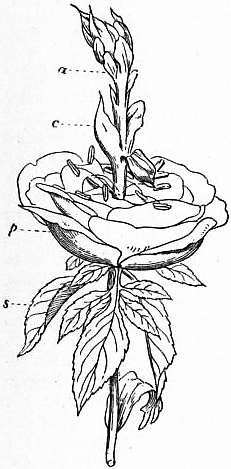
Fig. 1.—Proliferous Rose.
s, Sepals transformed into leaves. p, Petals multiplied at the expense of the stamens, which are reduced in number. c, Coloured leaves representing abortive carpels. a, Axis prolonged, bearing an imperfect flower at its apex.
Flowers are produced from flower-buds, just as leaf-shoots arise from leaf-buds. These two kinds of buds have a resemblance to each other as regards the arrangement and the development of their parts; and it sometimes happens, from injury and other causes, that the part of the axis which, in ordinary cases, would produce a leaf-bud, gives origin to a flower-bud. A flower-bud has not in ordinary circumstances any power of extension by the continuous development of its apex. In this respect it differs from a leaf-bud. In some cases, however, of monstrosity, especially seen in the rose (fig. 1), the central part is prolonged, and bears leaves or flowers. In such cases the flowers, so far as their functional capabilities are concerned, are usually abortive. This phenomenon is known as proliferation of the floral axis.
Flower-buds, like leaf-buds, are produced in the axil of leaves, which are called bracts.
The term bract is properly applied to the leaf from which the primary floral axis, whether simple or branched, arises, while the leaves which arise on the axis between the bract and the outer envelope of the flower Bracts. are bracteoles or bractlets. Bracts sometimes do not differ from the ordinary leaves, as in Veronica hederifolia, Vinca, Anagallis and Ajuga. In general as regards their form and appearance they differ from ordinary leaves, the difference being greater in the upper than in the lower branches of an inflorescence. They are distinguished by their position at the base of the flower or flower-stalk. Their arrangement is similar to that of the leaves. When the flower is sessile the bracts are often applied closely to the calyx, and may thus be confounded with it, as in the order Malvaceae and species of Dianthus and winter aconite (Eranthis), where they have received the name of epicalyx or calyculus. In some Rosaceous plants an epicalyx is present, due to the formation of stipulary structures by the sepals. In many cases bracts act as protective organs, within or beneath which the young flowers are concealed in their earliest stage of growth.
When bracts become coloured, as in Amherstia nobilis, Euphorbia splendens, Erica elegans and Salvia splendens, they may be mistaken for parts of the corolla. They are sometimes mere scales or threads, and at other times are undeveloped, giving rise to the ebracteate inflorescence of Cruciferae and some Boraginaceae. Sometimes they are empty, no flower-buds being produced in their axil. A series of empty coloured bracts terminates the inflorescence of Salvia Horminum. The smaller bracts or bracteoles, which occur among the subdivisions of a branching inflorescence, often produce no flower-buds, and thus anomalies occur in the floral arrangements. Bracts are occasionally persistent, remaining long attached to the base of the peduncles, but more usually they are deciduous, falling off early by an articulation. In some instances they form part of the fruit, becoming incorporated with other organs. Thus, the cones of firs and the stroboli of the hop are composed of a series of spirally arranged bracts covering fertile flowers; and the scales on the fruit of the pine-apple are of the same nature. At the base of the general umbel in umbelliferous plants a whorl of bracts often exists, called a general involucre, and at the base of the smaller umbels or umbellules there is a similar leafy whorl called an involucel or partial involucre. In some instances, as in fool’s-parsley, there is no general involucre, but simply an involucel; while in other cases, as in fennel or dill (fig. 15), neither involucre nor involucel is developed. In Compositae the name involucre is applied to the bracts surrounding the head of flowers (fig. 2, i), as in marigold, dandelion, daisy, artichoke. This involucre is frequently composed of several rows of leaflets, which are either of the same or of different forms and lengths, and often lie over each other in an imbricated manner. The leaves of the involucre are spiny in thistles and in teazel (Dipsacus), and hooked in burdock. Such whorled or verticillate bracts generally remain separate (polyphyllous), but may be united by cohesion (gamophyllous), as in many species of Bupleurum and in Lavatera. In Compositae besides the involucre there are frequently chaffy and setose bracts at the base of each flower, and in Dipsacaceae a membranous tube surrounds each flower. These structures are of the nature of an epicalyx. In the acorn the cupule or cup (fig. 3) is formed by a growing upwards of the flower-stalk immediately beneath the flower, upon which scaly or spiny protuberances appear; it is of the nature of bracts. Bracts also compose the husky covering of the hazel-nut.
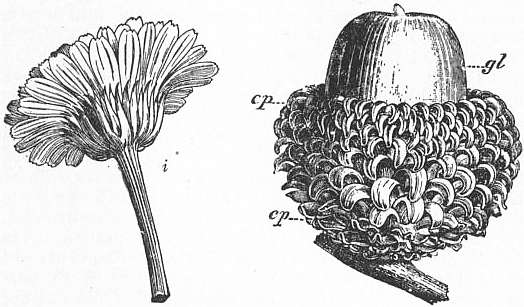
Fig. 2.—Head (capitulum) of Marigold (Calendula), showing a congeries of flowers, enclosed by rows of bracts, i, at the base, which are collectively called an involucre. From Strasburger’s Lehrbuch der Botanik, by permission of Gustav Fischer.
Fig. 3.—Cupule of Quercus Aegilops. cp, Cupule; gl, fruit. (After Duchartre.)
When bracts become united, and overlie each other in several rows, it often happens that the outer ones do not produce flowers, that is, are empty or sterile. In the artichoke the outer imbricated scales or bracts are in this condition, and it is from the membranous white scales or bracts (paleae) forming the choke attached to the edible receptacle that the flowers are produced. The sterile bracts of the daisy occasionally produce capitula, and give rise to the hen-and-chickens daisy. In place of developing flower-buds, bracts may, in certain circumstances, as in proliferous or viviparous plants, produce leaf-buds.
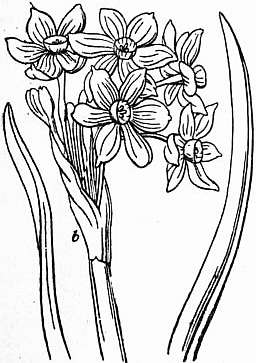
Fig. 4.—Flowers of Narcissus (Narcissus Tazetta) bursting from a sheathing bract b.
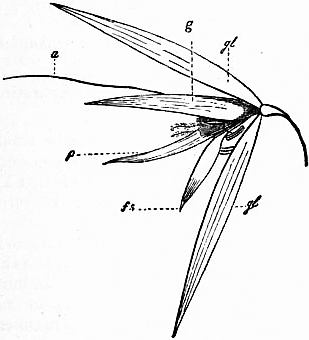
Fig. 5.—Spikelet of Oat (Avena sativa) laid open, showing the sterile bracts gl, gl, or empty glumes; g, the fertile or floral glume, with a dorsal awn a; p, the pale; fs, an abortive flower.
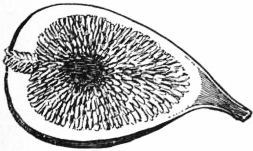
Fig. 6.—Peduncle of Fig (Ficus Carica), ending in a hollow receptacle, enclosing numerous male and female flowers.
A sheathing bract enclosing one or several flowers is called a spathe. It is common among Monocotyledons, as Narcissus (fig. 4), snow-flake, Arum and palms. In some palms it is 20 ft. long, and encloses 200,000 flowers. It is often associated with that form of inflorescence termed the spadix, and may be coloured, as in Anthurium, or white, as in arum lily (Richardia aethiopica). When the spadix is compound or branching, as in palms, there are smaller spathes, surrounding separate parts of the inflorescence. The spathe protects the flowers in their young state, and often falls off after they are developed, or hangs down in a withered form, as in some palms, Typha and Pothos. In grasses the outer scales or glumes of the spikelets are sterile bracts (fig. 5, gl); and in Cyperaceae bracts enclose the organs of reproduction. Bracts are frequently changed into complete leaves. This change is called phyllody of bracts, and is seen in species of Plantago, especially in the variety of Plantago media, called the rose-plantain in gardens, where the bracts become leafy and form a rosette round the flowering axis. Similar changes occur in Plantago major, P. lanceolata, Ajuga reptans, dandelion, daisy, dahlia and in umbelliferous plants. The conversion of bracts into stamens (staminody of bracts) has been observed in the case of Abies excelsa. A lengthening of the axis of the female strobilus of Coniferae is not of infrequent occurrence in Cryptomeria japonica, larch (Larix europaea), &c., and this is usually associated with a leaf-like condition of the bracts, and sometimes even with the development of leaf-bearing shoots in place of the scales.
The arrangement of the flowers on the axis, or the ramification of the floral axis, is called the inflorescence. The primary axis of the inflorescence is sometimes called the rachis; its branches, whether terminal or lateral, which form the stalks supporting flowers or clusters of flowers, are peduncles, and if small branches are given off by it, they are called pedicels. A flower having a stalk is called pedunculate or pedicellate; one having no stalk is sessile. In describing a branching inflorescence, it is common to speak of the rachis as the primary floral axis, its branches as the secondary floral axes, their divisions as the tertiary floral axes, and so on; thus avoiding any confusion that might arise from the use of the terms rachis, peduncle and pedicel.
The peduncle is simple, bearing a single flower, as in primrose; or branched, as in London-pride. It is sometimes succulent, as in the cashew, in which it forms the large coloured expansion supporting the nut; spiral, as in Cyclamen and Vallisneria; or spiny, as in Alyssum spinosum. When the peduncle proceeds from radical leaves, that is, from an axis which is so shortened as to bring the leaves close together in the form of a cluster, as in the primrose, auricula or hyacinth, it is termed a scape. The floral axis may be shortened, assuming a flattened, convex or concave form, and bearing numerous flowers, as in the artichoke, daisy and fig (fig. 6). The floral axis sometimes appears as if formed by several peduncles united together, constituting a fasciated axis, as in the cockscomb, in which the flowers form a peculiar crest at the apex of the flattened peduncles. Adhesions occasionally take place between the peduncle and the bracts or leaves of the plant, as in the lime-tree (fig. 7). The adhesion of the peduncles to the stem accounts for the extra-axillary position of flowers, as in many Solanaceae. When this union extends for a considerable length along the stem, several leaves may be interposed between the part where the peduncle becomes free and the leaf whence it originated, and it may be difficult to trace the connexion. The peduncle occasionally becomes abortive, and in place of bearing a flower, is transformed into a tendril; at other times it is hollowed at the apex, so as apparently to form the lower part of the outer whorl of floral leaves as in Eschscholtzia. The termination of the peduncle, or the part on which the whorls of the flower are arranged, is called the thalamus, torus or receptacle.
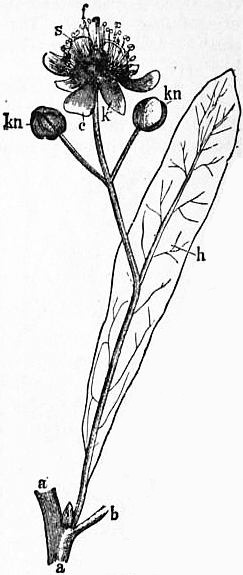
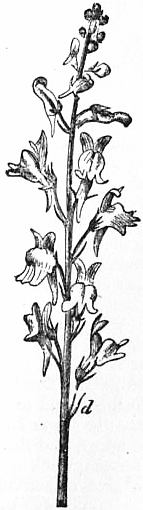
(From Vines’ Students’ Text-Book of Botany, by permission of Swan Sonnenschein & Co.) (From Strasburger’s Lehrbuch der Botanik, by permission of Gustav Fischer.)
Fig. 7.—Inflorescence of the Lime (Tilia platyphyllos) (nat. size). Fig. 8.—Raceme of Linaria striata. d, bract.
a, Branch. b, Petiole with axillary bud. Attached to the peduncle is the bract (h). k, Calyx. c, Corolla. s, Stamens. f, Ovary. kn, Flower-bud.
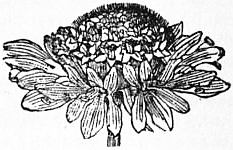
Fig. 9.—Head of flowers (capitulum) of Scabiosa atropurpurea. The inflorescence is simple and indeterminate, and the expansion of the flowers centripetal, those at the circumference opening first.
There are two distinct types of inflorescence—one in which the flowers arise as lateral shoots from a primary axis, which goes on elongating, and the lateral shoots never exceed in their development the length of the Inflorescence. primary axis beyond their point of origin. The flowers are thus always axillary. Exceptions, such as in cruciferous plants, are due to the non-appearance of the bracts. In the other type the primary axis terminates in a single flower, but lateral axes are given off from the axils of the bracts, which again repeat the primary axis; the development of each lateral axis is stronger than that of the primary axis beyond its point of origin. The flowers produced in this inflorescence are thus terminal. The first kind of inflorescence is indeterminate, indefinite or axillary. Here the axis is either elongated, producing flower-buds as it grows, the lower expanding first (fig. 8), or it is shortened and depressed, and the outer flowers expand first (fig. 9). The expansion of the flowers is thus centripetal, that is, from base to apex, or from circumference to centre.
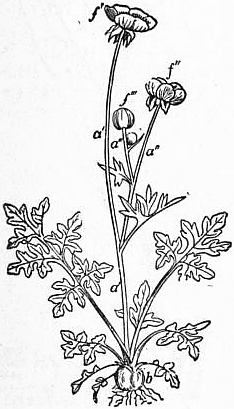
Fig. 10.—Plant of Ranunculus bulbosus, showing determinate inflorescence.
The second kind of inflorescence is determinate, definite or terminal. In this the axis is either elongated and ends in a solitary flower, which thus terminates the axis, and if other flowers are produced, they belong to secondary axes farther from the centre; or the axis is shortened and flattened, producing a number of separate floral axes, the central one expanding first, while the others are developed in succession farther from the centre. The expansion of the flowers is in this case centrifugal, that is, from apex to base, or from centre to circumference. It is illustrated in fig. 10, Ranunculus bulbosus; a′ is the primary axis swollen at the base in a bulb-like manner b, and with roots proceeding from it. From the leaves which are radical proceeds the axis ending in a solitary terminal flower f′. About the middle of this axis there is a leaf or bract, from which a secondary floral axis a″ is produced, ending in a single flower f″, less advanced than the flower f′. This secondary axis bears a leaf also, from which a tertiary floral axis a″′ is produced, bearing an unexpanded solitary flower f″′. From this tertiary axis a fourth is in progress of formation. Here f′ is the termination of the primary axis, and this flower expands first, while the other flowers are developed centrifugally on separate axes.
A third series of inflorescences, termed mixed, may be recognized. In them the primary axis has an arrangement belonging to the opposite type from that of the branches, or vice versa. According to the mode and degree of development of the lateral shoots and also of the bracts, various forms of both inflorescences result.
Amongst indefinite forms the simplest occurs when a lateral shoot produced in the axil of a large single foliage leaf of the plant ends in a single flower, the axis of the plant elongating beyond, as in Veronica hederifolia, Vinca minor and Lysimachia nemorum. The flower in this case is solitary, and the ordinary leaves become bracts by producing flower-buds in place of leaf-buds; their number, like that of the leaves of this main axis, is indefinite, varying with the vigour of the plant. Usually, however, the floral axis, arising from a more or less altered leaf or bract, instead of ending in a solitary flower, is prolonged, and bears numerous bracteoles, from which smaller peduncles are produced, and those again in their turn may be branched in a similar way. Thus the flowers are arranged in groups, and frequently very complicated forms of inflorescence result. When the primary peduncle or floral axis, as in fig. 8, is elongated, and gives off pedicels, ending in single flowers, a raceme is produced, as in currant, hyacinth and barberry. If the secondary floral axes give rise to tertiary ones, the raceme is branching, and forms a panicle, as in Yucca gloriosa. If in a raceme the lower flower-stalks are developed more strongly than the upper, and thus all the flowers are nearly on a level, a corymb is formed, which may be simple, as in fig. 11, where the primary axis a′ gives off secondary axes a″, a″, which end in single flowers; or branching, where the secondary axes again subdivide. If the pedicels are very short or wanting, so that the flowers are sessile, a spike is produced, as in Plantago and vervain (Verbena officinalis) (fig. 12). If the spike bears unisexual flowers, as in willow or hazel (fig. 13), it is an amentum or catkin, hence such trees are called amentiferous; at other times it becomes succulent, bearing numerous flowers, surrounded by a sheathing bract or spathe, and then it constitutes a spadix, which may be simple, as in Arum maculatum (fig. 14), or branching as in palms. A spike bearing female flowers only, and covered with scales, is a strobilus, as in the hop. In grasses there are usually numerous sessile flowers arranged in small spikes, called locustae or spikelets, which are either set closely along a central axis, or produced on secondary axes formed by the branching of the central one; to the latter form the term panicle is applied.
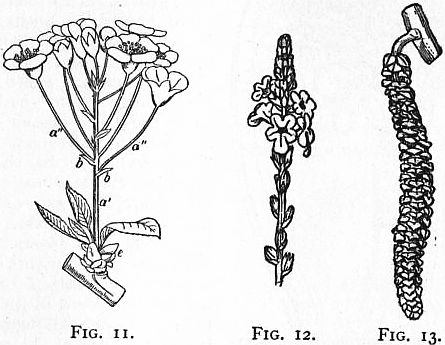
Fig. 11.—Corymb of Cerasus Mahaleb, terminating an abortive branch, at the base of which are modified leaves in the form of scales, e. a′, Primary axis; a″, secondary axes bearing flowers; b, bract in the axils of which the secondary axes arise. Fig. 12.—Spike of Vervain (Verbena officinalis), showing sessile flowers on a common rachis. The flowers at the lower part of the spike have passed into fruit, those towards the middle are in full bloom, and those at the top are only in bud. Fig. 13.—Amentum or catkin of Hazel (Corylus Avellana), consisting of an axis or rachis covered with bracts in the form of scales, each of which covers a male flower, the stamens of which are seen projecting beyond the scale. The catkin falls off in a mass, separating from the branch by an articulation.
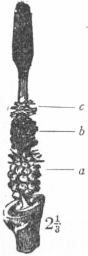
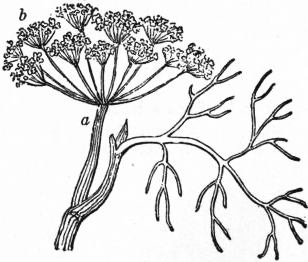
(From Strasburger’s Lehrbuch der Botanik, by permission of Gustav Fischer.)
Fig. 14.—Spadix of Arum maculatum. (After Wossidlo.) a, Female flowers; b, male flowers; c, hairs representing sterile flowers. Fig. 15.—Compound umbel of Common Dill (Anethum graveolens), having a primary umbel a, and secondary umbels b, without either involucre or involucel.
If the primary axis, in place of being elongated, is contracted, it gives rise to other forms of indefinite inflorescence. When the axis is so shortened that the secondary axes arise from a common point, and spread out as radii of nearly equal length, each ending in a single flower or dividing again in a similar radiating manner, an umbel is produced, as in fig. 15. From the primary floral axis a the secondary axes come off in a radiating or umbrella-like manner, and end in small umbels b, which are called partial umbels or umbellules. This inflorescence is seen in hemlock and other allied plants, which are hence called umbelliferous. If there are numerous flowers on a flattened, convex or slightly concave receptacle, having either very short pedicels or none, a capitulum (head) is formed, as in dandelion, daisy and other composite plants (fig. 2), also in scabious (fig. 9) and teazel. In the American button-bush the heads are globular, in some species of teazel elliptical, while in scabious and in composite plants, as sunflower, dandelion, thistle, centaury and marigold, they are somewhat hemispherical, with a flattened, slightly hollowed, or convex disk. If the margins of such a receptacle be developed upwards, the centre not developing, a concave receptacle is formed, which may partially or completely enclose a number of flowers that are generally unisexual. This gives rise to the peculiar inflorescence of Dorstenia, or to that of the fig (fig. 6), where the flowers are placed on the inner surface of the hollow receptacle, and are provided with bracteoles. This inflorescence has been called a hypanthodium.
Lastly, we have what are called compound indefinite inflorescences. In these forms the lateral shoots, developed centripetally upon the primary axis, bear numerous bracteoles, from which floral shoots arise which may have a centripetal arrangement similar to that on the mother shoot, or it may be different. Thus we may have a group of racemes, arranged in a racemose manner on a common axis, forming a raceme of racemes or compound raceme, as in Astilbe. In the same way we may have compound umbels, as in hemlock and most Umbelliferae (fig. 15), a compound spike, as in rye-grass, a compound spadix, as in some palms, and a compound capitulum, as in the hen-and-chickens daisy. Again, there may be a raceme of capitula, that is, a group of capitula disposed in a racemose manner, as in Petasites, a raceme of umbels, as in ivy, and so on, all the forms of inflorescence being indefinite in disposition. In Eryngium the shortening of the pedicels changes an umbel into a capitulum.
The simplest form of the definite type of the inflorescence is seen in Anemone nemorosa and in gentianella (Gentiana acaulis), where the axis terminates in a single flower, no other flowers being produced upon the plant. This is a solitary terminal inflorescence. If other flowers were produced, they would arise as lateral shoots from the bracts below the first-formed flower. The general name of cyme is applied to the arrangement of a group of flowers in a definite inflorescence. A cymose inflorescence is an inflorescence where the primary floral axis before terminating in a flower gives off one or more lateral unifloral axes which repeat the process—the development being only limited by the vigour of the plant. The floral axes are thus centrifugally developed. The cyme, according to its development, has been characterized as biparous or uniparous. In fig. 16 the biparous cyme is represented in the flowering branch of Cerastium. Here the primary axis t ends in a flower, which has passed into the state of fruit. At its base two leaves are produced, in each of which arise secondary axes t′ t′, ending in single flowers, and at the base of these axes a pair of opposite leaves is produced, giving rise to tertiary axes t″ t″, ending in single flowers, and so on. The term dichasium has also been applied to this form of cyme.
In the natural order Carophyllaceae (pink family) the dichasial form of inflorescence is very general. In some members of the order, as Dianthus barbatus, D. carthusianorum, &c., in which the peduncles are short, and the flowers closely approximated, with a centrifugal expansion, the inflorescence has the form of a contracted dichasium, and receives the name of fascicle. When the axes become very much shortened, the arrangement is more complicated in appearance, and the nature of the inflorescence can only be recognized by the order of opening of the flowers. In Labiate plants, as the dead-nettle (Lamium), the flowers are produced in the axil of each of the foliage leaves of the plant, and they appear as if arranged in a simple whorl of flowers. But on examination it is found that there is a central flower expanding first, and from its axis two secondary axes spring bearing solitary flowers; the expansion is thus centrifugal. The inflorescence is therefore a contracted dichasium, the flowers being sessile, or nearly so, and the clusters are called verticillasters (fig. 17). Sometimes, especially towards the summit of a dichasium, owing to the exhaustion of the growing power of the plant, only one of the bracts gives origin to a new axis, the other remaining empty; thus the inflorescence becomes unilateral, and further development is arrested. In addition to the dichasial form there are others where more than two lateral axes are produced from the primary floral axis, each of which in turn produces numerous axes. To this form the terms trichasial and polychasial cyme have been applied; but these are now usually designated cymose umbels. They are well seen in some species of Euphorbia. Another term, anthela, has been used to distinguish such forms as occur in several species of Luzula and Juncus, where numerous lateral axes arising from the primary axis grow very strongly and develop in an irregular manner.
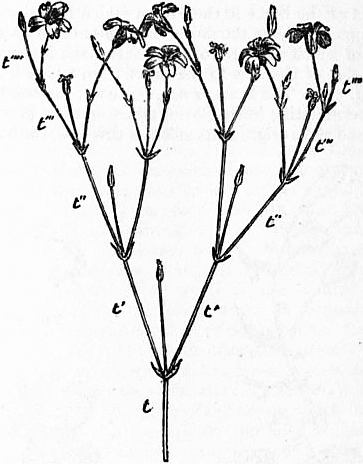
(From Strasburger’s Lehrbuch der Botanik, by permission of Gustav Fischer.)
Fig. 16.—Cymose inflorescence (dichasium) of Cerastium collinum; t-t″", successive axes. (After Duchartre.)
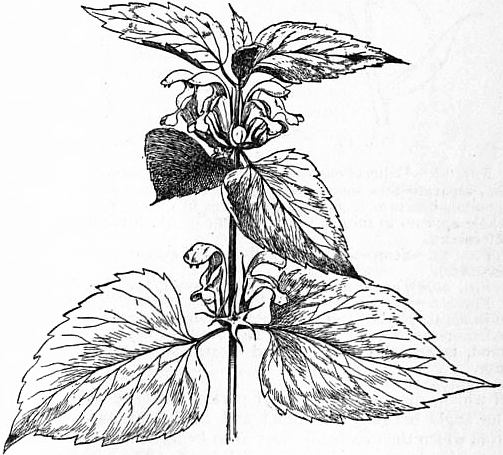
Fig. 17.—Flowering stalk of the White Dead-nettle (Lamium album). The bracts are like the ordinary leaves of the plant, and produce clusters of flowers in their axil. The clusters are called verticillasters, and consist of flowers which are produced in a centrifugal manner.
In the uniparous cyme a number of floral axes are successively developed one from the other, but the axis of each successive generation, instead of producing a pair of bracts, produces only one. The basal portion of the consecutive axes may become much thickened and arranged more or less in a straight line, and thus collectively form an apparent or false axis or sympodium, and the inflorescence thus simulates a raceme. In the true raceme, however, we find only a single axis, producing in succession a series of bracts, from which the floral peduncles arise as lateral shoots, and thus each flower is on the same side of the floral axis as the bract in the axil of which it is developed; but in the uniparous cyme the flower of each of these axes, the basal portions of which unite to form the false axis, is situated on the opposite side of the axis to the bract from which it apparently arises (fig. 18). The bract is not, however, the one from which the axis terminating in the flower arises, but is a bract produced upon it, and gives origin in its axil to a new axis, the basal portion of which, constituting the next part of the false axis, occupies the angle between this bract and its parent axis—the bract from which the axis really does arise being situated lower down upon the same side of the axis with itself. The uniparous cyme presents two forms, the scorpioid or cicinal and the helicoid or bostrychoid.
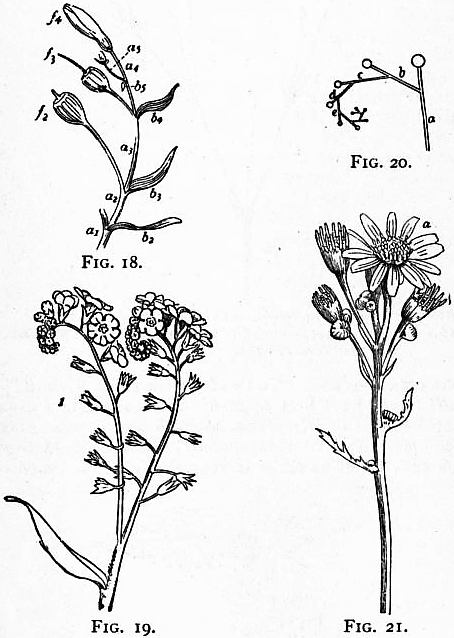
Fig. 18.—Helicoid cyme of a species of Alstroemeria. a1, a2, a3, a4, &c., separate axes successively developed in the axils of the corresponding bracts b2, b3, b4, &c., and ending in a flower f2, f3, f4, &c. The whole appears to form a simple raceme of which the axes form the internodes. Fig. 19.—Scorpioidal or cicinal cyme of Forget-me-not (Myosotis palustris). Fig. 20.—Diagram of definite floral axes a, b, c, d, e, &c. Fig. 21.—Flowering stalk of Ragwort (Senecio). The flowers are in heads (capitula), and open from the circumference inwards in an indefinite centripetal manner. The heads of flowers, on the other hand, taken collectively, expand centrifugally—the central one a first.
In the scorpioid cyme the flowers are arranged alternately in a double row along one side of the false axis (fig. 19), the bracts when developed forming a second double row on the opposite side; the whole inflorescence usually curves on itself like a scorpion’s tail, hence its name. In fig. 20 is shown a diagrammatic sketch of this arrangement. The false axis, a b c d, is formed by successive generations of unifloral axes, the flowers being arranged along one side alternately and in a double row; had the bracts been developed they would have formed a similar double row on the opposite side of the false axis; the whole inflorescence is represented as curved on itself. The inflorescence in the family Boraginaceae are usually regarded as true scorpioid cymes.
In the helicoid cyme there is also a false axis formed by the basal portion of the separate axes, but the flowers are not placed in a double row, but in a single row, and form a spiral or helix round the false axis. In Alstroemeria, as represented in fig. 18, the axis a1 ends in a flower (cut off in the figure) and bears a leaf. From the axil of this leaf, that is, between it and the primary axis a1 arises a secondary axis a2, ending in a flower f2, and producing a leaf about the middle. From the axil of this leaf a tertiary floral axis a3, ending in a flower f3, takes origin. In this case the axes are not arranged in two rows along one side of the false axis, but are placed at regular intervals, so as to form an elongated spiral round it.
Compound definite inflorescences are by no means common, but in Streptocarpus polyanthus and in several calceolarias we probably have examples. Here there are scorpioid cymes of pairs of flowers, each pair consisting of an older and a younger flower.
Forms of inflorescence occur, in which both the definite and indefinite types are represented—mixed inflorescences. Thus in Composite plants, such as hawk weeds (Hieracia) and ragworts (Senecio, fig. 21), the heads of flowers, Mixed inflorescence. taken as a whole, are developed centrifugally, the terminal head first, while the florets, or small flowers on the receptacle, open centripetally, those at the circumference first. So also in Labiatae, such as dead-nettle (Lamium), the different whorls of inflorescence are developed centripetally, while the florets of the verticillaster are centrifugal. This mixed character presents difficulties in such cases as Labiatae, where the leaves, in place of retaining their ordinary form, become bracts, and thus might lead to the supposition of the whole series of flowers being one inflorescence. In such cases the cymes are described as spiked, racemose, or panicled, according to circumstances. In Saxifraga umbrosa (London-pride) and in the horse-chestnut we meet with a raceme of scorpioid cymes; in sea-pink, a capitulum of contracted scorpioid cymes (often called a glomerulus); in laurustinus, a compound umbel of dichasial cymes; a scorpioid cyme of capitula in Vernonia scorpioides. The so-called catkins of the birch are, in reality, spikes of contracted dichasial cymes. In the bell-flower (Campanula) there is a racemose uniparous cyme. In the privet (Ligustrum vulgare) there are numerous racemes of dichasia arranged in a racemose manner along an axis; the whole inflorescence thus has an appearance not unlike a bunch of grapes, and has been called a thyrsus.