VOLUME X SLICE V Fleury, Claude to Foraker (continued 11)
Reading edition
FOOT-AND-MOUTH DISEASE (Aphthous Fever, Epizootic Aphtha, Eczema Epizootica), a virulent contagious and inoculable malady of animals, characterized by initial fever, followed by the formation of vesicles or blisters on the tongue, palate and lips, sometimes in the nostrils, fourth stomach and intestine of cattle, and on parts of the body where the skin is thin, as on the udder and teats, between the claws, on the heels, coronet and pastern. The disease begins suddenly and spreads very rapidly. A rise of temperature precedes the vesicular eruption, which is accompanied by salivation and a peculiar “smacking” of the lips. The vesicles gradually enlarge and eventually break, exposing a red raw patch, which is very sensitive. The animal cannot feed so well as usual, suffers much pain and inconvenience, loses condition, and, if a milk-yielding creature, gives less milk, or, if pregnant, may abort. More or less lameness is a constant symptom, and sometimes the feet become very much diseased and the animal is so crippled that it has to be destroyed. It is often fatal to young animals. It is transmitted by the saliva and the discharges from the vesicles, though all the secretions and excretions are doubtless infective, as well as all articles and places soiled by them. This disease can be produced by injecting the saliva, or the lymph of the vesicles, into the blood or the peritoneal cavity.
If we were to judge by the somewhat vague descriptions of different disorders by Greek and Roman writers, this disease has been a European malady for more than 2000 years. But no reliance can be placed on this evidence, and it is not until we reach the 17th and 18th centuries that we find trustworthy proof of its presence, when it was reported as frequently prevailing extensively in Germany, Italy and France. During the 19th century, owing to the vastly extended commercial relations between civilized countries, it has, like the lung-plague, become widely diffused. In the Old World its effects are now experienced from the Caspian Sea to the Atlantic Ocean. Hungary, Lower Austria, Bohemia, Saxony and Prussia were invaded in 1834. Cattle in the Vosges and in Switzerland were attacked in 1837, and the disease extending to France, Belgium and Holland, reached England in 1839, and quickly spread over the three kingdoms (see also under Agriculture). At this time the importation of foreign animals into England was prohibited, and it was supposed that the infection must have been introduced by surplus ships’ stores, probably sheep, which had not been consumed during the voyage. This invasion was followed at intervals by eleven distinct outbreaks, and since 1902 Great Britain has been free of foot-and-mouth disease. From the observations of the best authorities it would appear to be an altogether exotic malady in the west of Europe, always invading it from the east; at least, this has been the course noted in all the principal invasions. It was introduced into Denmark in 1841; and into the United States of America in 1870, from Canada, where it had been carried by diseased cattle from England. It rapidly extended through cattle traffic from the state first invaded to adjoining states, but was eventually extinguished, and does not now appear to be known in North America. It was twice introduced into Australia in 1872, but was stamped out on each occasion. It appears to be well known in India, Ceylon, Burma and the Straits Settlements. In 1870 it was introduced into the Andaman Islands by cattle imported from Calcutta, where it was then prevailing, and in the same year it appeared in South America. In South Africa it is frequently epizootic, causing great inconvenience, owing to the bullocks used for draught purposes becoming unfit for work. These cattle also spread the contagion. It is not improbable that it also prevails in central Africa, as Schweinfurth alludes to the cattle of the Dinkas suffering from a disease of the kind.
Though not usually a fatal malady, except in very young animals, or when malignant, yet it is a most serious scourge. In one year (1892) in Germany, it attacked 150,929 farms, with an estimated loss to the owners of £7,500,000 sterling. It is transmissible to nearly all the domestic animals, but its ravages are most severe among cattle, sheep, goats and swine. Human beings are also liable to infection.
The treatment of affected animals comprises a laxative diet, with salines, and the application of antiseptics and astringents to the sores. The preventive measures recommended are, isolation of the diseased animals, boiling the milk before use, and thorough disinfection of all places and substances which are capable of conveying the infection.
FOOTBALL, a game between two opposing sides played with a large inflated ball, which is propelled either by the feet alone or by both feet and hands.
Pastimes of the kind were known to many nations of antiquity, and their existence among savage tribes, such as the Maoris, Faroe Islanders, Philippine Islanders, Polynesians and Eskimos, points to their primitive nature. In Greece the ἐπίσκυρος seems to have borne a resemblance to the modern game. Of this we read in Smith’s Dictionary of Antiquities—“It was the game at football, played in much the same way as with us, by a great number of persons divided into two parties opposed to one another.” Amongst the Romans the harpastum, derived from the Greek verb ἁρπάζω, I seize, thus showing that carrying the ball was permissible, bore a certain resemblance. Basil Kennett, in his Romae antiquae notitia, terms this missile a “larger kind of ball, which they played with, dividing into two companies and striving to throw it into one another’s goals, which was the conquering cast.” The harpastum was a gymnastic game and probably played for the most part indoors. The real Roman football was played with the inflated follis, which was kicked from side to side over boundaries, and thus must have closely resembled the modern Association game. Tradition ascribes its introduction in northern Europe to the Roman legions. It has been played in Tuscany under the name of Calcio from the middle ages down to modern times.
Regarding the origin of the game in Great Britain the Roman tradition has been generally accepted, although Irish antiquarians assert that a variety of football has been played in Ireland for over 2000 years. In early times the great football festival of the year was Shrove Tuesday, though the connexion of the game with this particular date is lost in obscurity. William Fitzstephen, in his History of London (about 1175), speaks of the young men of the city annually going into the fields after dinner to play at the well-known game of ball on the day quae dicitur Carnilevaria. As far as is known this is the first distinct mention of football in England. It was forbidden by Edward II. (1314) in consequence of “the great noise in the city caused by hustling over large balls (rageries de grosses pelotes).” A clear reference is made “ad pilam ... pedinam” in the Rotuli Clausarum, 39 Edward III. (1365), memb. 23, as one of the pastimes to be prohibited on account of the decadence of archery, and the same thing occurs in 12 Richard II. c. 6 (1388). Both Henry VIII. and Elizabeth enacted laws against football, which, both then and under the Stuarts and the Georges, seems to have been violent to the point of brutality, a fact often referred to by prominent writers. Thus Sir Thomas Elyot, in his Boke named the Governour (1531), speaks of football as being “nothyng but beastely fury and extreme violence, whereof proceedeth hurte and consequently rancour and malice to remayne with thym that be wounded, wherefore it is to be put in perpetual silence.” In Stubbes’ Anatomie of Abuses (1583) it is referred to as “a develishe pastime ... and hereof groweth envy, rancour and malice, and sometimes brawling, murther, homicide, and great effusion of blood, as experience daily teacheth.” Fifty years later (1634) Davenant is quoted (in Hone’s Table-Book) as remarking, “I would now make a safe retreat, but methinks I am stopped by one of your heroic games called football; which I conceive (under your favour) not very conveniently civil in the streets, especially in such irregular and narrow roads as Crooked Lane. Yet it argues your courage, much like your military pastime of throwing at cocks, since you have long allowed these two valiant exercises in the streets.”
An evidence of its old popularity in Ireland is that the statutes of Galway in 1527 forbade every other sport save archery, excepting “onely the great foot balle.” In the time of Charles II. football was popular at Cambridge, particularly at Magdalene College, as is evidenced by the following extract from the register book of that institution under the date 1679:—
“That no schollers give or receive at any time any treat or collation upon account of ye football play, on or about Michaelmas Day, further than Colledge beere or ale in ye open halle to quench their thirsts. And particularly that that most vile custom of drinking and spending money—Sophisters and Freshmen together—upon ye account of making or not making a speech at that football time be utterly left off and extinguished.”
It nevertheless remained for the most part a game for the masses, and never took root, except in educational institutions, among the upper classes until the 19th century. No clubs or code of rules had been formed, and the sole aim seems to have been to drive the ball through the opposing side’s goal by fair means or foul. So rough did the game become that James I. forbade the heir apparent to play it, and describes the exercise in his Basilikon Doron as “meeter for laming than making able the users thereof.” Both sexes and all ages seem to have taken part in it on Shrove Tuesday; shutters had to be put up and houses closed in order to prevent damage; and it is not to be wondered that the game fell into bad repute. Accidents, sometimes fatal, occurred; and Shrove Tuesday “football-day” gradually died out about 1830, though a relic of the custom still remained in a few places. For some thirty years football was only practised at the great English public schools, many of which possessed special games, which in practically all cases arose from the nature of the individual ground. Thus the rough, open game, with its charging, tackling and throwing, which were features of football when it was taken up by the great public schools, would have been extremely dangerous if played in the flagged and walled courts of some schools, as, for example, the old Charterhouse. Hence at such institutions the dribbling style of play, in which Mr Montague Shearman (Football, in the “Badminton Library”) sees the origin of the Association game, came into existence. Only at Rugby (later at some other schools), which from the first possessed an extensive grass field, was the old game preserved and developed, including even its roughness, for actual “hacking” (i.e. intentional kicking of an opponent’s legs) was not expressly abolished at Rugby until 1877. The description of the old school game at Rugby contained in Tom Brown’s School Days has become classic.
1. Rugby Union.—We have seen that from early times a rudimentary game of football had been a popular form of sport in many parts of Great Britain, and that in the old-established schools football had been a regular game among the boys. In different schools there arose various developments of the original game; or rather, what, at first, must have been a somewhat rough form of horse-play with a ball began to take shape as a definite game, with a definite object and definite rules. Rugby school had developed such a game, and from football played according to Rugby rules has arisen Rugby football. It was about the middle of the 19th century that football—up till that time a regular game only among schoolboys—took its place as a regular sport among men. To begin with, men who had played the game as schoolboys formed clubs to enable them to continue playing their favourite school game, and others were induced to join them; while in other cases, clubs were formed by men who had not had the experience of playing the game at school, but who had the energy and the will to follow the example of those who had had this experience. In this way football was established as a regular game, no longer confined to schoolboys. When football was thus first started, the game was little developed or organized. Rules were very few, and often there was great doubt as to what the rules were. But, almost from the first, clubs were formed to play football according to Rugby rules—that is, according to the rules of the game as played at Rugby school. But even the Rugby rules of that date were few and vague, and indeed almost unintelligible to those who had not been at Rugby school. Still, the fact that play was according to Rugby rules produced a certain uniformity; but it was not till the establishment of the English Union, and the commencement of international matches, that a really definite code of rules was drawn up.
It is an interesting question to ask why it was that the game of Rugby school became so popular in preference to the games of other schools, such as Eton, Winchester or Harrow. It was probably very largely due to the reputation and success of Rugby school under Dr Arnold, and this also led most probably to its adoption by other schools; for in 1860 many schools besides Rugby played football according to Rugby rules. The rapidity with which the game spread after the middle of the 19th century was remarkable. The Blackheath club, the senior club of the London district, was established in 1860, and Richmond, its great rival, shortly afterwards. Before 1870, football clubs had been started in Lancashire and Yorkshire; indeed the Sheffield football club dates back to 1855. Likewise, in the universities of Oxford and Cambridge, Rugby football clubs had been formed before 1870, and by that date the game had been implanted both in Ireland and South Wales; while in Scotland, before 1860, football had taken a hold. Thus by 1870 the game had been established throughout the United Kingdom, and in many districts had been regularly played for a number of years. Rapid as, in some ways, had been the spread of the game between the years 1850 and 1870, it was as nothing to what happened in the following twenty years; for by 1890 Rugby football, together with Association football, had become the great winter amusement of the people, and roused universal interest; while to-day on any fine Saturday afternoon in winter there are tens of thousands of people playing football, while those who watch the game can be counted by the hundred thousand. The causes that led to this great increase in the game and interest taken in it were, undoubtedly, the establishment of the various national Unions and the international matches; and, of course, the local rivalry of various clubs, together with cup or other competitions prevalent in certain districts, was a leading factor. The establishment of the English Union led to a codification of the rules without which development was impossible.
In the year 1871 the English Rugby Union was founded in London. This Union was an association of some clubs and schools which joined together and appointed a committee and officials to draw up a code of rules of the game. From this beginning the English Rugby Union has become the governing body of Rugby football in England, and has been joined by practically all the Rugby clubs in England, and deals with all matters connected with Rugby football, notably the choosing of the international teams. In 1873 the Scottish Football Union was founded in Edinburgh on the same lines, and with the same objects, while in 1880 the Welsh Football Union, and in 1881 the Irish Rugby Football Union, were established as the national Unions of Wales and Ireland, though in both countries there had been previously Unions not thoroughly representative of the country. All these Unions became the chief governing body within their own country, and one of their functions was to make the rules and laws of the game; but as this had been done to start with by the English Union, the others adopted the English rules, with amendments to them from time to time. This state of affairs had one element of weakness—viz. that since all the Unions made their own rules, if ever a dispute should arise between any of them, a dead-lock was almost certain to ensue. Such a dispute did occur in 1884 between the English and Scottish Unions. This dispute eventually turned on the question of the right of the English Union to make and interpret the rules of the game, and to be the paramount authority in the game, and superior to the other Unions. Scotland, Ireland and Wales resisted this claim, and finally, in 1889, Lord Kingsburgh and Major Marindin were appointed as a commission to settle the dispute. The result was the establishment of the International Board, which consists of representatives from each Union—six from England, two from each of the others—whose duties were to settle any question that might arise between the different Unions, and to settle the rules under which international matches were to be played, these rules being invariably adopted by the various Unions as the rules of the game.
With the establishment of the International Board the organization of the game was complete. Still harmony did not prevail, and in 1895 occurred a definite disruption. A number of leading clubs in Yorkshire and Lancashire broke off from the English Union and formed the Northern Union, which since that date has had many accessions, and has become the leading body in the north of England. The question in dispute was the payment of players. Football was originally played by men for the sheer love of the game, and by men who were comparatively well-to-do, and who could give the time to play it; but with the increasing popularity of the game it became the pastime of all classes of the people, and clubs began to grow rich by “drawing big gates,”—that is, large numbers of spectators, frequently many thousands in number, paid for the privilege of witnessing the match. In these circumstances the temptation arose to reimburse the player for any out-of-pocket expenses he might be put to for playing the game, and thus it became universally recognized as legitimate to pay a player’s expenses to and from a match. But in the case of working men it often meant that they lost part of their weekly wage when they had to go a distance to play a match, or to go on tour with their club—that is, go off for a few days and play one or two matches in different parts of the country—and consequently the claim was made on their behalf to recoup them for their loss of wage; while at the same time rich clubs began to be willing to offer inducements to good players to join their club, and these inducements were generally most acceptable in the form of money. In Association football (see below) professionalism—i.e. the hiring and paying of a player for his services—had been openly recognized. A large section of the English Union—the amateur party—would not tolerate anything that savoured of professionalism, and regarded payments made to a player for broken time as illegitimate. The result was the formation of the Northern Union, which allowed such payments, and has practically recognized professionalism. This body has also somewhat altered the laws of the game, and reduced the number of players constituting a team from fifteen to thirteen. In Scotland and Ireland Rugby footballers are strongly amateur; but wherever Rugby football is the popular game of the artisan the professional element is strong.
Besides legislation, one of the functions of the Unions is to select international teams. On the 27th of March 1871 the first international match was played between England and Scotland in Edinburgh. This was a match between teams picked from English and Scottish players. These matches from the first roused widespread interest, and were a great stimulus to the development of the game. With the exception of a few years, when there were disputes between their respective Unions, all the countries of the United Kingdom have annually played one another—England having played Scotland since 1871, Ireland since 1875 and Wales since 1880. Scotland commenced playing Ireland in 1877 and Wales in 1883, while Ireland and Wales met first in 1882 and then in 1884, and since 1887 have played annually. The qualifications of a player for any country were at first vaguely considered to be birth; but they were never definitely settled, and there has been a case of a player playing for two countries. In 1894, however, the International Board decided that no player was to play for more than one country, and this has been the only pronouncement on the question; and though birth is still looked upon as the main qualification, it is not essential. Though international matches excite interest throughout the United Kingdom, the matches between two rival clubs arouse just as much excitement in their district, particularly when the clubs may be taken as representatives of two neighbouring rival towns. But when to this rivalry there is added the inducement to play for a cup, or prize, the excitement is much more intense. Among Rugby players cup competitions have never been so popular as among Association, but the competition for the Yorkshire Cup was very keen in the days before the establishment of the Northern Union, and this undoubtedly was the main cause of the popularity of the game in that county. Similarly the competition for the South Wales Cup from 1878 to 1887 did a great deal to establish the game in that country. The method of carrying on these competitions is, that all the clubs entered are drawn by lot, in pairs, to play together in the first round; the winners of these ties are then similarly drawn in pairs for the next round, until for the final round there is only one pair left, the winner of which takes the cup. An elaboration of this competition is the “League system” of the Association game. This, likewise, has not been popular with Rugby players. Still it exists in some districts, especially where clubs are anxious to draw big gates. In the League system a certain number of clubs form a league to play one another twice each season; two points are counted for a win and one for a draw. The club which at the end of the season comes out with most points wins the competition. The advantage of this system over a cup competition is, that interest is kept up during the whole season, and one defeat does not debar a club from eventually coming out first.
It is said that wherever Britons go they take their games with them, and this has certainly been the case with Rugby football, especially in New Zealand, South Africa and Australia. An interchange of football visits between these colonies and the motherland is now an important feature in the game. These tours date from 1888, when an English team visited Australia and New Zealand. In the following season, 1889, a team of New Zealanders, some of whom were native Maories, came over to England, and by their play even then indicated how well the grammar of the game had been studied in that colony. Subsequently several British teams visited at intervals New Zealand and Australia, and in 1905 New Zealand sent home a team which eclipsed anything previously accomplished. They played altogether thirty-three matches, including fixtures with England, Ireland, Scotland and Wales, and only sustained one defeat, viz. by a try in their match with Wales, a record which speaks for itself. In 1908 a combined team of English and Welsh players toured in New Zealand and Australia, and also visited Canada on their way home. The team was not so strong as could have been wished, and though they did fairly well in Australia, they lost all three “test matches” against New Zealand. In South Africa the game is followed with equal enthusiasm, and the play is hardly inferior, if at all, to that of the New Zealanders. The first British team to visit the Cape went in 1891 through the generosity of Cecil Rhodes, who guaranteed the undertaking against loss. Teams were also sent out in 1896 and 1903; the result of matches played in each visit showing the steady improvement of the colonists. In 1906 the South Africans paid their first visit to England, and the result of their tour proved them to be equally formidable with the New Zealanders. England managed to draw with them, but Scotland was the only one of the home Unions to gain a victory. The success of these colonial visits, more especially financially, created a development very foreign to the intentions of their organizers. The Northern Union as a professional body had drifted into a somewhat parlous state, through suffering on the one hand from a lack of international matches, and on the other from the competition of Association professional teams. The great financial success resulting from the New Zealand tour of 1905 roused the attention of the Northern Union authorities, and they quickly entered into negotiations with New Zealand players to collect a team who would come over and play the Northern Union clubs, the visiting players themselves taking a share of the gate-money. For this purpose a team of New Zealanders toured the north of England in 1907, and their action caused the introduction of professional or Northern Union football in both New Zealand and Australia.
The spread of the game has not, however, been confined to English-speaking races. In France it has found fruitful soil, and numerous clubs exist in that country. Since 1906 international matches have been played between France and England, and the energy of French players, coupled with their national élan, makes them formidable opponents. The Rugby code has also obtained a firm footing in Canada, India, Ceylon and the Argentine.
The game itself is essentially a winter pastime, as two requisite conditions for its enjoyment are a cool atmosphere and a soft though firm turf. The field of play is an oblong, not more than 110 yds. long nor more than 75 yds. broad, and it usually approximates to these dimensions. The boundaries are marked by lines, called touch-lines, down the sides, and goal-lines along the ends. The touch-lines are continued beyond the goal-lines for a distance of not more than 25 yds.; and parallel to the goal-line and behind it, at a distance of not more than 25 yds., is drawn a line called the dead-ball line, joining the ends of the touch-lines produced. On each goal-line, at an equal distance from the touch-lines, are erected two posts, termed goal-posts, exceeding 11 ft. in height, and generally much more—averaging perhaps from 20 to 30 ft. from the ground, and placed 18 ft. 6 in. apart. At a height of 10 ft. from the ground they are joined by a cross-bar; and the object of the game is to kick the ball over the cross-bar between the upright posts, and so obtain a goal. The ball is egg-shaped (strictly an oblate spheroid), and the official dimensions are—length, 11 to 11¼ in.; length circumference, 30 to 31 in.; width circumference, 25½ to 26 in.; weight, 13 to 14½ oz. It is made of india-rubber inflated, and covered with a leather case. Halfway between the two goal-lines there is generally drawn the half-way line, but sometimes it is marked by flags on the touch-line; and 25 yds. from each goal-line there is similarly marked the 25-yds. line. In the original game the side that had gained the majority of goals won the match, and if no goal had been scored, or an equal number, the game was said to be left drawn; but a modification was adopted before long. A goal can be kicked from the field in the ordinary course of play; but from the very first a try goal could be obtained by that side one of whose players either carried the ball across his opponents’ goal-line and then touched it down (i.e. on the ground), or touched it down after it had been kicked across the goal-line, before any of his opponents. The “try” is then proceeded with as follows: the ball is taken out by a member of the side obtaining the try in a straight line from the spot where it was “touched down,” and is deposited in a selected position on the ground in the field of play, the defending side being all confined behind their own goal-line until the moment the ball is so placed on the ground, when another member of the attacking side endeavours to kick it from the ground (a “place kick”) over the bar and between the goal-posts. Frequently a goal is kicked; very often not. The modification first allowed was to count that side the winner which had gained the majority of tries, provided no goal or an equal number of goals had been scored; but a majority of one goal took precedence of any number of tries. But this, too, was afterwards abolished, and a system of points instituted by which the side with the majority of points wins. The numerical value, however, of goals and tries has undergone several changes, the system in 1908 being as follows:—A try counts 3 points. A goal from a try (in which case the try shall not count) 5 points. A dropped goal (except from a mark or a penalty kick) 4 points; a dropped goal being a goal obtained by a player who drops the ball from his hands and kicks it the moment it rises off the ground, as in the “half-volley” at cricket or tennis. A goal from a mark or penalty kick 3 points. Under the Northern Union code any sort of goal counts 2 points, a try 3 points; but if a try be converted into a goal, both try and goal count, i.e. 5 points are scored.
In the game itself not only may the ball be kicked in the direction of the opponents’ goal, but it may also be carried; but it must not be thrown forward or knocked on—that is, in the direction of the opponents’ goal—though it may be thrown back. Thus the game is really a combination of football and handball. The main principle is that any one who is not “offside” is in play. A player is offside if he gets in front of the ball—that is, on the opponents’ side of the ball, nearer than a colleague in possession of the ball to the opponents’ goal-line; when in this position he must not interfere with an opponent or touch the ball under penalty. The leading feature of the game is the “scrummage.” In old days at Rugby school there was practically no limit to the numbers of players on each side, and not infrequently there would be a hundred or more players on one side. This was never prevalent in club football; twenty a-side was the usual number to start with, reduced in 1877 to fifteen a-side, the number still maintained. In the old Rugby big sides the ball got settled amidst a mass of players, and each side attempted to drive it through this mass by shoving, kicking, and otherwise forcing their way through with the ball in front of them. This was the origin of the scrummage.
The game is played usually for one hour, or one hour and ten minutes, sometimes for one hour and a half. Each side defends each goal in turn for half the time of play. Of the fifteen players who compose a side, the usual arrangement is that eight are called “forwards,” and form the scrummage; two “half-backs” are posted outside the scrummage; and four “three-quarter-backs,” a little behind the halves, stretch in a line across the field, their duties being mainly to run and kick and pass the ball to other members of their own side, and to prevent their opponents from doing the same. In recent years, owing to the development of “passing,” the field position of the half-backs has undergone a change. One stands fairly close to the scrummage and is known as the “scrum-half,” the other takes a position between the latter and the three-quarters, and is termed the “stand-off-half.” Behind the three-quarters comes the “full-back” or “back,” a single individual to maintain the last line of defence; his duties are entirely defensive, either to “tackle” an opponent who has managed to get through, or, more usually, to catch and return long kicks. Play is started by one side kicking the ball off from the centre of the field in the direction of the opponents’ goal. The ball is then caught by one of the other side, who either kicks it or runs with it. In running he goes on until he is “tackled,” or caught, by one of his opponents, unless he should choose to “pass” or throw it to another of his own side, who, provided he be not offside, may either kick, or run, or pass as he chooses. The ball in this way is kept moving until it crosses the touch-line, or goal-line, or is tackled. If the ball crosses the touch-line both sides line up at right angles to the point where it crossed the line, and the ball is thrown in straight either by one of the same side whose player carried the ball across the touch-line, or, if the ball was kicked or thrown out, by one of the opposite side. If the ball crosses the goal-line either a try is gained, as explained above, or if the defending side touch it down first, the other side retire to the line 25 yds. from the goal-line, and the defending side kick it up the field. If the ball is tackled the player carrying the ball gets up from the ground as soon as possible, and the forwards at once form the scrummage by putting down their heads and getting ready to shove against one another. They shove as soon as the ball is put down between the two front rows. In the scrummage the object is, by shoving the opponents back or otherwise breaking away with the ball in front, to carry the ball in the direction of the opponents’ goal-line by a series of short kicks in which the players run after the ball as fast as possible, while their opponents lie in wait to get the ball, and either by a kick or other device stop the rush. Instead, however, of the forwards breaking away with the ball, sometimes they let the ball come out of the scrummage to their half-backs, who either kick or run with it, or pass it to the three-quarter-backs, and so the game proceeds until the ball is once more “dead”—that is, brought to a standstill. The scrummage appears to be an uninteresting manœuvre, and a strange relic of bygone times; but it is not merely a manœuvre in which weight and strength alone tell—it also needs a lot of dexterity in moving the ball with the feet, applying the weight to best advantage, and also in outflanking the opposing side, as it were—usually termed wheeling—directing all the force to one side of the scrummage and thus breaking away. As a rule the game is a lively one, for the players are rarely at rest; if there is much scrummaging it is called a slow game, but, if much running and passing, a fast or an open game. The spectator, unless he be an expert, prefers the open game; but in any case the game is always a hard and exciting struggle, frequently with the balance of fortune swaying very rapidly from one side to the other, so that it is a matter of no surprise to find the British public so ardently attached to it.
(C. J. N. F.; C. J. B. M.)
2. Association.—It is generally supposed that the English game of Association football is the outcome of the game of football as played at Cambridge University about the middle of the 19th century. In October 1863 a committee, consisting of representatives of the schools of Eton, Harrow, Rugby, Marlborough, Shrewsbury and Westminster, drew up a code of laws which settled the fundamental principle of the “Association” game, as distinguished from other forms of the game which permitted of handling and carrying the ball. In Association football the use of the hands or arms, either for the purpose of playing the ball or impeding or holding an opponent, is absolutely prohibited; “dribbling” or kicking the ball with the feet, and propelling it by the head or body, are the methods to be adopted. The Cambridge laws specially provided for “kicking” the ball. Laws 13 and 14 provided that “the ball, when in play, may be stopped by any part of the body, but may not be held or hit by the hands, arms or shoulders. All charging is fair, but holding, pushing with the hands, tripping up and shinning are forbidden.”
The laws of Association football first took practical shape as the outcome of a meeting held on the 26th of October 1863 at the Freemasons’ Tavern, London. The clubs which sent delegates were representative of all classes of football then played. The meeting was a momentous one, for not only was the foundation laid of the Football Association, the national association which has since then controlled the game in England, but as the outcome of the differences of opinion which existed as to “hacking” being permissible under the laws, the representatives who favoured the inclusion of the practice, which is now so roundly condemned in both the Association and Rugby games, withdrew and formed the Rugby Union.
The Cambridge laws were considered by the committee of the Football Association at their meeting on the 24th of November 1863. They took the view that those laws “embraced the true principles of the game with the greatest simplicity”; the laws were “officially” passed on the 1st of December 1863, and the first publication was made in Bell’s Life four days later. These laws have from time to time been modified, but the principles as laid down in 1863 have been adhered to; and the Association game itself has altered very little since 1880. The usual dimensions for a ground are 120 yds. long by 80 yds. wide, and the goals are 8 yds. in width with a cross-bar from post to post 8 ft. from the ground. The ball is about 14 oz. in weight, and must be a perfect sphere from 27 to 28 in. in circumference, as distinguished from the elliptical or egg-shaped Rugby ball. A rectangular space extending to 18 yds. in front of the goals, and marked with lines on the ground, constitutes the “penalty area”; within which, at a distance of 12 yds. opposite the centre of the goal, is the “penalty kick mark.” The boundary lines at the sides of the field are called the “touch-lines”; those at the ends (in the centre of which are the goals) being the “goal-lines.” The game is started by a place kick from the centre of the field of play, and none of the opposite side is allowed to approach within 10 yds. of the ball when it is kicked off. When the ball passes over the touch line it has to be thrown in by one of the opposite side, and can be returned into the field of play in any direction. If it passes over the goal-line at any time without touching one of the defending side, it has to be kicked out by the goalkeeper or one of the backs from a line marked in front of goal, the spot selected being in front of the post nearest the point where the ball left the field of play. But should it touch one of the defending side in its transit over the goal-line the attacking side has the privilege of a free kick from the corner flag (a “corner kick”). This is often a great advantage, but such free kick does not produce a goal unless the ball touches one of the other players on its way to the post. Ordinarily a goal is scored when the ball goes between the goal-posts and under the cross-bar, not being thrown, knocked on or carried. The regulation duration of a game is an hour and a half, and ends are changed at forty-five minutes. The side winning the toss has the choice of ends or kick-off, and the one obtaining the majority of goals wins. A goal cannot be scored from a free kick except when the free kick has been allowed by the referee as a penalty for certain infringements of the rules by the opposite side; and if such infringement take place within the penalty area on the part of a player on the side then defending the goal, and in the judgment of the referee be intentional, a “penalty kick” is awarded to the attacking side. The penalty kick is a free kick from the penalty kick mark, all the players of the defending side being excluded from the penalty area, except the goalkeeper, who is confined to the goal-line; the result, therefore, being an almost certain goal.
A player is always in play as long as there are three of the opposite side between him and the opposite goal at the time the ball is kicked. This “offside” rule gives much trouble to the young player, though why it should do so it is not easy to say. The rule is simple if the words in italics are remembered. The ball must not be carried, knocked or wilfully handled under any pretence whatever, save by the goalkeeper, who is allowed to use his hands in defence of his goal, either by knocking on or throwing, within his own half of the field of play. Thus far he is entitled to go in maintaining his goal, but if he carry the ball the penalty is a free kick. There are other infringements of the rules which also involve the penalty of a free kick, among them the serious offences of tripping, hacking and jumping at a player. Players are not allowed to wear nails in their boots (except such as have their heads driven in flush with the leather), or metal plates or gutta-percha, and any player discovered infringing this rule is liable to be prohibited from taking further part in a match.
In the early ’sixties of the 19th century there were probably not more than twenty-five organized clubs playing Association football in the United Kingdom, and these were chiefly confined in the south of England to the universities and public schools. But whilst the game was being established in the south it was making steady progress in the north, particularly in Yorkshire, where the Sheffield Club had been formed as early as 1854. In 1867 the game had become so well established that it was decided to play an inter-county match. The match, which was played “in the wilds of Battersea Park,” terminated in a draw, neither side having obtained a goal; and it did much to stimulate the growing popularity of the game. During the season 1870-1871, only three years later, two matches of an international character were played between Englishmen and Scotsmen in membership with the Football Association; they were not, however, recognized as “international” matches. The first real international match, England v. Scotland, was played on the 30th of November 1872 at Partick, Glasgow; the first international match between England and Wales was played at Kennington Oval in 1879; and that between England and Ireland at Belfast in 1882. In 1896 amateur international matches were inaugurated with Germany, Austria and Bohemia; and games are now annually played with Scotland, Wales, Ireland, France, Belgium, Germany, Holland, Austria and other continental countries. As the outcome of the international relations with Scotland, Wales and Ireland, an International Football Association Board was formed in 1882, when a universal code of laws was agreed upon. Two representatives from each of the four national associations constitute the board, whose laws are accepted and observed not only by the clubs and players of the United Kingdom but in all countries where the Association game is played. At a meeting held at Paris on the 21st of May 1904 the “International Federation of Association Football” was instituted. It consists of the recognized national associations in the respective countries: and its objects are to develop and control Association international football. The countries in federation are: Austria, Belgium, Denmark, England, Finland, France, Germany, Hungary, Italy, Netherlands, Norway, Sweden and Switzerland.
The small number of clubs taking part in the game in the early days becomes of interest when compared with the magnitude of the game in the 20th century. Association football has become one of the most popular of all national sports in the United Kingdom. It is slowly but surely taking a similar position on the continent of Europe and is making progress even in the Far East, Japan being one of its latest adherents. In the season of 1871-1872 the Football Association inaugurated its popular challenge cup competition which is now competed for by both amateur and professional clubs. In the first year fifteen clubs entered, all of which were from the south of England. The first winners of the cup were the Wanderers, who defeated the Royal Engineers in the final tie by one goal to nothing. For the first ten years the competition was mostly limited to the southern clubs, but in the season of 1881-1882 the Blackburn Rovers were only defeated in the final tie by the Old Etonians by one goal to nothing. Professionalism was then unknown in the game, and comparatively little interest was taken in it except by the players themselves. In the following season of 1882-1883 the cup was for the first time taken north by the Blackburn Olympic Club, and it remained in the north for the next nineteen years, until in the season of 1900-1901 it was again brought south by the Tottenham Hotspur Club, who defeated the Sheffield United Club at Bolton by three goals to one. In the following season the cup was again taken north by the Bury Club. In the early days of the competition a few hundred people only attended the final tie, which for many years was played at Kennington Oval in London. In the course of time, however, the interest of the public so largely increased that it became necessary to seek a ground of greater capacity; accordingly in 1893 the final was played at Fallowfield, Manchester, where it was watched by forty thousand people; in 1894 it was played at Everton and in 1895 at the Crystal Palace. The attendance during the following ten years averaged 80,000 people. The record attendance was in the season of 1900-1901, when the south were contesting with the north, the spectators then being upwards of 113,000. In the season of 1908-1909 356 clubs entered the competition; in 1910-11 the number had increased to 404.
The great development of the game necessitated many changes in the system of control. About the year 1880 (although contrary to the rules) a practice of making payment to players crept into the game in the north of England and slowly developed. After some years of debate as to the best method of dealing with this development the Football Association decided in 1885 to legalize and control the payment of players. The rules define a professional player as one who receives remuneration of any sort above his necessary hotel and travelling expenses actually paid, or is registered as a professional. They further provide that training expenses not paid by the players themselves will be considered as remuneration beyond necessary travelling and hotel expenses. Players competing for any money prizes in football contests are also considered professionals.
In 1888 the Football League, a combination of professional clubs of the north and midlands of England, was formed; and a new scheme was inaugurated for the playing of matches on what is known as the “League” principle, the essential advantage of which is that the clubs in membership of a league agree to play with each other “home and home” matches each season, and also bind themselves under certain penalties to play their best team in all league matches. Six years later the Southern League came into existence, primarily with the object of increasing the interest in the game in the south and west of England. The Football League and the Southern League very soon had their imitators, and in 1909 there were upwards of six hundred league competitions playing under the sanction and control of the Football Association. The league system also found favour in Scotland, Wales and Ireland, and has extended to most of the colonies where Association football is played. In the season of 1893-1894 the Amateur Cup Competition, restricted to amateur clubs in membership with the Football Association, was inaugurated. In the first season 32 clubs entered, and the growing popularity of the competition is shown by the fact that in the season of 1908-1909 there were 229 entries.
The Football Association, founded in 1863 with its eleven clubs, had in 1909 under its jurisdiction upwards of 10,000 amateur clubs and a quarter of a million of amateur players, and 400 professional clubs with 7000 professional players. It has also directly affiliated 52 county, district and colonial associations, and indirectly in membership a large number of minor associations which are affiliated through the county and district associations. The Army Association includes 316 army clubs in Great Britain and Ireland, together with clubs formed by the various battalions in India, South Africa, Gibraltar and other army stations; and the Royal Navy Football Association comprises all ships afloat having Association football clubs.
The regulations of the Football Association, which is the recognized administrative and legislative body for the game in England, make provision for the sanction and control of leagues and competitions; and its rules, regulations, principles and practices very largely prevail in all national associations. The king is the patron, and the council consists of 56 members, a president, 6 vice-presidents, a treasurer, 10 representatives elected by the clubs in the ten divisions into which the country is subdivided, together with representatives of the army, the navy and of county associations in England which have upwards of 50 clubs in membership, each representative being directly appointed by his association. In 1905 the Football Association became incorporated under the Joint Stock Companies Acts, and as a consequence the word “Limited” appears in its title. It is not, however, a trading body; the shareholders are not entitled to any dividend, bonus or profit, nor may the members of the council, who are the directors, receive any payment for their services. The Scottish Football Association is also an incorporated body with similar powers. Many of the leading clubs of the United Kingdom have also become incorporated, but under the regulations of the Football Association they may not pay a larger dividend to their shareholders than 5%, nor may any of the directors receive payment for their services.
The whole policy of legislation in Association football of late years has been naturally to make the game faster by bringing every one into full play. The great aim accordingly has been to encourage combination and to discourage purely individual efforts. In the early days, though there was a certain amount of cohesion, a player had to rely mainly on himself. Even up to the middle of the ’seventies dribbling was looked upon as the great desideratum; it was the essential for a forward, just as long kicks were the main object of a back. The development of the game was of course bound to change all that. The introduction of passing, long or short, but long in particular, placed the dribbler pure and simple at a discount, and necessitated methods with which he was mostly unacquainted. Combined play gradually came to be regarded as the keynote to success. Instead of one full back, as was originally the case, and one half-back, the defence gradually developed by the addition first of a second half, then of a second full back, and still later of a third half-back, until it came to show, in addition to the goalkeeper of course, two full backs and three half-backs. The eight forwards who used to constitute the attack in the earliest days of the Association have been reduced by degrees, as the science of the game became understood, until they now number only five. The effect of the transition has been to put the attack and defence on a more equal footing, and as a natural consequence to make the game more open and thereby generally more interesting and attractive. Association football is indeed, from the standpoint of the spectator, a much brighter game than it was in its infancy, the result of the new methods bringing every one of the eleven players into full relief throughout the game. The players who, as a rule, make or mar the success of a side in modern football are the centre forward and the centre half-back. They are the pivot on which the attack and the defence respectively turn. Instead of close dribbling and following up, the new formation makes for accuracy of passing among the forwards, with intelligent support from the half-backs. The net result is practically the effective combination of the whole side. To do his part as it ought to be done every member of an eleven must work in harmony with the rest, and on a definite system, in all cases subordinating his own methods and personal interests to promote the general well-being of the side.
(C. W. A.; F. J. W.)
The literature of British football is very extensive, but the following works are among the best: Football in the “Badminton Library” (London, 1904), where the different games played at Eton, Harrow, Rugby, Winchester and other public schools are thoroughly described; Rev. F. Marshall, Football; the Rugby Game (London, Cassells); J.E. Vincent, Football; its History for Five Centuries (London, 1885); C.J.B. Marriott and C.W. Alcock, Football (“Oval Series”); “Football,” in the Encyclopaedia of Sport; The Rugby Football Union Handbook, Richardson, Greenwich, Official Annual; and The Football Annual, Merritt and Hatcher (Association Game), London.
United States.—In America the game of football has been elaborated far more than elsewhere, and involves more complications than in England. From colonial times until 1871 a kind of football generally resembling the English Association game was played on the village greens and by the students of colleges and academies. There was no running with the ball, but dribbling, called “babying,” was common. In 1871 a code of rules was drawn up, but they were unsatisfactory and not invariably observed. “Batting the ball,” i.e. striking the ball forward with the fists, was allowed. There were two backs, sixteen rushers or forwards, and two rovers or “peanutters,” who lurked near the opponents’ goal. During this period the first international football game was played at Yale between the college team and one made up of old Etonians, the rules being a compromise between the American and the English.
English Rugby, introduced from Canada, was first played at Harvard University, and in 1875 a match under a compromise set of rules, taken partly from the Rugby Union and partly from the existing American game, was played with Yale. The following year Yale adopted the regular Rugby Union rules, and played Harvard under these. Later, several other colleges adopted these English rules. Absence of tradition necessitated expansion of these laws, and a convention of colleges was assembled. Thenceforward annual conventions were held, which from time to time altered and amplified the rules. A college association was formed, and the game grew in popularity. Public criticism of the roughness shown in the play early threatened its existence; indeed at one time the university authorities compelled Harvard to abstain from the annual game with Yale. Changes in the rules were introduced, and the game has been characterized by less roughness and by increased skill. It has become the most popular autumn game in the United States, the principal university matches often attracting crowds of 35,000 and even 40,000 spectators. The association subsequently disbanded, but a Rules Committee, invited by the University Athletic Club of New York, made the necessary changes in the rules from time to time, and these have been accepted by the country at large. In the West associations were formed; but the game in the East is played principally under separate agreements between the contesting universities, all using, however, one code of rules. Later this Rules Committee amalgamated with a new committee of wider representation. Amateur athletic clubs as well as public and private schools have also taken up the game. The American football season lasts from the middle of September to the first of December only, owing to the severity of the American winter. Professional football is not played in America.
The American Rugby game is played by teams of eleven men on a field of 330 ft. long and 160 ft. wide, divided by chalk lines into squares with sides 5 yds. long, leaving a strip 5 ft. wide on each side of the field. Until 1903 the field was divided by latitudinal lines only and was therefore popularly called the “gridiron”; subsequently it was called the “checkerboard.” The end lines are called “goal-lines,” the side “touch-lines.” The two lines 25 yds. from each goal-line, and the middle line, or 55 yard-line, are made broader than the rest. In the middle of each goal-line is a goal, consisting of two uprights exceeding 20 ft. in length, set 18 ft. 6 in. apart with a crossbar 10 ft. from the ground. The ball is in shape and material of the English Rugby type.
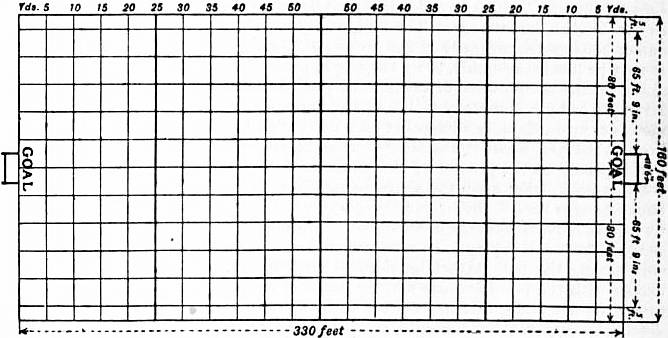
Diagram of Field
The football rules provide that when the ball is put in play in a scrimmage, the first man who receives the ball, commonly known as the quarter-back, may carry it forward beyond the line of scrimmage, provided in so doing he crosses such line at least 5 yds. from the point where the snapper-back put the ball in play, and furthermore, that a forward pass may be made provided the ball passes over the line of scrimmage at least 5 yds. from the point at which the ball is put in play. The field is marked off at intervals of 5 yds. with white lines parallel to the goal line, for convenience in penalizing fouls and for measuring the 10 yds. to be gained in three downs, and also at intervals of 5 yds. with white lines parallel to the side lines, in order to assist the referee in determining whether the quarter-back runs according to rule, or whether, in case of a forward pass, such pass is legally made. Thus the football field is changed from the gridiron as in 1902, to what now resembles a checkerboard, and the above diagram shows exactly how the field should be marked. As the width of the field does not divide evenly into 5 yd. spaces, it is wise to run the first line through the middle point of the field and then to mark off the 5 yds. on each side from that middle line. In order to save labour, it may be sufficient to omit the full completion of the longitudinal lines, as the object of these lines is accomplished if their points of intersection with the transverse lines are distinctly marked, for instance, by a line a foot long.
A match game consists of two periods (halves) of thirty-five minutes with an interval of fifteen minutes. Practice games usually have shorter halves. There are four officials: the umpire, whose duty it is to watch the conduct of the players and decide regarding fouls; the referee, who decides questions regarding the progress of the ball and of play; the field judge who assists the referee and keeps the time; and the linesman, who (with two assistants, one representing each eleven) marks the distance gained or lost in each play.
In scoring, a “touchdown” (the English Rugby “try”) counts 5 points, a goal from a touchdown 6 (or one added to the 5 for the touchdown), a “goal from the field,” whether from placement or drop-kick, 4, and a “safety” (the English Rugby “touchdown”) 2. Mutatis mutandis, these are made as in English Rugby. American Rugby differs from the English game, because in the scrimmage the men are lined up opposite each other, and, although separated by the length of the ball, are engaged in a constant man-to-man contest, and also in that a system of “interference” is allowed. Furthermore, a player in the American game is put “on side” when a kicked ball strikes the ground; and forward passing, i.e. throwing the ball toward the opponents’ goal, is permissible under certain restrictions. The costume usually consists of a close-fitting jersey with shoulders and elbows padded and reinforced with leather; short trousers with padded thighs and knees, heavy stockings and shoes with leather cleats. In the early period of the game caps were worn, but, as they were impossible to keep on, they were discarded in favour of the wearing of long hair, and the “chrysanthemum head” became the distinguishing mark of the football player. This, however, proved an inadequate protection, and some players now wear a “head harness” of soft padded leather. Substitutes are allowed in the places of injured players.
The object of the game is identical with that of English Rugby, and the rules in regard to fair catches, punting, drop-kicking, place-kicking, goal-kicking, passing and gentlemanly conduct are practically the same, except that, on a free kick after a fair catch, the opposing players in the American game may not come up to the mark but must keep 10 yds. in front of it. In the American game there is no scrummage in the English sense, nor is the ball thrown in at right angles after going into touch. The element of chance in both these methods of play was done away with by the enunciation of the principle of the “possession of the ball.” In America, when the ball has gone out of bounds or a runner has been tackled and held and the ball downed, the ball is also put into play by an evolution called a scrimmage, usually called “line-up,” which beyond the name bears no resemblance to the English scrummage. The ball, at every moment of the game, belongs theoretically either to one side or to the other. It may be lost by a fumble, or by the side in possession not being able to make the required distance of 10 yds. in three successive attempts or by a voluntary kick. In the line-up the seven linemen (i.e. forwards) face each other on a line parallel to the goal-lines on the spot where it was ordered down by the referee. The ball is placed on the ground by the centre-rush, also called the snapper-back, who, upon the signal being given by his quarter-back, “snaps back” the ball to this player, or to the full-back, by a quick movement of the hand or foot. The moment the ball is snapped-back it is in play. In every scrimmage it is a foul for the side having the ball (attacking side) to obstruct an opponent except with the body (no use may be made of hands or arms); or for the defending side to interfere with the snap-back. The defenders may use their hands and arms only to get their opponents out of the way in order to get at the man with the ball. Each member of the attacking side endeavours, of course, to prevent his opponents from breaking through and interfering with the quarter-back, who requires this protection from his line in order to have time to pass the ball to one of the backs, whom he has notified by a signal to be ready. In the United States a player may be obstructed by an off-side opponent so long as hands and arms are not used. In the line-up this is called “blocking-off” and “interference” when done to protect a friend running with the ball. Interference is one of the most important features of American football. As soon as the ball is passed to one of the half-backs for a run, for example, round one end of the line, his interference must form immediately. This means that one or more of his fellows must accompany and shield him as he runs, blocking off any opponent who tries to tackle him. The first duty of the defence against a hostile run is therefore to break up the interference, i.e. put these defenders out of the play, so that the runner may be reached and tackled.
The game begins by the captains tossing for choice of kick-off or goal. If the winner of the toss chooses the goal, on account of the direction of wind, the loser must kick off and send the ball at least 10 yds. into the opponents’ territory from a place-kick from the 55 yds. line. The two ends of the kicking side, who are usually fast runners, get down the field after the ball as quickly as possible, in order to prevent the man who catches the kick-off from running back with the ball. When the kick-off is caught, the catcher with the aid of interference runs it back as far as possible, and as soon as he is tackled and held by his opponents the ball is down, and a line-up takes place, the ball being in the possession of the catcher’s side, which now attacks. In order to prevent the so-called “block game,” once prevalent, in which neither side made any appreciable progress, the rules provide that the side in possession of the ball must make at least 10 yds. in three successive attempts, or, failing to do so, must surrender the ball to the enemy, or, as it is called, “lose the ball on downs”. This is infrequent in actual play, because if, after two unsuccessful attempts, or partly successful, it becomes evident that the chances of completing the obligatory 10-yd. gain on the remaining attempt are unfavourable, a forward pass or a kick is resorted to, rather than risk losing the ball on the spot. The kick, although resulting in the loss of the ball, nevertheless gives it to the enemy much nearer his goal. When the wind is strong the side favoured by it usually kicks often, as the other side, not being able to kick back on equal terms, is forced to play a rushing game, which is always exhausting. Again, the kicking game is often resorted to by the side that has the lead in the score, in order to save its men and yet retain the advantage. The only remaining way to advance the ball is on a free-kick after a fair catch, as in the English game. The free kick may be either a punt, a drop-kick or a kick from placement. Whenever the ball goes over the side line into touch it is brought back to the point where it crossed the line by the man who carried it over, or, if kicked or knocked over, by a man of the side which did not kick it out, and there put in play in one of two ways. Either it may be touched to the ground and then kicked at least 10 yds. towards the opponents’ goal, or it may be taken into the field at right angles to the line a distance not less than 5 yds. nor more than 15, and there put down for a line-up, the player who takes it in first declaring how far he will go, so that the opposing team may not be caught napping.
Of the seven men in the line, the centre is chosen for his weight and ability to handle the ball cleanly in snapping back. He must also, in case the full-back is to make the next play, be able to throw the ball from between his legs accurately into the full-back’s hands, thus saving the time that would be wasted if the quarter-back were used as an intermediary. The two “guards,” who must also be heavy men, form with the centre the bulk of the line, protecting the backs in offence, and in defence blocking the enemy. The two “tackles” must be heavy yet active and aggressive men, as they must not only help the centre and guards in repelling assaults on the middle of the line, but also assist the ends in stopping runs round the line as well as those between tackle and end, a favourite point of attack. The “ends” are chosen for their activity, sure tackling, fast running and ability to follow up the ball after a kick. Of the four players behind the line, the full-back must be a sure catcher and tackler and a fast runner. The two half-backs must also be fast runners and good dodgers. One of them is often chosen for his ability to gain ground by “bucking the line,” i.e. plunging through the opposing team’s line. He must therefore be over the average weight, while the other half-back is called upon to gain by running round the opposing ends. The quarter-back is the commanding general and therefore the most important member of his side, as with him lies the choice of plays to be made when on the attack. Courage, coolness, promptness in decision and discrimination in the choice of plays are the qualities absolutely required for this position. As soon as his side obtains the ball, the quarter-back shouts out a signal, consisting of a series of numbers or letters, or both, which denotes a certain play that is to be carried through the moment the ball is snapped back. A good quarter-back thinks rapidly and shouts his signal for the next play as soon as a down has been called and while the scrimmage is forming, so that the plays are run off rapidly and the enemy is given as little time as possible to concentrate. The signals, which are secret and often changed to guard them from being solved by the enemy, are formed by designating every position and every space in the line, as well as kicks and other open plays, by a number or letter. Some signals are called sequence-signals, and indicate a prearranged series of plays for use in certain emergencies. Every manœuvre of the attacking side is carried out by every member of the team, the ideal being “every man in every play every time.” As soon as a signal is given each man should know what part of the ensuing move will fall to him, in carrying the ball, interfering for the runner, or getting down the field under a punt. Every team has its own code.
About 1890 the system of interference led to momentum and mass plays (wedge-formations, tandems, &c.), i.e. to the grouping of bodies of men behind the line, and starting them before the ball was snapped back, so that they struck the line with an acquired momentum that was extremely severe, particularly when met by men equally determined. These plays caused frequent injuries and led to legislation against them, the most important law providing for a limitation to the number of men who could be dropped back of the line, and practically keeping seven men drawn up in the line.
Penalties are of three kinds: (1) forfeiture of the game, for refusing to play when directed to do so by the referee, and for repeated fouls made with the intention of delaying the game; (2) disqualification of players for unnecessary roughness or ungentlemanly conduct; and (3) for infringement of rules, for which certain distances are taken away from the previous gains of the side making the fouls.
The game resolves itself into a series of scrimmages interspersed with runs and kicks. The systematized development of plays places at the disposal of the quarter an infinite variety of attack, which he seeks to direct at the opposing line with bewildering rapidity and dash. During the preliminary games of the season “straight football” is generally played; that is, intricate attacks are avoided and kicks and simple plunges into the line are mainly relied upon. “Trick plays,” which comprise all manœuvres of an intricate nature, are reserved for later and more important matches. Among these is the “fake (false) kick,” in which the full-back takes position as if to receive the ball for a kick, but the ball is passed to a different player for a run. Another play of this kind is the “wing-shift,” in which some or all of the players on one side of centre suddenly change to the other side, thus forming a mass and throwing the opponents’ line out of balance. To this category belong also “double passes,” “false passes,” “delayed passes,” “delayed runs” and “criss-crosses.”
Training for football in America resembles that for other sports in regard to food and hygiene. The coaching systems at the universities differ, but there is generally a head coach, who is assisted by graduates, each of whom pays especial attention to one set of men, one to the men in the centre of the line, one to the backs, another to the ends, &c. Candidates for the teams are put through a severe course of practice in catching punts and hard-thrown passes, in quick starts, falling on the ball, tackling a mechanical dummy, in blocking, breaking through the line, and all kinds of kicking, although in matches the kicking is generally left to one or two men who have shown themselves particularly expert. Every player is taught to dive for the ball whenever he sees it on the ground, as possession is of cardinal importance in American football, and dribbling for this reason is unknown. When running with the ball the player is taught to take short steps, to follow his interference, that is, not isolate himself from his defenders, and neither to slow up nor shut his eyes when striking the opposing line. Tackling well below the waist is taught, but it is a foul to tackle below the knee. The general rule for defensive work of all kinds is “play low.”
See Walter Camp, How to play Football, and the Official Football Guide (annual), both in Spalding’s Athletic Library; his Book of College Sports (New York, 1893), his American Football (New York, 1894), and his Football (Boston, 1896)—the last in co-operation with L.F. Deland; R.H. Barbour, The Book of School and College Sports (New York, 1904); W.H. Lewis, Primer of College Football (Boston, 1896).
(E. B.; W. Ca.)
FOOTE, ANDREW HULL (1806-1863), American admiral, was born at New Haven, Connecticut, on the 12th of September 1806, his father, Samuel Augustus Foote (1780-1846), being a prominent lawyer and Whig politician, who as U.S. senator moved in 1829 “Foote’s resolutions” on public lands, in the discussion of which Daniel Webster made his “reply to Hayne.” He entered the U.S. navy in 1822, and was commissioned lieutenant in 1830. After cruising round the world (1837-1840) in the “John Adams,” he was assigned to the Philadelphia Naval Asylum, and later (1846-1848) to the Boston Navy Yard. In 1849 he was made commander of the “Perry,” and engaged for two years in suppressing the slave trade on the African coast. In 1856, as commander of the “Portsmouth,” he served on the East India station, under Com. James Armstrong, and he captured the Barrier Forts near Canton. From October 1858 to the outbreak of the Civil War, he was in charge of the Brooklyn Navy Yard, becoming a full captain in 1861. In August 1861 he was assigned to the command “of the naval operations upon the Western waters.” His exploit in capturing Fort Henry (on the right bank of the Tennessee river) from the Confederates, on the 6th of February 1862, without the co-operation of General Grant’s land forces, who had not arrived in time, was a brilliant success; but their combined attack on Fort Donelson (12 m. off, on the left bank of the Cumberland river), whither most of the Fort Henry garrison had escaped, resulted, before its surrender (Feb. 16), in heavy losses to Foote’s gunboats, Foote himself being severely wounded. In March-April he co-operated in the capture of New Madrid (q.v.) and Island No. 10. In June he retired from his command and in July was promoted rear-admiral, and became chief of the Bureau of Equipment and Recruiting. On the 26th of June 1863 he died at New York.
See the life (1874) by Professor James Mason Hoppin (1820-1906).
FOOTE, MARY HALLOCK (1847- ), American author and illustrator, was born in Milton, New York, on the 19th of November 1847, of English Quaker ancestry. She was educated at the Poughkeepsie (N.Y.) Female Collegiate Seminary and at the Cooper Institute School of Design for women, in New York. In 1876 she married Arthur De Wint Foote, a mining engineer, and subsequently lived in the mining regions of California, Idaho, Colorado and Mexico. She is best known for her stories, in which, as in her drawings, she portrays vividly the rough picturesque life, especially the mining life, of the West. Some of her best drawings appear in her own books. Among her publications are The Led-Horse Claim (1883), John Bodewin’s Testimony (1886), The Chosen Valley (1892), Cœur d’Alene (1894); The Prodigal (1900), a novelette; The Desert and the Sown (1902); and several collections of short stories, including A Touch of Sun and other Stories (1903).
FOOTE, SAMUEL (1720-1777), English dramatist and actor, was baptized at Truro on the 27th of January 1720. Of his attachment to his native Cornwall he gives no better proofs as an author than by making the country booby Timothy (in The Knights) sound the praises of that county and of its manly pastimes; but towards his family he showed a loyal and enduring affection. His father was a man of good family and position. His mother, Eleanor Goodere, whom he is said in person as well as in disposition to have strongly resembled, he liberally supported in the days of his prosperity, and after her death indignantly vindicated her character from the imputations recklessly cast upon it by the revengeful spite of the duchess of Kingston. About the time when Foote came of age, he inherited his first fortune through the murder of his uncle, Sir John Dinely Goodere, Bart., by his brother, Captain Samuel Goodere. Foote was educated at the collegiate school at Worcester, and at Worcester College, Oxford, distinguishing himself in both places by mimicry and audacious pleasantries of all kinds, and, although he left Oxford without taking his degree, acquiring a classical training which afterwards enabled him neatly to turn a classical quotation or allusion, and helped to give to his prose style a certain fluency and elegance.
Foote was “designed” for the law, but certainly not by nature. In his chambers at the Temple, and in the Grecian Coffee-house hard by, he learned to know something of lawyers if not of law, and was afterwards able to jest at the jargon and to mimic the mannerisms of the bar, and to satirize the Latitats of the other branch of the profession with particular success. The famous argument in Hobson v. Nobson, in The Lame Lovers, is almost as good of its kind as that in Bardell v. Pickwick. But a stronger attraction drew him to the Bedford Coffee-house in Covent Garden, and to the theatrical world of which it was the social centre. After he had run through two fortunes (the second of which he appears to have inherited at his father’s death), and had then passed through severe straits, he made his first appearance on the actual stage in 1744. It is said that he had married a young lady in Worcestershire; but the traces of his wife (he affirmed himself that he was married to his washer-woman) are mysterious, and probably apocryphal.
Foote’s first appearance as an actor was made little more than two years after that of Garrick, as to whose merits the critics, including Foote himself, were now fiercely at war. His own first venture, as Othello, was a failure; and though he was fairly successful in genteel comedy parts, and was, after a favourable reception at Dublin, enrolled as one of the regular company at Drury Lane in the winter of 1745-1746, he had not as yet made any palpable hit. Finding that his talent lay neither in tragedy nor in genteel comedy, he had begun to wonder “where the devil it did lie,” when his successful performance of the part of Bayes in The Rehearsal at last suggested to him the true outlet for his extraordinary gift of mimicry. Following the example of Garrick, he had introduced into this famous part imitations of actors, and had added a variety of other satirical comment in the way of “gag.” Engaging a small company of actors, he now boldly announced for the 22nd of April 1747, at the theatre in the Haymarket “gratis,” “a new entertainment called the Diversions of the Morning,” to which were to be added a farce adapted from Congreve, and an epilogue “spoken by the B-d-d Coffee-house.” Foote’s success in these Diversions obtained for him the name of “the English Aristophanes,” an absurd compliment, declined by Foote himself (see his letter in The Minor). The Diversions consisted of a series of imitations of actors and other well-known persons, whose various peculiarities of voice, gesture, manner or dress were brought directly before the spectators, while the epilogue introduced the wits of the Bedford engaged in ludicrous disputation, and specially “took off” an eminent physician (probably the munificent Sir William Browne, whom he afterwards caricatured in The Devil on Two Sticks), and a notorious quack oculist of the day. The actors ridiculed in this entertainment having at once procured the aid of the constables for preventing its repetition, Foote immediately advertised an invitation to his friends to drink a dish of tea with him at the Haymarket on the following day at noon—“and ’tis hoped there will be a great deal of comedy and some joyous spirits; he will endeavour to make the morning as diverting as possible. Tickets for this entertainment to be had at St George’s coffee-house, Temple-Bar, without which no person will be admitted. N.B.—Sir Dilbury Diddle will be there, and Lady Betty Frisk has absolutely promised.” The device succeeded to perfection; further resistance was abandoned as futile by the actors, whom Foote mercilessly ridiculed in the “instructions to his pupils” which the entertainer pretended to impart (typifying them under characters embodying their several chief peculiarities or defects—the massive and sonorous James Quin as a watchman, the shrill-voiced Lacy Ryan as a razor-grinder, the charming Peg Woffington, whose tones had an occasional squeak in them, as an orange-woman crying her wares and the bill of the play); and Mr Foote’s Chocolate, which was afterwards converted into an evening Tea, became an established favourite with the town.
In spite of this success, he seems to have contrived to spend a third fortune, and to have found it necessary to eke out his means by a speculation in small-beer, as is recorded in an amusing anecdote told of him by Johnson. But he could now command a considerable income; and when money came he seems to have freely expended it in both hospitality and charity. During his engagements at Covent Garden and at Drury Lane, of which he was joint-manager, and in professional trips to Scotland, and more especially to Ireland, he appeared both in comedies of other authors and more especially in his own. He played Hartop in his Knights (1749, printed 1754). Taste (1752), in which parts of the Diversions were incorporated, was followed by some eighteen pieces, the majority of which were produced at the Haymarket, the favourite home of Foote’s entertainments. In 1760 he succeeded in obtaining for this theatre a licence from the lord chamberlain, afterwards (in 1766) converted into a licence for summer performances for life. The entertainments were a succession of variations on the original idea of the Diversions and the Tea. Now, it was an Auction of Pictures (1748), of part of which an idea may be formed from the second act of the comedy Taste; now, a lecture on Orators (1754), suggested by some bombastic discourses given by Macklin in his old age at the Piazza coffee-house in Covent Garden, where Foote had amused the audience and confounded the speaker by interposing his humorous comments. The Orators is preserved in the shape of a hybrid piece, which begins with a mock lecture on the art of oratory and its representatives in England, and ends with a diverting scene of a pot-house forum debate, to which Holberg’s Politician-Tinman can hardly have been a stranger. At a later date (1773) a new device was introduced in a Puppet-show. The piece (unprinted) played in this by the puppets was called Piety in Pattens, and professed to show “by the moral how maidens of low degree might become rich from the mere effects of morality and virtue, and by the literature how thoughts of the most commonplace might be concealed under cover of words the most high flown.” In other words, it was an attack upon sentimental comedy, which was still not altogether extinguished. An attack upon Garrick in connexion with the notorious Shakespeare jubilee was finally left out from the Puppet-show, and thus was avoided a recurrence of the quarrel which many years before had led to an interchange of epistolary thrusts, and an imitation by Woodward of the imitative Foote.
On the whole, the relations between the two public favourites became very friendly, and on Foote’s part unmistakably affectionate, and they have not been always generously represented by Garrick’s biographers. A comparison between the two as actors is of course out of the question; but, though Foote was a buffoon, and his tongue a scurrilous tongue, there is no authentic ground for the suggestion that his character was one of malicious heartlessness. Of Samuel Johnson’s opinions of him many records remain in Boswell; when Johnson had at last found his way into Foote’s company (he afterwards found it to Foote’s own table) he was unable to “resist” him, and, on hearing of Foote’s death, he thought the career just closed worthy of a lasting biographical record.
Meanwhile most of poor Foote’s friendships in high life were probably those that are sworn across the table, and require “t’other bottle” to keep them up. It is not a pleasant picture—of Lord Mexborough and his royal guest the duke of York, and their companions, bantering Foote on his ignorance of horsemanship, and after he had weakly protested his skill, taking him out to hounds on a dangerous animal. He was thrown and broke his leg, which had to be amputated, the “patientee” (in which character he said he was now making his first appearance) consoling himself with the reflection that he would now be able to take off “old Faulkner” (a pompous Dublin alderman with a wooden leg, whom he had brought on the stage as Peter Paragraph in The Orators) “to the life.” The duke of York made him the best reparation in his power by promising him a life-patent for the theatre in the Haymarket (1766); and Foote not only resumed his profession, as if, like Sir Luke Limp, he considered the leg he had lost “a redundancy, a mere nothing at all,” but ingeniously turned his misfortune to account in two of his later pieces, The Lame Lover and The Devil on Two Sticks, while, with the true instinct of a public favourite, making constant reference to it in plays and prologues. Though the characters played by him in several of his later plays are comparatively short and light, he continued to retain his hold over the public, and about the year 1774 was beginning to think of withdrawing, at least for a time, to the continent, when he became involved in what proved a fatal personal quarrel. Neither in his entertainments nor in his comedies had he hitherto (except in Garrick’s case, and it is said in Johnson’s) put any visible restraint upon personal satire. The Author, in which, under the infinitely humorous character of Cadwallader, he had brought a Welsh gentleman of the name of Ap-Rice on the stage, had, indeed, been ultimately suppressed. But in general he had pursued his hazardous course, mercilessly exposing to public ridicule and contempt not only fribbles and pedants, quacks or supposed quacks in medicine (as in The Devil on Two Sticks), enthusiasts in religion, such as Dr Dodd (in The Cozeners) and George Whitefield and his connexion (in The Minor). He had not only dared the wrath of the whole Society of Antiquaries (in The Nabob), and been rewarded by the withdrawal, from among the pundits who rationalized away Whittington’s Cat, of Horace Walpole and other eminent members of the body, but had in the same play attacked a well-known representative of a very influential though detested element in English society,—the “Nabobs” themselves. But there was one species of cracked porcelain which he was not to try to hold up to contempt with impunity. The rumour of his intention to bring upon the stage, in the character of Lady Kitty Crocodile in The Trip to Calais, the notorious duchess of Kingston, whose trial for bigamy was then (1775) impending, roused his intended victim to the utmost fury; and the means and influence she had at her disposal enabled her, not only to prevail upon the lord chamberlain to prohibit the performance of the piece (in which there is no hint as to the charge of bigamy itself), but to hire agents to vilify Foote’s character in every way that hatred and malice could suggest. After he had withdrawn the piece, and letters had been exchanged between the duchess and him equally characteristic of their respective writers, Foote took his revenge upon the chief of the duchess’s instruments, a “Reverend Doctor” Jackson, who belonged to the “reptile” society of the journalists of the day, so admirably satirized by Foote in his comedy of The Bankrupt. This man he gibbeted in the character of Viper in The Capuchin, under which name the altered Trip to Calais was performed in 1776. But the resources of his enemies were not yet at an end; and a discharged servant of Foote’s was suborned by Jackson to bring a charge of assault and apply for a warrant against him. Though the attempt utterly broke down, and Foote’s character was thus completely cleared, his health and spirits had given way in the struggle—as to which, though he seems to have had the firm support of the better part of the public, including such men as Burke and Reynolds, the very audiences of his own theatre had been, or had seemed to be, divided in opinion. He thus resolved to withdraw, at least for a time, from the effects of the storm, let his theatre to Colman, and after making his last appearance there in May 1777, set forth in October on a journey to France. But at Dover he fell sick on the day after his arrival there, and after a few hours died (October 21st). His epitaph in St Mary’s church at Dover (written by his faithful treasurer William Jewell) records that he had a hand “open as day for melting charity.” His resting-place in Westminster Abbey is without any memorial.
Foote’s chief power as an actor lay in his extraordinary gift of mimicry, which extended to the mental and moral, as well as the mere outward and physical peculiarities of the personages whose likeness he assumed. He must have possessed a wonderful flexibility of voice, though his tones are said to have been harsh when his voice was not disguised, and an incomparable readiness for rapidly assuming characters, both in his entertainments and in his comedies, where he occasionally “doubled” parts. The excellent “patter” of some of his plays, such as The Liar and The Cozeners, must have greatly depended for its effect upon rapidity of delivery. In person he was rather short and stout, and coarse-featured; but his overflowing humour is said to have found full expression in the irresistible sparkle of his eyes.
As a dramatic author he can only be assigned a subordinate rank. He regarded comedy as “an exact representation of the peculiar manners of that people among whom it happens to be performed; a faithful imitation of singular absurdities, particular follies, which are openly produced, as criminals are publicly punished, for the correction of individuals and as an example to the whole community.” This he regarded as the utile, or useful purpose, of comedy; the dulce he conceived to be “the fable, the construction, machinery, conduct, plot, and incidents of the piece.” For part at least of this view (advanced by him in the spirited and scholarly “Letter” in which he replied, “to the Reverend Author of the ‘Remarks, Critical and Christian,’ on The Minor”), he rather loftily appealed to classical authority. But he overlooked the indispensableness of the dulce to the comic drama under its primary aspect as a species of art. His comic genius was particularly happy in discovering and reproducing characters deserving of ridicule; and the fact that he not only took them from real life, but closely modelled them on well-known living men and women, was not in himself an artistic sin. Nor indeed was the novelty of this process absolute, though probably no other comic dramatist has ever gone so far in this course, or has pursued it so persistently. The public delighted in his “d——d fine originals,” because it recognized them as copies; and he was himself proud that he had taken them from real persons, instead of their being “vamped from antiquated plays, pilfered from the French farces, or the baseless beings of the poet’s brain.” But the real excellence of many of Foote’s comic characters lies in the fact that, besides being incomparably ludicrous types of manners, they remain admirable comic types of general human nature. Sir Gregory Gazette, and his imbecile appetite for news; Lady Pentweazel, and her preposterous vanity in her superannuated charms; Mr Cadwallader, and his view of the advantages of public schools (where children may “make acquaintances that may hereafter be useful to them; for between you and I, as to what they learn there, does not signify twopence”); Major Sturgeon and Jerry Sneak; Sir Thomas Lofty, Sir Luke Limp, Mrs Mechlin, and a score or two of other characters, are excellent comic figures in themselves, whatever their origin; and many of the vices and weaknesses exposed by Foote’s vigorous satire will remain the perennial subject of comic treatment so long as a stage exists. The real defect of his plays lies in the abnormal weakness of their construction, in the absolute contempt which the great majority of them show for the invention or conduct of a plot, and in the unwarrantable subordination of the interest of the action to the exhibition of particular characters. His characters are ready-made, and the action is only incidental to them. With the exception of The Liar (which Foote pretended to have taken from Lope de Vega, but which was really founded on Steele’s adaptation of Corneille’s Le Menteur), and perhaps of The Bankrupt, there is hardly one of Foote’s “comedies” in which the conception and conduct of the action rise above the exigencies of the merest farce. Not that sentimental scenes and even sentimental characters are wanting, but these familiar ingredients are as incapable of exciting real interest as an ordinary farcical action is in itself unable to produce more than transitory amusement. In his earlier plays Foote constantly resorts to the most hackneyed device of farce—a disguise. Of course Foote must have been well aware of the shortcomings of his rapidly manufactured productions; he knew that if he might sneer at “genteel comedy” as suited to the dramatists of the servants’ hall, and pronounce the arts of the drama at the great houses to be “directed by the genius of insipidity,” he, like the little theatre where he held sway, was looked upon as “an eccentric, a mere summer fly.”