VOLUME X SLICE V Fleury, Claude to Foraker (continued 7)
Reading edition
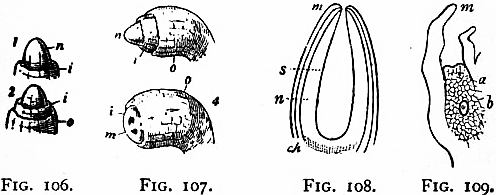
Figs. 106 and 107.—Successive stages in the development of an ovule. n, Nucellus; i, inner; o, outer integument in section; m, micropyle. Fig. 108.—Orthotropous ovule of Polygonum in section, showing the embryo-sac s, in the nucellus n, the different ovular coverings, the base of the nucellus or chalaza ch, and the apex of the ovule with its micropyle m. Fig. 109.—Vertical section of the ovule of the Austrian Pine (Pinus austriaca), showing the nucellus a, consisting of delicate cellular tissue containing deep in its substance an embryo-sac b. The micropyle m is very wide.
The ovule appears at first as a small cellular projection from the placenta. The cells multiply until they assume a more or less enlarged ovate form constituting what has been called the nucellus (fig. 106, n), or central cellular mass of the ovule. This nucellus may remain naked, and alone form the ovule, as in some orders of parasitic plants such as Balanophoraceae, Santalaceae, &c.; but in most plants it becomes surrounded by certain coverings or integuments during its development. These appear first in the form of cellular rings at the base of the nucellus, which gradually spread over its surface (figs. 106, 107). In some cases only one covering is formed, especially amongst gamopetalous dicotyledons, as in Compositae, Campanulaceae, also in walnut, &c. But usually besides the single covering another is developed subsequently (fig. 106, o), which gradually extends over that first formed, and ultimately covers it completely, except at the apex. There are thus two integuments to the nucellus, an outer and an inner. The integuments do not completely invest the apex of the nucellus, but an opening termed the micropyle is left. The micropyle indicates the organic apex of the ovule. A single cell of the nucellus enlarges greatly to form the embryo-sac or megaspore (fig. 108, s). This embryo-sac increases in size, gradually supplanting the cellular tissue of the nucellus until it is surrounded only by a thin layer of it; or it may actually extend at the apex beyond it, as in Phaseolus and Alsine media; or it may pass into the micropyle, as in Santalum. In Gymnosperms it usually remains deep in the nucellus and surrounded by a thick mass of cellular tissue (fig. 109). For an account of the further development of the megaspore, and the formation of the egg-cell, from which after fertilization is formed the embryo, see Gymnosperms and Angiosperms.
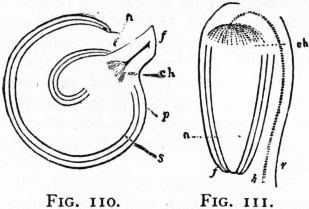
Fig. 110.—Campylotropous ovule of wall-flower (Cheiranthus), showing the funicle f, which attaches the ovule to the placenta; p, the outer, s, the inner coat, n, the nucellus, ch, the chalaza. The ovule is curved upon itself, so that the micropyle is near the funicle. Fig. 111.—Anatropous ovule of Dandelion (Taraxacum), n, nucellus, which is inverted, so that the chalaza ch, is removed from the base or hilum h, while the micropyle f is near the base. The connexion between the base of the ovule and the base of the nucellus is kept up by means of the raphe r.
The point where the integuments are united to the base of the nucellus is called the chalaza (figs. 111, 112). This is often coloured, is of a denser texture than the surrounding tissue, and is traversed by fibro-vascular bundles, which pass from the placenta to nourish the ovule.
When the ovule is so developed that the chalaza is at the hilum (next the placenta), and the micropyle is at the opposite extremity, there being a short funicle, the ovule is orthotropous. This form is well seen in Polygonaceae (fig. 112), Cistaceae, and most gymnosperms. In such an ovule a straight line drawn from the hilum to the micropyle passes along the axis of the ovule. Where, by more rapid growth on one side than on the other, the nucellus, together with the integuments, is curved upon itself, so that the micropyle approaches the hilum, and ultimately is placed close to it, while the chalaza is at the hilum, the ovule is campylotropous (fig. 110). Curved ovules are found in Cruciferae, and Caryophyllaceae. The inverted or anatropous ovule (fig. 111) is the commonest form amongst angiosperms. In this ovule the apex with the micropyle is turned towards the point of attachment of the funicle to the placenta, the chalaza being situated at the opposite extremity; and the funicle, which runs along the side usually next the placenta, coalesces with the ovule and constitutes the raphe (r), which often forms a ridge. The anatropous ovule arises from the placenta as a straight or only slightly curved cellular process, and as it grows, gradually becomes inverted, curving from the point of origin of the integuments (cf. figs. 106, 107). As the first integument grows round it, the amount of inversion increases, and the funicle becomes adherent to the side of the nucellus. Then if a second integument be formed it covers all the free part of the ovule, but does not form on the side to which the raphe is adherent. These may be taken as the three types of ovule; but there are various intermediate forms, such as semi-anatropous and others.
The position of the ovule relative to the ovary varies. When there is a single ovule, with its axis vertical, it may be attached to the placenta at the base of the ovary (basal placenta), and is then erect, as in Polygonaceae and Compositae; or it may be inserted a little above the base, on a parietal placenta, with its apex upwards, and then is ascending, as in Parietaria. It may hang from an apicilar placenta at the summit of the ovary, its apex being directed downwards, and is inverted or pendulous, as in Hippuris vulgaris; or from a parietal placenta near the summit, and then is suspended, as in Daphne Mezereum, Polygalaceae and Euphorbiaceae. Sometimes a long funicle arises from a basal placenta, reaches the summit of the ovary, and there bending over suspends the ovule, as in Armeria (sea-pink); at other times the hilum appears to be in the middle, and the ovule becomes horizontal. When there are two ovules in the same cell, they may be either collateral, that is, placed side by side (fig. 92), or the one may be erect and the other inverted, as in some species of Spiraea and Aesculus; or they may be placed one above another, each directed similarly, as is the case in ovaries containing a moderate or definite number of ovules. Thus, in the ovary of Leguminous plants (fig. 91), the ovules, o, are attached to the extended marginal placenta, one above the other, forming usually two parallel rows corresponding to each margin of the carpel. When the ovules are definite (i.e. are uniform, and can be counted), it is usual to find their attachment so constant as to afford good characters for classification. When the ovules are very numerous (indefinite), while at the same time the placenta is not much developed, their position exhibits great variation, some being directed upwards, others downwards, others transversely; and their form is altered by pressure into various polyhedral shapes. In such cases it frequently happens that some of the ovules are arrested in their development and become abortive.
From Strasburger’s Lehrbuch der Botanik, by permission of Gustav Fischer.
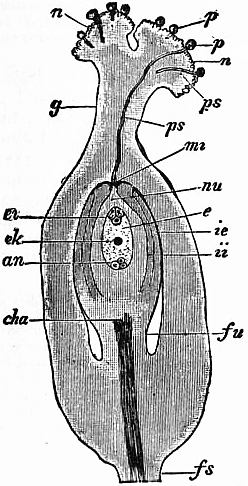
Fig. 112.—Ovary of Polygonum Convolvulus in longitudinal section during fertilization. (× 48.)
fs, Stalk-like base of ovary. fu, Funicle. cha, Chalaza. nu, Nucellus. mi, Micropyle. ii, inner, ie, outer integument. e, Embryo-sac. ek, Nucleus of embryo-sac. ei, Egg-apparatus. an, Antipodal cells. g, Style. n, Stigma. p, Pollen-grains. ps, Pollen-tubes.
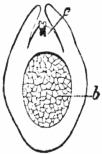
Fig. 113.—Vertical section of the ovule of the Scotch Fir (Pinus sylvestris) in May of the second year, showing the enlarged embryo-sac b, full of endosperm cells, and pollen-tubes c, penetrating the summit of the nucellus after the pollen has entered the large micropyle.
When the pistil has reached a certain stage in growth it becomes ready for fertilization. Pollination having been effected, and the pollen-grain having reached the stigma in angiosperms, or the summit of the nucellus in gymnosperms, Fertilization. it is detained there, and the viscid secretion from the glands of the stigma in the former case, or from the nucellus in the latter, induce the protrusion of the intine as a pollen-tube through the pores of the grain. The pollen-tube or tubes pass down the canal (fig. 112), through the conducting tissue of the style when present, and reach the interior of the ovary in angiosperms, and then pass to the micropyle of the ovule, one pollen-tube going to each ovule. Sometimes the micropyle lies close to the base of the style, and then the pollen-tube enters it at once, but frequently it has to pass some distance into the ovary, being guided in its direction by various contrivances, as hairs, grooves, &c. In gymnosperms the pollen-grain resting on the apex of the nucellus sends out its pollen-tubes, which at once penetrate the nucellus (fig. 113). In angiosperms when the pollen-tube reaches the micropyle it passes down into the canal, and this portion of it increases considerably in size. Ultimately the apex of the tube comes in contact with the tip of the embryo-sac and perforates it. The male cells in the end of the pollen-tube are then transmitted to the embryo-sac and fertilization is effected. Consequent upon this, after a longer or shorter period, those changes commence in the embryo-sac which result in the formation of the embryo plant, the ovule also undergoing changes which convert it into the seed, and fit it for a protective covering, and a store of nutriment for the embryo. Nor are the effects of fertilization confined to the ovule; they extend to other parts of the plant. The ovary enlarges, and, with the seeds enclosed, constitutes the fruit, frequently incorporated with which are other parts of the flower, as receptacle, calyx, &c. In gymnosperms the pollen-tubes, having penetrated a certain distance down the tissue of the nucellus, are usually arrested in growth for a longer or shorter period, sometimes nearly a year. Fruit and seed are discussed in a separate article—Fruit.
(A. B. R.)
FLOWERS, ARTIFICIAL. Imitations of natural flowers are sometimes made for scientific purposes (as the collection of glass flowers at Harvard University, which illustrates the flora of the United States), but more often as articles of decoration and ornament. A large variety of materials have been used in their manufacture by different peoples at different times—painted linen and shavings of stained horn by the Egyptians, gold and silver by the Romans, rice-paper by the Chinese, silkworm cocoons in Italy, the plumage of highly coloured birds in South America, wax, small tinted shells, &c. At the beginning of the 18th century the French, who originally learnt the art from the Italians, made great advances in the accuracy of their reproductions, and towards the end of that century the Paris manufacturers enjoyed a world-wide reputation. About the same time the art was introduced into England by French refugees, and soon afterwards it spread also to America. The industry is now a highly specialized one and comprises a large number of operations performed by separate hands. Four main processes may be distinguished. The first consists of cutting up the various fabrics and materials employed into shapes suitable for forming the leaves, petals, &c.; this may be done by scissors, but more often stamps are employed which will cut through a dozen or more thicknesses at one blow. The veins of the leaves are next impressed by means of a die, and the petals are given their natural rounded forms by goffering irons of various shapes. The next step is to assemble the petals and other parts of the flower, which is built up from the centre outwards; and the fourth is to mount the flower on a stalk formed of brass or iron wire wrapped round with suitably coloured material, and to fasten on the leaves required to complete the spray.
FLOYD, JOHN (1572-1649), English Jesuit, was born in Cambridgeshire in 1572. He entered the Society of Jesus when at Rome in 1592 and is also known as Daniel à Jesu, Hermannus Loemelius, and George White, the names under which he published a score of controversial treatises. He had considerable fame both as a preacher and teacher, and was frequently arrested in England. His last years were spent at Louvain and he died at St Omer on the 15th of September 1649. His brother Edward Floyd was impeached and sentenced by the Commons in 1621 for speaking disparagingly of the elector palatine.
FLOYD, JOHN BUCHANAN (1807-1863), American politician, was born at Blacksburg, Virginia, on the 1st of June 1807. He was the son of John Floyd (1770-1837), a representative in Congress from 1817 to 1829 and governor of Virginia from 1830 to 1834. After graduating at South Carolina College in 1826, the son practised law in his native state and at Helena, Arkansas, and in 1839 settled in Washington county, Virginia, which in 1847-1849 and again in 1853 he represented in the state legislature. Meanwhile, from 1849 to 1852, he was governor of Virginia, in which position he recommended to the legislature the enactment of a law laying an import tax on the products of such states as refused to surrender fugitive slaves owned by Virginia masters. In March 1857 he became secretary of war in President Buchanan’s cabinet, where his lack of administrative ability was soon apparent. In December 1860, on ascertaining that Floyd had honoured heavy drafts made by government contractors in anticipation of their earnings, the president requested his resignation. Several days later Floyd was indicted for malversation in office, but the indictment was overruled on technical grounds. There is no proof that he profited by these irregular transactions; in fact he went out of the office financially embarrassed. Though he had openly opposed secession before the election of Lincoln, his conduct after that event, especially after his breach with Buchanan, fell under suspicion, and he was accused of having sent large stores of government arms to Southern arsenals in anticipation of the Civil War. In the last days of his term he apparently had such an intention, but during the year 1860 the Southern States actually received less than their full quota of arms. After the secession of Virginia he was commissioned a brigadier-general in the Confederate service. He was first employed in some unsuccessful operations in western Virginia, and in February 1862 became commander of the Confederate forces at Fort Donelson, from which he fled with his second in command, General Gideon J. Pillow, on the night of February 18, leaving General Simon B. Buckner to surrender to General Grant. A fortnight later President Davis relieved him of his command. He died at Abingdon, Virginia, on the 26th of August 1863.
FLOYER, SIR JOHN (1649-1734), English physician and author, was born at Hinters in Staffordshire, and was educated at Oxford. He practised in Lichfield, and it was by his advice that Dr Johnson, when a child, was taken by his mother to be touched by Queen Anne for the king’s evil on the 30th of March 1714. He died on the 1st of February 1734. Floyer was an advocate of cold bathing, introduced the practice of counting the rate of the pulse-beats, and gave an early account of the pathological changes in the lungs associated with emphysema.
His writings include:—Φαρμακο-Βάσανος: or the Touchstone of Medicines, discovering the virtues of Vegetables, Minerals and Animals, by their Tastes and Smells (2 vols., 1687); The praeternatural State of animal Humours described by their sensible Qualities (1696); An Enquiry into the right Use and Abuses of the hot, cold and temperate Baths in England (1697); A Treatise of the Asthma (1st ed., 1698); The ancient Ψυχρολουσία revived, or an Essay to prove cold Bathing both safe and useful (London, 1702; several editions 8vo; abridged, Manchester, 1844, 12mo); The Physician’s Pulse-watch (1707-1710); The Sibylline Oracles, translated from the best Greek copies, and compared with the sacred Prophecies (1st ed., 1713); Two Essays: the first Essay concerning the Creation, Aetherial Bodies, and Offices of good and bad Angels; the second Essay concerning the Mosaic System of the World (Nottingham, 1717); An Exposition of the Revelations (1719); An Essay to restore the Dipping of Infants in their Baptism (1722); Medicina Gerocomica, or the Galenic Art of preserving old Men’s Healths (1st ed., 1724); A Comment on forty-two Histories described by Hippocrates (1726).
FLUDD, or Flud, ROBERT [Robertus de Fluctibus] (1574-1637), English physician and mystical philosopher, the son of Sir Thomas Fludd, treasurer of war to Queen Elizabeth in France and the Low Countries, was born at Milgate, Kent. After studying at St John’s College, Oxford, he travelled in Europe for six years, and became acquainted with the writings of Paracelsus. He subsequently returned to Oxford, became a member of Christ Church, took his medical degrees, and ultimately became a fellow of the College of Physicians. He practised in London with success, though it is said that he combined with purely medical treatment a good deal of faith-healing. Following Paracelsus, he endeavoured to form a system of philosophy founded on the identity of physical and spiritual truth. The universe and all created things proceed from God, who is the beginning, the end and the sum of all things, and to him they will return. The act of creation is the separation of the active principle (light) from the passive (darkness) in the bosom of the divine unity (God). The universe consists of three worlds; the archetypal (God), the macrocosm (the world), the microcosm (man). Man is the world in miniature, all the parts of both sympathetically correspond and act upon each other. It is possible for man (and even for the mineral and the plant) to undergo transformation and to win immortality. Fludd’s system may be described as a materialistic pantheism, which, allegorically interpreted, he put forward as containing the real meaning of Christianity, revealed to Adam by God himself, handed down by tradition to Moses and the patriarchs, and revealed a second time by Christ. The opinions of Fludd had the honour of being refuted by Kepler, Gassendi and Mersenne. Though rapt in mystical speculation, Fludd was a man of varied attainments. He did not disdain scientific experiments, and is thought by some to be the original inventor of the barometer. He was an ardent defender of the Rosicrucians, and De Quincey considers him to have been the immediate, as J.V. Andreä was the remote, father of freemasonry. Fludd died on the 8th of September 1637.
See J.B. Craven, Robert Fludd, the English Rosicrucian (1902), where a list of his works is given; A.E. Waite, The Real History of the Rosicrucians (1887); De Quincey, The Rosicrucians and Freemasons; J. Hunt, Religious Thought in England (1870), i. 240 seq. His works were published in 6 vols., Oppenheim and Gouda, 1638.
FLÜGEL, GUSTAV LEBERECHT (1802-1870), German orientalist, was born at Bautzen on the 18th of February 1802. He received his early education at the gymnasium of his native town, and studied theology and philology at Leipzig. Gradually he devoted his attention chiefly to Oriental languages, which he studied in Vienna and Paris. In 1832 he became professor at the Fürstenschule of St Afra in Meissen, but ill-health compelled him to resign that office in 1850, and in 1851 he went to Vienna, where he was employed in cataloguing the Arabic, Turkish and Persian manuscripts of the court library. He died at Dresden on the 5th of July 1870.
Flügel’s chief work is an edition of the bibliographical and encyclopaedic lexicon of Haji Khalfa, with Latin translation (7 vols., London and Leipzig, 1835-1858). He also brought out an edition of the Koran (Leipzig, 1834 and again 1893); then followed Concordantiae Corani arabicae (Leipzig, 1842 and again 1898); Mani, seine Lehren und seine Schriften (Leipzig, 1862); Die grammatischen Schulen der Araber (Leipzig, 1862); and Ibn Kutlûbugas Krone der Lebensbeschreibungen (Leipzig, 1862). An edition of Kitâb-al-Fihrist, prepared by him, was published after his death.
FLÜGEL, JOHANN GOTTFRIED (1788-1855), German lexicographer, was born at Barby near Magdeburg, on the 22nd of November 1788. He was originally a merchant’s clerk, but emigrating to the United States in 1810, he made a special study of the English language, and returning to Germany in 1819, was in 1824 appointed lector of the English language in the university of Leipzig. In 1838 he became American consul, and subsequently representative and correspondent of the Smithsonian Institution at Washington and several other leading American literary and scientific institutions. He died at Leipzig on the 24th of June 1855.
The fame of Flügel rests chiefly on the Vollständige englisch-deutsche und deutsch-englische Wörterbuch, first published in 2 vols. (Leipzig) in 1830, which has had an extensive circulation not only in Germany but in England and America. In this work he was assisted by J. Sporschil, and a new and enlarged edition, edited by his son Felix Flügel (1820-1904), was published at Brunswick (1890-1892). Another edition, in two volumes, edited by Prof. Immanuel Schmidt and S. Tanger appeared (Brunswick, London & New York) in 1906. Among his other works are—Vollständige engl. Sprachlehre (1824-1826); Triglotte, oder kaufmännisches Wörterbuch in drei Sprachen, Deutsch, Englisch und Französisch (1836-1840); Kleines Kaufmännisches Handwörterbuch in drei Sprachen (1840); and Praktisches Handbuch der engl. Handelscorrespondenz (1827, 9th ed. 1873). All these have passed through several editions. In addition, Flügel also published in the English language: A series of Commercial Letters (Leipzig, 1822), a 9th edition of which appeared in 1874 under the title Practical Mercantile Correspondence and a Practical Dictionary of the English and German Languages (2 vols., Hamburg and Leipzig, 1847-1852; 15th ed., Leipzig, 1891). The last was continued and re-edited by his son Felix.
FLUKE (probably connected with the Ger. flach, flat), a name given to several kinds of fish, flat in shape, especially to the common flounder; also the name of a trematoid worm, resembling a flounder in shape, which as a parasite infects the liver and neighbouring organs of certain animals, especially sheep, and causes liver-rot. The most common is the Fasciola hepatica (see Trematodes). It is also the name of a species of kidney potato. Probably from a resemblance to the shape of the fish, “fluke” is the name given to the holding-plates, triangular in shape, at the end of the arms of an anchor, and to the triangular extremities of the tail of a whale. The use of the word as a slang expression for a lucky accident appears to have been first applied in billiards to an unintentional scoring shot.
FLUME (through an O. Fr. word flum, from the Lat. flumen, a river), a word formerly used for a stream, and particularly for the tail of a mill-race. It is used in America for a very narrow gorge running between precipitous rocks, with a stream at the bottom, but more frequently is applied to an artificial channel of wood or other material for the diversion of a stream of water from a river for purposes of irrigation, for running a sawmill, or for various processes in the hydraulic method of gold-mining (see Aqueduct).
FLUMINI MAGGIORE, a town of the province of Cagliari, Sardinia, 10 m. by road N. of Iglesias, and 5 m. from the W. coast. Pop. (1901) town 3908; commune 9647. It is the centre of a considerable lead and zinc mining district. Three miles to the S. are the ruins of a temple erected probably in the time of Commodus (Corpus inscr. Lat. x., Berlin, 1883, No. 7539). They seem to mark the site of Metalla (mines), a station on the coast road from Sulci to Tharros, and the centre of the mining district in Roman times. At Flumini Maggiore itself were found two ingots of lead, one bearing a stamp with Hadrian’s name.
FLUORANTHENE, C15H10, also known as idryl, a hydrocarbon occurring with phenanthrene, pyrene, diphenyl, and other substances in “Stupp” fat (the fat obtained in working up the mercury ores in Idria), and also in the higher boiling fractions of the coal tar distillate. It was discovered by R. Fittig in 1878, who, with Gebhard and H. Liepmann, elucidated its constitution (see Ann., 1879, 200, p. 1). The hydrocarbons are separated from the “Stupp” by means of alcohol, the soluble portion on distillation giving first phenanthrene and then a mixture of pyrene and fluoranthene. From the tar distillate, the chrysene can be fractionally precipitated, and the fluoranthene can be separated from most of the pyrene by fractional distillation in a partial vacuum. In either case the two hydrocarbons are finally separated by fractional crystallization of their picrates, which are then decomposed by ammonia. Fluoranthene crystallizes in large slender needles or monoclinic tables, melting at 109-110° C. and boiling at 250-251° C. (60 mm.). It is easily soluble in hot alcohol, ether and carbon bisulphide. On oxidation with chromic acid it forms a quinone, C15H8O2, and an α-diphenylene ketocarboxylic acid The picrate melts at 182-183° C.
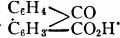
FLUORENE (α-diphenylene methane), C13H10 or (C6H4)2CH2, a hydrocarbon found in coal-tar. It is obtained from the higher boiling fractions, after separation of naphthalene and anthracene, by fractional distillation, the portion boiling between 290-340° C. being taken. The fluorene is separated from this by placing it in a freezing mixture, and is then redistilled or crystallized from glacial acetic acid, or purified by means of its picrate. It may be prepared by distilling diphenylene ketone over zinc dust, or by heating it with hydriodic acid and phosphorus to 150-160° C.; and also by passing the vapour of diphenyl methane through a red hot tube. It crystallizes in colourless plates, possessing a violet fluorescence, melting at 112-113° and boiling at 293-295° C. By oxidation with chromic acid in glacial acetic acid solution, it is converted into diphenylene ketone (C6H4)2·CO; whilst on heating with hydriodic acid and phosphorus to 250-260° C. it gives a hydro derivative of composition C18H22.
FLUORESCEIN, or Resorcin-Phthalein, C20H12O5, in chemistry, a compound discovered in 1876 by A. v. Baeyer by the condensation of phthalic anhydride with resorcin at 195-200° C. (Ann., 1876, 183, p. 1). The two reacting substances are either heated alone or with zinc chloride for some hours, and the melt obtained is boiled out with water, washed by dilute alcohol, extracted by means of sodium hydrate, and the solution so obtained is precipitated by an acid. The precipitate is well washed with water and then dried. By repeating this process two or three times, the fluorescein may be obtained in a very pure condition. It forms a yellow amorphous powder, insoluble in water but soluble in alcohol, and crystallizing from the alcoholic solution in small dark red nodules. It is readily soluble in solutions of the caustic alkalis, the solution being of a dark red colour and showing (especially when largely diluted with water) a brilliant green fluorescence. It was so named on account of this last character. By brominating fluorescein in glacial acetic acid solution, eosin (tetrabromfluorescein) is obtained, the same compound being formed by heating 3.5-dibrom-2.4-dioxybenzoylbenzoic acid above its melting point (R. Meyer, Ber., 1895, 28, p. 1576). It crystallizes from alcohol in yellowish red needles, and dyes silk, wool, and mordanted cotton a fine pink colour. When heated with caustic alkalis it yields dibromresorcin and dibrommonoresorcin-phthalein. The corresponding iodo compound is known as erythrosin. Fluorescein is readily nitrated, yielding a di- or tetra-nitro compound according to conditions. The entrance of the negative nitro group into the molecule weakens the central pyrone ring in the fluorescein nucleus and the di- and tetra-nitro compounds readily yield hydrates (see J.T. Hewitt and B.W. Perkins, Jour. Chem. Soc., 1900, p. 1326). By the action of ammonia or amines the di-nitro fluoresceins are converted into yellow dyestuffs (F. Reverdin, Ber., 1897, 30, p. 332). Other dyestuffs obtained from fluorescein are safrosine or eosin scarlet (dibromdinitrofluorescein) and rose Bengal (tetraiodotetrachlorfluorescein).
On fusion with caustic alkali, fluorescein yields resorcin, C6H4(OH)2, and monoresorcin phthalein (dioxybenzoylbenzoic acid), (HO)2C6H3·CO·C H4·COOH. With zinc dust and caustic soda it yields fluorescin. By warming fluorescein with excess of phosphorus pentachloride it yields fluorescein chloride, C20H10O3Cl2 (A. Baeyer), which crystallizes from alcohol in small prisms, melting at 252° C. When heated with aniline and aniline hydrochloride, fluorescein yields a colourless anilide (O. Fischer and E. Hepp, Ber., 1893, 26, p. 2236), which is readily methylated by methyl iodide and potash to a fluoresceinanilidedimethyl ether, which when heated for six hours to 150° C. with acetic and hydrochloric acids, is hydrolysed and yields a colourless fluoresceindimethyl ether, which melts at 198° C. On the other hand, by heating fluorescein with caustic potash, methyl iodide and methyl alcohol, a coloured (yellow) dimethyl ether, melting at 208° C. is obtained (Fischer and Hepp). By heating the coloured dimethyl ether with caustic soda, the monomethyl ether is obtained (O. Fischer and E. Hepp, Ber., 1895, 28, p. 397); this crystallizes in triclinic tables, and melts at 262° C. It is to be noted that the colourless monomethyl ether fluoresces strongly in alkaline solution, the dimethyl ether of melting point 208° fluoresces only in neutral solution (e.g., in alcoholic solution), and the dimethyl ether of melting point 198° C. only in concentrated hydrochloric or sulphuric acid solution (Fischer and Hepp). Considerable discussion has taken place as to the position held by the hydroxyl groups in the fluorescein molecule, C. Graebe (Ber., 1895, 28, p. 28) asserting that they were in the ortho position to the linking carbon atom of the phthalic anhydride residue. G. Heller (Ber., 1895, 28, p. 312), however, showed that monoresorcin-phthalein when brominated in glacial acetic acid gives a dibrom derivative which, with fuming sulphuric acid, yields dibromxanthopurpurin (1.3-dioxy-2.4-dibromanthraquinone), a reaction which is only possible if the fluorescein (from which the monoresorcin-phthalein is derived) contains free hydroxyl groups in the para position to the linking carbon atom of the phthalic anhydride residue.
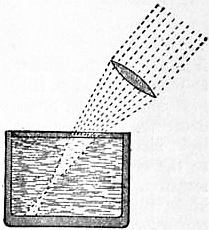
Fig. 1.
FLUORESCENCE. In a paper read before the Royal Society of Edinburgh in 1833, Sir David Brewster described a remarkable phenomenon he had discovered to which he gave the name of “internal dispersion.” On admitting a beam of sunlight, condensed by a lens, into a solution of chlorophyll, the green colouring matter of leaves (see fig. 1), he was surprised to find that the path of the rays within the fluid was marked by a bright light of a blood-red colour, strangely contrasting with the beautiful green of the fluid when seen in moderate thickness. Brewster afterwards observed the same phenomenon in various vegetable solutions and essential oils, and in some solids, amongst which was fluor-spar. He believed this effect to be due to coloured particles held in suspension. A few years later, Sir John Herschel independently discovered that if a solution of quinine sulphate, which, viewed by transmitted light, appears colourless and transparent like water, were illuminated by a beam of ordinary daylight, a peculiar blue colour was seen in a thin stratum of the fluid adjacent to the surface by which the light entered. The blue light was unpolarized and passed freely through many inches of the fluid. The incident beam, after having passed through the stratum from which the blue light came, was not sensibly enfeebled or coloured, but yet it had lost the power of producing the characteristic blue colour when admitted into a second solution of quinine sulphate. A beam of light modified in this mysterious manner was called by Herschel “epipolized.” Brewster showed that epipolic was merely a particular case of internal dispersion, peculiar only in this respect, that the rays capable of dispersion were dispersed with unusual rapidity.
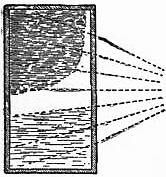
Fig. 2.
The investigation of this phenomenon was afterwards taken up by Sir G.G. Stokes, to whom the greater part of our present knowledge of the subject is due. Stokes’s first paper “On the Change of the Refrangibility of Light” appeared in 1852. He repeated the experiments of Brewster and Herschel, and considerably extended them. These experiments soon led him to the conclusion that the effect could not be due, as Brewster had imagined, to the scattering of light by suspended particles, but that the dispersed beam actually differed in refrangibility from the light which excited it. He therefore termed it “true internal dispersion” to distinguish it from the scattering of light, which he called “false internal dispersion.” As this name, however, is apt to suggest Brewster’s view of the phenomenon, he afterwards abandoned it as unsatisfactory, and substituted the word “fluorescence.” This term, derived from fluor-spar after the analogy of opalescence from opal, does not presuppose any theory. To examine the nature of the fluorescence produced by quinine, Stokes formed a pure spectrum of the sun’s rays in the usual manner. A test-tube, filled with a dilute solution of quinine sulphate, was placed just outside the red end of the spectrum and then gradually moved along the spectrum to the other extremity. No fluorescence was observed as long as the tube remained in the more luminous portion, but as soon as the violet was reached, a ghost-like gleam of blue light shot right across the tube. On continuing to move the tube, the blue light at first increased in intensity and afterwards died away, but not until the tube had been moved a considerable distance into the ultra-violet part of the spectrum. When the blue gleam first appeared it extended right across the tube, but just before disappearing it was confined to a very thin stratum on the side at which the exciting rays entered. Stokes varied this experiment by placing a vessel filled with the dilute solution in a spectrum formed by a train of prisms. The appearance is illustrated diagrammatically in fig. 2. The greater part of the light passed freely as if through water, but from about half-way between the Fraunhofer lines G and H to far beyond the extreme violet, the incident rays gave rise to light of a sky-blue colour, which emanated in all directions from the portion of the fluid (represented white in fig. 2) which was under the influence of the incident rays. The anterior surface of the blue space coincided, of course, with the inner surface of the glass vessel. The posterior surface marked the distance to which the incident rays were able to penetrate before they were absorbed. This distance was at first considerable, greater than the diameter of the vessel, but decreased with great rapidity as the refrangibility of the incident light increased, so that from a little beyond the extreme violet to the end, the blue space was reduced to an excessively thin stratum. This shows that the fluid is very opaque to the ultra-violet rays. The fixed lines in the violet and invisible part of the solar spectrum were represented by dark lines, or rather planes, intersecting the blue region. Stokes found that the fluorescent light is not homogeneous, for on reducing the incident rays to a narrow band of homogeneous light, and examining the dispersed beam through a prism, he found that the blue light consisted of rays extending over a wide range of refrangibility, but not into the ultra-violet.
Another method, which Stokes found especially useful in examining different substances for fluorescence, was as follows. Two coloured media were prepared, one of which transmitted the upper portion of the spectrum and was opaque to the lower portion, while the second was opaque to the upper and transparent to the lower part of the spectrum. These were called by Stokes “complementary absorbents.” No pair could be found which were exactly complementary, of course, but the condition was approximately fulfilled by several sets of coloured glasses or solutions. One such combination consisted of a deep-blue solution of ammioniacal copper sulphate and a yellow glass coloured with silver. The two media together were almost opaque. The light of the sun being admitted through a hole in the window-shutter, a white porcelain tablet was laid on a shelf fastened in front of the hole. If the vessel containing the blue solution was placed so as to cover the hole, and the tablet was viewed through the yellow glass, scarcely any light entered the eye, but if a paper washed with some fluorescent liquid were laid on the tablet it appeared brilliantly luminous. Different pairs of complementary absorbents were required according to the colour of the fluorescent light. This experiment shows clearly that the light which passed through the first absorbent and which would have been stopped by the second gave rise in the fluorescent substance to rays of a different wave-length which were transmitted by the second absorbent. Scattered light, with which the true fluorescent light was often associated, was eliminated by this method, being stopped by the second absorbent.
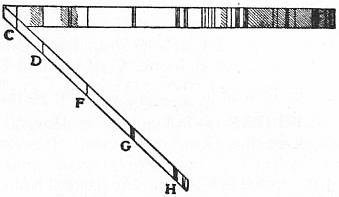
Fig. 3.—Spectrum of Chlorophyll.
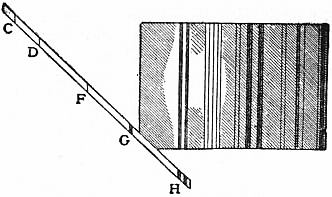
Fig. 4.—Spectrum of Aesculin.
Stokes also used a method, analogous to Newton’s method of crossed prisms, for the purpose of analysing the fluorescent light. A spectrum was produced by means of a slit and a prism, the slit being horizontal instead of vertical. The resulting very narrow spectrum was projected on a white paper moistened with a fluorescent solution, and viewed through a second prism with its refracting edge perpendicular to that of the first prism. In addition to the sloping spectrum seen under ordinary circumstances, another spectrum due to the fluorescent light alone, made its appearance, as seen in figs. 3 and 4. In this spectrum the colours do not run from left to right, but in horizontal lines. Thus the dark lines of the solar spectrum lie across the colours. The spectra in figs. 3 and 4 were obtained by V. Pierre with an improved arrangement of Stokes’s method. It will be seen that, in the case of chlorophyll, the whole spectrum, far into the ultra-violet, gives rise to a short range of red fluorescent light, while the effective part of the exciting light in the case of aesculin (a glucoside occurring in horse-chestnut bark) begins a little above the fixed line G and the fluorescent light covers a wide range extending from orange to blue.
Besides the substances already mentioned, a large number of vegetable extracts and some inorganic bodies are strongly fluorescent. Stokes found that most organic substances show signs of fluorescence. Green fluor-spar from Alston Moor exhibits a violet, uranium glass a yellowish-green fluorescence. Tincture of turmeric gives rise to a greenish light, and the extract of seeds of Datura stramonium a pale green light. Ordinary paraffin oil fluoresces blue. Barium platinocyanide, which is much used in the fluorescent screens employed in work with the Röntgen rays, shows a brilliant green fluorescence with ordinary light. Crystals of magnesium platinocyanide possess the remarkable property of emitting a polarized fluorescent light, the colour and plane of polarization depending on the position of the crystal with respect to the incident beam, and, if polarized light is used, on the plane of polarization of the latter.
Stokes’s Law.—In all the substances examined by Stokes, the fluorescent light appeared to be of lower refrangibility than the light which excited it. Stokes considered it probable that this lowering of the refrangibility of the light was a general law which held for all substances. This is known as Stokes’s law. It has been shown, however, by E. Lommel and others, that this law does not hold generally. Lommel distinguishes two kinds of fluorescence. The bodies which exhibit the first kind are those which possess strong absorption bands, of which only one remains appreciable after great dilution. These bodies are always strongly coloured and show anomalous dispersion and (in solids) surface colour. In such cases, the maximum of intensity in the fluorescent spectrum corresponds to the maximum of absorption. Stokes’s law is not obeyed, for a fluorescent spectrum can be produced by means of homogeneous light of lower refrangibility than a great part of the fluorescent light. The second kind of fluorescence is the most common, and is exhibited by bodies which show absorption only in the upper part of the spectrum, i.e. they are usually yellow or brown or (if the absorption is in the ultra-violet) colourless. The absorption bands also are different from those of substances of the first kind, for they readily disappear on dilution. A third class of bodies is formed by those substances which exhibit both kinds of fluorescence.
Nature of Fluorescence.—No complete theory of fluorescence has yet been given, though various attempts have been made to explain the phenomenon. Fluorescence is closely allied to phosphorescence (q.v.), the difference consisting in the duration of the effect after the exciting cause is removed. Liquids which fluoresce only do so while the exciting light is falling on them, ceasing immediately the exciting light is cut off. In the case of solids, on the other hand, such as fluor-spar or uranium glass, the effect, though very brief, does not die away quite instantaneously, so that it is really a very brief phosphorescence. The property of phosphorescence has been generally attributed to some molecular change taking place in the bodies possessing it. That some such change takes place during fluorescence is rendered probable by the fact that the property depends upon the state of the sensitive substance; some bodies, such as barium platinocyanide, fluorescing in the solid state but not in solution, while others, such as fluorescein, only fluoresce in solution. Fluorescence is always associated with absorption, but many bodies are absorbent without showing fluorescence. A satisfactory theory would have to account for these facts as well as for the production of waves of one period by those of another, and the non-homogeneous character of the fluorescent light. Quite recently W. Voigt has sought to give a theory of fluorescence depending on the theory of electrons. Briefly, this theory assumes that the electrons which constitute the molecule of the sensitive body can exist in two or more different configurations simultaneously, and that these are in dynamical equilibrium, like the molecule in a partially dissociated gas. If the electrons have different periods of vibration in the different configurations, then it would happen that the electrons whose period nearly corresponded with that of the incident light would absorb the energy of the latter, and if they then underwent a transformation into a different configuration with a different period, this absorbed energy would be given out in waves of a period corresponding to that of the new configuration.
Applications of Fluorescence.—The phenomenon of fluorescence can be utilized for the purpose of illustrating the laws of reflection and refraction in lecture experiments since the path of a ray of light through a very dilute solution of a sensitive substance is rendered visible. The existence of the dark lines in the ultra-violet portion of the solar spectrum can also be demonstrated in a simple manner. In addition to the foregoing applications, Stokes made use of this property for studying the character of the ultra-violet spectrum of different sources of illumination and flames. He suggested also that the property would in some cases furnish a simple test for the presence of a small quantity of a sensitive substance in an organic mixture. Fluorescent screens are largely used in work with Röntgen rays. There appears to be some prospect of light being thrown on the question of molecular structure by experiments on the fluorescence of vapours. Some very interesting experiments in this direction have been performed by R.W. Wood on the fluorescence of sodium vapour.
References.—Sir G.G. Stokes, Mathematical and Physical Papers, vols. iii. and iv.; Müller-Pouillet, Lehrbuch der Physik, Bd. ii. (1897); A. Wullner, Lehrbuch der Experimentalphysik, Bd. iv. (1899); A.A. Winkelmann, Handbuch der Physik, Bd. vi. (1906); R.W. Wood, Physical Optics (1905).
(J. R. C.)
FLUORINE (symbol F, atomic weight 19), a chemical element of the halogen group. It is never found in the uncombined condition, but in combination with calcium as fluor-spar CaF2 it is widely distributed; it is also found in cryolite Na3AlF6, in fluor-apatite, CaF2·3Ca3P2O8, and in minute traces in sea-water, in some mineral springs, and as a constituent of the enamel of the teeth. It was first isolated by H. Moissan in 1886 by the electrolysis of pure anhydrous hydrofluoric acid containing dissolved potassium fluoride. The U-shaped electrolytic vessel and the electrodes are made of an alloy of platinum-iridium, the limbs of the tube being closed by stoppers made of fluor-spar, and fitted with two lateral exit tubes for carrying off the gases evolved. Whilst the electrolysis is proceeding, the apparatus is kept at a constant temperature of −23° C. by means of liquid methyl chloride. The fluorine, which is liberated as a gas at the anode, is passed through a well cooled platinum vessel, in order to free it from any acid fumes that may be carried over, and finally through two platinum tubes containing sodium fluoride to remove the last traces of hydrofluoric acid; it is then collected in a platinum tube closed with fluor-spar plates. B. Brauner (Jour. Chem. Soc., 1894, 65, p. 393) obtained fluorine by heating potassium fluorplumbate 3KF·HF·PbF4. At 200° C. this salt decomposes, giving off hydrofluoric acid, and between 230-250° C. fluorine is liberated.
Fluorine is a pale greenish-yellow gas with a very sharp smell; its specific gravity is 1.265 (H. Moissan); it has been liquefied, the liquid also being of a yellow colour and boiling at -187° C. It is the most active of all the chemical elements; in contact with hydrogen combination takes place between the two gases with explosive violence, even in the dark, and at as low a temperature as −210° C; finely divided carbon burns in the gas, forming carbon tetrafluoride; water is decomposed even at ordinary temperatures, with the formation of hydrofluoric acid and “ozonised” oxygen; iodine, sulphur and phosphorus melt and then inflame in the gas; it liberates chlorine from chlorides, and combines with most metals instantaneously to form fluorides; it does not, however, combine with oxygen. Organic compounds are rapidly attacked by the gas.
Only one compound of hydrogen and fluorine is known, namely hydrofluoric acid, HF or H2F2, which was first obtained by C. Scheele in 1771 by decomposing fluor-spar with concentrated sulphuric acid, a method still used for the commercial preparation of the aqueous solution of the acid, the mixture being distilled from leaden retorts and the acid stored in leaden or gutta-percha bottles. The perfectly anhydrous acid is a very volatile colourless liquid and is best obtained, according to G. Gore (Phil. Trans., 1869, p. 173) by decomposing the double fluoride of hydrogen and potassium, at a red heat in a platinum retort fitted with a platinum condenser surrounded by a freezing mixture, and having a platinum receiver luted on. It can also be prepared in the anhydrous condition by passing a current of hydrogen over dry silver fluoride. The pure acid thus obtained is a most dangerous substance to handle, its vapour even when highly diluted with air having an exceedingly injurious action on the respiratory organs, whilst inhalation of the pure vapour is followed by death. The anhydrous acid boils at 19°.5 C. (H. Moissan), and on cooling, sets to a solid mass at −102°.5 C, which melts at −92°.3 C. (K. Olszewski, Monats. für Chemie, 1886, 7, p. 371). Potassium and sodium readily dissolve in the anhydrous acid with evolution of hydrogen and formation of fluorides. The aqueous solution is strongly acid to litmus and dissolves most metals directly. Its most important property is that it rapidly attacks glass, reacting with the silica of the glass to form gaseous silicon fluoride, and consequently it is used for etching. T.E. Thorpe (Jour. Chem. Soc., 1889, 55, p. 163) determined the vapour density of hydrofluoric acid at different temperatures, and showed that there is no approach to a definite value below about 88° C. where it reaches the value 10.29 corresponding to the molecular formula HF; at temperatures below 88° C. the value increases rapidly, showing that the molecule is more complex in its structure. (For references see J.N. Friend, The Theory of Valency (1909), p. 111.) The aqueous solution behaves on concentration similarly to the other halogen acids; E. Deussen (Zeit. anorg. Chem., 1905, 44, pp. 300, 408; 1906, 49, p. 297) found the solution of constant boiling point to contain 43.2% HF and to boil at 110° (750 mm.).
The salts of hydrofluoric acid are known as fluorides and are easily obtained by the action of the acid on metals or their oxides, hydroxides or carbonates. The fluorides of the alkali metals, of silver, and of most of the heavy metals are soluble in water; those of the alkaline earths are insoluble. A characteristic property of the alkaline fluorides is their power of combining with a molecule of hydrofluoric acid and with the fluorides of the more electro-negative elements to form double fluorides, a behaviour not shown by other metallic halides. Fluorides can be readily detected by their power of etching glass when warmed with sulphuric acid; or by warming them in a glass tube with concentrated sulphuric acid and holding a moistened glass rod in the mouth of the tube, the water apparently gelatinizes owing to the decomposition of the silicon fluoride formed. The atomic weight of fluorine has been determined by the conversion of calcium, sodium and potassium fluorides into the corresponding sulphates. J. Berzelius, by converting silver fluoride into silver chloride, obtained the value 19.44, and by analysing calcium fluoride the value 19.16; the more recent work of H. Moissan gives the value 19.05.
See H. Moissan, Le Fluor et ses composes (Paris, 1900).
FLUOR-SPAR, native calcium fluoride (CaF2), known also as Fluorite or simply Fluor. In France it is called fluorine, whilst the term fluor is applied to the element (F). All these terms, from the Lat. fluere, “to flow,” recall the fact that the spar is useful as a flux in certain metallurgical operations. (Cf. its Ger. name Flussspat or Fluss.)
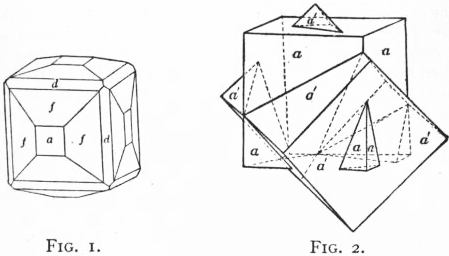
Fluor-spar crystallizes in the cubic system, commonly in cubes, either alone or combined with the octahedron, rhombic dodecahedron, four-faced cube, &c. The four-faced cube has been called the fluoroid. In fig. 1, a is the cube (100), d the rhombic dodecahedron (110), and f the four-faced cube (310). Fig. 2 shows a characteristic twin of interpenetrant cubes. The crystals are sometimes polysynthetic, a large octahedron, e.g., being built up of small cubes. The faces are often etched or corroded. Cleavage is nearly always perfect, parallel to the octahedron.
Fluor-spar has a hardness of 4, so that it is scratched by a knife, though not so readily as calcite. Its specific gravity is about 3.2. The colour is very variable, and often beautiful, but the mineral is too soft for personal decoration, though it forms a handsome material for vases, &c. In some fluor-spar the colour is disposed in bands, regularly following the contour of the crystal. As the colour is usually expelled, or much altered, by heat, it is believed to be due to an organic pigment, and the presence of hydrocarbons has been detected in many specimens by G. Wyrouboff, and other observers. H.W. Morse (Proc. Amer. Acad., 1906, p. 587) obtained carbon monoxide and dioxide, hydrogen and nitrogen and small quantities of oxygen from Weardale specimens by heating. He concluded that the gases are due to the decomposition of an organic colouring matter, which has, however, no connexion with the fluorescence or thermo-luminescence of the mineral. Certain crystals from Cumberland are beautifully fluorescent, appearing purple with a bluish internal haziness by reflected light, and greenish by transmitted light. Fluor-spar, though cubic, sometimes exhibits weak double refraction, probably due to internal tension. Many kinds of fluor-spar are thermo-luminescent, i.e. they glow on exposure to a moderate heat, and the name of chlorophane has been given to a variety which exhibits a green glow. The mineral also phosphoresces under the Röntgen rays. Cavities containing liquid occasionally occur in crystals of fluor-spar, notably in the greasy green cubes of Weardale in Durham. A dark violet fluor-spar from Wölsendorf in Bavaria, evolves an odour of ozone when struck, and has been called antozonite. Ozone is also emitted by a violet fluor-spar from Quincié, dep. Rhône, France. In both cases the spar evolves free fluorine, which ozonizes the air.
Fluor-spar is largely employed by the metallurgist, especially in lead-smelting, and in the production of ferro-silicon and ferro-manganese. It is also used in iron and brass foundries, and has been found useful as a flux for certain gold-ores and in the reduction of aluminium. It is used as a source of hydrofluoric acid, which it evolves when heated with sulphuric acid. The mineral is also used in the production of opal glass and enamel ware. In consequence of its low refractive and dispersive power, colourless pellucid fluor-spar is valuable in the construction of apochromatic lenses, but this variety is rare. The dark violet fluor-spar of Derbyshire, known locally as “Blue John,” is prized for ornamental purposes. It occurs almost exclusively at Tray Cliff, near Castleton. The dark purple spar, called by the workmen “bull beef,” may be changed, by heat, to a rich amethystine tint. Being very brittle, the spar is rather difficult to work on the lathe, and is often toughened by means of resin. F. Corsi, the eminent Italian antiquary, held that fluor-spar was the material of the famous murrhine vases.
Fluor-spar is a mineral of very wide distribution. Some of the finest crystals occur in the lead-veins of the Carboniferous Limestone series in the north of England, especially at Weardale, Allendale and Alston Moor. It is also found in the lead and copper-mines of Cornwall and S. Devon, notably near Liskeard, where fine crystals have been found, with faces of the six-faced octahedron replacing the corners of the cube. In Cornwall fluor-spar is known to the miners as “cann.” Fine yellow fluor-spar occurs in some of the Saxon mines, and beautiful rose-red octahedra are found in the Alps, near Göschenen. Many localities in the United States yield fluor-spar, and it is worked commercially in a few places, notably at Rosiclare in southern Illinois.
FLUSHING, formerly a township and a village of Queens county, New York, U.S.A., on Long Island, at the head of Flushing Bay, since the 1st of January 1898 a part of the borough of Queens, New York City. Flushing is served by the Long Island railroad and by electric lines. It was settled in 1644 by a company of English non-conformists who had probably been residents of Flushing in Holland, from which the new place took its name. Subsequently a large number of Quakers settled here, and in 1672 George Fox spent some time in the township. Before the War of Independence Flushing was the country-seat of many rich New Yorkers and colonial officials.
FLUSHING (Dutch Vlissingen), a fortified seaport in the province of Zeeland, Holland, on the south side of the island of Walcheren, at the mouth of the estuary of the western Scheldt, 4 m. by rail S. by W. of Middelburg, with which it is also connected by steam tramway and by a ship canal. There is a steam ferry to Breskens and Ter Neuzen on the coast of Zeeland-Flandres. Pop. (1900) 18,893. An important naval station and fortress up to 1867, Flushing has since aspired, under the care of the Dutch government, to become a great commercial port. In 1872 the railway was opened which, in conjunction with the regular day and night service of steamers to Queenborough in the county of Kent, forms one of the main routes between England and the east of Europe. In 1873 the great harbour, docks and canal works were completed. Yet the navigation of the port remains far behind that of Rotterdam or Antwerp, the tonnage being in 1899 about 7.9% of that of the kingdom. As a summer resort, however, Flushing has acquired considerable popularity, sea-baths and a large modern hotel being situated on the fine beach about three-quarters of a mile north-west of the town. It possesses a town hall, containing a collection of local antiquities, a theatre, an exchange, an academy of sciences and a school of navigation. The Jakobskerk, or Jacob’s church, founded in 1328, contains monuments to Admiral de Ruyter (1607-1676) and the poet Jacob Bellamy (1757-1786), who were natives of Flushing. The chief industries of the town are connected with the considerable manufacture of machinery, the state railway-workshops, shipbuilding yards, Krupp iron and steel works’ depot, brewing, and oil and soap manufacture. The chief imports are colonial produce and wine, wood and coal. The exports include agricultural produce (wheat and beans), shrimps and meat.
FLUTE, a word adapted from O. Fr. fleüte, modern flûte; from O. Fr. have come the Span. flauta, Ital. flauto and Ger. Flöte. The New English Dictionary dismisses the derivations suggested from Lat. flatuare or flavitare; ultimately the word must be referred to the root seen in “blow,” Lat. flare, Ger. blasen, &c.
1. In music “flute” is a general term applied to wood-wind instruments consisting of a pipe pierced with lateral holes and blown directly through the mouthpiece without the intervention of a reed. The flute family is classified according to the mouthpiece used to set in vibration the column of air within the tube: i.e. (1) the simple lateral mouth-hole or embouchure which necessitates holding the instrument in a transverse position; (2) the whistle or fipple mouthpiece which allows the performer to hold the instrument vertically in front of him. There is a third class of pipes included among the flutes, having no mouthpiece of any sort, in which the column of air is set in vibration by blowing obliquely across the open end of the pipe, as in the ancient Egyptian nay, and the pan-pipe or syrinx (q.v.). The transverse flute has entirely superseded the whistle flute, which has survived only in the so-called penny whistle, in the “flute-work” of the organ (q.v.), and in the French flageolet.
The Transverse Flute or German Flute (Fr. flûte traversière, flûte allemande: Ger. Flöte, Querflöte, Zwerchpfeiff, Schweitzerpfeiff; Ital. flauto traverso) includes the concert flute known both as flute in C and as flute in D, the piccolo (q.v.) or octave flute, and the fife (q.v.). The modern flute consists of a tube open at one end and nominally closed at the other by means of a plug or cork stopper: virtually, however, the tube is an open one giving the consecutive harmonic series of the open pipe or of a stretched string. The primitive flute was made in one piece, but the modern instrument is composed of three adjustable joints. (1) The head-joint, plugged at the upper end and containing at about one-third of the length the mouth-hole or embouchure. This embouchure, always open when the instrument is being played, converts the closed tube into an open one, in an acoustical sense. (2) The body, containing the holes and keys necessary to produce the scale which gave the flute its original designation of D flute, the head and body together, when the holes are closed, giving the fundamental note D. Before the invention of keys, this fundamental note and the notes obtained by the successive opening of the six holes produced the diatonic scale of D major. All other semitones were obtained by what is known as cross fingering (Fr. doigté fourchu; Ger. Gabelgriffe). It became usual to consider this the typical fingering nomenclature, whatever the fundamental note given out by the flute, and to indicate the tonality by the note given out when the six lateral holes are covered by the fingers. The result is that the tonality is always a tone lower than the name of the instrument indicates. Thus the D flute is really in C, the F flute is E♭, &c. (3) The foot-joint or tail-joint containing the two additional keys for C♯ and C which extend the compass downwards, completing the chromatic scale of C in the fundamental octave.
The compass of the modern flute is three octaves with chromatic semitones from The sound is produced by holding the flute transversely with the embouchure turned slightly outwards, the lower lip resting on the nearer edge of the embouchure, and blowing obliquely across, not into, the orifice. The flat stream of air from the lips, known as the air-reed, breaks against the sharp outer edge of the embouchure. The current of air, thus set in a flutter, produces in the stationary column of air within the tube a series of pulsations or vibrations caused by the alternate compression and rarefaction of the air and generating sounds of a pitch proportional to the length of the stationary column, which is practically somewhat longer than the length of the tube.1 The length of this column is varied by opening the lateral finger-holes. The current or air-reed thus acts upon the air column within the flute, without passing through the tube, as a plectrum upon a string, setting it in vibration. The air column of the flute is the sound-producer, whereas in instruments with reed mouthpieces the vibrating reed is more properly the sound-producer, while the air column, acting as a resonating medium, reinforces the note of the reed by vibrating synchronously with it. If the angle2 at which the current of air is directed against the outer edge of the embouchure be made less acute and the pressure of the breath be at the same time increased, the frequency of the alternate pulses of compression and rarefaction within the tube will be increased two, three or fourfold, forming a corresponding number of nodes and loops which results in harmonics or upper partials, respectively the octave, the twelfth, the double octave. By this means sounds of higher pitch are produced without actually shortening the length of the column of air by means of lateral holes. The acoustic theory of sound-production in the flute is one on which there is great diversity of opinion. The subject is too vast to be treated here, but readers who wish to pursue it may consult the works of Rockstro,3 Helmholtz,4 and others.5 The effect of boring lateral holes in pipes is to shorten the vibrating length of the air column, which may be regarded as being effective only between the hole in question and the mouthpiece. In order to obtain this result the diameter of the hole should be equal to that of the bore; as long as the holes were covered by the fingers, this was obviously impossible. The holes, therefore, being smaller than the laws of acoustics demand, have to be placed proportionally nearer the mouthpiece in order to avoid deepening the pitch and deadening the tone. This principle was understood by wind-instrument makers of classic Greece (see Aulos and Clarinet), and has been explained by Chladni6 and Gottfried Weber.7


From Captain Day’s Catalogue, &c., by permission of Messrs. Eyre & Spottiswoode.
Fig. 1.—Eight-keyed Cone Flute by Richard Potter. 18th century.

Messrs. Rudall, Carte & Co.
Fig. 2.—Boehm Cylinder Flute. Rockstro Model.
The bore of the early flute with six finger-holes was invariably cylindrical throughout, but towards the end of the 17th century a modification took place, the head joint alone remaining cylindrical while the rest of the bore assumed the form of a cone having its smallest diameter at the open end of the tube. The conoidal bore greatly improved the quality of tone and the production of the higher harmonics of the third octave. Once the conical bore had been adopted, the term flute was exclusively applied to the new instruments, the smaller flutes, then cylindrical, used in the army being designated fife (q.v.). At the present day in England, France and America, the favourite mode of construction is that introduced by Theobald Boehm, and known as the “cylinder flute with the parabolic head,” of which more will be said further on. The successive opening of the holes and keys on the flute produces the chromatic scale of the first or fundamental octave. By increasing the pressure of the breath and slightly altering the position of the lips over the mouth-hole, the same fingering produces the notes of the fundamental octave in the next octave higher. The third octave of the compass is obtained by the production of the higher harmonics (Fr. sons harmoniques; Ger. Flageolettöne), of the fundamental scale, facilitated by the opening of certain of the finger-holes as “vent holes.” The quality of tone depends somewhat on the material of which the flute is made; silver and gold produce a liquid tone of exquisite delicacy suitable for solo music, cocus-wood and ebonite a rich mellow tone of considerable power suitable for orchestral music. The tone differs further in the three registers, the lowest being slightly rough, the medium sweet and elegiac, and the third bird-like and brilliant. The proportions, position and form of the stopper and of the air chamber situated between it and the embouchure are mainly influential in giving the flute its peculiar slightly hollow timbre, due to the paucity of the upper partials of which according to Helmholtz8 only the octave and twelfth are heard. Mr Blaikley9 states, however, that when the fundamental D is played, he can discern the seventh partial. The technical capabilities of the flute are practically unlimited to a good player who can obtain sustained notes diminuendo and crescendo, diatonic and chromatic scales and arpeggios both legato and staccato, leaps, turns, shakes, &c. By the articulation with the tongue of the syllables te-ke or ti-ke repeated quickly for groups of double notes, or of te-ke-ti for triplets, an easy effective staccato is produced, known respectively as double or triple tonguing, a device understood early in the 16th century and mentioned by Martin Agricola,10 who gives the syllables as de for sustained notes, di-ri for shorter notes, and tel-lel-lel for staccato passages in quick tempo.11
Musical instruments, such as flutes, in which a column of air is set in vibration by regular pulsations derived from a current of air directed by the lips of the executant against the side of the orifice serving as embouchure, appear to be of very ancient origin. The Hindus, Chinese and Japanese claim to have used these modes of blowing from time immemorial. The ancient Egyptians had a long pipe held obliquely and blown across the end of the pipe itself at its upper extremity; it was known as Saïb-it12 and was frequently figured on the monuments. The same instrument, called “nay,” is still used in Mahommedan countries. The oblique aulos of the Greeks, plagiaulos,13 was of Egyptian origin and was perhaps at first blown from the end as described above,14 since we know that the Greeks were familiar with that method of blowing in the syrinx or pan-pipe. The instruments preserved at the British Museum15 having lateral embouchures show, however, that they were also acquainted—probably through the Hindus—with the transverse flute, although in the case of these specimens a reed must have been inserted into the mouth-hole or no sound would have been obtained.
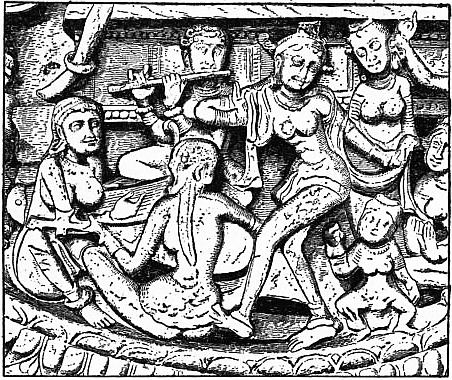
Fig. 3.—Transverse Flute. 1st or 2nd century A.D. From the Tope at Amarābati, British Museum.
The high antiquity of a lateral embouchure in Europe is generally admitted; the flute evidently penetrated from the East at some period not yet determined. A transverse flute is seen on Indian sculptures of the Gandhara school showing Greek influence, and dating from the beginning of our era (fig. 3). But although the transverse flute was evidently known to the Greeks and Romans, it did not find the same favour as the reed instruments known as auloi. We have no evidence of the survival of the transverse flute after the fall of the Roman empire until it filtered through from Byzantine sources during the early middle ages. Instances of the flute occur on a group of caskets16 of Italo-Byzantine work of the 9th or 10th century, while of purely Byzantine origin we find examples of flutes in Greek MSS.17 preserved in Paris, at the British Museum and elsewhere. There is moreover in the cathedral of St Sophia at Kiev18 an orchestra depicted on frescoes said to date from the 11th century; among the musicians is a flautist.
The first essentially western European trace of the transverse flute occurs in a German MS. of the 12th century, the celebrated Hortus deliciarum of the abbess Herrad von Landsperg.19 Fol. 221 shows a syren playing upon the transverse flute, which Herrad explains in a legend as tibia; in the vocabulary the latter is translated swegel. In the 13th century it occurs among the miniatures of the fifty-one musicians in the beautiful MS. Las Cantigas de Santa Maria in the Escorial, Madrid.20 Eustache Deschamps, a French poet of the 14th century, in one of his ballads, makes mention of the “flute traversaine,” and we are justified in supposing that he refers to the transverse flute. It had certainly acquired some vogue in the 15th century, being figured in an engraving in Sebastian Virdung’s celebrated work,21 where it is called “Zwerchpfeiff,” and, with the drums, it already constituted the principal element of the military music. Agricola (op. cit.) alludes to it as the “Querchpfeiff” or “Schweizerpfeiff,” the latter designation dating, it is said, from the battle of Marignan (1515), when the Swiss troops used it for the first time in war.
From Agricola onwards transverse flutes formed a complete family, said to comprise the discant, the alto and tenor, and the bass— respectively. Praetorius22 designates the transverse flute as “Flauta traversa’ Querpfeiff” and “Querflöt,” and gives the pitch of the bass in the tenor and alto in and the discant in as varieties then in use. A flute concert at that time included two discants, four altos or tenors, and two basses. The same author distinguishes between the “Traversa” and the “Schweizerpfeiff” or fife (which he also calls “Feldpfeiff,” i.e. military flute), although the construction was the same. There were two kinds of “Feldpfeiff,” in and respectively; they were employed exclusively with the military drum.
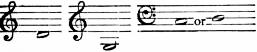


Mersenne’s23 account of the transverse flute, then designated “flûte d’Allemagne” or “flûte allemande” in France, and an “Air de Cour” for four flutes in his work lead us to believe that there were then in use in France the soprano flute in the tenor or alto flute in and the bass flute descending to . The museum of the Conservatoire Royal of Brussels possesses specimens of all these varieties except the last. All of them are laterally pierced with six finger-holes; they have a cylindrical bore, and are fashioned out of a single piece of wood. Their compass consists of two octaves and a fifth. Mersenne’s tablature for fingering the flute differs but little from those of Hotteterre-le-Romain24 and Eisel25 for the diatonic scale; he does not give the chromatic semitones and the flute had as yet no keys.



Fig. 4. Fig. 5.
Fig. 4.—Bass Flute. From Museo Civico, Verona (facsimile).
Fig. 5.—Bass Flute. Brussels Museum.
The largest bass flute in the Brussels museum is in at the French normal pitch A 435 double vibrations per second. It measures 0.95 m. from the centre of the blow orifice to the lower extremity of the tube. The disposition of the lateral holes is such that it is impossible to cover them with the fingers if the flute is held in the ordinary way. The instrument must be placed against the mouth in an almost vertical direction, inclining the extremity of the tube either to the right or the left. This inconvenient position makes it necessary that the instrument should be divided into two parts, enabling the player to turn the head joint that the embouchure may be most commodiously approached by the lips, which is not at all easy. The first and fourth of the six lateral holes are double in order to accommodate both right- and left-handed players, the holes not in use being stopped up with wax. The bass flute shown in fig. 4 is the facsimile of an instrument in the Museo Civico of Verona. The original, unfortunately no longer fit for use, is nevertheless sufficiently well preserved to allow of all its proportionate measurements being given. The lowest note, E♭, is obtained with a remarkable amplitude of sound, thus upsetting a very prevalent opinion that it is impossible to produce by lateral insufflation sounds which go a little lower than the ordinary limit downwards of the modern orchestral flute.26

The bass flute cited by Mersenne should not differ much from that of the Museo Civico at Verona. We suppose it to have been in , and that it was furnished with an open key like that which was applied to the recorders (flûtes douces) of the same epoch, the function of the key being to augment by another note the compass of the instrument in the lower part. A bass flute in G similar to the one in fig. 5 is figured and described in Diderot and D’Alembert’s encyclopaedia 27 (1751). According to Quantz,28 it was in France and about the middle of the 17th century that the first modifications were introduced in the manufacture of the flute. The improvements at this period consisted of the abandonment of the cylindrical bore in favour of a conical one, with the base of the cone forming the head of the instrument. At the same time the flute was made of three separate pieces called head, body, and tail or foot, which were ultimately further subdivided. The body or middle joint was divided into two pieces, so that the instrument could be tuned to the different pitches then in use by a replacement with longer or shorter pieces. It was probably about 1677, when Lully introduced the German flute into the opera, that recourse was had for the first time to keys, and that the key of D# was applied to the lower part of the instrument.29 The engraving of B. Picart, dated 1707, given in Hotteterre’s book, represents the flute as having reached the stage of improvement of which we have just spoken. In 1726 Quantz,30 finding himself in Paris, had a second key applied to the flute, placed nearly at the same height as the first, that of the , intended to differentiate the D# and the E♭.31 This innovation was generally well received in Germany, but does not appear to have met with corresponding success in other countries. In France and England manufacturers adopted it but rarely; in Italy it was declared useless.32 About the same time flutes were constructed with the lower extremity lengthened sufficiently to produce the fundamental C, and furnished with a supplementary key to produce the C♯. This innovation, spoken of by Quantz,33 did not meet with a very favourable reception, and was shortly afterwards abandoned. Passing mention may be made of the drawing of a flute with a C key in the Music-Saal of J.F.B. Majer (Nuremberg, 1741), p. 45.


The tuning of the instrument to different pitches was effected by changes in the length, and notably by substituting a longer or shorter upper piece in the middle joint. So wide were the differences in the pitches then in use that seven such pieces for the upper portion of it were deemed necessary. The relative proportions between the different parts of the instrument being altered by these modifications in the length, it was conceived that the just relation could be re-established by dividing the foot into two pieces, below the key. These two pieces were adjusted by means of a tenon, and it was asserted that, in this way, the foot could be lengthened proportionately to the length of the middle joint. Flutes thus improved took the name of “flûtes à registre.” The register system was, about 1752, applied by Quantz to the head joint34 and, the embouchure section being thus capable of elongation, it was allowable to the performer, according to the opinion of this professor, to lower the pitch of the flute a semitone, without having recourse to other lengthening pieces, and without disturbing the accuracy of intonation.
The upper extremity of the flute, beyond the embouchure orifice, is closed by means of a cork stopper. On the position of this cork depends, in a great measure, the accurate tuning of the flute. It is in its right place when the accompanying octaves are true. Quantz, in speaking of this accessory, mentions the use of a nut-screw to give the required position to the cork.35 He does not name the inventor of this appliance, but, according to Tromlitz,36 the improvement was due to Quantz himself. The invention goes back to 1726.
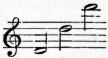
When the Method of Quantz appeared there were still in use, besides the orchestral flute in D, the little fourth flute in G, the low fourth flute in A, and the flûte d’amour a note higher; in France they had, moreover, the little octave flute in D (octave). A bass flute in D had also been attempted (see fig. 5). When Ribock published his Bemerkungen über die Flöte37 the flute had already the five keys here shown. This author states that the inventor of these new keys is not known to him, but that either Kusder, a musical instrument-maker in London, or Johann Georg Tromlitz of Leipzig was the originator, since he has not been able to trace those keys on the flutes of any other maker. Although Tromlitz does not claim for himself the invention of the keys for F, G♯ and B♭, he states that “he had occupied himself for several years in applying these keys so as not to augment the difficulty of playing, but on the contrary to render the handling of them as easy as possible.”38 In the later work published in 1800,39 however, he seems to attribute the invention of these keys to Richard Potter of London; he says that he has never yet been fortunate enough to come across a good flute by that maker—“the flute has certainly gained by the addition of the keys for F, G♯ and B♭, but this is not everything, for on such a flute much must perforce be left unattempted.... Only a flute with eight keys according to my invention is capable of everything.” It would seem, moreover, from circumstantial evidence stated clearly and on good authority by Rockstro40 that the keys for F, G♯ and B♭ must have been used first in England and made by Richard Potter before 1774. The higher key of C adopted from 1786 by Tromlitz, we believe to have been first recommended by Ribock (1782).41 Tromlitz in Über Flöten describes at length what may be termed the first systematic effort to overcome the difficulties created by the combination of open holes and closed keys. He attempted to solve the question by determining the positions of the holes according to the exigencies of fingering instead of subordinating them to the more arbitrary theories connected with the musical scale.
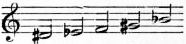
In 1785 Richard Potter improved Quantz’s slide applied to the head joint as well as to the register of the foot by a double system of tubes forming double sliding air-tight joints. In the document42 describing this improvement Potter patented the idea of lining the holes with silver tubes and of adapting metal conical valves to the keys. Potter’s patent conical valves were an adaptation of the contrivance first invented by J.F. Boie or Boye of Göttingen,43 who used pewter for the plugs, and silver for lining the holes. The keys mentioned in the patent were four—D♯, F, G♯, A♯. The idea of extending the compass of the flute downwards was taken up again about the same time by two players of the flute in London named Tacet and Florio. They devised a new disposition of the keys C and C#, and confided the execution of their invention to Potter. In Dr Arnold’s New Instructions for the German Flute occurs a tablature, the engraving of which goes back to the end of the 18th century, and bears the following title, “A Complete Drawing and Concise Scale and Description of Tacet and Florio’s new invented German Flute, with all the additional keys explained.” It explains the use of six keys—C, C♯, D♯, F, G♯, A♯—that are not always figured, because the employment of so many keys was at once admitted. Tromlitz himself, who, however, made flutes with nine keys—adding E♭, another F, and C♮, declared that he was not in favour of so great a complication, and that he preferred the flute with only two keys, D♯ and E♭, with a register foot joint and a cork nut-screw at the head joint. This instrument met all requirements. He was always much opposed to the use of the old keys for C♮ and C♯, because they altered the recognised quality of tone of the instrument. When Tromlitz published his method, the family of flutes had become modified. It comprehended only the typical flute in D, the flûte d’amour a minor third lower, a “third” flute a minor third higher, and, finally, the little octave flute.
While Tromlitz was struggling in Germany with the idea of augmenting the compass of the flute downwards by employing open keys for C♮ and C♯, an Italian, Giovanni Batista Orazi,44 increased the scale of the instrument downwards by the application of five new keys, viz. B, B♭, A, A♭, and G. At the same time that he produced this invention 45 he conceived the plugging of the lateral holes by the valve keys then recently invented by Potter. But it was hardly possible to obtain a perfect plugging of seven lateral holes with the aid of as many keys, for the control of which there were only the two little fingers, and therefore this invention of Orazi proved a failure.
In 1808 the Rev. Frederick Nolan,46 of Stratford, near London, conceived an open key, the lever of which, terminating by a ring, permitted the closing of a lateral hole at the same time the key was being acted upon. The combination in this double action is the embryo of the mechanism that a little later was to transform the system of the flute. Two years later Macgregor,47 a musical-instrument maker in London, constructed a bass flute an octave lower than the ordinary flute. The idea was not new, as is proved by the existence of the bass flute mentioned above. The difference between the two instruments lies in the mechanism of the keys. That employed by Macgregor consisted of a double lever, a contrivance dating from before the middle of the 18th century, of which the application is seen in an oboe of large dimensions preserved in the National Museum at Munich.48
In 1811 Johann Nepomuk Capeller invented the extra D[natural] hole and key, which is still in constant use on every flute of modern construction.49
About 1830 the celebrated French flautist Tulou added two more keys, those of F♯ and C♯, and a key, called “de cadence,” to facilitate the accompanying shakes.
To increase the number of keys, to improve their system of plugging, and to extend the scale of the instrument in the lower region,—these had hitherto been the principal problems dealt with in the improvement of the flute. No maker, no inventor to whose labours we have called attention, had as yet devoted his attention to the rational division of the column of air by means of the lateral holes. In 1831 Theobald Boehm, a Bavarian, happening to be in London, was struck with the power of tone the celebrated English performer Charles Nicholson drew from his instrument. Boehm learned, and not without astonishment, that his English colleague obtained this result by giving the lateral holes a much greater diameter than was then usually admitted. About the same time Boehm made the acquaintance of an amateur player named Gordon, who had effected certain improvements; he had bored the lateral hole for the lower E, and had covered it with a key, while he had replaced the key for F with a ring. These innovations set Boehm about attempting a complete reform of the instrument.50 He went resolutely to work, and during the year 1832 he produced the new flute which bears his name. This instrument is distinguished by a new mechanism of keys, as well as by larger holes disposed along the tube in geometrical progression.
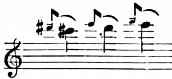
Boehm’s system had preserved the key of G♯ open; Coche,51 a professor in the Paris Conservatoire, assisted by Auguste Buffet the younger, a musical-instrument maker in that city, modified Boehm’s flute by closing the G♯ with a key, wishing thus to render the new fingering more conformable to the old. He thus added a key, facilitating the shake upon C♯ with D♯, and brought about some other changes in the instrument of less importance.
Boehm had not, however, altered the bore of the flute, which had been conical from the end of the 17th century. In 1846, however, he made further experiments, and the results obtained were put in practice by the construction of a new instrument, of which the body was given a cylindrical bore, while the diameter of the head was modified at the embouchure, the head-joint becoming parabolic (see fig. 2). The inventor thus obtained a remarkable equality in the tones of the lower octave, a greater sonorousness, and a perfect accuracy of intonation, by establishing the more exact proportions which a column of air of cylindrical form permitted.
The priority of Boehm’s invention was long contested, his detractors maintaining that the honour of having reconstructed the flute was due to Gordon. But an impartial investigation vindicates the claim of the former to the invention of the large lateral holes.52 His greatest title to fame is the invention of the mechanism which allows the production of the eleven chromatic semitones intermediate between the fundamental note and its first harmonic by means of eleven holes so disposed that in opening them successively they shorten the column of air in exact proportional quantities.53 Boehm (Essays, &c.) published a diagram or scheme to be adopted in determining the position of the note-holes of wind instruments for every given pitch. This diagram gives the position of the intermediate holes which he had been enabled to establish by a rule of proportion based on the law of the lengths of strings.
The Boehm flute, notwithstanding the high degree of perfection it has reached, has not secured unanimous favour; even now there are players who prefer the ordinary flute. The change of fingering required for some notes, the great delicacy and liability to derangement of the mechanism, have something to do with this. In England especially, the ordinary flute retains many partisans, thanks to the improvements introduced by a clever player, Abel Siccama, in 1845 (Patent No. 10,553). He bored the lateral holes of E and A lower, and covered them with open keys. He added some keys, and made a better disposition of the other lateral holes, of which he increased the diameter, producing thus a sonorousness almost equal to that of the Boehm flute, while yet preserving the old fingering for the notes of the first two octaves. But in spite of these improvements the old flute will not bear an impartial comparison with that of Boehm.
A flute constructed on a radically new system by Signor Carlo Tommaso Georgi and introduced in 1896 places the technique of the instrument on an entirely new and simple basis. The principal features of this flute consist in an embouchure placed at the upper extremity of the tube instead of at the side, which allows the instrument to be held in a perpendicular position; no tuning cork is required. There are eleven holes mathematically placed in the tube which give the semitones of the scale; there are no keys. The eleven holes are fingered by the fingers and thumbs, the C♯ hole being closed by the side of the left fore-finger. All the notes are obtained by means of simple fingering as far as G♯ of the third octave, the remaining notes of which are produced by cross-fingering. For the convenience of players with short fingers keys can be added, and the head of the Georgi flute can be used with any cylinder flute. The compass of the Georgi flute is almost the same as that of the concert flute; viz. If the lower C and C♯ are required, extra holes and keys can be added. Everything that is possible on the Boehm flute is possible on the Georgi and more, owing to the simplicity of the fingering; each finger having but one duty to perform, all trills are equally easy. The tone is the true flute tone, brilliant and sympathetic.54
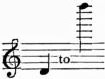
The old English fipple flute, or flûte à bec, is described under the headings Recorder and Flageolet.
(V. M.; K. S.)
2. In architecture the name “flute” is given to the vertical channels (segmental, semicircular or elliptical in horizontal section) employed on the shafts of columns in the classic styles. The flutes are separated one from the other by an “arris” in the Doric order and by a “fillet” in the Ionic and Corinthian orders. The earliest fluted columns are those in Egypt, at first with plain faces without any sinking, subsequently at Karnac (1400 B.C.) with a segmental sinking equal in depth to about one-seventh of the width of the flute. The columns flanking one of the “beehive” tombs at Mycenae have segmental flutes and are the earliest Greek examples. In two of the earliest Doric temples at Metapontum and Syracuse (temple of Apollo) the flutes are also segmental, but in later examples in order to emphasize the arris they were formed of three arcs and are known as “false ellipses,” and this applies to nearly all the fluting in Greek examples whether belonging to the Doric, Ionic or Corinthian orders. The number of flutes varies, there being 52 in the archaic temple of Diana at Ephesus and from 30 to 52 flutes in the Persian columns according to the diameter of the column. In the Greek Doric column 20 is the usual number, but there are 16 only in the temples of Sunium, Assos, Segesta and the temple of Apollo at Syracuse; 18 in one of the temples of Selinus and the temple of Diana at Syracuse, and 24 in the temple of Neptune at Paestum. The depth of the flute also varies; in the Propylaea at Athens the radius is equal to the width of the flute and the flute is segmental. In the Parthenon the radius of the central part of the flute is greater than the width, but the smaller arcs on either side accentuate better the arris. A similar accentuation is found in the Ionic and Corinthian orders, where the flutes are separated by fillets, and their section is always elliptical in Greek work, the depth of the flute, however, being always greater than in the Doric order. Thus, in the temple of Ilissus and the Ionic column in the cella of the temple at Bassae, the depth is about one-quarter of the width, in the Propylaea at Priene it is about one-third, and in the Erechtheum and other examples of the Greek Ionic order it is little more than one-half. The width of the fillet also varies, being as a rule one quarter of the width of the flute; and the same applies to the Greek Corinthian order. In the Roman Doric, Ionic and Corinthian orders, the flute is either segmental or semicircular, its depth being about one third of the width in the Doric column, and in all Ionic, Corinthian and Composite columns half the width of the flute. The fillet also is much broader in Roman examples, being about one-third of the width of the flute. In Roman columns sometimes the flutes of the lower part of the shaft, about one-third of the height, are partly filled with a convex moulding, “cabling” being the usual term applied to this treatment. The French architects of the 16th and 17th centuries carried this decorative feature much farther, and in the Tuileries and the Louvre carved a series of leaves in the flutes. In a few Italian buildings, instead of the fluting of the column being vertical, it twines round the column and is known as spiral fluting; a fine example is found in the Bevilacqua palace at Verona by San Michele. Fluting is sometimes introduced into capitals, as in the tomb of Mylasa, and in friezes, as in the theatre at Cnidos, the Incantada at Salonica, and a doorway at Patara. In one of the museums at Rome is a fine sarcophagus, the sides of which are sculptured with flutes in waved lines. The coronas of many of the Roman temples were carved with flutes. In medieval buildings, fluting was occasionally introduced in imitation of Roman work, as in the churches of central Syria and of Autun and Langres in France, but in the south of Italy and Sicily it would seem to have been brought in as a variety of treatment, in the decoration of the shafts carrying the arches of cloisters, as at Monreale in Sicily and in those of St John Lateran and St Paul-outside-the-Walls at Rome.
(R. P. S.)
1 See E.F.F. Chladni, Die Akustik (Leipzig, 1802), p. 87.
2 See Sonreck, “Über die Schwingungserregung und die Bewegung der Luftsäule in offenen und gedeckten Röhren,” Pogg. Ann., 1876, vol. 158.
3 The Flute (London, 1890), § 90-105, pp. 34-40.
4 Theorie der Luftschwingungen in Röhren mit offenen Enden (Berlin, 1896). Ostwald’s Klassiker der exacten Wissenschaften, No. 80.
5 V.C. Mahillon, Experimental Studies on the Resonance of Trunco-Conical and Cylindrical Air Columns, translated by F.A. Mahan (London, 1901); D.J. Blaikley, Acoustics in Relation to Wind Instruments (London, 1890); Friedrich Zamminer, Die Musik und die musikalischen Instrumente, &c. (Giessen, 1855); idem. “Sur le mouvement vibratoire de l’air dans les tuyaux,” Comptes rendus, 1855, vol. 41, &c.
6 Op. cit., § 73, pp. 87-88, note 1.
7 “Akustik der Blasinstrumente,” Allgem. musikal. Zeit. (Leipzig, 1816), Bd. xviii. No. 5, p. 65 et seq. See also Ernst Euting, Zur Geschichte der Blasinstrumente im 16. und 17. Jahrhundert. Inaugural Dissertation, Friedrich-Wilhelms Universität. (Berlin, 15th of March 1899), p. 9.
8 Lehre von der Tonempfindung (Braunschweig, 1877).
9 See additions by D. J. B. to article “Flute” in Grove’s Dictionary of Music and Musicians (London, 1904).
10 Musica instrumentalis deutsch (Wittenberg, 1528).
11 See also L’Artusi, Delle imperfettioni della musica moderna (Venice, 1600), p. 4; Gottfried Weber in Cäcilia, Bd. ix. p. 99.
12 See “Les Anciennes Flûtes égyptiennes,” by Victor Loret in Journal asiatique (Paris, 1889), vol. xiv. p. 133 et seq., two careful articles based on the ancient Egyptian instruments still extant. See also Lauth, “Über die ägyptische Instrumente,” Sitzungs. der philos., philolog. und histor. Klasse. der Kgl. bayer. Akad. zu München (1873).
13 See Albert A. Howard, “The Aulos or Tibia,” Harvard Studies, iv. (Boston, 1893), pp. 16-17.
14 Representations of flutes blown as here described have been found in Europe. See Comptes rendus de la commission impériale archéologique (St Petersburg, 1867), p. 45, and atlas for the same date, pl. vi. Pompeian painting given by Helbig, Wandgemälde, No. 7607; Zahn, vol. iii. pl. 31; Museo Borbonnico, pl. xv. No. 18; Clarac, pl. 130, 131, 139; Heuzey, Les Figurines, p. 136.
15 There are two flutes at the British Museum (Catal. No. 84, 4-9 and 5 and 6), belonging to the Castellani collection, made of wood encased in bronze in which the mouthpiece, consisting of the head of a maenad, has a lateral hole bored obliquely into the main tube. This hole was probably intended for the reception of a reed. The pipe is stopped at the end beyond the mouthpiece as in the modern flute. There are six holes. See also the plagiaulos from Halicarnassus in the British Museum described by C.T. Newton in History of Discoveries at Halicarnassus (London), vol. ii. p. 339. The Louvre has two ancient statues (from the villa Borghese) representing satyrs playing upon transverse flutes. Unfortunately these marbles have been restored, especially in the details affecting our present subject, and are therefore examples of no value to us. Another statue representing a flute-player occurs in the British Museum. The instrument has been supposed to be a transverse flute, but erroneously, for the insufflation of the lateral tube against which the instrumentalist presses his lips, could not, without the intervention of a reed, excite the vibratory movement of the column of air.