VOLUME X SLICE V Fleury, Claude to Foraker (continued 9)
Reading edition
“False Attacks” are broad movements made for the purpose of drawing the adversary out or of disconcerting him. They may consist of an advance, an extension, a change of engagement, an intentional uncovering by taking a wide guard (called “invitation guard”), or any movement or combination of movements tending to make the adversary believe that a real attack is under way.
“The Assault” is a formal fencing bout or series of bouts in public, while formal fencing in private is called “loose play” or a “friendly bout.” Bouts between fencers take place on a platform about 24 ft. long and 6 ft. wide (in the United States 20 × 3 ft.). Formal bouts are usually for a number of touches, or for a certain number of minutes, the fencer who touches oftenest winning. The judges (usually three or five) are sometimes empowered to score one or more points against a competitor for breaches of good form, or for overstepping the space limits. In the United States bouts are for four minutes, with a change of places after two minutes, and the competitors are not interrupted, the winner being indicated by a vote of the judges, who take into account touches and style. In all countries contestants are required to wear jackets of a light colour, so that hits may be easily seen. Audible acknowledgment of all touches, whether on the target or not, is universally considered to be a fencer’s duty. Fencing competitions are held in Great Britain under the rules of the Amateur Fencing Association, and in the United States under those of the Amateur Fencers’ League of America.
Fencing Terms (not mentioned above): “Cavazione,” Ital. for disengagement. “Contraction, Parries of,” those which do not parry in the simplest manner, but drag the adverse blade into another line, e.g. to parry a thrust in high sixte by counter of quarte. “Controtempo,” Ital. for time-thrust. “Coronation,” an attack preceded by a circular movement from high sixte to high quarte (and vice versa) made famous by Lafaugère. “Corps-à-corps” (body to body), the position of two fencers who are at such close quarters that their persons touch: when this occurs the fencers must again come on guard. “Coulé,” Fr. for glide. “Disarm,” to knock the foil out of the adversary’s hand; it is of no value in the French school. “Double Hit,” when both fencers attack and hit at the same time; neither hit counts. “Filo,” Ital. for glide (graze). “Flying Cut-over,” a cut-over executed as a continuation of a parry, the hand being drawn back towards the body. “Incontro,” Ital. for double attack. “Give the blade,” to allow the adversary easy contact with the foil; it is often resorted to in order to tempt the adversary into a beat or bind. “Menace,” to threaten the adversary by an extension and forward movement of the trunk. “Mur,” see “Salute.” “Passage of arms,” a series of attacks and parries, ending in a successful hit. “Phrase of arms,” a series of attacks and parries ending in a hit or invalidation. “Invalidation,” a hit on some part of the person outside the target, made by the fencer whose right it is at that moment to attack or riposte; such a hit invalidates one made simultaneously or subsequently by his opponent, however good. “Rebeat,” two beats, executed as quickly as possible together, one on each side of the adversary’s blade. “Reprises d’attaque,” Fr. for renewed attacks. “Salute,” the courteous salutation of the public and the adversary before and after a bout. A more elaborate salute, called by the French the Mur, consists of a series of parries, lunges and other evolutions carried out by both fencers at the same time. Important exhibition assaults are usually preceded by the Mur, which is called in English the Grand Salute. “Septime enveloppée,” a riposte by means of a twist and thrust after a parry in septime. It envelops and masters the adverse blade, whence the name. “Secret thrusts,” the French “bottes secrètes,” pretended infallible attacks of which the user is supposed alone to know the method of execution; they have no real existence. “Sforza,” Ital. for disarmament. “Scandaglio,” Ital for examination, studying the form of an opponent at the beginning of a bout. “Toccato!” Ital. for “Touched!”,. Fr. “Touché.”
Bibliography.—The literature of foil-fencing is practically identical with that of the art in general (see Fencing). The following modern works are among the best. French School: Fencing, in the Badminton library (1897); Foil and Sabre, by L. Rondelle (Boston, 1892); “Fencing,” by C. Prevost in the Encyclopaedia of Sport (1901); Fencing, by Edward Breck (New York, 1906). Italian school: Istruzione per la scherma, &c., by S. de Frae (Milan, 1885); La Scherma italiana di spada e di sciabola, by F. Masiello (Florence, 1887).
(E. B.)
FOIX, PAUL DE (1528-1584), French prelate and diplomatist. He studied Greek and Roman literature at Paris, and jurisprudence at Toulouse, where shortly after finishing his curriculum he delivered a course of lectures on civil law, which gained him great reputation. At the age of nineteen he was named councillor of the parlement of Paris. Having in this capacity expressed himself favourable to the adoption of mild measures in regard to certain persons accused of Lutheranism, he was arrested, but escaped punishment, and subsequently regained the favour of the French court. At the end of 1561 he was sent ambassador to England, where he remained four years. He was then sent to Venice, and returned a short time afterwards to England to negotiate a marriage between Queen Elizabeth and the duke of Anjou. He again fulfilled several important missions during the reign of Henry III. of France. In 1577 he was made archbishop of Toulouse, and in 1579 was appointed ambassador to Rome, where he remained till his death in 1584.
Les Lettres de Messire de Paul de Foix, archevesque de Toloze et ambassadeur pour le roy auprès du pape Grégoire XIII, au roi Henry III, were published in 1628, but there are some doubts as to their authenticity. See Gallia Christiana (1715 seq.); M.A. Muret, Oraison funèbre de Paul de Foix (Paris, 1584); “Lettres de Catherine de Médicis,” edited by Hector de la Ferrière (Paris, 1880 seq.) in the Collection de documents inédits sur l’histoire de France.
FOIX, a town of south-western France, in the middle ages capital of the counts of Foix, and now capital of the department of Ariège, 51 m. S. of Toulouse, on the Southern railway from that city to Ax. Pop. (1906) town, 4498; commune, 6750. It is situated between the Ariège and the Arget at their confluence. The old part of the town, with its ill-paved winding streets and old houses, is dominated on the west by an isolated rock crowned by the three towers of the castle (12th, 14th and 15th centuries), while to the south it is limited by the shady Promenade de Villotte. The chief church is that of St Volusien, a Gothic building of the 14th century. The town is the seat of a prefecture, a court of assizes and a tribunal of first instance, and has a lycée, training colleges, a chamber of commerce and a branch of the Bank of France. Flour-milling and iron-working are carried on. Foix probably owes its origin to an oratory founded by Charlemagne. This afterwards became an abbey, in which were laid the remains of St Volusien, archbishop of Tours in the 5th century.
The county of Foix included roughly the eastern part of the modern department of Ariège, a region watered chiefly by the Ariège and its affluents. During the later middle ages it consisted of an agglomeration of small holdings ruled by lords, who, though subordinate to the counts of Foix, had some voice in the government of the district. Protestantism obtained an early entrance into the county, and the religious struggles of the 16th and 17th centuries were carried on with much implacability therein. The estates of the county, which can be traced back to the 14th century, consisted of three orders and possessed considerable power and virility. In the 17th and 18th centuries Foix formed one of the thirty-three governments of France, and in 1790 it was incorporated in the department of Ariège.
Counts of Foix.—The counts of Foix were an old and distinguished French family which flourished from the 11th to the 15th century. They were at first feudatories of the counts of Toulouse, but chafing under this yoke they soon succeeded in throwing it off, and during the 13th and 14th centuries were among the most powerful of the French feudal nobles. Living on the borders of France, having constant intercourse with Navarre, and in frequent communication with England, they were in a position peculiarly favourable to an assertion of independence, and acted rather as the equals than as the dependents of the kings of France.
The title of count of Foix was first assumed by Roger, son of Bernard Roger, who was a younger son of Roger I., count of Carcassonne (d. 1012), when he inherited the town of Foix and the adjoining lands, which had hitherto formed part of the county of Carcassonne. Dying about 1064, Roger was succeeded by his brother Peter, who died six years later, and was succeeded in turn by his son, Roger II. This count took part in the crusade of 1095, and was afterwards excommunicated by Pope Paschal II. for seizing ecclesiastical property; but subsequently he appeased the anger of the church by rich donations, and when he died in 1125 he was succeeded by his son, Roger III. The death of Roger III. about 1149, and of his son, Roger Bernard I., in 1188, brought the county to Roger Bernard’s only son, Raymond Roger, who, in 1190, accompanied the French king, Philip Augustus, to Palestine and distinguished himself at the capture of Acre. He was afterwards engaged in the wars of the Albigenses, and on being accused of heresy his lands were given to Simon IV., count of Montfort. Raymond Roger, who came to terms with the church and recovered his estates before his death in 1223, was a patron of the Provençal poets, and counted himself among their number. He was succeeded by his son, Roger Bernard II., called the Great, who assisted Raymond VII., count of Toulouse, and the Albigenses in their resistance to the French kings, Louis VIII. and Louis IX., was excommunicated on two occasions and died in 1241. His son, Roger IV., who followed, died in 1265, and was succeeded by his son, Roger Bernard III., who, more famous as a poet than as a warrior, was taken prisoner both by Philip III. of France and by Peter III. of Aragon. This count married Marguerite, daughter and heiress of Gaston VII., viscount of Béarn (d. 1290), and this union led to the outbreak of a long feud between the houses of Foix and Armagnac; a quarrel which was continued by Roger Bernard’s son and successor, Gaston I., who became count in 1302, inheriting both Foix and Béarn. Becoming embroiled with the French king, Philip IV., in consequence of the struggle with the count of Armagnac, Gaston was imprisoned in Paris; but quickly regaining his freedom he accompanied King Louis X. on an expedition into Flanders in 1315, and died on his return to France in the same year. His eldest son, Gaston II., was the next count. Having become reconciled with the house of Armagnac, Gaston took part in various wars both in France and Spain, dying at Seville in 1343, when he was succeeded by his son, Gaston III. (1331-1391). Gaston III., who was surnamed Phoebus on account of his beauty, was the most famous member of the old Foix family. Like his father he assisted France in her struggle against England, being entrusted with the defence of the frontiers of Gascony; but when the French king, John II., showed a marked preference for the count of Armagnac, Gaston left his service and went to fight against the heathen in Prussia. Returning to France about 1357 he delivered some noble ladies from the attacks of the adherents of the Jacquerie at Meaux, and was soon at war with the count of Armagnac. During this struggle he also attacked the count of Poitiers, the royal representative in Languedoc, but owing to the intervention of Pope Innocent VI. he made peace with the count in 1360. Gaston, however, continued to fight against the count of Armagnac, who, in 1362, was defeated and compelled to pay a ransom; and this war lasted until 1377, when peace was made. Early in 1380 the count was appointed governor of Languedoc, but when Charles VI. succeeded Charles V. as king later in the same year, this appointment was cancelled. Refusing, however, to heed the royal command, and supported by the communes of Languedoc, Gaston fought for about two years against John, duke of Berry, who had been chosen as his successor, until, worsted in the combat, he abandoned the struggle and retired to his estates, remaining neutral and independent. In 1348 the count had married Agnes, daughter of Philip, count of Evreux (d. 1343), by his wife Jeanne II., queen of Navarre. By Agnes, whom he divorced in 1373, he had an only son, Gaston, who is said to have been incited by his uncle, Charles II., king of Navarre, to poison his father, and who met his death in 1381. It is probable, as Froissart says, that he was killed by his father. Left without legitimate sons, Gaston was easily persuaded to bequeath his lands to King Charles VI., who thus obtained Foix and Béarn when the count died at Orthes in 1391. Gaston was very fond of hunting, but was not without a taste for art and literature. Several beautiful manuscripts are in existence which were executed by his orders, and he himself wrote Déduits de la chasse des bestes sauvaiges et des oiseaulx de proye. Froissart, who gives a graphic description of his court and his manner of life, speaks enthusiastically of Gaston, saying: “I never saw none like him of personage, nor of so fair form, nor so well made,” and again, “in everything he was so perfect that he cannot be praised too much.”
Almost immediately after Gaston’s death King Charles VI. granted the county of Foix to Matthew, viscount of Castelbon, a descendant of Count Gaston I. Dying without issue in 1398, Matthew’s lands were seized by Archambault, count of Grailly and captal de Buch, the husband of his sister Isabella (d. 1426), who became count of Foix in 1401. Archambault’s eldest son, John (c. 1382-1436), who succeeded to his father’s lands and titles in 1412, had married in 1402 Jeanne, daughter of Charles III., king of Navarre. Having served the king of France in Guienne and the king of Aragon in Sardinia, John became the royal representative in Languedoc, when the old quarrel between Foix and Armagnac broke out again. During the struggle between the Burgundians and the Armagnacs, he intrigued with both parties, and consequently was distrusted by the dauphin, afterwards King Charles VII. Deserting the cause of France, he then allied himself with Henry V. of England; but when Charles VII. became king in 1422, he returned to his former allegiance and became the king’s representative in Languedoc and Guienne. He then assisted to suppress the marauding bands which were devastating France; fought for Aragon against Castile; and aided his brother, the cardinal of Foix, to crush some insurgents in Aragon. Peter, cardinal of Foix (1386-1464), was the fifth son of Archambault of Grailly, and was made archbishop of Arles in 1450. He took a prominent part in the struggle between the rival popes, and founded and endowed the Collège de Foix at Toulouse. The next count was John’s son, Gaston IV., who married Leonora (d. 1479), a daughter of John, king of Aragon and Navarre. In 1447 he bought the viscounty of Narbonne, and having assisted King Charles VII. in Guienne, he was made a peer of France in 1458. In 1455 his father-in-law designated him as his successor in Navarre, and Louis XI. of France gave him the counties of Rousillon and Cerdagne, and made him his representative in Languedoc and Guienne; but these marks of favour did not prevent him from joining a league against Louis in 1471. His eldest son, Gaston, the husband of Madeleine, a daughter of Charles VII. of France, died in 1470, and when Gaston IV. died two years later, his lands descended to his grandson, Francis Phoebus (d. 1483), who became king of Navarre in 1479, and was succeeded by his sister Catherine (d. 1517), the wife of Jean d’Albret (d. 1516). Thus the house of Foix-Grailly was merged in that of Albret and subsequently in that of Bourbon; and when Henry of Navarre became king of France in 1589 the lands of the counts of Foix-Grailly became part of the French royal domain. A younger son of Count Gaston IV. was John (d. 1500), who received the viscounty of Narbonne from his father and married Marie, a sister of the French king Louis XII. He was on good terms both with Louis XI. and Louis XII., and on the death of his nephew Francis Phoebus, in 1483, he claimed the kingdom of Navarre against Jean d’Albret and his wife, Catherine de Foix. The ensuing struggle lasted until 1497, when John renounced his claim. He left a son, Gaston de Foix (1489-1512), the distinguished French general, and a daughter, Germaine, who became the second wife of Ferdinand I., king of Spain. In 1507 Gaston exchanged his viscounty of Narbonne with King Louis XII. for the duchy of Nemours, and as duke of Nemours he took command of the French troops in Italy. Having delivered Bologna and taken Brescia, Gaston encountered the troops of the Holy League at Ravenna in April 1512, and after putting the enemy to flight was killed during the pursuit. From the younger branch of the house of Foix-Grailly have also sprung the viscounts of Lautrec and of Meilles, the counts of Bénanges and Candale, and of Gurson and Fleix.
See D.J. Vaissète, Histoire générale de Languedoc, tome iv. (Paris, 1876); L. Flourac, Jean Ier, comte de Foix, vicomte souverain de Béarn (Paris, 1884); Le Père Anselme, Histoire généalogique, tome iii. (Paris, 1726-1733); Castillon, Histoire du comte de Foix (Toulouse, 1852); Madaune, Gaston Phœbus, comte de Foix et souverain de Béarn (Pau, 1865); and Froissart’s Chroniques, edited by S. Luce and G. Raynaud (Paris, 1869-1897).
FOLARD, JEAN CHARLES, Chevalier de (1669-1752), French soldier and military author, was born at Avignon on the 13th of February 1669. His military ardour was first awakened by reading Caesar’s Commentaries, and he ran away from home and joined the army. He soon saw active service, and, young as he was, wrote a manual on partisan warfare, the manuscript of which passed with Folard’s other papers to Marshal Belleisle on the author’s death. In 1702 he became a captain, and aide-de-camp to the duke of Vendôme, then in command of the French forces in Italy. In 1705, while serving under Vendôme’s brother, the Grand Prior, Folard won the cross of St Louis for a gallant feat of arms, and in the same year he distinguished himself at the battle of Cassano, where he was severely wounded. It was during his tedious recovery from his wounds that he conceived the tactical theories to the elucidation of which he devoted most of his life. In 1706 he again rendered good service in Italy, and in 1708 distinguished himself greatly in the operations attempted by Vendôme and the duke of Burgundy for the relief of Lille, the failure of which was due in part to the disagreement of the French commanders; and it is no small testimony to the ability and tact of Folard that he retained the friendship of both. Folard was wounded at Malplaquet in 1709, and in 1711 his services were rewarded with the governorship of Bourbourg. He saw further active service in 1714 in Malta, under Charles XII. of Sweden in the north, and under the duke of Berwick in the short Spanish War of 1719. Charles XII. he regarded as the first captain of all time, and it was at Stockholm that Folard began to formulate his tactical ideas in a commentary on Polybius. On his way back to France he was shipwrecked and lost all his papers, but he set to work at once to write his essays afresh, and in 1724 appeared his Nouvelles Découvertes sur la guerre dans une dissertation de Polybe, followed (1727-1730) by Histoire de Polybe traduite par ... de Thuillier avec un commentaire ... de M. de Folard, Chevalier de l’Ordre de St Louis. Folard spent the remainder of his life in answering the criticisms provoked by the novelty of his theories. He died friendless and in obscurity at Avignon in 1752.
An analysis of Folard’s military writings brings to light not a connected theory of war as a whole, but a great number of independent ideas, sometimes valuable and suggestive, but far more often extravagant. The central point of his tactics was his proposed column formation for infantry. Struck by the apparent weakness of the thin line of battle of the time, and arguing from the ἔμβολον or cuneus of ancient warfare, he desired to substitute the shock of a deep mass of troops for former methods of attack, and further considered that in defence a solid column gave an unshakable stability to the line of battle. Controversy at once centred itself upon the column. Whilst some famous commanders, such as Marshal Saxe and Guido Starhemberg, approved it and put it in practice, the weight of military opinion throughout Europe was opposed to it, and eventually history justified this opposition. Amongst the most discriminating of his critics was Frederick the Great, who is said to have invited Folard to Berlin. The Prussian king certainly caused a précis to be made by Colonel von Seers, and wrote a preface thereto expressing his views. The work (like others by Frederick) fell into unauthorized hands, and, on its publication (Paris, 1760) under the title Esprit du Chev. Folard, created a great impression. “Thus kept within bounds,” said the prince de Ligne, “Folard was the best author of the time.” Frederick himself said tersely that “Folard had buried diamonds in a rubbish-heap.” Thus began the controversy between line and column formations, which long continued and influenced the development of tactics up to the most modern times. Folard’s principal adherents in the 18th century were Joly de Maizeroy and Menil Durand.
See Mémoires pour servir à l’histoire de M. le Chevalier de Folard (Paris and Regensburg, 1753), and for a detailed account of Folard’s works and those of his critics and supporters. Max Jähns, Geschichte der Kriegswissenschaften, vol. ii. pp. 1478-1493 (Munich and Leipzig, 1890).
FOLD, a pleat or bend in a flexible material, or a curve in any surface, whence its particular application in geology with which this article deals. The verb “to fold” (O. Eng. fealdan) meant originally to double back a piece of cloth or other material so as to form a pleat, whence has evolved its various senses of to roll up, to enclose, enfold or embrace as with the arms, to clasp the hands or arms together, &c. The word is common to Teutonic languages, cf. Ger. falten, Dutch vouwen (for vouden), &c., and the ultimate Indo-European root is found in Gr. πλέκειν, Lat. plicare, plectere, to plait, pleat, weave, and in the suffixes of such words as διπλάσιος, duplex, double, simplex, &c. Similarly the termination “-fold” is added to numbers implying “so many,” e.g. twofold, hundredfold, cf. “manifold.” The similar word for an enclosure or pen for animals, especially for sheep, and hence applied in a spiritual sense to a community of worshippers, or to the whole body of Christians regarded as Christ’s flock, must be distinguished. In O. Eng. it is falæd, and cognate forms are found in Dutch vaalt, &c. It apparently meant a planked or boarded enclosure, cf. Dan. fjael, Swed. fjöl, plank.
In geology, a fold is a bend or curvature in the stratified rocks of the earth’s crust, whereby they have been made to take up less horizontal space. The French equivalents are pli, plissement, ridement; in Germany, Falte, Faltung, Sattelung are the terms usually employed. It is comparatively rarely that bedded rocks are observed in the position in which they were first deposited, a certain amount of buckling up or sagging down of the crust being continually in progress in one region or another. In every instance therefore where, in walking over the surface, we traverse a series of strata which gradually, and without dislocations, increase or diminish in inclination, we cross part of a great curvature in the strata of the earth’s crust.
Such foldings, however, can often be distinctly seen, either on some cliff or coast-line, or in the traverse of a piece of hilly or mountainous ground. The observer cannot long continue his researches in the field without discovering that the rocks of the earth’s crust have been almost everywhere thrown into curves, usually so broad and gentle as to escape observation except when specially looked for. The outcrop of beds at the surface is commonly the truncation of these curves. The strata must once have risen above the present surface, and in many cases may be found descending to the surface again with a contrary dip, the intervening portion of the undulation having been worn away.

Fig. 1.—Section of the Isle of Wight—a Monoclinal Curve, a, Chalk; b, Woolwich and Reading beds; c, London clay; d, Bagshot series; e, Headon series; f, g, Osborne and Bembridge series.
The curvature occasionally shows itself among horizontal or gently inclined strata in the form of an abrupt inclination, and then an immediate resumption of the previous flat or sloping character. The strata are thus bent up and continue on the other side of the tilt at a higher level. Such bends are called monoclines, monoclinal folds or flexures, because they present only one fold, or one half of a fold, instead of the two which we see in an arch or trough. The most notable instance of this structure in Britain is that of the Isle of Wight, of which a section is given in fig. 1. The Cretaceous rocks on the south side of the island rapidly rise in inclination till they become nearly vertical. The Lower Tertiary strata follow with a similar steep dip, but rapidly flatten down towards the north coast. Some remarkable cases of the same structure have been brought to light by J.W. Powell in his survey of the Colorado region.
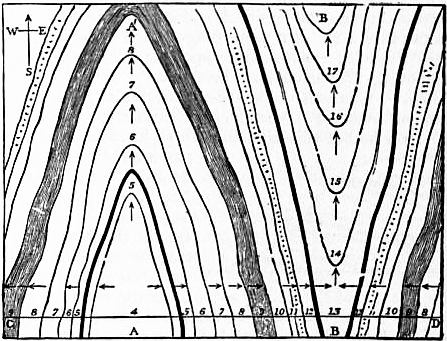
Fig. 2.—Plan of Anticlinal and Synclinal Folds.
It much more frequently happens that the strata have been bent into arches and troughs, so that they can be seen dipping under the surface on one side of the axis of a fold, and rising up again on the other side. Where they dip away from the axis of movement the structure is termed an anticline or anticlinal fold; where they dip towards the axis, it is a syncline or synclinal fold. The diagram in fig. 2 may be taken to represent a series of strata (1-17) thrown into an anticline (AA′) and syncline (BB′). A section drawn across these folds in the line CD would show the structure given in fig. 3. Here we see that, at the part of the anticlinal axis (A) where the section crosses, bed No. 4 forms the crown of the arch, Nos. 1, 2 and 3 being concealed beneath it. On the east side of the axis the strata follow each other in regular succession as far as No. 13, which, instead of passing here under the next in order, turns up with a contrary dip and forms the centre of a trough or syncline (B). From underneath No. 13 on the east side the same beds rise to the surface which passed beneath it on the west side. The particular bed marked EF has been entirely removed by denudation from the top of the anticline, and is buried deep beneath the centre of the syncline.
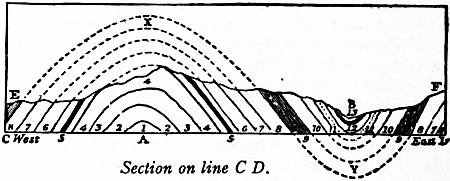
Fig. 3.—Section of Anticlinal and Synclinal Folds on the line CD (fig. 2).
Such foldings of strata must always die out unless they are abruptly terminated by dislocations. In the cases given in fig. 2, both the arch and trough are represented as diminishing, the former towards the north, the latter towards the south. The observer in passing northwards along the axis of that anticline finds himself getting into progressively higher strata as the fold sinks down. On the other hand, in advancing southwards along the synclinal axis, he loses stratum after stratum and gets into lower portions of the series. When a fold diminishes in this way it is said to “nose out.” In fig. 2 there is obviously a general inclination of the beds towards the north, besides the outward dip from the anticline and the inward dip from the syncline. Hence the anticline noses out to the north and the syncline to the south.
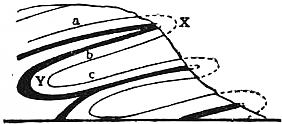
Fig. 4.
Simple Folds.—In describing rock-folds special terms have been assigned to certain portions of the fold; thus, the sloping sides of an anticline or syncline are known as the “limbs,” “slopes,” “flanks” or “members” of the fold; in an anticline, the part X, fig. 3, the angle of the bend, is the “crest” or “crown” (Ger. Gewölbebiegung, Fr. charnière anticlinale), the corresponding part of a syncline being the “trough-core” or “base,” Y, fig. 3 (Ger. Muldenbiegung, Fr. charnière synclinale). The portion of an anticline which has been removed by denudation is the “aerial arch,” dotted in fig. 3. The innermost strata in a fold constitute the “core,” arch-core A, fig. 3, or trough-core B, in the same figure. In the majority of folds the bending of the strata has taken place about an “axial plane” (often called the “axis”), which in the examples illustrated in fig. 3 would pass through the points A and B, perpendicularly to the horizontal line CD. In powerfully folded regions the axial planes of the folds are no longer upright; they may be moderately inclined, producing an “inversion,” “inverted fold” or “overfold.” When the inclination of the axial plane is great a “recumbent overfold” is produced (Fr. pli couché, Ger, liegende Falte). In a fold of this kind (fig. 4) we have an “arch limb” (a), a middle limb (b) and a floor or “trough limb” (c). X and Y are the upper and lower bends respectively. One of the important functions of a fold is its direction; this of course depends upon the orientation of the axial plane. The crest-line of an anticline or trough-line of a syncline is rarely horizontal for any great distance; its departure from horizontality is designated the “pitch,” and the fold is said to pitch (or dip) towards the north, &c. Most simple folds—with the exception of very shallow curvatures of wide area,—when considered in their entirety, are seen to be somewhat canoe-shaped in form. There are three variations of the simple fold dependent upon the position of the limbs, (1) the limbs may tend to diverge as they recede from the crest (fig. 3), sometimes styled an “open anticline”; (2) the limbs may be parallel in “closed” folds (commonly known as isoclinal folding); (3) the limbs may make an open angle or widen out towards the crest (fig. 4). This is known as a fan-shaped fold (Fr. pli en éventail, Ger. Fächerfalte); another variant of the same form is the mushroom fold (Fr. pli en champignon). The axial plane is not always extended: it may be so abbreviated that the folding appears to have taken place about a point; anticlines of this type are variously designated “short-anticlines,” “brachyanticlinaux” or “domes”; similarly, there are “short-synclines,” “brachysynclinaux” or “cuvettes.” The dip in cases of this kind has been described as “qua-qua versal” or “periclinal.”
Complex Folding.—Sometimes a simple fold has been itself subjected to further folding repeated more than once, it is then termed a “refolded fold” (Fr. pli replié); fine examples may be observed in the Alps and in other mountain chains. A great regional major fold containing within itself a number of minor “special” or subsidiary folds is described as a “geanticline” (Fr. structure en éventail composé), or as a “geosyncline” (Fr. structure en éventail renversé). Even folds of lesser magnitude may be highly complex in regions of extreme crustal movement, and may contain smaller folds of the first, second, third or higher order (Fr. couches gaufrées [fig. 5]). In its smaller manifestation, this class of folding passes into “crumpling” or “puckering,” where quite a large number of folds may be crowded into a single hand specimen. In “frilling” or “frilled structure” the folds have still smaller amplitude, and in many highly corrugated rocks minute folds are observable with the microscope that do not appear to the unaided eye. When a series of adjacent isoclinal overfolds has passed into a series of thrusts (see Fault), the so-called “imbricated” structure (Fr. structure imbriquée, Ger. Schuppenstruktur) is generated. Occasionally crust-blocks resembling “graben” and “horsts” are circumscribed by folds instead of faults; when this is so they have been called respectively “infolded graben” or “overfolded horsts.”
The heterogeneous character of great masses of strata has always had a marked influence on the nature of the folding; some beds have yielded much more readily than others, certain beds will be found to be faulted, while those above and below have folded without fracture. In many examples of apparent plasticity it can be shown that this effect has been produced by an infinite number of minute slippings within the rock substance.
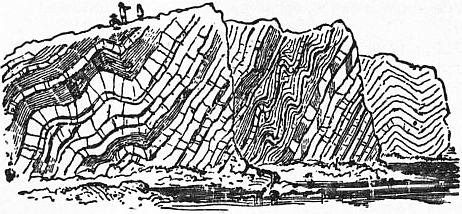
Fig. 5.—Curved and Contorted Rocks, near Old Head of Kinsale. (Du Noyer.)
The larger rock folds have produced important economic results. For example, in many coal regions the deposits have been conserved in some districts in the synclines or “basins,” while they have been removed by denudation from the uplifted anticlines in others. Near the crest of anticlines is commonly an enriched portion of the ground in mineralized districts; and, in the case of water supply, the tilt of the strata determines the direction of the underground flowage. Again, the most convenient site for oil wells is the crest of an anticline or “dome,” where an impervious stratum imprisons the gas and oil in a subjacent saturated layer under pressure.
For a discussion of the question of the distribution and arrangement of the great folded regions of the earth’s crust, see E. Suess, Das Antlitz der Erde, English translation. The Face of the Earth, vols. i., ii., iii., iv. (Oxford). See also E. de Margerie and A. Heim, Les Dislocations de l’écorce terrestre (Zurich, 1888); A. Rothpletz, Geotektonische Probleme (Stuttgart, 1894).
FOLENGO, TEOFILO (1491-1544), otherwise known as Merlino Coccajo or Cocajo, one of the principal Italian macaronic poets, was born of noble parentage at Cipada near Mantua on the 8th of November 1491, From his infancy he showed great vivacity of mind, and a remarkable cleverness in making verses. At the age of sixteen he entered the monastery of Monte Casino near Brescia, and eighteen months afterwards he became a professed member of the Benedictine order. For a few years his life as a monk seems to have been tolerably regular, and he is said to have produced a considerable quantity of Latin verse, written, not unsuccessfully, in the Virgilian style. About the year 1516 he forsook the monastic life for the society of a well-born young woman named Girolama Dieda, with whom he wandered about the country for several years, often suffering great poverty, having no other means of support than his talent for versification. His first publication was the Merlini Cocaii macaronicon, which relates the adventures of a fictitious hero named Baldus. The coarse buffoonery of this work is often relieved by touches of genuine poetry, as well as by graphic descriptions and acute criticisms of men and manners. Its macaronic style is rendered peculiarly perplexing to the foreigner by the frequent introduction of words and phrases from the Mantuan patois. Though frequently censured for its occasional grossness of idea and expression, it soon attained a wide popularity, and within a very few years passed through several editions. Folengo’s next production was the Orlandino, an Italian poem of eight cantos, written in rhymed octaves. It appeared in 1526, and bore on the title-page the new pseudonym of Limerno Pitocco (Merlin the Beggar) da Mantova. In the same year, wearied with a life of dissipation, Folengo returned to his ecclesiastical obedience; and shortly afterwards wrote his Chaos del tri per uno, in which, partly in prose, partly in verse, sometimes in Latin, sometimes in Italian, and sometimes in macaronic, he gives a veiled account of the vicissitudes of the life he had lived under his various names, We next find him about the year 1533 writing in rhymed octaves a life of Christ entitled L’Umanità del Figliuolo di Dio; and he is known to have composed, still later, another religious poem upon the creation, fall and restoration of man, besides a few tragedies. These, however, have never been published. Some of his later years were spent in Sicily under the patronage of Don Fernando de Gonzaga, the viceroy; he even appears for a short time to have had charge of a monastery there. In 1543 he retired to Santa Croce de Campesio, near Bassano; and there he died on the 9th of December 1544.
Folengo is frequently quoted and still more frequently copied by Rabelais. The earlier editions of his Opus macaronicum are now extremely rare. The often reprinted edition of 1530 exhibits the text as revised by the author after he had begun to amend his life.
FOLEY, JOHN HENRY (1818-1874), Irish sculptor, was born at Dublin on the 24th of May 1818. At thirteen he began to study drawing and modelling at the schools of the Royal Dublin Society, where he took several first-class prizes. In 1835 he was admitted a student in the schools of the Royal Academy, London. He first appeared as an exhibitor in 1839 with his “Death of Abel and Innocence.” “Ino and Bacchus,” exhibited in 1840, gave him immediate reputation, and the work itself was afterwards commissioned to be done in marble for the earl of Ellesmere. “Lear and Cordelia” and “Death of Lear” were exhibited in 1841. “Venus rescuing Aeneas” and “The Houseless Wanderer” in 1842, “Prospero and Miranda” in 1843. In 1844 Foley sent to the exhibition at Westminster Hall his “Youth at a Stream,” and was, with Calder Marshall and John Bell, chosen by the commissioners to do work in sculpture for the decoration of the Houses of Parliament. Statues of John Hampden and Selden were executed for this purpose, and received liberal praise for the propriety, dignity and proportion of their treatment. Commissions of all kinds now began to come rapidly. Fanciful works, busts, bas-reliefs, tablets and monumental statues were in great numbers undertaken and executed by him with a steady equality of worthy treatment. In 1849 he was made an associate and in 1858 a member of the Royal Academy. Among his numerous works the following may be noticed, besides those mentioned above:—“The Mother”; “Egeria,” for the Mansion House; “The Elder Brother in Comus,” his diploma work; “The Muse of Painting,” the monument of James Ward, R.A.; “Caractacus,” for the Mansion House; “Helen Faucit”; “Goldsmith” and “Burke,” for Trinity College, Dublin; “Faraday”; “Reynolds”; “Barry,” for Westminster Palace Yard; “John Stuart Mill,” for the Thames embankment; “O’Connell” and “Cough,” for Dublin; “Clyde,” for Glasgow; “Clive,” for Shrewsbury; “Hardinge,” “Canning” and “Outram,” for Calcutta; “Hon. James Stewart,” for Ceylon; the symbolical group “Asia,” as well as the statue of the prince himself, for the Albert Memorial in Hyde Park; and “Stonewall Jackson,” in Richmond, Va. The statue of Sir James Outram is probably his masterpiece. Foley’s early fanciful works have some charming qualities; but he will probably always be best remembered for the workmanlike and manly style of his monumental portraits. He died at Hampstead on the 27th of August 1874, and on the 4th of September was buried in St Paul’s cathedral. He left his models to the Royal Dublin Society, his early school, and a great part of his property to the Artists’ Benevolent Fund.
See W. Cosmo Monkhouse, The Works of J.H. Foley (1875).
FOLEY, SIR THOMAS (1757-1833), British admiral, entered the navy in 1770, and, during his time as midshipman, saw a good deal of active service in the West Indies against American privateers. Promoted lieutenant in 1778, he served under Admiral (afterwards Viscount) Keppel and Sir Charles Hardy in the Channel, and with Rodney’s squadron was present at the defeat of De Lángara off Cape St Vincent in 1780, and at the relief of Gibraltar. Still under Rodney’s command, he went out to the West Indies, and took his part in the operations which culminated in the victory of the 12th of April 1782. In the Revolutionary War he was engaged from the first. As flag-captain to Admiral John Gell, and afterwards to Sir Hyde Parker, Foley took part in the siege of Toulon in 1793, the action of Golfe Jouan in 1794, and the two fights off Toulon on the 13th of April and the 13th of July 1795. At St Vincent he was flag-captain to the second in command, and in the following year was sent out in command of the “Goliath” (74), to reinforce Nelson’s fleet in the Mediterranean. The part played by the “Goliath” in the battle of the Nile was brilliant. She led the squadron round the French van, and this manœuvre contributed not a little to the result of the day. Whether this was done by Foley’s own initiative, or intended by Nelson, has been a matter of controversy (see Journal of the Royal United Service Institution, 1885, p. 916). His next important service was with Nelson in the Baltic. The “Elephant” carried Nelson’s flag at the battle of Copenhagen, and her captain acted as his chief-of-staff. Ill-health obliged Foley to decline Nelson’s offer (made when on the point of starting for the battle of Trafalgar) of the post of Captain of the Fleet. From 1808 to 1815 he commanded in the Downs and at the peace was made K.C.B. Sir Thomas Foley rose to be full admiral and G.C.B. He died while commanding in chief at Portsmouth in 1833.
See J.B. Herbert, Life and Services of Sir Thomas Foley (Cardiff, 1884).
FOLI (Foley), ALLAN JAMES (1837-1899), Irish bass singer, was born at Cahir, Tipperary, on the 7th of August 1837; originally a carpenter, he studied under Bisaccia at Naples, and made his first appearance at Catania in 1862. From the opera in Paris he was engaged by Mapleson for the season of 1865, and appeared with much success in various parts. He sang in the first performance of The Flying Dutchman (Daland) in England in 1870, and in the first performance of Gounod’s Redemption in 1882. He was distinguished in opera and oratorio alike for his vigorous, straightforward way of singing, and was in great request at ballad concerts. He died on the 20th of October 1899.
FOLIGNO (anc. Fulginiae, q.v.), a town and episcopal see of Umbria, Italy, 771 ft. above sea-level, in the province of Perugia, from which it is 25 m. S.E. by rail. Pop. (1901) 9532 (town), 26,278 (commune). It lies in a fertile plain, on the Topino, a tributary of the Tiber; it is almost square in shape and is surrounded by walls. It is a picturesque and interesting town; several of its churches contain paintings by Umbrian masters, notably works by Niccolò di Liberatore (or Niccolò Alunno, 1430-1502), and among them his chief work, a large altar-piece (the predella of which is in the Louvre) in S. Niccolò. The cathedral has a romanesque S. façade of 1133, restored in 1903; the interior was modernized in the 18th century. To the left of the choir is an octagonal chapel by Antonio da Sangallo the younger (1527). In the same piazza as the S. façade is the Palazzo del Governo, erected in 1350, which has a chapel with frescoes by Ottaviano Nelli of Gubbio (1424). S. Maria infra Portas is said to date from the 7th century, but from this period only the columns of the portico remain. Raphael’s “Madonna di Foligno,” now in the Vatican, was originally painted for the church of S. Anna. The Palazzo Orfini and the Palazzo Deli are two good Renaissance buildings.
Foligno seems to have been founded about the middle of the 8th century A.D. It changed hands often during the wars of the 13th century, and was destroyed by Perugia in 1281. From 1305 to 1439 it was governed by the family of the Trinci as deputies of the Holy See, until in the latter year one of its members went against the church. Pope Eugene IV. sent a force against Foligno, to which the inhabitants opened their gates, and the last of the Trinci, Corrado II., was beheaded. Henceforth Foligno belonged to the states of the church until 1860. It suffered from a severe earthquake in 1832. Foligno is a station on the main line from Rome (via Orte) to Ancona, and is the junction for Perugia. Three miles to the E. is the abbey of Sassovivo with cloisters of 1229, very like those of S. Paolo fuori le Mura at Rome, with pairs of small columns supporting arches, and decorations in coloured mosaic (“Cosmatesque” work). The church has been modernized.
FOLIO (properly the ablative case of the Lat. folium, leaf, but also frequently an adaptation of the Ital. foglio), a term in bibliography and printing, with reference either to the size of paper employed, or of the book, or to the pagination. In the phrase “in folio” it means a sheet of paper folded once, and thus a book bound up in sheets thus folded is a book of the largest size and is known as a “folio” (see Bibliography). Similarly, “folio” is one of the sizes of paper adapted to be thus folded (see Paper). In book-keeping the word is used for a page in a ledger on which the credit and debtor account is written; in law-writing, for a fixed number of words in a legal document, used for measurement of the length and for the addition of costs. In Great Britain, a “folio” is taken to contain 72 words, except in parliamentary and chancery documents, when the number is 90. In the U.S.A. 100 words form a “folio.”
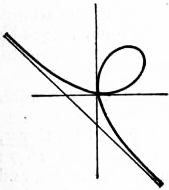
FOLIUM, in mathematics, a curve invented and discussed by René Descartes. Its cartesian equation is x³ + y³ = 3axy. The curve is symmetrical about the line x = y, and consists of two infinite branches asymptotic to the line x + y + a = o and a loop in the first quadrant. It may be traced by giving m various values in the equations x = 3am / (1 + m³), y = 3am² (1 + m³), since by eliminating m between these relations the equation to the curve is obtained. Hence it is unicursal (see Curve). The area of the loop, which equals the area between the curve and its asymptote, is 3a/2.
FOLKES, MARTIN (1690-1754), English antiquary, was born in London on the 29th of October 1690. He was educated at Saumur University and Clare College, Cambridge, where he so distinguished himself in mathematics that when only twenty-three years of age he was chosen a fellow of the Royal Society. He was elected one of the council in 1716, and in 1723 Sir Isaac Newton, president of the society, appointed him one of the vice-presidents. On the death of Newton he became a candidate for the presidency, but was defeated by Sir Hans Sloane, whom, however, he succeeded in 1741; in 1742 he was made a member of the French Academy; in 1746 he received honorary degrees from Oxford and Cambridge. In 1733 he set out on a tour through Italy, in the course of which he composed his Dissertations on the Weights and Values of Ancient Coins. Before the Society of Antiquaries, of which he was president from 1749 to 1754, he read in 1736 his Observations on the Trajan and Antonine Pillars at Rome and his Table of English Gold Coins from the 18th Year of King Edward III. In 1745 he printed the latter with another on the history of silver coinage. He also contributed both to the Society of Antiquaries and to the Royal Society other papers, chiefly on Roman antiquities. He married in 1714 Lucretia Bradshaw, an actress who had appeared at the Haymarket and Drury Lane (see Nichols’s Lit. Anecdot. ii. 578-598).
For Sir John Hill’s attack on Folkes (Review of the Works of the Royal Soc., 1751), see D’Israeli, Calamities and Quarrels of Authors (1860), pp. 364-366.
FOLKESTONE, a municipal borough, seaport and watering-place of Kent, England, within the parliamentary borough of Hythe, 71 m. S.E. by E. of London by the South-Eastern & Chatham railway. Pop. (1891) 23,905; (1901) 30,650. This is one of the principal ports in cross-Channel communications, the steamers serving Boulogne, 30 m. distant. The older part of Folkestone lies in a small valley which here opens upon the shore between steep hills. The more modern portions extend up the hills on either hand. To the north the town is sheltered by hills rising sharply to heights of 400 to 500 ft., on several of which, such as Sugarloaf and Castle Hills, are ancient earthworks. Above the cliff west of the old town is a broad promenade called the Lees, commanding a notable view of the channel and connected by lifts with the shore below. On this cliff also stands the parish church of St Mary and St Eanswith, a cruciform building of much interest, with central tower. It is mainly Early English, but the original church, attached to a Benedictine priory, was founded in 1095 on the site of a convent established by Eanswith, daughter of Eadbald, king of Kent in 630. The site of this foundation, however, became endangered by encroachments of the sea. The monastery was destroyed at the dissolution of religious houses by Henry VIII. Folkestone inner harbour is dry at low water, but there is a deep water pier for use at low tide by the Channel steamers, by which not only the passenger traffic, but also a large general trade are carried on. The fisheries are important. Among institutions may be mentioned the grammar school, founded in 1674, the public library and museum, and a number of hospitals and sanatoria. The discontinued Harveian Institution for young men was named after William Harvey, discoverer of the circulation of the blood, a native of Folkestone (1578), who is also commemorated by a tercentenary memorial on the Lees. Folkestone is a member of the Cinque Port of Dover. It is governed by a mayor, 7 aldermen and 21 councillors. Area, 2522 acres. To the west of Folkestone, close to Shorncliffe camp, is the populous suburb of Cheriton (an urban district, pop. 7091).
Folkestone (Folcestan) was among the possessions of Earl Godwine and was called upon to supply him with ships when he was exiled from England; at the time of the Domesday Survey it belonged to Odo, bishop of Bayeux. From early times it was a member of the Cinque Port of Dover, and had to find one out of the twenty-one ships furnished by that port for the royal service. It shared the privileges of the Cinque Ports, whose liberties were exemplified at the request of the barons of Folkestone by Edward III. in 1330. The corporation, which was prescriptive, was entitled the mayor, jurats and commonalty of Folkestone. The history of Folkestone is a record of its struggle against the sea, which was constantly encroaching upon the town. In 1629 the inhabitants, impoverished by their losses, obtained licence to erect a port. By the end of the 18th century the town had become prosperous by the increase of its fishing and shipping trades, and by the middle of the 19th century one of the chief health and pleasure resorts of the south coast.
FOLKLAND (folcland). This term occurs three times in Anglo-Saxon documents. In a law of Edward the Elder (c. i. 2) it is contrasted with bookland in a way which shows that these two kinds of tenure formed the two main subdivisions of landownership: no one is to deny right to another in respect of folkland or bookland. By a charter of 863 (Cod. Dipl. 281), King Æthelberht exchanges five hides of folkland for five hides of bookland which had formerly belonged to a thane, granting the latter for the newly-acquired estates exemption from all fiscal exactions except the threefold public obligation of attending the fyrd and joining in the repair of fortresses and bridges. Evidently folkland was not free from the payment of gafål (land tax) and providing quarters for the king’s men. In ealdorman Alfred’s will the testator disposes freely of his bookland estates in favour of his sons and his daughter, but to a son who is not considered as rightful offspring five hides of folkland are left, provided the king consents. It is probable that folkland is meant in two or three cases when Latin documents speak of terra rei publicae jure possessa.
Two principal explanations have been given to this term. Allen thought that folkland was similar to the Roman ager publicus: it was the common property of the nation (folc), and the king had to dispose of it by carving out dependent tenures for his followers more or less after the fashion of continental beneficia. These estates remained subject to the superior ownership of the folk and of the king: they could eventually be taken back by the latter and, in any case, the heir of a holder of folkland had to be confirmed in possession by the king. A letter of Bede to the archbishop Ecgbert of York may be interpreted to apply to this kind of tenure. Kemble, K. Maurer, H.C. Lodge, Stubbs and others followed Allen’s lead.
Another theory was started by Professor Vinogradoff in an article on folkland in the English Hist. Review for 1893. It considers folkland as landownership by folkright—at common law, as might be said in modern legal speech. In opposition to it bookland appears as landownership derived from royal privilege. The incidents recorded in the charters characterize folkland as subject to ordinary fiscal burdens and to limitations in respect of testamentary succession. Thane Wallaf has to be relieved from fiscal exactions when his estate is converted from folkland into bookland (C.D. 281). Ealdorman Alfred’s son, not being recognized as legitimate, has to claim folkland not by direct succession or devise, but by the consent of the king. These incidents and limitations are thrown into relief by copious illustrations as to the fundamental features of bookland contained in the numberless “books.” These are exemptions from fiscal dues and freedom of disposition of the owner. This view of the matter has been accepted by the chief modern authorities.
Bibliography.—J. Allen, Inquiry into the Rise and Growth of Royal Prerogative in England (London, 1849); K. Maurer, Kritische Überschau (1853), Band i. 102 ff.; F.W. Maitland, Domesday Book and Beyond, 244 ff. (Cambridge, 1897); P. Vinogradoff, “Folcland,” in the Eng. Hist. Rev. (1893), p. 1 ff.; Sir F. Pollock, Land Laws (London, 1896); H. Brunner, Deutsche Rechtsgeschichte, Band i. (2nd ed., 293, Leipzig, 1887-1892).
(P. Vi.)
FOLKLORE, a term invented in 1846 by Mr W.J. Thoms as a designation for the traditional learning of the uncultured classes of civilized nations. The word has been adopted in this sense into many foreign languages; it is sometimes regarded as the equivalent of the Ger. Volkskunde. But folklore is, properly speaking, the “lore of the folk,” while Volkskunde is lore or learning about the folk, and includes not only the mental life of a people, but also their arts and crafts. The term folklore is also used to designate the science which deals with folklore; the study of survivals involves the investigation of the similar customs, beliefs, &c., of races on lower planes of culture; consequently folklore, as interpreted by the English and American societies, concerns itself as much or more with savage races as with the popular superstitions of the white races.
History.—The scientific study of folklore dates back to the first quarter of the 19th century, but folklore was collected long before that date. The organized study of folklore is a thing of recent growth. The first Folklore Society was founded in London in 1878; similar bodies now exist in the United States, France, Italy, Switzerland and especially in Germany and Austria. The folk-tale makes its appearance in literature at a very early period; Egyptian examples have come down to us from the 28th century B.C. In Greece the Homeric poems contain many folk-tale incidents; for India we have the Jatakas and Panchatantra; and for the Arabs the great collection of the Thousand and One Nights. Another type of folk-narrative is represented by Aesop’s Fables. Not unnaturally beliefs and customs received less attention; our knowledge of them among the ancients is as a rule pieced together. Among the oldest professed collections are J.B. Thiers (1606-1703), Traité des superstitions (1679), Aubrey’s Miscellanies (1686) and H. Bourne’s (1696-1733) Antiquitates vulgares (1725); but they belong to the antiquarian, non-scientific period.
The pioneers of the modern scientific treatment of folklore were the brothers Grimm, by the publication of their Kinder-und Hausmärchen (1812-1815) and Deutsche Mythologie (1835). They were the first to present the folk-tale in its genuine unadulterated form. They differed from their predecessors in regarding the myth, not as the result of conscious speculation, but of a mythopoeic impulse. They were, however, disposed to press modern linguistic evidence too far and make the figures of the folk-tale the lineal representatives of ancient gods, as the folk-tales themselves were of the myths. This tendency was exaggerated by their successors, J.W. Wolf, W. Rochholz and others. At the outset of his career, W. Mannhardt (1831-1880), the forerunner of the anthropological school of folklore, shared in this mistake. Breaking away eventually from the philological schools, which interpreted myths and their supposed descendants, the folk-tales, as relating to the storm, the sun, the dawn, &c. (see Mythology), Mannhardt made folk-custom and belief his basis. To this end he set himself to collect and compare the superstitions of the peasantry; but his health was always feeble and he never completed his scheme. For a time Mannhardt’s researches bore fruit neither in his own country nor abroad. In 1878 the foundation of the Folklore Society marked a new era in England, where the philological school had had few adherents; and the anthropological school soon produced evidence of its vitality in the works of Mr Andrew Lang, Dr J.G. Frazer and Professor Robertson Smith.
With the growth of our knowledge of European folk-custom and belief on the one hand, and of rites and religions of people in the lower stages of culture on the other hand, it has become abundantly clear that there is no line of demarcation between the two. Each throws light upon the other, and the superstitions of Europe are the lineal descendants of savage creeds which have their parallels all over the world in the culture of primitive peoples.
Subdivisions.—The folklore of civilized peoples may be conveniently classified under three main heads: (1) belief and custom; (2) narratives and sayings; (3) art. These again may be subdivided. The first division, Belief and Custom, includes (A) Superstitious beliefs and practices, including (a) those connected with natural phenomena or inanimate nature, (b) tree and plant superstitions, (c) animal superstitions, (d) ghosts and goblins, (e) witchcraft, (f) leechcraft, (g) magic in general and divination, (h) eschatology, and (i) miscellaneous superstitions and practices; and (B) Traditional customs, including (a) festival customs for which are set aside certain days and seasons, (b) ceremonial customs on the occasion of events such as birth, death or marriage, (c) games, (d) miscellaneous local customs, such as agricultural rites connected with the corn-spirit (see Demonology), and (e) dances. The second head of Narratives and Sayings may be subdivided (A) into (a) sagas or tales told as true, (b) Märchen or nursery tales, (c) fables, (d) drolls, apologues, cumulative tales, &c., (e) myths (see Mythology), and (f) place legends; (B) into ballads and songs (in so far as they do not come under art); and (C) into nursery rhymes, riddles, jingles, proverbs, nicknames, place rhymes, &c. The third head, Art, subdivides into (a) folk music with ballads and songs, (b) folk drama. Any classification, however, labours under the disadvantage of separating items which properly belong together. Thus, myths are obviously the form in which some superstitions are expressed. They may also be aetiological in their nature and form an elaborate record of a custom. Eschatological beliefs naturally take the form of myths. Traditional narratives can also be classified under art, and so on.
Literature.—The literature of the subject falls into two sharply defined classes—synthetic works and collections of folklore—of which the latter are immensely more numerous. Of the former class the most important is Dr J.G. Frazer’s Golden Bough, which sets out from the study of a survival in Roman religion and covers a wide field of savage and civilized beliefs and customs. Especially important are the chapters on agricultural rites, in which are set forth the results of Mannhardt’s researches. Other important lines of folklore research in the Golden Bough are those dealing with spring ceremonies, with the primitive view of the soul, with animal cults, and with sun and rain charms. Mr E.S. Hartland’s Legend of Perseus is primarily concerned with the origin of a folk-tale, and this problem in the end is dismissed as insoluble. A large part of the book is taken up with a discussion of sympathetic magic, and especially with the “life index,” an object so bound up with the life of a human being that it acts as an indication of his well-being or otherwise. The importance of children’s games in the study of folklore has been recognized of recent years. An admirable collection of the games of England has been published by Mrs G.L. Gomme. With the more minute study of uncivilized peoples the problem of the diffusion of games has also come to the fore. In particular it is found that the string-game called “cat’s cradle” in various forms is of very wide diffusion, being found even in Australia. The question of folk-music has recently received much attention (see Song).
Bibliography.—Introductory works: M.R. Cox, Introduction to Folklore; Kaindl, Die Volkskunde; Marillier in Revue de l’histoire des religions, xliii. 166, and other works mentioned by Kaindl.
General works: J.G. Frazer, The Golden Bough; E.S. Hartland, The Legend of Perseus; A. Lang, Custom, and Myth, Myth, Ritual and Religion; Tylor, Primitive Culture; Liebrecht, Zur Volkskunde.
British Isles. England: Burne, Shropshire Folklore; Denham Tracts (F.L.S.); Harland and Wilkinson, Lancashire Folklore; Henderson, Folklore of Northern Counties; County Folklore Series (Printed Extracts) of the F.L.S. Wales: Elias Owen, Welsh Folklore; Rhys, Celtic Folklore. Scotland: Dalyell, Darker Superstitions; Gregor, Folklore of N.E. of Scotland; the works of J.G. Campbell, &c.
Germany: Grimm, Deutsche Mythologie, English translation by Stallybrass; Wuttke, Der deutsche Volksaberglaube; Meyer, Deutsche Volkskunde; Tetzner, Die Slaven in Deutschland; Mogk in Paul’s Grundriss der germanischen Philologie, and the works cited by Kaindl (see above).
France: Sebillot’s works; Rolland, Faune populaire; Laisnel de la Salle, Croyances et légendes.
On the Slavs see the works of Krauss and v. Wlislochi; for Bohemia, Grohmann, Aberglaube; for Greece, Abbott, Macedonian Folklore, and Rennell Rodd, Folklore of Greece; for Italy, Pitré’s bibliography; for India, Crooke’s works, and the Indian Antiquary. For questionnaires see Handbook of Folklore (Folklore Soc.); Sebillot, Essai de questionnaires; Journal of American Folklore (1890, &c.); and Kaindl’s Volkskunde. For a bibliography of folk-tales see Hartland, Mythology and Folk-tales; to his list may be added Petitot’s Légendes indiennes; Rand, Legends of the Micmacs; Lummis, The Man who Married the Moon; and the publications of the American Folklore Society. For other works see bibliographies in Folklore and other periodicals. On special points may be mentioned Miss Cox’s Cinderella (Folklore Society); Kohler’s works, &c. (see also bibliography to the article Tale). For games see Gomme, English Games; Culin, Korean Games; Rochholz, Alemannisches Kinderlied; Böhme, Deutsches Kinderlied; Handelmann, Volks- und Kinderspiele; Jayne, String Figures, &c.; and the bibliography to Doll. See also Sonnenschein’s Best Books.
The following is a list of the more important Societies and publications:—
England: Folklore Society; Folksong Society; Gipsy-lore Society.
U.S.A.: American Folklore Society.
France: Société des traditions populaires.
Germany: Verein für Volkskunde; Hessische Vereinigung für Volkskunde; and minor societies in Saxony, Silesia and other provinces.
Austria: Verein für österreichische Volkskunde.
Switzerland: Schweizerische Gesellschaft für Volkskunde.
Italy: Società per lo studio delle tradizioni popolari.
In addition to these, the anthropological societies devote more or less attention to folklore. Besides the publications of the societies mentioned above, minor societies or individuals are responsible for the following among others: Belgium, Wallonia; Poland, Wisla; France, Melusine (1878, 1883-1901); Bohemia, Cesky Lid; Denmark, Dania, &c.; Germany, Zeitschrift für Völkerpsychologie (1859-1890); Am Urguell (1890-1898).
(N. W. T.)
FOLLEN, AUGUST (or, as he afterwards called himself, Adolf) LUDWIG (1794-1855), German poet, was born at Giessen on the 21st of January 1794, the son of a district judge. He studied theology at Giessen and law at Heidelberg, and after leaving the university edited the Elberfeld Allgemeine Zeitung. Suspected of being connected with some radical plots, he was imprisoned for two years in Berlin. When released in 1821 he went to Switzerland, where he taught in the canton school at Aarau, farmed from 1847-1854 the estate of Liebenfels in Thurgau, and then retired to Bern, where he lived till his death on the 26th of December 1855. Besides a number of minor poems he wrote Harfengrüsse aus Deutschland und der Schweiz (1823) and Malegys und Vivian (1829), a knightly romance after the fashion of the romantic school. Of his many translations, mention may be made of the Homeric Hymns in collaboration with R. Schwenck (1814), Tasso’s Jerusalem Delivered (1818) and Siegfrieds Tod from the Nibelungenlied (1842); he also collected and translated Latin hymns and sacred poetry (1819). In 1846 he published a brief collection of sonnets entitled An die gottlosen Nichtswüteriche. This was aimed at the liberal philosopher Arnold Ruge, and was the occasion of a literary duel between the two authors. Follen’s posthumous poem Tristans Eltern (1857) may also be mentioned, but his best-known work is a collection of German poetry entitled Bildersaal deutscher Dichtung (1827).
FOLLEN, KARL (1795-1840), German poet and patriot, brother of A.L. Follen, was born at Romrod in Hesse-Darmstadt, on the 5th of September 1795. He first studied theology at Giessen, but after the campaign of 1814, in which, like his brother August, he took part as a Hessian volunteer, began the study of jurisprudence, and in 1818 established himself as Privatdocent of civil law at Giessen. Owing to being suspected of political intrigues, he removed to Jena, and thence, after the assassination of Kotzebue, fled to France. Here again the political murder of the duc de Berry, on the 14th of January 1820, led to Follen being regarded as a suspect, and he accordingly took refuge in Switzerland, where he taught for a while at the cantonal school at Coire and at the university of Basel; but the Prussian authorities imperatively demanding his surrender, he sought in 1824 the hospitality of the United States of America. Here he became an instructor in German at Harvard in 1825, and in 1830 obtained an appointment as professor of German language and literature there; but his anti-slavery agitation having given umbrage to the authorities, he forfeited his post in 1835, and was ordained Unitarian minister of a chapel at Lexington in Massachusetts in 1836. He perished at sea on board a steamboat which was totally consumed by fire while on a voyage from New York to Boston, on the night of the 13th-14th of January 1840. Follen was the author of several celebrated patriotic songs written in the interests of liberty. The best is perhaps Horch auf, ihr Fürsten! Du Volk, horch auf! of which Johannes Wit, called von Dörring (1800-1863), was long, though erroneously, considered the author. It was published in A.L. Follen’s collection of patriotic songs, Freie Stimmen frischer Jugend.
His wife Elisa Lee (1787-1860), an American authoress of some reputation, published after his death his lectures and sermons, with a biography written by herself (5 vols., Boston, 1846).
FOLLETT, SIR WILLIAM WEBB (1798-1845), English lawyer, was born at Topsham in Devonshire on the 2nd of December 1798. He was the son of Captain Benjamin Follett, who had retired from the army in 1790, and engaged in business at Topsham. He received his education at Exeter grammar school and Trinity College, Cambridge, graduating in 1818. He had entered the Inner Temple in 1816 and began to practise as a pleader below the bar in 1821, but was called to the bar in 1824, and joined the western circuit in 1825. At the very outset his great qualifications were universally recognized. He was thoroughly master of his profession, and his rapid rise in it was due not only to his quick perception and sound judgment, but to his singular courtesy, kindness and sweetness of temper. In 1830 he married the eldest daughter of Sir Ambrose Harding Gifford, chief justice of Ceylon. In 1835 he was returned to parliament for Exeter. In parliament he early distinguished himself, and under the first administration of Sir Robert Peel was appointed solicitor-general (November 1834); but resigned with the ministry in April 1835. In the course of this year he was knighted. On the return of Peel to power in 1841 Sir William was again appointed solicitor-general, and in April 1844 he succeeded Sir Frederick Pollock as attorney-general. But his health, which had begun to fail him in 1838, and had been permanently injured by a severe illness in 1841, now broke down, and he was compelled to relinquish practice and to visit the south of Europe. He returned to England in March 1845; but the disease, consumption, reasserted itself, and he died in London on the 28th of June following. A statue of Follett, executed by Behnes, was erected by subscription in Westminster Abbey.
FONBLANQUE, ALBANY WILLIAM (1793-1872), English journalist, descended from a noble French Huguenot family, the Greniers of Languedoc, was born in London in 1793. John Grenier, a banker, became naturalized in England under the name of Fonblanque; and his son John Samuel Martin Fonblanque (1760-1838), a distinguished equity lawyer, and the author of a standard legal work, a Treatise on Equity, was the father of Albany Fonblanque; he represented the borough of Camelford in parliament; and was one of the Whig friends of George IV. when prince of Wales. At fourteen young Fonblanque was sent to Woolwich to prepare for the Royal Engineers. His health, however, failed, and for two years his studies had to be suspended. Upon his recovery he studied for some time with a view to being called to the bar. At the age of nineteen (1812) he commenced writing for the newspapers, and very soon attracted notice both by the boldness and liberality of his opinions, and by the superiority of his style to what Macaulay, when speaking of him, justly called the “rant and twaddle of the daily and weekly press” of the time. While he was eagerly taking his share in all the political struggles of this eventful period, he was also continuing his studies, devoting no less than six hours a day to the study of classics and political philosophy. Under this severe mental training his health once more broke down. His energy, however, was not impaired. He became a regular contributor to the newspapers and reviews, realizing a fair income which, as his habits were simple and temperate, secured him against pecuniary anxieties.
From 1820 to 1830 Albany Fonblanque was successively employed upon the staff of The Times and the Morning Chronicle, whilst he contributed to the Examiner, to the London Magazine and to the Westminster Review. In 1828 the Examiner newspaper, which had been purchased by the Rev. Dr Fellowes, author of the Religion of the Universe, &c., was given over to Fonblanque’s complete control; and for a period of seventeen years (1830 to 1847) he not only sustained the high character for political independence and literary ability which the Examiner had gained under the direction of Leigh Hunt and his brother, John Hunt, but even compelled his political opponents to acknowledge a certain delight in the boldness and brightness of the wit directed against themselves. When it was proposed that the admirers and supporters of the paper should facilitate a reduction in its price by the payment of their subscription ten years in advance, not only did Mr Edward Bulwer (Lord Lytton) volunteer his aid, but also Mr Disraeli, who was then coquetting with radicalism. During his connexion with the Examiner, Fonblanque had many advantageous offers of further literary employment; but he devoted his energies and talents almost exclusively to the service of the paper he had resolved to make a standard of literary excellence in the world of journalism. Fonblanque was offered the governorship of Nova Scotia; but although he took great interest in colonial matters, and had used every effort to advocate the more generous political system which had colonial self-government for its goal, he decided not to abandon his beloved Examiner even for so sympathetic an employment. In 1847, however, domestic reasons induced him to accept the post of statistical secretary of the Board of Trade. This of course compelled him to resign the editorship of the Examiner, but he still continued to contribute largely to the paper, which, under the control of John Forster, continued to sustain its influential position. During the later years of his life Fonblanque took no prominent part in public affairs; and when he died at the age of seventy-nine (1872) he seemed, as his nephew, Edward Fonblanque, rightly observes, “a man who had lived and toiled in an age gone by and in a cause long since established.”
The character of Albany Fonblanque’s political activity may be judged of by a study of his England under Seven Administrations (1837), in comparison with the course of social and political events in England from 1826 to 1837. As a journalist, he must be regarded in the light of a reformer. Journalism before his day was regarded as a somewhat discreditable profession; men of true culture were shy of entering the hot and dusty arena lest they should be confounded with the ruder combatants who fought there before the public for hire. But the fact that Fonblanque, a man not only of strong and earnest political convictions but also of exceptional literary ability, did not hesitate to choose this field as a worthy one in which both a politician and a man of letters might usefully as well as honourably put forth his best gifts, must have helped, in no small degree, to correct the old prejudice.
See the Life and Labours of Albany Fonblanque, edited by his nephew, Edward Barrington de Fonblanque (London, 1874); a collection of his articles with a brief biographical notice.
FOND DU LAC, a city and the county-seat of Fond du Lac county, Wisconsin, U.S.A., about 60 m. N. of Milwaukee, at the S. end of Lake Winnebago, and at the mouth of the Fond du Lac river, which is navigable for only a short distance. Pop. (1890) 12,024; (1900) 15,110, of whom 2952 were foreign-born; (1910) 18,797. The city is a railway centre of some importance, and is served by the Chicago, Milwaukee & St Paul, the Minneapolis, St Paul & Sault St Marie, and the Chicago & North-Western railways, by interurban electric lines, and by steamboat lines connecting through the Fox river with vessels on the Great Lakes. At North Fond du Lac, just beyond the city limits, are car-shops of the two last-mentioned railways, and in the city are manufactories of machinery, automobiles, wagons and carriages, awnings, leather, beer, flour, refrigerators, agricultural implements, toys and furniture. The total value of the city’s factory products in 1905 was $5,599,606, an increase of 95.7% since 1900. The city has a Protestant Episcopal cathedral, the Grafton Hall school for girls, and St Agnes hospital and convent, and a public library with about 25,000 volumes in 1908. The first settlers on the site of Fond du Lac arrived about 1835. Subsequently a village was laid out which was incorporated in 1847; a city charter was secured in 1852.
FONDI (anc. Fundi), a town of Campania, Italy, in the province of Caserta, 12 m. N.W. of Formia, and 11 m. E.N.E. of Terracina by road. Pop. (1901) 9930. It lies 25 ft. above sea-level, at the N. end of a plain surrounded by mountains, which extend to the sea. It occupies the site of the ancient Fundi, a Volscian town, belonging later to Latium adjectum, on the Via Appia, still represented by the modern high-road which passes through the centre of the town. It is rectangular in plan, and portions of its walls, partly in fine polygonal work and partly in opus incertum, are preserved. Both plan and walls date, no doubt, from the Roman period. The gate on the north-east still exists, and bears the inscription of three aediles who erected the gate, the towers and the wall. A similar inscription of three different aediles from the N.W. gate still exists, but not in situ. In the neighbourhood are the remains of several ancient villas, and along the Via Appia still stands an ancient wall of opus reticulatum, with an inscription, in large letters, of one Varronianus, the letters being at intervals of 25 ft. The engineering of the ancient Via Appia between Fondi and Formia, where it passes through the mountains near Itri, is remarkable.
The modern town is still enclosed by the ancient walls. The castle on the S.E. side has some 15th-century windows with beautiful tracery. Close by is the Gothic church of S. Pietro (formerly S. Maria), which was the cathedral until the see was suppressed in 1818 and united with that of Gaeta; it contains a fine pulpit with “cosmatesque” work and the fine tomb of Cristoforo Caetani (1439), two interesting 15th-century triptychs and an episcopal throne, which served for the coronation of the anti-pope Clement VII. in 1378. In the Dominican monastery the cell which St Thomas Aquinas sometimes occupied is shown.
The ancient city of Fundi in 338 B.C. (or 332) received (with Formiae) the civitas sine suffragio, because it had always secured the Romans safe passage through its territory; the people as a whole did not join Privernum in its war against Rome three years later, though Vitruvius Vacca, the leader, was a native of Fundi. It acquired the full citizenship in 188 B.C., and was partly under the control of a praefectus. The inscription upon some waterpipes which have been discovered shows that later it became a municipium. It was governed by three aediles: Horace’s jest against the officious praetor (sic) is due to the exigencies of metre (Th. Mommsen in Hermes, xiii. p. 113). The family of Livia, the consort of Augustus, belonged to Fundi. During the Lombard invasions in 592 Fundi was temporarily abandoned, but it seems to have come under the rule of the papacy by A.D. 754 at any rate. Pope John VIII. ceded it with its territory to Docibile, duke of Gaeta, but its history is somewhat intricate after this period. Sometimes it appears as an independent countship, though held by members of the Caetani family, who about 1297 returned to it. In 1504 it was given to Prospero Colonna. In 1534 Khair-ed-Din Barbarossa tried to carry off Giulia Gonzaga, countess of Fondi, and sacked the city. After this Fondi was much neglected; in 1721 it was sold to the Di Sangro family, in which it still remains. Its position as a frontier town between the papal states and the kingdom of Naples, just in the territory of the latter—the Via Appia can easily be blocked either N.W. at the actual frontier called Portella1 or S.E. of it—affected it a good deal during the French Revolution and the events which led up to the unification of Italy.
The Lago di Fondi, which lies in the middle of the plain, and the partially drained marshes surrounding it, compelled the ancient Via Appia, followed by the modern road, to make a considerable détour. The lake was also known in classical times ass, lacus Amyclanu from the town of Amyclae or Amunclae, which was founded, according to legend, by Spartan colonists, and probably destroyed by the Oscans in the 5th century B.C. (E. Pais in Rendiconti dei Lincei, 1906, 611 seq.); the bay was also known as mare Amunclanum.
The ancient Speluncae (mod. Sperlonga) on the coast also belonged to the territory of Fundi. Here was the imperial villa in which Sejanus saved the life of Tiberius, who was almost crushed by a fall of rock. Considerable remains of it, and of the caves from which it took its name, still exist 1 m. S.E. of the modern village. For modern discoveries see P. di Tucci in Notizie degli scavi (1880), 480; G. Patroni, ibid. (1898), 493. The wine of Fundi is spoken of by ancient writers, though the ager Caecubus, the coast plain round the Lago di Fundi, was even more renowned, and Horace frequently praises its wine; and though Pliny the Elder speaks as if its production had almost entirely ceased in his day (attributing this to neglect, but even more to the excavation works of Nero’s projected canal from the lacus Avernus to Ostia), Martial mentions it often, and it is spoken of in the inscription of a wine-dealer of the time of Hadrian, together with Falernian and Setian wines (Corpus inscript. Lat. vi. Berlin, 1882, 9797). The plain of Fondi is the northernmost point in Italy where the cultivation of oranges and lemons is regularly carried on in modern times.
See G. Conte Colino, Storia di Fondi (Naples, 1902); B. Amante and R. Bianchi, Memorie storiche e statutarie di Fondi in Campania (Rome, 1903); T. Ashby, in English Historical Review, xix. (1904) 557 seq.
(T. As.)
1 For the pass of Ad Lautulas see Terracina.
FONNI, a town of Sardinia, in the province of Sassari, 3280 ft. above sea-level, to the N.W. of Monte Gennargentu, 21 m. S. of Nuoro by road. Pop. (1901) 4323. It is the highest village in Sardinia, and situated among fine scenery with some chestnut woods. The church of the Franciscans, built in 1708, contains some curious paintings by local artists. The costumes are extremely picturesque, and are well seen on the day of St John the Baptist, the patron saint. The men’s costume is similar to that worn in the district generally; the linen trousers are long and black gaiters are worn. The women wear a white chemise; over that a very small corselet, and over that a red jacket with blue and black velvet facings. The skirt is brown above and red below, with a blue band between the two colours; it is accordion-pleated. Two identical skirts are often worn, one above the other. The unmarried girls wear white kerchiefs, the married women black. A little to the N. of Fonni, by the high-road, stood the Roman station of Sorabile, mentioned in the Antonine Itinerary as situated 87 m. from Carales on the road to Olbia. Excavations made in 1879 and 1880 led to the discovery of the remains of this station, arranged round three sides of a courtyard some 100 ft. square, including traces of baths and other buildings, and a massive embanking wall above them, some 150 ft. in length, to protect them from landslips (F. Vivanet, in Notizie degli scavi, 1879, 350; 1881, 31), while a discharge certificate (tabula honestae missionis) of sailors who had served in the classis Ravennas was found in some ruins here or hereabouts (id. ib., 1882, 440; T. Mommsen, Corp. inscr. Lat. x. 8325). Near Fonni, too, are several “menhirs” (called pietre celtiche in the district) and other prehistoric remains.
(T. As.)
FONSAGRADA, a town of north-western Spain, in the province of Lugo; 25 m. E.N.E. of Lugo by road. Pop. (1900) 17,302. Fonsagrada is situated 3166 ft. above the sea, on the watershed between the rivers Rodil and Suarna. It is an important market for all kinds of agricultural produce, and manufactures linen and frieze; but its trade is mainly local, owing to the mountainous character of the neighbourhood, and the lack of a railway or navigable waterway, which prevent the development of any considerable export trade.
FONSECA, MANOEL DEODORO DA (1827-1892), first president of the united states of Brazil, was born at Alagoas on the 5th of August 1827, being the third son of Lieut.-Colonel Manoel Mendes da Fonseca (d. 1859). He was educated at the military school of Rio de Janeiro, and had attained the rank of captain in the Brazilian army when war broke out in 1864 against Montevideo, and afterwards against Solano Lopez, dictator of Paraguay. His courage gained him distinction, and before the close of the war in 1870 he reached the rank of colonel, and some years later that of general of division. After holding several military commands, he was appointed in 1886 governor of the province of Rio Grande do Sul. In this position he threw himself heartily into politics, espoused the republican opinions then becoming prevalent, and sheltered their exponents with his authority. After a fruitless remonstrance, the government at the close of the year removed him from his post, and recalled him to the capital as director of the service of army material. Finding that even in that post he still continued to encourage insubordination, the minister of war, Alfredo Chaves, dismissed him from office. On 14th of May 1887, in conjunction with the viscount de Pelotas, Fonseca issued a manifesto in defence of the military officers’ political rights. From that time his influence was supreme in the army. In December 1888, when the Conservative Correa d’Oliveira became prime minister, Fonseca was appointed to command an army corps on the frontier of Matto Grosso. In June 1889 the ministry was overthrown, and on a dissolution an overwhelming Liberal majority was returned to the chamber of deputies. Fonseca returned to the capital in September. Divisions of opinion soon arose within the Liberal party on the question of provincial autonomy. The more extreme desired the inauguration of a complete federal system. Amongst the most vehement was Ruy Barbosa, the journalist and orator, and after some difficulty he persuaded Fonseca to head an armed movement against the government. The insurrection broke out on the 15th of November 1889. The government commander, Almeida Barreto, hastened to place himself under Fonseca’s orders, and the soldiers and sailors made common cause with the insurgents. The affair was almost bloodless, the minister of marine, baron de Ladario, being the only person wounded. Fonseca had only intended to overturn the ministry, but he yielded to the insistency of the republican, leaders and proclaimed a republic. A provisional government was constituted by the army and navy in the name of the nation, with Fonseca at its head. The council was abolished, and both the senate and the chamber of deputies were dissolved. The emperor was requested to leave the territory of Brazil within twenty-four hours, and on the 17th of November was embarked on a cruiser for Lisbon. On the 20th of December a decree of banishment was pronounced against the imperial family. So universal was the republican sentiment that there was no attempt at armed resistance. The provisional government exercised dictatorial powers for a year, and on the 25th of February 1891 Fonseca was elected president of the republic. He was, however, no politician, and possessed indeed little ability beyond the art of acquiring popularity. His tenure of office was short. In May he became involved in an altercation with congress, and in November pronounced its dissolution, a measure beyond his constitutional power. After a few days of arbitrary rule insurrection broke out in Rio Grande do Sul, and before the close of November Fonseca, finding himself forsaken, resigned his office. From that time he lived in retirement. He died at Rio de Janeiro on the 23rd of August 1892.
FONSECA, Amapala or Conchagua, BAY OF, an inlet of the Pacific Ocean in the volcanic region between the Central American republics of Honduras, Salvador and Nicaragua. The bay is unsurpassed in extent and security by any other harbour on the Pacific. It is upwards of 50 m. in greatest length, by about 30 m. in average width, with an entrance from the sea about 18 m. wide, between the great volcanoes of Conchagua (3800 ft.) and Coseguina (3000 ft.). The lofty islands of Conchaguita and Mianguiri, with a collection of rocks called “Los Farellones,” divide the entrance into four distinct channels, each of sufficient depth for the largest vessels. A channel called “El Estero Real” extends from the extreme southern point of the bay into Nicaragua for about 50 m., reaching within 20 or 25 m. of Lake Managua. The principal islands in the bay are Sacate Grande, Tigre, Gueguensi and Esposescion belonging to Honduras, and Martin Perez, Punta Sacate, Conchaguita and Mianguiri belonging to Salvador. Of these Sacate Grande is the largest, being about 7 m. long by 4 broad. The island of Tigre from its position is the most important in the bay, being about 20 m. in circumference, and rising in a cone to the height of 2500 ft. On the southern and eastern shores of the island the lava forms black rocky barriers to the waves, varying in height from 10 to 80 ft.; but on the northward and eastward are a number of playas or smooth, sandy beaches. Facing one of the most considerable of these is the port of Amapala (q.v.). Fonseca Bay was discovered in 1522 by Gil Gonzalez de Avila, and named by him after his patron, Archbishop Juan Fonseca, the implacable enemy of Columbus.
FONT (Lat. fons, “fountain” or “spring,” Ital. fonte, Fr. les fonts), the vessel used in churches to hold the water for Christian baptism. In the apostolic period baptism was administered at rivers or natural springs (cf. Acts viii. 36), and no doubt the primitive form of the rite was by immersion in the water. Infusion—pouring water on the head of the neophyte—was early introduced into the west and north of Europe on account of the inconvenience of immersion, as well as its occasional danger; this form has never been countenanced in the Oriental churches. Aspersion, or sprinkling, was also admitted as valid, but recorded early examples of its use are rare (see Baptism). These different modes of administering baptism have caused corresponding changes in the receptacles for the water. After the cessation of persecution, when ritual and ornament began to develop openly, special buildings were erected for administering the rite of baptism. This was obviously necessary, for a large piscina (basin or tank) in which candidates could be immersed would occupy too much space of the church floor itself. These baptisteries consisted of tanks entered by steps (an ascent of three, and descent of four, to the water was the normal but not the invariable number) and covered with a domed chamber (see Baptistery).
By the 9th century, however, the use of separate baptisteries had generally given place to that of fonts. The material of which these were made was stone, often decorative marble; as early as 524, however, the council of Lerida enacted that if a stone font were not procurable the presbyter was to provide a suitable vessel, to be used for the sacrament exclusively, which might be of any material. In the Eastern Church the font never became an important decorative article of church furniture: “The font, κολυμβήθρα (says Neale, Eastern Church, i. 214), in the Eastern Church is a far less conspicuous object than it is in the West. Baptism by immersion has been retained; but the font seldom or never possesses any beauty. The material is usually either metal or wood. In Russia the columbethra is movable and only brought out when wanted.”
One of the most elaborate of early fonts is that described by Anastasius in the Lateran church at Rome, and said to have been presented thereto by Constantine the Great. It was of porphyry, overlaid with silver inside and out. In the middle were two porphyry pillars carrying a golden dish, on which burnt the Paschal lamp (having an asbestos wick and fed with balsam). On the rim of the bowl was a golden lamb, with silver statues of Christ and St. John the Baptist. Seven silver stags poured out water. This elaborate vessel was of course exceptional; the majority of early fonts were certainly much simpler. A fine early Byzantine stone example exists, or till recently existed, at Beer-Sheba.
Few if any fonts survive older than the 11th century. These are all of stone, except a few of lead; much less common are fonts of cast bronze (a fine example, dated 1112, exists at the Church of St Barthélemy, Liége). The most ancient are plain cylindrical bowls, with a circular—sometimes cruciform or quatrefoil—outline to the basin, either without support or with a single central pillar; occasionally there is more than one pillar. The basins are usually lined with lead to prevent absorption by the stone. The church of Efenechtyd, Denbigh, possesses an ancient font made of a single block of oak. Though the circular form is the commonest, early Romanesque fonts are not infrequently square; and sometimes an inverted truncated cone is found. Octagonal fonts are also known, though uncommon; hexagons are even less common, and pentagons very rare. There is a pentagonal font of this period at Cabourg, dept. Calvados, N. France.
Fonts early began to be decorated with sculpture and relief. Arcading and interlacing work are common; so are symbol and pictorial representation. A very remarkable leaden font is preserved at Strassburg, bearing reliefs representing scenes in the life of Christ. At Pont-à-Mousson on the Moselle are bas-reliefs of St John the Baptist preaching, and baptizing Christ. Caryatides sometimes take the place of the pillars, and sculptured animals and grotesques of strange design not infrequently form the base. More remarkable is the occasional persistence of pagan symbolism; an interesting example is the very ancient font from Ottrava, Sweden, which, among a series of Christian symbols and figures on its panels, bears a representation of Thor (see G. Stephens’ brochure, Thunor the Thunderer).
In the 13th century octagonal fonts became commoner. A very remarkable example exists at the cathedral of Hildesheim in Hanover, resting on four kneeling figures, each bearing a vase from which water is running (typical of the rivers of Paradise). Above is an inscription explaining the connexion of these rivers with the virtues of temperance, courage, justice and prudence. On the sides of the cup are representations of the passage of the Jordan, of the Red Sea, the Baptism of Christ, and the Virgin and Child. The font has a conical lid, also ornamented with bas-reliefs. A cast of this font is to be seen in the Victoria and Albert Museum at South Kensington. A leaden font, with figures of Our Lord, the Virgin Mary, St Martin, and the twelve Apostles, exists at Mainz; it is dated 1328 by a set of four leonine hexameters inscribed upon it. In the 14th and succeeding centuries octagonal fonts became the rule. They are delicately ornamented with mouldings and similar decorations, in the contemporary style of Gothic architectural art. Though the basin is usually circular in 15th-century fonts, examples are not infrequently found in which the outline of the basin follows the octagonal shape of the outer surface of the vessel. Examples of this type are to be found at Strassburg, Freiburg and Basel.