VOLUME X SLICE V Fleury, Claude to Foraker (continued 4)
Reading edition
An attempt by the Venetians to seize Ferrara led to a general Italian war, in which Florence also took part on the side hostile to Venice, and when peace was made in 1484 the republic gained some advantages. The following year a revolt of the Neapolitan barons against King Ferdinand broke out, actively supported by Pope Innocent VIII.; Lorenzo remained neutral at first, but true to his policy of maintaining the balance of power and not wishing to see Ferdinand completely crushed, he ended by giving him assistance in spite of the king’s unpopularity in Florence. Peace was made when the pope agreed to come to terms in 1486, and in 1487 Lorenzo regained Sarzana, which Genoa had taken from Florence nine years previously. The general disorders and ceaseless intrigues all over Italy required Lorenzo’s constant attention, and he succeeded in making Florence “the Savonarola. needle of the balance of power in Italy.” At this time the Dominican Fra Girolamo Savonarola (q.v.) was in Florence and aroused the whole city by his denunciations of ecclesiastical corruption and also of that of the Florentines. He opposed Lorenzo’s government as the source of the immorality of the people, and to some extent influenced public opinion against him. Ill-health now gained on Lorenzo, and Savonarola, whom he had summoned to his bedside, refused to give absolution to the destroyer of Florentine liberties. Lorenzo, during whose rule Florence had become one of the greatest centres of art and literature in Europe, died in 1492.
He was succeeded by his son Piero, who had none of his father’s capacity and made a number of political blunders. When Charles VIII. of France came to Italy to conquer Naples Piero decided to assist the latter kingdom, although the Piero de’ Medici. traditional sympathies of the people were for the French king, and when Charles entered Florentine territory and captured Sarzana, Piero went to his camp and asked pardon for opposing him. The king demanded the cession of Pisa, Leghorn and other towns, which Piero granted, but on returning to Florence on the 8th of November 1494 he found the opposition greatly strengthened and his popularity forfeited, especially when the news of his disgraceful cessions to Charles became known. He was refused admittance to the palace, and the people began to shout “Popolo e libertà!” in opposition to the Medicean cry of “Palle, Palle!” (from the Medici arms). With a small escort he fled from the city, followed soon after by his brother Giovanni. Expulsion of the Medici (1494). Charles VIII. in Florence. That same day Pisa rose in revolt against the Florentines, and was occupied by Charles. The expulsion of the Medici produced some disorder, but Piero Capponi (q.v.) and other prominent citizens succeeded in keeping the peace. Ambassadors, one of whom was Savonarola, were sent to treat with the French king, but no agreement was arrived at until Charles entered Florence on the 17th of November at the head of 12,000 men. In spite of their French sympathies the citizens were indignant at the seizure of Sarzana, and while they gave the king a splendid welcome, they did not like his attitude of conqueror. Charles was impressed with the wealth and refinement of the citizens, and above all with the solid fortress-like appearance of their palaces. The signory appointed Piero Capponi, a man of great ability and patriotism, and experienced in diplomacy, the gonfaloniere Francesco Valori, the Dominican Giorgio Vespucci, and the jurisconsult and diplomatist Domenico Bonsi, syndics to conduct the negotiations with the French king. Charles’s demands by no means pleased the citizens, and the arrogance and violence of his soldiers led to riots in which they were assailed with stones in the narrow streets. When the king began to hint at the recall of Piero de’ Medici, whose envoys had gained his ear, the signory ordered the citizens to be ready to fly to arms. The proposal was dropped, but Charles demanded an immense sum of money before he would leave the city; long discussions followed, and when at last he presented an insolent ultimatum the syndics refused to accept it. The king said in Piero Capponi. a threatening tone, “Then we shall sound our trumpets,” whereupon Capponi tore up the document in his face and replied, “And we shall ring our bells.” The king, realizing what street fighting in Florence would mean, at once came to terms; he contented himself with 120,000 florins, agreeing to assume the title of “Protector and Restorer of the liberty of Florence,” and to give up the fortresses he had taken within two years, unless his expedition to Naples should be concluded sooner; the Medici were to remain banished, but the price on their heads was withdrawn. But Charles would not depart, a fact which caused perpetual disturbance in the city, and it was not until the 28th of November, after an exhortation by Savonarola whom he greatly respected, that he left Florence.
It was now intended to re-establish the government on the basis of the old republican institutions, but it was found that sixty years of Medici rule had reduced them to mere shadows, and the condition of the government, largely The revived republic. Savonarola as a statesman. controlled by a balìa of 20 accoppiatori and frequently disturbed by the summoning of the parlamento, was utterly chaotic. Consequently men talked of nothing save of changing the constitution, but unfortunately there was no longer an upper class accustomed to public affairs, while the lower class was thoroughly demoralized. Many proposals were made, none of them of practical value, until Savonarola, who had already made a reputation as a moral reformer, began his famous series of political sermons. In the prevailing confusion the people turned to him as their only hope, and gradually a new government was evolved, each law being enacted as the result of his exhortations. A Greater Council empowered to appoint magistrates and pass laws was formed, to which all citizens netti di specchio (who had paid their taxes) and beneficiati (i.e. who had sat in one of the higher magistracies or whose fathers, grandfathers, or great-grandfathers had done so) were eligible together with certain others. There were 3200 such citizens, and they sat one-third at a time for six months. The Greater Council was to elect another council of 80 citizens over forty years old, also to be changed every six months; this body, which the signory must consult once a week, together with the colleges and the signory itself, was to appoint ambassadors and commissaries of war, and deal with other confidential matters. The system of forced loans was abolished and a 10% tax on real property introduced in its stead, and a law of amnesty for political offenders enacted. Savonarola also proposed a court of appeal for criminal and political crimes tried by the Otto di guardia e balìa; this too was agreed to, but the right of appeal was to be, not to a court as Savonarola suggested, but to the Greater Council, a fact which led to grave abuses, as judicial appeals became subject to party passions. The parlamenti were abolished and a monte di pietà to advance money at reasonable interest was created. But in spite of Savonarola’s popularity there was a party called the Bigi (greys) who intrigued secretly in favour of the return of the Medici, while the men of wealth, called the Arrabbiati, although they hated the Medici, were even more openly opposed to the actual régime and desired to set up an aristocratic oligarchy. The adherents of Savonarola were called the Piagnoni, or snivellers, while the Neutrali changed sides frequently.
A league between the pope, the emperor, Venice and Spain having been made against Charles VIII., the latter was forced to return to France. On his way back he passed through Florence, and; although the republic had refused to join the League against Charles VIII. league, it believed itself in danger, as Piero de’ Medici was in the king’s train. Savonarola was again sent to the French camp, and his eloquence turned the king from any idea he may have had of reinstating the Medici. At the same time Charles violated his promise by giving aid to the Pisans in their revolt against Florence, and did not restore the other fortresses. After the French had abandoned Italy, Piero de’ Medici, encouraged by the league, enlisted a number of mercenaries and marched on Florence, but the citizens, fired by Savonarola’s enthusiasm, flew to arms and prepared for an energetic resistance; owing to Piero’s incapacity and the exhaustion of his funds the expedition came to nothing. At the same time the conditions of the city were not prosperous; its resources were strained by the sums paid to Charles and by the war; its credit was shaken, its trade paralysed, famine and plague visited the city, and the war to subjugate Pisa was proceeding unsatisfactorily. Worse still was the death in 1496 of one of its ablest and most disinterested statesmen, Piero Capponi. The league now attacked Florence, for Pope Alexander VI. Alexander VI. against Florence. hated Savonarola and was determined to destroy the republic, so as to reinstate the Medici temporarily and prepare the way for his own sons; the Venetians and Imperialists besieged Leghorn, and there was great misery in Florence. All this decreased Savonarola’s popularity to some extent, but the enemy having been beaten at Leghorn and the league being apparently on the point of breaking up, the Florentines took courage and the friar’s party was once more in the ascendant. Numerous processions were held, Savonarola’s sermons against corruption and vice seemed to have temporarily transformed the citizens, and the carnival of 1497 remained famous for the burning of the “vanities” (i.e. indecent books and pictures and carnival masks and costumes). The friar’s sermons against ecclesiastical corruption, and especially against the pope, resulted in his excommunication by the latter, in consequence of which he lost much of his influence and immorality spread once more. That same year Piero made another unsuccessful attempt on Florence. New Medici plots having been discovered, Bernardo del Nero and other prominent citizens were tried and put to death; but the party hostile to Savonarola gained ground and had the support of the Franciscans, who were hostile to the Dominican order. Pulpit warfare was waged between Savonarola and his opponents, and the matter ended in his being forbidden to preach and in a proposed ordeal by fire, which, however, never came off. The pope again and again demanded that the friar be surrendered to him, but without success, in spite of his threats of an interdict against the city. The Piagnoni were out of power, and a signory of Arrabbiati having been elected in 1498, a mob of Savonarola’s opponents attacked the convent of St Mark where he resided, and he himself was arrested and imprisoned. The commission appointed to try him on charges of heresy and treason was composed Trial and execution of Savonarola (1498). of his enemies, including Doffo Spini, who had previously attempted to murder him; many irregularities were committed during the three trials, and the prisoner was repeatedly tortured. The outgoing signory secured the election of another which was of their way of thinking, and on the 22nd of May 1498 Savonarola was condemned to death and executed the following day.
The pope having been satisfied, the situation in Florence was less critical for the moment. The war against Pisa was renewed, and in 1499 the city might have been taken but for the dilatory tactics of the Florentine commander Paolo Vitelli, who was consequently arrested on a charge of treason and put to death. Louis XII. of France, who now sent an army into Italy to conquer the Milanese, obtained the support of the Florentines. Cesare Borgia, who had seized many cities in Romagna, suddenly demanded the reinstatement of the Medici in Florence, and the danger was only warded off by appointing him captain-general of the Florentine forces at a large salary (1501). The weakness of the government becoming every day more apparent, several constitutional changes were made, and many old institutions, such as that of the podestà and capitano del popolo, were abolished; finally in 1502, in order to give more stability to the government, the office of gonfaloniere, with the right of proposing laws to the signory, was made a life appointment. The election fell on Piero Soderini (1448-1522), Piero Soderini. an honest public-spirited man of no particular party, but lacking in strength of character. One useful measure which he took was the institution of a national militia at the suggestion of Niccolò Machiavelli (1505). In the meanwhile the Pisan war dragged on without much headway being made. In 1503 both Piero de’ Medici and Alexander VI. had died, eliminating two dangers to the republic. Spain, who was at war with France over the partition of Naples, helped the Pisans as the enemies of Florence, France’s ally (1501-1504), but when the war was over the Florentines were able to lay siege to Pisa (1507), and in 1509 the city was driven by famine to surrender and became a dependency of Florence once more.
Pope Julius II., after having formed the league of Cambrai with France and Spain against Venice, retired from it in 1510, and raised the cry of “Fuori i Barbari” (out with the barbarians), with a view to expelling the French from Schismatic council of Pisa (1510). Italy. King Louis thereupon proposed an oecumenical council so as to create a schism in the Church, and demanded that it be held in Florentine territory. After some hesitation the republic agreed to the demand, and the council was opened at Pisa, whereupon the pope immediately placed Florence under an interdict. At the request of the Florentines the council removed to Milan, but this did not save them from the pope’s wrath. A Spanish army under Raymundo de Cardona and accompanied by Cardinal Giovanni de’ Medici and his brother Giuliano entered the republic’s territory and demanded 100,000 florins, the dismissal of Soderini, and the readmission of the Medici. Soderini offered to resign, but the Greater Council supported him and preparations for defence were made. In August the Spaniards took Prato by storm and committed hideous atrocities on the inhabitants; Florence was in a panic, a group of the Ottimati, or nobles, forced Soderini to resign and leave the city, and Cardona’s new terms were accepted, viz. the readmission of the Medici, a fine of 150,000 florins, and an Return of the Medici (1512). alliance with Spain. On the 1st of September 1512 Giuliano and Giovanni de’ Medici, and their nephew Lorenzo, entered Florence with the Spanish troops; a parlamento was summoned, and a packed balìa formed which abolished the Greater Council and created a constitution similar to that of Lorenzo the Magnificent. Giuliano became de facto head of the government, but he did not pursue the usual vindictive policy of his house, although he resorted to the Laurentian method of amusing the citizens with splendid festivities. In 1513, on the death of Julius II., Giovanni de’ Medici was elected pope as Leo X., an event which greatly enhanced the importance of the house. In March 1514 Giuliano died, and was succeeded by Lorenzo, who was also created duke of Urbino. At his death in 1519 Cardinal Giulio de’ Medici (son of the Giuliano murdered in the Pazzi conspiracy) took charge of the government; he met with some opposition and had to play off the Ottimati against the Piagnoni, but he did not rule badly and maintained at all events the outward forms of freedom. In 1523 he was created pope as Clement VII. and sent his relatives Ippolito and Alessandro, both minors and bastards, to Florence under the tutorship of Cardinal Silvio Passerini. Ippolito was styled the Magnifico and destined to be ruler of the republic, but Cardinal Passerini’s regency proved most unpopular, and the city was soon seething with discontent. Revolts broke out and Passerini showed himself quite unequal to coping with the situation. The Ottimati were mostly anti-Medicean, and by 1527 the position was untenable. When Filippo Strozzi, and above Second expulsion of the Medici (1527). all his wife, threw their influence in the scales against the Medici, and the magistrates declared for their expulsion from power, Passerini, Ippolito and Alessandro left Florence (17th of May 1527). A Consiglio degli Scelti was summoned, and a constitution similar to that of Savonarola’s time was established. The Greater Council was revived and Niccolò Capponi created gonfaloniere for a year. But Florence was torn by factions—the Ottimati who desired an oligarchy, the Palleschi or Mediceans who generally supported them, the Adirati who opposed Capponi for his moderation, the Arrabbiati who were strongly anti-Medicean, and the Popolani who opposed the Ottimati. “It is almost impossible that a state so disorganized and corrupt as Florence then was should produce men of parts and character, but if by chance any such should arise they would be hated and persecuted, their dispositions would be soured by indignation, or they would be hunted from their country or die of grief” (Benedette Varchi). Capponi did his best to reform the city and save the situation, and while adopting Savonarola’s tone in internal affairs, he saw the dangers in the foreign situation, realizing that a reconciliation between the pope and the emperor Charles V. would prove disastrous for Florence, for Clement would certainly seize the opportunity to reinstate his family in power. Having been re-elected gonfaloniere in spite of much opposition in 1528, Capponi tried to make peace with the pope, but his correspondence with the Vatican resulted in a quite unjustified charge of high treason, and although acquitted he had to resign office and leave the city for six months. Francesco Carducci was elected gonfaloniere in his place, and on the 29th of June 1529 the pope and the emperor concluded a treaty by which the latter agreed to re-establish the Medici in Florence. Carducci made preparations for a siege, but a large part of the people were against him, either from Medicean sympathies or fear, although the Frateschi, as the believers in Savonarola’s views were called, supported him strongly. A body called the Nove della Milizia, of whom Michelangelo Buonarroti was a member, was charged with the defence of the city, and Michelangelo (q.v.) himself superintended the strengthening of the fortifications. A most unfortunate choice for the chief command of the army was the appointment of Malatesta Baglioni. In August an imperial army under Philibert, prince of Orange, advanced on the city. In September Malatesta surrendered Perugia, and other cities fell before the Imperialists. All attempts to come to terms with the pope were The siege of Florence. unsuccessful, and by October the siege had begun. Although alone against papacy and empire, the citizens showed the greatest spirit and devotion, and were successful in many sorties. The finest figure produced by these events was that of Francesco Ferruccio (q.v.); by his defence of Empoli he showed himself a first-class soldier, and was appointed commissioner-general. He executed many rapid marches and counter-marches, assaulting isolated bodies of the enemy unexpectedly, and harassing them continually. But Malatesta was a traitor at heart and hindered the defence of the city in every way. Ferruccio, who had recaptured Volterra, marched to Gavinana above Pistoia to attack the Imperialists in the rear. A battle took place at that spot on the 3rd of August, but in spite of Ferruccio’s heroism he was defeated and killed; the prince of Orange also fell in that desperate engagement. Malatesta contributed to the defeat by preventing a simultaneous attack by the besieged. The sufferings from famine within the city were now very great, and an increasingly large part of the people favoured surrender. The signory, at last realizing that Malatesta was a traitor, dismissed him; but it was too late, and he now behaved as though he were governor of Florence; when the troops attempted to enforce the dismissal he turned his guns on them. On the 9th of August the signory saw that Surrender of Florence (1530). all hope was lost and entered into negotiations with Don Ferrante Gonzaga, the new imperial commander. On the 12th the capitulation was signed: Florence was to pay an indemnity of 80,000 florins, the Medici were to be recalled, the emperor was to establish the new government, “it being understood that liberty is to be preserved.” Baccio Valori, a Medicean who had been in the imperialist camp, now took charge, and the city was occupied by foreign troops. A parlamento was summoned, the usual packed balìa created, and all opposition silenced. The city was given over to Pope Clement, who, disregarding the terms of the capitulation, had Carducci and Girolami (the last gonfaloniere) hanged, and established Alessandro de’ Medici, the natural son of Lorenzo, duke of Urbino, as head of the republic on the 5th of July 1531. The next year the signory was abolished, Alessandro created gonfaloniere for life, and his lordship made hereditary in his family by imperial patent. Thus Florence lost her liberty, and came to be the capital of the duchy (afterwards grand-duchy) of Tuscany (see Tuscany).
The Medici dynasty ruled in Tuscany until the death of Gian Gastone in 1737, when the grand-duchy was assigned to Francis, duke of Lorraine. But it was governed by a regency until 1753, when it was conferred by the empress The Grand-Duchy of Tuscany. Maria Theresa on his son Peter Leopold. During the Napoleonic wars the grand-duke Ferdinand III. of Habsburg-Lorraine was driven from the throne, and Tuscany was annexed to the French empire in 1808. In 1809 Florence was made capital of the kingdom of Etruria, but after the fall of Napoleon in 1814 Ferdinand was reinstated. He died in 1833, and was succeeded by Leopold II. In 1848 there was a liberal revolutionary movement in Florence, and Leopold granted a constitution. But civil disorders followed, and in 1849 the grand-duke returned under an Austrian escort. In 1859, after the Franco-Italian victories over the Austrians in Lombardy, by a bloodless revolution in Florence Leopold was expelled and Tuscany annexed to the Sardinian kingdom.
In 1865 Florence became the capital of the kingdom of Italy, but after the occupation of Rome in 1870 during the Franco-Prussian war, the capital was transferred to the Eternal City (1871).
Bibliography.—The best complete history of Florence is Gino Capponi’s Storia della Repubblica di Firenze (2 vols., Florence, 1875), which although defective as regards the earliest times is a standard work based on original authorities; also F.T. Perrens, Histoire de Florence (9 vols., Paris, 1877-1890). For the early period see Pasquale Villari’s I Primi Due Secoli della storia di Firenze (Eng. ed., London, 1894), and R. Davidsohn’s Geschichte der Stadt Florenz (Berlin, 1896); P. Villari’s Savonarola (English ed., London, 1896) is invaluable for the period during which the friar’s personality dominated Florence, and his Machiavelli (English ed., London, 1892) must be also consulted, especially for the development of political theories. Among the English histories of Florence, Napier’s Florentine History (6 vols., London, 1846-1847) and A. Trollope’s History of the Commonwealth of Florence (4 vols., London, 1865) are not without value although out of date. Francis Hyett’s Florence (London, 1903) is more recent and compendious; the author is somewhat Medicean in his views, and frequently inaccurate. For the later history, A. von Reumont’s Geschichte von Toscana (Gotha, 1876-1877) is one of the best works. There is a large number of small treatises and compendia of Florentine history of the guide-book description. See also the bibliographies in Medici, Machiavelli, Savonarola, Tuscany, &c.
(L. V.*)
1 The historian, not to be confounded with the modern historian and statesman of the same name (q.v.).
2 The history of Florence from 1434 to 1737 will be found in greater detail in the article Medici, save for the periods from 1494 to 1512 and from 1527 to 1530, during which the republic was restored. For the period from 1530 to 1860 see also under Tuscany.
FLORES, an island in the Atlantic Ocean, belonging to Portugal, and forming part of the Azores archipelago. Pop. (1900) 8137; area, 57 sq. m. Flores and the adjacent island of Corvo (pop. 806; area, 7 sq. m.) constitute the westernmost group of the Azores, and seem but imperfectly to belong to the archipelago, from the rest of which they are widely severed. They lie also out of the usual track of navigators; but to those who, missing their course, are led thither, Flores affords good shelter in its numerous bays. Its poultry is excellent; and the cattle are numerous, but small. It derives its name from the abundance of the flowers that find shelter in its deep ravines. Its capital is Santa Cruz das Flores (2247). In 1591 Flores was the station of the English fleet before the famous sea fight between Sir R. Grenville’s ship “Revenge” and a Spanish fleet of 53 vessels. See Azores.
FLORES, an island of the Dutch East Indies, a member of the chain extending east of Java. Its length is 224 m., its greatest breadth 37 m., and its area 5850 sq. m. The existence of slate, chalk, and sandstone, eruptive rock, volcanoes and heights stretching west and east, indicates a similar structure to that of the other islands of the chain. Several volcanoes are active. Among the loftier summits are, on the south coast, Gunong Rokka (7940 ft.) and Keo (6560 ft.); with the lesser but constantly active Gunong Api, forming a peninsula; and at the south-east, Lobetobi (7120 ft.). The thickly wooded interior is little explored. The coasts have deep bays and extensive rounded gulfs, where are situated the principal villages (kampongs). On the north coast are Bari, Reo, Maumer and Geliting; on the east, Larantuka; and on the south, Sikka and Endeh. The rivers, known only at their mouths, seem to be unnavigable. The mean temperature is 77° to 80° F., and the yearly rainfall 43 to 47 in. For administrative purposes the island is divided into West Flores (Mangerai), attached to the government of Celebes, and Middle and East Flores (Larantuka and dependencies), attached to the residency of Timor. The population is estimated at 250,000. The people live by trade, fishing, salt-making, shipbuilding, and the cultivation of rice, maize, and palms in the plain, but there is little industry or commerce. Some edible birds’ nests, rice, sandalwood and cinnamon are exported to Celebes and elsewhere. The inhabitants of the coast-districts are mainly of Malay origin. The aborigines, who occupy the interior, are of Papuan stock. They are tall and well-built, with dark or black skins. The hair is frizzly. They are pure savages; their only religion is a kind of nature-worship. They consider the earth holy and inviolable; thus in severe droughts they only dig the river-beds for water as a last resource. Portugal claimed certain portions of the island until 1859.
FLOREZ, ENRIQUE (1701-1773), Spanish historian, was born at Valladolid on the 14th of February 1701. In his fifteenth year he entered the order of St Augustine, was afterwards professor of theology at the university of Alcala, and published a Cursus theologiae in five volumes (1732-1738). He afterwards devoted himself to historical studies. Of these the first-fruit was his Clave Historial, a work of the same class as the French Art de vérifier les dates, and preceding it by several years. It appeared in 1743, and passed through many editions. In 1747 was published the first volume of España Sagrada, teatro geografico-historico de la Iglesia de España, a vast compilation of Spanish ecclesiastical history which obtained a European reputation, and of which twenty-nine volumes appeared in the author’s lifetime. It was continued after his death by Manuel Risco and others, and further additions have been made at the expense of the Spanish government. The whole work in fifty-one volumes was published at Madrid (1747-1886). Its value is considerably increased by the insertion of ancient chronicles and documents not easily accessible elsewhere. Florez was a good numismatist, and published Medallas de las Colonias in 2 vols. (1757-1758), of which a third volume appeared in 1773. His last work was the Memorias de las reynas Catolicas, 2 vols. (1770). Florez led a retired, studious and unambitious life, and died at Madrid on the 20th of August 1773.
See F. Mendez, Noticia de la vida y escritos de Henrique Florez (Madrid, 1780).
FLORIAN, SAINT, a martyr honoured in Upper Austria. In the 8th century Puoche was mentioned as the place of his tomb, and on the site was built the celebrated monastery of canons regular, St Florian, which still exists. His Acta are of considerable antiquity, but devoid of historical value. Their substance is borrowed from the Acta of St Irenaeus of Sirmium. The cult of St Florian was introduced into Poland, together with the relics of the saint, which were brought thither in 1183 by Giles, bishop of Modena. Casimir, duke of Poland, dedicated a church at Cracow to him. He is represented in various ways, especially as a warrior holding in his hand a vessel from which he pours out flames. His protection is often sought against fire. His day in the calendar is the 4th of May.
See Acta Sanctorum, May, i. 461-467; B. Krusch, Scriptores rerum Merovingicarum, iii. 65-68; C. Cahier, Caractéristiques des saints, p. 490 (Paris, 1867).
(H. De.)
FLORIAN, JEAN PIERRE CLARIS DE (1755-1794), French poet and romance writer, was born on the 6th of March 1755 at the château of Florian, near Sauve, in the department of Gard. His mother, a Spanish lady named Gilette de Salgues, died when he was quite a child. His uncle and guardian, the marquis of Florian, who had married a niece of Voltaire, introduced him at Ferney and in 1768 he became page at Anet in the household of the duke of Penthièvre, who remained his friend throughout his life. Having studied for some time at the artillery school at Bapaume he obtained from his patron a captain’s commission in a dragoon regiment, and in this capacity it is said he displayed a boisterous behaviour quite incongruous with the gentle, meditative character of his works. On the outbreak of the French Revolution he retired to Sceaux, but he was soon discovered and imprisoned; and though his imprisonment was short he survived his release only a few months, dying on the 13th of September 1794.
Florian’s first literary efforts were comedies; his verse epistle Voltaire et le serf du Mont Jura and an eclogue Ruth were crowned by the French Academy in 1782 and 1784 respectively. In 1782 also he produced a one-act prose comedy, Le Bon Ménage, and in the next year Galatée, a romantic tale in imitation of the Galatea of Cervantes. Other short tales and comedies followed, and in 1786 appeared Numa Pompilius, an undisguised imitation of Fénelon’s Télémaque. In 1788 he became a member of the French Academy, and published Estelle, a pastoral of the same class as Galatée. Another romance, Gonzalve de Cordoue, preceded by an historical notice of the Moors, appeared in 1791, and his famous collection of Fables in 1792. Among his posthumous works are La Jeunesse de Florian, ou Mémoires d’un jeune Espagnol (1807), and an abridgment (1799) of Don Quixote, which, though far from being a correct representation of the original, had great and merited success.
Florian imitated Salomon Gessner, the Swiss idyllist, and his style has all the artificial delicacy and sentimentality of the Gessnerian school. Perhaps the nearest example of the class in English literature is afforded by John Wilson’s (Christopher North’s) Lights and Shadows of Scottish Life. Among the best of his fables are reckoned “The Monkey showing the Magic Lantern,” “The Blind Man and the Paralytic,” and “The Monkeys and the Leopard.”
The best edition of Florian’s Œuvres complètes appeared in Paris in 16 volumes, 1820; his Œuvres inédites in 4 volumes, 1824.
See “Vie de Florian,” by L.F. Jauffret, prefixed to his Œuvres posthumes (1802); A.J.N. de Rosny, Vie de Florian (Paris, An V.); Sainte-Beuve, Causeries du lundi, t. iii.; A. de Montvaillant, Florian, sa vie, ses œuvres (1879); and Lettres de Florian à Mme de la Briche, published, with a notice by the baron de Barante in Mélanges published (1903) by the Société des bibliophiles français.
FLORIANOPOLIS (formerly Desterro, Nossa Senhora do Desterro and Santa Catharina, and still popularly known under the last designation), a city and port of Brazil and the capital of the state of Santa Catharina, on the western or inside shore of a large island of the same name, 485 m. S.S.W. of Rio de Janeiro, in 27° 30′ S., 48° 30′ W. Pop. (1890) 11,400, including many Germans; (1902, estimate) 16,000; of the municipality, including a large rural district and several villages (1890), 30,687. The harbour is formed by the widening of the strait separating the island from the mainland, which is nearly 2 m. wide at this point. It is approached by narrow entrances from the N. and S., which are defended by small forts. The island is mountainous and wooded, and completely shelters the harbour from easterly storms. The surroundings are highly picturesque and tropical in character, but the town itself is poorly built and unattractive. Its public buildings include the president’s official residence, arsenal, lyceum, hospital and some old churches. The climate is warm for the latitude, but the higher elevations of the vicinity are noted for their mild climate and healthfulness. There are some German colonies farther up the coast whose products find a market here, and a number of small settlements along the mainland coast add something to the trade of the town. The more distant inland towns are partly supplied from this point, but difficult mountain roads tend to restrict the trade greatly. There is a considerable trade in market produce with Rio de Janeiro, but the exports are inconsiderable. Santa Catharina was formerly one of the well-known whaling stations of the South Atlantic, and is now a secondary military and naval station.
The island of Santa Catharina was originally settled by the Spanish; Cabeza de Vaca landed here in 1542 and marched hence across country to Asuncion, Paraguay. The Spanish failed to establish a permanent colony, however, and the Portuguese took possession. The island was captured by a Spanish expedition under Viceroy Zeballos in 1777. A boundary treaty of that same year restored it to Portugal. In 1894 Santa Catharina fell into the possession of revolutionists against the government of President Floriano Peixoto. With the collapse of the revolution the city was occupied by the government forces, and its name was then changed to Florianopolis in honour of the president of the republic.
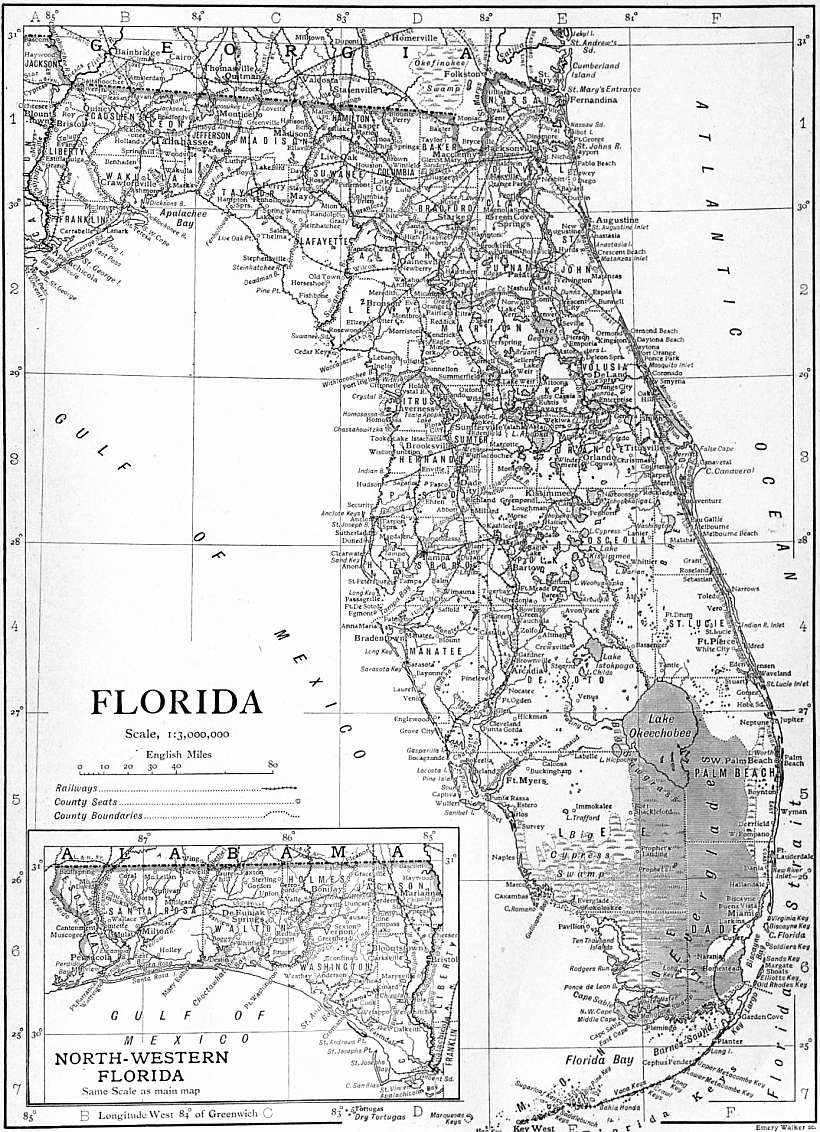
FLORIDA, the most southern of the United States of America, situated between 24° 30′ and 31° N. lat. and 79° 48′ and 87° 38′ W. long. It is bounded N. by Georgia and Alabama, E. by the Atlantic Ocean, S. by the Strait of Florida, which separates it from Cuba, and by the Gulf of Mexico, and W. by Alabama and the Gulf. The Florida Keys, a chain of islands extending in a general south-westerly direction from Biscayne Bay, are included in the state boundaries, and the city of Key West, on an island of the same name, is the seat of justice of Monroe county. The total area of the state is 58,666 sq. m., of which 3805 sq. m. are water surface. The coast line is greater than that of any other state, extending 472 m. on the Atlantic and 674 m. on the Gulf Coast.
The peculiar outline of Florida gives it the name of “Peninsula State.” The average elevation of the surface of the state above the sea-level is less than that of any other state except Louisiana, but there is not the monotony of unbroken level which descriptions and maps often suggest. The N.W. portion of the state is, topographically, similar to south-eastern Alabama, being a rolling, hilly country; the eastern section is a part of the Atlantic coastal plain; the western coast line is less regular than the eastern, being indented by a number of bays and harbours, the largest of which are Charlotte Harbour, Tampa Bay and Pensacola Bay. Along much of the western coast and along nearly the whole of the eastern coast extends a line of sand reefs and narrow islands, enclosing shallow and narrow bodies of water, such as Indian river and Lake Worth—called rivers, lakes, lagoons, bays and harbours. In the central part of the state there is a ridge, extending N. and S. and forming a divide, separating the streams of the east coast from those of the west. Its highest elevation above sea-level is about 300 ft. The central region is remarkable for its large number of lakes, approximately 30,000 between Gainesville in Alachua county, and Lake Okeechobee. They are due largely to sinkholes or depressions caused by solution of the limestone of the region. Many of the lakes are connected by subterranean channels, and a change in the surface of one lake is often accompanied by a change in the surface of another. By far the largest of these lakes, nearly all of them shallow, is Lake Okeechobee, a body of water about 1250 sq. m. in area and almost uniformly shallow, its depth seldom being greater than 15 ft. Caloosahatchee river, flowing into the Gulf of Mexico near Charlotte Harbour, is its principal outlet. Among the other lakes are Orange, Crescent, George, Weir, Harris, Eustis, Apopka, Tohopekaliga, Kissimmee and Istokpoga. The chief feature of the southern portion of the state is the Everglades (q.v.), the term “Everglade State” being popularly applied to Florida. Within the state there are many swamps, the largest of which are the Big Cypress Swamp in the S. adjoining the Everglades on the W., and Okefinokee Swamp, extending from Georgia into the N.E. part of the state.
A peculiar feature of the drainage of the state is the large number of subterranean streams and of springs, always found to a greater or less extent in limestone regions. Some of them are of great size. Silver Spring and Blue Spring in Marion county, Blue Spring and Orange City Mineral Spring in Volusia county, Chipola Spring near Marianna in Jackson county, Espiritu Santo Spring near Tampa in Hillsboro county, Magnolia Springs in Clay county, Suwanee Springs in Suwanee county, White Sulphur Springs in Hamilton county, the Wekiva Springs in Orange county, and Wakulla Spring, Newport Sulphur Spring and Panacea Mineral Spring in Wakulla county are the most noteworthy. Many of the springs have curative properties, one of them, the Green Cove Spring in Clay county, discharging about 3000 gallons of sulphuretted water per minute. Not far from St Augustine a spring bursts through the sea itself with such force that the ocean breakers roll back from it as from a sunken reef. The springs often merge into lakes, and lake systems are usually the sources of the rivers, Lake George being the principal source of the St Johns, and Lake Kissimmee of the Kissimmee, while a number of smaller lakes are the source of the Oklawaha, one of the most beautiful of the Floridian rivers.
(Click to enlarge.)
Of the rivers the most important are the St Johns, which flows N. from about the middle of the peninsula, empties into the Atlantic a short distance below Jacksonville, and is navigable for about 250 m. from its mouth, the Withlacoochee, flowing in a general north-westerly direction from its source in the N.E. part of Polk county, and forming near its entrance into the Gulf of Mexico the boundary between Levy and Citrus counties, and four rivers, the Escambia, the Choctawatchee, the Apalachicola, and the Suwanee, having their sources in other states and traversing the north-western part of Florida. On account of its sand reefs, the east coast has not so many harbours as the west coast. The most important harbours are at Fernandina, St Augustine, and Miami on the E. coast, and at Tampa, Key West and Pensacola on the W. coast.
The soils of Florida have sand as a common ingredient.1 They may be divided into three classes: the pine lands, which often have a surface of dark vegetable mould, under which is a sandy loam resting on a substratum of clay, marl or limestone—areas of such soil are found throughout the state; the “hammocks,” which have soil of similar ingredients and are interspersed with the pine lands—large areas of this soil occur in Levy, Alachua, Citrus, Hernando, Pasco, Gadsden, Leon, Madison, Jefferson and Jackson counties; and the alluvial swamp lands, chiefly in E. and S. Florida, the richest class, which require drainage to fit them for cultivation.
As regards climate Florida may be divided into three more or less distinct zones. North and west of a line passing through Cedar Keys and Fernandina the climate is distinctly “southern,” similar to that of the Gulf states; from this line to another extending from the mouth of the Caloosahatchee to Indian river inlet the climate is semi-tropical, and is well suited to the cultivation of oranges; S. of this the climate is sub-tropical, well adapted to the cultivation of pineapples. Since the semi-tropical and sub-tropical zones are nearer the course of the Gulf Stream, and are swept by the trade winds, their temperatures are more uniform than those of the zones of southern climate; indeed, the extremes of heat (103° F.) and cold (13° F.) are felt in the region of southern climate. The mean annual temperature of the state is 70.8° F., greater in the sub-tropical than in the other climate zones, and the Atlantic coast is in general warmer than the Gulf Coast. The rainfall averages 52.09 in. per annum. On account of its warm climate, Florida has many resorts for health and pleasure, which are especially popular in the season from January to April; the more important are St Augustine, Ormond, Daytona, Palm Beach, Miami, Tampa, White Springs, Hampton Springs, Worthington Springs and Orange Springs.
No metals have ever been discovered in Florida. The principal minerals are rock phosphate and (recently more important) land and river pebble phosphate, found in scattered deposits in a belt on the “west coast” about 30 m. wide and extending from Tallahassee to Lake Okeechobee. The centre of the quarries is Dunnellon in Marion county, and pebble phosphate is found in Hillsboro, Polk, De Soto, Osceola, Citrus and Hernando counties. Although the economic value of the phosphate deposits was first realized about 1889, between 1894 and 1907 Florida produced, each year, more than half of all the phosphate rock produced in the whole United States, the yield of Florida (1,357,365 long tons) in 1907 being valued at $6,577,757; that of the whole country at $10,653,558. Florida is also the principal source in the United States for fuller’s earth, a deposit of which, near Quincy, was first discovered in 1893; and clay (including kaolin) is also mined to some extent. Other minerals that have been discovered but have not been industrially developed are gypsum, lignite and cement rock. The lack of a thorough geological survey has perhaps prevented the discovery of other minerals—certainly it is responsible for a late recognition of the economic value of the known mineral resources.
The flora of N. Florida is similar to that of south-eastern North America; that of S. Florida seems to be a link between the vegetation of North America and that of South America and the West Indies, for out of 247 species of S. Florida that have been examined, 187 are common to the West Indies, Mexico and South America. The forests cover approximately 37,700 sq. m., chiefly in the northern part of the state, including about half of the peninsula, yellow pine being predominant, except in the coastal marsh lands, where cypress, found throughout the state, particularly abounds. About half of the varieties of forest trees in the United States are found, and among the peculiar species are the red bay or “Florida Mahogany,” satinwood and cachibou, and the Florida yew and savin, both almost extinct. The lumber industry is important: in 1905 the total factory product of lumber and timber was valued at $10,901,650, and lumber and planing mill products were valued at $1,690,455. In 1900 this was the most valuable industry in the state; in 1905 it was second to the manufacture of tobacco. The fauna is similar in general to that of the southern United States. Among the animals are the puma, manatee (sea cow), alligator and crocodile, but the number of these has been greatly diminished by hunting. Ducks, wild turkeys, bears and wild cats (lynx) are found, but in decreasing numbers.
The fisheries are very valuable; the total number of species of fish in Florida waters is about 600, and many species found on one coast are not found on the other. The king fish and tarpon are hunted for sport, while mullet, shad, redsnappers, pompano, trout, sheepshead and Spanish mackerel are of great economic value. The sponge and oyster fisheries are also important. The total product of the fisheries in 1902 was valued at about $2,000,000.
Industry and Commerce.—The principal occupation is agriculture, in which 44% of the labouring population was engaged in 1900, but only 12.6% of the total land surface was enclosed in farms, of which only 34.6% was improved, and the total agricultural product for 1899 was valued at $18,309,104. As the number of farms increased faster than the cultivated area from 1850 to 1900, the average size of farms declined from 444 acres in 1860 to 140 in 1880 and to 106.9 in 1900, the largest class of farms being those with an acreage varying from 20 to 50 acres. Nearly three-fourths of the farms, in 1900, were cultivated by their owners, but the cash tenantry system showed an increase of 100% since 1890, being most extensively used in the cotton counties. One-third of the farms were operated by negroes, but one-half of these farms were rented, and the value of negro farm property was only one-eighth that of the entire farm property of the state. According to the state census of 1905 only 1,621,362 acres were improved; of 45,984 farms, 31,233 were worked by whites.
Fruits normally form the principal crop; the total value for 1907-8 of the fruit crops of the state (including oranges, lemons, limes, grape-fruit, bananas, guavas, pears, peaches, grapes, figs, pecans, &c.) was $6,160,299, according to the report of the State Department of Agriculture. The discovery of Florida’s adaptability to the culture of oranges about 1875 may be taken as the beginning of the state’s modern industrial development. But the unusual severity of the winters of 1887, 1894 and 1899 (the report of the Twelfth Census which gives the figures for this year being therefore misleading) destroyed three-fourths of the orange trees, and caused an increased attention to stock-raising, and to various agricultural products. Orange culture has recovered much of its importance, but it is carried on in the more southern counties of the state. The cultivation of pineapples, in sub-tropical Florida, is proving successful, the product far surpassing that of California, the only other state in the Union in which pineapples are grown. Grape-fruit, guavas and lemons are also successfully produced in this part of the state. The cultivation of strawberries and vegetables (cabbage, cauliflower, beets, beans, tomatoes, egg-plant, cucumbers, water-melons, celery, &c.) for northern markets, and of orchard fruits, especially plums, pears and prunes, has likewise proved successful. In 1907-8, according to the State Department of Agriculture, the total value of vegetable and garden products was $3,928,657. In 1903, according to the statistics of the United States Department of Agriculture, Indian corn ranked next to fruits (as given in the state reports), but its product as compared with that of various other states is unimportant—in 1907 it amounted to 7,017,000 bushels only; rice is the only other cereal whose yield in 1899 was greater than that of 1889, but the Florida product was surpassed (in 1899) by that of the Carolinas, Georgia, Louisiana and Texas; in 1907 the product of rice in Florida (69,000 bushels) was less than that of Texas, Louisiana, South Carolina, Arkansas and Georgia severally. Tobacco culture, which declined after 1860 on account of the competition of Cuba and Sumatra, has revived since 1885 through the introduction of Cuban and Sumatran seed; the product of 1907 (6,937,500 ℔) was more than six times that of 1899, the product in 1899 (1,125,600 ℔) being more than twice that of 1889 (470,443 ℔), which in turn was more than twenty times that for 1880 (21,182 ℔)—the smallest production recorded for many decades. In 1907 the average farm price of tobacco was 45 cents per ℔ higher than that of any other state. In 1899, 84% of the product was raised in Gadsden county. The sweet potato and pea-nut crops have also become very valuable; on the other hand the Census of 1900 showed a decline in acreage and production of cotton. In 1907 the acreage (265,000 acres) was less than in any cotton-growing state except Missouri and Virginia; the crop for 1907-1908 was 49,794 bales. Sea-island cotton of very high grade is grown in Alachua county. The production of sugar, begun by the early Spanish settlers, declined, but that of syrup increased. Pecan nuts are a promising crop, and many groves were planted after 1905. In 1900 there were more than 1,900,000 acres of land in the state unoccupied. The low lands of the South are being drained partly by the state and partly by private companies. Irrigation, introduced in 1888 by the orange growers, has been adopted by other farmers, especially the tobacco-growers of Gadsden county, and so the evil effects of the droughts, so common from February to June, are avoided. The value of farm property in the southern counties, which have been developed very recently, shows a steady increase, that of Hillsboro county surpassing the other counties of the state. In 1907-8, according to the state Department of Agriculture, the total value of all field crops (cotton, cereals, sugar-cane, hay and forage, sweet potatoes, &c.) was $11,856,340, and the total value of all farm products (including live stock, $20,817,804, poultry and products, $1,688,433, and dairy products, $1,728,642) was $46,371,320.
The manufactures of Florida, as compared with those of other states, are unimportant. Their product in 1900 was more than twice the product in 1890, and the product in 1905 (from establishments under the factory system only) was $50,298,290, i.e. 47.1% greater than in 1900. The most important industries were those that depended upon the forests, their product amounting to nearly 45% of the entire manufactured product of the state. The lumber and timber products were valued in 1905 at $10,901,650, almost twice their valuation in 1890, and an increase of 1.2% over the product of 1900. The manufacture of turpentine and rosin, material for which is obtained from the pine forests, had increased greatly in importance between 1890 and 1900, the product in 1890 being valued at only $191,859, that of 1900 at $6,469,605, and from the latter sum it increased in 1905 to $9,901,905, an increase of more than one-half. In 1900 the state ranked second and in 1905 first of all the states of the country in the value of this product; in 1905 the state’s product amounted to 41.4% of that of the entire country. The manufacture of cigars and cigarettes (almost entirely of cigars, few cigarettes being manufactured), carried on chiefly by Cubans at Key West and Tampa, also increased in importance between 1890 and 1900, the products in the latter year being valued at $10,735,826, or more than one-quarter more than in 1890, and in 1905 there was a further increase of 56.2%, the gross value being $16,764,276, or nearly one-third of the total factory product of the state. In 1900 Florida ranked fourth in the manufacture of tobacco among the states of the Union, being surpassed by New York, Pennsylvania and Ohio; in 1905 it ranked third (after New York and Pennsylvania). Most of the tobacco used is imported from Cuba, though, as has been indicated, the production of the state has greatly increased since 1880. In the manufacture of fertilizers, the raw material for which is derived from the phosphate beds, Florida’s aggregate product in 1900 was valued at $500,239, and in 1905 at $1,590,371, an increase of 217.9% in five years.
Florida’s industrial progress has been mainly since the Civil War, for before that conflict a large part of the state was practically undeveloped. An important influence has been the railways. In 1880 the total railway mileage was 518 m.; in 1890 it was 2489 m.; in 1900, 3255 m., and in January 1909, 4,004.92 m. The largest system is the Atlantic Coast Line, the lines of which in Florida were built or consolidated by H.B. Plant (1819-1899) and once formed a part of the so-called “Plant System” of railways. The Florida East Coast Railway is also the product of one man’s faith in the country, that of Henry M. Flagler (b. 1830). The Seaboard Air Line, the Louisville & Nashville, and the Georgia Southern & Florida are the other important railways. The Southern railway penetrates the state as far as Jacksonville, over the tracks of the Atlantic Coast Line. A state railway commission, whose members are elected by the people, has power to enforce its schedule of freight rates except when such rates would not pay the operating expenses of the railway. In 1882 the Florida East Coast Line Canal and Transportation Co. was organized to develop a waterway from Jacksonville to Biscayne Bay by connecting with canals the St Johns, Matanzas, and Halifax rivers, Mosquito Lagoon, Indian river, Lake Worth, Hillsboro river, New river, and Snake Creek; in 1908 this vast undertaking was completed. The development of marine commerce has been retarded by unimproved harbours, but Fernandina and Pensacola harbours have always been good. Since 1890 much has been done by the national Government, aided in many cases by the local authorities and by private enterprise, to improve the harbours and to extend the limits of river navigation. With the increase of trade between the United States and the West Indies following the Spanish-American War (1898), the business of the principal ports, notably of Fernandina, Tampa and Pensacola, greatly increased.
Population.—The population of Florida in 1880 was 269,493; in 1890, 391,422, an increase of 45.2%; and in 1900, 528,542, or a further increase of 35%; and in 1905, by a state census, 614,845; and in 1910, 752,619. In 1900, 95.5% were native born, 43.7% were coloured (including 479 Chinese, Japanese and Indians), and in 1905 the percentages were little altered. The Seminole Indians, whose number is not definitely known, live in and near the Everglades. The urban population on the basis of places having a population of 4000 or more was 16.6% of the total in 1900 and 22.7% in 1905, the percentage for Florida, as for other Southern States, being small as compared with the percentage for most of the other states of the Union. In 1900 there were 92, and, in 1905, 125 incorporated cities, towns and villages; but only 14 (in 1905, 22) of these had a population of over 2000, and only 4 (in 1905, 8) a population of more than 5000. The four in 1900 were: Jacksonville (28,429); Pensacola (17,747); Key West (17,114); and Tampa (15,839). The eight in 1905 were Jacksonville (35,301), Tampa (22,823), Pensacola (21,505), Key West (20,498), Live Oak (7200), Lake City (6409), Gainesville (5413), and St Augustine (5121). Tallahassee is the capital of the state. In 1906 the Baptists were the strongest religious denomination; the Methodists ranked second, while the Roman Catholic, Presbyterian and Protestant Episcopal churches were of relatively minor importance.
Government.—The present constitution was framed in 1885 and was ratified by the people in 1886. Its most important feature, when compared with the previous constitution of 1868, is its provision for the choice of state officials other than the governor (who was previously chosen by election) by elections instead of by the governor’s appointment, but the governor, who serves for four years and is not eligible for the next succeeding term, still appoints the circuit judges, the state attorneys for each judicial circuit and the county commissioners; he may fill certain vacancies and may suspend, and with the Senate remove officers not liable to impeachment. The governor is a member of the Board of Pardons, the other members being the attorney-general, the secretary of state, the comptroller and the commissioner of agriculture; he and the secretary of state, attorney-general, comptroller, treasurer, superintendent of public instruction, and commissioner of agriculture comprise a Board of Commissioners of State Institutions; he is also a member of the Board of Education. The office of lieutenant-governor was abolished by the present constitution. The legislature meets biennially, the senators being chosen for four, the representatives for two years. By an amendment of 1896 the Senate consists of not more than 32, and the House of Representatives of not more than 68 members; by a two-thirds vote of members present the legislature may pass a bill over the governor’s veto. The three judges of the Supreme Court and the seven of the circuit court serve for six years, those of the county courts for four years, and justices of the peace (one for each justice district, of which the county commissioners must form at least two in each county) hold office for four years. The constitutional qualifications for suffrage are: the age of twenty-one years, citizenship in the United States or presentation of naturalization certificates at registration centres, residence in the state one year and in the county six months, and registration. To these requirements the payment of a poll-tax has been added by legislative enactment, such an enactment having been authorized by the constitution. Insane persons and persons under guardianship are excluded by the constitution, and “all persons convicted of bribery, perjury, larceny or of infamous crime, or who shall make or become directly or indirectly interested in any bet or wager the result of which shall depend upon any election,” or who shall participate as principal, second or challenger in any duel, are excluded by legislative enactment.
Amendments to the constitution may be made by a three-fifths vote of each house of the legislature, ratified by a majority vote of the people. A revision of the Constitution may be made upon a two-thirds vote of all members of both Houses of the legislature, if ratified by a majority vote of the people; a Constitutional Convention is then to be provided for by the legislature, such convention to meet within six months of the passage of the law therefor, and to consist of a number equal to the membership of the House of Representatives, apportioned among the counties, as are the members of this House.
A homestead of 160 acres, or of one-half of an acre in an incorporated town or city, owned by the head of a family residing in the state, with personal property to the value of $1000 and the improvements on the real estate, is exempt from enforced sale except for delinquent taxes, purchase money, mortgage or improvements on the property. The wife holds in her own name property acquired before or after marriage; the intermarriage of whites and negroes (or persons of negro descent to the fourth generation) is prohibited. All these are constitutional provisions. By legislative enactment whites and blacks living in adultery are to be punished by imprisonment or fine; divorces may be secured only after two years’ residence in the state and on the ground of physical incapacity, adultery, extreme cruelty, habitual indulgence in violent temper, habitual drunkenness, desertion for one year, previous marriage still existing, or such relationship of the parties as is within the degrees for which marriage is prohibited by law. Legitimacy of natural children can be established by subsequent marriage of the parents, and the age of consent is sixteen years.
The bonded debt was incurred during the Reconstruction Period (1865-1875). In 1871 7% 30 year bonds to the extent of $350,000 were issued and in 1873 another issue of 6% 30 year bonds to the value of $925,000 was made. Most of these were held by the Educational Fund at the time of their maturity. By 1901 all but $267,700 of the issue of 1871 had been retired and this amount was then refunded with 3% 50 year bonds which were taken by the Educational Fund. In 1903 $616,800 of the 1873 issue was held by the Educational Fund and $148,000 by individuals. The first part of this claim was refunded by a new bond issue, also taken by the Educational Fund, the second was paid from an Indian war claim of $692,946, received from the United States government in 1902, when $132,000 bonds of 1857, held by the United States government, were also extinguished. The bonded debt was thus reduced to $884,500; and on the 1st of January 1909 the debt, consisting of refunding bonds held as educational funds, amounted to $601,567.
Penal System.—There is no penitentiary; the convicts are hired to the one highest bidder who contracts for their labour, and who undertakes, moreover, to lease all other persons convicted during the term of the lease, and sub-leases the prisoners. In 1889 the convicts were placed under the care of a supervisor of convicts, and in 1905 the law was amended so that one or more supervisors could be appointed at the will of the governors. In 1908 there were four supervisors and one state prison physician, and there are special laws designed to prevent abuses in the system. In 1908 the state received $208,148 from the lease of convicts. Decrepit prisoners were formerly leased, but in 1906 the lease excluded such as were thought unfit by the state prison physician. Women convicts were still leased with the men in 1908; of the 446 convicts committed in that year, there were 15 negro females, 356 negro males and 75 white males. In the same year 54 escaped, and 27 were recaptured. The leased convicts are employed in the turpentine and lumber industries and in the phosphate works. The 1232 convicts “on hand” at the close of 1908 were held in 38 camps, 4 being the minimum, and 160 the maximum number, at a camp. In 1908 two central hospitals for the prisoners were maintained by the lessee company. County prison camps are under the supervision of the governor and the supervisors of convicts. The state supervisors must inspect each state prison camp and each county prison camp every thirty days.
Education.—As early as 1831 an unsuccessful attempt was made to form an adequate public school fund; the first real effort to establish a common school system for the territory was made after 1835; in 1840 there were altogether 18 academies and 51 common schools, and in 1849 the state legislature made an appropriation in the interest of the public instruction of white pupils, and this was supplemented by the proceeds of land granted by the United States government for the same purpose. In 1852 Tallahassee established a public school; and in 1860 there were, according to a report of the United States census, 2032 pupils in the public schools of the state, and 4486 in “academies and other schools.” The Civil War, however, interrupted the early progress, and the present system of common schools dates from the constitution of 1868 and the school law of 1869. The school revenue derived from the interest of a permanent school fund, special state and county taxes, and a poll-tax, in 1907-1908 amounted to $1,716,161; the per capita cost for each child of school age was $6.11 (white, $9.08; negro, $2.24), and the average school term was 108 days (112 for whites, 99 for negroes). The state constitution prescribes that “white and colored children shall not be taught in the same school, but impartial provision shall be made for both.” The percentage of enrolment in 1907-1908 was 60 (whites, 66; negroes, 52). The percentage of attendance to enrolment was 70%,—68% for white and 74% for negro schools. Before 1905 the state provided for higher education by the Florida State College, at Tallahassee, formerly the West Florida Seminary (founded in 1857); the University of Florida, at Lake City, which was organized in 1903 by enlarging the work of the Florida Agricultural College (founded in 1884); the East Florida Seminary, at Gainesville (founded 1848 at Ocala); the normal school (for whites) at De Funiak Springs; and the South Florida Military Institute at Bartow; but in 1905 the legislature passed the Buckman bill abolishing all these state institutions for higher education and establishing in their place the university of the state of Florida and a state Agricultural Experiment Station, both now at Gainesville, and the Florida Female College at Tallahassee, which has the same standards for entrance and for graduation as the state university for men. Private educational institutions in Florida are John B. Stetson University at De Land (Baptist); Rollins College (1885) at Winter Park (non-sectarian), with a collegiate department, an academy, a school of music, a school of expression, a school of fine arts, a school of domestic and industrial arts, and a business school; Southern College (1901), at Sutherland (Methodist Episcopal, South); the Presbyterian College of Florida (1905), at Eustis; Jasper Normal Institute (1890), at Jasper, and the Florida Normal Institute at Madison. The negroes have facilities for advanced instruction in the Florida Baptist Academy, and Cookman Institute (Methodist Episcopal, South), both at Jacksonville, and in the Normal and Manual Training School (Congregational), at Orange Park. There are a school for the Blind, Deaf, and Dumb (1885) at St. Augustine, a hospital for the insane at Chattahoochee and a reform school at Marianna, all wholly supported by the state, and a Confederate soldiers’ and sailors’ home at Tallahassee, which is partially supported by the state.
History.—The earliest explorations and attempts at colonization of Florida by Europeans were made by the Spanish. The Council of the Indies claimed that since 1510 fleets and ships had gone to Florida, and Florida is shown on the Cantino map of 1502. In 1513 Juan Ponce de Leon (c. 1460-1521), who had been with Christopher Columbus on his second voyage and had later been governor of Porto Rico, obtained a royal grant authorizing him to discover and settle “Bimini,”—a fabulous island believed to contain a marvellous fountain or spring whose waters would restore to old men their youth or at least had wonderful curative powers. Soon after Easter Day he came in sight of the coast of Florida, probably near the mouth of the St Johns river. From the name of the day in the calendar, Pascua Florida, or from the fact that many flowers were found on the coast, the country was named Florida. De León seems to have explored the coast, to some degree, on both sides of the peninsula, and to have turned homeward fully convinced that he had discovered an immense island. He returned to Spain in 1514, and obtained from the king a grant to colonize “the island of Bimini and the island of Florida,” of which he was appointed adelantado, and in 1521 he made another expedition, this one for colonization as well as for discovery. He seems to have touched at the island of Tortugas, so named on account of the large number of turtles found there, and to have landed at several places, but many of his men succumbed to disease and he himself was wounded in an Indian attack, dying soon afterward in Cuba. Meanwhile, in 1516, another Spaniard, Diego Miruelo, seems to have sailed for some distance along the west coast of the peninsula. The next important exploration of Florida was that of Panfilo de Narvaez. In 1527 he sailed from Cuba with about 600 men (soon reduced to less than 400), landed (early in 1528) probably at the present site of Pensacola, and for six months remained in the country, he and his men suffering terribly from exposure, hunger and fierce Indian attacks. In September, his ships being lost and his force greatly reduced in number, he hastily constructed a crazy fleet, re-embarked probably at Apalachee Bay, and lost his life in a storm probably near Pensacola Bay. Only four of his men, including Nuñez Cabeza de Vaca, succeeded after eight years of Indian captivity and of long and weary wanderings, in finding their way to Spanish settlements in Mexico. Florida was also partially explored by Ferdinando de Soto (q.v.) in 1539-1540. In the summer of 1559 another attempt at colonization was made by Tristan de Luna, who sailed from Vera Cruz, landed at Pensacola Bay, and explored a part of Florida and (possibly) Southern Alabama. Somewhere in that region he desired to make a permanent settlement, but he was abandoned by most of his followers and gave up his attempt in 1561.
In the following year, Jean Ribaut (1520-1565), with a band of French Huguenots, landed first near St Augustine and then at the mouth of the St Johns river, which he called the river of May, and on behalf of France claimed the country, which he described as “the fairest, fruitfullest and pleasantest of all the world”; but he made his settlement on an island near what is now Beaufort, South Carolina. In 1564 René de Laudonnière (? -c. 1586), with another party of Huguenots, established Fort Caroline at the mouth of the St Johns, but the colony did not prosper, and in 1565 Laudonnière was about to return to France when (on the 28th of August) he was reinforced by Ribaut and about 300 men from France. On the same day that Ribaut landed, a Spanish expedition arrived in the bay of St Augustine. It was commanded by Pedro Menéndez de Avilés (1523-1574), one of whose aims was to destroy the Huguenot settlement. This he did, putting to death almost the entire garrison at Fort Caroline “not as Frenchmen, but as Lutherans,” on the 20th of September 1565. The ships of Ribaut were soon afterwards wrecked near Matanzas Inlet; he and most of his followers surrendered to Menéndez and were executed. Menéndez then turned his attention to the founding of a settlement which he named St Augustine (q.v.); he also explored the Atlantic coast from Cape Florida to St Helena, and established forts at San Mateo (Fort Caroline), Avista, Guale and St Helena. In 1567 he returned to Spain in the interest of his colony.
The news of the destruction of Fort Caroline, and the execution of Ribaut and his followers, was received with indifference at the French court; but Dominique de Gourgues (c. 1530-1593), a friend of Ribaut but probably a Catholic, organized an expedition of vengeance, not informing his men of his destination until his three ships were near the Florida coast. With the co-operation of the Indians under their chief Saturiba he captured Fort San Mateo in the spring of 1568, and on the spot where the garrison of Fort Caroline had been executed, he hanged his Spanish prisoners, inscribing on a tablet of pine the words, “I do this not as unto Spaniards but as to traitors, robbers and murderers.” Feeling unable to attack St Augustine, de Gourgues returned to France.
The Spanish settlements experienced many vicissitudes. The Indians were hostile and the missionary efforts among them failed. In 1586 St Augustine was almost destroyed by Sir Francis Drake and it also suffered severely by an attack of Captain John Davis in 1665. Not until the last decade of the 17th century did the Spanish authorities attempt to extend the settlements beyond the east coast. Then, jealous of the French explorations along the Gulf of Mexico, they turned their attention to the west coast, and in 1696 founded Pensacola. When the English colonies of the Carolinas and Georgia were founded, there was constant friction with Florida. The Spanish were accused of inciting the Indians to make depredations on the English settlements and of interfering with English commerce and the Spanish were in constant fear of the encroachments of the British. In 1702, when Great Britain and Spain were contending in Europe, on opposite sides, in the war of the Spanish Succession, a force from South Carolina captured St Augustine and laid siege to the fort, but being unable to reduce it for lack of necessary artillery, burned the town and withdrew at the approach of Spanish reinforcements. In 1706 a Spanish and French expedition against Charleston, South Carolina, failed, and the Carolinians retaliated by invading middle Florida in 1708 and again in 1722. In 1740 General James Edward Oglethorpe, governor of Georgia, supported by a naval force, made an unsuccessful attack upon St Augustine; two years later a Spanish expedition against Savannah by way of St Simon’s Island failed, and in 1745 Oglethorpe again appeared before the walls of St Augustine, but the treaty of Aix-la-Chapelle in 1748 prevented further hostilities. Pensacola, the other centre of Spanish settlement, though captured and occupied (1719-1723) by the French from Louisiana, had a more peaceful history.
By the treaty of Paris in 1763 Florida was ceded to England in return for Havana. The provinces of East Florida and West Florida were now formed, the boundaries of West Florida being 31° N. lat. (when civil government was organized in 1767, the N. line was made 32° 28′), the Chattahoochee, and the Apalachicola rivers, the Gulf of Mexico, Mississippi Sound, Lakes Borgne, Pontchartrain and Maurepas, and the Mississippi river. A period of prosperity now set in. Civil in place of military government was instituted; immigration began; and Andrew Turnbull, an Englishman, brought over a band of about 1500 Minorcans (1769), whom he engaged in the cultivation of indigo at New Smyrna. Roads were laid out, some of which yet remain; and in the last three years of English occupation the government spent $580,000 on the two provinces. Consequently, the people of Florida were for the most part loyal to Great Britain during the War of American Independence. In 1776, the Minorcans of New Smyrna refused to work longer on the indigo plantations; and many of them removed to St Augustine, where they were protected by the authorities. Several plans were made to invade South Carolina and Georgia, but none matured until 1778, when an expedition was organized which co-operated with British forces from New York in the siege of Savannah, Georgia. In the following year, Spain having declared war against Great Britain, Don Bernardo de Galvez (1756-1794), the Spanish governor at New Orleans, seized most of the English forts in West Florida, and in 1781 captured Pensacola.
By the treaty of Paris (1783) Florida reverted to Spain, and, no religious liberty being promised, many of the English inhabitants left East and West Florida. A dispute with the United States concerning the northern boundary was settled by the treaty of 1795, the line 31° N. lat. being established.
The westward expansion of the United States made necessary American ports on the Gulf of Mexico; consequently the acquisition of West Florida as well as of New Orleans was one of the aims of the negotiations which resulted in the Louisiana Purchase of 1803. After the cession of Louisiana to the United States, the people of West Florida feared that that province would be seized by Bonaparte. They, therefore, through a convention at Buhler’s Plains (July 17, 1810), formulated plans for a more effective government. When it was found that the Spanish governor did not accept these plans in good faith, another convention was held on the 26th of September which declared West Florida to be an independent state, organized a government and petitioned for admission to the American Union. On the 27th of October President James Madison, acting on a theory of Robert R. Livingston that West Florida was ceded by Spain to France in 1800 along with Louisiana, and was therefore included by France in the sale of Louisiana to the United States in 1803, declared West Florida to be under the jurisdiction of the United States. Two years later the American Congress annexed the portion of West Florida between the Pearl and the Mississippi rivers to Louisiana (hence the so-called Florida parishes of Louisiana), and that between the Pearl and the Perdido to the Mississippi Territory.
In the meantime war between Great Britain and the United States was imminent. The American government asked the Spanish authorities of East Florida to permit an American occupation of the country in order that it might not be seized by Great Britain and made a base of military operations. When the request was refused, American forces seized Fernandina in the spring of 1812, an action that was repudiated by the American government after protest from Spain, although it was authorized in official instructions. About the same time an attempt to organize a government at St Mary’s was made by American sympathizers, and a petty civil war began between the Americans, who called themselves “Patriots,” and the Indians, who were encouraged by the Spanish. In 1814 British troops landed at Pensacola to begin operations against the United States. In retaliation General Andrew Jackson captured the place, but in a few days withdrew to New Orleans. The British then built a fort on the Apalachicola river, and there directed expeditions of Indians and runaway negroes against the American settlements, which continued long after peace was concluded in 1814. In 1818 General Jackson, believing that the Spanish were aiding the Seminole Indians and inciting them to attack the Americans, again captured Pensacola. By the treaty of 1819 Spain formally ceded East and West Florida to the United States; the treaty was ratified in 1821, when the United States took formal possession, but civil government was not established until 1822.
Indian affairs furnished the most serious problems of the new Territory of Florida. The aborigines, who seemed to have reached a stage of civilization somewhat similar to that of the Aztecs, were conquered and exterminated or absorbed by Creeks about the middle of the 18th century. There was a strong demand for the removal of these Creek Indians, known as Seminoles, and by treaties at Payne’s Landing in 1832 and Fort Gibson in 1833 the Indian chiefs agreed to exchange their Florida lands for equal territory in the western part of the United States. But a strong sentiment against removal suddenly developed, and the efforts of the United States to enforce the treaty brought on the Seminole War (1836-42), which resulted in the removal of all but a few hundred Seminoles whose descendants still live in southern Florida.
In 1845 Florida became a state of the American Union. On the 10th of January 1861 an ordinance of secession, which declared Florida to be a “sovereign and independent nation,” was adopted by a state convention, and Florida became one of the Confederate States of America. The important coast towns were readily captured by Union forces; Fernandina, Pensacola and St Augustine in 1862, and Jacksonville in 1863; but an invasion of the interior in 1864 failed, the Union forces being repulsed in a battle at Olustee (on the 20th of February 1864). In 1865 a provisional governor was appointed by President Andrew Johnson, and a new state government was organized. The legislature of 1866 rejected the Fourteenth Amendment to the Federal Constitution, and soon afterwards Florida was made a part of the Third Military District, according to the Reconstruction Act of 1867. Negroes were now registered as voters by the military authorities, and another Constitutional Convention met in January and February 1868. A factional strife in the dominant party, the Republican, now began; fifteen delegates withdrew from the convention; the others framed a constitution, and then resolved themselves into a political convention. The seceding members with nine others then returned and organized; but the factions were reconciled by General George M. Meade. A new constitution was framed and was ratified by the electors, and Florida passed from under a quasi-military to a full civil government on the 4th of July 1868.
The factional strife in the Republican party continued, a number of efforts being made to impeach Governor Harrison Reed (1813-1899). The decisive year of the Reconstruction Period was 1876. The Canvassing Board, which published the election returns, cast out some votes, did not wait for the returns from Dade county, and declared the Republican ticket elected. George F. Drew (1827-1900), the Democratic candidate for governor, then secured a mandamus from the circuit court restraining the board from going behind the face of the election returns; this was not obeyed and a similar mandamus was therefore obtained from the supreme court of Florida, which declared that the board had no right to determine the legality of a particular vote. According to the new count thus ordered, the Democratic state ticket was elected. By a similar process the board’s decision in favour of the election of Republican presidential electors was nullified, and the Democratic electors were declared the successful candidates; but the electoral commission, appointed by Congress, reversed this decision. (See Electoral Commission.)
Since 1876 Florida has been uniformly Democratic in politics.
American Governors of Florida.
Territorial Governors.
Andrew Jackson 1821-1822
William P. Duval 1822-1834
John H. Eaton 1834-1835
Richard K. Call 1835-1840
Robert R. Reid 1840-1841
Richard K. Call 1841-1844
John Branch 1844-1845
State Governors.
William D. Moseley 1845-1849 Democrat
Thomas Brown 1849-1853 Whig
James E. Broome 1853-1857 Democrat
Madison S. Perry 1857-1861 ”
John Milton 1861-1865 ”
William Marvin 1865 Provisional
David S. Walker 1865-1868 Democrat
Harrison Reed 1868-1872 Republican
Ossian B. Hart 1873-1874 ”
Marcellus L. Stearns 1874-1877 ”
George F. Drew 1877-1881 Democrat
William D. Bloxham 1881-1885 ”
Edward A. Perry 1885-1889 ”
Francis P. Fleming 1889-1893 ”
Henry L. Mitchell 1893-1897 ”
William D. Bloxham 1897-1901 ”
William S. Jennings 1901-1905 ”
Napoleon B. Broward 1905-1909 ”
Albert W. Gilchrist 1909- ”
Bibliography.—Physical and economic conditions are discussed in a pamphlet (591 pp.) published by the State Department of Agriculture, Florida, a Pamphlet Descriptive of its History, Topography, Climate, Soil, &c. (Tallahassee, 1904); in Climate, Soil and Resources of Florida (United States Department of Agriculture, Washington, 1882); A Preliminary Report on the Soils of Florida (United States Department of Agriculture, Division of Soils, Bulletin 13, 1898); C.L. Norton’s Handbook of Florida (2nd edition, New York, 1892); the volumes of the Twelfth Census of the United States (for 1900) which treat of Agriculture and Manufactures, and the Special Report on Mines and Quarries for 1902. J.N. MacGonigle’s “Geography of Florida” (National Geographic Magazine, vol. 7), T.D.A. Cockerell’s “West Indian Fauna in Florida” (Nature, vol. 46), L.F. Pourtales’s “Flora and Fauna of the Florida Keys” (American Naturalist, vol. 11), and C.F. Millspaugh’s Flora of the Sand Keys of Florida (Chicago, 1907), a Field Columbian Museum publication, are of value. To sportsmen, C.B. Cory’s Hunting and Fishing in Florida (Boston, 1896) and A.W. and J.A. Dimock’s Florida Enchantments (New York, 1908) are of interest. For administration, see Wilbur F. Yocum’s Civil Government of Florida (De Land, Florida, 1904); and the Revised Statutes of Florida (1892). The standard history is that by G.R. Fairbanks, History of Florida (Philadelphia, 1871). This should be supplemented by D.G. Brinton’s Notes on the Floridian Peninsula, its Literary History, Indian Tribes and Antiquities (Philadelphia, 1859), which has an excellent descriptive bibliography of the early explorations; Woodbury Lowery, The Spanish Settlements within the Present Limits of the United States (New York, vol. i., 1901; vol. ii., sub-title Florida, 1905); R.L. Campbell’s Historical Sketches of Colonial Florida (Cleveland, 1892), which treats at length of the history of Pensacola; H.E. Chambers’s West Florida and its Relation to the Historical Cartography of the United States (Johns Hopkins Studies in Historical and Political Science, Series 16, No. 5); and Herbert B. Fuller’s The Purchase of Florida; its History and Diplomacy (Cleveland, O., 1906). The only published collections of documents relating to the state are Buckingham Smith’s Colleccion de varios documentos para la historia de la Florida y tierras adyacentes (London, 1857), and Benjamin F. French’s Historical Collections of Louisiana (New York, 1846-1875).
1 Almost everywhere limestone is the underlying rock, but siliceous sands, brought out by the Atlantic rivers to the N.E., are carried the whole length of the Florida coast by marine action.
FLORIDABLANCA, DON JOSE MOÑINO Y REDONDO, Count of (1728-1808), Spanish statesman, was born at Murcia in 1728. He was the son of a retired army officer, and received a good education, which he completed at the university of Salamanca, especially applying himself to the study of law. For a time he followed the profession of an advocate, and acquired a high reputation. A more public career was opened to him by the marquis of Esquilache, then chief minister of state, who sent him ambassador to Pope Clement XIV. Successful in his mission, he was soon after appointed by Charles III. successor to his patron, and his administration was one of the most brilliant Spain had ever seen. He regulated the police of Madrid, reformed many abuses, projected canals, established many societies of agriculture and economy and many philanthropical institutions, and gave encouragement to learning, science and the fine arts. Commerce flourished anew under his rule, and the long-standing disputes with Portugal about the South American colonies were settled. He sought to strengthen the alliance of Spain with Portugal by a double marriage between the members of the royal houses, designing by this arrangement to place ultimately a Spanish prince on the throne of Portugal. But in this he failed. Floridablanca was the right-hand man of King Charles III. in his policy of domestic reform, and was much under the influence of French philosophes and economic writers. Like other reformers of that school he was a strong supporter of the royal authority and a convinced partisan of benevolent despotism. The French Revolution frightened him into reaction, and he advocated the support of the first coalition against France. He retained his office for three years under Charles IV.; but in 1792, through the influence of the favourite Godoy, he was dismissed and imprisoned in the castle of Pampeluna. Here he was saved from starvation only by the intervention of his brother. He was afterwards allowed to retire to his estates, and remained in seclusion till the French invasion of 1808. He was then called by his countrymen to take the presidency of the central junta. But his strength failed him, and he died at Seville on the 20th of November of the same year. He left several short treatises on jurisprudence.
See Obras originales del Conde de Floridablanca, edited, with biographical introduction, by A. Ferrer del Rio; in the Biblioteca de Rivadeneyra, vol. lix.
FLORIDOR [Josias de Soulas, Sieur de Prinefosse] (d. c. 1671), French actor, was born in Brie early in the 17th century, the son of a gentleman of German family who had moved to France, married there, and become a Roman Catholic. The son entered the French army, but after being promoted ensign, quitted the army for the theatre, where he took the name of Floridor. His first Paris appearance was in 1640. Three years later he was called to the company at the Hôtel de Bourgogne, where he played all the leading parts in tragedy and comedy and became the head of his profession. He was a man of superb physique and excellent carriage, with a flexible and sonorous voice, and manners of rare distinction and elegance. He was much liked at court, and Louis XIV. held him in particular esteem. He died in 1671 or 1672.
FLORIN, the name applied to several coins of the continent of Europe and to two coins struck in England at different times. The word comes through the Fr. florin from the Ital. fiorino, flower, Lat. flos, florem. Fiorino was the Italian name of a gold coin issued at Florence in 1252, weighing about fifty-four grains. This coin bore on the obverse a lily, from which it took its name of “the flower,” on the reverse the Latin name of the city Florentia, from which it was also known as a “florence.” “Florin” and “florence” seem to have been used in English indiscriminately as the name of this coin. The Florentine florin was held in great commercial repute throughout Europe, and similar coins were struck in Germany, other parts of Italy, France, &c. The English gold florin was introduced by Edward III. in 1343, half and quarter florins being struck at the same time. This gold florin weighed 108 grains and was to be current for six shillings. It was found, however, to be overvalued in proportion to the silver currency and was demonetized the following year. The florin did not again appear in the English coinage until 1849, when silver coins with this name, having a nominal value of two shillings (one-tenth of a pound), were struck. When first issued the “Dei gratia” was omitted from the inscription, and they were frequently referred to as the “Godless” or “graceless” florins. The D.G. was added in 1852. In 1887 a double florin or four shilling piece was issued, but its coinage was discontinued in 1890. The total value of double florins issued during these years amounted to £533,125. (See also Numismatics.)
FLORIO, GIOVANNI (1553?-1625), English writer, was born in London about 1553. He was of Tuscan origin, his parents being Waldenses who had fled from persecution in the Valtelline and taken refuge in England. His father, Michael Angelo Florio, was pastor of an Italian Protestant congregation in London in 1550. He was attached to the household of Sir William Cecil, but dismissed on a charge of immorality. He dedicated a book on the Italian language to Henry Herbert, and may have been a tutor in the family of William Herbert, earl of Pembroke. Anthony à Wood says that the Florios left England on the accession of Queen Mary, but returned after her death. The son resided for a time at Oxford, and was appointed, about 1576 tutor to the son of Richard Barnes, bishop of Durham, then studying at Magdalen College. In 1578 Florio published a work entitled First Fruits, which yield Familiar Speech, Merry Proverbs, Witty Sentences, and Golden Sayings (4to). This was accompanied by A Perfect Induction to the Italian and English Tongues. The work was dedicated to the earl of Leicester. Three years later Florio was admitted a member of Magdalen College, and became a teacher of French and Italian in the university. In 1591 appeared his Second Fruits, to be gathered of Twelve Trees, of divers but delightsome Tastes to the Tongues of Italian and English men; to which was annexed the Garden of Recreation, yielding six thousand Italian Proverbs (4to). These manuals contained an outline of the grammar, a selection of dialogues in parallel columns of Italian and English, and longer extracts from classical Italian writers in prose and verse. Florio had many patrons; he says that he “lived some years” with the earl of Southampton, and the earl of Pembroke also befriended him. His Italian and English dictionary, entitled A World of Words, was published in folio in 1598. After the accession of James I., Florio was named French and Italian tutor to Prince Henry, and afterwards became a gentleman of the privy chamber and clerk of the closet to the queen, whom he also instructed in languages. His magnum opus is the admirable translation of the Essayes on Morall, Politike, and Millitarie Discourses of Lo. Michaell de Montaigne, published in folio in 1603 in three books, each dedicated to two noble ladies. A second edition in 1613 was dedicated to the queen. Special interest attaches to the first edition from the circumstance that of the several copies in the British Museum library one bears the autograph of Shakespeare—long received as genuine but now supposed to be by an 18th-century hand—and another that of Ben Jonson. It was suggested by Warburton that Florio is satirized by Shakespeare under the character of Holofernes, the pompous pedant of Love’s Labour’s Lost, but it is much more likely, especially as he was one of the earl of Southampton’s protégés, that he was among the personal friends of the dramatist, who may well have gained his knowledge of Italian and French from him. He had married the sister of the poet Daniel, and had friendly relations with many writers of his day. Ben Jonson sent him a copy of Volpone with the inscription, “To his loving father and worthy friend Master John Florio, Ben Jonson seals this testimony of his friendship and love.” He is characterized by Wood, in Athenae Oxonienses, as a very useful man in his profession, zealous for his religion, and deeply attached to his adopted country. He died at Fulham, London, in the autumn of 1625.
FLORIS, FRANS, or more correctly Frans de Vriendt, called Floris (1520-1570), Flemish painter, was one of a large family trained to the study of art in Flanders. Son of a stonecutter, Cornelis de Vriendt, who died at Antwerp in 1538, he began life as a student of sculpture, but afterwards gave up carving for painting. At the age of twenty he went to Liége and took lessons from Lambert Lombard, a pupil of Mabuse, whose travels in Italy had transformed a style truly Flemish into that of a mongrel Leonardesque. Following in the footsteps of Mabuse, Lambert Lombard had visited Florence, and caught the manner of Salviati and other pupils of Michelangelo and Del Sarto. It was about the time when Schoreel, Coxcie and Heemskerk, after migrating to Rome and imitating the masterpieces of Raphael and Buonarroti, came home to execute Dutch-Italian works beneath the level of those produced in the peninsula itself by Leonardo da Pistoia, Nanaccio and Rinaldo of Mantua. Fired by these examples, Floris in his turn wandered across the Alps, and appropriated without assimilation the various mannerisms of the schools of Lombardy, Florence and Rome. Bold, quick and resolute, he saw how easy it would be to earn a livelihood and acquire a name by drawing for engravers and painting on a large scale after the fashion of Vasari. He came home, joined the gild of Antwerp in 1540, and quickly opened a school from which 120 disciples are stated to have issued. Floris painted strings of large pictures for the country houses of Spanish nobles and the villas of Antwerp patricians. He is known to have illustrated the fable of Hercules in ten compositions, and the liberal arts in seven, for Claes Jongeling, a merchant of Antwerp, and adorned the duke of Arschot’s palace of Beaumont with fourteen colossal panels. Comparatively few of his works have descended to us, partly because they came to be contemned for their inherent defects, and so were suffered to perish, partly because they were soon judged by a different standard from that of the Flemings of the 16th century. The earliest extant canvas by Floris is the “Mars and Venus ensnared by Vulcan” in the Berlin Museum (1547), the latest a “Last Judgment” (1566) in the Brussels gallery. Neither these nor any of the intermediate works at Alost, Antwerp, Copenhagen, Dresden, Florence, Léau, Madrid, St Petersburg and Vienna display any charm of originality in composition or in form. Whatever boldness and force they may possess, or whatever principles they may embody, they are mere appropriations of Italian models spoiled in translation or adaptation. Their technical execution reveals a rapid hand, but none of the lustre of bright colouring; and Floris owed much of his repute to the cleverness with which his works were transferred to copper by Jerome Cock and Theodore de Galle. Whilst Floris was engaged on a Crucifixion of 27 ft., and a Resurrection of equal size, for the grand prior of Spain, he was seized with illness, and died on the 1st of October 1570 at Antwerp.