VOLUME X SLICE V Fleury, Claude to Foraker (continued 10)
Reading edition
In England no fonts can certainly be said to date before the Norman conquest, although it is possible that a few very rude examples, such as those of Washaway, Cornwall, and Denton, Sussex, are actually of Saxon times; of course we cannot count as “Saxon fonts” those adapted from pre-Norman sculptured stones originally designed for other purposes, such as that at Dolton, Devonshire. On the other hand, Norman fonts are very common, and are often the sole surviving relics of the Norman parish church. They are circular or square, sometimes plain, but generally covered with carving of arcades, figures, foliage, &c. Among good examples that might be instanced of this period are Alphington, Devon (inverted cone, without foot); Stoke Cannon, Devon (supported on caryatides); Ilam, Staffs (cup-shaped); Fincham, Burnham Deepdale, Sculthorpe, Toftrees, and Shernborne in Norfolk (all, especially the last, remarkable for elaborate carving); Youlgrave, Derby (with a projecting stoup in the side for the chrism—a unique detail); besides others in Lincoln cathedral; Iffley, Oxon; Newenden, Kent; Coleshill, Warwick; East Meon, Hants; Castle Frome, Herefordshire. Some of the best examples of “Norman” fonts in England (such as the notable specimen in Winchester cathedral) were probably imported from Belgium. In the Transitional period we may mention a remarkable octagonal font at Belton, Lincolnshire; in this period fall most of the leaden fonts that remain in England, of which thirty are known (7 in Gloucestershire, 4 in Berkshire and Kent, 3 in Norfolk, Oxford and Sussex, 1 in Derby, Dorset, Lincoln, Somerset, Surrey and Wiltshire); perhaps the finest examples are at Ashover, Derbyshire, and Walton, Surrey. Early English fonts are comparatively rare. They bear the moulding, foliage and tooth ornament in the usual style of the period. A good example of an Early English font is at All Saints, Leicester; others may be seen at St Giles’, Oxford, and at Lackford, Suffolk. Fonts of the Decorated period are commoner, but not so frequent as those of the preceding Norman or subsequent Perpendicular periods. Fonts of the Perpendicular period are very common, and are generally raised upon steps and a lofty stem, which, together with the body of the font, are frequently richly ornamented with panelling. It was also the custom during this period to ornament the font with shields and coats of arms and other heraldic insignia, as at Herne, Kent. The fonts of this period, however, are as a rule devoid of interest, and, like most Perpendicular work, are stiff and monotonous. There is, however, a remarkable font, with sculptured figures, belonging to the late 14th century, at West Drayton in Middlesex.
In Holyrood chapel there was a brazen font in which the royal children of Scotland were baptized. It was carried off in 1544 by Sir R. Lea, and given by him to the church at St Albans, but was afterwards destroyed by the Puritans. A silver font existed at Canterbury, which was sometimes brought to Westminster on the occasion of a royal baptism. At Chobham, Surrey, there is a leaden font covered with oaken panels of the 16th century. The only existing structure at all recalling the ancient baptisteries in English churches is found at Luton in Bedfordshire. The font at Luton belongs to the Decorated style, and is enclosed in an octagonal structure of freestone, consisting of eight pillars about 25 ft. in height, supporting a canopy. The space around the font is large enough to hold twelve adults comfortably. At the top of the canopy is a vessel for containing the consecrated water, which when required was let down into the font by means of a pipe.
In 1236 it was ordered by Edmund, archbishop of Canterbury, that baptismal fonts should be kept under lock and key, as a precaution against sorcery:—“Fontes baptismales sub sera clausi teneantur propter sortilegia.” The lids appear at first to have been quite simple and flat. They gradually, however, partook of the ornamentation of the font itself, and are often of pyramidal and conical forms, highly decorated with finials, crockets, mouldings and grotesques. Sometimes these covers are very heavy and are suspended by chains to enable them to be raised at will. Very rich font covers may be seen at Ewelme, Oxon; St Gregory, Sudbury; North Walsingham, Norfolk; Worlingworth, Suffolk. The ordinary position of the font in the church was and is near the entrance, usually to the left of the south door.
See Arcisse de Caumont, Cours d’antiquités monumentales (Paris, 1830-1843); Francis Simpson, A Series of Antient Baptismal Fonts (London, 1828); Paley, Ancient Fonts; E.E. Viollet-le-Duc, Dict. raisonné de l’architecture (1858-1868), vol. v.; J.H. Parker’s Glossary of Architecture; Francis Bond, Fonts and Font-Covers (London, 1908). A large number of fine illustrations of fonts, principally of the earlier periods, will be found in the volumes of the Reliquary and Illustrated Archaeologist.
(R. A. S. M.)
FONTAINE, PIERRE FRANÇOIS LÉONARD (1762-1853), French architect, was born at Pontoise on the 20th of September 1762. He came of a family several of whose members had distinguished themselves as architects. Leaving the college of Pontoise at the age of sixteen he was sent to L’Isle-Adam to assist in hydraulic works undertaken by the architect André. To facilitate his improvement André allowed him to have access to his plans and to copy his designs. In October 1779 he was sent to Paris to study in the school of Peyre the younger, and there began his acquaintance with Percier, which ripened into a life-long friendship. After six years of study he competed for a prize at the Academy, and, winning the second for the plan of an underground chapel, he received a pension and was sent to Rome (1785). Percier accompanied him. The Revolution breaking out soon after his return to France, he took refuge in England; but after the establishment of the consulate he was employed by Bonaparte, to whom he had been introduced by the painter, David, to restore the palace of Malmaison. Henceforth he was fully engaged in the principal architectural works executed in Paris as architect successively to Napoleon I., Louis XVIII. and Louis Philippe. In conjunction with Percier (till his death) he was employed on the arch of the Carrousel, the restoration of the Palais-Royal, the grand staircase of the Louvre, and the works projected for the union of the Louvre and the Tuileries. In 1812 he was admitted a member of the Academy of Fine Arts, and in 1813 was named first architect to the emperor. With Percier he published the following works—Palais, maisons, et autres édifices de Rome moderne (1802); Descriptions de cérémonies et de fêtes (1807 and 1810); Recueil de décorations intérieures (1812); Choix des plus célèbres maisons de plaisance de Rome et des environs (1809-1813); Résidences des souverains, Parallèle (1833). L’histoire du Palais-Royal was published by Fontaine alone, who lost Percier, his friend and associate, in 1838, and himself died in Paris on the 10th of October 1853.
FONTAINEBLEAU, a town of northern France, capital of an arrondissement in the department of Seine-et-Marne, 37 m. S.E. of Paris on the railway to Lyons. Pop. (1906) 11,108. Fontainebleau, a town of clean, wide and well-built streets, stands in the midst of the forest of Fontainebleau, nearly 2 m. from the left bank of the Seine. Of its old houses, the Tambour mansion, and a portion of that which belonged to the cardinal of Ferrara, both of the 16th century, are still preserved; apart from the palace, the public buildings are without interest. A statue of General Damesme (d. 1848) stands in the principal square, and a monument to President Carnot was erected in 1895. Fontainebleau is the seat of a subprefect and has a tribunal of first instance and a communal college. The school of practical artillery and engineering was transferred to Fontainebleau from Metz by a decree of 1871, and now occupies the part of the palace surrounding the cour des offices.
Fontainebleau has quarries of sand and sandstone, saw-mills, and manufactories of porcelain and gloves. Fine grapes are grown in the vicinity. The town is a fashionable summer resort, and during the season the president of the Republic frequently resides in the palace. This famous building, one of the largest, and in the interior one of the most sumptuous, of the royal residences of France, lies immediately to the south-east of the town. It consists of a series of courts surrounded by buildings, extending from W. to E.N.E.; they comprise the Cour du Cheval Blanc or des Adieux (thus named in memory of the parting scene between Napoleon and the Old Guard in 1814), the Cour de la Fontaine, the Cour Ovale, built on the site of a more ancient château, and the Cour d’ Henri IV.: the smaller Cour des Princes adjoins the northern wing of the Cour Ovale. The exact origin of the palace and of its name (Lat. Fons Bleaudi) are equally unknown, but the older château was used in the latter part of the 12th century by Louis VII., who caused Thomas Becket to consecrate the Chapelle St Saturnin, and it continued a favourite residence of Philip Augustus and Louis IX. The creator of the present edifice was Francis I., under whom the architect Gilles le Breton erected most of the buildings of the Cour Ovale, including the Porte Dorée, its southern entrance, and the Salle des Fêtes, which, in the reign of Henry II., was decorated by the Italians, Francesco Primaticcio and Nicolo dell’ Abbate, and is perhaps the finest Renaissance chamber in France. The Galerie de François I. and the lower storey of the left wing of the Cour de la Fontaine are the work of the same architect, who also rebuilt the two-storeyed Chapelle St Saturnin. In the same reign the Cour du Cheval Blanc, including the Chapelle de la Ste Trinité and the Galerie d’Ulysse, destroyed and rebuilt under Louis XV., was constructed by Pierre Chambiges. After Francis I., Fontainebleau owes most to Henry IV., to whom are due the Cour d’ Henri IV., the Cour des Princes, with the adjoining Galerie de Diane, and Galerie des Cerfs, used as a library. Louis XIII. built the graceful horseshoe staircase in the Cour du Cheval Blanc; Napoleon I. spent 12,000,000 francs on works of restoration, and Louis XVIII., Louis Philippe and Napoleon III. devoted considerable sums to the same end. The palace is surrounded by gardens and ornamental waters—to the north the Jardin de l’Orangerie, to the south the Jardin Anglais and the Parterre, between which extends the lake known as the Bassin des Carpes, containing carp in large numbers. A space of over 200 acres to the east of the palace is covered by the park, which is traversed by a canal dating from the reign of Henry IV. On the north the park is bordered by a vinery producing fine white grapes.
Forest of Fontainebleau.—The forest of Fontainebleau is one of the most beautiful wooded tracts in France, and for generations it has been the chosen haunt of French landscape painters. Among the most celebrated spots are the Vallée de la Solle, the Gorge aux Loups, the Gorges de Franchard and d’Apremont, and the Fort l’Empereur. The whole area extends to 42,200 acres, with a circumference of 56 m. Nearly a quarter of this area is of a rocky nature, and the quarries of sandstone supplied a large part of the paving of Paris. The oak, pine, beech, hornbeam and birch are the chief varieties of trees.
It is impossible to do more than mention a few of the historical events which have taken place at Fontainebleau. Philip the Fair, Henry III. and Louis XIII. were all born in the palace, and the first of these kings died there. James V. of Scotland was there received by his intended bride; and Charles V. of Germany was entertained there in 1539. Christina of Sweden lived there for years, and the gallery is still to be seen where in 1657 she caused her secretary Monaldeschi to be put to death. In 1685 Fontainebleau saw the signing of the revocation of the edict of Nantes, and in the following year the death of the great Condé. In the 18th century it had two illustrious guests in Peter the Great of Russia and Christian VII. of Denmark; and in the early part of the 19th century it was twice the residence of Pius VII.,—in 1804 when he came to consecrate the emperor Napoleon, and in 1812-1814, when he was his prisoner.
See Pfnor, Monographie de Fontainebleau, with text by Champollion Figeac (Paris, 1866); Guide artistique et historique au palais de Fontainebleau (Paris, 1889); E. Bourges, Recherches sur Fontainebleau (Fontainebleau, 1896).
FONTAN, LOUIS MARIE (1801-1839), French man of letters, was born at Lorient on the 4th of November 1801. He began his career as a clerk in a government office, but was dismissed for taking part in a political banquet. At the age of nineteen he went to Paris and began to contribute to the Tablettes and the Album. He was brought to trial for political articles written for the latter paper, but defended himself so energetically that he secured the indefinite postponement of his case. The offending paper was suppressed for a time, and Fontan produced a collection of political poems, Odes et épîtres, and a number of plays, of which Perkins Warbec (1828), written in collaboration with MM. Halévy and Drouineau, was the most successful. In 1828 the Album was revived, and in it Fontan published a virulent but witty attack on Charles X., entitled Le Mouton enragé (20th June 1829). To escape the inevitable prosecution Fontan fled over the frontier, but, finding no safe asylum, he returned to Paris to give himself up to the authorities, and was sentenced to five years’ imprisonment and a heavy fine. He was liberated by the revolution of 1830, and his Jeanne la folle, performed in the same year, gained a success due perhaps more to sympathy with the author’s political principles than to the merits of the piece itself, a somewhat crude and violent picture of Breton history. A drama representing the trial of Marshal Ney, which he wrote in collaboration with Charles Dupenty, Le Procès d’un maréchal de France (printed 1831), was suppressed on the night of its production. Fontan died in Paris on the 10th of October 1839.
A sympathetic portrait of Fontan as a prisoner, and an analysis of his principal works, are to be found in Jules Janin’s Histoire de la littérature dramatique, vol. i.
FONTANA, DOMENICO (1543-1607), Italian architect and mechanician, was born at Mili, a village on the Lake of Como, in 1543. After a good training in mathematics, he went in 1563 to join his elder brother, then studying architecture at Rome. He made rapid progress, and was taken into the service of Cardinal Montalto, for whom he erected a chapel in the church of Santa Maria Maggiore and the villa Negroni. When the cardinal’s pension was stopped by the pope, Gregory XIII., Fontana volunteered to complete the works in hand at his own expense. The cardinal being soon after elected pope, under the name of Sixtus V., he immediately appointed Fontana his chief architect. Amongst the works executed by him were the Lateran palace, the palace of Monte Cavallo (the Quirinal), the Vatican library, &c. But the undertaking which brought Fontana the highest repute was the removal of the great Egyptian obelisk, which had been brought to Rome in the reign of Caligula, from the place where it lay in the circus of the Vatican. Its erection in front of St Peter’s he accomplished in 1586. After the death of Sixtus V., charges were brought against Fontana of misappropriation of public moneys, and Clement VIII. dismissed him from his post (1592). This appears to have been just in time to save the Colosseum from being converted by Fontana into a huge cloth factory, according to a project of Sixtus V. Fontana was then called to Naples, and accepted the appointment of architect to the viceroy, the count of Miranda. At Naples he built the royal palace, constructed several canals and projected a new harbour and bridge, which he did not live to execute. The only literary work left by him is his account of the removal of the obelisk (Rome, 1590). He died at Naples in 1607, and was honoured with a public funeral in the church of Santa Anna. His plan for a new harbour at Naples was carried out only after his death. His son Giulio Cesare succeeded him as royal architect in Naples, the university of that town being his best-known building.
FONTANA, LAVINIA (1552-1614), Italian portrait-painter, was the daughter of Prospero Fontana (q.v.). She was greatly employed by the ladies of Bologna, and, going thence to Rome, painted the likenesses of many illustrious personages, being under the particular patronage of the family (Buoncampagni) of Pope Gregory XIII., who died in 1585. The Roman ladies, from the days of this pontiff to those of Paul V., elected in 1605, showed no less favour to Lavinia than their Bolognese sisters had done; and Paul V. was himself among her sitters. Some of her portraits, often lavishly paid for, have been attributed to Guido. In works of a different kind also she united care and delicacy with boldness. Among the chief of these are a Venus in the Berlin museum; the “Virgin lifting a veil from the sleeping infant Christ,” in the Escorial; and the “Queen of Sheba visiting Solomon.” Her own portrait in youth—she was accounted very beautiful—was perhaps her masterpiece; it belongs to the counts Zappi of Imola, the family into which Lavinia married. Her husband, whose name is given as Paolo Zappi or Paolo Foppa, painted the draperies in many of Lavinia’s pictures. She is deemed on the whole a better painter than her father; from him naturally came her first instruction, but she gradually adopted the Caraccesque style, with strong quasi-Venetian colouring. She was elected into the Academy of Rome, and died in that city in 1614.
FONTANA, PROSPERO (1512-1597), Italian painter, was born in Bologna, and became a pupil of Innocenzo da Imola. He afterwards worked for Vasari and Perino del Vaga. It was probably from Vasari that Fontana acquired a practice of offhand, self-displaying work. He undertook a multitude of commissions, and was so rapid, that he painted, it is said, in a few weeks an entire hall in the Vitelli palace at Città di Castello. Along with daring, he had fertility of combination, and in works of parade he attained a certain measure of success, although his drawing was incorrect and his mannerism palpable. He belongs to the degenerate period of the Bolognese school, under the influence chiefly of the imitators of Raphael—Sabbatini, Sammachini and Passerotti being three of his principal colleagues. His soundest successes were in portraiture, in which branch of art he stood so high that towards 1550 Michelangelo introduced him to Pope Julius III. as a portrait-painter; and he was pensioned by this pope, and remained at the pontifical court with the three successors of Julius. Here he lived on a grand scale, and figured as a sort of arbiter and oracle among his professional brethren. Returning to Bologna, after doing some work in Fontainebleau and in Genoa, he opened a school of art, in which he became the preceptor of Lodovico and Agostino Caracci; but these pupils, standing forth as reformers and innovators, finally extinguished the academy and the vogue of Fontana. His subjects were in the way of sacred and profane history and of fable. He has left a large quantity of work in Bologna,—the picture of the “Adoration of the Magi,” in the church of S. Maria delle Grazie, being considered his masterpiece—not unlike the style of Paul Veronese. He died in Rome in 1597.
FONTANE, THEODOR (1819-1898), German poet and novelist, was born at Neu-Ruppin on the 30th of December 1819. At the age of sixteen he was apprenticed to a chemist, and after qualifying as an apothecary, he found employment in Leipzig and Dresden. In 1844 he travelled in England, and settling in Berlin devoted himself from 1849 to literature. He made repeated journeys to England, interesting himself in old English ballads, and as the first fruits of his tours published Ein Sommer in London (1854); Aus England, Studien und Briefe (1860) and Jenseit des Tweed, Bilder und Briefe aus Schottland (1860). Fontane was particularly attached to the Mark of Brandenburg, in which his home lay; he was proud of its past achievements, and delighted in the growth of the capital city, Berlin. The fascination which the country of his birth had for him may be seen in his delightfully picturesque Wanderungen durch die Mark Brandenburg (1862-1882, 4 vols.). He also described the wars of Prussia in Der schleswig-holsteinische Krieg im Jahre 1864 (1866) and Der deutsche Krieg von 1866 (1869). He proceeded to the theatre of war in 1870, and, being taken prisoner at Vaucouleurs, remained three months in captivity. His experiences he narrates in Kriegsgefangen. Erlebtes 1870 (1871), and he published the result of his observations of the campaign in Der Krieg gegen Frankreich 1870-71 (1874-1876). Like most of his contemporaries, he at first sought inspiration for his poetry in the heroes of other countries. His Gedichte (1851) and ballads Manner und Helden (1860) tell of England’s glories in bygone days. Then the achievements of his own countrymen entered into rivalry, and these, as an ardent patriot, he immortalized in poem and narrative. It is, however, as a novelist that Fontane is best known. His fine historical romance Vor dem Sturm (1878) was followed by a series of novels of modern life: L’Adultera (1882); Schach von Wuthenow (1883); Irrungen, Wirrungen (1888); Stine (1890); Unwiederbringlich (1891); Effi Briest (1895); Der Stechlin (1899), in which with fine literary tact Fontane adapted the realistic methods and social criticism of contemporary French fiction to the conditions of Prussian life. He died on the 20th of September 1898 at Berlin.
Fontane’s Gesammelte Romane und Erzählungen were published in 12 vols. (1890-1891; 2nd ed., 1905). For his life see the autobiographical works Meine Kinderjahre (1894) and Von zwanzig bis dreissig (1898), also Briefe an seine Familie (1905); also F. Servaes, Theodor Fontane (1900).
FONTANES, LOUIS, Marquis de (1757-1821), French poet and politician, was born at Niort (Deux Sèvres) on the 6th of March 1757. He belonged to a noble Protestant family of Languedoc which had been reduced to poverty by the revocation of the edict of Nantes. His father and grandfather remained Protestant, but he was himself brought up as a Catholic. His parents died in 1774-1775, and in 1777 Fontanes went to Paris, where he found a friend in the dramatist J.F. Ducis. His first published poems, some of which were inspired by English models, appeared in the Almanack des Muses; “Le Cri de mon cœur,” describing his own sad childhood, in 1778; and “La Forêt de Navarre” in 1780. His translation from Alexander Pope, L’Essai sur l’homme, was published with an elaborate preface in 1783, and La Chartreuse and Le Jour des morts in the same year, Le Verger in 1788 and his Épître sur l’édit en faveur des non-catholiques, and the Essai sur l’astronomie in 1789. Fontanes was a moderate reformer, and in 1790 he became joint-editor of the Modérateur. He married at Lyons in 1792, and his wife’s first child was born during their flight from the siege of that town. Fontanes was in hiding in Paris when the four citizens of Lyons were sent to the Convention to protest against the cruelties of Collot d’Herbois. The petition was drawn up by Fontanes, and the authorship being discovered, he fled from Paris and found shelter at Sevran, near Livry, and afterwards at Andelys. On the fall of Robespierre he was made professor of literature in the École Centrale des Quatre-Nations, and he was one of the original members of the Institute. In the Mémorial, a journal edited by La Harpe, he discreetly advocated reaction to the monarchical principle. He was exiled by the Directory and made his way to London, where he was closely associated with Chateaubriand. He soon returned to France, and his admiration for Napoleon, who commissioned him to write an éloge on Washington, secured his return to the Institute and his political promotion. In 1802 he was elected to the legislative chamber, of which he was president from 1804 to 1810. Other honours and titles followed. He has been accused of servility to Napoleon, but he had the courage to remonstrate with him on the judicial murder of the due d’Enghien, and as grand master of the university of Paris (1808-1815) he consistently supported religious and monarchical principles. He acquiesced in the Bourbon restoration, and was made a marquis in 1817. He died on the 17th of March 1821 in Paris, leaving eight cantos of an unfinished epic poem entitled La Grèce sauvée.
The verse of Fontanes is polished and musical in the style of the 18th century. It was not collected until 1839, when Sainte-Beuve edited the Œuvres (2 vols.) of Fontanes, with a sympathetic critical study of the author and his career. But by that time the Romantic movement was in the ascendant and Fontanes met with small appreciation.
FONTENAY-LE-COMTE, a town of western France, capital of an arrondissement in the department of Vendée 30 m. N.E. of La Rochelle on the State railway between that town and Saumur. Pop. (1906) town, 7639; commune, 10,326. Fontenay, an ancient and straggling town, is situated a few miles south of the forest of Vouvant and on both banks of the Vendée, at the point where it becomes navigable. The church of Notre-Dame (15th to 18th centuries), which has a fine spire and a richly sculptured western entrance, and the church of St Jean (16th and 17th centuries) are the chief religious buildings. The town has several houses of the 16th and 17th centuries. The most remarkable of these is the Hôtel de Terre Neuve (1595-1600), which contains much rich decoration together with collections of furniture and tapestry. Fontenay was the birthplace of many prominent men during the 15th and 16th centuries, and the Fontaine des Quatre-Tias, a fountain in the Renaissance style, given to the town by King Francis I., commemorates the fact. The chief square is named after François Viète, the great mathematician, who was born at Fontenay in 1540. The public institutions of the town include a tribunal of first instance and a communal college. Among its industries are the manufacture of felt hats, oil and soap and timber-sawing, flour-milling and tanning. There is trade in horses, mules, timber, grain, fruit, &c.
Fontenay was in existence as early as the time of the Gauls. The affix of “comte” is said to have been applied to it when it was taken by King Louis IX. from the family of Lusignan and given to his brother Alphonse, count of Poitou, under whom it became capital of Bas-Poitou. Ceded to the English by the treaty of Brétigny in 1360 it was retaken in 1372 by Duguesclin. It suffered repeated capture during the Religious Wars of the 16th century, was dismantled in 1621 and was occupied both by the republicans and the Vendeans in the war of 1793. From 1790 to 1806 it was capital of the department of Vendée.
FONTENELLE, BERNARD LE BOVIER DE (1657-1757), French author, was born at Rouen, on the 11th of February 1657. He died in Paris, on the 9th of January 1757, having thus very nearly attained the age of 100 years. His father was an advocate settled in Rouen, his mother a sister of the two Corneille. He was educated at the college of the Jesuits in his native city, and distinguished himself by the extraordinary precocity and versatility of his talents. His teachers, who readily appreciated these, were anxious for him to join their order, but his father had designed him for the bar, and an advocate accordingly he became; but, having lost the first cause which was entrusted to him, he soon abandoned law and gave himself wholly to literary pursuits. His attention was first directed to poetry; and more than once he competed for prizes of the French Academy, but never with success. He visited Paris from time to time and established intimate relations with the abbé de Saint Pierre, the abbé Vertot and the mathematician Pierre Varignon. He witnessed, in 1680, the total failure of his tragedy Aspar. Fontenelle afterwards acknowledged the justice of the public verdict by burning his unfortunate drama. His opera of Thétis et Pélée, 1689, though highly praised by Voltaire, cannot be said to rise much above the others; and it may be regarded as significant that of all his dramatic works not one has kept the stage. His Poésies pastorales (1688) have no greater claim to permanent repute, being characterized by stiffness and affectation; and the utmost that can be said for his poetry in general is that it displays much of the limae labor, great purity of diction and occasional felicity of expression.
His Lettres galantes du chevalier d’Her ..., published anonymously in 1685, was an amusing collection of stories that immediately made its mark. In 1686 his famous allegory of Rome and Geneva, slightly disguised as the rival princesses Mreo and Eenegu, in the Relation de l’île de Bornéo, gave proof of his daring in religious matters. But it was by his Nouveaux Dialogues des morts (1683) that Fontenelle established a genuine claim to high literary rank; and that claim was enhanced three years later by the appearance of the Entretiens sur la pluralité des mondes (1686), a work which was among the very first to illustrate the possibility of being scientific without being either uninteresting or unintelligible to the ordinary reader. His object was to popularize among his countrymen the astronomical theories of Descartes; and it may well be doubted if that philosopher ever ranked a more ingenious or successful expositor among his disciples.
Hitherto Fontenelle had made his home in Rouen, but in 1687 he removed to Paris; and in the same year he published his Histoire des oracles, a book which made a considerable stir in theological and philosophical circles. It consisted of two essays, the first of which was designed to prove that oracles were not given by the supernatural agency of demons, and the second that they did not cease with the birth of Christ. It excited the suspicion of the Church, and a Jesuit, by name Baltus, published a ponderous refutation of it; but the peace-loving disposition of its author impelled him to leave his opponent unanswered. To the following year (1688) belongs his Digression sur les anciens et les modernes, in which he took the modern side in the controversy then raging; his Doutes sur le système physique des causes occasionnelles (against Malebranche) appeared shortly afterwards.
In 1691 he was received into the French Academy in spite of the determined efforts of the partisans of the ancients in this quarrel, especially of Racine and Boileau, who on four previous occasions had secured his rejection. He consequently was admitted a member both of the Academy of Inscriptions and of the Academy of Sciences; and in 1697 he became perpetual secretary to the latter body. This office he actually held for the long period of forty-two years; and it was in this official capacity that he wrote the Histoire du renouvellement de l’Académie des Sciences (Paris, 3 vols., 1708, 1717, 1722) containing extracts and analyses of the proceedings, and also the éloges of the members, written with great simplicity and delicacy. Perhaps the best known of his éloges, of which there are sixty-nine in all, is that of his uncle Pierre Corneille. This was first printed in the Nouvelles de la république des lettres (January 1685) and, as Vie de Corneille, was included in all the editions of Fontenelle’s Œuvres. The other important works of Fontenelle are his Élements de la géometrie de l’infini (1727) and his Apologie des tourbillons (1752). Fontenelle forms a link between two very widely different periods of French literature, that of Corneille, Racine and Boileau on the one hand, and that of Voltaire, D’Alembert and Diderot on the other. It is not in virtue of his great age alone that this can be said of him; he actually had much in common with the beaux esprits of the 17th century, as well as with the philosophes of the 18th. But it is to the latter rather than to the former period that he properly belongs.
He has no claim to be regarded as a genius; but, as Sainte-Beuve has said, he well deserves a place “dans la classe des esprits infiniment distingués”—distinguished, however, it ought to be added by intelligence rather than by intellect, and less by the power of saying much than by the power of saying a little well. In personal character he has sometimes been described as having been revoltingly heartless; and it is abundantly plain that he was singularly incapable of feeling strongly the more generous emotions—a misfortune, or a fault, which revealed itself in many ways. “Il faut avoir de l’âme pour avoir du goût.” But the cynical expressions of such a man are not to be taken too literally; and the mere fact that he lived and died in the esteem of many friends suffices to show that the theoretical selfishness which he sometimes professed cannot have been consistently and at all times carried into practice.
There have been several collective editions of Fontenelle’s works, the first being printed in 3 vols. at the Hague in 1728-1729. The best is that of Paris, in 8 vols. 8vo, 1790. Some of his separate works have been very frequently reprinted and also translated. The Pluralité des mondes was translated into modern Greek in 1794. Sainte-Beuve has an interesting essay on Fontenelle, with several useful references, in the Causeries du lundi, vol. iii. See also Villemain, Tableau de la littérature française au XVIIIe siècle; the abbé Trublet, Mémoires pour servir à l’histoire de la vie et des ouvrages de M. de Fontenelle (1759); A. Laborde-Milaà, Fontenelle (1905), in the “Grands écrivains français” series; and L. Maigron, Fontenelle, l’homme, l’œuvre, l’influence (Paris, 1906).
FONTENOY, a village of Belgium, in the province of Hennegau, about 4 m. S.E. of Tournai, famous as the scene of the battle of Fontenoy, in which on the 11th of May 1745 the French army under Marshal Saxe defeated the Anglo-Allied army under the duke of Cumberland. The object of the French (see also Austrian Succession, War of the) was to cover the siege of the then important fortress of Tournai, that of the Allies, who slowly advanced from the east, to relieve it. Informed of the impending attack, Louis XV., with the dauphin, came with all speed to witness the operations, and by his presence to give Saxe, who was in bad health and beset with private enemies, the support necessary to enable him to command effectively. Under Cumberland served the Austrian field-marshal Königsegg, and, at the head of the Dutch contingent, the prince of Waldeck.
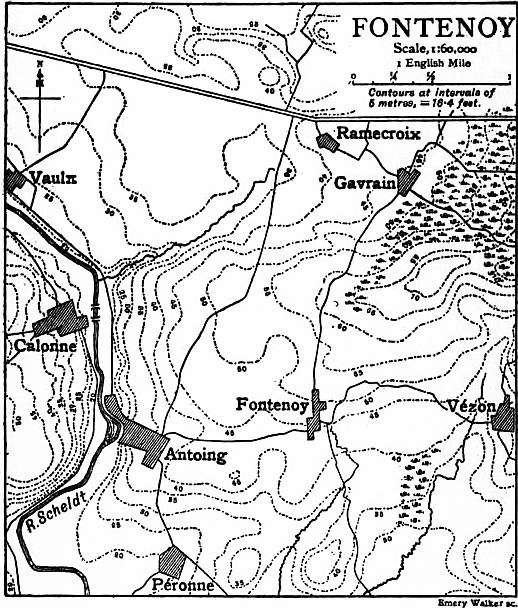
The right of the French position (see map) rested on the river at Antoing, which village was fortified and garrisoned, between Antoing and Fontenoy three square redoubts were constructed, and Fontenoy itself was put in a complete state of defence. On the left rear of this line, and separated from Fontenoy by some furlongs of open ground, another redoubt was made at the corner of the wood of Barry and a fifth towards Gavrain. The infantry was arrayed in deployed lines behind the Antoing-Fontenoy redoubts and the low ridge between Fontenoy and the wood; behind them was the cavalry. The approaches to Gavrain were guarded by a mounted volunteer corps called Grassins. At Calonne the marshal had constructed three military bridges against the contingency of a forced retreat. The force of the French was about 60,000 of all arms, not including 22,000 left in the lines before Tournai. Marshal Saxe himself, who was suffering from dropsy to such an extent that he was unable to mount his horse, slept in a wicker chariot in the midst of the troops. At early dawn of the 11th of May, the Anglo-Hanoverian army with the Austrian contingent formed up in front of Vézon, facing towards Fontenoy and the wood, while the Dutch on their left extended the general line to Péronne. The total force was 46,000, against about 52,000 whom Saxe could actually put into the line of battle.
The plan of attack arranged by Cumberland, Königsegg and Waldeck on the 10th grew out of circumstances. A preliminary skirmish had cleared the broken ground immediately about Vézon and revealed a part of the defender’s dispositions. It was resolved that the Dutch should attack the front Antoing-Fontenoy, while Cumberland should deliver a flank attack against Fontenoy and all in rear of it, by way of the open ground between Fontenoy and the wood. A great cavalry attack round the wood was projected but had to be given up, as in the late evening of the 10th the Allies’ light cavalry drew fire from its southern edge. Cumberland then ordered his cavalry commander to form a screen facing Fontenoy, so as to cover the formation of the infantry. On the morning of the 11th another and most important modification had to be made. The advance was beginning when the redoubt at the corner of the wood became visible. Cumberland hastily told off Brigadier James Ingoldsby (major and brevet-colonel 1st Guards), with four regiments and an artillery detachment, to storm this redoubt which, crossing its fire with that of Fontenoy, seemed absolutely to inhibit the development of the flank attack. At 6 A.M. the brigade moved off, but it was irresolutely handled and halted time after time; and after waiting as long as possible, the British and Hanoverian cavalry under Sir James Campbell rode forward and extended in the plain, becoming at once the target for a furious cannonade which killed their leader and drove them back. Thereupon Sir John (Lord) Ligonier, whose deployment the squadrons were to have covered, let them pass to the rear, and, hearing the guns of the Dutch towards Antoing, pushed the British infantry forward through the lanes, each unit on reaching open ground covering the exit and deployment of the one in rear, all under the French cannonade. This went on for two hours, and save that it showed the magnificent discipline of the British and Hanoverian regiments, was a bad prelude to the real attack. Cumberland’s own exertions brought a few small guns to the front of the Guards’ Brigade, and one of the first shots from these killed Antoine Louis, duc de Gramont, colonel of the Gardes Françaises, and another Henri du Baraillon du Brocard, Saxe’s artillery commander.
It was now 9 A.M., and while the guns from the wood redoubt battered the upright ranks of the Allies, Ingoldsby’s brigade was huddled together, motionless, on the right. Cumberland himself galloped thither, and under his reproaches Ingoldsby lost the last remnants of self-possession. To Sir John Ligonier’s aide-de-camp, who delivered soon afterwards a bitterly formal order to advance, Ingoldsby sullenly replied that the duke’s orders were for him to advance in line with Ligonier’s main body. By now, too, the Dutch advance against Antoing-Fontenoy had collapsed.
But on the right the cannonade and the blunders together had roused a stern and almost blind anger in the leaders and the men they led. Ingoldsby was wounded, and his successor, the Hanoverian general Zastrow, gave up the right attack and brought his battalions into the main body. A second halfhearted attack on Fontenoy itself, delivered by some Dutch troops, was almost made successful by the valour of two of these battalions (one of them being the then newly raised Highland regiment, the Black Watch) which came thither of their own accord. Meantime the young duke and the old Austrian field-marshal had agreed to take all risks and to storm through between Fontenoy and the wood redoubt, and had launched the great attack, one of the most celebrated in the history of war. The English infantry was in two lines. The Hanoverians on their left, owing to want of space, were compelled to file into third line behind the redcoats, and on their outer flanks were the battalions that had been with Ingoldsby. A few guns, man-drawn, accompanied the assaulting mass, and the cavalry followed. The column may have numbered 14,000 infantry. All the infantry battalions closed on their centre, the normal three ranks becoming six. If the proper distances between lines were preserved, the mass must have formed an oblong about 500 yds × 600 yds (excluding the cavalry).
The duke of Cumberland placed himself at the head of the front line and gave the signal to advance. Slowly and in parade order, drums beating and colours flying, the mass advanced, straight up the gentle slope, which was swept everywhere by the flanking artillery of the defence. Then, when the first line reached the low crest on the ends of which stood the French artillery, the fire, hitherto convergent, became a full enfilade from both sides, and at the same moment the enemy’s horse and foot became visible beyond. A brief pause ensued, and the front gradually contracted as regiments shouldered inwards to avoid the fire. Then the French advanced, and the Guards Brigade and the Gardes Françaises met face to face. Captain Lord Charles Hay (d. 1760), lieutenant of the First (Grenadier) Guards, suddenly ran in front of the line, took off his hat to the enemy and drank to them from a pocket flask, shouting a taunt, “We hope you will stand till we come up to you, and not swim the river as you did at Dettingen,” then, turning to his own men, he called for three cheers. The astonished French officers returned the salute and gave a ragged counter-cheer. Whether or not the French, as legend states, were asked and refused to fire first, the whole British line fired one tremendous series of volleys by companies. 50 officers and 760 men of the three foremost French regiments fell at once, and at so appalling a loss the remnant broke and fled. Three hundred paces farther on stood the second line of the French, and slowly the mass advanced, firing regular volleys. It was now well inside the French position, and no longer felt the enfilade fire that swept the crest it had passed over. By now, as the rear lines closed up, the assailants were practically in square and repelled various partial attacks coming from all sides. The Régiment du Roi lost 33 officers and 345 men at the hands of the Second (Coldstream) Guards. But these counter-attacks gained a few precious minutes for the French. It was the crisis of the battle. The king, though the court meditated flight, stood steady with the dauphin at his side,—Fontenoy was the one great day of Louis XV.’s life,—and Saxe, ill as he was, mounted his horse to collect his cavalry for a charge. The British and Hanoverians were now at a standstill. More and heavier counter-strokes were repulsed, but no progress was made; their cavalry was unable to get to the front, and Saxe was by now thinking of victory. Captain Isnard of the Touraine regiment suggested artillery to batter the face of the square, preparatory to a final charge. General Löwendahl galloped up to Saxe, crying, “This is a great day for the king; they will never escape!” The nearest guns were planted in front of the assailants, and used with effect. The infantry, led by Löwendahl, fastened itself on the sides of the square, the regiments of Normandy and Vaisseaux and the Irish Brigade conspicuous above the rest. On the front, waiting for the cannon to do its work, were the Maison du Roi, the Gendarmerie and all the light cavalry, under Saxe himself, the duke of Richelieu and count d’Estrées. The left wing of the Allies was still inactive, and troops were brought up from Antoing and Fontenoy to support the final blow. About 2 P.M. it was delivered, and in eight minutes the square was broken. As the infantry retired across the plain in small stubborn groups the French fire still made havoc in their ranks, but all attempts to close with them were repulsed by the terrible volleys, and they regained the broken ground about Vézon, whence they had come. Cumberland himself and all the senior generals remained with the rearguard.
The losses at Fontenoy were, as might be expected, somewhat less than normally heavy when distributed over the whole of both armies, but exceedingly severe in the units really engaged. Eight out of nineteen regiments of British infantry lost over 200 men, two of these more than 300. A tribute to the loyalty and discipline of the British, as compared with the generality of armies in those days, may be found in the fact that the three Guards’ regiments had no “missing” men whatever. The 23rd (Royal Welsh Fusiliers) had 322 casualties. Böschlanger’s Hanoverian regiment suffered even more heavily, and four others of that nation had 200 or more casualties. The total loss was about 7500, that of the French 7200. The French “Royal” regiment lost 30 officers and 645 men; some other regimental casualties have been mentioned above. The Dutch lost a bare 7% of their strength.
Fontenoy was in the 18th century what the attack of the Prussian Guards at St Privat is to-day, a locus classicus for military theorists. But the technical features of the battle are completely overshadowed by its epic interest, and above all it illustrates the permanent and unchangeable military characteristics of the British and French nations.
FONTEVRAULT, or Fontevraud (Lat. Fons Ebraldi), a town of western France, in the department of Maine-et-Loire, 10 m. S.E. of Saumur by road and 2½ m. from the confluence of the Loire and Vienne. Pop. (1906) 1279. It is situated in the midst of the forest of Fontevrault. The interest of the place centres in its abbey, which since 1804 has been utilized and abused as a central house of detention for convicts. The church (12th century), of which only the choir and apse are appropriated to divine service, has a beautiful nave formerly covered by four cupolas destroyed in 1816. There is a fifth cupola above the crossing. In a chapel in the south transept are the effigies of Henry II. of England, of his wife Eleanor of Guienne, of Richard I. of England and of Isabella of Angoulême, wife of John of England—Eleanor’s being of oak and the rest of stone. The cloister, refectory and chapter-house date from the 16th century. The second court of the abbey contains a remarkable building, the Tour d’Évrault (12th century), which long went under the misnomer of chapelle funéraire, but was in reality the old kitchen. Details and diagrams will be found in Viollet-le-Duc’s Dictionnaire de l’architecture. There are three stories, the whole being surmounted by a pyramidal structure.
The Order of Fontevrault was founded about 1100 by Robert of Arbrissel, who was born in the village of Arbrissel or Arbresec, in the diocese of Rennes, and attained great fame as a preacher and ascetic. The establishment was a double monastery, containing a nunnery of 300 nuns and a monastery of 200 monks, separated completely so that no communication was allowed except in the church, where the services were carried on in common; there were, moreover, a hospital for 120 lepers and other sick, and a penitentiary for fallen women, both worked by the nuns. The basis of the life was the Benedictine rule, but the observance of abstinence and silence went beyond it in stringency. The special feature of the institute was that the abbess ruled the monks as well as the nuns. At the beginning the order had a great vogue, and at the time of Robert’s death, 1117, there were several monasteries and 3000 nuns; afterwards the number of monasteries reached 57, all organized on the same plan. The institute never throve out of France; there were attempts to introduce it into Spain and England: in England there were three houses—at Ambresbury (Amesbury in Wiltshire), Nuneaton, and Westwood in Worcestershire. The nuns in England as in France were recruited from the highest families, and the abbess of Fontevrault, who was the superior-general of the whole order, was usually of the royal family of France.
See P. Hélyot, Hist, des ordres religieuses (1718), vi. cc. 12, 13; Max Heimbucher, Orden und Kongregationen (1907), i. 46; the arts. “Fontevrauld” in Wetzer and Welte, Kirchenlexicon (ed. 2), and in Herzog-Hauck, Realencyklopädie (ed. 3), supply full references to the literature. The most recent monograph is Édouard, Fontevrault et ses monuments (1875); for the later history see art. by Edmund Bishop in Downside Review (1886).
(E. C. B.)
FOOD (like the verb “to feed,” from a Teutonic root, whence O. Eng. foda; cf. “fodder”; connected with Gr. πατεῖσθαι, to feed), the general term for what is eaten by man and other creatures for the sustenance of life. The scientific aspect of human food is dealt with under Nutrition and Dietetics.
Infancy.—The influence of a normal diet upon the health of man (we exclude here the question of diet in illness, which must depend on the abnormal conditions existing) begins at the earliest stage of his life. No food has as yet been found so suitable for the young of all animals as their mother’s milk. This, however, has not been from want of seeking. Dr Brouzet (Sur l’éducation médicinale des enfants, i. p. 165) had such a bad opinion of human mothers, that he expressed a wish for the state to interfere and prevent them from suckling their children, lest they should communicate immorality and disease! A still more determined pessimist was the famous chemist Van Helmont, who thought life had been reduced to its present shortness by our inborn propensities, and proposed to substitute bread boiled in beer and honey for milk, which latter he calls “brute’s food.” Baron Justus von Liebig, as the result of his chemical researches, introduced a “food for infants,” which in more modern days has been followed by a multiplication of patent foods. A close imitation of human milk may also be made by the addition to fresh cow’s milk of half its bulk of soft water, in each pint of which has been mixed a heaped-up teaspoonful of powdered “sugar of milk” and a pinch of phosphate of lime. These artificial substitutes for the natural nutriment have their value where for any reason it is not available. The wholesomest food, however, for the first six months is certainly mother’s milk alone. A vigorous baby can indeed bear with impunity much rough usage, and often appears none the worse for a certain quantity of farinaceous food; but the majority do not get habituated to it without an exhibition of dislike which indicates rebellion of the bowels. It is only when the teeth are on their way to the front, as shown by dribbling, that the parotid glands secrete an active saliva capable of digesting bread stuffs. Till then anything but milk must be given tentatively, and considered in the light of a means of education for its future mode of nutrition.
The time for weaning should be fixed partly by the child’s age, partly by the growth of the teeth. The first group of teeth nine times out of ten consists of the lower central front teeth, which may appear any time during the sixth and seventh month. The mother may then begin to diminish the number of suckling times; and by a month she can have reduced them to twice a day, so as to be ready when the second group makes its way through the upper front gums to cut off the supply altogether. The third group, the lateral incisors and first grinders, usually after the first anniversary of birth, give notice that solid food can be chewed. But it is prudent to let dairy milk form a considerable portion of the fare till the eye-teeth are cut, which seldom happens till the eighteenth or twentieth month.
Childhood and Youth.—At this stage of life the diet must obviously be the best which is a transition from that of infancy to that of adult age. Growth is not completed, but yet entire surrender of every consideration to the claim of growth is not possible, nor indeed desirable. Moreover, that abundance of adipose tissue, or reserve new growth, which a baby can bear is an impediment to the due education of the muscles of the boy or girl. The supply of nutriment need not be so continuous as before, but at the same time should be more frequent than for the adult. Up to at least fourteen or fifteen years of age the rule should be four meals a day, varied indeed, but nearly equal in nutritive power and in quantity, that is to say, all moderate, all sufficient. The maturity the body then reaches involves a hardening and enlargement of the bones and cartilages, and a strengthening of the digestive organs, which in healthy young persons enables us to dispense with some of the watchful care bestowed upon their diet. Three full meals a day are generally sufficient, and the requirements of mental training may be allowed to a certain extent to modify the attention to nutrition which has hitherto been paramount.
Adults.—It is only necessary here to refer to the article on Dietetics (see also Vegetarianism) for a discussion of the food of normal adults; and to such headings as Dietary (for fixed allowances) or Cookery. Different staple articles of food are dealt with under their own headings. For animals other than man see the respective articles on them.
Among numerous books on the subject, in addition to those enumerated under Dietetics, see Sir Henry Thompson’s Foods and Feeding (1894); Hart’s Diet in Sickness and Health (1896); Knight, Food and its Functions (1895).
FOOD PRESERVATION. The preservation of food material beyond the short term during which it naturally keeps sound and eatable has engaged human thought from the earliest dawn of civilization. Necessity compelled man to store the plenitude of one season or place against the need of another. The hunter dried, smoked and salted meat and fish, pastoral man preserved milk in the form of cheese and butter, or fermented grape-juice into wine. With the separation of country from town, the development of manufacturing nation as distinct from agricultural and food-producing people, the spreading of civilized man from torrid to arctic zones, the needs of travellers on land and sea and of armies on the march, the problem of the prevention of the natural decomposition to which nearly all food substances are liable became increasingly urgent, and forms to-day, next to the production of food, the most important problem in connexion with the feeding and the trade of nations. As long as the reasons of decomposition were unknown, all attempts at preservation were necessarily empirical, and of the numberless processes which have during modern times been proposed and attempted comparatively few have stood the test of experience. In the light of modern knowledge, however, the guiding principles appear to be very simple.
Very few organic materials undergo decomposition, as it were, of their own accord. They may lose water by evaporation, and fatty substances may alter by the absorption of oxygen from the air. They are otherwise quite stable and unchangeable while not attacked and eaten up by living organisms, or while the life with which they may be endowed is in a state of suspense. An apple is alive and in breathing undergoes its ripening change; a grain of wheat is dormant and does not alter. A substance, in order to be a food material, must be decomposable under the attack of a living organism; the energy stored in it must be available to that stream of energy which we call life, whether the life be in the form of the human consumer or of any lower organism. All decomposition of food is due to the development within the food of living organisms. Under conditions under which living organisms cannot enter or cannot develop food keeps undecomposed for an indefinite length of time. The problem of food preservation resolves itself, therefore, into that of keeping out or killing off all living things that might feed upon and thus alter the food, and as these organisms mainly belong to the family of moulds, yeasts and bacteria, modern food preservation is strictly a subject for the bacteriologist.
The changes which food undergoes on keeping are easily intelligible when once their biological origin is recognized. Yeasts cause the decomposition of saccharine substances into alcohol and carbon dioxide, acetic and lactic ferments produce from sugar or from alcohol the organic acids causing the souring of food, moulds as a rule cause oxidation and complete destruction of organic matter, nitrogenous or saccharine, while most bacteria act mainly upon the nitrogenous constituents, producing albumoses and peptones and breaking up the complex albumen-molecule into numerous smaller molecules often allied to alkaloids, generally with the production of evil-smelling gases. These processes may go on simultaneously, but more frequently take place successively in the decomposition of food, one set of organisms taking up the work of destruction as the conditions become favourable to its development and unfavourable to its predecessor. The organisms may come from the air, the soil or from animal sources. The air teems with organisms which settle and may develop when brought upon a favourable nidus; the organic matter of the soil largely consists of fungoid life; while the intestinal canal and other mucous membranes of all animals harbour bacteria, sarcinae and other organisms in countless millions. Whenever, therefore, food material is exposed to the air, or touched by the soil or by animals or man, it becomes infected with living cells, which by their development lead to its decomposition and destruction.
Fungoid organisms may be killed by heat or by chemicals; or their development may be arrested by cold, removal of water, or by the presence of agents inhibiting their growth though not destroying their life. All successful processes of food preservation depend upon one or other of these circumstances.
Preservation by Heat.—At the boiling-point of water all living cells perish, but some spores of bacteria may survive for about three hours. Few adult bacteria can live beyond 75° C. (167° F.) in the presence of water, though dry heat only kills with certainty at 140° C. (284° F.). Destruction of life takes place more rapidly in solutions showing an acid than a feebly alkaline reaction; hence acid fruit is more easily preserved than milk, which, when quite fresh, is alkaline. By cooking, therefore, food becomes temporarily sterile, until a fresh crop of organisms finds access from the air. By repeated cooking all food can be indefinitely preserved. One of the most important functions of cookery is sterilization. Civilized man unwittingly revolts against the consumption of non-sterile food, and the use of certain fungus-infected material is an inheritance from barbarous ages; few materials of animal origin are eaten raw, and in vegetables some sort of sterilizing process is attempted by washing (of salads) or removal of the outer skin (of fruits). All preparation of food for the table, cooking being the most important, tends towards preservation, but is effectual only for a few hours or days at most, unless special means are adopted to prevent reinfection. The housewife covering the jam with a thin paper soaked in brandy, or the potted meat with a thin layer of lard, attempts unconsciously to bar the road to bacteria and other minute organisms. To preserve food in a permanent manner and on a commercial scale it has to be cooked in a receptacle which must be sufficiently strong for transport, cheap, light and unattacked by the material in contact with it. None of the receptacles at present in use quite fulfils the whole of these conditions: glass and china are heavy and fragile, and their carriage is expensive; tinned iron, so-called tin-plate, is rarely quite unaffected by food materials, but owing to its strength, tenacity and cheapness, it is used on an ever-increasing scale. The sheet iron, which formerly was made of soft wrought iron, now generally consists of steel containing but very little carbon; it is cleaned by immersion in acid and covered with a very thin layer of pure tin, all excess of tin being removed by hot rollers and brushes. The layer of tin, which formerly constituted from 3 to 5% of the total weight of the plate, has, owing to the increased price of tin and the improvement in machinery, gradually become so thin that its weight is only from 1 to 3%. Not rarely, therefore, the tin-surface is imperfect, perforated or pin-holed. Tin itself is slightly attacked by all acid juices of vegetable or animal substances. With the exception of milk, all human food is slightly acid, and consequently all food that has been preserved in tin canisters contains variable traces of dissolved tin. Happily, salts of tin have but little physiological action. Nevertheless, the employment cf tin-plate for very acid materials, like tomatoes, peaches, &c., is very objectionable.
The process of preservation in canisters is carried out as follows:—The canister, which has been made either by the use of solder or by folding machinery only, is packed with the material to be preserved, and a little water having been added to fill the interstices the lid is secured by soldering or folding, generally the former. Sterilization is effected by placing the tins in pressure chambers, which are heated by steam to 120° C. or more. The tins are exposed to that temperature for such time as experience has shown to be necessary to heat the contents throughout to at least 100° C. The temperature is then allowed to fall slowly to below the boiling-point of water, when the tins can be taken out of the pressure chamber, or they are placed in pans filled with water or a solution of calcium chloride and are therein heated till thoroughly cooked. Sometimes a small aperture is pierced through the lid, to allow of the escape of the expanding air, such holes before cooling closed by means of a drop of solder. This process, which was originally introduced by François Appert early in the 19th century, is employed on an enormous scale, especially in America. The use of lacquered tins, having the inner surface of the tin covered with a heat-resisting varnish, is gradually extending. Imperfect sterilization shows itself in many cases by gas development within the tin, which causes the ends to become convex and drummy. More frequently than not the contents of the larger tins, containing meat or other animal products, are not absolutely sterile, but the conditions are mostly such that the organisms which have survived the cooking process cannot develop. When they can develop without formation of gas dangerous products of decomposition may be produced without showing themselves to taste or smell. Numerous cases of so-called ptomaine poisoning have thus occurred; these are more frequently associated with preserved fish and lobster than with meats, although no class of preserved animal food is free from liability of ptomaine formation. The formation of poisonous substances has never been traced to preserved fruit or other material poor in nitrogen. The mode of preserving food in china or glass is quite similar, but the losses by breakage are not inconsiderable. Food which has been preserved in tins is sometimes transferred to glass and re-sterilized, the feeling against “tinned” food caused by the “Chicago scandals” not having entirely subsided. Were it not for the facts that sterilization is rarely quite perfect, and that the food attacks the tin, the contents of tin canisters ought to keep for an indefinite length of time. Under existing circumstances, however, there is a distinct limit to the age of soundness of canned food.
Preservation by Chemicals.—Salt is the oldest chemical preservative and, either alone or in conjunction with saltpetre and with wood-smoke, has been used for many centuries, mainly as a meat preservative. It is used either dry in layers strewn on the surface of the meat or fish to be preserved, or in the form of brine in which the meat is submerged or which is injected into the carcasses. The preserving power of salt is but moderate. It has the great advantage that in ordinary doses it is non-injurious, that an excess at once betrays itself in the taste, and that it can be readily removed by soaking in water. When aided by wood-smoke, which depends for its preservative power upon traces of creosote and formaldehyde, it is, however, quite efficient. The addition of saltpetre is principally for the purpose of giving to the meat a bright pink tint. The strongly saline taste of pickled meat or salted butter appears gradually to have become repugnant to a large part of mankind, and other preservatives have come into use, possessing greater bactericidal power and less taste. The serious objection attaching to them is discussed in the article Adulteration. At the present time the use of borax or boracic acid is almost universal in England. Meat which has been exposed to the vapours of formaldehyde, and has thus been superficially sterilized, is also coming into commerce in increasing quantities. Formaldehyde in itself is distinctly poisonous, and has the property of combining with albuminoids and rendering them completely insoluble in the digestive secretions. Salicylic and benzoic acids are not infrequently used to stop fermentation of saccharine beverages or deterioration of so-called “potted meats,” which are supposed to last fresh and sweet on the consumer’s table for a considerable length of time. Sulphurous acid and sulphites are chiefly used in the preservation of thin ales, wine and fruit, and sodium fluoride has been found in butter. The whole of these substances possess decided and injurious physiological properties. Alcohol now rarely forms a preservative of food material, its employment being confined to small fruit. The use of sugar as a preservative depends upon the fact that, although in a dilute solution it is highly prone to fermentation and other decomposition, it possesses bactericidal properties when in the form of a concentrated syrup. A sugar solution containing 30% of water or less does not undergo any biological change; in the presence of organic acids, like those contained in fruit, growth of organisms is inhibited when the percentage of water is somewhat greater. Upon this fact depends the use of sugar in the manufacture of jams, marmalades and jellies. Moulds may grow on the surface of such saccharine preparations, but the interior remains unaffected and unaltered.
Preservation by Drying.—Food materials in which the percentage of moisture is small (not exceeding about 8%) are but little liable to bacterial growths, at most to the attacks of innocent Penicillium. Nature preserves the germs in seeds and nuts, which are laden with otherwise decomposable food material, by the simple expedient of water removal. The life of cereal grains and many seeds appears to be unlimited. By the removal of water the most perishable materials, like meat or eggs, can be rendered unchangeable, except so far as the inevitable oxidation of the fatty substances contained in them is concerned and which is independent of life-action. The drying of meat, upon which a generation ago inventors bestowed a great deal of attention, has become almost obsolete, excepting for comparatively small articles or animals, like ox tongues or tails and fish. It has been superseded even among less civilized communities by the spread of canned food. Fruit, however, is very largely preserved in the dried state. Grapes are sun-dried and thus form currants, raisins and sultanas, the last variety being often bleached by the addition of sulphites. Plums, apples and pears are artificially dried in ovens on wooden battens or on wire sieves; from the latter they are apt to become contaminated with notable quantities of zinc. Excellent preparations of dried vegetables, including potatoes, carrots, onions, French beans and cabbages, are also manufactured.
The utilization of meat in the form of meat extract belongs to some extent to this class of preserved foods. Its origin is due to J. von Liebig and Max von Pettenkofer, and dates from the middle of the 19th century. The soluble material is extracted mainly from beef, in Australia to some extent from mutton, by means of warm water; the albumen is coagulated by heat and removed, and the broths thus obtained are evaporated in vacuo until the extract contains no more than about 20% of water. One pound of extract is obtained from about 25 ℔ of lean beef.
Preservation by Refrigeration.—At or below the freezing-point of water fungoid organisms are incapable of growth and multiplication. Although it has been asserted that many of them perish when kept for some time in the frozen condition, it is certain that the vast majority of bacteria and their germs remain merely dormant. Even so highly organized structures as cereal seeds do not suffer in vitality on being kept for a considerable length of time at the far lower temperature of liquid air. Biological change is, therefore, arrested at freezing-point, and as long as that temperature is maintained food material remains unaltered, except for physical changes depending upon the evaporation of water and of volatile flavouring matters, or chemical alterations due to oxidation.
Refrigeration, therefore, affords the means of keeping for a reasonably long time, and without the addition of any preservative substance, food in a raw condition. It is the only process of preservation which from a sanitary point of view is entirely unobjectionable as ordinarily and properly employed. Its introduction on a commercial scale has more powerfully affected the economic conditions of England and, to a less degree, of the United States than any other scientific advance since the establishment of railways and steamboats. Enormous quantities of frozen carcasses, butter, fruit, vegetables and fish are introduced in the fresh condition into Great Britain and stored until required. Extreme fluctuations of supply or of price have become almost impossible, and the abundance of Australian and New Zealand ranches, and of West Indian orchards, has been made readily accessible to the British consumer. For household purposes cooling in ice-chests or ice-chambers suffices to preserve food on a comparatively small scale. The ice used for the purpose comes, to a small extent, from natural sources, stored from the winter or imported from northern countries; a far larger quantity is artificially produced by the methods described in the article on Refrigerating, which also contains an account of the means by which low temperatures are produced for industrial purposes of importation and storage. Fleets of steamships fitted with refrigerating machinery and insulated cold-rooms are employed in carrying the food materials, which are deposited in cold-stores at docks, warehouses, markets and hotels. The first cargo of frozen meat was shipped in July 1873 from Melbourne, but arrived in October in an unsatisfactory state. In 1875-1876 sound frozen meat came from America. The first cargo of frozen meat was successfully brought to the United Kingdom in 1880 from Australia in the “Strathleven,” fitted with a Bell-Coleman air machine. The temperature in the cold-storage rooms is generally kept near 34° F., whilst in the chilling chambers a somewhat lower, and in the freezing room or chambers a much lower temperature (between 0° and 10° F.) is maintained. The carcasses to be frozen should be cooled slowly at first to ensure even freezing throughout and to prevent damage by the unequal expansion of the outer layer of ice. The carcasses when freezing must be hung separated from each other, but for storage or transportation they are packed tightly together. Fish such as salmon is washed, thoroughly cleansed, and frozen on trays. Butter should be cooled as rapidly as possible to about 10° F.; its composition as regards proportion of volatile fatty-acids, &c., remains absolutely unaltered for years. Cheese should only be cold-stored when nearly ripe and should not be frozen. Eggs must be carefully selected, each one being inspected by candle-light. They are placed in cases holding about three hundred, which are taken first to a room in which they are slowly cooled to about 33° F., and are then kept in store just below freezing-point. Particular attention must be paid to the relative humidity of the air in egg stores. Fruit should be quite fresh; grapes may be chilled to 26° F., while lemons cannot safely be kept at a lower temperature than 36°. The time during which soft fruit can be kept even in cold-store is limited, and does not exceed about six weeks.
In the early days of the chilled-meat trade considerable prejudice existed against stored meat. While in many cases the flavour of fresh meat is rather superior, the food value is in no way altered by cold-storage.1
Preservation by Pickling other than Salt.—For the preservation of vegetables, vinegar or other solution of acetic acid is used to a limited extent. Eggs are submerged in lime-water or a dilute solution of sodium silicate (soluble glass). During the storage of eggs the more aqueous white of egg yields by endosmosis a portion of its water to the more concentrated yolk, which thereby expands and renders its thin containing-membrane liable to rupture. Fish, such as sardines, sprats and salmon, is preserved by packing in olive or other oil.
The preservation of the most important dairy product, namely, milk, deserves a separate notice. It has already been stated that alkaline liquids, like milk, are more difficult to sterilize by heat than acid materials. In consequence of the alteration in flavour which milk undergoes by long continued boiling, and of the fact that milk forms perhaps the best medium for the growth and propagation of bacterial organisms, there is exceptional difficulty in its sterilization. As secreted by a healthy cow it is a perfectly sterile fluid, and, as shown by Sir J. Lister, when drawn under aseptic conditions and kept under such, it remains definitely fresh and sweet. Bacterial and other pollution at the time of milking arises from the animal, the stable, the milker and the vessels. In animals suffering from tuberculosis and other bacterial affections the milk may be infected within the udder. Milk as it reaches the consumer rarely contains less than 50,000 bacteria and often many millions per cubic centimetre. In fresh country cream 100 millions per cubic centimetre are not unusual. These bacteria are of many kinds, some of them spore-bearing. The spores are more difficult to kill than the adult organism. The first step towards preservation is the removal of the dirt unavoidably present, to the particles of which a considerable proportion of the bacteria adhere. Filtration through cloths or, better, the passing of the milk through centrifugals effects that removal. Subsequent treatment is preferably preceded by a breaking-up of the larger fat-globules by the projection of a jet of the milk under high pressures against a steel or agate plate, a process known as homogenizing. From homogenized milk the cream separates slowly, and does not form the coherent layer thrown up by ordinary milk. Heating is then effected either after bottling or by passing the milk continuously through pipes in which it is heated to from 160° to 170° F. By a repetition of the heating process on two or more succeeding days, complete sterilization may be effected, although a single treatment is sufficient to render the milk stable for a few days. Many forms of pasteurizing apparatus for milk are in use. Since the general introduction of pasteurization of the skim-milk used in Denmark for the feeding of calves and pigs, tuberculosis in these animals has practically disappeared. On the continent of Europe the use of sterilized milk is now very general. In England it has found little favour in households, but is making rapid progress on board ship.
Milk which has been condensed has for many years found a most extensive sale. The first efforts to condense and thus preserve milk date from 1835, when an English patent was granted to Newton. In 1849 C.N. Horsford prepared condensed milk with the addition of lactose. Commercially successful milk condensation began in 1856. The milk is heated to about 180° F. and filled into large copper vacuum pans, after having been mixed with from 10 to 12 parts of sugar per 100 parts of milk. Evaporation takes place in the pans at about 122° F., and is carried on till the milk is boiled down to such concentration that 100 parts of the condensed milk, including the sugar, contain the solids of 300 parts of milk. Sweetened condensed milk, although rarely quite sterile, keeps indefinitely, and is invariably brought into commerce in tin canisters. The preparation of sweetened condensed milk forms one of the most important branches of manufacture in Switzerland and is steadily increasing in England. Although milk can quite well be preserved in the form of condensed unsweetened milk, which dietetically possesses immense advantages over the sweetened milk in which the balance between carbohydrates and albuminoids is very unfavourable, such unsweetened milk has found little or no favour. Milk powder is manufactured under various patents, the most successful of which depends upon the addition of sodium bicarbonate and the subsequent rapid evaporation of the milk on steam-heated revolving iron cylinders. Milk powder made from skim-milk keeps well for considerable periods, but full-cream milk develops rancid or tallowy flavours by the oxidation of the finely divided butter-fat. It is largely employed in the preparation of so-called milk chocolates.
(O. H.*)
1 Per contra, see the article by Mary E. Pennington in the Year-book for 1907 (1908) of the U.S. Dept. of Agriculture, pp. 197-206, with illustrations of chickens kept in cold storage for two and three years. The results there shown cast considerable doubt on the efficiency of even refrigeration so far as an “indefinite” period is concerned; and it is suggested that the consumption of frozen meat may really account for various modern diseases.
FOOL (O. Fr. fol, modern fou, foolish, from a Late Latin use of follis, bellows, a ball filled with air, for a stupid person, a jester, a wind-bag), a buffoon or jester.
The class of professional fools or jesters, which reached its culminating point of influence and recognized place and function in the social organism during the middle ages, appears to have existed in all times and countries. Not only have there always been individuals naturally inclined and endowed to amuse others; there has been besides in most communities a definite class, the members of which have used their powers or weaknesses in this direction as a regular means of getting a livelihood. Savage jugglers, medicine-men, and even priests, have certainly much in common with the jester by profession. There existed in ancient Greece a distinct class of professed fools whose habits were not essentially different from those of the jesters of the middle ages. Of the behaviour of one of these, named Philip, Xenophon has given a picturesque account in the Banquet. Philip of Macedon is said to have possessed a court fool, and certainly these (as well as court poets and court philosophers, with whom they have sometimes been not unreasonably confounded) were common in a number of the petty courts at that era of civilization. Scurrae and moriones were the Roman parallels of the medieval witty fool; and during the empire the manufacture of human monstrosities was a regular practice, slaves of this kind being much in request to relieve the languid hours. The jester again has from time immemorial existed at eastern courts. Witty stories are told of Bahalul (see D’Herbelot, s.v.) the jester of Harun al-Reshid, which have long had a place in Western fiction. On the conquest of Mexico court fools and deformed human creatures of all kinds were found at the court of Montezuma. But that monarch no doubt hit upon one great cause of the favour of monarchs for this class when he said that “more instruction was to be gathered from them than from wiser men, for they dared to tell the truth.” Douce, in his essay On the Clowns and Fools of Shakespeare, has made a ninefold division of English fools, according to quality and place of employment, as the domestic fool, the city or corporation fool, the tavern fool, the fool of the mysteries and moralities. The last is generally called the “vice,” and is the original of the stage clowns so common among the dramatists of the time of Elizabeth, and who embody so much of the wit of Shakespeare. A very palpable classification is that which distinguishes between such creatures as were chosen to excite to laughter from some deformity of mind or body, and such as were so chosen for a certain (to all appearance generally very shallow) alertness of mind and power of repartee,—or briefly, butts and wits. The dress of the regular court fool of the middle ages was not altogether a rigid uniform. To judge from the prints and illuminations which are the sources of our knowledge on this matter, it seems to have changed considerably from time to time. The head was shaved, the coat was motley, and the breeches tight, with generally one leg different in colour from the other. The head was covered with a garment resembling a monk’s cowl, which fell over the breast and shoulders, and often bore asses’ ears, and was crested with a cockscomb, while bells hung from various parts of the attire. The fool’s bauble was a short staff bearing a ridiculous head, to which was sometimes attached an inflated bladder, by means of which sham castigations were effected. A long petticoat was also occasionally worn, but seems to have belonged rather to the idiots than to the wits.
The fool’s business was to amuse his master, to excite him to laughter by sharp contrast, to prevent the over-oppression of state affairs, and, in harmony with a well-known physiological precept, by his liveliness at meals to assist his lord’s digestion. The names and the witticisms of many of the official jesters at the courts of Europe have been preserved by popular or state records. In England the list is long between Hitard, the fool of Edmund Ironside, and Muckle John, the fool of Charles I., and probably the last official royal fool of England. Many are remembered from some connexion with general or literary history. Scogan was attached to Edward IV., and later was published a collection of poor jests ascribed to him, to which Andrew Boorde’s name was attached, but without authority.
Will Sommers, of the time of Henry VIII., seems to have been a kind-hearted as well as a witty man, and occasionally used his influence with the king for good and charitable purposes. Armin, who, in his Nest of Ninnies, gives a full description of Sommers, and introduces many popular fools, says of him—
“Only this much, he was a poor man’s friend. And helpt the widow often in her end. The king would ever grant what he would crave. For well he knew Will no exacting knave.”
The literature of the period immediately succeeding his death is full of allusions to Will Sommers.
Richard Tarleton, famous as a comic actor, cannot be omitted from any list of jesters. A book of Tarleton’s Jests was published in 1611, and, together with his News out of Purgatory, was reprinted by Halliwell Phillips for the Shakespeare Society in 1844. Archie Armstrong, for a too free use of wit and tongue against Laud, lost his office and was banished the court. The conduct of the archbishop against the poor fool is not the least item of the evidence which convicts him of a certain narrow-mindedness and pettiness. In French history, too, the figure of the court-jester flits across the gay or sombre scene at times with fantastic effect. Caillette and Triboulet are well-known characters of the times of Francis I. Triboulet appears in Rabelais’s romance, and is the hero of Victor Hugo’s Le Roi s’amuse, and, with some changes, of Verdi’s opera Rigoletto; while Chicot, the lithe and acute Gascon, who was so close a friend of Henry III., is portrayed with considerable justness by Dumas in his Dame de Monsoreau. In Germany Rudolph of Habsburg had his Pfaff Cappadox, Maximilian I. his Kunz von der Rosen (whose features, as well as those of Will Sommers, have been preserved by the pencil of Holbein), and many a petty court its jester after jester.
Late in the 16th century appeared Le Sottilissime Astuzie di Bertoldo, which is one of the most remarkable books ever written about a jester. It is by Giulio Cesare Croce, a street musician of Bologna, and is a comic romance giving an account of the appearance at the court of Alboin king of the Lombards of a peasant wonderful in ugliness, good sense and wit. The book was for a time the most popular in Italy. A great number of editions and translations appeared, and it was even versified. Though fiction, both the character and the career of Bertoldo are typical of the jester. That the private fool existed as late as the 18th century is proved by Swift’s epitaph on Dicky Pearce, the earl of Suffolk’s jester.
See Flögel, Geschichte der Hofnarren (Leipzig, 1789); Doran, The History of Court Fools (1858).
(W. He.)
FOOLS, FEAST OF (Lat. festum stultorum, fatuorum, follorum, Fr. fête des fous), the name for certain burlesque quasi-religious festivals which, during the middle ages, were the ecclesiastical counterpart of the secular revelries of the Lord of Misrule. The celebrations are directly traceable to the pagan Saturnalia of ancient Rome, which in spite of the conversion of the Empire to Christianity, and of the denunciation of bishops and ecclesiastical councils, continued to be celebrated by the people on the Kalends of January with all their old licence. The custom, indeed, so far from dying out, was adopted by the barbarian conquerors and spread among the Christian Goths in Spain, Franks in Gaul, Alemanni in Germany, and Anglo-Saxons in Britain. So late as the 11th century Bishop Burchard of Worms thought it necessary to fulminate against the excesses connected with it (Decretum, xix. c. 5, Migne, Patrologia lat. 140, p. 965). Then, just as it appears to have been sinking into oblivion among the people, the clergy themselves gave it the character of a specific religious festival. Certain days seem early to have been set apart as special festivals for different orders of the clergy: the feast of St Stephen (December 26) for the deacons, St John’s day (December 27) for the priests, Holy Innocents’ Day for the boys, and for the sub-deacons Circumcision, the Epiphany, or the 11th of January. The Feast of Holy Innocents became a regular festival of children, in which a boy, elected by his fellows of the choir school, functioned solemnly as bishop or archbishop, surrounded by the elder choir-boys as his clergy, while the canons and other clergy took the humbler seats. At first there is no evidence to prove that these celebrations were characterized by any specially indecorous behaviour; but in the 12th century such behaviour had become the rule. In 1180 Jean Beleth, of the diocese of Amiens, calls the festival of the sub-deacons festum stultorum (Migne, Patrol. lat. 202, p. 79). The burlesque ritual which characterized the Feast of Fools throughout the middle ages was now at its height. A young sub-deacon was elected bishop, vested in the episcopal insignia (except the mitre) and conducted by his fellows to the sanctuary. A mock mass was begun, during which the lections were read cum farsia, obscene songs were sung and dances performed, cakes and sausages eaten at the altar, and cards and dice played upon it.
This burlesquing of things universally held sacred, though condemned by serious-minded theologians, conveyed to the child-like popular mind of the middle ages no suggestion of contempt, though when belief in the doctrines and rites of the medieval Church was shaken it became a ready instrument in the hands of those who sought to destroy them. Of this kind of retribution Scott in The Abbot gives a vivid picture, the Protestants interrupting the mass celebrated by the trembling remnant of the monks in the ruined abbey church, and insisting on substituting the traditional Feast of Fools.
This naive temper of the middle ages is nowhere more conspicuously displayed than in the Feast of the Ass, which under various forms was celebrated in a large number of churches throughout the West. The ass had been introduced into the ritual of the church in the 9th century, representing either Balaam’s ass, that which stood with the ox beside the manger at Bethlehem, that which carried the Holy Family into Egypt, or that on which Christ rode in triumph into Jerusalem. Often the ass was a mere incident in the Feast of Fools; but sometimes he was the occasion of a special festival, ridiculous enough to modern notions, but by no means intended in an irreverent spirit. The three most notable celebrations of the Feast of the Ass were at Rouen, Beauvais and Sens. At Rouen the feast was celebrated on Christmas Day, and was intended to represent the times before the coming of Christ. The service opened with a procession of Old Testament characters, prophets, patriarchs and kings, together with heathen prophets, including Virgil, the chief figure being Balaam on his ass. The ass was a hollow wooden effigy, within which a priest capered and uttered prophecies. The procession was followed, inside the church, by a curious combination of ritual office and mystery play, the text of which, according to the Ordo processionis asinorum secundum Rothomagensem usum, is given in Du Cange.
Far more singular was the celebration at Beauvais, which was held on the 14th of January, and represented the flight into Egypt. A richly caparisoned ass, on which was seated the prettiest girl in the town holding in her arms a baby or a large doll, was escorted with much pomp from the cathedral to the church of St Étienne. There the procession was received by the priests, who led the ass and its burden to the sanctuary. Mass was then sung; but instead of the ordinary responses to the Introit, Kyrie, Gloria, &c., the congregation chanted “Hinham” (Hee-haw) three times. The rubric of the mass for this feast actually runs: In fine Missae Sacerdos versus ad populum vice, Ite missa est, Hinhannabit: populus vero vice, Deo Gratias, ter respondebit Hinham, Hinham, Hinham (At the close of the mass the priest turning to the people instead of saying, Ite missa est, shall bray thrice: the people, instead of Deo gratias, shall thrice respond Hee-haw, Hee-haw, Hee-haw).
At Sens the Feast of the Ass was associated with the Feast of Fools, celebrated at Vespers on the Feast of Circumcision. The clergy went in procession to the west door of the church, where two canons received the ass, amid joyous chants, and led it to the precentor’s table. Bizarre vespers followed, sung falsetto and consisting of a medley of extracts from all the vespers of the year. Between the lessons the ass was solemnly fed, and at the conclusion of the service was led by the precentor out into the square before the church (conductus ad ludos); water was poured on the precentor’s head, and the ass became the centre of burlesque ceremonies, dancing and buffoonery being carried on far into the night, while the clergy and the serious-minded retired to matins and bed.
Various efforts were made during the middle ages to abolish the Feast of Fools. Thus in 1198 the chapter of Paris suppressed its more obvious indecencies; in 1210 Pope Innocent III. forbade the feasts of priests, deacons and sub-deacons altogether; and in 1246 Innocent IV. threatened those who disobeyed this prohibition with excommunication. How little effect this had, however, is shown by the fact that in 1265 Odo, archbishop of Sens, could do no more than prohibit the obscene excesses of the feast, without abolishing the feast itself; that in 1444 the university of Paris, at the request of certain bishops, addressed a letter condemning it to all cathedral chapters; and that King Charles VII. found it necessary to order all masters in theology to forbid it in collegiate churches. The festival was, in fact, too popular to succumb to these efforts, and it survived throughout Europe till the Reformation, and even later in France; for in 1645 Mathurin de Neuré complains in a letter to Pierre Gassendi of the monstrous fooleries which yearly on Innocents’ Day took place in the monastery of the Cordeliers at Antibes. “Never did pagans,” he writes, “solemnize with such extravagance their superstitious festivals as do they.... The lay-brothers, the cabbage-cutters, those who work in the kitchen ... occupy the places of the clergy in the church. They don the sacerdotal garments, reverse side out. They hold in their hands books turned upside down, and pretend to read through spectacles in which for glass have been substituted bits of orange-peel.”
See B. Picart, Cérémonies et coutumes religieuses de tous les peuples (1723); du Tilliot, Mémoires pour servir à l’histoire de la fête des Fous (Lausanne, 1741); Aimé Cherest, Nouvelles recherches sur la fête des Innocents et la fête des Fous dans plusieurs églises et notamment dans celle de Sens (Paris, 1853); Schneegans in Müller’s Zeitschrift für deutsche Kulturgeschichte (1858); H. Böhmer, art. “Narrenfest” in Herzog-Hauck, Realencyklop. (ed. 1903); Du Cange, Glossarium (ed. 1884), s.v. “Festum Asinorum.”
FOOLSCAP, the cap, usually of conical shape, with a cockscomb running up the centre of the back, and with bells attached, worn by jesters and fools (see Fool); also a conical cap worn by dunces. The name is given to a size of writing or printing paper, varying in size from 12 × 15 in. to 17 × 13-1/2 in. (see Paper). The name is derived from the use of a “fool’s cap” as a watermark. A German example of the watermark dating from 1479 was exhibited in the Caxton Exhibition (1877). The New English Dictionary finds no trustworthy evidence for the introduction of the watermark by a German, Sir John Spielmann, at his paper-mill at Dartford in 1580, and states that there is no truth in the familiar story that the Rump Parliament substituted a fool’s cap for the royal arms as a watermark on the paper used for the journals of parliament.
FOOL’S PARSLEY, in botany, the popular name for Aethusa Cynapium, a member of the family Umbelliferae, and a common weed in cultivated ground. It is an annual herb, with a fusiform root and a smooth hollow branched stem 1 to 2 ft. high, with much divided (ternately pinnate) smooth leaves and small compound umbels of small irregular white flowers. The plant has a nauseous smell, and, like other members of the order (e.g. hemlock, water-drop wort), is poisonous.
FOOT, the lower part of the leg, in vertebrate animals consisting of tarsus, metatarsus and phalanges, on which the body rests when in an upright position, standing or moving (see Anatomy: Superficial and Artistic; and Skeleton: Appendicular). The word is also applied to such parts of invertebrate animals as serve as a foot, either for movement or attachment to a surface. “Foot” is a word common in various forms to Indo-European languages, Dutch, voet, Ger. Fuss, Dan. fod, &c. The Aryan root is pod-, which appears in Sans. pūd, Gr. ποῦς, ποδός and Lat. pes, pedis. From the resemblance to the foot, in regard to its position, as the base of anything, or as the lowest member of the body, or in regard to its function of movement, the word is applied to the lowest part of a hill or mountain, the plate of a sewing-machine which holds the material in position, to the part of an organ pipe below the mouth, and the like. In printing the bottom of a type is divided by a groove into two portions known as “feet.” Probably referring to the beating of the rhythm with the foot in dancing, the Gr. ποῦς and Lat. pes were applied in prosody to a grouping of syllables, one of which is stressed, forming the division of a verse. “Foot,” i.e. foot-soldier, was formerly, with an ordinal number prefixed, the name of the infantry regiments of the British army. It is now superseded by territorial designations, but it still is used in the four regiments of the infantry of the Household, the Foot Guards. As a lineal measure of length the “foot” is of great antiquity, estimated originally by the length of a man’s foot (see Weights and Measures). For the ceremonial washing of feet, see Maundy Thursday.