VOLUME II SLICE IV Aram, Eugene to Arcueil (continued 5)
Reading edition
Appian, Mithrid. 30, 49, 56, 64; Plutarch, Sulla, 11, 16-19, 20, 23; Lucullus, 8.
Archelaus, king of Egypt, was his son. In 56 B.C. he married Berenice, daughter of Ptolemy Auletes, queen of Egypt, but his reign only lasted six months. He was defeated by Aulus Gabinius and slain (55).
See Strabo xii. p. 558, xvii. p. 796; Dio Cassius xxxix. 57-58; Cicero, Pro Rabirio, 8; Hirtius (?), Bell. Alex. 66; also Ptolemies.
Archelaus, king of Cappadocia, was grandson of the last named. In 41 B.C. (according to others, 34), he was made king of Cappadocia by Mark Antony, whom, however, he deserted after the battle of Actium. Octavian enlarged his kingdom by the addition of part of Cilicia and Lesser Armenia. He was not popular with his subjects, who even brought an accusation against him in Rome, on which occasion he was defended by Tiberius. Subsequently he was accused by Tiberius, when emperor, of endeavouring to stir up a revolution, and died in confinement at Rome (A.D. 17). Cappadocia was then made a Roman province. Archelaus was said to have been the author of a geographical work, and to have written treatises On Stones and Rivers.
Strabo xii. p. 540; Suetonius, Tiberius, 37, Caligula, 1; Dio Cassius xlix. 32-51; Tacitus, Ann. ii. 42.
ARCHELAUS, king of Judaea, was the son of Herod the Great. He received the kingdom of Judaea by the last will of his father, though a previous will had bequeathed it to his brother Antipas. He was proclaimed king by the army, but declined to assume the title until he had submitted his claims to Augustus at Rome. Before setting out, he quelled with the utmost cruelty a sedition of the Pharisees, slaying nearly 3000 of them. At Rome he was opposed by Antipas and by many of the Jews, who feared his cruelty; but Augustus allotted to him the greater part of the kingdom (Judaea, Samaria, Ituraea) with the title of ethnarch. He married Glaphyra, the widow of his brother Alexander, though his wife and her second husband, Juba, king of Mauretania, were alive. This violation of the Mosaic law and his continued cruelty roused the Jews, who complained to Augustus. Archelaus was deposed (A.D. 7) and banished to Vienne. The date of his death is unknown.
Archelaus is mentioned in Matt. ii. 22, and the parable of Luke xix. 11 f. probably refers to his journey to Rome.
See Schürer, Gesch. des jüdischen Volkes, i. 449-453.
(J. H. A. H.)
ARCHELAUS, king of Macedonia (413-399 B.C.), was the son of Perdiccas and a slave mother. He obtained the throne by murdering his uncle, his cousin and his half-brother, the legitimate heir, but proved a capable and beneficent ruler. He fortified cities, constructed roads and organized the army. He endeavoured to spread among his people the refinements of Greek civilization, and invited to his court, which he removed from Aegae to Pella, many celebrated men, amongst them Zeuxis, Timotheus, Euripides and Agathon. In 399 he was killed by one of his favourites while hunting; according to another account he was the victim of a conspiracy.
Diodorus Siculus xiii. 49, xiv. 37; Thucydides ii. 100. See Macedonia.
ARCHELAUS OF MILETUS, Greek philosopher of the 5th century B.C., was born probably at Athens, though Diogenes Laërtius (ii. 16) says at Miletus. He was a pupil of Anaxagoras, and is said by Ion of Chios (ap. Diog. Laërt. ii. 23) to have been the teacher of Socrates. Some argue that this is probably only an attempt to connect Socrates with the Ionian school; others (e.g. Gomperz, Greek Thinkers) uphold the story. There is similar difference of opinion as regards the statement that Archelaus formulated certain ethical doctrines. In general, he followed Anaxagoras, but in his cosmology he went back to the earlier Ionians. He postulated primitive Matter, identical with air and mingled with Mind, thus avoiding the dualism of Anaxagoras. Out of this conscious “air,” by a process of thickening and thinning, arose cold and warmth, or water and fire, the one passive, the other active. The earth and the heavenly bodies are formed from mud, the product of fire and water, from which springs also man, at first in his lower forms. Man differs from animals by the possession of the moral and artistic faculty. No fragments of Archelaus remain; his doctrines have to be extracted from Diogenes Laërtius, Simplicius, Plutarch and Hippolytus.
See Ionian School; for his ethical theories see T. Gomperz, Greek Thinkers (Eng. trans., 1901), vol. i. p. 402.
ARCHENHOLZ, JOHANN WILHELM VON (1743-1812), German historian, was born at Langfuhr, a suburb of Danzig, on the 3rd of September 1743. From the Berlin Cadet school he passed into the Prussian army at the age of sixteen, and took part in the last campaigns of the Seven Years’ War. Retiring from military service, on account of his wounds, with the rank of captain in 1763, he travelled for sixteen years and visited nearly all the countries of Europe, and resided in England for ten years (1769-1779). Returning to Germany in 1780, he obtained a lay canonry at the cathedral of Magdeburg, and immediately entered upon a literary career by publishing the periodical Litteratur- und Völkerkunde (Leipzig, 1782-1791). This was followed in 1785 by England und Italien (2nd ed., Leipzig, 1787), in which he gives a remarkably unprejudiced appreciation of English political and social institutions. Between 1789 and 1798 he published his Annalen der britischen Geschichte (20 vols). But the work by which he is best known to fame is his brilliantly written history of the Seven Years’ War, Geschichte des siebenjährigen Krieges (first published in the Berliner historisches Taschenbuch of 1787, and later in 2 vols., Berlin, 1793; 13th ed., Leipzig, 1892). This work, though as regards the main facts and details it only follows other writers, is still a useful source of information upon the epoch with which it deals. In 1792 Archenholz removed to Hamburg, and there, from 1792 to 1812, edited the journal Minerva, which had a great reputation for its literary, historical and political information. Archenholz died at his country seat, Oyendorf, near Hamburg, on the 28th of February 1812.
ARCHER, WILLIAM (1856- ), English critic, was born at Perth on the 23rd of September 1856, and was educated at Edinburgh University. He became a leader-writer on the Edinburgh Evening News in 1875, and after a year in Australia returned to Edinburgh. In 1879 he became dramatic critic of the London Figaro, and in 1884 of the World. In London he soon took a prominent literary place. Mr Archer had much to do with introducing Ibsen to the English public by his translation of The Pillars of Society, produced at the Gaiety Theatre, London, in 1880. He also translated, alone or in collaboration, other productions of the Scandinavian stage: Ibsen’s Doll’s House (1889), Master Builder (1893); Edvard Brandes’s A Visit (1892); Ibsen’s Peer Gynt (1892); Little Eyolf (1895); and John Gabriel Borkman (1897); and he edited Henrik Ibsen’s Prose Dramas (5 vols., 1890-1891). Among his critical works are:—English Dramatists of To-day (1882); Masks or Faces? (1888); five vols. of critical notices reprinted, The Theatrical World (1893-1897); America To-day, Observations and Reflections; Poets of the Younger Generation (1901); Real Conversations (1904).
ARCHERMUS, a Chian sculptor of the middle of the 6th century B.C. His father Micciades, and his sons, Bupalus and Athenis, were all sculptors of marble, using doubtless the fine marble of their native land. The school excelled in draped female figures. Archermus is said by a scholiast (on Aristophanes’ Birds, v. 573) to have been the first to represent Victory and Love with wings. This statement gives especial interest to a discovery made at Delos of a basis signed by Micciades and Archermus which was connected with a winged female figure in rapid motion (see Greek Art), a figure naturally at first regarded as the Victory of Archermus. Unfortunately further investigation has discredited the notion that the statue belongs to the basis, which seems rather to have supported a sphinx.
ARCHERY, the art and practice of shooting with the bow (arcus) and arrow, or with crossbow and bolts. Though these weapons are by no means widely used amongst savage tribes of the present day, their origin is lost in the mists of antiquity. Amongst the great peoples of ancient history the Egyptians were History in war. the first and the most famous of archers, relying on the bow as their principal weapon in war. Their bows were somewhat shorter than a man, and their arrows varied between 2 ft. and 2 ft. 8 in. in length. Here, as elsewhere, flint heads for arrows were by no means rare, but bronze was the usual material employed. The Biblical bow was of reed, wood or horn, and the Israelites used it freely both in war (Gen. xlviii. 22) and in the chase (xxi. 20). The Assyrians also were a nation of archers. Amongst the Greeks of the historic period archery was not much in evidence, in spite of the tradition of Teucer, Ulysses and many other archers of the Iliad and Odyssey. The Cretans, however, supplied Greek armies with the bowmen required. In the “Ten Thousand” figured two hundred Cretan bowmen of Sosias’ corps. Rüstow and Köchly (Geschichte des griechischen Kriegwesens, p. 131) estimate the range of the Cretan bow at eighty to one hundred paces, as compared with the sling-bullet’s forty or fifty, and the javelin’s thirty to forty. The Romans as a nation were, equally with the Greeks, indifferent to archery; in their legions the archer element was furnished by Cretans and Asiatics. On the other hand nearly all Asiatic and derived nations were famous bowmen, from the nations who fought under Xerxes’ banner onwards. The Persian, Scythian and Parthian bow was far more efficient than the Cretan, though the latter was not wanting in the heterogeneous armies of the East. The sagittarii, three thousand strong, who fought in the Pharsalian campaign, were drawn from Crete, Pontus, Syria, &c. But the Roman view of archery was radically altered when the old legionary system perished at Adrianople (A.D. 378). After this time the armies of the empire consisted in great part of horse-archers. Their missiles, we are told, pierced cuirass and shield with ease, and they shot equally well dismounted and at the gallop. These troops, combined with heavy cavalry and themselves not unprovided with armour, played a decisive part in the Roman victories of the age of Belisarius and Narses. The destruction of the Franks at Casilinum (A.D. 554) was practically the work of the horse-archers.
In the main, the nations whose migrations altered the face of Europe were not archers. Only with the Welsh, the Scandinavians, and the peoples in touch with the Eastern empire was the bow a favourite weapon. The edicts of Charlemagne could not succeed in making archery popular in his dominions, and Abbot Ebles, the defender of Paris in 886, is almost the only instance of a skilled archer in the European records of the time. The sagas, on the other hand, have much to say as to the feats of northern heroes with the bow. With English, French and Germans the bow was the weapon of the poorest military classes. The Norman archers, who doubtless preserved the traditions of their Danish ancestors, were in the forefront of William’s line at Hastings (1066), but contemporary evidence points conclusively to the short bow, drawn to the chest, as the weapon used on this occasion. The combat of Bourgthéroulde in 1124 shows that the Normans still combined heavy cavalry and archers as at Hastings. Horse-archers too (contrary to the usual belief) were here employed by the English.
Yet the “Assize of Arms” of 1181 does not mention the bow, and Richard I. was at great pains to procure crossbowmen for the Crusades. The crossbow had from about the 10th century gradually become the principal missile weapon in Europe, in spite of the fact that it was condemned by the Lateran Council of 1139. As early as 1270 in France, and rather later in Spain, the master of the crossbowmen had become a great dignitary, and in Spain the weapon was used by a corps d’élite of men of gentle birth, who, with their gay apparel, were a picturesque feature of continental armies of the period. But the Genoese, Pisans and Venetians were the peoples which employed the crossbow most of all. Many thousand Genoese crossbowmen were present at Creçy.
It was in the Crusades that the crossbow made its reputation, opposing heavier weight and greater accuracy to the missiles of the horse-archers, who invariably constituted the greatest and most important part of the Asiatic armies. So little change in warfare had centuries brought about that a crusading force in 1104 perished at Carrhae, on the same ground and before the same mounted-archer tactics, as the army of Crassus in 55 B.C. But individually the crusading crossbowman was infinitely superior to the Turkish or Egyptian horse-archer.
England, which was to become the country of archers par excellence, long retained the old short bow of Hastings, and the far more efficient crossbow was only used as a rule by mercenaries, such as the celebrated Falkes de Breauté English use. and his men in the reign of John. South Wales, it seems certain, eventually produced the famous long-bow. In Ireland, in Henry II.’s time, Strongbow made great use of Welsh bowmen, whom he mounted for purposes of guerrilla warfare, and eventually the prowess of Welsh archers taught Edward I. the value of the hitherto discredited arm. At Falkirk (q.v.), once for all, the long-bow proved its worth, and thenceforward for centuries it was the principal weapon of English soldiers. By 1339, archers had come to be half of the whole mass of footmen, and later the proportion was greatly increased. In 1360 Edward III. mounted his archers, as Strongbow had done. The long-bow was about 5 ft., and its shaft a cloth-yard long. Shot by a Welsh archer, a shaft had penetrated an oak door (at Abergavenny in 1182) 4 in. thick and the head stood out a hand’s breadth on the inner side. Drawn to the right ear, the bow was naturally capable of long shooting, and in Henry VIII.’s time practice at a less range than one furlong was forbidden. In rapidity it was the equal of the short bow and the superior of the crossbow, which weapon, indeed, it surpassed in all respects. Falkirk, and still more Creçy, Poitiers and Agincourt, made the English archers the most celebrated infantry in Europe, and the kings of England, in whatever else they differed from each other, were, from Edward II. to Henry VIII., at one in the matter of archery. In 1363 Edward III. commanded the general practice of archery on Sundays and holidays, all other sports being forbidden. The provisions of this act were from time to time re-issued, particularly in the well-known act of Henry VIII. The price of bows and arrows was also regulated in the reign of Edward III., and Richard III. ordained that for every ton of certain goods imported ten yew-bows should be imported also, while at the same time long-bows of unusual size were admitted free of duty. In order to prevent the too rapid consumption of yew for bow-staves, bowyers were ordered to make four bows of wych-hazel, ash or elm to one of yew, and only the best and most useful men were allowed to possess yew-bows. Distant and exposed counties were provided for by making bowyers, fletchers, &c., liable (unless freemen of the city of London) to be ordered to any point where their services might be required. In Scotland and Ireland also, considerable attention was paid to archery. In 1478 archery was encouraged in Ireland by statute, and James I. and James IV. of Scotland, in particular, did their best to stimulate the interest of their subjects in the bow, whose powers they had felt in so many battles from Falkirk to Homildon Hill.
The introduction of hand-firearms was naturally fatal to the bow as a warlike weapon, but the conservatism of the English, and the non-professional character of wars waged by them, added to the technical deficiencies of early Decline as weapon. firearms, made the process of change in England very gradual. The mercenary or professional element was naturally the first to adopt the new weapons. At Pont de l’Arche in 1418 the English had “petits canons” (which seem to have been hand guns), and during the latter part of the Hundred Years’ War their use became more and more frequent. The crossbow soon disappeared from the more professional armies of the continent. Charles the Bold had, before the battle of Morat (1476), ten thousand coulevrines à main. But in the hands of local forces the crossbow lingered on, at least in rural France, until about 1630. Its last appearance in war was in the hands of the Chinese at Taku (1860). But the long-bow, an incomparably finer weapon, endured as one of the principal arms of the English soldier until about 1590. Edward IV. entered London after the battle of Barnet with 500 “smokie gunners” (foreign mercenaries), but at that engagement Warwick’s centre consisted solely of bows and bills (1471). The new weapons gradually made their way, but even in 1588, the year of the Armada, the local forces of Devonshire comprised 800 bows to 1600 “shot,” and 800 bills to 800 pikes. But the Armada year saw the last appearance of the English archer, and the same county in 1598 provides neither archers nor billmen, while in the professional army in Ireland these weapons had long given way to musket and caliver, pike and halberd. Archers appeared in civilized warfare as late as 1807, when fifteen hundred “baskiers,” horse-archers, clad in chain armour, fought against Napoleon in Poland.
As a weapon of the chase the bow was in its various forms employed even more than in war. The rise of archery as a sport in England was, of course, a consequence of its military value, which caused it to be so heartily encouraged by all English sovereigns.
The Japanese were from their earliest times great archers, and the bow was the weapon par excellence of their soldiers. The standard length of the bow (usually bamboo) was 7 ft. 6 in., of the arrow 3 ft. to 3 ft. 9 in. Numerous Japan. feats of archery are recorded to have taken place in the “thirty-three span” halls of Kioto and Tokyo, where the archer had to shoot the whole length of a very low corridor, 128 yds. long. Wada Daihachi in the 17th century shot 8133 arrows down the corridor in twenty-four consecutive hours, averaging five shots a minute, and in 1852 a modern archer made 5583 successful shots in twenty hours, or over four a minute.
The Pastime of Archery.—The use of the bow and arrow as a pastime naturally accompanied their use as weapons of war, but when the gun began to supersede the bow the pastime lost its popularity. Charles II., however, History of Sport. and his queen, Catherine of Braganza, interested themselves in English archery, the queen in 1676 presenting a silver badge or shield to the “Marshall of the Fraternity of Archers,” which badge, once the property of the Finsbury Archers, was transferred to the keeping of the Royal Toxophilite Society, when in 1841 the two clubs combined. The Toxophilite Society was founded in 1781; for though in the north archery had long been practised, its resuscitation in the south really dates from the formation of this club by Sir Ashton Lever. This society received the title of “Royal” in 1847, though it had long been patronized by royalty. It is an error to suppose that the Finsbury Archers were connected with the Archers’ division of the Hon. Artillery Company, but many members of the Toxophilite Society joined that division, and used its ground for shooting, securing, however, a London ground of their own in the district where Gower Street, W.C., now is. When this ground became unavailable, the shooting probably took place at Highbury, and later in 1820, on Lord’s cricket ground, the present ground in the Inner Circle of Regent’s Park, near the Botanical Gardens, not being acquired till 1833. The society may be regarded as the most important body connected with archery, most of the leading archers belonging to it, though the Grand National Archery Society controls the public meetings. Among its more important events is the shooting of 144 arrows at 100 yds. for the Crunder Cup and Bugle. In the early days of the club targets of different sizes were used at the different ranges, and the scores were recorded in money (e.g. “Mr Elwin, 86 hits, £5 : 5 : 6”). The Woodmen of Arden can claim an almost equal antiquity, having been founded—some say “revived”— in 1785. The number of members is limited to 80; at one time there were 81, Sir Robert Peel having been elected as a supernumerary by way of compliment. The headquarters of the Woodmen are at Meriden in Warwickshire; the club has a nominal authority over vert and venison, whence its officers bear appropriate names-warden, master-forester and verderers; and the annual meeting is called the Wardmote. The master-forester, or captain for the year, is the maker of the first “gold” at the annual target; he who makes the second is the senior verderer. The club devotes itself to the old-fashioned clout-shooting at long ranges, reckoned by “scores,” nine score meaning 180 yds., and so on. (Vide “Clout-shooting” infra.) The chief matches in which the Woodmen engage are those against the Royal Company of Scottish Archers. The Royal British Bowmen date back to the end of the 18th century. Like many others, during the Napoleonic war they suspended operations, revived when peace was made. The club was finally dissolved in 1880. The Royal Kentish Bowmen were founded in 1785, but did not survive the war. John O’Gaunt’s Bowmen, who still meet at Lancaster, were revived, not created, at the same time, and still flourish. The Herefordshire Bowmen only shoot at 60 yds., while the West Berks Society is limited to twelve members, who meet at each other’s houses, except for their Autumn Handicap, shot on the Toxophilite Grounds— 216 arrows at 100 yds. The Royal Company of Archers is the chief Scottish society. Originally a semi-military body constituted in 1676, it practised archery as a pastime from the time of its foundation, several meetings being held in the first few years of its existence. It devoted itself to “rovers,” or long-range shooting at the “clout,” among its most interesting trophies being the “Musselburgh Arrow,” first shot for in 1603, possibly even earlier, in that town; the competition was then open to all comers, for archery was long popular in Scotland, especially at Kilwinning, the headquarters of popinjay (q.v.) shooting. Other prizes are the “Peebles Silver Arrow,” dating back to 1626, the “Edinburgh Silver Arrow” (1709), the “Selkirk Arrow,” a very ancient prize, the “Dalhousie Sword,” the “Hopetoun Royal Commemoration Prize,” and others, shot for at ranges of 180 or 200 yds. The most curious is the “Goose Medal.” Originally a goose was buried in a butt with only its head visible, and this was the archers’ mark; now a small glass globe is substituted. The “Popingo (Popinjay) Medal,” for which a stuffed parrot was once used as the mark, is now contested at the ordinary butts. The Kilwinning Society of Archers, founded in 1688, did not disband till 1870; the Irvine Toxophilites flourished from 1814 till about 1867. But of all societies the Grand National Archery Society, regulating the great meetings, though comparatively young, is the most important. Various open meetings were already in existence, but in 1844 a few leading archers projected a Grand National Meeting, which was held in York in that year and in 1845 and 1846, and subsequently in other places. But the society did not exist as such till 1861, after the meeting held at Liverpool, since when, notwithstanding some financial troubles, it has been the legislative and managing body of English archery. The chief meetings are the “Championship,” the “Leamington and Midland Counties,” the “Crystal Palace,” the “Grand Western” and the “Grand Northern.” For some years a “Scottish Grand National” was held, but fell into abeyance. The “Scorton Arrow” is no longer shot for in the Yorkshire village of that name, but the meeting, held regularly in the county, dates back to 1673 by record, and is probably far older. The silver arrow and the captaincy are awarded to the man who makes the first gold; the silver bugle and lieutenancy to the first red; the gold medal to most hits, and a horn spoon to the last white.
In the United States archery has had a limited popularity. The only one of the early clubs that lasted long was the “United Bowmen of Philadelphia,” founded in 1828, but defunct in 1859. There was a revival twenty years later, when a National Association was formed; and various meetings were held annually and championships instituted, but there was never any popular enthusiasm for the sport, though it showed signs of increasing favour towards the end of the 19th century. The longer ranges are not greatly favoured by American archers, though at some meetings the regulation “York Round” (vide infra under “Targets”) and the “National” are shot. Other rounds are the “Potomac,” 24 arrows at 80, 24 at 70, and 24 at 60 yds.; the “Double American,” 60 arrows each at 60, 50 and 40 yds.; and the “Double Columbia,” for ladies, 48 each at 50, 40 and 30 yds. In team matches ladies shoot 96 arrows at 50 yds., gentlemen 96 at 60.
The Bow.—As used in the pastime of archery the length of the bows does not vary much, though it bears some relation to the length of the arrow and the length of the arrow to the strength of the archer, to which the weight of the bow has to be adapted. The proper weight of a bow is the number of ℔ which, attached to the string, will draw a full-length arrow to its head. For men’s bows the drawing-power varies from 40 to 60 ℔, anything above this being extreme; ladies’ bows draw from 24 to 32 ℔ Estimating 50 ℔ as a fair average, such a bow would be 6 ft. 1 in. long for a 30-in., 6 ft. for a 28-in., and 5 ft. 11 in. for a 27-in. arrow, but the height as well as the strength of the archer have to be considered. Similarly a lady’s bow on the average measures about 5 ft. 6 in. and her arrows 25 in. Modern bows are either made entirely of yew (occasionally of other woods), when they are called “self-bows,” or of a combination of woods, when they are called “backed-bows.” Self-bows are rarely or never made in a single stave, owing to the difficulty of obtaining true and flawless wood of the necessary length; hence two staves joined by a double fish-joint, which forms the centre of the bow, are used, tested and adjusted so that they may be as equally elastic as possible. The best yew is imported from Italy and Spain, and is allowed to season for three years before it is made into a bow, which again is not used till it is two years older. In backed-bows the belly, the rounded part nearest to the string, is generally but not necessarily made of yew, the back, or flat part, of yew (the best), hickory, lance or other woods, glued together in strips. The centre of the bow, for about 18 in., should be stiff and resisting, then tapering off gradually to the horns in which the string is fitted, the greatest care being taken that the two limbs are uniform. The bow of self-yew is generally considered more agreeable to handle and has a better “cast,” throwing the arrow more smoothly and with less jar, and since no glued parts are exposed, it is less liable to injury from wet. On the other hand, “crysals” (tiny cracks, which are apt to extend) are more frequent in this class of bow. Self-yew bows cost £8 or £10, where a good backed-bow can be bought for about half that. The self-bow is more sensitive than other bows, and its work is mostly done during the last few inches of the pull, where the backed-bow pulls evenly throughout. The backed-bow should be perfectly straight in the back, but after use often loses its shape either by “following the string,” i.e. getting bent inwards on the string-side, or by becoming “reflex” (bending the opposite way). Self-bows are even more apt to lose their shape than backed-bows, as there is no hard wood to counteract the natural grain. A bow that is strongly reflexed at the ends is known as a “Cupid’s bow.” To form the handle the wood of the bow is left thick in the centre, and braid, leather or indiarubber is wound round it to give a better grip.
The String and Stringing.—The string is made of three strands of hemp, dressed with a preparation of glue, and should be perfectly round, smooth and not frayed, as a broken string may result in a broken bow. The string, at its centre, is 6 in. from the belly of the man’s bow; 5 in. in the lady’s bow. The clenched fist with the thumb upright was the old, rough and ready estimate, known as “fist-mele.” For a few inches above and below the nocking point the string is lapped with carpet-thread to save it from fraying by contact with the arm; the nocking point being made by another lapping of filoselle silk, so that the string may exactly fit the nock of the arrow. When a bow is properly strung the string should be longitudinally along the middle of the belly.
Arrows and Nocking.—The parts of the arrow are the shaft, the “nock” or notch, the “pile” or point, and the feathers. The shaft is made of seasoned red deal, and may be “self” or “footed.” Most arrows are “footed,” i.e. a piece of hard wood to which the pile is attached is spliced to the deal shaft, which should be perfectly straight and stiff. The shaft is made in several shapes. Most archers prefer the “parallel” pattern—the shaft being the same size from nock to pile; the next is the “barrelled,” the shape being thick in the centre and tapering towards the ends. The “bob-tail” diminishes from the pile to the nock; the “chested” tapers from the middle to the pile. The pile should not be taper but cylindrical, “broadshouldered” where the point begins. The nock is cut square. There are three feathers, the body feathers of a turkey or peacock being the best. They should all curve the same way, are about 1½ in. long and ½ in. deep, with the ends near the nock either square, or balloon-shaped. The weight of an arrow is its weight in new English silver; a five-shilling arrow is heavy for a man’s bow, while four-shillings is light. A 28-in. arrow for a 50-℔ bow may weigh four-and-ninepence; a 27-in. arrow four-and-sixpence. This may serve as a rough standard.
Other Implements.—The archer uses finger-tips, or a “tab” of leather, to protect the fingers against the string, and a leather “bracer” to protect the left arm from its blow. Quivers are not now used except by ladies. A special box for carrying bows and arrows about; a proper cupboard, known as an “ascham,” in which they may be kept at home in a dry, even temperature, not too hot; and a baize or leather case for use on the ground, are important minor articles of equipment.
Targets, Scoring and Handicapping.—The targets, 4 ft. in diameter, are made of straw 3 to 4 in. thick, and are supported sloping slightly backwards by an iron stand. The faces are of floor-cloth painted with concentric rings, 44⁄5 in. each in breadth. The outer ring, white, counts one point; the next, black, three; the next, blue, five; the next, red, seven; and the next, gold—a complete circle of 44⁄5 in. radius—nine. The exact centre of the gold is called the “pin-hole.” The targets are set up in pairs, facing each other, the distances for men being 100, 80 and 60 yds.; for ladies, 60 and 50; for convenience, 5 yds. are added to allow for a shooting-line that distance in front of each target. The centre of the gold should be 4 ft. from the ground. Each archer shoots three arrows—an “end”—at one target; they then cross over and mark the scores. If an arrow cuts two rings, the archer is credited with the value of the higher one. In matches a “York Round” or a “St George’s Round” is usually shot by men, the former consisting of 144 arrows, 72 at 100 yds., 48 at 80 yds., and 24 at 60 yds., the latter of 36 arrows at each of these distances. One York Round only is shot on a day; a double York Round is shot, one on each day, at the more important meetings. Ladies usually shoot the “National Round” of 48 arrows at 60 yds. and 24 at 50 yds. At most meetings the prizes are awarded on the gross scores; at others, including the Championship meeting, on points, two points for the highest score on the round and two for most hits on the round, one point each for highest score and most hits at each of the three ranges, ten points in all. Ladies’ scores are calculated similarly. To decide the Championship, the Grand National Archery Society passed a rule in 1894 that “The Champion prizes shall be awarded to the archer gaining the greatest number of points, provided that those for gross hits or gross score are included; any points won by other archers shall be redistributed among those gaining the points for gross hits or gross score.” Handicapping may be done by “rings,” the winner of a first prize not being allowed to count “whites” at subsequent meetings, and “blacks” and “blues” being lost for further successes. Better methods are (1) to deduct a percentage from the gross score of successful shooters, (2) to handicap by points, as in other pastimes, or (3) to rate a shooter according to the average of his last year’s performances, re-rating him monthly, or at convenient intervals, the system being to add his average of the current year to his average of last year, and divide the sum by two to form his new rating.
Clout and Long Distance Shooting.—This form of archery is chiefly supported by the Woodmen of Arden and the Royal Company. At 100 yds., the target (smaller by 4 in. than the usual one, but with an inner white circle instead of the blue) is set up against a butt only 18 in. from the ground, but for nine-score, ten-score, and twelve-score shooting it is a white target, 2 ft. 6 in. in diameter, with a black centre. The target, the centre and the arrow that hits the centre are each known as a “clout.” Hits and misses are signalled by a marker stationed, rather perilously, by the side of the butt. The target is sloped backwards to an angle of 60°, with rings marked round it on the ground at distances of 1½ ft., 3 ft., 6 ft. and 9 ft., a hit in the outer ring counting one, and in the next two, and so on, the clout or centre counting six. For the longer ranges lighter arrows are used. The Scottish clout was a piece of canvas, stretched on a frame; the range 180 or 200 yds.; all arrows counted one that were within 24 ft. of the target, the clout counting two. Modern archers have paid scant attention to mere distance-shooting, which is an art of its own, but their experiments prove that with a fairly heavy bow, say 60 ℔ or 63 ℔, and a long light arrow, known as a “flight arrow,” a good archer should be able to reach 300 or 310 yds. With a heavier bow, properly under control, 50 or 60 yds. might be added to this by a strong man. These experiments seem to be verified by a quotation from Shakespeare (Henry IV. Act iii. Sc. 2): “A’ would have clapped i’ the clout and twelve score, and carried you a forehand shaft a fourteen and fourteen and a half,” i.e. 280 or 290 yds. Instances are recorded of Englishmen shooting 340 and 360 yds., but in 1795 Mahmoud Effendi of the Turkish embassy shot 482 yds. with a Turkish bow, and Sultan Selim 972. The Turk, however, used a Turkish bow and a 14-in. arrow, with a grooved rest on his left arm along which the arrow passed, to compensate for the difference between the draw of the bow and the shortness of the arrow. The diplomatist’s shot is supported by good evidence, but the sultan’s is regarded as improbable at least.
Championship and Scores.—The British championship meetings, instituted in 1844, are conducted under the laws of the Grand National Archery Society: the prizes, apart from the Challenge prizes, are given in money, there being also a rule that any one who makes three golds at one end receives a shilling from all others of the same sex who are shooting. The most notable champion was Horace A. Ford (d. 1880), who held the title for eleven consecutive years, 1849 to 1859 inclusive, and again in 1867. He made a four-figure score at four other championship meetings, his highest, 1251 (in 1857) for 245 hits being unapproached. To him the modern scientific practice of archery must largely be attributed, together with its improvement and its popularity. The names of G. Edwards, Major C. Hawkins Fisher, H.H. Palairet, C.E. Nesham, and G.E.S. Fryer, are also notable as champions. Among ladies Mrs Horniblow was champion for eleven years between 1852 and 1881, Miss Legh for nineteen years between 1880 and 1908; Mrs Piers Legh, Miss Betham and Mrs Bowly claim the title on four occasions. Mrs Bowly’s score of 823 (1894) was the highest made for the championship till Miss Legh made 825 with 143 hits—only one arrow missed altogether—in 1898; beating her own record with a score of 841 (143 hits) in 1904. It should not be forgotten that as the championship is awarded by points, the highest score does not necessarily win.
See Roger Ascham, Toxophilus (1545), edited by Edward Arber (London, 1868); The Arte of Warre, by William Garrard (London 1591); The Arte of Archerie, by Gervase Markham (London, 1634); Ancient and Modern Methods of Arrow Release, by E.S. Morse (1885); The English Bowman, by T. Roberts (London, 1801); A Treatise on Archery, by Thomas Waring (London, 9th ed., 1832); The Theory and Practice of Archery, by Horace A. Ford (new ed., London, 1887); Archery, by C.J. Longman and H. Walrond (Badminton Library, London, 1894).
(W. J. F.)
ARCHES, COURT OF, the English ecclesiastical court of appeal of the archbishop of Canterbury, as metropolitan of the province of Canterbury, from all the consistory and commissary courts in the province. It derives its name from its ancient place of judicature, which was in the church of Beata Maria de Arcubus—St Mary-le-Bow or St Mary of the Arches, “by reason of the steeple thereof raised at the top with stone pillars in fashion like a bow bent archwise.” This parish was the chief of thirteen locally situated within the diocese of London but exempt from the bishop’s jurisdiction, and it was no doubt owing to this circumstance that it was selected originally as the place of judicature for the archbishop’s court. The proper designation of the judge is official principal of the Arches court, but by custom he came to be styled the dean of the Arches, a title belonging formerly to the chief official of the subordinate court. Originally, the official principal exercised metropolitan jurisdiction, while the dean of the Arches exercised the “peculiar” jurisdiction. The jurisdictions called “peculiars” at one time numbered nearly 300 in England. They were originally introduced by the pope for the purpose of curtailing the bishop’s legitimate authority within his diocese; “an object which,” says Phillimore, “they certainly attained, to the great confusion of ecclesiastical jurisdiction for many years.” The dean of the Arches originally had jurisdiction over the thirteen London parishes above mentioned, but as the official principal was often absent as ambassador on the continent, he became his substitute, and gradually the two offices were blended together. The original office of the dean of the Arches may now be regarded as extinct, though the title is still popularly used, for no dean of the Arches has been appointed eo nomine for several centuries, and by an act of 1838 bishops have jurisdiction over all peculiars within their diocese. The judge of the Arches court was until 1874 appointed by the archbishop of Canterbury by patent which, when confirmed by the dean and chapter of Canterbury, conferred the office for the life of the holder. He took the oaths of office required by the 127th canon. But by the Public Worship Regulation Act 1874 the two archbishops were empowered, subject to the approval of the sovereign by sign-manual, from time to time to appoint a practising barrister of ten years’ standing, or a person who had been a judge of one of the superior courts (being a member of the Church of England) to be, during good behaviour, a judge for the purpose of exercising jurisdiction under that act, and it was enacted (sec. 7) that on a vacancy occurring in the office of official principal of the Arches court the judge should become ex officio such official principal. In this way the late Lord Penzance became dean on the retirement of Sir Robert Phillimore in 1875. Lord Penzance received in 1878 a supplemental patent as dean from Archbishop Tait, but did not otherwise fulfil the conditions observed on the appointment of his predecessors. On Lord Penzance’s retirement in 1899, his successor, Sir Arthur Charles, received a patent from the archbishop of Canterbury as official principal of the Arches court, and he took the oaths of office according to the practice before the Public Worship Regulation Act. He was subsequently and separately appointed judge under that act. Sir A. Charles resigned in 1903 and was succeeded by Sir L.T. Dibdin, who qualified in the same way as his immediate predecessor. The official principal of the Arches court is the only ecclesiastical judge who is empowered to pass a sentence of deprivation against a clerk in holy orders. The appeals from the decisions of the Arches court were formerly made to the king in chancery, but they are now by statute addressed to the king in council, and they are heard before the judicial committee of the privy council. By an act of Henry VIII. (Ecclesiastical Jurisdiction Act 1532) the Arches court is empowered to hear, in the first instance, such suits as are sent up to it by letters of request from the consistorial courts of the bishops of the province of Canterbury, and by the Church Discipline Act 1840, this jurisdiction is continued to it, and it is further empowered to accept letters of request from the bishops of the province of Canterbury after they have issued commissions of inquiry under that statute, and the commissioners have made their report.
The Arches court was also the court of appeal from the consistory courts of the bishops of the province in all testamentary and matrimonial causes. The matrimonial jurisdiction was transferred to the crown by the Matrimonial Causes Act 1857. Under the Clergy Discipline Act 1892 an appeal lies from the judgment of a consistory court under that act, in respect of fact by leave of the appellate court, and in respect of law without leave, to either the Arches court or the judicial committee of the privy council at the option of the appellant. Under the Benefices Act 1898 the official principal of the archbishop is required to institute a presentee to a benefice if the tribunal constituted under that act decides that there is no valid ground for refusing institution and the bishop of the diocese notwithstanding fails to institute him. After the College of Advocates was incorporated and had established itself in Doctors’ Commons, the archbishop’s court of appeal, as well as his prerogative court, were usually held in the hall of the College of Advocates, but after the destruction of the buildings of the college, the court of appeal held its sittings, for the most part, in Westminster Hall. For many years past there has been but little business in the Arches court, mainly owing to the unwillingness of a large number of the clergy to recognize the jurisdiction of what they deny to be any longer a spiritual court, and the consistent use by the bishops of their right of veto in the case of prosecutions under the Public Worship Regulation Act. On the rare occasions when a sitting of the court is necessary, it is held in the library of Lambeth Palace, or at the Church House, Westminster.
ARCHESTRATUS, of Syracuse or Gela, a Greek poet, who flourished about 330 B.C. After travelling extensively in search of foreign delicacies for the table, he embodied the result in a humorous poem called Ήδυπάθεια, afterwards freely translated by Ennius under the title Heduphagetica. About 300 lines of this gastronomical poem are preserved in Athenaeus. The writer, who has been styled the Hesiod or Theognis of gluttons, parodies the style of the old gnomic poets; chief attention is paid to details concerning fish.
Ribbeck, Archestrati Reliquiae (1877); Brandt, Corpusculum Poesis Epicae Graecae ludibundae, i. 1888; Schmid, De Archestrati Gelensis Fragmentis (1896).
ARCHIAC, ÉTIENNE JULES ADOLPHE DESMIER DE SAINT SIMON, Vicomte D’ (1802-1868), French geologist and palaeontologist, was born at Reims on the 24th of September 1802. He was educated in the Military School of St Cyr, and served for nine years as a cavalry officer until 1830, when he retired from the service. Prior to this he had published an historical romance; but now geology came to occupy his chief attention. In his earlier scientific works, which date from 1835, he described the Tertiary and Cretaceous formations of France, Belgium and England, and dealt especially with the distribution of fossils geographically and in sequence. Later on he investigated the Carboniferous, Devonian and Silurian formations. His great work, Histoire des progrès de la géologie, 1834-1859, was published in 8 volumes at Paris (1847-1860). In 1853 the Wollaston Medal of the Geological Society was awarded to him. In the same year, with Jules Haime (1824-1856), he published a monograph on the Nummulitic formation of India. In 1857 he was elected a member of the Academy of Sciences, and in 1861 he was appointed professor of palaeontology in the Muséum d’Histoire Naturelle in Paris. Of later works his Paléontologie stratigraphique, in 3 vols. (1864-1865); his Géologie et paléontologie (1866); and his palaeontological contributions to de Tchihatcheff’s Asie mineure (1866), may be specially mentioned.
He died on the 24th of December 1868.
See Notice sur les travaux scientifiques du vicomte d’Archiac, par A. Gaudry (Meulan, 1874); Extrait du Bull. Soc. Géol. de France, ser. 3, t. ii. p. 230 (1874).
ARCHIAS, AULUS LICINIUS, Greek poet, was born at Antioch in Syria 120 B.C. In 102, his reputation having been already established, especially as an improvisatore, he came to Rome, where he was well received amongst the highest and most influential families. His chief patron was Lucullus, whose gentile name he assumed. In 93 he visited Sicily with his patron, on which occasion he received the citizenship of Heracleia, one of the federate towns, and indirectly, by the provisions of the lex Plautia Papiria, that of Rome. In 61 he was accused by a certain Gratius of having assumed the citizenship illegally; and Cicero successfully defended him in his speech Pro Archia. This speech, which furnishes nearly all the information concerning Archias, states that he had celebrated the deeds of Marius and Lucullus in the Cimbrian and Mithradatic wars, and that he was engaged upon a poem of which the events of Cicero’s consulship formed the subject. The Greek Anthology contains thirty-five epigrams under the name of Archias, but it is doubtful how many of these (if any) are the work of the poet of Antioch.
Cicero, Pro Archia; T. Reinach, De Archia Poeta (1890).
ARCHIDAMUS, the name of five kings of Sparta, of the Eurypontid house.
1. The son and successor of Anaxidamus. His reign, which began soon after the close of the second Messenian War, is said to have been quiet and uneventful (Pausanias iii. 7. 6).
2. The son of Zeuxidamus, reigned 476-427 B.C. (but see Leotychides). He succeeded his grandfather Leotychides upon the banishment of the latter, his father having already died. His coolness and presence of mind are said to have saved the Spartan state from destruction on the occasion of the great earthquake of 464 (Diodorus xi. 63; Plutarch, Cimon, 16), but this story must be regarded as at least doubtful. He was a friend of Pericles and a man of prudence and moderation. During the negotiations which preceded the Peloponnesian War he did his best to prevent, or at least to postpone, the inevitable struggle, but was overruled by the war party. He invaded Attica at the head of the Peloponnesian forces in the summers of 431, 430 and 428, and in 429 conducted operations against Plataea. He died probably in 427, certainly before the summer of 426, when we find his son Agis on the throne.
Herod, vi. 71; Thuc. i. 79-iii. 1; Plut. Pericles, 29. 33; Diodorus xi. 48-xii. 52.
3. The son and successor of Agesilaus II., reigned 360-338 B.C. During his father’s later years he proved himself a brave and capable officer. In 371 he led the relief force which was sent to aid the survivors of the battle of Leuctra. Four years later he captured Caryae, ravaged the territory of the Parrhasii and defeated the Arcadians, Argives and Messenians in the “tearless battle,” so called because the victory did not cost the Spartans a single life. In 364, however, he sustained a severe reverse in attempting to relieve a besieged Spartan garrison at Cromnus in south-western Arcadia. He showed great heroism in the defence of Sparta against Epaminondas immediately before the battle of Mantineia (362). He supported the Phocians during the Sacred War (355-346), moved, no doubt, largely by the hatred of Thebes which he had inherited from his father; he also led the Spartan forces in the conflicts with the Thebans and their allies which arose out of the Spartan attempt to break up the city of Megalopolis. Finally he was sent with a mercenary army to Italy to protect the Tarentines against the attacks of Lucanians or Messapians; he fell together with the greater part of his force at Mandonion1 on the same day as that on which the battle of Chaeronea was fought.
Xen. Hell. v. 4, vi. 4, vii. 1. 4, 5; Plut. Agis, 3, Camillus, 19, Agesilaus. 25, 33, 34, 40; Pausanias iii. 10, vi. 4; Diodorus xv. 54, 72, xvi. 24, 39, 59, 62, 88.
4. The son of Eudamidas I., grandson of Archidamus III. The dates of his accession and death are unknown. In 294 B.C. he was defeated at Mantineia by Demetrius Poliorcetes, who invaded Laconia, gained a second victory close to Sparta, and was on the point of taking the city itself when he was called away by the news of the successes of Lysimachus and Ptolemy in Asia Minor and Cyprus.
Plut. Agis, 3, Demetrius, 35; Pausanias, i. 13. 6, vii. 8. 5; Niese, Gesch. der griech. u. makedon. Slaalen, i. 363.
5. The son of Eudamidas II., grandson of Archidamus IV., brother of Agis IV. On his brother’s murder he fled to Messenia (241 B.C.). In 227 he was recalled by Cleomenes III., who was then reigning without a colleague, but shortly after his return he was assassinated. Polybius accuses Cleomenes of the murder, but Plutarch is probably right in saying that it was the work of those who had caused the death of Agis, and feared his brother’s vengeance.
Plutarch, Cleomenes, i. 5; Polybius v. 37, viii. I; Niese, op. cit. ii. 304, 311.
(M. N. T.)
1 So Plut. Agis, 3 (all MSS.). Following Cellarius, some authorities read Manduria or Mandyrium.
ARCHIL (a corruption of “orchil,” Ital. oricello, the origin of which is unknown), a purple dye obtained from various species of lichens. Archil can be extracted from many species of the genera Roccella, Lecanora, Umbilicaria, Parmelia and others, but in practice two species of Roccella—R. tinctoria and R. fuciformis—are almost exclusively used. These, under the name of “orchella weed” or “dyer’s moss,” are obtained from Angola, on the west coast of Africa, where the most valuable kinds are gathered; from Cape Verde Islands; from Lima, on the west coast of South America; and from the Malabar coast of India. The colouring properties of the lichens do not exist in them ready formed, but are developed by the treatment to which they are subjected. A small proportion of a colourless, crystalline principle, termed orcinol (a dioxytoluene), is found in some, and in all a series of acid substances, erythric, lecanoric acids, &c. Orcinol in presence of oxygen and ammonia takes up nitrogen and becomes changed into a purple substance, orceine (C7H7NO3), which is essentially the basis of all lichen dyes. Two other colouring-matters, azoerythin and erythroleinic acid, are sometimes present. Archil is prepared for the dyer’s use in the form of a “liquor” (archil) and a “paste” (persis), and the latter, when dried and finely powdered, forms the “cudbear” of commerce, a dye formerly manufactured in Scotland from a native lichen, Lecanora tartarea. The manufacturing process consists in washing the weeds, which are then ground up with water to a thick paste. If archil paste is to be made this paste is mixed with a strong ammoniacal solution, and agitated in an iron cylinder heated by steam to about 140° F. till the desired shade is developed—a process which occupies several days. In the preparation of archil liquor the principles which yield the dye are separated from the ligneous tissue of the lichens, agitated with a hot ammoniacal solution, and exposed to the action of air. When potassium or sodium carbonate is added, a blue dye known as litmus, much used as an “indicator,” is produced. French purple or lime lake is a lichen dye prepared by a modification of the archil process, and is a more brilliant and durable colour than the other. The dyeing of worsted and home-spun cloth with lichen dyes was formerly a very common domestic employment in Scotland; and to this day, in some of the outer islands, worsted continues to be dyed with “crottle,” the name given to the lichens employed.
ARCHILOCHUS, Greek lyric poet and writer of lampoons, was born at Paros, one of the Cyclades islands. The date of his birth is uncertain, but he probably flourished about 650 B.C.; according to some, about forty years earlier but certainly not before the reign of Gyges (687-652), whom he mentions in a well-known fragment. His father, Telesicles, who was of noble family, had conducted a colony to Thasos, in obedience to the command of the Delphic oracle. To this island Archilochus himself, hard pressed by poverty, afterwards removed. Another reason for leaving his native place was personal disappointment and indignation at the treatment he had received from Lycambes, a citizen of Paros, who had promised him his daughter Neobule in marriage, but had afterwards withdrawn his consent. Archilochus, taking advantage of the licence allowed at the feasts of Demeter, poured out his wounded feelings in unmerciful satire. He accused Lycambes of perjury, and his daughters of leading the most abandoned lives. Such was the effect produced by his verses, that Lycambes and his daughters are said to have hanged themselves. At Thasos the poet passed some unhappy years; his hopes of wealth were disappointed; according to him, Thasos was the meeting-place of the calamities of all Hellas. The inhabitants were frequently involved in quarrels with their neighbours, and in a war against the Saians—a Thracian tribe—he threw away his shield and fled from the field of battle. He does not seem to have felt the disgrace very keenly, for, like Alcaeus and Horace, he commemorates the event in a fragment in which he congratulates himself on having saved his life, and says he can easily procure another shield. After leaving Thasos, he is said to have visited Sparta, but to have been at once banished from that city on account of his cowardice and the licentious character of his works (Valerius Maximus vi. 3, externa 1). He next visited Siris, in lower Italy, a city of which he speaks very favourably. He then returned to his native place, and was slain in a battle against the Naxians by one Calondas or Corax, who was cursed by the oracle for having slain a servant of the Muses.
The writings of Archilochus consisted of elegies, hymns—one of which used to be sung by the victors in the Olympic games (Pindar, Olympia, ix. i)—and of poems in the iambic and trochaic measures. To him certainly we owe the invention of iambic poetry and its application to the purposes of satire. The only previous measures in Greek poetry had been the epic hexameter, and its offshoot the elegiac metre; but the slow measured structure of hexameter verse was utterly unsuited to express the quick, light motions of satire. Archilochus made use of the iambus and the trochee, and organized them into the two forms of metre known as the iambic trimeter and the trochaic tetrameter. The trochaic metre he generally used for subjects of a serious nature; the iambic for satires. He was also the first to make use of the arrangement of verses called the epode. Horace in his metres to a great extent follows Archilochus (Epistles, i. 19. 23-35). All ancient authorities unite in praising the poems of Archilochus, in terms which appear exaggerated (Longinus xiii. 3; Dio Chrysostom, Orationes, xxxiii.; Quintilian x. i. 60; Cicero, Orator, i.). His verses seem certainly to have possessed strength, flexibility, nervous vigour, and, beyond everything else, impetuous vehemence and energy. Horace (Ars Poetica, 79) speaks of the “rage” of Archilochus, and Hadrian calls his verses “raging iambics.” By his countrymen he was reverenced as the equal of Homer, and statues of these two poets were dedicated on the same day.
His poems were written in the old Ionic dialect. Fragments in Bergk, Poetae Lyrici Graeci; Liebel, Archilochi Reliquiae (1818); A. Hauvette-Besnault, Archiloque, sa vie et ses poésies (1905).
ARCHIMANDRITE (from Gr. ἄρχων, a ruler, and μάνδρα, a fold or monastery), a title in the Greek Church applied to a superior abbot, who has the supervision of several abbots and monasteries, or to the abbot of some specially great and important monastery, the title for an ordinary abbot being hegumenos. The title occurs for the first time in a letter to Epiphanius, prefixed to his Panarium (c. 375), but the Lausiac History of Palladius may be evidence that it was in common use in the 4th century as applied to Pachomius (q.v.). In Russia the bishops are commonly selected from the archimandrites. The word occurs in the Regula Columbani (c. 7), and du Cange gives a few other cases of its use in Latin documents, but it never came into vogue in the West. Owing to intercourse with Greek and Slavonic Christianity, the title is sometimes to be met with in southern Italy and Sicily, and in Hungary and Poland.
See the article in the Dictionnaire d’archéologie chrétienne et de liturgie.
ARCHIMEDES (c. 287-212 B.C.), Greek mathematician and inventor, was born at Syracuse, in Sicily. He was the son of Pheidias, an astronomer, and was on intimate terms with, if not related to, Hiero, king of Syracuse, and Gelo his son. He studied at Alexandria and doubtless met there Conon of Samos, whom he admired as a mathematician and cherished as a friend, and to whom he was in the habit of communicating his discoveries before publication. On his return to his native city he devoted himself to mathematical research. He himself set no value on the ingenious mechanical contrivances which made him famous, regarding them as beneath the dignity of pure science and even declining to leave any written record of them except in the case of the σφαιροποιἶα (Sphere-making), as to which see below. As, however, these machines impressed the popular imagination, they naturally figure largely in the traditions about him. Thus he devised for Hiero engines of war which almost terrified the Romans, and which protracted the siege of Syracuse for three years. There is a story that he constructed a burning mirror which set the Roman ships on fire when they were within a bowshot of the wall. This has been discredited because it is not mentioned by Polybius, Livy or Plutarch; but it is probable that Archimedes had constructed some such burning instrument, though the connexion of it with the destruction of the Roman fleet is more than doubtful. More important, as being doubtless connected with the discovery of the principle in hydrostatics which bears his name and the foundation by him of that whole science, is the story of Hiero’s reference to him of the question whether a crown made for him and purporting to be of gold, did not actually contain a proportion of silver. According to one story, Archimedes was puzzled till one day, as he was stepping into a bath and observed the water running over, it occurred to him that the excess of bulk occasioned by the introduction of alloy could be measured by putting the crown and an equal weight of gold separately into a vessel filled with water, and observing the difference of overflow. He was so overjoyed when this happy thought struck him that he ran home without his clothes, shouting εὒρηκα, εὒρηκα, “I have found it, I have found it.” Similarly his pioneer work in mechanics is illustrated by the story of his having said δός μοι ποῦ στῶ καὶ κινῶ τὴν γῆν (or as another version has it, in his dialect, πᾶ βῶ καὶ κινῶ τὰν γᾶν), “Give me a place to stand and I (will) move the earth.” Hiero asked him to give an illustration of his contention that a very great weight could be moved by a very small force. He is said to have fixed on a large and fully laden ship and to have used a mechanical device by which Hiero was enabled to move it by himself: but accounts differ as to the particular mechanical powers employed. The water-screw which he invented (see below) was probably devised in Egypt for the purpose of irrigating fields.
Archimedes died at the capture of Syracuse by Marcellus, 212 B.C. In the general massacre which followed the fall of the city, Archimedes, while engaged in drawing a mathematical figure on the sand, was run through the body by a Roman soldier. No blame attaches to the Roman general, Marcellus, since he had given orders to his men to spare the house and person of the sage; and in the midst of his triumph he lamented the death of so illustrious a person, directed an honourable burial to be given him, and befriended his surviving relatives. In accordance with the expressed desire of the philosopher, his tomb was marked by the figure of a sphere inscribed in a cylinder, the discovery of the relation between the volumes of a sphere and its circumscribing cylinder being regarded by him as his most valuable achievement. When Cicero was quaestor in Sicily (75 B.C.), he found the tomb of Archimedes, near the Agrigentine gate, overgrown with thorns and briers. “Thus,” says Cicero (Tusc. Disp., v. c. 23, § 64), “would this most famous and once most learned city of Greece have remained a stranger to the tomb of one of its most ingenious citizens, had it not been discovered by a man of Arpinum.”
Works.—The range and importance of the scientific labours of Archimedes will be best understood from a brief account of those writings which have come down to us; and it need only be added that his greatest work was in geometry, where he so extended the method of exhaustion as originated by Eudoxus, and followed by Euclid, that it became in his hands, though purely geometrical in form, actually equivalent in several cases to integration, as expounded in the first chapters of our text-books on the integral calculus. This remark applies to the finding of the area of a parabolic segment (mechanical solution) and of a spiral, the surface and volume of a sphere and of a segment thereof, and the volume of any segments of the solids of revolution of the second degree.
The extant treatises are as follows:—
(1) On the Sphere and Cylinder (Περὶ σφαίρας καὶ κυλίνδρου). This treatise is in two books, dedicated to Dositheus, and deals with the dimensions of spheres, cones, “solid rhombi” and cylinders, all demonstrated in a strictly geometrical method. The first book contains forty-four propositions, and those in which the most important results are finally obtained are: 13 (surface of right cylinder), 14, 15 (surface of right cone), 33 (surface of sphere), 34 (volume of sphere and its relation to that of circumscribing cylinder), 42, 43 (surface of segment of sphere), 44 (volume of sector of sphere). The second book is in nine propositions, eight of which deal with segments of spheres and include the problems of cutting a given sphere by a plane so that (a) the surfaces, (b) the volumes, of the segments are in a given ratio (Props. 3, 4), and of constructing a segment of a sphere similar to one given segment and having (a) its volume, (b) its surface, equal to that of another (5, 6).
(2) The Measurement of the Circle (Κύκλου μέτρησις) is a short book of three propositions, the main result being obtained in Prop. 2, which shows that the circumference of a circle is less than 31⁄7 and greater than 310⁄71 times its diameter. Inscribing in and circumscribing about a circle two polygons, each of ninety-six sides, and assuming that the perimeter of the circle lay between those of the polygons, he obtained the limits he has assigned by sheer calculation, starting from two close approximations to the value of √3, which he assumes as known (265/153 < √3 < 1351/780).
(3) On Conoids and Spheroids (Περὶ κωνοειδέων καὶ σφαιροειδέων) is a treatise in thirty-two propositions, on the solids generated by the revolution of the conic sections about their axes, the main results being the comparisons of the volume of any segment cut off by a plane with that of a cone having the same base and axis (Props. 21, 22 for the paraboloid, 25, 26 for the hyperboloid, and 27-32 for the spheroid).
(4) On Spirals (Περὶ ἑλίκων) is a book of twenty-eight propositions. Propositions 1-11 are preliminary, 13-20 contain tangential properties of the curve now known as the spiral of Archimedes, and 21-28 show how to express the area included between any portion of the curve and the radii vectores to its extremities.
(5) On the Equilibrium of Planes or Centres of Gravity of Planes (Περὶ ἐπιπέδων ὶσορροπιῶν ἤ κεντρα βαρῶν ἐπιπέδων). This consists of two books, and may be called the foundation of theoretical mechanics, for the previous contributions of Aristotle were comparatively vague and unscientific. In the first book there are fifteen propositions, with seven postulates; and demonstrations are given, much the same as those still employed, of the centres of gravity (1) of any two weights, (2) of any parallelogram, (3) of any triangle, (4) of any trapezium. The second book in ten propositions is devoted to the finding the centres of gravity (1) of a parabolic segment, (2) of the area included between any two parallel chords and the portions of the curve intercepted by them.
(6) The Quadrature of the Parabola (Τετραγωνισμὸς παραβολῆς) is a book in twenty-four propositions, containing two demonstrations that the area of any segment of a parabola is 4⁄3 of the triangle which has the same base as the segment and equal height. The first (a mechanical proof) begins, after some preliminary propositions on the parabola, in Prop. 6, ending with an integration in Prop. 16. The second (a geometrical proof) is expounded in Props. 17-24.
(7) On Floating Bodies (Περὶ ὀχουμένων) is a treatise in two books, the first of which establishes the general principles of hydrostatics, and the second discusses with the greatest completeness the positions of rest and stability of a right segment of a paraboloid of revolution floating in a fluid.
(8) The Psammites (Ψαμμίτης, Lat. Arenarius, or sand reckoner), a small treatise, addressed to Gelo, the eldest son of Hiero, expounding, as applied to reckoning the number of grains of sand that could be contained in a sphere of the size of our “universe,” a system of naming large numbers according to “orders” and “periods” which would enable any number to be expressed up to that which we should write with 1 followed by 80,000 ciphers!
(9) A Collection of Lemmas, consisting of fifteen propositions in plane geometry. This has come down to us through a Latin version of an Arabic manuscript; it cannot, however, have been written by Archimedes in its present form, as his name is quoted in it more than once.
Lastly, Archimedes is credited with the famous Cattle-Problem, enunciated in the epigram edited by G.E. Lessing in 1773, which purports to have been sent by Archimedes to the mathematicians at Alexandria in a letter to Eratosthenes. Of lost works by Archimedes we can identify the following: (1) investigations on polyhedra mentioned by Pappus; (2) Άρχαί, Principles, a book addressed to Zeuxippus and dealing with the naming of numbers on the system explained in the Sand Reckoner; (3) Περὶ ζυγῶν, On balances or levers; (4) Κεντροβαρικά, On centres of gravity; (5) Κατοπτρικά, an optical work from which Theon of Alexandria quotes a remark about refraction; (6) Έφόδιον, a Method, mentioned by Suidas; (7) Περὶ σφαιροποιἶας, On Sphere-making, in which Archimedes explained the construction of the sphere which he made to imitate the motions of the sun, the moon and the five planets in the heavens. Cicero actually saw this contrivance and describes it (De Rep. i. c. 14, §§ 21-22).
Bibliography.—The editio princeps of the works of Archimedes, with the commentary of Eutocius, is that printed at Basel, in 1544, in Greek and Latin, by Hervagius. D. Rivault’s edition (Paris, 1615) gave the enunciations in Greek and the proofs in Latin somewhat retouched. A Latin version of them was published by Isaac Barrow in 1675 (London, 4to); Nicolas Tartaglia published in Latin the treatises on Centres of Gravity, on the Quadrature of the Parabola, on the Measurement of the Circle, and on Floating Bodies, i. (Venice, 1543); Trojanus Curtius published the two books on Floating Bodies in 1565 after Tartaglia’s death; Frederic Commandine edited the Aldine edition of 1558, 4to, which contains Circuli Dimensio, De Lineis Spiralibus, Quadratura Paraboles, De Conoidibus et Spheroidibus, and De numero Arenae; and in 1565 the same mathematician published the two books De iis quae vehuntur in aqua. J. Torelli’s monumental edition of the works with the commentaries of Eutocius, published at Oxford in 1792, folio, remained the best Greek text until the definitive text edited, with Eutocius’ commentaries, Latin translation, &c., by J.L. Heiberg (Leipzig, 1880-1881) superseded it. The Arenarius and Dimensio Circuli, with Eutocius’ commentary on the latter, were edited by Wallis with Latin translation and notes in 1678 (Oxford), and the Arenarius was also published in English by George Anderson (London, 1784), with useful notes and illustrations. The first modern translation of the works is the French edition published by F. Peyrard (Paris, 1808, 2 vols. 8vo.). A valuable German translation with notes, by E. Nizze, was published at Stralsund in 1824. There is a complete edition in modern notation by T.L. Heath (The Works of Archimedes, Cambridge, 1897). On Archimedes himself, see Plutarch’s Life of Marcellus.
(T. L. H.)
ARCHIMEDES, SCREW OF, a machine for raising water, said to have been invented by Archimedes, for the purpose of removing water from the hold of a large ship that had been built by King Hiero II. of Syracuse. It consists of a water-tight cylinder, enclosing a chamber walled off by spiral divisions running from end to end, inclined to the horizon, with its lower open end placed in the water to be raised. The water, while occupying the lowest portion in each successive division of the spiral chamber, is lifted mechanically by the turning of the machine. Other forms have the spiral revolving free in a fixed cylinder, or consist simply of a tube wound spirally about a cylindrical axis. The same principle is sometimes used in machines for handling wheat, &c. (see Conveyors).
ARCHIPELAGO, a name now applied to any island-studded sea, but originally the distinctive designation of what is now generally known as the Aegean Sea (Αἰγαῖον πέλαγος), its ancient name having been revived. Several etymologies have been proposed: e.g. (1) it is a corruption of the ancient name, Egeopelago; (2) it is from the modern Greek, Άγιο πέλαγο, the Holy Sea; (3) it arose at the time of the Latin empire, and means the Sea of the Kingdom (Archi); (4) it is a translation of the Turkish name, Ak Denghiz, Argon Pelagos, the White Sea; (5) it is simply Archipelagus, Italian, arcipelago, the chief sea. For the Grecian Archipelago see Aegean Sea. Other archipelagoes are described in their respective places.
ARCHIPPUS, an Athenian poet of the Old Comedy, who flourished towards the end of the 5th century B.C. His most famous play was the Fishes, in which he satirized the fondness of the Athenian epicures for fish. The Alexandrian critics attributed to him the authorship of four plays previously assigned to Aristophanes. Archippus was ridiculed by his contemporaries for his fondness for playing upon words (Schol. on Aristophanes, Wasps, 481).
Titles and fragments of six plays are preserved, for which see T. Kock, Comicorum Atticorum Fragmenta, i. (1880); or A. Meineke, Poetarum Comicorum Graecorum Fragmenta (1855).
ARCHITECTURE (Lat. architectura, from the Gr. ἀρχιτέκτων, a master-builder), the art of building in such a way as to accord with principles determined, not merely by the ends the edifice is intended to serve, but by high considerations of beauty and harmony (see Fine Arts). It cannot be defined as the art of building simply, or even of building well. So far as mere excellence of construction is concerned, see Building and its allied articles. The end of building as such is convenience, use, irrespective of appearance; and the employment of materials to this end is regulated by the mechanical principles of the constructive art. The end of architecture as an art, on the other hand, is so to arrange the plan, masses and enrichments of a structure as to impart to it interest, beauty, grandeur, unity, power. Architecture thus necessitates the possession by the builder of gifts of imagination as well as of technical skill, and in all works of architecture properly so called these elements must exist, and be harmoniously combined.
Like the other arts, architecture did not spring into existence at an early period of man’s history The ideas of symmetry and proportion which are afterwards embodied in material structures could not be evolved until at least a moderate degree of civilization had been attained, while the efforts of primitive man in the construction of dwellings must have been at first determined solely by his physical wants. Only after these had been provided for, and materials amassed on which his imagination might exercise itself, would he begin to plan and erect structures, possessing not only utility, but also grandeur and beauty. It may be well to enumerate briefly the elements which in combination form the architectural perfection of a building. These elements have been very variously determined by different authorities. Vitruvius, the only ancient writer on the art whose works have come down to us, lays down three qualities as indispensable in a fine building: Firmitas, Utilitas, Venustas, stability, utility, beauty. From an architectural point of view the last is the principal, though not the sole element; and, accordingly, the theory of architecture is occupied for the most part with aesthetic considerations, or the principles of beauty in designing. Of such principles or qualities the following appear to be the most important: size, harmony, proportion, symmetry, ornament and colour. All other elements may be reduced under one or other of these heads.
With regard to the first quality, it is clear that, as the feeling of power is a source of the keenest pleasure, size, or vastness of proportion, will not only excite in the mind of man the feelings of awe with which he regards the sublime in nature, but will impress him with a deep sense of the majesty of human power. It is, therefore, a double source of pleasure. The feelings with which we regard the Pyramids of Egypt, the great hall of columns at Karnak, the Pantheon, or the Basilica of Maxentius at Rome, the Trilithon at Baalbek, the choir of Beauvais cathedral, or the Arc de l’Étoile at Paris, sufficiently attest the truth of this quality, size, which is even better appreciated when the buildings are contemplated simply as masses, without being disturbed by the consideration of the details.
Proportion itself depends essentially upon the employment of mathematical ratios in the dimensions of a building. It is a curious but significant fact that such proportions as those of an exact cube, or of two cubes placed side by side—dimensions increasing by one-half (e.g., 20 ft. high, 30 wide and 45 long)—or the ratios of the base, perpendicular and hypotenuse of a right-angled triangle (e.g. 3, 4, 5, or their multiples)—please the eye more than dimensions taken at random. No defect is more glaring or more unpleasant than want of proportion. The Gothic architects appear to have been guided in their designs by proportions based on the equilateral triangle.
By harmony is meant the general balancing of the several parts of the design. It is proportion applied to the mutual relations of the details. Thus, supported parts should have an adequate ratio to their supports, and the same should be the case with solids and voids. Due attention to proportion and harmony gives the appearance of stability and repose which is indispensable to a really fine building. Symmetry is uniformity in plan, and, when not carried to excess, is undoubtedly effective. But a building too rigorously symmetrical is apt to appear cold and tasteless. Such symmetry of general plan, with diversity of detail, as is presented to us in leaves, animals, and other natural objects, is probably the just medium between the excesses of two opposing schools.
Next to general beauty or grandeur of form in a building comes architectural ornament. Ornament, of course, may be used to excess, and as a general rule it should be confined to the decoration of constructive parts of the fabric; but, on the other hand, a total absence or a paucity of ornament betokens an unpleasing poverty. Ornaments may be divided into two classes—mouldings and the sculptured representation of natural or fanciful objects. Mouldings, no doubt, originated, first, in simply taking off the edge of anything that might be in the way, as the edge of a square post, and then sinking the chamfer in hollows of various forms; and thence were developed the systems of mouldings we now find in all styles and periods. Each of these has its own system; and so well are their characteristics understood, that from an examination of them a skilful architect will not only tell the period in which any building has been erected, but will even give an estimate of its probable size, as professors of physiology will construct an animal from the examination of a single bone. Mouldings require to be carefully studied, for nothing offends an educated eye like a confusion of mouldings, such as Roman forms in Greek work, or Early English in that of the Tudor period. The same remark applies to sculptured ornaments. They should be neither too numerous nor too few, and above all, they should be consistent. The carved ox skulls, for instance, which are appropriate in a temple of Vesta or of Fortune would be very incongruous on a Christian church.
Colour must be regarded as a subsidiary element in architecture, and although it seems almost indispensable and has always been extensively employed in interiors, it is doubtful how far external colouring is desirable. Some contend that only local colouring, i.e. the colour of the materials, should be admitted; but there seems no reason why any colour should not be used, provided it be employed with discretion and kept subordinate to the form or outline.
Origin of the Art.—The origin of the art of architecture is to be found in the endeavours of man to provide for his physical wants; in the earliest days the cave, the hut and the tent may have given shelter to those who devoted themselves to hunting and fishing, to agriculture and to a pastoral and nomadic life, and in many cases still afford the only shelter from the weather. There can be no doubt, however, that climate and the materials at hand affect the forms of the primitive buildings; thus, in the two earliest settlements of mankind, in Chaldaea and Egypt, where wood was scarce, the heat in the day-time intense, and the only material which could be obtained was the alluvial clay, brought down by the rivers in both those countries, they shaped this into bricks, which, dried in the sun, enabled them to build rude huts, giving them the required shelter. These may have been circular or rectangular on plan, with the bricks laid in horizontal courses, one projecting over the other, till the walls met at the top. The next advance in Egypt was made by the employment of the trunks of the palm tree as a lintel over the doorway, to support the wall above, and to cover over the hut and carry the flat roof of earth which is found down to the present day in all hot countries. Evidence of this system of construction is found in some of the earliest rock-cut tombs at Giza, where the actual dwelling of the deceased was reproduced in the tomb, and from these reproductions we gather that the corners, or quoins of the hut were protected by stems of the douva plant, bound together in rolls by the leaves, which, in the form of torus rolls, were also carried across the top of the wall. Down to the present day the huts of the fellahs are built in the same way, and, surmounted as they are by pigeon-cots, bear so strong a resemblance to the pylons and the walls of the temples as at all events to suggest, if not to prove, that in their origin these stone erections were copies of unburnt brick structures. From long exposure in the sun, these bricks acquire a hardness and compactness not much inferior to some of the softer qualities of stone, but they are unable to sustain much pressure; consequently it is necessary to make the walls thicker at the bottom than at the top, and it is this which results in the batter or raking sides of all the unburnt brick walls. The same raking sides are found in all their mastabas, or tombs, sometimes built in unburnt brick and sometimes in stone, in the latter case being simple reproductions of the former. In some of the early mastabas, built in brick, either to vary the monotony of the mass and decorate the walls, or to ensure greater care in their construction, vertical brick pilasters are provided, forming sunk panels. These form the principal decoration, as reproduced in stone, of an endless number of tombs, some of which are in the British Museum. At the top of each panel they carve a portion of trunk necessary to support the walls of brick, and over the doorway a similar feature. In Chaldaea the same decorative features are found in the stage towers which constituted their temples, and broad projecting buttresses, indented panels and other features, originally constructive, form the decorations of the Assyrian palaces. There also, built in the same material, unburnt brick, the walls have a similar batter, though they were faced with burnt bricks. In later times in Greece and Asia Minor, where wood was plentiful, the stone architecture suggests its timber origin, and though unburnt brick was still employed for the mass of the walls, the remains in Crete and the representations in painting, &c., show that it was encased in timber framing, so that the raking walls were no longer a necessary element in their structure. The clearest proofs of original timber construction are shown in the rock-cut tombs of Lycia, where the ground sill, vertical posts, cross beams, purlins and roof joists are all direct imitations of structures originally erected in wood.
The numerous relics of structures left by primeval man have generally little or no architectural value; and the only interesting problem regarding them—the determination of their date and purpose and of the degree of civilization which they manifest—falls within the province of archaeology (see Archaeology; Barrow; Lake-Dwellings; Stone Monuments).
Technical terms in architecture will be found separately explained under their own headings in this work, and in this article a general acquaintance with them is assumed. A number of architectural subjects are also considered in detail in separate articles; see, for instance, Capital; Column; Design; Order; and such headings as Abbey; Aqueduct; Arch; Basilica; Baths; Bridges; Catacomb; Crypt; Dome; Mosque; Palace; Pyramid; Temple; Theatre; &c., &c. Also such general articles on national art as China: Art; Egypt: Art and Archaeology; Greek Art; Roman Art; &c., and the sections on architecture and buildings under the headings of countries and towns.
In the remainder of this article the general history of the evolution of the art of architecture will be considered in various sections, associated with the nations and periods from which the leading historic styles are chronologically derived, in so far as the dominant influences on the art, and not the purely local characteristics of countries outside the main current of its history, are concerned; but the opportunity is taken to treat with some attempt at comprehensiveness the leading features of the architectural history of those countries and peoples which are intimately connected with the development of modern architecture.
These consecutive sections are as follows:—
Egyptian Assyrian Persian Greek Parthian Sassanian Etruscan Roman Byzantine Early Christian Early Christian Work in Central Syria Coptic Church in Egypt Romanesque and Gothic in— Italy France Spain England Germany Belgium and Holland Renaissance: Introduction Italy France Spain England Germany Belgium and Holland Mahommedan
Finally, a section on what can only be collectively termed Modern architecture deals with the main lines of the later developments down to the present day in the architectural history of different countries.
(R. P. S.)
Egyptian Architecture
Although structures discovered in Chaldaea, at Tello and Nippur, seeming to date back to the fifth millennium B.C., suggest that the earlier settlements of mankind were in the valley of the Tigris and Euphrates, north of the Persian Gulf, it is to Egypt that we must turn for the most ancient records of monumental architecture (see also Egypt: Art and Archaeology). The proximity of the ranges of hills (the Arabian and Libyan chains) to the Nile, and the facilities which that river afforded for the transport of the material quarried in them, enabled the Egyptians at a very early period to reproduce in stone those structures in unburnt brick to which we have already referred.
Although the great founder of the first Egyptian monarchy is reputed to be Menes, the Thinite who traditionally founded the capital at Memphis, he was preceded, according to Flinders Petrie, by an earlier invading race coming from the south, who established a monarchy at This near Abydos, having entered the country by the Kosseir road from the Red Sea; and this may account for the early tradition that it was the Ethiopians who founded the earliest dynastic race, “Ethiopians” being a wide term which may embrace several races.
Egyptian architecture is usually described under the principal periods in which it was developed. They are as follows1:—(A) the Memphite kingdom, whose capital was at Memphis, south-west of Cairo, the Royal Domain extending south some 30 to 40 m.; (B) the first Theban kingdom with Thebes as the capital; this covers three dynasties. Then follows an interregnum of five dynasties, when the invasion of the Hyksos took place; this was architecturally unproductive. On the expulsion of the Hyksos there followed (C) the second Theban kingdom, consisting of three dynasties, under whose reign the finest temples were erected throughout the country. After 1102 followed six dynasties (1102-525 B.C.), with capitals at Sais, Tanis and Bubastis, when the decadence of art and power took place. Then followed the Persian invasion, 525-331 B.C., which was destructive instead of being reproductive. On the defeat of the Persians by Alexander the Great, and after his death in 323 B.C., was founded (D) the Ptolemaic kingdom, with Alexandria as the capital. A great revival of art then took place, which to a certain extent was carried on under the Roman occupation from 27 B.C., and lasted about 300 years.
With the exception of a small temple, found by Petrie in front of the temple of Medum, and the so-called “Temple of the Sphinx,” the only monuments remaining of the Memphite kingdom are the Pyramids, which were built by the kings as their tombs, and the mastabas, in which the members of the royal family and of the priests and chiefs were buried. The mastaba (Arabic for “bench”) was a tomb, oblong in plan, with battering side and a flat roof, containing various chambers, of which the principal were (1) the Chapel for offerings, (2) the Serdab, in which the Ka or double of the deceased was deposited, and (3) the well, always excavated in the rock, in which the mummy was placed.
The three best-known pyramids are those situated about 7 m. south-west of Cairo, which were built by the second, third and fourth kings of the fourth dynasty,—Khufu (c. 3969-3908 B.C.), Khafra (c. 3908-3845 B.C.), and Menkaura (c. 3845-3784 B.C.), who are better known as Cheops, Cephren and Mycerinus. The first of these is the largest and most remarkable in its construction and setting out. The pyramid of Cephren was slightly smaller, and that of Mycerinus still more so, compensated for by a casing in granite. The dimensions and other details are given in the article Pyramids. From the purely architectural point of view they are the least impressive of masses, and their immense size is not realized until on a close approach.
The temple of the Sphinx, attributed to Cephren, is T-shaped in plan, with two rows of square piers down the vertical and one row down the cross portion. These carried a flat roof of stone. The temple is remarkable for the splendid finish given to the granite piers, and to the alabaster slabs which cased the rock in which it had been partially excavated (but see Egypt: History, I.).
The Serapeum at Sakkara, in which the sacred bulls were embalmed and buried, the tomb of Ti (a fifth dynasty courtier), and the tombs of the kings and queens of Thebes, have no special architectural features which call for description here.
We pass on to the first Theban kingdom, the eighth king of which, Nebheprē Menthotp III., built the temple lately discovered on the south side of the temple at Deir-el-Bahri, of which it is the prototype. It was a sepulchral temple, and being built on rising ground was approached by flights of steps. In the centre was a solid mass of masonry which, it is thought by some authorities, was crowned by a pyramid. This was surrounded by a double portico with square piers in the outer range, and octagonal piers in the inner range, there being a wall between the two ranges.
The earliest tombs in which the column (q.v.) appears, as an architectural feature, are those at Beni Hasan, attributed to the period of Senwosri (formerly read Usertesen) I., the second king of the twelfth dynasty. These are carved in the solid rock. There are two types, the Polygonal column, sometimes in error called the Protodoric, which was cut in the rock in imitation of a wooden column, and a second variety known as the Lotus column, which is employed inside, supporting the rock-cut roof, but having such slender proportions as to suggest that it was copied from the posts of a porch, round which the Lotus plant had been tied.
The culminating period of the Egyptian style begins with the kings of the eighteenth dynasty, their principal capital being Thebes, described by Herodotus as the “City with the Hundred Gates”; and although the execution of the masonry is inferior to that of the older dynasties, the grandeur of the conception of their temples, and the wealth displayed in their realization entitle Thebes to the most important position in the history of the Egyptian style, especially as the temples there grouped on both sides of the river exceed in number and dimensions the whole of the other temples throughout Egypt. This to a certain extent may possibly be due to the distance of Thebes from the Mediterranean, which has contributed to their preservation from invaders. We have already referred to the probable origin of the peculiar batter or raking side given to the walls of the pylons and temples, with the Torus moulding surrounding the same and crowned with the cavetto cornice. What, however, is more remarkable is the fact that, once accepted as an important and characteristic feature, it should never have been departed from, and that down to and during the Roman occupation the same batter is found in all the temples, though constructively there was no necessity for it. The strict adherence to tradition may possibly account for this, but it has resulted in a magnificent repose possessed by these structures, which seem built to last till eternity.
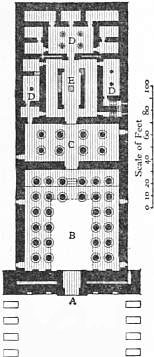
Fig. 1.—Plan of the Temple of Chons.
A, Pylon. B, Great court. C, Hall of columns. D, Priest’s hall. E, Sanctuary.
An avenue with sphinxes on both sides forms the approach to the temple. These avenues were sometimes of considerable length, as in the case of that reaching from Karnak to Luxor, which is 1½ m. long. The leading features of the temple (see fig. 1) were:—(A) The pylon, consisting of two pyramidal masses of masonry crowned with a cavetto cornice, united in the centre by an immense doorway, in front of which on either side were seated figures of the king and obelisks. (B) A great open court surrounded by peristyles on two or three sides. (C) A great hall with a range of columns down the centre on either side, forming what in European architecture would be known as nave and aisles, with additional aisles on each side; these had columns of less height than those first mentioned, so as to allow of a clerestory, lighting the central avenue. (D) Smaller halls with their flat roofs carried by columns. And finally (E) the sanctuary, with passage round giving access to the halls occupied by the priest.