VOLUME II SLICE IV Aram, Eugene to Arcueil (continued 3)
Reading edition
Thuja gigantea, the red or canoe cedar, a native of north-western America from southern Alaska to north California, is the finest species, the trunk rising from a massive base to the height of 150 to 200 ft. It was not introduced to Britain till 1853. It is one of the handsomest of conifers, forming an elongated cone of foliage, which in some gardens has already reached 70 or 80 ft. in height. It thrives in most kinds of soils. The timber is easily worked and used for construction, especially where exposed to the weather.
ARBOS, FERNANDEZ (1863- ), Spanish violinist and composer, was born in Madrid, and trained at the conservatoire there, and later at Brussels and at Berlin under Joachim. He became a professor at Hamburg and then at Madrid, becoming famous meanwhile as one of the finest violinists of the day; and after visiting England in 1890 and establishing his reputation there, he became professor at the Royal College of Music in London. As a composer he is best known by his violin pieces, and by a comic opera, El Centro de la Tierra (1895).
ARBOUR, or Arbor (originally “herber” or “erber,” O. Fr. herbier, from Lat. herbarium, a collection of herbs, herba, grass; the word came to be spelt “arber” through its pronunciation, as in the case of Derby, and by the 16th century was written “arbour,” helped by a confusion of derivation from Lat. arbor, a tree, and by change of meaning), a grass-plot or lawn, a herb-garden, or orchard, and a shady bower of interlaced trees, or climbing plants trained on lattice-work. The application of the word has shifted from the grass-covered ground, the proper meaning, to the covering of trees overhead. “Arbor” (from the Latin for “tree”) is a term applied to the spindle of a wheel, particularly in clock-making.
ARBROATH, or Aberbrothock, a royal, municipal and police burgh, and seaport of Forfarshire, Scotland. It is situated at the mouth of Brothock water, 17 m. N.E. of Dundee by the North British railway, which has a branch to Forfar, via Guthrie, on the Caledonian railway. Pop. (1891) 22,821; (1901) 22,398. The town is under the jurisdiction of a provost, bailies and council, and, with Brechin, Forfar, Inverbervie and Montrose, returns one member to parliament. The leading industries include the manufacture of sailcloth, canvas and coarse linens, tanning, boot and shoe making, and bleaching, besides engineering works, iron foundries, chemical works, shipbuilding and fisheries. The harbour, originally constructed and maintained by the abbots, by an agreement between the burgesses and John Gedy, the abbot in 1394, was replaced by one more commodious in 1725, which in turn was enlarged and improved in 1844. The older portion was converted into a wet dock in 1877, and the entrance and bar of the new harbour were deepened. A signal tower, 50 ft. high, communicates with the Bell Rock (q.v.) lighthouse on the Inchcape Rock, 12 m. south-east of Arbroath, celebrated in Southey’s ballad. The principal public buildings are the town-hall, a somewhat ornate market house, the gildhall, the public hall, the infirmary, the antiquarian museum (including some valuable fossil remains) and the public and mechanics’ libraries. The parish church dates from 1570, but has been much altered, and the spire was added in 1831. The ruins of a magnificent abbey, once one of the richest foundations in Scotland, stand in High Street. It was founded by William the Lion in 1178 for Tironesian Benedictines from Kelso, and consecrated in 1197, being dedicated to St Thomas Becket, whom the king had met at the English court. It was William’s only personal foundation, and he was buried within its precincts in 1214. Its style was mainly Early English, the western gable Norman. The cruciform church measured 276 ft. long by 160 ft. wide, and was a structure of singular beauty and splendour. The remains include the vestry, the southern transept (the famous rose window of which is still entire), part of the chancel, the southern wall of the nave, part of the entrance towers and the western doorway. It was here that the parliament met which on the 6th of April 1320 addressed to the pope the notable letter, asserting the independence of their country and reciting in eloquent terms the services which their “lord and sovereign” Robert Bruce had rendered to Scotland. The last of the abbots was Cardinal Beaton, who succeeded his uncle James when the latter became archbishop of St Andrews. At the Reformation the abbey was dismantled and afterwards allowed to go to ruin. Part of the secular buildings still stand, and the abbot’s house, or Abbey House as it is now called, is inhabited. Arbroath was created a royal burgh in 1186, and its charter of 1599 is preserved. King John exempted it from “toll and custom” in every part of England excepting London. Arbroath is “Fairport” of Scott’s Antiquary, and Auchmithie, 3 m. north-east (“Musselcrag” of the same romance), is a quaint old-fashioned place, where the men earn a precarious living by fishing. On each side of the village the coast scenery is remarkably picturesque, the rugged cliffs—reaching in the promontory of Red Head, the scene of a thrilling incident in the Antiquary, a height of 267 ft.—containing many curiously shaped caves and archways which attract large numbers of visitors. At the 14th-century church of St Vigeans, 1 m. north of Arbroath, stands one of the most interesting of the sculptured stones of Scotland, with what is thought to be the only legible inscription in the Pictish tongue. The parish—originally called Aberbrothock and now incorporated with Arbroath for administrative purposes—takes its name from a saint or hermit whose chapel was situated at Grange of Conon, 3½ m. north-west. Two miles west by south are the quarries of Carmyllie, the terminus of a branch line from Arbroath, which was the first light railway in Scotland and was opened in 1900.
ARBUTHNOT, ALEXANDER (1538-1583), Scottish ecclesiastic and poet, educated at St Andrews and Bourges, was in 1569 elected principal of King’s College, Aberdeen, which office he retained until his death. He played an active part in the stirring church politics of the period, and was twice moderator of the kirk, and a member of the commission of inquiry into the condition of the university of St Andrews (1583). The “correctness” of his attitude on all public questions won for him the commendation of Catholic writers; he is not included in Nicol Burne’s list of “periurit apostatis”; but his policy and influence were misliked by James VI., who, when the Assembly had elected Arbuthnot to the charge of the church of St Andrews, ordered him to return to his duties at King’s College. He had been for some time minister of Arbuthnott in Kincardineshire. His extant works are (a) three poems, “The Praises of Wemen” (224 lines), “On Luve” (10 lines), and “The Miseries of a Pure Scholar” (189 lines), and (b) a Latin account of the Arbuthnot family, Originis et Incrementi Arbuthnoticae Familiae Descriptio Historica (still in MS.), of which an English continuation, by the father of Dr John Arbuthnot, is preserved in the Advocates’ Library, Edinburgh. The praise of the fair sex in the first poem is exceptional in the literature of his age; and its geniality may help us to understand the author’s popularity with his contemporaries. Arbuthnot must not be confused with his contemporary and namesake, the Edinburgh printer, who produced the first edition of Buchanan’s History of Scotland in 1582. Some have discovered in the publication of this work a false clue to James’s resentment against the principal of King’s College.
The particulars of Arbuthnot’s life are found in Calderwood, Spottiswood, and other Church historians, and in Scott’s Fasti Ecclesiae Scoticanae. The poems are printed in Pinkerton’s Ancient Scottish Poems (1786), i. pp. 138-155.
ARBUTHNOT, JOHN (1667-1735), British physician and author, was born at Arbuthnott, Kincardineshire, and baptized on the 29th of April 1667. His father, Alexander Arbuthnot, was an episcopalian minister who was deprived of his living in 1689 by his patron, Viscount Arbuthnott, for refusing to conform to the Presbyterian system. After his death, in 1691, John went to London, where he lived in the house of a learned linen-draper, William Pate, and supported himself by teaching mathematics. In 1692 he published Of the Laws of Chance ..., based on the Latin version, De Ratociniis in ludo aleae, of a Dutch treatise by Christiaan Huygens. In 1692 he entered University College, Oxford, as a fellow-commoner, acting as private tutor to Edward Jefferys; and in 1696 he graduated M.D. at St Andrews university. In An Examination of Dr Woodward’s Account of the Deluge (1697) he confuted an extraordinary theory advanced by Dr William Woodward. An Essay on the Usefulness of Mathematical Learning followed in 1701, and in 1704 he became a fellow of the Royal Society. He had the good fortune to be called in at Epsom to prescribe for Prince George of Denmark, and in 1705 he was made physician extraordinary to Queen Anne. Four years later he became royal physician in ordinary, and in 1710 he was elected fellow of the Royal College of Physicians. Arbuthnot’s ready wit and varied learning made him very valuable to the Tory party. He was a close friend of Jonathan Swift and of Alexander Pope, and Lord Chesterfield says that even the generous acknowledgment they made of his assistance fell short of their real indebtedness. He had no jealousy of his fame as an author, and his abundant imagination was always at the service of his friends. In 1712 appeared “Law is a Bottomless Pit, Exemplify’d in the case of the Lord Strutt, John Bull, Nicholas Frog and Lewis Baboon, who spent all they had in a law-suit. Printed from a Manuscript found in the Cabinet of the famous Sir Humphrey Polesworth.” This was the first of a series of five pamphlets advocating the conclusion of peace. Arbuthnot describes the confusion after the death of the Lord Strutt (Charles II. of Spain), and the quarrels between the greedy tradespeople (the allies). These put their cause into the hands of the attorney, Humphrey Hocus (the duke of Marlborough), who does all he can to prolong the struggle. The five tracts are printed in two parts as the “History of John Bull” in the Miscellanies in Prose and Verse (1727, preface signed by Pope and Swift). Arbuthnot fixed the popular conception of John Bull, though it is not certain that he originated the character, and the lively satire is still amusing reading. It was often asserted at the time that Swift wrote these pamphlets, but both he and Pope refer to Arbuthnot as the sole author. In the autumn of the same year he published a second satire, “Proposals for printing a very Curious Discourse in Two Volumes in Quarto, entitled, Ψευδολογία Πολιτική; or, A Treatise of the Art of Political Lying,” best known by its sub-title. This ironical piece of work was not so popular as “John Bull.” “’Tis very pretty,” says Swift, “but not so obvious to be understood.” Arbuthnot advises that a lie should not be contradicted by the truth, but by another judicious lie. “So there was not long ago a gentleman, who affirmed that the treaty with France for bringing popery and slavery into England was signed the 15th of September, to which another answered very judiciously, not by opposing truth to his lie, that there was no such treaty; but that, to his certain knowledge, there were many things in that treaty not yet adjusted.”
Arbuthnot was one of the leading spirits in the Scriblerus Club, the members of which were to collaborate in a universal satire on the abuses of learning. The Memoirs of the extraordinary Life, Works, and Discoveries of Martinus Scriblerus, of which only the first book was finished, first printed in Pope’s Works (1741), was chiefly the work of Arbuthnot, who is at his best in the whimsical account of the birth and education of Martin. Swift, writing on the 3rd of July 1714 to Arbuthnot, says:—“To talk of Martin in any hands but yours, is a folly. You every day give better hints than all of us together could do in a twelvemonth: and to say the truth, Pope who first thought of the hint has no genius at all to it, to my mind; Gay is too young: Parnell has some ideas of it, but is idle; I could put together, and lard, and strike out well enough, but all that relates to the sciences must be from you.”
The death of Queen Anne put an end to Arbuthnot’s position at court, but he still had an extensive practice, and in 1727 he delivered the Harveian oration before the Royal College of Physicians. Lord Chesterfield and William Pulteney were his patients and friends; also Mrs Howard (Lady Suffolk) and William Congreve. His friendship with Swift was constant and intimate; he was friend and adviser to Gay; and Pope wrote (2nd of August 1734) that in a friendship of twenty years he had found no one reason of complaint from him. Arbuthnot’s youngest son, who had just completed his education, died in December 1731. He never quite recovered his former spirits and health after this shock. On the 17th of July 1734 he wrote to Pope: “A recovery in my case, and at my age, is impossible; the kindest wish of my friends is Euthanasia.” In January 1735 was published the “Epistle to Dr Arbuthnot,” which forms the prologue to Pope’s satires. He died on the 27th of February 1735 at his house in Cork Street, London.
Among Arbuthnot’s other works are:—An Argument for Divine Providence, taken from the constant regularity observed in the Births of both sexes (Phil. Trans. of the Royal Soc., 1710); “Virgilius Restauratus,” printed in the second edition of Pope’s Dunciad (1729); An Essay concerning the Effects of Air on Human Bodies (1733); An Essay concerning the Nature of Ailments ... (1731); and a valuable Table of Ancient Coins, Weights and Measures (1727), which is an enlargement of an earlier treatise (1705). He had a share in the unsuccessful farce of Three Hours after Marriage, printed with Gay’s name on the title-page (1717). Some pieces printed in A Supplement to Dr Swift’s and Mr Pope’s Works ... (1739) are there asserted to be Arbuthnot’s. The Miscellaneous Works of the late Dr Arbuthnot were published at Glasgow in an unauthorized edition in 1751. This includes many spurious pieces.
See The Life and Works of John Arbuthnot (1892), by George A. Aitken.
ARCACHON, a coast town of south-western France, in the department of Gironde, 37 m. W.S.W. of Bordeaux on the Southern railway. Pop. (1906) 9006. Arcachon is situated on the southern border of the lagoon of Arcachon at the foot of dunes covered with splendid pine-woods. It comprises two distinct parts, the summer town, extending for 2½ m. along the shore, and bordered by a firm sandy beach, frequented by bathers, and the winter town, farther inland, consisting of numerous villas scattered amongst the pines.
Owing to the mildness of its climate the winter town is a resort for consumptive patients. The principal industries are oyster-breeding, which is conducted on a very large scale, and fishing. The port has trade with Spain and England.
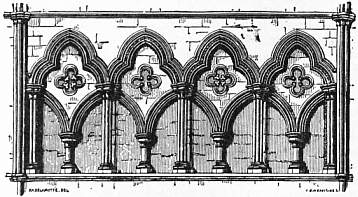
ARCADE, in architecture, a range of arches, supported either by columns or piers; isolated in the case of those separating the nave of a church from the aisles, or forming the front of a covered ambulatory, as in the cloisters in Italy and Sicily, round the Ducal Palace or the Square of St Mark’s, Venice, round the courts of the palaces in Italy, or in Paris round the Palais-Royal and the Place des Vosges. The earliest examples known are those of the Tabularium, the theatre of Marcellus, and the Colosseum, in Rome. In the palace of Diocletian at Spalato the principal street had an arcade on either side, the arches of which rested direct on the capital without any intervening entablature or impost block. The term is also applied to the galleries, employed decoratively, on the façades of the Italian churches, and carried round the apses where they are known as eaves-galleries. Sometimes these arcades project from the wall sufficiently to allow of a passage behind, and sometimes they are built into and form part of the wall; in the latter case, they are known as blind or wall arcades; and they were constantly employed to decorate the lower part of the walls of the aisles and the choir-aisles in English churches. Externally, blind arcades are more often found in Italy and Sicily, but there are examples in England at Canterbury, Ely, Peterborough, Norwich, St John’s (Chester), Colchester and elsewhere. Internally, the oldest example is that of the old refectory in Westminster Abbey (fig. 1). Sometimes the design is varied with interlacing arches as in St John’s Devizes (fig. 2), and Beverley Minster (fig. 3). In Sicily and the south of Italy these interlacing arcades are the special characteristic of the Saracenic work there found, and their origin may be found in the interlaced arches of the Mosque of Cordova in Spain. In the cathedral of Palermo and at Monreale they are carried round the apses at the east end. At Caserta-Vecchia, in South Italy, they decorate the lantern over the crossing, and at Amain the turrets on the north-west campanile.
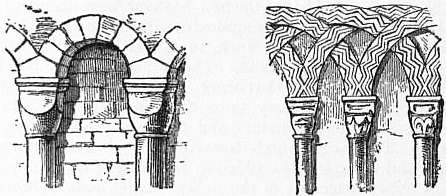
Fig. 1.—Arcade, Westminster Abbey. Fig. 2.—Arcade, St John’s, Devizes.
From Rickman’s Styles of Architecture, by permission of Parker & Co.
Fig. 3.—Triforium at Beverley.
The term is also applied to the covered passages which form thoroughfares from one street to another, as in the Burlington Arcade, London; in Paris such an arcade is usually called passage, and in Italy galleria.
(R. P. S.)
ARCADELT, or Archadelt, Jacob (c. 1514-c. 1556), a Netherlands composer, of the early part of the Golden Age. In 1539 he left a position at Florence to teach the choristers of St Peter’s, Rome, and became one of the papal singers in 1540. He was a prolific church composer, but the works published in his Italian time consist entirely of madrigals, five books of which, published at Venice, probably gave a great stimulus to the beginnings of the Venetian school of composition. In 1555 he left Italy and entered the service of Cardinal Charles of Lorraine, duke of Guise, and after this published three volumes of masses, besides contributing motets to various collections. The Ave Maria, ascribed to him and transcribed as a pianoforte piece by Liszt, does not seem to be traced to an earlier source than its edition by Sir Henry Bishop, which has possibly the same kind of origin in Arcadelt as the hymn tune “Palestrina” has in the delicate and subtle Gloria of Palestrina’s Magnificat Quinti Toni, the fifth in his first Book of Magnificats.
ARCADIA, a district of Greece, forming the central plateau of Peloponnesus. Shut off from the coast lands on all sides by mountain barriers, which rise in the northernpeaks of Erymanthus (mod. Olonos) to 7400, of Cyllene (Ziria) to 7900, in the southern corner buttresses of Parthenium and Lycaeum to more than 5000 ft., this inland plateau is again divided by numerous subsidiary ranges. In eastern or “locked” Arcadia these heights run in parallel courses intersected by cross-ridges, enclosing a series of upland plains whose waters have no egress save by underground channels or zerethra. The western country is more open, with isolated mountain-groups and winding valleys, where the Alpheus with its tributaries the Ladon and Erymanthus drains off in a complex river-system the overflow from all Arcadia. The ancient inhabitants were a nation of shepherds and huntsmen, worshipping Pan, Hermes and Artemis, primitive nature-deities. The difficulties of communication and especially the lack of a seaboard seriously hindered intercourse with the rest of Greece. Consequently the same population, whose origins Greek tradition removed back into the world’s earliest days, held the land throughout historic times, without even an admixture of Dorian immigrants. Their customs and dialect persisted, the latter maintaining a peculiar resemblance to that of the equally conservative Cypriotes. Thus Arcadia lagged behind the general development of Greece, and its political importance was small owing to chronic feuds between the townships (notably between Mantineia and Tegea) and the readiness of its youth for mercenary service abroad.
The importance of Arcadia in Greek history was due to its position between Sparta and the Isthmus. Unable to force their way through Argolis, the Lacedaemonians early set themselves to secure the passage through the central plateau. The resistance of single cities, and the temporary union of the Arcadians during the second Messenian war, did not defer the complete subjugation of the land beyond the 6th century. In later times revolts were easily stirred up among individual cities, but a united national movement was rarely concerted. Most of these rebellions were easily quelled by Sparta, though in 469 and again in 420 the disaffected cities, backed by Argos, formed a dangerous coalition and came near to establishing their independence. A more whole-hearted attempt at union in 371 after the battle of Leuctra resulted in the formation of a political league out of an old religious synod, and the foundation of a federal capital in a commanding strategic position (see Megalopolis). But a severe defeat at the hands of Sparta in 368 (the “tearless battle”) and the recrudescence of internal discord soon paralysed this movement. The new fortress of Megalopolis, instead of supplying a centre of national life, merely accentuated the mutual jealousy of the cities. During the Hellenistic age Megalopolis stood staunchly by Macedonia; the rest of Arcadia rebelled against Antipater (330, 323) and Antigonus Gonatas (266). Similarly the various cities were divided in their allegiance between the Achaean and the Aetolian leagues, with the result that Arcadia became the battleground of these confederacies, or fell a prey to Sparta and Macedonia. These conflicts seem to have worn out the land, which already in Roman times had fallen into decay. An influx of Slavonic settlers in the 8th century A.D. checked the depopulation for a while, but Arcadia suffered severely from the constant quarrels of its Frankish barons (1205-1460). The succeeding centuries of Turkish rule, combined with an Albanian immigration, raised the prosperity of the land, but in the Wars of Independence the strategic importance of Arcadia once more made it a centre of conflict. In modern times the population remains sparse, and pending the complete restoration of the water conduits the soil is unproductive. The modern department of Arcadia extends to the Gulf of Nauplia with a sea-coast of about 40 m.
Authorities.—Strabo pp. 388 sq.; Pausanias viii.; W.M. Leake, Travels in the Morea (London, 1830), chs. iii., iv., xi.-xviii., xxiii.-xxvi.; E. Curtius, Peloponnesos (Gotha, 1851), i. 153-178; H.F. Tozer, Geography of Greece (London, 1873), pp. 287-292; E.A. Freeman, Federal Government (ed. 1893, London), ch. iv. § 3; B.V. Head, Historia Numorum (Oxford, 1887), pp. 372-373; B. Niese in Hermes (1899), pp. 520 f.
(M. O. B. C.)
ARCADIUS (378-408), Roman emperor, the elder son of Theodosius the Great, was created Augustus in 383, and succeeded his father in 395 along with his brother Honorius. The empire was divided between them, Honorius governing the two western prefectures (Gaul and Italy), Arcadius the two eastern (the Orient and Illyricum). Both were feeble, and, in Gibbon’s phrase, slumbered on their thrones, leaving the government to others. Arcadius submitted at first to the guidance of the praetorian prefect Rufinus, and, after his murder (end of 395) by the troops, to the counsels of the eunuch Eutropius (executed end of 399). His consort Eudoxia (daughter of a Frank general, Bauto), a woman of strong will, exercised great influence over him; she died in 404. In the last year of his reign, Anthemius (praetorian prefect) was the chief adviser and support of the throne. The first years of the reign were marked by the ravaging of the Greek peninsula by the West Goths under Alaric (q.v.) in 395-396. The movement of the Goth Gainas (who held the post of master of soldiers) in 399-400 is less famous but was more dangerous. At that time there were two rival political parties at Constantinople, the “Roman” party led by Aurelian (son of Taurus), praetorian prefect, and supported by the empress and a Germanizing and Arianizing party led by Aurelian’s brother (possibly Caesarius, praetorian prefect in 400). Gainas entered into a close league with the latter; fomented a Gothic rebellion in Phrygia; and forced the emperor to put Eutropius to death. For some months he and the party which he supported were supreme in Constantinople. He was, however, finally forced to leave, and having plundered for some time in Thrace was captured and killed by the loyal Goth Fravitta. The Roman party recovered its power; Aurelian was again praetorian prefect in 402; and the Germanization which was to befall the western world was averted from the east. Another important question was decided in this reign, the relation of the patriarch of Constantinople to the emperor. The struggle between the court and the patriarch John Chrysostom (q.v.), who assumed an independent attitude and gravely offended the empress by his sermons against the worldliness and frivolity of the court, with open allusions to herself, resulted in his fall and exile (404). This virtually determined the subordination of the patriarch of Constantinople to the emperor. The rivalry of the see of Alexandria with Constantinople was also displayed in the contest, Theophilus, patriarch of Alexandria, assisting the court in bringing about the fall of Chrysostom. Throughout the reign of Arcadius there was estrangement and jealousy between the two brothers or their governments. The principal ground of this hostility was probably dissatisfaction on both sides with the territorial partition. The line had been drawn east of Dalmatia. The ministers of Arcadius desired to annex Dalmatia to his portion, while the general Stilicho, who was supreme in the west, wished to wrest from the eastern realm the prefecture of Illyricum or a considerable part of it. His designs were unsuccessful, and during the reign of Theodosius II., son of Arcadius (who died in 408), Dalmatia was transferred to the dominion of the eastern ruler.
Authorities.—Ancient: Fragments of Eunapius and Olympiodorus (in Müller’s Fragmenta Historicorum Graecorum, vol. iv.); fragments of Philostorgius, Socrates, Sozomen, Zosimus, Synesius of Cyrene (“The Egyptian”), Claudian. Modern: Gibbon’s Decline and Fall, vol. iii., ed. Bury; J.B. Bury, Later Roman Empire, vol. i. (1889); T. Hodgkin, Italy and her Invaders, vol. i. (ed. 2, 1892); Güldenpenning, Geschichte des ostromischen Reiches unter den Kaisern Arcadius und Theodosius II. (1885).
ARCADIUS, of Antioch, Greek grammarian, flourished in the 2nd century A.D. According to Suidas, he wrote treatises on orthography and syntax, and an onomaticon (vocabulary), described as a wonderful production. An epitome of the great work of Herodian on general prosody in twenty books, wrongly attributed to Arcadius, is probably the work of Theodosius of Alexandria or a grammarian named Aristodemus. This epitome (Περὶ Τόνων) only includes nineteen books of the original work; the twentieth is the work of a forger of the 16th century. Although meagre and carelessly put together, it is valuable, since it preserves the order of the original and thus affords a trustworthy foundation for its reconstruction.
Text by Barker, 1823; Schmidt, 1860; see also Galland, De Arcadii qui fertur libra de accentibus (1882).
ARCELLA (C.G. Ehrenberg), a genus of lobose Rhizopoda, characterized by a chitinous plano-convex shell, the circular aperture central on the flat ventral face, and more than one nucleus and contractile vacuole. It can develop vacuoles, or rather fine bubbles of carbonic acid gas in its cytoplasm, to float up to the surface of the water.
ARCESILAUS (316-241 B.C.), a Greek philosopher and founder of the New, or Middle, Academy (see Academy, Greek). Born at Pitane in Aeolis, he was trained by Autolycus, the mathematician, and later at Athens by Theophrastus and Crantor, by whom he was led to join the Academy. He subsequently became intimate with Polemon and Crates, whom he succeeded as head of the school. Diogenes Laërtius says that he died of excessive drinking, but the testimony of others (e.g. Cleanthes) and his own precepts discredit the story, and he is known to have been much respected by the Athenians. His doctrines, which must be gathered from the writings of others (Cicero, Acad. i. 12, iv. 24; De Orat. iii. 18; Diogenes Laërtius iv. 28; Sextus Empiricus, Adv. Math. vii. 150, Pyrrh. Hyp. i. 233), represent an attack on the Stoic φαντασία καταληπτική (Criterion) and are based on the sceptical element (see Scepticism) which was latent in the later writings of Plato. He held that strength of intellectual conviction cannot be regarded as valid, inasmuch as it is characteristic equally of contradictory convictions. The uncertainty of sensible data applies equally to the conclusions of reason, and therefore man must be content with probability which is sufficient as a practical guide. “We know nothing, not even our ignorance”; therefore the wise man will be content with an agnostic attitude. He made use of the Socratic method of instruction and left no writings. His arguments were marked by incisive humour and fertility of ideas.
See R. Brodeisen, De Arcesila philosopho (1821); Aug. Geffers, De Arcesila (1842); Ritter and Preller, Hist, philos. graec. (1898); Ed. Zeller, Phil. d. Griech. (iii. 1448); and general works under Scepticism.
ARCH, JOSEPH (1826- ), English politician, founder of the National Agricultural Labourers’ Union, was born at Barford, a village in Warwickshire, on the 10th of November 1826. His parents belonged to the labouring class. He inherited a strong sentiment of independence from his mother; and his objections to the social homage expected by those whom the catechism boldly styled his “betters” made him an “agitator.” Having educated himself by unremitting exertions, and acquired fluency of speech as a Methodist local preacher, he founded in 1872 the National Agricultural Labourers’ Union, of which he was president. A rise then came in the wages of agricultural labourers, but this had the unforeseen effect of destroying the union; for the labourers, deeming their object gained, ceased to “agitate.” Mr Arch nevertheless retained sufficient popularity to be returned to parliament for north-west Norfolk in 1885; and although defeated next year owing to his advocacy of Irish Home Rule, he regained his seat in 1892, and held it in 1895, retiring in 1900. He was deservedly respected in the House of Commons; seldom has an agitator been so little of a demagogue.
A biography written by himself or under his direction, and edited by Lady Warwick (1898), tells the story of his career.
ARCH,1 in building, a constructional arrangement of blocks of any hard material, so disposed on the lines of some curve that they give mutual support one to the other.
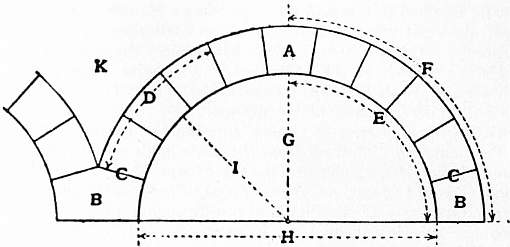
Fig. 1.
The blocks, which are technically known as voussoirs, should be of a wedge shape, the centre or top block (see fig. 1, A) being the keystone A; the lower blocks B B which rest on the supporting pier are the springers, the upper surface of which is called the skewback, C C; the side blocks, as D, are termed the haunches. The lower surface or soffit of the arch is the intrados, E, and the upper surface the extrados, F. The rise of the arch is the distance from the springing to the soffit, G, the width between the springers is called the span, H, and the radius I. The triangular spaces between the arches are termed spandrils, K.
The arch is employed for two purposes:—(1) to span an opening in a wall and support the superstructure; (2) when continuous to form a vault known as a barrel or waggon vault.
The arch has been used from time immemorial by every nation, but owing to the tendency of the upper portion to sink, especially when bearing any superincumbent weight, it requires strong lateral support, and it is for this reason that in the earliest examples in unburnt brick at Nippur in Chaldaea, c. 4000 B.C., and at Rakakna (Requaqna) and Dendera in Egypt, 3500-3000 B.C., it was employed only below the level of the ground which served as an abutment on either side.
In the building of an arch, the voussoirs have to be temporarily supported, until the keystone is inserted. This at the present day is effected by means of centreing an assemblage of timbers framed together, with its upper surface of the same form as the arch required; the voussoirs are laid on the centreing till the ring of the arch is completed. In the case of arches of small span, such as the early examples referred to, limited to about 6 ft., such centreing might be dispensed with in various ways, but it is difficult to see how the arches of the great entrance gateways, shown in the Assyrian bas-reliefs, could have been built without temporary support of some kind. In those days, when any amount of labour could be obtained, even the erection of a temporary wall might have been less costly than the employment of timber, of which there was great scarcity.
The Assyrian tradition would seem to have descended first to the Parthian builders, who in the palace of El Hadr built semicircular arches with regular voussoirs decoratively treated. The Sassanians who followed them employed the elliptical or egg-shaped arch, of which the lower part was built in horizontal courses up to about one-third of the height, which lessened the span of the arched portion.
In Europe the earliest arches were those built by the Etruscans, either over canals (see article Architecture: Etruscan), or in the entrance gateways of their towns. The skew-arch in the gateway at Perugia shows great knowledge in its execution. From the Etruscans the adoption of the arch passed to the Romans, who certainly employed centreing of some kind, but always economized its use, as is clearly shown by Choisy. Although their walls from the Augustan age were built in concrete, arches of brick were always turned over their entrance doorways, sometimes in two or three rings. The Romans utilized the arch in other ways, sometimes burying it in their concrete construction, as in their vaults, and sometimes introducing it as a veneer only, as in the Pantheon. In their monumental structures in stone, the arch was sometimes built with regular voussoirs, i.e. with a semicircular extrados, and sometimes with the joint carried far beyond. The latter was not done in the early examples of the Tabularium and the Theatre of Marcellus, but in the Colosseum and all the arches of triumph the joints run through the spandrils, notwithstanding the recognition of the arch proper by its moulded archivolt.
Although the value of the pointed arch as a stronger constructional feature than the semicircular (owing to the tendency to sink in the keystone of the latter) had been recognized by the Assyrian builders, who employed it in their drains, it was not used systematically as an architectural feature till the 9th century, in the mosque of Tulun at Cairo; it seems to have been regarded by the Mahommedans as an emblem of their faith, and its use spread through Syria to Persia, was brought to Sicily from Egypt, and was taken back by the Sicilian masons to Palestine and employed throughout the Crusaders’ churches during the 12th century. As the pointed arch had already, for constructional reasons, been employed in Périgord from the commencement of the 11th century, it does not follow that the Crusaders brought it from Palestine, but there is no doubt that its universal employment in France early in the 12th century may have been partly due to its adoption in the Crusaders’ churches. At first in Gothic work both the semicircular and pointed arches were used simultaneously in the same building, the larger arches being pointed, the smaller ones and windows being semicircular. The great value of the pointed arch in vaulting is described in the article Vault.
We have suggested that the pointed arch became an emblem of Mahommedan faith, and it was introduced in India but not as a constructive feature, for the Hindus objected to the arch, which they say never sleeps, meaning that it is always exerting a thrust which tends to its destruction. In India therefore it was built in horizontal courses with vertical slabs leaning against one another to form the apex. The Moors of north Africa, however, never employed it, preferring the horseshoe arch which they brought into Spain and developed in the mosque of Cordova. In the additions made to this mosque the prayer chamber was enriched by the caliph Mansur, who, to eke out the height, raised arch upon arch. In the Alhambra it appears in the decorative plaster work, and travels northwards into the south of France, where at Le Puy and elsewhere it is found decorating doorways and windows; in England it was employed towards the end of the 12th century.
About the middle of the 14th century at Gloucester the four-centred pointed arch was introduced, which became afterwards the leading characteristic feature of the Tudor style. In France they adopted the three-centred arch in the 15th century.
The ogee arch was the natural result of the development of tracery in the commencement of the 14th century, and in Gloucester (about 1310) the foliations were run one into the other without the enclosing circles. About the middle of the 14th century, in the arcade of the first storey of the ducal palace in Venice, flowing tracery is found, from which the ogee arch there was probably derived, as throughout Venice it becomes the favourite feature in domestic architecture of that and the succeeding century.
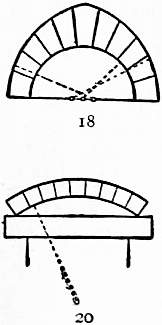
The arches are of various forms as follows:—


2. Semicircular arch, the centre of which is in the same line with its springers.
3. Segmental arch, where the centre is below the springing.
4. Horseshoe arch, with the centre above the springing; employed in Moorish architecture.
5. Stilted arches, where the centre is below the springing, but the sides are carried down vertically.
6. Equilateral pointed arches, described from two centres, the radius being the whole width of the arch.
7. Drop arches, with centres within the arch.
8. Lancet arches, with centres outside the arch.
9. Three centre arches, employed in French Flamboyant.
10. Four centre arches, employed in the Perpendicular and Tudor periods.
11. Ogee arches, with curves of counter flexure, found in English Decorated and French Flamboyant.
12. Pointed horseshoe arches, found in the mosque of Tulun, Cairo, 9th century.
13. Pointed foiled arches, in the arcades of Beverley Minster (c. 1230) and Netley Abbey.
14. Cusped arch; Christchurch Priory, Hants.
15. Multifoil cusped arch, invented by the Moors at Cordova in the 10th century.
16. Flat arch, where the soffit is horizontal and sometimes slightly cambered (dotted line).
17. Upright elliptical arch, sometimes called the egg-shaped arch, employed in Egyptian and Sassanian architecture.
18. The Tuscan arch, where the extrados takes the form of a pointed arch.
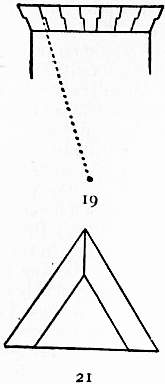
19. The joggled arch used in medieval chimneypieces and in Mahommedan architecture.
20. The discharging or relieving arch, built above the architrave or lintel to take off the weight of the superstructure.
21. The relieving arch as used in Egypt, in the pyramid of Cheops; and in Saxon architecture, where it was built with Roman bricks or tiles, or consisted of two sloping slabs of stone.
(R. P. S.)
1 The ultimate derivation of “arch” is the Latin arcus, a bow, or arch, in origin meaning something bent, from which through the French is also derived “arc,” a curve. In French there are two words arche, one meaning a chest or coffer, from Latin arca (arcere, to keep close), hence the English “ark”; the other meaning a vaulted arch, such as that of a bridge, and derived from a Low Latin corruption of arcus, into arca (du Cange, Glossarium, s.v.). The word “arch,” prefixed to names of offices, seen in “archbishop,” “archdeacon,” “archduke,” &c., means “principal” or “chief,” and comes from the Greek prefix ἀρχ- or ἀρχι- from ἄρχειν, to begin, lead, or rule; it is also prefixed to other words, and usually with words implying hatred or detestation, such as “arch-fiend”, “arch-scoundrel”; it is from an adaptation of this use, as seen in such expressions as “arch-rogue,” extended to “arch-look,” “arch-face,” that the word comes to mean a mischievous, roguish expression of face or demeanour.
ARCHAEOLOGY (from Gr. ἀρχαῖα, ancient things, and λόγος, theory or science), a general term for the study of antiquities. The precise application of the term has varied from time to time with the progress of knowledge, according to the character of the subjects investigated and the purpose for which they were studied. At one time it was thought improper to use it in relation to any but the artistic remains of Greece and Rome, i.e. the so-called classical archaeology (now dealt with in this encyclopaedia under the headings of Greek Art and Roman Art); but of late years it has commonly been accepted as including the whole range of ancient human activity, from the first traceable appearance of man on the earth to the middle ages. It may thus be conceived how vast a field archaeology embraces, and how intimately it is connected with the sciences of geology (q.v.) and anthropology (q.v.), while it naturally includes within its borders the consideration of all the civilizations of ancient times.
In dealing with so vast a subject, it becomes necessary to distinguish. The archaeology of zoological species constitutes the sphere of palaeontology (q.v.), while that of botanical species is dealt with as palaeobotany (q.v.); and every different science thus has its archaeological side. For practical purposes it is now convenient to separate the sphere of archaeology in its relation to the study of the purely artistic character of ancient remains, from that of the investigation of these remains as an instrument for arriving at conclusions as to the political and social history of the nations of antiquity; and in this work the former is regarded primarily as “art” and dealt with in the articles devoted to the history of art or the separate arts, while “archaeology” is particularly regarded as the study of the evidences for the history of mankind, whether or not the remains are themselves artistically and aesthetically valuable. In this sense a knowledge of the archaeology is part of the materials from which every historical article in this encyclopaedia is constructed, and in recent years no subject has been more fertile in yielding information than “archaeology,” as representing the work of trained excavators and students of antiquity in all parts of the world, but notably in the countries round the Mediterranean. It is for its services in illuminating the days before those of documentary history and for checking and reinforcing the evidence of the raw material (the “unwritten history” of architecture, tombs, art-products, &c.), that recent archaeological work has been so notable. The work of the literary critic and historian has been amplified by the spade-work of the expert excavator and explorer to an extent undreamt of by former generations; and ancient remains, instead of being treated merely as interesting objects of art, have been forced to give up their secret to the historian, as evidence for the period, character and affiliations of the peoples who produced and used them. The increase of precise knowledge of the past, due to greater opportunities of topographical research, more care and observation in dealing with ancient remains and improved methods of studying them in museums (q.v.) and collections, has led to more accurate reading of results by a comparison of views, under the auspices of learned societies and institutions, thus raising archaeology from among the more empirical branches of learning into the region of the more exact sciences. This change has improved not only the status of archaeology but also its material, for the higher standard of work now demanded necessarily acts as a deterrent on the poorly equipped worker, and the tendency is for the general result to be of a higher quality.
The archaeological details concerning all subjects which have their “unwritten history” are dealt with in the separate articles in this work, including the ancient civilizations of Assyria, Egypt and other countries and peoples, while the articles on separate sites where excavations have been particularly noteworthy may be referred to for their special interest; see also Anthropology; Ethnology, &c. It remains here to deal generally with the early conditions of the prehistoric ancient world in their broader aspects, which constitute the starting-place for the archaeologist in various parts of the world at different times, and the foundations of our present understanding of the primitive epochs in the history of man.
The beginning of archaeology, as the study of pre-documentary history, may be broadly held to follow on the last of the geological periods, viz., the Quaternary, though it is claimed, and with some reason, that traces of man have been found in Quaternary period. deposits of the preceding or Tertiary period. Although there is no valid reason against the existence of Tertiary man, it must be confessed that the evidence in favour of the belief is of a very inconclusive and unconvincing kind. The discussion has been mainly confined to the two questions (1) whether the deposit containing the relics was without doubt of Tertiary times, and (2) whether the objects found showed undoubted signs of human workmanship. Vast quantities of material have been brought forward, and endless discussions have taken place, but hitherto without carrying entire conviction to the minds of the more serious and cautious students of prehistoric archaeology. A chronic difficulty, and one which can never be entirely removed, is our ignorance of the precise methods of nature’s working. It is an obvious fact, that natural forces, such as glacial action, earthquakes, landslips and the like, must crush and chip flints and break up animal remains, grinding and scratching them in masses of gravel or sand. If it were possible to determine with precision what’ were the peculiarities of the flint or bone, thus altered by natural agencies, it would be easy to separate them from others purposely made by man to serve some useful end. Our present knowledge, however, does not allow us to go so far in dealing with the ruder early attempts of man to fabricate weapons or implements. Even the one feature that is commonly held to determine human agency, the “bulb of percussion,” cannot be considered satisfactory, without collateral evidence of some kind. Flint breaks with what is called a conchoidal fracture, as do many other substances, such as glass. Thus on the face of a flint flake, at the end where the blow was delivered to detach it from the nodule, is seen a lump or bulb, which is usually regarded as evidence of human workmanship. To produce such a bulb it is necessary to deliver a somewhat heavy blow of a peculiar kind at a particular point of a flattened surface; and the operation requires a certain amount of practice. The fulfilment of all the necessary conditions might well be a rare occurrence in nature, and the bulb of percussion has come to be regarded as the hall-mark of human manufacture; but recent investigations have shown that the intervention of man is not necessary and that natural forces frequently produce a similar result. When, therefore, it is a question whether or no a group of rude flints are of human workmanship, evidence of design or purpose in their forms must be established. If this be found, and in addition if a number of flints, all having this character of design, be found together, then and then only is it safe to admit them into the domain of archaeology. There can be no doubt that much time and energy have been wasted, and a number of intelligent workers have been fruitlessly occupied in following up archaeological will-o’-the-wisps, through neglecting this elementary precaution.
Whether or no man produced flint implements before Quaternary times, it would seem to be a necessity that he should have passed through an earlier stage, before arriving at the precision of workmanship and the fixed types Eolithic. found in the old Stone Age deposits known as palaeolithic. It is now claimed that this earlier and ruder stage has actually been discovered in what are known as the Plateau-gravels of Kent, in Belgium, and even in Egypt, and the name of eolithic (ἠὠς, dawn, λίθος, stone) has been bestowed upon them. The controversy as to the human character has been very keen, some alleging that the fractured edges and even the definite and fairly constant types are entirely produced by natural forces. Sir Joseph Prestwich in England, and Alfred Rutot in Belgium, the latter arguing from his own discoveries in that country, have strongly supported the artificial character of the relics. On the other hand it is pointed out that the existence of these implements on the high levels of Kent furnished confirmation of Sir Joseph Prestwich’s theory of the submergence of the district, and that his support was thus somewhat biassed, while the geological conditions in Belgium are not quite comparable with those of the Kent plateau; and the Belgian evidence, whatever it may be worth in itself, is of no avail as corroboration of the Kentish case. It is to be regretted that the conditions are not more convincing, for, as stated above, they agree fairly well with the evolution theory of man’s handiwork, and if they could be accepted, would carry back the evidences to a more remote time when the physical features of Kent were of a very different character. The critics of eoliths have brought forward some facts that at first sight would seem to be of a very damaging nature. It was observed that in the process of cement manufacture the flints that had passed through a rotary machine in which they were violently struck by its teeth or knocked against each other, possessed just those features that were claimed as indisputable proof of man’s handiwork, and that even the forms were the same. These statements have, of course, been met by counter-statements equally forcible, and the matter may still be considered to be in suspense. The great struggle, therefore, is now more closely restricted to the nature of the chipping than as to the quasi-geological question, and if the solution is ever to be found, it will be by means of a closer examination and a better understanding of the difference between intentional and accidental flaking.
On reaching the Palaeolithic period we come to firmer ground and to evidence that is more certain and generally accepted. This evidence is fundamentally geological, inasmuch as the age of the archaeological remains is dependent Palaeolithic. upon that of the beds in which they are found. That they were deposited at the same time is now no longer questioned. The flints are found to have the same colour and surface characteristics as the unworked nodules among which they lie, and are generally rolled and abraded in the same way. This in itself suffices to show that the worked and unworked flints were deposited in their present stratigraphical position at the same time. The remote age of the beds themselves is demonstrated by the presence of bones of animals either now extinct or found only in far distant latitudes, such as the mammoth, reindeer, rhinoceros, &c., and in some cases these bones are found in such relative positions as to prove they were deposited with the flesh still adhering to them, and also that the animal was contemporary with the makers of the flint implements. Evidence of a somewhat different kind is provided for the palaeolithic period by certain caverns that have been discovered in England and on the continent. In these limestone caves palaeolithic man has lived, slept, eaten his food and made his tools and weapons. Much of his handiwork has been left, with the bones of animals on which he lived, scattered upon the floor of the cave, and has been sealed up by the infiltration of lime-charged water, so that the deposit remains, untouched to our own day, below an impermeable bed of stalagmite. In such circumstances there can be no doubt of the contemporaneous character of the remains, natural or artificial, if found on the same level. Moreover, so far as type is a criterion of age, the flint tools found in the cave deposits tend to confirm the date assigned to those of the river-gravels.
It is fairly certain that about the middle of the Tertiary period the northern hemisphere possessed a temperate climate, such that even the polar regions were habitable. But the physical aspect of northern Europe was very different from that of Quaternary times. North of a line drawn roughly from southern England to St Petersburg all was sea. It was during the latter half of the Tertiary period that the continent assumed its present general form, though even in Pleistocene (Quaternary) times England and Ireland formed part of it. The great change of climate from temperate to arctic conditions during the latter half of the Tertiary period has been interpreted in various ways, no one of which is yet universally accepted. There can be little doubt, however, that no single cause was responsible for so complete a change. There may have been some alteration in the relative positions of the earth and the sun, which would conceivably have produced it; but what is practically certain is that the physical geography of northern Europe was affected by considerable difference in level, and it is clear that the raising of mountain ranges and the general elevation of the continent must necessarily have reacted on the climatic conditions. If in the later Tertiary time we find that the Alps, the Carpathians and the Caucasus have come into existence, it is not surprising to find that these huge condensers have brought about a humid condition of the continent to such an extent that this phase has been called the Pluvial Age. The humidity, however, was in some ways only a secondary result of the protrusion of high mountain ranges. The primary cause of the physical conditions that we now find in the valleys and plains was the formation of glaciers. These rivers of ice descending far into the lower levels during the winter months, melted during the summer, causing enormous volumes of water to rush through the valleys and over the plains, carrying with it masses of mud and boulders which were left stranded sometimes at immense distances. The intensity and force of the rivers thus formed would depend upon two factors, first the extent of the watershed, and secondly, the height of the mountains from which the water was derived. The result of increasing cold was that in course of time the northern hemisphere was surmounted by a cap of ice, of immense thickness (about 6000 ft.) in the Scandinavian area and gradually becoming thinner towards the south, but at no time does it seem to have extended quite to the south of England. This is proved by the absence of boulder-clay (glacial mud) in the districts south of London. These arctic conditions were not, however, continuous, but alternated with periods of a much less rigorous temperature during what has been called the Ice Age. Remains both of mammals and plants have been found, under conditions that are held to prove this alternation.
Such being the natural forces at work remodelling the surface of the earth; forces of such gigantic power as to be almost inconceivable in these more placid times, it can easily be understood how, in the course of the many thousands of years before the Quaternary period, when the surface of the globe attained its present aspect, the powerful river-systems of Europe wore their beds deep into the solid rocks. In some cases in Europe the erosive power of the river has worn through its bed to such an extent that the present stream is some hundreds of feet lower than its forerunner in palaeolithic times. From various causes, however, the rivers did not always wear for themselves a deep channel, but spread themselves over a wide area. This seems to have been the case with the Thames near London: the river-bed is not of any great depth, but at various periods it has occupied the space between Clapton on the north-east and Clapham on the south-west. It must not be assumed that the whole of this area of 7 m. or more was filled by the river at any one time, but rather that during the course of the palaeolithic period the river had its bed somewhere between these two limits. For instance, it is probable that at one period the bank of the Thames was at a point nearly midway between the northern and southern limits, where Gray’s Inn Road now stands. It was here that the earliest recorded palaeolithic implement (now in the British Museum) was found towards the close of the 17th century in association with mammoth bones. But it is safe to say that the Thames was a very much wider and more imposing river in palaeolithic times than it is now, when its average width at London is under 300 yds. As, in the course of ages, it changed its bed and by degrees lessened in size and volume, it would leave, on the terraces formed on its banks, the deposits of brick-earth and gravel brought down by the stream, and it is on these terraces that the relics of palaeolithic man are found, sometimes in great quantities. It will be obvious from the nature of the case that the highest terraces, and those farthest apart, should contain the earliest implements; but it is by no means easy in the present state of the land surface and with our present knowledge, to place the remains in their relative sequence. More accurate observation, and a better understanding of the conditions under which these deposits were made, should solve many such problems. Much light has been thrown upon many points by Worthington Smith, who has excavated with great care two palaeolithic floors at Clapton and at Caddington near Dunstable. The latter discovery was of quite exceptional interest as confirming the geological evidence by that of archaeology. In this case the original level at which palaeolithic man had worked was clearly defined, and was prolific of dark-grey implements, which had evidently been made on the spot, as Smith found that many of the flakes could be replaced on the blocks or cores from which they had been struck by palaeolithic man; there were also the flint hammers that had been used in the operation. Above the floor was a layer of brick-earth, again covered by contorted drift, in which also implements occurred, but of a very different kind from those found below. In place of being sharp and unabraded, and with the refuse flakes accompanying them, they were rolled and disfigured, of an ochreous tint, and evidently had been transported in the drift from a much higher level now no longer existing, as the site where they occurred is the highest in the vicinity, about 500-600 ft. above sea-level. Here then we have a clear case of palaeolithic man being compelled to abandon his working place on the lower level by the descent of the waters containing the products of his own forerunners, probably then very remote. In this case the sequence of the various strata may be considered certain, and the remains thus accurately determined and correlated are naturally of extreme value and importance. But even this does not enable us to diagnose another discovery unless the internal evidence is equally clear and conclusive. One point of importance that may be noted is that the older abraded implements were mostly of the usual drift type, while the more recent ones from the “floor” contained forms more highly developed and elaborated, such as occur in the French caves. Explorations of this kind, carefully conducted in a strictly scientific spirit by men of training and intelligence, are the only means by which real progress will be made in this puzzling branch of archaeology.
Although many problems yet remain to be solved in England, its small area, and the relatively large number of workers, have together sufficed to put the main facts of the earlier stages of man’s existence on a fairly satisfactory basis. In France, owing to the richness of the results, a great number of trained and ardent workers have made equal, if not better, progress. But unfortunately the real scientific spirit is not invariably found. Not so long ago an apparently serious writer in a well-known scientific magazine gave a detailed account of his studies in primitive methods and explained at great length his attempts at the manufacture of flint and stone implements. He found by the processes he adopted that it was much more easy for him to produce a polished implement than one merely flaked. From this fact he seriously argued that a great mistake had been made in the relative ages of the neolithic and palaeolithic periods, and that the former must necessarily be the older of the two. The evidence of geological position and of the mammalian remains accompanying the obviously older flints was entirely disregarded, just as on the other hand it was forgotten that in regard to neolithic remains the proofs were in every way in favour of a relatively modern origin. Such attempts not only bring the serious study of early man into disrepute, but tend to retard the progress of real knowledge and are therefore to be deplored and when possible discouraged.
Caves (q.v.) have been at all periods regarded as something uncanny and mysterious, with perhaps a tinge of the supernatural. In classical times they were associated with semi-divine beings, with oracles, and even with the Cave Period. gods themselves, while half the legends of dwarfs and gnomes that run through the folk-lore of medieval and modern Europe are associated with caves. They have been used as shelters or habitations at all times, and in examining them it is fully as necessary to sift the evidence of age as it would be in dealing with the river-gravels. Their exploration in the first instance may well have been due to chance, but it is fairly certain that during the 16th century the search for the horn of the unicorn as an antidote to disease, was responsible for the opening up of a certain number. Among the finds were no doubt the fossil bones of Quaternary animals to which mythical names and imaginary properties were attached, and the popular belief in such amulets naturally gave a great impetus to the search. It is, however, only a little more than a century ago that these investigations took anything like a scientific turn, and even then they had only a palaeontological end in view. The idea that archaeology entered into the matter was not at all realized for some years. The remains of many extinct or migrated animals, such as the hyena, grizzly bear, reindeer and bison, were found in quantities in the now famous cave at Gailenreuth in Franconia; and later, William Buckland explored the equally well-known hyena-cave at Kirkdale in Yorkshire, where he demonstrated that these animals had lived on the spot, feeding on the mammoth, rhinoceros and other creatures that had been their prey. The remains of man, however, had not been found, nor were they even looked for. It was not until Kent’s cavern, near Torquay, was examined by the Rev. J. McEnery, that man was clearly proved to have been contemporary with these extinct beasts. So contrary was this contention to the ideas prevalent in the second quarter of the 19th century, that the pioneer in this work had died (in 1841) before the immense importance of his discovery was admitted. To Godwin Austen in the first place and to W. Pengelley in the second, with the aid of the British Association, was due the vindication of McEnery’s veracity and accuracy.
Several circumstances conspire to give a special interest to Kent’s cavern, and not the least is the fact that the age and appearance of the various strata indicate that it has been the home or the refuge of human beings at all ages even up to medieval times, and perhaps from a period even more remote than is the case elsewhere. In the black mould that formed the uppermost layer were found fragments of medieval pottery, and relatively in close proximity were ancient British and Roman remains as well as relics of the earliest days of metallurgy, in the shape of bronze fragments. The two thousand years or more that may have separated the oldest from the most modern of these later products, is as nothing in comparison with the immense intervals that lie between the earliest of them and the infinitely more remote period when gigantic mammals first inhabited the cave. Attempts have been made from time to time to express in years what the interval must have been: but as the computations have differed by hundreds of thousands of years, according to the method adopted, it is scarcely wise to do more than speculate. Beneath the black mould, containing what may be called the recent remains, was a layer of stalagmite, some feet in thickness; and under this at one place was a great quantity of charcoal, which has been with good reason assumed to show the site of fireplaces. A quantity of implements of palaeolithic type was found, but the main layer at this level consisted of a reddish clay known as cave-earth, and in this deposit were implements both of flint and horn, as well as bones of extinct animals. The flint implements were mostly of the usual river-drift type, but some were of types generally confined to cave-deposits of this period; while the barbed harpoon heads, and more especially a bone needle, were definitely of the cave class, so well represented in the caves of Dordogne. Again, below the cave-earth was a breccia formed of limestone and sandstone pebbles cemented together by a calcareous paste. In this also were found implements and bones of bears.
The succession of strata indicated above may be taken as typical of the caverns used by palaeolithic man, the breccia and stalagmite flooring being in themselves proof of a very considerable age, while the association in the former, or under the latter, of remains of human handiwork, with bones of extinct animals, may be safely taken to show contemporaneous existence.
Once the mind has fairly grasped the fact that man was living at so remote a time, it is a simple and natural conclusion that he should have provided himself with weapons and tools more or less rudely fashioned from the stones he found ready to his hand. The analogy of the recently extinct Tasmanian is sufficient to show that even the meanest savage is not without such aids. But the caves of France, of the same palaeolithic period, and used by men theoretically in the same stage of culture, bring before us a race of artists of first-rate capacity, who for accuracy of observation, and for skill in indicating the character and peculiarities of the animals around them, have never been surpassed. Such a statement sounds like a contradiction in terms. We are dealing with human beings whose intellect, to judge by their physical characters, should be on a level with that of the Fuegian or the Australian black, and far below that of the Maori or the Sandwich Islander. Yet none of these gentle and relatively cultured brown races produced anything in the nature of art that can in any sense be compared with the masterly drawings or sculptures of the cave-men of France. The best-known of the engravings, that of the mammoth on a piece of ivory, is in the Jardin des Plantes in Paris. It is evidently intended to be nothing more than a sketch, the lines of the finely curved tusks being repeated several times in the desire for accuracy. But the heavy lumbering walk of the ponderous beast, his attitude, and even the character of the hairy hide, are all shown or suggested with a skill and freedom that not only denotes daily familiarity with the thing represented, but a most complete mastery of the art of translating the idea into simple line. This mammoth-drawing is probably the most important and monumental of its class, but there are many others that possess artistic qualities not less remarkable, while they have in addition a grace and beauty of line not less astonishing. One of these, in the British Museum, the head of an ibex-like creature, is outlined with a decision and refinement that can scarcely be surpassed, and many other sketches in horn or stone in the same collection show a keen appreciation of the characteristic features of the different animals as well as a masterly deftness in the handling of the graving-tool. If we are forced to marvel at the graphic skill of the cave-men, their sculptures in the round are on a still higher plane, as may be seen in the figures of reindeer in ivory in the British Museum. While they are not highly finished, they show a complete understanding of the animal’s peculiar forms and contours, which are rendered in a direct, unhesitating way that should betoken a long period of artistic training and an executive power uncommon at any time. These drawings and sculptures have always been appreciated and even regarded as being of a much more advanced style than was to be expected among men who are always classed in the lower grades of culture. But enough stress has not hitherto been laid on the artistic quality of the work, which would be considered fine at any time in the world’s history. This high artistic level was attained by a race of men whom we cannot credit with any great intellectual equipment; men, moreover, who were engaged in a daily struggle for the barest necessaries of life, in a trying climate and surrounded by a fauna whose means of attack and defence were infinitely superior to their own. There are many astonishing problems in archaeology, but none so badly in need of solution. Had the discovery been confined to a single drawing or even to a single site, fraud or a misreading of the conditions might have been alleged, but the case is very different. The drawings and sculptures have been found generally enough in France to demonstrate that such artistic power was fairly common, while the question of the authenticity and period of the discoveries has long since been satisfactorily settled. It is true that the climatic conditions in pleistocene France were more favourable to man than was the case farther north, but even an agreeable climate does not necessarily produce an artistic race; if it were so, the Polynesians would probably be the greatest artists the world has ever seen. The physical remains of palaeolithic man, even when found under unquestionable conditions, are, however, so scanty, that it is unlikely that the important question of the race or races inhabiting central and northern Europe will ever be settled by their means. The evidence at present is in favour of two very different types, one dwarfish and brutal (Canstadt), the other more advanced and noble in physical character (Cro-Magnon). To the latter were due the artistic productions, and until further physical evidence is forthcoming recourse must be had to the most minute examination of the objects themselves and to accurate observation of the conditions under which they are found. So far as our present materials go, these are the only means by which more light may be thrown on the many problems of early man.
In spite of the unquestioned and unquestionable character of palaeolithic discoveries in general, it must not be assumed that there has been an absence of falsification, forgery, and what the French call “mystification”; on the contrary, such attempts to meet the demand have been common enough. Apart from Edward Simpson, who was notorious as “Flint Jack” in the middle of the 19th century, many others, both in England and on the continent of Europe, have devoted themselves to this peculiar industry. Boucher de Perthes tried to conquer the scepticism of some of his friends who doubted the human origin of the Abbeville flints, by unwisely offering his workmen a reward for the discovery of human bones in the same beds. The Moulin Quignon jaw was accordingly produced, and became the subject of much controversy; but the evidence finally showed that it had originally come from elsewhere. The cave drawings also have found their imitators in modern times. One Meillet, a man of education, took a special pleasure in the production of spurious examples, and even published an account of his pretended discoveries. But here, as in all the attempts at imitation of the cave drawings, the modern efforts were betrayed by their poor artistic quality, and a comparison of the new discoveries with the old was generally enough to disclose the forgery. Two drawings on bone of a wolf and a bear, declared to have been found in a cave at Thayingen in Switzerland, were afterwards shown to have been copied from a child’s picture-book. In Switzerland also a brisk trade was carried on some years ago in false antiquities said to come from the Lake-dwellings; and fantastic types of tools and implements were placed on the market. In Italy, too, a lively discussion has taken place of late years over the authenticity of curiously shaped flint implements from the neighbourhood of Verona; while America has provided similar food for discussion in the well-known Lenapé stone and the Calaveras skull. The former bears drawings of the French cave type, while the latter if genuine would carry back the story of man in the American continent before Pliocene times.
An apparent break in the continuity of man’s history in Europe occurs at the end of the palaeolithic period. Attempts have been made to bridge the gap by means of a “mesolithic” period (μέσος, middle); but it would Mesolithic. not seem probable that the missing links will occur at all events so far north as Britain. We leave palaeolithic man in a cold climate, surrounded by a somewhat mixed fauna that formed his prey. We know him as a hunter and artist, but the remains show that he had no knowledge of pottery till towards the close of the period. Among the humbler arts he practised at least sewing, and lived in caves or took shelter at the base of overhanging rocks; but like the Australian, he frequently camped in the open. His successor of the later Stone Age (neolithic) we find to be a very different character and with very different surroundings. The configuration of the land in which he lived is practically the same as we now see it. The severe arctic conditions with the appropriate fauna had entirely disappeared, and the introduction of new arts must have radically changed his daily life. The most important of these are the training of domestic animals, agriculture, and the development of pottery. What were the burial rites of palaeolithic man we have at present no means of knowing, but for his neolithic successor we know that these were matters of great moment. The abundance of arrowheads of flint indicate the common use of the bow and arrow as a weapon, while the art of weaving marks an immense stride in the direction of comfort and civilization. Of the form and construction of his dwelling we have only a limited knowledge, derived with some uncertainty from the analogy of the dwellings for the dead (barrows) and more certainly from the remains of the villages found erected on piles on the shores of lakes.
A much-debated question arises here that cannot be passed over. The changes just mentioned are not such as would be produced by internal causes alone. Much of the evidence is in favour of neolithic man being an immigrant, coming into northern and central Europe long after palaeolithic man and his characteristic fauna had disappeared. Where did the earlier race go and who are its modern representatives, if any? The answers to this question are many. W. Boyd Dawkins is of opinion that the reindeer was followed by man in its journey to the north after the retreating glaciers, and that the modern representative of palaeolithic man is the Eskimo. His arguments are ingenious but unconvincing; they mainly consist in the similarity of the habits of both races in using harpoons and implements of similar form and make, their power of carving and drawing on bone, the absence of pottery, disregard of the dead, &c. As to the positive evidence, it is almost enough to say that the Eskimo, like the cave-men, used the material nearest to hand that served their purpose, and that nothing is more remarkable than the similarity of primitive weapons used by widely separated peoples; while the negative evidence as to the absence of pottery is of little value; their conditions of life would allow them neither to make it nor keep it. Till recently we had no evidence at all of the treatment of the dead by palaeolithic man, but this is no longer the case; the discoveries in the Grottes de Grimaldi, Monaco, show several methods of burial, near a hearth, or in rude stone cists (see Dr Verneau in L’Anthropologie, xvii. 291). A stronger argument would be furnished if it could be shown that by his physical character the Eskimo is an intruder in his present home, and is unrelated to his neighbours. But this has not yet been done, and the skulls of the Eskimo do not resemble any of those hitherto found in the caves. In fact, what evidence there is on the subject is rather against than in favour of the wanderings northward of the inhabitants of the caves. There are indications, on the other hand, that in the south of France, in the Pyrenees, the reindeer was in existence, with man, at a later period than that of the caves, while the type of skull is that of Cro-Magnon. Here, therefore, it may be that something like a bridging of the gap between palaeolithic and neolithic times may be forthcoming. But it still remains to be found, and for the present we must be content with uncertainty.
The neolithic period has often been loosely called the age of polished stone, from the fact that in no case has a polished or ground stone implement been found in a palaeolithic deposit. The term is not only loose but inaccurate. Neolithic. In the first place, there is no reason why the cave-men should not be found to have polished a stone implement on occasion, for they habitually polished their weapons of bone. Secondly, neolithic man was by no means uniform in his methods; he polished or ground the surfaces of such tools or weapons as would be improved by the process; but to take a common instance, he found that the efficacy of his arrow-point was sufficient when chipped only, and polishing is only occasionally found, as in Ireland. Many other implements also are found in neolithic times with no trace of grinding and yet with every appearance of being complete.
The most trustworthy evidence with regard to this and the succeeding archaeological periods is to be found in the grave-mounds. For the earlier part of the neolithic age, however, these are by no means fruitful of relics. From their shape they are called in England “long barrows” to distinguish them from the round barrows which belong to a succeeding time, though evidence is being accumulated to show that this division is not of universal application. Long barrows are by no means of such frequent occurrence in Britain as the round variety; they are most common in Wiltshire, Gloucestershire and Dorset, and occur as far north as Caithness. Some of them contain within the mound a stone chamber, at times with a gallery leading to it, and in the chamber the interment or interments took place. Similar barrows have been found on the continent of Europe, and both in Britain and abroad have one feature in common, viz. that no metal, with possibly the exception of gold, has ever been found in them. This similarity of burial custom, though it may conceivably indicate intercourse, certainly does not prove identity of race, as has been sometimes claimed. The type of skulls found in the interment is clear evidence against such an assumption.
In Britain, the burials were at times by inhumation only, and occasionally a great number of bodies were interred in the same barrow: at others, cremation had preceded burial. Another remarkable feature is that in many instances it is certain from the relative position of the bones of the unburnt burials that the corpse had been allowed to decay before the burial took place. This curious practice is known among many savage tribes of the present day. Its occurrence in Britain has been adduced in favour of the prevalence of cannibalism at this time, and not altogether without reason. While metal is entirely absent in the long barrows (and in fact relics of any kind are very rarely found), it is significant that in the succeeding round barrows also metal occurs but seldom, and then always of the types attributed to the earliest part of the Bronze Age. When, therefore, the mound pottery is of a class that may well be anterior to metal, and no metal is found with the burial, it is not unreasonable to assign such barrows to the Stone Age. A similar argument may be applied to the stone implements, but in the opposite direction. Many stone implements are found either isolated, or perhaps with no other relics that serve to fix their period. The material alone is often considered sufficient evidence of their being before the age of metals; but it is at any rate quite certain that a large number of stone axes, more particularly those with a socket for the handle, belong really to the Bronze Age. This uncertainty makes any account of the neolithic age difficult, unless the material is taken as the main basis.
Neolithic man, like his forerunners, still recognized that flint and allied stones provided the best material for his cutting and piercing implements, though he made use to a great extent of other hard stones that came ready to his hand. The mining of flint was undertaken on a large scale, and great care was taken to get down to the layer containing the best quality. In Norfolk, at Grime’s Graves, and in Sussex, at Cissbury near Worthing, the flint shafts have been carefully explored by William Greenwell, General Pitt-Rivers and others. The system was to sink two shafts some little distance apart and deep enough to reach the desired flint-bed, and the two shafts were then joined by a gallery at the bottom. At Grime’s Graves large numbers of deer’s horns were found, which had evidently been used as picks, as is proved by the marks found in the chalk walls; and the horn had been trimmed for the purpose. Cups of chalk were also found in the galleries and were believed to have been used as lamps. At Cissbury great quantities of unfinished and defective implements were found in the work, as well as horn tools, as in Norfolk. At such factories the primitive appliances correspond very closely with those in use among existing savages. The pebble was used as a hammer or an anvil, and the more delicate flaking was done by pressure with a piece of horn rather than by blows. Naturally enough the number of completed implements found in these factories is small; the finished tools would be bartered at once and carried away from the factory. All the animal remains found in these pits belong to present geological conditions, thus emphasizing what has been stated above, that the absence of polished implements is no evidence for great age. Many other factories have been found in Britain, in Ireland and on the continent of Europe: at Grovehurst in Kent, at Stourpaine near Blandford, at Whitepark Bay, county Antrim, and in Belgium at Spiennes. Among the North American Indians the method would seem to have been somewhat different. After journeying to the site of a suitable quality of stone, they did not always complete the implements on the spot, but made a number of oval chipped disks of good stone which they carried away and worked up into the required implements at their leisure. These disks bear a strong likeness to some of the ovate implements from the Drift in Europe; in fact, but for the difference of surface condition or patina, they would be identical.
Plate I.
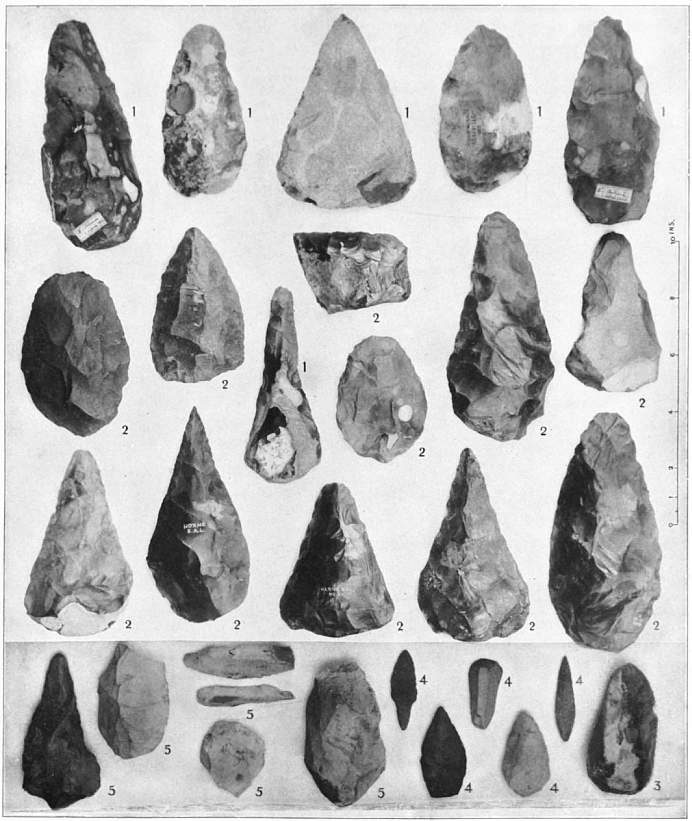
PALAEOLITHIC PERIOD. 1. French Drift 2. English Drift. 3. French transition (Le Moustier). 4. French Cave Period. 5. English Cave Period.
Plate II.
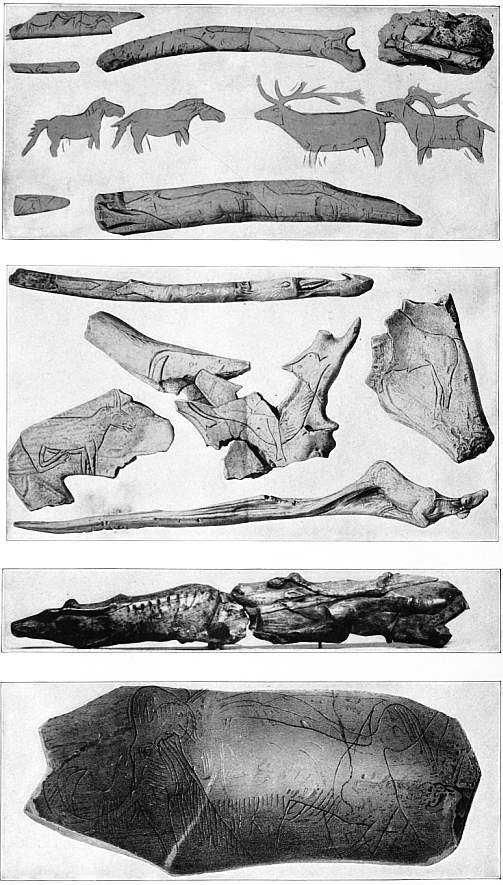
SCULPTURE AND ENGRAVINGS OF THE CAVE PERIOD. FROM DORDOGNE, FRANCE.
Plate III.
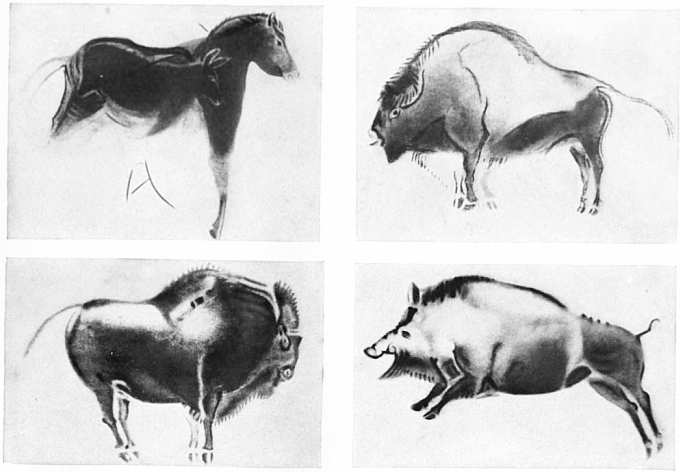
WALL PAINTINGS OF THE CAVE PERIOD. CAVERN OF ALTAMIRA, SANTANDER, SPAIN.
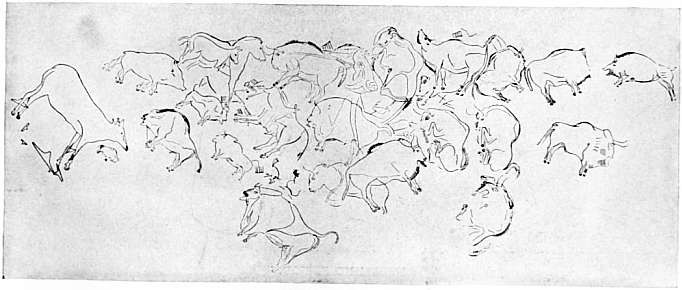
OUTLINE OF WALL-PAINTINGS, ALTAMIRA, LENGTH ABOUT 45½ FT. (cf PAINTING, Plate I.)
By permission, from La Caverne d’Altamira by Cartaulhac and Breuil Monaco 1906.
Plate IV.
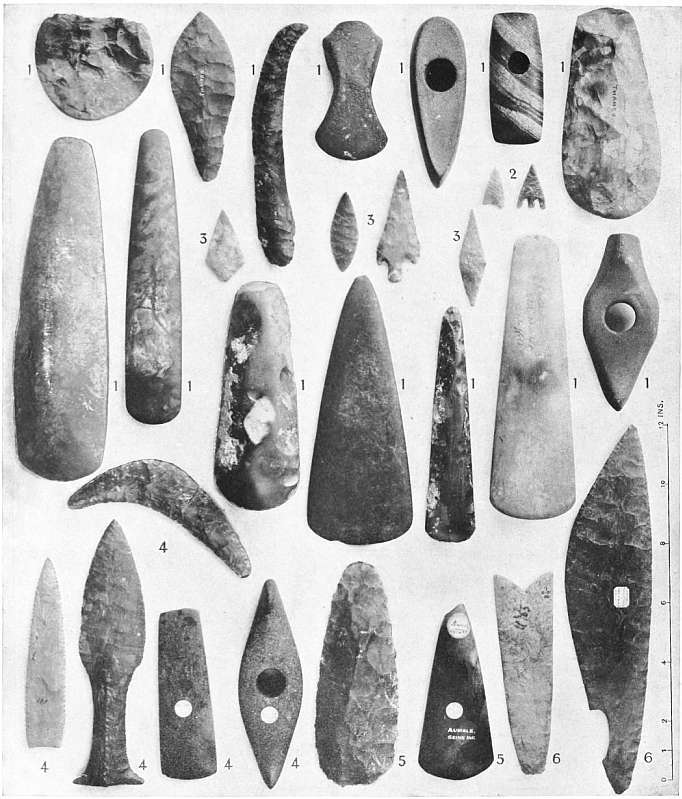
NEOLITHIC PERIOD.
1. Flint and stone implements, England 2. Flint arrow-heads, England. 3. Arrow-heads, Ireland.
4. Flint and stone implements, Denmark. 5. Flint implements, France. 6. Flint implements, Egypt.
While the severe climatic conditions that preceded the neolithic age restricted the presence of man to the more temperate parts of the globe, it may be assumed that in neolithic times there was nothing to prevent him from occupying the greater part of the earth’s surface, short of the neighbourhood of the two poles. Thus it may be expected that an age of stone will be found, if looked for, in every part of the globe. So far as our present knowledge goes, all is in favour of the use of stone before metals, in all countries. The one material requires no special treatment before being adapted to man’s use, while the other demands considerable knowledge, even if reasoning power have but little place in the process. Thus the probabilities are here borne out by the facts. In the extensive “kitchen-middens” of Japan are found great numbers of chert implements mixed with pottery of a primitive type, recalling that of European early Bronze Age barrows, while the succeeding periods of metal are equally clear. Even in the Far East, therefore, the same sequence is to be observed. In China, the conditions are more obscure. The superstitious regard for ancestors has prevented the exploration of ancient tombs in that country, and thus systematic search has been impossible, while the precise details of the discovery of such relics as have come to light are difficult to obtain. In spite of the assertion that China had no Stone Age, it is surely more probable, in the absence of exact knowledge, that she followed the normal course. Modern territorial divisions, more especially if they are independent of the natural physical conditions of the land, such as mountain ranges, great rivers and the like, have but little value in considering the race problems of remote ages. If, therefore, we find that, in the countries bordering on what is now the Chinese empire, the ancient inhabitants followed the same broad lines of culture that are evident elsewhere, it is easy to believe that China too was normal in this respect. The negroes and Bantu races of Africa also were thought to have passed direct to the use of iron, perhaps owing to the existence on the Nile of a civilization of great antiquity, which enabled them to pass over the intervening stages. Inherently improbable, this is now known not to have been the case. Stone implements, whether ground or merely chipped, have been discovered on the Congo, and more recently on the Zambezi. It is quite true that in both cases they are found in superficial deposits, and may be of any age. But here again the probabilities are greatly in favour of their having been in use before iron was known. While stone tools, such as knives or arrow-heads, may possess qualities that render them superior to bronze or copper, it is certain that once the working of iron was understood, its superiority to stone would at once be perceived, and the stone tools be discarded. There can be little doubt that investigations in Central Africa will demonstrate that the same course was followed there as elsewhere. In South Africa, in Egypt and in Somaliland large quantities of stone implements have been discovered, and of the great age of most of them there can be no doubt. Some from the banks of the Nile have even been claimed as “eolithic”; but here, as in Europe, We can only say that the case is not proven: General Pitt-Rivers did good service in Egypt by discovering among the stratified gravels near Thebes a number of rude flints bearing unmistakeable signs of human workmanship, but he described them merely as of “palaeolithic type,” and deplored the absence of mammalian remains in the gravels. At the same time he pointed out that the bulk of the implements claimed as palaeolithic (and, it may be, correctly) are found on the surface, and therefore cannot be dissociated from the surface types; hence form alone cannot be trusted to determine age. Further, we are by no means well informed as to the value of patination in flints found on the surface in Egypt. The depth and intensity of the patination would no doubt have a direct relation to the age of the implement, if only it could be proved that all of them had been equally subjected to the conditions that produced the discoloration. But this is clearly impossible. Some implements may conceivably have been continuously on the surface of the desert from the time they were made, and have been acted upon by the sun and air for many thousands of years, while others, though of equal age, may have been covered by sand or otherwise protected for a large part of the intervening centuries. Patination, therefore, like form, can only claim a conditional value. It is at the best an uncertain indication of age, as great age may be possible without it. Similarly, in Somaliland, the condition of the implements is very curious, and in some respects puzzling, while their forms resemble those from the Drift in Europe. But as to the climatic conditions we know nothing, and it is therefore useless to speculate on the condition of the stones; as to the geology we know next to nothing, and no mammalian remains give us a helping hand, while the form alone is a dangerous foundation for argument.
Investigations in the more remote parts of the world, though they may occasionally produce some startling novelty in the history of mankind, can scarcely be expected to furnish the same trustworthy continuous story as is to Europe and America. be found in the European area. Here history provides us with a fairly truthful account of what has happened for a period varying from two to three thousand years, or in some places even longer, and we are thus able to judge whether particular discoveries come into the historical stage or not. In more primitive lands where history (if there be any) partakes more of the character of mythical tradition, the task of defining the period to which particular discoveries belong is rendered much more difficult. In America, where history may be said to have begun five hundred years ago, such a feat is of course impossible, until a great deal of work on comparative lines has been accomplished. The accounts of the civilization of Mexico and Peru at the time of the Spanish conquest show a state of culture which in some respects must have put the Spaniards to shame, while in others it was primitive in the extreme. As regards internal communications, the working of gold and copper, and the manufacture and decoration of pottery, these American kingdoms were on a level with all but the most advanced nations; but of history in the true sense of the word they have none. In spite of this, it is by no means a hopeless task to disentangle the apparent confusion of their archaeology. It is now fairly well known what were the races or tribes that inhabited particular districts, and it is thus easy to make a corpus of the types adopted by the various peoples. This is the first certain step in the application of archaeological method. By degrees, as these types become familiar to the trained eye, it will not be difficult to arrange them in a progressive series, from the earliest in style to the latest. That this will be done by the archaeologists of the American continent, even with the present scanty materials, there can be little doubt. Numbers of young and enthusiastic workers have now had a good training in exploration in historical lands, and will usefully employ their experience on the antiquities of their own country. But if once a key be found to the ancient Mexican inscriptions, so plentifully scattered through the ancient monuments, it may be that enlightenment will come even more suddenly and more surely. The one problem that is of the greatest interest still awaits solution, viz. whether there is any relation, in culture or more remotely in race, between the inhabitants of ancient America and those of Europe or Asia. One thing is certain, that if there be any connexion, it is of infinite remoteness. But it is at any rate noteworthy that the same designs, patterns and even games are found in ancient Mexico and in India or China; and whether these resemblances arise from relations between the peoples using them or from accident, is a problem well worth investigation.
In countries like Scandinavia or Switzerland, the story of the early ages is clear and comparatively free from complications. The one by its remoteness was left to develop with but little help from the rest of Europe up to historical times; the other, protected on so many sides by its mountain ranges, seems to have enjoyed a peaceful existence during the Stone and Bronze Ages. A community of fishermen and agriculturists, they led a calm domestic life on the edges of their many lakes where they constructed dwellings on piles with only a gangway to the shore, to prevent the attacks of predatory animals. The practice of building houses in lakes was a common one not only in Switzerland, but also in Britain and in Ireland, as in modern times among the natives of New Guinea. Besides securing the safety of the inhabitants, it had the not unimportant advantage of being more healthy; all refuse of food and other useless matter could at once be thrown into the water where it would be harmless. A similar form of dwelling is the Irish “crannog,” constructed on an island or shoal in a lake, in some cases artificially heightened so as to bring it above water. These crannogs were probably inhabited in Ireland up to comparatively recent times, if one may judge by the remains found on the sites.
It must not be forgotten that although the neolithic period had many phases, yet its duration is in no way comparable to the incalculable length of the palaeolithic age. For a variety of reasons it is thought that one of the earliest stages of neolithic times is represented by the now well-known kitchen-middens (refuse-heaps) of Denmark. These heaps are often of great size, sometimes reaching 10 ft. in height, and nearly 350 yds. in length. Here along the coast line the natives of Denmark lived, apparently building their huts upon the mounds and cooking their food upon hearths of stone. The conditions of their daily life would seem to have resembled those of the natives of Tierra del Fuego. Their implements of flint seem to have been chipped only, and it is conjectured that the few polished and more highly finished implements that have been found in the middens are importations from more cultured tribes living inland. Their food was in very great part composed of shell-fish, though they evidently caught and ate various kinds of deer, boar and a variety of carnivorous animals. The race which made these mounds is believed to have been akin to the Lapps, and their dwellings can hardly have been anything more than the rudest protection from the weather. The Swiss lake-dwellers were far more advanced, even in the Stone Age; their dwellings were elaborately planned and constructed, and remains of them have been plentifully found in the various Swiss lakes. Various forms of construction were adopted: in one the foundations consisted of poles driven into the bed of the lake; in others a kind of framework simply rested on the bottom, and in a third, the substructure was formed of layers of sticks reaching from the bottom of the lake up to the surface. The walls were of wattle, closed up with clay to keep out the weather; the hearths were of stone slabs, and the floors of clay well trodden down. Practically the same type of dwelling seems to have continued through the Stone and Bronze Ages, though on some sites no metal whatever is found and it is therefore assumed that these are of the earlier period. These people cultivated the land, growing wheat and barley; they were also hunters and fishermen, capable of manufacturing pottery without the aid of the wheel, which had not yet come into use so far north; and they wove mats and garments, while ropes and netting are plentiful. Their tools and weapons were made of stone, and to a great extent of deer’s horn. Human remains are hardly ever found on the sites of the lake-dwellings, and it is therefore uncertain what were the social affinities of the people; but the evidence of the sites is in favour of the same race being continuous into the Bronze Age, when their condition was more comfortable, as is shown by the abundant remains of domesticated animals.