VOLUME II SLICE IV Aram, Eugene to Arcueil (continued 4)
Reading edition
Among the most notable and obvious relics of prehistoric times, both in Britain and in many other countries such as Spain, Portugal, France and even India, are gigantic circles and avenues of stone and dolmens (see Stone Monuments). These enduring monuments have excited Stone Age relics. the wonder of countless generations, and lent themselves to superstitious practices down to modern times. But the precise purpose for which they were erected and even the period to which they belonged, had never been definitely settled. They had been called burial places of great chiefs, and not unnaturally had been thought by others to have been temples or places of primitive worship used by the Druids, who moreover were often credited with their erection. Obviously such a question called for settlement, and the British Association in the year 1898 appointed a committee to investigate these stone circles with a view to ascertaining their age. Operations were begun at the well-known circle of Arbor Low, south of Buxton in Derbyshire; careful excavations were made through the ditch and the encircling mound and also within the circle, and although the evidence was not of the most complete kind, yet the committee came to the conclusion that the circle belonged to the end of the neolithic age. At Arbor Low all the stones are now lying on the ground (although, to judge from the other circles in England, they were certainly once upright), and the opportunities for surveying were thereby much diminished. It is a fortunate circumstance, therefore, that the fall of one of the stones at Stonehenge (q.v.) at the end of the 19th century, and the increasingly perilous state of some of the others, caused the owner, with the advice of the Society of Antiquaries of London, to undertake the raising of the great leaning stone in the interior of the circle. The work was superintended by W. Gowland, F.S.A., who made special investigations during the necessary digging, for the purpose of recovering any remains of man’s handiwork that had been left by the builders of the monument. In this he was very successful, finding in the course of the very limited excavation at the base of the monolith, a great number of stone mauls or hammers that corresponded so nearly with the bruised surfaces of the monoliths, that there can be no doubt of their having been used to dress the standing stones.
From a review of all the evidence of an archaeological nature that was to be obtained, Gowland came to the conclusion that the construction of Stonehenge belonged to the latter part of the neolithic age. No trace of a metal implement occurred in any of the debris. This would of itself be an interesting fact, but it became infinitely more interesting from researches in quite another direction, which brought corroborative evidence of a curious kind. For many years Sir Norman Lockyer and Prof. Penrose were engaged in examining the orientation of temples in Egypt and Greece, with a view to determining on what astronomical principle, if any, the plans had been laid down. With a rectangular plan, and with portions of the interior still well defined, they were able by elaborate calculation to determine that the temples had been definitely planned with relation to the rising or setting of the sun or of a particular star. Having been successful in these investigations they proceeded to apply the test to Stonehenge. The experiment was made on the longest day in the year 1901. Owing to a gradual change in the obliquity of the earth’s orbit, the point of sunrise on corresponding days of each year is not constant; and though the difference is hardly perceptible from year to year, in the course of centuries it becomes great enough for use as a measure of time. Enough remains of the monument to show the direction of sunrise at the time that Stonehenge was erected, it being always assumed that the coincidence of the main axis with the central line of the Avenue was designed with reference to sunrise on the longest day of the year. At the date of the experiment it was found that the sun had shifted nearly two diameters in the interval, and this variation gives a date of about 1680 B.C., which practically confirms the verdict of archaeology and seems to prove, moreover, that Stonehenge was a temple of the sun.
Stonehenge therefore may be taken as marking for Britain the close of the neolithic period and heralding the dawn of a new era, in which the inhabitants of the British Isles first acquired the art of working metal.
There is reason to believe that the transition from the use of stone to that of bronze was not due to the peaceful advance of civilization, but rather to the irruption of an Aryan race from the south-east of Europe into the countries Bronze Age. to the west and north. Of these people the Celts are to some extent the representatives at a somewhat more recent period. Here, however, we are dealing with terms the precise meaning of which is not yet generally admitted, and which, moreover, have too intimate a relation to the problems of philology to be fully discussed here (see Indo-European). The term Aryan (q.v.) itself is not free from objections. It was held by Max Müller to relate to a language and a civilization that took its rise in Central Asia, while others now contend that, although it is the mother language of the Sanskrit, Greek, Latin, Teutonic and Celtic languages, it might equally well have originated in Europe. However this may be, and even this brief statement shows how wide a field the arguments would cover, there can be little doubt that the Bronze Age Celts were of this stock, and that in course of time they gradually spread their language and culture over a large part of Europe. Whether or no the knowledge of bronze started from one or more centres, it gradually spread from the south-east of Europe until it reached Scandinavia; the dates being roughly in Crete, 3000 B.C.; in Sicily, 2500 B.C.; in central France, 2000 B.C.; in Britain and in Scandinavia 1800 B.C. The appearance of the Celts in Britain is indicated by the presence of the round barrows. They were a fairly tall, short-headed race, using cremation and also inhumation in their burials, skilful in the manufacture of pottery and of the simpler forms of bronze implements, and freely using bone, jet, and at times amber, while gold was well known and evidently greatly esteemed. In the early centuries of the Bronze Age, swords, spears and shields were apparently quite unknown, the principal metallic products being flat axes, simple knives or daggers, and small tools or ornaments. In the burial places the bodies, if unburnt, are nearly always found in a crouching position, as if in the attitude of sleep; if cremated, the burnt bones are generally enshrined in an urn under the tumulus, the burial being sometimes in a cist formed of large stones. The pottery vessels are remarkable in more ways than one. In the first place they would seem to have been specially made for the burial rites, for whenever domestic pottery has been found, it is of quite a different character, unornamented and simple in outline. It must be confessed, however, that this latter is by no means common. The sepulchral vessels are at times highly decorated, and sometimes of great size. They are invariably hand made, and though they are by no means well fired they are never sun-dried, as is often said to be the case. A common kind of decoration is produced by impressing twisted cords in the damp clay, and this is believed with some reason to have had its origin in the practice of winding cords round the unbaked vessel to prevent distortion before or during the process of firing. That operation would of course burn away the cord and leave only its impression on the urn. Other forms of ornament are also used, incised lines in rudely geometrical designs, impressions of the end of a stick, and at times rows of hollows produced by the finger or thumb. The method of the burial, beyond giving an insight into the art of the period, also helps us to realize to some extent the ideas of primitive man. The underlying reason for careful and ceremonial burial is not always readily understood, apart from a knowledge of the ritual, such as existed in ancient Egypt. But in the Bronze Age in Britain it was the custom to bury with the dead not only carefully made vessels which doubtless contained food for the journey to the lower world, but also the ornaments and weapons of the deceased. Often the bonea of a pig have been found in the grave, doubtless representing part of the provender which could not conveniently be placed in the so-called food-vessel. Such practices indicate with a fair amount of certainty a belief in a future life in another world, where probably the conditions were thought to be much the same as in this. The burial of the weapons and other property of a dead man is, however, not always due to the belief that he may need them in some future state. The reason may well be that it would be thought unlucky for a survivor to use them.
Just as the neolithic age was immeasurably shorter than the palaeolithic, but was notable for great improvements in the arts of life, so the Bronze Age in its turn was shorter than the neolithic age, and again witnessed even more marked advance in culture. It is in fact an illustration of the truism that each step in knowledge renders all that follow less laborious; but it is not easy to understand how the transition from stone to metal came about, nor why bronze came to be the chosen metal rather than iron. Bronze, in the first place, is a composite metal, a mixture of copper and tin, while iron can be at once reduced from its ores; indeed, in the form of meteoric iron, it is already metallic, and needs but a hammer to produce whatever form may be wanted. From the archaeological point of view, there is, however, good reason for believing that bronze preceded iron. The forms of axes that are without doubt the earliest, are in outline much the same as the stone prototype, being only thinner in proportion. Then again, iron implements are never found on the earlier sites, and if they had been in existence some of them certainly would remain: further, at the end of the Bronze Age it is found that the forms of weapons in that metal are exactly copied in iron, as, for instance, at Hallstatt (q.v.) in the Salzkammergut, the famous cemetery which best illustrates the passage from the use of bronze to that of iron. It has been claimed that bronze was preceded by copper, a sequence which seems inherently probable; and whether or no it was general enough or enduring enough to constitute a period, there can be no reasonable doubt that in the Mediterranean area, and in central Europe, as well as in Ireland, great numbers of implements were made of copper alone without any appreciable admixture of tin. The casting of pure copper presents certain difficulties, in that the metal is not adapted for anything but a mould open to the air, and this would limit its utility, until the discovery that tin in a certain proportion (roughly 1 : 9) not only made the resulting metal much harder and better fitted for cutting-tools and weapons, but at the same time rendered possible the use of closed moulds.
There are thus two problems in connexion with the history of the Bronze Age. How was the metal discovered? And by whom or where? As to the first, it must be remembered that in some parts of the world, e.g. in China and in Cornwall, copper and tin are found together, and it may well be that tin was first accidentally included as an impurity, which, had it been noticed, would have been eliminated. Once it was found to produce a more useful metal, the blend would be deliberately made, and repeated trials would eventually demonstrate the most suitable proportion of one metal to the other. The question of where it was first discovered is one that is not likely to be answered with certainty, but the one essential is the presence of the two metals in one and the same locality. Tin does not exist in either Egypt or Mesopotamia, although bronze articles from the fourth and third millennium respectively B.C. have been found in these countries. The tin to produce the mere metal must have come from some foreign country; and the choice seems to be very small. Spain at the other end of the Mediterranean is unlikely, and Britain still more so; central Asia, Asia Minor, or China again seem too remote; for the spread of metallurgy from these centres would imply a trade connexion nearly 4000 B.C. In later times, later perhaps by 3000 years, Spain and Britain were undoubtedly among the chief sources of the tin supply of Europe and of the Mediterranean generally; but it will long remain a problem where bronze was first produced. There is indeed, no real necessity for confining its origin to a single locality; it is easily conceivable that the invention occurred independently in more places than one.
The history of early metallurgy has been carefully studied by W. Gowland, who communicated the results of his researches to the Society of Antiquaries of London in 1899. In his opinion the ores from which copper was first obtained by smelting were originally found as pebbles or boulders in the beds of streams, where man in the Stone Age had been accustomed to search for stones to convert into implements; and in the same way the beds of rivers were for a long subsequent period the only sources of tin. Actual mining belongs in his opinion to a far later period, and naturally had its origin in the discovery of outcrops of the metal on the surface. By the simple application of fire, lumps of ore were reduced to a smaller size, and were then prepared for smelting by further reduction to the condition of a coarse powder. This latter process was carried out in the same way that grain was crushed between two stones; and stone-mills, doubtless used for the purpose, have been found in ancient workings in Wales. The next stage would be the furnace, and there can be little doubt that this would be of the simplest kind, merely a hole in the ground with the fire covering the metal, and with nothing but a natural draught. But Gowland holds that even with these singularly inadequate appliances, copper could be smelted from the surface ores, though the output would naturally be of the most uncertain and intermittent character, depending, as it must have done, on the wind. And until the discovery of bellows or some other method of increasing the draught of air, no progress could be made in this direction. With regard to the resulting metal, viz. copper, we have certain knowledge. From time to time there are found in the earth in Britain and elsewhere, hoards of fragmentary or imperfect bronze implements, portions of axes, swords, rings, &c., all of which have been failures in castings. These hoards are assumed to have been gathered together by the bronze founders to be recast into perfect and useful implements. Now, frequently associated with these hoards are portions of cakes of pure copper, originally circular in shape, flat on one face and convex on the other, like a lens with one flat face. The form of these cakes is in itself a fair proof of the prevalence of the method of smelting described above, as it is quite clear that the convex face of the cake followed the contour of the hole in the ground above which the fire was placed. The cakes are generally found broken up into small handy blocks. This can only be done in one way, viz. by watching the cake, after the fire and slag has been raked off it, until it is on the point of becoming solid, when it is quickly pulled out of the hole and broken up. It will be noted that while the implements in these founders’ hoards are invariably of bronze, the cakes are as invariably of copper. This is at first sight puzzling, until it is realized that these founders probably carried the tin necessary for forming bronze in the form of ore, and that tin ore in its pure state is a snuff-coloured powder very easily overlooked when lying on the earth, which it might very nearly resemble in colour, though it would be much heavier. Thus it is probable that in many such discoveries the tin ore has accompanied the copper cakes and bronze fragments, but has hitherto eluded the eyes of the finder. Not only have we this conclusive evidence of the methods by which Bronze Age man produced his raw material, but the discovery of crucibles and moulds takes us a step further towards the finished implements. The crucibles are generally simple bowls of thick clay with an extension of the lip at one side to pour out the molten metal. Several of these, with plentiful traces of metal still remaining in them, were found by the brothers Siret in the Bronze Age settlement at El Argar in Murcia. In the same place also were found moulds of stone for the casting of simple triangular axes. These were of the class known as open moulds, one stone being hollowed to the desired form, the other half being simply a flat cover, with no relation to the form of the implement to be produced. From the nature of the metal, such a mould is the only kind in which the casting of an efficient copper implement would be possible; and among the objects discovered by the Sirets were articles in plenty of pure copper.
Much has been written in support of the theory that the bronze tools and implements found in this or that country must have been importations from southern and more highly civilized lands. More particularly has this been alleged with regard to Britain, which, lying as it did on the extreme limit of the ancient world, was regarded as being dependent on the continent for the more complex weapons. The constant discovery, however, of these hoards of rough metal, as well as of moulds of the highest finish for casting swords, daggers, celts, and almost every kind of ancient bronze implement and weapon known to us, provides a conclusive proof of the contrary. The occurrence of a foreign type of implement is so rare as to be a source of especial gratification to the collector who secures it; and it may be taken that, in general terms, all the bronze swords, daggers and spears found in Britain were of home manufacture. Relations with the continent, however, did exist, as is shown by the occurrence of an Irish type of gold ornament in France and Scandinavia, and by the similarity of ornamental motives in the British Isles and elsewhere. Among the continental races it is natural to find intercommunication more common, owing to the absence of natural barriers. The weapons of the Bronze Age were swords, spears, daggers and axes (celts), though the last would be equally well adapted for more peaceful purposes. The swords were usually of a narrow leaf shape, cast with the handle in one piece, the mounting of the grip and the pommel being added. For perfection of workmanship the weapons of this period have never been surpassed, and the skill of adjustment in the moulds, the fine and equal quality of the metal, and the flawless condition of the surfaces still excite wonder among the most expert of modern founders. The cutting edges of swords and “celts” were often, if not always, hammered to serve the double purpose of hardening that part of the weapon and sharpening the edge. In the case of the axe-heads (celts), this hammering had a distinct influence on the evolution of the form of the implement. The earliest celts, whether of copper or bronze, were in form, copies of their stone prototypes, and curiously enough exactly like the ordinary woodman’s axe of to-day, but of course without the socket for the handle. Hammering rendered the cutting edge both broader and thinner, giving it at the same time a curved outline. This widened curve eventually became an ornamental feature, the two ends of the cutting edge becoming curved points and adding greatly to the elegance of the outline. Later, the other edges were finished by hammering also, at times in a simple ornamental fashion; and whether for greater rigidity or for some other reason, flanges were produced in the same way on those edges, which again affected the ultimate form of the celt. The early flat celt was no doubt simply fixed in a perforated wooden handle, which would naturally tend to split if wielded with any vigour. The side-flanges were in course of time utilized to prevent this, by allowing the use of a different form of handle. In place of the simple straight handle, a branch was cut with an elbow-joint, and its shorter limb then divided into two prongs, between which the metal passed, while the flanges, beaten up from the edges, overlapped the two forks; and no doubt a lashing of sinew was added to render the whole secure. This made a good serviceable tool or weapon, and prevented the splitting of the handle; but still another step was taken. The flanges on the edges met over the prong of the handle on either side, while the upper end of the celt itself eventually became a mere septum dividing the two openings. This septum was finally judged to be useless, and done away with; and the celt was cast with one hollow only for the reception of the ends of the handle; thus the flat celt became, by a natural process of evolution and improvement, a socketed celt. It is a curious fact, however, that the modern form of axe where the handle passes through a socket in the metal itself does not seem to have been much in favour in the Bronze Age, although it was a stone form that certainly survived into the succeeding period.
This and other shortcomings in what must have been the universal weapon and implement of the race, were remedied from time to time by various improvements in the form of the bronze axe-head and the method of hafting; and the various stages of development, from the flat blade of copper or bronze to the socketed implement and even to a pattern now in use, can still be traced in the Bronze Age specimens that have come down to us.
Plate V.
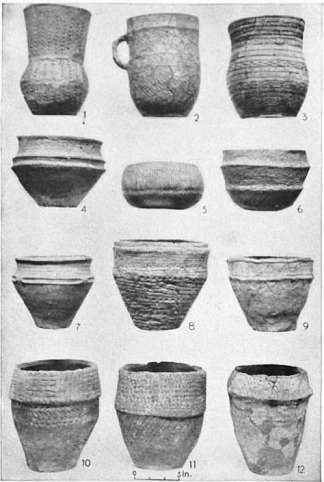
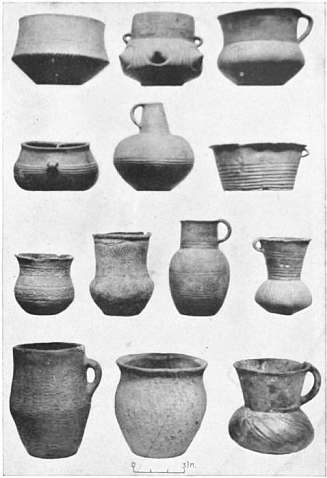
SEPULCHRAL POTTERY, BRITISH ISLES (BRONZE AGE). 1-3, Drinking cups or beakers. 4-9, Food vessels. 10-12, Cinerary urns. SEPULCHRAL POTTERY FROM THE CONTINENT OF EUROPE (NEOLITHIC, BRONZE, AND IRON AGES).
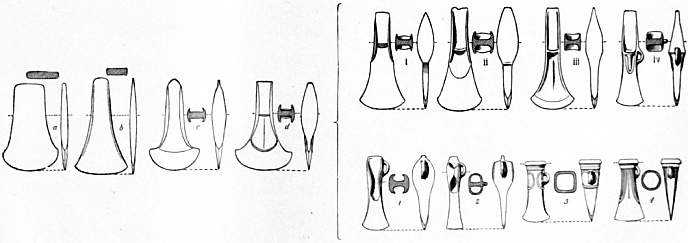
STAGES IN THE EVOLUTION OF THE CELT OR IMPLEMENT OF CHISEL FORM. (1) From stone to metallic form. (2) Growth of the stop ridge to palstave. (3) Growth of the wings to socket-celt.
By permission, from the British Museum Guide to the Bronze Age.
Plate VI.
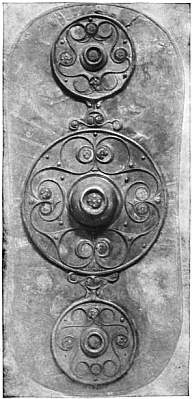
1. Bronze shield with red enamel ornaments, found in the Thames near Battersea; about 31 in. long. Bronze mounted wooden bucket found in a pit burial at Aylesford. Early Iron Age. The objects here represented are all in the British Museum. By permission, from the British Museum Guide to the Early Iron Age. Chariot burial of a Gaulish chief, Somme Bionne, Marne, France. Horned bronze helmet with traces of enamel ornament, found in the Thames near Waterloo Bridge.
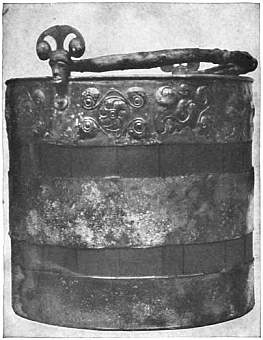
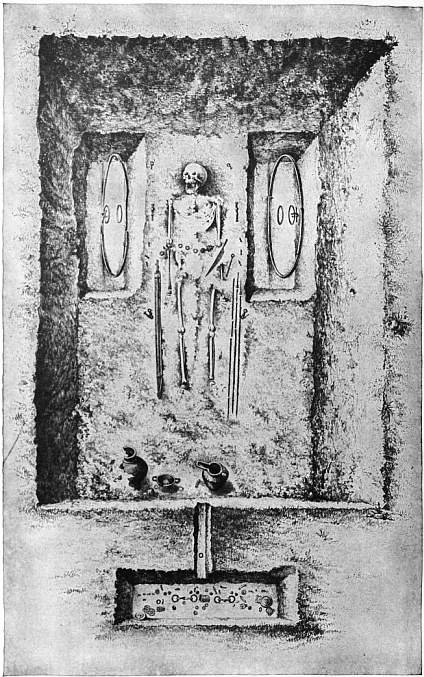
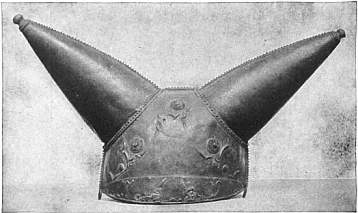
With the discovery of iron as the ideal metal for cutting implements and weapons, we enter into the millennium before the Christian era; for roughly speaking, the development of the civilization associated with the gradual Iron age. substitution of iron for bronze began about 1000 B.C. Again we look towards the south-east of Europe for the earliest evidence of this great advance; from that quarter it gradually spread over the whole continent, reaching the more northern parts about five hundred years later. In Egypt, the home of a marvellous civilization at a very early time, the conditions were different, and there is reason to suppose that iron was known there long before it was in use on the northern side of the Mediterranean. Our knowledge of the dates at which iron was first known in parts of Asia is still very limited, and further discoveries must be awaited.
The archaeology of Ireland presents features in many respects different from those of the rest of the British Islands in the Stone and Bronze Ages. Such affinities in style as are traceable connect it rather with Scotland than with Ireland. any part of the south, a fact doubtless due to proximity as well as in part to race connexions. A special feature is the astonishing quantity of gold that was produced in Ireland during the early Bronze Age. The frequent discovery of gold ornaments of this time has enriched to a surprising degree the museum of the Royal Irish Academy in Dublin, while many private and public collections both in Ireland and elsewhere contain a considerable number of similar relics. If these represented the total wealth of gold of the Bronze Age the amount would probably exceed that of any ancient period in any country, except perhaps the republic of Colombia in South America. But the known remains can only be a small proportion of the original wealth. Vast quantities must have been discovered from medieval times onwards, nearly all of which would be melted down, owing to the ignorance of the finders or to the uncertainty of ownership. Further, it may be taken as certain that there still remains in the earth a great mass of the metal which may or may not be discovered at some future time. If it were by any means possible to estimate what these united categories would amount to, the result would scarcely be credited. It is well known that gold has been, and still is, found in Ireland; but it is hard to believe that there were no richer deposits than are now known. It is at any rate certain that the rivers were worked as late as the opening centuries of our era. In the Bronze Age the most characteristic ornaments were penannular objects of all sizes from a small finger ring up to an armlet, generally known as “ring money” from the difficulty of assigning a definite use to the whole series; and the flat, crescent-shaped, diadem-like objects called “lunulae,” which are perhaps even more definitely characteristic of Ireland. Such objects of gold, if ornamented at all, are, like some of the flat axe-heads, engraved with simple geometrical patterns, lozenge-shaped chequers and the like, a type of decoration in itself easily determined as being of the Bronze Age, but bearing at the same time an interesting and very curious analogy to remains of the same period from the Iberian Peninsula, more especially from Portugal. If any overland culture-relations existed between the two countries, it would be only reasonable to expect the occurrence of the objects in question in the intervening districts. But so far nothing of the kind has been discovered. Moreover, had it been an isolated instance of resemblance it might be negligible, but an equally odd similarity is found in the fact that the Irish were in the habit of grinding the faces of their flint arrow-heads, an apparently useless refinement, while the Portuguese of the early Bronze Age did the same. Again, the dolmens of Ireland bear a distinct resemblance to those of Spain and Portugal, while the French dolmens, with few exceptions in the north, have a different character. These curious points are in favour of the tradition that the original inhabitants of Ireland were of Iberian origin, and further, that they did not come overland but by sea, and there are indeed signs of extensive navigation in the Bronze Age of northern Europe. It was perhaps in the middle of our Bronze Age, say about 1000 B.C., that this Iberian race was supplanted by the Celts, who took a considerable time to emerge from their native barbarism. It is, at any rate, fairly certain that for some hundreds of years previous to this Celtic invasion, Ireland was an enormously rich country, supplying not only herself, but also Britain and part of the Atlantic seaboard with gold. The fact became eventually an ingrained tradition in the history of the country, subsisting in Irish literature for centuries after the Christian era. Such natural wealth must have produced in these early times a marked effect on the relations and culture of these Iberian Irish, and one might reasonably expect a much higher level of luxury and wealth than is indicated by the remains commonly found. With the opportunities provided by communication with the continent, and the interchange of goods, with all the chances of benefiting by ideas current among other races, it is astonishing that Ireland did not play a more prominent part in Europe, more than a thousand years before the Christian era.
While gold as a metal was known in Europe, even before copper, it is a curious fact that silver was almost unknown, and hardly ever used. One of the most interesting sites for the metal, at about the same period of which we have Mediterranean area. just been speaking in Ireland, was the Mediterranean coast of Spain. Here in the neighbourhood of Almeria have been found remains of a large and apparently prosperous population ranging from the Stone Age to the end of the Bronze Age, with houses and tombs, besides the fortifications rendered necessary, in the later period, by their possession of the rare and precious metal, silver. Rare it certainly was, for the quantity found was exceedingly small, tiny slender rings for the fingers or the ears, and rivets to hold the axe-blade in its handle; but nothing to compare with the lavish richness of the American mines. The interesting race who occupied these dwellings and finally were laid to rest in the adjoining graves were evidently connected more or less closely with the peoples inhabiting the eastern coasts of the Mediterranean.
Recent discoveries in the central Mediterranean area not only furnish new and trustworthy (though none the less surprising) dates in ancient history, but may also bridge the distance between the Levant and the Pillars of Hercules. The results achieved by Arthur Evans and other distinguished explorers in Crete (q.v.) opened a new chapter in the history of European civilization, and may fitly be compared with the excavation of Troy, Mycenae and Tiryns by Schliemann some thirty years before. The progress of archaeology in the interval can be well tested by a comparison of the discussions to which the two series of discoveries gave rise. The mistaken attributions and unfortunate animosities in connexion with earlier excavations are almost forgotten, while the brilliant discoveries in the island of King Minos have not only themselves been made on scientific principles, but are illumined by the splendid revelation of the civilizations of the Mycenaean and the pre-Mycenaean era.
A great change indeed took place in the methods of classical study during the last decade of the 19th century, a change which affected the entire character of future classical research. It was formerly the common habit among Classical. students and professors of archaeology to confine their attention and their interests entirely to classical texts and even to classical sites, rejecting as outside the scope of their studies anything that was not manifestly beautiful as art. Whatever was primitive in its aspect, or wanting in the familiar characteristics that had for centuries been associated with Greek art, was either rejected entirely or at any rate relegated to a second place, as having but a poor claim to be classed with objects of the finer periods. The result was necessarily misleading. The uninstructed majority very naturally regarded the art of Pheidian times as a thing of supernatural growth, which had been bestowed by divine favour upon a chosen spot on the earth, without a human parentage, and almost without leaving any descendants. The evolutionary methods of other branches of science, however, were by degrees brought to bear upon the sacred precincts of pure Greek art. It was found that the crude products of the second millennium B.C., the formless images evolved by the uncultured dwellers in the Mediterranean area more than a thousand years before the time of Pheidias, were in truth the prototypes of the creations of himself and his contemporaries. This step being taken, the rest became easy. The most commonplace and ordinary relics were collected with as much avidity as they had formerly been rejected, in the belief that their simple forms would aid in the elucidation of their more complex and highly elaborated descendants. This minute attention, moreover, was not only given to the works of man, but even the remains of humanity received the attention they merited. It has been rightly thought, during recent years, that the question of race was a factor that deserved treatment in dealing with works of art of early times; and that natural evolution due to man’s tendency to change with time, might not be sufficient to account for the differences of type observed in human remains from the same country. For this reason, not only the objects associated with the burial have been preserved, but also the skeleton itself. This has been examined, measurements taken and recorded for comparison, and inferences made, sometimes of a surprising character. For example, if a cemetery be found with a preponderance of tall, long-headed skeletons in a district where the prevailing type of skeleton is short and brachycephalic (short-headed), the observer may reasonably expect a different kind of burial-furniture, and suspect an intruding race. In this particular respect, archaeology owes a signal debt to physical anthropology and to anthropological methods in general. The combination of the two is far more likely to lead to a reasonable and satisfactory conclusion than would be possible if the one branch of science had been pursued alone.
When once the existence of abundant remains of prehistoric man had been admitted, and their study had received recognition as a branch of science, the evidence supplied by the relics themselves and by their relation to Value of ethnology. extinct or existing animals would have sufficed to give a considerable insight into the conditions of primitive life. But, fortunately, corroborative evidence of the most useful kind was at hand, and has been of the greatest service in solving what might otherwise have been insoluble problems. Though the progress of civilization, and more especially the ever increasing rapidity of communication are rapidly changing the habits of life among the primitive peoples in various parts of the world, yet till past the middle of the 19th century, a certain number of tribes, if not races, were still in the Stone Age. Even at the present day stone-using tribes still exist, although by chance metal may be known to them. The importance of the study of their conditions of life and their technical processes, and of the collecting of their implements for the express purpose of illustrating prehistoric man, was recognized by Henry Christy (1810-1865), who had made extensive investigations and collected relics in conjunction with Edouard Lartet in the now famous caverns of the Dordogne, at a time when such explorations were somewhat of a novelty; and concurrently he formed a large collection of the productions of existing savage peoples, both collections after his death passing to the British Museum, his intention being that the one should elucidate the ether. (It is only fair to his memory, however, to state here that, by his express wish, the most important of the relics that he had obtained from the Dordogne caves were returned to France where they now are. Such instances of international courtesy are rare enough to deserve mention.) The value and interest of such a series can scarcely be over-rated. Almost till the 20th century, the Indians of North America, the Australian and Tasmanian natives, as well as those of New Zealand and the many archipelagoes of the Pacific, were, if not ignorant of the use of metals, at least habitually using stone where civilized man would use metal. The Maori made his war club of jade and the pounders for preparing his food of stone. The Australian had his stone axe-blade; and low as he stands in the culture scale, his spear-heads are chipped with an exquisite precision. The Papuan of inland New Guinea is still making his weapons of stone and wood; while until quite recently the North American Indian was making his delicate stone arrow points, and the Solomon islander his beautiful polished stone axe-blades. The knowledge gained by the study of a large series of such objects enables us to fill up very many gaps in the story of early man as told by his own remains. In fact, in this respect, the value of the comparison is much greater than could reasonably be expected; for, whatever may be the reason, nothing is more marked than the extraordinary similarity of stone implements at all times and over the whole world. An arrow-point made by a Patagonian Indian, one from a Japanese shell mound, and a third of the Stone Age from Ireland, are found to be practically identical. Whether it is that the same material and the same necessity naturally produce a like result, or whether there has existed throughout a continuity of type, is a question that will never be satisfactorily answered. The results, however, are of eminently practical value. The arrow-heads of neolithic man, which are found by hundreds all over Europe, may be seen fixed in their shafts in the hands of an American Indian; rude pieces of quartz, which unmounted would escape notice as implements, are seen to make excellent tools when mounted in a handle by the Australian black, while flakes of slate find a use when mounted as skinning knives by the Eskimo.
Now that the narrower conception of archaeology as a minor branch of classical studies has been given up, the new science has gradually won its way to universal recognition; and anthropology, a still wider subject but in many Organized study. points closely allied to the scientific study of ancient remains, has still more recently found favour at all the leading universities, and practical measures have been taken to establish the study on a firm and scientific basis. Apart from this official encouragement, much has been done towards the systematization and teaching of archaeology by practical excavators, whose pupils have attained considerable numbers and celebrity. Something has been done, too, in the national and provincial museums, to present the relics of past ages in an intelligible manner, so that the collections no longer consist of curiosities but of documents rich in instruction and interest even to the general visitor. The progress of photography, as well as the improvement and cheapening of methods of illustration, have also assisted enormously in the advance of archaeology; and similarly, the antiquities exhibited in museums and private collections to illustrate and amplify written records, have in the last generation received much attention on their own account, and have reacted in various ways on the teaching of ancient history. In some countries a further step in general education has been taken, and the lamentable waste of archaeological material arrested to some extent by the distribution of pictures and diagrams among schools and institutions, to call attention to the more ordinary local types, and to encourage those who are likely to discover them in the soil to save them from destruction and render them available for scientific study. A certain familiarity on the part of the young with the mere appearance of antiquities that come to light continually and are almost as often discarded or destroyed, would probably result in valuable additions being made to the available data.
Bibliography.—The most useful general works are the following:— Salomon Reinach, Epoque des alluvions et des cavernes (Musée de St Germain); Hoernes, Der diluviale Mensch in Europa; Sir John Evans, Stone Implements of Great Britain, and Bronze Implements of Great Britain; Boyd Dawkins, Cave-hunting, and Early Man in Britain; Greenwell, British Barrows; W.G. Smith, Man the Primeval Savage; James Geikie, Prehistoric Europe; Mortillet, Le Préhistorique; Robert Munro, Lake Dwellings of Europe; Ridgeway, Early Age of Greece; Jos. Anderson, Scotland in Pagan Times; the works of Oscar Montelius and Sophus Müller; L’Anthropologie, Matériaux pour l’histoire primitive de l’homme; Christy and Lartet, Reliquiae Aquitanicae; A. Michaelis, A Century of Archaeological Discovery (Eng. trans., 1908). See also Anthropology, and authorities mentioned there; Stone Age; Bronze Age; Iron Age, &c.; Geology; and the articles on different countries and sites.
(C. H. Rd.)
ARCHAEOPTERYX. The name of Archaeopteryx lithographica was based by Hermann von Meyer upon a feather (Gr. πτέρυξ, wing) found in 1861 in the lithographic slate quarries of Solenhofen in Bavaria, the geological horizon being that of the Kimmeridge clay of the Upper Oolite or Jurassic system. In the same year and at the same place was discovered the specimen (figs. 1 and 3) now in the British Museum, named by Andreas Wagner Griphosaurus. Sir R. Owen has described it as A. macroura. Stimulated by the high price paid by the British Museum, the quarry owners diligently searched, and in 1872 another, much finer, preserved specimen was found. This was bought by K.W. v. Siemens, who presented it to the Berlin Museum. The late W. Dames has written an excellent monograph on it.
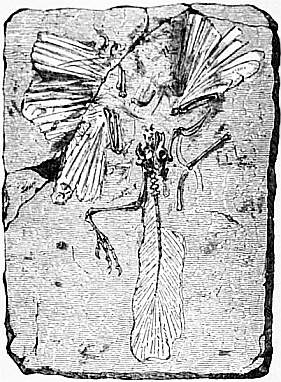
Fig. 1.—The British Museum specimen.
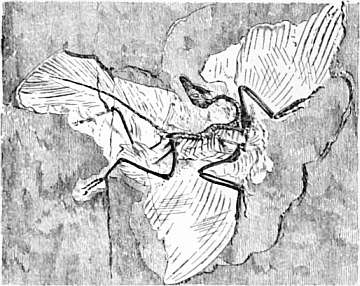
Fig. 2.—The specimen in the Museum für Naturkunde, Berlin. After a photograph taken from a cast.
Archaeopteryx was a bird, without any doubt, but still with so many low, essentially reptilian characters that it forms a link between these two classes. About the size of a rook, its most obvious peculiarity is the long reptilian tail, composed of 20 vertebrae and not ending in a pygostyle. The last dozen vertebrae each carry a pair of well-developed typical quills. Upon these features of the tail E. Haeckel established the subclass Saururae, containing solely Archaeopteryx, in opposition to the Ornithurae, comprising all the other birds. Herein he has been followed by many zoologists. However, the fact that various recent birds possess the same kind of caudal skeleton, likewise without a pygostyle, although reduced to at least 13 vertebrae, shows that the two terms do not express a fundamental difference.
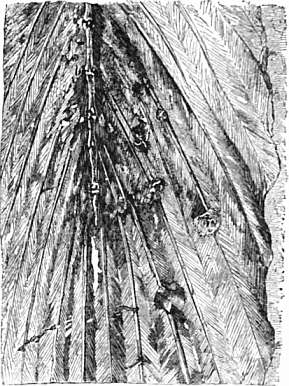
Fig. 3.—Tail of British Museum specimen.
The importance of Archaeopteryx justifies the following descriptive detail. Vertebral column composed of about 50 vertebrae, viz. 10-11 cervical, 12-11 thoracic, 2 lumbar, 5-6 sacral, and 20 or 21 caudal, with a total caudal length of the Berlin specimen of 7 in. The cervical and thoracic vertebrae seem to be biconcave; the cervical ribs are much reduced and were apparently still movable; the thoracic ribs are devoid of uncinate processes. Paired abdominal ribs are doubtful. Scarcely anything is known of the sternum, and little of the shoulder-girdle, except the very stout furcula; scapula typically bird-like. Humerus about 2½ in. long, with a strong crista lateralis, which indicates a strongly developed great pectoral muscle and hence, by inference, the presence of a keel to the sternum. Radius and ulna typically avine, 2.1 in. in length. Carpus with two separate bones. The hand skeleton consists of 3 completely separate metacarpals, each carrying a complete, likewise free, finger; the shortened thumb with 2, the index with 3, the third with 4 phalanges; each finger with a curved claw. The whole wing is consequently, although essentially avine, still reptilian in the unfused state of the metacarpals and the numbers of the phalanges. The pelvis is imperfectly known. The preacetabular portion of the ilium is shorter than the posterior half. The hind-limb is typically avine, with intertarsal joint, distally reduced fibula, and the three elongated metatarsals which show already considerable anchylosis; reduction of the toes to four, with 2, 3, 4 and 5 phalanges; the hallux is separate, and as usual in recent birds posterior in position. Skull bird-like, except that the short bill cannot have been enclosed in a horny rhamphotheca, since the upper jaw shows a row of 13, the lower jaw 3 conical teeth, all implanted in distinct sockets.
The remiges and rectrices indicate perfect feathers, with shaft and complete vanes which were so neatly finished that they must have possessed typical radii and hooklets. Some of the quills measure fully 5 in. in length. Six or seven remiges were attached to the hand, ten to the ulna.
It is idle to speculate on the habits of this earliest of known birds. That it could fly is certain, and the feet show it to have been well adapted to arboreal life. The clawed slender fingers did not make Archaeopteryx any more quadrupedal or bat-like in its habits than is a kestrel hawk, with its equally large, or even larger thumb-claw.
Bibliography.—H. v. Meyer, Neues Jahrb.f. Mineralog. (1861), p. 679; Sir R. Owen, “On the Archaeopteryx von Meyer...” Phil. Trans., 1863, pp. 33-47, pls. i.-iv.; T.H. Huxley, “Remarks on the Skeleton of the Archaeopteryx and on the relations of the bird to the reptile,” Geol. Mag. i., 1864, pp. 55-57; C. Vogt, “L’Archaeopteryx macrura,” Revue scient. de la France et de l’étranger, 1879, pp. 241-248; W. Dames, “Über Archaeopteryx,” Palaeontol. Abhandl. ii. (Berlin, 1884); Idem, “Über Brustbein Schulter- und Beckengürtel der Archaeopteryx,” Math. naturw. Mitth. Berlin. vii. (1897), pp. 476-492.
(H. F. G.)
ARCHAISM (adj. “archaic”; from Gr. ἁρχαῖος, old), an old-fashioned usage, or the deliberate employment of an out-of-date and ancient mode of expression.
ARCHANGEL (Archangelsk), a government of European Russia, bounded N. by the White Sea and Arctic Ocean, W. by Finland and Olonets, S. by Vologda, and E. by the Ural mountains. It comprehends the islands of Novaya-Zemlya, Vaygach and Kolguev, and the peninsula of Kola. Its area is 331,505 sq. m., and its population in 1867 was 275,779 and in 1897, 349,943. The part which lies within the Arctic Circle is very desolate and sterile, consisting chiefly of sand and reindeer moss. The winter is long and severe, and even in summer the soil is frozen. The rivers (Tuloma, Onega, Dvina, Mezen and Pechora) are closed in September and scarcely thaw before July. The Kola peninsula is, however, diversified by hills exceeding 3000 ft. in altitude and by large lakes (e.g. Imandra), and its coast enjoys a much more genial climate. South of the Arctic Circle the greater part of the country is covered with forests, intermingled with lakes and morasses, though in places there is excellent pasturage. Here the spring is moist, with cold, frosty nights; the summer a succession of long foggy days; the autumn again moist. The rivers are closed from October to April. The inhabitants of the northern districts—nomad tribes of Samoyedes, Zyryans, Lapps, and the Finnish tribes of Karelians and Chudes—support themselves by fishing and hunting. In the southern districts hemp and flax are raised, but grain crops are little cultivated, so that the bark of trees has often to be ground up to eke out the scanty supply of flour. Potatoes are grown as far north as 65°. Shipbuilding is carried on, and the forests yield timber, pitch and tar. Excellent cattle are raised in the district of Kholmogory on the Dvina, veal being supplied to St Petersburg. Gold is found in the districts of Kola, naphtha and salt in those of Kem and Pinega, and lignite in Mezen. Sulphurous springs exist in the districts of Kholmogory and Shenkursk. The industry and commerce are noticed below in the article on the town Archangel, which is the capital. The government is divided into nine districts, the chief towns of which are—Alexandrovsk or Kola (pop. 300), Archangel (q.v.), Kem (1825), Kholmogory (1465), Mezen (2040), Novaya-Zemlya (island), Pechora, Pinega (1000) and Shenkursk (1308).
See A.P. Engelhardt, A Russian Province of the North (Eng. trans., by H. Cooke, 1899).
ARCHANGEL (Archangelsk), chief town of the government of Archangel, Russia, at the head of the delta of the Dvina, on the right bank of the river, in lat. 64° 32′ N. and long. 40° 33′ E. Pop. (1867) 19,936; (1897) 20,933. As early as the 10th century, if not earlier, the Norsemen frequented this part of the world (Bjarmeland) on trading expeditions; the best-known is that made by Ottar or Othere between 880 and 900 and described (or translated) by Alfred the Great, king of England. The modern town dates, however, from the visit of the English voyager, Richard Chancellor, in 1553. An English factory was erected on the lower Dvina soon after that date, and in 1584 a fort was built, around which the town grew up. Archangel was for long the only seaport of Russia (or Muscovy). The tsar Boris Godunov (1598-1605) threw the trade open to all nations; and the chief participants in it were England, Holland and Germany. In 1668-1684 the great bazaar and trading hall was built, principally by Tatar prisoners. In 1691-1700 the exports to England averaged £112,210 annually. After Peter the Great made St Petersburg the capital of his dominions (1702), he placed Archangel under vexatious commercial disabilities, and consequently its trade declined. In 1762 it was granted the same privileges as St Petersburg, and since then it has gradually recovered its former prosperity. It is the seat of a bishop, and has a cathedral (1709-1743), a museum, the monastery of the Archangel Michael (whence the city gets its name), an ecclesiastical seminary, a school of navigation and a naval hospital. Linen, leather, canvas, cordage, mats, tallow, potash and beer are manufactured. There is a lively trade with St Petersburg, and the sea-borne exports, which consist chiefly of timber, flax, linseed, oats, flour, pitch, tar, skins and mats, amount in value to about 1½ millions sterling annually (82½ % for timber), but the imports (mostly fish) are worth only about £200,000. A fish fair is held every year on the 1st (15th) of September. Archangel communicates with the interior of Russia by river and canal, and has a railway line (522 m.) to Yaroslavl. The harbour, deepened to 18¼ ft., is about a mile below the city, and is accessible from May to October. About 12 m. lower down there are a government dockyard and merchants’ warehouses. A new military harbour, Alexandrovsk or Port Catherine, has been made on Catherine (Ekaterininsk) Bay, on the Murman coast of the Kola peninsula. The shortest day at Archangel has only 3 hrs. 12 min., the longest 21 hrs. 48 min. of daylight.
ARCHBALD, a borough of Lackawanna county, Pennsylvania, U.S.A., in the N.E. part of the state, 10 m. N.E. of Scranton. Pop. (1890) 4032; (1900) 5396; (1869 foreign-born); (1910) 7194. It is served by the Delaware & Hudson, and the New York, Ontario & Western railways, and by an interurban electric line. It is about 900 ft. above sea-level; in the vicinity are extensive deposits of anthracite coal, the mining and breaking of which is the principal industry; silk throwing and weaving is another industry of the borough. At Archbald is a large glacial “pot hole,” about 20 ft. in diameter and 40 ft. in depth. Archbald, named in honour of James Archbald, formerly chief engineer of the Delaware & Hudson railway, was a part of Blakely township (incorporated in 1818) until 1877, when it became a borough.
ARCHBISHOP (Lat. archiepiscopus, from Gr. ἀρχιεπίσκοπος), in the Christian Church, the title of a bishop of superior rank, implying usually jurisdiction over other bishops, but no superiority of order over them. The functions of the archbishop, as at present exercised, developed out of those of the metropolitan (q.v.); though the title of archbishop, when it first appeared, implied no metropolitan jurisdiction. Nor are the terms interchangeable now; for not all metropolitans are archbishops,1 nor all archbishops metropolitans. The title seems to have been introduced first in the East, in the 4th century, as an honorary distinction implying no superiority of jurisdiction. Its first recorded use is by Athanasius, bishop of Alexandria, who applied it to his predecessor Alexander as a mark of respect. In the same way Gregory of Nazianzus bestowed it upon Athanasius himself. In the next century its use would seem to have been more common as the title of bishops of important sees; for several archbishops are stated to have been present at the council of Chalcedon in 451. In the Western Church the title was hardly known before the 7th century, and did not become common until the Carolingian emperors revived the right of the metropolitans to summon provincial synods. The metropolitans now commonly assumed the title of archbishop to mark their pre-eminence over the other bishops; at the same time the obligation imposed upon them, mainly at the instance of St Boniface, to receive the pallium (q.v.) from Rome, definitely marked the defeat of their claim to exercise metropolitan jurisdiction independently of the pope.
At the present day, the title of archbishop is retained in the Roman Catholic Church, the various oriental churches, the Anglican Church, and certain branches of the Lutheran (Evangelical) Church.
In the Roman Catholic Church the powers of the archbishop are considerably less extensive than they were in the middle ages. According to the medieval canon law, based on the decretals, and codified in the 13th century in the Roman Catholic Church. Corpus juris canonici, by which the earlier powers of metropolitans had been greatly curtailed, the powers of the archbishop consisted in the right (1) to confirm and consecrate suffragan bishops; (2) to summon and preside over provincial synods; (3) to superintend the suffragans and visit their dioceses, as well as to censure and punish bishops in the interests of discipline, the right of deprivation, however, being reserved to the pope; (4) to act as a court of appeal from the diocesan courts; (5) to exercise the jus devolutionis, i.e. present to benefices in the gift of bishops, if these neglect their duty in this respect. These rights were greatly curtailed by the council of Trent. The confirmation and consecration of bishops (q.v.) is now reserved to the Holy See. The summoning of provincial synods, which was made obligatory every three years by the council, was long neglected, but is now more common wherever the political conditions, e.g. in the United States, Great Britain and France, are favourable. The disciplinary powers of the archbishop, on the other hand, can scarcely be said to survive. The right to hold a visitation of a suffragan’s diocese or to issue censures against him was, by Sess. xxiv. c. 3 de ref., of the council of Trent, made dependent upon the consent of the provincial synod after cause shown (causa cognita et probata); and the only two powers left to the archbishop in this respect are to watch over the diocesan seminaries and to compel the residence of the bishop in his diocese. The right of the archbishop to exercise a certain disciplinary power over the regular orders is possessed by him, not as archbishop, but as the delegate ad hoc of the pope. Finally, the function of the archbishop as judge in a court of appeal, though it still subsists, is of little practical importance now that the clergy, in civil matters, are universally subject to the secular courts.
Besides archbishops who are metropolitans there are in the Roman Catholic Church others who have no metropolitan jurisdiction. Such are the titular archbishops in partibus, and certain archbishops of Italian sees who have no bishops under them. Archbishops rank immediately after patriarchs and have the same precedence as primates. The right to wear the pallium is confined to those archbishops who are not merely titular. It must be applied for, either in person or by proxy, at Rome by the archbishop within three months of his consecration or enthronement, and, before receiving it, he must take the oaths of fidelity and obedience to the Holy See. Until the pallium is granted, the archbishop is known only as archbishop-elect, and is not empowered to exercise his potestas ordinis in the archdiocese nor to summon the provincial synod and exercise the jurisdiction dependent upon this. He may, however, exercise his purely episcopal functions. The special ensign of his office is the cross, crux erecta or gestatoria, carried before him on solemn occasions (see Cross).
In the Orthodox and other churches of the East the title of archbishop is of far more common occurrence than in the West, and is less consistently associated with metropolitan functions. Thus in Greece there are eleven archbishops Eastern Church. to thirteen bishops, the archbishop of Athens alone being metropolitan; in Cyprus, where there are four bishops and only one archbishop, all five are of metropolitan rank.
In the Protestant churches of continental Europe the title of archbishop has fallen into almost complete disuse. It is, however, still borne by the Lutheran bishop of Upsala, who is metropolitan of Sweden, and by the Lutheran bishop Lutheran Church. of Åbo in Finland. In Prussia the title has occasionally been bestowed by the king on general superintendents of the Lutheran church, as in 1829, when Frederick William III. gave it to his friend and spiritual adviser, the celebrated preacher, Ludwig Ernst Borowski (1740-1831), general superintendent of Prussia (1812) and bishop (1816).
In the Church of England and its sister and daughter churches the position of the archbishop is defined by the medieval canon law as confirmed or modified by statute since the Reformation. It is, therefore, as regards both the potestas ordinis Church of England. and jurisdiction, substantially the same as in the Roman Catholic Church, save as modified on the one hand by the substitution of the supremacy of the crown for that of the Holy See, and on the other by the restrictions imposed by the council of Trent.
The ecclesiastical government of the Church of England is divided between two archbishops—the archbishop of Canterbury, who is “primate of all England” and metropolitan of the province of Canterbury, and the archbishop of York, who is “primate of England” and metropolitan of the province of York. The jurisdiction of the archbishop of Canterbury as primate of all England extends in certain matters into the province of York. He exercised the jurisdiction of legatus natus of the pope throughout all England before the Reformation, and since that event he has been empowered, by 25 Hen. VIII. c. 21, to exercise certain powers of dispensation in cases formerly sued for in the court of Rome. Under this statute the archbishop continues to grant special licences to marry, which are valid in both provinces; he appoints notaries public, who may practise in both provinces; and he grants dispensations to clerks to hold more than one benefice, subject to certain restrictions which have been imposed by later statutes. The archbishop also continues to grant degrees in the faculties of theology, music and law, which are known as Lambeth degrees. His power to grant degrees in medicine, qualifying the recipients to practise, was practically restrained by the Medical Act 1858.
The archbishop of Canterbury exercises the twofold jurisdiction of a metropolitan and a diocesan bishop. As metropolitan he is the guardian of the spiritualities of every vacant see within the province, he presents to all benefices which fall vacant during the vacancy of the see, and through his special commissary exercises the ordinary jurisdiction of a bishop within the vacant diocese. He exercises also an appellate jurisdiction over each bishop, which, in cases of licensed curates, he exercises personally under the Pluralities Act 1838; but his ordinary appellate jurisdiction is exercised by the judge of the Arches court (see Arches, Court of). The archbishop had formerly exclusive jurisdiction in all causes of wills and intestacies, where parties died having personal property in more than one diocese of the province of Canterbury, and he had concurrent jurisdiction in other cases. This jurisdiction, which he exercised through the judge of the Prerogative court, was transferred to the crown by the Court of Probate Act 1857. The Arches court was also the court of appeal from the consistory courts of the bishops of the province in all testamentary and matrimonial causes. The matrimonial jurisdiction was transferred to the crown by the Matrimonial Causes Act 1857. The court of Audience, in which the archbishop presided personally, attended by his vicar-general, and sometimes by episcopal assessors, has fallen into desuetude. The vicar-general, however, exercises jurisdiction in matters of ordinary marriage licences and of institutions to benefices. The master of the faculties regulates the appointment of notaries public, and all dispensations which fall under 25 Hen. VIII. c. 21.
A right very rarely exercised by the archbishop of Canterbury, but one of great importance, is that of the visitation and deprivation of inferior bishops. Since there is no example of the archbishop of York exercising or being reputed to have such disciplinary jurisdiction over his suffragans,2 and this right could, according to the canon law cited above, in the middle ages only be exercised normally in concert with the provincial synod, it would seem to be a survival of the special jurisdiction enjoyed by the pre-Reformation archbishop as legatus natus of the pope. It was somewhat freely exercised by Cranmer and his successors immediately after the Reformation; but the main precedent now relied upon is that of Dr Watson, bishop of St Davids, who was deprived in 1695 by Archbishop Tennison for simony and other offences, the legality of the sentence being finally confirmed by the House of Lords on the 25th of January 1705. It was proved in the course of the long argument in this case that the archbishop of Canterbury had undoubtedly exercised such independent power of visitation both before and after the Reformation; and it was on this precedent that in 1888 the judicial committee of the privy council mainly relied in deciding that the archbishop had the right to cite before him the bishop of Lincoln (Dr Edward King), who was accused of certain irregular ritual practices. The trial began on the 12th of February 1889 before the archbishop and certain assessors, the protest of Dr King, based on the claim that he could only be tried in a provincial synod, being overruled by Archbishop Benson on the grounds above stated. The main importance of the “Lincoln Judgment,” delivered on the 21st of November 1890, is that it set a new precedent for the effective jurisdiction of the archbishop, based on the ancient canon law, and so did something towards the establishment of a purely “spiritual” court, the absence of which had been one of the main grievances of a large body of the clergy.
It is the privilege of the archbishop of Canterbury to crown the kings and queens of England. He is entitled to consecrate all the bishops within his province and was formerly entitled, upon consecrating a bishop, to select a benefice within his diocese at his option for one of his chaplains, but this practice was indirectly abolished by 3 and 4 Vict. c. III, § 42. He is entitled to nominate eight chaplains, who had formerly certain statutory privileges, which are now abolished. He is ex officio an ecclesiastical commissioner for England, and has by statute the right of nominating one of the salaried ecclesiastical commissioners.
The archbishop exercises the ordinary jurisdiction of a bishop over his diocese through his consistory court at Canterbury, the judge of which court is styled the commissary-general of the city and diocese of Canterbury. The archbishop holds a visitation of his diocese personally every three years, and he is the only diocesan who has kept up the triennial visitation of the dean and chapter of his cathedral.3 The archbishop of Canterbury takes precedence immediately after princes of the blood royal and over every peer of parliament, including the lord chancellor.
The archbishop of York has immediate spiritual jurisdiction as metropolitan in the case of all vacant sees within the province of York, analogous to that which is exercised by the archbishop of Canterbury within the province of Canterbury. He has also an appellate jurisdiction of an analogous character, which he exercises through his provincial court, whilst his diocesan jurisdiction is exercised through his consistorial court, the judges of both courts being nominated by the archbishop. His ancient testamentary and matrimonial jurisdiction was transferred to the crown by the same statutes which divested the see of Canterbury of its jurisdiction in similar matters. It is the privilege of the archbishop of York to crown the queen consort and to be her perpetual chaplain. The archbishop of York takes precedence over all subjects of the crown not of royal blood, but after the lord high chancellor of England. He is ex officio an ecclesiastical commissioner for England (see further England, Church of).
The Church of Ireland had at the time of the Act of Union four archbishops, who took their titles from Armagh, Dublin, Cashel and Tuam. By acts of 1833 and 1834, the metropolitans of Cashel and of Tuam were reduced to the status of diocesan bishops. The two archbishoprics of Armagh and Dublin are maintained in the disestablished Church of Ireland.
The title archbishop has been used in certain of the colonial churches, e.g. Australia, South Africa, Canada, and the West Indies, since 1893, when it was assumed by the metropolitans of Canada and Rupert’s Land (see Anglican Communion). Archbishops have the title of His (or Your) Grace and Most Reverend Father in God.
See Hinschius, System des katholischen Kirchenrechts (Berlin, 1869), also article “Erzbischof,” in Hauck, Realencyklopadie (1898); Phillimore, The Ecclesiastical Law of the Church of England, and authorities there cited.
(W. A. P.)
1 In the Roman Church it is safe to say that all metropolitans are archbishops. In, e.g., the Scottish and American episcopal churches, however, the metropolitan is the senior bishop pro tem.
2 Unless the case of the claim of Mark, bishop of Carlisle, to be tried by his ordinary instead of by a temporal court, be a precedent (Phillimore, Eccles. Law, p. 74, ed. 1895).
3 The court of Peculiars is no longer held, inasmuch as the peculiars have been placed by acts of parliament under the ordinary jurisdiction of the bishops of the respective dioceses in which they are situated.
ARCHCHANCELLOR (Lat. Archicancellarius; Ger. Erzkanzler), or chief chancellor, a title given to the highest dignitary of the Holy Roman Empire, and also used occasionally during the middle ages to denote an official who supervised the work of chancellors or notaries.
In the 9th century Hincmar, archbishop of Reims, in his work, De ordine palatii et regni, speaks of a summus cancellarius, evidently an official at the court of the Carolingian emperors and kings. A charter of the emperor Lothair I. dated 844 refers to Agilmar, archbishop of Vienne, as archchancellor, and there are several other references to archchancellors in various chronicles. This office existed in the German kingdom of Otto the Great, and about this time it appears to have become an appanage of the archbishopric of Mainz. When the Empire was restored by Otto in 962, a separate chancery seems to have been organized for Italian affairs, and early in the 11th century the office of archchancellor for the kingdom of Italy was in the hands of the archbishop of Cologne. The theory was that all the imperial business in Germany was supervised by the elector of Mainz, and for Italy by the elector of Cologne. However, the duties of archchancellor for Italy were generally discharged by deputy, and after the virtual separation of Italy and Germany, the title alone was retained by the elector. When the kingdom of Burgundy or Arles was acquired by the emperor Conrad II. in 1032 it is possible that a separate chancery was established for this kingdom. However this may be, during the 12th century the elector of Trier took the title of archchancellor for the kingdom of Arles, although it is doubtful if he ever performed any duties in connexion with this office. This threefold division of the office of imperial archchancellor was acknowledged in 1356 by the Golden Bull of the emperor Charles IV., but the duties of the office were performed by the elector of Mainz. The office in this form was part of the constitution of the Empire until 1803 when the archbishopric of Mainz was secularized. The last elector, Karl Theodor von Dalberg, however, retained the title of archchancellor until the dissolution of the Empire in 1806. H. Reincke in Der alte Reichstag und der neue Bundesrat (Tübingen, 1906) points out a marked resemblance between the medieval archchancellor and the German imperial chancellor of the present day.
See du Cange, Glossarium, s. “Archicancellarius”; and Chancellor.
ARCHDEACON (Lat. archidiaconus, Gr. ἀρχιδιάκονος), a high official of the Christian Church. The office of archdeacon is of great antiquity. So early as the 4th century it is mentioned as an established office, and it is probable that it was in existence in the 3rd. Originally the archdeacon was, as the name implies, the chief of the deacons attached to the bishop’s cathedral, his duty being, besides preaching, to supervise the deacons and their work, i.e. more especially the care of the sick and the arrangement of the externals of divine worship. Even thus early their close relation to the bishop and their employment in matters of episcopal administration gave them, though only in deacons’ orders, great importance, which continually developed. In the East, in the 5th century, the archdeacons were already charged with the proof of the qualifications of candidates for ordination; they attended the bishops at ecclesiastical synods, and sometimes acted as their representatives; they shared in the administration of sees during a vacancy. In the West, in the 6th and 7th centuries, besides the original functions of their office, archdeacons had certain well-defined rights of visitation and supervision, being responsible for the good order of the lower clergy, the upkeep of ecclesiastical buildings and the safe-guarding of the church furniture—functions which involved a considerable disciplinary power. During the 8th and 9th centuries the office tended to become more and more exclusively purely administrative, the archdeacon by his visitations relieving the bishop of the minutiae of government and keeping him informed in detail of the condition of his diocese. The archdeacon had thus become, on the one hand, the oculus episcopi, but on the other hand, armed as he was with powers of imposing penance and, in case of stubborn disobedience, of excommunicating offenders, his power tended more and more to grow at the bishop’s expense. This process received a great impulse from the erection in the 11th and 12th centuries of defined territorial jurisdictions for the archdeacons, who had hitherto been itinerant representatives of the central power of the diocese. The dioceses were now mapped out into several archdeaconries (archidiaconatus), which corresponded with the political divisions of the countries; and these defined spheres, in accordance with the prevailing feudal tendencies of the age, gradually came to be regarded as independent centres of jurisdiction.1 The bishops, now increasingly absorbed in secular affairs, were content with a somewhat theoretical power of control, while the archdeacons rigorously asserted an independent position which implied great power and possibilities of wealth. The custom, moreover, had grown up of bestowing the coveted office of archdeacon on the provosts, deans and canons of the cathedral churches, and the archdeacons were thus involved in the struggle of the chapters against the episcopal authority. By the 12th century the archdeacon had become practically independent of the bishop, whose consent was only required in certain specified cases.
The power of the archdeacon reached its zenith at the outset of the 13th century. Innocent III. describes him as judex ordinarius, and he possesses in his own right the powers of visitation, of holding courts and imposing penalties, of deciding in matrimonial causes and cases of disputed jurisdiction, of testing candidates for orders, of inducting into benefices. He has the right to certain procurations, and to appoint and depose archpriests and rural deans. And these powers he may exercise through delegated officiales. His jurisdiction has become, in fact, not subordinate to, but co-ordinate with that of the bishop. Yet, so far as orders were concerned, he remained a deacon; and if archdeacons were often priests, this was because priests who were members of chapters were appointed to the office.
From the 13th century onward a reaction set in. The power of the archdeacons rested upon custom and prescription, not upon the canon law; and though the bishops could not break, they could circumvent it. This they did by appointing new officials to exercise in their name the rights still reserved to them, or to which they laid claim. These were the officiales: the officiales foranei, whose jurisdiction was parallel with that of the archdeacons, and the officiales principales and vicars-general, who presided over the courts of appeal. The clergy having thus another authority, and one moreover more canonical, to appeal to, the power of the archdeacons gradually declined; and, so far as the Roman Catholic Church is concerned, it received its death-blow from the council of Trent (1564), which withdrew all matrimonial and criminal causes from the competence of the archdeacons, forbade them to pronounce excommunications, and allowed them only to hold visitations in connexion with those of the bishop and with his consent. These decrees were not, indeed, at once universally enforced; but the convulsions of the Revolutionary epoch and the religious reorganization that followed completed the work. In the Roman Church to-day the office of archdeacon is merely titular, his sole function being to present the candidates for ordination to the bishop. The title, indeed, hardly exists save in Italy, where the archdeacon is no more than a dignified member of a chapter, who takes rank after the bishop. The ancient functions of the archdeacon are exercised by the vicar-general. In the Lutheran church the title Archidiakonus is given in some places to the senior assistant pastor of a church.
In the Church of England, on the other hand, the office of archdeacon, which was first introduced at the Norman conquest, survives, with many of its ancient duties and prerogatives. Since 1836 there have been at least two archdeaconries in each diocese, and in some dioceses there are four archdeacons. The archdeacons are appointed by their respective bishops, and they are, by an act of 1840, required to have been six full years in priest’s orders. The functions of the archdeacon are in the present day ancillary in a general way to those of the bishop of the diocese. It is his especial duty to inspect the churches within his archdeaconry, to see that the fabrics are kept in repair, and to hold annual visitations of the clergy and churchwardens of each parish, for the purpose of ascertaining that the clergy are in residence, of admitting the newly elected churchwardens into office, and of receiving the presentments of the outgoing churchwardens. It is his privilege to present all candidates for ordination to the bishop of the diocese. It is his duty also to induct the clergy of his archdeaconry into the temporalities of their benefices after they have been instituted into the spiritualities by the bishop or his vicar-general. Every archdeacon is entitled to appoint an official to preside over his archidiaconal court, from which there is an appeal to the consistory court of the bishop. The archdeacons are ex officio members of the convocations of their respective provinces.
It is the privilege of the archdeacon of Canterbury to induct the archbishop and all the bishops of the province of Canterbury into their respective bishoprics, and this he does in the case of a bishop under a mandate from the archbishop of Canterbury, directing him to induct the bishop into the real, actual, and corporal possession of the bishopric, and to install and to enthrone him; and in the case of the archbishop, under an analogous mandate from the dean and chapter of Canterbury, as being guardians of the spiritualities during the vacancy of the archiepiscopal see. In the colonies there are two or more archdeacons in each diocese, and their functions correspond to those of English archdeacons. In the Episcopal church of America the office of archdeacon exists in only one or two dioceses.
See Hinschius, Kirchenrecht, ii., §§ 86. 87; Schröder, Die Entwicklung des Archdiakonats bis zum 11. Jahrhundert (Munich, 1890); Wetzer and Welte, Kirchenlexikon (Freiburg-im-Breisgau, 1882-1901); Herzog-Hauck, Realencyklopadie (ed. 1896); Phillimore, Ecclesiastical Law, part ii. chap. v. (London, 1895).
(W. A. P.)
1 Archdeaconries were, indeed, sometimes treated as ordinary fiefs and were held as such by laymen. Thus Ordericus Vitalis says that “(Fulk) granted to the monks the archdeaconry which he and his predecessors held in fee of the archbishop of Rouen” (Hist. Eccl. iii. 12).
ARCHDUKE (Lat. archidux, Ger. Erzherzog,) a title peculiar now to the Austrian royal family. According to Selden it denotes “an excellency or pre-eminence only, not a superiority or power over other dukes, as in archbishop it doth over other bishops.” Yet in this latter sense it would seem to have been assumed by Bruno of Saxony, archbishop of Cologne, and duke of Lorraine (953-965), when he divided his duchy into the dukedoms of Upper and Lower Lorraine. The designation was, however, exceedingly rare during the middle ages. The title of archduke of Lorraine ceased with the circumstances which had produced it. The later dynasties of Brabant and Lorraine, when these fiefs became hereditary, bore only the title of duke. The house of Habsburg, therefore, did not acquire this title with the inheritance of the dukes of Lorraine. Nor does it occur in any of the charters granted to the dukes of Austria by the emperors; though in that creating the first duke of Austria the archiduces palatii, i.e. the principal dukes of the court, are mentioned. The “Archidux Austriae, seu Austriae inferioris” is spoken of by Abbot Rudolph (d. 1138) in his chronicles of the abbey of St Trond (Gesta Abbatum Trudonensium) but this is no more than a rhetorical flourish, and the title of “archduke palatine” (Pfalz-Erzherzog) was, in fact, assumed first by Duke Rudolph IV. (d. 1365), and was one of the rights and privileges included in his famous forgery of the year 1358, the privilegium maius, which purported to have been bestowed by the emperor Frederick I. on the dukes of Austria in extension of the genuine privilegium minus of 1156, granted to the margrave Henry II. Rudolph IV. used the title on his seals and charters till he was compelled to desist by the emperor Charles IV. The title was also assumed for a time, probably on the strength of the privilegium maius, by Duke Ernest of Styria (d. 1424); but it did not legally belong to the house of Habsburg until 1453, when Duke Ernest’s son, the emperor Frederick III. (Frederick V., duke of Styria and Carinthia, 1424-1493, of Austria, 1463-1493), confirmed the privilegium maius and conferred the title of archduke of Austria on his son Maximilian and his heirs. The title archduke (or archduchess) is now borne by all members of the Austrian imperial house.
See John Selden, Titles of Honor (1672); Antonius Matthaeus, De nobilititate, de principibus, deducibus, &c., libriquatuor (Amsterdam and Leiden, 1696, lib. i. cap. 6); Pfeffel, Abrégé chronologique de l’hist, el du droit public d’Allemagne (Paris, 1766); Brinckmeier, Glossarium diplomaticum, &c. (1850-1863, 2 vols.); J.F. Joachim, “Abhandlung von dem Titel ‘Erzherzog,’ welchen das Haus Oesterreich fuhrt.” in Prufende Gesellschaft zu Halle, 7; F. Wachter, art. “Erzherzog,” in Allgem. Encykl. der Wissenschiften u. Kunste (1842, pub. by Ersch and Gruber); A. Huber, Ueber die Entstehungszeit der oesterreichischen Freiheitsbriefe (Vienna, 1860); W. Erben, Das Privilegium Friedrichs I. für das Herzogtum Österreich (Vienna, 1902).
ARCHEAN SYSTEM (from ἀρχή, beginning), in geology. Below the lowest distinctly fossiliferous strata, that is, below those Cambrian rocks which bear the Olenellus fauna, there lies a great mass of stratified, metamorphic and igneous rock, to which the non-committal epithet “pre-Cambrian” is often applied; and indeed in not a few instances this general term is sufficiently precise for the present state of our knowledge. Nevertheless there are large tracts, both in the Old World and in the New, in which a subdivision of this assemblage of ancient rocks is not only possible but desirable. It is quite clear in certain regions that there is a lowermost group with a prevailing granitoid, gneissic and schistose facies, mainly of igneous origin, above which there are one or several groups bearing a distinctly sedimentary aspect. It is to this lowermost gneissic group that the term “Archean” may be conveniently limited.
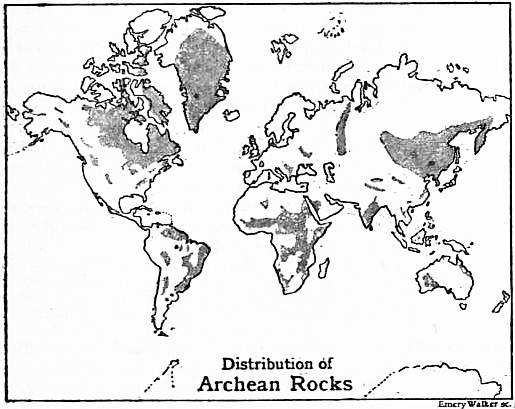
Thus, while the name “pre-Cambrian” may be used to indicate all these very old rocks whenever there is still any difficulty in subdividing them further, it is an advantage to have a special appellation for the oldest group where this can be distinguished.
It must be pointed out that the term “Archean” has been used as a synonym for pre-Cambrian; and that the expressions Azoic (from α-, privative; ζωή, life), Eozoic (from ἠὠς, dawn), and Fundamental Complex, have been employed in somewhat the same sense. Archeozoic has been proposed by American writers to apply to the lowest pre-Cambrian rocks with the same significance as “Archean” in the restricted sense employed here; but it is perhaps safer to avoid any reference to the supposed stage of life development where all direct evidence is non-existent. The so-called “Azoic” rocks have already been made to yield evidence of life, and there is no reason to presuppose the impossibility of finding other records of still earlier organisms.
The prevailing rocks of the Archean system are igneous, with metamorphosed varieties of the same; sedimentary rocks, distinctly recognizable as such, are scarce, though highly metamorphosed rocks supposed to be sediments, in some regions, take an important place.
There are several features which are peculiarly characteristic of the Archean rocks:—(1) the extraordinary complexity of the assemblage of igneous materials; (2) the extreme metamorphism and deformation which nearly all the rocks have suffered; and (3) the inextricable intermixture of igneous rocks with those for which a sedimentary origin is postulated. Wherever the Archean rocks have been closely examined two great groups of rocks are distinguishable, an older, schistose group and a younger, granitoid and gneissic group. For many years the latter was supposed to be the older, hence the epithets “primitive” or “fundamental” were applied to it. Now, however, it has been shown, both in Europe and in North America, that in certain regions a schistose series is penetrated by a gneissose series and when this occurs the schists must be the older. But bearing in mind the difficulties of interpretation, it is not at all unreasonable to assume that there may yet be regions where the gneissose rocks are the oldest; for where no schistose series is present there may be no criterion for estimating the age of the granites and gneisses. The exceedingly great difficulties which lie in the way of every attempt to unravel the history of an Archean rock-complex cannot be too forcibly emphasized; for to be able to demonstrate the order of events and succession of rocks we should at least know whether we are dealing with sediments, flows of volcanic material, or intrusions, yet in many instances this cannot be done. In some areas the gradual passage of highly foliated and metamorphosed schists may be traced into comparatively unaltered arkoses, greywackes, conglomerates; or into volcanic lava-flows, pyro-clastic rocks or dikes; or again through a gneissose rock into a granite or a gabbro; but the districts wherein these relationships have been thoroughly worked out are very few.
This much may be said, that where the Archean system has been most carefully studied, there appears to be (1) a schistose series, of itself by no means simple but containing the foliated equivalents of sedimentary and igneous rocks; into this series a gneissose group (2) has been intruded in the form of batholites, great sheets and sills with accompanying intrusional prolongations into the schists; subsequently, into the gneisses and schists, after they had been further deformed, sheared and foliated, another set (3) of dikes or thin sheet-like intrusions penetrated. All this, namely, the formation of sediments, the outpouring of volcanic rocks, their repeated deformation by powerful dynamic agencies and then their penetration by dikes and sheets had been completed and erosion had been at work upon the hardened and exposed rocks, before the earliest pre-Cambrian sediment was deposited.
There has been much premature speculation as to the nature and origin of these very ancient rocks. The prevalence of regular foliation with layers of different mineral composition, producing a close resemblance to bedding, has led some to imagine that the gneisses and schists were themselves the product of the primeval oceans, a supposition that is no longer worthy of further discussion. Others have supposed that the gneisses were largely produced by the resorption and fusion of older sediments in the molten interior of the earth; there is no evidence that this has taken place upon an extended scale, though there is reason to believe that something of this kind has happened in places, and there is in the hypothesis nothing radically untenable. In one way the sedimentary schists have undoubtedly been incorporated within the gneissose mass, namely, by the extremely thorough and intimate penetration of the former by the latter along planes of foliation; and when a complex mass such as this has been further sheared and metamorphosed, a uniform gneiss appears to result from the intermixture.
A not uncommon cause of the apparently bedded arrangement of layers of different mineralogical composition may be traced to the original differentiation of the granitoid magma into different mineral-sheets. When these mineralogically different layers were forced into other rocks, sometimes before the complete consolidation of the former and sometimes subsequent to it, in the generally metamorphosed condition of the whole, it is easy to see a superficial resemblance to bedding.
The Archean rocks have frequently been spoken of as the original crust of the earth; but even granting a cooling molten globe with a first-formed stony surface, it is tolerably clear that such a crust has nowhere yet been found, nor is it ever likely to be discovered. The very earliest recognizable sediments are the result of the destruction of still earlier exposures of rock; the oldest known volcanic rocks were poured upon a surface we can no longer distinguish, and as for the great granitoid masses, they could only have been formed under the pressure of superincumbent masses of material. The earliest known sediments must have been deep in the zones of shearing and rock flowage before the first pre-Cambrian denudation. The time required for these changes is difficult to conceive.
As regards the life of the Archean, or, as some call it, the “Archeozoic” period, we know nothing. The presence of carbonaceous shale and graphitic schists as well as of the altered sedimentary iron ores has been taken as indicative of vegetable life. Similarly, the occurrence of limestones suggests the existence of organic activity, but direct evidence is wanting. Much interest naturally attaches to this remote period, and when Sir William E. Logan in 1854 found the foraminifera-like Eozoon Canadense, high hopes of further discoveries were entertained, but the inorganic nature of this structure has since been clearly proved.
Distribution.—It is generally assumed that the Archean rocks underlie all the younger formations over the whole globe, and presumably this is the only system that does so. Naturally, the area of its outcrop is limited, for, directly or indirectly, all the younger rock groups must rest upon it.
It has been estimated that Archean rocks appear at the surface over one-fifth of the land area (omitting coverings of superficial drifts). This estimate is no more than the roughest approximation, and is liable at any time to revision as our knowledge of little-known regions is increased. It must ever be borne in mind that the presence of a gneissose or schistose complex does not in itself imply the Archean age of such a set of rocks. Local manifestations of a similar petrological facies may and do appear which are of vastly inferior geological age; and unless there is unequivocal evidence that such rocks lie beneath the oldest fossil-bearing strata, there can be no absolute certainty as to their antiquity. It is more than likely that certain occurrences of gneiss and schist, at present regarded as Archean, may prove on fuller examination to be metamorphosed representatives of younger periods.
Britain.—The most important exposure of Archean rocks in Britain is in the north-west of Scotland, where they form the mainland in Sutherland and Ross-shire, and appear also in the outer Hebrides. Their great development in the isle of Lewis has given rise to the term “Lewisian” (Hebridean), by which the gneisses of this region are now generally known. The Lewisian series comprises two great groups of rocks, (1) the so-called “fundamental complex,” an assemblage of acid, basic and intermediate irruptive rocks, associated together in a complex of extraordinary intricacy, and (2) a series of dikes, which like the rocks they traverse, show every gradation from ultra-basic to ultra-acid types. But the above bald statement conveys no idea of the complexity of the series, for before the “fundamental complex” had been pierced by the later dike system it had been subjected to severe dynamo-metamorphism and many of the massive rocks had been folded, thrust and sheared, and a very general state of foliation had been produced. Nor was this all, for after the intrusion of the dikes, great movements brought about vertical dislocations, and thrust planes, which traversed the rocks at all angles, accompanied by still further internal shearing and superinduced foliation.
In the valley of Loch Maree and thence south-westward into Glenelg, a series of mica-schists, quartz-schists, saccharoid limestones and graphitic schists has been regarded as a group of sedimentary origin through which the Lewisian rocks have been irrupted.
In England several small masses of gneiss, notably at Primrose Hill on the Wrekin, Shropshire, in the Malvern hills, and on the island of Anglesey in North Wales, are supposed to correspond with the Lewisian of Scotland.
North America.—In this continent there is a great development of Archean rocks in Canada. On the eastern side it covers nearly the whole of the Labrador peninsula, and extends into Baffin Bay and possibly over much of Greenland; a broad tract unites the great lake region with Labrador, and from the same region, by way of the Mackenzie valley, a similar tract extends in a north-westerly direction to the Arctic Ocean. This northern (Canadian) area of Archean includes portions of the states of Minnesota, Michigan, Wisconsin and the Adirondack region of New York. On the western side of the continent a series of disconnected exposures of Archean rocks runs downwards in a narrow belt from Alaska to New Mexico; and on the eastern side a similar belt reaches from Newfoundland to Alabama.
Much attention is now being given to the more scattered exposures of Archean rocks, but the best-known area is the classical ground in the vicinity of Lake Superior and Lake Huron and in the Ottawa gneiss region of Canada. Some of the more important districts are the following:—
Rainy Lake district, Canada: The Archean rocks here consist of altered diorites and diabases (the lower Keewatin series) and black hornblende schists (probably altered igneous rocks), with mica gneisses which are perhaps of sedimentary origin.
The Mona and Kiticni schists; metamorphosed lava and tuffs, with serpentine and dolomite, probably derived from peridotites; there are also gneissic granites and syenites.
In the Menominee region of Michigan and Wisconsin, the Quinnesec schist series mainly consist of schistose quartz porphyry with associated gneisses.
In the Mesaba district of Minnesota the Archean consists of a complex of more or less foliated igneous rocks mostly basic in character.
The Archean of the Vermilion district of Minnesota comprises the Soudan formation, an altered sedimentary series with banded cherts, jasper and magnetite schists; the iron ores are extensively mined. At the base is a conglomerate containing pebbles from the formation below, the Ely greenstone, which is made up of altered basalts and andesites, generally in a schistose condition, but occasionally exhibiting spherulitic structures. Into these two formations a series of granites have been intruded.
Europe.—In Scandinavia, as in Scotland, the pre-Cambrian is represented by an earlier and a later series of rocks of which the former (Grundfjeldet, Urberget) may be taken to be the equivalent of the Lewisian gneisses. This assemblage of coarse red and grey banded gneisses, with associated granulites and many varieties of acid, basic and intermediate rocks in a gneissose condition, is intimately related to a highly metamorphosed sedimentary series comprising limestones, quartzites and schists, which, as in Scotland, is apparently older than the gneisses. Similar rocks occur in Sweden and Finland.
In Bavaria and Bohemia the Archean is divisible into a lower red gneiss, a comparatively simple series, called by C.W. von Gümbel the “gneiss of Bojan”; and an upper, grey gneiss with other schistose rocks, serpentine and graphitic limestone, termed by the same author the “Hercynian gneiss.”
In Brittany a gneissose and schistose igneous series lies at the base of the pre-Cambrian. The pre-Cambrian cores of the eastern and central Pyrenees, consisting of gneiss, schists and altered limestones, are presumably of Archean age.
Asia, Australia, &c.—In northern China, mica-gneisses and granite-gneisses with associated schists may be regarded as Archean. In India the system is represented by the Bundelkhand gneiss and the central older gneisses of the Himalayas. In Japan, in the Abukuma plateau, there is much granite, gneiss and schist which may be of this age. In Australia, similar rocks are recognized as Archean in South Australia and Westralia, and they are estimated to cover an area of no less than 20,000 sq. m.; in Tasmania they are well developed on the western side. Although a great area is occupied by crystalline rocks in New Zealand, the Archean age of any portion of the series is not yet satisfactorily established; the lower granites and gneisses may belong to this period. Africa contains enormous tracts of crystalline gneisses, granites and schists, and some of these are almost certainly of Archean age; but in the present state of our knowledge it is impossible to speak more exactly.
References.—A good general account of the Archean system will be found in Sir A. Geikie’s Text Book of Geology, vol. ii., 4th ed. (1903), and in T.C. Chamberlin and R.D. Salisbury’s Geology, vol. ii. (1906); these volumes contain references to all important literature.
(J. A. H.)
ARCHELAUS OF CAPPADOCIA (1st century B.C.), general of Mithradates the Great in the war against Rome. In 87 B.C. he was sent to Greece with a large army and fleet, and occupied the Peiraeus after three days’ fighting with Bruttius Sura, prefect of Macedonia, who in the previous year had defeated Mithradates’ fleet under Metrophanes and captured the island of Sciathus. Here he was besieged by Sulla, compelled to withdraw into Boeotia, and completely defeated at Chaeroneia (86). A fresh army was sent by Mithradates, but Archelaus was again defeated at Orchomenus, after a two days’ battle (85). On the conclusion of peace, Archelaus, finding that he had incurred the suspicion of Mithradates, deserted to the Romans, by whom he was well received. Nothing further is known of him.