BOOK IX.[1]
Herbert Hoover translation
BOOK IX.[1]

ince I have written of the varied work of preparing the ores, I will now write of the various methods of smelting them. Although those who burn, roast and calcine[2] the ore, take from it something which is mixed or combined with the metals; and those who crush it with stamps take away much; and those who wash, screen and sort it, take away still more; yet they cannot remove all which conceals the metal from the eye and renders it crude and unformed. Wherefore smelting is necessary, for by this means earths, solidified juices, and stones are separated from the metals so that they obtain their proper colour and become pure, and may be of great use to mankind in many ways. When the ore is smelted, those things which were mixed with the metal before it was melted are driven forth, because the metal is perfected by fire in this manner. Since metalliferous ores differ greatly amongst themselves, first as to the metals which they contain, then as to the quantity of the metal which is in them, and then by the fact that some are rapidly melted by fire and others slowly, there are, therefore, many methods of smelting. Constant practice has taught the smelters by which of these methods they can obtain the most metal from any one ore. Moreover, while sometimes there are many methods of smelting the same ore, by which an equal weight of metal is melted out, yet one is done at a greater cost and labour than the others. Ore is either melted with a furnace or without one; if smelted with a furnace the tap-hole is either temporarily closed or always open, and if smelted without a furnace, it is done either in pots or in trenches. But in order to make this matter clearer, I will describe each in detail, beginning with the buildings and the furnaces.
A wall which will be called the "second wall" is constructed of brick or stone, two feet and as many palms thick, in order that it may be strong enough to bear the weight. It is built fifteen feet high, and its length depends on the number of furnaces which are put in the works; there are usually six furnaces, rarely more, and often less. There are three furnace walls, a back one which is against the "second" wall, and two side ones, of which I will speak later. These should be made of natural stone, as this is more serviceable than burnt bricks, because bricks soon become defective and crumble away, when the smelter or his deputy chips off the accretions which adhere to the walls when the ore is smelted. Natural stone resists injury by the fire and lasts a long time, especially that which is soft and devoid of cracks; but, on the contrary, that which is hard and has many cracks is burst asunder by the fire and destroyed. For this reason, furnaces which are made of the latter are easily weakened by the fire, and when the accretions are chipped off they crumble to pieces. The front furnace wall should be made of brick, and there should be in the lower part a mouth three palms wide and one and a half feet high, when the hearth is completed. A hole slanting upward, three palms long, is made through the back furnace wall, at the height of a cubit, before the hearth has been prepared; through this hole and a hole one foot long in the "second" wall—as the back of this wall has an arch—is inserted a pipe of iron or bronze, in which are fixed the nozzles of the bellows. The whole of the front furnace wall is not more than five feet high, so that the ore may be conveniently put into the furnace, together with those things which the master needs for his work of smelting. Both the side walls of the furnace are six feet high, and the back one seven feet, and they are three palms thick. The interior of the furnace is five palms wide, six palms and a digit long, the width being measured by the space which lies between the two side walls, and the length by the space between the front and the back walls; however, the upper part of the furnace widens out somewhat.
A—Furnaces. B—Forehearths. [Pg 357] There are two doors in the second wall if there are six furnaces, one of the doors being between the second and third furnaces and the other between the fourth and fifth furnaces. They are a cubit wide and six feet high, in order that the smelters may not have mishaps in coming and going. It is necessary to have a door to the right of the first furnace, and similarly one to the left of the last, whether the wall is longer or not. The second wall is carried further when the rooms for the cupellation furnaces, or any other building, adjoin the rooms for the blast furnaces, these buildings being only divided by a partition. The smelter, and the ones who attend to the first and the last furnaces, if they wish to look at the bellows or to do anything else, go out through the doors at the end of the wall, and the other people go through the other doors, which are the common ones. The furnaces are placed at a distance of six feet from one another, in order that the smelters and their assistants may more easily sustain the fierceness of the heat. Inasmuch as the interior of each furnace is five palms wide and each is six feet distant from the other, and inasmuch as there is a space of four feet three palms at the right side of the first furnace and as much at the left side of the last furnace, and there are to be six furnaces in one building, then it is necessary to make the second wall fifty-two feet long; because the total of the widths of all of the furnaces is seven and a half feet, the total of the spaces between the furnaces is thirty feet, the space on the outer sides of the first and last furnaces is nine feet and two palms, and the thickness of the two transverse walls is five feet, which make a total measurement of fifty-two feet.[3]
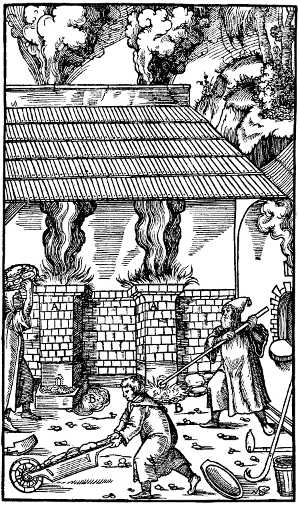
Outside each furnace hearth there is a small pit full of powder which is compressed by ramming, and in this manner is made the forehearth which receives the metal flowing from the furnaces. Of this I will speak later.
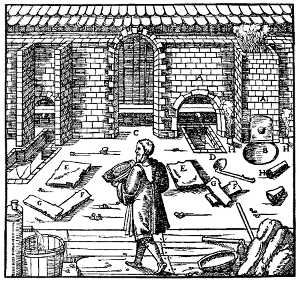
A—Furnaces. B—Forehearth. C—Door. D—Water tank. E—Stone which covers it. F—Material of the vent walls. G—Stone which covers it. H—Pipe exhaling the vapour. [Pg 358] Buried about a cubit under the forehearth and the hearth of the furnace is a transverse water-tank, three feet long, three palms wide and a cubit deep. It is made of stone or brick, with a stone cover, for if it were not covered, the heat would draw the moisture from below and the vapour might be blown into the hearth of the furnace as well as into the forehearth, and would dampen the blast. The moisture would vitiate the blast, and part of the metal would be absorbed and part would be mixed with the slags, and in this manner the melting would be greatly damaged. From each water-tank is built a walled vent, to the same depth as the tank, but six digits wide; this vent slopes upward, and sooner or later penetrates through to the other side of the wall, against which the furnace is built. At the end of this vent there is an opening where the steam, into which the water has been converted, is exhausted through a copper or iron tube or pipe. This method of making the tank and the vent is much the best. Another kind has a similar vent but a different tank, for it does not lie transversely under the forehearth, but lengthwise; it is two feet and a palm long, and a foot and three palms wide, and a foot and a palm deep. This method of making tanks is not condemned by us, as is the construction of those tanks without a vent; the latter, which have no opening into the air through which the vapour may discharge freely, are indeed to be condemned.
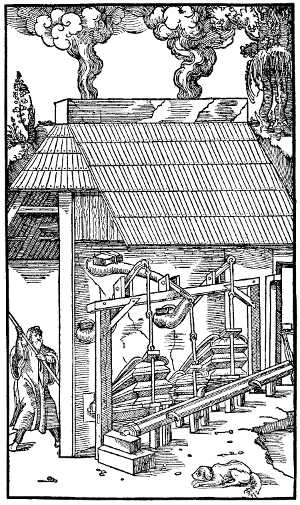
[Pg 359] Fifteen feet behind the second wall is constructed the first wall, thirteen feet high. In both of these are fixed roof beams[4], which are a foot wide and thick, and nineteen feet and a palm long; these are placed three feet distant from one another. As the second wall is two feet higher than the first wall, recesses are cut in the back of it two feet high, one foot wide, and a palm deep, and in these recesses, as it were in mortises, are placed one end of each of the beams. Into these ends are mortised the bottoms of just as many posts; these posts are twenty-four feet high, three palms wide and thick, and from the tops of the posts the same number of rafters stretch downward to the ends of the beams superimposed on the first wall; the upper ends of the rafters are mortised into the posts and the lower ends are mortised into the ends of the beams laid on the first wall; the rafters support the roof, which consists of burnt tiles. Each separate rafter is propped up by a separate timber, which is a cross-beam, and is joined to its post. Planks close together are affixed to the posts above the furnaces; these planks are about two digits thick and a palm wide, and they, together with the wicker work interposed between the timbers, are covered with lute so that there may be no risk of fire to the timbers and wicker-work. In this practical manner is constructed the back part of the works, which contains the bellows, their frames, the mechanism for compressing the bellows, and the instrument for distending them, of all of which I will speak hereafter.
The four long walls: A—First. B—Second. C—Third. D—Fourth. The seven transverse walls: E—First. F—Second. G—Third. H—Fourth. I—Fifth. K—Sixth. L—Seventh, or middle. [Pg 361] In front of the furnaces is constructed the third long wall and likewise the fourth. Both are nine feet high, but of the same length and thickness as the other two, the fourth being nine feet distant from the third; the third is twenty-one and a half feet from the second. At a distance of twelve feet from the second wall, four posts seven and a half feet high, a cubit wide and thick, are set upon rock laid underneath. Into the tops of the posts the roof beam is mortised; this roof beam is two feet and as many palms longer than the distance between the second and the fifth transverse walls, in order that its ends may rest on the transverse walls. If there should not be so long a beam at hand, two are substituted for it. As the length of the long beam is as above, and as the posts are equidistant, it is necessary that the posts should be a distance of nine feet, one palm, two and two-fifths digits from each other, and the end ones this distance from the transverse walls. On this longitudinal beam and to the third and fourth walls are fixed twelve secondary beams twenty-four feet long, one foot wide, three palms thick, and distant from each other three feet, one palm, and two digits. In these secondary beams, where they rest on the longitudinal beams, are mortised the ends of the same number of rafters as there are posts which stand on the second wall. The ends of the rafters do not reach to the tops of the posts, but are two feet away from them, that through this opening, which is like the open part of a forge, the furnaces can emit their fumes. In order that the rafters should not fall down, they are supported partly by iron rods, which extend from each rafter to the opposite post, and partly supported by a few tie-beams, which in the same manner extend from some rafters to the posts opposite, and give them stability. To these tie-beams, as well as to the rafters which face the posts, a number of boards, about two digits thick and a palm wide, are fixed at a distance of a palm from each other, and are covered with lute so that they do not catch fire. In the secondary beams, where they are laid on the fourth wall, are mortised the lower ends of the same number of rafters as those in a set of rafters[5] opposite them. From the third long wall these rafters are joined and tied to the ends of the opposite rafters, so that they may not slip, and besides they are strengthened with substructures which are made of cross and oblique timbers. The rafters support the roof.
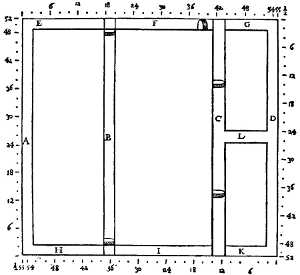
In this manner the front part of the building is made, and is divided into three parts; the first part is twelve feet wide and is under the hood, which consists of two walls, one vertical and one inclined. The second part is the same number of feet wide and is for the reception of the ore to be smelted, the fluxes, the charcoal, and other things which are needed by the smelter. The third part is nine feet wide and contains two separate rooms of equal size, in one of which is the assay furnace, while the other contains the metal to be melted in the cupellation furnaces. It is thus necessary that in the building there should be, besides the four long walls, seven transverse walls, of which the first is constructed from the upper end of the first long wall to the upper end of the second long wall; the second proceeds from the end of this to the end of the third long wall; the third likewise from this end of the last extends to the end of the fourth long wall; the fourth leads from the lower end of the first long wall to the lower end of the second long wall; the fifth extends from the end of this to the end of the third long wall; the sixth extends from this last end to the end of the fourth long wall; the seventh divides into two parts the space between the third and fourth long walls.
To return to the back part of the building, in which, as I said, are the bellows[6], their frames, the machinery for compressing them, and the instrument for distending them. Each bellows consists of a body and a head. The body is composed of two "boards," two bows, and two hides. The upper board is a palm thick, five feet and three palms long, and two and a half feet wide at the back part, where each of the sides is a little curved, and it is a cubit wide at the front part near the head. The whole of the body of the bellows tapers toward the head. That which we now call the "board" consists of two pieces of pine, joined and glued together, and of two strips of linden wood which bind the edges of the board, these being seven digits wide at the back, and in front near the head of the bellows one and a half digits wide. These strips are glued to the boards, so that there shall be less damage from the iron nails driven through the hide. There are some people who do not surround the boards with strips, but use boards only, which are very thick. The upper board has an aperture and a handle; the aperture is in the middle of the board and is one foot three palms distant from where the board joins the head of the bellows, and is six digits long and four wide. The lid for this aperture is two palms and a digit long and wide, and three digits thick; toward the back of the lid is a little notch cut into the surface so that it may be caught by the hand; a groove is cut out of the top of the front and sides, so that it may engage in mouldings a palm wide and three digits thick, which are also cut out in a similar manner under the edges. Now, when the lid is drawn forward the hole is closed, and when drawn back it is opened; the smelter opens the aperture a little so that the air may escape from the bellows through it, if he fears the hides might be burst when the bellows are too vigorously and quickly inflated; he, however, closes the aperture if the hides are ruptured and the air escapes. Others perforate the upper board with two or three round holes in the same place as the rectangular one, and they insert plugs in them which they draw out when it is necessary. The wooden handle is seven palms long, or even longer, in order that it may extend outside; one-half of this handle, two palms wide and one thick, is glued to the end of the board and fastened with pegs covered with glue; the other half projects beyond the board, and is rounded and seven digits thick. Besides this, to the handle and to the board is fixed a cleat two feet long, as many palms wide and one palm thick, and to the under side of the same board, at a distance of three palms from the end, is fixed another cleat two feet long, in order that the board may sustain the force of distension and compression; these two cleats are glued to the board, and are fastened to it with pegs covered with glue.
The lower bellows-board, like the upper, is made of two pieces of pine and of two strips of linden wood, all glued together; it is of the same width and thickness as the upper board, but is a cubit longer, this extension being part of the head of which I have more to say a little later. This lower bellows-board has an air-hole and an iron ring. The air-hole is about a cubit distant from the posterior end, and it is midway between the sides of the bellows-board, and is a foot long and three palms wide; it is divided into equal parts by a small rib which forms part of the board, and is not cut from it; this rib is a palm long and one-third of a digit wide. The flap of the air-hole is a foot and three digits long, three palms and as many digits wide; it is a thin board covered with goat skin, the hairy part of which is turned toward the ground. There is fixed to one end of the flap, with small iron nails, one-half of a doubled piece of leather a palm wide and as long as the flap is wide; the other half of the leather, which is behind the flap, is twice perforated, as is also the bellows-board, and these perforations are seven digits apart. Passing through these a string is tied on the under side of the board; and thus the flap when tied to the board does not fall away. In this manner are made the flap and the air-hole, so when the bellows are distended the flap opens, when compressed it closes. At a distance of about a foot beyond the air-hole a slightly elliptical iron ring, two palms long and one wide, is fastened by means of an iron staple to the under part of the bellows-board; it is at a distance of three palms from the back of the bellows. In order that the lower bellows-board may remain stationary, a wooden bolt is driven into the ring, after it penetrates through the hole in the transverse supporting plank which forms part of the frame for the bellows. There are some who dispense with the ring and fasten the bellows-board to the frame with two iron screws something like nails.
The bows are placed between the two boards and are of the same length as the upper board. They are both made of four pieces of linden wood three digits thick, of which the two long ones are seven digits wide at the back and two and a half at the front; the third piece, which is at the back, is two palms wide. The ends of the bows are a little more than a digit thick, and are mortised to the long pieces, and both having been bored through, wooden pegs covered with glue are fixed in the holes; they are thus joined and glued to the long pieces. Each of the ends is bowed (arcuatur) to meet the end of the long part of the bow, whence its name "bow" originated. The fourth piece keeps the ends of the bow distended, and is placed a cubit distant from the head of the bellows; the ends of this piece are mortised into the ends of the bow and are joined and glued to them; its length without the tenons is a foot, and its width a palm and two digits. There are, besides, two other very small pieces glued to the head of the bellows and to the lower board, and fastened to them by wooden pegs covered with glue, and they are three palms and two digits long, one palm high, and a digit thick, one half being slightly cut away. These pieces keep the ends of the bow away from the hole in the bellows-head, for if they were not there, the ends, forced inward by the great and frequent movement, would be broken.
The leather is of ox-hide or horse-hide, but that of the ox is far preferable to that of the horse. Each of these hides, for there are two, is three and a half feet wide where they are joined at the back part of the bellows. A long leathern thong is laid along each of the bellows-boards and each of the bows, and fastened by T-shaped iron nails five digits long; each of the horns of the nails is two and a half digits long and half a digit wide. The hide is attached to the bellows-boards by means of these nails, so that a horn of one nail almost touches the horn of the next; but it is different with the bows, for the hide is fastened to the back piece of the bow by only two nails, and to the two long pieces by four nails. In this practical manner they put ten nails in one bow and the same number in the other. Sometimes when the smelter is afraid that the vigorous motion of the bellows may pull or tear the hide from the bows, he also fastens it with little strips of pine by means of another kind of nail, but these strips cannot be fastened to the back pieces of the bow, because these are somewhat bent. Some people do not fix the hide to the bellows-boards and bows by iron nails, but by iron screws, screwed at the same time through strips laid over the hide. This method of fastening the hide is less used than the other, although there is no doubt that it surpasses it in excellence.
Lastly, the head of the bellows, like the rest of the body, consists of two boards, and of a nozzle besides. The upper board is one cubit long, one and a half palms thick. The lower board is part of the whole of the lower bellows-board; it is of the same length as the upper piece, but a palm and a digit thick. From these two glued together is made the head, into which, when it has been perforated, the nozzle is fixed. The back part of the head, where it is attached to the rest of the bellows-body, is a cubit wide, but three palms forward it becomes two digits narrower. Afterward it is somewhat cut away so that the front end may be rounded, until it is two palms and as many digits in diameter, at which point it is bound with an iron ring three digits wide.
The nozzle is a pipe made of a thin plate of iron; the diameter in front is three digits, while at the back, where it is encased in the head of the bellows, it is a palm high and two palms wide. It thus gradually widens out, especially at the back, in order that a copious wind can penetrate into it; the whole nozzle is three feet long.
A—Upper bellows-board. B—Lower bellows-board. C—The two pieces of wood of which each consists. D—Posterior arched part of each. E—Tapered front part of each. F—Pieces of linden wood. G—Aperture in the upper board. H—Lid. I—Little mouldings of wood. K—Handle. L—Cleat on the outside. The cleat inside I am not able to depict. M—Interior of the lower bellows-board. N—Part of the head. O—Air-hole. P—Supporting bar. Q—Flap. R—Hide. S—Thong. T—Exterior of the lower board. V—Staple. X—Ring. Y—Bow. Z—Its long pieces. AA—Back piece of the bow. BB—The bowed ends. CC—Crossbar distending the bow. DD—The two little pieces. EE—Hide. FF—Nail. GG—Horn of the nail. HH—A screw. II—Long thong. KK—Head. LL—Its lower board. MM—Its upper board. NN—Nozzle. OO—The whole of the lower bellows-board. PP—The two exterior plates of the head hinges. QQ—Their curved piece. RR—Middle plate of the head. SS—The two outer plates of the upper bellows-board. TT—Its middle plate. VV—Little axle. XX—Whole bellows. [Pg 365] The upper bellows-board is joined to the head of the bellows in the following way. An iron plate[7], a palm wide and one and a half palms long, is first fastened to the head at a distance of three digits from the end; from this plate there projects a piece three digits long and two wide, curved in a small circle. The other side has a similar plate. Then in the same part of the upper board are fixed two other iron plates, distant two digits from the edge, each of which are six digits wide and seven long; in each of these plates the middle part is cut away for a little more than three digits in length and for two in depth, so that the curved part of the plates on the head corresponding to them may fit into this cut out part. From both sides of each plate there project pieces, three digits long and two digits wide, similarly curved into small circles. A little iron pin is passed through these curved pieces of the plates, like a little axle, so that the upper board of the bellows may turn upon it. The little axle is six digits long and a little more than a digit thick, and a small groove is cut out of the upper board, where the plates are fastened to it, in such a manner that the little axle when fixed to the plates may not fall out. Both plates fastened to the bellows-board are affixed by four iron nails, of which the heads are on the inner part of the board, whereas the points, clinched at the top, are transformed into heads, so to speak. Each of the other plates is fastened to the head of the bellows by means of a nail with a wide head, and by two other nails of which the heads are on the edge of the bellows-head. Midway between the two plates on the bellows-board there remains a space two palms wide, which is covered by an iron plate fastened to the board by little nails; and another plate corresponding to this is fastened to the head between the other two plates; they are two palms and the same number of digits wide.
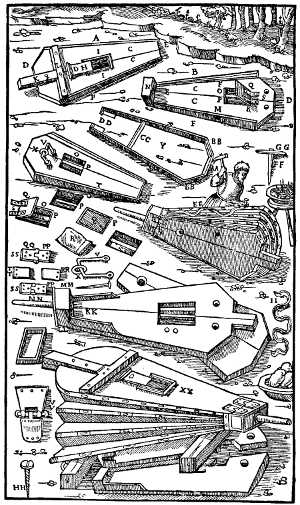
The hide is common to the head as to all the other parts of the body; the plates are covered with it, as well as the front part of the upper bellows-board, and both the bows and the back of the head of the bellows, so that the wind may not escape from that part of the bellows. It is three palms and as many digits wide, and long enough to extend from one of the sides of the lower board over the back of the upper; it is fastened by many T-headed nails on one side to the upper board, and on the other side to the head of the bellows, and both ends are fastened to the lower bellows-board.
In the above manner the bellows is made. As two are required for each furnace, it is necessary to have twelve bellows, if there are to be six furnaces in one works.
A—Front sill. B—Back sill. C—Front posts. D—Their slots. E—Beam imposed upon them. F—Higher posts. G—Their slots. H—Beam imposed upon them. I—Timber joined in the mortises of the posts. K—Planks. L—Transverse supporting planks. M—The holes in them. N—Pipe. O—Its front end. P—Its rear end. [Pg 368] Now it is time to describe their framework. First, two sills a little shorter than the furnace wall are placed on the ground. The front one of these is three palms wide and thick, and the back one three palms and two digits. The front one is two feet distant from the back wall of the furnace, and the back one is six feet three palms distant from the front one. They are set into the earth, that they may remain firm; there are some who accomplish this by means of pegs which, through several holes, penetrate deeply into the ground.
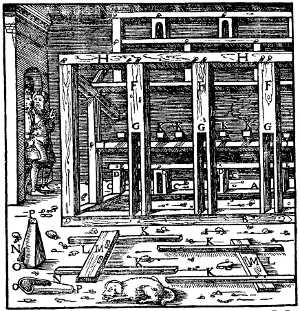
Then twelve short posts are erected, whose lower ends are mortised into the sill that is near the back of the furnace wall; these posts are two feet high, exclusive of the tenons, and are three palms and the same number of digits wide, and two palms thick. A slot one and a half palms wide is cut through them, beginning two palms from the bottom and extending for a height of three palms. All the posts are not placed at the same intervals, the first being at a distance of three feet five digits from the second, and likewise the third from the fourth, but the second is two feet one palm and three digits from the third; the intervals between the other posts are arranged in the same manner, equal and unequal, of which each four pertain to two furnaces. The upper ends of these posts are mortised into a transverse beam which is twelve feet, two palms, and three digits long, and projects five digits beyond the first post and to the same distance beyond the fourth; it is two palms and the same number of digits wide, and two palms thick. Since each separate transverse beam supports four bellows, it is necessary to have three of them.
Behind the twelve short posts the same number of higher posts are erected, of which each has the middle part of the lower end cut out, so that its two resulting lower ends are mortised into the back sill; these posts, exclusive of the tenons, are twelve feet and two palms high, and are five palms wide and two palms thick. They are cut out from the bottom upward, the slot being four feet and five digits high and six digits wide. The upper ends of these posts are mortised into a long beam imposed upon them; this long beam is placed close under the timbers which extend from the wall at the back of the furnace to the first long wall; the beam is three palms wide and two palms thick, and forty-three feet long. If such a long one is not at hand, two or three may be substituted for it, which when joined together make up that length. These higher posts are not placed at equal distances, but the first is at a distance of two feet three palms one digit from the second, and the third is at the same distance from the fourth; while the second is at a distance of one foot three palms and the same number of digits from the third, and in the same manner the rest of the posts are arranged at equal and unequal intervals. Moreover, there is in every post, where it faces the shorter post, a mortise at a foot and a digit above the slot; in these mortises of the four posts is tenoned a timber which itself has four mortises. Tenons are enclosed in mortises in order that they may be better joined, and they are transfixed with wooden pins. This timber is thirteen feet three palms one digit long, and it projects beyond the first post a distance of two palms and two digits, and to the same number of palms and digits beyond the fourth post. It is two palms and as many digits wide, and also two palms thick. As there are twelve posts it is necessary to have three timbers of this kind.
On each of these timbers, and on each of the cross-beams which are laid upon the shorter posts, are placed four planks, each nine feet long, two palms three digits wide, and two palms one digit thick. The first plank is five feet one palm one digit distant from the second, at the front as well as at the back, for each separate plank is placed outside of the posts. The third is at the same distance from the fourth, but the second is one foot and three digits distant from the third. In the same manner the rest of the eight planks are arranged at intervals, the fifth from the sixth and the seventh from the eighth are at the same distances as the first from the second and the third from the fourth; the sixth is at the same distance from the seventh as the second from the third.
Two planks support one transverse plank six feet long, one foot wide, one palm thick, placed at a distance of three feet and two palms from the back posts. When there are six of these supporting planks, on each separate one are placed two bellows; the lower bellows-boards project a palm beyond them. From each of the bellows-boards an iron ring descends through a hole in its supporting plank, and a wooden peg is driven into the ring, so that the bellows-board may remain stationary, as I stated above.
The two bellows communicate, each by its own plank, to the back of a copper pipe in which are set both of the nozzles, and their ends are tightly fastened in it. The pipe is made of a rolled copper or iron plate, a foot and two palms and the same number of digits long; the plate is half a digit thick, but a digit thick at the back. The interior of the pipe is three digits wide, and two and a half digits high in the front, for it is not absolutely round; and at the back it is a foot and two palms and three digits in diameter. The plate from which the pipe is made is not entirely joined up, but at the front there is left a crack half a digit wide, increasing at the back to three digits. This pipe is placed in the hole in the furnace, which, as I said, was in the middle of the wall and the arch. The nozzles of the bellows, placed in this pipe, are a distance of five digits from its front end.
A—Lever which when depressed by means of a cam compresses the bellows. B—Slots through the posts. C—Bar. D—Iron implement with a rectangular link. E—Iron instrument with round ring. F—Handle of bellows. G—Upper post. H—Upper lever. I—Box with equal sides. K—Box narrow at the bottom. L—Pegs driven into the upper lever. [Pg 370] The levers are of the same number as the bellows, and when depressed by the cams of the long axle they compress the bellows. These levers are eight feet three palms long, one palm wide and thick, and the ends are inserted in the slots of the posts; they project beyond the front posts to a distance of two palms, and the same distance beyond the back posts in order that each may have its end depressed by its two cams on the axle. The cams not only penetrate into the slots of the back posts, but project three digits beyond them. An iron pin is set in round holes made through both sides of the slot of each front post, at three palms and as many digits from the bottom; the pin penetrates the lever, which turns about it when depressed or raised. The back of the lever for the length of a cubit is a palm and a digit wider than the rest, and is perforated; in this hole is engaged a bar six feet and two palms long, three digits wide, and about one and one-half digits thick; it is somewhat hooked at the upper end, and approaches the handle of the bellows. Under the lever there is a nail, which penetrates through a hole in the bar, so that the lever and bar may move together. The bar is perforated in the upper end at a distance of six digits from the top; this hole is two palms long and a digit wide, and in it is engaged the hook of an iron implement which is a digit thick. At the upper part this implement has either a round or square opening, like a link, and at the lower end is hooked; the link is two digits high and wide and the hook is three digits long; the middle part between the link and the hook is three palms and two digits long. The link of this implement engages either the handle of the bellows, or else a large ring which does engage it. This iron ring is a digit thick, two palms wide on the inside of the upper part, and two digits in the lower part, and this iron ring, not unlike the first one, engages the handle of the bellows. The iron ring either has its narrower part turned upward, and in it is engaged the ring of another iron implement, similar to the first, whose hook, extending upward, grips the rope fastened to the iron ring holding the end of the second lever, of which I will speak presently; or else the iron ring grips this lever, and then in its hook is engaged the ring of the other implement whose ring engages the handle of the bellows, and in this case the rope is dispensed with.
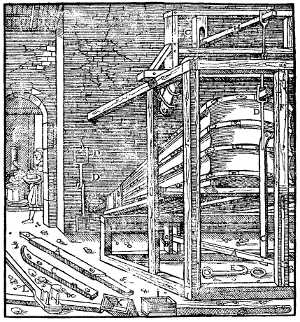
Resting on beams fixed in the two walls is a longitudinal beam, at a distance of four and a half feet from the back posts; it is two palms wide, one and a half palms thick. There are mortised into this longitudinal beam the lower ends of upper posts three palms wide and two thick, which are six feet two palms high, exclusive of their tenons. The upper ends of these posts are mortised into an upper longitudinal beam, which lies close under the rafters of the building; this upper longitudinal beam is two palms wide and one thick. The upper posts have a slot cut out upward from a point two feet from the bottom, and the slot is two feet high and six digits wide. Through these upper posts a round hole is bored from one side to the other at a point three feet one palm from the bottom, and a small iron axle penetrates through the hole and is fastened there. Around this small iron axle turns the second lever when it is depressed and raised. This lever is eight feet long, and its other end is three digits wider than the rest of the lever; at this widest point is a hole two digits wide and three high, in which is fixed an iron ring, to which is tied the rope I have mentioned; it is five palms long, its upper loop is two palms and as many digits wide, and the lower one is one palm one digit wide. This half of the second lever, the end of which I have just mentioned, is three palms high and one wide; it projects three feet beyond the slot of the post on which it turns; the other end, which faces the back wall of the furnaces, is one foot and a palm high and a foot wide.
On this part of the lever stands and is fixed a box three and a half feet long, one foot and one palm wide, and half a foot deep; but these measurements vary; sometimes the bottom of this box is narrower, sometimes equal in width to the top. In either case, it is filled with stones and earth to make it heavy, but the smelters have to be on their guard and make provision against the stones falling out, owing to the constant motion; this is prevented by means of an iron band which is placed over the top, both ends being wedge-shaped and driven into the lever so that the stones can be held in. Some people, in place of the box, drive four or more pegs into the lever and put mud between them, the required amount being added to the weight or taken away from it.
There remains to be considered the method of using this machine. The lower lever, being depressed by the cams, compresses the bellows, and the compression drives the air through the nozzle. Then the weight of the box on the other end of the upper lever raises the upper bellows-board, and the air is drawn in, entering through the air-hole.
A—Axle. B—Water-wheel. C—Drum composed of rundles. D—Other axle. E—Toothed wheel. F—Its spokes. G—Its segments. H—Its teeth. I—Cams of the axle. [Pg 372] The machine whose cams depress the lower lever is made as follows. First there is an axle, on whose end outside the building is a water-wheel; at the other end, which is inside the building, is a drum made of rundles. This drum is composed of two double hubs, a foot apart, which are five digits thick, the radius all round being a foot and two digits; but they are double, because each hub is composed of two discs, equally thick, fastened together with wooden pegs glued in. These hubs are sometimes covered above and around by iron plates. The rundles are thirty in number, a foot and two palms and the same number of digits long, with each end fastened into a hub; they are rounded, three digits in diameter, and the same number of digits apart. In this practical manner is made the drum composed of rundles.
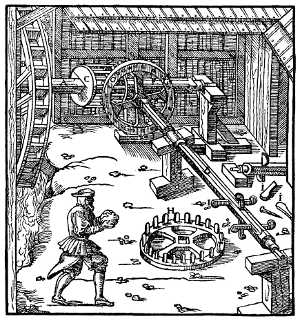
There is a toothed wheel, two palms and a digit thick, on the end of another axle; this wheel is composed of a double disc[8]. The inner disc is composed of four segments a palm thick, everywhere two palms and a digit wide. The outer disc, like the inner, is made of four segments, and is a palm and a digit thick; it is not equally wide, but where the head of the spokes are inserted it is a foot and a palm and digit wide, while on each side of the spokes it becomes a little narrower, until the narrowest part is only two palms and the same number of digits wide. The outer segments are joined to the inner ones in such a manner that, on the one hand, an outer segment ends in the middle of an inner one, and, on the other hand, the ends of the inner segments are joined in the middle of the outer ones; there is no doubt that by this kind of joining the wheel is made stronger. The outer segments are fastened to the inner by means of a large number of wooden pegs. Each segment, measured over its round back, is four feet and three palms long. There are four spokes, each two palms wide and a palm and a digit thick; their length, excluding the tenons, being two feet and three digits. One end of the spoke is mortised into the axle, where it is firmly fastened with pegs; the wide part of the other end, in the shape of a triangle, is mortised into the outer segment opposite it, keeping the shape of the same as far as the segment ascends. They also are joined together with wooden pegs glued in, and these pegs are driven into the spokes under the inner disc. The parts of the spokes in the shape of the triangle are on the inside; the outer part is simple. This triangle has two sides equal, the erect ones as is evident, which are a palm long; the lower side is not of the same length, but is five digits long, and a mortise of the same shape is cut out of the segments. The wheel has sixty teeth, since it is necessary that the rundle drum should revolve twice while the toothed wheel revolves once. The teeth are a foot long, and project one palm from the inner disc of the wheel, and three digits from the outer disc; they are a palm wide and two and a half digits thick, and it is necessary that they should be three digits apart, as were the rundles.
The axle should have a thickness in proportion to the spokes and the segments. As it has two cams to depress each of the levers, it is necessary that it should have twenty-four cams, which project beyond it a foot and a palm and a digit. The cams are of almost semicircular shape, of which the widest part is three palms and a digit wide, and they are a palm thick; they are distributed according to the four sides of the axle, on the upper, the lower and the two lateral sides. The axle has twelve holes, of which the first penetrates through from the upper side to the lower, the second from one lateral side to the other; the first hole is four feet two palms distant from the second; each alternate one of these holes is made in the same direction, and they are arranged at equal intervals. Each single cam must be opposite another; the first is inserted into the upper part of the first hole, the second into the lower part of the same hole, and so fixed by pegs that they do not fall out; the third cam is inserted into that part of the second hole which is on the right side, and the fourth into that part on the left. In like manner all the cams are inserted into the consecutive holes, for which reason it happens that the cams depress the levers of the bellows in rotation. Finally we must not omit to state that this is only one of many such axles having cams and a water-wheel.
I have arrived thus far with many words, and yet it is not unreasonable that I have in this place pursued the subject minutely, since the smelting of all the metals, to which I am about to proceed, could not be undertaken without it.
The ores of gold, silver, copper, and lead, are smelted in a furnace by four different methods. The first method is for the rich ores of gold or silver, the second for the mediocre ores, the third for the poor ores, and the fourth method is for those ores which contain copper or lead, whether they contain precious metals or are wanting in them. The smelting of the first ores is performed in the furnace of which the tap-hole is intermittently closed; the other three ores are melted in furnaces of which the tap-holes are always open.
A—Charcoal. B—Mortar-box. C—Stamps. [Pg 373] First, I will speak of the manner in which the furnaces are prepared for the smelting of the ores, and of the first method of smelting. The powder from which the hearth and forehearth should be made is composed of charcoal and earth (clay?). The charcoal is crushed by the stamps in a mortar-box, the front of which is closed by a board at the top, while the charcoal, crushed to powder, is removed through the open part below; the stamps are not shod with iron, but are made entirely of wood, although at the lower part they are bound round at the wide part by an iron band.
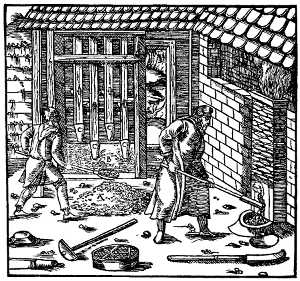
A—Tub. B—Sieve. C—Rods. D—Bench-frame. [Pg 374] The powder into which the charcoal is crushed is thrown on to a sieve whose bottom consists of interwoven withes of wood. The sieve is drawn backward and forward over two wooden or iron rods placed in a triangular position on a tub, or over a bench-frame set on the floor of the building; the powder which falls into the tub or on to the floor is of suitable size, but the pieces of small charcoal which remain in the sieve are emptied out and thrown back under the stamps.
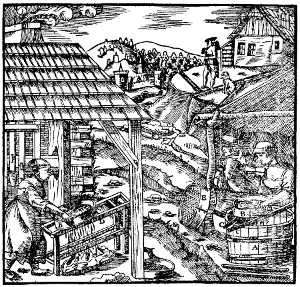
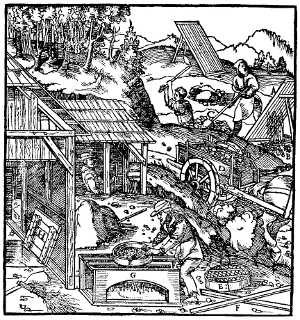
A—Screen. B—Poles. C—Shovel. D—Two-wheeled cart. E—Hand-sieve. F—Narrow boards. G—Box. H—Covered pit. [Pg 375] When the earth is dug up it is first exposed to the sun that it may dry. Later on it is thrown with a shovel on to a screen—set up obliquely and supported by poles,—made of thick, loosely woven hazel withes, and in this way the fine earth and its small lumps pass through the holes of the screen, but the clods and stones do not pass through, but run down to the ground. The earth which passes through the screen is conveyed in a two-wheeled cart to the works and there sifted. This sieve, which is not dissimilar to the one described above, is drawn backward and forward upon narrow boards of equal length placed over a long box; the powder which falls through the sieve into the box is suitable for the mixture; the lumps that remain in the sieve are thrown away by some people, but by others they are placed under the stamps. This powdered earth is mixed with powdered charcoal, moistened, and thrown into a pit, and in order that it may remain good for a long time, the pit is covered up with boards so that the mixture may not become contaminated.
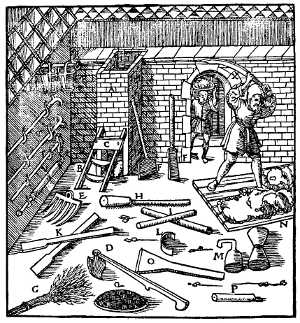
A—Furnace. B—Ladder. C—Board fixed to it. D—Hoe. E—Five-toothed rake. F—Wooden spatula. G—Broom. H—Rammer. I—Rammer, same diameter. K—Two wooden spatulas. L—Curved blade. M—Bronze rammer. N—Another bronze rammer. O—Wide spatula. P—Rod. Q—Wicker basket. R—Two buckets of leather in which water is carried for putting out a conflagration, should the officina catch fire. S—Brass pump with which the water is squirted out. T—Two hooks. V—Rake. X—Workman beating the clay with an iron implement. [Pg 377] They take two parts of pulverised charcoal and one part of powdered earth, and mix them well together with a rake; the mixture is moistened by pouring water over it so that it may easily be made into shapes resembling snowballs; if the powder be light it is moistened with more water, if heavy with less. The interior of the new furnace is lined with lute, so that the cracks in the walls, if there are any, may be filled up, but especially in order to preserve the rock from injury by fire. In old furnaces in which ore has been melted, as soon as the rocks have cooled the assistant chips away, with a spatula, the accretions which adhere to the walls, and then breaks them up with an iron hoe or a rake with five teeth. The cracks of the furnace are first filled in with fragments of rock or brick, which he does by passing his hand into the furnace through its mouth, or else, having placed a ladder against it, he mounts by the rungs to the upper open part of the furnace. To the upper part of the ladder a board is fastened that he may lean and recline against it. Then standing on the same ladder, with a wooden spatula, he smears the furnace walls over with lute; this spatula is four feet long, a digit thick, and for a foot upward from the bottom it is a palm wide, or even wider, generally two and a half digits. He spreads the lute equally over the inner walls of the furnace. The mouth of the copper pipe[9] should not protrude from the lute, lest sows[10] form round about it and thus impede the melting, for the furnace bellows could not force a blast through them. Then the same assistant throws a little powdered charcoal into the pit of the forehearth and sprinkles it with pulverised earth. Afterward, with a bucket he pours water into it and sweeps this all over the forehearth pit, and with the broom drives the turbid water into the furnace hearth and likewise sweeps it out. Next he throws the mixed and moistened powder into the furnace, and then a second time mounting the steps of the ladder, he introduces the rammer into the furnace and pounds the powder so that the hearth is made solid. The rammer is rounded and three palms long; at the bottom it is five digits in diameter, at the top three and a half, therefore it is made in the form of a truncated cone; the handle of the rammer is round and five feet long and two and a half digits thick; the upper part of the rammer, where the handle is inserted, is bound with an iron band two digits wide. There are some who, instead, use two rounded rammers three and a half digits in diameter, the same at the bottom as at the top. Some people prefer two wooden spatulas, or a rammer spatula.
In a similar manner, mixed and moistened powder is thrown and pounded with a rammer in the forehearth pit, which is outside the furnace. When this is nearly completed, powder is again put in, and pushed with the rammer up toward the protruding copper pipe, so that from a point a digit under the mouth of the copper pipe the hearth slopes down into the crucible of the forehearth,[11] and the metal can run down. The same is repeated until the forehearth pit is full, then afterward this is hollowed out with a curved blade; this blade is of iron, two palms and as many digits long, three digits wide, blunt at the top and sharp at the bottom. The crucible of the forehearth must be round, a foot in diameter and two palms deep if it has to contain a centumpondium of lead, or if only seventy librae, then three palms in diameter and two palms deep like the other. When the forehearth has been hollowed out it is pounded with a round bronze rammer. This is five digits high and the same in diameter, having a curved round handle one and a half digits thick; or else another bronze rammer is used, which is fashioned in the shape of a cone, truncated at the top, on which is imposed another cut away at the bottom, so that the middle part of the rammer may be grasped by the hand; this is six digits high, and five digits in diameter at the lower end and four at the top. Some use in its place a wooden spatula two and a half palms wide at the lower end and one palm thick.
The assistant, having prepared the forehearth, returns to the furnace and besmears both sides as well as the top of the mouth with simple lute. In the lower part of the mouth he places lute that has been dipped in charcoal dust, to guard against the risk of the lute attracting to itself the powder of the hearth and vitiating it. Next he lays in the mouth of the furnace a straight round rod three quarters of a foot long and three digits in diameter. Afterward he places a piece of charcoal on the lute, of the same length and width as the mouth, so that it is entirely closed up; if there be not at hand one piece of charcoal so large, he takes two instead. When the mouth is thus closed up, he throws into the furnace a wicker basket full of charcoal, and in order that the piece of charcoal with which the mouth of the furnace is closed should not then fall out, the master holds it in with his hand. The pieces of charcoal which are thrown into the furnace should be of medium size, for if they are large they impede the blast of the bellows and prevent it from blowing through the tap-hole of the furnace into the forehearth to heat it. Then the master covers over the charcoal, placed at the mouth of the furnace, with lute and extracts the wooden rod, and thus the furnace is prepared. Afterward the assistant throws four or five larger baskets full of charcoal into the furnace, filling it right up; he also throws a little charcoal into the forehearth, and places glowing coals upon it in order that it may be kindled, but in order that the flames of this fire should not enter through the tap-hole of the furnace and fire the charcoal inside, he covers the tap-hole with lute or closes it with fragments of pottery. Some do not warm the forehearth the same evening, but place large charcoals round the edge of it, one leaning on the other; those who follow the first method sweep out the forehearth in the morning, and clean out the little pieces of charcoal and cinders, while those who follow the latter method take, early in the morning, burning firebrands, which have been prepared by the watchman of the works, and place them on the charcoal.
At the fourth hour the master begins his work. He first inserts a small piece of glowing coal into the furnace, through the bronze nozzle-pipe of the bellows, and blows up the fire with the bellows; thus within the space of half an hour the forehearth, as well as the hearth, becomes warmed, and of course more quickly if on the preceding day ores have been smelted in the same furnace, but if not then it warms more slowly. If the hearth and forehearth are not warmed before the ore to be smelted is thrown in, the furnace is injured and the metals lost; or if the powder from which both are made is damp in summer or frozen in winter, they will be cracked, and, giving out a sound like thunder, they will blow out the metals and other substances with great peril to the workmen. After the furnace has been warmed, the master throws in slags, and these, when melted, flow out through the tap-hole into the forehearth. Then he closes up the tap-hole at once with mixed lute and charcoal dust; this plug he fastens with his hand to a round wooden rammer that is five digits thick, two palms high, with a handle three feet long. The smelter extracts the slags from the forehearth with a hooked bar; if the ore to be smelted is rich in gold or silver he puts into the forehearth a centumpondium of lead, or half as much if the ore is poor, because the former requires much lead, the latter little; he immediately throws burning firebrands on to the lead so that it melts. Afterward he performs everything according to the usual manner and order, whereby he first throws into the furnace as many cakes melted from pyrites[12], as he requires to smelt the ore; then he puts in two wicker baskets full of ore with litharge and hearth-lead[13], and stones which fuse easily by fire of the second order, all mixed together; then one wicker basket full of charcoal, and lastly the slags. The furnace now being filled with all the things I have mentioned, the ore is slowly smelted; he does not put too much of it against the back wall of the furnace, lest sows should form around the nozzles of the bellows and the blast be impeded and the fire burn less fiercely.
This, indeed, is the custom of many most excellent smelters, who know how to govern the four elements[14]. They combine in right proportion the ores, which are part earth, placing no more than is suitable in the furnaces; they pour in the needful quantity of water; they moderate with skill the air from the bellows; they throw the ore into that part of the fire which burns fiercely. The master sprinkles water into each part of the furnace to dampen the charcoal slightly, so that the minute parts of ore may adhere to it, which otherwise the blast of the bellows and the force of the fire would agitate and blow away with the fumes. But as the nature of the ores to be smelted varies, the smelters have to arrange the hearth now high, now low, and to place the pipe in which the nozzles of the bellows are inserted sometimes on a great and sometimes at a slight angle, so that the blast of the bellows may blow into the furnace in either a mild or a vigorous manner. For those ores which heat and fuse easily, a low hearth is necessary for the work of the smelters, and the pipe must be placed at a gentle angle to produce a mild blast from the bellows. On the contrary, those ores that heat and fuse slowly must have a high hearth, and the pipe must be placed at a steep incline in order to blow a strong blast of the bellows, and it is necessary, for this kind of ore, to have a very hot furnace in which slags, or cakes melted from pyrites, or stones which melt easily in the fire[15], are first melted, so that the ore should not settle in the hearth of the furnace and obstruct and choke up the tap-hole, as the minute metallic particles that have been washed from the ores are wont to do. Large bellows have wide nozzles, for if they were narrow the copious and strong blast would be too much compressed and too acutely blown into the furnace, and then the melted material would be chilled, and would form sows around the nozzle, and thus obstruct the opening into the furnace, which would cause great damage to the proprietors' property. If the ores agglomerate and do not fuse, the smelter, mounting on the ladder placed against the side of the furnace, divides the charge with a pointed or hooked bar, which he also pushes down into the pipe in which the nozzle of the bellows is placed, and by a downward movement dislodges the ore and the sows from around it.
After a quarter of an hour, when the lead which the assistant has placed in the forehearth is melted, the master opens the tap-hole of the furnace with a tapping-bar. This bar is made of iron, is three and a half feet long, the forward end pointed and a little curved, and the back end hollow so that into it may be inserted a wooden handle, which is three feet long and thick enough to be well grasped by the hand. The slag first flows from the furnace into the forehearth, and in it are stones mixed with metal or with the metal adhering to them partly altered, the slag also containing earth and solidified juices. After this the material from the melted pyrites flows out, and then the molten lead contained in the forehearth absorbs the gold and silver. When that which has run out has stood for some time in the forehearth, in order to be able to separate one from the other, the master first either skims off the slags with the hooked bar or else lifts them off with an iron fork; the slags, as they are very light, float on the top. He next draws off the cakes of melted pyrites, which as they are of medium weight hold the middle place; he leaves in the forehearth the alloy of gold or silver with the lead, for these being the heaviest, sink to the bottom. As, however, there is a difference in slags, the uppermost containing little metal, the middle more, and the lowest much, he puts these away separately, each in its own place, in order that to each heap, when it is re-smelted, he may add the proper fluxes, and can put in as much lead as is demanded for the metal in the slag; when the slag is re-melted, if it emits much odour, there is some metal in it; if it emits no odour, then it contains none. He puts the cakes of melted pyrites away separately, as they were nearest in the forehearth to the metal, and contain a little more of it than the slags; from all these cakes a conical mound is built up, by always placing the widest of them at the bottom. The hooked bar has a hook on the end, hence its name; otherwise it is similar to other bars.
A, B, C—Three furnaces. At the first stands the smelter, who with a ladle pours the alloy out of the forehearth into the moulds. D—Forehearth. E—Ladle. F—Moulds. G—Round wooden rammer. H—Tapping-bar. At the second furnace stands the smelter, who opens the tap-hole with his tapping-bar. The assistant, standing on steps placed against the third furnace which has been broken open, chips off the accretions. I—Steps. K—Spatula. L—The other hooked bar. M—Mine captain carrying a cake, in which he has stuck the pick, to the scales to be weighed. N—Another mine captain opens a chest in which his things are kept. [Pg 383] Afterward the master closes up the tap-hole and fills the furnace with the same materials I described above, and again, the ores having been melted, he opens the tap-hole, and with a hooked bar extracts the slags and the cakes melted from pyrites, which have run down into the forehearth. He repeats the same operation until a certain and definite part of the ore has been smelted, and the day's work is at an end; if the ore was rich the work is finished in eight hours; if poor, it takes a longer time. But if the ore was so rich as to be smelted in less than eight hours, another operation is in the meanwhile combined with the first, and both are performed in the space of ten hours. When all the ore has been smelted, he throws into the furnace a basket full of litharge or hearth-lead, so that the metal which has remained in the accretions may run out with these when melted. When he has finally drawn out of the forehearth the slags and the cakes melted from pyrites, he takes out, with a ladle, the lead alloyed with gold or silver and pours it into little iron or copper pans, three palms wide and as many digits deep, but first lined on the inside with lute and dried by warming, lest the glowing molten substances should break through. The iron ladle is two palms wide, and in other respects it is similar to the others, all of which have a sufficiently long iron shaft, so that the fire should not burn the wooden part of the handle. When the alloy has been poured out of the forehearth, the smelter foreman and the mine captain weigh the cakes.
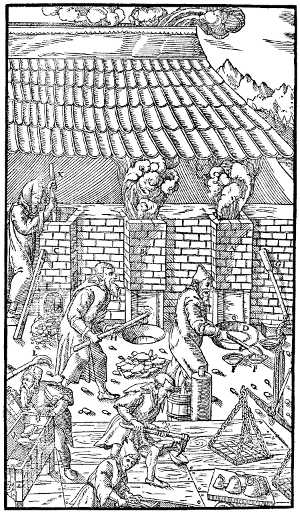
Then the master breaks out the whole of the mouth of the furnace with a crowbar, and with that other hooked bar, the rabble and the five-toothed rake, he extracts the accretions and the charcoal. This crowbar is not unlike the other hooked one, but larger and wider; the handle of the rabble is six feet long and is half of iron and half of wood. The furnace having cooled, the master chips off the accretions clinging to the walls with a rectangular spatula six digits long, a palm broad, and sharp on the front edge; it has a round handle four feet long, half of it being of iron and half of wood. This is the first method of smelting ores.
Because they generally consist of unequal constituents, some of which melt rapidly and others slowly, the ores rich in gold and silver cannot be smelted as rapidly or as easily by the other methods as they can by the first method, for three important reasons. The first reason is that, as often as the closed tap-hole of the furnace is opened with a tapping-bar, so often can the smelter observe whether the ore is melting too quickly or too slowly, or whether it is flaming in scattered bits, and not uniting in one mass; in the first case the ore is smelting too slowly and not without great expense; in the second case the metal mixes with the slag which flows out of the furnace into the forehearth, wherefore there is the expense of melting it again; in the third case, the metal is consumed by the violence of the fire. Each of these evils has its remedy; if the ore melts slowly or does not come together, it is necessary to add some amount of fluxes which melt the ore; or if they melt too readily, to decrease the amount.
The second reason is that each time that the furnace is opened with a tapping-bar, it flows out into the forehearth, and the smelter is able to test the alloy of gold and lead or of silver with lead, which is called stannum.[16] When the tap-hole is opened the second or third time, this test shows us whether the alloy of gold or silver has become richer, or whether the lead is too debilitated and wanting in strength to absorb any more gold or silver. If it has become richer, some portion of lead added to it should renew its strength; if it has not become richer, it is poured out of the forehearth that it may be replaced with fresh lead.
The third reason is that if the tap-hole of the furnace is always open when the ore and other things are being smelted, the fluxes, which are easily melted, run out of the furnace before the rich gold and silver ores, for these are sometimes of a kind that oppose and resist melting by the fire for a longer period. It follows in this case, that some part of the ore is either consumed or is mixed with the accretions, and as a result little lumps of ore not yet melted are now and then found in the accretions. Therefore when these ores are being smelted, the tap-hole of the furnace should be closed for a time, as it is necessary to heat and mix the ore and the fluxes at the same time; since the fluxes fuse more rapidly than the ore, when the molten fluxes are held in the furnace, they thus melt the ore which does not readily fuse or mix with the lead. The lead absorbs the gold or silver, just as tin or lead when melted in the forehearth absorbs the other unmelted metal which has been thrown into it. But if the molten matter is poured upon that which is not molten, it runs off on all sides and consequently does not melt it. It follows from all this that ores rich in gold or silver, when put into a furnace with its tap-hole always open, cannot for that reason be smelted so successfully as in one where the tap-hole is closed for a time, so that during this time the ore may be melted by the molten fluxes. Afterward, when the tap-hole has been opened, they flow into the forehearth and mix there with the molten lead. This method of smelting the ores is used by us and by the Bohemians.
A, B—Two furnaces. C—Forehearths. D—Dipping-pot. The smelter standing by the first furnace draws off the slags with a hooked bar. E—Hooked bar. F—Slags. G—The assistant drawing a bucket of water which he pours over the glowing slags to quench them. H—Basket made of twigs of wood intertwined. I—Rabble. K—Ore to be smelted. L—The master stands at the other furnace and prepares the forehearth by ramming it with two rammers. M—Crowbar. [Pg 385] The three remaining methods of smelting ores are similar to each other in that the tap-holes of the furnaces always remain open, so that the molten metals may continually run out. They differ greatly from each other, however, for the tap-hole of the first of this kind is deeper in the furnace and narrower than that of the third, and besides it is invisible and concealed. It easily discharges into the forehearth, which is one and a half feet higher than the floor of the building, in order that below it to the left a dipping-pot can be made. When the forehearth is nearly full of the slags, which well up from the invisible tap-hole of the furnace, they are skimmed off from the top with a hooked bar; then the alloy of gold or silver with lead and the melted pyrites, being uncovered, flow into the dipping-pot, and the latter are made into cakes; these cakes are broken and thrown back into the furnace so that all their metal may be smelted out. The alloy is poured into little iron moulds.
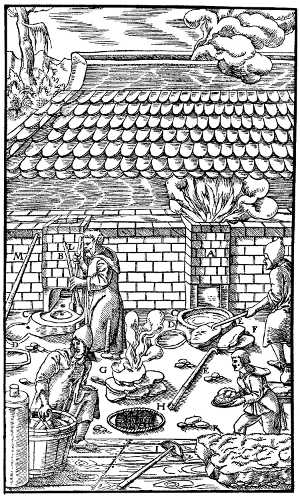
The smelter, besides lead and cognate things, uses fluxes which combine with the ore, of which I gave a sufficient account in Book VII. The metals which are melted from ores that fuse readily in the fire, are profitable because they are smelted in a short time, while those which are difficult to fuse are not as profitable, because they take a long time. When fluxes remain in the furnace and do not melt, they are not suitable; for this reason, accretions and slags are the most convenient for smelting, because they melt quickly. It is necessary to have an industrious and experienced smelter, who in the first place takes care not to put into the furnace more ores mixed with fluxes than it can accommodate.
The powder out of which this furnace hearth and the adjoining forehearth and the dipping-pot are usually made, consists mostly of equal proportions of charcoal dust and of earth, or of equal parts of the same and of ashes. When the hearth of the furnace is prepared, a rod that will reach to the forehearth is put into it, higher up if the ore to be smelted readily fuses, and lower down if it fuses with difficulty. When the dipping-pot and forehearth are finished, the rod is drawn out of the furnace so that the tap-hole is open, and through it the molten material flows continuously into the forehearth, which should be very near the furnace in order that it may keep very hot and the alloy thus be made purer. If the ore to be smelted does not melt easily, the hearth of the furnace must not be made too sloping, lest the molten fluxes should run down into the forehearth before the ore is smelted, and the metal thus remain in the accretions on the sides of the furnace. The smelter must not ram the hearth so much that it becomes too hard, nor make the mistake of ramming the lower part of the mouth to make it hard, for it could not breathe[17], nor could the molten matter flow freely out of the furnace. The ore which does not readily melt is thrown as much as possible to the back of the furnace, and toward that part where the fire burns very fiercely, so that it may be smelted longer. In this way the smelter may direct it whither he wills. Only when it glows at the part near the bellows' nozzle does it signify that all the ore is smelted which has been thrown to the side of the furnace in which the nozzles are placed. If the ore is easily melted, one or two wicker baskets full are thrown into the front part of the furnace so that the fire, being driven back by it, may also smelt the ore and the sows that form round about the nozzles of the bellows. This process of smelting is very ancient among the Tyrolese[18], but not so old among the Bohemians.
A, B—Two furnaces. C—Forehearth. D—Dipping-pots. The master stands at the one furnace and draws away the slags with an iron fork. E—Iron fork. F—Wooden hoe with which the cakes of melted pyrites are drawn out. G—The forehearth crucible: one-half inside is to be seen open in the other furnace. H—The half outside the furnace. I—The assistant prepares the forehearth, which is separated from the furnace that it may be seen. K—Bar. L—Wooden rammer. M—Ladder. N—Ladle. [Pg 387] The second method of smelting ores stands in a measure midway between that one performed in a furnace of which the tap-hole is closed intermittently, and the first of the methods performed in a furnace where the tap-hole is always open. In this manner are smelted the ores of gold and silver that are neither very rich nor very poor, but mediocre, which fuse easily and are readily absorbed by the lead. It was found that in this way a large quantity of ore could be smelted at one operation without much labour or great expense, and could thus be alloyed with lead. This furnace has two crucibles, one of which is half inside the furnace and half outside, so that the lead being put into this crucible, the part of the lead which is in the furnace absorbs the metals of the ores which easily fuse; the other crucible is lower, and the alloy and the molten pyrites run into it. Those who make use of this method of smelting, tap the alloy of gold or silver with lead from the upper crucible once or twice if need be, and throw in other lead or litharge, and each absorbs that flux which is nearest. This method of smelting is in use in Styria[19].
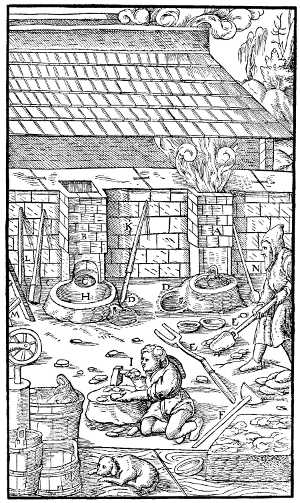
A, B—Two furnaces. C—Tap-holes of furnaces. D—Forehearths. E—Their tap-holes. F—Dipping-pots. G—At the one furnace stands the smelter carrying a wicker basket full of charcoal. At the other furnace stands a smelter who with the third hooked bar breaks away the material which has frozen the tap-hole of the furnace. H—Hooked bar. I—Heap of charcoal. K—Barrow on which is a box made of wicker work in which the coals are measured. L—Iron spade. [Pg 389] The furnace in the third method of smelting ores has the tap-hole likewise open, but the furnace is higher and wider than the others, and its bellows are larger; for these reasons a larger charge of the ore can be thrown into it. When the mines yield a great abundance of ore for the smelter, they smelt in the same furnace continuously for three days and three nights, providing there be no defect either in the hearth or in the forehearth. In this kind of a furnace almost every kind of accretion will be found. The forehearth of the furnace is not unlike the forehearth of the first furnace of all, except that it has a tap-hole. However, because large charges of ore are smelted uninterruptedly, and the melted material runs out and the slags are skimmed off, there is need for a second forehearth crucible, into which the molten material runs through an opened tap-hole when the first is full. When a smelter has spent twelve hours' labour on this work, another always takes his place. The ores of copper and lead and the poorest ores of gold and silver are smelted by this method, because they cannot be smelted by the other three methods on account of the greater expense occasioned. Yet by this method a centumpondium of ore containing only one or two drachmae of gold, or only a half to one uncia, of silver,[20] can be smelted; because there is a large amount of ore in each charge, smelting is continuous, and without expensive fluxes such as lead, litharge, and hearth-lead. In this method of smelting we must use only cupriferous pyrites which easily melt in the fire, in truth the cakes melted out from this, if they no longer absorb much gold or silver, are replenished again from crude pyrites alone. If from this poor ore, with melted pyrites alone, material for cakes cannot be made, there are added other fluxes which have not previously been melted. These fluxes are, namely, lead ore, stones easily fused by fire of the second order and sand made from them, limestone, tophus, white schist, and iron stone[21].
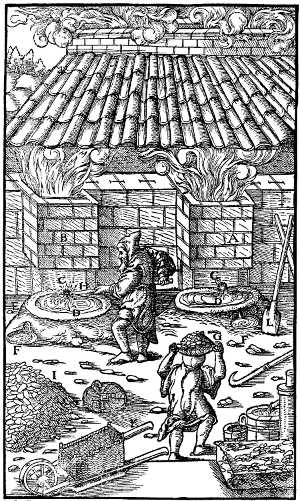
Although this method of smelting ores is rough and might not seem to be of great use, yet it is clever and useful; for a great weight of ores, in which the gold, silver, or copper are in small quantities, may be reduced into a few cakes containing all the metal. If on being first melted they are too crude to be suitable for the second melting, in which the lead absorbs the precious metals that are in the cakes, or in which the copper is melted out of them, yet they can be made suitable if they are repeatedly roasted, sometimes as often as seven or eight times, as I have explained in the last book. Smelters of this kind are so clever and expert, that in smelting they take out all the gold and silver which the assayer in assaying the ores has stated to be contained in them, because if during the first operation, when he makes the cakes, there is a drachma of gold or half an uncia of silver lost from the ores, the smelter obtains it from the slags by the second smelting. This method of smelting ores is old and very common to most of those who use other methods.
A—Furnace of the Carni. B—Low wall. C—Wood. D—Ore dripping lead. E—Large crucible. F—Moulds. G—Ladle. H—Slabs of lead. I—Rectangular hole at the back of the furnace. K—Saxon furnace. L—Opening in the back of the furnace. M—Wood. N—Upper crucible. O—Dipping-pot. P—Westphalian method of melting. Q—Heaps of charcoal. R—Straw. S—Wide slabs. T—Crucibles. V—Polish hearth. [Pg 393] Although lead ores are usually smelted in the third furnace—whose tap-hole is always open,—yet not a few people melt them in special furnaces by a method which I will briefly explain. The Carni[22] first burn such lead ores, and afterward break and crush them with large round mallets. Between the two low walls of a hearth, which is inside a furnace made of and vaulted with a rock that resists injury by the fire and does not burn into chalk, they place green wood with a layer of dry wood on the top of it; then they throw the ore on to this, and when the wood is kindled the lead drips down and runs on to the underlying sloping hearth[23]. This hearth is made of pulverised charcoal and earth, as is also a large crucible, one-half of which lies under the furnace and the other half outside it, into which runs the lead. The smelter, having first skimmed off the slags and other things with a hoe, pours the lead with a ladle into moulds, taking out the cakes after they have cooled. At the back of the furnace is a rectangular hole, so that the fire may be allowed more draught, and so that the smelter can crawl through it into the furnace if necessity demands.
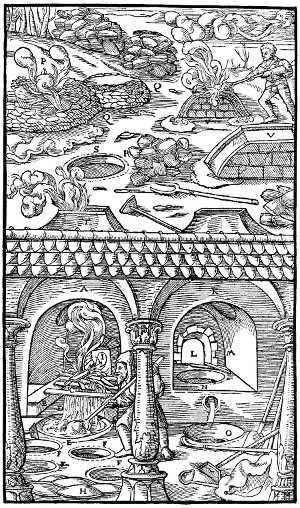
The Saxons who inhabit Gittelde, when smelting lead ore in a furnace not unlike a baking oven, put the wood in through a hole at the back of the furnace, and when it begins to burn vigorously the lead trickles out of the ore into a forehearth. When this is full, the smelting being accomplished, the tap-hole is opened with a bar, and in this way the lead, together with the slags, runs into the dipping-pots below. Afterward the cakes of lead, when they are cold, are taken from the moulds.
In Westphalia they heap up ten wagon-loads of charcoal on some hillside which adjoins a level place, and the top of the heap being made flat, straw is thrown upon it to the thickness of three or four digits. On the top of this is laid as much pure lead ore as the heap can bear; then the charcoal is kindled, and when the wind blows, it fans the fire so that the ore is smelted. In this wise the lead, trickling down from the heap, flows on to the level and forms broad thin slabs. A few hundred pounds of lead ore are kept at hand, which, if things go well, are scattered over the heap. These broad slabs are impure and are laid upon dry wood which in turn is placed on green wood laid over a large crucible, and the former having been kindled, the lead is re-melted.
The Poles use a hearth of bricks four feet high, sloping on both sides and plastered with lute. On the upper level part of the hearth large pieces of wood are piled, and on these is placed small wood with lute put in between; over the top are laid wood shavings, and upon these again pure lead ore covered with large pieces of wood. When these are kindled, the ore melts and runs down on to the lower layer of wood; and when this is consumed by the fire, the metal is collected. If necessity demand, it is melted over and over again in the same manner, but it is finally melted by means of wood laid over the large crucible, the slabs of lead being placed upon it.
The concentrates from washing are smelted together with slags (fluxes?) in a third furnace, of which the tap-hole is always open.
A—Furnaces. B—Vaulted roof. C—Columns. D—Dust-chamber. E—Opening. F—Chimney. G—Window. H—Door. I—Chute. [Pg 395] It is worth while to build vaulted dust-chambers over the furnaces, especially over those in which the precious ores are to be smelted, in order that the thicker part of the fumes, in which metals are not wanting, may be caught and saved. In this way two or more furnaces are combined under the same vaulted ceiling, which is supported by the wall, against which the furnaces are built, and by four columns. Under this the smelters of the ore perform their work. There are two openings through which the fumes rise from the furnaces into the wide vaulted chamber, and the wider this is the more fumes it collects; in the middle of this chamber over the arch is an opening three palms high and two wide. This catches the fumes of both furnaces, which have risen up from both sides of the vaulted chamber to its arch, and have fallen again because they could not force their way out; and they thus pass out through the opening mentioned, into the chimney which the Greeks call καπνοδόχη, the name being taken from the object. The chimney has thin iron plates fastened into the walls, to which the thinner metallic substances adhere when ascending with the fumes. The thicker metallic substances, or cadmia,[25] adhere to the vaulted chamber, and often harden into stalactites. On one side of the chamber is a window in which are set panes of glass, so that the light may be transmitted, but the fumes kept in; on the other side is a door, which is kept entirely closed while the ores are being smelted in the furnaces, so that none of the fumes may escape. It is opened in order that the workman, passing through it, may be enabled to enter the chamber and remove the soot and pompholyx[26] and chip off the cadmia; this sweeping is done twice a year. The soot mixed with pompholyx and the cadmia, being chipped off, is thrown down through a long chute made of four boards joined in the shape of a rectangle, that they should not fly away. They fall on to the floor, and are sprinkled with salt water, and are again smelted with ore and litharge, and become an emolument to the proprietors. Such chambers, which catch the metallic substances that rise with the fumes, are profitable for all metalliferous ores; but especially for the minute metallic particles collected by washing crushed ores and rock, because these usually fly out with the fire of the furnaces.
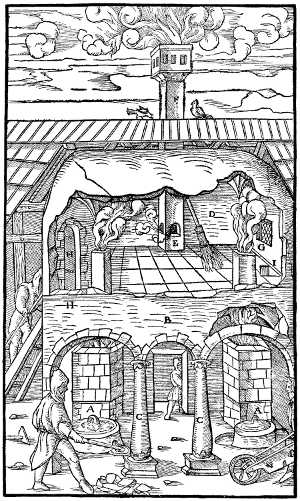
I have explained the four general methods of smelting ores; now I will state how the ores of each metal are smelted, or how the metal is obtained from the ore. I will begin with gold. Its sand, the concentrates from washing, or the gold dust collected in any other manner, should very often not be smelted, but should be mixed with quicksilver and washed with tepid water, so that all the impurities may be eliminated. This method I explained in Book VII. Or they are placed in the aqua which separates gold from silver, for this also separates its impurities. In this method we see the gold sink in the glass ampulla, and after all the aqua has been drained from the particles, it frequently remains as a gold-coloured residue at the bottom; this powder, when it has been moistened with oil made from argol[27], is then dried and placed in a crucible, where it is melted with borax or with saltpetre and salt; or the same very fine dust is thrown into molten silver, which absorbs it, and from this it is again parted by aqua valens[28].
It is necessary to smelt gold ore either outside the blast furnace in a crucible, or inside the blast furnace; in the former case a small charge of ore is used, in the latter a large charge of it. Rudis gold, of whatever colour it is, is crushed with a libra each of sulphur and salt, a third of a libra of copper, and a quarter of a libra of argol; they should be melted in a crucible on a slow fire for three hours, then the alloy is put into molten silver that it may melt more rapidly. Or a libra of the same crude gold, crushed up, is mixed together with half a libra of stibium likewise crushed, and put into a crucible with half an uncia of copper filings, and heated until they melt, then a sixth part of granulated lead is thrown into the same crucible. As soon as the mixture emits an odour, iron-filings are added to it, or if these are not at hand, iron hammer-scales, for both of these break the strength of the stibium. When the fire consumes it, not alone with it is some strength of the stibium consumed, but some particles of gold and also of silver, if it be mixed with the gold[29]. When the button has been taken out of the crucible and cooled, it is melted in a cupel, first until the antimony is exhaled, and thereafter until the lead is separated from it.
Crushed pyrites which contains gold is smelted in the same way; it and the stibium should be of equal weight and in truth the gold may be made from them in a number of different ways[30]. One part of crushed material is mixed with six parts of copper, one part of sulphur, half a part of salt, and they are all placed in a pot and over them is poured wine distilled by heating liquid argol in an ampulla. The pot is covered and smeared over with lute and is put in a hot place, so that the mixture moistened with wine may dry for the space of six days, then it is heated for three hours over a gentle fire that it may combine more rapidly with the lead. Finally it is put into a cupel and the gold is separated from the lead[31].
Or else one libra of the concentrates from washing pyrites, or other stones to which gold adheres, is mixed with half a libra of salt, half a libra of argol, a third of a libra of glass-galls, a sixth of a libra of gold or silver slags, and a sicilicus of copper. The crucible into which these are put, after it has been covered with a lid, is sealed with lute and placed in a small furnace that is provided with small holes through which the air is drawn in, and then it is heated until it turns red and the substances put in have alloyed; this should take place within four or five hours. The alloy having cooled, it is again crushed to powder and a pound of litharge is added to it; then it is heated again in another crucible until it melts. The button is taken out, purged of slag, and placed in a cupel, where the gold is separated from the lead.
Or to a libra of the powder prepared from such metalliferous concentrates, is added a libra each of salt, of saltpetre, of argol, and of glass-galls, and it is heated until it melts. When cooled and crushed, it is washed, then to it is added a libra of silver, a third of copper filings, a sixth of litharge, and it is likewise heated again until it melts. After the button has been purged of slag, it is put into the cupel, and the gold and silver are separated from the lead; the gold is parted from the silver with aqua valens. Or else a libra of the powder prepared from such metalliferous concentrates, a quarter of a libra of copper filings, and two librae of that second powder[32] which fuses ores, are heated until they melt. The mixture when cooled is again reduced to powder, roasted and washed, and in this manner a blue powder is obtained. Of this, and silver, and that second powder which fuses ores, a libra each are taken, together with three librae of lead, and a quarter of a libra of copper, and they are heated together until they melt; then the button is treated as before. Or else a libra of the powder prepared from such metalliferous concentrates, half a libra of saltpetre, and a quarter of a libra of salt are heated until they melt. The alloy when cooled is again crushed to powder, one libra of which is absorbed by four pounds of molten silver. Or else a libra of the powder made from that kind of concentrates, together with a libra of sulphur, a libra and a half of salt, a third of a libra of salt made from argol, and a third of a libra of copper resolved into powder with sulphur, are heated until they melt. Afterward the lead is re-melted, and the gold is separated from the other metals. Or else a libra of the powder of this kind of concentrates, together with two librae of salt, half a libra of sulphur, and one libra of litharge, are heated, and from these the gold is melted out. By these and similar methods concentrates containing gold, if there be a small quantity of them or if they are very rich, can be smelted outside the blast furnace.