BOOK VII. (continued 2)
Herbert Hoover translation
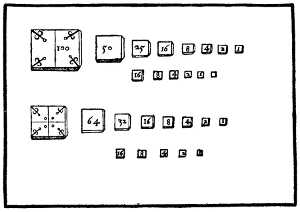
The1stis called1centumpondium.
"2nd"50librae.
"3rd"25 "
"4th"16 "
"5th"8 "
"6th"4 "
"7th"2 "
"8th"1 "
"9th"1selibra.
"10th"8semunciae.
"11th"4 "
"12th"2 "
"13th"1 "
"14th"1sicilicus.
The fourteenth is the last, for the proportionate weights which correspond with a drachma and half a drachma are not used. On all these weights of the lesser scale, are written the numbers of librae and of semunciae. Some copper assayers divide both the lesser and greater scale weights into divisions of a different scale. Their largest weight of the greater scale weighs one hundred and twelve librae, which is the first unit of measurement.
1st=112librae.
2nd=64 "
3rd=32 "
4th=16 "
5th=8 "
6th=4 "
7th=2 "
8th=1 "
9th=1selibra or sixteen semunciae.
10th=8semunciae.
11th=4 "
12th=2 "
13th=1 "
As for the selibra of the lesser weights, which our people, as I have often said, call a mark, and the Romans call a bes, coiners who coin gold, divide it just like the greater weights scale, into twenty-four units of two sextulae each, and each unit of two sextulae is divided into four semi-sextulae and each semi-sextula into three units of four siliquae each. Some also divide the separate units of four siliquae into four individual siliquae, but most, omitting the semi-sextulae, then divide the double sextula into twelve units of four siliquae each, and do not divide these into four individual siliquae. Thus the first and greatest unit of measurement, which is the bes, weighs twenty-four double sextulae.
The2nd=12double sextulae.
"3rd=6 " "
"4th=3 " "
"5th=2 " "
"6th=1 " "
"7th=2semi-sextulae or four semi-sextulae.
"8th=1semi-sextula or 3 units of 4 siliquae each.
"9th=2units of four siliquae each.
"10th=1 " " "
Coiners who mint silver also divide the bes of the lesser weights in the same way as the greater weights; our people, indeed, divide it into sixteen semunciae, and the semuncia into eighteen units of four siliquae each.
There are ten weights which are placed in the other pan of the balance, when they weigh the silver which remains from the copper that has been consumed, when they assay the alloy with fire.
The1st=16semunciae = 1 bes.
"2nd=8 "
"3rd=4 "
"4th=2 "
"5th=1 " or 18 units of 4 siliquae each.
"6th=9units of 4 siliquae each.
"7th=6 " "
"8th=3 " "
"9th=2 " "
"10th=1 " "
The coiners of Nuremberg who mint silver, divide the bes into sixteen semunciae, but divide the semuncia into four drachmae, and the drachma into four pfennige. They employ nine weights.
The1st=16semunciae.
"2nd=8 "
"3rd=4 "
"4th=2 "
"5th=1 "
For they divide the bes in the same way as our own people, but since they divide the semuncia into four drachmae,
the6thweight=2drachmae.
"7th"=1drachma or 4 pfennige.
"8th"=2pfennige.
"9th"=1pfennig.
The men of Cologne and Antwerp[43] divide the bes into twelve units of five drachmae and one scripulum, which weights they call nummi. Each of these they again divide into twenty-four units of four siliquae each, which they call grenlins. They have ten weights, of which
the1st=12nummi = 1 bes.
"2nd=6 "
"3rd=3 "
"4th=2 "
"5th=1 " = 24 units of 4 siliquae each.
"6th=12units of 4 siliquae each.
"7th=6 " "
"8th=3 " "
"9th=2 " "
"10th=1 " "
And so with them, just as with our own people, the mark is divided into two hundred and eighty-eight grenlins, and by the people of Nuremberg it is divided into two hundred and fifty-six pfennige. Lastly, the Venetians divide the bes into eight unciae. The uncia into four sicilici, the sicilicus into thirty-six siliquae. They make twelve weights, which they use whenever they wish to assay alloys of silver and copper. Of these
the1st=8unciae = 1 bes.
"2nd=4 "
"3rd=2 "
"4th=1 " or 4 sicilici.
"5th=2sicilici.
"6th=1sicilicus.
"7th=18siliquae.
"8th=9 "
"9th=6 "
"10th=3 "
"11th=2 "
"12th=1 "
Since the Venetians divide the bes into eleven hundred and fifty-two siliquae, or two hundred and eighty-eight units of 4 siliquae each, into which number our people also divide the bes, they thus make the same number of siliquae, and both agree, even though the Venetians divide the bes into smaller divisions.
This, then, is the system of weights, both of the greater and the lesser kinds, which metallurgists employ, and likewise the system of the lesser weights which coiners and merchants employ, when they are assaying metals and coined money. The bes of the larger weight with which they provide themselves when they weigh large masses of these things, I have explained in my work De Mensuris et Ponderibus, and in another book, De Precio Metallorum et Monetis.
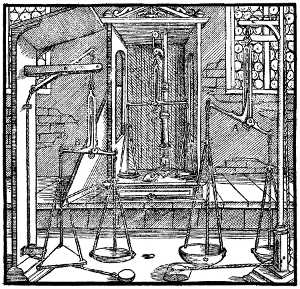
A—First small balance. B—Second. C—Third, placed in a case. [Pg 265] There are three small balances by which we weigh ore, metals, and fluxes. The first, by which we weigh lead and fluxes, is the largest among these smaller balances, and when eight unciae (of the greater weights) are placed in one of its pans, and the same number in the other, it sustains no damage. The second is more delicate, and by this we weigh the ore or the metal, which is to be assayed; this is well able to carry one centumpondium of the lesser weights in one pan, and in the other, ore or metal as heavy as that weight. The third is the most delicate, and by this we weigh the beads of gold or silver, which, when the assay is completed, settle in the bottom of the cupel. But if anyone weighs lead in the second balance, or an ore in the third, he will do them much injury.
Whatsoever small amount of metal is obtained from a centumpondium of the lesser weights of ore or metal alloy, the same greater weight of metal is smelted from a centumpondium of the greater weight of ore or metal alloy.
END OF BOOK VII.