BOOK XI. (continued 2)
Herbert Hoover translation
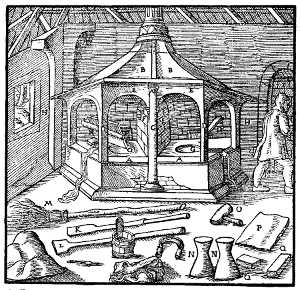
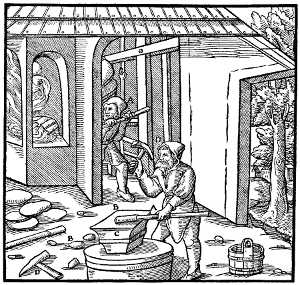
Then with an iron shovel, whose wooden handle is six feet long, he throws live charcoal into the crucible; or else charcoal, kindled by means of a few live coals, is added to them. Over the live charcoal he lays "dried" cakes, which, if they were of copper of the first quality, weigh all together three centumpondia, or three and a half centumpondia; but if they were of copper of the second quality, then two and a half centumpondia; if they were of the third quality, then two centumpondia only; but if they were of copper of very superior quality, then they place upon it six centumpondia, and in this case they make the crucible wider and deeper.[24] The lowest "dried" cake is placed at a distance of two palms from the pipe, the rest at a greater distance, and when the lower ones are melted the upper ones fall down and get nearer to the pipe; if they do not fall down they must be pushed with a shovel. The blade of the shovel is a foot long, three palms and two digits wide, the iron part of the handle is two palms long, the wooden part nine feet. Round about the "dried" cakes are placed large long pieces of charcoal, and in the pipe are placed medium-sized pieces. When all these things have been arranged in this manner, the fire must be more violently excited by the blast from the bellows. When the copper is melting and the coals blaze, the master pushes an iron bar into the middle of them in order that they may receive the air, and that the flame can force its way out. This pointed bar is two and a half feet long, and its wooden handle four feet long. When the cakes are partly melted, the master, passing out through the door, inspects the crucible through the bronze pipe, and if he should find that too much of the "slag" is adhering to the mouth of the pipe, and thus impeding the blast of the bellows, he inserts the hooked iron bar into the pipe through the nozzle of the bellows, and, turning this about the mouth of the pipe, he removes the "slags" from it. The hook on this bar is two digits high; the iron part of the handle is three feet long; the wooden part is the same number of palms long. Now it is time to insert the bar under the iron plate, in order that the "slags" may flow out. A—Pointed bar. B—Thin copper layer. C—Anvil. D—Hammer. [Pg 534] When the cakes, being all melted, have run into the crucible, he takes out a sample of copper with the third round bar, which is made wholly of iron, and is three feet long, a digit thick, and has a steel point lest its pores should absorb the copper. When he has compressed the bellows, he introduces this bar as quickly as possible into the crucible through the pipe between the two nozzles, and takes out samples two, three, or four times, until he finds that the copper is perfectly refined. If the copper is good it adheres easily to the bar, and two samples suffice; if it is not good, then many are required. It is necessary to smelt it in the crucible until the copper adhering to the bar is seen to be of a brassy colour, and if the upper as well as the lower part of the thin layer of copper may be easily broken, it signifies that the copper is perfectly melted; he places the point of the bar on a small iron anvil, and chips off the thin layer of copper from it with a hammer.[25]
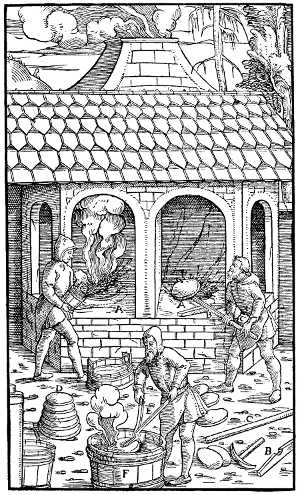
If the copper is not good, the master draws off the "slags" twice, or three times if necessary—the first time when some of the cakes have been melted, the second when all have melted, the third time when the copper has been heated for some time. If the copper was of good quality, the "slags" are not drawn off before the operation is finished, but at the time they are to be drawn off, he depresses the bar over both bellows, and places over both a stick, a cubit long and a palm wide, half cut away at the upper part, so that it may pass under the iron pin fixed at the back in the perforated wood. This he does likewise when the copper has been completely melted. Then the assistant removes the iron plate with the tongs; these tongs are four feet three palms long, their jaws are about a foot in length, and their straight part measures two palms and three digits, and the curved a palm and a digit. The same assistant, with the iron shovel, throws and heaps up the larger pieces of charcoal into that part of the hearth which is against the little wall which protects the other wall from injury by fire, and partly extinguishes them by pouring water over them. The master, with a hazel stick inserted into the crucible, stirs it twice. Afterward he draws off the slags with a rabble, which consists of an iron blade, wide and sharp, and of alder-wood; the blade is a digit and a half in width and three feet long; the wooden handle inserted in its hollow part is the same number of feet long, and the alder-wood in which the blade is fixed must have the figure of a rhombus; it must be three palms and a digit long, a palm and two digits wide, and a palm thick. Subsequently he takes a broom and sweeps the charcoal dust and small coal over the whole of the crucible, lest the copper should cool before it flows together; then, with a third rabble, he cuts off the slags which may adhere to the edge of the crucible. The blade of this rabble is two palms long and a palm and one digit wide, the iron part of the handle is a foot and three palms long, the wooden part six feet. Afterward he again draws off the slags from the crucible, which the assistant does not quench by pouring water upon them, as the other slags are usually quenched, but he sprinkles over them a little water and allows them to cool. If the copper should bubble, he presses down the bubbles with the rabble. Then he pours water on the wall and the pipes, that it may flow down warm into the crucible, for, the copper, if cold water were to be poured over it while still hot, would spatter about. If a stone, or a piece of lute or wood, or a damp coal should then fall into it, the crucible would vomit out all the copper with a loud noise like thunder, and whatever it touches it injures and sets on fire. A—Crucible. B—Board. C—Wedge-shaped bar. D—Cakes of copper made by separating them with the wedge-shaped bar. E—Tongs. F—Tub. [Pg 537] Subsequently he lays a curved board with a notch in it over the front part of the crucible; it is two feet long, a palm and two digits wide, and a digit thick. Then the copper in the crucible should be divided into cakes with an iron wedge-shaped bar; this is three feet long, two digits wide, and steeled on the end for the distance of two digits, and its wooden handle is three feet long. He places this bar on the notched board, and, driving it into the copper, moves it forward and back, and by this means the water flows into the vacant space in the copper, and he separates the cake from the rest of the mass. If the copper is not perfectly smelted the cakes will be too thick, and cannot be taken out of the crucible easily. Each cake is afterward seized by the assistant with the tongs and plunged into the water in the tub; the first one is placed aside so that the master may re-melt it again immediately, for, since some "slags" adhere to it, it is not as perfect as the subsequent ones; indeed, if the copper is not of good quality, he places the first two cakes aside. Then, again pouring water over the wall and the pipes, he separates out the second cake, which the assistant likewise immerses in water and places on the ground together with the others separated out in the same way, which he piles upon them. These, if the copper was of good quality, should be thirteen or more in number; if it was not of good quality, then fewer. If the copper was of good quality, this part of the operation, which indeed is distributed into four parts, is accomplished by the master in two hours; if of mediocre quality, in two and a half hours; if of bad quality, in three. The "dried" cakes are re-melted, first in the first crucible and then in the second. The assistant must, as quickly as possible, quench all the cakes with water, after they have been cut out of the second crucible. Afterward with the tongs he replaces in its proper place the iron plate which was in front of the furnace, and throws the charcoal back into the crucible with a shovel. Meanwhile the master, continuing his work, removes the wooden stick from the bars of the bellows, so that in re-melting the other cakes he may accomplish the third part of his process; this must be carefully done, for if a particle from any iron implement should by chance fall into the crucible, or should be thrown in by any malevolent person, the copper could not be made until the iron had been consumed, and therefore double labour would have to be expended upon it. Finally, the assistant extinguishes all the glowing coals, and chips off the dry lute from the mouth of the copper pipe with a hammer; one end of this hammer is pointed, the other round, and it has a wooden handle five feet long. Because there is danger that the copper would be scattered if the pompholyx and spodos, which adhere to the walls and the hood erected upon them, should fall into the crucible, he cleans them off in the meantime. Every week he takes the copper flowers out of the tub, after having poured off the water, for these fall into it from the cakes when they are quenched.[26]
The bellows which this master uses differ in size from the others, for the boards are seven and a half feet long; the back part is three feet wide; the front, where the head is joined on is a foot, two palms and as many digits. The head is a cubit and a digit long; the back part of it is a cubit and a palm wide, and then becomes gradually narrower. The nozzles of the bellows are bound together by means of an iron chain, controlled by a thick bar, one end of which penetrates into the ground against the back of the long wall, and the other end passes under the beam which is laid upon the foremost perforated beams. These nozzles are so placed in a copper pipe that they are at a distance of a palm from the mouth; the mouth should be made three digits in diameter, that the air may be violently expelled through this narrow aperture.
There now remain the liquation thorns, the ash-coloured copper, the "slags," and the cadmia.[27] Liquation cakes are made from thorns in the following manner.[28] There are taken three-quarters of a centumpondium of thorns, which have their origin from the cakes of copper-lead alloy when lead-silver is liquated, and as many parts of a centumpondium of the thorns derived from cakes made from once re-melted thorns by the same method, and to them are added a centumpondium of de-silverized lead and half a centumpondium of hearth-lead. If there is in the works plenty of litharge, it is substituted for the de-silverized lead. One and a half centumpondia of litharge and hearth-lead is added to the same weight of primary thorns, and half a centumpondium of thorns which have their origin from liquation cakes composed of thorns twice re-melted by the same method (tertiary thorns), and a fourth part of a centumpondium of thorns which are produced when the exhausted liquation cakes are "dried." By both methods one single liquation cake is made from three centumpondia. In this manner the smelter makes every day fifteen liquation cakes, more or less; he takes great care that the metallic substances, from which the first liquation cake is made, flow down properly and in due order into the forehearth, before the material of which the subsequent cake is to be made. Five of these liquation cakes are put simultaneously into the furnace in which silver-lead is liquated from copper, they weigh almost fourteen centumpondia, and the "slags" made therefrom usually weigh quite a centumpondium. In all the liquation cakes together there is usually one libra and nearly two unciae of silver, and in the silver-lead which drips from those cakes, and weighs seven and a half centumpondia, there is in each an uncia and a half of silver. In each of the three centumpondia of liquation thorns there is almost an uncia of silver, and in the two centumpondia and a quarter of exhausted liquation cakes there is altogether one and a half unciae; yet this varies greatly for each variety of thorns, for in the thorns produced from primary liquation cakes made of copper and lead when silver-lead is liquated from the copper, and those produced in "drying" the exhausted liquation cakes, there are almost two unciae of silver; in the others not quite an uncia. There are other thorns besides, of which I will speak a little further on.
Those in the Carpathian Mountains who make liquation cakes from the copper "bottoms" which remain after the upper part of the copper is divided from the lower, in the furnace similar to an oven, produce thorns when the poor or mediocre silver-lead is liquated from the copper. These, together with those made of cakes of re-melted thorns, or made with re-melted litharge, are placed in a heap by themselves; but those that are made from cakes melted from hearth-lead are placed in a heap separate from the first, and likewise those produced from "drying" the exhausted liquation cakes are placed separately; from these thorns liquation cakes are made. From the first heap they take the fourth part of a centumpondium, from the second the same amount, from the third a centumpondium,—to which thorns are added one and a half centumpondia of litharge and half a centumpondium of hearth-lead, and from these, melted in the blast furnace, a liquation cake is made; each workman makes twenty such cakes every day. But of theirs enough has been said for the present; I will return to ours.
The ash-coloured copper[29] which is chipped off, as I have stated, from the "dried" cakes, used some years ago to be mixed with the thorns produced from liquation of the copper-lead alloy, and contained in themselves, equally with the first, two unciae of silver; but now it is mixed with the concentrates washed from the accretions and the other material. The inhabitants of the Carpathian Mountains melt this kind of copper in furnaces in which are re-melted the "slags" which flow out when the copper is refined; but as this soon melts and flows down out of the furnace, two workmen are required for the work of smelting, one of whom smelts, while the other takes out the thick cakes from the forehearth. These cakes are only "dried," and from the "dried" cakes copper is again made.
The "slags"[30] are melted continually day and night, whether they have been drawn off from the alloyed metals with a rabble, or whether they adhered to the forehearth to the thickness of a digit and made it smaller and were taken off with spatulas. In this manner two or three liquation cakes are made, and afterward much or little of the "slag," skimmed from the molten alloy of copper and lead, is re-melted. Such liquation cakes should weigh up to three centumpondia, in each of which there is half an uncia of silver. Five cakes are placed at the same time in the furnace in which argentiferous lead is liquated from copper, and from these are made lead which contains half an uncia of silver to the centumpondium. The exhausted liquation cakes are laid upon the other baser exhausted liquation cakes, from both of which yellow copper is made. The base thorns thus obtained are re-melted with a few baser "slags," after having been sprinkled with concentrates from furnace accretions and other material, and in this manner six or seven liquation cakes are made, each of which weighs some two centumpondia. Five of these are placed at the same time in the furnace in which silver-lead is liquated from copper; these drip three centumpondia of lead, each of which contains half an uncia of silver. The basest thorns thus produced should be re-melted with only a little "slag." The copper alloyed with lead, which flows down from the furnace into the forehearth, is poured out with a ladle into oblong copper moulds; these cakes are "dried" with base exhausted liquation cakes. The thorns they produce are added to the base thorns, and they are made into cakes according to the method I have described. From the "dried" cakes they make copper, of which some add a small portion to the best "dried" cakes when copper is made from them, in order that by mixing the base copper with the good it may be sold without loss. The "slags," if they are utilisable, are re-melted a second and a third time, the cakes made from them are "dried," and from the "dried" cakes is made copper, which is mixed with the good copper. The "slags," drawn off by the master who makes copper out of "dried" cakes, are sifted, and those which fall through the sieve into a vessel placed underneath are washed; those which remain in it are emptied into a wheelbarrow and wheeled away to the blast furnaces, and they are re-melted together with other "slags," over which are sprinkled the concentrates from washing the slags or furnace accretions made at this time. The copper which flows out of the furnace into the forehearth, is likewise dipped out with a ladle into oblong copper moulds; in this way nine or ten cakes are made, which are "dried," together with bad exhausted liquation cakes, and from these "dried" cakes yellow[31] copper is made.
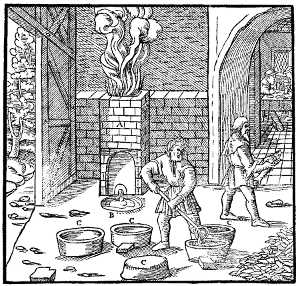
A—Furnace. B—Forehearth. C—Oblong moulds. [Pg 543] The cadmia,[32] as it is called by us, is made from the "slags" which the master, who makes copper from "dried" cakes, draws off together with other re-melted base "slags"; for, indeed, if the copper cakes made from such "slags" are broken, the fragments are called cadmia; from this and yellow copper is made caldarium copper in two ways. For either two parts of cadmia are mixed with one of yellow copper in the blast furnaces, and melted; or, on the contrary, two parts of yellow copper with one of cadmia, so that the cadmia and yellow copper may be well mixed; and the copper which flows down from the furnace into the forehearth is poured out with a ladle into oblong copper moulds heated beforehand. These moulds are sprinkled over with charcoal dust before the caldarium copper is to be poured into them, and the same dust is sprinkled over the copper when it is poured in, lest the cadmia and yellow copper should freeze before they have become well mixed. With a piece of wood the assistant cleanses each cake from the dust, when it is turned out of the mould. Then he throws it into the tub containing hot water, for the caldarium copper is finer if quenched in hot water. But as I have so often made mention of the oblong copper moulds, I must now speak of them a little; they are a foot and a palm long, the inside is three palms and a digit wide at the top, and they are rounded at the bottom.
The concentrates are of two kinds—precious and base.[33] The first are obtained from the accretions of the blast furnace, when liquation cakes are made from copper and lead, or from precious liquation thorns, or from the better quality "slags," or from the best grade of concentrates, or from the sweepings and bricks of the furnaces in which exhausted liquation cakes are "dried"; all of these things are crushed and washed, as I explained in Book VIII. The base concentrates are made from accretions formed when cakes are cast from base thorns or from the worst quality of slags. The smelter who makes liquation cakes from the precious concentrates, adds to them three wheelbarrowsful of litharge and four barrowsful of hearth-lead and one of ash-coloured copper, from all of which nine or ten liquation cakes are melted out, of which five at a time are placed in the furnace in which silver-lead is liquated from copper; a centumpondium of the lead which drips from these cakes contains one uncia of silver. The liquation thorns are placed apart by themselves, of which one basketful is mixed with the precious thorns to be re-melted. The exhausted liquation cakes are "dried" at the same time as other good exhausted liquation cakes.
The thorns which are drawn off from the lead, when it is separated from silver in the cupellation furnace[34], and the hearth-lead which remains in the crucible in the middle part of the furnaces, together with the hearth material which has become defective and has absorbed silver-lead, are all melted together with a little slag in the blast furnaces. The lead, or rather the silver-lead, which flows from the furnace into the forehearth, is poured out into copper moulds such as are used by the refiners; a centumpondium of such lead contains four unciae of silver, or, if the hearth was defective, it contains more. A small portion of this material is added to the copper and lead when liquation cakes are made from them, if more were to be added the alloy would be much richer than it should be, for which reason the wise foreman of the works mixes these thorns with other precious thorns. The hearth-lead which remains in the middle of the crucible, and the hearth material which absorbs silver-lead, is mixed with other hearth-lead which remains in the cupellation furnace crucible; and yet some cakes, made rich in this manner, may be placed again in the cupellation furnaces, together with the rest of the silver-lead cakes which the refiner has made.
The inhabitants of the Carpathian Mountains, if they have an abundance of finely crushed copper[35] or lead either made from "slags," or collected from the furnace in which the exhausted liquation cakes are dried, or litharge, alloy them in various ways. The "first" alloy consists of two centumpondia of lead melted out of thorns, litharge, and thorns made from hearth-lead, and of half a centumpondium each of lead collected in the furnace in which exhausted liquation cakes are "dried," and of copper minutum, and from these are made liquation cakes; the task of the smelter is finished when he has made forty liquation cakes of this kind. The "second" alloy consists of two centumpondia of litharge, of one and a quarter centumpondia of de-silverized lead or lead from "slags," and of half a centumpondium of lead made from thorns, and of as much copper minutum. The "third" alloy consists of three centumpondia of litharge and of half a centumpondium each of de-silverized lead, of lead made from thorns, and of copper minutum contusum. Liquation cakes are made from all these alloys; the task of the smelters is finished when they have made thirty cakes.
The process by which cakes are made among the Tyrolese, from which they separate the silver-lead, I have explained in Book IX.
Silver is separated from iron in the following manner. Equal portions of iron scales and filings and of stibium are thrown into an earthenware crucible which, when covered with a lid and sealed, is placed in a furnace, into which air is blown. When this has melted and again cooled, the crucible is broken; the button that settles in the bottom of it, when taken out, is pounded to powder, and the same weight of lead being added, is mixed and melted in a second crucible; at last this button is placed in a cupel and the lead is separated from the silver.[36]
There are a great variety of methods by which one metal is separated from other metals, and the manner in which the same are alloyed I have explained partly in the eighth book of De Natura Fossilium, and partly I will explain elsewhere. Now I will proceed to the remainder of my subject.
END OF BOOK XI.