BOOK VIII. (continued 2)
Herbert Hoover translation
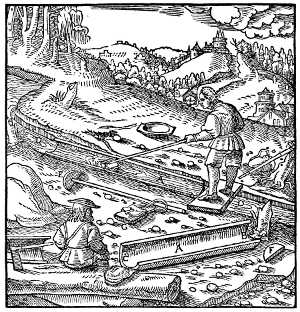
A—Tray. B—Bowl-like depression. C—Handles. [Pg 334] Sand mixed with particles of gold is also washed in a tray, or in a trough or bowl. The tray is open at the further end, is either hewn out of a squared trunk of a tree or made out of a thick plank to which side-boards are fixed, and is three feet long, a foot and a half wide, and three digits deep. The bottom is hollowed out into the shape of an elongated bowl whose narrow end is turned toward the head, and it has two long handles, by which it is drawn backward and forward in the river. In this way the fine sand is washed, whether it contains particles of gold or the little black stones from which tin is made.
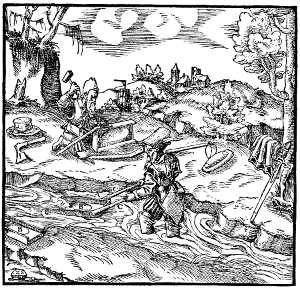
A—Trough. B—Its open end. C—End that may be closed. D—Stream. E—Hoe. F—End-board. G—Bag. [Pg 335] The Italians who come to the German mountains seeking gold, in order to wash the river sand which contains gold-dust and garnets,[19] use a fairly long shallow trough hewn out of a tree, rounded within and without, open at one end and closed at the other, which they turn in the bed of the stream in such a way that the water does not dash into it, but flows in gently. They stir the sand, which they throw into it, with a wooden hoe, also rounded. To prevent the particles of gold or garnets from running out with the light sand, they close the end with a board similarly rounded, but lower than the sides of the trough. The concentrates of gold or garnets which, with a small quantity of heavy sand, have settled in the trough, they wash in a bowl and collect in bags and carry away with them.
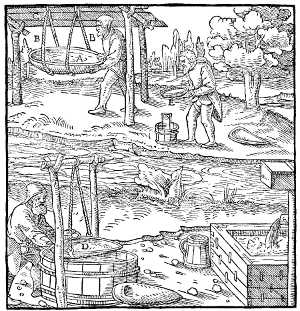
A—Large bowl. B—Ropes. C—Beam. D—Other large bowl which coiners use. E—Small bowl. [Pg 336] Some people wash this kind of sand in a large bowl which can easily be shaken, the bowl being suspended by two ropes from a beam in a building. The sand is thrown into it, water is poured in, then the bowl is shaken, and the muddy water is poured out and clear water is again poured in, this being done again and again. In this way, the gold particles settle in the back part of the bowl because they are heavy, and the sand in the front part because it is light; the latter is thrown away, the former kept for smelting. The one who does the washing then returns immediately to his task. This method of washing is rarely used by miners, but frequently by coiners and goldsmiths when they wash gold, silver, or copper. The bowl they employ has only three handles, one of which they grasp in their hands when they shake the bowl, and in the other two is fastened a rope by which the bowl is hung from a beam, or from a cross-piece which is upheld by the forks of two upright posts fixed in the ground. Miners frequently wash ore in a small bowl to test it. This bowl, when shaken, is held in one hand and thumped with the other hand. In other respects this method of washing does not differ from the last.
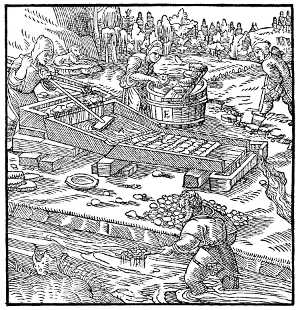
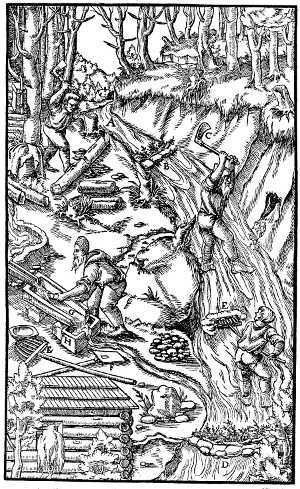
A—Stream. B—Ditch. C—Mattock. D—Pieces of turf. E—Seven-pronged fork. F—Iron shovel. G—Trough. H—Another trough below it. I—Small wooden trowel. [Pg 337] I have spoken of the various methods of washing sand which contains grains of gold; I will now speak of the methods of washing the material in which are mixed the small black stones from which tin is made[20]. Eight such methods are in use, and of these two have been invented lately. Such metalliferous material is usually found torn away from veins and stringers and scattered far and wide by the impetus of water, although sometimes venae dilatatae are composed of it. The miners dig out the latter material with a broad mattock, while they dig the former with a pick. But they dig out the little stones, which are not rare in this kind of ore, with an instrument like the bill of a duck. In districts which contain this material, if there is an abundant supply of water, and if there are valleys or gentle slopes and hollows, so that rivers can be diverted into them, the washers in summer-time first of all dig a long ditch sloping so that the water will run through it rapidly. Into the ditch is thrown the metallic material, together with the surface material, which is six feet thick, more or less, and often contains moss, roots of plants, shrubs, trees, and earth; they are all thrown in with a broad mattock, and the water flows through the ditch. The sand and tin-stone, as they are heavy, sink to the bottom of the ditch, while the moss and roots, as they are light, are carried away by the water which flows through the ditch. The bottom of the ditch is obstructed with turf and stones in order to prevent the water from carrying away the tin-stone at the same time. The washers, whose feet are covered with high boots made of hide, though not of rawhide, themselves stand in the ditch and throw out of it the roots of the trees, shrubs, and grass with seven-pronged wooden forks, and push back the tin-stone toward the head of the ditch. After four weeks, in which they have devoted much work and labour, they raise the tin-stone in the following way; the sand with which it is mixed is repeatedly lifted from the ditch with an iron shovel and agitated hither and thither in the water, until the sand flows away and only the tin-stone remains on the shovel. The tin-stone is all collected together and washed again in a trough by pushing it up and turning it over with a wooden trowel, in order that the remaining sand may separate from it. Afterward they return to their task, which they continue until the metalliferous material is exhausted, or until the water can no longer be diverted into the ditches.
A—Trough. B—Wooden shovel. C—Tub. D—Launder. E—Wooden trowel. F—Transverse trough. G—Plug. H—Falling water. I—Ditch. K—Barrow conveying material to be washed. L—Pick like the beak of a duck with which the miner digs out the material from which the small stones are obtained. [Pg 338] The trough which I mentioned is hewn out of the trunk of a tree and the interior is five feet long, three-quarters of a foot deep, and six digits wide. It is placed on an incline and under it is put a tub which contains interwoven fir twigs, or else another trough is put under it, the interior of which is three feet long and one foot wide and deep; the fine tin-stone, which has run out with the water, settles in the bottom. Some people, in place of a trough, put a square launder underneath, and in like manner they wash the tin-stone in this by agitating it up and down and turning it over with a small wooden trowel. A transverse trough is put under the launder, which is either open on one end and drains off into a tub or settling-pit, or else is closed and perforated through the bottom; in this case, it drains into a ditch beneath, where the water falls when the plug has been partly removed. The nature of this ditch I will now describe.
A—Launder. B—Interlacing fir twigs. C—Logs; three on one side, for the fourth cannot be seen because the ditch is so full with material now being washed. D—Logs at the head of the ditch. E—Barrow. F—Seven-pronged fork. G—Hoe. [Pg 340] If the locality does not supply an abundance of water, the washers dig a ditch thirty or thirty-six feet long, and cover the bottom, the full length, with logs joined together and hewn on the side which lies flat on the ground. On each side of the ditch, and at its head also, they place four logs, one above the other, all hewn smooth on the inside. But since the logs are laid obliquely along the sides, the upper end of the ditch is made four feet wide and the tail end, two feet. The water has a high drop from a launder and first of all it falls into interlaced fir twigs, in order that it shall fall straight down for the most part in an unbroken stream and thus break up the lumps by its weight. Some do not place these twigs under the end of the launder, but put a plug in its mouth, which, since it does not entirely close the launder, nor altogether prevent the discharge from it, nor yet allow the water to spout far afield, makes it drop straight down. The workman brings in a wheelbarrow the material to be washed, and throws it into the ditch. The washer standing in the upper end of the ditch breaks the lumps with a seven-pronged fork, and throws out the roots of trees, shrubs, and grass with the same instrument, and thereby the small black stones settle down. When a large quantity of the tin-stone has accumulated, which generally happens when the washer has spent a day at this work, to prevent it from being washed away he places it upon the bank, and other material having been again thrown into the upper end of the ditch, he continues the task of washing. A boy stands at the lower end of the ditch, and with a thin pointed hoe stirs up the sediment which has settled at the lower end, to prevent the washed tin-stone from being carried further, which occurs when the sediment has accumulated to such an extent that the fir branches at the outlet of the ditch are covered.
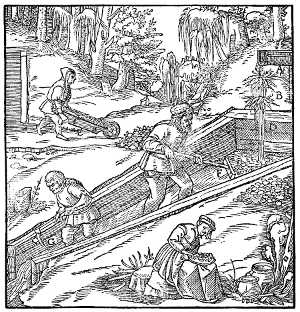
A—Strakes. B—Tank. C—Launder. D—Plug. E—Wooden shovel. F—Wooden mallet. G—Wooden shovel with short handle. H—The plug in the strake. I—Tank placed under the plug. [Pg 341] The third method of washing materials of this kind follows. Two strakes are made, each of which is twelve feet long and a foot and a half wide and deep. A tank is set at their head, into which the water flows through a little launder. A boy throws the ore into one strake; if it is of poor quality he puts in a large amount of it, if it is rich he puts in less. The water is let in by removing the plug, the ore is stirred with a wooden shovel, and in this way the tin-stone, mixed with the heavier material, settles in the bottom of the strake, and the water carries the light material into the launder, through which it flows on to a canvas strake. The very fine tin-stone, carried by the water, settles on to the canvas and is cleansed. A low cross-board is placed in the strake near the head, in order that the largest sized tin-stone may settle there. As soon as the strake is filled with the material which has been washed, he closes the mouth of the tank and continues washing in the other strake, and then the plug is withdrawn and the water and tin-stone flow down into a tank below. Then he pounds the sides of the loaded strake with a wooden mallet, in order that the tin-stone clinging to the sides may fall off; all that has settled in it, he throws out with a wooden shovel which has a short handle. Silver slags which have been crushed under the stamps, also fragments of silver-lead alloy and of cakes melted from pyrites, are washed in a strake of this kind.
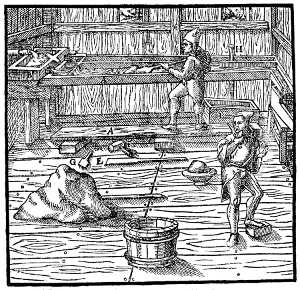
A—Sieve. B—Tub. C—Water flowing out of the bottom of it. D—Strake. E—Three-toothed rake. F—Wooden scrubber. [Pg 342] Material of this kind is also washed while wet, in a sieve whose bottom is made of woven iron wire, and this is the fourth method of washing. The sieve is immersed in the water which is contained in a tub, and is violently shaken. The bottom of this tub has an opening of such size that as much water, together with tailings from the sieve, can flow continuously out of it as water flows into it. The material which settles in the strake, a boy either digs over with a three-toothed iron rake or sweeps with a wooden scrubber; in this way the water carries off a great part of both sand and mud. The tin-stone or metalliferous concentrates settle in the strake and are afterward washed in another strake.
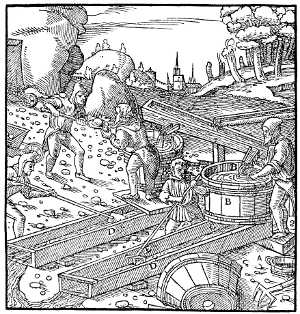
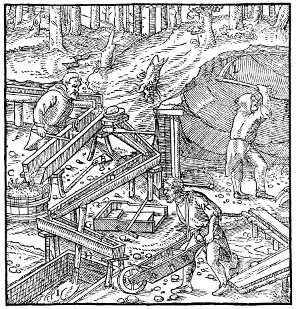
A—Box. B—Perforated plate. C—Trough. D—Cross-boards. E—Pool. F—Launder. G—Shovel. H—Rake. [Pg 343] These are ancient methods of washing material which contains tin-stone; there follow two modern methods. If the tin-stone mixed with earth or sand is found on the slopes of mountains or hills, or in the level fields which are either devoid of streams or into which a stream cannot be diverted, miners have lately begun to employ the following method of washing, even in the winter months. An open box is constructed of planks, about six feet long, three feet wide, and two feet and one palm deep. At the upper end on the inside, an iron plate three feet long and wide is fixed, at a depth of one foot and a half from the top; this plate is very full of holes, through which tin-stone about the size of a pea can fall. A trough hewn from a tree is placed under the box, and this trough is about twenty-four feet long and three-quarters of a foot wide and deep; very often three cross-boards are placed in it, dividing it off into compartments, each one of which is lower than the next. The turbid waters discharge into a settling-pit.
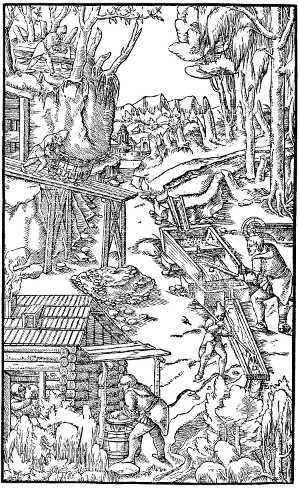
The metalliferous material is sometimes found not very deep beneath the surface of the earth, but sometimes so deep that it is necessary to drive tunnels and sink shafts. It is transported to the washing-box in wheelbarrows, and when the washers are about to begin they lay a small launder, through which there flows on to the iron plate so much water as is necessary for this washing. Next, a boy throws the metalliferous material on to the iron plate with an iron shovel and breaks the small lumps, stirring them this way and that with the same implement. Then the water and sand penetrating the holes of the plate, fall into the box, while all the coarse gravel remains on the plate, and this he throws into a wheelbarrow with the same shovel. Meantime, a younger boy continually stirs the sand under the plate with a wooden scrubber nearly as wide as the box, and drives it to the upper end of the box; the lighter material, as well as a small amount of tin-stone, is carried by the water down into the underlying trough. The boys carry on this labour without intermission until they have filled four wheelbarrows with the coarse and worthless residues, which they carry off and throw away, or three wheelbarrows if the material is rich in black tin. Then the foreman has the plank removed which was in front of the iron plate, and on which the boy stood. The sand, mixed with the tin-stone, is frequently pushed backward and forward with a scrubber, and the same sand, because it is lighter, takes the upper place, and is removed as soon as it appears; that which takes the lower place is turned over with a spade, in order that any that is light can flow away; when all the tin-stone is heaped together, he shovels it out of the box and carries it away. While the foreman does this, one boy with an iron hoe stirs the sand mixed with fine tin-stone, which has run out of the box and has settled in the trough and pushes it back to the uppermost part of the trough, and this material, since it contains a very great amount of tin-stone, is thrown on to the plate and washed again. The material which has settled in the lowest part of the trough is taken out separately and piled in a heap, and is washed on the ordinary strake; that which has settled in the pool is washed on the canvas strake. In the summer-time this fruitful labour is repeated more often, in fact ten or eleven times. The tin-stone which the foreman removes from the box, is afterward washed in a jigging sieve, and lastly in a tub, where at length all the sand is separated out. Finally, any material in which are mixed particles of other metals, can be washed by all these methods, whether it has been disintegrated from veins or stringers, or whether it originated from venae dilatatae, or from streams and rivers.
A—Launder. B—Cross trough. C—Two spouts. D—Boxes. E—Plate. F—Grating. G—Shovels. H—Second cross trough. I—Strake. K—Wooden scrubber. L—Third cross trough. M—Launder. N—Three-toothed rake. [Pg 345] The sixth method of washing material of this kind is even more modern and more useful than the last. Two boxes are constructed, into each of which water flows through spouts from a cross trough into which it has been discharged through a pipe or launder. When the material has been agitated and broken up with iron shovels by two boys, part of it runs down and falls through the iron plates full of holes, or through the iron grating, and flows out of the box over a sloping surface into another cross trough, and from this into a strake seven feet long and two and a half feet wide. Then the foreman again stirs it with a wooden scrubber that it may become clean. As for the material which has flowed down with the water and settled in the third cross trough, or in the launder which leads from it, a third boy rakes it with a two-toothed rake; in this way the fine tin-stone settles down and the water carries off the valueless sand into the creek. This method of washing is most advantageous, for four men can do the work of washing in two boxes, while the last method, if doubled, requires six men, for it requires two boys to throw the material to be washed on to the plate and to stir it with iron shovels; two more are required with wooden scrubbers to keep stirring the sand, mixed with the tin-stone, under the plate, and to push it toward the upper end of the box; further, two foremen are required to clean the tin-stone in the way I have described. In the place of a plate full of holes, they now fix in the boxes a grating made of iron wire as thick as the stalks of rye; that these may not be depressed by the weight and become bent, three iron bars support them, being laid crosswise underneath. To prevent the grating from being broken by the iron shovels with which the material is stirred in washing, five or six iron rods are placed on top in cross lines, and are fixed to the box so that the shovels may rub them instead of the grating; for this reason the grating lasts longer than the plates, because it remains intact, while the rods, when worn by rubbing, can easily be replaced by others.
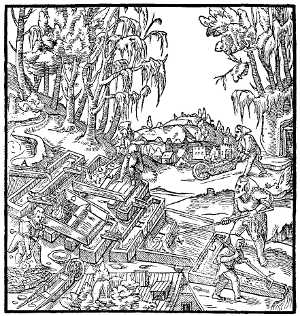
A—Pits. B—Torrent. C—Seven-pronged fork. D—Shovel. [Pg 346] Miners use the seventh method of washing when there is no stream of water in the part of the mountain which contains the black tin, or particles of gold, or of other metals. In this case they frequently dig more than fifty ditches on the slope below, or make the same number of pits, six feet long, three feet wide, and three-quarters of a foot deep, not any great distance from each other. At the season when a torrent rises from storms of great violence or long duration, and rushes down the mountain, some of the miners dig the metalliferous material in the woods with broad hoes and drag it to the torrent. Other miners divert the torrent into the ditches or pits, and others throw the roots of trees, shrubs, and grass out of the ditches or pits with seven-pronged wooden forks. When the torrent has run down, they remove with shovels the uncleansed tin-stone or particles of metal which have settled in the ditches or pits, and cleanse it.
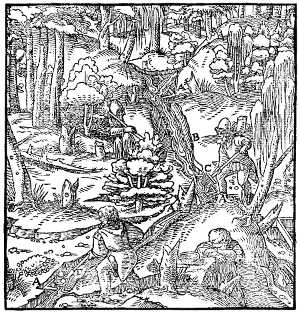
A—Gully. B—Ditch. C—Torrent. D—Sluice box employed by the Lusitanians. [Pg 347] The eighth method is also employed in the regions which the Lusitanians hold in their power and sway, and is not dissimilar to the last. They drive a great number of deep ditches in rows in the gullies, slopes, and hollows of the mountains. Into these ditches the water, whether flowing down from snow melted by the heat of the sun or from rain, collects and carries together with earth and sand, sometimes tin-stone, or, in the case of the Lusitanians, the particles of gold loosened from veins and stringers. As soon as the waters of the torrent have all run away, the miners throw the material out of the ditches with iron shovels, and wash it in a common sluice box.
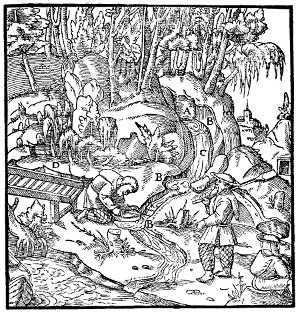
A—Trough. B—Launder. C—Hoe. D—Sieve. [Pg 348] The Poles wash the impure lead from venae dilatatae in a trough ten feet long, three feet wide, and one and one-quarter feet deep. It is mixed with moist earth and is covered by a wet and sandy clay, and so first of all the clay, and afterward the ore, is dug out. The ore is carried to a stream or river, and thrown into a trough into which water is admitted by a little launder, and the washer standing at the lower end of the trough drags the ore out with a narrow and nearly pointed hoe, whose wooden handle is nearly ten feet long. It is washed over again once or twice in the same way and thus made pure. Afterward when it has been dried in the sun they throw it into a copper sieve, and separate the very small pieces which pass through the sieve from the larger ones; of these the former are smelted in a faggot pile and the latter in the furnace. Of such a number then are the methods of washing.
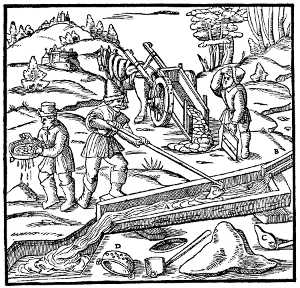
A—Furnace. B—Its mouth. C—Poker. D—Rake with two teeth. E—Hoe. [Pg 349] One method of burning is principally employed, and two of roasting. The black tin is burned by a hot fire in a furnace similar to an oven[21]; it is burned if it is a dark-blue colour, or if pyrites and the stone from which iron is made are mixed with it, for the dark blue colour if not burnt, consumes the tin. If pyrites and the other stone are not volatilised into fumes in a furnace of this kind, the tin which is made from the tin-stone is impure. The tin-stone is thrown either into the back part of the furnace, or into one side of it; but in the former case the wood is placed in front, in the latter case alongside, in such a manner, however, that neither firebrands nor coals may fall upon the tin-stone itself or touch it. The fuel is manipulated by a poker made of wood. The tin-stone is now stirred with a rake with two teeth, and now again levelled down with a hoe, both of which are made of iron. The very fine tin-stone requires to be burned less than that of moderate size, and this again less than that of the largest size. While the tin-stone is being thus burned, it frequently happens that some of the material runs together.
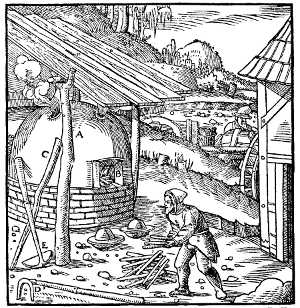
The burned tin-stone should then be washed again on the strake, for in this way the material which has been run together is carried away by the water into the cross-trough, where it is gathered up and worked over, and again washed on the strake. By this method the metal is separated from that which is devoid of metal.
A—Pits. B—Wood. C—Cakes. D—Launder. [Pg 350] Cakes from pyrites, or cadmia, or cupriferous stones, are roasted in quadrangular pits, of which the front and top are open, and these pits are generally twelve feet long, eight feet wide, and three feet deep. The cakes of melted pyrites are usually roasted twice over, and those of cadmia once. These latter are first rolled in mud moistened with vinegar, to prevent the fire from consuming too much of the copper with the bitumen, or sulphur, or orpiment, or realgar. The cakes of pyrites are first roasted in a slow fire and afterward in a fierce one, and in both cases, during the whole following night, water is let in, in order that, if there is in the cakes any alum or vitriol or saltpetre capable of injuring the metals, although it rarely does injure them, the water may remove it and make the cakes soft. The solidified juices are nearly all harmful to the metal, when cakes or ore of this kind are smelted. The cakes which are to be roasted are placed on wood piled up in the form of a crate, and this pile is fired[22].
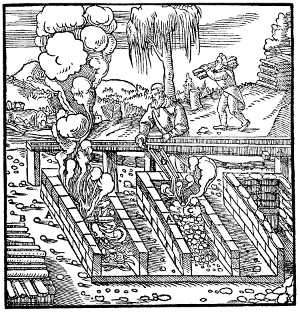
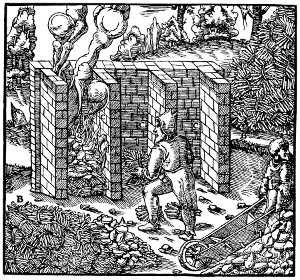
A—Cakes. B—Bundles of faggots. C—Furnaces. [Pg 351] The cakes which are made of copper smelted from schist are first thrown upon the ground and broken, and then placed in the furnace on bundles of faggots, and these are lighted. These cakes are generally roasted seven times and occasionally nine times. While this is being done, if they are bituminous, then the bitumen burns and can be smelled. These furnaces have a structure like the structure of the furnaces in which ore is smelted, except that they are open in front; they are six feet high and four feet wide. As for this kind of furnace, three of them are required for one of those in which the cakes are melted. First of all they are roasted in the first furnace, then when they are cooled, they are transferred into the second furnace and again roasted; later they are carried to the third, and afterward back to the first, and this order is preserved until they have been roasted seven or nine times.
END OF BOOK VIII.