BOOK X. (continued 2)
Herbert Hoover translation
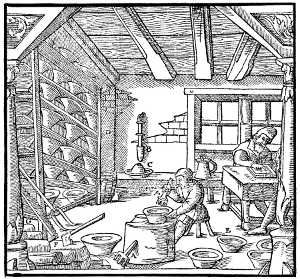
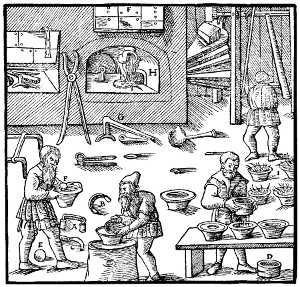
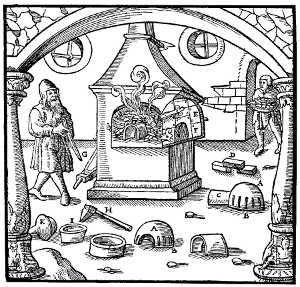
A—Grate. B—Brass block. C—Block of wood. D—Cakes of silver. E—Hammer. F—Block of wood channelled in the middle. G—Bowl full of holes. H—Block of wood fastened to an iron implement. I—Fir-wood. K—Iron bar. L—Implement with a hollow end. The implement which has a circular end is shown in the next picture. M—Implement, the extremity of which is bent upwards. N—Implement in the shape of tongs. [Pg 486] In order that they may be more easily broken, the silver cakes are placed upon an iron grate by the refiner, and are heated by burning charcoal placed under them. He has a brass block two palms and two digits long and wide, with a channel in the middle, which he places upon a block of hard wood. Then with a double-headed hammer, he beats the hot cakes of silver placed on the brass block, and breaks them in pieces. The head of this hammer is a foot and two digits long, and a palm wide. Others use for this purpose merely a block of wood channelled in the top. While the fragments of the cake are still hot, he seizes them with the tongs and throws them into a bowl with holes in the bottom, and pours water over them. When the fragments are cooled, he puts them nicely into the test by placing them so that they stand upright and project from the test to a height of two palms, and lest one should fall against the other, he places little pieces of charcoal between them; then he places live charcoal in the test, and soon two twig basketsful of charcoal. Then he blows in air with the bellows. This bellows is double, and four feet two palms long, and two feet and as many palms wide at the back; the other parts are similar to those described in Book VII. The nozzle of the bellows is placed in a bronze pipe a foot long, the aperture in this pipe being a digit in diameter in front and quite round, and at the back two palms wide. The master, because he needs for the operation of refining silver a fierce fire, and requires on that account a vigorous blast, places the bellows very much inclined, in order that, when the silver has melted, it may blow into the centre of the test. When the silver bubbles, he presses the nozzle down by means of a small block of wood moistened with water and fastened to an iron rod, the outer end of which bends upward. The silver melts when it has been heated in the test for about an hour; when it is melted, he removes the live coals from the test and places over it two billets of fir-wood, a foot and three palms long, a palm two digits wide, one palm thick at the upper part, and three digits at the lower. He joins them together at the lower edges, and into the billets he again throws the coals, for a fierce fire is always necessary in refining silver. It is refined in two or three hours, according to whether it was pure or impure, and if it is impure it is made purer by dropping granulated copper or lead into the test at the same time. In order that the refiner may sustain the great heat from the fire while the silver is being refined, he lets down an iron door, which is three feet long and a foot and three palms high; this door is held on both ends in iron plates, and when the operation is concluded, he raises it again with an iron shovel, so that its edge holds against the iron hook in the arch, and thus the door is held open. When the silver is nearly refined, which may be judged by the space of time, he dips into it an iron bar, three and a half feet long and a digit thick, having a round steel point. The small drops of silver that adhere to the bar he places on the brass block and flattens with a hammer, and from their colour he decides whether the silver is sufficiently refined or not. If it is thoroughly purified it is very white, and in a bes there is only a drachma of impurities. Some ladle up the silver with a hollow iron implement. Of each bes of silver one sicilicus is consumed, or occasionally when very impure, three drachmae or half an uncia[41].
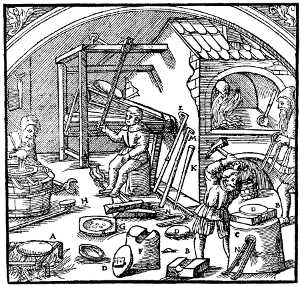
A—Implement with a ring. B—Ladle. C—Its hole. D—Pointed bar. E—Forks. F—Cake of silver laid upon the implement shaped like tongs. G—Tub of water. H—Block of wood, with a cake laid upon it. I—Hammer. K—Silver again placed upon the implement resembling tongs. L—Another tub full of water. M—Brass wires. N—Tripod. O—Another block. P—Chisel. Q—Crucible of the furnace. R—Test still smoking. [Pg 488] The refiner governs the fire and stirs the molten silver with an iron implement, nine feet long, a digit thick, and at the end first curved toward the right, then curved back in order to form a circle, the interior of which is a palm in diameter; others use an iron implement, the end of which is bent directly upward. Another iron implement has the shape of tongs, with which, by compressing it with his hands, he seizes the coals and puts them on or takes them off; this is two feet long, one and a half digits wide, and the third of a digit thick.
When the silver is seen to be thoroughly refined, the artificer removes the coals from the test with a shovel. Soon afterward he draws water in a copper ladle, which has a wooden handle four feet long; it has a small hole at a point half-way between the middle of the bowl and the edge, through which a hemp seed just passes. He fills this ladle three times with water, and three times it all flows out through the hole on to the silver, and slowly quenches it; if he suddenly poured much water on it, it would burst asunder and injure those standing near. The artificer has a pointed iron bar, three feet long, which has a wooden handle as many feet long, and he puts the end of this bar into the test in order to stir it. He also stirs it with a hooked iron bar, of which the hook is two digits wide and a palm deep, and the iron part of its handle is three feet long and the wooden part the same. Then he removes the test from the hearth with a shovel or a fork, and turns it over, and by this means the silver falls to the ground in the shape of half a sphere; then lifting the cake with a shovel he throws it into a tub of water, where it gives out a great sound. Or else, having lifted the cake of silver with a fork, he lays it upon the iron implement similar to tongs, which are placed across a tub full of water; afterward, when cooled, he takes it from the tub again and lays it on the block made of hard wood and beats it with a hammer, in order to break off any of the powder from the test which adheres to it. The cake is then placed on the implement similar to tongs, laid over the tub full of water, and cleaned with a bundle of brass wire dipped into the water; this operation of beating and cleansing is repeated until it is all clean. Afterward he places it on an iron grate or tripod; the tripod is a palm and two digits high, one and a half digits wide, and its span is two palms wide; then he puts burning charcoal under the tripod or grate, in order again to dry the silver that was moistened by the water. Finally, the Royal Inspector[42] in the employment of the King or Prince, or the owner, lays the silver on a block of wood, and with an engraver's chisel he cuts out two small pieces, one from the under and the other from the upper side. These are tested by fire, in order to ascertain whether the silver is thoroughly refined or not, and at what price it should be sold to the merchants. Finally he impresses upon it the seal of the King or the Prince or the owner, and, near the same, the amount of the weight.
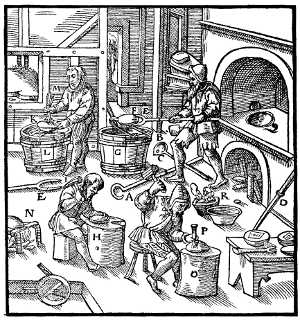
A—Muffle. B—Its little windows. C—Its little bridge. D—Bricks. E—Iron door. F—Its little window. G—Bellows. H—Hammer-chisel. I—Iron ring which some use instead of the test. K—Pestle with which the ashes placed in the ring are pounded. [Pg 489] There are some who refine silver in tests placed under iron or earthenware muffles. They use a furnace, on the hearth of which they place the test containing the fragments of silver, and they place the muffle over it; the muffle has small windows at the sides, and in front a little bridge. In order to melt the silver, at the sides of the muffle are laid bricks, upon which the charcoal is placed, and burning firebrands are put on the bridge. The furnace has an iron door, which is covered on the side next to the fire with lute in order that it may not be injured. When the door is closed it retains the heat of the fire, but it has a small window, so that the artificers may look into the test and may at times stimulate the fire with the bellows. Although by this method silver is refined more slowly than by the other, nevertheless it is more useful, because less loss is caused, for a gentle fire consumes fewer particles than a fierce fire continually excited by the blast of the bellows. If, on account of its great size, the cake of silver can be carried only with difficulty when it is taken out of the muffle, they cut it up into two or three pieces while it is still hot, with a wedge or a hammer-chisel; for if they cut it up after it has cooled, little pieces of it frequently fly off and are lost.
END OF BOOK X.