SECOND PART. The Astronomy of Dante. (continued 3)
Reading edition
The extent of variability also depends upon our latitude (just as with sunrises and sunsets); and in Florence the retardation in one day may sometimes be only twenty minutes, sometimes an hour and twenty minutes. The difference would be less in Dante’s Purgatory, since this was in latitude 32° south, and the intervals between moonset and moonset become less variable in length as we approach the equator, just as the days become less unequal all the year round. Still, they would vary a good deal, so we must conclude that Dante only means to indicate the time quite roughly when he uses the moon as a clock. As a matter of fact, he seldom does so in the Divine Comedy without giving us another clue to the time as well.
These passages all belong to a most interesting series of time indications, which we may now proceed to examine.
VI. DANTE’S JOURNEY THROUGH THE THREE REALMS:
INDICATIONS OF TIME AND DIRECTION BY MEANS OF THE SKIES.
1. TIME REFERENCES IN THE DIVINE COMEDY.
The plan of the universe through which Dante feigns himself to have journeyed is familiar to all readers of the Divine Comedy. Hell, as the Fathers taught, was a subterranean cavity, and Dante pictures it as an inverted cone, whose apex reaches the exact centre of Earth and therefore of the universe. It is situated vertically underneath Jerusalem, the centre of the inhabited Earth. He departs from the Fathers, however, in removing Purgatory from these dim regions, and placing it on an island in the midst of the ocean of the uninhabited hemisphere, exactly at the antipodes of Jerusalem. On this island rises a mountain whose immensely lofty summit reaches the upper regions of the atmosphere, and upon the summit is the Eden of our first parents. This original conception is an extraordinary gain, both from the artistic and the allegorical points of view; and it is in harmony with the idea of Aristotle, and of many mediæval writers, that the southern hemisphere was the “nobler” part of Earth. Here, then, man was permitted to dwell before the Fall, and hither come repentant souls, saved from Hell, but not yet pure enough to enter Heaven. Paradise consists of all the spheres of mediæval astronomy, and the poet rises from one to another until he finally reaches the all-embracing Empyrean, where his vision ends.
Nowhere does he describe this scheme in full, but it was evidently clear in his own mind, and by following him step by step in his journey it is easily reconstructed, and is represented in the accompanying diagram.
In the same way he never states how long a time he spent on this visionary journey, yet this also he had definitely determined, and in each Cantica he refers once to the period of time alloted to each realm.
In the last Circle but one of the Inferno, he is warned by Virgil that the time allowed is drawing to a close;[442] in the last but one of the Purgatorio Virgil urges him to make the best use of the time appointed;[443] and in the Paradiso, just before the final vision, St. Bernard tells him that the time of his trance is nearly over.[444]
In the first Canto, which is introductory to the whole Commedia, he mentions the time at which he assumes that his vision began. It was “nel mezzo del cammin di nostra vita,”[445] which may mean simply that he was middle-aged, or comparing it with the passage in the Convivio quoted earlier (see p. 347), we may suppose it to mean that he was exactly in his 35th year. The season was spring—“la dolce stagione,”[446] and when night was over the sun rose among those stars which were with him at the Creation, which was believed to have taken place at the vernal equinox some sixty-five centuries before.
“Il Sol montava su con quelle stelle Ch’ eran con lui quando l’Amor Divino Mosse da prima quelle cose belle.”[447]
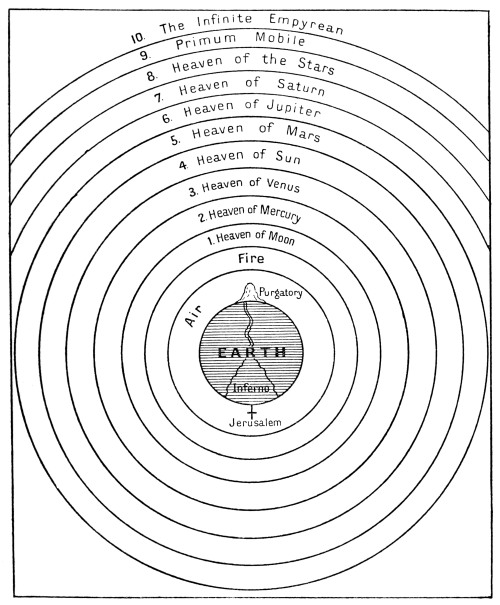
Fig. 45. The Universe of Dante.
The expression “quelle stelle,”[448] however, shows us that Dante does not intend to be pedantically accurate, which would indeed be inartistic in a poem. He speaks several times of the supposed slow motion of the star sphere,[449] and although he never mentions its effect in shifting the place of the equinox continually among the stars, we can hardly imagine that he failed to understand this. He knew quite well, therefore, that the stars which accompanied the sun in that first springtime of the world could not be the same stars which rose with him now. But astronomers had agreed to call the part of the sky which contains the vernal equinox by its old name, and it would be exceedingly tiresome if he were to distinguish, every time he mentioned them, between the zodiacal constellations and the zodiacal signs; there shall be no occasion, therefore, to stop and consider which he means, and no ambiguity: he assumes once for all that they always have been and always are identical, that the “first point of Aries” or vernal equinox is now and always at the beginning of the constellation Aries. To this assumption he is consistent throughout.
Another important point to notice is that, since it is the time of the equinox, there is no difference between “temporary” and “equal” hours.[450] Days and nights are of equal length; sunrise and sunset are nearly at 6 a.m. and 6 p.m., according to our modern method of reckoning.[451] In this way also, and without any sacrifice of astronomical accuracy, the poet has simplified his time references for his readers.
We must observe, however, that the day is as uncertain as the year; for, although it is certainly near the equinox, “quelle stelle” may mean exactly the first point of Aries or only the constellation Aries in general. From this Canto alone, therefore, we cannot be sure of the exact date.
From other allusions of various kinds, scattered throughout the Divine Comedy, we gather that Dante did intend a definite date to be understood, but unfortunately the data by which he means to fix it are themselves so ambiguous that commentators differ as to the day, the month, and the year. The question has so direct a bearing on Dante’s astronomy that we cannot shirk it; but for the present, leaving it aside, let us deal merely with the hour, which is distinctly stated from the first, and indicated in a number of passages so clearly that readers with an elementary knowledge of the apparent movements of the heavenly bodies can find little difficulty in following Virgil and Dante through their journey, seeing exactly how many days it required, and frequently at what hour of day or night they were in a particular spot. If my readers are not now in possession of this elementary knowledge, this book has been written in vain.
I give below a list of all the hour-indications, astronomical and others, for the sake of clearness and completeness; but I omit for the present those that indicate only the date, and merely call the days the first, second, etc. These passages, though they are only to be understood in a popular sense, prove quite as clearly as the elaborate astronomical explanations in the Convivio how deep an interest Dante always took in astronomy; and a study of them shows that he had carefully considered the positions of the heavenly bodies and their movements during the progress of the action in his poem.
TIME REFERENCES IN THE DIVINE COMEDY
Night. In the Forest. Moon full
(see below, Inf. xx. 127-129, and Purg. xxiii. 118-121).
“La notte ch’ i’ passai.”
Inf. i. 21.
“The night that I had spent.”
1st day. Just before sunrise.
At the foot of the Hill.
“Ma poi ch’ io fui al piè d’un colle giunto, * * * * * Guardai in alto, e vidi le sue spalle Vestite già de’ raggi del pianeta Che mena dritto altrui per ogni calle.” Inf. i. 13-18.
“But after I had reached a mountain’s foot, * * * * * Upward I looked, and I beheld its shoulders Vested already with that planet’s rays Which leadeth others right by every road.”
Sunrise 6 a.m. [452]
Climbing the Hill.
“Tempo era dal principio del mattino, E il sol montava su con quelle stelle Ch’eran con lui quando l’ Amor divino Mosse da prima quelle cose belle.” Inf. i. 37-40.
“The time was the beginning of the morning, And up the sun was mounting with those stars That with him were, what time the Love Divine At first in motion set those beautous things.”
Evening twilight.
At the Gate of Hell.
“Lo giorno se n’andava, e l’ aer bruno....” Inf. ii. 1.
“Day was departing, and the brown air....”
Midnight.
Crossing the fourth circle.
“Già ogni stella cade, che saliva Quando mi mossi.” Inf. vii. 98, 99.
“Already sinks each star that was ascending When I set out.”
2nd day. About 2 hrs. before sunrise (4 a.m.)
On the edge of the cliff,
preparing to descend to the 7th circle.
“I Pesci guizzan su per l’ orizzonta, E il Carro tutto sovra il Coro giace.” Inf. xi. 113, 114.
“Quivering are the Fishes on the horizon, And the Wain wholly over Caurus lies.”
(Dante refers to the previous day.)
In the 7th circle.
“Mi smarri’ in una valle. * * * * * Pur ier mattina le volsi le spalle.” Inf. xv. 50-52.
“I lost me in a valley. * * * * * But yestermorn I turned my back upon it.”
After sunrise, between 6 and 7 a.m.
Leaving the 4th Pit of Circle VIII.
(Virgil reminds Dante of the night before last, spent in the Forest.)
“Già tiene il confine D’ ambedue gli emisperi e tocca l’ onda Sotto Sibilia Caino e le spine; E già iernotte fu la luna tonda; Ben ten dee ricordar, chè non ti nocque Alcuna volta per la selva fonda.” Inf. xx. 124-129.
“... Already holds the confines Of both the hemispheres, and under Seville Touches the ocean-wave, Cain and the thorns; And yesternight the moon was round already; Thou shouldst remember well: it did not harm thee From time to time within the forest deep.”
7 a.m.
On the bridge over the 5th Pit.
“Ier, più oltre cinq’ ore che quest’ otta, Mille dugento con sessanta sei Anni compiè che qui la via fu rotta.” Inf. xxi. 112-114.
“Yesterday, five hours later than this hour, One thousand and two hundred sixty-six Years were complete that here the way was broken.”
About 1 p.m.
Leaving the 9th Pit.
“E già la Luna è sotto nostri piedi, Lo tempo è poco omai che n’è concesso.” Inf. xxix. 10, 11.
“And now the moon is underneath our feet. Henceforth the time allotted us is brief.”
Nightfall.
At the bottom of the world.
“La notte risurge; ed oramai È da partir, chè tutto avem veduto.” Inf. xxxiv. 68, 69.
“Night is reascending, and ’tis time That we depart, for we have seen the whole.”
3rd day. (no night intervening) 7.30 a.m.
In the new hemisphere
“Già il sole a mezza terza riede.” Inf. xxxiv. 96.
“And now the sun to middle-tierce returns.”
4th day. About an hour before sunrise (5 a.m.).
On the island of Purgatory.
“E quindi uscimmo a riveder le stelle.” Inf. xxxiv. 139.
“Thence we came forth to see again the stars.”
“Lo bel pianeta che ad amar conforta Faceva tutto rider l’ oriente, Velando i Pesci ch’ erano in sua scorta.” Purg. i. 19-21.
“The beauteous planet that to love incites Was making all the orient to laugh, Veiling the Fishes that were in her escort.”
Dawn.
“Lo sol vi mostrerà, che surge omai.” Purg. i. 107.
“The sun, which now is rising, will direct you.”
“L’ alba vinceva l’ ora mattutina.” Purg. i. 115.
“The dawn was vanquishing the matin hour.”
Sun just below east horizon.
On the Shore of the Island.
“Già era il sole all’ orizzonte giunto Lo cui meridian cerchio coperchia Jerusalem col suo più alto punto; E la notte, che opposita a lui cerchia, Uscia di Gange fuor con le bilance Che le caggion di man quando soperchia; Si che le bianche e le vermilie guance, Là dove io era, della bella Aurora, Per troppa etate divenivan rance.” Purg. ii. 1-9.
“Already had the sun the horizon reached Whose circle of meridian covers o’er Jerusalem with its most lofty point; And night, that opposite to him revolves, Was issuing forth from Ganges, with the scales That fall from out her hand when she exceedeth; So that the white and the vermilion cheeks Of beautiful Aurora, where I was, By too great age were changing into orange.”
Sun risen.
“Da tutte parti saettava il giorno Lo sol, ch’avea con le saette conte Di mezzo il ciel cacciato il Capricorno.” Purg. ii. 55-57.
“On every side was darting forth the day The sun, who had with his resplendent shafts From the mid-heaven chased forth the Capricorn.”
Soon after sunrise.
Walking westward, towards the Mountain of Purgatory.
“Lo sol che retro fiammeggiava roggio.” Purg. iii. 16.
“The sun that in our rear was flaming red.”
Shortly after 6 a.m. (3 p.m. in Italy).
“Vespero è già colà dov’ è sepolto Lo corpo dentro al quale io facea ombra.” Purg. iii. 25, 26.
“’Tis vespers there already where is buried The body within which I cast a shadow.”
About 9.30 a.m.
At the foot of the Mountain.
“Ben cinquanta gradi salito era Lo sole.” Purg. iv. 15, 16.
“Fifty full degrees uprisen was The sun.”
Midday.
On a ledge of the Mountain (Anti-purgatory).
“Vedi ch’è tocco Meridian dal sole, e dalla riva. Copre la notte già col piè Morrocco.” Purg. iv. 137-139.
“See, the sun has touched Meridian, and from the shore the night Covers already with her foot Morocco.”
Afternoon.
Climbing the eastern slope of the Mountain.
“Vedi omai che il poggio l’ ombra getta. * * * * * Prima che sii lassù tornar vedrai Colui che già si copre della costa, Sì che i suoi raggi tu romper non fai.” Purg. vi. 51-57.
“See, e’en now the hill a shadow casts. * * * * * Ere thou art up there, thou shalt see return Him, who now hides himself behind the hill, So that thou dost not interrupt his rays.”
Evening.
“Vedi già come dichina il giorno.” Purg. vii. 43.
“See already how the day declines.”
Sunset (6 p.m.).
In the Flowery Valley, on the Mountain-side.
“Era già l’ora che volge il disio Ai naviganti e intenerisce il core, Lo di ch’han detto ai dolci amici addio; E che lo nuovo peregrin d’ amore Punge, se ode squilla di lontano Che paia il giorno pianger che si more.” Purg. viii. 1-6.
“’Twas on the hour that turneth back desire In those who sail the sea, and melts the heart, The day they’ve said to their sweet friends farewell; And the new pilgrim penetrates with love, If he doth hear from far away a bell That seemeth to deplore the dying day.”
Evening twilight.
“Tempo era già che l’ aer s’annerava.” Purg. viii. 49.
“Already now the air was growing dark.”
(Dante refers to the morning of the same day.)
“Per entro il lochi tristi Venni stamane.” Purg. viii. 58, 59.
“Through the dismal places I came this morn.”
Early night: about 7 p.m.
“Le quattro chiare stelle Che vedevi staman, son di là basse, E queste son salite ov’ eran quelle.” Purg. viii. 91-93.
“The four resplendent stars Thou sawest this morning are down yonder low, And these have mounted up to where those were.”
Shortly before moonrise, between 8 and 9 p.m.
“La concubina di Titone antico Già s’imbiancava al balco d’oriente, Fuor delle braccia del suo dolce amico; Di gemme la sua fronte era lucente, Poste in figura del freddo animale Che con la coda percote la gente; E la notte de’ passi con che sale Fatti avea due nel loco ov’ eravamo, E il terzo già chinava in giuso l’ ale.” Purg. ix. 1-9.
“The concubine of old Tithonus now Gleamed white upon the eastern balcony, Forth from the arms of her sweet paramour; With gems her forehead all relucent was, Set in the shape of that cold animal Which with its tail doth smite amain the people; And of the steps with which she mounts the Night Had taken two in that place where we were, And now the third was bending down its wings.”
5th day. Dawn.
At the Gate of Purgatory.
“Nell’ ora che comincia i tristi lai La rondinella presso alla mattina.” Purg. ix. 13, 14.
“Just at the hour when her sad lay begins The little swallow, near unto the morning.”
(See also ix. 52 “nell’ alba che precede al giorno,” and ix. 59 “come il di fu chiaro.”)
(See also “At dawn, which doth precede the day.” and “As day grew bright”).
More than 2 hours after sunrise (after 8 a.m.).
“Il sole er’ alto già più che due ore.“ Purg. ix. 44.
“And now the sun was more than two hours high.”
About 9.30 a.m.
On the 1st Cornice of the Mountain.
“Pria lo scemo della luna Rigiunse al letto suo per rícorcarsi, Che noi fossimo fuori di quella cruna.” Purg. x. 14-16.
“Sooner had the moon’s decreasing disc Regained its bed to sink again to rest. Than we were forth out of that needle’s eye.”
12 noon.
Ascent to the 2nd Cornice.
“Più era già per noi del monte volto, E del cammin del sole assai più speso Che non stimava l’animo non sciolto. * * * * * ... Vedi che torna Dal servigio del dì l’ancella sesta.” Purg. xii. 73-81.
“More of the mount by us was now encompassed, And far more spent the circuit of the sun, Than had the mind preoccupied imagined. * * * * * ... Lo, returning is From service of the day the sixth handmaiden.”
3 p.m. (midnight in Italy).
Ascent to the 3rd Cornice.
“Quanto tra l‘ultimar dell’ ora terza E il principio del dì par della spera Che sempre a guisa di fanciullo scherza, Tanto pareva già in ver la sera Essere al sol del suo corso rimaso; Vespero là, e qui mezza notte era. E i raggi ne ferian per mezzo il naso, Perchè per noi girato era si il monte, Che già dritti andavamo in ver l’occaso.” Purg. xv. 1-9.
“As much as ’twixt the close of the third hour And dawn of day appeareth of that sphere Which aye in fashion of a child is playing, So much, it now appeared, towards the night Was of his course remaining to the sun; There it was evening, and ’twas midnight here. And the rays smote the middle of our faces, Because by us the mount was so encircled, That straight towards the west we now were going.”
Evening.
On the 3rd Cornice.
“Noi andavam per lo vespero, attenti Oltre, quanto potean gli occhi allungarsi Contra i raggi serotini e lucenti.“ Purg. xv. 139-141.
“We passed along athwart the twilight, peering Forward, as far as ever eye could stretch Against the sunbeams serotine and lucent.”
Sunset at sea-level, 6 p.m.
“Io rividi Lo sole in pria, che già nel corcare era.” Purg xvii. 8, 9.
“I saw again The sun at first, that was already setting.”
On the 3rd Cornice.
“I raggi, morti già, nei bassi lidi.“ Purg. xvii. 12.
“Rays already dead on the low shores.”
Ascent to the 4th Cornice.
“Procacciam di salir pria che s’abbui.” Purg. xvii. 62.
“Let us make haste to mount ere it grow dark.”
Sunset on the Mountain, shortly after 6 p.m.
On the 4th Cornice.
“Già eran sopra noi tanto levati Gli ultimi raggi che la notte segue, Che le stelle apparivan da più lati.” Purg. xvii. 70-72.
“Already over us were so uplifted The latest sunbeams which the night pursues, That upon many sides the stars appeared.”
Towards midnight.
“La luna, quasi a mezza notte tarda, Facea le stelle a noi parer più rade, Fatta com’ un secchione che tutto arda; E correa contra il ciel per quelle strade Che il sole infiamma allor che quel da Roma Tra i Sardi e i Corsi il vede quando cade.” Purg. xviii. 76-81.
“The moon, belated almost unto midnight, [453] Now made the stars appear to us more rare, Formed like a bucket that is all ablaze; And counter to the heavens ran through those paths Which the sun sets aflame when he of Rome Sees it ’twixt Sardes and Corsicans go down.”
6th day. Nearly 2 hours before sunrise, about 4 a.m.
On the 4th Cornice.
“Nell’ ora che non può il calor diurno Intepidar più il freddo della luna, Vinto da terra, o talor da Saturno; Quando i geomanti lor Maggior Fortuna Veggiono in oriente, innanzi all’ alba, Surger per via che poco le sta bruno.” Purg. xix. 1-6.
“It was the hour when the diurnal heat No more can warm the coldness of the moon, Vanquished by Earth, or peradventure Saturn; When geomancers their Fortuna Major See in the orient, before the dawn, Rise by a path that long remains not dim.”
Early morning.
Ascent to 5th Cornice.
“Su mi levai, e tutti eran già, pieni Dell’ alto dì i giron del sacro monte, Ed andavam col sol nuovo alle reni.” Purg. xix. 37-39.
“I rose, and full already of high day Were all the circles of the sacred mountain, And with the new sun at our back we went.”
About 10 a.m.
On the 6th Cornice.
“E già le quattro ancelle eran del giorno Rimase addietro, e la quinta era al temo, Drizzando pure in su l’ ardente corno.” Purg. xxii. 118-120.
“And four handmaidens of the day already Were left behind, and at the pole the fifth Was pointing upwards still its burning horn.”
(Dante refers to “the other day” when he began the journey.)
“Di quella vita mi volse costui Che mi va innanzi, l’ altr’ ier, quando tonda Vi si mostrò la suora di colui— E il sol mostrai.” Purg. xxiii. 118-121.
“Out of that life he turned me back who goes In front of me, some days agone, when round The sister of him yonder showed herself— And to the sun I pointed.”
Between 2 and 4 p.m.
Ascent to the 7th Cornice.
“Il sole avea lo cerchio di merigge Lasciato al Tauro, e la notte allo Scorpio.” Purg. xxv. 2, 3.
“The sun bad his meridian circle To Taurus left, and Night to Scorpio.”
Evening.
On the 7th Cornice, west side of the Mountain.
“Feriami il sole sull’ omero destro, Che già, raggiando, tutto l’ occidente Mutava in bianco aspetto di cilestro.” Purg. xxvi. 4-6.
“On the right shoulder smote me now the sun, That, raying out, already the whole west Changed from its azure aspect into white.”
Sunset at sea-level, 6 p.m.
About to cross the zone of fire.
“Sì come quando i primi raggi vibra La dove il suo Fattore il sangue sparse, Cadendo Ibero sotto l’ alta Libra, E l’ onde in Gange da nona riarse, Sì stava il sole; onde il giorno sen giva.” Purg. xxvii. 1-5.
“As when he vibrates forth his earliest rays In regions where his Maker shed his blood, The Ebro falling under lofty Libra, And waters in the Ganges burnt with noon, So stood the sun; hence was the day departing.”
Sun about to set on the mountain heights.
At the foot of the last stairway.
“Lo sol sen va, soggiunse, e vien la sera.” Purg. xxvii. 61.
“The sun departs, it added, and night cometh.”
Sun sets.
Climbing the last stairway.
“Io toglieva i raggi Dinanzi a me del sol ch’era già basso. * * * * * Il sol corcar, per l’ ombra che si spense Sentimmo.” Purg. xxvii. 65-69.
“I cut off the rays Before me of the sun, that now was low. * * * * * By the vanished shadow the sun’s setting Behind us we perceived.”
Night.
On the last stairway.
“Vedev’ io le stelle.” Purg. xxvii. 89.
“I beheld the stars.”
7th day. About 4 a.m.
“Nell’ ora, credo, che dell’ oriente Prima raggiò nel monte Citerea.” Purg. xxvii. 94, 95.
“It was the hour, I think, when from the east First on the mountain Cytherea beamed.”
Dawn.
“E già per gli splendori antelucani * * * * * Le tenebre fuggian da tutti i lati.” Purg. xxvii. 109-112.
“And now before the antelucan splendours * * * * * The darkness fled away on every side.”
Early morning.
In the Earthly Paradise.
“Vedi là il sol che in fronte ti riluce.” Purg. xxvii. 133.
“Behold the sun that shines upon thy forehead.”
“L’ ôre prime.”
“The hours of prime.”
Midday.
By the fountain of Eunoë.
“Teneva il sole il cerchio di merigge.” Purg. xxxiii. 104.
“The sun was holding the meridian circle.”
Ascent to Paradise.
“Fatto avea di là mane e di qua sera Tal foce quasi, e tutto era là bianco Quello emisperio, e l’ altra parte nera.” Par. i. 43-45.
“Almost that passage had made morning there And evening here, and there was wholly white That hemisphere, and black the other part.”
8th day.
A lapse of 6 hrs. since entering the 8th heaven.
(Cf. Par. xxii. 151-153).
Sunset in Jerusalem (sunrise in Purgatory).
In the eighth heaven among the stars of Gemini.
“Dall’ ora ch’io avea guardato prima Io vidi mosso me per tutto l’arco Che fa del mezzo al fine il primo clima; Si ch’io vedea di là da Gade il varco Folle d’Ulisse. e di qua presso il lito Nel qual si fece Europa dolce carco; E più mi fora discoperto il sito Di questa Aiuola, ma il sol procedea Sotto i miei piedi un segno e più partito.” Par. xxvii. 79-87.
“Since the first time that I had downward looked I saw that I had moved through the whole arc Which the first climate makes from midst to end; So that I saw the mad track of Ulysses Past Gades, and this side well nigh [454] the shore Whereon became Europa a sweet burden; And of this threshing-floor the site to me Were more unveiled, but the sun was preceding Under my feet, a sign and more removed.”
2. THE INFERNO.
Using the above table as a guide, we may now see how Dante uses the movements of the heavenly bodies both for time and direction, and we shall discover how long his journey takes.
Dante has spent a night in a dark forest. The moon was then full; but we only learn this later, when Virgil reminds him of it, and he himself mentions it to Forese, when talking in the Purgatorio. At dawn he finds himself at the foot of a hill on which are already shining the first rays of the morning sun—the planet which leads all aright by every path. The sun rises: it is in Aries, consequently the moon, being full, must be in Libra, and must have set as the sun rose, i.e. at about 6 a.m. Virgil appears, rescues the poet from three terrible beasts, and announces that he has come to conduct him through Hell and Purgatory, and to lead him to Beatrice, who will guide him to Paradise.
On the evening of the same day, at twilight, the poets enter the Inferno. This great subterranean cavity, shaped like an inverted cone (see fig. 45), is divided into nine circles, in which the different classes of sinners are punished. In this blind world of eternal darkness no star shines, and the sun is never once mentioned as timegiver; when Virgil wishes to remind Dante that they must hasten, he refers to the position of moon or stars, and the former is called “La Donna che qui regge.”[455]
After passing through four circles, Virgil says that every star is now sinking which was ascending when he started, indicating that it is now six hours since they entered the Inferno, or soon after midnight. He does not mean that all these stars are setting, but that they have crossed the meridian, and are at some point of their descent towards the west. Strictly speaking this does not apply to stars north of the equator, since they take more than six hours to reach the meridian, being above the horizon for more than twelve. Perhaps Virgil is thinking chiefly of the constellations of the zodiac.
The poets cross the fifth circle, enter the “basso Inferno”[456] or city of Dis, and on the edge of the precipice which borders the circle of the Heretics they sit while Virgil explains the system of the several circles. Then he expresses a wish to continue the journey, for the Fishes (of the zodiac) are quivering on the horizon, and the Wain lies to the north-west. As it is the time of the Vernal Equinox, and the sun is in Aries, Pisces is the zodiacal sign immediately preceding the sun, and begins to rise about four in the morning. The part of Ursa Major called the Wain is somewhat less than 180° distant from Pisces; hence when the latter appears on the eastern horizon the former will be in the west (and of course always in the north). The “Caurus” of the Latins was the wind from the north-west.
They descend a cliff over loose stones which roll under the unaccustomed weight of Dante’s living feet. Virgil tells him that both here and elsewhere in Hell the ancient rocks were riven by an earthquake which immediately preceded the triumphant descent of Christ after His crucifixion. So mighty was the shock that he thought the universe was dissolving into chaos by the force of love, as Empedocles had said must happen periodically. At the base of the cliff they cross the river Phlegethon, then pass through the wood of the Harpies, and walk along the stone banks of a conduit which afterwards falls with thunderous roar down a steep precipice. On the burning sand through which the conduit runs, Dante sees Brunetto Latini, and tells him that it was only yesterday that he escaped from the Forest. The monster Geryon carries them down the precipice, and they reach the ten Pits of Malebolge, which like so many moats surround the central Depth.
When looking down upon the astrologers in the fourth Pit, Virgil again hastens Dante on, telling him that now Cain and the thorns—by which he means the moon, alluding to the legend[457]—is on the boundary of the two hemispheres, and already touching the waves below Seville. The two hemispheres are those of the habitable earth whose centre is Jerusalem, and the uninhabitable with Purgatory at its centre: the moon, therefore, is just setting as seen from Jerusalem, and in the Inferno the time is Jerusalem time. It is here that Virgil adds, “And yesternight the moon was full:” did we not know this, the fact that she was setting would give no clue to the time. When full, she set as the sun rose, that was at 6 a.m.; now, therefore, she is setting after sunrise, between six and seven in the morning;[458] and this is how Virgil tells Dante, without mentioning the sun, that a new day has begun.
The poets accordingly hasten on to the bridge above the next Pit, the fifth, and here the demons treacherously mislead them by assuring them that the next bridge directly on their way is broken down, but the one to the left is standing. The anniversary of the catastrophe is precisely determined by Malacoda, the chief demon of the band, as five hours later than the present hour on the preceding day. There can be no doubt that he refers to the same earthquake as Virgil described when descending the stony cliff, and all commentators are agreed to this. The time now, therefore, is five hours before midday, i.e. 7 a.m., since it was at midday that Dante believed Christ to have died.[459]
The scenes with the demons follow, the breathless escape into the next Pit, of the Hypocrites, and the horrors of the Pit of the Thieves.
Then for a short space, when the suffering and the murk of Hell is becoming almost intolerable, we are suddenly lifted into the upper air by the narrative of Ulysses—into the pure air and the vast spaces of the southern ocean, and we see once more the skies. We follow the adventurers to the regions beyond the sun, the world where no one lives; we see all the stars of the other pole, and the moon shines down upon us. Too soon comes the tragic end of the story, and the waters close over the ship; the shade of Ulysses passes on, and we are once more in the “buio d’ inferno.”[460]
At the next Pit, that of the Schismatics, as Dante stands ready to weep for pity on the bridge above it, Virgil reproaches him for delaying, for little remains now of the time permitted for seeing the Inferno, and already the moon is beneath their feet. This is about an hour after midday; for if the moon were full she would be just opposite the sun, hence under our feet when the sun is on the meridian, i.e. at noon; but this is one day after Full Moon, and therefore she does not reach the position till about an hour later.
The tenth and last Pit is traversed, and when the giant Antæus has lifted them down into the sorrowful pit towards which all the rest of Hell converges, the poets have nearly reached the centre of the earth. For they have been descending continually, finding a slight fall between each circle, and between the great divisions of different classes of sin, three sharp steep falls—the cliff descending to the River of blood and other circles of the violent, the precipice down which Geryon carried them to the Malebolge of Fraud, and the Dark Pit to the bottom of which Antæus conveyed them, where in the Frozen Lake treachery was punished. Last of all, at the very centre and bottom of the whole “dolorous kingdom” of Lucifer, they see its King, and Virgil says all has been seen, and it is time to depart, for Night is rising again.
Thus we see that the journey through the Inferno has taken exactly the time from one sunset to another, twenty-four hours.
Now Virgil seizes the shaggy side of the fiend, while the monstrous wings are raised, and with Dante clinging to him climbs down the side, as far as the hip; here with difficulty and labour the master turns round, so that his head is where his feet were, and climbs up, panting, so that Dante thinks they are returning. But when the ascent has been made, and both poets sit down to rest, Dante sees to his astonishment that the frozen lake is gone, the head and wings of Lucifer are gone, they are looking down upon him, and see only his legs which are directed upwards! To add to Dante’s bewilderment, Virgil now says, “Rise, for the way is long and the road is bad, and the sun has already returned to middle-tierce,” which, as we have seen, means at the time of the equinox 7.30 in the morning. Night was just beginning in the dreadful place they have so recently left, but now for the first time Virgil mentions the sun as giving them the time, and it is early morning.
The explanation is that the point which they passed with so great an effort is the exact centre of the world; they are now on its further side, and above them is the other hemisphere, where all is ocean save the island of Purgatory. Virgil explains how it was through the fall of Lucifer from Heaven that all the land except Purgatory is in one hemisphere, and that there is a cavity through which they may now climb to the opposite hemisphere. When Lucifer fell, all the land which then existed in the unknown hemisphere fled for fear of him, sinking under the sea, and then escaping round the globe settled in the inhabited hemisphere. It may be, he adds, that then the earth in the interior fled away from him upwards to form land in this hemisphere (Purgatory) and thus an empty space is left here. Up this, which is the same length as the tunnel of the Inferno, they climb, guided through the darkness by the sound of a little brook which has worn its winding way down the rock. On this route there is nothing to detain them, for they are alone in the darkness, but it presumably takes much longer to ascend than it did to descend, for climbing without a pause it takes about twenty-three hours (from the centre) to reach that round hole in the rocks through which at last they once more see the stars, just before the dawn of a new day.
3. PURGATORY.
Leaving Earth’s centre at sunset by Jerusalem time, sunrise by Purgatory time, the poets emerge next morning by starlight when the morning star is making all the orient smile. Henceforth Dante does not need to be told how moon or stars are standing in the sky: he has but to look up, and see the sun and sometimes the moon by day, the stars and sometimes the moon by night. The Inferno was like one long dark night, Paradise will be one brilliant day; in Purgatory the sun rises four times and sets three times, before Dante reaches the summit, and thence rises to Paradise with Beatrice.
“Lo bel pianeta che ad amar conforta”[461] is of course Venus: if there were any doubt about this, the words used concerning the dawn of the last morning on the Mountain would solve it, for there “Cytherea” is spoken of as shining in the east on the mountain. She is in Pisces, the sign which rises about two hours before Aries, or 4 a.m. at this season, and as the stars are still clearly visible, it is about 5 a.m. The poets have evidently come up from the subterranean passage facing east, for they see Venus first, then Dante turns to his right (south) and sees the four brilliant stars near the south pole, then turning towards the north pole he sees that the Wain has disappeared beneath the horizon, and close beside him he finds Cato, on whose face the Four Stars are shining. Cato tells them that the sun, which is about to rise, will be their guide to reach the Mountain, and as they first go down to the shore, following his instructions, daylight begins to appear.
While they are still on the shore the sun reaches the point just below the horizon, for he is described as just touching the western horizon of the other hemisphere, whose zenith is above Jerusalem, and night is just rising on the eastern horizon of that hemisphere. Where the poets are the rose colour in the east is turning to orange, just before the sun rises. It rises over their horizon while they are watching a light far over the sea, which with almost incredible rapidity draws near, becomes visible as a vessel, touches land, the spirits disembark, and the celestial pilot “sen gì, come venne, veloce.”[462] The sun has now driven Capricorn from the mid sky with his bright beams, that is, the stars have become invisible in bright daylight, and fig. 46 shows that when Aries rises over the eastern horizon Capricorn will be overhead. But the sun is still very low, so swift was the coming of the spirits, for Dante’s shadow is not yet visible to them: it is by his breathing that they perceive he is a living man. It is only after the meeting with Casella, and the dispersal of the spirits by Cato, that the sun, still red with sunrise tints, makes Dante’s shadow fall in front of him as the poets are walking westward towards the mountain. He is alarmed not to see Virgil’s shadow on the ground beside it, and is told that the body within which Virgil once had cast a shadow lies buried in a country where it is now the time of vespers. That is, in Italy it is three o’clock in the afternoon: hence in Purgatory, where they now are, it is six in the morning.
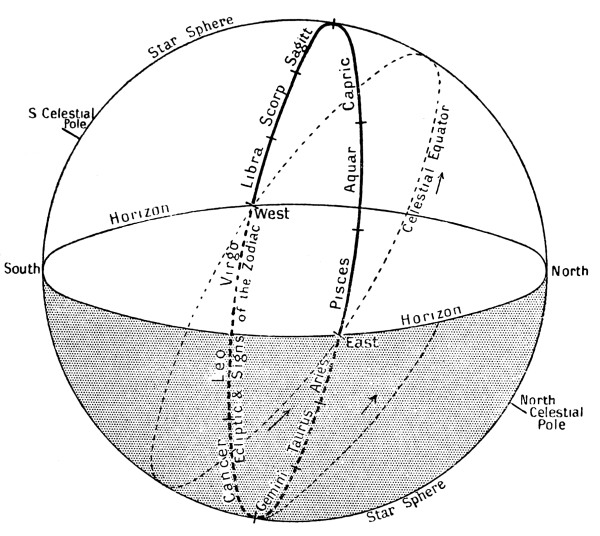
Fig. 46. The Signs of the Zodiac as seen at sunrise from the Mountain of Purgatory at the autumnal equinox there (the vernal equinox in the Northern Hemisphere). Purg. ii. 55.
At 6 a.m. Aries is just rising, Libra the opposite constellation is just setting, while Capricornus has just reached the meridian. The signs follow one another in their diurnal course over the sky in the direction shown by the arrows, circling parallel to the celestial equator.
At the foot of the mountain they are joined by a band of spirits, and walking very slowly with them, conversing with Manfred, so much time passes that to Dante’s surprise, when they reach the place where the ascent is to be made (still on the eastern side), the sun has travelled fully fifty degrees since rising. As the sun passes over 360° in 24 hours, this indicates about 3½ hours after sunrise, or 9.30 a.m.[463] The climb to the first ledge is slow and very arduous, for as Virgil explains, the lower slopes are the most difficult, since the act of climbing becomes more and more easy as the ascent is made. Resting on a ledge, they look back and at the sun, and note how it has travelled north, so that it now strikes their left shoulders; and after a conversation with Belacqua Virgil begins to mount again, saying that it is noon. The other hemisphere consequently is all in darkness, from Ganges (“la riva”[464]) to Morocco.
Other spirits have been met and spoken with, and they are still climbing when evening comes, and Dante, thinking he is to reach the summit of the mountain and see Beatrice that day, entreats Virgil to hasten. “See,” he says, “how the mountain now casts a shadow.” For the sun has travelled round to the west, and the poets, still on its eastern side, are in deep shadow: this explains how, when they meet Sordello, he does not recognize that Dante is a living man, as all the spirits until now have done. But Virgil assures him that the way is longer than he knows: before they reach the summit, the sun, now hidden behind the mountain and not causing Dante to cast any shadow, will return again to the east.
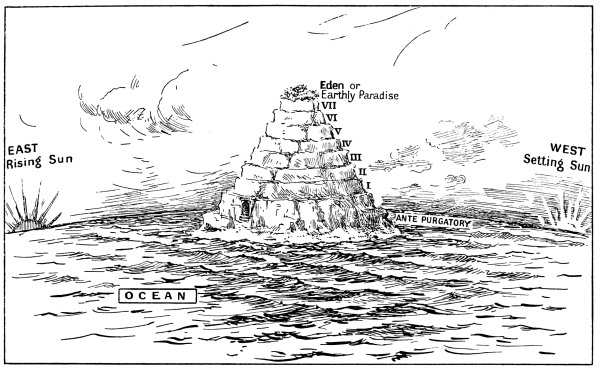
Fig. 47. Northern slope of the Mountain of Purgatory, up which Dante climbed. Being in the southern hemisphere, this was the sunny side, and he followed the sun’s course, from east through north to west.
Immediately after this, they meet with Sordello, who tells them that it is impossible to climb even one step on the mountain after sunset, and leads them to a flowery valley, in which to rest for the night. The spirits in the valley sing the evening hymn while the sun sets; and it begins to grow dark while Dante is talking with judge Nino, explaining whence he came that morning. As soon as the stars become visible, his eyes seek the southern pole, and fix themselves on three brilliant stars which have taken the place of that constellation of four which he saw some fourteen hours before. The latter have travelled to the south-west, and are hidden behind the mountain, and the new constellation is above the pole towards the east.
Night has risen two steps and part of a third in this place when Dante falls asleep, and the most natural meaning of this is that it is somewhat more than two hours after sunset, or after 8 o’clock, in Purgatory. The moon has not yet risen, since she is like a clock which loses on an average 50 minutes every day.
Since the first morning in the Forest, when she was exactly 12 hours behind the sun and set at six o’clock, three whole days have elapsed,[465] and if she has lost 3 times 50 minutes, or 2½ hours, she will rise 14½ hours after the sun rises, that is 2½ hours after sunset, or at about 8.30. As the retardation varies much, let us say simply that she rises to-night between eight and nine o’clock. She has also moved among the stars, about 13 degrees each day, and as 3 × 13 = 39, and there are 30° in a zodiacal sign, she has passed out of Libra and is in Scorpio. Libra begins to rise at 6 p.m., and Scorpio at a little before 8, therefore part of Scorpio is now above the horizon.[466] This, then, is the meaning of the first two stanzas of Canto ix.: the mistress of Tithonus is the aurora before moonrise (the solar aurora being his wedded wife, according to classical mythology), and this pale aurora is showing white in her balcony of the eastern sky, while on her forehead shine the stars of Scorpio, the cold creature with the stinging tail.
This curious passage has been otherwise interpreted by some commentators, and Scartazzini calls it “oscuro al superlativo,”[467] a riddle which still waits its Œdipus. According to him, “Titone” should be read “Titan,” the sun-god, and his mistress is Tethys the ocean, which is now shining not under his rays (“fuor delle braccia del suo dolce amico”[468]) but under the rays of the rising moon. This seems far-fetched, and the reading doubtful. In any case, it would indicate the same hour and the same phenomenon (moonrise).
Others think that the solar aurora is intended, and explain the “freddo animale”[469] as Pisces, and the “steps” as the watches of the night. But why a terrible tail should be ascribed to a fish is not clear, nor is it easy to see how the third step with which Night ascends could be the hour of dawn. Night, which circles opposite to the sun, surely reaches the culminating point and begins to descend at midnight, just as midday is “il colmo del dì.”[470] Moreover, the third watch would bring us at latest to a little before 3 a.m. To make the “steps” signs of the zodiac is no better; for if Libra, Scorpio, and Sagittarius have risen, it is midnight; what then can be shining in the east? and on whose forehead are the stars of Scorpio glittering?
On the other hand, all accords well if we accept the first interpretation—the light of the moon just about to rise whitening the eastern sky, some brilliant stars of Scorpio shining there, and Dante falling asleep at the third hour of the night, wearied after his sleepless nights, and the hardest day’s climb that he will have. We need not grudge him his long sleep of nearly twelve hours, as those do who take this passage to indicate midnight or early morning.[471]
When Dante wakes the sun has already been up for more than two hours, but a dream which had come to him in the early dawn, at the time when the swallow begins to twitter, has had its counterpart in the truth, that the lady Lucia came at that time and carried him up the mountain side, leaving him outside the Gate of Purgatory when the day was bright.
When this Gate has been passed through, a narrow chasm between the rocks has to be climbed, and the passage is so difficult that it is at least an hour before the poets emerge on the open space of the First Cornice. For the waning moon has already set, and as she has lost another half hour or so during the night, the time of her setting this morning was about 9 a.m.
When Dante next notices the position of the sun, which he is too intent to do for some time, they have travelled some distance along the First Cornice, with its outer edge on their right, and the sixth handmaid is returning from the service of the day, that is, the sixth hour is ended: it is midday, and they have spent nearly three hours here, looking at the rock sculptures and conversing with the spirits.
The ascent to the Second Cornice is made with marvellously little fatigue, as Virgil had promised. There they at first find no one to direct them, so Virgil looks at the sun, and turns westward towards it, taking it as their guide, and they walk for about a mile before encountering any spirits in this circle.
The stairway to the next Cornice is reached at the time of vespers, that is, 3 p.m.; and Dante describes the position of the sun by saying that the portion of sky which it still had to traverse before evening was equal to the portion which is brought into view between the beginning of the day and the end of the third hour, that is, it was three hours before sunset; and he compares this ceaseless motion of the sky, which according to the Ptolemaic system caused the motion of the sun, to an ever-playing child. We need not particularly enquire whether he is thinking of the heaven of the sun, or the Primum Mobile: it may be either, but is most likely simply the diurnal movement in general, made strikingly evident by the sun. The sun’s rays now strike their faces, for they have so far circled the mountain that they are walking towards the west; “Vespero là”[472] means in Purgatory, and “qui”[473] is Italy, where it is midnight now.
The sun is low when they reach the third Cornice, and when they emerge from the dense cloudy fog which here envelopes the spirits, Dante gradually sees the ball of the sun as when mists clear away, and he sees that it is just about to set. In fact the low shores at the foot of the mountain are already in shadow. Virgil urges that they make the ascent to the next Circle before darkness comes, and, as each ascent is easier than the last, they are able just to reach the summit before the sun is quite gone. Here Dante sees the stars begin to appear, while he is wondering at the strange law which robs him of power to proceed (as Sordello had warned them) after the sun has set.
They employ this time of forced inaction by talking of the sins which are punished in the several Circles, until all Dante’s questions are answered, and he is beginning to fall asleep. It is at this moment that he first mentions the moon: she is glowing, shaped like a bucket in her present phase, and the stars are paled by her light. She is “belated almost till midnight,” if the epithet “tarda” belongs to her; if it applies to “mezza notte,” then it is almost late midnight when she is seen paling the stars. She ought to have risen about ten o’clock, but Dante does not speak of her rising, so this may mean simply that it was moonlight and starlight at the time of which he is about to speak, viz. nearly the late hour of midnight; or else that since he is now on the northern slope of the mountain, and the moon is in a southern sign, she did not become visible to him till towards midnight. In any case, the “quasi” shows that he is only giving us a rough idea of the time.
But in what sign was she? Her position in the zodiac is described in a peculiarly round-about fashion. Dante says that her course against the sky, that is, her monthly motion which is contrary to the diurnal, had taken her to that part of her track in which the sun is when from Rome he is seen to set between Sardinia and Corsica. The straits between these islands lie west and a little south of Rome, therefore the sun sets in that direction when he is going south after passing the autumnal equinox in Libra, and this is just what the moon is doing now. (The sun passes the same point again when coming north, before entering Aries at the spring equinox, but Dante has either forgotten this, or considers it obvious that the first position is meant here).
This is probably all that he means to convey, and if we ask for more exact information, it is almost impossible to tell what degree or even what sign in the zodiac he intends us to understand; for as the straits are nearly two hundred miles from Rome they are quite invisible thence, and we do not know what he thought was their precise direction. The mediæval commentator Benvenuto da Imola says that the position intended is in Scorpio; the moderns usually say Sagittarius, but without explaining how they draw this conclusion. Benvenuto’s is probably simply the position which he thought the moon ought to have in order to agree with what Dante says about her, just as he states that Venus was in Pisces in March 1300, although this was not the case at all, as we shall presently see.
A calculation based on the difference in latitude between Rome and the Straits shows that they are only about 9° south of west, and that the sun, when setting in this direction is about 6° south of the equator: this is the case 15 days after the equinox, which in the beginning of the fourteenth century fell on September 14. Therefore the date at which the sun was seen from Rome setting in the direction between Sardinia and Corsica was the 29th of September, and its position in the zodiac was then the middle of the sign Libra. (Owing to precession, it would be in the constellation Virgo, but we have seen that Dante ignores precession in these references.)
But the moon ought now, on this second night in Purgatory, to have reached at least the last degrees of Scorpio, since on the previous night she rose when the first part was already above the horizon. Dante has therefore made a flagrant mistake with his moon, running her back into Libra again, and falsifying all his previous descriptions—if he knew as much about geography as we do now. But it is only necessary to glance at the map of Henry of Mainz to see that such a supposition would be grotesque. The portolan maps did indeed show the relative positions of Rome, Sardinia, and Corsica, with remarkable accuracy;[474] but as we have already said, it is not in the least likely that Dante had ever seen one of these sailing charts. It was on the classics, and especially on Orosius, that he relied for his geography,[475] and the suggestion of Dr. Moore seems most plausible, that he was here thinking of the Spaniard’s description of Sardinia:—“Habet ab oriente et borea Tyrrenicum mare quod spectat ad portum urbis Romae.”[476] This implies that Sardinia lay south-west of Rome, in a direction such as the sun might have had when setting in November, in Scorpio or Sagittarius.
Or possibly, when the poet was in Rome in 1301, he may have been watching a sunset in the second week in November, and may have been told, among other pieces of misinformation which are so readily given to visitors to great cities, that he was looking towards the straits which separate Sardinia from Corsica. We can imagine his replying, or thinking: “Then the sun sets behind them when he has nearly finished his course in Scorpio, and is about to yoke his steeds under another star!”[477]
It is while the moon is shining on this Cornice that the spirits who purge their sins on it appear, rushing past in haste. Then at last Dante sleeps, and dreams again in the cold moonlit dawn when Aquarius and Pisces are on the horizon (see p. 290).
The mountain is full of daylight when Virgil wakes him, and the newly-risen sun shines behind them as they continue their journey, for they had reached the north point of the circle, and are walking now due west. They mount almost immediately to the Fifth Cornice, where presently they are startled by a violent trembling of the mountain followed by a mighty shout of “Gloria in excelsis” from all the spirits. Statius joins them, and from him they learn that this was no earthquake, for since passing the gate of Purgatory they are in a region too lofty for such disturbances to be felt, or for rain or snow or dew to fall; the mountain trembles, and the shout of praise follows, when a soul rises, purified and ready to ascend to Paradise. With Statius they climb to the Sixth Cornice, and then, looking round, they see that the fifth handmaid of the sun’s chariot is directing its upward course, that is, it is the fifth hour, or between 10 and 11 a.m. As usual, they walk on with the outer edge of the circle on their right. It is here that we are reminded, as once in the Inferno, that only a certain time is allowed, for while Dante is looking eagerly at the first mysterious tree Virgil gently urges him onward:—
“Lo più che padre mi dicea, Figliuole, Vienne oramai, chè il tempo che c’ è imposto Più utilmente compartir si vuole.”[478]
It is here also that Dante informs his old friend Forese Donati and other spirits, who are all astonished at the sight of his shadow, that he is a living man who was rescued by Virgil some days ago, when the sister of the sun was round (referring of course to the full moon in the forest), and he points to the sun. Now a curious question arises: Dante was in sunshine in the early morning; he is in sunshine now, and has been walking all morning in the same direction in which the sun was moving; how is it then that Statius did not notice his shadow, but had to be told that he was not a spirit?[479] If the Mountain had been a small hill, it would have been quite easy to walk so large a part of a circle round it, in a short time, that the poets would have been in shadow until the sun caught them up again when they lingered talking on the Sixth Cornice; but the Mountain was so large that a whole day’s walking only brought them a quarter of the way round, i.e. from the east side to the north, and it was evidently a distance of many miles.[480] It is difficult to believe that Dante has forgotten, because he is so careful throughout to mention the surprise of the spirits except when his shadow could not be seen for one reason or another. It is true that in the latitude of Purgatory (32° south, as that of Jerusalem is 32° north), the sun rises rather steeply, which makes it easier to get into the shade in the early morning while circling a mountain.[481] On the other hand a simpler solution offers itself in the text. Statius approaches Dante and Virgil from behind, and they only stop and turn their faces to him for a few moments while Virgil returns his greeting, then walk on quickly while Statius makes his surprised reply: “What! if you are spirits....” If he has not yet quite overtaken them he cannot see Dante’s shadow, which Dante himself is screening from view as it falls in front of him, the morning sun being still at his back, and Virgil explains at once that his companion is a living man.
In spite of their haste, the three poets remain about four hours in this sixth Cornice; and when they reach the ascent to the next it was indeed time to climb without any delay, for the sun had left the meridian to the sign which follows Aries, viz. Taurus, and Night, “che opposita a lui cerchia,”[482] had left the meridian of the opposite hemisphere to Scorpio. Aries at the time of the equinox begins to cross the meridian at midday, Taurus at two o’clock, and Gemini at four[483]: therefore it is now between two and four in the afternoon. The three poets hasten therefore (Statius still accompanying Virgil and Dante), like men who pause for nothing on their way, whatever the road be like; and a question Dante is longing to ask with regard to the form of purgation last seen is put and answered as they follow one another up the narrow stair; as soon as they reach the top, they turn to the right, as usual, without hesitation or delay. As Dante walks cautiously between the outer edge of this Cornice and the fire which bursts forth from the inner wall of rock, all the blue of the western sky is already changing into ash-white, and he has come so far round the Mountain that the evening rays strike his right shoulder. With one of the many touches which show Dante’s close observation and his vivid realization of the scene he is describing, he says here that his shadow falling on the flame makes it appear a deeper red, and this is observed by the spirits. When they reach the spot where, on the further side of the flames, the chanting Angel guides them across to the last ascent, the sun is very near to its setting. Its burning noonday beams are shining on the waves of Ganges, its first morning beams quiver over Jerusalem, and Spain lying under Libra is wrapped in midnight gloom; hence it is beginning to set at sea-level in Purgatory. High on the Mountain it still shines, but when the poets have crossed the flames, the voice of the Angel persuades them to hasten their steps before the darkness comes. The stair mounts through the rock on the west side of the Mountain so that the low sun casts Dante’s shadow in front of him as he climbs. And he has only climbed a few steps when they are all aware that the sun has completely set because the shadow disappears. Before the colour has all faded from the west, and the whole vast range of the horizon seen from this height has become one uniform tint, each of the three makes a bed of one step, and between the high and narrow enclosing rocky walls Dante sees the stars come out, much brighter and much larger than he has ever seen them before. No moonlight dims them, for moonrise will be late to-night, long after Dante has fallen asleep.
Once again, for the third and last time, he has a prophetic dream in the early dawn; and if we compare these three parallel passages, we find that each begins with the same words “Nell’ ora.”[484] The first time the ideas connected with the time are wholly sorrowful, for it is said to be the hour when the swallow begins to twitter, perchance in memory of her former woes—alluding to the tragic tale of Procne and Philomel. The second is a depressing time, for it is the cold hour when, the day’s heat being all spent, the chilled earth cannot overcome the influence of the cold planets such as the moon or Saturn, but there is a thought of hope in the stars of the Greater Fortune seen rising in the east, in a sky which is now scarcely dark to them. The third is all joy, for it is the hour when Cytherea (the planet Venus), burning ever in the fire of love, shines first upon the mountain. Dante’s sleep flees from him as the shades of darkness flee on all sides, chased by the brightness before sunrise; and when Virgil tells him that to-day he shall reach the goal of his desires, he speeds up the remaining steps of the stair, almost as if on wings.
The poets arrived on the shores of Purgatory, as we saw, facing east, and now that they have attained the summit of the mountain, coming up the western slope, they again face east, and the just risen sun shines in their faces. Dante walks towards it: a breeze fans his forehead and causes all the trees to bend in the direction of the shadow thrown at sunrise by the Mountain (i.e. westwards), and the murmur of this gentle wind in the branches forms a bass to the treble of the singing birds who are greeting the morning hours. For a few steps the stream of Lethe stays his steps in this direction, but he soon reaches a bend, and once more “a levante mi rendei.”[485] The symbolical procession which accompanies Beatrice comes towards him from the east, and after he has crossed the river Lethe and joined the procession beside the Car in which Beatrice is throned, all turn to the sun, which by this time must have travelled some distance towards the north. After the vision of the disasters which befell the holy Car, and after Beatrice has spoken with Dante again, they reach the fountain whence Eunoe flows, and now the sun is on the meridian and it is noon, though (as Dante reminds us) different places have different meridians, so that it is not noon everywhere else. He is bathed in the holy waters, and thus, all having been accomplished for which he has visited these regions, he is “puro e disposto a salire alle stelle.”[486]
Hell was entered at twilight, Purgatory at dawn, the ascent to Paradise is made at noon, “il colmo del dì.”[487] The time spent in Purgatory is three days and the morning of a fourth, which is the seventh from the beginning of the vision.
4. PARADISE.
That the time of ascent to the spheres was noon is again stated in the opening Canto of the Paradiso, where Dante says that the sun had brought morning there (Purgatory) and evening here (the inhabited hemisphere), and that now the whole of that hemisphere was bright while the whole of this was dark.[488] The sun is therefore now due north. While Beatrice stood beside the waters of Eunoe, after walking towards the sun, it had moved to her left, so she now turns in that direction to gaze upon it.[489] She, like Virgil, takes as her guide that sun which Dante has said is the fittest symbol of God, and it is through the power of this heavenly light that he is raised from earth. Compare
“Amor che il ciel governi ... col tuo lume mi levasti.”[490]
He is not conscious of any effort, or even movement, but is astonished by a great light and strange music, and learns that he is in the sphere of fire and listening to the harmony of the spheres. His soul, freed from all that bound it to earth, is soaring towards its natural goal, as fire mounts up and rivers run down.
The upward gaze to the sun or to the skies, and its power to raise them, is again described in Par. i. 142: Beatrice “rivolse inver lo cielo il viso,”[491] and in ii. 22, “Beatrice in suso ed io in lei guardava.”[492] Thus they rise to the First Heaven, of the moon. In answer to an eager question of Dante’s about the markings of the moon, Beatrice is led to discourse on the spheres and their movers. Spirits appear, and Dante learns that although all the redeemed dwell in the Empyrean, those of different degrees of blessedness will manifest themselves to him in each sphere. After explaining this and other things, Beatrice once more
“si rivolse tutta disiante A quelle parte ove il mondo è più vivo,”[493]
and swift as an arrow that strikes its mark before the cord has ceased to quiver, they ascend to the Second Heaven, of Mercury. To understand the above lines we must remember that the sun, as Dante told us in the introductory Canto,[494] is at the equinox, or near it, and therefore on the equator; also that the equator of a sphere, where motion is quickest, is its most living part.[495] Beatrice is therefore looking again at the sun. Some understand “quella parte”[496] to refer directly to the sun, “quegli ch’ è padre d’ogni mortal vita,”[497] some to the equinoctial point;[498] others think that the east is meant; others the Empyrean, in which is the true life of all the Universe.
Equally swiftly and unconsciously, Dante ascends to the successive heavens of Venus, the sun, Mars, Jupiter, and Saturn, finding himself always in the planet which occupies each sphere. Mounting the mysterious golden ladder which is set up in Saturn, with a rapidity inconceivable on earth, the poet finds himself in the Heaven of Stars, in the constellation of Gemini. Now that he is so near the final blessedness his eyes are clear and keen, and that his heart may be filled with joy Beatrice bids him look down and see how much of the universe is already beneath his feet. There lie the seven spheres, and there is the little globe of Earth, so small that, like Scipio, he smiles at its paltry appearance; there is the moon, showing him the face turned away from Earth, which has no dark markings: there is the sun, at which for once he is able to gaze; and near it circle Mercury and Venus; the temperate Jupiter moves between his father Saturn and his son Mars; with a new power of vision Dante can grasp all their sizes and distances and the various speeds of their movements; and the poor little disc of the earth, small and round as a threshing floor,[499] about which we quarrel so fiercely, is all visible to him at a glance, its highest hills and its lowest river-valleys running down to the sea. He turns away his eyes to look into the beautiful eyes of his guide. She is standing, erect, intent, watching eagerly for that glorious Procession, whose coming is making a growing brightness in the sky.
“La donna mia si stava eretta Ed attenta, rivolta inver la plaga Sotto la quale il sol mostra men fretta.”[500]
No other intimation is given as to the direction from which the Procession comes. The sun’s daily motion appears slowest on the meridian, as Dante remarked in Purg. xxxiii. 103, 104, because he is scarcely changing his position with regard to the horizon; or in the south (where we in this hemisphere see him when on the meridian); he shows least haste to leave us in the long summer days, near the solstice. If the Procession descends from the heaven of heavens to show itself here symbolically to Dante, as we know that the spirits in other heavens did,[501] then Beatrice was gazing upwards, and the meridian may be meant, particularly that part of it which passes directly overhead. If the Procession came from the east, like the Procession in Eden,[502] the summer solstice in Cancer is meant, which lies east of Gemini. It is difficult to see any special meaning in its coming from the south, for although some commentators say that this suggests the consummate glory of the midday sun, the same idea is conveyed by the meridian. A constellation like Cancer perhaps corresponds better than a circle like the meridian with the expression “plaga,”[503] and the idea of the east makes more perfect the beautiful simile which the poet has just drawn between the little bird on the spray beside its nest waiting for the sun to rise, and Beatrice watching for the advent of Him who is likened to a sun among the starry company of His saints.[504]
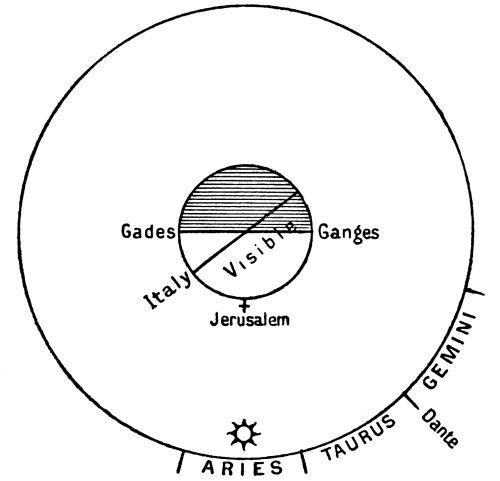
Fig. 48. Dante’s first view of Earth from the Stars.
Par. xxii. (see p. 397).
When this glorious company has at length vanished, she bids him look down once more, this time that he may realise how he has been revolving with the spheres, the little earth lying immoveable at his feet. He looks down, and notes what parts of Earth are lighted by the sun, and what parts are wrapped in darkness, for now he is able to see what he had often imagined, the shadow of night sweeping westward over the globe. The Atlantic Ocean, where Ulysses sailed beyond Gades, is all in daylight, and so is the Mediterranean, but the sun is setting over Jerusalem, for he says that its position prevents him from seeing beyond the coast whence Europa was carried (i.e. Phœnicia or Palestine). It must therefore be midday at Gades, and the sun is on the meridian there; it is “a sign and more,” or something between 30° and 60°, advanced to the west beyond the meridian over which Dante stands.
He does not define his own position more exactly than this, but we may conjecture that he was 45° (a sign and a half) east of the sun, since this would be the meridian of Rome, and there would be a peculiar fitness in such a position at such a moment, when he has just received a message of warning and prophecy from St. Peter to bear to this city.[505]
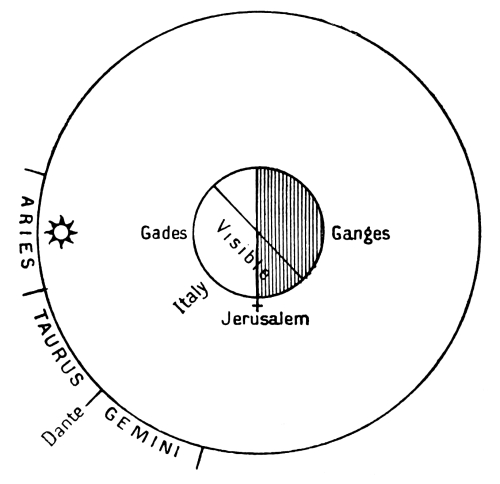
Fig. 49. The view six hours later.
Par. xxvii.
Fig. 49 shows these positions of Dante and the sun, and the consequent limits of his vision. Jerusalem is “near,” in comparison with the much more distant sunlit space of ocean in the opposite direction. We place the sun in the middle of Aries, because we shall see presently (when discussing the date) that this is its most probable position, and Dante in the first degree of Gemini because this is 45° east of the sun, and also because the fact that he is above Earth’s “first climate” suggests that he is in the beginning of this sign. For the northern limit of the first climate was 20½°, according to Alfraganus, and the ecliptic in the sign of Gemini rises gradually from 20° north of the equator to 23½° at its end, where it adjoins Cancer.
Since the time when he looked down before, he sees that he has revolved over an arc equal to half the climate, that is 90°, for the climates only extended over the habitable earth, which was 180° in longitude. His former position, then, must have been 90° further east, halfway between Jerusalem and Ganges; and it was then noon at Jerusalem, while all the ocean east of Ganges lay in the black darkness of night. Fig. 48 shows this position.
In this interpretation of a difficult passage, the meaning given to the first lines seems a little forced; but if we take them in the more natural sense that Dante had moved from above the centre to the end of the climate, that is, from the meridian of Jerusalem to Gades, we are met by a difficulty in the following lines. For to say that he is standing over Gades, and in the same breath that the sun is more than 30° further to the west, means that it is setting more than 30° west of Jerusalem: he cannot therefore possibly see Jerusalem, nor is it “near” him. It does not help us to take “presso” in its alternative meaning, and say that he could see “nearly as far as” Jerusalem, for however little more than 30° “a sign and more” may mean, it brings the “terminator” (as astronomers call the dividing line between light and darkness on a planet) a long way from Jerusalem and much nearer Italy, according to Dante’s reckoning of distances in the Mediterranean. This is shown on fig. 50, where the data are made as favourable as possible, by putting the sun at the very end of Aries.
On the whole, it is easier to accept a round-about expression in the first lines than an inaccurate one later. The former is quite characteristic of Dante, and we have already met some like it in the Divina Commedia in descriptions of the positions of heavenly bodies.[506]
Looking back to the earlier position, as described in Canto xxii., we find no light thrown on the question; for here he does not mention any particular place as visible, nor say where the terminator lay. His words are:—
“L’aiuola che ci fa tanto feroci, Volgendom’ io con gli eterni Gemelli, Tutta m’apparve dai colli alle foci.”[507]
This seems to express simply a bird’s eye view of Earth, as it lay stretched out like a map below the observer.
It is, however, often taken to mean that the whole habitable earth was visible. This could never be unless the sun, as well as Dante, was over the meridian of Jerusalem, which is obviously impossible while one is in Aries and the other in Gemini; and as he refers back to the first passage from the second he cannot have forgotten this.[508]
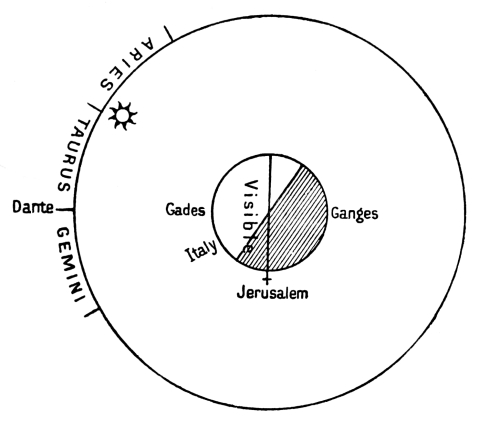
Fig. 50. An impossible interpretation of Par. xxvii.
A book which aims at explaining Dante’s Paradiso to young people[509] suggests an original way of reconciling the two passages, for the author gravely asserts that the sun was at first below Dante’s feet in Gemini, but that by the time he looked down again it had moved a good distance onward, and was then in the sign of Taurus! According to this, a whole month must have elapsed, and time had gone backwards, from May to April!
A suggestion much more worthy of attention is that of Professor Rizzacasa d’Orsogna, who thinks the key is to be found in the line, “Volgendom’ io con gli eterni Gemelli.” This, he suggests, is in anticipation of the second passage, for although Dante could not see the whole habitable earth at any one time, his change of position, as he revolved with the Twins, enabled him to do so in the course of time which elapsed between his two views. A comparison of figures 48 and 49 will make this clear.
One more suggestion may perhaps be made, though it is rather a hazardous one. “Dai colli alle foci”[510] may mean from the Apennine Hills to the mouths of Ganges. This would be decisive for the correctness of the explanation illustrated by our diagram. (See fig. 48).
In any case, the points which Dante specially wishes us to understand are clear and simple: at the first glance he was struck by the insignificance of the Earth; at the second, he became conscious that he was moving with the spheres, having passed over 90° of arc, or a quarter of the diurnal revolution, and he saw that it was now sunset at Jerusalem.
He next ascends to the Primum Mobile, though he cannot tell us to which part of it Beatrice chose to lead him, since it is perfectly uniform throughout. Beatrice explains that this most swift and living sphere, although it contains no star by which its motion is made visible, causes the (diurnal) motion of all the lower spheres; and thus it is like a flower-pot in which are hidden the roots of Time, while in the others we see the leaves. Here he sees the nine hierarchies of angels who direct the nine moving spheres; and finally he soars to the Empyrean, where Beatrice returns to her seat among the blessed spirits who form the Celestial Rose, and St. Bernard encourages him to lift his eyes to “L’Amor che move il sole e l’ altre stelle.”[511] This is the end and consummation of the Vision.
The reader will have observed that although there are several indications of direction in Dante’s journey through Paradise, all referring to the heavenly bodies, there are no time references after he has left Earth and entered the regions of eternity, except the passage discussed above, which indicates a period of six hours spent in the eighth heaven, since 90° of the diurnal revolution correspond with six hours of time. But it tells us also that at the close of this period the sun was setting over Jerusalem: consequently another morning was dawning in Purgatory. Eighteen hours have passed, therefore, since Dante left the Earthly Paradise at noon; and he rises to the Primum Mobile and thence to the Empyrean on the eighth day of his Vision.
The whole Vision, therefore, occupied an octave, or eight days.
5. POSITIONS OF SUN, MOON, AND PLANETS AMONG THE STARS DURING DANTE’S VISION.
The allusions to sun, moon, and stars in the Divine Comedy, when thus brought together, are seen to follow one another according to a regular scheme, and they form a very good guide by which to time Dante on his journey. There is a little inaccuracy in one passage about the stars, and the moon is ambiguous once, but quite explicable. Taking the allusions in a simple popular sense, as he seems to intend us to do, assuming that the signs and the constellations of the zodiac are identical, and that the moon, which at first is opposite the sun, traverses about 13° in the zodiac daily, and loses about an hour of time more or less, there is very little difficulty in following him. It is quite enough to know that the sun is somewhere in Aries throughout, and that the moon is therefore in Libra at the beginning.
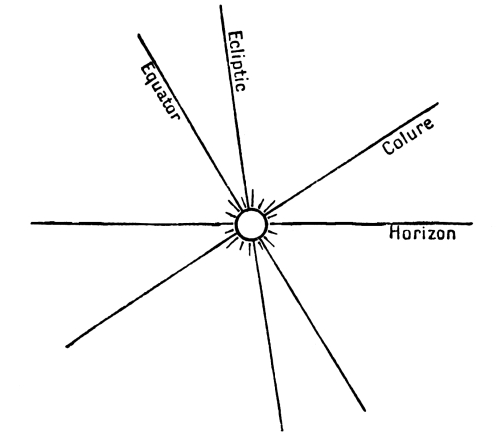
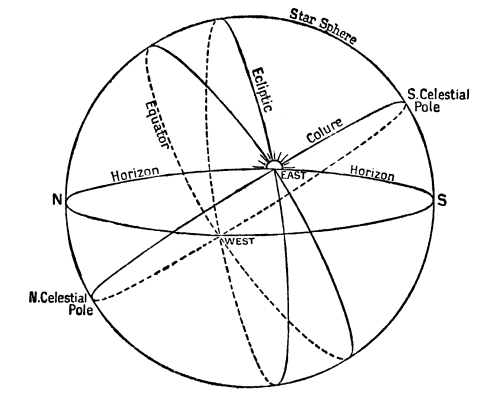
Fig. 51. The rising sun at the Spring Equinox.
But if we wish to know a little more accurately the positions of sun and moon among the stars, we must carefully compare the passages bearing on this question. Commentators differ so much that while some think the sun’s annual motion is ignored, and it is assumed to be at the equinox all the time, others maintain that it was at the equinox on the first day and moved on through Aries at the rate of about one degree a day (as it should do, since there are 365 days in a year and 360° in the circumference of the sphere);[512] while others again say that it was merely somewhere in Aries from the beginning.
What are the actual indications of its position? No one questions that it was in Aries throughout the Vision, for this is often indicated, sometimes directly, as in Inf. i. 38-40, sometimes by mentioning Taurus as the sign following the sun,[513] or Pisces as the sign preceding.[514]
There are four detailed descriptions:—
(1) On the first morning, the sun rose among those stars which were with him at the Creation.[515] As we have seen, this may mean merely some point in Aries, or the first point of Aries, at which the sun was thought to have been placed when created.
(2) On the seventh day it rose near a point where three crosses are formed by the intersection of four circles.[516] One naturally thinks of the horizon as one of these circles; the equator and ecliptic, whose intersection define the equinox, suggest themselves as two more; the fourth is doubtless the colure which passes through the equinoctial points and the poles, although curiously enough this is not mentioned by Ptolemy or Alfraganus, who only speak of the solstitial colure. Fig. 51 shows how the horizon makes a cross with each of the other three when the equinox is upon it. The sun is at the point of intersection when rising with the equinox, and it was near there when it rose this morning—“quasi.” It was therefore near, but not exactly at the equinox, and we know that it was the vernal, not the autumnal equinox, from the many allusions to Aries.
(3) When Dante rises to the sun (on the same day) he directs our attention once more to this point where “the one motion strikes the other,” that is, where the ecliptic—the oblique circle which bears the planets—branches off from the equator, and he reminds us of the supreme importance of this divergence. The sun, he says, was in this place. He does not mean at the exact point of intersection, or this passage would be in flat contradiction to the last: “quella parte”[517] is no more precise than “quelle stelle,”[518] and means only this part of the sky, or the constellation of Aries. The words which follow not only specify that it was the spring equinox, but suggest that the sun had already traversed several of those spirals which bring him to us earlier each morning, i.e. it was several days after the equinox.[519]
(4) On the same day the sun was “one sign and more” removed from some point in Gemini.[520] This is very vague, but at least the sun cannot now have been at the first point of Aries, or it would have been two whole signs from even the first degree of Gemini.
It seems, then, that we cannot possibly agree that the sun was at the equinox throughout the poem. It is clear that it was past the equinox towards the end; but from these four passages we cannot be sure whether it was there on the first morning, or whether it moved through some undefined part of Aries during the Vision.
One consideration gives us some help, however. We know from Inf. xxi. 112-114 that the first day was either March 25, which was believed in the Middle Ages to be the true anniversary of the Crucifixion, or Good Friday, which was kept by the Church as such. March 25 is four days after the date which the Church still kept as the day of the Equinox (March 21), and 13 days after the true equinox, which at this time fell on March 12. Good Friday also almost inevitably must fall after the equinox, since Easter follows the full moon which follows the equinox. It is true that some of Dante’s readers may still have regarded the old traditional date of March 25 as the true day of the equinox, and possibly it was to suit all shades of knowledge that he left the sun’s position vague; but he himself certainly knew better, and probably had March 12 in his mind. Then those who held to March 25 might consider the sun as exactly at the equinox on the first day of the Vision, but all better-informed readers and Dante himself must have regarded it as somewhat past this point. If we take it that, e.g., it was a week past the equinox, the sun was in about 7° of Aries, and this position agrees with the four crucial passages mentioned above. The stress laid on the equinox seems to demand that the sun should be at least as near it as this on the first day; and a week later it would have reached the middle of Aries, which is the position we assigned to it from a discussion of Par. xxvii. 86, 87.
This also agrees well with the course of the moon in the zodiac, which must depend upon the sun’s. We have seen that she was opposite the sun on the first morning, that her light paled the first-risen stars of Scorpio while she was yet beneath the eastern horizon three days later, and that she was proceeding south on the following night. If the sun was in the 7th degree of Aries on the first morning, the moon must have been in the 7th degree of Libra; her mean daily motion of 13° would bring her to the 16th degree of Scorpio three days later and to the last degree on the day following; so even if we allow a deviation of a few degrees from the average, she was just where she should have been on each occasion. We have assumed for convenience that she became full and was opposite the sun just as she set on the first morning, but this may have happened at any time during the previous night (in the Forest): Dante has not specified the hour, and it is of no consequence, since the indications of time by the moon must necessarily be vague.
The time of sunrise will still differ little from 6 o’clock, a week after the equinox. In London it is a quarter of an hour earlier, but the difference is less in Italy, and still less in the latitude of Jerusalem.
Besides the sun and moon, two of the planets are mentioned as in a particular place among the stars.
Venus, before sunrise on the fourth morning, is seen among the stars of Pisces;[521] and she is also mentioned as a morning star before sunrise on the seventh day.[522]
Saturn is in Leo. “Il petto del Leone”[523] may mean the western part of the Lion, the part which first rises and contains the head and breast, or it may refer to the star Regulus, which is called by Ptolemy and Alfraganus “Cor Leonis.”[524] “Sotto il petto”[525] may mean the position of the planet as seen projected in the sky or a map, that is, a little south of this part of the constellation; more probably, perhaps, Dante is thinking of the supposed position of Saturn’s sphere below that of the stars.[526]
Mars is spoken of as having returned to his own Lion a number of times: “al suo Leon ... venne,”[527] but this does not necessarily imply that he was in that constellation at the time.
Mercury and Jupiter are not noted as seen anywhere in the sky, nor does Dante say in what constellation they were when he entered them with Beatrice.
There are a number of pitfalls into which Dante might have stumbled, with this disposition of the skies, and the change to the southern hemisphere; and that he has avoided all is as clear a proof of his familiarity with astronomical phenomena as the positive evidence of his truthful, consistent descriptions. For instance, he might very well have represented the cold planet Saturn as actually aiding the cold moon in driving away the heat of the day during the night, in Purg. xix. 1-3, instead of only saying “talor da Saturno;”[528] but if so, this would have been inconsistent with the position of Saturn in Leo, since Leo was below the horizon when dawn was drawing near and Pisces was rising. Again, we have already mentioned that he evidently did not forget that it was autumn in the southern hemisphere. He never suggests that it was spring in Purgatory, and in the passage quoted above, where he describes sunrise at the March equinox, saying that the sun then moves “con miglior corso e con migliore stella,”[529] this happiest effect on the world is restricted to “mortals,” who as he thought all dwelt in the northern hemisphere, “surge ai mortali.”[530] I do not mean that the expression was used for this reason, but it is an example of how instinctively he avoided mistakes into which any other author would almost certainly have fallen.
6. THE ASSUMED DATE OF THE VISION.
Even among Dante enthusiasts there must be many who are astonished at the warmth of the controversy concerning the assumed date of his Vision. To know whether he feigned himself to have entered the Inferno with Virgil in March or in April, in the year 1300 or in 1301, really does not help us to appreciate the music of his verse nor the depth of his thought; yet a wealth of learning and research has been poured out upon this problem, and some commentators seem ready to defend their opinions with their lives, if that would avail to convince their readers!
The date is indeed intimately connected with the narrative of the Divine Comedy, since there are constant allusions to current events. By choosing a year earlier than the time at which he was writing, Dante is able not only to tell the spirits what is passing on the earth they have left, but to endow them with the power of prophesying to him events which are to come.[531] The peculiar interest of the problem for us just now is that astronomy has been called in to solve it. We have seen that the positions and movements of the heavenly bodies are all consistent with one another in his poem, but it is interesting to ask whether they are merely a consistent fiction or whether they correspond with facts. Did Dante arrange his moon and planets according to his feeling for scenery and the convenience of his time references, or did he take the positions as they really were at some particular date? If so, the full moon, Venus a morning star in Pisces, and Saturn in Leo, all together near a spring equinox, ought to help to fix that date.
The year which is almost universally accepted, by the oldest as well as the most modern commentators, is 1300, chiefly on the authority of Inf. xxi. 112-114. Here Malacoda says that yesterday (the day of Dante’s entering the Inferno) it was 1266 years since the earthquake which accompanied the Crucifixion (see p. 370). Adding to this the 34 years which Dante has told us he believed to have elapsed between the Nativity and the Crucifixion,[532] we get 1266 + 34 = 1300. And the day is either the Church Festival commemorating the Crucifixion, i.e. Good Friday, which in 1300 fell on April 8, or March 25, which was believed to be the actual anniversary.
If this is the right interpretation of the passage, we may say at once that Dante’s astronomical data are imaginary, for the moon was not full on the night preceding either of these dates, but on March 5, and April 4: Saturn was indeed in Leo, but Venus was so near the Sun as to be invisible in March, and began to appear as an evening star in Taurus on about the 9th of April.
These positions were all carefully calculated by Prof. Angelitti, who is a professional astronomer as well as a Dante scholar; and he made the thrilling discovery that the positions agree wonderfully well for the year 1301! In this year the moon was full on the early morning of the 25th of March; Venus entered Pisces three days later, and was a morning star, near her greatest elongation west, and very brilliant; Saturn was not only still in Leo but was just three degrees west of Regulus; and Mars was also in Leo.
If the anniversary of the Crucifixion means Good Friday, the day would be March 31 in 1301, and the moon would be wrong, but March 25 has some claims to be considered the more probable date. A fixed calendar date is more appropriate to use for calculating an exact number of years than a changing festival, which might rather be regarded as an “ideal date.”[533] Moreover, March 25 is suggested by the allusion to the Creation in the opening Canto; this day was also the traditional date for the spring equinox,[534] and it was one of the most important days in the year to Florentines, being their New Year’s Day as well as Lady Day.
We know that the idea of writing his great work was in Dante’s mind even when he wrote the last words of the Vita Nuova,[535] and we need only suppose that he was thinking of it when he looked at the sky on the evening before Lady Day in 1301, that he saw the full moon, and the two bright planets Mars and Saturn making a striking asterism with Regulus; also that in the early dawn about the same time he rejoiced in the sight of Venus veiling the Fishes in the east.
But is this attractive theory admissible? Can we take Dante’s words elsewhere as referring to the year 1301?