FIRST PART. The Story of Astronomy from Primitive Times until the Age of Dante. (continued 3)
Reading edition
Besides this, Ptolemy had to represent the planet’s movements north and south (note how this varies in fig. 28.). This was partly managed by the aid of small wheels, rotating in such a way that they lifted and lowered the epicycle as required.
Although Ptolemy quotes Babylonian observations of lunar eclipses dating back as far as the eighth century b.c., the oldest planetary observations that he uses were made only four hundred years before his time, and they were probably Greek. Even these were generally very rough. For instance:—
In the 496th year of Nabonassar, on the 17th day of Choeac, in the morning, Mercury was three moon-breadths north of the tail of Capricorn.
In the same year, Phamenoth the 30th, Mercury was three moon-breadths south of the horn of Taurus which is also the foot of the Charioteer.
The first year of Nabonassar (a Babylonian epoch) corresponds with b.c. 747, so the 496th year is b.c. 251. The months used by Ptolemy are usually Egyptian. The later observations, made with an astrolabe, were much more precise; Ptolemy quotes one from Theon of Smyrna, which states that Mercury was 3° 50′ in advance of the Heart of the Lion (Regulus), and for his own observations he also usually gives the sign, degree, and minute. Sometimes the planets had been observed so near stars that their positions could be very accurately determined by the aid of Hipparchus’ star catalogue. Timocharis, on a certain morning in the 13th year of Ptolemy Philadelphus (b.c. 273), saw Venus beside the last star in the wing of the Virgin (Beta Virginis); Ptolemy himself saw her so close behind a certain star in Aquarius that she seemed to touch it with her rays; and in the 83rd year after the death of Alexander, Jupiter had been observed to eclipse the Southern Ass, that is the southernmost of the pair of stars on either side of the little cluster in Cancer which the ancients called the Manger.
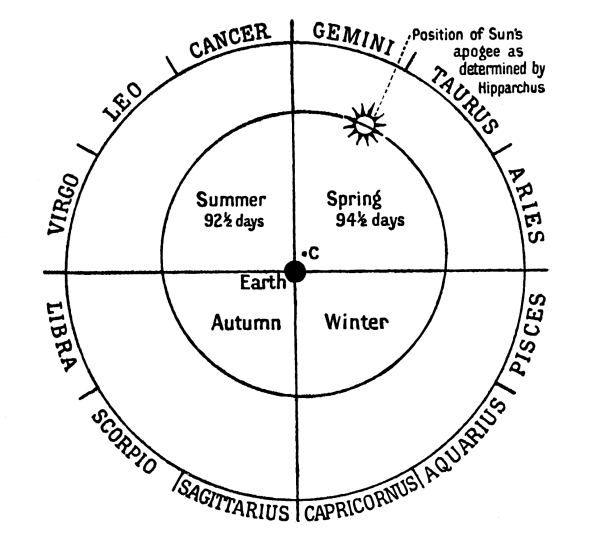
Fig. 32. The sun’s Deferent. (Its eccentricity is exaggerated).
The sun was much easier to manage than the planets. Moving always in the same direction, he needed no epicycle, and remaining always in the ecliptic, no wheels. His one irregularity, the varying speed in different parts of the zodiac, which Meton had discovered and Calippus confirmed, Hipparchus accounted for by placing him on eccentric deferent; Ptolemy adopted this without change, and made the year the same length as Hipparchus had done. As the slowest motion was observed when the sun was in the sign of Gemini (at the time of year corresponding with the end of our month of May), the eccentric was placed as in the diagram; and the sun, supposed to be revolving uniformly round the centre C, had a slower motion as seen from Earth when he went north, because he was then more distant.
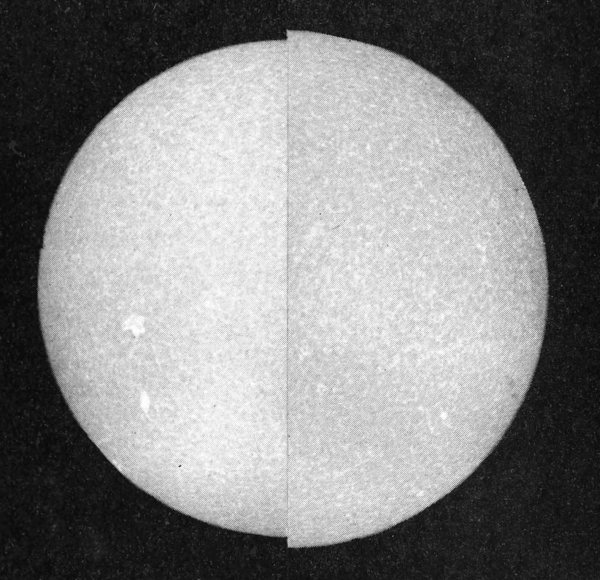
We know now that it is really Earth which revolves round the sun, but the elliptical shape of her orbit is not unlike the eccentric deferent which the Greeks gave to the sun, and they guessed quite rightly from his motion that he is further from us in one part of the year than in the other. This is easily proved to-day by the fact that he grows apparently smaller, as shown by photographs or measurements taken at different times of year, but the change was not perceptible to the rougher methods of the ancients.
It was a pity that Ptolemy did not take more pains to verify the work of Hipparchus on the sun, for the sun’s “apogee,” or point of greatest distance from Earth, has an extremely slow motion among the stars which ought to have been quite perceptible in nearly three centuries;[52] but here again he seems to have thought that where Hipparchus had given so much attention he might pass on to something else, and so missed an interesting discovery.
1911, July 1.1912, Jan. 3.
[To face p 146
Fig. 33. Apparent Variation in the Size of the Sun.
Two half photographs of the Sun, taken at Kodaikanal Observatory. The smaller was taken two days before apogee, the larger on the day of perigee.
Instead, he worked very hard at the moon, and added another periodical irregularity to those already known. Perhaps his feelings were somewhat mixed when this happened, his pride and pleasure in his important discovery being counter-balanced by the consciousness that it would still further complicate his lunar theory. Our satellite is acted upon by ourselves as well as by the sun, so that she suffers many perturbations, for Earth, though so small compared with the sun, is comparatively near. Ptolemy’s discovery was a difference in her speed at full and new, as compared with her intermediate phases, and this periodic difference is called by modern astronomers the “evection.” It was already known that her nodes, or the points at which she crosses the ecliptic, are in constant retrogressive motion, just like the equinoctial points, where the sun crosses the equator; but the moon’s crossing points, instead of taking thousands of years to circle the zodiac, run round in about eighteen years. This was discovered early, because observations were chiefly made during eclipses, and at these times the moon is always at a node, that is to say, she is crossing the ecliptic, the sun’s path; otherwise the eclipse could not happen. It was also known that she has a varying speed in the zodiac, and that her apogee, where the motion is slowest, instead of being apparently fixed, like that of the sun, also runs round the zodiac, but with a direct motion, and in a period of about nine years.
We need not enter into all the details of Ptolemy’s arrangements for the moon, which are exceedingly complicated, but it is interesting to note that he does not explain her varying velocity by an eccentric, as with the sun and the planets. She has an eccentric, but Ptolemy needed it for representing his own discovery, the evection, so he gave her an epicycle, using it in quite a different way from the epicycles of the planets. This epicycle also revolved while moving on the eccentric, but in the opposite direction, and there was so little difference in speed between the two motions that it never brought the moon to a stop, nor reversed her direction, but simply increased and retarded her motion alternately during her monthly revolution. Thus, when the moon was at M, in what Ptolemy called the upper apsis (or arc) of her epicycle, or as we should say in her apogee, the motion on the epicycle was contrary to her motion on the eccentric, and made it seem slower. When the epicycle had travelled halfway round the eccentric, it had also made nearly half a revolution on its own axis: consequently the moon was at M¹, near the lower apsis, or perigee, and the motion on the eccentric seemed to be accelerated.
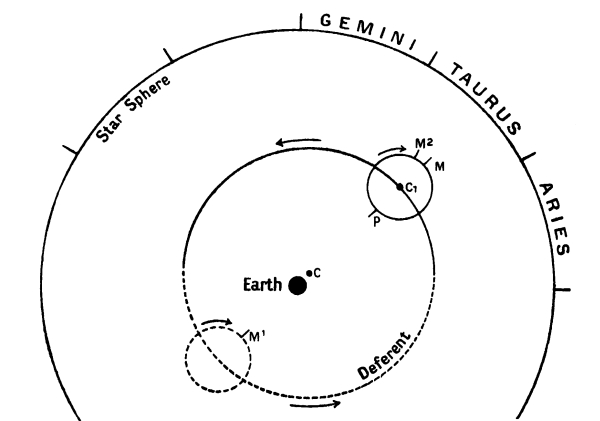
Fig. 34. The moon’s epicycle and deferent.
The slight difference in speed between the two motions accounted for the continuous displacement of the apogee in the zodiac, as may be seen from the diagram. For suppose that when in apogee at M the moon is seen from Earth among the stars in the middle of Taurus. At the return of the epicycle to this place next month, she has not yet quite completed a revolution on her epicycle but is at M², and will not be in apogee until the centre of her epicycle is advanced 3° further in Taurus. After some time (five months), apogee does not occur until the moon is in Gemini, and it will be nine years before it occurs again in Taurus.
These are the leading features of the system by which Ptolemy represented the motions of the planets, the sun, and the moon. He is uncomfortably conscious that it may strike us as very complicated, and in his last book he makes a kind of apology. We must remember, he says, that we are not dealing with earthly machines which jar and wear, but with celestial bodies which have no weight, cause no friction, and are eternally the same. Delambre somewhat cruelly retorts that he need not have wasted time in writing such rubbish, but have been content to put his results into tables.
But what true astronomer could be content with tables and nothing more? He must try to understand their significance. Nearing the end of his great work, which had cost so much labour, and was so brilliant a success within its limits, Ptolemy allows us to see in this little paragraph that he felt he had but touched the hem of Nature’s veil, and longed in vain to lift it. The circles which he manipulated so skilfully were only mathematical abstractions to him:[53] what was the reality behind? What were the stars? whence came their unwearied strength, their eternal calm? The power of Egypt, of Assyria, and of Persia had declined, Greece was now laid low, and it was the day of Rome, but still Venus pursued her ancient path among the little stars of Aquarius, and when all faded in the solemn dawn, the sun arose in his ancient majesty. Then Ptolemy looked at his circles and triangles, and felt how inadequate they were; yet it was the nearest approach he could make to truth.
They did indeed represent very beautifully the celestial motions, and also in a general way the variations in brightness or diameter, but their unreality is betrayed by the fact that the latter was often grossly exaggerated, as for instance with the moon, whose epicycle had to be so large, in order to represent her motions, that at perigee she ought to appear twice as large in diameter as at apogee! Ptolemy can hardly have failed to notice this, though he does not mention it. With regard to the planets, he is careful to tell us that he knows no way of finding their real distances: the ratios of their epicycles to their deferents he had carefully computed in each case, but to estimate the diameters in stadia was utterly beyond his powers. He believed, however, that all were very much nearer than the stars, and more distant than the moon, and he found universal agreement among astronomers in placing Saturn, Jupiter, and Mars, beyond the sun, in order of the periods of their deferents, which were all longer than a year. Venus and Mercury, however, had periods the same as the sun: on which side of him, then, must they be placed? Some modern authors, Ptolemy says, thought they were beyond the sun, but he agrees with the most ancient, and places them between sun and moon. The general disposition of the heavenly bodies according to Ptolemy is shown in Fig. 35, with the periods of epicycles and deferents, and the directions of the several movements, but epicycles and spaces between deferents are all made equal. It will be noted that the sun has no epicycle and that the moon turns on hers in a reverse direction, that the centres of those of Mercury and Venus are in a line with the sun, while the lines joining Mars, Jupiter, and Saturn to the centres of theirs are in each case parallel with the line joining Earth and Sun. Beyond all the wandering stars is the sphere of the fixed stars, moving in its vast period of 36,000 years; and the whole system is carried round Earth in one great revolution of a day and a night.
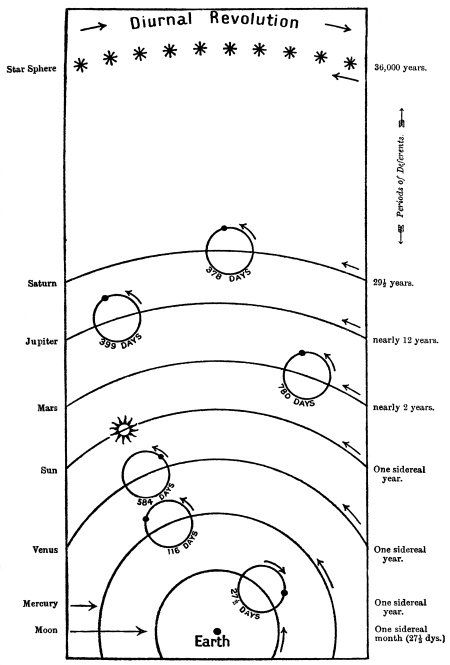
Fig. 35. The Ptolemaic system.
The arcs of circles are portions of the deferents which carry round the smaller circles (the epicycles) in the periods named at the side.
And here we have to note one astonishing fact. Although the planets were all beyond reach of measurement, it was not so with the moon, which the Greeks rightly recognized as our nearest neighbour. They had actually achieved the long-desired feat of measuring her real size and distance.
The fundamental principle on which they worked is easily explained. If we look out of a window at a tree in the garden, it appears against a background of some distant scenery; if we alter our position by walking to another window, the tree changes its place with regard to the relatively motionless background, and its apparent change of place bears a definite proportion to its distance from us. A tree near the house changes its position greatly, a tree at the far end of the garden much less. From careful measurements of the angle through which the tree appears to have moved and the distance we have walked between the two windows, the distance of the tree from the house may be easily deduced.
The tree in the garden is the moon, the distant landscape is the star-spangled sky. The space between the two windows must be increased to thousands of miles, but the astronomer need not walk it. If he makes his first observation when the moon has just risen, carefully measuring her position among the stars, the revolving Earth will carry him to a new position in a few hours, when with the moon high in the sky he can once more compare her position with the same stars, and from the change he then finds he can deduce her distance. The Greeks thought it was the sky, and not the earth which moved, but this makes no difference, as the question is one of relative motion only.
The problem, however, when applied to the moon, is a complicated one, implying not only skill in trigonometry and the possession of suitable instruments for measuring the necessary angles, but also accurate knowledge of the size of the earth and the motions of the moon, since her progress eastward among the stars during the interval between the two observations must be allowed for. Hipparchus and the astronomers of Alexandria were the first to qualify themselves for attacking this difficult problem, and the proof of their success is that Ptolemy’s value for the distance of the moon is very near the truth as obtained by modern methods. The same method is now used, only it is found better to do what was not possible for the Greeks, namely to compare observations made at places several thousands of miles distant, for instance Greenwich and the Cape, instead of allowing the same place to be moved by the earth’s rotation.
When the distance of the moon had been thus discovered, it was a very simple matter to find her real size from her apparent size.
The distances of all other heavenly bodies are too great to be determined by naked eye methods, for the displacement (technically called “parallax”) is so small that it is quite invisible without a telescope. Hipparchus had tried repeatedly to measure the distance of the sun, but recognized that neither the method of Aristarchus nor any other was really conclusive. It was, however, the best attempt that had been made, and Ptolemy assumed that he knew the distance to be about twenty times that of the moon, so he gave the sizes and distances of these two bodies as follows, taking Earth’s semi-diameter as unit:—
According to Ptolemy. Modern Values.
Semi-diameter. Distance. Semi-diameter. Distance.
Moon ⁵/₁₇ (=0·290) 59 0·273 60·3
Sun 5½ 1210 109·4 23,439
In Books VII and VIII of the Almagest Ptolemy describes the 48 ancient constellations and the course of the Milky Way among them. The position of each star is noted as it appears in its constellation-figure, but the celestial latitude and longitude is also given, and this great catalogue is evidently taken from Hipparchus.
PTOLEMY’S FORTY-EIGHT CONSTELLATIONS.[54]
Ursa Minor Pegasus
Ursa Major Andromeda
Draco Triangulum
Cepheus Cetus
Auriga Orion
Corona Borealis The River (Eridanus)
The Kneeler (Hercules) Lepus
Lyra The Dog (Canis Major)
The Bird (Cygnus) Canis Minor (Procyon)
Cassiopeia Argo
Perseus Hydra
Böotes Crater
Ophiuchus Corvus
Serpens Centaur
Sagitta The Wild Beast (Lupus)
Aquila Ara
Delphinus Corona Australis
Equuleus Piscis Australis,
Aries, Taurus, Gemini, Cancer, Leo, Virgo, Libra,
Scorpio, Sagittarius, Capricornus, Aquarius, Pisces.
Ptolemy sometimes remarks on the colour of the brighter stars, and always mentions the brightness, or “magnitude” as we call it now, for the classification of Ptolemy (or Hipparchus?) was found convenient and accurate enough to be retained by modern astronomers, and the same system is now continued with the faint telescopic stars.
The stars ranked as “first-magnitude,” or brightest of all, are fifteen in number, and as these are evidently the “quindici stelle”[55] alluded to by Dante in Par. xiii. 4, it will be interesting to give a list of them here.
PTOLEMY’S FIRST-MAGNITUDE STARS.
Name and Description Modern Name and Meaning. in the Catalogue.
1. Arctouros, fire-coloured Arcturus (the Bear-Watcher).
2. The brightest star in the Lyre Vega, in Lyra. (Falling Eagle, Arabic).
3. Aichs (the Goat) Capella (Little Goat, Latin).
4. The brightest star of the Hyades, fire-coloured Aldebaran. (The follower, because following the Pleiades, Arabic).
5. Basiliskos (the royal), the heart (of Leo). Regulus (Latin equivalent).
6. The tip of the tail (of Leo) Denebola (Lion’s Tail, Arabic).
7. Stachys (Ear-of-Corn) Spica (Latin equivalent).
8. The last of the Water and Mouth of the Southern Fish. Fomalhaut. (Mouth of the Fish, Arabic).
9. The fire-coloured bright star on the shoulder of Orion. Betelgueux. (Shoulder of Giant, Arabic).
10. On the left foot of Orion, common to the Water. Rigel. (Foot of the Giant, Arabic).
11. The last of the River Achernar (Arabic equivalent).
12. The very brilliant star, fire-coloured, at the mouth of the Dog, called the Dog. Sirius (Greek Seirios, or Sothis, from the Egyptian Sept), in Canis Major.[56]
13. Prokuon (the preceding Dog), on the thigh of Prokuon Procyon (in Canis Minor), which rises before Canis Major.
14. Canopos, on the rudder (of Argo) Canopus (an Egyptian god, and a town on the Nile delta).
15. The tip of the right forefoot (of the Centaur). Alpha Centauri.
Altair and Antares were counted as second magnitude, though we now class them among the first.
It will be seen from the above that only two of these fifteen brightest stars of Ptolemy’s still bear their Greek names, Arcturus, and Procyon; but most of the other modern names are direct translations, either into Latin or Arabic, of Ptolemy’s description or name for the star, while Vega and Aldebaran have preserved their original Arabic names (much corrupted), and Canopus and Sirius are derived from the Egyptian. Regulus-Basiliskos apparently comes from Babylon, for the name of this star on tablets of the second century b.c. was Shar-ru, which means “royal.”
Ptolemy’s “Last of the River” was taken by his Arab and other commentators to be the first-magnitude star which consequently they named Achernar, but this was too far south to be visible at Alexandria, though possibly he heard of it or saw it himself at Syene, where it rose over the horizon in his times. Delambre thinks it is the same as Fomalhaut, which already belongs to two other constellations in the star catalogue; Brown suggests it was Theta Eridani, which may have been brighter sixteen centuries ago. Perhaps it was the star we now call Alpha in the Phoenix, for this lies between the last bend of the River and the Water of Aquarius, and its magnitude is between first and second. The stars of the Southern Cross are included by Ptolemy in the stars about the hind feet of the Centaur, though it is difficult to identify each one with certainty: the positions are not very accurately given.
Ptolemy wrote also on Astrology, or as it was then called Judicial Astronomy, and his work on the subject, which is in four books, received the name of the Tetrabiblios. It seems that astrology was not very much believed in by the Greeks, for he protests that the influences of the stars are real, and can be known and predicted, but allows that this part of astronomy is much more difficult than the mathematical part, with which he had dealt in the Syntax, and that it has not yet been perfected, and therefore it is sometimes slandered as untrue. Astrologers sometimes make mistakes, like doctors, yet both astrology and medicine are useful arts. He mentions especially the Egyptians as practising it.
Only second in importance to the Almagest, and even better known in old days, was Ptolemy’s work on Geography. In this he shows how the size of the earth and the latitudes and longitudes of places on Earth, can be discovered by observations of the heavens. For Earth’s diameter he adopts the value found by Poseidonius. His terrestrial globe had a moveable half-circle attached to the poles, which was divided into 90° from the equator in both directions, so that by placing this against any spot on the globe, its latitude north or south of the equator could be immediately read off. Only half the equator was marked on this globe, and divided into 180°, for the known part of the earth all lay within these limits. The parallels of latitude marked were not the same as we use, though the most northerly fell very close to the Arctic Circle: it showed the latitude of the Island of Thule, far away “towards the Bears,” as Ptolemy expresses it, meaning that it lay under the constellations near the North Pole. The most southerly was not far below the equator, and others were marked between these which divided the known Earth into “climates,” according to the height of the Pole and the length of the longest day in each. Among the many towns which figured on this globe we may mention Alexandria, Rome, Athens, Jerusalem, Florence, Cadiz, Paris, Strasburg, London, Bath. Meridians were marked at every 5 degrees. From this globe Ptolemy shows how a plane map may be constructed. He took Rhodes as the central meridian, because it had a nearly central position among the “climates,” and was the place in which Hipparchus had observed.
Ptolemy also wrote books on Optics, on the theory and construction of Dials, and on Music!
V. RETROSPECT.
The Almagest is the last word of Greek astronomy. We have seen how from the dawn of Greek history, as far as we can trace it back in literature, the Greeks were familiar with the skies, and how the most ancient of their philosophers had tried, chiefly by abstract reasoning, to discover the cause of the circling motions—never changing, never ceasing—of sun and stars. When the seemingly unruly movements of the planets were known, they still felt sure that there must be some underlying principle which would bring all into harmony. Inspired by Plato, and helped by the Egyptians, Eudoxus took the first step towards finding this principle by careful study of the planetary motions, and at last, after many generations of observers and mathematicians, Ptolemy was able to describe these motions as accurately as was possible with the methods available.
At first the heavenly bodies had been thought of as gods, then as worlds like our own, then as spheres of ethereal fire. They were swept round by a mighty wind, they ran on wheels, they floated in the ether, they were set in crystal spheres; the controlling force was the principle of number or harmony, an all-pervading World-Soul, a host of immaterial intellectual Beings subject to one eternal First Mover. It was also suggested that the greater part of the motions were apparent only, that Earth was really in motion, spinning on her axis, revolving round a Central Fire, or revolving round the Sun. But these ideas had not enough evidence to support them when suggested. Had a great imaginative thinker, a Pythagoras or an Aristarchus, arisen after Ptolemy, he could have shown in detail how by assuming these two motions the phenomena could be more simply accounted for, and he could have made out a very good case for their probability.[57] But the time was past then for such bold originality, and the explanation of Aristotle was universally adopted. He, as we saw, placed the abode of the gods, the rulers of the universe, beyond the outermost sphere, and found the principle for which all were seeking, which should be the key to all celestial motions, in the law of circular motion.
The Greeks had at first thought that the earth was a disc, under a tent-like sky; then it was a cylinder, with the sky in tiers above; then a huge hemisphere filling half the universe. But they discovered that it was a sphere, surrounded on every side by the heavens; and they found its true size, and that the portion of it which was known to them was less than a quarter of its whole extent. They explained the marvel of Earth’s remaining unsupported in space by the known facts of gravity, arguing that the falling of every particle of earth towards Earth’s centre proved that it was also the centre of the Universe, and that every heavy thing tended thither by a law of nature.
They also knew the size and the distance of the moon; they realized that the planets were all immeasurably remote, and the stars vastly more distant still. They believed that there were great intervals between the planets, corresponding to the differences in their periods of revolution, but the stars were always thought of as set in a great sphere, and therefore all at the same distance from Earth at its centre. The relative positions of the stars on this great sphere, and times of rising and setting of many of them had been known in a rough way for many ages, through the familiar appearance of the constellations, named we know not by whom; but Hipparchus measured their positions in degrees, and was able to foretell where any star would be in the sky for any place or time. He also discovered the Precession of the Equinoxes, and this was thought to prove a slow rotation of the star sphere.
Astrology was learned by the Greeks in Egypt and the East, but was never practised with the enthusiasm shown by their teachers.
As regards the division of time, the Greeks adopted from the Babylonians the twenty-four hour day which we still use, and their months began with the young moon. Their year therefore had to contain a whole number of months, and it had sometimes twelve, and sometimes thirteen, as with the ancient Babylonians, but the system by which this was arranged was quite different, as they did not depend upon observations of the stars, but counted the number of days between equinox and equinox by means of gnomons. Great difficulties were found in trying to reconcile the lunar and solar periods. The ancient 12-month year, used in the time of Hesiod, was found to be much too short, and alternate years of 12 and 13 months made the period too long; then an eight-year cycle was invented, but this had to be constantly corrected, which led to great confusion. As we have seen how carefully Meton and Euctemon had determined the length of the tropical year, even before the days of Eudoxus, surprise may be felt that a calendar year was not fixed to correspond accurately with the movements of the sun, ignoring the irreconcileable movements of the moon, but it is difficult for us to realize in these days how wrong and strange it seemed if a new moon occurred in the middle or at the end of a month, instead of at the beginning. In Aristophanes’ play of The Clouds, which was acted in b.c. 423, the moon was said to grumble because men would not keep the months as she showed them:—
“Yet you will not mark your days As she bids you, but confuse them, jumbling them all sorts of ways, And she says the gods in chorus shower reproaches on her head, When in bitter disappointment they go supperless to bed, Not obtaining festal banquets duly on the festal day.”
Then Meton made his celebrated discovery that nineteen tropical years correspond almost exactly with 235 synodic months (the difference is in fact only a few hours), and a cycle of 19 years was arranged, which was adopted by all Greek states and dependencies. Some of the years had twelve and some thirteen months, and some of the months 29 and others 30 days, but all followed in a regular order, and when one cycle was completed another was begun. The total number of days in each cycle was 6940, and as this is only 9½ hours longer than 19 true tropical years, it follows that the average year in the Metonic cycle was only half an hour longer than it should have been.[58] The average month was not quite two minutes longer than the true synodic month.
An improvement even on Meton’s cycle was made by Calippus, who proposed to correct its too great length by quadrupling the period, and then deducting one day from the whole. This would have given a cycle of 76 calendar years, in which the average year was 365¼ days, or only 11¼ minutes too long. It does not seem, however, to have been ever brought into actual use as a calendar, but Ptolemy often refers to the Calippic epoch as a date from which to calculate celestial phenomena.
Theon of Alexandria c. 380 a.d.
After Ptolemy, the Alexandrian school of astronomy produced only copyists and commentators, the last of whom was Theon, who saw his daughter Hypatia murdered and the library burned by fanatical mobs. It only remains for us to see how the Greek system of astronomy, brought to so great perfection in the Almagest, was neglected for many centuries, and by whom it was at length rediscovered and made to live again.
VI. ASTRONOMY UNDER IMPERIAL AND CHRISTIAN ROME.
b.c. 46 to a.d. 1000.
Vos O clarissima mundi Lumina labentem cœlo quæ ducitis annum. Georgic I.
No new school of astronomy arose under the Roman Empire, nor do we even know of one Roman who devoted his life to the science. The genius of this people lay in other directions, and Dante truly says:—
‘“Nature ordained in the world a place and a people for universal command ... to wit, Rome and her citizens or people. The which our poet too has touched upon right subtly in the sixth [Virgil, in the sixth book of the Æneid], introducing Anchises admonishing Æneas, the father of the Romans, thus:—
“Others shall beat out the breathing bronze more softly, I do well believe it! And shall draw the living features from the marble; shall plead causes better, and trace with the rod the movements of the sky, and tell of the rising stars. Roman! do thou be mindful how to sway the peoples with command. These be thy arts: to lay upon them the custom of peace, to spare the subject and fight down the proud.”’[59]
Yet there were some enthusiastic amateur astronomers in Rome, for Cicero tells us of one who had felt old age to be no burden because he was so eager over his astronomical studies, sitting up sometimes all night to finish his calculations, and delighted when an eclipse he had foretold came to pass.[60] This ardent amateur, Sulpicius Gallus by name, had found such knowledge of practical value in his younger days, when he was with the legions in Macedonia, for he had been able to persuade the troops not to be alarmed by an eclipse of the moon which was about to happen, explaining how it was due to natural causes; and while the soldiers in the opposite camp were shrieking and moaning, believing that the eclipse portended the death of their king, the Roman soldiers remained quite calm. This was on the eve of the battle of Pydna, in b.c. 168, a little before the time of Hipparchus.
Ovid b.c. 43-a.d. 17.
Virgil b.c. 70-19.
Manilius c. a.d. 10.
Cicero b.c. 106-43.
In Cicero’s own life-time, and throughout the early days of the Empire, it was the fashion to have at least a smattering of Greek astronomy. Ovid tells legends of the constellations; Virgil, at his farm where he lingered happily among his vines, his cattle, and his bees, studied the varying aspects of the constellations in connection with the seasons and the weather; Manilius wrote a long poem in five books on astronomy and astrology; Cicero himself was quite learned in the subject, and made a translation of Aratus, which had a great vogue.
Very popular also, both in classical and mediæval times, was his Dream of Scipio, which was an imitation of Plato’s fable of the vision of Er, in the Republic. The moral is that earthly fame is valueless, since Earth itself is insignificant compared with the starry heavens, but that those who practice virtue for its own sake shall return to the stars whence their souls originally came. The youthful Scipio is transported to the skies in a dream, and meets the souls of his father and of the elder Scipio Africanus in “a radiant circle of dazzling whiteness, which you have learned from the Greeks to call the Milky Way.” There he sees “stars which we never saw from this place, and their magnitudes were such as we never imagined, the smallest of which was that which, placed upon the extremity of the heavens, but nearest to the earth, shone with borrowed light.” But the shining globes of the stars are so great that Earth seems to have contracted to a point, and Scipio gazes at it, grieved.
“How long will your gaze be fixed on Earth?” cries Africanus. “Do you not see into what temples you have entered?” and he points out nine spheres which compose the whole universe. The outermost, in which the stars are fixed, is most divine, and within this are seven, one of which contains the planet called Saturn upon earth, the next the glorious Jupiter, friendly and helpful to mankind, then Mars, ruddy and terrible, and the next place in the middle region is held by the sun, the leader, prince, and governor of all other luminaries, the soul of the world, filling all things with his light. Venus and Mercury follow him in their courses, like attendants, and in the lowest sphere rolls the moon, kindled by his rays. Below this, all is mortal and transitory, except the souls given to the human race by the grace of the gods; above the moon all is eternal. Earth, which is at the centre and forms the ninth sphere, is immoveable and below all the rest; and all weights, by their natural gravitation, fall towards her.
Scipio then asks what is the sound which fills his ears, so loud and yet so sweet? and he is told that he hears the music of the spheres, which is too great for mortal ears, just as the sun is too bright for human eyes to look upon. Yet those who make music upon Earth, with strings or voice, like all others who follow heavenly pursuits, are opening for themselves a path by which to return to the stars, the true home of the soul.
Strabo born c. b.c. 63.
Seneca b.c. 3-a.d. 65.
Pliny c. a.d. 23-79.
Proclus died c. 480 a.d.
Martianus Capella, 5th century a.d.
Simplicius 5th century a.d.
Other famous Latin authors who wrote on astronomy were Strabo, Seneca, and Pliny, who quote Eudoxus and Aristotle, Poseidonius, and Hipparchus. When Ptolemy’s work was done there was no great writer to popularize it. Three hundred years later Proclus writes a commentary on it, and Martianus Capella mentions it, but Simplicius, in his commentary on Aristotle’s De Cœlo, though he speaks of “the admirable Ptolemy,” is evidently unacquainted with his work.
No Roman added anything new to astronomy, and the most precious parts of their writings for the history of astronomy are some fragmentary notes of early Greek astronomers whose original works are lost.
The practical use of astronomy for measuring time appealed, however, to the Roman people. The most ancient Roman year (said to have been introduced by Romulus) had only ten months, March being the first, which explains why the ninth to the twelfth of our present months have the names of September, October, November and December, as if they came in the order of seventh to tenth. Two more months were added later, and at some unknown date the old Octennial or 8-year Cycle was adopted from the Greeks. This involved the use of intercalary months of varying length, and the priests were entrusted with the business of arranging them. But the priests thought it much more important that the length of the year should suit their convenience than that it should conform to the celestial movements, so they made it long or short according as they approved or not of the persons holding office at the time; and by the time of Julius Cæsar the calendar had fallen into such confusion that March 25, which was supposed to be the date of the spring equinox, came in the middle of winter!
Julius Cæsar and Sosigenes b.c. 46.
A drastic reform was necessary. Julius Cæsar called in the Alexandrian astronomer Sosigenes, and gave the Empire the calendar which, with the exception of one small reform made since, we still use. The moon was thrown over altogether: there were to be no more intercalary months, and every year was to be exactly like the last, except for the addition of one day in every fourth year, so as to make the average year equal to 365¼ days. Since the tropical solar year is only 11 minutes, 14 seconds shorter than this, many centuries would elapse before the months of this calendar would depart from their proper seasons. March 25 was restored to the time of the vernal equinox, but the first day of the new year was to be January 1, and Julius Cæsar gave his own name to the old fifth month of Quintilis. Each month was to be alternately of 31 and 30 days, except February, which would only have its full complement of 30 days in the fourth year (Leap Year), and 29 every other year. This reform was regarded by some as an unwarrantable interference by a despot. Cicero, when some one mentioned that the constellation Lyra would rise at a certain hour, answered bitterly, “Yes, if the edict allows it!”
Unfortunately, the simplicity of the scheme was a good deal spoiled by the folly of Augustus, who could not bear that the month of his predecessor should have 31 days while the next, the old Sextilis, which he turned into August, named after himself, should have only 30. So he made two months of 31 days come together, and took away a day from February. Afterwards, Nero gave his name to April, and Domitian his to October, but this was more than a long-suffering world could bear, and the new names were gladly forgotten as soon as the tyrants were dead.
Although, therefore, Rome was obliged to apply to Alexandria, that is to Greek astronomy, to carry out the project, it was Rome that gave us the most correct and convenient calendar which exists, better in both respects than that which had been used in Greece itself.[61]
But alas! the celestial science, a willing servant as time-measurer for the daily uses of humanity, a docile captive to adorn the triumph of literature, was doomed to a baser servitude. It was in the early days of the Empire, and all through the Middle Ages, that the pseudo-science of Astrology was pursued with passion, and men spent their lives in studying the paths of planets and positions of the stars, urged solely by the delusive hope of being able therefrom to read the book of fate and guide the lives of their superstitious clients. From Chaldea, its ancient home, came the most famous astrologers, but their art was soon learned in every country of Europe, and its professors were sought after by peasants and kings—now reviled and banished as impious and leagued with devils, now loaded with honours and rewards, revered, hated, welcomed, forbidden, but always believed in. Although when Christianity was established the seven planets could no longer be regarded as great gods ruling over the lesser gods of the stars, they were still thought to be mighty revealers of fate. Each had his special attributes and influence over man: the fiery colour of Mars no doubt suggested the warlike and hostile spirit ascribed from time immemorial to this planet-god; the slow motion of Saturn in his distant sphere gave an impression of a mournful morose being, the “frigida Saturni stella” of Virgil; Venus was the planet of love; the sun, of honour and power, and so forth. Each planet was also mysteriously connected with a colour, and, the alchemists said, with a metal; the sun with gold, the moon with silver, Saturn with pale heavy lead, etc. Each also influenced a special part of the body: thus, if Mercury were unfavourably placed at the moment of a child’s birth it would be liable to suffer from lung-disease; the moon’s position affected the brain; the sun’s the heart, etc.
As the planets had distinct and often contrary influences in different positions, it was necessary, in determining a man’s fate, to consider the aspect of the whole heavens, especially at the moment of his birth, but horoscopes were also cast for any period in his career, past, present, or to come, enabling him to guard against threatening evils or bad tendencies, and to seize favourable opportunities. The method was as follows: the sky-sphere, as it appeared at the given time and place, was divided into twelve “houses,” by drawing meridians (called “circles of position”) 30° apart. The house just about to rise on the eastern horizon was called the “ascendant,” and was the first and most important, planets situated there having more power than anywhere else; but each house had its special significance, the second (just above the eastern horizon) being the House of Riches, the seventh of Marriage, the twelfth of Enemies, etc. The kind and the strength of each planet’s influence depended mainly upon the house in which it happened to be, and was strongest when the planet was in its own house and also in its favourite zodiacal sign. The sun was considered to be most at home in Leo, the moon in Cancer, and each of the other five planets owned two of the remaining signs. Another important point was the “aspect” of the planets with regard to one another, that is, their angular distance apart on the sky-sphere. If Mars and Jupiter, for instance, were in “opposition,” i.e. 180° apart, the portent was unfavourable, but in “trine” or “sextile” aspect (120° or 60° apart), favourable.
It is evident that for casting horoscopes it was necessary to be able to calculate for any given time or place the positions of the heavenly bodies; and for this the skies must be watched, and the movements known of the stars, of sun and moon, and of planets. To this extent, therefore, an interest in genuine astronomy was kept alive; but on the other hand, the system fostered belief in the overwhelming importance of Earth in the Universe, and the existence of the heavenly bodies for the sole purpose of ruling and foretelling human destinies: no one cared to inquire what were the underlying laws, and what the real nature, of the heavenly phenomena.
Closely allied to this superstitious belief in planetary influences, was the dread of comets, meteors, and eclipses, which were everywhere regarded as omens. It was in vain that Seneca urged the greater importance of investigating the nature of the heavenly bodies about which something was already known, and of trying to solve the problem worthy of highest consideration, viz. whether the earth, as some had asserted, was turning rapidly, or was stationary in a turning World. His very protest, as well as his lengthy dissertation on comets, shows how far less interesting, alike to philosophers and public, were the ordered courses of stars and planets, than the startling apparition of such rare objects as that great “hairy star” which, appearing suddenly during the games instituted by Augustus after the assassination of Julius Cæsar, was thought to be the soul of the dead Emperor. Augustus erected a temple in its honour.
Rome, considered as the metropolis of the dominant temporal power, failed to encourage astronomy; Rome as the centre of the spiritual power directly discouraged it.
Cosmas c. 540 a.d.
Augustine 354-430 a.d.
In the fourth and fifth centuries after Christ “the old heathen theory” that Earth is a sphere was opposed by some of the Fathers, as inconsistent with certain expressions in the Bible; and in the sixth an Egyptian monk, Cosmas Indicopleustes, formulated a scheme of the Universe according to which the Jewish Tabernacle was a type and pattern of the World. The earth is the flat oblong floor, surrounded by four seas; these are enclosed by four massive walls which support a roof (the firmament or sky), and above this live the angels, who move the sun, moon, and stars across the firmament, and let down rain through its window. This childish cosmogony, supposed to be in entire accordance with Genesis, Isaiah, and the Psalms, bears a curious similarity to one of the oldest “heathen theories” of all, born in the land where Cosmas lived.[62] Saint Augustine, however, author of the paralysing doctrine: “Nothing is to be accepted save on the authority of Scripture,” does not seem to have considered belief in a spherical Earth forbidden, but it was to him a matter of perfect indifference, while he upheld as an article of faith that in no case could any antipodean inhabitants exist. For they could not be descendants of Adam, nor ever hear the Gospel, since everyone knew the torrid zone to be an impossible barrier between north and south. Another favourite Church doctrine was that Jerusalem was the centre of the earth: this idea, which it will be remembered has a place in Dante’s cosmogony, was based on the words in Ezekiel:[63] “This is Jerusalem: I have set it in the midst of the nations and countries that are round about her.” Good bishop Arculf, and other pilgrims, were shown a pillar “on the north side of the holy places, and in the middle of the city,” which marked the exact spot, and were told in proof of the assertion that at midday at the summer solstice this pillar cast no shadow! How this proved its central position is a mystery, and if true the pillar must have been deplorably crooked, for the sun can never pass overhead in Jerusalem, in a latitude of nearly 32° north.
The Church, like the State, saw that astronomy had one use, and applied, like the State, to Greek astronomy for a calendar. It was necessary that the ecclesiastical calendar should be luni-solar, since Easter, which corresponds with the Jewish passover, must fall on the Sunday following the first full moon after the Vernal Equinox. By 325 a.d., when the Council of Nice was held, at which this question was settled, the Vernal Equinox fell on March 21 instead of March 25, owing to the neglected eleven minutes in the Julian year. March 21 was therefore adopted by the Church as the date of the equinox, which was assumed to remain constant; and the old luni-solar cycle of Meton was used, and still is used in all churches which celebrate Easter, as a basis for the ecclesiastical calendar.
The custom of reckoning years forwards and backwards from the birth of Christ was first introduced by a Roman abbot, Dionysius Exiguus, in the sixth century, but it did not become general in Christian countries until the ninth century. Dionysius adopted as the first day of the epoch, not January 1, but March 25, the old Roman date of the vernal equinox. This was because it was Annunciation Day, and it was a belief of the Middle Ages that the Annunciation and also the Crucifixion actually took place on this day, and also that the Creation began on the same date.
Martianus Capella 5th cent. a.d.
Cassiodorus c. 530 a.d.
Boëthius died 525.
At the break-up of the Roman Empire some fragments of classical learning were saved from the wreck, mainly in the text-books of the “heathen” writers, Capella, Cassiodorus, and Boëthius. These were preserved by the Church, now the only repository of learning. The secular instruction given to churchmen included astronomy, for while the “Trivium” comprised the three elementary sciences of Grammar, Rhetoric, and Dialectic, the “Quadrivium” comprised the four advanced sciences of Arithmetic, Astronomy, Geometry, and Music. But only a mere smattering of the “Quadrivium” was taught in this period, and scarcely more of astronomy than was necessary for determining the date of Easter. The intimate knowledge and ingenious theories of the Greeks concerning the celestial motions interested no one any more.
Charlemagne 732-814.
Isidore died 636.
Bede c. 673-735
Fergil, 745.
Dicuil, 825
From the seventh century, however, the ignorance began to be less dense. Charlemagne established many schools, and there were enlightened monks here and there—Saint Isidore of Seville, the Venerable Bede, and Irish scholars like Fergil and Dicuil—whose teachings show that the elements of astronomy as taught by the Greeks were not totally forgotten everywhere. From the beginning of the ninth century all famous monasteries had schools for laymen as well as for monks.
In Italy the darkness was never quite so deep as in northern Europe, for traditions of classical culture never quite died out. And although throughout the long period from Ptolemy to the end of the tenth century, astronomy had been almost completely neglected in Europe, the way was slowly being made plain for a great revival. The ideal Empire, governing the whole world from the Eternal City, and the ideal Church making all men brothers, though neither has ever existed in fact, did so in men’s minds, as we see clearly in Dante, and both exercised a powerful influence. The Roman Empire and the Roman Church did impress a kind of unity on Europe as it grew: there was one civilization, one religion, one language in which new thoughts could be conveyed to all. Thus the ground was prepared, and whenever a new school of astronomy should arise or be imported, it would not remain the property of one nation surrounded by barbarians, but might at once be shared in and advanced by the whole of Europe.
VII. ARAB ASTRONOMY.
a.d. 750 TO 1250.
Once more the scene changes. While European science is at low ebb, if we look to the banks of the Tigris, not many miles from the ruins of ancient Babylon, we find the centre of a new and famous school of astronomy.
Al Mansur 753-775 a.d.
From the deserts of Arabia an immense empire had arisen, which in less than a century spread eastwards as far as India, and westwards to Morocco and Spain. Its first capital was Damascus, but in 755, after the defeat of the Omeyyad dynasty, the new Caliph fixed his capital at Baghdad, the wondrous city of the Thousand and one Nights. This Caliph was the renowned Al Mansur. To his court there came one day a scholar from India, who was skilled in the knowledge of the stars, and he laid before the Caliph a book which treated of things celestial and showed how to foretell eclipses. Al Mansur was profoundly interested, and ordered a translation of the book to be made into Arabic. The astronomical system of the Hindus was at that time very similar to the Greek, and there can be no doubt that Greek astronomy had found its way to India several centuries before this.
Haroun al Raschid 786-809 a.d.
Shortly after this the writings of Greek philosophers and astronomers were brought to the court at Baghdad. They had been carefully preserved, copied, and translated into Syriac, by Nestorian monks in some of the many monasteries which were founded in Persia and other countries of the East when these heretic Christians were driven out of Europe in the fifth century; and many of the Court physicians of Baghdad came from a Nestorian school of medicine. Haroun al Raschid, son of Al Mansur, gave orders for Ptolemy’s Syntax to be translated into Arabic, and it now received its name of Almagest: several other translations were made later, and Aristotle was eagerly studied. This Caliph sent an embassy to Charlemagne, and among the presents sent by the East to the West were an elephant and a clepsydra.
Al Mamun 813-833 a.d.
Al Mamun, son and successor of Haroun Al Raschid, is said to have learned astronomy under a Persian teacher. He also added to his father’s library, and one of the terms of a treaty he made with Michael, the Greek emperor, was that a collection of Greek writings should be made throughout the empire, and forwarded (originals or copies) to Baghdad. Moreover, he was not content with merely reading astronomy, Greek, Persian, or Hindu: he ordered Ptolemy’s estimate of the size of the earth to be tested, by measuring an arc of a meridian in his own country, and he founded a splendid observatory in the province of Baghdad. The instruments were of the same kinds as the Alexandrian, but they were larger, and better made, and the circles were more accurately divided. The Arab astronomers were good observers, and among them for the first time we hear of astronomers winning fame by skill in instrument making. Their dials were superior to those of any other race, and they made some important improvements in mathematics, which were immensely useful to astronomers. One great service was the introduction of the decimal notation, which they learned from the Hindus.
Astrology is forbidden by the Koran, but it was practised eagerly, nevertheless, by the Arabs, who constructed tables for this purpose, and made improvements in the methods used.
Traces of Arab contributions to astronomy survive in our words “zenith” and “nadir,” and “almanac”; our word for a “cipher” is the Arabic “zifra,” and indicates the main advantage of the decimal notation in arithmetic; while “sine” is the Latin translation of an Arabic word, and reminds us of the great improvements made in trigonometry.[64]
Alfraganus c. 840 a.d.
Albategnius c. 900 a.d.
Abul Wefa 940-998.
Among the many names of Ptolemy’s successors at Baghdad, strange and uncouth to our ears, the three most famous are Mohammed ebn Ketir of Fargana, Mohammed ben Geber Albatani, and Mohammed Abul Wefa al Buzjani, which became known to the West under the shortened forms of Alfraganus, Albategnius, and Abul Wefa.
Ebn Jounis died 1009.
Egypt too had her Arab school of astronomy, as she had had her Greek. A little later than Abul Wefa, Ebn Jounis drew up the famous Hakemite Tables of the sun, moon, and planets, under the patronage of the Caliph Hakem of Cairo.
At the western end of the Arab dominions there were centres of intellectual activity in Morocco and southern Spain. Cordova, the city of the marvellous mosque, had also, in the tenth century, an Academy, and a library which rivalled that of Baghdad; and here, in the midst of almost ceaseless public strife and agitation, in a strangely mingled atmosphere of cultured refinement unknown to the rest of Europe, and of ferocious barbarism, of tyranny and tolerance, heroic deeds of chivalry and treacherous intrigues, there lived and dreamed and worked men of science and philosophers, poets, and artists.
Arzachel c. 1080.
Averroës 1126-1198.
Al Betrugi c. 1150.
Abul Hazan c. 1200.
The best known of the Spanish Arabs whose names are connected with astronomy are Arzachel, who drew up the Tables of Toledo; Averroës, the great philosopher, author of De Substantia Orbis, and a commentary on Aristotle’s Metaphysics, who saw “a black spot on the sun” on the day he had predicted a transit of Mercury; and Al Betrugi (or Alpetragius) who wrote on the Spheres. There was also a certain Abul Hazan, a renowned geographer, who travelled across North Africa, and made a catalogue of 240 stars, including some not given by Ptolemy.
Of all the astronomical writings of the Arabs, one of those which became earliest and best known in Europe was the Elements of Astronomy and Chronology of Alfraganus. This was actually used by Dante as his favourite text-book, and he mentions it in the Convivio. I shall therefore give a short account of its contents, following the edition of Golius, printed in Arabic and Latin at Amsterdam in 1669.
In the first chapter Alfraganus gives an account of the calendars used by different nations—Arabs and Berbers, Syrians, Romans, Persians, and Egyptians. After this he plunges at once into a description of the Universe, as portrayed by Ptolemy, and follows his master so closely that his book is almost a much-abridged and simplified Almagest, with a few additions, and with all the mathematics left out.
It is accepted almost without dispute among learned men, says Alfraganus, that the sky is spherical, and rotates on two fixed poles, one north, one south. This is proved by the observed movements of the stars. Equally undisputed among the learned is the fact that Earth and water together form a globe, which is surrounded by air. The spherical form of Earth is proved by the fact that phenomena such as lunar eclipses and shooting stars are seen at a later hour by observers in the East, and by the changing height of stars above the horizon as one travels north or south. Earth is at the centre of the universe, and is but a point compared with the heavens.
There are two principal celestial motions: (1) the “prime motion” which causes the whole sky to revolve with every celestial body, and produces day and night; (2) the proper motions of the sun and other stars in the opposite direction and round other poles. The great circle of the first motion Alfraganus calls the Equator of the Day; that of the second, the Star-bearing Circle, i.e. the zodiac, or more precisely, the ecliptic.
The twelve zodiacal signs are then described, with the division of each into degrees and minutes, the positions of the equinoxes at the beginning of Aries and Libra, and of the solstices at the beginning of Cancer and Capricorn. The Colure is described as a great circle cutting the zodiac (i.e. ecliptic) and equator at the points where they are furthest apart (i.e. at the solstices). This greatest difference was found by Ptolemy to be 23° 51′ but according to the measurement ordered to be made by Al Mamun of pious memory, which was carried out by a number of experts, it is 23° 35′. This value is adopted and quoted subsequently throughout the book of Alfraganus.
Alfraganus then proceeds to explain very clearly how the movements of sun and stars appear from different latitudes on Earth—on the equator, at stations further north, and finally at the pole. He shows how it happens that on the equator day and night are always of equal length, and the sun passes exactly overhead twice a year; whereas day and night vary more and more in length, according to season, as one travels further north, and the sun is lower; until at last at the pole the year consists of one long day and one equally long night, the celestial pole is in the zenith and the celestial equator on the horizon, so that the sky revolves like a mill-stone (i.e. the stars do not rise and set, but trace out horizontal circles, like a wheel which is not upright but flat on the ground).
The circumference of Earth, as determined by Al Mamun of glorious memory, is 20,400 miles, and the diameter, therefore, is nearly 6500.[65] Alfraganus deduces from this the area of the whole Earth and also of the habitable portion of Earth. The latter extends only from the equator to 66° 25′ North, and its longitude at the equator is equal to 180° or 10,200 miles, at the northern limit to 4080 miles. This is divided into seven “Climates,“ as in Ptolemy’s Geography, the first lying a little north of the equator. Alfraganus gives for each the length of the longest day, the height of the pole above the horizon, the extent of territory, and the principal regions and towns comprised. He admits that south of the first climate as far as 0° is some land, surrounded by sea, and sparsely inhabited, and north of the seventh climate are a few towns, but these are of no account.
Our author treats next of the risings and settings of the zodiacal signs, and of the division of the day into 24 equal or 24 “temporary” hours (see p. 26).
After this, the unanimous opinion of wise and learned men concerning the spheres is duly set forth in seven chapters; how there are eight great Orbs, the smaller enclosed within the greater, the star sphere being the outermost and largest of all; how epicycles are fixed in these; how only the star sphere has its centre exactly in Earth, the others being slightly eccentric; what are the positions of the poles and centres of the great spheres and the small epicycles, their relative sizes, and their different velocities as they turn; finally, how well the system represents the movements of sun, moon, stars, and planets. The moon’s mean daily motion, resulting from a wonderful combination of five circular motions, amounts to about 13° 11′; the sun’s is 59′, and he completes a revolution in 365¼ days “less an insignificant fraction.” (This being a popular treatise Alfraganus apparently thinks it unnecessary to state the length of the year more precisely). The sluggish motion (“motus tardissimus”) of the star sphere, which is communicated to all the rest in addition to their own motions, is 1° in a century, according to Ptolemy, so that it completes a revolution in 36,000 years.
Coming now to the fixed stars, their number, and brightness, Alfraganus does not copy Ptolemy’s great catalogue, but informs us that learned men (“sapientes”) did number all the fixed stars as far south as they could see in the 3rd climate, and divided them according to magnitude into six classes. “To the first class they assigned the bright and shining stars such as Canis (Sirius) and Procyon, Vultur Cadens (Vega) and Cor Leonis (Regulus). Stars a little less bright they called second magnitude: such are Alfarcatein and Benet Naax,” Arab constellations which the Latin version describes as the two bright stars of Ursa Minor, and those brilliant ones in the tail of Ursa Major. Thus they proceeded with the other magnitudes, the smallest measured being of the sixth magnitude. The number of stars in each class is given, and the total of 1022;[66] then a list of the 15 first-magnitude stars, which are the same as Ptolemy’s (See p. 155). This is followed by a list of the Arab “Mansions of the moon.”
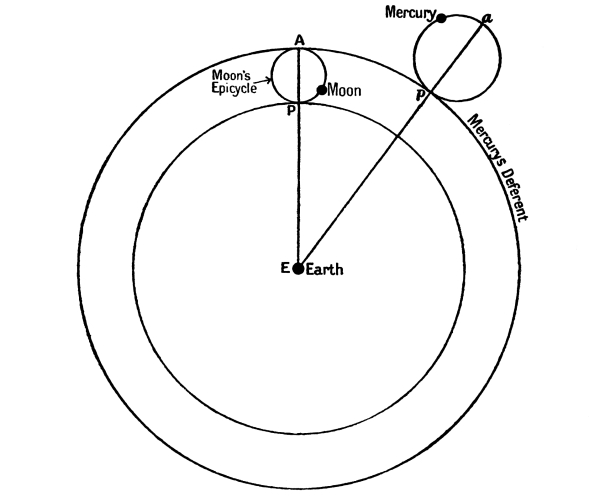
Fig. 36. Method (erroneous) of estimating planetary distances, described by Alfraganus.
The distance E A being known, and E p being assumed equal to it, the distance E a can be calculated from the known ratio E a: p a.
So far (with the exception of the mansions of the moon) the Arab writer has followed the Greek, but we have now reached a point where he diverges. Ptolemy, he says, only tells us the distances and sizes of the sun and moon, and said nothing about the other heavenly bodies; but if we suppose the greatest distance of the moon to be the same as the least distance of Mercury, and from this calculate his greatest distance (for the ratio is known), and if we proceed in the same way with Mercury and Venus, we shall find that the greatest distance of Venus equals the least distance of the sun as given by Ptolemy. Ptolemy’s least distance for the sun, which was totally wrong, was 1160 Earth-radii: the greatest distance of Venus, calculated in this way from Ptolemy’s figures, was 1150. Alfraganus takes this unlucky coincidence as an indication that there is only just sufficient space between each sphere and the next to allow their respective epicycles to pass one another, and upon this entirely erroneous assumption he proceeds to lay down the distances of each planet from the earth, and finally of the stars, which are all supposed to be at the same distance, equal to the greatest distance of Saturn.
Who first suggested this method of estimating distances we do not know: the first mention of it occurs in Europe in the fifth century a.d. The following table shows the distances obtained in this way:—
GREATEST DISTANCE.
In Semi-Diameters of Earth.
Moon 64⅛
Mercury 167
Venus 1120
Sun 1220
Mars 8876
Jupiter 14,405
Saturn and Stars 20,110
In this, the moon’s distance is approximately correct, but the sun’s is not much more than one-twentieth of its true value. To set the stars at a distance of only twenty thousand times Earth’s semi-diameter seems to us to bring them very close,[67] but they would still be beyond measurement by naked eye methods, so it is no contradiction to Alfraganus’ earlier statement that Earth is a point compared with the heavens.
The Arabs also believed that they had succeeded in measuring the apparent diameters of the planets and even of the points of light which are all we can see of stars, so Alfraganus gives the accepted sizes of all. I give them below in descending order of size. The modern values in the third column show how false were the results obtained by this mistaken method.
DIAMETER: EARTH = 1.
Alfraganus. Modern Values.
Sun 5½ 109½
The 15 first-magnitude stars 4¾ Arcturus, Sirius, Spica, and others,

much larger than the sun.
Jupiter 4⁹/₁₆ 11
Saturn 4½ 9
Other stars, in order of Various. Some certainly
magnitude, 2nd to 6th ... larger than the sun.
Mars 1⅛ ½
Earth 1 1
Venus ³/₁₀ ⁹/₁₀
Moon ⁵/₁₇ ¼
Mercury ¹/₁₈ ⅓
In the above table the size of the moon (whose parallax had been found by the Greeks) is the only one which is nearly right. The sun is far too small, and so are the stars. We cannot yet know with certainty the diameter of any star, but they are all comparable with the sun, and many are enormously larger.[68] As their distances are all different, some of the brightest may be comparatively small, and some of the faintest the largest of all.
The Arabs took a backward step in adopting these imaginary measurements, for Hipparchus had recognized that only the moon was near enough to measure, and although Ptolemy accepted Aristarchus’ value for the sun, he distinctly stated that the planets had no parallaxes and he could not tell their distances.
The next four chapters describe briefly the risings, settings, and meridian transits of stars as seen from different latitudes on Earth; the heliacal risings and settings and the conjunctions with the sun of planets, stars, and moon: the phases of the moon and the direction of her horns at different times of the year. Parallax is then clearly defined and discussed.
A description follows of the earth’s shadow, thrown by the sun into space—its tapering form, its position, always pointing away from the sun, its width at the distance of the moon, and its length according to Ptolemy. This is stated to be 268 times Earth’s semi-diameter, which is nearly correct,[69] for although Alfraganus believed (from Ptolemy’s erroneous parallax) that the sun, was much nearer than it really is, it followed from this—since the size was deduced from the distance—that he also thought it much smaller, and the length of a shadow thrown by any dark body is longer the nearer it is to the light-source, but shorter, the smaller is the light-source.
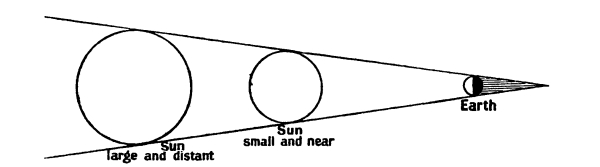
Fig. 37. Earth’s Shadow.
The two last chapters are devoted to eclipses, lunar and solar, and Alfraganus points out that, unlike lunar eclipses, eclipses of the sun vary in duration and magnitude according to the place on Earth from which they are viewed.
The book concludes: “Enough having now been said concerning the eclipses of sun and moon, by the goodness of God we have been enabled to bring this writing to an end; and for this Deo Laus et Gloria.”
The time at which Alfraganus lived is not precisely known, but it seems to have been in the first half of the 9th century, since from internal evidence he wrote after, but probably not much after, the death of Al Mamun. His name indicates that he was a native of the beautiful and fertile country, shut in by lofty mountains, which lies on either side of the ancient river Jaxartes. He was surnamed the Calculator, and wrote on sun dials and the astrolabe, but we do not know of any observational work of his.
Later Arab writers although they all continued to base their work on that of Ptolemy, improved on some of his estimates. Albategnius began his book “On the Number and Motions of the Stars” by saying that having studied Ptolemy’s Syntax and mastered the Greek methods, and having noticed some errors in the positions of the stars, he felt impelled to add to Ptolemy’s observations, as the latter had added to those of Abrachis (Hipparchus), for it is not given to man to attain perfection. He gives a much more accurate value for precession than Alfraganus had done, who merely copied Ptolemy, for he makes it 54½ seconds yearly, or one degree in 66 instead of in 100 years. His tropical year, too, is only two minutes shorter than the modern value, so that he improved upon Hipparchus in this respect; and he made the discovery which Ptolemy missed, the motion of the sun’s apogee. He merely notes, however, that the position found by himself differed from that given in the Almagest, so it is doubtful whether he realized his discovery, or merely thought that a large error had been made.
Although some of Ptolemy’s values were thus corrected by the Baghdad astronomers, no change was made in his theory of epicycles and eccentrics, which all accepted as having a concrete existence, partly because at first they did not distinguish between these and the spheres discussed by Aristotle, which he had described as formed of the same material as the planets. As Ptolemy does not explicitly state that his circles were only symbols, this is not surprising. They are formed, say the Arabs, of the fifth essence al-acir (the æther); and they conceived the epicycle as gliding over the outer surface of the deferent, like a small soap-bubble on the back of a big one. This notion, coupled with Ptolemy’s erroneous distance of the sun, misled them, as we have seen, into their imaginary discovery of planetary distances.
Tabit ben Korra 826-901.
It was also partly due to Ptolemy’s unfortunate habit of adopting the doubtful or merely provisional results of his predecessors, and representing them as well established and confirmed by himself, that they fell into another error. Tabit ben Korra, noting the discrepancy between the Greek and the Arab value of precession, investigated the question, and put forward a theory that the motion varies both in amount and direction. In his book “On the Motion of the Eighth Sphere” he describes an elaborate apparatus which he had invented to account for this variation, but he is very modest about it, and after narrating the results obtained by others, and how they had left them to be judged by posterity, he adds “And this is what we have done, with God’s blessing.” Then follow his figures and tables. This imaginary discovery was accepted by some of the Arab school, and it appears in many mediæval tables, instead of precession, under the name of the “trepidation.”
The belief in the material reality of the spheres caused the Arabs to add a ninth sphere to the eighth of Ptolemy and Alfraganus, for they thought it was enough to demand of the eighth that it should carry all the stars and give them their slow movement of precession (or trepidation). This ninth sphere, therefore, enveloped the whole universe: upon it were fixed no epicycles, no stars, no planets, but it originated the “prime motion” by turning once in a day and night, and communicating this revolution to all the inner spheres. It became known in mediæval astronomy as the Primum Mobile or first moving.
Nasir-ed-din 1201-1274.
Alfonso 1223-1284.
The Baghdad school of astronomy came to an end with Abul Wefa in 998, and the Spanish schools died out when Seville and Cordova were captured by the Christians in the thirteenth century; but the impetus given to the study of Greek astronomy and astronomical observation was carried on by other nations. In Persia a fine observatory was founded by Nasir-ed-din; in Spain the Christian king, Alfonso X, ordered tables to be drawn up to replace those of Arzachel, and the Libros de Saber to be compiled. The movement in Persia was short-lived, but in Europe the revival of astronomy had begun.
VIII. THE RETURN OF GREEK ASTRONOMY TO EUROPE.
a.d. 1000 to 1300.
“He hath made everything beautiful in His time; also He hath set the infinite in their heart.”
In the whole cycle of the changing year there is no moment so wonderful in northern climes as that which comes in early February, when winter is not yet past, but for the first time the promise of spring is felt in the air. Not a leaf has unfolded its green, but the swelling buds on the trees make a purple flush all over the woods, the blackbird sings an exultant strain, and in some sheltered copse you may find a delicate daring primrose already in bloom.
Such a moment in the history of Europe was the year 1000 Anno Domini. After the apathy, the ignorance, the despair of the Dark Ages, a new spirit began to breathe hope into the hearts of men. A love of beauty, a new religious fervour, a passionate desire for knowledge took possession of them. Yet it was nearly a hundred years before the great universities which were one expression of this new spirit sprang up in Paris, Bologna, Oxford, to be followed later by similar centres of intellectual activity in all parts of Europe.
By the end of the twelfth century it is said that there were 100,000 students in Bologna. A large number were foreigners from many lands, for as Latin was the universal tongue in education, all nations could understand each other, and scholars often wandered from one university to another, attracted by the fame of some great master. Similarly the doctors would teach first in one town and then another. Men of all ages and classes met together, for among the students were young boys and elderly ecclesiastics, poor scholars who begged their bread, and rich nobles who came with a tutor, a chaplain, and a whole suite of servants. There were no colleges or even lecture-halls: the students joined together in small groups to take a house and share expenses, and the professor lectured in his own house, or in a hired room, or, if the audience was large, in a city square, speaking from an open-air pulpit. All were united in the ardent pursuit of learning, and none complained if the floors were merely covered with straw, and the lectures, which often lasted three hours, began before sunrise on winter mornings in rooms which had no light and no fire. Was it not enough that when leaving at the end of university life one was technically said to be “going home a wise man”?
One cause of this intellectual fervour was the influence of Arab culture, with which Europe came into contact through the crusades, and through the Saracens in Sicily, and the Moors in Spain. For this reason astronomy and astrology took a high rank among the new studies. To distinguish between the two is quite a modern idea, and in mediæval times either name was used indifferently to cover both subjects. In Bologna university in the thirteenth century an important school of medicine and arts arose, through Arab influence, and the Arab doctors of medicine introduced the system of astronomy which they had learned from the Greeks. “A doctor without astrology,” it was said, “is like an eye that cannot see;” and before prescribing for a patient it was thought quite as important to determine the positions of the planets, as the nature of the disease. By the beginning of the fourteenth century there were salaried professors of astrology in Bologna, and they were more highly esteemed than any other professors except those of philosophy.
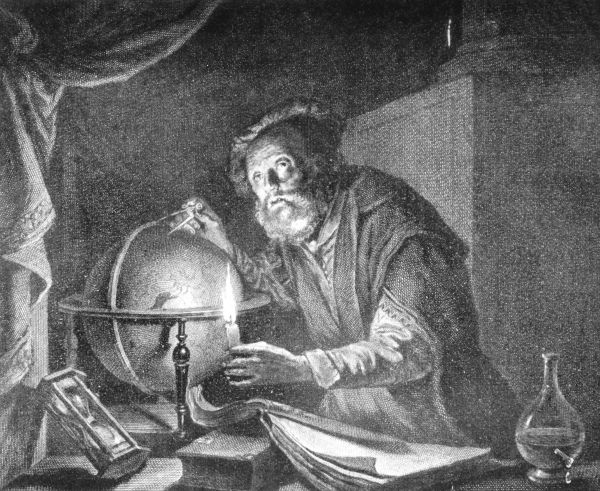
[To face p. 200.
A MEDIÆVAL ASTRONOMER.
From a painting by Gerard Dow.
Cecco d’Ascoli d. 1327.
One of their duties was to provide “judgments” (i.e. to cast the horoscope) gratis for students. But the dignity was a perilous one. Legitimate prediction by astrology bordered close on necromancy, which was banned by the Church, and one of Bologna’s most famous professors in astrology, the learned Cecco d’Ascoli, was burned at the stake in Florence in 1327 for the crime of sorcery.
Astronomy, like other subjects, was taught chiefly by lectures and “repetitions,” or classes for catechizing the students on what they had already heard. Books could also be had, though they were dear, on hire or purchase, from the university “stationers” or librarians.
The first books on Greek astronomy which found their way into European universities were Latin translations of Arabic commentaries and paraphrases of Aristotle, which travelled from Moorish academies in Spain to Paris. The astronomical treatises with strange technical terms in Arabic were hard work to translate, especially when they had already passed through several languages, as often happened. Thus it was possible to possess a work of Aristotle which was a Latin translation of a Hebrew translation of a commentary upon an Arabic translation of a Syriac translation of the original Greek text!
Urban IV., pope 1261-1264.
But meanwhile some of Aristotle’s works in the Greek entered Italy from the East, as a result of the crusading conquest of Constantinople in 1204. The first translations of these into Latin were very poor, but later on St. Thomas Aquinas, with the help of Pope Urban IV., had a better version made.
Frederick II. 1194-1250.
Sacrobosco died c. 1256.
Roger Bacon c. 1214 to c. 1294.
It was long before a good Latin version of Ptolemy’s Almagest could be obtained. A translation was made from the Arabic in 1230, at the bidding of the Emperor Frederick II., who did much, at his Sicilian court, to encourage Arab literature, but this translation was not much known or used.[70] The teachings of the Almagest became known chiefly through popular expositions such as those of Alfraganus, Albategnius, and John Halifax of Holywood, an English monk who became famous under his Latinized name of Sacrobosco. He was not an astronomer but had studied Greek and Arab writings, and finding that the study of astronomy was neglected because books on the subject were difficult both to procure and to understand, he compiled a useful handbook, which became widely popular and remained so for several centuries. Several other writers, notably Roger Bacon, wrote on the spheres, on the use of astrolabes, and on astrology. The books prescribed in Bologna for the course in Astrology and Mathematics were as follows:—
A work on Arithmetic or Algebra.
Euclid, with a thirteenth century commentary.
The “Theorica Planetarum,” which was either a free translation
of Ptolemy’s Almagest or an exposition of its principles.
The Alfonsine Tables.
The Canons of De Lignières (of Amiens, 1330 a.d.),
i.e. rules for the use of astronomical tables to determine
the motions of the heavenly bodies.
Portions of the Canon of Avicenna (the Arab philosopher).
A treatise on the Astrolabe by a Jewish astrologer of the ninth century.
A treatise on the Quadrant.
The astrological works of Ptolemy, with a commentary.
A book by Alchabicius (fl. c. 850 a.d.), probably his work on astrology.
A book on astrological medicine.
Alfonso X. 1223-1284.
From the above we gather that a past master in Astrology would understand the elements of mathematics, and all the astronomy that Ptolemy’s translator or commentator could teach; that he had learned—at least in theory—the use of astronomical instruments and tables, and a good deal of astrology, including its use in medical practice. The tables were intended mainly for astrological predictions. The standard Alfonsine Tables had been drawn up in 1252 by Christians, Jews, and Moors, under the direction of Alfonso X. king of Castile. They contained lists of positions of the planets, dates of Easter moons, “golden numbers” and “dominical letters” of the ecclesiastical calendar, times and other details of eclipses, together with methods for finding the places of planets, and for casting horoscopes. This is the Alfonso who was so much shocked at the complexity of Ptolemy’s multitudinous circles that “the ointment of his name is marred,” says Fuller, “with the dead fly of his atheisticall speech”: “If only the Creator had consulted me, when He made the world, I would have given some good advice!”
Sylvester II. (Gerbert) Pope, 999-1003.
Not one of all these books pretended to add any new discovery to astronomy: all intellectual energy was absorbed in eagerly assimilating the knowledge stored by Greeks and Arabs. Nor were any great observatories founded in Europe yet, in imitation of Alexandria, Rhodes, or Baghdad. The instruments in use were celestial globes and small portable astrolabes and quadrants for determining positions and angular distances between the heavenly bodies. The learned pope, Sylvester II., who had studied astronomy among the Moors in Spain, was so skilful in making astrolabes that some accused him of gaining the art by selling his soul to the devil!
Albertus Magnus 1193-1280.
Aquinas 1225-1274.
When Aristotle first came to Paris (about 1200 a.d.), in Oriental dress, and accompanied by Moslem authors, the Council of Paris denounced him as an infidel; yet in less than fifty years all his works were placed on the list of books prescribed in the university course. This was brought about by the Dominicans. In six of his twenty-one ponderous volumes the German friar Albertus Magnus paraphrased the whole of Aristotle’s works, and stripping his philosophy of the pantheistic and materialistic garb in which the Spanish Arab Averroës had clothed it, presented the Greek philosopher as an ally of Christianity. The Italian saint, Thomas Aquinas, pupil of Albertus, in his much more readable commentaries and treatises, popularized this idea so successfully that Aristotle—the Philosopher, as he was called—speedily became as great an authority on every other subject as he had always been on logic.
It was a mutual victory. Aquinas captured the Greek for the Christian faith; Aristotle won the western world to accept his theories. No longer was the doctrine of a spherical Earth called “an old heathen theory”: it was almost an integral part of the Catholic faith. Aristotle’s demonstration that there must be a First Mover, himself unmoved, became an argument for the existence of the Christian Deity; the intelligences which preside over the celestial movements were interpreted as the nine hierarchies of angels whose existence was taught by the Church. To the eight spheres of the Greeks and the Primum Mobile of the Arabs, the thirteenth-century Christians added the all-embracing heaven of heavens, the Empyrean, to be the abode of the Creator and blessed spirits. Within the central immoveable earth they placed Purgatory and the fires of Hell. They accepted the limits of the habitable earth as laid down by Ptolemy, but kept Jerusalem as the centre by asserting that it was situated 90° from the Pillars of Hercules, and 90° from the mouths of the Ganges. Eden, the earthly paradise of Adam and Eve, was represented on contemporary maps as in the extreme East, separated by sea from the eastern boundary of the inhabited earth.
Thus theology and science supported one another. All learning was sacred, and all that man’s mind is capable of understanding he might aspire to know, for the search if rightly pursued would lead at last to the perfect bliss of beholding with unveiled eyes the Source of all Truth.