SECOND PART. The Astronomy of Dante. (continued 5)
Reading edition
The symbolism of the spheres assigned in Paradise to the different saints is partly drawn from astrological ideas, for in Venus Dante meets the lovers, in Mars the warriors, in Jupiter the just rulers. But those who were not eternally faithful to their vows are in the moon because she has the lowest sphere,[725] the contemplative saints are in the highest planet, the theologians who enlightened the faithful are in the sun, and the ambitious are in the little planet which ever keeps closest to the sun. The heaven of “many and diverse stars” shows the poet a host of saints, and the Primum Mobile, which controls the movement of the other spheres, reveals to him the Angels who direct them.
It seems, then, that Dante was not interested in technical astrology, and had never made a study of it; and I think we may adduce this additional evidence that he had not learned astronomy in a university, or under Cecco d’Ascoli. It is only necessary to look at the list of books prescribed at Bologna[726] to feel sure that Dante had not taken a regular course there. The list, it is true, belongs to a somewhat later time, but there is no reason to suppose that astrology became of more importance in the late fourteenth century than at its beginning.
Nevertheless, however little Dante may have cared for the details of astrology, we shall never understand all that the skies meant to him unless we realize that a general belief in their influence on man was deeply rooted in his mind. For him it was a tremendous fact, and one which pervades his writings, that stars and spheres are the instruments of God’s providence, and are ordained by the First Mover to mould the destinies of Earth.[727] It is their movements which manifest His Will;[728] they are the hammers,[729] earth the metal, they are the seals,[730] and earth the wax.
Three times the stars are invoked to bring justice and righteousness on earth.[731] Through the spheres the elements were evolved out of the first chaotic matter, and everything on earth took form; all life and motion is generated by them.[732] Man’s soul is a direct creation by God, but the moving heavens play an important part in the formation of his material body, his mental faculties, and his disposition.[733] Were it not for the action of the spheres, children would be precisely like their parents, their whole nature being governed by the law of heredity alone: it is the different influences of the skies that give them different natures.[734] This, says Beatrice, is perhaps what Plato meant when he said that souls came from different stars and returned thither: if his meaning was that the influences of the stars is so great that to them is due the praise or blame which we distribute to men, there is some truth in the saying.[735]
Some truth only—“alcun vero”; for the stars are not independent powers, for good or evil, which men are unable to resist. This view is expressly combated in Purg. xvi. 58-84. Dante has asked the spirit of the courtly Venetian Marco Lombardo why the world is so full of wickedness now, for some say it is the effect of the heavens, and others seek an earthly cause. Marco groans at the blindness of men, who accuse heaven for the results of their own misdeeds: it is true that the heavens influence our lower natures, our instincts, and desires; but the soul is free, and can control them. This is in accordance with the teaching of St. Augustine and Aquinas. In one passage of the De Monarchia, Dante goes even further than this, and asserts that the influences of the spheres are only good, and that evil results from imperfections in the material on which these perfect instruments work.[736]
Conceptions such as these give us a new idea of mediæval astrology. They may be mistaken, but at least they are grand, and not unworthy of a philosopher and a Christian.
5. THE MOTIVE POWER.
Dante’s ideas regarding the laws and origin of motion in the universe were derived from Aristotelian metaphysics and Church doctrines. He believed that there were three kinds of motion proper to three kinds of bodies: i.e. heavy bodies tended towards the centre of the universe, which is also the centre of the earth; light bodies tended upwards to the region of fire just below the moon; and bodies of ethereal substance—the stars, planets, and spheres—moved eternally in circles round the centre. Thus Beatrice, when speaking of the instinct implanted in all created things, which bears them through the great ocean of being each to his destined haven, says:—
“Questi ne porta il foco inver la luna, * * * * * Questi la terra in sè stringe ed aduna.”[737]
And Virgil:—
“Il foco movesi in altura, Per la sua forma, ch’ è nata a salire Là dove più in sua materia dura.”[738]
That is to say the form of a flame fits it to rise to that place where, being in its own element, it may last longer than on Earth. Conversely, the centre of the earth is described as the bottom of the whole universe, and the point towards which all weights are attracted.[739] These opposite forces Dante calls gravity and levity.[740]
The most interesting illustration of this force of gravity is the description, in the last canto of the Inferno, of passing the centre of the earth, “il punto al qual si traggon d’ogni parte i pesi.”[741] Virgil turned here “con fatica e con angoscia,”[742] and bid Dante hold him fast, “ansando com’ uom lasso.”[743] It was natural to suppose that the force of gravity would increase as one neared the centre, though the fact is that it decreases. In deep mines it is less than at the surface of earth; and if we could go to much greater depths we should find that we could stand in any position, and walk in any direction with almost equal ease, till at the exact centre the sense of weight and of “up” and “down” would vanish altogether. This is because it is the whole mass of the earth which attracts, and when we penetrate beneath the surface the part above is no longer dragging us down, and its effect is annulled. But at the surface gravity acts as if the force were all concentrated at the centre, and falling bodies increase their speed as they approach the surface: before the days of Newton, therefore, it was thought that the whole of the attracting force was actually situated at the centre of the earth. Brunetto Latini speaks of gravity increasing as this point is approached, and Dante, like Aristotle, calls it the goal of gravity.[744]
Between the physical and the spiritual universe as conceived by Dante, there is a very close correspondence. Souls burdened with the weight of sin fall towards the centre of the universe, sinking deeper the heavier is their guilt, and at the bottom of the whole universe is the personification of all evil. Repentant souls, as they are freed from their sins, rise higher and higher, and the ascent becomes always easier, until at last they soar heavenward as naturally and spontaneously as flames of fire. In Paradise the motion of the pure spirits is inconceivably rapid, and their mystic dances expressive of joy are always in circles.
Motion in circles was the only appropriate kind for the heavenly bodies,[745] but the actual force which originated and preserved their motions was intelligence and will. When Dante sang, “Voi che intendendo il terzo ciel movete,”[746] he was not addressing beings created merely by his poet’s imagination. His own commentary on the words shows us that they were as real to him as the planets themselves. He can know nothing of them through the senses, yet is as certain of their existence as one with closed eyes is of light.[747] These beings move the spheres not through any material contact, but solely by the power of thought: they are immaterial immortal intelligences, commonly called Angels, and Dante identifies them with the Forms of Aristotle, the Ideas of Plato, and the gods and goddesses of the Pagans, “avvegnachè non così filosoficamente intendessero quelle come Plato.”[748] As the hammer beats out forms in metal, and thus expresses what is in the mind of the smith, and as he works from the artist’s design, so the movements and “virtues” of the sacred spheres mould earthly events, but these movements and virtues are the expression of controlling angels, and they are carrying out the Will of the First Mover. And as the joy of a happy mortal shines out in the eyes, so the joy of the angels shines out in stars and planets.[749]
There were nine Orders in the angelic hierarchies, according to the teaching of the Church, the chief authority on this subject being a book De Celestia Hierarchia, supposed to have been written by Dionysius the Areopagite, a disciple of St. Paul, who had learned from the apostle what he had seen when rapt to the third heaven. Aquinas assigns to one of these nine orders the guidance of stars and planets, and to others the rule over earthly affairs. But since the latter follow the celestial motions, there was no need to separate the two functions, and Dante laid down in the Convivio that a few Angels from each Order preside over the movements of each sphere. With Aristotle, he agreed that there is one Intelligence for each movement, so that for Venus (for instance) there are three movers to direct respectively the circling of the Epicycle, the Deferent, and the movement of Precession which every planet shares with the stars; but whether there is a fourth mover to guide the diurnal motion of Venus or if all the inner spheres are swept along by the motion of the Primum Mobile, he would not presume to decide.[750]
When he wrote the Paradiso, he no longer thought that a few Angels were set apart for this ministry: he implies that all the angels in each order united in the act of moving a whole heaven and perhaps he means to include the beatified human spirits as well.[751] He also slightly changes the correspondence between the angelic orders and their respective spheres.[752]
Swiftness of motion in a sphere corresponds with fervour of adoration in the Movers: hence the highest and swiftest of the moving heavens, which is the Primum Mobile, is moved by the highest Order, the Seraphim: and the lowest and slowest, which is that of the moon, by the lowest order, the Angels.[753]
All these movements are a proof of the existence of a First Mover, Himself unmoved, as Aquinas had said, following Aristotle, and the first words of Dante’s confession of faith in Paradise are an echo of this:—
“Io credo in uno Iddio, Solo ed eterno, che tutto il ciel muove, Non moto, con amore e con disio.”[754]
Here, as often elsewhere, Dante identifies the heavens with their Movers, and speaks as if the spheres themselves were moved by love and longing. In the tenth heaven, or Empyrean, this longing was completely fulfilled, hence this heaven was for ever at rest.[755]
VIII. MEDIÆVAL AND MODERN VIEWS OF THE UNIVERSE.
Let us now gather into one picture the details of mediæval astronomy which Dante has taught us, and try to see the universe as it presented itself to men’s minds in his days.
Motionless, at the centre of all things, is the earth, a massive globe 20,400 miles in circumference.[756] Only the northern part of one hemisphere is inhabited; the rest is covered by ocean. It is surrounded by air, into which rise the exhalations from land and sea which cause winds, rain, etc. Above the height to which these rise, and above the tops of the highest mountains, the air sweeps uninterruptedly round the earth from east to west, sharing the movement of the skies. Above this again is the region of pure fire: all fire on Earth’s surface tends to rise into it, and hot dry vapours ascending here burst into flame, and are seen from Earth as shooting stars and comets.
Bounding the sphere of fire is the lowest of the celestial spheres, that of the moon; and here we pass abruptly from the world of the four elements, transitory, changing, to the celestial world, eternal, changeless. Sphere rises above sphere, carrying moon and sun and planets, until we reach the vast orb in which are set all the stars.
All these bodies are composed of a mysterious imponderable substance called æther; all are perfectly spherical, and all their movements are circular. The diurnal rotation which we see is caused by an outermost sphere which contains no star: it communicates its own motion to all the spheres within it. The zodiacal motions of sun, moon, and planets, and the precession of the equinoxes, are caused by the proper motion of each sphere, rotating from west to east. The oscillating movements of the five planets and the varying speed of the moon are caused by small rotating spheres called epicycles, on which planets and moon are fixed, the epicycles in their turn being attached to the large spheres.
The distance from the earth to the nearest heavenly body, which is the moon, is 64⅛ times the radius of the earth; the distance of the fixed stars, more than 20,000 times the radius of Earth.
Mercury, the smallest of the heavenly bodies, is only 232 miles in diameter,[757] the moon and Venus are both rather more than a quarter the size of the earth, Mars is a little larger than Earth; next in order of size come the stars, from the faintest visible increasing up to those of the second magnitude; Saturn and Jupiter are much larger than Earth, and the fifteen brightest (first-magnitude) stars larger still; the sun is the largest body in the whole universe, having a diameter 5½ times Earth’s diameter. It is immensely bright and hot, is the source of light to the whole universe, and on Earth is the chief giver of light, heat, and life, and the chief measure of time.
The moon and stars are also useful in this way to Earth, and upon her are poured all the influences of the celestial spheres, the sun, moon, and planets: these are the instruments by which every event on Earth is brought to pass.
It is their nature to move in circles, as it is Earth’s nature to remain motionless at the centre of the universe; but all their motions are controlled by the wills of immortal angels, which are subject to the Will of the First Mover.
The sensible universe is eternal, but it is finite and measurable, and of definite form,[758] being bounded by a sphere. Beyond this in every direction is infinity.
Such was the mediæval conception of the Universe, as we gather from learned mediæval books, and as we find it vividly pictured in Dante’s glowing verse. How do we conceive it now?
The heavens are the same to our eyes as to Dante’s. The blue dome of the sky still arches over our heads, and in it we may see the stars shine out after the sun has set; we may see Venus making all the orient smile at early dawn, and the light of the moon not yet risen paling the stars of Scorpio. We may also see with our bodily eyes what was only visible to the keen eyes of Dante’s mind, the rising sun travelling to our left, and the southern stars circling round the southern pole, while the stars of the north sink below the ocean floor.[759]
But to one who knows anything of modern astronomy the ideas suggested are widely different. Most striking is the absence of that sharp contrast between Earth and heaven which our forefathers felt. Earth is not to us small, dark, and inert, made of the basest material and sunk, like the dregs of the Universe, to its lowest depths. Earth is a heavenly body, as the Pythagoreans rightly guessed, a beautiful big planet, shining brightly by reflected sunlight and moving swiftly, like her sister-planets. To Venus she is the brightest star in the sky; to the moon she shows a far larger disc than the moon shows to us, and markings more beautiful and wonderful, brilliant caps of snow at either pole, oceans coloured blue-green, and continents varying in tint, whenever the dazzling white clouds part to reveal her surface.
Earth is the largest planet among her neighbours, Mercury, Venus, and Mars; just as Jupiter is largest among the giant planets—Saturn and the more recently discovered Uranus and Neptune. In the gap between these two groups modern astronomers have discovered hundreds of tiny planets, to which Earth is a monster, for many are only a few miles in diameter. The meteorites which shoot across our view, “startling quiet eyes,” we still regard as a kind of conflagration in our upper atmosphere, but instead of vapours rising from Earth’s surface we recognise them as visitants from inter-planetary space, caught by Earth’s great mass as they pass too near, and flaming up with the heat caused by their sudden rush through the air. They exist in shoals of thousands and millions, some small as pebbles, some like great rocks, but all belonging to our system and pursuing definite paths like planets. The same must be said of comets, which have just as little to do with a hypothetical fire-sphere round Earth, but travel in regular periods, some long, some short; several small ones are seen every year, and occasionally a great splendour like Halley’s draws near to us in its orbit, yet even these seem to consist of very small quantities of matter. Other members of our celestial family are the moons of Mars, Jupiter, and the rest, of which more are still being discovered. The Earth-Moon system is, however, unique in that our satellite is much nearer our own size than the proportionately tiny companions of other planets and the pair must look like a beautiful “double” moving through the stars and continually revolving round one another.
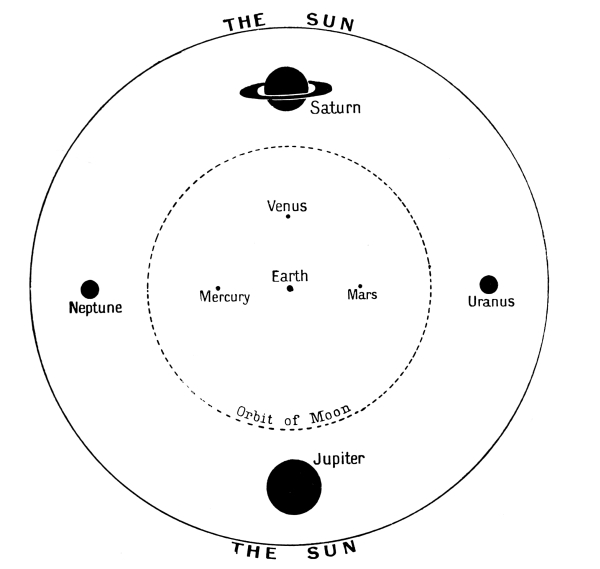
Fig. 53. Comparative sizes of the Sun and his satellites. p. 490
All these bodies are made, not of a mysterious ether, but of something just as wonderful, beautiful, and incomprehensible—the same stuff as Earth. Most probably all developed in long-past ages out of a nebula, or mass of gas which for some unknown reason was intensely hot. Small bodies, like the Moon and Mars, cooled off the most quickly, and have lost or are losing their air and their water; larger bodies, like Jupiter, have still some heat, and are probably in a more or less fluid condition. On the sun an inconceivable heat still rages; everything is in a gaseous state, and this globe which men used to think eternally changeless is the scene of the fiercest turmoil; currents are always ascending and descending, clouds of fire are flung up thousands of miles high, and patches which look black compared with the surrounding surface and indicate a mysterious commotion are constantly forming, developing, and disappearing. The sun is enormously larger than Dante thought, larger than all the planets put together, large enough for our moon’s whole orbit to fit comfortably inside. It is hot enough and brilliant enough to light all the planets: this, which was only a guess of mediæval astronomers, we know as a fact to-day, and the planets which are suitably placed show it to us, when seen in the telescope; Venus, for instance, changing her phase “according as the sun looks upon her,” exactly like the moon. And Earth must show similar phases as seen from Mars.
For Aristarchus was right: the sun is the centre of the planetary movements, including those of the planet Earth.
We saw how Ptolemy’s system hinted at this, in the significant connection between each planet’s movement and the movement of the sun; but a strong argument against it was that if Earth were really moving round the sun we ought to see a yearly displacement in the positions of all the stars. Modern instruments have at last made it possible to perceive this displacement. About a hundred stars, our nearest neighbours, describe a very minute orbit in the sky, which in every case is an exact reflection of the sun’s apparent orbit round the earth. Unless, therefore, we are going to provide all these stars, as well as the planets, with epicycles, which must all revolve in the same period, in the same direction, and in parallel planes, we must conclude that the movement is really Earth’s yearly movement round the sun. These miniature star-orbits also show us the stupendous distances which lie between Earth and the nearest stars, while by far the greater number are too remote to show any displacement at all.
Aristarchus and those other ancient astronomers were also right who thought that Earth was turning on her axis, and thus producing by her own motion the alternation of day and night, and the apparent circling of the stars. When we look now at stars hastening across the sky, they no longer present themselves to our thought as fixed on a sphere with a radius of 20,000 Earth-radii, which is revolving round us at a tremendous speed; we feel that we are looking into space at glowing globes which are at various and almost inconceivable distances from us; also that all those we see, all those that Hipparchus numbered, are but an insignificant fraction of all those now known to exist. All have their own real motions, as well as the apparent motions produced by Earth, but these are in different directions, towards what goal we cannot at present tell. Compared with them, Earth is indeed insignificant, in size and also in brightness, for while she shines with reflected light they glow as the sun does and are his peers.
Nevertheless, with them too we have a feeling of kinship, for analysis of their light shows that they too are made of earth-stuffs: they are not eternal nor changeless, for very many vary constantly in their light, and they are at different stages of development, some appearing very young, while others are beginning to burn dim and low, and some can only be inferred to exist, for they seem to be wholly dark.
More wonderful perhaps than anything else, we find that the force which binds the whole of our sun’s family together is nothing strange and unknown, but the same familiar force of gravity, which the Greeks knew so well but thought only applicable to Earth. Its rule includes the seemingly unruly comets and meteors, and it extends as far as our search can reach, to the uttermost star.
This sense of unity throughout the world, which is always growing stronger, is comforting. And we allow ourselves to wonder whether intelligent life has not developed elsewhere, as well as on this globe that we inhabit. Perhaps each planet that attends our sun is fitted at some period to be the abode of life: surely among the millions of stars many must have attendant planets, and on some of them even now are living, thinking, beings.
Dante’s world was easier to think about than ours. Encompassed by an infinity which gave the imagination free scope, the material universe within was neatly rounded off, as it were, complete, finished. Only in the central spot was any development taking place, and thither were directed all effects of the circling spheres. Our universe is vague, vast, mysterious, without known limits or centre, offering problem after problem to the thinker. Dante’s marvellous moon-substance is simple compared with the baffling nature of our æther; Dante’s Angel-Movers are intelligible compared with the amazing mystery of universal gravitation.
Yet when we lift our eyes from earth to heaven, we share the feeling of our mediæval forefathers, of the ancient Greeks, of the earliest men whenever and wherever they became men. The unerring courses of the stars speak to us, “the unperturbed to the perturbed,” of perfect harmony, untouched by chance or arbitary conflicting wills. Now, however, we do not believe this is because heaven is essentially different from earth: it is because we see there only the grand outlines, only the working of great laws, of a system which includes our own earth. Could we but lose sight of the details here, and view the history of man as we view the stars, the harmony would be as grand.
HYMN TO ZEUS.
Most glorious of the Immortals, many-named, Almighty for ever, Zeus, Ruler of Nature, that governest all things with law, Hail! for lawful it is that all mortals should address thee. For we are thy offspring, taking the image only of thy voice, as many mortal things as live and move upon the earth. Therefore will I hymn thee, and sing thy might for ever. For thee doth all this universe that circles round the earth obey, moving whithersoever thou leadest, and is gladly swayed by thee. Such a minister hast thou in thine invincible hands—the two-edged, blazing, imperishable thunderbolt. For under its stroke all nature shuddereth, and by it thou guidest aright the universal Reason, that roams through all things, mingling itself with the greater and lesser lights, till it has grown so great, and become supreme king of all. Nor is aught done on the earth without thee, O God, nor in the divine sphere of the heavens, nor in the sea, Save the works that evil men do in their folly. Yea, but thou knowest even to find a place for superfluous things, and to order that which is disorderly, and things not dear to men are dear to thee. Thou dost harmonize into one all good and evil things, that there should be one everlasting Reason of them all. And this the evil among mortal men avoid and heed not wretched, ever desiring to possess the good; yet they nor see nor hear the Universal Law of God, which, obeying with all their heart, their life would be well. But they rush graceless each to his own aim, Some cherishing lust for fame, the nurse of evil strife, Some bent on monstrous gain, Some turned to folly and the sweet works of the flesh, Hastening indeed to bring the very contrary of these things to pass. But thou, O Zeus, the all-giver, dweller in the darkness of cloud, lord of thunder, save thou men from their unhappy folly, Which do thou, O Father, scatter from their souls, and give them to discover the wisdom, in whose assurance thou governest all things with justice; So that, being honoured, they may pay thee honour, Hymning thy works continually, as it beseems a mortal man, Since there can be no greater glory for men or gods than this, Duly to praise for ever the Universal Law.
Cleanthes (3rd century b.c.). Translation by T. W. Rolleston.