SECOND PART. The Astronomy of Dante. (continued 2)
Reading edition
If a light as dazzling as this spirit were to shine forth in Cancer, there would be perpetual day for a whole month in winter. For when the sun entered Capricornus, which he does in December, he would be exactly opposite, so that as one light set the other would rise, and there would be no darkness until the sun passed into another sign.
To many similar instances the diagram (p. 276) will be found to supply a key, and some we shall have occasion to notice presently in another connection.
3. THE STARS.
If our poet did not love moonlight, there is no doubt that starlight was very dear to him. Never are stars spoken of as cold, or placed in antithesis to the sun. Rather are they classed together, as in the pathetic letter, written when he heard of the possibility that the Florentines might receive him again if he would consent to return as a disgraced but pardoned criminal. If this is the only path to Florence, never will he re-enter the beloved city. “What then?” he cries. “Can he not see the mirrors of the sun and of the stars, wherever he may be? can he not meditate on precious truths under any sky?”[238]
He describes the Inferno as bereft of stars as well as of sun;[239] he hopes to escape those dark abysses to see the beautiful stars again,[240] and the terror of the sounds of weeping and crying is heightened indescribably by the simple words:—“risonavan per l’aer senza stelle.”[241] When he does at length come forth to see “le cose belle che porta il ciel”[242] how eagerly he gazes, not only at Venus, but at the new stars in the south! how his “greedy eyes”[243] seek the same region as soon as dusk begins to fall! and how radiantly the stars look down upon him on that last night on the rocky slopes of the Mountain, near the summit![244]
This is all allegorical, no doubt, but it is because of Dante’s feeling for the real “belle stelle”[245] that he uses them as symbols of truth and holiness, and concludes each Cantica of the Divine Comedy with their name:—
“E quindi uscimmo a riveder le stelle.”[246] “Puro e disposto a salire alle stelle.”[247] “L’Amor che move il sole e l’altre stelle.”[248]
Here “stelle” has the wider meaning of the French “astres,” for which we have no equivalent in English except the clumsy “heavenly bodies;” but most of Dante’s hundred references are to stars in the more special sense, and often to particular stars or constellations. Over eighty occur in the Divine Comedy.
Stars are jewels, torches, flames, immortal nymphs adorning every region of the sky.[249] Heaven is made beautiful by their light, and the joy of the angels is expressed in their shining, as mortal joy shines forth in human eyes.[250] If the spirits in the fourth heaven are described as glowing suns,[251] the “splendours” that descend upon the golden ladder in the seventh, make Dante think that all the stars in the sky are gathered together there.[252]
The eyes of Beatrice shone brighter than stars;[253] light comes as from many stars in reading the sacred books;[254] faith gleams like a star in the sky;[255] and truth appears in a mind cleared of falsehood and error like the radiance of stars in a sky which has been wholly swept of cloud and mist by a north wind.
“Come rimane splendido e sereno L’emisperio dell’ aer, quando soffia Borea da quella guancia ond’ è più leno, Perchè si purga e risolve la roffia Che pria turbava, sì che il ciel ne ride Con le bellezze d’ogni sua paroffia: Così fec’ io, poi che mi provvide La Donna mia del suo risponder chiaro, E come stella in cielo il ver si vide.”[256]
Stars, as well as the sun, are used as symbols for the objects of Dante’s deepest reverence; for the Blessed Virgin is called “la viva stella,”[257] and the Final Vision in which the redeemed find their ultimate bliss is a Trinal Light seen as a single star:—
“O trina Luce, che in unica stella Scintillando a lor vista sì gli appaga, Guarda quaggiù alla nostra procella.”[258]
The diurnal motion of the stars is referred to many times. As Dante watched the mystical procession in the Earthly Paradise, and saw one group follow in the footsteps of another across the flowers and the grass, he thought of the stately procession of stars which we see here by night, star following star across the sky.[259] Their movement marks for him the passage of time, as we see in the first sonnet of the Vita Nuova:—
“Già eran quasi ch’ atterzate l’ ore Del tempo che ogni stella è piu lucente.”[260]
and in the Inferno, where Virgil hastens Dante, saying that all the stars are sinking which were rising when he started on his long journey.[261]
The motion of those stars which neither rise nor set, but are always seen circling round the pole, is clearly described. In the heaven of the sun, spirits gather round Dante and Beatrice, and circle round them, “Come stelle vicine ai fermi poli;”[262] and the motion of the stars near the pole is said to be slow, like the part of a wheel which is near the axle.[263] We may compare these descriptions with the statement of Alfraganus:—“Eæ stellæ (i.e. the northern circumpolar) vertuntur omnes circa idem punctum. Et quei ex iis puncto huic est vicinior, minorem conficit circulum: motusque ejus appâret lentior.”[264] Dante assumes that his readers understand this motion when he describes himself as seeing unknown stars near the South Pole. The Mount of Purgatory is supposed to be situated in the southern hemisphere, and at his first arrival, before dawn, he turns to the right, after looking at Venus in the east, therefore to the south, and sees near the pole four stars so brilliant that the whole sky seems to rejoice in their radiance, and he pities the “widowed” northern hemisphere because they are invisible there.[265] In the evening, as soon as it begins to grow dark, although he is engaged in an interesting discourse with a friend with whom he had exchanged warm greetings, he looks eagerly once more towards the pole (note the intensity expressed by the repeated “pure”)—
“Gli occhi miei ghiotti andavan pure al cielo, Pur là dove le stelle son più tarde, Sì come rota più presso allo stelo.”[266]
He now sees three bright stars which make this pole glow with light, and Virgil says that the stars he saw in the morning are low, while those now visible have risen higher to take their place.
“Ed egli a me: Le quattro chiare stelle Che vedevi staman son di là basse, E queste son salite ov’ eran quelle.”[267]
The diurnal movement of the starry heaven is also alluded to in the Convivio, and contrasted with that immensely slow movement which was discovered by Hipparchus, and is called by us Precession. The starry heaven, says Dante, displays one of its poles to us, and keeps the other hidden; and in like manner it displays only one movement to us, and keeps the other almost hidden. By the first, it revolves once in every day from east to west; the other is nearly insensible, being only one degree in a hundred years, and it is from west to east.[268] This is the value of precession as given by Alfraganus, following Ptolemy.
It was this stupendous and mysterious cycle which was used by Dante to measure the age of Beatrice, though for his own he used (as we saw) the ordinary measure of the sun’s period. When he first saw “la gloriosa donna”[269] she had only been in this life so long that the starry heaven had moved towards the east one-twelfth part of a degree. Therefore, she was one-twelfth of a hundred years old, or 8 years 4 months, “so that it was near the beginning of her ninth year that she appeared to me, and I saw her nearly at the end of my ninth.”[270]
Dante tells us how many stars had been counted by “the sages of Egypt,” by whom he means Ptolemy and the other Alexandrians: he did not know that the star catalogue of the Almagest was originally made by Hipparchus of Rhodes.
“Dico ch’ il cielo stellato ci mostra molto stelle; chè, secondochè li savi d’Egitto hanno veduto, infino all’ultima stella che appare loro in meridie, mille ventidue corpora di stelle pongono, di cui io parlo.”[271]
It will be noted that he carefully avoids saying that this is the number of all the stars visible from the whole earth. Had he, like Ristoro, run away with the idea that a blank space on the globe meant a blank in the sky, his night sky seen from Purgatory would have been strangely bare and dull! Yet both writers used the same text-book. Dante is here following Alfraganus closely, for he had written in his nineteenth chapter:—
“Sciendum itaque sapientes inivisse mensuram stellarum fixarum omnium, quoad instrumentis observari eæ potuerunt, extremam usque meridiei partem, in tertio climate ipsis conspicuam.... Stellæ universae quarum agi mensura potuit sunt mille viginti duæ.”[272]
Both in the Quæstio and the Paradiso Dante notes how stars differ, not only in their brightness or “magnitude,” but also in the quality of their light, by which he probably means their colour:—
“Videmus in eo [sc. cœlum stellatum] differentiam in magnitudine stellarum et in luce.”[273]
“Lumi, li quali nel quale e nel quanto Notar si posson di diversi volti.”[274]
It seems as if it were the beauty and the movement of the starry sky as a whole which appealed to Dante, rather than the distinguishing of special stars and constellations. Those which he mentions are almost all either in the zodiac, and used to denote the hour, the season, or the position of one of the seven planets; or else they are near one of the poles and illustrate the circumpolar motion.
All the zodiacal constellations are mentioned except Virgo and Sagittarius. Besides the ordinary names of “Ariete,” “Libra,” etc., Aries is called “il Montone;”[275] Gemini “il segno che segue il Tauro,” “gli eterni Gemelli,” and “il bel nido di Leda,”[276] in reference to the mother of Castor and Pollux, its two brightest stars; Libra is “le Bilance”;[277] Scorpio “il freddo animale”;[278] Capricornus is “il Capra del ciel”;[279] and Pisces “la celeste Lasca.”[280]
In one place Castor and Pollux are mentioned, but merely as a synonym for the whole constellation of Gemini.[281] “Il petto del Leone ardente”[282] is perhaps Cor Leonis, the Heart of the Lion, for this is the name given to Regulus by both Ptolemy and Alfraganus. The “Maggior Fortuna”[283] of Purg. xix. 4, is a group of stars belonging to the two constellations of Aquarius and Pisces, in which the geomancers, who told fortunes by means of certain points traced at random, thought they saw a special series of these points,-:::..
It is generally agreed that the “gemme” of Purg. ix. 4, “poste in figura del freddo animale, Che con la coda percote la gente,”[284] are some stars of Scorpio which were shining on the eastern horizon just before the moon rose on the first night in the Island of Purgatory.
The zodiacal constellations in general are spoken of as “all the lights of his [the sun’s] path:” “Tutti i lumi della sua strada.” (Par. xxvi. 121, 122).
The pole star is described as the point of the axle round which the first sphere revolves.[285] The first sphere (or wheel, as it is called, with reference to its circling motion) is here the Primum Mobile, which was thought to cause the diurnal motion. This unique position gains for the pole star the name of “the star,” as for instance in Conv. III. v. 84, 85, where Dante says that a man standing at the north pole would have “la stella” directly over his head. And in Paradise he hears a voice among the spirits which makes him turn in its direction as the needle turns to the star—
“Voce, che l’ago alla stella Parer mi fece in volgermi al suo dove.”[286]
This property of the magnet was known in Dante’s day, as well as its power of attracting iron, though only the latter had been known to Ptolemy and the classical world. Whether the discovery came from China, where it is said that some form of compass has been used since the second century a.d., or whether it had been discovered independently by Arab or Italian navigators, we do not know: but scholars and poets in the twelfth and early thirteenth centuries write of the “ugly brown stone” used by sailors to make an instrument that cannot lie. For a needle, rubbed by it and run through a straw, when floated on water turns so surely to “the star” that one need never doubt its guidance. Thus writes Guyot, the poet of Languedoc, about 1200:—
“Un art font qui mentir ne puet, Par la vertu de la manete, Une pierre laide et brunete, Ou le fers volentiers se joint, Ont: si esgardent le droit point, Puis c’une aiguile i ont touchie, Et en un festu l’ont couchie, En l’eve la metent sanz plus,
Puis se torne la pointe toute Contre l’estoile si sanz doute, Que ja nas hom n’en doutera.”
And thus Ristoro:—
“L’angola, che guidi li marinari, chè per la virtu del cielo è tratta e rivolta alla stella la quale è chiamata tramontana.”[287]
Albertus Magnus speaks of it in the same way, as something well known to mariners.
It seems strange to us how Dante and his contemporaries failed to see the importance of this discovery; Brunetto Latini, when the ugly stone was shown to him on his visit to Roger Bacon at Oxford, even professing to regard it as a mere toy, of no practical use. Dante discusses the number of the stars known to Ptolemy, and describes the last mad voyage of Ulysses, who saw all the stars of the other pole, while ours sank low on the ocean floor;[288] but he does not seem to guess that the new toy would make possible even longer voyages than these, and that in time the blank in his celestial globe would be filled.
Yet even in his own life-time plucky little Genoa fitted out two galleys which ventured through the forbidden Straits, with intent to circumnavigate Africa and find a new route to India. And meanwhile, travelling by old overland or coasting routes, Italian missionary monks, and Italian traders, were visiting southern countries and describing southern skies. Friar Giovanni de Monte Corvino, who was in South India with Nicolo of Pistoia, writes home in 1291, telling of his disappointment that he had never been able to see “the other pole star” (l’altra tramontana), though he saw new stars moving round and evidently near to it, close to the southern horizon. A few years later Marco Polo the Venetian was dictating the story of his travels to a Pisan in Genoa: he had been further south than the missionaries, for in a certain island (probably Sumatra) he had seen the south pole “a spear’s length” above the horizon; and in the land of Zinzi (Zanzibar?) he had seen a marvellous star as big as a sack (which was evidently the Greater Magellanic Cloud). This he drew a picture of with his own hand.
Dante’s silence, and probable incredulity, regarding these experiences of his own countrymen and contemporaries is characteristic of his age; for scholars were too eager to explore the precious classical lore lately recovered from oblivion, to realize that they were on the threshold of a new era in knowledge, of which these men were pioneers.
It is sometimes thought, however, that Dante made use of contemporary observations of southern skies in his description of the stars he feigned himself to have seen when the Wain disappeared under his northern horizon.[289] Quite correctly, he does not place any single bright star to mark the south pole; his two constellations, one of four bright stars seen above the pole in the morning,[290] one of three which takes its place after sunset,[291] are these real or fictitious?
It is a fact that there are four bright stars in the form of a cross, lying between 56° and 63° south: are these Dante’s “quattro chiare stelle,” “quattro luci sante?”[292] They were not recognized as a separate constellation until the beginning of the sixteenth century, when Amerigo Vespucci described them in his letters about his southern voyages, and the Florentine Andrea Corsali wrote about the marvellous Cross which was so beautiful that in his opinion no other constellation in the sky was worthy to be compared with it. This, he believed, was the very cross of which Dante had spoken in a prophecy.
Even among Dante’s most enthusiastic admirers, I suppose none will be found to-day to support this view; but many think that he must have heard of the Cross from travellers. True, these stars are visible during at least part of the year in all places south of 34° north, and therefore in North Africa, and they had been catalogued by Ptolemy as part of the Centaur, so that no astronomer could take them to be a newly-found constellation, but might not some unscientific traveller like Marco Polo have brought a vague report of their position?
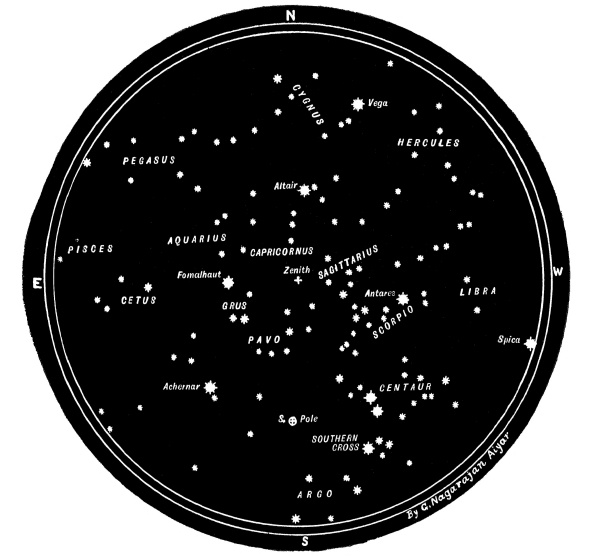
[To face p. 295.
MAP OF STARS VISIBLE BEFORE DAWN IN PURGATORY.
To this we might reply that Dante never says his four stars were in the form of a Cross; that there had to be four to represent the four Pagan virtues, the other constellation of three representing the three Christian virtues (compare the group of four handmaidens who sing, “Noi siam qui ninfe, e nel ciel siamo stelle,”[293] and are followed by a group of three);[294] and that this other constellation was certainly imaginary, since there is no group of three bright stars anywhere near the south pole.
But the fact is that conjectures and arguments are unnecessary, since Dante has expressly said that his four stars had never been seen before by anyone except the first people—“non viste mai fuor che alla prima gente,” (Purg. i. 24)—that is, our first parents, in that Eden of his imagining which was in the southern hemisphere, and on the island where he was then standing in his vision.
As a matter of curiosity I have included a map showing what stars would have been really visible to Dante at the supposed latitude of Purgatory, when Pisces was on the eastern horizon, as described in Purg. i. It will be seen that the Southern Cross is low, and would have been hidden behind the Mountain of Purgatory at five o’clock in the morning.[295]
Among northern constellations, Ursa Major is frequently spoken of by Dante, under different names, but always with reference to its high northern latitude. As the Wain, “il Carro,” it is said to be lying in the north-west when Pisces is on the eastern horizon, and to have disappeared from view in the southern hemisphere.[296] The wain-pole or shaft is pictured as sweeping round in the diurnal revolution, but always remaining above our horizon day and night, throughout its turning:
“Quel Carro, a cui il seno Basta del nostro cielo e notte e giorno, Sì ch’ al volger del temo non vien meno.”[297]
The same idea is expressed in the Midwinter Ode, where the constellation is called the Seven Frosty Stars, never lost to sight in Europe:—
“Fuggito è ogni augel che ’l caldo segue Dal paese d’Europa, che non perde Le sette stelle gelide unquemai.”[298]
This is a reminiscence of some lines of Boëthius quoted by Dante in De Monarchia, in which the northern nations are described as under the sway of the “septem gelidi triones.”[299] The Septem Triones, the Seven Ploughing Oxen, was one of the Latin names for Ursa Major, whence comes “septentrional” for North. This name also is used by Dante in Purg. xxx. 1, where the Seven Candlesticks of the mystic procession seen in the Garden of Eden are likened to these seven stars, and are named the Septentrion of the First Heaven (the Empyrean). This divine Septentrion was guiding the Procession, as the starry Septentrion of a lower heaven guides the mariner into port:
“faceva lì ciascuno accorto Di suo dover, come il più basso face Qual timon gira per venire a porto.”[300]
Like the seven stars, also, the heavenly Septentrion is said figuratively to know neither setting nor rising, but unlike them it knows no cloud except of sin.[301] Because it is spoken of as guiding mariners, some commentators have taken the above to refer rather to Septentrio Minor (Ursa Minor), which also has seven chief stars, and is a better guide because nearer the Pole, as Thales taught; but the comparatively faint stars of the Little Bear would not be so apt a comparison with the celestial lights.
By the name of the Bears, both Ursa Major and Minor are referred to as guides at sea in Par. ii. 9. In the strange new seas on which Dante warns his readers he is about to enter, Minerva will blow a favouring wind, Apollo will steer the barque, and the nine Muses will guide his course by the Bears. They are also spoken of together in Purg. iv. 65, to indicate the northern part of the sky.
A fifth name for Ursa Major is derived from the fable (known to Dante probably from Ovid’s Metamorphoses) of the nymph Helice, who was turned into a she-bear by Juno, and was hunted by her own son, Orcas. Jupiter transformed them into Ursa Major and Boötes.
“Se i barbari, venendo di tal plaga Che ciascun giorno d’Elice si copra, Rotante col suo figlio ond’ ell’ è vaga, Vedendo Rome e l’ ardua sua opra, Stupefaciensi....”[302]
Here we have the same idea as of the Wain wheeling round but never setting, with the addition of a neighbouring constellation describing a circle in the same time.
The Barbarians who lived in a region always dominated by Ursa Major, and came to marvel at the mighty buildings of ancient Rome, are probably the races of northern Europe in general; and this reminds us again of the lines of Boëthius quoted above, for it is among the peoples ruled by Rome that he mentions “quos premunt septem gelidi triones.”[303] If, however, Dante meant a country where the seven stars pass exactly overhead, the barbarians must have inhabited Scotland, or southern Scandinavia, or central Russia. If he means that Boötes also remained always above the horizon, they must have come from within the Arctic Circle, but this is not likely.
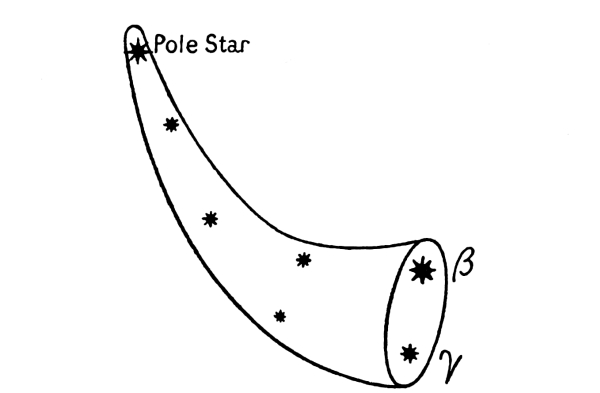
Fig. 42. Ursa Minor as a Horn. Par. xiii. 10.
In one of the passages just quoted other constellations and stars are mentioned together with Ursa Major. In Par. xii. Dante has compared the two circles of spirits which surround Beatrice and himself to a double rainbow, and to two garlands of immortal roses. In the next canto he finds a new simile: in imagination he takes some of the brightest and most familiar stars from our sky, and makes of them two new constellations in the form of two crowns. The stars are these: fifteen from different parts of the sky, which are so brilliant that they shine through air dense enough to quench lesser orbs; the Wain, which never sets in our sky; and the mouth of the horn whose tip is the axis on which the Primum Mobile revolves. That is to say, as we have before remarked, Dante takes the fifteen first-magnitude stars and the stars instanced by Alfraganus as of second magnitude. Ursa Minor is aptly compared to a horn, the wide mouth of which is formed by its two bright stars Beta and Gamma,[304] while the narrow end is Alpha, the Pole Star. These twenty-four bright stars we must then imagine to group themselves into two constellations like that into which Ariadne, the daughter of Minos, was changed when she died; this is Corona Borealis or the Northern Crown, otherwise called Ariadne’s Crown, which suggests a circle, though it is not a perfect one. Dante uses the word “segni” for any constellations, a custom we find in Ristoro also, although the modern usage is to restrict “signs” to mean only divisions of the zodiac.
The star-like spirits, thus grouped into a surpassingly brilliant double constellation, begin to sing their ineffable heavenly song, and to circle round the centre where Dante stands, in a marvellous dance, whose swiftness, when compared with anything known on earth, is as the movement of that swift heaven which carries with it all the rest, when compared with the flowing of the sluggish river Chiana.[305]
This passage helps us to understand expressions which often strike one as very strange, describing the circling movements of the spirits in Paradise. For the likeness to stars is clear throughout. Their brightness is an expression of their happiness,[306] and increases in each succeeding heaven. Only in the lowest can Dante see the forms and features of Piccarda and the other blessed spirits; in the next they clothe themselves in light, and although at first the radiant eyes of Justinian are seen, the first words addressed to him cause him to shine more brilliantly than before, and as the sun conceals himself by his own light, so the spirit conceals himself by the splendour which grows with his joy.[307] In the third heaven the spirits shine in the star of Venus like sparks seen in flame;[308] in the fourth they are called suns, and surpass the sun in brilliancy;[309] in the fifth they are compared with the Galaxy[310] and with shooting stars,[311] in the seventh and eighth with stars[312] and with spheres of light, turning on fixed poles and flaming like comets.[313]
In like manner the swiftness of their motion increases in proportion to the clearness with which each beholds eternal truth.[314] The almost incredible speed with which Dante himself soars from sphere to sphere, and with which the spirits move—whether in coming towards him, impelled by Divine charity, in returning to the heaven of heavens, or in circling with one another in mystic dance—is frequently dwelt upon, and illustrated by many striking similes. The dance is always a circling or wheeling movement (“il giro,” “la rota,” Par. viii. 20 and 26; ix. 65). And besides this, individual spirits turn with a rapid motion, remaining on the same spot. Descending the celestial Ladder in the heaven of Saturn, step by step, they revolve:—
“Vid’ io più fiamelle Di grado in grado scendere e girarsi, Ed ogni giro le facea più belle.”[315]
Now these two things, their light and their movements, were all the facts concerning the stars which mediæval astronomers could observe; and the movements were thought to be in circles and inconceivably rapid. Motion in circles, and especially the movement of rotation on an axis, remaining in the same place, had been said by Aristotle to be the most noble form of motion, and the fittest for celestial bodies. Therefore, when Dante represents the redeemed and the angels as expressing their bliss by radiance and marvellously rapid motion in circles, he makes them resemble the heavenly spheres and stars among which they manifest themselves to him. The motions are directly compared with those of stars in the passage already quoted:—
“Poi, sì cantando, quegli ardenti soli Si fur girati intorno a noi tre volte, Come stelle vicine ai fermi poli.”[316]
Remembering this significance of circular motion we shall feel a little less strange the similes of a mill and a top applied to the spirits of Paradise.[317]
A third way in which the spirits express their joy is by the sweetness of their song,[318] and here also they resemble the heavenly bodies, which make sweet music as they circle. This doctrine of Pythagoras was very popular throughout the Middle Ages.
4. THE GALAXY.
The Galaxy or Milky Way is twice referred to in the Divine Comedy. In Inf. xvii. 106-108, it is in connection with the myth of Phaeton, who being allowed by his father Jove to drive the chariot of the sun for one day, lost control of his chargers, and going all astray, burned the sky in a part which still shows signs of this catastrophe, i.e. the Milky Way.
“Quando Fetòn abbandonò li freni, Per che il ciel, come pare ancor, si cosse.”[319]
This of course is only a poetical myth. But in the Paradiso, in three lines the appearance, colour, and approximate position of the Galaxy are described, and allusion is made to the difference of opinions between learned men with regard to the puzzling question of its nature. Dante is in the heaven of Mars. He sees the soldier saints, star-like and fiery red, some larger and some less, thronging thick in two great bands, which, crossing one another in the depths of the planet, form a marvellous Crucifix. The crowded lights make him think of the Galaxy, with its multitudinous points of light, differing in brightness, although that is white, and lies in a great circle between the celestial poles.
“Come, distinta da minori e maggi Lumi, biancheggia tra i poli del mondo Galassia sì che fa dubbiar ben saggi, Sì costellati facean nel profondo Marte quei rai il venerabil segno Che fan giunture di quadranti in tondo.”[320]
If we now turn to the fifteenth chapter of Treatise II. of the Convivio, we shall find the Phaeton myth and the various theories about the Milky Way set forth in due order, and shall learn which of these Dante considered to be true.
He is comparing the two sciences of Metaphysics and Physics with the Heaven of the Fixed Stars, and takes the opportunity to tell us some of the most important facts known about it. Here he calls the Galaxy a circle:—“La Galassia, cioè quello bianco cerchio che il vulgo chiama la Via de Santo Jacopo.”[321] This popular name perhaps arose through a confusion of Galaxy and Galicia, where was a famous shrine of St. James, and hence came the belief in Italy that the Galassia was a sign by night to guide pilgrims on their way to this shrine at Compostella in Galizia.
Dante proceeds as follows with his comparison:—
“E per la Galassia, ha questo cielo grande similitudine colla Metafisica. Perchè è da sapere che di quella Galassia li filosofi hanno avuto diverse opinioni. Chè li Pittagorici dissero che ’l sole alcuna fiata errò nella sua via, e, passando per altre parti non convenienti al suo fervore, arse il luogo, per lo quale passò; e rimasevi quell’ apparenza dell’ arsura. E credo che si mossero dalla favola di Fetonte, la quale narra Ovidio nel principio del secondo di Metamorfoseos. Altri dissero (siccome fu Anassagora e Democrito) che ciò era lume del sole ripercosso in quella parte. E queste opinioni con ragioni dimostrative riprovarono. Quello che Aristotile si dicesse di ciò, non si può bene sapere, perchè la sua sentenza non si trova cotale nell’ una traslazione come nell’ altra. E credo che fosse l’errore de’ traslatori; che nella Nuova par dicere che ciò sia uno raunamento di vapori sotto le stelle di quelle parte, che sempre traggono quelli; e questa non pare avere ragione vera. Nella Vecchia dice, che la Galassia non è altro che multitudine di stelle fisse in quella parte, tanto picciole che distinguere di quaggiù non le potemo, ma di loro apparisce quello albore il quale noi chiamiamo Galassia. [E puote essere che il cielo in quella parte è più spesso, e però ritiene e ripresenta quello lume] e questa opinione pare avere, con Aristotile, Avicenna e Tolommeo. Onde conciossiacosachè la Galassia sia uno effetto di quelle stelle le quali non potemo vedere, se non per lo effetto loro intendiamo quelle cose, e la Metafisica tratta delle prime sustanze, le quali noi non potemo simigliantemente intendere se non per li loro effetti; manifesto è che ’l cielo stellato ha grande similitudine colla Metafisica.”[322]
This characteristic passage is interesting for several reasons. It illustrates the mediæval fondness for allegory, the reluctance to believe that Aristotle could ever be wrong, and the interest in ancient Greek speculations, in all of which Dante expresses the feelings of his age: and it brings vividly before us the methods and the difficulties of mediæval authors. For Dante is repeating from Albertus Magnus all these ancient speculations: the officious copyist who altered Aristotle’s words, the fact that Aristotle could only be read in Latin, and the variety of translations, were all everyday obstacles to study; and Dante’s own book has suffered from one of them in this very passage. The words placed between brackets are evidently an interpolation (as Mr. Wicksteed observes in the “Temple” Convivio): without them the passage goes on smoothly and logically to its end. On the assumption that the Galaxy is composed of a multitude of small stars, but not that the sky is denser in that part, the parallel with Metaphysics holds good.
Dante therefore held the true opinion about the Milky Way, but he was mistaken in thinking that he had the support of Aristotle. It was the “New Translation” (made by Aquinas from the Greek) which gave his opinion correctly; in the “Old” (made by Michael Scot from the Arabic) his statement had been apparently changed without comment into one which seems to Dante—and also to us—to represent the truth about the Galaxy.
5. THE PLANETS.
All the planets which were known before the days of the telescope are mentioned by Dante several times. Each has its peculiar beauty, but “la lucentissima stella di Venere”[323] is brighter and more beautiful than any other. He speaks of “la chiarezza del suo aspetto, ch ’è soavissima a vedere più che altra stella.”[324]
No reader of the Purgatorio can ever forget that matchless morning on which Dante, escaping at last from the murky gloom of the Inferno, sees the sky once more, pure blue even to its furthest limits, and the planet of love shining in the east.
“Dolce color d’oriental zaffiro, Che s’accoglieva nel sereno aspetto Dell’ aer, puro infino al primo giro, Agli occhi miei ricominciò diletto, Tosto ch’ i’ uscii fuor dell’ aura morta, Che m’avea contristati gli occhi e il petto, Lo bel pianeta che ad amar conforta Faceva rider tutto l’oriente, Velando i Pesci ch’erano in sua scorta.”[325]
Strange to say, the beginning of the above beautiful passage which conveys so direct and vivid an impression of blue sky and pure air, presents some difficulties when one comes to translate it word by word, especially as the texts offer more than one reading. By some commentators the “primo giro”[326] has been understood to mean the sphere of the moon,[327] or even the highest sphere (the Primum Mobile); but this is certainly inadmissible, as Dante supposed the atmosphere to reach only as far as the sphere of Fire, which came between it and the moon. The prime circle is here evidently the horizon, the fundamental circle of observers, the First Circle of the astrologers, from which they reckoned all the rest. It is here that the sky usually becomes pale and misty, however blue and clear it may be above. The colour was gathering and deepening,[328] especially in the east, where Dante was looking, as dawn began to appear in a perfectly cloudless sky; for during the darkness of the night it would have appeared almost black.
Dr. Moore thinks the authority better for a different reading, viz. “Dal mezzo”[329] instead of “Dell’ aer.”[330] In this case, we must take “mezzo puro” to mean mid-heaven, that is the zenith, “puro” being used as a noun, and meaning a cloudless sky (like “sereno” in Purg. v. 38); and “il sereno aspetto” must mean “the quiet scene.”
Venus appears again in the Purgatorio, shining upon the Mountain from the east before sunrise; and this time she is called Cytherea, after the island near which she was fabled to have risen from the sea, and in which she received a special worship.
“Dell’ oriente ... raggiò nel monte Citerea, Che di foco d’amor par sempre ardente.”[331]
The position of Venus in her course through the zodiac is indicated in the previous passage by the expression “velando i Pesci.”[332] The oscillating motion, by which she appears first on the morning and then on the evening side of the sun is referred to several times. In prose Dante speaks of her two apparitions, the morning and the evening: “la sua apparenza, or da mane, or da sera;”[333] in poetry, he describes her as wooing the sun, first following and then facing him:—
“la stella Che il sol vagheggia or da coppa or da ciglio.”[334]
Mercury and Venus (called rather oddly after their mothers), are said both to move closely round the sun:—
... “vidi com’ si move Circa e vicino a lui Maia e Dione.”[335]
“Quel bel pianeta di Mercuro”[336] keeps closest, for he is more hidden than any other in the rays of the sun. Here again the fact is expressed in simple prose in the Convivio:—
“Mercurio ... più va velata de’ raggi del sole che null’ altra stella.”[337]
which explains (if necessary) the more poetical language of the Paradiso:—
“La spera, Che si vela ai mortal con altrui raggi.”[338]
In the same way we may compare the descriptions of Mars in the Paradiso with a statement in the Convivio:—
“Esso Marte ... il suo calore è simile a quello del fuoco; ... esso appare affocato di colore.”[342]
The famous occultation of Mars by the moon, seen by Aristotle, is quoted by Dante in Conv. II. iii. 59-65.
Jupiter is the “dolce stella”[343] and the “giovial facella.”[344] He is silvery white, the whitest of all the stars:—“Intra tutte le stelle bianca si mostra, quasi argentata.”[345]
Therefore when Dante saw the planet filled with brilliant spirits, he says: “Giove pareva argento lì d’ oro distinto.”[346] Comparisons between the colours of Jupiter and Mars are made in Par. xviii. 64-69, and xxvii. 13-15.
Finally Saturn is the slowest and the most distant of all the planets. These two characteristics are thus described in the Convivio:—
“L’una si è la tardezza del suo movimento per li dodici segni; chè ventinove anni e più, secondo le scritture degli astrologi, vuole di tempo lo suo cerchio: l’altra si è che esso è alto sopra tutti gli altri pianeti.”[347]
In the Paradiso Saturn is called a Mirror,[348] a Crystal,[349] a splendour;[350] his circling motion is alluded to, and his position at the time in the zodiac:—
Some of the most beautiful similes in the Divine Comedy are drawn from the planets. The angel-pilot of Purgatory, when first seen far off over the sea, is likened to the planet Mars, glowing red through morning mists, low in the west above the ocean floor;[353] and the angel that welcomes the poet to the second circle on the Mountain is beautiful as the Morning Star.
“A noi venia la creatura bella, Bianco vestita, e nella faccia quale Par tremolando mattutina stella.”[354]
Although any of the planets when rising just before the sun may be called a morning star, Venus is probably intended here, as also where St. Bernard, in his devotion to the Virgin, is compared with the Morning Star which takes its beauty from the sun:—
“Colui ch’abbelliva di Maria, Come del sole stella mattutina.”[355]
All the seven planets (that is, including sun and moon), are occasionally mentioned together, “tutti e sette,”[356] and their movement in the ecliptic is referred to in Par. x, 14: “L’obbliquo cerchio che i pianeti porta.”[357] In the 14th and 15th chapters of the second treatise of the Convivio, already so often quoted, Dante draws an elaborate comparison between the seven planets and the seven sciences of the Trivium and Quadrivium. The moon is Grammar, Mercury Dialectic, Venus Rhetoric, the Sun Arithmetic, Mars Music, Jupiter Geometry, and Saturn Astrology. The reasons given for the latter are the slow movement and the height (i.e. distance from Earth) of Saturn, which Dante compares with the length of the time taken in learning astronomy, and the loftiness of its subject.
In the same way the star sphere is said to resemble Physics and Metaphysics, the Primum Mobile Ethics, and the Empyrean Theology. The argument is very fanciful, but just what would appeal to readers of Dante’s day, who loved to find allegories everywhere; and it gives him an opportunity of instructing them very simply in his beloved science.
He sometimes uses the planetary periods as divisions of time (as Plato said they should be used), for computing earthly events, and in him this does not seem affectation, as it would with almost anyone else. It seems quite natural that Cacciaguida, when speaking in the heaven of Mars, and answering a question regarding the date of his birth, should count the time not by solar but by Martian years, saying that from the beginning of the Christian Era to the day of his birth, Mars had returned to his Lion (the constellation of Leo) five hundred and eighty times.[358] The length of the Martian year according to Alfraganus is 1 Persian year, 10 months, and 22 days nearly. The Persian year (as he tells us in the first chapter of the Elementa) consists of 12 months of 30 days each plus 5 extra days, making 365 days exactly (not 365¼ days like the Roman), so the Martian year is 687 days (the modern estimate is 686·9). 687 days × 580 gives us 1091 a.d. as the date of Cacciaguida’s birth. This is consistent with the date of his death, for he had just told Dante that he fell in the Crusade to which he followed the Emperor Conrad, and we know that this was fought in the year 1147.
Some commentators think that Dante did not intend the Martian year to be taken so precisely, but only as approximately two solar years, since he gave it thus in Conv. II. xv. 145. But there he specially states that he is quoting an approximate figure only (“uno anno quasi”[359] is half the period of Mars) whereas in the Paradiso it is used to fix a date. Since by taking 580 × 2 years we get 1160, an impossible date of birth for a man who died in 1147, the only way to support this theory that Dante was speaking loosely here is to adopt another reading of the passage, and substitute “tre” for “trenta.”[360] Then 553 (instead of 580) × 2 years would give the date 1106; but the reading is not supported by good authority.
The period of Venus is used with equal appropriateness when Dante is relating how love for the Gentil Donna found a way to his heart, coming on the rays of Venus,[361] the star of love.
“La stella di Venere due fiate ere rivolta in quello suo cerchio che la fa parere serotina e mattutina, secondo i due diversi tempi, appresso lo transpassamento di quella Beatrice beata, che vive in cielo con gli angioli e in terra colla mia anima, quando quella Gentil Donna, di cui feci menzione nella fine della Vita Nuova, apparve primamente accompagnata d’Amore agli occhi miei, e prese alcuno luogo nella mia mente.”[362]
Venus runs through her changes, appearing first as Evening and then as Morning star, in 584 days; and, as the reader will remember, this movement was ascribed by Ptolemy to her epicycle (“quello suo cerchio,” “that circle of hers”). Dante would find 584 days given for it in his Alfraganus.[363] Twice 584 is 1168 days, or three years and a little more than 2 months. Therefore, since we know from V. N. xxx. that Beatrice died in June 1290, Dante wishes to say that he first saw the Lady of Pity in August 1293.
The period has been taken by some modern commentators to refer to the 225 days in which Venus revolves round the sun, but this period has no place in the Ptolemaic system. We cannot here discuss Dante’s allegory of the Gentle Lady and Philosophy, but in this passage he has stated without ambiguity or uncertainty the date of her first appearance.[364]
6. ECLIPSES.
We find solar eclipses mentioned six times in Dante’s works. As in all old records, there is no allusion to the features which chiefly strike modern astronomers—the pearly corona, and the blood-red prominences standing out like flames round the black disc. The terror of the sudden darkness, even when foreseen, seems to have absorbed all attention, and only the appearance of stars in the daytime and the frightened behaviour of animals was noted by Ristoro, and by others until quite modern times.
In his letter to the Cardinals of Italy, Dante speaks of the shameful and grievous removal of the Papacy from Rome to Avignon as an eclipse of the sun.[365] In his dream of the death of Beatrice, he sees the sun so darkened that the stars appear, to his great terror:—
“Poi mi parve vedere appoco appoco Turbar lo Sole ed apparir la stella.”[366]
He also refers to the disputed idea that the darkness at the time of the Crucifixion was caused by an eclipse of the sun,[367] and to the figurative eclipse which then took place in heaven.[368]
If he had ever seen one in reality, it would have made more impression upon him, and we should surely have found it referred to several times and vividly described. The only suggestion of a personal experience is where he temporarily loses the power of sight by gazing too fixedly upon the spirit of St. John; and he compares this to a man who looks so intently at the sun, just before an eclipse, that he becomes incapable of seeing it at the critical moment.[369] This incident may have been told him by an observer of the total eclipse of June 1239, which was visible in Italy, and seems to be the one described by Ristoro.
Lastly, he mentions the discovery that the moon comes between us and the sun, which we have learned from eclipses, as an example of the proper method of reasoning: for we must first ask whether a thing is, and afterwards why it is. Thus man’s wonder leads him to knowledge.[370]
The eclipsed moon is only once mentioned, viz. in De Mon. III. iv. 140-142, where she is described as not wholly dark. With his usual indifference to her Dante fails to note the often extraordinary beauty of her colouring when the eclipse is total.
7. COMETS AND METEORS.
The connection between these two classes of heavenly bodies seems to be real, though its exact nature is still a mystery. In old days little or no distinction was drawn between them, so that it is sometimes difficult to know whether a writer is describing a large meteor, or a comet, or a shower of falling stars.
Dante only mentions comets once, very briefly, when he describes spirits in Paradise as “fiammando forte a guisa di comete.”[371] He says nothing of the magnificent comet described by Ristoro, which rose at three o’clock in the morning, huge as a mountain, and with great rays like a mane; but travelling always towards the south grew gradually fainter, and disappeared after 60 days. Yet it was seen in Tuscany shortly before Dante’s birth, and it was thought to herald the death of the Pope (Urban IV. in 1264) and the terrible war in which first Manfred and afterwards Conradin were slain. These events are familiar to every reader of the Divine Comedy,[372] but there is never any mention of the comet.
Nor does he describe in any detail the fiery cross which was seen in the sky above Florence “in the beginning of her destruction,” which does not mean, as one might think, the legendary sack of the city by Totila, but the treacherous entry of Charles of Valois, “Totila secundus,”[373] in November 1301. This portent was of course considered as of ill omen for the Republic, and although Dante was still absent on his embassy to Rome, and cannot have seen it himself, it is rather remarkable that he says so little about it. It is described by an eye-witness, “Io, che chiaramente la viddi”[374] as a red cross which appeared in the evening over the Priors’ Palace; the vertical arm seemed to be 20 ells long, the transverse one a little shorter, and it remained visible for as long as it would take a horse to gallop two furlongs. Villani the historian describes it as like a comet with an immense trail, as of smoke, behind it. Dante merely mentions it, together with the ball of fire seen by Seneca at the death of Augustus, which, judging by Seneca’s own words, was also a large meteor, for he describes it as flashing into sight and moving very rapidly, disappearing as it moved.[375]
Dante calls meteors “kindled vapours,”[376] in accordance with the doctrines of Aristotle, but the popular idea of them is shown by his observation that they might be taken for stars in motion, only that no star vanishes from its place, and they are only seen for a short time.[377] Ristoro d’Arezzo had already alluded to this fallacy:—
“Alquanti non savi credono ch’elle sieno stelle, che caggino del cielo e vengano meno.”[378]
He gives the same reason as Dante for disbelieving this, and Seneca had expressed it more forcibly, saying that if true there would be no more stars in the sky, for some meteors are seen every night.
Albertus Magnus, who seems to have had a genius for mistaking his authorities, quotes Alfraganus as stating that shooting stars are most frequent in evening twilight, though nothing of the kind is said in the Elementa. Dante perhaps accepted the statement, though it is by no means necessarily implied in his “di prima notte:”[379] moreover there is some authority for the alternative reading of “mezza notte.”[380] Wherever the idea originated, its sole foundation must have been the circumstance that more persons are awake in the early than in the late hours of the night: the fact is that more meteorites are captured by the morning side of the earth, which is turned in the direction towards which she is moving in her orbit.
Shooting stars were necessarily familiar to a lover of starry skies, and Dante has given us an exquisite description of the suddenness with which they startle quiet eyes, while their brilliancy and swiftness of flight provides him with two beautiful similes.
In the first he compares them, and also flashes of summer lightning, with messenger spirits in Purgatory hastening to bring their friends to him:—
“Vapori accesi non vid’ io sì tosto Di prima notte mai fender sereno, Nè, sol calando, nuvole d’agosto, Che color non tornasser suso in meno, E giunti là, con gli altri a noi dier volta.”[381]
The second illustrates the brightness and beauty, as well as the movement, of the star-like spirits in Mars:—
“Quale per li seren tranquilli e puri Discorre ad ora ad or subito foco, Movendo gli occhi che stavan sicuri, E pare stella che tramuti loco, Se non che dalla parte ond’ ei s’ accende Nulla sen perde, ed esso dura poco ...”[382]
8. THE SUN’S PATH IN THE SKY SEEN FROM DIFFERENT PARTS OF THE EARTH.
We have now seen how familiar Dante was with the aspects of the skies above his head. His writings show also that he had pictured clearly to himself what they must be in other parts of the world—in regions far east or west, in the southern hemisphere, at the equator, and at either pole. Science could not tell him all that he would have liked to know about the stars, so that although he can speak of regions where Ursa Major passes overhead, and where it sinks out of sight below the horizon, he has to fall back upon his imagination and invent new constellations for the southern hemisphere.
But astronomy could tell him, and his habit of accurate thought, as well as his imagination, helped him to grasp how the sun would appear at any latitude on the earth, and what would be the results on the length of day and night, and on the seasons. A very interesting little disquisition on this subject is found in the Convivio, in illustration of some lines in one of his Odes, which speak of the sun circling the whole world. In order to understand this completely, Dante says, we must know exactly in what way the sun circles the world. The chief point to bear in mind while reading his description is that the sun, besides the simple daily motion in a circle, has a constant slow motion north or south, and therefore his path in the sky, as we see it day after day, is really spiral.
The passage is much too long to quote in full, but if the reader will follow me, taking his Convivio and opening it at chapter v. of Treatise III. and beginning at line 66, I will give a résumé which will form a running commentary on the text, and an explanation of any points which may not at once be clear.
We see the sky, says Dante, continually revolving round Earth as centre; and it has two fixed poles of revolution—the northern, which is visible to nearly all the land not covered by sea, and the southern, which is hidden from nearly all of it. And the circle which is equi-distant from these two poles [the celestial equator] is that part of the sky in which we see the sun when he is in Aries and in Libra.
Now if a stone could be dropped from this pole of ours [the northern], it would fall far away yonder in the ocean just where, if a man were standing, he would always have the Pole Star exactly overhead. [“La stella”[383] is the Pole Star, see p. 291]. And I believe (Dante says) that from Rome to the north pole, in a direct line, is a distance of about 2,700 miles. To fix our ideas, let us imagine that at this spot there is a city called Maria, and let us imagine another city, called Lucia, at the spot exactly opposite, where a stone would fall if dropped from the other pole. And I believe that from Rome southwards to this second place would be a distance of about 7500 miles. Thus the distance between the two cities, in whatever direction the measuring cord be stretched, would be 10,200 miles, that is, half the circumference of the globe,[384] and the inhabitants of Maria would have their feet opposite the feet of those of Lucia. [If any two spots on a sphere are exactly antipodal, but in no other case, the distance may be measured in an infinity of directions, and always come out the same.]
Lastly, let us imagine a circle on the globe, which will be at equal distances everywhere from Maria and Lucia [the equator]. According to the opinions of the astrologers, if I understand them aright, and according to what is said by Albertus Magnus and by Lucan, this circle would divide the dry land from the ocean there in the south, approximately along the extremity of the First Climate, where amongst others live the Garamantes, who go almost always naked, to whom Cato went when fleeing from Cæsar.
“Approximately,” because the southern extremity of the First Climate, according to Alfraganus, lay a little north of the equator, although land extended, and was sparsely inhabited, as far the equator (see p. 186).
Dante speaks again of these extra-climatal races in De Mon. I. xiv. 43-51, where he contrasts the Scythians who live beyond the seventh climate, and therefore endure extreme inequality of days and nights, and suffer almost intolerable cold, with the Garamantes who live under the equator, where days and nights are always equal, and the heat is so intense that they can scarcely bear any clothing. Since “the astrologers who determine the climates”[385] had fixed their northern limit at 50½°, nearly the whole of Britain also lay, like barbarous Scythia, in this scarcely habitable region of long nights and bitter cold!
When we have marked these three places on the globe, i.e. the two poles and the equator, it is easy (Dante goes on) to see how the sun circles. I say then, that the heaven of the sun turns from west to east, not directly against the diurnal movement—that is, the movement which produces day and night—but obliquely against it, and so that its middle circle, which is similarly between its two poles, and on which is the body of the sun [i.e. the ecliptic], cuts in two opposite points the circle of the two first poles [the equator], that is, at the beginning of Aries and the beginning of Libra; it diverges from that circle in two arcs, one north and the other south. The highest points of these arcs are equally distant from the first circle in either direction, being 23 degrees and a little more; and the one summit is at the beginning of Cancer, and the other at the beginning of Capricorn.
Therefore, when the sun is in the beginning of Aries, travelling in the mid-circle of the first poles [the equator], Maria will see this sun circling the world, low down on the ground, or on the sea, like a mill-stone only half of which is seen, and day after day he will be seen to rise, like the screw of a press, until he has performed about ninety revolutions, or a little more. When these revolutions are accomplished, he will be as high in the sky above Maria as he stands in the sky of the Garamantes at middle-tierce at the time of equal days and nights.[386]
[From Conv. IV. xxiii. and III. vi., where Dante explains the use of temporal hours, we learn that mid-tierce on the day of the equinox is an hour and a half after sunrise, or 7.30 a.m. Since the sun moves through 360 degrees divided by 24, that is 15 degrees, in an hour, and his motion is vertical in equatorial countries at the equinox, it would bring him in 1½ hours to 22½ degrees above the horizon. His greatest height above the horizon at the pole is only one degree more than this, for it is obviously equal to the greatest distance between the equator and the ecliptic, i.e. 23½ degrees, since at the pole the equator coincides with the horizon. This gives a good idea, therefore, of the appearance of the sun in the sky to the people at Maria, and is a striking illustration of the difference between the polar sun and the equatorial. For at the time mentioned, the sun has only a quarter the height which it will attain at noon, when it will pass through the zenith of the Garamantes; yet this is the highest position in which the inhabitants of Maria can ever see it].
If a man stood upright in Maria, and kept turning his face to the sun, he would see it move to his right [as we do].
After reaching his greatest height in the sky, the sun would begin to descend again, in the same spiral way like a screw turning, for another ninety revolutions or so, until once more he was circling down on the horizon, only half his body visible.
Then he would be lost to sight altogether, and would begin to be seen in Lucia, where he would rise and descend in just the same way as in Maria. But if a man faced the sun in Lucia, he would see it moving to his left [as one does in Australia where it goes north at noon].
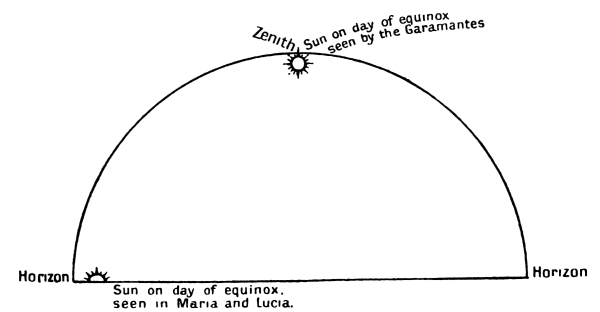
Fig. 43. The Sun at the Equinox, seen from the poles and the equator. Conv. III. v.
(Maria, Lucia, imaginary cities at the North and South poles).
We see, then, that these places have one day in the year which is six months long, and one night of equal length, and when it is day with one, it is night with the other.
Now on the circle on the globe where the Garamantes live [the equator], the sun when in Aries goes exactly overhead, not circling horizontally like a mill-stone, but vertically like a wheel, and exactly half of this wheel is visible above the horizon.
After this, the sun is seen to depart and go towards Maria for about 91 days; then in about the same time it returns, and enters Libra; then it goes towards Lucia for about 91 days, and in the same period returns. And this place, which circles the entire globe, always has equal day and night, on whichever side of it the sun is; and twice in the year it has a very hot summer, and twice a mild winter.
The regions which are between the two imaginary cities and the mid-circle, see the sun in different ways, according to their distance from these places, but the details, our author says, he will leave to the ingenious reader,
“Siccome omai, per quello che detto è, puote vedere chi ha nobile ingegno, al quale è bello un poco di fatica lasciare.”[387]
He draws attention to the interesting fact, which follows from the above, that in the course of a year (when the heaven of the sun has made a complete revolution and returned to the same place), every part of this globe on which we live has received an equal amount of daylight. And the essay ends in an apostrophe which recalls the reproof of Virgil to those who will not look up to the skies:[388]
“O ineffabile Sapienza che a così ordinasti, quanto è povera la nostra mente a Te comprendere! E voi, a cui utilità e diletto io scrivo, in quanta cecità vivete, non levando gli occhi suso a queste cose, tenendoli fissi nel fango della vostra stoltezza.”[389]
It is interesting to compare this passage with the parallel passages in Alfraganus and Ristoro. The astronomer is concise and clear; the monk is diffuse and apt to repeat himself; the poet is quaintly picturesque. Both the Italians evidently draw the main facts from the Arab, and all use the illustration of a mill-stone to explain the horizontal motion of the heavens at the pole: here are the three corresponding passages:—
“Coelumque molæ trusatilis instar gyrum vertitur.”[390]
“Lì si volgera il cielo attorno con tutte le sue stelle, in modo di macina.”[391]
“Conviene che Maria veggia ... esso sole ‘girare il mondo’ ... come una mola.”[392]
Dante alone uses the figure of a wheel to illustrate the vertical motion at the equator; he perhaps takes from Ristoro the idea of the spiral. For the latter describes the path of the sun as a “via tortuosa, la quale i savi chiamano spira;”[393] but he explains it as like a string wound round a stick, Dante like the screw of a press. Dante is dealing only with the sun, and does not enter into details about the visibility of the zodiacal signs like the other two authors; but on the other hand he goes south to the other pole, which apparently does not interest the others, perhaps because the southern hemisphere was thought to be uninhabited. But the poet has added life to his description by supposing both poles inhabited, placing there his imaginary, mysteriously-named cities of “Maria” and “Lucia.” On the equator, where Ristoro has the mythical city of Arym, whose wise and prosperous citizens enjoy a perfect climate, Dante, relying more on the classics, lets his barbarous Garamantes run about naked most of the year, under the fierce equatorial sun.
Needless to say, his little homily in conclusion is all his own; it is more interesting to find that he alone mentions the opposite movements of the Sun, to right and left respectively in the north and south hemispheres,[394] and the fact that every part of the earth receives the same amount of sunlight in a year. This may have been suggested by someone else, but one would like to think he arrived at it independently, when thinking over the facts.
In the light of this treatise, which describes so truthfully the path of the sun, and its effect on the seasons in different latitudes, we may explain two rather puzzling passages in the Divine Comedy.
One is at the beginning of the tenth canto of the Paradiso, where Dante wishes his readers to realize the position of the sun when he entered it with Beatrice, and the great importance of this position. “Lift your eyes with me, reader,” he says, “to that place in the lofty heavens where the one motion meets the other, and see how the oblique circle which carries the planets branches off from that point.” The reader is now familiar with the “two chief motions,” and knows that one is the diurnal, from east to west, the other the planetary periodical motions in the opposite direction; they meet at the equinoxes, where the ecliptic cuts the equator. It is the spring equinox which Dante is speaking of, for a little further on he says that the sun, situated in the place above-mentioned, was circling in those spirals which bring him to us earlier every day (lines 31-33). Now if the path of the planets were not thus oblique, he continues, much virtue in heaven would be lost, and almost every earthly power dead. Even if the obliquity were merely less or more, the universal order of both heaven and earth would suffer greatly. But why this should be so he leaves his readers to think out for themselves, having a greater matter in hand which demands all his attention.
It is easy to see that if the sun always moved in the equator, without departing from it either north or south, he would rise every day to the same height in the sky, and there would be no change of seasons anywhere on the earth; he would always be overhead at noon to Dante’s Garamantes, living on the equator, and always just on the horizon, day and night, to the people of “Maria” and “Lucia” at the Poles. If the ecliptic made a greater angle with the equator the seasons would be more marked, and the sun would rise higher in summer in high latitudes. If the angle were less, the reverse would be the case. Moreover if sun and moon and all the planets followed the same track, they would be constantly eclipsing one another.
But if we would understand the full meaning of—
“Se la strada lor non fosse torta, Mota virtù nel ciel sarebbe in vano, E quasi ogni potenza quaggiù morta.”[395]
we must turn to thirteenth-century Ristoro of Arezzo, who has set forth in detail the results which he believed would follow from a change in the ecliptic. If all the seven planets moved in the same narrow path, there would be much less variety in their “aspects,” and therefore in their influences upon the earth; and in the frequent eclipses one would prevent the other from looking at the earth (“impedimenterebbe l’uno l’altro a guardare la terra”), and so hinder its action. And since it is the northward movement of the sun which causes our plants to blossom, and later to bear fruit, if there were no such motion we should see no renewal of life. He argues further that if the obliquity of the ecliptic were greater, countries in high latitudes would have too severe a winter to be inhabited; while if it were less, the summer there would not be warm enough for the ripening of harvests; therefore in whichever way it differed from the actual value, a smaller part of the earth would be habitable.
“Or ti riman, lettor, sopra il tuo banco, Dietro pensando a ciò!”[396]
How much of this was in Dante’s mind it is hardly possible to say, but it is evident that the “via tortuosa” of the seven planets, and its effects on the earth, was a favourite subject for thought in his time.[397]
But the most famous passage relating to the sun’s path and its aspect in strange latitudes is Purg. iv. 52-84.
Here Dante is able at once to understand the startling appearance of the sun travelling to his left instead of his right, as seen on the first morning in Purgatory, for he grasps the full meaning of Virgil’s explanation, and caps it, in a way which seems astonishingly quick-witted to unastronomical readers!
The two poets had begun to climb the mountain just at sunrise, and sat down to rest on a ledge at about half-past nine, looking east. Dante at first looked down at the shore, whence he had so painfully climbed, then raised his eyes to the sun, and was amazed to find that its rays struck him on the left shoulder.
Virgil, seeing his astonishment, explains why the sun is going north instead of south as it climbs the sky. The sun is now in Aries, and therefore on the equator, as we know from several passages, but Virgil begins by saying that if it were in Gemini [a more northerly sign] and kept to its ancient path, Dante would see it travelling still further northwards in its daily course. “If Castor and Pollux [stars in Gemini] were in company with that Mirror [the sun] which carries his light up and down [i.e. goes north and south alternately], you would see the glowing zodiac [that part in which the sun is] revolving still closer to the Bears.” Gemini is literally nearer to the constellations of the Bears than Aries, but this is not the sense of Virgil’s statement: he means merely to indicate the north in general (see Ptolemy, p. 157). “To understand why the sun goes north,” Virgil says, “you must know that this mountain and Zion [Jerusalem] are so situated on the earth that one is precisely antipodal to the other; and so, the sun’s path being between them, when he is viewed in one direction from Jerusalem, he is viewed in the opposite direction from Purgatory. If you turn from the east to your right to see him from Jerusalem, you must turn to your left in Purgatory.” Virgil speaks of the sun’s path or the ecliptic as the path which Phaëton was not able to keep, and he describes the two antipodal places as having one and the same horizon but two entirely different hemispheres.
“Certainly,” replies Dante, “I have never seen anything so clearly as I now perceive what at first puzzled me. For the middle circle of the celestial motion,[398] which is called the equator in a certain art [astronomy], and which always remains between the sun and winter, [the sun crosses it departing from us in either hemisphere at the autumnal equinox], here lies to the north of us, for the reason you have given [namely, that we are in the southern hemisphere], whilst the Hebrews [inhabitants of Jerusalem] see it towards the hot region [the south].”
Observe that the expression used of the equator “che sempre riman tra il sole e il verno,”[399] distinctly suggests the reversed seasons in the southern and northern hemispheres, so that Dante has no intention, as Dr. Moore suggests, of assuming by a poetic licence that it is spring in Purgatory as well as in Italy.[400] It is autumn in the southern hemisphere, but this need not distress us: the holy Mountain knows no inclement weather,[401] and in the Garden of Eden on its summit spring flowers and autumn fruits eternally flourish together.[402]
An allusion is made to a tropical summer in “la terra che perde ombra.”[403] Tropical Africa is intended, where the sun at certain times passes directly overhead, and therefore casts no shadows, as the Alexandrian astronomers had observed (see p. 117).
Did Dante believe that no land exists anywhere in the southern hemisphere? There are some indications that he thought it possible to push the limits of the habitable earth a little beyond the equatorial boundary of Alfraganus. There would be no heresy in lengthening the southward extremities of Africa or Asia, because all that the Church forbade was to plant another land in the south, separated from us by a vast ocean or impassable torrid zone, and to people it with inhabitants, who could not therefore be descendants of Adam or have the Gospel preached to them. Nor would there be any inconsistency with the poet’s own description of our hemisphere as that covered by “la gran secca,”[404] or with the voyage of Ulysses, on which he saw no land but the Mountain of Purgatory; for he sailed south-west, not due south, and the “mondo senza gente”[405] was “diretro al Sol.”[406]
The indications are as follows:—
(1) The passage quoted above, where it is said that the equator “divides the uncovered land from the ocean”[407] is ambiguous in the original, and might mean “divides the land uncovered by Ocean.”
(2) Shortly before, he has distinctly admitted that there is some land in the southern hemisphere, by saying that the north celestial pole is visible to nearly all the land not covered by sea, and the south is hidden from nearly all of it. The first is true in any case, since though the pole is theoretically visible as far as the equator, it is often hidden by mist or rising land on the northern horizon; but unless the second “nearly” has been added by a (somewhat natural) mistake of a copyist, it can only apply to lands in the southern hemisphere.[408]
(3) There is a stanza in Canzone XV. which suggests that Dante believed Ethiopia to be on the south side of the equator. Classical and mediæval cosmographers had very vague ideas about the extent and position of this country. Dante describes a wind raised in its deserts by the sun, which now is heating it (implying the time of summer?); but the same wind, crossing the sea to Europe, darkens all this hemisphere, bringing clouds which fall in snow.
“Levasi della rena d’Etiopia Un vento pellegrin, che l’ aer turba, Per la spera del sol, ch’ or la riscalda, E passa il mare, onde n’adduce copia Di nebbia tal, che s’ altro non la sturba Questo emisperio chiude tutto, e salda; E poi si solve, e cade in bianca falda Di fredda neve, ed in noiosa pioggia.”[409]
However, it may be said that “or la riscalda”[410] means merely that it is always hot in the tropics, even when we have winter, and that “questo emisperio”[411] cannot possibly mean the whole of the terrestrial northern hemisphere from equator to pole, but simply describes the appearance of the hemispherical sky,[412] completely covered with cloud.
These doubtful passages are not strong enough to set against the explicit statement in the Quæstio that the habitable earth extends from the equator to the Arctic circle and no further.[413] Letters and reports from missionaries and traders, none of them scientific, did not shake Dante’s faith in the limits laid down by Ptolemy and Alfraganus. His geography was utterly wrong, but his astronomy was right; and therefore, although he had no idea of what he would see on our globe in untravelled latitudes, he knew exactly, and has described vividly, what he would see in the sunny sky.
9. CELESTIAL PHENOMENA AND TIME.
The foregoing quotations have shown how well Dante understood the changing appearances of the celestial phenomena as viewed from different latitudes: it now remains to be seen what were his conceptions of longitude.
A difference in longitude between two places makes no difference in the stars, nor in the apparent paths of the heavenly bodies, but they come to the meridian sooner in the more easterly place; and as it is the meridian passage of the sun which determines local time, this will vary in exact proportion to the distance east. When it is early morning in England, it is noon in Burmah, and evening in Fiji. As Alfraganus had observed (following Ptolemy), a celestial phenomenon such as a lunar eclipse, which is caused by an actual darkening of the moon’s surface when immersed in Earth’s shadow, is visible in every place where the moon is above the horizon, though the local hour differs.
It is otherwise with a total solar eclipse, for this is only visible from the very small portion of Earth on which the moon’s shadow falls as she passes between us and the sun (see fig. 44); and as this shadow moves on, owing to her own motion and the diurnal revolution combined, the eclipse becomes visible successively from different parts of the earth. Dante realized this when he quoted the argument of some theologians that the miraculous three hours’ darkness described in the Gospels could not have been caused by an eclipse of the sun, as Aquinas and others had suggested, because it was visible all over the earth at the same absolute time, that is, during the Crucifixion.[414] Some said, he tells us, that the moon went back and placed herself between us and the sun (for the moon at Passover time was always full, and therefore opposite the sun), so that the sun’s light should not come down (to us on the earth); others, that the sun hid itself, for a corresponding eclipse was seen by Spaniards and Indians as well as Jews.[415] Spaniards and Indians were supposed to live at the extreme western and eastern limits of the habitable earth: they were 180° in longitude, or 12 hours in time, apart, and Jerusalem was midway between them. Therefore the sun would be visible to all, though only just rising in India and just setting in Spain;[416] but it could not have been an eclipse that darkened it to all at the same time.
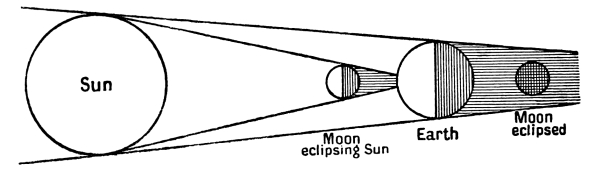
Fig. 44. Lunar and Solar Eclipses.
This passage shows that Dante was entirely orthodox and conservative in his geography, as far as longitude was concerned, and confirms us in the conclusion that he was so also with regard to latitude, and was not likely to accept contemporary evidence about lands south of the equator, or stars unknown to Ptolemy. In the Divine Comedy there are several passages which refer to the same system, as for instance where Night is described as covering the whole region from “the Shore” to Morocco,[417] or where the time is stated to be noon on the Ganges, sunrise at Jerusalem, and midnight in Spain.[418] And in the Quæstio de Aqua et Terra the system is thus clearly explained:—
“As all these agree in believing [the naturalists, the astrologers, and the cosmographers], this habitable earth extends in longitude from Gades, which lies on the western boundaries of Hercules, as far as the mouths of the Ganges, as Orosius writes.[419] That longitude is such that at the equinox the sun is setting upon those who are at one of these boundaries, while it is rising upon those who are at the other, as astrologers have discovered by eclipses of the moon. Therefore the aforesaid boundaries must be 180 degrees distant in longitude, which is half the distance of the whole circumference.”[420]
Gades is not the city of Cadiz, but two islands (the “Gades Insulæ” of Orosius), on which Hercules was said to have set up his Pillars, as a sign that no one should venture further; and they were thought to lie in the mouth of what we call the Straits of Gibraltar:[421]—
“quella foce stretta, Ov’ Ercule segnò li suoi riguardi, Acciochè l’uom più oltre non si metta.”[422]
Through these Ulysses sailed, never to return.[423]
It is difficult to believe that a lunar eclipse had ever been observed simultaneously, and the local time compared, on the Ganges and at Gibraltar, as the above quotation from the Quæstio declares: and if it had been, the astrologers, the cosmographers, and the naturalists would have found out that they were greatly mistaken, for the distance is little more than half what they thought. All that Ptolemy had said was that this was the right method for calculating longitudes, and he gave as an example an eclipse which had been seen at Arbela at the fifth hour and at Carthage at the second hour.[424] It was, in fact, an excellent method, and the only one before the day of chronographs and telegraphs; and it seems to have been assumed that Ptolemy’s guess of 180° for the extent in longitude of the inhabited earth was based upon it.
Then this 180° was considered, in the Middle Ages, as divided into two equal parts, the western half containing Europe and Africa, the eastern containing Asia. On the western front of Asia lay Jerusalem, thus holding the central position in the inhabited earth which was thought to be her right, on the authority of certain Scripture texts, as we saw.[425] This gave the Mediterranean a length of 90°, which of course is vastly too great. Even Ptolemy had only estimated it at 62°, and the Alfonsine Tables made it 52°, while the true distance is only about 42°.
Latitude, however, was much more easily measured than longitude, for it was only necessary to take the height of the pole star above the horizon with an astrolabe; and the latitude of Jerusalem is really just about midway between the supposed limits of the habitable earth, the equator and arctic circle, for it is nearly 32° north.
Some daring spirits ventured to suggest that the dry land stretched much further round the globe than was commonly supposed, so that one might sail from Spain to Asia in quite a short time, and they sheltered themselves behind the great names of Aristotle, Seneca, Pliny, and Esdras.[426] Albertus Magnus quotes Aristotle to this effect, although in another part of the same book (his De Cælo et Mundo), he repeats the usual phrase about the habitable Earth being all contained within one of the northern quadrants of earth. Roger Bacon expresses himself more boldly, and it is possible that he was impressed by the long journey of the Franciscan friar Rubruquis, on his mission to Central Asia, from St. Louis of France to the Emperor of the Mongols. Besides relating the story of this journey, Bacon speaks of men who were known to live in tropical Taprobane (Ceylon), and if there, why not also south of Capricorn? There may be delightful countries there, since it is the better and nobler part of the world, as Aristotle and Averroës taught.
Moreover, Dante’s own countryman, the learned Pietro d’Abano, maintained that there are habitable lands on, and even beyond the equator, and did not hesitate to quote conversations with Marco Polo as evidence, although this “most extensive traveller and most diligent enquirer” was accounted a romancer by most of his contemporaries. Had not Messer Marco told him that in islands south of the equator he had seen not only great rams with coarse stiff wool like the bristles of pigs, but human beings?[427]
Roger Bacon was banished from Oxford on a charge of heresy and witchcraft: Pietro d’Abano escaped the Inquisition by dying, in 1316. Men such as these belonged to the new age that was coming, the age that would throw away the old lesson-books, and begin to discover for itself—and they suffered in consequence. Dante belonged heart and soul to his own era, and clung passionately to its ideals and traditions. For him the Ganges still flowed into the all-surrounding ocean on the east coast of Asia, 90 degrees from Jerusalem, as Orosius had pictured it, and there is not the faintest echo in his writings of the voyages of his countrymen, Corvino and his bishops, or Polo and his companions,[428] between “Greater India” and “Zayton” (Amoy harbour), although they surely must have recognized, when they praised the great rivers of China, that these flowed into a sea many days’ journey beyond that into which the Ganges rolled its waters. Nor is there, on the other hand, any hint of the monstrous races with which Dark-Age superstition had peopled the remote regions of the earth, although they were regularly represented on the maps of that time. It is true that the “portolani,” or handy charts, of which the earliest known date from Dante’s life-time, showed none of these things, but depicted the coast-lands of the Mediterranean and Black Seas with marvellous accuracy: but they were only for pilots and merchant captains, and had nothing to do with scholars. The maps Dante would see were hung on church or monastery walls, or illustrated learned books; and the mappe-monde of Cardinal Heinrich of Mainz may be taken as typical of them all. It much resembles our great Hereford Map of the World, and was probably copied from the same original design.
It is two hundred years older than Dante, but so stationary was geography throughout the Middle Ages that it might have been executed in his day, or, except for a few details, several centuries earlier.
Mediæval maps are as fascinating as a fairy tale, which indeed they much resemble. The shape is conventional, and not supposed to represent the true shape of the habitable earth; it is sometimes circular, sometimes quadrilateral, occasionally oval, as in the present instance. The east is here, as usual, at the top, and there we see the Paradise of Adam and Eve, and close beside it, to the north, the River Ganges, flowing into the great ocean which surrounds all the land. At the opposite or western extremity are the Pillars of Hercules, which two angels appear to be guarding. In the centre, but not so exactly or conspicuously central as in some other maps, we find “Hierusalem.” Along the south is the long narrow continent of Africa, with the Atlas and Ethiopian mountains; and the Nile, rising far in the south-west, after mysterious submergences and reappearances, finally flows into the Mediterranean, past the pictured Pyramids, here strangely called (according to Dark-Age myth) the Barns of Joseph. In the north another Angel points to the country where dwell the Gog-Magogs, and not far off are the lands of the Hyperboreans, here described as untroubled by disease or discord, of the “most wicked” Gryphons, and of the Dog-headed folk, adjoining the Arctic Ocean.
Italy is a very large country, roughly triangular, and in the Mediterranean to the south lie Sicily, the whirlpool Charybdis, the rock Scylla, Sardinia, Corsica, and other islands. Rome is figured as a battlemented city, about halfway between Jerusalem and the Pillars of Hercules.
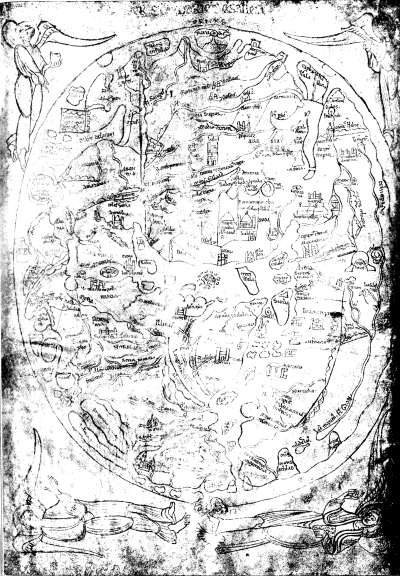
[To face p. 344.
MAP OF THE WORLD BY HEINRICH OF MAINZ, ABOUT a.d. 1110.
Reproduced by permission from Beazley’s “Dawn of Modern Geography.”
This is where Dante also places the imperial city, for in his system it is about 45°, or 3 hours, east of Gades and west of Jerusalem. He tells us in one place that it was vespers in Naples when the sun rose in Purgatory,[429] and in another that when it was vespers or three o’clock in the afternoon in Purgatory, it was midnight “here”[430] which may mean Florence or Italy in general; both these statements indicate a difference of nine hours or 135° between Italy and Purgatory. Purgatory in the Divine Comedy is exactly antipodal to Jerusalem, and therefore twelve hours distant in time;[431] and for the sake of his allegory Dante has so far departed from tradition as to place the Earthly Paradise here also.[432] These five places may therefore be diagramatically represented thus:—
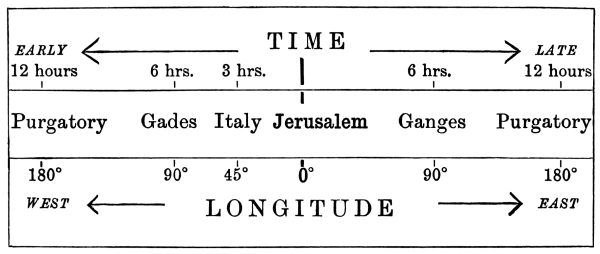
With this key, Dante’s fondness for describing the time at one place by mentioning one of the others need be no stumbling-block, as it is to many readers.
The fact is that though Dante had none of our opportunities for changing time-reckoning by long journeys, nor for communicating with friends at the other side of the world, who wake while we sleep, the marvellous daily revolution of the skies had a fascination for him, and he delighted to picture a glorious sunrise taking place in one country while in another it was high noon, or the middle of the night. Thus, the beautiful description of the stars fading in the growing light of dawn, which we quoted above, is preceded by a picture of the sun glowing on the meridian some 6000 miles away (rather more than a quarter the circumference of the globe), while with us Earth’s shadow has sunk almost to a level plane.[433]
Again, Folco of Marseilles, when describing his birthplace, says that the greatest of all the seas (the Mediterranean) except the ocean which encircles all the habitable earth, stretches so far against the sun (i.e. from west to east), that the line of sky which is on its horizon at one end is on its meridian at the other.[434] If the sun were seen just rising on the eastern horizon at Gades, it would be on the meridian at Jerusalem and the time would there be noon.
Dante’s hours are always reckoned from sunrise, and they are the “temporary” or Church hours. He defines both kinds in the Convivio. The same lines of his Ode which provided him with a text whereon to discourse of the sun’s movements, give him occasion to treat of the division of each day into hours, thus:—
“I say that the sun, in circling round the world, ne’er beholdeth aught so noble as this lady, from which it follows that she is, as the words affirm, the most noble of all the things on which the sun shines. And I say in that hour, etc. Wherefore we must know that the hour is understood in two senses by astrologers. One sense is employed when they assign twenty-four hours to the day and night, that is, twelve to the day and twelve to the night, however long or short the day may be. And these hours become short or long in the day and in the night, according as the day and night wax and wane. And the Church uses hours in this sense when she speaks of Prime, Tierce, Sext, and None; and these are called temporal hours. The other sense is employed when, of the twenty-four hours alloted to the day and night, the day has sometimes fifteen and the night nine, and sometimes the night has sixteen and the day eight assigned to it, according as the day and the night wax and wane; and these are called equal hours. And at the equinox these latter are always one and the same with those which are called temporal; for it must needs be so when the day and the night are of the same length.”[435]
The choice of these two examples of unequal days and nights seems to be another instance of Dante’s dependence upon Alfraganus, for in Chapter VIII. of the Elementa Astronomica we read that the middle of the seventh climate (in which the inequality is greatest) has a longest day of 16 hours, and the middle of the fifth, of 15 hours; and in chapter IX. we find that Magna Roma is situated in the fifth climate.
In the fourth treatise of the Convivio, Dante returns to the same subject, and enters into further detail about Church hours and divisions of the day.[436] Our lives, like the arch of heaven which is always above us, consist of a rise and a decline, with a culminating point, and this point he fixes as normally reached at a man’s 35th year, as Ristoro had also done.[437] In the same way the day rises and declines, and culminates at the sixth hour; and it is the most noble hour of the day and the most virtuous (in the old Latin sense of virtue as strength, efficacy).
“La sesta ora, cioè il mezzo del dì, è la più nobile di tutto il dì, e la più vertuosa.”[438]
This means the whole of the sixth hour (as we should say, from 11 to 12 o’clock): the beginning of the seventh hour is the exact moment of noon, after which the day begins to decline. It was for this reason, Dante believes, that Christ chose to die during the sixth hour,[439] and during his 34th year, for then the day and his human life were both at their culmination, and had not begun to decline.
There was some difference in the methods of reckoning the hours for Church offices, but Dante tells in this same passage which of them he considered right, and he follows it consistently in his works. The Church day was divided into four parts, viz.:—
At the equinox=
Tierce, Sunrise to the end of the third hour 6 to 9 a.m.
Sext, Fourth to end of sixth hour 9 a.m. to 12 noon
Nones, Seventh to end of ninth 12 noon to 3 p.m.
Vespers, Tenth hour to sunset 3 to 6 p.m.
Two of the Church offices were to be said at the beginning, and one at the end, of these periods, as follows:—
Tierce, at the end i.e. 9 a.m. at the equinox.
Nones, at the beginning i.e. 12 noon.
Vespers, ”” i.e. 3 p.m. at the equinox.
Thus sext is omitted altogether, and Dante says that the reason for the arrangement is to approximate in every case to that hour which is the noblest of the whole day, the sixth.
Mid-tierce was halfway through the period from sunrise to the end of the third hour, that is, 7.30 a.m. at the time of the equinox; and mid-nones and mid-vespers were counted in the same way.
As an instance of reckoning hours by the sun, we may quote the reply of Adam when Dante desired to know how long time he had spent in Eden:
“Dalla prim’ ora a quella che seconda, Come il sol muta quadra, l’ora sesta.”[440]
Just as the time of day may be told, if one is accustomed to watch the sun, by noting how much of the daily course has been run, so the time of day or night (according to her phase) may be told by the moon; only with her we must take into consideration the rapid and variable motion eastwards in the zodiac. Alfraganus says that her mean daily motion in longitude is 13° and nearly 11 minutes,[441] but that a small amount must be added or subtracted every day in order to find her true motion. As a clock, therefore, for use in daily life, she leaves much to be desired. This daily motion makes her fall constantly behind the sun, so that she loses time every day, and not even the same amount of time; for though she crosses the meridian on an average 50½ minutes later each day, the interval is sometimes only 38 minutes and sometimes as much as 66 minutes. And her times of setting and rising are even more variable.
This is easily understood if we remember how much the sun’s time of setting varies throughout the year, according to the part of the zodiac in which he is travelling, and consider that what the sun does in a year the moon does in a month. And in her case the effect is sometimes exaggerated, sometimes diminished, for her path in the zodiac is inclined to the sun’s path; moreover, her greatest departure from it to north and south takes place in different parts of the zodiac at different times. These facts were well known to Ptolemy and to mediæval astronomers, and everyone who watches the moon must have noticed how variable are the intervals between one moonrise or one moonset and the next.